Characteristics, Physical and Moral; Origin, Distribution and Historic Summary, etc.
Reading edition
Characteristics. I. 1. The people generally known to us as “Kacháris” differ in some material ways from their Hindu and Musulmán neighbours alike in things material and moral. They are certainly not a tall or handsome race, and in general appearance bear some resemblance to the Nepáli, being as a rule shorter and stouter than the people of North-west India, though well fitted to bear up against physical fatigue and hardship. PhysicalIn face and figure they show a distinct approximation to what is known as the Mongolian type, i.e., they have square set faces, projecting cheek-bones, with almond-shaped eyes, and scanty beard and moustache, the last-mentioned being often wanting altogether. In this way they are well fitted for all forms of outdoor (field and factory) labour that require strength rather than skill, and may very reasonably be regarded as the “navvies” of Assam.
Mental. 2. In mental and intellectual power they are undoubtedly far below their Hindu neighbours; for they possess neither the quickness of apprehension, nor the astonishing power of memory, &c., characteristic of the higher castes among the Hindus. On the other hand, what they do succeed in mastering, often with much toil and painful effort, they digest and retain with much tenacity. Among other social and mental features of character there are two which are seldom wanting to the “Kachári”: (1) he is an intensely clannish being. A fine imposed on one member of a village community is sometimes paid by the whole body of villagers together. When employed in any considerable numbers on a tea factory, the Kachári labourers so employed, resenting some real or fancied wrong done to one of their number, will often leave the garden in a body, even though there may be a month’s pay due to every one of them. Again they have (2) no small share of that quality so powerful for good or evil, according as it is guided into right or wrong channels, i.e., a certain strength of will, “what their friends might call firmness, and their enemies might term obstinacy.” If they once make up their minds, and they are abundantly capable of doing this, to act in a certain way, it is mere waste of time to attempt to reason them out of their resolution, for nothing short of absolute and overpowering physical force is of any avail to turn them from the course they have once for all resolved to adopt and act upon.
Moral. 3. As regards the moral character of the Kachári race, those who know them best will be the first to speak favourably of them. Like many of the Sub-Himalayan hill tribes, they undoubtedly have a certain weakness for what may be looked upon as their national beverage (Madh, zu), a form of rice-beer. Of this, in itself a comparatively harmless liquor when taken in moderation, they at times consume very large quantities, especially at weddings, funerals, and at the January and April Bihu festivals; and more particularly at what is known as the “first eating of the new rice” (Nowán bhát khoa; Mikham gădàn zánai), which usually takes place about the middle of December or a little earlier. At this last-mentioned gathering the writer has sometimes seen well-nigh the entire population of a Kachári village hors de combat from the effect of over-indulgence in the national beverage. But they are certainly not habitual drunkards, and in this matter Kacháris as a rule would compare not unfavourably with the working man in more civilised lands; e.g., in England. But apart from this particular failing, one almost universal among hill tribes on this frontier, it is pleasing to be able to say that among them are to be found many simple virtues of great price, i.e., honesty, truthfulness, straightforwardness and a general trustworthiness deserving of all honour. In illustration of their simple truthfulness, even when involving serious consequences to themselves, the writer recalls a story told him some years ago by an officer in charge of the subdivision of Mangaldai, the late A. J. Primrose, I.C.S. A Kachári of Sekhár Mauza was brought before this magistrate on a charge (manslaughter) involving a very heavy penalty, when he without hesitation admitted his guilt, though the evidence against him was of the slightest, or at least utterly insufficient to secure a conviction. The relations of the sexes too are on the whole of a very sound and wholesome character, far more so probably than in many countries boasting of a higher civilisation. Infant marriage is as yet unknown among them, and so far as the present writer has been able to ascertain during the past forty years, the young people are as a rule chaste before marriage and true to their marriage vows in after-life. But it must be clearly understood that all this holds good of the Kachári in his simple, patriarchal, village life, and there only. His innocence is the innocence of ignorance, not the innocence of experience: and he is as a rule free from certain forms of evil because in his village life he has never come under any temptation to indulge in them. When contaminated by civilization, e.g., when brought into contact with our civil and criminal courts, much of this innocence must inevitably disappear; and of this sad deterioration of character any man who has been long in the country, and learnt to know the people well, must have experienced many melancholy and painful illustrations.
It is possible that there were at least two great immigrations from the north and north-east into the rich valley of the Brahmaputra, i.e., one entering North-east Bengal and Western Assam through the valley of the Tista, Dharla, Sankosh, &c., and founding there what was formerly the powerful kingdom of Kāmārūpa; and the other making its way through the Subansiri, Dibong and Dihong valleys into Eastern Assam, where a branch of the widespread Kachári race, known as Chutiyás, undoubtedly held sway for a lengthened period. The capital quarters of this last-mentioned people (the Chutiyás) was at or near the modern Sadiya, not far from which certain ruins of much interest, including a copper-roofed temple (Támár ghar), are still to be seen. It is indeed not at all unlikely that the people known to us as Kacháris and to themselves as Baḍa (Bara), were in earlier days the dominant race in Assam; and as such they would seem to have left traces of this domination in the nomenclature of some of the physical features of the country, e.g., the Kachári word for water (di; dŏi) apparently forms the first syllable of the names of many of the chief rivers of the province, such as Diputá, Dihong, Dibong, Dibru, Dihing, Dimu, Desáng, Diku (cf. khu Tista), &c., and to these may be added Dikrang, Diphu, Digáru, &c., all near Sadiya, the earliest known centre of Chutiyá (Kachári) power and civilisation.
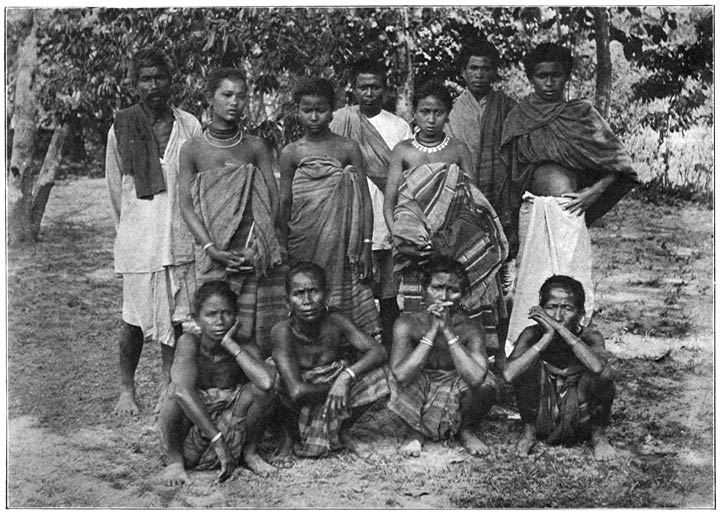
Group of Meches (Goalpara District).
From a Photograph by Mr. T. E. Emerson.
Distribution. III. But however this may be, there would seem to be good reason for believing that the Kachári (Baḍa) race is a much more widely distributed one than it was at one time supposed to be. They are undoubtedly found well outside the limits of modern (political) Assam, i.e., in North-east Bengal Koch-Behar, &c., and also in Hill Tippera, where the language of the people gives decisive evidence that they are of the Baḍa stock. But apart from these outlying members of the race, there are within the limits of Assam itself at least 1,000,000 souls, probably many more, who belong to the Kachári race; though many of the number have of late years become more or less Hinduised, and have lost the use of their mother tongue. These may perhaps be conveniently divided into a (1) Northern and (2) a Southern group, the Brahmaputra being taken roughly as the dividing line, thus:—
Name. Approximate numbers. Chief habitat.
I. Northern Group.
1. Bårå (Kachári) 272,500 Western Darrang, Kachári Duars, and in North Kamrup.
2. Rábhá (Totalá) 31,370 Golpara.
3. Mech (Mes) 93,900 Do.
4. Dhimal (See Bryan Hodgson) North-east Bengal.
5. Koch 10,300 On Northern Frontier from Jalpaiguri to North-west Darrang.
6. Solanimiyas 15–18 families only Only in Mangaldai Subdivision.
7. Mahaliyas Western Darrang. All slightly Hinduised Kacháris.

Phulgariyas
Saraniyas
II. Southern Group.
1. Di-má-sá “big-water-folk” 15,931 North Cachar Hills.
2. Hojáis 2,750 Do. and Nowgong.
3. Lálungs 40,160 South-west Nowgong and adjoining districts.
4. Garos 150,000 On Garo Hills and at foot of same.
5. Haijongs 8,766 On plains adjoining southern slope of the Garo Hills.
6. Hill Tippera (Tripura) people 105,850 Hill Tippera, &c.
To these may be added one or two smaller communities, e.g., the Moráns and the Chutiyás in Upper Assam, whose language, not altogether extinct as yet though apparently dying out rapidly, would seem to prove them to be closely akin to the Kachári (Baḍa) race.
The reign of the last Kachári king, Govind Chandra, was little better than one continuous flight from place to place through the constant attacks of the Burmese, who finally compelled the unhappy monarch to take refuge in the adjoining British district of Sylhet. He was, indeed, reinstated in power by the aid of the East India Company’s troops in 1826, but was murdered some four years later, when his kingdom became part of the British dominions. His commander-in-chief, one Tulá Rám, was allowed to remain in possession of a portion of the subdivision now known as North Cachar, a region shown in old maps of Assam as “Tula Ram Senapati’s country.” But on the death of this chieftain in 1854, this remaining portion of the old Kachári Raj was formally annexed to the district of Nowgong.
As regards this last-mentioned migration, i.e., from Maibong to Kháspur about A.D. 1750, and the conversion to Hinduism which soon followed it, it would seem that the movement was only a very limited and restricted one, confined indeed very largely to the Raja and the members of his court. The great majority of his people remained in the hill country, where to this day they retain their language, religion, customs, &c., to a great extent intact. It is not improbable, indeed, that this statement may hold good of the earlier migrations also, i.e., those that resulted from the prolonged struggle between the Ahoms and the Chutiyás. When as a result of that struggle the defeated race withdrew first to Dimápur and afterwards to Máibong, it is not unlikely that the great body of the Chutiyás (Kacháris) which remained in the rich valley of Assam came to terms with their conquerors (the Ahoms) and gradually became amalgamated with them, much as Saxons, Danes, Normans, &c., slowly but surely became fused into one nationality in the centuries following the battle of Hastings. In this way it may well be that the Kachári race were the original autochthones of Assam, and that even now, though largely Hinduised, they still form a large, perhaps the main, constituent element in the permanent population of the Province. To this day one often comes across villages bearing the name of “Kachárigaon,” the inhabitants of which are completely Hinduised, though for some considerable time they would seem to have retained their Kachári customs, &c., unimpaired. It may be that, whilst the great body of the Chutiyá (Kachári) race submitted to their Ahom conquerors, the stronger and more patriotic spirits among them, influenced perhaps by that intense clannishness which is so marked a feature in the Kachári character, withdrew to less favoured parts of the Province, where their conquerors did not care at once to follow them up; i.e., the Southern section of the race may have made its way into the districts known as the Garo Hills and North Cachar; whilst the Northern section perhaps took up its abode in a broad belt of country at the foot of the Bhutan Hills, still known as the “Kachári Duars,” a region which, being virtually “Terai” land, had in earlier days a very unenviable reputation on the score of its recognised unhealthiness. And if this view of the matter be at all a sound one, what is known to have happened in our own island may perhaps furnish a somewhat interesting “historic parallel.” When about the middle of the fifth century the Romans finally withdrew from Britain, we know that successive swarms of invaders, Jutes, Danes, Saxons, Angles, &c., from the countries adjoining the North and Baltic seas, gradually overran and occupied the richer lowland of what is now England, driving all who remained alive of the aboriginal Britons to take refuge in the less favoured parts of the country, i.e., the mountains of Wales and the highlands of Scotland, where many of the people of this day retain their ancient mother speech: very much as the Kacháris of Assam still cling to their national customs, speech, religion, &c., in those outlying parts of the Province known in modern times as the Garo Hills, North Cachar and the Kachári Duars of North-west Assam.
It is fairly obvious that the Oriental love for the grotesquely marvellous has had no small share in the development of this tradition; but whilst making all due allowance for this, the writer ventures to think that the tradition itself is not altogether without a certain historic value. It probably represents the closing scenes in the protracted struggle for supremacy between the Ahoms and the Chutiyás (Kacháris) when the latter, finally beaten, endeavoured to escape their foes by crossing the Brahmaputra to the South bank, using for that purpose whatever material was at hand, e.g., rude dug-out boats (khel náu), extemporised rafts (bhel), &c. The student of Assam history will remember that a like mishap befell Mir Jumla’s expedition for the conquest of Assam; Rangpur, Ghergaon, &c., when a violent storm or sudden rise in the river carried away or sunk the boats containing his ammunition and other stores, and he was compelled to come to terms with the Ahom rulers. A sudden storm or rapid rise in the river may have prevented many of the fugitives from crossing, and these would perforce have fallen into the hands of the Ahoms. The latter, acting on the principle “Divide et impera,” may have forced their captives to take up their abode in the unhealthy (Terai) country now known as the “Kachári Duárs,” and further may have prohibited any communication between the two severed fragments of the conquered race, which would thenceforth naturally drift further asunder, until the separation became as complete as it remains to this day.
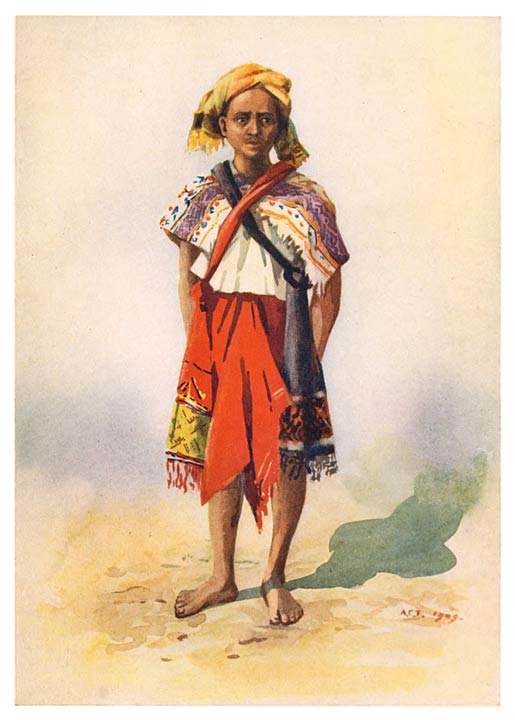
KACHARI MAN