Preface
Reading edition
Irish Fairy Lore has well been called by Mr. Alfred Nutt, one of the leading authorities on the subject, “As fair and bounteous a harvest of myth and romance as ever flourished among any race,” and Dr. Joyce, the well-known Irish scholar and historian, states: “that it is very probable that the belief in the existence of fairies came in with the earliest colonists that entered Ireland, and that this belief is recorded in the oldest of native Irish writings in a way that proves it to have been, at the time treated of, long established and universally received.”
Colgan himself supplies us with the name and derivation of the Irish word for fairy, Sidh (shee), still used throughout the country. “Fantastical spirits,” he writes, “are by the Irish called men of the Sidh, because they are seen, as it were, to come out of the beautiful hills to infest men, and hence the vulgar belief that they reside in certain subterranean habitations; and sometimes the hills themselves are called by the Irish Sidhe or Siodha.”
In Colgan’s time, then, the fairy superstition had passed from the upper classes, gradually disenthralled of it by the influence of Christianity to the common people, among whom it is still rife. But it is clear that in the time of St. Patrick a belief in a world of fairies existed even in the King’s household, for it is recorded that “when the two daughters of King Leary of Ireland, Ethnea the fair and Fedelma the ruddy, came early one morning to the well of Clebach to wash, they found there a synod of holy bishops with Patrick. And they knew not whence they came, or in what form, or from what people, or from what country; but they supposed them to be Duine Sidh, or gods of the earth, or a phantasm.”
As suggested, the belief of the Princesses obtains to this very day amongst the peasantry of remote districts in Ireland, who still maintain that the fairies inhabit the Sidhe, or hills, and record instances of relations and friends being transported into their underground palaces.
The truth is that the Gaelic peasant, Scotch and Irish, is a mystic, and believes not only in this world, and the world to come, but in that other world which is the world of Faery, and which exercises an extraordinary influence upon many actions of his life.
We see in the well-known dialogue between Oisin (Ossian) and St. Patrick, and in other early Irish writers, how potent an influence Druidism, with its powers of concealing and changing, of paralysing and cursing, had been held to be in the days when the Irish worshipped no hideous idols, but adored Beal and Dagdae, the Great or the Good God, and afterwards Aine, the Moon, Goddess of the Water and of Wisdom, and when their minor Deities were Mananan Mac Lir, the Irish Neptune, whose name is still to be found in the Isle of Man; Crom, who corresponded to Ceres; Iphinn, the benevolent, whose relations to the Irish Oirfidh resembled those of Apollo towards Orpheus. The ancient Irish owed allegiance also to the Elements, to the Wind, and to the Stars.
Besides these Pagan Divinities, however, and quite apart from them, the early Irish believed in a hierarchy of fairy beings, closely analagous to us “humans,” supposed to people hill and valley, old road and old earth-mound, lakes and rivers, and there to exercise a constant, if occult, influence upon mankind.
Various theories have been advanced to account for their origin. Some call these fairies angels outcast from heaven for their unworthiness, yet not evil enough for hell, and who, therefore, occupy intermediate space.
Others suggest that they are the spirits of that mysterious early Irish race, the Tuatha da Danann, who were driven by their conquerors, the Milesians, to become “men of the hills,” if not “cave” and “lake dwellers,” in order to avoid the extermination that ultimately awaited them. Their artistic skill and superior knowledge evidenced to this day by remarkable sepulchral mounds, stone-inscribed spiral ornamentation, and beautiful bronze spear-heads, led them to be accounted magicians, and Mr. Yeats and others of his school favour the idea that the minor deities of the early Irish above referred to were the earliest members of the Tuatha da Danann dynasty, and that we here have a form of that ancestor worship now met with amongst the Chinese and Japanese.
Dr. Joyce does not hold, however, that the subjugation of the Tuatha da Dananns, with the subsequent belief regarding them, was the origin of Irish fairy mythology.
“The superstition, no doubt, existed long previously; and this mysterious race, having undergone a gradual deification, became confounded and identified with the original local gods, and ultimately superseded them altogether.”
But whatever their origin, supernatural powers evil and beneficent were supposed to attach to them such as the power of spiriting away young married women to act as fairy nurses, and their infants to replace fairy weaklings, or again the power of conferring wealth, health, and prosperity where a certain ritual due to them had been performed by their human allies.
The injurious powers of malevolently disposed fairies can only be met, according to popular belief, by wizards and wise women, who still exercise their arts in remote districts of Gaelic-speaking Ireland and Scotland.
These fairies are supposed to be life-sized, but there was another class of diminutive preternatural beings who came into close touch with man.
Amongst these were the Luchryman (Leith-phrogan) or brogue (shoe) maker, otherwise known as Lepracaun. He is always found mending or making a shoe, and if grasped firmly and kept constantly in view will disclose hid treasure to you or render up his sporan na sgillinge or purse of the (inexhaustible) shilling. He could only be bound by a plough chain or woollen thread. He is the type of industry which, if steadily faced, leads to fortune, but, if lost sight of, is followed by its forfeiture.
Love in idleness is personified by another pigmy, the Gean-canach (love-talker). He does not appear like the Luchryman, with a purse in one of his pockets but with his hands in both of them and a dudeen (ancient Irish pipe) in his mouth as he lazily strolls through lonely valleys making love to the foolish country lasses and “gostering” with the idle “boys.”
To meet him meant bad luck, and whoever was ruined by ill-judged love was said to have been with the Gean-canach.
Another evil sprite was the Clobher-ceann, “a jolly, red-faced drunken little fellow,” always “found astride on a wine-butt” and drinking and singing from a full tankard in a hard drinker’s cellar, and bound by his appearance to bring its owner to speedy ruin.
Then there were the Leannan-sighe, or native Muses, to be found in every place of note to inspire the local bard, and the Beansighes (Banshees, fairy women) attached to each of the old Irish families and giving warning of the death of one of its members with piteous lamentations.
Black Joanna of the Boyne (Siubhan Dubh na Boinne) appeared on Hallowe’en in the shape of a great black fowl, bringing luck to the house whose Vanithee (woman of the house) kept it constantly clean and neat.
The Pooka, who appeared in the shape of a horse, and whom Shakespeare has adapted as “Puck,” was a goblin who combined “horse-play” with viciousness.
The dullaghan was a churchyard demon whose head was of a movable kind, and Dr. Joyce writes: “You generally meet him with his head in his pocket, under his arm, or absent altogether; or if you have the fortune to light upon a number of dullaghans, you may see them amusing themselves by flinging their heads at one another or kicking them for footballs.”
An even more terrible churchyard demon is the beautiful phantom that waylays the widower at his wife’s very tomb and poisons him by her kiss when he has yielded to her blandishments.
Of monsters the Irish had, and still believe in, the Piast (Latin bestia), a huge dragon or serpent confined to lakes by St. Patrick till the day of judgment, but still occasionally seen in their waters.
In Fenian times the days of Finn and his companion knights, the Piast, however, roamed the country, devouring men and women and cattle in large numbers, and some of the early heroes are recorded to have been swallowed alive by them and then to have hewed their way out of their entrails.
The Merrow, or Mermaid, is also still believed in, and many Folk Tales exist describing their intermarriage with mortals.
According to Nicholas O’Kearney—“It is the general opinion of many old persons versed in native traditional lore, that, before the introduction of Christianity, all animals possessed the faculties of human reason and speech; and old story-tellers will gravely inform you that every beast could speak before the arrival of St. Patrick, but that the Saint having expelled the demons from the land by the sound of his bell, all the animals that, before that time, had possessed the power of foretelling future events, such as the Black Steed of Binn-each-labhra, the Royal Cat of Clough-magh-righ-cat (Clough), and others, became mute; and many of them fled to Egypt and other foreign countries.”
Cats are said to have been appointed to guard hidden treasures; and there are few who have not heard old Irish peasants tell about a strange meeting of cats and a violent battle fought by them in his neighbourhood. “It was believed,” adds O’Kearney, “that an evil spirit in the shape of a cat assumed command over these animals in various districts, and that when those wicked beings pleased they could compel all the cats belonging to their division to attack those of some other district. The same was said of rats; and rat-expellers, when commanding a colony of those troublesome and destructive animals to emigrate to some other place, used to address their ‘billet’ to the infernal rat supposed to hold command over the rest. In a curious pamphlet on the power of bardic compositions to charm and expel rats, lately published, Mr. Eugene Curry states that a degraded priest, who was descended from an ancient family of hereditary bards, was enabled to expel a colony of rats by the force of satire!”
Hence, of course, Shakespeare’s reference to rhyming Irish rats to death.
A few words upon the writers in this collection. Of Folk Tale collectors the palm must be given to Dr. Douglas Hyde, whose great knowledge of Irish, combined with a fine literary faculty, has enabled him to present the stories he has generously granted me the use of, in a manner which combines complete fidelity to his original, with true artistic feeling.
Dr. Joyce has not only granted the use of his fine Heroic Tale of the Pursuit of the Gilla Dacker, but had the honour of supplying Alfred, Lord Tennyson, the late Poet Laureate, with the subject of his “Voyage of Maeldune” in a story of that name, adapted into English in his “Old Celtic Romances.” The Laureate acted on my suggestion that he should found a poem upon one of the romances in that book; and to that circumstance I owe the kind permission by his son and Messrs. Macmillan to republish it at length in this volume.
Besides Dr. Hyde and Dr. Joyce I have been enabled, through the friendly leave of Messrs. Macmillan and Elliot and Stock, to use Mr. Jeremiah Curtin’s and Mr. Larminie’s excellently told Irish Fairy Tales. These two latter Folk Tale collectors have worked upon Dr. Hyde’s plan of taking down their tales from the lips of the peasants, and reproducing them, whether from their Irish or Hiberno-Irish, as clearly as they were able to do so. The recent death of both of these writers is a serious loss to Irish Folk Lore.
Obligations are due to Miss Hull for two hitherto unpublished and fine Folk Tales, to Lady Gregory for the use of her “Birth of Cuchulain,” to Standish James O’Grady for his “Boyish Exploits of Cuchulain and The Coming of Finn,” to the late Mrs. Ewing for “The Hill-man and the House-wife,” to Mrs. William Allingham for the use of two of her husband’s poems, to Mr. D. J. Donoghue for a poem by Mr. Thomas Boyd, and Mr. Chesson for one of his wife’s (Nora Hopper), to Mrs. Shorter (Dora Sigerson) for a poem, and to Mr. Joseph Campbell for another, and finally to Mr. W. B. Yeats for his two charming Fairy Poems, “The Stolen Child” and “Faery Song.”
Alfred Perceval Graves.
Erinfa, Harlech, N. Wales, July 12, 1909.
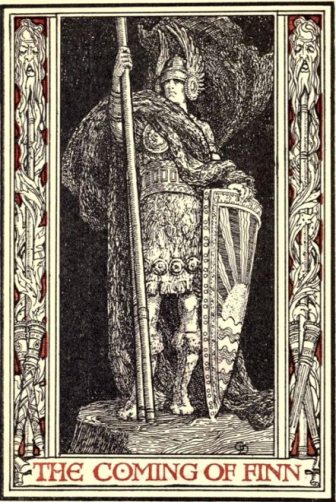
t was the Eve of Samhain, which we Christians call All Hallows’ Eve. The King of Ireland, Conn, the Hundred-Fighter, sat at supper in his palace at Tara. All his chiefs and mighty men were with him. On his right hand was his only son, Art the Solitary, so called because he had no brothers. The sons of Morna, who kept the boy Finn out of his rights and were at the time trying to kill him if they could, were here too. Chief amongst them was Gaul mac Morna, a huge and strong warrior, and Captain of all the Fians ever since that battle in which Finn’s father had been killed.
And Gaul’s men were with him. The great long table was spread for supper. A thousand wax candles shed their light through the chamber, and caused the vessels of gold, silver, and bronze to shine. Yet, though it was a great feast, none of these warriors seemed to care about eating or drinking; every face was sad, and there was little conversation, and no music. It seemed as if they were expecting some calamity. Conn’s sceptre, which was a plain staff of silver, lay beside him on the table, and there was a canopy of bright bronze over his head. Gaul mac Morna, Captain of the Fians, sat at the other end of the long table. Every warrior wore a bright banqueting mantle of silk or satin, scarlet or crimson, blue, green, or purple, fastened on the breast either with a great brooch or with a pin of gold or silver. Yet, though their raiment was bright and gay, and though all the usual instruments of festivity were there, and a thousand tall candles shed their light over the scene, no one looked happy.
hen was heard a low sound like thunder, and the earth seemed to tremble, and after that they distinctly heard a footfall like the slow, deliberate tread of a giant. These footfalls sent a chill into every heart, and every face, gloomy before, was now pale.
The King leaned past his son Art the Solitary, and said to a certain Druid who sat beside Art, “Is this the son of Midna come before his time?” “It is not,” said the Druid, “but it is the man who is to conquer Midna. One is coming to Tara this night before whose glory all other glory shall wax dim.”
Shortly after that they heard the voices of the doorkeepers raised in contention, as if they would repel from the hall someone who wished to enter, then a slight scuffle, and after that a strange figure entered the chamber. He was dressed in the skins of wild beasts, and wore over his shoulders a huge thick cloak of wild boars’ skins, fastened on the breast with a white tusk of the same animal. He wore a shield and two spears. Though of huge stature his face was that of a boy, smooth on the cheeks and lips. It was white and ruddy, and very handsome. His hair was like refined gold. A light seemed to go out from him, before which the candles burned dim. It was Finn.
He stood in the doorway, and cried out in a strong and sonorous, but musical, voice:
Conn the Hundred-Fighter, son of Felimy, the righteous son of Tuthal the legitimate, O King of the Kings of Erin, a wronged and disinherited youth, possessing nowhere one rood of his patrimony, a wanderer and an outlaw, a hunter of the wildernesses and mountains, claims hospitality of thee, illustrious prince, on the eve of the great festival of Samhain.”
“Thou art welcome whoever thou art,” answered the King, “and doubly welcome because thou art unfortunate. I think, such is thy face and form, that thou art the son of some mighty king on whom disaster has fallen undeserved. The high gods of Erin grant thee speedy restoration and strong vengeance of thy many wrongs. Sit here, O noble youth, between me and my only son, Art, heir to my kingdom.”
An attendant took his weapons from the youth and hung them on the wall with the rest, and Finn sat down between the King of Ireland and his only son. Choice food was set before him, which he ate, and old ale, which he drank. From the moment he entered no one thought of anything but of him. When Finn had made an end of eating and drinking, he said to the King:
“O illustrious prince, though it is not right for a guest to even seem to observe aught that may be awry, or not as it should be, in the hall of his entertainer, yet the sorrow of a kindly host is a sorrow, too, to his guest, and sometimes unawares the man of the house finds succour and help in the stranger. There is sorrow in this chamber of festivity. If anyone who is dear to thee and thy people happens to be dead, I can do nothing. But I say it, and it is not a vain boast, that even if a person is at the point of death, I can restore him to life and health, for there are marvellous powers of life-giving in my two hands.”
onn the Hundred-Fighter answered, “Our grief is not such as you suppose; and why should I not tell a cause of shame, which is known far and wide? This, then, is the reason of our being together, and the gloom which is over us. There is a mighty enchanter whose dwelling is in the haunted mountains of Slieve Gullion in the north. His name is Allen, son of Midna, and his enmity to me is as great as his power. Once every year, at this season, it is his pleasure to burn Tara. Descending out of his wizard haunts, he standeth over against the city and shoots balls of fire out of his mouth against it, till it is consumed. Then he goes away mocking and triumphant. This annual building of Tara, only to be annually consumed, is a shame to me, and till this enchanter declared war against me, I have lived without reproach.”
“But,” said Finn, “how is it that thy young warriors, valiant and swift, do not repel him, or kill him?”
“Alas!” said Conn, “all our valour is in vain against this man. Our hosts encompass Tara on all sides, keeping watch and ward when the fatal night comes. Then the son of Midna plays on his Druidic instrument of music, on his magic pipe and his magic lyre, and as the fairy music falls on our ears, our eyelids grow heavy, and soon all subside upon the grass in deep slumber. So comes this man against the city and shoots his fire-balls against it, and utterly consumes it. Nine years he has burnt Tara in that manner, and this is the tenth. At midnight to-night he will come and do the same. Last year (though it was a shame to me that I, who am the high King over all Ireland, should not be able myself to defend Tara) I summoned Gaul mac Morna and all the Fians to my assistance. They came, but the pipe and lyre of the son of Midna prevailed over them too, so that Tara was burned as at other times. Nor have we any reason to believe that the son of Midna will not burn the city again to-night, as he did last year. All the women and children have been sent out of Tara this day. We are only men of war here, waiting for the time. That, O noble youth, is why we are sad. The ‘Pillars of Tara’ are broken, and the might of the Fians is as nought before the power of this man.”
“What shall be my reward if I kill this man and save Tara?” asked Finn.
“Thy inheritance,” answered the King, “be it great or small, and whether it lies in Ireland or beyond Ireland; and for securities I give you my son Art and Gaul mac Morna and the Chief of the Fians.”
Gaul and the captains of the Fianna consented to that arrangement, though reluctantly, for their minds misgave them as to who the great youth might be.
After that all arose and armed themselves and ringed Tara round with horse and foot, and thrice Conn the Hundred-Fighter raised his awful regal voice, enjoining vigilance upon his people, and thrice Gaul mac Morna did the same, addressing the Fians, and after that they filled their ears with wax and wool, and kept a stern and fierce watch, and many of them thrust the points of their swords into their flesh.
ow Finn was alone in the banqueting chamber after the rest had gone out, and he washed his face and his hands in pure water, and he took from the bag that was at his girdle the instruments of divination and magic, which had been his father’s, and what use he made of them is not known; but ere long a man stood before him, holding a spear in one hand and a blue mantle in the other. There were twenty nails of gold of Arabia in the spear. The nails glittered like stars, and twinkled with live light as stars do in a frosty night, and the blade of it quivered like a tongue of white fire. From haft to blade-point that spear was alive. There were voices in it too, and the war-tunes of the enchanted races of Erin, whom they called the Tuatha De Danan, sounded from it. The mantle, too, was a wonder, for innumerable stars twinkled in the blue, and the likeness of clouds passed through it. The man gave these things to Finn, and when he had instructed him in their use, he was not seen.
Then Finn arose and armed himself, and took the magic spear and mantle and went out. There was a ring of flame round Tara that night, for the Fians and the warriors of Conn had torches in their hands, and all the royal buildings of Tara showed clear in the light, and also the dark serpentine course of the Boyne, which flowed past Tara on the north; and there, standing silent and alert, were the innumerable warriors of all Erin, with spear and shield, keeping watch and ward against the son of Midna, also the Four Pillars of Tara in four dense divisions around the high King, even Conn the Hundred-Fighter.
Finn stood with his back to the palace, which was called the House-of-the-going-round-of-Mead, between the palace and Conn, and he grasped the magic spear strongly with one hand and the mantle with the other.
s midnight drew nigh, he heard far away in the north, out of the mountains of Slieve Gullion, a fairy tune played, soft, low, and slow, as if on a silver flute; and at the same time the roar of Conn the Hundred-Fighter, and the voice of Gaul like thunder, and the responsive shouts of the captains, and the clamour of the host, for the host shouted all together, and clashed their swords against their shields in fierce defiance, when in spite of all obstructions the fairy music of the enchanter began to steal into their souls. That shout was heard all over Ireland, echoing from sea to sea, and the hollow buildings of Tara reverberated to the uproar. Yet through it all could be heard the low, slow, delicious music that came from Slieve Gullion. Finn put the point of the spear to his forehead. It burned him like fire, yet his stout heart did not fail. Then the roar of the host slowly faded away as in a dream, though the captains were still shouting, and two-thirds of the torches fell to the ground. And now, succeeding the flute music, sounded the music of a stringed instrument exceedingly sweet. Finn pressed the cruel spear-head closer to his forehead, and saw every torch fall, save one which wavered as if held by a drunken man, and beneath it a giant figure that reeled and tottered and strove in vain to keep its feet. It was Conn the Hundred-Fighter. As he fell there was a roar as of many waters; it was the ocean mourning for the high King’s fall. Finn passed through the fallen men and stood alone on the dark hill-side. He heard the feet of the enchanter splashing through the Boyne, and saw his huge form ascending the slopes of Tara. When the enchanter saw that all was silent and dark there he laughed and from his mouth blew a red fire-ball at the Teck-Midcuarta, which he was accustomed first to set in flames. Finn caught the fire-ball in the magic mantle. The enchanter blew a second and a third, and Finn caught them both. The man saw that his power over Tara was at an end, and that his magic arts had been defeated. On the third occasion he saw Finn’s face, and recognised his conqueror. He turned to flee, and though slow was his coming, swifter than the wind was his going, that he might recover the protection of his enchanted palace before the “fair-faced youth clad in skins” should overtake him. Finn let fall the mantle as he had been instructed, and pursued him, but in vain. Soon he perceived that he could not possibly overtake the swift enchanter. Then he was aware that the magic spear struggled in his hand like a hound in a leash. “Go, then, if thou wilt,” he said, and, poising, cast the spear from him. It shot through the dark night hissing and screaming. There was a track of fire behind it. Finn followed, and on the threshold of the enchanted palace he found the body of Midna. He was quite dead, with the blood pouring through a wound in the middle of his back; but the spear was gone. Finn drew his sword and cut off the enchanter’s head, and returned with it to Tara. When he came to the spot where he had dropped the mantle it was not seen, but smoke and flame issued there from a hole in the ground. That hole was twenty feet deep in the earth, and at the bottom of it there was a fire always from that night, and it was never extinguished. It was called the fire of the son of Midna. It was in a depression on the north side of the hill of Tara, called the Glen of the Mantle, Glen-a-Brat.
inn, bearing the head, passed through the sleepers into the palace and spiked the head on his own spear, and drove the spear-end into the ground at Conn’s end of the great hall. Then the sickness and faintness of death came upon Finn, also a great horror and despair overshadowed him, so that he was about to give himself up for utterly lost. Yet he recalled one of his marvellous attributes, and approaching a silver vessel, into which pure water ever flowed and which was always full, he made a cup with his two hands and, lifting it to his mouth, drank, and the blood began to circulate in his veins, and strength returned to his limbs, and the cheerful hue of rosy health to his cheeks.
Having rested himself sufficiently he went forth and shouted to the sleeping host, and called the captains by their names, beginning with Conn. They awoke and rose up, though dazed and stupid, for it was difficult for any man, no matter how he had stopped his ears, to avoid hearing Finn when he sent forth his voice of power. They were astonished to find that Tara was still standing, for though the night was dark, the palaces and temples, all of hewn timber, were brilliantly coloured and of many hues, for in those days men delighted in splendid colours.
When the captains came together Finn said, “I have slain Midna.” “Where is his head?” they asked, not because they disbelieved him, but because the heads of men slain in battle were always brought away for trophies. “Come and see,” answered Finn. Conn and his only son and Gaul mac Morna followed the young hero into the Teck-Midcuarta, where the spear-long waxen candles were still burning, and when they saw the head of Midna impaled there at the end of the hall, the head of the man whom they believed to be immortal and not to be wounded or conquered, they were filled with great joy, and praised their deliverer and paid him many compliments.
ho art thou, O brave youth?” said Conn. “Surely thou art the son of some great king or champion, for heroic feats like thine are not performed by the sons of inconsiderable and unknown men.”
Then Finn flung back his cloak of wild boars’ skins, and holding his father’s treasure-bag in his hand before them all, cried in a loud voice:
“I am Finn, the son of Cool, the son of Trenmor, the son of Basna; I am he whom the sons of Morna have been seeking to destroy from the time that I was born; and here to-night, O King of the Kings of Erin, I claim the fulfilment of thy promise, and the restoration of my inheritance, which is the Fian leadership of Fail.” Thereupon Gaul mac Morna put his right hand into Finn’s, and became his man. Then his brothers and his sons, and the sons of his brothers, did so in succession, and after that all the chief men of the Fians did the same, and that night Finn was solemnly and surely installed in the Fian leadership of Erin, and put in possession of all the woods and forests and waste places, and all the hills and mountains and promontories, and all the streams and rivers of Erin, and the harbours and estuaries and the harbour-dues of the merchants, and all ships and boats and galleys with their mariners, and all that pertained of old time to the Fian leadership of Fail.
Standish James O’Grady.
(Told in the Wexford Peasant Dialect.)
here was once a king, some place or other, and he had three daughters. The two eldest were very proud and uncharitable, but the youngest was as good as they were bad. Well, three princes came to court them, and two of them were the moral of the two eldest ladies, and one was just as lovable as the youngest. They were all walking down to a lake one day that lay at the bottom of the lawn, just like the one at Castleboro’, and they met a poor beggar. The King wouldn’t give him anything, and the eldest princes wouldn’t give him anything, nor their sweethearts; but the youngest daughter and her true love did give him something, and kind words along with it, and that was better nor all.
When they got to the edge of the lake, what did they find but the beautifulest boat you ever saw in your life; and says the eldest, “I’ll take a sail in this fine boat;” and says the second eldest, “I’ll take a sail in this fine boat;” and says the youngest, “I won’t take a sail in that fine boat, for I’m afraid it’s an enchanted one.” But the others overpersuaded her to go in, and her father was just going in after her, when up sprung on the deck a little man only seven inches high, and he ordered him to stand back. Well, all the men put their hands to their soords; and if the same soords were only thraneens they weren’t able to draw them, for all sthrenth was left their arms. Seven Inches loosened the silver chain that fastened the boat and pushed away; and after grinning at the four men, says he to them: “Bid your daughters and your brides farewell for awhile. That wouldn’t have happened you three, only for your want of charity. You,” says he to the youngest, “needn’t fear; you’ll recover your princess all in good time, and you and she will be as happy as the day is long. Bad people, if they were rolling stark naked in gold, would not be rich. Banacht lath!” Away they sailed, and the ladies stretched out their hands, but weren’t able to say a word.
ell, they were crossin’ the lake while a cat’d be lickin’ her ear, and the poor men couldn’t stir hand nor foot to follow them. They saw Seven Inches handing the three princesses out of the boat, and letting them down by a nice basket and winglas into a draw-well that was convenient, but king nor princes never saw an opening before in the same place. When the last lady was out of sight the men found the strength in their arms and legs again. Round the lake they ran, and never drew rein till they came to the well and windlass, and there was the silk rope rolled on the axle, and the nice white basket hanging to it. “Let me down,” says the youngest prince; “I’ll die or recover them again.” “No,” says the second daughter’s sweetheart, “I’m entitled to my turn before you.” “And,” says the other, “I must get first turn, in right of my bride.” So they gave way to him, and in he got into the basket, and down they let him. First they lost sight of him, and then, after winding off a hundred perches of the silk rope, it slackened, and they stopped turning. They waited two hours, and then they went to dinner, because there was no chuck made at the rope.

uards were set till morning, and then down went the second prince, and, sure enough, the youngest of all got himself let down on the third day. He went down perches and perches, while it was as dark about him as if he was in a big pot with the cover on. At last he saw a glimmer far down, and in a short time he felt the ground. Out he came from the big lime-kiln, and lo and behold you, there was a wood and green fields, and a castle in a lawn, and a bright sky over all. “It’s in Tir-na-n Oge I am,” says he. “Let’s see what sort of people are in the castle.” On he walked across fields and lawn, and no one was there to keep him out or let him into the castle; but the big hall door was wide open. He went from one fine room to another that was finer, and at last he reached the handsomest of all, with a table in the middle; and such a dinner as was laid upon it! The prince was hungry enough, but he was too mannerly to go eat without being invited. So he sat by the fire, and he did not wait long till he heard steps, and in came Seven Inches and the youngest sister by the hand. Well, prince and princess flew into one another’s arms, and says the little man, says he, “Why aren’t you eating?” “I think, sir,” says he, “it was only good manners to wait to be asked.” “The other princes didn’t think so,” says he. “Each of them fell to without leave nor license, and only gave me the rough side o’ his tongue when I told them they were making more free than welcome. Well, I don’t think they feel much hunger now. There they are, good marvel instead of flesh and blood,” says he, pointing to two statues, one in one corner and the other in the other corner of the room. The prince was frightened, but he was afraid to say anything, and Seven Inches made him sit down to dinner between himself and his bride, and he’d be as happy as the day is long, only for the sight of the stone men in the corner. Well, that day went by, and when the next came, says Seven Inches to him, “Now, you’ll have to set out that way,” pointing to the sun, “and you’ll find the second princess in a giant’s castle this evening, when you’ll be tired and hungry, and the eldest princess to-morrow evening; and you may as well bring them here with you. You need not ask leave of their masters; they’re only housekeepers with the big fellows. I suppose, if they ever get home, they’ll look on poor people as if they were flesh and blood like themselves.”
Away went the prince, and bedad it’s tired and hungry he was when he reached the first castle at sunset. Oh, wasn’t the second princess glad to see him! And if she didn’t give him a good supper it’s a wonder. But she heard the giant at the gate, and she hid the prince in a closet. Well, when he came in, he snuffed, and he snuffed, an’ says he, “Be (by) the life, I smell fresh mate.” “Oh,” says the princess, “it’s only the calf I got killed to-day.” “Ay, ay,” says he, “is supper ready?” “It is,” says she; and before he ruz from the table he hid three-quarters of the calf and a kag of wine. “I think,” says he, when all was done, “I smell fresh mate still.” “It’s sleepy you are,” says she; “go to bed.” “When will you marry me?” says the giant; “you’re puttin’ me off too long.” “St. Tibb’s Eve,” says she. “I wish I knew how far off that is,” says he; and he fell asleep with his head in the dish.
ext day he went out after breakfast, and she sent the prince to the castle where the eldest sister was. The same thing happened there; but when the giant was snoring, the princess wakened up the prince, and they saddled two steeds in the stables, and magh go bragh (the field for ever) with them. But the horses’ heels struck the stones outside the gate, and up got the giant, and after them he made. He roared, and he shouted, and the more he shouted the faster ran the horses; and just as the day was breaking he was only twenty perches behind. But the prince didn’t leave the Castle of Seven Inches without being provided with something good. He reined in his steed, and flung a short, sharp knife over his shoulder, and up sprung a thick wood between the giant and themselves. They caught the wind that blew before them, and the wind that blew behind them did not catch them. At last they were near the castle where the other sister lived; and there she was, waiting for them under a high hedge, and a fine steed under her.
But the giant was now in sight, roaring like a hundred lions, and the other giant was out in a moment, and the chase kept on. For every two springs the horses gave the giants gave three, and at last they were only seventy perches off. Then the prince stopped again and flung the second skian behind him. Down went all the flat field, till there was a quarry between them a quarter of a mile deep, and the bottom filled with black water; and before the giants could get round it the prince and princesses were inside the domain of the great magician, where the high thorny hedge opened of itself to everyone that he chose to let in.
Well, to be sure, there was joy enough between the three sisters till the two eldest saw their lovers turned into stone. But while they were shedding tears for them Seven Inches came in and touched them with his rod. So they were flesh and blood and life once more, and there was great hugging and kissing, and all sat down to a nice breakfast, and Seven Inches sat at the head of the table.
When breakfast was over he took them into another room, where there was nothing but heaps of gold and silver and diamonds, and silks and satins; and on a table there was lying three sets of crowns: a gold crown was in a silver crown, and that was lying in a copper crown. He took up one set of crowns and gave it to the eldest princess; and another set, and gave it to the second princess; and another set, and gave it to the youngest princess of all; and says he, “Now you may all go to the bottom of the pit, and you have nothing to do but stir the basket, and the people that are watching above will draw you up, princesses first, princes after. But remember, ladies, you are to keep your crowns safe, and be married in them all the same day. If you be married separately, or if you be married without your crowns, a curse will follow—mind what I say.”
So they took leave of him with great respect, and walked arm-in-arm to the bottom of the draw-well. There was a sky and a sun over them and a great high wall, and the bottom of the draw-well was inside the arch. The youngest pair went last, and says the princess to the prince, “I’m sure the two princes don’t mean any good to you. Keep these crowns under your cloak, and if you are obliged to stay last, don’t get into the basket, but put a big stone, or any heavy thing, inside, and see what will happen.”
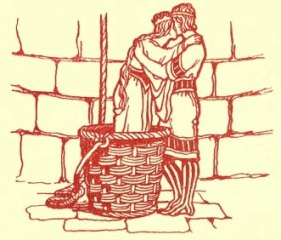
o when they were inside the dark cave they put in the eldest princess first, and she stirred the basket and up she went, but first she gave a little scream. Then the basket was let down again, and up went the second princess, and then up went the youngest; but first she put her arms round her prince’s neck and kissed him, and cried a little. At last it came to the turn of the youngest prince, and well became him—instead of going into the basket he put in a big stone. He drew on one side and listened, and after the basket was drawn up about twenty perch down came itself and the stone like thunder, and the stone was made brishe of on the flags.
Well, my poor prince had nothing for it but to walk back to the castle; and through it and round it he walked, and the finest of eating and drinking he got, and a bed of bog-down to sleep on, and fine walks he took through gardens and lawns, but not a sight could he get, high or low, of Seven Inches. Well, I don’t think any of us would be tired of this way of living for ever! Maybe we would. Anyhow, the prince got tired of it before a week, he was so lonesome for his true love; and at the end of a month he didn’t know what to do with himself.
One morning he went into the treasure room and took notice of a beautiful snuff-box on the table that he didn’t remember seeing there before. He took it in his hands and opened it, and out Seven Inches walked on the table. “I think, prince,” says he, “you’re getting a little tired of my castle?” “Ah!” says the other, “if I had my princess here, and could see you now and then, I’d never see a dismal day.” “Well, you’re long enough here now, and you’re wanting there above. Keep your bride’s crowns safe, and whenever you want my help open this snuff-box. Now take a walk down the garden, and come back when you’re tired.”
ell, the prince was going down a gravel walk with a quick-set hedge on each side and his eyes on the ground, and he thinking on one thing and another. At last he lifted his eyes, and there he was outside of a smith’s bawn gate that he had often passed before, about a mile away from the palace of his betrothed princess. The clothes he had on him were as ragged as you please, but he had his crowns safe under his old cloak.
So the smith came out, and says he, “It’s a shame for a strong big fellow like you to be on the sthra, and so much work to be done. Are you any good with hammer and tongs? Come in and bear a hand, and I’ll give you diet and lodging and a few thirteens when you earn them.” “Never say’t twice,” says the prince; “I want nothing but to be employed.” So he took the sledge and pounded away at the red-hot bar that the smith was turning on the anvil to make into a set of horse-shoes.
Well, they weren’t long powdhering away, when a stronshuch (idler) of a tailor came in; and when the smith asked him what news he had, he got the handle of the bellows and began to blow to let out all he had heard for the last two days. There were so many questions and answers at first that, if I told them all, it would be bed-time before I’d be done. So here is the substance of the discourse; and before he got far into it the forge was half filled with women knitting stockings and men smoking.
ous all heard how the two princesses were unwilling to be married till the youngest would be ready with her crowns and her sweetheart. But after the windlass loosened accidentally when they were pulling up her bridegroom that was to be, there was no more sign of a well or a rope or a windlass than there is on the palm of your hand. So the buckeens that were coortin’ the eldest ladies wouldn’t give peace nor ease to their lovers nor the King till they got consent to the marriage, and it was to take place this morning. Myself went down out of curiosity; and to be sure I was delighted with the grand dresses of the two brides and the three crowns on their heads—gold, silver, and copper—one inside the other. The youngest was standing by, mournful enough, in white, and all was ready. The two bridegrooms came walking in as proud and grand as you please, and up they were walking to the altar rails when, my dear, the boards opened two yards wide under their feet, and down they went among the dead men and the coffins in the vaults. Oh, such screeching as the ladies gave! and such running and racing and peeping down as there was; but the clerk soon opened the door of the vault, and up came the two heroes, and their fine clothes covered an inch thick with cobwebs and mould.
So the King said they should put off the marriage, “For,” says he, “I see there is no use in thinking of it till my youngest gets her three crowns and is married along with the others. I’ll give my youngest daughter for a wife to whoever brings three crowns to me like the others; and if he doesn’t care to be married, some other one will, and I’ll make his fortune.” “I wish,” says the smith, “I could do it; but I was looking at the crowns after the princesses got home, and I don’t think there’s a black or a white smith on the face of the earth could imitate them.” “Faint heart never won fair lady,” says the prince. “Go to the palace, and ask for a quarter of a pound of gold, a quarter of a pound of silver, and a quarter of a pound of copper. Get one crown for a pattern, and my head for a pledge, and I’ll give you out the very things that are wanted in the morning.” “Ubbabow,” says the smith, “are you in earnest?” “Faith, I am so,” says he. “Go! Worse than lose you can’t.”
o make a long story short, the smith got the quarter of a pound of gold, and the quarter of a pound of silver, and the quarter of a pound of copper, and gave them and the pattern crown to the prince. He shut the forge door at nightfall, and the neighbours all gathered in the bawn, and they heard him hammering, hammering, hammering, from that to daybreak, and every now and then he’d pitch out through the window bits of gold, silver, or copper; and the idlers scrambled for them, and cursed one another, and prayed for the good luck of the workman.
Well, just as the sun was thinking to rise he opened the door and brought the three crowns he got from his true love, and such shouting and huzzaing as there was! The smith asked him to go along with him to the palace, but he refused; so off set the smith, and the whole townland with him; and wasn’t the King rejoiced when he saw the crowns! “Well,” says he to the smith, “you’re a married man, and what’s to be done?” “Faith, your majesty, I didn’t make them crowns at all; it was a big shuler (vagrant) of a fellow that took employment with me yesterday.” “Well, daughter, will you marry the fellow that made these crowns?” “Let me see them first, father.” So when she examined them she knew them right well, and guessed it was her true love that had sent them. “I will marry the man that these crowns came from,” says she.
ell,” said the King to the eldest of the two princes, “go up to the smith’s forge, take my best coach, and bring home the bridegroom.” He was very unwilling to do this, he was so proud, but he did not wish to refuse. When he came to the forge he saw the prince standing at the door, and beckoned him over to the coach. “Are you the fellow,” says he, “that made them crowns?” “Yes,” says the other. “Then,” says he, “maybe you’d give yourself a brushing, and get into that coach; the King wants to see you. I pity the princess.” The young prince got into the carriage, and while they were on the way he opened the snuff-box, and out walked Seven Inches, and stood on his thigh. “Well,” says he, “what trouble is on you now?” “Master,” says the other, “please to let me back in my forge, and let this carriage be filled with paving-stones.” No sooner said than done. The prince was sitting in his forge, and the horses wondered what was after happening to the carriage.
When they came to the palace yard the King himself opened the carriage door to pay respect to the new son-in-law. As soon as he turned the handle a shower of stones fell on his powdered wig and his silk coat, and down he fell under them. There was great fright, and some tittering, and the King, after he wiped the blood from his forehead, looked very cross at the eldest prince. “My liege,” says he, “I’m very sorry for this accidence, but I’m not to blame. I saw the young smith get into the carriage, and we never stopped a minute since.” “It’s uncivil you were to him. Go,” says he to the other prince, “and bring the young prince here, and be polite.” “Never fear,” says he.
ut there’s some people that couldn’t be good-natured if they were to be made heirs of Damer’s estate. Not a bit civiller was the new messenger than the old, and when the King opened the carriage door a second time it’s a shower of mud that came down on him; and if he didn’t fume and splutter and shake himself it’s no matter. “There’s no use,” says he, “going on this way. The fox never got a better messenger than himself.”
So he changed his clothes and washed himself, and out he set to the smith’s forge. Maybe he wasn’t polite to the young prince, and asked him to sit along with himself. The prince begged to be allowed to sit in the other carriage, and when they were half-way he opened his snuff-box. “Master,” says he, “I’d wished to be dressed now according to my rank.” “You shall be that,” says Seven Inches. “And now I’ll bid you farewell. Continue as good and kind as you always were; love your wife, and that’s all the advice I’ll give you.” So Seven Inches vanished; and when the carriage door was opened in the yard, out walks the prince, as fine as hands and pins could make him, and the first thing he did was to run over to his bride and embrace her very heartily.
Everyone had great joy but the two other princes. There was not much delay about the marriages that were all celebrated on the same day, and the youngest prince and princess were the happiest married couple you ever heard of in a story.
Patrick Kennedy.
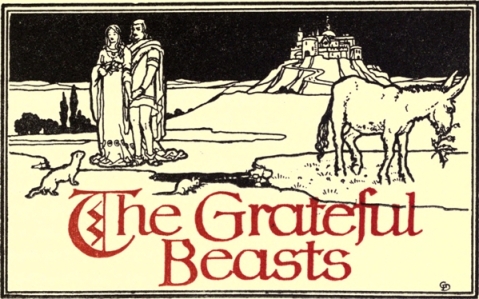
here was once a young man on his way to a fair with five shillings in his pocket. As he went he saw some little boys beating a poor mouse they had just caught.
“Come, boys,” says he, “do not be so cruel. Sell me your mouse for sixpence, and go off and buy some sweets.”
They gave him the mouse, and he let the poor little beast go. He had not gone far when he met a fresh set of boys teasing the life out of a poor weasel.
Well, he bought him off for a shilling and let him go. The third creature he saved, from a crowd of cruel young men, was an ass, but he had to give a whole half-crown to get him off. “Now,” says poor Neddy, “you may as well take me with you. I’ll be of some use, I think, for when you are tired you can get up on my back.” “With all my heart,” said Jack, for that was the young man’s name.
The day was very hot, and the boy sat under a tree to enjoy the shade. As soon as he did he fell asleep, but he was soon awakened by a wicked-looking giant and his two servants. “How dare you let your ass trespass in my field,” cried he, “and do such mischief.” “I had no notion that he had done anything of the kind.” “No notion? I’ll notion you, then. Bring out that chest,” said he to one of his servants, and before you could wink they had tied the poor boy, hand and foot, with a stout rope, thrown him into the chest, and tossed the chest into the river. Then they all went away but poor Neddy, till who should come up but the weasel and the mouse, and they asked him what was the matter. So the ass told them his story.
h,” said the weasel, “he must be the same boy that saved the mouse and myself. Had he a brown patch in the arm of his coat?” “The very same.” “Come, then,” said the weasel, “and let us try and get him out of the river.” “By all means,” said the others. So the weasel got on the ass’s back and the mouse got into his ear, and away they went. They had not gone far when they saw the chest, which had been stopped among the rushes at the end of a little island.
In they went, and the weasel and the mouse gnawed the rope till they had set their master free.
Well, they were all very glad, and were having a great talk about the giant and his men, when what should the weasel spy but an egg, with the most lovely colours on the shell, lying down in the shallow water. It was not long before he had fished it out, and Jack kept turning it round and round and praising it.
“Oh, my dear friends,” said he to the ass, the mouse, and the weasel, “how I wish it was in my power to thank you as I should like. How I wish I had a fine house and grounds to take you to where you could live in peace and plenty.”
The words were hardly out of his mouth when he and the beasts found themselves standing on the steps of a grand castle, with the finest lawn before it that you ever saw. There was no one inside or outside it to keep it from them, so in they went, and there they lived as happy as kings.
Jack was standing at his gate one day as three merchants were passing by with their goods packed on the backs of horses and mules.
“Bless our eyes,” cried they, “what does this mean? There was no castle or lawn here when we went by last time.”
“That is true,” cried Jack, “but you shall not be the worse for it. Take your beasts into the yard at the back of the house and give them a good feed, and if you can spare the time stay and take a bit of dinner with me.”
hey were only too glad to do so; but after dinner Jack was so foolish as to show them his painted egg, and to tell them that you had only to wish for a thing when you had it in your hand and your wish was granted. He proved it to be so. Then one of his guests put a powder into Jack’s next glass of wine, and when he awoke he found himself in the island again, with his patched coat on him, and his three friends in front of him, all looking very downhearted. “Ah, Master,” said the weasel, “you will never be wise enough for the tricky people that are in the world.”
“Where did these thieves say they lived, and what names did they say they were called by?” Jack scratched his head, and after a while was able to tell them.
“Come, Neddy,” says the weasel, “let us be jogging. It would not be safe for the master to go with us; but if we have luck we will bring him the egg back after all.”
So the weasel got on the ass’s back and the mouse got into his ear, and away they went till they reached the house of the head rogue. The mouse went in, and the ass and the weasel hid themselves in a copse outside.
he mouse soon came back to them.
“Well, what news?” said they.
“Dull news enough; he has the egg in a low chest in his bedroom, and the door is strongly locked and bolted, and a pair of cats with fiery eyes are chained to the chest watching it night and day.”
“Let us go back,” said the ass; “we can do nothing.” “Wait!” said the weasel.
When bedtime came, said the weasel to the mouse: “Go in at the keyhole and get behind the rogue’s head, and stay there two or three hours sucking his hair.”
“What good would there be in that?” asked the ass. “Wait, and you’ll know!” said the weasel.
Next morning the merchant was quite mad to find the state his hair was in.
“But I’ll be a match for you to-night, my fine mouse,” said he. So he unchained the cats next night and made them sit by his bedside and watch.
Just as he was dropping asleep the weasel and the mouse were outside the door, and gnawing away till they had scooped out a hole in the bottom of it. In went the mouse, and it was not long before he had the egg quite safe.
They were soon on the road again; the mouse in the ass’s ear, the weasel on his back, and the egg in the weasel’s mouth.
When they came to the river, and were swimming across, the ass began to bray. “Hee-haw, hee-haw,” cried he. “Is there anyone like me in all the world? I am carrying the mouse and the weasel and the great enchanted egg that can do anything. Why do you not praise me?”
ut the mouse was asleep, and the weasel dared not open his mouth for fear of dropping the egg. “I’ll shake you all off, you thankless pack, if you won’t praise me,” cried the ass, and the poor weasel forgot the egg, and cried out: “Oh, don’t, don’t!” when down went the egg into the deepest pool in the river. “Now you have done it,” said the weasel, and you may be sure the ass looked very foolish.
“Oh, what are we to do?” groaned he. “Keep a good heart,” said the weasel. Then looking down into the deep water, he cried: “Hear! all you frogs and fish. There is a great army of storks and cranes coming to take you all out and eat you up red-raw. Make haste! Make haste!” “Oh, and what can we do?” cried they, coming up to the top. “Gather up the stones from below and hand them to us, and we’ll build a big wall on the bank to defend you.” So the fish and frogs fell to work like mad, and were at it hard and fast, reaching up all the stones and pebbles they found at the bottom of the pool.
At last a big frog came up with the egg in his mouth, and when the weasel had hold of it he climbed into a tree and cried out, “That will do; the army has got a great fright at our walls, and they are all running away.” So the poor things were greatly relieved.
You may be sure that Jack jumped for joy to see his friends and the egg again. They were soon back in their castle, and when Jack began to feel lonely he did not find it hard to find a pretty lady to marry him, and then they two and the three grateful beasts were as happy as the days were long.
Patrick Kennedy.
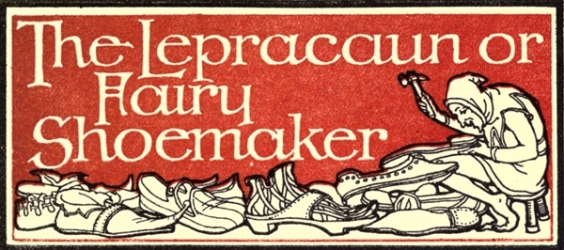
I. ittle Cowboy, what have you heard, Up on the lonely rath’s green mound? Only the plaintive yellow bird Sighing in sultry fields around, Chary, chary, chary, chee-ee!— Only the grasshopper and the bee?— “Tip-tap, rip-rap, Tick-a-tack-too! Scarlet leather, sewn together, This will make a shoe. Left, right, pull it tight; Summer days are warm; Underground in winter, Laughing at the storm!” Lay your ear close to the hill. Do you not catch the tiny clamour, Busy click of an elfin hammer, Voice of the Lepracaun singing shrill As he merrily plies his trade? He’s a span And a quarter in height. Get him in sight, hold him tight, And you’re a made Man! II. You watch your cattle the summer day, Sup on potatoes, sleep in the hay; How would you like to roll in your carriage, Look for a Duchess’s daughter in marriage? Seize the Shoemaker—then you may! “Big boots a-hunting, Sandals in the hall, White for a wedding-feast, Pink for a ball. This way, that way, So we make a shoe; Getting rich every stitch, Tick-tack-too!” Nine-and-ninety treasure-crocks This keen miser-fairy hath, Hid in mountains, woods, and rocks, Ruin and round-tow’r, cave and rath, And where the cormorants build; From times of old Guarded by him; Each of them fill’d Full to the brim With gold! III. I caught him at work one day, myself, In the castle-ditch, where foxglove grows— A wrinkled, wizen’d, and bearded Elf, Spectacles stuck on his pointed nose, Silver buckles to his hose, Leather apron—shoe in his lap— “Rip-rap, tip-tap, Tick-tack-too! (A grasshopper on my cap! Away the moth flew!) Buskins for a fairy prince, Brogues for his son— Pay me well, pay me well, When the job is done!” The rogue was mine, beyond a doubt. I stared at him; he stared at me; “Servant, Sir!” “Humph!” says he, And pulled a snuff-box out. He took a long pinch, look’d better pleased, The queer little Lepracaun; Offer’d the box with a whimsical grace— Pouf! he flung the dust in my face, And, while I sneezed, Was gone! William Allingham.
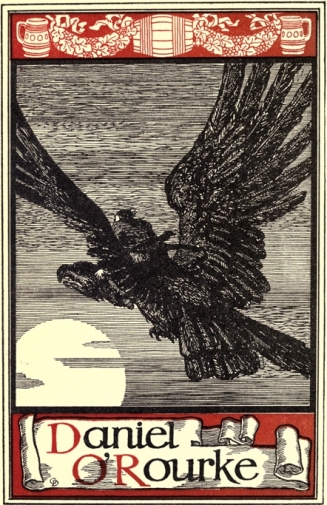

eople may have heard of the renowned adventures of Daniel O’Rourke, but how few are there who know that the cause of all his perils, above and below, was neither more nor less than his having slept under the walls of the Pooka’s Tower. I knew the man well. He lived at the bottom of Hungry Hill, just at the right-hand side of the road as you go towards Bantry. An old man was he at the time he told me the story, with grey hair and a red nose; and it was on the 25th of June, 1813, that I heard it from his own lips, as he sat smoking his pipe under the old poplar tree, on as fine an evening as ever shone from the sky. I was going to visit the caves in Dursey Island, having spent the morning at Glengariff. “I am often axed to tell it, sir,” said he, “so that this is not the first time. The master’s son, you see, had come from beyond foreign parts in France and Spain, as young gentlemen used to go before Buonaparte or any such was heard of; and, sure enough, there was a dinner given to all the people on the ground, gentle and simple, high and low, rich and poor. The ould gentlemen were the gentlemen, after all, saving your honour’s presence. They’d swear at a body a little, to be sure, and, maybe, give one a cut of a whip now and then, but we were no losers by it in the end; and they were so easy and civil, and kept such rattling houses, and thousands of welcomes; and there was no grinding for rent, and there was hardly a tenant on the estate that did not taste of his landlord’s bounty often and often in a year; but now it’s another thing. No matter for that, sir, for I’d better be telling you my story.
ell, we had everything of the best, and plenty of it; and we ate, and we drank, and we danced, and the young master, by the same token, danced with Peggy Barry, from the Bohereen—a lovely young couple they were, though they are both low enough now. To make a long story short, I got, as a body may say, the same thing as tipsy almost, for I can’t remember, ever at all, no ways, how it was I left the place; only I did leave it, that’s certain. Well, I thought, for all that, in myself, I’d just step to Molly Cronohan’s, the fairy woman, to speak a word about the bracket heifer that was bewitched; and so, as I was crossing the stepping-stones of the ford of Ballyashenogh, and was looking up at the stars, and blessing myself—for why? it was Lady-day—I missed my foot, and souse I fell into the water. ‘Death alive!’ thought I, ‘I’ll be drowned now!’ However, I began swimming, swimming, swimming away for dear life, till at last I got ashore, somehow or other, but never the one of me can tell how, upon a dissolute island.
“I wandered and wandered about there, without knowing where I wandered, until at last I got into a big bog. The moon was shining as bright as day, or your fair lady’s eyes, sir (with your pardon for mentioning her), and I looked east and west, north and south, and every way, and nothing did I see but bog, bog, bog. I could never find out how I got into it; and my heart grew cold with fear, for sure and certain I was that it would be my berrin’ place. So I sat upon a stone, which, as good luck would have it, was close by me, and I began to scratch my head, and sing the ULLAGONE—when all of a sudden the moon grew black, and I looked up and saw something for all the world as if it was moving down between me and it, and I could not tell what it was. Down it came with a pounce, and looked at me full in the face; and what was it but an eagle?—as fine a one as ever flew from the kingdom of Kerry! So he looked at me in the face, and says he to me, ‘Daniel O’Rourke,’ says he, ‘how do you do?’ ‘Very well, I thank you, sir,’ says I; ‘I hope you’re well’; wondering out of my senses all the time how an eagle came to speak like a Christian. ‘What brings you here, Dan?’ says he. ‘Nothing at all, sir,’ says I, ‘only I wish I was safe home again.’ ‘Is it out of the island you want to go, Dan?’ says he. ‘’Tis, sir,’ says I; so I up and told him how I had taken a drop too much, and fell into the water; how I swam to the island; and how I got into the bog and did not know my way out of it. ‘Dan,’ says he, after a minute’s thought, ‘though it is very improper of you to get drunk on a Lady-day, yet, as you are a decent sober man, who ’tends mass well, and never fling stones at me or mine, nor cries out after one in the field, my life for yours,’ says he; ‘so get up on my back, and grip me well for fear you’d fall off, and I’ll fly you out of the bog.’ ‘I am afraid,’ says I, ‘your honour’s making game of me; for whoever heard of riding a-horseback on an eagle before?’ ‘’Pon the honour of a gentleman,’ says he, putting his right foot on his breast, ‘I am quite in earnest; and so now either take my offer or starve in the bog—besides I see that your weight is sinking the stone.’
t was true enough, as he said, for I found the stone every minute going from under me. I had no choice; so, thinks I to myself, faint heart never won fair lady, and this is fair persuadance. ‘I thank your honour,’ says I, ‘for the loan of your civility; and I’ll take your kind offer.’ I therefore mounted on the back of the eagle, and held him tight enough by the throat, and up he flew in the air like a lark. Little I knew the trick he was going to serve me. Up, up, up—God knows how far he flew. ‘Why, then,’ said I to him—thinking he did not know the right road home—very civilly, because why? I was in his power entirely; ‘sir,’ says I, ‘please your honour’s glory, and with humble submission to your better judgment, if you’d fly down a bit, you’re now just over my cabin, and I could be put down there, and many thanks to your worship.’
“‘Arrah, Dan,’ says he, ‘do you think me a fool? Look down in the next field, and don’t you see two men and a gun? By my word, it would be no joke to shoot this way, to oblige a drunken blackguard that I picked up off a could stone in a bog.’ ‘Bother you,’ says I to myself, but I did not speak out, for where was the use? Well, sir, up he kept flying, flying, and I asking him every minute to fly down, and all to no use. ‘Where in the world are you going, sir?’ says I to him. ‘Hold your tongue, Dan,’ says he, ‘and mind your own business, and don’t be interfering with the business of other people.’ ‘Faith, this is my business, I think,’ says I. ‘Be quiet, Dan!’ says he: so I said no more.
“At last, where should we come to but to the moon itself. Now, you can’t see it from this, but there is, or there was in my time, a reaping-hook sticking out of the side of the moon, this way (drawing the figure thus on the ground with the end of his stick).
an,’ says the eagle, ‘I’m tired with this long fly; I had no notion ’twas so far.’ ‘And my lord, sir,’ says I, ‘who in the world axed you to fly so far—was it I? Did not I beg and pray and beseech you to stop half an hour ago?’ ‘There’s no use talking, Dan,’ said he; ‘I’m tired bad enough, so you must get off, and sit down on the moon until I rest myself.’ ‘Is it sit down on the moon?’ said I; ‘is it upon that little round thing, then? Why, then, sure, I’d fall off in a minute, and be kilt and spilt, and smashed all to bits; you are a vile deceiver—so you are.’ ‘Not at all, Dan,’ says he; ‘you can catch fast hold of the reaping-hook that’s sticking out of the side of the moon, and ’twill keep you up.’ ‘I won’t, then,’ said I. ‘Maybe not,’ said he, quite quiet. ‘If you don’t, my man, I shall just give you a shake, and one slap of my wing, and send you down to the ground, where every bone in your body will be smashed as small as a drop of dew on a cabbage-leaf in the morning.’ ‘Why, then, I’m in a fine way,’ said I to myself, ‘ever to have come along with the likes of you’; and so, giving him a hearty curse in Irish, for fear he’d know what I said, I got off his back with a heavy heart, took hold of the reaping-hook and sat down upon the moon, and a mighty cold seat it was, I can tell you that.
“When he had me there fairly landed, he turned about on me, and said, ‘Good morning to you, Daniel O’Rourke,’ said he; ‘I think I’ve nicked you fairly now. You robbed my nest last year’ (’twas true enough for him, but how he found it out is hard enough to say), ‘and in return you are freely welcome to cool your heels dangling upon the moon like a cockthrow.’
s that all, and is this how you leave me, you brute, you,’ says I. ‘You ugly unnatural baste, and is this the way you serve me at last? Bad luck to yourself, with your hook’d nose, and to all your breed, you blackguard.’ ’Twas all to no manner of use; he spread out his great big wings, burst out a laughing, and flew away like lightning. I bawled after him to stop; but I might have called and bawled for ever, without his minding me. Away he went, and I never saw him from that day to this—sorrow fly away with him! You may be sure I was in a disconsolate condition, and kept roaring out for the bare grief, when all at once a door opened right in the middle of the moon, creaking on its hinges as if it had not been opened for a month before—I suppose they never thought of greasing them—and out there walks—who do you think but the man in the moon himself? I knew him by his bush.
“‘Good morrow to you, Daniel O’Rourke,’ says he, ‘how do you do?’ ‘Very well, thank your honour,’ says I. ‘I hope your honour’s well.’ ‘What brought you here, Dan?’ said he. So I told him how I was a little overtaken in liquor at the master’s, and how I was cast on a dissolute island, and how I lost my way in the bog, and the thief of an eagle promised to fly me out of it, and how, instead of that, he had fled me up to the moon.
an,’ said the man in the moon, taking a pinch of snuff, when I was done, ‘you must not stay here.’ ‘Indeed, sir,’ says I, ‘’tis much against my will that I’m here at all; but how am I to go back?’ ‘That’s your business,’ said he; ‘Dan, mine is to tell you that you must not stay, so be off in less than no time.’ ‘I’m doing no harm,’ said I, ‘only holding on hard by the reaping-hook lest I fall off.’ ‘That’s what you must not do, Dan,’ says he. ‘Pray, sir,’ says I, ‘may I ask how many you are in family that you would not give a poor traveller lodging? I’m sure ’tis not often you’re troubled with strangers coming to see you, for ’tis a long way.’ ‘I’m by myself, Dan,’ says he, ‘but you’d better let go the reaping-hook.’ ‘Faith, and with your leave,’ says I, ‘I’ll not let go the grip, and the more you bids me the more I won’t let go—so I will.’ ‘You had better, Dan,’ says he again. ‘Why, then, my little fellow,’ says I, taking the whole weight of him with my eye from head to foot, ‘there are two words to that bargain; and I’ll not budge—you may, if you like.’ ‘We’ll see how that is to be,’ says he; and back he went, giving the door such a great bang after him (for it was plain he was huffed), that I thought the moon and all would fall down with it.
“Well, I was preparing myself to try strength with him, when back he comes, with the kitchen cleaver in his hand, and without saying a word he gives two bangs to the handle of the reaping-hook that was holding me up, and whap it came in two. ‘Good morning to you, Dan,’ says the spiteful little blackguard, when he saw me cleanly falling down with a bit of the handle in my hand; ‘I thank you for your visit, and fair weather after you, Daniel.’ I had no time to make any answer to him, for I was tumbling over and over, and rolling and rolling, at the rate of a fox-hunt. ‘God help me!’ says I, ‘but this is a pretty pickle for a decent man to be seen in at this time of the night. I am now sold fairly.’ The word was not out of my mouth, when, whiz! what should fly by close to my ear but a flock of wild geese, all the way from my own bog of Ballyasheenagh, else how should they know me? The ould gander, who was their general, turning about his head, cried out to me, ‘Is that you, Dan?’ ‘The same,’ said I, not a bit daunted now at what he said, for I was by this time used to all kinds of bedivilment, and, besides, I knew him of ould. ‘Good morrow to you,’ says he, ‘Daniel O’Rourke; how are you in health this morning?’ ‘Very well, sir,’ says I, ‘thank you kindly,’ drawing my breath, for I was mightily in want of some, ‘I hope your honour’s the same.’ ‘I think ’tis falling you are, Daniel,’ says he. ‘You may say that, sir,’ says I. ‘And where are you going all the way so fast?’ said the gander. So I told him how I had taken the drop, and how I came on the island, and how I lost my way in the bog, and how the thief of an eagle flew me up to the moon, and how the man in the moon turned me out. ‘Dan,’ said he, ‘I’ll save you; put out your hand and catch me by the leg, and I’ll fly you home.’ ‘Sweet is your hand in a pitcher of honey, my jewel,’ says I, though all the time I thought within myself that I don’t much trust you; but there was no help, so I caught the gander by the leg, and away I and the other geese flew after him as fast as hops.
“We flew, and we flew, and we flew, until we came right over the wide ocean. I knew it well, for I saw Cape Clear to my right hand, sticking up out of the water. ‘Ah, my lord,’ said I to the goose, for I thought it best to keep a civil tongue in my head anyway, ‘fly to land, if you please.’ ‘It is impossible, you see, Dan,’ said he, ‘for a while, because, you see, we are going to Arabia.’ ‘To Arabia!’ said I, ‘that’s surely some place in foreign parts, far away. Oh! Mr. Goose, why, then, to be sure, I’m a man to be pitied among you.’
hist, whist, you fool,’ said he, ‘hold your tongue; I tell you Arabia is a very decent sort of place, as like West Carbery as one egg is like another, only there is a little more sand there.’

“Just as we were talking a ship hove in sight, sailing so beautiful before the wind. ‘Ah, then, sir,’ said I, ‘will you drop me on the ship, if you please?’ ‘We are not fair over it,’ said he; ‘if I dropped you now you would go splash into the sea.’ ‘I would not,’ says I, ‘I know better than that, for it is just clean under us, so let me drop now at once.’
“‘If you must, you must,’ said he; ‘there, take your own way’; and he opened his claw, and, faith, he was right—sure enough, I came down plump into the very bottom of the salt sea! Down to the very bottom I went, and I gave myself up, then, for ever, when a whale walked up to me, scratching himself after his night’s sleep, and looked me full in the face, and never the word did he say, but, lifting up his tail, he splashed me all over again with the cold salt water till there wasn’t a dry stitch upon my whole carcass! And I heard somebody saying—’twas a voice I knew too—‘Get up, you drunken brute, off o’ that’; and with that I woke up, and there was Judy with a tub full of water, which she was splashing all over me—for, rest her soul, though she was a good wife, she could never bear to see me in drink, and had a bitter hand of her own.
“‘Get up,’ said she again; ‘and of all places in the parish, would no place sarve your turn to lie down upon but under the ould walls of Carrigapooka? An uneasy resting I am sure you had of it.’ And, sure enough, I had, for I was fairly bothered out of my senses with eagles, and men of the moons, and flying ganders, and whales, driving me through bogs and up to the moon, and down to the bottom of the green ocean. If I was in drink ten times over, long would it be before I’d lie down in the same spot again, I know that!”
T. Crofton Croker.
(The Birth of Cuchulain.) n the long time ago, Conchubar, son of Ness, was King of Ulster, and he held his court in the palace of Emain Macha. And this is the way he came to be King. He was but a young lad, and his father was not living, and Fergus, son of Rogh, who was at that time King of Ulster, asked his mother Ness in marriage.
Now Ness, that was at one time the quietest and kindest of the women of Ireland, had got to be unkind and treacherous because of an unkindness that had been done to her, and she planned to get the kingdom away from Fergus for her own son. So she said to Fergus, “Let Conchubar hold the kingdom for a year, so that his children after him may be called the children of a king; and that is the marriage portion I will ask of you.”
“You may do that,” the men of Ulster said to him; “for even though Conchubar gets the name of being king, it is yourself that will be our King all the time.” So Fergus agreed to it, and he took Ness as his wife, and her son Conchubar was made King in his place.
But all through the year Ness was working to keep the kingdom for him, and she gave great presents to the chief men of Ulster to get them on her side. And though Conchubar was but a young lad at the time, he was wise in his judgments and brave in battle, and good in shape and in form, and they liked him well. And at the end of the year, when Fergus asked to have the kingship back again, they consulted together; and it is what they agreed, that Conchubar was to keep it. And they said, “It is little Fergus thinks about us, when he was so ready to give up his rule over us for a year; and let Conchubar keep the kingship,” they said, “and let Fergus keep the wife he has got.”
ow, it happened one day that Conchubar was making a feast at Emain Macha for the marriage of his sister Dechtire with Sualtim, son of Roig. And at the feast Dechtire was thirsty, and they gave her a cup of wine, and as she was drinking it a mayfly flew into the cup, and she drank it down with the wine. And presently she went into her sunny parlour, and her fifty maidens along with her, and she fell into a deep sleep. And in her sleep Lugh of the Long Hand appeared to her, and he said, “It is I myself was the mayfly that came to you in the cup, and it is with me you must come away now, and your fifty maidens along with you.” And he put on them the appearance of a flock of birds, and they went with him southward till they came to Brugh na Boinne, the dwelling-place of the Sidhe. And no one at Emain Macha could get tale or tidings of them, or know where they had gone, or what had happened them.
It was about a year after that time there was another feast in Emain, and Conchubar and his chief men were sitting at the feast. And suddenly they saw from the window a great flock of birds, that lit on the ground and began to eat up everything before them, so that not so much as a blade of grass was left.
The men of Ulster were vexed when they saw the birds destroying all before them, and they yoked nine of their chariots to follow after them. Conchubar was in his own chariot, and there were following with him Fergus, son of Rogh, and Laegaire Buadach the Battle-Winner, and Celthair, son of Uithecar, and many others, and Bricriu of the bitter tongue was along with them.
hey followed after the birds across the whole country southward, across Slieve Fuad, by Ath Lethan, by Ath Garach and Magh Gossa, between Fir Rois and Fir Ardae; and the birds before them always. They were the most beautiful that had ever been seen; nine flocks of them there were, linked together two-and-two with a chain of silver, and at the head of every flock there were two birds of different colours, linked together with a chain of gold; and there were three birds that flew by themselves, and they all went before the chariots to the far end of the country, until the fall of night, and then there was no more seen of them.
And when the dark night was coming on, Conchubar said to his people, “It is best for us to unyoke the chariots now, and to look for some place where we can spend the night.”
Then Fergus went forward to look for some place, and what he came to was a very small poor-looking house. A man and a woman were in it, and when they saw him they said, “Bring your companions here along with you, and they will be welcome.” Fergus went back to his companions and told them what he had seen. But Bricriu said: “Where is the use of going into a house like that, with neither room nor provisions nor coverings in it; it is not worth our while to be going there.”
Then Bricriu went on himself to the place where the house was. But when he came to it, what he saw was a grand, new, well-lighted house; and at the door there was a young man wearing armour, very tall and handsome and shining. And he said, “Come into the house, Bricriu; why are you looking about you?” And there was a young woman beside him, fine and noble, and with curled hair, and she said, “Surely there is a welcome before you from me.” “Why does she welcome me?” said Bricriu. “It is on account of her that I myself welcome you,” said the young man. “And is there no one missing from you at Emain?” he said. “There is, surely,” said Bricriu. “We are missing fifty young girls for the length of a year.” “Would you know them again if you saw them?” said the young man. “If I would not know them,” said Bricriu, “it is because a year might make a change in them, so that I would not be sure.” “Try and know them again,” said the man, “for the fifty young girls are in this house, and this woman beside me is their mistress, Dechtire. It was they themselves, changed into birds, that went to Emain Macha to bring you here.” Then Dechtire gave Bricriu a purple cloak with gold fringes; and he went back to find his companions. But while he was going he thought to himself, “Conchubar would give great treasure to find these fifty young girls again, and his sister along with them. I will not tell him I have found them. I will only say I have found a house with beautiful women in it, and no more than that.”
When Conchubar saw Bricriu he asked news of him.
“What news do you bring back with you, Bricriu?” he said. “I came to a fine well-lighted house,” said Bricriu; “I saw a queen, noble, kind, with royal looks, with curled hair; I saw a troop of women, beautiful, well dressed; I saw the man of the house, tall and open-handed and shining.” “Let us go there for the night,” said Conchubar. So they brought their chariots and their horses and their arms; and they were hardly in the house when every sort of food and of drink, some they knew and some they did not know, was put before them, so that they never spent a better night. And when they had eaten and drunk and began to be satisfied, Conchubar said to the young man, “Where is the mistress of the house that she does not come to bid us welcome?” “You cannot see her to-night,” said he, “for she is in the pains of childbirth.”
o they rested there that night, and in the morning Conchubar was the first to rise up; but he saw no more of the man of the house, and what he heard was the cry of a child. And he went to the room it came from, and there he saw Dechtire, and her maidens about her, and a young child beside her. And she bade Conchubar welcome, and she told him all that had happened her, and that she had called him there to bring herself and the child back to Emain Macha. And Conchubar said, “It is well you have done by me, Dechtire; you gave shelter to me and to my chariots; you kept the cold from my horses; you gave food to me and my people, and now you have given us this good gift. And let our sister, Finchoem, bring up the child,” he said. “No, it is not for her to bring him up, it is for me,” said Sencha, son of Ailell, chief judge and chief poet of Ulster. “For I am skilled; I am good in disputes; I am not forgetful; I speak before anyone at all in the presence of the King; I watch over what he says; I give judgment in the quarrels of kings; I am judge of the men of Ulster; no one has a right to dispute my claim, but only Conchubar.”
“If the child is given to me to bring up,” said Blai, the distributor, “he will not suffer from want of care or from forgetfulness. It is my messages that do the will of Conchubar; I call up the fighting men from all Ireland; I am well able to provide for them for a week, or even for ten days; I settle their business and their disputes; I support their honour; I get satisfaction for their insults.”
ou think too much of yourself,” said Fergus. “It is I that will bring up the child; I am strong; I have knowledge; I am the King’s messenger; no one can stand up against me in honour or riches; I am hardened to war and battles; I am a good craftsman; I am worthy to bring up the child. I am the protector of all the unhappy; the strong are afraid of me; I am the helper of the weak.”
“If you will listen to me at last, now you are quiet,” said Amergin, “I am able to bring up a child like a king. The people praise my honour, my bravery, my courage, my wisdom; they praise my good luck, my age, my speaking, my name, my courage, and my race. Though I am a fighter, I am a poet; I am worthy of the King’s favour; I overcome all the men who fight from their chariots; I owe thanks to no one except Conchubar; I obey no one but the King.”
Then Sencha said, “Let Finchoem keep the child until we come to Emain, and Morann, the judge, will settle the question when we are there.”
So the men of Ulster set out for Emain, Finchoem having the child with her. And when they came there Morann gave his judgment. “It is for Conchubar,” he said, “to help the child to a good name, for he is next of kin to him; let Sencha teach him words and speaking; let Fergus hold him on his knees; let Amergin be his tutor.” And he said, “This child will be praised by all, by chariot drivers and fighters, by kings and by wise men; he shall be loved by many men; he will avenge all your wrongs; he will defend your fords; he will fight all your battles.”