Preface (continued 3)
Reading edition
nd so they sailed from island to island and from bay to bay, over many seas and by many shores, ever following the track, till at length they arrived at the Land of Promise. And when they had made the land, and knew for a certainty that this was indeed the Land of Promise, they rejoiced greatly; for in this land Dermat O’Dyna had been nurtured by Mannanan Mac Lir of the Yellow Hair.
Then they held council as to what was best to be done; and Finn’s advice was that they should burn and spoil the country in revenge of the outrage that had been done to his people. Dermat, however, would not hear of this. And he said:
“Not so, O King. The people of this land are of all men the most skilled in druidic art; and it is not well that they should be at feud with us. Let us rather send to Avarta a trusty herald to demand that he should set our companions at liberty. If he does so, then we shall be at peace; if he refuse, then shall we proclaim war against him and his people, and waste this land with fire and sword till he be forced, even by his own people, to give us back our friends.”
This advice was approved by all. And then Finn said:
“But how shall heralds reach the dwelling of this enchanter; for the ways are not open and straight, as in other lands, but crooked and made for concealment, and the valleys and plains are dim and shadowy and hard to be traversed?”
ut Foltlebar, nothing daunted by the dangers and the obscurity of the way, offered to go with a single trusty companion; and they took up the track and followed it without being once thrown out, till they reached the mansion of Avarta. There they found their friends amusing themselves on the green outside the palace walls; for, though kept captive in the island, yet were they in no wise restrained, but were treated by Avarta with much kindness. When they saw the heralds coming towards them their joy knew no bounds; they crowded round to embrace them, and asked them many questions regarding their home and their friends.
At last Avarta himself came forth and asked who these strangers were; and Foltlebar replied:
“We are of the people of Finn Mac Cumal, who has sent us as heralds to thee. He and his heroes have landed on this island guided hither by me; and he bade us tell thee that he has come to wage war and to waste this land with fire and sword as a punishment for that thou hast brought away his people by foul spells, and even now keepest them in bondage.”
When Avarta heard this he made no reply, but called a council of his chief men to consider whether they should send back to Finn an answer of war or of peace. And they, having much fear of the Feni, were minded to restore Finn’s people and to give him his own award in satisfaction for the injury done to him; and to invite Finn himself and those who had come with him to a feast of joy and friendship in the house of Avarta.
varta himself went with Foltlebar to give this message. And after he and Finn had exchanged friendly greetings, he told them what the council had resolved; and Finn and Dermat and the others were glad at heart. And Finn and Avarta put hand in hand and made a league of friendship.
So they went with Avarta to his house, where they found their lost friends; and, being full of gladness, they saluted and embraced each other. Then a feast was prepared; and they were feasted for three days, and they ate and drank and made merry.
On the fourth day a meeting was called on the green to hear the award. Now, it was resolved to make amends on the one hand to Finn, as King of the Feni, and on the other to those who had been brought away by the Gilla Dacker. And when all were gathered together Finn was first asked to name his award; and this is what he said:
“I shall not name an award, O Avarta; neither shall I accept an eric from thee. But the wages I promised thee when we made our covenant at Knockainy, that I will give thee. For I am thankful for the welcome thou hast given us here; and I wish that there should be peace and friendship between us for ever.”
But Conan, on his part, was not so easily satisfied; and he said to Finn:
ittle hast thou endured, O Finn, in this matter; and thou mayst well waive thy award. But hadst thou, like us, suffered from the sharp bones and the rough carcass of the Gilla Dacker’s monstrous horse in a long journey from Erin to the Land of Promise, across wide seas, through tangled woods, and over rough-headed rocks, thou wouldst then, methinks, name an award.”
At this, Avarta and the others who had seen Conan and his companions carried off on the back of the big horse could scarce keep from laughing; and Avarta said to Conan:
“Name thy award, and I will fulfil it every jot; for I have heard of thee, Conan, and I dread to bring the gibes and taunts of thy foul tongue on myself and my people.”
“Well, then,” said Conan, “my award is this: that you choose fifteen of the best and noblest men in the Land of Promise, among whom are to be your own best beloved friends; and that you cause them to mount on the back of the big horse, and that you yourself take hold of his tail. In this manner you shall fare to Erin, back again by the self-same track the horse took when he brought us hither—through the same surging seas, through the same thick thorny woods, and over the same islands and rough rocks and dark glens. And this, Avarta, is my award,” said Conan.
Now, Finn and his people were rejoiced exceedingly when they heard Conan’s award—that he asked from Avarta nothing more than like for like. For they feared much that he might claim treasure of gold and silver, and thus bring reproach on the Feni.
Avarta promised that everything required by Conan should be done, binding himself in solemn pledges. Then the heroes took their leave; and having launched their ship on the broad, green sea, they sailed back by the same course to Erin. And they marched to their camping-place at Knockainy, where they rested in their tents.
varta then chose his men. And he placed them on the horse’s back, and he himself caught hold of the tail; and it is not told how they fared till they made harbour and landing-place at Cloghan Kincat. They delayed not, but straightway journeyed over the self-same track as before till they reached Knockainy.
Finn and his people saw them afar off coming towards the hill with great speed; the Gilla Dacker, quite as large and as ugly as ever, running before the horse; for he had let go the tail at Cloghan Kincat. And the Feni could not help laughing heartily when they saw the plight of the fifteen chiefs on the great horse’s back; and they said with one voice that Conan had made a good award that time.
When the horse reached the spot from which he had at first set out the men began to dismount. Then the Gilla Dacker, suddenly stepping forward, held up his arm and pointed earnestly over the heads of the Feni towards the field where the horses were standing; so that the heroes were startled, and turned round every man to look. But nothing was to be seen except the horses grazing quietly inside the fence.
Finn and the others now turned round again with intent to speak to the Gilla Dacker and bring him and his people into the tents; but much did they marvel to find them all gone. The Gilla Dacker and his great horse and fifteen nobles of the Land of Promise had disappeared in an instant; and neither Finn himself nor any of his chiefs ever saw them afterwards.
Patrick Weston Joyce.
(Ulster Irish.) own in Fannet, in times gone by, lived Jamie Freel and his mother. Jamie was the widow’s sole support; his strong arm worked for her untiringly, and as each Saturday night came round he poured his wages into her lap, thanking her dutifully for the halfpence which she returned him for tobacco.
He was extolled by his neighbours as the best son ever known or heard of. But he had neighbours of whose opinions he was ignorant—neighbours who lived pretty close to him, whom he had never seen, who are, indeed, rarely seen by mortals, except on May Eves or Halloweens.
An old ruined castle, about a quarter of a mile from his cabin, was said to be the abode of the “wee folk.” Every Halloween were the ancient windows lighted up, and passersby saw little figures flitting to and fro inside the building, while they heard the music of flutes and pipes.
It was well known that fairy revels took place; but nobody had the courage to intrude on them.
Jamie had often watched the little figures from a distance, and listened to the charming music, wondering what the inside of the castle was like; but one Halloween he got up, and took his cap, saying to his mother, “I’m awa to the castle to seek my fortune.”
“What!” cried she. “Would you venture there—you that’s the widow’s only son? Dinna be sae venturesome and foolitch, Jamie! They’ll kill you, an’ then what’ll come o’ me?”
“Never fear, mother; nae harm’ll happen me, but I maun gae.”
e set out, and, as he crossed the potato field, came in sight of the castle, whose windows were ablaze with light that seemed to turn the russet leaves, still clinging to the crab-tree branches, into gold.
Halting in the grove at one side of the ruin, he listened to the elfin revelry, and the laughter and singing made him all the more determined to proceed.
Numbers of little people, the largest about the size of a child of five years old, were dancing to the music of flutes and fiddles, while others drank and feasted.
“Welcome, Jamie Freel! Welcome, welcome, Jamie!” cried the company, perceiving their visitor. The word “Welcome” was caught up and repeated by every voice in the castle.
Time flew, and Jamie was enjoying himself very much, when his hosts said, “We’re going to ride to Dublin to-night to steal a young lady. Will you come, too, Jamie Freel?”
“Ay, that I will,” cried the rash youth, thirsting for adventure.
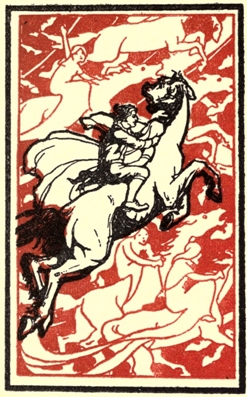
A troop of horses stood at the door. Jamie mounted, and his steed rose with him into the air. He was presently flying over his mother’s cottage, surrounded by the elfin troop, and on and on they went, over bold mountains, over little hills, over the deep Lough Swilley, over towns and cottages, where people were burning nuts and eating apples and keeping merry Halloween. It seemed to Jamie that they flew all round Ireland before they got to Dublin.
his is Derry,” said the fairies, flying over the cathedral spire; and what was said by one voice was repeated by all the rest, till fifty little voices were crying out, “Derry! Derry! Derry!”
In like manner was Jamie informed as they passed over each town on the route, and at length he heard the silvery voices cry, “Dublin! Dublin!”
It was no mean dwelling that was to be honoured by the fairy visit, but one of the finest houses in Stephen’s Green.
The troop dismounted near a window, and Jamie saw a beautiful face on a pillow in a splendid bed. He saw the young lady lifted and carried away, while the stick which was dropped in her place on the bed took her exact form.
The lady was placed before one rider and carried a short way, then given another, and the names of the towns were cried as before.
They were approaching home. Jamie heard “Rathmullan,” “Milford,” “Tamney,” and then he knew they were near his own house.
“You’ve all had your turn at carrying the young lady,” said he. “Why wouldn’t I get her for a wee piece?”
“Ay, Jamie,” replied they pleasantly, “you may take your turn at carrying her, to be sure.”
Holding his prize very tightly he dropped down near his mother’s door.
“Jamie Freel! Jamie Freel! is that the way you treat us?” cried they, and they, too, dropped down near the door.
Jamie held fast, though he knew not what he was holding, for the little folk turned the lady into all sorts of strange shapes. At one moment she was a black dog, barking and trying to bite; at another a glowing bar of iron, which yet had no heat; then again a sack of wool.
ut still Jamie held her, and the baffled elves were turning away when a tiny woman, the smallest of the party, exclaimed, “Jamie Freel has her awa frae us, but he sall nae hae gude of her, for I’ll mak’ her deaf and dumb,” and she threw something over the young girl.
While they rode off, disappointed, Jamie Freel lifted the latch and went in.
“Jamie man!” cried his mother, “you’ve been awa all night. What have they done on you?”
“Naething bad, mother; I hae the very best o’ gude luck. Here’s a beautiful young lady I hae brought you for company.”
“Bless us and save us!” exclaimed his mother; and for some minutes she was so astonished she could not think of anything else to say.
Jamie told the story of the night’s adventure, ending by saying, “Surely you wouldna have allowed me to let her gang with them to be lost for ever?”
“But a lady, Jamie! How can a lady eat we’er (our) poor diet and live in we’er poor way? I ax you that, you foolitch fellow!”
“Well, mother, sure it’s better for her to be over here nor yonder,” and he pointed in the direction of the castle.
Meanwhile the deaf and dumb girl shivered in her light clothing, stepping close to the humble turf fire.
“Poor crathur, she’s quare and handsome! Nae wonder they set their hearts on her,” said the old woman, gazing at their guest with pity and admiration. “We maun dress her first; but what in the name o’ fortune hae I fit for the likes of her to wear?”
he went to her press in “the room” and took out her Sunday gown of brown drugget. She then opened a drawer and drew forth a pair of white stockings, a long snowy garment of fine linen, and a cap, her “dead dress,” as she called it.
These articles of attire had long been ready for a certain triste ceremony, in which she would some day fill the chief part, and only saw the light occasionally when they were hung out to air; but she was willing to give even these to the fair trembling visitor, who was turning in dumb sorrow and wonder from her to Jamie, and from Jamie back to her.
The poor girl suffered herself to be dressed, and then sat down on a “creepie” in the chimney corner and buried her face in her hands.
“What’ll we do to keep up a lady like thou?” cried the old woman.
“I’ll work for you both, mother,” replied the son.
“An’ how could a lady live on we’er poor diet?” she repeated.
“I’ll work for her,” was all Jamie’s answer.
He kept his word. The young lady was very sad for a long time, and tears stole down her cheeks many an evening, while the old woman span by the fire and Jamie made salmon nets, an accomplishment acquired by him in hopes of adding to the comfort of their guest.
ut she was always gentle, and tried to smile when she perceived them looking at her; and by degrees she adapted herself to their ways and mode of life. It was not very long before she began to feed the pig, mash potatoes and meal for the fowls, and knit blue worsted socks.
So a year passed and Halloween came round again. “Mother,” said Jamie, taking down his cap, “I’m off to the ould castle to seek my fortune.”
“Are you mad, Jamie?” cried his mother in terror; “sure they’ll kill you this time for what you done on them last year.”
Jamie made light of her fears and went his way.
As he reached the crab-tree grove he saw bright lights in the castle windows as before, and heard loud talking. Creeping under the window he heard the wee folk say, “That was a poor trick Jamie Freel played us this night last year, when he stole the young lady from us.”
“Ay,” said the tiny woman, “an’ I punished him for it, for there she sits a dumb image by the hearth, but he does na’ know that three drops out o’ this glass that I hold in my hand wad gie her her hearing and speech back again.”
Jamie’s heart beat fast as he entered the hall. Again he was greeted by a chorus of welcomes from the company—“Here comes Jamie Freel! Welcome, welcome, Jamie!”
As soon as the tumult subsided the little woman said, “You be to drink our health, Jamie, out o’ this glass in my hand.”
Jamie snatched the glass from her and darted to the door. He never knew how he reached his cabin, but he arrived there breathless and sank on a stove by the fire.
ou’re kilt, surely, this time, my poor boy,” said his mother.
“No, indeed, better luck than ever this time!” and he gave the lady three drops of the liquid that still remained at the bottom of the glass, notwithstanding his mad race over the potato field.
The lady began to speak, and her first words were words of thanks to Jamie.
The three inmates of the cabin had so much to say to one another that, long after cock-crow, when the fairy music had quite ceased, they were talking round the fire.
“Jamie,” said the lady, “be pleased to get me paper and pen and ink that I may write to my father and tell him what has become of me.”
She wrote, but weeks passed and she received no answer. Again and again she wrote, and still no answer.
At length she said, “You must come with me to Dublin, Jamie, to find my father.”
“I hae no money to hire a car for you,” he answered; “an’ how can you travel to Dublin on your foot?”
But she implored him so much that he consented to set out with her and walk all the way from Fannet to Dublin. It was not as easy as the fairy journey; but at last they rang the bell at the door of the house in Stephen’s Green.
“Tell my father that his daughter is here,” said she to the servant who opened the door.
he gentleman that lives here has no daughter, my girl. He had one, but she died better nor a year ago.”
“Do you not know me, Sullivan?”
“No, poor girl, I do not.”
“Let me see the gentleman. I only ask to see him.”
“Well, that’s not much to ax. We’ll see what can be done.”
In a few moments the lady’s father came to the door.
“How dare you call me your father?” cried the old gentleman angrily. “You are an impostor. I have no daughter.”
“Look in my face, father, and surely you’ll remember me.”
“My daughter is dead and buried. She died a long, long time ago.” The old gentleman’s voice changed from anger to sorrow. “You can go,” he concluded.
“Stop, dear father, till you look at this ring on my finger. Look at your name and mine engraved on it.”
“It certainly is my daughter’s ring, but I do not know how you came by it. I fear in no honest way.”
“Call my mother—she will be sure to know me,” said the poor girl, who by this time was weeping bitterly.
“My poor wife is beginning to forget her sorrow. She seldom speaks of her daughter now. Why should I renew her grief by reminding her of her loss?”
But the young lady persevered till at last the mother was sent for.
“Mother,” she began, when the old lady came to the door, “don’t you know your daughter?”
“I have no daughter. My daughter died, and was buried a long, long time ago.”
“Only look in my face and surely you’ll know me.”
The old lady shook her head.
ou have all forgotten me; but look at this mole on my neck. Surely, mother, you know me now?”
“Yes, yes,” said her mother, “my Gracie had a mole on her neck like that; but then I saw her in the coffin, and saw the lid shut down upon her.”
It became Jamie’s turn to speak, and he gave the history of the fairy journey, of the theft of the young lady, of the figure he had seen laid in its place, of her life with his mother in Fannet, of last Halloween, and of the three drops that had released her from her enchantments.
She took up the story when he paused and told how kind the mother and son had been to her.
The parents could not make enough of Jamie. They treated him with every distinction, and when he expressed his wish to return to Fannet, said they did not know what to do to express their gratitude.
But an awkward complication arose. The daughter would not let him go without her. “If Jamie goes, I’ll go, too,” she said. “He saved me from the fairies, and has worked for me ever since. If it had not been for him, dear father and mother, you would never have seen me again. If he goes, I’ll go, too.”
This being her resolution, the old gentleman said that Jamie should become his son-in-law. The mother was brought from Fannet in a coach-and-four, and there was a splendid wedding.
They all lived together in the grand Dublin house, and Jamie was heir to untold wealth at his father-in-law’s death.
Letitia Maclintock.
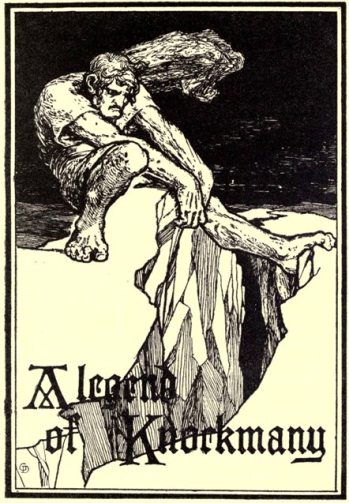
t so happened that Finn and his gigantic relatives were all working at the Giant’s Causeway in order to make a bridge, or, what was still better, a good stout pad-road across to Scotland, when Finn, who was very fond of his wife, Oonagh, took it into his head that he would go home and see how the poor woman got on in his absence. So accordingly he pulled up a fir-tree, and after lopping off the roots and branches, made a walking-stick of it and set out on his way to Oonagh.
Finn lived at this time on Knockmany Hill, which faces Cullamore, that rises up, half hill, half mountain, on the opposite side.
The truth is that honest Finn’s affection for his wife was by no manner of means the whole cause of his journey home. There was at that time another giant, named Far Rua—some say he was Irish and some say he was Scotch—but whether Scotch or Irish, sorrow doubt of it but he was a targer. No other giant of the day could stand before him; and such was his strength that, when well vexed, he could give a stamp that shook the country about him. The fame and name of him went far and near, and nothing in the shape of a man, it was said, had any chance with him in a fight. Whether the story is true or not I cannot say, but the report went that by one blow of his fist he flattened a thunderbolt, and kept it in his pocket in the shape of a pancake to show to all his enemies when they were about to fight him. Undoubtedly he had given every giant in Ireland a considerable beating, barring Finn M’Coul himself; and he swore that he would never rest night or day, winter or summer, till he could serve Finn with the same sauce, if he could catch him. Finn, however, had a strong disinclination to meet a giant who could make a young earthquake or flatten a thunderbolt when he was angry, so accordingly he kept dodging about from place to place—not much to his credit as a Trojan, to be sure—whenever he happened to get the hard word that Far Rua was on the scent of him. And the long and the short of it was that he heard Far Rua was coming to the Causeway to have a trial of strength with him; and he was, naturally enough, seized in consequence with a very warm and sudden fit of affection for his wife, who was delicate in her health, poor woman, and leading, besides, a very lonely, uncomfortable life of it in his absence.
“God save all here,” said Finn good-humouredly, putting his honest face into his own door.
“Musha, Finn, avick, an’ you’re welcome to your own Oonagh, you darlin’ bully.” Here followed a smack that it is said to have made the waters of the lake curl, as it were, with kindness and sympathy.
“Faith,” said Finn, “beautiful; and how are you, Oonagh—and how did you sport your figure during my absence, my bilberry?”
“Never a merrier—as bouncing a grass widow as ever there was in sweet ‘Tyrone among the bushes.’”
Finn gave a short, good-humoured cough, and laughed most heartily to show her how much he was delighted that she made herself happy in his absence.
“An’ what brought you home so soon, Finn?” said she.
hy, avourneen,” said Finn, putting in his answer in the proper way, “never the thing but the purest of love and affection for yourself. Sure, you know that’s truth, anyhow, Oonagh.”
Finn spent two or three happy days with Oonagh, and felt himself very comfortable considering the dread he had of Far Rua. This, however, grew upon him so much that his wife could not but perceive something lay on his mind which he kept altogether to himself. Let a woman alone in the meantime for ferreting or wheedling a secret out of her good man when she wishes. Finn was a proof of this.
“It’s this Far Rua,” said he, “that’s troublin’ me. When the fellow gets angry and begins to stamp he’ll shake you a whole townland, and it’s well known that he can stop a thunderbolt, for he always carries one about with him in the shape of a pancake to show to anyone that might misdoubt it.”
As he spoke he clapped his thumb in his mouth, as he always did when he wanted to prophesy or to know anything.
“He’s coming,” said Finn; “I see him below at Dungannon.”
“An’ who is it, avick?”
“Far Rua,” replied Finn, “and how to manage I don’t know. If I run away I am disgraced, and I know that sooner or later I must meet him, for my thumb tells me so.”
“When will he be here?” says she.
“To-morrow, about two o’clock,” replied Finn with a groan.
“Don’t be cast down,” said Oonagh; “depend on me, and, maybe, I’ll bring you out of this scrape better than ever you could bring yourself.”
his quieted Finn’s heart very much, for he knew that Oonagh was hand-and-glove with the fairies; and, indeed, to tell the truth, she was supposed to be a fairy herself. If she was, however, she must have been a kind-hearted one, for by all accounts she never did anything but good in the neighbourhood.
Now, it so happened that Oonagh had a sister named Granua living opposite to them, on the very top of Cullamore, which I have mentioned already, and this Granua was quite as powerful as herself. The beautiful valley that lies between the Granlisses is not more than three or four miles broad, so that of a summer evening Granua and Oonagh were able to hold many an agreeable conversation across it, from one hill-top to the other. Upon this occasion Oonagh resolved to consult her sister as to what was best to be done in the difficulty that surrounded them.
“Granua,” said she, “are you at home?”
“No,” said the other, “I’m picking bilberries at Althadhawan” (the Devil’s Glen).
“Well,” said Oonagh, “go up to the top of Cullamore, look about you, and then tell us what you see.”
“Very well,” replied Granua, after a few minutes; “I am there now.”
“What do you see?” asked the other.
“Goodness be about us!” exclaimed Granua, “I see the biggest giant that ever was known coming up from Dungannon.”
“Ay,” said Oonagh, “there’s our difficulty. That’s Far Rua, and he’s comin’ up now to leather Finn. What’s to be done?”
’ll call to him,” she replied, “to come up to Cullamore and refresh himself, and maybe that will give you and Finn time to think of some plan to get yourselves out of the scrape. But,” she proceeded, “I’m short of butter, having in the house only half a dozen firkins, and as I’m to have a few giants and giantesses to spend the evenin’ with me I’d feel thankful, Oonagh, if you’d throw me up fifteen or sixteen tubs, or the largest miscaun you’ve got, and you’ll oblige me very much.”
“I’ll do that with a heart and a half,” replied Oonagh; “and, indeed, Granua, I feel myself under great obligations to you for your kindness in keeping him off us till we see what can be done; for what would become of us all if anything happened to Finn, poor man!”
She accordingly got the largest miscaun of butter she had—which might be about the weight of a couple of dozen millstones, so that you can easily judge of its size—and calling up her sister, “Granua,” says she, “are you ready? I’m going to throw you up a miscaun, so be prepared to catch it.”
“I will,” said the other. “A good throw, now, and take care it does not fall short.”
Oonagh threw it, but in consequence of her anxiety about Finn and Far Rua she forgot to say the charm that was to send it up, so that instead of reaching Cullamore, as she expected, it fell about half-way between the two hills at the edge of the Broad Bog, near Augher.
y curse upon you!” she exclaimed, “you’ve disgraced me. I now change you into a grey stone. Lie there as a testimony of what has happened, and may evil betide the first living man that will ever attempt to move or injure you!”
And, sure enough, there it lies to this day, with the mark of the four fingers and thumb imprinted on it, exactly as it came out of her hand.
“Never mind,” said Granua, “I must only do the best I can with Far Rua. If all fail, I’ll give him a cast of heather broth, or a panada of oak bark. But, above all things, think of some plan to get Finn out of the scrape he’s in, or he’s a lost man. You know you used to be sharp and ready-witted; and my own opinion is, Oonagh, that it will go hard with you, or you’ll outdo Far Rua yet.”
She then made a high smoke on the top of the hill, after which she put her finger in her mouth and gave three whistles, and by that Far Rua knew that he was invited to the top of Cullamore—for this was the way that the Irish long ago gave a sign to all strangers and travellers to let them know they are welcome to come and take share of whatever was going.
In the meantime Finn was very melancholy, and did not know what to do, or how to act at all. Far Rua was an ugly customer, no doubt, to meet with; and, moreover, the idea of the confounded “cake” aforesaid flattened the very heart within him. What chance could he have, strong and brave as he was, with a man who could, when put in a passion, walk the country into earthquakes and knock thunderbolts into pancakes? The thing was impossible, and Finn knew not on what hand to turn him. Right or left, backward or forward, where to go he could form no guess whatever.
onagh,” said he, “can you do anything for me? Where’s all your invention? Am I to be skivered like a rabbit before your eyes and to have my name disgraced for ever in the sight of all my tribe, and me the best man among them? How am I to fight this man-mountain—this huge cross between an earthquake and a thunderbolt—with a pancake in his pocket that was once——?”
“Be aisy, Finn,” replied Oonagh. “Troth, I’m ashamed of you. Keep your toe in your pump, will you? Talking of pancakes, maybe we’ll give him as good as any he brings with him—thunderbolts or otherwise. If I don’t treat him to as smart feeding as he’s got this many a day, don’t trust Oonagh again. Leave him to me, and do just as I bid you.”
This relieved Finn very much, for, after all, he had great confidence in his wife, knowing, as he did, that she had got him out of many a quandary before. The present, however, was the greatest of all; but, still, he began to get courage and to eat his victuals as usual. Oonagh then drew the nine woollen threads of different colours, which she always did to find out the best way of succeeding in anything of importance she went about. She then plaited them into three plaits, with three colours in each, putting one on her right arm, one round her heart, and the third round her right ankle, for then she knew that nothing could fail her that she undertook.
aving everything now prepared, she sent round to the neighbours and borrowed one-and-twenty iron griddles, which she took and kneaded into the hearts of one-and-twenty cakes of bread, and these she baked on the fire in the usual way, setting them aside in the cupboard according as they were done. She then put down a large pot of new milk, which she made into curds and whey, and gave Finn due instructions how to use the curds when Far Rua should come. Having done all this, she sat down quite contented waiting for his arrival on the next day about two o’clock, that being the hour at which he was expected—for Finn knew as much by the sucking of his thumb. Now, this was a curious property that Finn’s thumb had; but notwithstanding all the wisdom and logic he used to suck out of it, it could never have stood to him here were it not for the wit of his wife. In this very thing, moreover, he was very much resembled by his great foe, Far Rua; for it was well known that the huge strength that he possessed all lay in the middle finger of his right hand, and that if he happened by any chance to lose it, he was no more, notwithstanding his bulk, than a common man.
At length the next day he was seen coming across the valley, and Oonagh knew that it was time to commence operations. She immediately made the cradle, and desired Finn to lie down in it and cover himself up with the clothes.
“You must pass for your own child,” said she, “so just lie there snug and say nothing, but be guided by me.” This, to be sure, was wormwood to Finn—I mean going into the cradle in such a cowardly manner—but he knew Oonagh very well; and finding that he had nothing else for it, with a very rueful face he gathered himself into it and lay snug, as she had desired him.
bout two o’clock, as he had been expected, Far Rua came in. “God save all here!” said he. “Is this where the great Finn M’Coul lives?”
“Indeed it is, honest man,” replied Oonagh. “God save you kindly—won’t you be sitting?”
“Thank you, ma’am,” says he, sitting down. “You’re Mrs. M’Coul, I suppose?”
“I am,” says she, “and I have no reason, I hope, to be ashamed of my husband.”
“No,” said the other; “he has the name of being the strongest and bravest man in Ireland. But, for all that, there’s a man not far from you that’s very anxious of taking a shake with him. Is he at home?”
“Why, no, then,” she replied; “and if ever a man left in a fury he did. It appears that someone told him of a big bosthoon of a giant called Far Rua being down at the Causeway to look for him, and so he set out there to try if he could catch him. Troth, I hope, for the poor giant’s sake, he won’t meet with him, for if he does Finn will make paste of him at once.”
“Well,” said the other, “I am Far Rua, and I have been seeking him these twelve minths, but he always kept clear of me; and I will never rest day or night till I lay my hands on him.”
At this Oonagh set up a loud laugh of great contempt, by the way, and looked at him as if he were only a mere handful of a man.
“Did you ever see Finn?” said she, changing her manner all at once.
“How could I?” said he. “He always took care to keep his distance.”
thought so,” she replied. “I judged as much; and if you take my advice, you poor-looking creature, you’ll pray night and day that you may never see him, for I tell you it will be a black day for you when you do. But, in the meantime, you perceive that the wind’s on the door, and as Finn himself is far from home, maybe you’d be civil enough to turn the house, for it’s always what Finn does when he’s here.”
This was a startler, even to Far Rua; but he got up, however, and after pulling the middle finger of his right hand until it cracked three times, he went outside, and getting his arms about the house, completely turned it as she had wished. When Finn saw this he felt a certain description of moisture, which shall be nameless, oozing out through every pore of his skin; but Oonagh, depending upon her woman’s wit, felt not a whit daunted.
“Arrah, then,” said she, “as you’re so civil, maybe you’d do another obliging turn for us, as Finn’s not here to do it himself. You see, after this long stretch of dry weather that we’ve had, we feel very badly off for want of water. Now, Finn says there’s a fine spring well somewhere under the rocks behind the hill there below, and it was his intention to pull them asunder; but having heard of you he left the place in such a fury that he never thought of it. Now, if you try to find it, troth, I’d feel it a kindness.”
he then brought Far Rua down to see the place, which was then all one solid rock; and after looking at it for some time, he cracked his right middle finger nine times, and, stooping down, tore a cleft about four hundred feet deep and a quarter of a mile in length, which has since been christened by the name of Lumford’s Glen. This feat nearly threw Oonagh herself off her guard; but what won’t a woman’s sagacity and presence of mind accomplish?
“You’ll now come in,” said she, “and eat a bit of such humble fare as we can give. Finn, even though you and he were enemies, would scorn not to treat you kindly in his own house; and, indeed, if I didn’t do it even in his absence, he would not be pleased with me.”
She accordingly brought him in, and placing half a dozen of the cakes we spoke of before him, together with a can or two of butter, a side of boiled bacon, and a stack of cabbage, she desired him to help himself—for this, be it known, was long before the invention of potatoes. Far Rua, who, by the way, was a glutton as well as a hero, put one of the cakes in his mouth to take a huge whack out of it, when both Finn and Oonagh were stunned with a noise that resembled something between a growl and a yell. “Blood and fury!” he shouted out. “How is this? Here are two of my teeth out! What kind of bread is this you gave me?”
“What’s the matter?” said Oonagh coolly.
“Matter!” shouted the other. “Why, here are two of the best teeth in my head gone.”
“Why,” said she, “that’s Finn’s bread—the only bread he ever eats when at home; but, indeed, I forgot to tell you that nobody can eat it but himself and that child in the cradle there. I thought, however, that as you were reported to be rather a stout little fellow of your size you might be able to manage it, and I did not wish to affront a man that thinks himself able to fight Finn. Here’s another cake—maybe it’s not so hard as that.”
ar Rua, at the moment, was not only hungry, but ravenous, so he accordingly made a fresh set at the second cake, and immediately another yell was heard twice as loud as the first. “Thunder and giblets!” he roared, “take your bread out of this, or I will not have a tooth in my head; there’s another pair of them gone.”
“Well, honest man,” replied Oonagh, “if you’re not able to eat the bread say so quietly, and don’t be awakening the child in the cradle there. There, now, he’s awake upon me!”
Finn now gave a skirl that frightened the giant, as coming from such a youngster as he was represented to be. “Mother,” said he, “I’m hungry—get me something to eat.” Oonagh went over, and putting into his hand a cake that had no griddle in it—Finn, whose appetite in the meantime was sharpened by what he saw going forward, soon made it disappear. Far Rua was thunderstruck, and secretly thanked his stars that he had the good fortune to miss meeting Finn, for, as he said to himself, I’d have no chance with a man who could eat such bread as that, which even his son that’s in the cradle can munch before my eyes.
“I’d like to take a glimpse at the lad in the cradle,” said he to Oonagh, “for I can tell you that the infant who can manage that nutriment is no joke to look at or to feed of a scarce summer.”
“With all the veins of my heart,” replied Oonagh. “Get up, acushla, and show this decent little man something that won’t be unworthy of your father, Finn M’Coul.”
inn, who was dressed for the occasion as much like a boy as possible, got up, and bringing Far Rua out, “Are you strong?” said he.
“Thunder and ounze!” exclaimed the other, “what a voice in so small a chap!”
“Are you strong?” said Finn again. “Are you able to squeeze water out of that white stone?” he asked, putting one into Far Rua’s hand. The latter squeezed and squeezed the stone, but to no purpose; he might pull the rocks of Lumford’s Glen asunder, and flatten a thunderbolt, but to squeeze water out of a white stone was beyond his strength. Finn eyed him with great contempt as he kept straining and squeezing and squeezing and straining till he got black in the face with the efforts.
“Ah, you’re a poor creature,” said Finn. “You a giant! Give me the stone here, and when I’ll show what Finn’s little son can do you may then judge of what my daddy himself is.”
Finn then took the stone, and then, slyly exchanging it for the curds, he squeezed the latter until the whey, as clear as water, oozed out in a little shower from his hand.
“I’ll now go in,” said he, “to my cradle; for I scorn to lose my time with anyone that’s not able to eat my daddy’s bread, or squeeze water out of a stone. Bedad, you had better be off out of this before he comes back, for if he catches you, it’s in flummery he’d have you in two minutes.”
ar Rua, seeing what he had seen, was of the same opinion himself; his knees knocked together with the terror of Finn’s return, and he accordingly hastened in to bid Oonagh farewell, and to assure her that, from that day out, he never wished to hear of, much less to see, her husband. “I admit fairly that I’m not a match for him,” said he, “strong as I am. Tell him I will avoid him as I would the plague, and that I will make myself scarce in this part of the country while I live.”
Finn, in the meantime, had gone into the cradle, where he lay very quietly, his heart in his mouth with delight that Far Rua was about to take his departure without discovering the tricks that been played off on him.
“It’s well for you,” said Oonagh, “that he doesn’t happen to be here, for it’s nothing but hawk’s meat he’d make of you.”
“I know that,” said Far Rua, “divel a thing else he’d make of me; but, before I go, will you let me feel what kind of teeth they are that can eat griddle-cakes like that?” and he pointed to it as he spoke.
“With all the pleasure in life,” says she; “only as they’re far back in his head you must put your finger a good way in.”
Far Rua was surprised to find so powerful a set of grinders in one so young; but he was still much more so on finding, when he took his hand from Finn’s mouth, that he had left the very finger upon which his whole strength depended behind him. He gave one loud groan and fell down at once with terror and weakness. This was all Finn wanted, who now knew that his most powerful and bitterest enemy was completely at his mercy. He instantly started out of the cradle, and in a few minutes the great Far Rua, that was for such a length of time the terror of him and all his followers, was no more.
William Carleton.
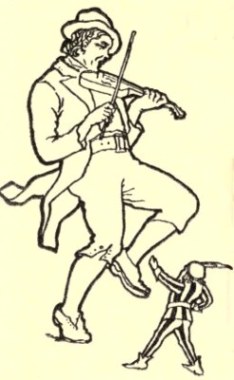
y father and mother were Irish And I am Irish too; I bought a wee fidil for ninepence And that is Irish too; I’m up in the morning early To meet the break of day, And to the lintwhite’s piping The many’s the tunes I play! One pleasant eve in June-time I met a lochrie man, His face and hands were weazen, His height was not a span. He boor’d me for my fidil— “You know,” says he, “like you, “My father and mother were Irish, “And I am Irish too!” He took my wee red fidil, And such a tune he turned, The Glaisé in it whispered The Lionan in it m’urned; Says he, “My lad, you’re lucky, “I wisht I was like you, “You’re lucky in your birth-star, “And in your fidil too!” He gave me back my fidil, My fidil-stick also, And stepping like a May-boy, He jumped the Lear-gaidh-knowe. I never saw him after, Nor met his gentle kind, But whiles I think I hear him, A-wheening in the wind!
Joseph Campbell.
in victory and blessings, O Fionn,” said Conan, “and tell me who was the man that, having only one leg, one arm, and one eye, escaped from you in consequence of his swiftness, and outstripped the Fenians of Eire, and why is this proverb used, ‘As Roc came to the house of Fionn’?”
“I will tell you that,” said Fionn. “One day the chief of the Fenians and I went to Teamhair Luachra, and we took nothing in the chase that same day but one fawn. When it had been cooked it was fetched to me for the purpose of dividing it. I gave a portion of it to each of the Fenian chiefs, and there remained none for my own share but a haunch bone. Gobha Gaoithe, son of Ronan, presented himself, and requested me to give him the haunch. I accordingly gave it to him. He then declared that I gave him that portion on account of his swiftness of foot: and he went out on the plain, but he had only gone a short distance when Caoilte, son of Ronan, his own brother, overtook him, and brought the haunch back again to me, and we had no further dispute about the matter. We had not been long so when we saw a huge, obnoxious, massy-boned, black, detestable giant, having only one eye, one arm, and one leg, hop forward towards us. He saluted us. I returned the salutation, and asked him whence he came. ‘I am come by the powers of the agility of my arm and leg,’ responded he, ‘having heard there is not one man in the world more liberal in bestowing gifts than you, O Fionn; therefore, I am come to solicit wealth and valuable gifts from you.’ I replied that were all the wealth of the world mine I would give him neither little nor much. He then declared ‘they were all liars who asserted that I never gave a refusal to any person.’ I replied that if he were a man I would not give him a refusal. ‘Well, then,’ said the giant, ‘let me have that haunch you have in your hand, and I will say good-bye to the Fenians, provided that you allow me the length of the haunch as a distance, and that I am not seized upon until I make my first hop.’ Upon hearing this I gave the haunch into the giant’s hand, and he hopped over the lofty stockades of the town; he then made use of the utmost swiftness of his one leg to outstrip all the rest of the Fenians. When the Fenian chiefs saw that, they started in pursuit of the giant, while I and the band of minstrels of the town went to the top of the dun to watch their proceedings. When I saw that the giant had outstripped them a considerable distance, I put on my running habiliments, and, taking no weapon but Mac an Loin in my hand, I started after the others. I overtook the hindmost division on Sliabh an Righ, the middle (next) division at Limerick, and the chiefs of the Fenians at Ath Bo, which is called Ath-Luain (Athlone), and those first in the pursuit at Rinn-an-Ruaigh, to the right-hand side of Cruachan of Connacht, where he (the giant) was distant less than a javelin’s cast from me. The giant passed on before me and crossed Eas Roe (now Ballyshannon), of the son of Modhuirn, without wetting his foot. I leaped over it after him. He then directed his course towards the estuary of Binn-Edair, keeping the circuit of Eire to his right hand. The giant leaped over the estuary, and it was a leap similar to flight over the sea. I sprang after him, and having caught him by the small of the back, laid him prostrate on the earth. ‘You have dealt unjustly by me, O Fionn,’ cried the giant; ‘for it was not with you I arranged the combat, but with the Fenians.’ I replied that the Fenians were not perfect, except I myself were with them. We had not remained long thus when Liagan Luaimneach, from Luachar Deaghaidh, came to us. He was followed by Caoilte Mac Ronan, together with the swiftest of the Fenians. Each of them couched his javelin, intending to drive it through the giant and kill him in my arms, but I protected him from their attacks. Soon after this the main body of the Fenians arrived; they enquired what was the cause of the delay that the giant had not been slain. ‘That is bad counsel,’ said the giant, ‘for a better man than I am would be slain in my eric.’ We bound the giant strongly on that occasion; and soon after Bran Beag O’Buadhchan came to invite me to a feast, and all the Fenians of Eire, who had been present, accompanied him to his house. The banqueting hall had been prepared for our reception at that time, and the giant was dragged into the middle of the house, and was there placed in the sight of all present. They asked him who he was. ‘Roc, son of Diocan, is my name,’ replied he, ‘that is, I am son to the Legislator of Aengus of the Brugh in the south. My betrothed poured a current of surprising affection and a torrent of deep love upon Sgiath Breac, son of Dathcaoin yonder, who is your foster son, O Fionn; it hurt my feelings severely to hear her boast of the swiftness and bravery of her lover in particular, and of the Fenians in general, and I declared that I would challenge him and all the Fenians of Eire to run a race with me; but she sneered at me. I then went to my beloved friend, Aengus of the Brugh, to bemoan my fate; and he metamorphosed me thus, and bestowed on me the swiftness of a druidical wind, as you have seen. This is my history for you; and you ought to be well satisfied with all the hurt and injury you have inflicted upon me already.’
hen I repented me of the indignity put upon the giant, and I released him from his bonds and I bade Liagan Luaimneach companion him to the presence of his betrothed one and testify to her on my behalf of his prowess in the race, wherein he had outstripped all the Fenians of Eire, save only myself. So the two went forth together in friendly amity, and Roc, for the champion feat reported of him by Liagan Luaimneach, recovered the affection of his betrothed, and straightway took her to wife. From that adventure, indeed, arose the proverb, ‘As Roc came to the House of Fionn,’ and so that is the answer to your question, O Conan,” said Fionn.
“Win victory and blessings, O Fenian King,” said Conan; “it is with clear memory and sweet words you relate these things. Tell me now the meaning of the byword, ‘The hospitality of Fionn in the house of Cuanna.’”
“I will tell you the truth concerning that, O Conan,” said Fionn. “Oisin, Caoilte, Mac Lughaidh, Diarmuid O’Duibhne, and myself happened one day, above all other days, to be on the summit of Cairn Feargall. We were accompanied by our five hounds, namely, Bran, Sceoluing, Sear Dubh, Luath Luachar, and Anuaill. We had not long been there when we perceived a rough, tall, huge giant approaching us. He carried an iron fork upon his back, and a grunting hog was placed between the prongs of the fork; a young girl of mature age followed and forced the giant on his way before her. ‘Let someone go forward and accost those people,’ said I. Diarmuid O’Duibhne followed, but did not overtake them. The other three and I started up, and followed Diarmuid and the giant. We overtook Diarmuid, but did not come up with the giant or the girl; for a dark, gloomy, druidical mist showered down between us and them, so that we could not discern what road they took. When the mist cleared away we looked around us, and discovered a light-roofed, comfortable-looking house at the edge of the ford near at hand. We proceeded to the house, before which spread a lawn upon which were two fountains. At the brink of one fountain lay a rude iron vessel, and a vessel of bronze at the brink of the other. Those we met in the house were an aged, hoary-headed man standing by the door jamb to the right hand, and a beautiful maid sitting before him; a rough, rude, huge giant before the fire busily cooking a hog; and an old man at the other side of the fire, having an iron-grey head of hair and twelve eyes in his head, while the twelve sons (germs) of discord beamed in each eye. There was also in the house a ram with a white belly, a jet-black head, dark-green horns, and green feet; and there was in the end of the house a hag covered with a dark ash-coloured garment. There were no persons in the house except these. The man at the door-post welcomed us; and we five, having our five hounds with us, sat on the floor of the bruighean. ‘Let submissive homage be done to Fionn Mac Cumhaill and his people,’ said the man at the door-post. ‘My case is that of a man begging a request, but obtaining neither the smaller nor the greater part of it,’ said the giant. Nevertheless, he rose up and did respectful homage to us. After a while I became suddenly thirsty, and no person present perceived it but Caoilte, who began to complain bitterly on that account. ‘You have no cause to complain, Caoilte,’ said the man of the door-post, ‘but only to step outside and fetch a drink for Fionn from whichever of the fountains you please.’ Caoilte did so, and fetched the bronze vessel brimful to me and gave me to drink. I took a drink from it, and the water tasted like honey while I was drinking, but bitter as gall when I put the vessel from my lips; so that darting pains and symptoms of death seized me and agonising pangs from the poisonous draught. I could be but with difficulty recognised; and the lamentation of Caoilte on account of my being in that condition was greater than that he had before given vent to on account of my thirst. The man at the door-post desired Caoilte to go out and bring me a drink from the other fountain. Caoilte obeyed, and brought me the iron vessel brimful. I never underwent so much hardship in battle or conflict as I then suffered while drinking, in consequence of the bitterness of the draught; but as soon as I put the vessel from my lips I recovered my own colour and appearance, and that gave joy and happiness to my people.
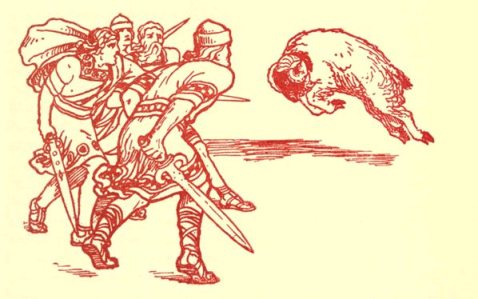
“The man then asked if the hog which was in the boiler was yet cooked. ‘It is cooked,’ replied the giant, ‘and allow me to divide it.’ ‘How will you divide it?’ said the man of the house. ‘I will give one hindquarter to Fionn and his hounds; the other hindquarter to Fionn’s four men; the forepart to myself; the chine and rump to the old man who sits at the opposite side of the fire and to the hag in yonder corner; and the giblets to you and the young woman who is opposite to you.’ ‘I pledge my word,’ said the man of the house, ‘you have divided it very fairly.’ ‘I pledge my word,’ exclaimed the ram, ‘that the division is very unfair so far as I am concerned, for I have been altogether forgotten.’ And so saying, he immediately snatched the quarter that lay before my four men, and carried it away into a corner, where he began to devour it. The four men instantly attacked the ram all at once with their swords, but though they laid on violently, it did not affect him in the least, and the blows fell away as from a stone or rock, so that they were forced to resume their seats. ‘Upon my veracity, he is doomed for evil who owns as companions such four fellows as you are, who tamely suffer one single sheep to carry away your food and devour it before your faces,’ exclaimed the man with the twelve eyes; and at the same time going up to the ram, he caught him by the feet and gave him a violent pitch out of the door, so that he fell on his back on the ground; and from that time we saw him no more. Soon after this the hag started up, and having thrown her ashy-grey coverlet over my four men, metamorphosed them into four withered, drooping-headed old men. When I saw that I was seized with great fear and alarm; and when the man at the door-post perceived this, he desired me to come over to him, place my head on his bosom, and sleep. I did so; and the hag got up and took her coverlet off my four men; and when I awoke I found them restored to their own shape, and that was a great happiness to me. ‘O Fionn,’ asked the man of the door-post, ‘do you feel surprised at the appearance and arrangements of this house?’ I assured him that I never saw anything which surprised me more. ‘Well, then, I will explain the meaning of all these things to you,’ said the man. ‘The giant carrying the grunting hog between the prongs of the iron fork, whom you first saw, is he who is yonder, and his name is SLOTH. She who is close to me is the young woman who had been forcing him along, that is ENERGY; and ENERGY compels SLOTH forward with her; for ENERGY moves, in the twinkling of the eye, a greater distance than the foot can travel in a year. The old man of the bright eyes yonder signifies the WORLD; and he is more powerful than anyone, which has been proved by his rendering the ram powerless. That ram which you saw signifies the CRIMES of the man. That hag there beyond is withering OLD AGE, and her clothing has withered your four men. The two wells from which you drank the two draughts mean FALSEHOOD and TRUTH; for while telling a lie one finds it sweet, but it becomes bitter at the last. Cuanna from Innistuil is my own name. I do not reside here, but having conceived a wonderful love for you, O Fionn, on account of your superiority in wisdom and general celebrity, I therefore put those things into the way before you in order that I might see you. And this story shall be called, to the end of the world, the Hospitality of Cuanna’s House to Fionn. Let you and your men come together, and do ye five sleep until morning.’ Accordingly we did so, and when we awoke in the morning we found ourselves on the summit of Cairn Feargaill, with our hounds and arms by us. So there is the meaning of the byword, ‘The hospitality of Fionn in the house of Cuanna,’ O Conan,” said Fionn.
(Translated from the Irish by Nicholas O’Kearney.)
(A Legend of Cong.) here was wanst upon a time, long ago, a beautiful young lady that lived in a castle up by the lake beyant, and they say she was promised to a king’s son, and they wor to be married, when, all of a suddent, he was murthered, the crathur (Lord help us!) and threwn in the lake abou, and so, of coorse, he couldn’t keep his promise to the fair lady—and more’s the pity.
“Well, the story goes that she went out iv her mind, bekase of loosin’ the king’s son—for she was tindher-hearted, God help her! like the rest iv us—and pined away after him, until at last no one about seen her, good or bad; and the story wint that the fairies took her away.
“Well, sir, in coorse o’ time the white throut, God bless it! was seen in the sthrame beyant; and sure the people didn’t know what to think of the crathur, seein’ as how a white brown throut was never heerd av afore nor sence; and years upon years the throut was there, just where you seen it this blessed minit, longer nor I can tell—aye, throth, and beyant the memory o’ th’ ouldest in the village.
“At last the people began to think it must be a fairy; for what else could it be?—and no hurt nor harm was iver put an the throut, until some wicked sinners of sojers kem to these parts, and laughed at all the people, and gibed and jeered them for thinkin’ o’ the likes; and one o’ them in partic’lar (bad luck to him—God forgi’ me for sayin’ it!) swore he’d catch the throut and ate it for his dinner—the blackguard!
ell, what would you think o’ the villiany of the sojer?—sure enough he cotch the throut, and away wid him home, and puts an the fryin’ pan, and into it he pitches the purty little thing. The throut squeeled all as one as a Christian crathur, and, my dear, you’d think the sojer id split his sides laughin’—for he was a harden’d villian; and when he thought one side was done, he turns it over to fry the other; and what would you think? but the divil a taste of a burn was an it at all at all; and sure the sojer thought it was a quare throut that couldn’t be briled; ‘but,’ says he, ‘I’ll give it another turn by and by’—little thinkin’ what was in store for him, the haythen!
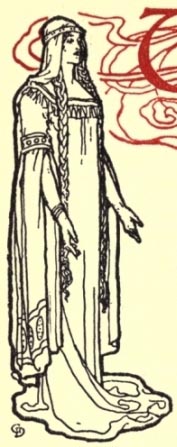
“Well, when he thought that side was done he turns it again—and lo and behould you, the divil a taste more done that side was nor the other. ‘Bad luck to me,’ says the sojer, ‘but that bates the world,’ says he; ‘but I’ll thry you agin, my darlint,’ says he, ‘as cunnin’ as you think yourself’—and so with that he turns it over and over, but not a sign av the fire was an the purty throut. ‘Well,’ says the desperate villian—(for sure, sir, only he was a desperate villian entirely; he might know he was doin’ a wrong thing, seein’ that all his endayvours was no good)—‘well,’ says he, ‘my jolly little throut, maybe you’re fried enough, though you don’t seem over well dress’d; but you may be better than you look, like a singed cat, and a tit-bit, afther all,’ says he; and with that he ups with his knife and fork to taste a piece o’ the throut—but, my jew’l, the minit he puts his knife into the fish there was a murtherin’ screech, that you’d think the life id lave you if you heerd it, and away jumps the throut out av the fryin’ pan into the middle o’ the flure; and an the spot where it fell up riz a lovely lady—the beautifullest young crathur that eyes ever seen, dressed in white, and a band o’ goold in her hair, and a sthrame o’ blood runnin’ down her arm.
ook where you cut me, you villian,’ says she, and she held out her arm to him—and, my dear, he thought the sight id lave his eyes.
“‘Couldn’t you lave me cool and comfortable in the river where you snared me, and not disturb me in my duty?’ says she.
“Well, he thrimbled like a dog in a wet sack, and at last he stammered out somethin’, and begged for his life, and ax’d her ladyship’s pardin, and said he didn’t know she was an duty, or he was too good a sojer not to know betther nor to meddle with her.
“‘I was on duty then,’ says the lady; ‘I was watchin’ for my thrue love that is comin’ by wather to me,’ says she; ‘an’ if he comes while I am away, an’ that I miss iv him, I’ll turn you into a pinkeen, and I’ll hunt you up and down for evermore, while grass grows or wather runs.’
“Well, the sojer thought the life id lave him at the thoughts iv his bein’ turned into a pinkeen, and begged for marcy; and, with that, says the lady:
“‘Renounce your evil coorses,’ says she, ‘you villian, or you’ll repint it too late. Be a good man for the futhur, and go to your duty reg’lar. And now,’ says she, ‘take me back and put me into the river agin, where you found me.’
“‘Oh, my lady,’ says the sojer, ‘how could I have the heart to drownd a beautiful lady like you?’
ut before he could say another word the lady was vanished, and there he saw the little throut an the ground. Well, he put it in a clane plate, and away he run for the bare life, for fear her lover would come while she was away; and he run, and he run, ever till he came to the cave agin, and threw the throut into the river. The minit he did, the wather was as red as blood until the sthrame washed the stain away; and to this day there’s a little red mark an the throut’s side where it was cut.
“Well, sir, from that day out the sojer was an althered man, and reformed his ways, and wint to his duty reg’lar, and fasted three times a week—though it was never fish he tuk an fastin’ days; for afther the fright he got fish id never rest an his stomach—savin’ your presence. But, anyhow, he was an althered man, as I said before; and in coorse o’ time he left the army, and turned hermit at last; and they say he used to pray evermore for the sowl of the White Throut.”
Samuel Lover.
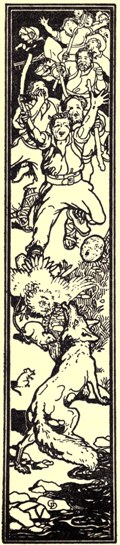
mouse, a rat, and a little red hen once lived together in the same cottage, and one day the little red hen said, “Let us bake a cake and have a feast.” “Let us,” says the mouse, and “let us,” says the rat. “Who’ll go and get the wheat ground?” says the hen. “I won’t,” says the mouse; “I won’t,” says the rat. “I will myself,” says the little red hen. “Who’ll make the cake?” “I won’t,” says the mouse; “I will,” says the rat. “Indeed, you shall not,” says the little red hen. Well, while the hen was stretching her hand out for it—“Hey Presto!” out rolled the cake from the cottage, and after it ran the mouse, the rat, and the little red hen.
When it was running away it went by a barn full of threshers, and they asked it where it was running. “Oh,” says it, “I’m running away from the mouse, the rat, and the little red hen, and from you, too, if I can.” So they rushed away after it with their flails, and it ran, and it ran till it came to a ditch full of ditchers, and they asked it where it was running.
h, I am running away from the mouse, the rat, and the little red hen, and from a barn full of threshers, and from you, too, if I can.”
Well, they all ran after it along with the rest, till it came to a well full of washers, and they asked the same question, and it returned the same answer, and after it they went.
At last it came to a ford where it met with a fox, and he asked where it was running. “Oh, I’m running away from the mouse, the rat, and the little red hen, from a barn full of threshers, a ditch full of ditchers, a well full of washers, and from you, too, if I can.”
“But you can’t cross the ford,” says the fox. “And can’t you carry me over?” says the cake. “What’ll you give me?” says the fox. “A kiss at Christmas and an egg at Easter,” says the cake.
“Very well,” says the fox—“up with you.” So he sat on his haunches with his nose in the air, and the cake got up by his tail till it sat on his crupper.
“Now, over with you,” says the cake. “You’re not high enough,” says the fox. Then it scrambled up on his shoulder. “Up higher still,” says he; “you wouldn’t be safe there.” “Am I right now?” says he. “You’ll be safer on the ridge pole of my nose.”
“Well,” says the cake, “I think I can go no further.” “Oh, yes,” says he, and he shot it up in the air, caught it in his mouth, and sent it down the Red Lane. And that was the end of the cake.
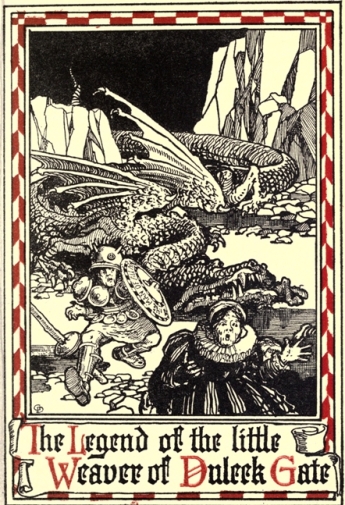
(A Tale of Chivalry.) ou see, there was a waiver lived wanst upon a time in Duleek here, hard by the gate, and a very honest, industherous man he was by all accounts. Well, it was one mornin’ that his housekeeper called to him, and he sitting very busy throwin’ the shuttle; and says she, “Your brekquest is ready!” “Lave me alone,” says he; “I’m busy with a patthern here that is brakin’ my heart, and until I complate and masther it intirely I won’t quit.”
“Oh, think o’ the iligant stirabout that’ll be spylte intirely.”
“To the divil with the stirabout!” says he.
“God forgive you,” says she, “for cursin’ your good brekquest.”
Well, he left the loom at last and wint over to the stirabout, and what would you think, but whin he looked at it, it was as black as a crow; for, you see, it was in the hoighth o’ summer, and the flies lit upon it to that degree that the stirabout was fairly covered with them.
hy, thin, bad luck to your impidence,” says the waiver; “would no place sarve you but that? And is it spyling my brekquest yiz are, you dirty bastes?” And with that, bein’ altogether cruked tempered at the time, he lifted his hand, and he made one great slam at the dish o’ stirabout and killed no less than three score and tin flies at the one blow. It was three score and tin exactly, for he counted the carcasses one by one, and laid them out on a clane plate for to view them.
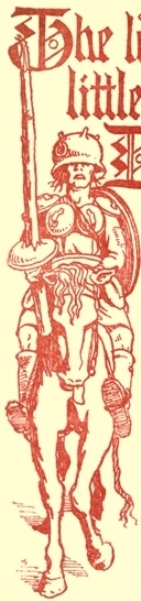
Well, he felt a powerful sperit risin’ in him when he seen the slaughter he done at one blow, and with that he got as consaited as the very dickens, and not a sthroke more work he’d do that day, but out he wint, and was fractious and impident to everyone he met, and was squarein’ up into their faces and sayin’, “Look at that fist! That’s the fist that killed three score and tin at one blow. Whoo! It is throwin’ away my time I have been all my life,” says he, “stuck to my loom, nothin’ but a poor waiver, when it is Saint George or the Dhraggin I ought to be, which is two of the sivin champions o’ Christendom. I’m detarmined on it, and I’ll set off immediately and be a knight arriant.” Well, sure enough, he wint about among his neighbours the next day, and he got an owld kittle from one and a saucepan from another, and he took them to the tailor, and he sewed him up a shuit o’ tin clothes like any knight arriant, and he borrowed a pot lid, and that he was very partic’lar about, bekase it was his shield, and he wint to a friend o’ his, a painther and glaizier, and made him paint an his shield in big letthers:
“I’M THE MAN OF ALL MIN, THAT KILL’D THREE SCORE AND TIN AT A BLOW.”
“When the people sees that,” says the waiver to himself, “the sorra one will dar for to come near me.”
nd with that he towld the housekeeper to scour out the small iron pot for him, “for,” says he, “it will make an iligant helmet.” And when it was done he put it an his head, and says she, “Is it puttin’ a great heavy iron pot an your head you are by way iv a hat?”
“Sartinly,” says he, “for a knight arriant should always have a woight an his brain.”
“But,” says she, “there’s a hole in it, and it can’t keep out the weather.”
“It will be the cooler,” says he, puttin’ it an him; “besides, if I don’t like it, it is aisy to stop it with a wisp o’ sthraw, or the like o’ that.”
“The three legs of it looks mighty quare stickin’ up,” says she.
“Every helmet has a spike stickin’ out o’ the top of it,” says the waiver, “and if mine has three, it’s only the grandher it is.”
“Well,” says the housekeeper, getting bitther at last, “all I can say is, it isn’t the first sheep’s head was dhress’d in it.”
“Your sarvint, ma’am,” says he; and off he set.
Well, he was in want of a horse, and so he wint to a field hard by where the miller’s horse was grazin’ that used to carry the ground corn round the counthry.
“This is the idintical horse for me,” says the waiver. “He is used to carryin’ flour and male; and what am I but the flower o’ shovelry in a coat o’ mail; so that the horse won’t be put out iv his way in the laste.”
ut as he was ridin’ him out o’ the field, who should see him but the miller. “Is it stalin’ my horse you are, honest man?” says the miller.
“No,” says the waiver; “I’m only goin’ to axercise him,” says he, “in the cool o’ the evenin’; it will be good for his health.”
“Thank you kindly,” says the miller, “but lave him where he is, and you’ll obleege me.”
“I can’t afford it,” says the waiver, runnin’ the horse at the ditch.
“Bad luck to your impidence,” says the miller; “you’ve as much tin about you as a thravellin’ tinker, but you’ve more brass. Come back here, you vagabone,” says he.
But he was too late—away galloped the waiver, and took the road to Dublin, for he thought the best thing he could do was to go to the King o’ Dublin (for Dublin was a grate place thin, and had a king iv its own), and he thought maybe the King o’ Dublin would give him work. Well, he was four days goin’ to Dublin, for the baste was not the best, and the roads worse, not all as one as now; but there was no turnpikes then, glory be to God! Whin he got to Dublin he wint sthrait to the palace, and whin he got into the coortyard he let his horse go and graze about the place, for the grass was growin’ out betune the stones; everything was flourishin’ thin in Dublin, you see. Well, the King was lookin’ out of his dhrawin’-room windy for divarshin, whin the waiver kem in; but the waiver pretended not to see him, and he wint over to a stone sate undher the windy—for, you see, there was stone sates all around about the place for the accommodation o’ the people—for the King was a dacent, obleegin’ man. Well, as I said, the waiver wint over and lay down an one o’ the sates, just undher the King’s windy, and purtended to go asleep; but he took care to turn out the front of his shield that had the letthers an it. Well, my dear, with that the King calls out to one of the lords of his coort that was standin’ behind him howldin’ up the skirt of his coat, according to rayson, and says he, “Look here,” says he, “what do you think of a vagabone like that comin’ undher my very nose to go sleep? It is thrue I’m a good King,” says he, “and I ’commodate the people by havin’ sates for them to sit down and enjoy the raycreation and contimplation of seein’ me here lookin’ out o’ my dhrawin’-room windy for divarshin; but that is no rayson they are to make a hotel o’ the place and come and sleep here. Who is it at all?” says the King.
“Not a one o’ me knows, plaze your majesty.”
“I think he must be a furriner,” says the King, “bekase his dhress is outlandish.”
“And doesn’t know manners, more betoken,” says the lord.
“I’ll go down and circumspect him myself,” says the King. “Folly me,” says he to the lord, wavin’ his hand at the same time in the most dignacious manner.
Down he wint accordingly, followed by the lord; and whin he wint over to where the waiver was lying, sure, the first thing he seen was his shield with the big letthers an it, and with that, says he to the lord, “By dad,” says he, “this is the very man I want.”
“For what, plaze your majesty?” says the lord.
o kill that vagabone dhraggin, to be sure,” says the King.
“Sure, do you think he could kill him,” says the lord, “whin all the stoutest knights in the land wasn’t aiquil to it, but never kem back, and was ate up alive by the cruel desaiver.”
“Sure, don’t you see there,” says the King, pointin’ at the shield, “that he killed three score and tin at one blow; and the man that done that, I think, is a match for anything.”
So, with that, he wint over to the waiver and shuck him by the shouldher for to wake him, and the waiver rubbed his eyes as if just wakened, and the King says to him, “God save you!” said he.
“God save you kindly!” says the waiver, purtendin’ he was quite onknowst who he was spakin’ to.
“Do you know who I am,” says the King, “that you make so free, good man?”
“No, indeed,” says the waiver; “you have the advantage o’ me.”
“To be sure I have,” says the King, moighty high; “sure, ain’t I the King o’ Dublin?” says he.
The waiver dhropped down on his two knees forninst the King, and says he, “I beg God’s pardon and yours for the liberty I tuk; plaze your holiness, I hope you’ll excuse it.”
“No offince,” says the King; “get up, good man. And what brings you here?” says he.
“I’m in want o’ work, plaze your riverence,” says the waiver.
“Well, suppose I give you work?” says the King.
“I’ll be proud to sarve you, my lord,” says the waiver.
“Very well,” says the King. “You killed three score and tin at one blow, I understan’,” says the King.
“Yis,” says the waiver; “that was the last thrifle o’ work I done, and I’m afeared my hand ’ill go out o’ practice if I don’t get some job to do at wanst.”
ou shall have a job immediantly,” says the King. “It is not three score and tin, or any fine thing like that; it is only a blaguard dhraggin that is disturbin’ the counthry and ruinatin’ my tinanthry wid aitin’ their powlthry, and I’m lost for want of eggs,” says the King.
“Throth, thin, plaze your worship,” says the waiver, “you look as yellow as if you swallowed twelve yolks this minit.”
“Well, I want this dhraggin to be killed,” says the King. “It will be no throuble in life to you; and I’m only sorry that it isn’t betther worth your while, for he isn’t worth fearin’ at all; only I must tell you that he lives in the county Galway, in the middle of a bog, and he has an advantage in that.”
“Oh, I don’t value it in the laste,” says the waiver; “for the last three score and tin I killed was in a soft place.”
“When will you undhertake the job then?” says the King.
“Let me at him at wanst,” says the waiver.
“That’s what I like,” says the King; “you’re the very man for my money,” says he.
“Talkin’ of money,” says the waiver, “by the same token, I’ll want a thrifle o’ change from you for my thravellin’ charges.”
s much as you plaze,” says the King; and with the word he brought him into his closet, where there was an owld stockin’ in an oak chest burstin’ wid goolden guineas.
“Take as many as you plaze,” says the King; and sure enough, my dear, the little waiver stuffed his tin clothes as full as they could howld with them.
“Now, I’m ready for the road,” says the waiver.
“Very well,” says the King; “but you must have a fresh horse,” says he.
“With all my heart,” says the waiver, who thought he might as well exchange the miller’s owld garron for a betther.
And, maybe, it’s wondherin’ you are that the waiver would think of goin’ to fight the dhraggin afther what he heerd about him when he was purtendin’ to be asleep. But he had no sitch notion: all he intended was—to fob the goold and ride back again to Duleek with his gains and a good horse. But, you see, cute as the waiver was, the King was cuter still; for these high quolity, you see, is great desaivers; and so the horse the waiver was put an was learned an purpose; and, sure, the minit he was mounted away powdhered the horse, and the divil a toe he’d go but right down to Galway. Well, for four days he was goin’ evermore, until at last the waiver seen a crowd o’ people runnin’ as if Owld Nick was at their heels, and they shoutin’ a thousand murdhers and cryin’, “The dhraggin, the dhraggin!” and he couldn’t stop the horse nor make him turn back, but away he pelted right forinst the terrible baste that was comin’ up to him, and there was the most nefarious smell o’ sulphur, savin’ your presence, enough to knock you down; and, faith, the waiver seen he had no time to lose, and so he threwn himself off the horse and made to a three that was growin’ nigh hand, and away he clambered up into it as nimble as a cat; and not a minit had he to spare, for the dhraggin kem up in a powerful rage, and he devoured the horse, body and bones, in less than no time; and then he began to sniffle and scent about for the waiver, and at last he clapt his eye an him where he was up in the three, and says he, “In throth, you might as well come down out o’ that,” says he, “for I’ll have you as sure as eggs is mate.”
“Divil a fut I’ll go down,” says the waiver.
“Sorra care I care,” says the dhraggin, “for you’re as good as ready money in my pocket this minit, for I’ll lie undher this three,” says he, “and sooner or later you must fall to my share”; and, sure enough, he sot down and began to pick his teeth with his tail afther the heavy brekquest he made that mornin’ (for he ate a whole village, let alone the horse), and he got dhrowsy at last and fell asleep; but before he wint to sleep he wound himself all round the three, all as one as a lady windin’ ribbon round her finger, so that the waiver could not escape.
Well, as soon as the waiver knew he was dead asleep by the snorin’ of him—and every snore he let out of him was like a clap o’ thunder——
The minit, the waiver began to creep down the three as cautious as a fox; and he was very nigh hand the bottom when, bad cess to it, a thievin’ branch he was dipindin’ an bruk, and down he fell right atop o’ the dhraggin. But if he did, good luck was an his side, for where should he fall but with his two legs right acrass the dhraggin’s neck, and, my jew’l, he laid howlt o’ the baste’s ears, and there he kept his grip, for the dhraggin wakened and endayvoured for to bite him; but, you see, by rayson the waiver was behind his ears he could not come at him, and, with that, he endayvoured for to shake him off; but the divil of a stir could he stir the waiver; and though he shuk all the scales an his body he could not turn the scale again the waiver.
y the hokey, this is too bad intirely,” says the dhraggin; “but if you won’t let go,” says he, “by the powers o’ wildfire, I’ll give you a ride that ’ill astonish your siven small sinses, my boy”; and with that away he flew like mad; and where do you think he did fly? By dad, he flew sthraight for Dublin—divil a less. But the waiver bein’ an his neck was a great disthress to him, and he would rather have made him an inside passenger; but, anyway, he flew and he flew till he kem slap up agin the palace o’ the King; for, bein’ blind with the rage, he never seen it, and he knocked his brains out—that is, the small thrifle he had, and down he fell spacheless. An’, you see, good luck would have it that the King o’ Dublin was lookin’ out iv his dhrawin’-room windy for divarshin that day also, and whin he seen the waiver ridin’ and the fiery dhraggin (for he was blazin’ like a tar barrel), he called out to his coortyers to come and see the show. “By the powdhers o’ war, here comes the knight arriant,” says the King, “ridin’ the dhraggin that’s all afire, and if he gets into the palace, yiz must be ready wid the fire ingines,” says he, “for to put him out.” But when they seen the dhraggin fall outside they all run downstairs and scampered into the palace yard for to circumspect the curiosity; and by the time they got down the waiver had got off o’ the dhraggin’s neck, and runnin’ up to the King, says he, “Plaze your holiness,” says he, “I did not think myself worthy of killin’ this facetious baste, so I brought him to yourself for to do him the honour of decripitation by your own royal five fingers. But I tamed him first before I allowed him the liberty for to dar’ to appear in your royal prisince, and you’ll oblige me if you just make your mark with your own hand upon the onruly baste’s neck.” And with that the King, sure enough, dhrew out his swoord and took the head aff the dirty brute as clane as a new pin. Well, there was great rejoicin’ in the coort that the dhraggin was killed; and says the King to the little waiver, says he, “You are a knight arriant as it is, and so it would be no use for to knight you over agin; but I will make you a lord,” says he.
“Oh, Lord!” says the waiver, thunderstruck like at his own good luck.
“I will,” says the King; “and as you are the first man I ever heerd tell of that rode a dhraggin, you shall be called Lord Mount Dhraggin,” says he.
“But that is not all I’ll do for you,” says the King; “I’ll give you my daughter, too, in marriage,” says he. Now, you see, that was nothing more than what he promised the waiver in his first promise; for by all accounts the King’s daughter was the greatest dhraggin ever was seen, and had the divil’s own tongue, and a beard a yard long, which she purtended was put an her, by way of a penance, by Father Mulcahy, her confissor; but it was well known it was in the family for ages, and no wondher it was so long by rayson of that same.
Samuel Lover.
Mor of Cloyne, a Munster Princess, is singing at the door of a Fairy Rath to her sister, a captive within it, the magic tune by which she once escaped from a like captivity.
ittle Sister, whom the Fay Hides away within his doon, Deep below yon seeding fern, Oh, list and learn my magic tune. Long ago, when snared like thee By the Shee, my harp and I O’er them wove the slumber spell, Warbling well its lullaby. Till with dreamy smiles they sank, Rank on rank, before the strain; And I rose from out the rath, And found my path to earth again. Little Sister, to my woe Hid below among the Shee, List and learn the magic tune, That it full soon may succour thee.
Alfred Perceval Graves.
(As told by an Irish Peasant.) here was a King in his own time in Erin, and he went hunting one day. The King met a man whose head was out through his cap, whose elbows and knees were out through his clothing, and whose toes were out through his shoes.
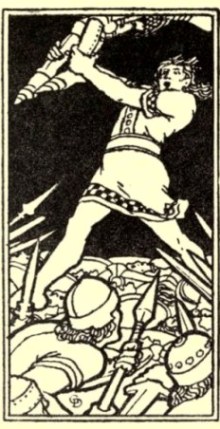
The man went up to the King, gave him a blow on the face, and drove three teeth from his mouth. The same blow put the King’s head in the dirt. When he rose from the earth, the King went back to his castle, and lay down sick and sorrowful.
The King had three sons, and their names were Ur, Arthur, and Lawn Dyarrig. The three were at school that day, and came home in the evening. The father sighed when the sons were coming in.
“What is wrong with our father?” asked the eldest.
“Your father is sick on his bed,” said the mother.
The three sons went to their father and asked what was on him.
“A strong man that I met to-day gave me a blow in the face, put my head in the dirt, and knocked three teeth from my mouth. What would you do to him if you met him?” asked the father of the eldest son.
“If I met that man,” replied Ur, “I would make four parts of him between four horses.”
ou are my son,” said the King. “What would you do if you met him?” asked he then as he turned to the second son.
“If I had a grip on that man I would burn him between four fires.”
“You, too, are my son. What would you do?” asked the King of Lawn Dyarrig.
“If I met that man, I would do my best against him, and he might not stand long before me.”
“You are not my son. I would not lose lands or property on you,” said the father. “You must go from me, and leave this to-morrow.”