Preface (continued 2)
Reading edition
And so it was settled. And the child was left until he should come to sensible years with his mother Dechtire and with her husband Sualtim. And they brought him up upon the plain of Muirthemne, and the name he was known by was Setanta, son of Sualtim.

ectera, one of the sisters of Conchubar Mac Nessa, married a prince whose patrimony lay along the shores of the Muirnict, and whose capital was Dun Dalgan. They had one child, a boy, whom they named Setanta. As soon as Setanta was able to understand the stories and conversation of those around him, he evinced a passion for arms and the martial life, which was so premature and violent as to surprise all who knew him. His thoughts for ever ran on the wars and achievements of the Red Branch. He knew all the knights by name, the appearance and bearing of each, and what deeds of valour they had severally performed. Emain Macha, the capital of the Clanna Rury, was never out of his mind. He saw for ever before his mind its moats and ramparts, its gates and bridges, its streets filled with martial men, its high-raised Duns and Raths, its branching roads, over which came the tributes of wide Ulla to the High King. He had seen his father’s tribute driven thither, and had even longed to be one of the four-footed beasts that he beheld wending their way to the wondrous city. But, above all, he delighted to be told of the great school where the young nobles of Ulster were taught martial exercises and the military art, under the superintendence of chosen knights and of the High King himself. Of the several knights he had his own opinion, and had already resolved to accept no one as his instructor save Fergus Mac Roy, tanist of Ulster.
f his father he saw little. His mind had become impaired, and he was confined in a secluded part of the Dun. But whenever he spoke to Dectera of what was nearest his heart, and his desire to enter the military school at Emain Macha, she laughed, and said that he was not yet old enough to endure that rough life. But secretly she was alarmed, and formed plans to detain him at home altogether. Then Setanta concealed his desire, but enquired narrowly concerning the partings of the roads on the way to Emania.
At last, when he was ten years old, selecting a favourable night, Setanta stole away from his father’s Dun, and before morning had crossed the frontier. He then lay down to rest and sleep in a wood. After this he set out again, travelling quickly, lest he should be met by any of his father’s people. On his back was strapped his little wooden shield, and by his side hung a sword of lath. He had brought his ball and hurle of red-bronze with him, and ran swiftly along the road, driving the ball before him, or throwing up his javelin into the air, and running to meet it ere it fell.
In the afternoon of that day Fergus Mac Roy and the King sat together in the part that surrounded the King’s palace. A chessboard was between them, and their attention was fixed on the game.
At a distance the young nobles were at their sports, and the shouts of the boys and the clash of the metal hurles resounded in the evening air.
uddenly, the noise ceased, and Fergus and the King looked up. They saw a strange boy rushing backwards and forwards through the crowd of young nobles, urging the ball in any direction that he pleased, as if in mockery, till none but the very best players attempted to stop him, while the rest stood about the ground in groups. Fergus and the King looked at each other for a moment in silence.
After this the boys came together into a group and held a council. Then commenced what seemed to be an attempt to force him out of the ground, followed by a furious fight. The strange boy seemed to be a very demon of war; with his little hurle grasped, like a war-mace, in both hands, he laid about him on every side, and the boys were tumbling fast. He sprang at tall youths, like a hound at a stag’s throat. He rushed through crowds of his enemies like a hawk through a flock of birds. The boys, seized with a panic, cried out that it was one of the Tuatha from the fairy hills of the Boyne, and fled right and left to gain the shelter of the trees. Some of them, pursued by the stranger, ran round Conchubar Mac Nessa and his knight. The boy, however, running straight, sprang over the chess table; but Conchubar seized him deftly by the wrist and brought him to a stand, but with dilated eyes and panting.
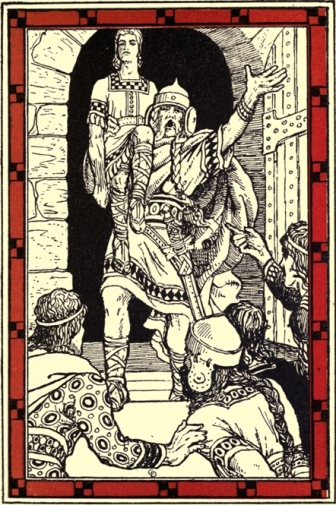
“Why are you so enraged, my boy?” said the King, “and why do you so maltreat my nobles?”
“Because they have not treated me with the respect due to a stranger,” replied the boy.
“Who are you yourself?” said Conchubar.
“I am Setanta, the son of Sualtim, and Dectera, your own sister, is my mother; and it is not before my uncle’s palace that I should be insulted and dishonoured.”
his was the début and first martial exploit of the great Cuculain, type of Irish chivalry and courage, in the bardic firmament a bright and particular star of strength, daring, and glory, that will not set nor suffer aught but transient obscuration till the extinction of the Irish race; Cuculain, bravest of the brave, whose glory affected even the temperate-minded Tierna, so that his sober pen has inscribed, in the annals of ancient Erin, this testimony: “Cuculain, filius Sualtam fortissimus heros Scotorum.”
After this Setanta was regularly received into the military school, where, ere long, he became a favourite both with old and young. He placed himself under the tuition of Fergus Mac Roy, who, each day, grew more and more proud of his pupil, for while still a boy his fame was extending over Ulla.
It was not long after this that Setanta received the name by which he is more generally known. Culain was chief of the black country of Ulla, and of a people altogether given up to the making of weapons and armour, where the sound of the hammer and husky bellows were for ever heard. One day Conchubar and some of his knights, passing through the park to partake of an entertainment at the house of the armourer, paused awhile, looking at the boys at play. Then, as all were praising his little nephew, Conchubar called to him, and the boy came up, flushed and shy, for there were with the King the chief warriors of the Red Branch. But Conchubar bade him come with them to the feast, and the knights around him laughed, and enumerated the good things which Culain had prepared for them. But when Setanta’s brow fell, Conchubar bade him finish his game, and after that proceed to Culain’s house, which was to the west of Emain Macha, and more than a mile distant from the city. Then the King and his knights went on to the feast, and Setanta returned joyfully to his game.
Now, when they were seen afar upon the plain the smith left his workshop and put by his implements, and having washed from him the sweat and smoke, made himself ready to receive his guests; but the evening fell as they were coming into the liss, and all his people came in also, and sat at the lower table, and the bridge was drawn up and the door was shut for the night, and the candles were lit in the high chamber.
Then said Culain, “Have all thy retinue come in, O Conchubar?” And when the King said that they were all there, Culain bade one of his apprentices go out and let loose the great mastiff that guarded the house. Now, this mastiff was as large as a calf and exceedingly fierce, and he guarded all the smith’s property outside the house, and if anyone approached the house without beating on the gong, which was outside the foss and in front of the drawbridge, he was accustomed to rend him. Then the mastiff, having been let loose, careered three times round the liss, baying dreadfully, and after that remained quiet outside his kennel, guarding his master’s property. But, inside, they devoted themselves to feasting and merriment, and there were many jests made concerning Culain, for he was wont to cause laughter to Conchubar Mac Nessa and his knights, yet he was good to his own people and faithful to the Crave Rue, and very ardent and skilful in the practice of his art. But as they were amusing themselves in this manner, eating and drinking, a deep growl came from without, as it were a note of warning, and after that one yet more savage; but where he sat in the champion’s seat, Fergus Mac Roy struck the table with his hand and rose straightway, crying out, “It is Setanta.” But ere the door could be opened they heard the boy’s voice raised in anger and the fierce yelling of the dog, and a scuffling in the bawn of the liss. Then they rushed to the door in great fear, for they said that the boy was torn in pieces; but when the bolts were drawn back and they sprang forth, eager to save the boy’s life, they found the dog dead, and Setanta standing over him with his hurle, for he had sprung over the foss, not fearing the dog. Forthwith, then, his tutor, Fergus Mac Roy, snatched him up on his shoulder, and returned with great joy into the banquet hall, where all were well pleased at the preservation of the boy, except Culain himself, who began to lament over the death of his dog and to enumerate all the services which he rendered to him.
“Do not grieve for thy dog, O Culain,” said Setanta, from the shoulder of Fergus, “for I will perform those services for you myself until a dog equally good is procured to take the place of him I slew.”
Then one jesting, said, “Cu-culain!” (Hound of Culain) and thenceforward he went by this name.
Standish O’Grady.
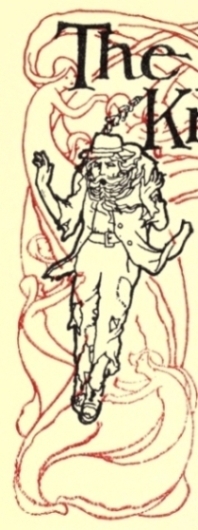
here was once a poor man who lived in the fertile glen of Aherlow, at the foot of the gloomy Galtee mountains, and he had a great hump on his back; he looked just as if his body had been rolled up and placed upon his shoulders; and his head was pressed down with the weight so much that his chin, when he was sitting, used to rest upon his knees for support. The country people were rather shy of meeting him in any lonesome place, for though, poor creature, he was as harmless and as inoffensive as a new-born infant, yet his deformity was so great that he scarcely appeared to be a human creature, and some ill-minded persons had set strange stories about him afloat. He was said to have a great knowledge of herbs and charms; but certain it was that he had a mighty skilful hand in plaiting straws and rushes into hats and baskets, which was the way he made his livelihood.
Lusmore, for that was the nickname put upon him, by reason of his always wearing a sprig of the fairy cap, or lusmore (the foxglove), in his little straw hat, would ever get a higher penny for his plaited work than anyone else, and perhaps that was the reason why someone, out of envy, had circulated the strange stories about him. Be that as it may, it happened that he was returning one evening from the pretty town of Cahir towards Cappagh, and as little Lusmore walked very slowly, on account of the great hump upon his back, it was quite dark when he came to the old moat of Knockgrafton, which stood on the right-hand side of the road. Tired and weary was he, and no ways comfortable in his own mind at thinking how much farther he had to travel, and that he should be walking all the night; so he sat down under the moat to rest himself, and began looking mournfully enough upon the moon, which—
Rising in clouded majesty at length Apparent Queen, unveil’d her peerless light, And o’er the dark her silver mantle threw.
Presently there arose a wild strain of unearthly melody upon the ear of little Lusmore. He listened, and he thought that he had never heard such ravishing music before. It was like the sound of many voices, each mingling and blending with the others so strangely that they seemed to be one, though all singing different strains, and the words of the songs were these:
Da Luan, Da Mort, Da Luan, Da Mort, Da Luan, Da Mort, Da Luan, Da Mort;
when there would be a moment’s pause, and then the round of melody went on again.
Lusmore listened attentively, scarcely drawing his breath, lest he might lose the slightest note. He now plainly perceived that the singing was within the moat; and though at first it had charmed him much, he began to get tired of hearing the same round sung over and over so often without any change; so, availing himself of the pause when Da Luan, Da Mort, had been sung three times, he took up the tune, and raised it with the words augus Da Dardeen, and then went on singing with the voices inside of the moat, Da Luan, Da Mort, finishing the melody, when the pause came again, with augus Da Dardeen.
he fairies within Knockgrafton, for the song was a fairy melody, when they heard this addition to the tune, were so much delighted that with instant resolve it was determined to bring the mortal among them whose musical skill so far exceeded theirs, and little Lusmore was conveyed into their company with the eddying speed of a whirlwind.
Glorious to behold was the sight that burst upon him as he came down through the moat, twirling round and round, with the lightness of a straw, to the sweetest music, that kept time to his motion. The greatest honour was then paid him, for he was put above all the musicians, and he had servants tending upon him and everything to his heart’s content, and a hearty welcome to all; and, in short, he was made as much of as if he had been the first man in the land.
Presently Lusmore saw a great consultation going on among the fairies, and, notwithstanding all their civility, he felt very much frightened, until one, stepping out from the rest, came up to him and said:
Lusmore! Lusmore! Doubt not, nor deplore, For the hump which you bore On your back is no more; Look down on the floor, And view it, Lusmore!
hen these words were said, poor little Lusmore felt himself so light and so happy that he thought he could have bounded at one jump over the moon, like the cow in the history of the cat and the fiddle; and he saw, with inexpressible pleasure, his hump tumble down upon the ground from his shoulders. He then tried to lift up his head, and did so with becoming caution, fearing that he might knock it against the ceiling of the great hall where he was. He looked round and round again with the greatest wonder and delight upon everything, which appeared more and more beautiful; and, overpowered at beholding such a resplendent scene, his head grew dizzy and his eyesight grew dim. At last he fell into a sound sleep, and when he awoke he found that it was broad daylight, the sun shining brightly, and the birds singing sweetly, and that he was lying just at the foot of Knockgrafton, with the cows and sheep grazing peaceably about him. The first thing Lusmore did, after saying his prayers, was to put his hand behind to feel for his hump, but no sign of one was there on his back, and he looked at himself with great pride, for he had now become a well-shaped, dapper little fellow, and, more than that, found himself in a full suit of new clothes, which he concluded the fairies had made for him.
Towards Cappagh he went, stepping out as lightly and springing up at every step as if he had been all his life a dancing-master. Not a creature who met Lusmore knew him without his hump, and he had a great work to persuade everyone that he was the same man—in truth he was not as far as the outward appearance went.
Of course it was not long before the story of Lusmore’s hump got about, and a great wonder was made of it. Through the country for miles round it was the talk of everyone, high and low.
ne morning, as Lusmore was sitting, contented enough, at his cabin door, up came an old woman to him, and asked him if he could direct her to Cappagh.
“I need give you no directions, my good woman,” said Lusmore, “for this is Cappagh. And whom may you want here?”
“I have come,” said the woman, “out of Decies country, in the county of Waterford, looking after one Lusmore, who, I have heard tell, had his hump taken off by the fairies; for there is a son of a gossip of mine who has got a hump on him that will be his death; and, maybe, if he could use the same charm as Lusmore the hump may be taken off him. And now I have told you the reason of my coming so far; ’tis to find out about this charm if I can.”
Lusmore, who was ever a good-natured little fellow, told the woman all the particulars, how he had raised the tune for the fairies at Knockgrafton, how his hump had been removed from his shoulders, and how he had got a new suit of clothes into the bargain.
The woman thanked him very much and then went away, quite happy and easy in her own mind. When she came back to her gossip’s house, in the county of Waterford, she told her everything that Lusmore had said, and they put the little hump-backed man, who was a peevish and cunning creature from his birth, upon a car, and took him all the way across the country. It was a long journey, but they did not care for that, so the hump was taken from off him; so they brought him just at nightfall, and left him under the old moat of Knockgrafton.
Jack Madden, for that was the humpy man’s name, had not been sitting there long when he heard the tune going on within the moat much sweeter than before; for the fairies were singing it the way Lusmore had settled their music for them, and the song was going on, Da Luan, Da Mort, Da Luan, Da Mort, Da Luan, Da Mort, augus Da Dardeen, without ever stopping. Jack Madden, who was in a great hurry to get quit of his hump, never thought of waiting till the fairies had done, or watching for a fit opportunity to raise the tune higher than Lusmore had; so, having heard them sing it over seven times without stopping, out he bawls, never minding the time or the humour of the tune, or how he could bring his words in properly, augus Da Dardeen, augus Da Hena, thinking that if one day was good two were better, and that, if Lusmore had one suit of clothes given him, he should have two.
No sooner had the words passed his lips than he was taken up and whisked into the moat with prodigious force, and the fairies came crowding round about him with great anger, screeching and screaming, and roaring out, “Who spoiled our tune? Who spoiled our tune?” And one stepped up to him above all the rest and said:
Jack Madden! Jack Madden! Your words came so bad in The tune we felt glad in;— This castle you’re had in, That your life we may sadden; Here’s two humps for Jack Madden!
And twenty of the strongest fairies brought Lusmore’s hump and put it down upon poor Jack’s back, over his own, where it became fixed as firmly as if it was nailed on with twelvepenny nails by the best carpenter that ever drove one. Out of their castle they then kicked him; and in the morning, when Jack Madden’s mother and her gossip came to look after their little man, they found him half dead, lying at the foot of the moat, with the other hump upon his back. Well, to be sure, how they did look at each other, but they were afraid to say anything lest a hump might be put upon their shoulders. Home they brought the unlucky Jack Madden with them, as downcast in their hearts and their looks as ever two gossips were; and what through the weight of his other hump and the long journey he died soon after, leaving, they say, his heavy curse to anyone who would go to listen to fairy tunes again.
T. Crofton Croker.
here dips the rocky highland Of Sleuth Wood in the lake, There lies a leafy island, Where flapping herons wake The drowsy water rats; There we’ve hid our faery vats, Full of berries, And of reddest stolen cherries. Come away, O human child! To the waters and the wild With a faery, hand in hand, For the world’s more full of weeping than you can understand. Where the wave of moonlight glosses The dim gray sands with light, Far off by furthest Rosses We foot it all the night, Weaving olden dances, Mingling hands and mingling glances, Till the moon has taken flight; To and fro we leap And chase the frothy bubbles, While the world is full of troubles And is anxious in its sleep. Come away, O human child! To the waters and the wild With a faery, hand in hand, For the world’s more full of weeping than you can understand. Where the wandering water gushes From the hills above Glen-Car, In pools among the rushes That scarce could bathe a star, We seek for slumbering trout, And whispering in their ears Give them unquiet dreams; Leaning softly out From ferns that drop their tears Over the young streams. Come away, O human child! To the waters and the wild With a faery, hand in hand, For the world’s more full of weeping than you can understand. Away with us he’s going, The solemn-eyed: He’ll hear no more the lowing Of the calves on the warm hillside; Or the kettle on the hob Sing peace into his breast, Or see the brown mice bob Round and round the oatmeal-chest. For he comes, the human child! To the waters and the wild With a faery, hand in hand, From a world more full of weeping than he can understand. W. B. Yeats.
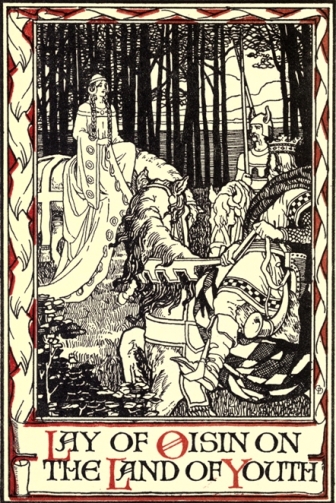
ne day we, the Fianna, were all assembled, generous Fionn and all of us that lived were there; we were hunting on a misty morning nigh the bordering shores of Loch Lein, where through fragrant trees of sweetest blossoms, and the mellow music of birds at all times, we aroused the hornless deer of the best bounding, course, and agility; our hounds and all our dogs were close after in full chase. ’Twas not long till we saw, westwards, a fleet rider advancing towards us, a young maiden of most beautiful appearance, on a slender white steed of swiftest power. We all ceased from the chase on seeing the form of the royal maid; ’twas a surprise to Fionn and the Fianns, they never beheld a woman equal in beauty. A royal crown was on her head, and a brown mantle of precious silk, spangled with stars of red gold, covering her shoes down to the grass. A gold ring was hanging down from each yellow curl of her golden hair; her eyes were blue, clear, and cloudless, like a dewdrop on the top of the grass. Redder were her cheeks than the rose, fairer was her visage than the swan upon the wave, and more sweet was the taste of her balsam lips than honey mingled through red wine. A garment, wide, long, and smooth, covered the white steed; there was a comely saddle of red gold, and her right hand held a bridle with a golden bit. Four shoes, well shaped, were under him, of the yellow gold of the purest quality; a silver wreath was on the back of his head, and there was not in the world a steed better.
he came to the presence of Fionn, and spoke with a voice sweet and gentle, and she said, “O King of the Fianna, long and distant is my journey now.”
“Who art thou thyself, O youthful princess! of fairest form, beauty, and countenance? Relate to us the cause of thy story, thine own name and thy country.”
“Golden-headed Niamh is my name, O sage Fionn of the great hosts. Beyond the women of the world I have won esteem; I am the fair daughter of the King of Youth.”
“Relate to us, O amiable princess, what caused thee to come afar across the sea—is it thy consort has forsaken thee, or what is the affliction that is on thyself?”
“’Tis not my husband that went from me; and as yet I have not been spoken of with any man, O King of the Fianna of highest repute; but affection and love I have given to thy son.”
“Which of my children is he, O blooming daughter, to whom thou hast given love, or yet affection? Do not conceal from us now the cause, and relate to us thy case, O woman.”
“I will tell thee that, O Fionn! Thy noble son of the well-tempered arms, high-spirited Oisin of the powerful hands, is the champion that I am now speaking of.”
“What is the reason that thou gavest love, O beautiful daughter of the glossy hair, to my own son beyond all, and multitudes of high lords under the sun?”
is not without cause, O King of the Fianna! I came afar for him—but reports I heard of his prowess, the goodness of his person and his mien.
“Many a son of a king and a high chief gave me affection and perpetual love; I never consented to any man till I gave love to noble Oisin.”
“By that hand on thee, O Patrick, though it is not shameful to me as a story, there was not a limb of me but was in love with the beautiful daughter of the glossy hair.”
I, Oisin, took her hand in mine, and said in speech of sweetest tone, “A true, gentle welcome before thee, O young princess, to this country! ’Tis thou art the brightest and the fairest of form, ’tis thee I prefer as wife, thou art my choice beyond the women of the world, O mild star of loveliest countenance!”
“Obligations unresisted by true heroes, O generous Oisin, I put upon thee to come with myself now upon my steed till we arrive at the ‘Land of Youth.’ It is the most delightful country to be found, of greatest repute under the sun, trees drooping with fruit, and blossom and foliage growing on the tops of boughs. Abundant, there, are honey and wine and everything that eye has beheld; there will not come decline on thee with lapse of time; death or decay thou wilt not see. Thou wilt get feasts, playing, and drink; thou wilt get melodious music on the harp strings; thou wilt get silver and gold; thou wilt get also many jewels. Thou wilt get the royal diadem of the ‘King of Youth,’ which he never yet gave to any person under the sun; ’twill protect thee both night and day, in battle, in tumult, and in rough conflict. Thou wilt get a fitting coat of protecting mail, and a gold-headed sword apt for strokes, from which no person ever escaped alive who once saw the sharp weapon. Thou wilt get everything I promised thee, and delights, also, which I may not mention; thou wilt get beauty, strength, and power, and I myself will be thy wife.”
“No refusal will I give from me,” said I, “O charming queen of the golden curls! Thou art my choice above the women of the world, and I will go with willingness to the ‘Land of Youth.’”
On the back of the steed we went together. Before me sat the virgin; she said, “Oisin, let us remain quiet till we reach the mouth of the great sea.”
Then arose the steed swiftly; when we arrived on the borders of the strand he shook himself then to pace forward, and neighed three times aloud.
When Fionn and the Fianna saw the steed travelling swiftly, facing the great tide, they raised three shouts of mourning and grief.
“O Oisin!” said Fionn slowly and sorrowfully, “woe it is to me that thou art going from me; I have not a hope that thou wilt ever again come back to me victorious.”
His form and beauty changed, and showers of tears flowed down, till they wet his breast and his bright visage, and he said, “My woe art thou, O Oisin, in going from me!”
Patrick, ’twas a melancholy story our parting from each other in that place, the parting of the father from his own son—’tis mournful, weak, and faint to be relating it! I kissed my father sweetly and gently, and the same affection I got from him. I bade adieu to all the Fianna, and the tears flowed down my cheeks. We turned our backs to the land and our faces directly due west; the smooth sea ebbed before us and filled in billows after us. We saw wonders in our travels, cities, courts, and castles, lime-white mansions and fortresses, brilliant summer-houses and palaces. We also saw, by our sides, a hornless fawn leaping nimbly, and a red-eared white dog, urging it boldly in the chase. We beheld also, without fiction, a young maid on a brown steed, a golden apple in her right hand, and she going on the top of the waves. We saw after her a young rider on a white steed, under a purple, crimson mantle of satin, and a gold-headed sword in his right hand.
“Who are yon two whom I see, O gentle princess? Tell me the meaning, of that woman of most beautiful countenance and the comely rider of the white steed.”
“Heed not what thou wilt see, O gentle Oisin, nor what thou hast yet seen; there is in them but nothing, till we reach the land of the ‘King of Youth.’”
We saw from us afar a sunny palace of beautiful front; its form and appearance were the most beauteous that were to be found in the world.
“What exceeding fine royal mansion, and also the best that eye hath seen, is this that we are travelling near to, or who is high chief of that place?”
“The daughter of the King of the ‘Land of Life’ is Queen, yet in that fortress she was taken by Fomhor Builleach, of Dromloghach, with violent strength of arms and activity. Obligation she put upon the brave never to make her a wife till she got a champion or true hero to stand battle with him hand to hand.”
ake success and blessings, O golden-headed Niamh. I have never heard better music than the gentle voice of thy sweet mouth; great grief to us is a woman of her condition. I will go now to visit her to the fortress, and it may be for us it is fated that that great hero should fall by me, in feats of activity as is wont to me.”
We went then into the fortress. To us came the youthful Queen. Equal in splendour was she to the sun, and she bade us a hundred welcomes.
There was apparel of yellow silk on the Queen of excellent beauty. Her chalk-white skin was like the swan on the wave, and her cheeks were of the colour of the rose. Her hair was of a golden hue, her blue eyes clear and cloudless; her honey lips of the colour of the berries, and her slender brows of loveliest form.
Then we there sat down, each of us on a chair of gold. There was laid out for us abundance of food and drinking-horns filled with beer. When we had taken a sufficiency of food and much sweet drinking wines, then spoke the mild young princess, and thus said she, “Hearken to me awhile.” She told us the knowledge and cause of her tale, and the tears flowed down her cheeks. She said, “My return is not to my own country whilst the great giant shall be alive.”
“Be silent, O young princess! Give o’er thy grief and do not mourn, and I give to thee my hand that the giant of slaughter shall fall by me!”
“There’s not a champion now to be found of greatest repute under the sun to give battle hand to hand to the bold giant of the hard blows.”
tell to thee, O gentle queen, I am not daunted at his coming to meet me. Unless he fall by me, by the strength of my arms, I will fall myself in thy defence.”
’Twas not long till we saw approaching the powerful giant that was most repulsive. A load was on him of the skins of deer, and an iron bar in his hand. He did not salute or bow to us, but looked into the countenance of the young maiden, proclaimed battle and great conflict, and I myself went to meet him. During three nights and three days we were in the great contest; though powerful was he, the valiant giant, I beheaded him without delay.
When the two young maidens saw the great giant lying motionless, weak and low, they uttered three joyful cries, with great boasting and merriment.
We then went to the fortress, and I was bruised, weak, and feeble, shedding blood in great abundance coming closely out of my wounds. The daughter of the “King of the Living” came in truth to relieve myself. She put balm and balsam in my wounds, and I was whole after her.
We consumed our feast with pleasure, and then we were merry after. In the fortress were prepared for us warm beds of the down of birds. We buried the great man in a deep sod-grave, wide and clear. I raised his flag and monument, and I wrote his name in Ogham Craobh.
On the morrow, at the appearance of day, we awoke out of our slumbers. “It is time for us,” said the daughter of the King, “to go without delay to our own land.”
e prepared ourselves without a stay, and we took our leave of the virgin. We were sorrowful and sad after her, and not less after us was the refulgent maid.
We turned our backs on the fortress, and our horse under us in full speed, and swifter was the white steed than March wind on the mountain summit. Ere long the sky darkened and the wind arose in every point, the great sea lit up strongly, and sight of the sun was not to be found. We gazed awhile on the clouds and on the stars that were under gloom. The tempest abated and the wind, and Phœbus brightened o’er our heads.
We beheld by our side a most delightful country, under full bloom, and plains, beautiful, smooth, and fine, and a royal fortress of surpassing beauty. Not a colour that eye has beheld of rich blue, green, and white, or purple, crimson, and of yellow, but was in this royal mansion that I am describing. There were at the other side of the fortress radiant summer-houses and palaces made, all of precious stones, by the hands of skilful men and great artists.
Ere long we saw approaching from the fortress to meet us three fifties of champions of best agility, appearance, fame, and of highest repute.
“What beauteous country is that, O gentle daughter of the golden locks? Of best aspect that the eye has seen; or is it the ‘Land of Youth’?”
“It is, truly, O generous Oisin! I have not told you a lie concerning it; there is nothing I promised thyself but is manifest to thee for ever.”
o us came after that a hundred maids of exquisite beauty, under-garments of silk filled with gold, welcoming me to their own country. We saw again approaching a multitude of glittering bright hosts, and a noble, great, and powerful King of matchless grace, form, and countenance. There was a yellow shirt of silken satin and a bright golden garment over it; there was a sparkling crown of gold, radiant and shining, upon his head. We saw coming after him the young Queen of highest repute, and fifty virgins sweet and mild, of most beautiful form, in her company. When all arrived in one spot, then courteously spoke the “King of Youth,” and said, “This is Oisin, the son of Fionn, the gentle consort of ‘Golden-headed Niamh’!”
He took me then by the hand and said aloud to the hearing of the host, “O brave Oisin! O son of the King! A hundred thousand welcomes to you! This country into which thou comest, I’ll not conceal its tidings from you, in truth, long and durable is your life, and thou thyself shalt be ever young. There’s not a delight on which the heart hath mused but is in this land awaiting thee. O Oisin! believe me in truth, for I am King of the ‘Land of Youth’! This is the gentle Queen and my own daughter, the Golden-headed Niamh, who went over the smooth seas for thee to be her consort for ever.”
I gave thanks to the King and I bowed down to the gentle Queen; nor stayed we there, but proceeded soon, till we reached the royal mansion of the “King of Youth.” There came the nobles of the fine fortress, both men and women, to meet us; there was a feast and banquet continuously there for ten nights and ten days.
espoused “Golden-headed Niamh,” O Patrick from Rome of white croziers! That is how I went to the “Land of Youth,” tho’ woeful and grievous to me to relate. I had, by Golden-headed Niamh, of children of surpassing beauty and bloom, of best form, shape, and countenance, two young sons and a gentle daughter. I spent a time protracted in length, three hundred years and more, until I thought ’twould be my desire to see Fionn and the Fianna alive. I asked leave of the King and of my kind spouse, Golden-headed Niamh, to go to Erin back again to see Fionn and his great host.
“Thou wilt get leave from me,” said the gentle daughter, “though ’tis a sorrowful tale to me to hear you mention it, lest thou mayest not come again in your life to my own land, O victorious Oisin!”
“What do we dread, O blooming Queen? Whilst the white steed is at my service he will teach me the way with ease, and will return safe back to thyself.”
“Remember, O Oisin! what I am saying. If thou layest foot on level ground thou shalt not come again for ever to this fine land in which I am myself. I say to thee again without guile, if thou alightest once off the white steed thou wilt never more come to the ‘Land of Youth,’ O golden Oisin of the warlike arms! I say to thee for the third time, if thou alightest off the steed thyself thou wilt be an old man, withered and blind, without activity, without pleasure, without run, without leap. ’Tis a woe to me, O loving Oisin, that thou ever goest to green Erin; ’tis not now as it has been; and thou never shalt see Fionn of the hosts. There is not now in all Erin but a father of orders and hosts of saints. O loving Oisin, here is my kiss; thou wilt never return to the ‘Land of Youth’!”
looked up into her countenance with compassion, and streams of tears ran from my eyes. O Patrick! thou wouldst have pitied her tearing the hair off the golden head. She put me under strict injunctions to go and come without touching the lea, and said to me, by virtue of their power, if I broke them that I’d never return safe. I promised her each thing, without a lie, that I would fulfil what she said to me. I went on the back of the white steed and bade farewell to the people of the fortress. I kissed my gentle consort, and sorrowful was I in parting from her; my two sons and my young daughter were under grief, shedding tears. I prepared myself for travelling, and I turned my back on the “Land of Youth.” The steed ran swiftly under me, as he had done with me and “Golden-headed Niamh.”
On my coming, then, into the country, I looked closely in every direction. I thought then, in truth, that the tidings of Fionn were not to be found. ’Twas not long for me, nor tedious, till I saw from the west approaching me a great troop of mounted men and women, and they came into my presence. They saluted me kindly and courteously, and surprise seized every one of them on seeing the bulk of my own person, my form, my appearance, and my countenance. I myself asked then of them, did they hear if Fionn was alive, or did anyone else of the Fianna live, or what disaster had swept them away?
e have heard tell of Fionn, for strength, for activity, and for prowess, that there never was an equal for him in person, in character, and in mien. There is many a book written down by the melodious sweet sages of the Gaels which we, in truth, are unable to relate to thee, of the deeds of Fionn and of the Fianna. We heard that Fionn had a son of brightest beauty and form; that there came a young maiden for him, and that he went with her to the ‘Land of Youth.’”

When I myself heard that announcement that Fionn did not live, or any of the Fianna, I was seized with weariness and great sorrow, and I was full of melancholy after them! I did not stop on my course, quick and smart without any delay, till I set my face straightforward to Almhuin of great exploits in broad Leinster. Great was my surprise there that I did not see the court of Fionn of the hosts; there was not in its place, in truth, but weeds, chick-weeds, and nettles. Alas, O Patrick! and alas, my grief! A miserable journey it was to me, without the tidings of Fionn or the Fianna; it left me through life under pain. After I left Almhuin of Leinster, there was not a residence where the Fianna had been, but I searched accurately without any delay. On my passing through the Glen of the Thrushes I saw a great assembly there, three hundred men and more were before me in the glen. One of the assembly spoke, and he said with a loud voice, “Come to our relief, O kingly champion, and deliver us from difficulty!”
then came forward, and the host had a large flag of marble; the weight of the flag was down on them, and to uphold it they were unable! Those that were under the flag below were being oppressed, weakly; by the weight of the great load many of them lost their senses. One of the stewards spoke and said, “O princely young hero, forthwith relieve my host, or not one of them will be alive!” ’Tis a shameful deed that it should now be said, and the number of men that is there, that the strength of the host is unable to lift the flag with great power. If Oscur, the son of Oisin, lived, he would take this flag in his right hand; he would fling it in a throw over the host. It is not my custom to speak falsehood.
I lay upon my right breast and I took the flag in my hand; with the strength and activity of my limbs I sent it seven perches from its place! With the force of the very large flag the golden girth broke on the white steed; I came down full suddenly on the soles of my two feet on the lea. No sooner did I come down than the white steed took fright. He went then on his way, and I stood in sorrow, both weak and feeble. I lost the sight of my eyes, my form, my countenance, and my vigour; I was an old man, poor and blind, without strength, understanding, or esteem. Patrick! there is to thee my story, as it occurred to myself, without a lie, my going and my adventures in certain, and my returning from the “Land of Youth.”
From “Ossianic Poems.” Edited by John O’Daly.
(Told in the Wexford Peasant Dialect.) ong ago a poor widow woman lived down by the iron forge near Enniscorthy, and she was so poor, she had no clothes to put on her son; so she used to fix him in the ash-hole, near the fire, and pile the warm ashes about him; and, accordingly, as he grew up, she sunk the pit deeper. At last, by hook or by crook, she got a goat-skin, and fastened it round his waist, and he felt quite grand, and took a walk down the street. So says she to him next morning, “Tom, you thief, you never done any good yet, and six-foot high, and past nineteen: take that rope and bring me a bresna from the wood.” “Never say’t twice, mother,” says Tom; “here goes.”
When he had it gathered and tied, what should come up but a big joiant, nine-foot high, and made a lick of a club at him. Well become Tom, he jumped a-one side and picked up a ram-pike; and the first crack he gave the big fellow he made him kiss the clod. “If you have e’er a prayer,” says Tom, “now’s the time to say it, before I make brishe of you.” “I have no prayers,” says the giant, “but if you spare my life I’ll give you that club; and as long as you keep from sin you’ll win every battle you ever fight with it.”
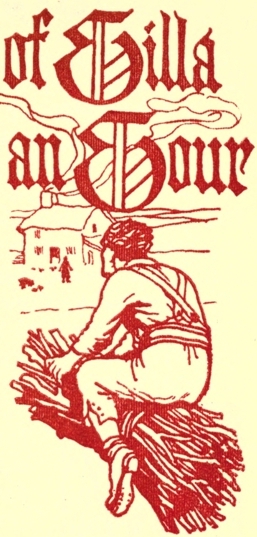
Tom made no bones about letting him off; and as soon as he got the club in his hands he sat down on the bresna and gave it a tap with the kippeen, and says, “Bresna, I had a great trouble gathering you, and run the risk of my life for you; the least you can do is to carry me home.” And, sure enough, the wind of the word was all it wanted. It went off through the wood, groaning and cracking till it came to the widow’s door.
ell, when the sticks were all burned Tom was sent off again to pick more; and this time he had to fight with a giant with two heads on him. Tom had a little more trouble with him—that’s all; and the prayers he said was to give Tom a fife that nobody could help dancing when he was playing it. Begonies, he made the big faggot dance home, with himself sitting on it. Well, if you were to count all the steps from this to Dublin, dickens a bit you’d ever arrive there. The next giant was a beautiful boy with three heads on him. He had neither prayers nor catechism no more nor the others; and so he gave Tom a bottle of green ointment that wouldn’t let you be burned, nor scalded, nor wounded. “And now,” says he, “there’s no more of us. You may come and gather sticks here till little Lunacy Day in harvest without giant or fairy man to disturb you.”
Well, now, Tom was prouder nor ten paycocks, and used to take a walk down street in the heel of the evening; but some of the little boys had no more manners nor if they were Dublin jackeens, and put out their tongues at Tom’s club and Tom’s goat-skin. He didn’t like that at all, and it would be mean to give one of them a clout. At last, what should come through the town but a kind of bellman, only it’s a big bugle he had, and a huntsman’s cap on his head, and a kind of painted shirt. So this—he wasn’t a bellman, and I don’t know what to call him—bugleman, maybe—proclaimed that the King of Dublin’s daughter was so melancholy that she didn’t give a laugh for seven years, and that her father would grant her in marriage to whoever would make her laugh three times. “That’s the very thing for me to try,” says Tom; and so, without burning any more daylight, he kissed his mother, curled his club at the little boys, and he set off along the yalla highroad to the town of Dublin.
At last Tom came to one of the city gates, and the guards laughed and cursed at him instead of letting him through. Tom stood it all for a little time, but at last one of them—out of fun, as he said—drove his bagnet half an inch or so into his side. Tom did nothing but take the fellow by the scruff of his neck and the waistband of his corduroys and fling him into the canal. Some ran to pull the fellow out, and others to let manners into the vulgarian with their swords and daggers; but a tap from his club sent them headlong into the moat or down on the stones, and they were soon begging him to stay his hands.
So at last one of them was glad enough to show Tom the way to the palace yard; and there was the King and the Queen, and the princess in a gallery, looking at all sorts of wrestling and sword-playing, and rinka-fadhas (long dances) and mumming, all to please the princess; but not a smile came over her handsome face.
ell, they all stopped when they seen the young giant, with his boy’s face and long black hair, and his short curly beard—for his poor mother couldn’t afford to buy razhurs—and his great strong arms and bare legs, and no covering but the goat-skin that reached from his waist to his knees. But an envious wizened basthard of a fellow, with a red head, that wished to be married to the princess, and didn’t like how she opened her eyes at Tom, came forward, and asked his business very snappishly. “My business,” says Tom, says he, “is to make the beautiful princess, God bless her, laugh three times.” “Do you see all them merry fellows and skilful swordsmen,” says the other, “that could eat you up with a grain of salt, and not a mother’s soul of ’em ever got a laugh from her these seven years?” So the fellows gathered round Tom, and the bad man aggravated him till he told them he didn’t care a pinch of snuff for the whole bilin’ of ’em; let ’em come on, six at a time, and try what they could do. The King, that was too far off to hear what they were saying, asked what did the stranger want. “He wants,” says the red-headed fellow, “to make hares of your best men.” “Oh!” says the King, “if that’s the way, let one of ’em turn out and try his mettle.” So one stood forward, with soord and pot-lid, and made a cut at Tom. He struck the fellow’s elbow with the club, and up over their heads flew the sword, and down went the owner of it on the gravel from a thump he got on the helmet. Another took his place, and another, and another, and then half a dozen at once, and Tom sent swords, helmets, shields, and bodies rolling over and over, and themselves bawling out that they were kilt, and disabled, and damaged, and rubbing their poor elbows and hips, and limping away. Tom contrived not to kill anyone; and the princess was so amused that she let a great sweet laugh out of her that was heard all over the yard. “King of Dublin,” says Tom, “I’ve quarter of your daughter.” And the King didn’t know whether he was glad or sorry, and all the blood in the princess’s heart run into her cheeks.
o there was no more fighting that day, and Tom was invited to dine with the royal family. Next day Redhead told Tom of a wolf, the size of a yearling heifer, that used to be serenading (sauntering) about the walls, and eating people and cattle; and said what a pleasure it would give the King to have it killed. “With all my heart,” says Tom. “Send a jackeen to show me where he lives, and we’ll see how he behaves to a stranger.” The princess was not well pleased, for Tom looked a different person with fine clothes and a nice green birredh over his long, curly hair; and besides, he’d got one laugh out of her. However, the King gave his consent; and in an hour and a half the horrible wolf was walking in the palace yard, and Tom a step or two behind, with his club on his shoulder, just as a shepherd would be walking after a pet lamb. The King and Queen and princess were safe up in their gallery, but the officers and people of the court that were padrowling about the great bawn, when they saw the big baste coming in gave themselves up, and began to make for doors and gates; and the wolf licked his chops, as if he was saying, “Wouldn’t I enjoy a breakfast off a couple of yez!” The King shouted out, “O Gilla na Chreck an Gour, take away that terrible wolf, and you must have all my daughter.” But Tom didn’t mind him a bit. He pulled out his flute and began to play like vengeance; and dickens a man or boy in the yard but began shovelling away heel and toe, and the wolf himself was obliged to get on his hind legs and dance Tatther Jack Walsh along with the rest. A good deal of the people got inside and shut the doors, the way the hairy fellow wouldn’t pin them; but Tom kept playing, and the outsiders kept shouting and dancing, and the wolf kept dancing and roaring with the pain his legs were giving him: and all the time he had his eyes on Redhead, who was shut out along with the rest. Wherever Redhead went the wolf followed, and kept one eye on him and the other on Tom, to see if he would give him leave to eat him. But Tom shook his head, and never stopped the tune, and Redhead never stopped dancing and bawling and the wolf dancing and roaring, one leg up and the other down, and he ready to drop out of his standing from fair tiresomeness.
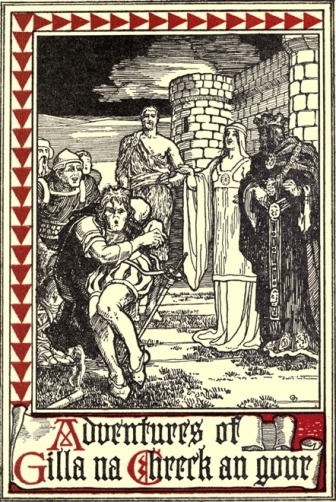
When the princess seen that there was no fear of anyone being kilt she was so divarted by the stew that Redhead was in that she gave another great laugh; and well become Tom, out he cried, “King of Dublin, I have two quarters of your daughter.” “Oh, quarters or alls,” says the King, “put away that divel of a wolf and we’ll see about it.” So Gilla put his flute in his pocket, and says he to the baste that was sittin’ on his currabingo ready to faint, “Walk off to your mountains, my fine fellow, and live like a respectable baste; and if ever I find you come within seven miles of any town——” He said no more, but spit in his fist, and gave a flourish of his club. It was all the poor divel wanted: he put his tail between his legs and took to his pumps without looking at man nor mortial, and neither sun, moon, nor stars ever saw him in sight of Dublin again.
t dinner everyone laughed but the foxy fellow; and, sure enough, he was laying out how he’d settle poor Tom next day. “Well, to be sure!” says he, “King of Dublin, you are in luck. There’s the Danes moidhering us to no end. D—— run to Lusk wid ’em! and if anyone can save us from ’em it is this gentleman with the goat-skin. There is a flail hangin’ on the collar-beam in Hell, and neither Dane nor Devil can stand before it.” “So,” says Tom to the King, “will you let me have the other half of the princess if I bring you the flail?” “No, no,” says the princess, “I’d rather never be your wife than see you in that danger.”
But Redhead whispered and nudged Tom about how shabby it would look to reneague the adventure. So he asked him which way he was to go, and Redhead directed him through a street where a great many bad women lived, and a great many shibbeen houses were open, and away he set.
Well, he travelled and travelled till he came in sight of the walls of Hell; and, bedad, before he knocked at the gates, he rubbed himself over with the greenish ointment. When he knocked a hundred little imps popped their heads out through the bars, and axed him what he wanted. “I want to speak to the big divel of all,” says Tom: “open the gate.”
It wasn’t long till the gate was thrune open, and the Ould Boy received Tom with bows and scrapes, and axed his business. “My business isn’t much,” says Tom. “I only came for the loan of that flail that I see hanging on the collar-beam for the King of Dublin to give a thrashing to the Danes.” “Well,” says the other, “the Danes is much better customers to me; but, since you walked so far, I won’t refuse. Hand that flail,” says he to a young imp; and he winked the far-off eye at the same time. So while some were barring the gates, the young devil climbed up and took down the iron flail that had the handstaff and booltheen both made out of red-hot iron. The little vagabond was grinning to think how it would burn the hands off of Tom, but the dickens a burn it made on him, no more nor if it was a good oak sapling. “Thankee,” says Tom; “now would you open the gate for a body and I’ll give you no more trouble.” “Oh, tramp!” says Ould Nick, “is that the way? It is easier getting inside them gates than getting out again. Take that tool from him, and give him a dose of the oil of stirrup.” So one fellow put out his claws to seize on the flail, but Tom gave him such a welt of it on the side of his head that he broke off one of his horns, and made him roar like a divel as he was. Well, they rushed at Tom, but he gave them, little and big, such a thrashing as they didn’t forget for a while. At last says the ould thief of all, rubbing his elbows, “Let the fool out; and woe to whoever lets him in again, great or small.”
So out marched Tom and away with him, without minding the shouting and cursing they kept up at him from the tops of the walls. And when he got home to the big bawn of the palace, there never was such running and racing as to see himself and the flail. When he had his story told he laid down the flail on the stone steps, and bid no one for their lives to touch it. If the King and Queen and princess made much of him before they made ten times as much of him now; but Redhead, the mean scruff-hound, stole over, and thought to catch hold of the flail to make an end of him. His fingers hardly touched it, when he let a roar out of him as if heaven and earth were coming together, and kept flinging his arms about and dancing that it was pitiful to look at him. Tom run at him as soon as he could rise, caught his hands in his own two, and rubbed them this way and that, and the burning pain left them before you could reckon one. Well, the poor fellow, between the pain that was only just gone, and the comfort he was in, had the comicalest face that ever you see; it was such a mixerum-gatherum of laughing and crying. Everyone burst out a laughing—the princess could not stop no more than the rest—and then says Gilla, or Tom, “Now, ma’am, if there were fifty halves of you I hope you’ll give me them all.” Well, the princess had no mock modesty about her. She looked at her father, and, by my word, she came over to Gilla and put her two delicate hands into his two rough ones, and I wish it was myself was in his shoes that day!
Tom would not bring the flail into the palace. You may be sure no other body went near it; and when the early risers were passing next morning they found two long clefts in the stone where it was, after burning itself an opening downwards, nobody could tell how far. But a messenger came in at noon and said that the Danes were so frightened when they heard of the flail coming into Dublin that they got into their ships and sailed away.
Well, I suppose before they were married Gilla got some man like Pat Mara of Tomenine to larn him the “principles of politeness,” fluxions, gunnery, and fortifications, decimal fractions, practice, and the rule-of-three direct, the way he’d be able to keep up a conversation with the royal family. Whether he ever lost his time larning them sciences, I’m not sure, but it’s as sure as fate that his mother never more saw any want till the end of her days.
Patrick Kennedy.
t is well known that the good people cannot stand mean ways. Now, there once lived a house-wife who had a sharp eye to her own good in this world, and gave alms of what she had no use, for the good of her soul. One day a hill-man knocked at her door. “Can you lend us a saucepan, good mother?” said he. “There’s a wedding in the hill, and all the pots are in use.” “Is he to have one?” asked the servant girl who opened the door. “Ay, to be sure,” said the house-wife. But when the maid was taking a saucepan from the shelf, she pinched her arm and whispered sharply, “Not that, you stupid; get the old one out of the cupboard. It leaks, and the hill-men are so neat and such nimble workers that they are sure to mend it before they send it home. So one does a good turn to the good people and saves sixpence from the tinker.” The maid fetched the saucepan, which had been laid by till the tinker’s next visit, and gave it to the dwarf, who thanked her and went away.
The saucepan was soon returned neatly mended and ready for use. At supper time the maid filled the pan with milk and set it on the fire for the children’s supper, but in a few minutes the milk was so burnt and smoked that no one could touch it, and even the pigs would not drink the wash into which it was thrown.
h, you good-for-nothing slut!” cried the house-wife, as she this time filled the pan herself. “You would ruin the richest, with your careless ways; there’s a whole quart of good milk spoilt at once.” “And that’s twopence,” cried a voice from the chimney, a queer whining voice like some old body who was always grumbling over something.
The house-wife had not left the saucepan for two minutes when the milk boiled over, and it was all burnt and smoked as before. “The pan must be dirty,” cried the house-wife in a rage; “and there are two full quarts of milk as good as thrown to the dogs.” “And that’s fourpence,” said the voice in the chimney.
After a long scrubbing the saucepan was once more filled and set on the fire, but it was not the least use, the milk was burnt and smoked again, and the house-wife burst into tears at the waste, crying out, “Never before did such a thing happen to me since I kept house! Three quarts of milk burnt for one meal!” “And that’s sixpence,” cried the voice from the chimney. “You didn’t save the tinker after all,” with which the hill-man himself came tumbling down the chimney, and went off laughing through the door. But from that time the saucepan was as good as any other.
Juliana Horatia Ewing.
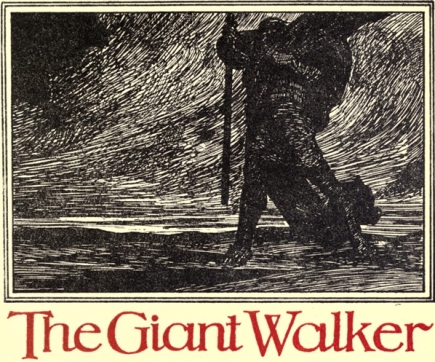
ow, all the night around their echoing camp Was heard continuous from the hills a sound as of the tramp Of giant footsteps; but, so thick the white mist lay around, None saw the Walker, save the King. He, starting at the sound, Called to his foot his fierce red hound; athwart his shoulders cast A shaggy mantle, grasped his spear, and through the moonlight passed Alone up dark Ben-Boli’s heights, towards which, above the woods, With sound as when at close of eve the noise of falling floods Is borne to shepherd’s ear remote on stilly upland lawn, The steps along the mountain-side with hollow fall came on. Fast beat the hero’s heart; and close down-crouching by his knee Trembled the hound, while, through the haze, huge as through mists at sea, The week-long sleepless mariner descries some mountain cape, Wreck-infamous, rise on his lee, appeared a monstrous Shape, Striding impatient, like a man much grieved, who walks alone, Considering of a cruel wrong; down from his shoulders thrown A mantle, skirted stiff with soil splashed from the miry ground, At every stride against his calves struck with as loud rebound As makes the main-sail of a ship brought up along the blast, When with the coil of all its ropes it beats the sounding mast. So, striding vast, the giant passed; the King held fast his breath— Motionless, save his throbbing heart; and chill and still as death Stood listening while, a second time, the giant took the round Of all the camp; but, when at length, for the third time, the sound Came up, and through the parting haze a third time huge and dim Rose out the Shape, the valiant hound sprang forth and challenged him. And forth, disdaining that a dog should put him so to shame, Sprang Congal, and essayed to speak: “Dread Shadow, stand! Proclaim What wouldst thou that thou thus all night around my camp shouldst keep Thy troublous vigil banishing the wholesome gift of sleep From all our eyes, who, though inured to dreadful sounds and sights By land and sea, have never yet, in all our perilous nights, Lain in the ward of such a guard.” The Shape made answer none, But with stern wafture of its hand went angrier striding on, Shaking the earth with heavier steps. Then Congal on his track Sprang fearless. “Answer me, thou churl!” he cried, “I bid thee back!” But while he spoke, the giant’s cloak around his shoulders grew Like to a black-bulged thunder-cloud, and sudden, out there flew From all its angry swelling folds, with uproar unconfined, Direct against the King’s pursuit, a mighty blast of wind. Loud flapped the mantle, tempest-lined, while, fluttering down the gale, As leaves in autumn, man and hound were swept into the vale; And, heard o’er all the huge uproar, through startled Dalaray The giant went, with stamp and clash, departing south away. Sir Samuel Ferguson.
ow, it chanced at one time during the chase, while they were hunting over the plain of Cliach, that Finn went to rest on the hill of Collkilla, which is now called Knockainy; and he had his hunting-tents pitched on a level spot near the summit, and some of his chief heroes tarried with him.
When the King and his companions had taken their places on the hill, the Feni unleashed their gracefully shaped, sweet-voiced hounds through the woods and sloping glens. And it was sweet music to Finn’s ear, the cry of the long-snouted dogs, as they routed the deer from their covers and the badgers from their dens; the pleasant, emulating shouts of the youths; the whistling and signalling of the huntsmen; and the encouraging cheers of the mighty heroes, as they spread themselves through the glens and woods, and over the broad green plain of Cliach.
Then did Finn ask who of all his companions would go to the highest point of the hill directly over them to keep watch and ward and to report how the chase went on. For, he said, the Dedannans were ever on the watch to work the Feni mischief by their druidical spells, and more so during the chase than at other times.
Finn Ban Mac Bresal stood forward and offered to go; and, grasping his broad spears, he went to the top, and sat viewing the plain to the four points of the sky. And the King and his companions brought forth the chess-board and chess-men and sat them down to a game.
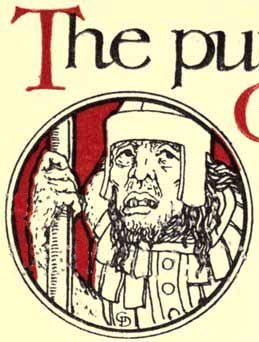
Finn Ban Mac Bresal had been watching only a little time when he saw on a plain to the east a Fomor of vast size coming towards the hill, leading a horse. As he came nearer Finn Ban observed that he was the ugliest-looking giant his eyes ever lighted on. He had a large, thick body, bloated and swollen out to a great size; clumsy, crooked legs; and broad, flat feet turned inwards. His hands and arms and shoulders were bony and thick and very strong-looking; his neck was long and thin; and while his head was poked forward, his face was turned up, as he stared straight at Finn Mac Bresal. He had thick lips, and long, crooked teeth; and his face was covered all over with bushy hair.
e was fully armed; but all his weapons were rusty and soiled and slovenly looking. A broad shield of a dirty, sooty colour, rough and battered, hung over his back; he had a long, heavy, straight sword at his left hip; and he held in his left hand two thick-handled, broad-headed spears, old and rusty, and seeming as if they had not been handled for years. In his right hand he held an iron club, which he dragged after him with its end on the ground; and, as it trailed along, it tore up a track as deep as the furrow a farmer ploughs with a team of oxen.
The horse he led was even larger in proportion than the giant himself, and quite as ugly. His great carcass was covered all over with tangled scraggy hair, of a sooty black; you could count his ribs and all the points of his big bones through his hide; his legs were crooked and knotty; his neck was twisted; and as for his jaws, they were so long and heavy that they made his head look twice too large for his body.
The giant held him by a thick halter, and seemed to be dragging him forward by main force, the animal was so lazy and so hard to move. Every now and then, when the beast tried to stand still, the giant would give him a blow on the ribs with his big iron club, which sounded as loud as the thundering of a great billow against the rough-headed rocks of the coast. When he gave him a pull forward by the halter, the wonder was that he did not drag the animal’s head away from his body; and, on the other hand, the horse often gave the halter such a tremendous tug backwards that it was equally wonderful how the arm of the giant was not torn away from his shoulder.
hen at last he had come up he bowed his head and bended his knee, and saluted the King with great respect.
Finn addressed him; and after having given him leave to speak he asked him who he was, and what was his name, and whether he belonged to one of the noble or ignoble races; also what was his profession or craft, and why he had no servant to attend to his horse.
The big man made answer and said, “King of the Feni, whether I come of a noble or of an ignoble race, that, indeed, I cannot tell, for I know not who my father and mother were. As to where I came from, I am a Fomor of Lochlann in the north; but I have no particular dwelling-place, for I am continually travelling about from one country to another, serving the great lords and nobles of the world, and receiving wages for my service.
“In the course of my wanderings I have often heard of you, O King, and of your greatness and splendour and royal bounty; and I have come now to ask you to take me into your service for one year; and at the end of that time I shall fix my own wages, according to my custom.
“You ask me also why I have no servant for this great horse of mine. The reason of that is this: at every meal I eat my master must give me as much food and drink as would be enough for a hundred men; and whosoever the lord or chief may be that takes me into his service, it is quite enough for him to have to provide for me, without having also to feed my servant.
oreover, I am so very heavy and lazy that I should never be able to keep up with a company on march if I had to walk; and this is my reason for keeping a horse at all.

“My name is the Gilla Dacker, and it is not without good reason that I am so called. For there never was a lazier or worse servant than I am, or one that grumbles more at doing a day’s work for his master. And I am the hardest person in the world to deal with; for, no matter how good or noble I may think my master, or how kindly he may treat me, it is hard words and foul reproaches I am likely to give him for thanks in the end.
“This, O Finn, is the account I have to give of myself, and these are my answers to your questions.”
“Well,” answered Finn, “according to your own account you are not a very pleasant fellow to have anything to do with; and of a truth there is not much to praise in your appearance. But things may not be so bad as you say; and, anyhow, as I have never yet refused any man service and wages, I will not now refuse you.”
Whereupon Finn and the Gilla Dacker made covenants, and the Gilla Dacker was taken into service for a year.
“And now,” said the Gilla Dacker, “as to this same horse of mine, I find I must attend to him myself, as I see no one here worthy of putting a hand near him. So I will lead him to the nearest stud, as I am wont to do, and let him graze among your horses. I value him greatly, however, and it would grieve me very much if any harm were to befall him; so,” continued he, turning to the King, “I put him under your protection, O King, and under the protection of all the Feni that are here present.”
t this speech the Feni all burst out laughing to see the Gilla Dacker showing such concern for his miserable, worthless old skeleton of a horse.
Howbeit, the big man, giving not the least heed to their merriment, took the halter off the horse’s head and turned him loose among the horses of the Feni.
But now, this same wretched-looking old animal, instead of beginning to graze, as everyone thought he would, ran in among the horses of the Feni, and began straightway to work all sorts of mischief. He cocked his long, hard, switchy tail straight out like a rod, and, throwing up his hind legs, he kicked about on this side and on that, maiming and disabling several of the horses. Sometimes he went tearing through the thickest of the herd, butting at them with his hard, bony forehead; and he opened out his lips with a vicious grin and tore all he could lay hold on with his sharp, crooked teeth, so that none were safe that came in his way either before or behind.
At last he left them, and was making straight across to a small field where Conan Mail’s horses were grazing by themselves, intending to play the same tricks among them. But Conan, seeing this, shouted in great alarm to the Gilla Dacker to bring away his horse, and not let him work any more mischief; and threatening, if he did not do so at once, to go himself and knock the brains out of the vicious old brute on the spot.
ut the Gilla Dacker told Conan that he saw no way of preventing his horse from joining the others, except someone put the halter on him. “And,” said he to Conan, “there is the halter; and if you are in any fear for your own animals, you may go yourself and bring him away from the field.”
Conan was in a mighty rage when he heard this; and as he saw the big horse just about to cross the fence, he snatched up the halter, and, running forward with long strides, he threw it over the animal’s head and thought to lead him back. But in a moment the horse stood stock still, and his body and legs became as stiff as if they were made of wood; and though Conan pulled and tugged with might and main, he was not able to stir him an inch from his place.
At last Fergus Finnvel, the poet, spoke to Conan and said, “I never would have believed, Conan Mail, that you could be brought to do horse-service for any knight or noble in the whole world; but now, indeed, I see that you have made yourself a horse-boy to an ugly foreign giant, so hateful-looking and low-born that not a man of the Feni would have anything to say to him. As you have, however, to mind this old horse in order to save your own, would it not be better for you to mount him and revenge yourself for all the trouble he is giving you, by riding him across the country, over the hill-tops, and down into the deep glens and valleys, and through stones and bogs and all sorts of rough places, till you have broken the heart in his big ugly body?”
onan, stung by the cutting words of the poet and by the jeers of his companions, jumped upon the horse’s back, and began to beat him mightily with his heels and with his two big heavy fists to make him go; but the horse seemed not to take the least notice, and never stirred.
“I know the reason he does not go,” said Fergus Finnvel; “he has been accustomed to carry a horseman far heavier than you—that is to say, the Gilla Dacker; and he will not move till he has the same weight on his back.”
At this Conan Mail called out to his companions, and asked which of them would mount with him and help to avenge the damage done to their horses.
“I will go,” said Coil Croda the Battle Victor, son of Criffan; and up he went. But the horse never moved.
Dara Donn Mac Morna next offered to go, and mounted behind the others; and after him Angus Mac Art Mac Morna. And the end of it was that fourteen men of the Clann Baskin and Clann Morna got up along with Conan; and all began to thrash the horse together with might and main. But they were none the better for it, for he remained standing stiff and immovable as before. They found, moreover, that their seat was not at all an easy one—the animal’s back was so sharp and bony.
When the Gilla Dacker saw the Feni beating his horse at such a rate he seemed very angry, and addressed the King in these words:
ing of the Feni, I now see plainly that all the fine accounts I heard about you and the Feni are false, and I will not stay in your service—no, not another hour. You can see for yourself the ill usage these men are giving my horse without cause; and I leave you to judge whether anyone could put up with it—anyone who had the least regard for his horse. The time is, indeed, short since I entered your service, but I now think it a great deal too long; so pay me my wages and let me go my ways.”
But Finn said, “I do not wish you to go; stay on till the end of your year, and then I will pay you all I promised you.”
“I swear,” answered the Gilla Dacker, “that if this were the very last day of my year, I would not wait till morning for my wages after this insult. So, wages or no wages, I will now seek another master; but from this time forth I shall know what to think of Finn Mac Cumal and his Feni!”
With that the Gilla Dacker stood up as straight as a pillar, and, turning his face towards the south-west, he walked slowly away.
When the horse saw his master leaving the hill he stirred himself at once and walked quietly after him, bringing the fifteen men away on his back. And when the Feni saw this they raised a loud shout of laughter, mocking them.
The Gilla Dacker, after he had walked some little way, looked back, and, seeing that his horse was following, he stood for a moment to tuck up his skirts. Then, all at once changing his pace, he set out with long, active strides; and if you know what the speed of a swallow is flying across a mountain-side, or the dry fairy wind of a March day sweeping over the plains, then you can understand the swiftness of the Gilla Dacker as he ran down the hill-side towards the south-west.
either was the horse behindhand in the race; for though he carried a heavy load, he galloped like the wind after his master, plunging and bounding forward with as much freedom as if he had nothing at all on his back.
The men now tried to throw themselves off; but this, indeed, they were not able to do, for the good reason that they found themselves fastened firmly, hands and feet and all, to the horse’s back.
And now Conan, looking round, raised his big voice and shouted to Finn and the Feni, asking them were they content to let their friends be carried off in that manner by such a horrible, foul-looking old spectre of a horse.
Finn and the others, hearing this, seized their arms and started off in pursuit. Now, the way the Gilla Dacker and his horse took was first through Fermore, which is at the present day called Hy Conall Gavra; next over the wide, heathy summit of Slieve Lougher; from that to Corca Divna; and they ran along by Slieve Mish till they reached Cloghan Kincat, near the deep green sea. And so the great horse continued his course without stop or stay, bringing the sixteen Feni with him through the sea. Now, this is how they fared in the sea while the horse was rushing farther and farther to the west: they had always a dry, firm strand under them, for the waters retired before the horse; while behind them was a wild, raging sea, which followed close after and seemed ready every moment to topple over their heads. But, though the billows were tumbling and roaring all round, neither horse nor riders were wetted by as much as a drop of brine or a dash of spray.
Then Finn spoke and asked the chiefs what they thought best to be done; and they told him they would follow whatsoever counsel he and Fergus Finnvel, the poet, gave them. Then Finn told Fergus to speak his mind; and Fergus said:
“My counsel is that we go straightway to Ben Edar, where we shall find a ship ready to sail. For our forefathers, when they wrested the land from the gifted, bright-complexioned Dedannans, bound them by covenant to maintain this ship for ever, fitted with all things needful for a voyage, even to the smallest article, as one of the privileges of Ben Edar; so that if at any time one of the noble sons of Gael Glas wished to sail to distant lands from Erin, he should have a ship lying at hand in the harbour ready to begin his voyage.”
hey agreed to this counsel, and turned their steps without delay northwards towards Ben Edar. They had not gone far when they met two noble-looking youths, fully armed, and wearing over their armour beautiful mantles of scarlet silk, fastened by brooches of gold. The strangers saluted the King with much respect; and the King saluted them in return. Then, having given them leave to converse, he asked them who they were, whither they had come, and who the prince or chief was that they served. And the elder answered:
“My name is Feradach, and my brother’s name is Foltlebar; and we are the two sons of the King of Innia. Each of us professes an art; and it has long been a point of dispute between us which art is the better, my brother’s or mine. Hearing that there is not in the world a wiser or more far-seeing man than thou art, O King, we have come to ask thee to take us into thy service among thy household troops for a year, and at the end of that time to give judgment between us in this matter.”
Finn asked them what were the two arts they professed.
“My art,” answered Feradach, “is this. If at any time a company of warriors need a ship, give me only my joiner’s axe and my crann-tavall, and I am able to provide a ship for them without delay. The only think I ask them to do is this—to cover their heads close, and keep them covered, while I give the crann-tavall three blows of my axe. Then I tell them to uncover their heads; and lo, there lies the ship in harbour ready to sail!”
hen Foltlebar spoke and said, “This, O King, is the art I profess. On land I can track the wild duck over nine ridges and nine glens, and follow her without being once thrown out till I drop upon her in her nest. And I can follow up a track on sea quite as well as on land if I have a good ship and crew.”
Finn replied, “You are the very men I want; and I now take you both into my service. At this moment I need a good ship and a skilful pilot more than any two things in the whole world.”
Whereupon Finn told them the whole story of the Gilla Dacker’s doings from beginning to end. “And we are now,” said he, “on our way to Ben Edar to seek a ship that we may follow this giant and his horse and rescue our companions.”
Then Feradach said, “I will get you a ship—a ship that will sail as swiftly as a swallow can fly!”
And Foltlebar said, “I will guide your ship in the track of the Gilla Dacker till ye lay hands on him, in whatsoever quarter of the world he may have hidden himself!”
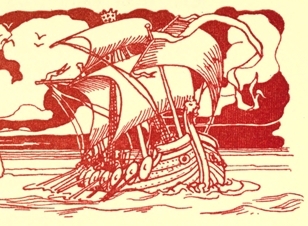
And so they turned back to Cloghan Kincat. And when they had come to the beach Feradach told them to cover their heads, and they did so. Then he struck three blows of his axe on the crann-tavall; after which he made them look. And lo, they saw a ship fully fitted out with oars and sails and with all things needed for a long voyage riding before them in the harbour!
hen they went on board and launched their ship on the cold, bright sea; and Foltlebar was their pilot and steersman. And they set their sail and plied their slender oars, and the ship moved swiftly westward till they lost sight of the shores of Erin; and they saw nothing all round them but a wide girdle of sea. After some days’ sailing a great storm came from the west, and the black waves rose up against them so that they had much ado to keep their vessel from sinking. But through all the roaring of the tempest, through the rain and blinding spray, Foltlebar never stirred from the helm or changed his course, but still kept close on the track of the Gilla Dacker.
At length the storm abated and the sea grew calm. And when the darkness had cleared away they saw to the west, a little way off, a vast rocky cliff towering over their heads to such a height that its head seemed hidden among the clouds. It rose up sheer from the very water, and looked at that distance as smooth as glass, so that at first sight there seemed no way to reach the top.
Foltlebar, after examining to the four points of the sky, found the track of the Gilla Dacker as far as the cliff, but no farther. And he accordingly told the heroes that he thought it was on the top of that rock the giant lived; and that, anyhow, the horse must have made his way up the face of the cliff with their companions.
hen the heroes heard this they were greatly cast down and puzzled what to do; for they saw no way of reaching the top of the rock; and they feared they should have to give up the quest and return without their companions. And they sat down and looked up at the cliff with sorrow and vexation in their hearts.
Fergus Finnvel, the poet, then challenged the hero Dermat O’Dyna to climb the rock in pursuit of the Gilla Dacker, and he did so, and on reaching the summit found himself in a beautiful fairy plain. He fared across it and came to a great tree laden with fruit beside a well as clear as crystal. Hard by, on the brink of the well, stood a tall pillar stone, and on its top lay a golden-chased drinking horn. He filled the horn from the well and drank, but had scarcely taken it from his lips when he saw a fully armed wizard champion advancing to meet him with looks and gestures of angry menace. The wizard upbraided him for entering his territory without leave and for drinking out of his well from his drinking horn, and thereupon challenged him to fight. For four days long they fought, the wizard escaping from Dermat every even-fall by leaping into the well and disappearing down through it. But on the fourth evening Dermat closed with the wizard when about to spring into the water, and fell with him into the well.
On reaching the bottom the wizard wrested himself away and started running, and Dermat found himself in a strangely beautiful country with a royal palace hard by, in front of which armed knights were engaged in warlike exercises. Through them the wizard ran, but, when Dermat attempted to follow, his way was barred by their threatening weapons. Nothing daunted, he fell upon them in all his battle fury, and routed them so entirely that they fled and shut themselves up in the castle or took refuge in distant woods.
vercome with his battle toil (and smarting all over with wounds) Dermat fell into a dead sleep, from which he was wakened by a friendly blow from the flat of a sword held by a young, golden-haired hero, who proved to be the brother of the Knight of Valour, King of that country of Tir-fa-tonn, whom in the guise of the Knight of the Fountain, Dermat had fought and chased away.
A part of the kingdom belonging to him had been seized by his wizard brother, and he now seeks and obtains Dermat’s aid to win it back for him.
When Dermat at last meets Finn and the other Feni who had gone in pursuit of him into the Kingdom of Sorca, at the summit of the great rock, he is able to relate how he headed the men of the Knight of Valour against the Wizard King, and slew him and defeated his army.
“And now,” continued he, bringing forth the Knight of Valour from among the strange host, “this is he who was formerly called the Knight of Valour, but who is now the King of Tir-fa-tonn. Moreover, this King has told me, having himself found it out by his druidical art, that it was Avarta the Dedannan (the son of Illahan of the Many-coloured Raiment) who took the form of the Gilla Dacker, and who brought the sixteen Feni away to the Land of Promise, where he now holds them in bondage.”
Then Foltlebar at once found the tracks of the Gilla Dacker and his horse. He traced them from the very edge of the rock across the plain to the sea at the other side; and they brought round their ship and began their voyage. But this time Foltlebar found it very hard to keep on the track; for the Gilla Dacker, knowing that there were not in the world men more skilled in following up a quest than the Feni, took great pains to hide all traces of the flight of himself and his horse; so that Foltlebar was often thrown out; but he always recovered the track after a little time.