Preface (continued 6)
Reading edition
When the King perceived the pony coming, he rose out. He took hold of her with his two hands. He took her in. He smothered her with kisses, and drowned her with tears; he dried her with finest cloths of silk and satin.
This is what the lady was doing while they were away. She boiled pitch, and filled a barrel, and that boiling. Now she went beside it. She rubbed the healing water to herself. She came out; she went to the barrel. She gave a jump in and out of the barrel. Three times she went in and out. She said she would never marry anyone who could not do the same. The young King came. He went to the barrel. He fell half in, half out.
e was all boiled and burned. Another gentleman came. He gave a jump into the barrel. He was burned. He came not out till he died. After that there was no one going in or out. The barrel was there, and no one at all was going near it. The lad went up to it. He rubbed the healing water on himself. He came to the barrel. He jumped in and out three times. He was watching her. She came out. She said she would never marry anyone but him.
Came the priest of the pattens, and the clerk of the bells. The pair were married. The wedding lasted three days and three nights. When it was over, the lad went to look at the place where the pony was. He never remembered to go and see the pony during the wedding. He found nothing but a heap of bones. There were two champions and two girls playing cards. The lad went crying when he saw the bones of the pony. One of the girls asked what was the matter with him. He said it was all one to her—that she cared nothing for his troubles.
“I would like to get knowledge of the cause why you are crying.”
“It was my pony who was here. I never remembered to see her during the wedding. I have nothing now but her bones. I don’t know what I shall do after her. It was she who did all that I accomplished.”
The girl went laughing.
“Would you know your pony if you saw her?”
“I would know,” said he.
She laid aside the cards. She stood up.
“Isn’t that your pony?” said she.
“It is,” said he.
“I was the pony,” said the girl, “and the two ravens who went in to drink my blood my two brothers. When the ravens came out, a little bird went in. You closed the pony. You would not let the little bird out till they brought the bottle of healing water that was in the eastern world. They brought the bottle to you. The little bird was my sister. It was my brothers were the ravens. We were all under enchantments. It is my sister who is married to you. The enchantments are gone from us since she was married.”
W. Larminie.
(From “West Irish Folk Tales.”)
(A Legend of Glendalough.)
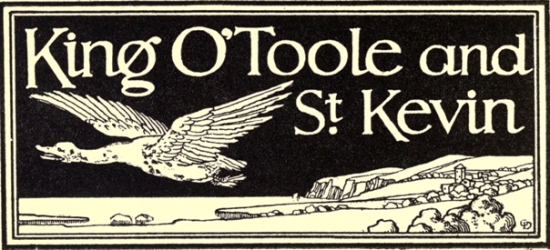
here was wanst a king, called King O’Toole, who was a fine ould king in the ould ancient times, long ago; and it was him that owned the Churches in the airly days.
“Surely,” said I, “the Churches were not in King O’Toole’s time?”
“Oh, by no manes, your honor—throth, it’s yourself that’s right enough there; but you know the place is called ‘The Churches’ bekase they wor built afther by St. Kavin, and wint by the name o’ the Churches iver more; and, therefore, av coorse, the place bein’ so called, I say that the King owned the Churches—and why not, sir, seein’ ’twas his birthright, time out o’ mind, beyant the flood? Well, the King (you see) was the right sort—he was the rale boy, and loved sport as he loved his life, and huntin’ in partic’lar; and from the risin’ o’ the sun up he got, and away he wint over the mountains beyant afther the deer: and the fine times them wor; for the deer was as plinty thin, aye throth, far plintyer than the sheep is now; and that’s the way it was with the King, from the crow o’ the cock to the song o’ the redbreast. Well, it was all mighty good as long as the King had his health; but, you see, in coorse o’ time, the King grewn ould, by raison he was stiff in his limbs, and when he got sthricken in years, his heart failed him, and he was lost intirely for want o’ divarshin, bekase he couldn’t go a huntin’ no longer; and, by dad, the poor King was obleeged at last for to get a goose to divart him. You see, the goose used for to swim acrass the lake, and go down divin’ for throut (and not finer throut in all Ireland than the same throut) and cotch fish on a Friday for the King, and flew every other day round about the lake divartin’ the poor King that you’d think he’d break his sides laughin’ at the frolicksome tricks av his goose; so, in coorse o’ time, the goose was the greatest pet in the counthry, and the biggest rogue, and divarted the King to no end, and the poor King was as happy as the day was long. So that’s the way it was; and all wint on mighty well antil, by dad, the goose got sthricken in years, as well as the King, and grew stiff in the limbs, like her masther, and couldn’t divart him no longer; and then it was that the poor King was lost complate, and didn’t know what in the wide world to do, seein’ he was gone out of all divarshin by raison that the goose was no more in the flower of her blume.
“Well, the King was nigh broken-hearted and melancholy intirely, and was walkin’ one mornin’ by the edge of the lake, lamentin’ his cruel fate, an’ thinkin’ o’ drownin’ himself, that could get no divarshin in life, when all of a suddint, turnin’ round the corner beyant, who should he meet but a mighty dacent young man comin’ up to him.
“‘God save you,’ says the King (for the King was a civil-spoken gintleman, by all accounts), ‘God save you,’ says he to the young man.
“‘God save you kindly,’ says the young man to him back again; ‘God save you, King O’Toole.’
“‘Thrue for you,’ says the King, ‘I am King O’Toole,’ says he, ‘prince and plennypennytinchery o’ these parts,’ says he; ‘but how kem ye to know that?’ says he.
“‘Oh, never mind,’ says Saint Kavin (for ’twas he that was in it). ‘And now, may I make bowld to ax, how is your goose, King O’Toole?’ says he.
“‘Blur-an-agers, how kem you to know about my goose?’ says the King.
h, no matther; I was given to understand it,’ says Saint Kavin.
“‘Oh, that’s a folly to talk,’ says the King, ‘bekase myself and my goose is private friends,’ says he, ‘and no one could tell you,’ says he, ‘barrin’ the fairies.’
“‘Oh, thin, it wasn’t the fairies,’ says Saint Kavin; ‘for I’d have you know,’ says he, ‘that I don’t keep the likes o’ sich company.’
“‘You might do worse, then, my gay fellow,’ says the King; ‘for it’s they could show you a crock o’ money as aisy as kiss hand; and that’s not to be sneezed at,’ says the King, ‘by a poor man,’ says he.
“‘Maybe I’ve a betther way of making money myself,’ says the saint.
“‘By gor,’ says the King, ‘barrin’ you’re a coiner,’ says he, ‘that’s impossible!’
“‘I’d scorn to be the like, my lord!’ says Saint Kavin, mighty high, ‘I’d scorn to be the like,’ says he.
“‘Then, what are you?’ says the King, ‘that makes money so aisy, by your own account.’
“‘I’m an honest man,’ says Saint Kavin.
“‘Well, honest man,’ says the King, ‘and how is it you make your money so aisy?’
“‘By makin’ ould things as good as new,’ says Saint Kavin.
“‘Is it a tinker you are?’ says the King.
o,’ says the saint; ‘I’m no tinker by thrade, King O’Toole; I’ve a betther thrade than a tinker,’ says he. ‘What would you say,’ says he, ‘if I made your ould goose as good as new?’
“My dear, at the word o’ making his goose as good as new, you’d think the poor ould King’s eyes was ready to jump out iv his head, ‘and,’ says he—‘throth, thin, I’d give you more money nor you could count,’ says he, ‘if you did the like, and I’d be behoulden to you in the bargain.’
“‘I scorn your dirty money,’ says Saint Kavin.
“‘Faith, thin, I’m thinkin’ a thrifle o’ change would do you no harm,’ says the King, lookin’ up sly at the ould caubeen that Saint Kavin had on him.
“‘I have a vow agin it,’ says the saint; ‘and I am book sworn,’ says he, ‘never to have goold, silver, or brass in my company.’
“‘Barrin’ the thrifle you can’t help,’ says the King, mighty cute, and looking him straight in the face.
“‘You just hot it,’ says Saint Kavin; ‘but though I can’t take money,’ says he, ‘I could take a few acres o’ land, if you’d give them to me.’
“‘With all the veins o’ my heart,’ says the King, ‘if you can do what you say.’
“‘Thry me!’ says Saint Kavin. ‘Call down your goose here,’ says he, ‘and I’ll see what I can do for her.’
“With that the King whistled, and down kem the poor goose, all as one as a hound, waddlin’ up to the poor ould cripple, her masther, and as like him as two pays. The minute the saint clapt his eyes on the goose, ‘I’ll do the job for you,’ says he, ‘King O’Toole!’
y Jaminee,’ says King O’Toole, ‘if you do, but I’ll say you’re the cleverest fellow in the sivin parishes.’
“‘Oh, by dad,’ says Saint Kavin, ‘you must say more nor that—my horn’s not so soft all out,’ says he, ‘as to repair your ould goose for nothin’; what’ll you gi’ me if I do the job for you?—that’s the chat,’ says Saint Kavin.
“‘I’ll give you whatever you ax,’ says the King; ‘isn’t that fair?’
“‘Divil a fairer,’ says the saint; ‘that’s the way to do business. Now,’ says he, ‘this is the bargain I’ll make with you, King O’Toole: will you gi’ me all the ground the goose flies over, the first offer, afther I make her as good as new?’
“‘I will,’ says the King.
“‘You won’t go back o’ your word?’ says Saint Kavin.
“‘Honor bright!’ says King O’Toole, howldin’ out his fist.
“‘Honor bright,’ says Saint Kavin back again, ‘it’s a bargain,’ says he. ‘Come here!’ says he to the poor ould goose—‘come here, you unfort’nate ould cripple,’ says he, ‘and it’s I that’ll make you the sportin’ bird.’
“With that, my dear, he tuk up the goose by the two wings—‘criss o’ my crass an you,’ says he, markin’ her to grace with the blessed sign at the same minute—and throwin’ her up in the air, ‘whew!’ says he, jist givin’ her a blast to help her; and with that, my jewel, she tuk to her heels, flyin’ like one o’ the aigles themselves, and cuttin’ as many capers as a swallow before a shower of rain. Away she wint down there, right forninst you, along the side o’ the clift, and flew over Saint Kavin’s bed (that is, where Saint Kavin’s bed is now, but was not thin, by raison it wasn’t made, but was conthrived afther by Saint Kavin himself, that the women might lave him alone), and on with her undher Lugduff, and round the ind av the lake there, far beyant where you see the watherfall—and on with her thin right over the lead mines o’ Luganure (that is, where the lead mines is now, but was not thin, by raison they worn’t discovered, but was all goold in Saint Kavin’s time). Well, over the ind o’ Luganure she flew, stout and studdy, and round the other ind av the little lake, by the Churches (that is, av coorse, where the Churches is now, but was not thin, by raison they wor not built, but aftherwards by Saint Kavin), and over the big hill here over your head, where you see the big clift—(and that clift in the mountain was made by Finn Ma Cool, where he cut it acrass with a big swoord that he got made a purpose by a blacksmith out o’ Rathdrum, a cousin av his own, for to fight a joyant (giant) that darr’d him an’ the Curragh o’ Kildare; and he thried the swoord first an the mountain, and cut it down into a gap, as is plain to this day; and faith, sure enough, it’s the same sauce he sarv’d the joyant, soon and suddint, and chopped him in two like a pratie, for the glory of his sowl and ould Ireland)—well, down she flew over the clift, and fluttherin’ over the wood there at Poulanass. Well—as I said—afther fluttherin’ over the wood a little bit, to plaze herself, the goose flew down, and bit at the fut o’ the King, as fresh as a daisy, afther flyin’ roun’ his dominions, jist as if she hadn’t flew three perch.
ell, my dear, it was a beautiful sight to see the King standin’ with his mouth open, lookin’ at his poor ould goose flyin’ as light as a lark, and betther nor ever she was; and when she lit at his fut he patted her an the head, and ‘ma vourneen,’ says he, ‘but you are the darlint o’ the world.’
“‘And what do you say to me,’ says Saint Kavin, ‘for makin’ her the like?’
“‘By gor,’ says the King, ‘I say nothin’ bates the art o’ men, ‘barrin’ the bees.’
“‘And do you say no more nor that?’ says Saint Kavin.
“‘And that I’m behoulden to you,’ says the King.
“‘But will you gi’ me all the ground the goose flewn over?’ says Saint Kavin.
“‘I will,’ says King O’Toole, ‘and you’re welkim to it,’ says he, ‘though it’s the last acre I have to give.’
“‘But you’ll keep your word thrue?’ says the saint.
“‘As thrue as the sun,’ says the King.
“‘It’s well for you,’ says Saint Kavin, mighty sharp—‘it’s well for you, King O’Toole, that you said that word,’ says he; ‘for if you didn’t say that word, the divil receave the bit o’ your goose id iver fly agin,’ says Saint Kavin.
“‘Oh, you needn’t laugh,’ said old Joe, ‘for it’s thruth I’m telling you.’
“Well, whin the King was as good as his word, Saint Kavin was plazed with him, and thin it was that he made himself known to the King.
“Well, my dear, that’s the way that the place kem, all at wanst, into the hands of Saint Kavin; for the goose flew round every individyial acre o’ King O’Toole’s property, you see, bein’ let into the saycret by Saint Kavin, who was mighty cute; and so, when he done the ould King out iv his property for the glory of God, he was plazed with him, and he and the King was the best o’ friends iver more afther (for the poor ould King was doatin’, you see), and the King had his goose as good as new to divart him as long as he lived; and the saint supported him afther he kem into his property, as I tould you, until the day iv his death—and that was soon afther; for the poor goose thought he was ketchin’ a throut one Friday; but, my jewel, it was a mistake he made—and instead of a throut, it was a thievin’ horse-eel! and, by gor, instead iv the goose killin’ a throut for the King’s supper—by dad, the eel killed the King’s goose—and small blame to him; but he didn’t ate her, bekase he darn’t ate what Saint Kavin laid his blessed hands on.”
Samuel Lover.
or the red shoon of the Shee, For the falling o’ the leaf, For the wind among the reeds, My grief. For the sorrow of the sea, For the song’s unquickened seeds, For the sleeping of the Shee, My grief. For dishonoured whitethorn-tree, For the runes that no man reads Where the grey stones face the sea, My grief. Lissakeole, that used to be Filled with music night and noon, For their ancient revelry, My grief. For the empty fairy shoon, Hollow rath and yellow leaf, Hands unkissed to sun or moon, My grief—my grief!
Nora Hopper.

here was once a poor woman that had three daughters, and one day the eldest said, “Mother, bake my cake and kill my cock till I go seek my fortune.” So she did, and when all was ready, says her mother to her, “Which will you have—half of these with my blessing, or the whole with my curse?” “Curse or no curse,” says she, “the whole is little enough.” So away she set, and if the mother didn’t give her her curse, she didn’t give her her blessing. She walked, and she walked, till she was tired and hungry, and then she sat down to take her dinner. While she was eating it a poor woman came up, and asked for a bit. “The dickens a bit you’ll get from me,” says she; “it’s all too little for myself.” And the poor woman walked away very sorrowful. At nightfall she got lodging at a farmer’s, and the woman of the house told her that she’d give her a spadeful of gold and a shovelful of silver if she’d only sit up and watch her son’s corpse that was waking in the next room. She said she’d do that, and so, when the family were in their bed, she sat by the fire, and cast an eye from time to time on the corpse that was lying under the table. All at once the dead man got up in his shroud, and stood before her, and said, “All alone, fair maid?” She gave him no answer; when he had said it the third time he struck her with a switch, and she became a grey flag. About a week after, the second daughter went to seek her fortune, and she didn’t care for her mother’s blessing no more nor her sister, and the very same thing happened to her. She was left a grey flag by the side of the other.
t last the youngest went off in search of the other two, and she took care to carry her mother’s blessing with her. She shared her dinner with the poor woman on the road, and she told her that she would watch over her.
Well, she got lodging in the same place as the others, and agreed to mind the corpse. She sat up by the fire, with the dog and cat, and amused herself with some apples and nuts the mistress had given her. She thought it a pity that the man under the table was a corpse, he was so handsome.
But at last he got up, and, says he, “All alone, fair maid?” and she wasn’t long about an answer:
All alone I am not, I’ve little dog Douse, and Pussy, my cat; I’ve apples to roast and nuts to crack, And all alone I am not.
“Ho, ho!” says he, “you’re a girl of courage, though you wouldn’t have enough to follow me. I am now going to cross the quaking bog, and go through the burning forest. I must then enter the cave of terror and climb the hill of glass, and drop from the top of it into the Dead Sea.” “I’ll follow you,” says she, “for I engaged to mind you.” He thought to prevent her, but she was stiff as he was stout.
Out he sprang through the window, and she followed him, till they came to the “Green Hills,” and then says he:
“Open, open, Green Hills and let the light of the Green Hills through.” “Aye,” says the girl, “and let the fair maid too.”
hey opened, and the man and woman passed through, and there they were on the edge of a bog.
He trod lightly over the shaky bits of moss and sod; and while she was thinking of how she’d get across, the old beggar appeared to her, but much nicer dressed, touched her shoes with a stick, and the soles spread a foot on each side. So she easily got over the shaky marsh. The burning wood was at the edge of the bog, and there the good fairy flung a damp, thick cloak over her, and through the flames she went, and a hair of her head was not singed. Then they passed through the dark cavern of horrors, when she’d have heard the most horrible yells, only that the fairy stopped her ears with wax. She saw frightful things, with blue vapours round them, and felt the sharp rocks and the slimy backs of frogs and snakes.
When they got out of the cavern, they were at the mountain of glass; and then the fairy made her slippers so sticky with a tap of her rod that she followed the young corpse quite easily to the top. There was the deep sea a quarter of a mile under them, and so the corpse said to her, “Go home to my mother, and tell her how far you came to do her bidding. Farewell!” He sprung head-foremost down into the sea, and after him she plunged, without stopping a moment to think about it. She was stupefied at first, but when they reached the waters she recovered her thoughts. After piercing down a great depth, they saw a green light towards the bottom. At last they were below the sea, that seemed a green sky above them; and, sitting in a beautiful meadow, she half-asleep, and her head resting against his side. She couldn’t keep her eyes open, and she couldn’t tell how long she slept; but when she woke, she was in bed at his house, and he and his mother sitting by her bedside, and watching her.
It was a witch that had a spite to the young man because he wouldn’t marry her, and so she got power to keep him in a state between life and death till a young woman would rescue him by doing what she had done. So, at her request, her sisters got their own shapes again, and were sent back to their mother, with their spades of gold and shovels of silver. Maybe they were better after that, but I doubt it much. The youngest got the young gentleman for her husband. I’m sure she lived happy, and, if they didn’t live happy—that we may!
Patrick Kennedy.

oll Roe Rafferty, the daughter of ould Jack Rafferty, was a fine young bouncin’ girl, large an’ lavish, wid a purty head of hair on her like scarlet, that bein’ one of the raisons why she was called Roe or red; her arms and cheeks were much the colour of the hair, an’ her saddle nose was the purtiest thing of its kind that ever was on a face.
“Well, anyhow, it was Moll Rafferty that was the dilsy. It happened that there was a nate vagabone in the neighbourhood, just as much overburdened wid beauty as herself, and he was named Gusty Gillespie. Gusty was what they call a black-mouth Prosbytarian, and wouldn’t keep Christmas day, except what they call ‘ould style.’ Gusty was rather good-lookin’, when seen in the dark, as well as Moll herself; anyhow, they got attached to each other, and in the end everything was arranged for their marriage.
“Now this was the first marriage that had happened for a long time in the neighbourhood between a Prodestant and a Catholic, and faix, there was one of the bride’s uncles, ould Harry Connolly, a fairyman, who could cure all complaints wid a secret he had, and as he didn’t wish to see his niece married on sich a fellow, he fought bittherly against the match. All Moll’s friends, however, stood up for the marriage, barrin’ him, and, of coorse, the Sunday was appointed, as I said, that they were to be dove-tailed together.
“Well, the day arrived, and Moll, as became her, went to mass, and Gusty to meeting, afther which they were to join one another in Jack Rafferty’s, where the priest, Father Mc. Sorley, was to slip up afther mass to take his dinner wid them, and to keep Misther Mc. Shuttle, who was to marry them, company. Nobody remained at home but ould Jack Rafferty an’ his wife, who stopped to dress the dinner, for, to tell the truth, it was to be a great let-out entirely. Maybe, if all was known, too, Father Mc. Sorley was to give them a cast of his office over and above the ministher, in regard that Moll’s friends were not altogether satisfied at the kind of marriage which Mc. Shuttle could give them. The sorrow may care about that—splice here, splice there—all I can say is that when Mrs. Rafferty was goin’ to tie up a big bag pudden, in walks Harry Connolly, the fairyman, in a rage, and shouts out, ‘Blood and blunderbushes, what are yez here for?’
“‘Arrah, why, Harry? Why, avick?’
“‘Why, the sun’s in the suds, and the moon in the high Horricks; there’s a clip-stick comin’ on, and there you’re both as unconsarned as if it was about to rain mether. Go out, an’ cross yourselves three times in the name o’ the four Mandromarvins, for as prophecy says:—“Fill the pot, Eddy, supernaculum—a blazing star’s a rare spectaculum.” Go out, both of you, an’ look at the sun, I say, an’ ye’ll see the condition he’s in—off!’
“Begad, sure enough, Jack gave a bounce to the door, and his wife leaped like a two-year-ould, till they were both got on a stile beside the house to see what was wrong in the sky.
“‘Arrah, what is it, Jack?’ says she, ‘can you see anything?’
“‘No,’ says he, ‘sorra the full of my eye of anything I can spy, barrin’ the sun himself, that’s not visible, in regard of the clouds. God guard us! I doubt there’s something to happen.’
“‘If there wasn’t Jack, what’d put Harry, that knows so much, in the state he’s in?’
“‘I doubt it’s this marriage,’ says Jack. ‘Betune ourselves, it’s not over an’ above religious of Moll to marry a black-mouth, an’ only for—; but, it can’t be helped now, though you see it’s not a taste o’ the sun is willin’ to show his face upon it.’
“‘As to that,’ says his wife, winkin’ with both her eyes, ‘if Gusty’s satisfied wid Moll, it’s enough. I know who’ll carry the whip hand, anyhow; but in the manetime let us ax Harry within what ails the sun?’
“Well, they accordianly went in, and put this question to him, ‘Harry, what’s wrong, ahagur? What is it now, for if anybody alive knows ’tis yourself?’
“‘Ah,’ said Harry, screwin’ his mouth wid a kind of a dry smile, ‘the sun has a hard twist o’ the colic; but never mind that, I tell you, you’ll have a merrier weddin’ than you think, that’s all’; and havin’ said this, he put on his hat and left the house.
ow, Harry’s answer relieved them very much, and so, afther callin’ to him to be back for dinner, Jack sat down to take a shough o’ the pipe, and the wife lost no time in tying up the pudden, and puttin’ it in the pot to be boiled.
“In this way things went on well enough for a while, Jack smokin’ away, an’ the wife cookin’ an’ dhressin’ at the rate of a hunt. At last, Jack, while sittin’, as I said, contentedly at the fire, thought he could persave an odd dancin’ kind of motion in the pot that puzzled him a good deal.
“‘Katty,’ says he, ‘what the dickens is in this pot on the fire?’
“‘Nerra thing but the big pudden. Why do you ax?’ says she.
“‘Why,’ says he, ‘if ever a pot tuck it into its head to dance a jig, and this did. Thundher and sparbles, look at it!’
“Begad, and it was thrue enough; there was the pot bobbin’ up an’ down, and from side to side, jiggin’ it away as merry as a grig; an’ it was quite aisy to see that it wasn’t the pot itself, but what was inside of it, that brought about the hornpipe.
“‘Be the hole o’ my coat,’ shouted Jack, ‘there’s somethin’ alive in it, or it would niver cut sich capers!’
“‘Begorra, there is, Jack; somethin’ sthrange entirely has got into it. Wirra, man alive, what’s to be done?’
“Jist as she spoke the pot seemed to cut the buckle in prime style, and afther a spring that’d shame a dancin’ masther, off flew the lid, and out bounced the pudden itself, hoppin’ as nimble as a pea on a drum-head about the floor. Jack blessed himself, and Katty crossed herself. Jack shouted, and Katty screamed. ‘In the name of goodness, keep your distance; no one here injured you!’
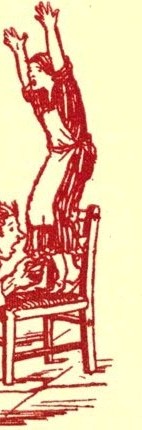
“The pudden, however, made a set at him, and Jack lepped first on a chair, and then on the kitchen table, to avoid it. It then danced towards Katty, who was repatin’ her prayers at the top of her voice, while the cunnin’ thief of a pudden was hoppin’ an’ jiggin’ it around her as if it was amused at her distress.
“‘If I could get the pitchfork,’ says Jack, ‘I’d dale wid it—by goxty, I’d thry its mettle.’
“‘No, no,’ shouted Katty, thinking there was a fairy in it; ‘let us spake it fair. Who knows what harm it might do? Aisy, now,’ says she to the pudden, ‘aisy, dear; don’t harm honest people that never meant to offend you. It wasn’t us—no, in troth, it was ould Harry Connolly that bewitched you; pursue him, if you wish, but spare a woman like me!’
“The pudden, bedad, seemed to take her at her word, and danced away from her towards Jack, who, like the wife, believin’ there was a fairy in it, an’ that spakin’ it fair was the best plan, thought he would give it a soft word as well as her.
“‘Plase your honour,’ said Jack, ‘she only spaiks the truth, an’ upon my voracity, we both feels much oblaiged to you for your quietness. Faith, it’s quite clear that if you weren’t a gentlemanly pudden, all out, you’d act otherwise. Ould Harry, the rogue, is your mark; he’s jist gone down the road there, and if you go fast you’ll overtake him. Be my song, your dancin’-masther did his duty, anyway. Thank your honour! God speed you, and may you niver meet wid a parson or alderman in your thravels.’
“Jist as Jack spoke, the pudden appeared to take the hint, for it quietly hopped out, and as the house was directly on the roadside, turned down towards the bridge, the very way that ould Harry went. It was very natural, of coorse, that Jack and Katty should go out to see how it intended to thravel, and as the day was Sunday, it was but natural, too, that a greater number of people than usual were passin’ the road. This was a fact; and when Jack and his wife were seen followin’ the pudden, the whole neighbourhood was soon up and afther it.
“‘Jack Rafferty, what is it? Katty, ahagur, will you tell us what it manes?’
“‘Why,’ replied Katty, ‘it’s my big pudden that’s bewitched, an’ it’s out hot foot pursuin’’—here she stopped, not wishin’ to mention her brother’s name—‘someone or other that surely put pishrogues[3] an it.’
“This was enough; Jack, now seein’ that he had assistance, found his courage comin’ back to him; so says he to Katty, ‘Go home,’ says he, ‘an’ lose no time in makin’ another pudden as good, an’ here’s Paddy Scanlan’s wife, Bridget, says she’ll let you boil it on her fire, as you’ll want our own to dress the rest of the dinner; and Paddy himself will lend me a pitchfork for purshuin’ to the morsel of that same pudden will escape, till I let the wind out of it, now that I’ve the neighbours to back an’ support me,’ says Jack.
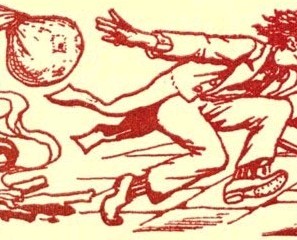
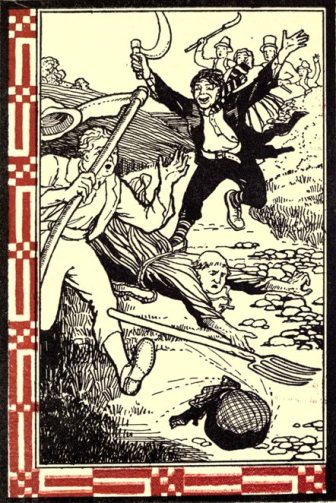
“This was agreed to, an’ Katty went back to prepare a fresh pudden, while Jack an’ half the townland pursued the other wid spades, graips, pitchforks, scythes, flails, and all possible description of instruments. On the pudden went, however, at the rate of about six Irish miles an hour, an’ sich a chase was never seen. Catholics, Prodestants, and Prosbytarians were all afther it, armed, as I said, an’ bad end to the thing, but its own activity could save it. Here it made a hop, there a prod was made at it; but off it went, and someone, as eager to get a slice at it on the other side, got the prod instead of the pudden. Big Frank Farrell, the miller, of Ballyboulteen, got a prod backwards that brought a hullabulloo out of him that you might hear at the other end of the parish. One got a slice of a scythe, another a whack of a flail, a third a rap of a spade, that made him look nine ways at wanst.
“‘Where is it goin’?’ asked one. ‘My life for you, it’s on its way to Meeting. Three cheers for it, if it turns to Carntaul!’ ‘Prod the sowl out of it if it’s a Prodestan’’ shouted the others; ‘if it turns to the left, slice it into pancakes. We’ll have no Prodestan’ puddens here.’
“Begad, by this time the people were on the point of beginnin’ to have a regular fight about it, when, very fortunately, it took a short turn down a little by-lane that led towards the Methodist praychin’-house, an’ in an instant all parties were in an uproar against it as a Methodist pudden. ‘It’s a Wesleyan,’ shouted several voices; ‘an’ by this an’ by that, into a Methodist chapel it won’t put a foot to-day, or we’ll lose a fall. Let the wind out of it. Come, boys, where’s your pitchforks?’
“The divle purshuin’ to the one of them, however, ever could touch the pudden, and jist when they thought they had it up against the gavel of the Methodist chapel, begad, it gave them the slip, and hops over to the left, clane into the river, and sails away before their eyes as light as an egg-shell.
ow, it so happened that a little below this place the desmesne wall of Colonel Bragshaw was built up to the very edge of the river on each side of its banks; and so, findin’ there was a stop put to their pursuit of it, they went home again, every man, woman, and child of them, puzzled to think what the pudden was at all, what it meant, or where it was goin’! Had Jack Rafferty an’ his wife been willin’ to let out the opinion they held about Henry Connolly bewitchin’ it, there is no doubt of it but poor Harry might be badly trated by the crowd, when their blood was up. They had sense enough, howaniver, to keep that to themselves, for Harry bein’ an ould bachelor, was a kind friend to the Raffertys. So, of coorse, there was all kinds of talk about it—some guessin’ this, an’ some guessin’ that—one party sayin’ the pudden was of their side, and another denyin’ it, an’ insisting it belonged to them, an’ so on.
“In the meantime, Katty Rafferty, for ’fraid the dinner might come short, went home and made another pudden much about the same size as the one that had escaped, an’ bringin’ it over to their next neighbour, Paddy Scanlan’s, it was put into a pot, and placed on the fire to boil, hopin’ that it might be done in time, espishilly as they were to have the ministher, who loved a warm slice of a good pudden as well as e’er a gentleman in Europe.
“Anyhow, the day passed; Moll and Gusty were made man an’ wife, an’ no two could be more lovin’. Their friends that had been asked to the weddin’ were saunterin’ about in pleasant little groups till dinner-time, chattin’ an’ laughin’; but above all things, sthrivin’ to account for the figaries of the pudden; for, to tell the truth, its adventures had now gone through the whole parish.
“Well, at any rate, dinner-time was drawin’ near, and Paddy Scanlan was sittin’ comfortably wid his wife at the fire, the pudden boilin’ before their eyes, when in walks Harry Connolly in a flutter, shoutin’, ‘Blood and blunderbushes, what are yez here for?’
“‘Arrah, why, Harry—why, avick?’ said Mrs. Scanlan.
“‘Why,’ said Harry, ‘the sun’s in the suds, an’ the moon in the high Horricks! Here’s a clipstick comin’ on, an’ there you sit as unconsarned as if it was about to rain mether! Go out, both of you, an’ look at the sun, I say, an’ ye’ll see the condition he’s in—off!’
“‘Ay, but, Harry, what’s that rowled up in the tail of your cothamore (big coat)?’
“‘Out wid yez,’ says Harry, ‘an’ pray aginst the clipstick—the sky’s fallin’!’
“Begad, it was hard to say whether Paddy or the wife got out first, they were so much alarmed by Harry’s wild, thin face and piercin’ eyes; so out they went to see what was wonderful in the sky, an’ kep lookin’ an’ lookin’ in every direction, but not a thing was to be seen, barrin’ the sun shinin’ down wid great good-humour, an’ not a single cloud in the sky.
“Paddy an’ the wife now came in laughin’ to scould Harry, who no doubt was a great wag in his way when he wished. ‘Musha, bad scran to you, Harry——’ and they had time to say no more, howandiver, for, as they were goin’ into the door, they met him comin’ out of it, wid a reek of smoke out of his tail like a lime-kiln.
“‘Harry,’ shouted Bridget, ‘my sowl to glory, but the tail of your cothamore’s afire—you’ll be burned. Don’t you see the smoke that’s out of it?’
ross yourselves three times,’ said Harry, widout stoppin’ or even lookin’ behind him, ‘for, as the prophecy says, Fill the pot, Eddy——’ They could hear no more, for Harry appeared to feel like a man that carried something a great deal hotter than he wished, as anyone might see by the liveliness of his motions, and the quare faces he was forced to make as he went along.

“‘What the dickens is he carryin’ in the skirts of his big coat?’ asked Paddy.
“‘My sowl to happiness, but maybe he has stolen the pudden,’ said Bridget, ‘for it’s known that many a sthrange thing he does.’
“They immediately examined the pot, but found that the pudden was there, as safe as tuppence, an’ this puzzled them the more to think what it was he could be carryin’ about with him in the manner he did. But little they knew what he had done while they were sky-gazin’!
“Well, anyhow, the day passed, and the dinner was ready, an’ no doubt but a fine gatherin’ there was to partake of it. The Prosbytarian ministher met the Methodist praycher—a divilish stretcher of an appetite he had, in throth—on their way to Jack Rafferty’s, an’ as he knew he could take the liberty, why, he insisted on his dinin’ wid him; for, afther all, in thim days, the clargy of all descriptions lived upon the best footin’ among one another, not all at one as now—but no matther. Well, they had nearly finished their dinner, when Jack Rafferty himself axed Katty for the pudden; but, jist as he spoke, in it came, as big as a mess-pot.
“‘Gintlemen,’ said he, ‘I hope none of you will refuse tastin’ a bit of Katty’s pudden; I don’t mane the dancin’ one that took to its thravels to-day, but a good solid fellow that she med since.’
o be sure we won’t,’ replied the priest. ‘So, Jack, put a thrifle on them three plates at your right hand, and send them over here to the clargy, an’ maybe,’ he said, laughin’—for he was a droll, good-humoured man—‘maybe, Jack, we won’t set you a proper example.’
“‘Wid a heart an’ a half, your riverence an’ gintlemen; in throth, it’s not a bad example ever any of you set us at the likes, or ever will set us, I’ll go bail. An’ sure, I only wish it was betther fare I had for you; but we’re humble people, gintlemen, an’ so you can’t expect to meet here what you would in higher places.’
“‘Betther a male of herbs,’ said the Methodist praycher, ‘where pace is——’ He had time to get no further, however; for much to his amazement, the priest an’ the ministher started up from the table, jist as he was goin’ to swallow the first mouthful of the pudden, and, before you could say Jack Robinson, started away at a lively jig down the floor.
“At this moment a neighbour’s son came runnin’ in, and tould them that the parson was comin’ to see the new-married couple, an’ wish them all happiness; an’ the words were scarcely out of his mouth when he made his appearance. What to think, he knew not, when he saw the ministher footin’ it away at the rate of a weddin’. He had very little time, however, to think; for, before he could sit down, up starts the Methodist praycher, an’, clappin’ his fists in his sides, chimes in in great style along wid him.
“‘Jack Rafferty,’ says he, and, by the way, Jack was his tenant, ‘what the dickens does all this mane?’ says he; ‘I’m amazed!’
“‘The not a particle o’ me can tell you,’ says Jack; ‘but will your reverence jist taste a morsel o’ pudden, merely that the young couple may boast that you ait at their weddin’; for, sure, if you wouldn’t, who would?’
“‘Well,’ says he, ‘to gratify them, I will; so, just a morsel. But, Jack, this bates Bannagher,’ says he again, puttin’ the spoonful of pudden into his mouth; ‘has there been drink here?’
“‘Oh, the divle a spudh,’ says Jack, ‘for although there’s plenty in the house, faith, it appears the gintlemen wouldn’t wait for it. Unless they tuck it elsewhere, I can make nothin’ o’ this.’
“He had scarcely spoken when the parson, who was an active man, cut a caper a yard high, an’ before you could bless yourself, the three clargy were hard at work dancin’, as if for a wager. Begad, it would be unpossible for me to tell you the state the whole meetin’ was in when they see this. Some were hoarse wid laughin’; some turned up their eyes wid wondher; many thought them mad; and others thought they had turned up their little fingers a thrifle too often.
“‘Be goxty, it’s a burnin’ shame,’ said one, ‘to see three black-mouth clargy in sich a state at this early hour!’ ‘Thundher an’ ounze, what’s over them at all?’ says others; ‘why, one would think they were bewitched. Holy Moses, look at the caper the Methodist cuts! An’ as for the Recthor, who would think he could handle his feet at sich a rate! Be this, an’ be that, he cuts the buckle, an’ does the threblin’ step aiquil to Paddy Horaghan, the dancin’-masther himself! An’ see! Bad cess to the morsel of the parson that’s not too hard at Peace upon a trancher, and it upon a Sunday, too! Whirroo, gintlemen, the fun’s in yez, afther all—whish! more power to yez!’
he sorra’s own fun they had, an’ no wondher; but judge of what they felt when all at once they saw ould Jack Rafferty himself bouncin’ in among them, an’ footin’ it away like the best of them. Bedad, no play could come up to it, an’ nothin’ could be heard but laughin’, shouts of encouragement, an’ clappin’ of hands like mad. Now, the minute Jack Rafferty left the chair, where he had been carvin’ the pudden, ould Harry Connolly come over and claps himself down in his place, in ordher to sent it round, of coorse; an’ he was scarcely sated when who should make his appearance but Barney Hartigan, the piper. Barney, by the way, had been sent for early in the day, but bein’ from home when the message for him went, he couldn’t come any sooner.
“‘Begorra,’ says Barney, ‘you’re airly at the work gintlemen! But what does this mane? But divle may care, yez shan’t want the music, while there’s a blast in the pipes, anyhow!’ So sayin’ he gave them Jig Polthogue, and afther that, Kiss My Lady, in his best style.
n the manetime the fun went on thick and threefold, for it must be remembered that Harry, the ould knave, was at the pudden; an’ maybe, he didn’t sarve it about in double-quick time, too! The first he helped was the bride, and before you could say chopstick she was at it hard and fast, before the Methodist praycher, who gave a jolly spring before her that threw them into convulsions. Harry liked this, and made up his mind soon to find partners for the rest; so he accordianly sent the pudden about like lightnin’; an’, to make a long story short, barrin’ the piper an’ himself, there wasn’t a pair of heels in the house but was as busy at the dancin’ as if their lives depended on it.
“‘Barney,’ says Harry, ‘jist taste a morsel o’ this pudden; divle the sich a bully of a pudden ever you ett. Here, your sowl! thry a snig of it—it’s beautiful!’
“‘To be sure I will,’ says Barney. ‘I’m not the boy to refuse a good thing. But, Harry, be quick, for you know my hands is engaged, an’ it would be a thousand pities not to keep them in music, an’ they so well inclined. Thank you, Harry. Begad, that is a fine pudden. But, blood an’ turnips! what’s this for?’
“The word was scarcely out of his mouth when he bounced up, pipes an’ all, and dashed into the middle of the party. ‘Hurroo! your sowls, let us make a night of it! The Ballyboulteen boys for ever! Go it, your reverence!—turn your partner—heel an’ toe, ministher. Good! Well done, again! Whish! Hurroo! Here’s for Ballyboulteen, an’ the sky over it!’
“Bad luck to sich a set ever was seen together in this world, or will again, I suppose. The worst, however, wasn’t come yet, for jist as they were in the very heat an’ fury of the dance, what do you think comes hoppin’ in among them but another pudden, as nimble an’ merry as the first! That was enough; they had all heard of it—the ministhers among the rest—an’ most of them had seen the other pudden, an’ knew that there must be a fairy in it, sure enough. Well, as I said, in it comes to the thick o’ them; but the very appearance of it was enough. Off the three clargy danced, and off the whole weddiners danced afther them, everyone makin’ the best of their way home; but not a sowl of them able to break out of the step, if they were to be hanged for it. Throth, it wouldn’t lave a laff in you to see the parson dancin’ down the road on his way home, and the ministher and Methodist praycher cuttin’ the buckle as they went along in the opposite direction. To make short work of it, they all danced home at last wid scarce a puff of wind in them; the bride an’ bridegroom danced away to bed; an’ now, boys, come an’ let us dance the Horo Lheig in the barn widout. But, you see, boys, before we go, and in order to make everything plain, I had as good tell you that Harry, in crossin’ the bridge of Ballyboulteen, a couple o’ miles between Squire Bragshaw’s demesne wall, saw the pudden floatin’ down the river—the truth is, he was waitin’ for it; but, be this as it may, he took it out, for the wather had made it as clane as a new pin, an’ tuckin’ it up in the tail of his big coat, contrived to bewitch it in the same manner by gettin’ a fairy to get into it, for, indeed, it was purty well known that the same Harry was hand an’ glove wid the good people. Others will tell you that it was half a pound of quicksilver he put into it, but that doesn’t stand to raison. At any rate, boys, I have tould you the adventures of the Mad Pudden of Ballyboulteen; but I don’t wish to tell you many other things about it that happened—for ’fraid I’d tell a lie!”
William Carleton.
was the chief of the race—he had stricken my father dead— But I gathered my fellows together; I swore I would strike off his head. Each of them looked like a king, and was noble in birth as in worth, And each of them boasted he sprang from the oldest race upon earth. Each was as brave in the fight as the bravest hero of song, And each of them liefer had died than have done one another a wrong. He lived on an isle in the ocean—we sail’d on a Friday morn— He that had slain my father the day before I was born.
And we came to the isle in the ocean, and there on the shore was he. But a sudden blast blew us out and away through a boundless sea. And we came to the Silent Isle that we never had touched before, Where a silent ocean always broke on a silent shore, And the brooks glittered on in the light without sound, and the long waterfalls Poured in a thunderless plunge to the base of the mountain walls, And the poplar and cypress unshaken by storm flourished up beyond sight And the pine shot aloft from the crag to an unbelievable height, And high in the heaven above it there flickered a songless lark, And the cock couldn’t crow, and the bull couldn’t low, and the dog couldn’t bark. And round it we went, and thro’ it, but never a murmur, a breath, It was all of it fair as life, it was all of it quiet as death, And we hated the beautiful Isle, for whenever we strove to speak Our voices were thinner and fainter than any flittermouse shriek; And the men that were mighty of tongue, and could raise such a battle-cry That a hundred who heard it would rush on a thousand lances and die— Oh, they to be dumb’d by the charm!—so fluster’d with anger were they They almost fell on each other; but, after, we sailed away. And we came to the Isle of Shouting, we landed, a score of wild birds Cried from the topmost summit with human voices and words; Once in an hour they cried, and whenever their voices peal’d The steer fell down at the plough and the harvest died from the field, And the men dropt dead in the valleys and half of the cattle went lame, And the roof sank in on the hearth, and the dwelling broke into flame; And the shouting of these wild birds ran into the hearts of my crew, Till they shouted along with the shouting, and seized one another and slew; But I drew them the one from the other; I saw that we could not stay, And we left the dead to the birds and we sail’d with our wounded away. And we came to the Isle of Flowers, their breath met us out on the seas, For the Spring and the middle Summer sat each on the lap of the breeze; And the red passion-flower to the cliffs, and the dark-blue clematis clung And starr’d with a myriad blossom, the long convolvulus hung; And the topmost spire of the mountain was lilies in lieu of snow, And the lilies like glaciers winded down, running out below Thro’ the fire of the tulip and poppy, the blaze of gorse, and the blush Of millions of roses that sprang without leaf or thorn from the bush; And the whole isle-side flashing down from the peak without ever a tree Swept like a torrent of gems from the sky to the blue of the sea; And we roll’d upon capes of crocus and vaunted our kith and kin, And we wallowed in beds of lilies, and chanted the triumph of Finn, Till each like a golden image was pollen’d from head to feet And each was as dry as a cricket, with thirst in the middle-day heat. Blossom, and blossom, and promise of blossom, but never a fruit! And we hated the Flowering Isle, as we hated the isle that was mute, And we tore up the flowers by the million and flung them in bight and bay. And we left but a naked rock, and in anger we sail’d away. And we came to the Isle of Fruits: all round from the cliffs and the capes, Purple or amber dangled a hundred fathom of grapes, And the warm melon lay, like a little sun, on the tawny sand, And the fig ran up from the beach, and rioted over the land, And the mountain arose, like a jewelled throne thro’ the fragrant air, Glowing with all-coloured plums, and with golden masses of pear, And the crimson and scarlet of berries that flamed upon bine and vine, But in every berry and fruit was the poisonous pleasure of wine: And the peak of the mountain was apples, the hugest that ever were seen, And they prest, as they grew, on each other, with hardly a leaflet between. And all of them redder than rosiest health, or than utterest shame, And setting, when Even descended, the very sunset aflame. And we stay’d three days, and we gorged and we madden’d till everyone drew His sword on his fellow to slay him, and ever they struck and they slew; And myself I had eaten but sparsely, and fought till I sunder’d the fray, Then I bade them remember my father’s death, and we sail’d away. And we came to the Isle of Fire: we were lured by the light from afar, For the peak sent up one league of fire to the Northern Star; Lured by the glare and the blare, but scarcely could stand upright, For the whole isle shudder’d and shook, like a man in a mortal affright; We were giddy, besides, with the fruits we had gorged, and so crazed that at last, There were some leap’d into the fire; and away we sail’d, and we past Over that undersea isle, where the water is clearer than air: Down we look’d: what a garden! Oh, bliss, what a Paradise there! Towers of a happier time, low down in a rainbow deep Silent palaces, quiet fields of eternal sleep! And three of the gentlest and best of my people, whate’er I could say, Plunged head down in the sea, and the Paradise trembled away. And we came to the Bounteous Isle, where the heavens lean low on the land, And ever at dawn from the cloud glitter’d o’er us a sun-bright hand, Then it opened, and dropped at the side of each man, as he rose from his rest, Bread enough for his need till the labourless day dipt under the West; And we wandered about it, and thro’ it. Oh, never was time so good! And we sang of the triumphs of Finn, and the boast of our ancient blood, And we gazed at the wandering wave, as we sat by the gurgle of springs, And we chanted the songs of the Bards and the glories of fairy kings; But at length we began to be weary, to sigh, and to stretch and yawn, Till we hated the Bounteous Isle, and the sun-bright hand of the dawn, For there was not an enemy near, but the whole green isle was our own, And we took to playing at ball, and we took to throwing the stone, And we took to playing at battle, but that was a perilous play, For the passion of battle was in us, we slew and we sail’d away. And we passed to the Isle of Witches, and heard their musical cry— “Come to us, Oh, come, come,” in the stormy red of a sky Dashing the fires and the shadows of dawn on the beautiful shapes, For a wild witch, naked as heaven, stood on each of the loftiest capes, And a hundred ranged on the rocks, like white sea-birds in a row, And a hundred gambled and pranced on the wrecks in the sand below, And a hundred splashed from the ledges, and bosomed the burst of the spray. But I knew we should fall on each other, and hastily sail’d away.
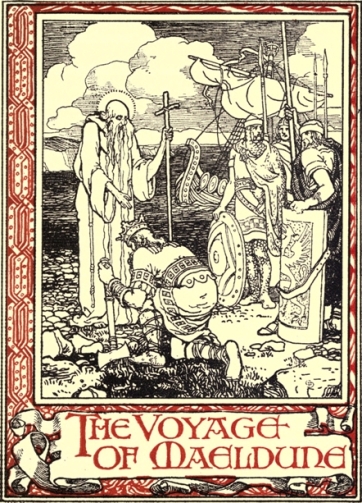
And we came in an evil time to the Isle of the Double Towers, One was of smooth-cut stone, one carved all over with flowers, But an earthquake always moved in the hollows under the dells, And they shock’d on each other and butted each other with clashing of bells, And the daws flew out of the Towers, and jangled and wrangled in vain, And the clash and boom of the bells rang into the heart and brain, Till the passion of battle was on us, and all took sides with the Towers, There were some for the clean-cut stone, there were more for the carven flowers, And the wrathful thunder of God peal’d over us all the day, For the one half slew the other, and, after, we sail’d away. And we came to the Isle of a Saint, who had sail’d with St. Brendan of yore, He had lived ever since on the isle, and his winters were fifteen score, And his voice was low as from other worlds, and his eyes were sweet, And his white hair sank to his heels, and his white beard fell to his feet, And he spake to me, “Oh, Maeldune, let be this purpose of thine! Remember the words of the Lord, when He told us ‘Vengeance is Mine!’ His fathers have slain thy fathers, in war or in single strife, Thy fathers have slain his fathers, each taken a life for a life, Thy father had slain his father, how long shall the murder last? Go back to the Isle of Finn and suffer the Past to be Past.” And we kiss’d the fringe of his beard, and we pray’d as we heard him pray, And the Holy Man he assoil’d us, and sadly we sail’d away. And we came to the Isle we were blown from, and there on the shore was he, The man that had slain my father. I saw him, and let him be. Oh, weary was I of the travel, the trouble, the strife, and the sin, When I landed again with a tithe of my men on the Island of Finn. Alfred Tennyson.
Leicester: Walter Watts & Co., Ltd., Printers.
Footnotes:
[1] From “Hero Tales of Ireland.”
[2] Stone fort or rampart or castle.
[3] Put it under Fairy influence.