Preface (continued 4)
Reading edition
On the following morning the three brothers rose with the dawn; the order was given Lawn Dyarrig to leave the castle and make his own way for himself. The other two brothers were going to travel the world to know could they find the man who had injured their father. Lawn Dyarrig lingered outside till he saw the two, and they going off by themselves.
“It is a strange thing,” said he, “for two men of high degree to go travelling without a servant.”
“We need no one,” said Ur.
“Company wouldn’t harm us,” said Arthur.
The two let Lawn Dyarrig go with them as a serving-boy, and set out to find the man who had struck down their father. They spent all that day walking, and came late to a house where one woman was living. She shook hands with Ur and Arthur, and greeted them. Lawn Dyarrig she kissed and welcomed; called him son of the King of Erin.
t is a strange thing to shake hands with the elder, and kiss the younger,” said Ur.
“This is a story to tell,” said the woman, “the same as if your death were in it.”
They made three parts of that night. The first part they spent in conversation, the second in telling tales, the third in eating and drinking, with sound sleep and sweet slumber. As early as the day dawned next morning the old woman was up, and had food for the young men. When the three had eaten, she spoke to Ur, and this is what she asked of him: “What was it that drove you from home, and what brought you to this place?”
“A champion met my father, and took three teeth from him and put his head in the dirt. I am looking for that man, to find him alive or dead.”
“That was the Green Knight from Terrible Valley. He is the man who took the three teeth from your father. I am three hundred years living in this place, and there is not a year of the three hundred in which three hundred heroes, fresh, young, and noble, have not passed on the way to Terrible Valley, and never have I seen one coming back, and each of them had the look of a man better than you. And now where are you going, Arthur?”
“I am on the same journey with my brother.”
“Where are you going, Lawn Dyarrig?”
“I am going with these as a servant,” said Lawn Dyarrig.
od’s help to you, it’s bad clothing that’s on your body,” said the woman. “And now I will speak to Ur. A day and a year since a champion passed this way. He wore a suit as good as was ever above ground. I had a daughter sewing there in the open window. He came outside, put a finger under her girdle, and took her with him. Her father followed straightway to save her, but I have never seen daughter nor father from that day to this. That man was the Green Knight of Terrible Valley. He is better than all the men that could stand on a field a mile in length and a mile in breadth. If you take my advice you’ll turn back and go home to your father.”
’Tis how she vexed Ur with this talk, and he made a vow to himself to go on. When Ur did not agree to turn home, the woman said to Lawn Dyarrig, “Go back to my chamber; you’ll find in it the apparel of a hero.”
He went back, and there was not a bit of the apparel he did not go into with a spring.
“You may be able to do something now,” said the woman, when Lawn Dyarrig came to the front. “Go back to my chamber and search through all the old swords. You will find one at the bottom. Take that.”
He found the old sword, and at the first shake that he gave he knocked seven barrels of rust out of it; after the second shake it was as bright as when made.
“You may be able to do well with that,” said the woman. “Go out, now, to that stable abroad, and take the slim white steed that is in it. That one will never stop nor halt in any place till he brings you to the Eastern World. If you like, take these two men behind you; if not, let them walk. But I think it is useless for you to have them at all with you.”
Lawn Dyarrig went out to the stable, took the slim white steed, mounted, rode to the front, and catching the two brothers, planted them on the horse behind him.
ow, Lawn Dyarrig,” said the woman, “this horse will never stop till he stands on the little white meadow in the Eastern World. When he stops, you’ll come down, and cut the turf under his beautiful right front foot.”
The horse started from the door, and at every leap he crossed seven hills and valleys, seven castles with villages, acres, roods, and odd perches. He could overtake the whirlwind before him seven hundred times before the whirlwind behind him could overtake him once. Early in the afternoon of the next day he was in the Eastern World. When he dismounted, Lawn Dyarrig cut the sod from under the foot of the slim white steed, in the name of the Father, Son, and Holy Ghost, and Terrible Valley was down under him there. What he did next was to tighten the reins on the neck of the steed and let him go home.
“Now,” said Lawn Dyarrig to his brothers, “which would you rather be doing—making a basket or twisting gads (withes)?”
“We would rather be making a basket; our help is among ourselves,” answered they.
Ur and Arthur went at the basket and Lawn Dyarrig at twisting the gads. When Lawn Dyarrig came to the opening with the gads all twisted and made into one, they hadn’t the ribs of the basket in the ground yet.
“Oh, then, haven’t ye anything done but that?”
“Stop your mouth,” said Ur, “or we’ll make a mortar of your head on the next stone.”
“To be kind to one another is the best for us,” said Lawn Dyarrig. “I’ll make the basket.”
hile they’d be putting one rod in the basket he had the basket finished.

“Oh, brother,” said they, “you are a quick workman.”
They had not called him brother since they left home till that moment.
“Who will go in the basket now?” said Lawn Dyarrig when it was finished and the gad tied to it.
“Who but me?” said Ur. “I am sure, brothers, if I see anything to frighten me you’ll draw me up.”
“We will,” said the other two.
He went in, but had not gone far when he cried to pull him up again.
“By my father, and the tooth of my father, and by all that is in Erin, dead or alive, I would not give one other sight on Terrible Valley!” he cried, when he stepped out of the basket.
“Who will go now?” said Lawn Dyarrig.
“Who will go but me?” answered Arthur.
Whatever length Ur went, Arthur didn’t go the half of it.
“By my father, and the tooth of my father, I wouldn’t give another look at Terrible Valley for all that’s in Erin, dead or alive!”
“I will go now,” said Lawn Dyarrig, “and as I put no foul play on you, I hope ye’ll not put foul play on me.”
“We will not, indeed,” said they.
hatever length the other two went, Lawn Dyarrig didn’t go the half of it, till he stepped out of the basket and went down on his own feet. It was not far he had travelled in Terrible Valley when he met seven hundred heroes guarding the country.
“In what place here has the Green King his castle?” asked he of the seven hundred.
“What sort of a sprisawn goat or sheep from Erin are you?” asked they.
“If we had a hold of you, the two arms of me, that’s a question you would not put a second time; but if we haven’t you, we’ll not be so long.”
They faced Lawn Dyarrig then and attacked him; but he went through them like a hawk or a raven through small birds. He made a heap of their feet, a heap of their heads, and a castle of their arms.
After that he went his way walking, and had not gone far when he came to a spring. “I’ll have a drink before I go further,” thought he. With that he stooped down and took a drink of the water. When he had drunk he lay on the ground and fell asleep.
Now, there wasn’t a morning that the lady in the Green Knight’s castle didn’t wash in the water of that spring, and she sent a maid for the water each time. Whatever part of the day it was when Lawn Dyarrig fell asleep, he was sleeping in the morning when the girl came. She thought it was dead the man was, and she was so in dread of him that she would not come near the spring for a long time. At last she saw he was asleep, and then she took the water. Her mistress was complaining of her for being so long. “Do not blame me,” said the maid. “I am sure that if it was yourself that was in my place you’d not come back so soon.” “How so?” asked the lady.
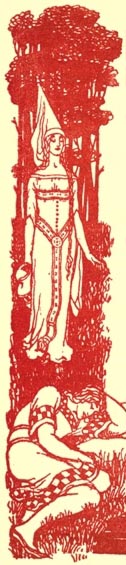
“The finest hero that ever a woman laid eyes on is sleeping at the spring.”
“That’s a thing that cannot be till Lawn Dyarrig comes to the age of a hero. When that time comes he’ll be sleeping at the spring.”
“He is in it now,” said the girl.
The lady did not stop to get any drop of the water on herself, but ran quickly from the castle. When she came to the spring she roused Lawn Dyarrig. If she found him lying, she left him standing. She smothered him with kisses, drowned him with tears, dried him with garments of fine silk and with her own hair. Herself and himself locked arms and walked into the castle of the Green Knight. After that they were inviting each other with the best food and entertainment till the middle of the following day. Then the lady said:
hen the Green Knight bore me away from my father and mother he brought me straight to this castle, but I put him under bonds not to marry me for seven years and a day, and he cannot; still, I must serve him. When he goes fowling he spends three days away and the next three days at home. This is the day for him to come back, and for me to prepare his dinner. There is no stir that you or I have made here to-day but that brass head beyond there will tell of it.”
“It is equal to you what it tells,” said Lawn Dyarrig, “only make ready a clean long chamber for me.”
She did so, and he went back into it. Herself rose up then to prepare dinner for the Green Knight. When he came, she welcomed him as every day. She left down his food before him, and he sat to take his dinner. He was sitting with knife and fork in hand when the brass head spoke. “I thought when I saw you taking food and drink with your wife that you had the blood of a man in you. If you could see that sprisawn of a goat or sheep out of Erin taking meat and drink with her all day, what would you do?”
“Oh, my suffering and sorrow!” cried the knight. “I’ll never take another bite or sup till I eat some of his liver and heart. Let three hundred heroes, fresh and young, go back and bring his heart to me, with the liver and lights, till I eat them.”
he three hundred heroes went, and hardly were they behind in the chamber when Lawn Dyarrig had them all dead in one heap.
“He must have some exercise to delay my men, they are so long away,” said the knight. “Let three hundred more heroes go for his heart, with the liver and lights, and bring them here to me.”
The second three hundred went, and as they were entering the chamber Lawn Dyarrig was making a heap of them, till the last one was inside, where there were two heaps.
“He has some way of coaxing my men to delay,” said the knight. “Do you go now, three hundred of my savage hirelings, and bring him.” The three hundred savage hirelings went, and Lawn Dyarrig let every man of them enter before he raised a hand, then he caught the bulkiest of them all by the two ankles, and began to wallop the others with him, and he walloped them till he drove the life out of the two hundred and ninety-nine. The bulkiest one was worn to the shin-bones that Lawn Dyarrig held in his two hands. The Green Knight, who thought Lawn Dyarrig was coaxing the men, called out then, “Come down, my men, and take dinner.”
“I’ll be with you,” said Lawn Dyarrig, “and have the best food in the house, and I’ll have the best bed in the house. God not be good to you for it, either.”
e went down to the Green Knight, and took the food from before him and put it before himself. Then he took the lady, set her on his own knee, and he and she went on eating. After dinner he put his finger under her girdle, took her to the best chamber in the castle, and stood on guard upon it till morning. Before dawn the lady said to Lawn Dyarrig:
“If the Green Knight strikes the pole of combat first, he’ll win the day; if you strike first, you’ll win if you do what I tell you. The Green Knight has so much enchantment that if he sees it is going against him the battle is, he’ll rise like a fog in the air, come down in the same form, strike you, and make a green stone of you. When yourself and himself are going out to fight in the morning, cut a sod a perch long, in the name of the Father, Son, and Holy Ghost; you’ll leave the sod on the next little hillock you meet. When the Green Knight is coming down and is ready to strike, give him a blow with the sod. You’ll make a green stone of him.”
As early as the dawn Lawn Dyarrig rose and struck the pole of combat. The blow that he gave did not leave calf, foal, lamb, kid, or child waiting for birth, without turning them five times to the left and five times to the right.
“What do you want?” asked the knight.
“All that’s in your kingdom to be against me the first quarter of the day, and yourself the second quarter.
“You have not left in the kingdom now but myself, and it is early enough for you that I’ll be at you.”
The knight faced him, and they went at each other, and fought till late in the day. The battle was strong against Lawn Dyarrig, when the lady stood in the door of the castle.
ncrease on your blows and increase on your courage,” cried she. “There is no woman here but myself to wail over you, or to stretch you before burial.”
When the knight heard the voice he rose in the air like a lump of fog. As he was coming down Lawn Dyarrig struck him with the sod on the right side of his breast, and made a green stone of him.
The lady rushed out then, and whatever welcome she had for Lawn Dyarrig the first time, she had twice as much now. Herself and himself went into the castle, and spent that night very comfortably. In the morning they rose early, and collected all the gold, utensils, and treasures. Lawn Dyarrig found the three teeth of his father in a pocket of the Green Knight, and took them. He and the lady brought all the riches to where the basket was. “If I send up this beautiful lady,” thought Lawn Dyarrig, “she may be taken from me by my brothers; if I remain below with her, she may be taken from me by people here.” He put her in the basket, and she gave him a ring so that they might know each other if they met. He shook the gad, and she rose in the basket.
When Ur saw the basket, he thought, “What’s above let it be above, and what’s below let it stay where it is.”
“I’ll have you as wife for ever for myself,” said he to the lady.
“I put you under bonds,” says she, “not to lay a hand on me for a day and three years.”
“That itself would not be long even if twice the time,” said Ur.
The two brothers started home with the lady; on the way Ur found the head of an old horse with teeth in it, and took them, saying, “These will be my father’s three teeth.”
hey travelled on, and reached home at last. Ur would not have left a tooth in his father’s mouth, trying to put in the three that he had brought; but the father stopped him.
Lawn Dyarrig, left in Terrible Valley, began to walk around for himself. He had been walking but one day when whom should he meet but the lad Short-clothes, and he saluted him. “By what way can I leave Terrible Valley?” asked Lawn Dyarrig.
“If I had a grip on you that’s what you wouldn’t ask me a second time,” said Short-clothes.
“If you haven’t touched me, you will before you are much older.”
“If you do, you will not treat me as you did all my people and my master.”
“I’ll do worse to you than I did to them,” said Lawn Dyarrig.
They caught each other then, one grip under the arm and one on the shoulder. ’Tis not long they were wrestling when Lawn Dyarrig had Short-clothes on the earth, and he gave him the five thin tyings dear and tight.
“You are the best hero I have ever met,” said Short-clothes; “give me quarter for my soul—spare me. When I did not tell you of my own will, I must tell in spite of myself.”
“It is as easy for me to loosen you as to tie you,” said Lawn Dyarrig, and he freed him.
“Since you are not dead now,” said Short-clothes, “there is no death allotted to you. I’ll find a way for you to leave Terrible Valley. Go and take that old bridle hanging there beyond and shake it; whatever beast comes and puts its head into the bridle will carry you.”
awn Dyarrig shook the bridle, and a dirty, shaggy little foal came and put its head in the bridle. Lawn Dyarrig mounted, dropped the reins on the foal’s neck, and let him take his own choice of roads. The foal brought Lawn Dyarrig out by another way to the upper world, and took him to Erin. Lawn Dyarrig stopped some distance from his father’s castle, and knocked at the house of an old weaver.
“Who are you?” asked the old man.
“I am a weaver,” said Lawn Dyarrig.
“What can you do?”
“I can spin for twelve and twist for twelve.”
“This is a very good man,” said the old weaver to his sons, “let us try him.”
The work they had been doing for a year he had done in one hour. When dinner was over the old man began to wash and shave, and his two sons began to do the same.
“Why is this?” asked Lawn Dyarrig.
“Haven’t you heard that Ur, son of the King, is to marry to-night the woman that he took from the Green Knight of Terrible Valley?”
“I have not,” said Lawn Dyarrig; “as all are going to the wedding, I suppose I may go without offence?”
“Oh, you may,” said the weaver; “there will be a hundred thousand welcomes before you.”
“Are there any linen sheets within?”
“There are,” said the weaver.
“It is well to have bags ready for yourself and two sons.”
he weaver made bags for the three very quickly. They went to the wedding. Lawn Dyarrig put what dinner was on the first table into the weaver’s bag, and sent the old man home with it. The food of the second table he put in the eldest son’s bag, filled the second son’s bag from the third table, and sent the two home.
The complaint went to Ur that an impudent stranger was taking all the food.
“It is not right to turn any man away,” said the bridegroom, “but if that stranger does not mind he will be thrown out of the castle.”
“Let me look at the face of the disturber,” said the bride.
“Go and bring the fellow who is troubling the guests,” said Ur to the servants.
Lawn Dyarrig was brought right away, and stood before the bride, who filled a glass with wine and gave it to him. Lawn Dyarrig drank half the wine, and dropped in the ring which the lady had given him in Terrible Valley.
When the bride took the glass again the ring went of itself with one leap on to her finger. She knew then who was standing before her.
“This is the man who conquered the Green Knight and saved me from Terrible Valley,” said she to the King of Erin; “this is Lawn Dyarrig, your son.”
Lawn Dyarrig took out the three teeth and put them in his father’s mouth. They fitted there perfectly, and grew into their old place. The King was satisfied, and as the lady would marry no man but Lawn Dyarrig, he was the bridegroom.
must give you a present,” said the bride to the Queen. “Here is a beautiful scarf which you are to wear as a girdle this evening.”
The Queen put the scarf round her waist.
“Tell me now,” said the bride to the Queen, “who was Ur’s father.”
“What father could he have but his own father, the King of Erin?”
“Tighten, scarf,” said the bride.
That moment the Queen thought that her head was in the sky and the lower half of her body down deep in the earth.
“Oh, my grief and my woe!” cried the Queen.
“Answer my question in truth, and the scarf will stop squeezing you. Who was Ur’s father?”
“The gardener,” said the Queen.
“Whose son is Arthur?”
“The King’s son.”
“Tighten, scarf,” said the bride.
If the Queen suffered before, she suffered twice as much this time, and screamed for help.
“Answer me truly, and you’ll be without pain; if not, death will be on you this minute. Whose son is Arthur?”
“The swineherd’s.”
“Who is the King’s son?”
“The King has no son but Lawn Dyarrig.”
“Tighten, scarf.”
The scarf did not tighten, and if the Queen had been commanding it a day and a year it would not have tightened, for the Queen told the truth that time. When the wedding was over, the King gave Lawn Dyarrig half his kingdom, and made Ur and Arthur his servants.
Jeremiah Curtin.
rich woman sat up late one night carding and preparing wool while all the family and servants were asleep. Suddenly a knock was given at the door, and a voice called out, “Open! Open!”
“Who is there?” said the woman of the house.
“I am the Witch of the One Horn,” was answered.
The mistress, supposing that one of her neighbours had called and required assistance, opened the door, and a woman entered, having in her hand a pair of wool carders, and bearing a horn on her forehead, as if growing there. She sat down by the fire in silence, and began to card the wool with violent haste. Suddenly she paused, and said aloud, “Where are the women; they delay too long?”
Then a second knock came to the door, and a voice called as before, “Open! Open!”
The mistress felt herself constrained to rise and open to the call, and immediately a second witch entered, having two horns on her forehead, and in her hand a wheel for spinning wool.
“Give me place,” she said; “I am the Witch of the Two Horns”; and she began to spin as quick as lightning.
And so the knocks went on, and the call was heard and the witches entered, until at last twelve women sat round the fire—the first with one horn, the last with twelve horns.
And they carded the thread and turned their spinning-wheels, and wound and wove.
ll singing together an ancient rhyme, but no word did they speak to the mistress of the house. Strange to hear and frightful to look upon were these twelve women, with their horns and their wheels; and the mistress felt near to death, and she tried to rise that she might call for help, but she could not move, nor could she utter a word or a cry, for the spell of the witches was upon her.
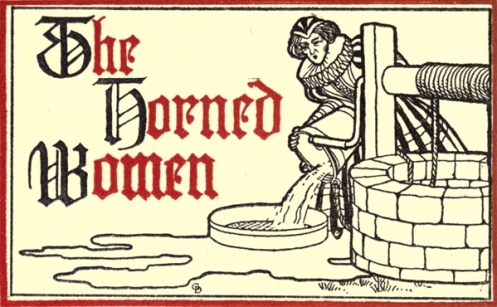
Then one of them called to her in Irish, and said, “Rise, woman, and make us a cake.” Then the mistress searched for a vessel to bring water from the well that she might mix the meal and make the cake, but she could find none.
And they said to her, “Take a sieve, and bring water in it.” And she took the sieve, and went to the well; but the water poured from it, and she could fetch none for the cake, and she sat down by the well and wept.
Then came a voice by her, and said, “Take yellow clay and moss and bind them together, and plaster the sieve so that it will hold.”
This she did, and the sieve held the water for the cake; and the voice said again:
“Return, and when thou comest to the north angle of the house cry aloud three times, and say, ‘The mountain of the Fenian women and the sky over it is all on fire.’”
And she did so.
When the witches inside heard the call, a great and terrible cry broke from their lips, and they rushed forth with wild lamentations and shrieks, and fled away to Slievenamon, where was their chief abode. But the Spirit of the Well bade the mistress of the house to enter and prepare her home against the enchantments of the witches, if they returned again.
nd first, to break their spells, she sprinkled the water in which she had washed her child’s feet (the feet-water) outside the door on the threshold; secondly, she took the cake which the witches had made in her absence, of meal mixed with the blood drawn from the sleeping family, and she broke the cake in bits, and placed a bit in the mouth of each sleeper, and they were restored; and she took the cloth they had woven, and placed it half in and half out of the chest with the padlock; and, lastly, she secured the door with a great crossbeam fastened in the jambs, so that they could not enter, and having done these things she waited.
Not long were the witches in coming, and they raged and called for vengeance.
“Open! Open!” they screamed. “Open, feet-water!”
“I cannot,” said the feet-water; “I am scattered on the ground, and my path is down to the Lough.”
“Open, open, wood and trees and beam!” they cried to the door.
“I cannot,” said the door, “for the beam is fixed in the jambs, and I have no power to move.”
“Open, open, cake that we have made and mingled with blood!” they cried again.
“I cannot,” said the cake, “for I am broken and bruised, and my blood is on the lips of the sleeping children.”
Then the witches rushed through the air with great cries, and fled back to Slievenamon, uttering strange curses on the Spirit of the Well, who had wished their ruin. But the woman and the house were left in peace, and a mantle dropped by one of the witches was kept hung up by the mistress as a sign of the night’s awful contest; and this mantle was in possession of the same family from generation to generation for five hundred years after.
Lady Wilde.


erence Mooney was an honest boy and well to do; an’ he rinted the biggest farm on this side iv the Galties; an’ bein’ mighty cute an’ a sevare worker, it was small wonder he turned a good penny every harvest. But, unluckily, he was blessed with an ilegant large family iv daughters, an’ iv coorse, his heart was allamost bruck, striving to make up fortunes for the whole of them. An’ there wasn’t a conthrivance iv any soart or description for makin’ money out iv the farm but he was up to.
“Well, among the other ways he had iv gettin’ up in the world he always kep a power iv turkeys, and all soarts iv poultrey; an’ he was out iv all rason partial to geese—an’ small blame to him for that same—for twice’t a year you can pluck them as bare as my hand—an’ get a fine price for the feathers, an’ plenty of rale sizable eggs—an’ when they are too ould to lay any more, you can kill them, an’ sell them to the gintlemen for goslings, d’ye see, let alone that a goose is the most manly bird that is out.
“Well, it happened in the coorse iv time that one ould gandher tuck a wondherful likin’ to Terence, an’ divil a place he could go serenadin’ about the farm, or lookin’ afther the men, but the gandher id be at his heels, an’ rubbin’ himself agin his legs, an’ lookin’ up in his face jist like any other Christian id do; an’, begorra, the likes iv it was never seen—Terence Mooney an’ the gandher wor so great.
n’ at last the bird was so engagin’ that Terence would not allow it to be plucked any more, an’ kep it from that time out for love an’ affection—just all as one like one iv his childer.
“But happiness in perfection never lasts long, an’ the neighbours begin’d to suspect the nathur an’ intentions iv the gandher, an’ some iv them said it was the divil, an’ more iv them that it was a fairy.
“Well, Terence could not but hear something of what was sayin’, an’ you may be sure he was not altogether asy in his mind about it, an’ from one day to another he was gettin’ more ancomfortable in himself, until he detarmined to sind for Jer Garvan, the fairy docthor, in Garryowen, an’ it’s he was the illigant hand at the business, an’ divil a sperit id say a crass word to him, no more nor a priest. An’, moreover, he was very great wid ould Terence Mooney—this man’s father that was.
“So without more about it he was sint for, an’, sure enough, the divil a long he was about it, for he kem back that very evenin’ along wid the boy that was sint for him, an’ as soon as he was there, an’ tuck his supper, an’ was done talkin’ for a while, he begin’d, of coorse, to look into the gandher.
“Well, he turned it this away an’ that away, to the right an’ to the left, an’ straight-ways an’ upside-down, an’ when he was tired handlin’ it, says he to Terence Mooney:
“‘Terence,’ says he, ‘you must remove the bird into the next room,’ says he, ‘an’ put a petticoat,’ says he, ‘or anny other convaynience round his head,’ says he.
“‘An’ why so?’ says Terence.
“‘Becase,’ says Jer, says he.
“‘Becase what?’ says Terence.
ecase,’ says Jer, ‘if it isn’t done you’ll never be asy agin,’ says he, ‘or pusillanimous in your mind,’ says he; ‘so ax no more questions, but do my biddin’,’ says he.
“‘Well,’ says Terence, ‘have your own way,’ says he.
“An’ wid that he tuck the ould gandher an’ giv’ it to one iv the gossoons.
“‘An’ take care,’ says he, ‘don’t smother the crathur,’ says he.
“Well, as soon as the bird was gone, says Jer Garvan, says he:
“‘Do you know what that old gandher is, Terence Mooney?’
“‘Divil a taste,’ says Terence.
“‘Well, then,’ says Jer, ‘the gandher is your own father,’ says he.
“‘It’s jokin’ you are,’ says Terence, turnin’ mighty pale; ‘how can an ould gandher be my father?’ says he.
“‘I’m not funnin’ you at all,’ says Jer; ‘it’s thrue what I tell you, it’s your father’s wandhrin’ sowl,’ says he, ‘that’s naturally tuck pissession iv the ould gandher’s body,’ says he. ‘I know him many ways, and I wondher,’ says he, ‘you do not know the cock iv his eye yourself,’ says he.
“‘Oh, blur an’ ages!’ says Terence, ‘what the divil will I ever do at all at all,’ says he; ‘it’s all over wid me, for I plucked him twelve times at the laste,’ says he.
“‘That can’t be helped now,’ says Jer; ‘it was a sevare act, surely,’ says he, ‘but it’s too late to lamint for it now,’ says he; ‘the only way to prevint what’s past,’ says he, ‘is to put a stop to it before it happens,’ says he.
hrue for you,’ says Terence, ‘but how the divil did you come to the knowledge iv my father’s sowl,’ says he, ‘bein’ in the ould gandher,’ says he.
“‘If I tould you,’ says Jer, ‘you would not undherstand me,’ says he, ‘without book-larnin’ an’ gasthronomy,’ says he; ‘so ax me no questions,’ says he, ‘an’ I’ll tell you no lies. But b’lieve me in this much,’ says he, ‘it’s your father that’s in it,’ says he; ‘an’ if I don’t make him spake to-morrow mornin’,’ says he, ‘I’ll give you lave to call me a fool,’ says he.
“‘Say no more,’ says Terence; ‘that settles the business,’ says he; ‘an’ oh, blur and ages! is it not a quare thing,’ says he, ‘for a dacent, respictable man,’ says he, ‘to be walkin’ about the counthry in the shape iv an ould gandher,’ says he; ‘and oh, murdher, murdher! is not it often I plucked him,’ says he, ‘an’ tundher and ouns! might not I have ate him?’ says he; and wid that he fell into a could parspiration, savin’ your prisince, an’ on the pint iv faintin’ wid the bare notions iv it.
“Well, whin he was come to himself agin, says Jerry to him, quite an’ asy:
“‘Terence,’ says he, ‘don’t be aggravatin’ yourself,’ says he; ‘for I have a plan composed that ’ill make him spake out,’ says he, ‘an’ tell what it is in the world he’s wantin’,’ says he; ‘an’ mind an’ don’t be comin’ in wid your gosther, an’ to say agin anything I tell you,’ says he, ‘but jist purtind, as soon as the bird is brought back,’ says he, ‘how that we’re goin’ to sind him to-morrow mornin’ to market,’ says he. ‘An’ if he don’t spake to-night,’ says he, ‘or gother himself out iv the place,’ says he, ‘put him into the hamper airly, and sind him in the cart,’ says he, ‘straight to Tipperary, to be sould for ating,’ says he, ‘along wid the two gossoons,’ says he, ‘an’ my name isn’t Jer Garvan,’ says he, ‘if he doesn’t spake out before he’s half-way,’ says he. ‘An’ mind,’ says he, ‘as soon as iver he says the first word,’ says he, ‘that very minute bring him aff to Father Crotty,’ says he; ‘an’ if his raverince doesn’t make him ratire,’ says he, ‘like the rest iv his parishioners, glory be to God,’ says he, ‘into the siclusion iv the flames iv purgathory,’ says he, ‘there’s no vartue in my charums,’ says he.
“Well, wid that the ould gandher was let into the room agin, an’ they all begin’d to talk iv sindin’ him the nixt mornin’ to be sould for roastin’ in Tipperary, jist as if it was a thing andoubtingly settled. But divil a notice the gandher tuck, no more nor if they wor spaking iv the Lord-Liftinant; an’ Terence desired the boys to get ready the kish for the poulthry, an’ to ‘settle it out wid hay soft an’ shnug,’ says he, ‘for it’s the last jauntin’ the poor ould gandher ’ill get in this world,’ says he.
“Well, as the night was gettin’ late, Terence was growin’ mighty sorrowful an’ down-hearted in himself entirely wid the notions iv what was goin’ to happen. An’ as soon as the wife an’ the crathurs wor fairly in bed, he brought out some illigint potteen, an’ himself an’ Jer Garvan sot down to it; an’, begorra, the more anasy Terence got, the more he dhrank, and himself and Jer Garvan finished a quart betune them. It wasn’t an imparial, though, an’ more’s the pity, for them wasn’t anvinted antil short since; but divil a much matther it signifies any longer if a pint could hould two quarts, let alone what it does, sinst Father Mathew—the Lord purloin his raverince—begin’d to give the pledge, an’ wid the blessin’ iv timperance to deginerate Ireland.
n’, begorra, I have the medle myself; an’ it’s proud I am iv that same, for abstamiousness is a fine thing, although it’s mighty dhry.
“Well, whin Terence finished his pint, he thought he might as well stop; ‘for enough is as good as a faste,’ says he; ‘an’ I pity the vagabond,’ says he, ‘that is not able to conthroul his licquor,’ says he, ‘an’ to keep constantly inside iv a pint measure,’ says he; an’ wid that he wished Jer Garvan a good night an’ walked out iv the room.
“But he wint out the wrong door, bein’ a thrifle hearty in himself an’ not rightly knowin’ whether he was standin’ on his head or his heels, or both iv them at the same time, an’ in place iv gettin’ into bed, where did he thrun himself but into the poulthry hamper that the boys had settled out ready for the gandher in the mornin’. An’, sure enough, he sunk down soft an’ complate through the hay to the bottom; an’ wid the turnin’ and roulin’ about in the night, the divil a bit iv him but was covered up as shnug as a lumper in a pittaty furrow before mornin’.
“So wid the first light, up gets the two boys that wor to take the sperit, as they consaved, to Tipperary; an’ they cotched the ould gandher an’ put him in the hamper, an’ clapped a good wisp iv hay an the top iv him, an’ tied it down sthrong wid a bit iv a coard, an’ med the sign iv the crass over him, in dhread iv any harum, an’ put the hamper up an the car, wontherin’ all the while what in the world was makin’ the ould bird so surprisin’ heavy.
ell, they wint along quite anasy towards Tipperary, wishin’ every minute that some iv the neighbours bound the same way id happen to fall in with them, for they didn’t half like the notions iv havin’ no company but the bewitched gandher, an’ small blame to them for that same.
“But although they wor shaking in their skhins in dhread iv the ould bird beginnin’ to convarse them every minute, they did not let an to one another, but kep singin’ an’ whistlin’ like mad to keep the dread out iv their hearts.
“Well, afther they wor on the road betther nor half an hour, they kem to the bad bit close by Father Crotty’s, an’ there was one divil of a rut three feet deep at the laste; an’ the car got sich a wondherful chuck goin’ through it that it wakened Terence widin in the basket.
“‘Bad luck to ye,’ says he, ‘my bones is bruck wid yer thricks; what the divil are ye doin’ wid me?’
“‘Did ye hear anything quare, Thady?’ says the boy that was next to the car, turnin’ as white as the top iv a mushroom; ‘did ye hear anything quare soundin’ out iv the hamper?’ says he.
“‘No, nor you,’ says Thady, turnin’ as pale as himself. ‘It’s the ould gandher that’s gruntin’ wid the shakin’ he’s gettin’,’ says he.
“‘Where the divil have ye put me into?’ says Terence inside. ‘Bad luck to your sowls,’ says he; ‘let me out, or I’ll be smothered this minute,’ says he.
here’s no use in purtending,’ says the boy; ‘the gandher’s spakin’, glory be to God,’ says he.
“‘Let me out, you murdherers,’ says Terence.
“‘In the name iv the blessed Vargin,’ says Thady, ‘an’ iv all the holy saints, hould yer tongue, you unnatheral gandher,’ says he.
“‘Who’s that, that dar to call me nicknames?’ says Terence inside, roaring wid the fair passion. ‘Let me out, you blasphamious infiddles,’ says he, ‘or by this crass I’ll stretch ye,’ says he.
“‘In the name iv all the blessed saints in heaven,’ says Thady, ‘who the divil are ye?’
“‘Who the divil would I be, but Terence Mooney,’ says he. ‘It’s myself that’s in it, you unmerciful bliggards,’ says he. ‘Let me out, or, by the holy, I’ll get out in spite iv yes,’ says he, ‘an’, by jaburs, I’ll wallop yes in arnest,’ says he.
“‘It’s ould Terence, sure enough,’ says Thady. ‘Isn’t it cute the fairy docthor found him out?’ says he.
“‘I’m an the pint of snuffication,’ says Terence. ‘Let me out, I tell you, an’ wait till I get at ye,’ says he, ‘for, begorra, the divil a bone in your body but I’ll powdher,’ says he.
“An’ wid that he beginned kickin’ and flingin’ inside in the hamper, and dhrivin’ his legs agin the sides iv it, that it was a wonder he did not knock it to pieces.
ell, as soon as the boys seen that they skelped the ould horse into a gallop as hard as he could peg towards the priest’s house, through the ruts, an’ over the stones; an’ you’d see the hamper fairly flyin’ three feet up in the air with the joultin’; glory be to God.
“So it was small wondher, by the time they got to his raverince’s door, the breath was fairly knocked out of poor Terence, so that he was lyin’ speechless in the bottom iv the hamper.
“Well, whin his raverince kem down, they up an’ they tould him all that happened, an’ how they put the gandher in the hamper, an’ how he beginned to spake, an’ how he confissed that he was ould Terence Mooney; an’ they axed his honour to advise them how to get rid iv the sperit for good an’ all.
“So says his raverince, says he:
“‘I’ll take my booke,’ says he, ‘an’ I’ll read some rale sthrong holy bits out iv it,’ says he, ‘an’ do you get a rope and put it round the hamper,’ says he, ‘an’ let it swing over the runnin’ wather at the bridge,’ says he, ‘an’ it’s no matther if I don’t make the sperit come out iv it,’ says he.
“Well, wid that the priest got his horse, and tuck his booke in undher his arm, an’ the boys follied his raverince, ladin’ the horse down to the bridge, an’ divil a word out iv Terence all the way, for he seen it was no use spakin’, an’ he was afeard if he med any noise they might thrait him to another gallop an’ finish him intirely.
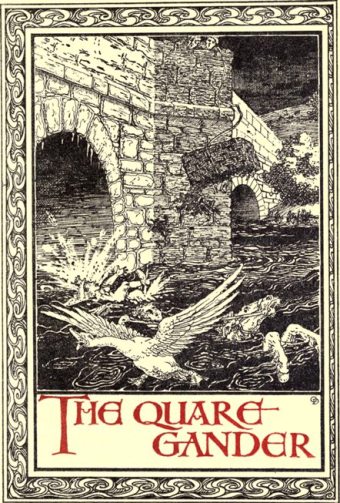
“Well, as soon as they wor all come to the bridge, the boys tuck the rope they had wid them an’ med it fast to the top iv the hamper, an’ swung it fairly over the bridge, lettin’ it hang in the air about twelve feet out iv the wather.
nd his raverince rode down to the bank of the river close by, an’ beginned to read mighty loud and bould intirely.
“An’ whin he was goin’ on about five minutes, all at onst the bottom iv the hamper kem out, an’ down wint Terence, falling splash into the wather, an’ the ould gandher a-top iv him. Down they both wint to the bottom, wid a souse you’d hear half a mile off.
“An’ before they had time to rise agin, his raverince, wid the fair astonishment, giv his horse one dig iv the spurs, an’ before he knew where he was, in he wint, horse an’ all, a-top iv them, an’ down to the bottom.
“Up they all kem agin together, gaspin’ and puffin’, an’ off down wid the current wid them, like shot in under the arch iv the bridge till they kem to the shallow wather.
“The ould gandher was the first out, and the priest and Terence kem next, pantin’ an’ blowin’ an’ more than half dhrounded, an’ his raverince was so freckened wid the dhroundin’ he got and wid the sight iv the sperit, as he consaved, that he wasn’t the better of it for a month.
“An’ as soon as Terence could spake he swore he’d have the life of the two gossoons; but Father Crotty would not give him his will. An’ as soon as he was got quiter they all endivoured to explain it; but Terence consaved he went raly to bed the night before, an’ his wife said the same to shilter him from the suspision for havin’ th’ dhrop taken. An’ his raverince said it was a mysthery, an’ swore if he cotched anyone laughin’ at the accident he’d lay the horsewhip across their shoulders.
“An’ Terence grew fonder an’ fonder iv the gandher every day, until at last he died in a wondherful old age, lavin’ the gandher afther him an’ a large family iv childher.
“An’ to this day the farm is rinted by one iv Terence Mooney’s lenial and legitimate postariors.”
Joseph Sheridan Le Fann.
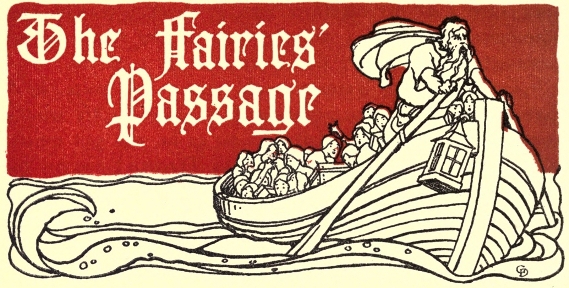
ap, tap, rap, rap! “Get up, gaffer Ferryman.” “Eh! Who is there?” The clock strikes three. “Get up, do, gaffer! You are the very man We have been long, long, longing to see.” The ferryman rises, growling and grumbling, And goes fum-fumbling, and stumbling, and tumbling Over the wares on his way to the door. But he sees no more Than he saw before, Till a voice is heard: “O Ferryman, dear! Here we are waiting, all of us, here. We are a wee, wee colony, we; Some two hundred in all, or three. Ferry us over the River Lee Ere dawn of day, And we will pay The most we may In our own wee way!” “Who are you? Whence came you? What place are you going to?” “Oh, we have dwelt over-long in this land: The people get cross, and are growing so knowing, too! Nothing at all but they now understand. We are daily vanishing under the thunder Of some huge engine or iron wonder; That iron—ah! it has entered our souls.” “Your souls? O gholes! You queer little drolls, Do you mean ——?” “Good gaffer, do aid us with speed, For our time, like our stature, is short indeed! And a very long way we have to go: Eight or ten thousand miles or so, Hither and thither, and to and fro, With our pots and pans And little gold cans; But our light caravans Run swifter than man’s.” “Well, well, you may come,” said the ferryman affably; “Patrick, turn out, and get ready the barge.” Then again to the little folk: “Tho’ you seem laughably Small, I don’t mind, if your coppers be large.” Oh, dear! what a rushing, what pushing, what crushing (The watermen making vain efforts at hushing The hubbub the while), there followed these words! What clapping of boards, What strapping of cords, What stowing away of children and wives, And platters, and mugs, and spoons, and knives! Till all had safely got into the boat, And the ferryman, clad in his tip-top coat, And his wee little fairies were safely afloat; Then ding, ding, ding, And kling, kling, kling, How the coppers did ring In the tin pitcherling! Off, then, went the boat, at first very pleasantly, Smoothly, and so forth; but after a while It swayed and it swagged this and that way, and presently Chest after chest, and pile after pile Of the little folk’s goods began tossing and rolling, And pitching like fun, beyond fairy controlling. O Mab! if the hubbub were great before, It was now some two or three million times more. Crash! went the wee crocks and the clocks; and the locks Of each little wee box were stove in by hard knocks; And then there were oaths, and prayers, and cries: “Take care!”—“See there!”—“Oh, dear, my eyes!”— “I am killed!”—“I am drowned!”—with groans and sighs, Till to land they drew. “Yeo-ho! Pull to! Tiller-rope, thro’ and thro’!” And all’s right anew. “Now jump upon shore, ye queer little oddities. (Eh, what is this?... Where are they, at all? Where are they, and where are their tiny commodities? Well, as I live!”....) He looks blank as a wall, Poor ferryman! Round him and round him he gazes, But only gets deeplier lost in the mazes Of utter bewilderment. All, all are gone, And he stands alone, Like a statue of stone, In a doldrum of wonder. He turns to steer, And a tinkling laugh salutes his ear, With other odd sounds: “Ha, ha, ha, ha! Fol lol! zidzizzle! quee, quee! bah, bah! Fizzigigiggidy! pshee! sha, sha!” “O ye thieves, ye thieves, ye rascally thieves!” The good man cries. He turns to his pitcher, And there, alas, to his horror perceives That the little folk’s mode of making him richer Has been to pay him with withered leaves!
James Clarence Mangan.
This story was told by one Laurence O’Flynn from near Swinford, in the County Mayo, to my friend, the late F. O’Conor, of Athlone, from whom I got it in Irish. It is the eleventh story in the “Sgeuluidhe Gaodhalach,” and is here for the first time literally translated into English.
An Chraoibhin Aoibhinn.
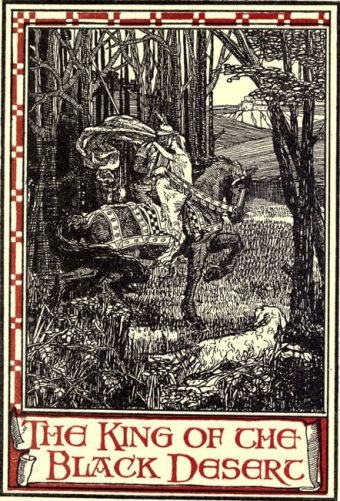
hen O’Conor was King over Ireland he was living in Rathcroghan, of Connacht. He had one son, but he, when he grew up, was wild, and the King could not control him, because he would have his own will in everything.
One morning he went out—
His hound at his foot, And his hawk on his hand, And his fine black horse to bear him—
and he went forward, singing a verse of a song to himself, until he came as far as a big bush that was growing on the brink of a glen. There was a grey old man sitting at the foot of the bush, and he said, “King’s son, if you are able to play as well as you are able to sing songs, I would like to play a game with you.” The King’s son thought that it was a silly old man that was in it, and he alighted, threw bridle over branch, and sat down by the side of the grey old man.
The old man drew out a pack of cards and asked, “Can you play these?”
“I can,” said the King’s son.
“What shall we play for?” said the grey old man.
“Anything you wish,” says the King’s son.
“All right; if I win you must do for me anything I shall ask of you, and if you win I must do for you anything you ask of me,” says the grey old man.
“I’m satisfied,” says the King’s son.
hey played the game, and the King’s son beat the grey old man. Then he said, “What would you like me to do for you, King’s son?”
“I won’t ask you to do anything for me,” says the King’s son. “I think that you are not able to do much.”
“Don’t mind that,” said the old man. “You must ask me to do something. I never lost a bet yet that I wasn’t able to pay it.”
As I said, the King’s son thought that it was a silly old man that was in it, and to satisfy him he said to him, “Take the head off my stepmother and put a goat’s head on her for a week.”
“I’ll do that for you,” said the grey old man. The King’s son went a-riding on his horse—
His hound at his foot, His hawk on his hand—
and he faced for another place, and never thought more about the grey old man until he came home.
He found a cry and great grief in the castle. The servants told him that an enchanter had come into the room where the Queen was, and had put a goat’s head on her in place of her own head.
“By my hand, but that’s a wonderful thing,” says the King’s son. “If I had been at home I’d have whipt the head off him with my sword.”
There was great grief on the King, and he sent for a wise councillor, and asked him did he know how the thing happened to the Queen.
“Indeed, I cannot tell you that,” said he; “it’s a work of enchantment.”
The King’s son did not let on that he had any knowledge of the matter, but on the morrow morning he went out—
His hound at his foot, His hawk on his hand, And his fine black horse to bear him—
and he never drew rein until he came as far as the big bush on the brink of the glen. The grey old man was sitting there under the bush, and said, “King’s son, will you have a game to-day?” The King’s son got down and said, “I will.” With that he threw bridle over branch and sat down by the side of the old man. He drew out the cards and asked the King’s son did he get the thing he had won yesterday.
“That’s all right,” said the King’s son.
“We’ll play for the same bet to-day,” says the grey old man.
“I’m satisfied,” said the King’s son.
They played—the King’s son won. “What would you like me to do for you this time?” says the grey old man. The King’s son thought and said to himself, “I’ll give him a hard job this time.” Then he said, “There’s a field of seven acres at the back of my father’s castle; let it be filled to-morrow morning with cows, and no two of them to be of one colour, or one height, or one age.”
“That shall be done,” says the grey old man.
The King’s son went riding on his horse—
His hound at his foot, His hawk on his hand—
and faced for home. The King was sorrowful about the Queen; there were doctors out of every place in Ireland, but they could not do her any good.
n the morning of the next day the King’s herd went out early, and he saw the field at the back of the castle filled with cows, and no two of them of the same colour, the same age, or the same height. He went in and told the King the wonderful news. “Go and drive them out,” says the King. The herd got men, and went with them driving out the cows, but no sooner would he put them out on one side than they would come in on the other. The herd went to the King again, and told him that all the men that were in Ireland would not be able to put out these cows that were in the field. “They’re enchanted cows,” said the King.
When the King’s son saw the cows, he said to himself, “I’ll have another game with the grey old man to-day!” That morning he went out—
His hound at his foot, His hawk on his hand, And his fine black horse to bear him—
and he never drew rein till he came as far as the big bush on the brink of the glen. The grey old man was there before him, and asked him would he have a game of cards.
“I will,” says the King’s son; “but you know well that I can beat you playing cards.”
“We’ll have another game, then,” says the grey old man. “Did you ever play ball?”
“I did, indeed,” said the King’s son; “but I think that you are too old to play ball, and, besides that, we have no place here to play it.”
“If you’re contented to play, I’ll find a place,” says the grey old man.
“I’m contented,” says the King’s son.
“Follow me,” says the grey old man.
he King’s son followed him through the glen until he came to a fine green hill. There he drew out a little enchanted rod, spoke some words which the King’s son did not understand, and after a moment the hill opened and the two went in, and they passed through a number of splendid halls until they came out into a garden. There was everything finer than another in that garden, and at the bottom of the garden there was a place for playing ball. They threw up a piece of silver to see who would have hand-in, and the grey old man got it.
They began then, and the grey old man never stopped until he won out the game. The King’s son did not know what he would do. At last he asked the old man what would he desire him to do for him.
“I am King over the Black Desert, and you must find out myself and my dwelling-place within a year and a day, or I shall find you out and you shall lose your head.”
Then he brought the King’s son out the same way by which he went in. The green hill closed behind them, and the grey old man disappeared out of sight.
The King’s son went home, riding on his horse—
His hound at his foot, His hawk on his hand—
and he sorrowful enough.
hat evening the King observed that there was grief and great trouble on his young son, and when he went to sleep the King and every person that was in the castle heard heavy sighings and ravings from him. The King was in grief—a goat’s head to be on the Queen—but he was seven times worse when they told him the (whole) story how it happened from beginning to end.
He sent for a wise councillor, and asked him did he know where the King of the Black Desert was living.
“I do not, indeed,” said he; “but as sure as there’s a tail on the cat, unless the young heir finds out that enchanter he will lose his head.”
There was great grief that day in the castle of the King. There was a goat’s head on the Queen, and the King’s son was going searching for an enchanter, without knowing whether he would ever come back.
After a week the goat’s head was taken off the Queen, and her own head was put upon her. When she heard of how the goat’s head was put upon her, a great hate came upon her against the King’s son, and she said “that he may never come back, alive or dead.”
Of a Monday morning he left his blessing with his father and his kindred; his travelling bag was bound upon his shoulder, and he went—
His hound at his foot, His hawk on his hand, And his fine black horse to bear him.
He walked that day until the sun was gone beneath the shadow of the hills and till the darkness of the night was coming, without knowing where he could get lodgings. He noticed a large wood on his left-hand side, and he drew towards it as quickly as he could, hoping to spend the night under the shelter of the trees. He sat down at the foot of a large oak tree, and opened his travelling bag to take some food and drink, when he saw a great eagle coming towards him.
“Do not be afraid of me, King’s son; I know you—you are the son of O’Conor, King of Ireland. I am a friend, and if you give me your horse to give to eat to four hungry birds that I have, I shall bear you farther than your horse would bear you, and, perhaps, I would put you on the track of him you are looking for.”
“You can have the horse, and welcome,” says the King’s son, “although I’m sorrowful at parting from him.”
“All right, I shall be here to-morrow at sunrise.” With that she opened her great gob, caught hold of the horse, struck in his two sides against one another, took wing, and disappeared out of sight.
The King’s son ate and drank his enough, put his travelling bag under his head, and it was not long till he was asleep, and he never awoke till the eagle came and said, “It is time for us to be going; there is a long journey before us. Take hold of your bag and leap up upon my back.”
“But to my grief,” says he, “I must part from my hound and my hawk.”
“Do not be grieved,” says she; “they will be here before you when you come back.”
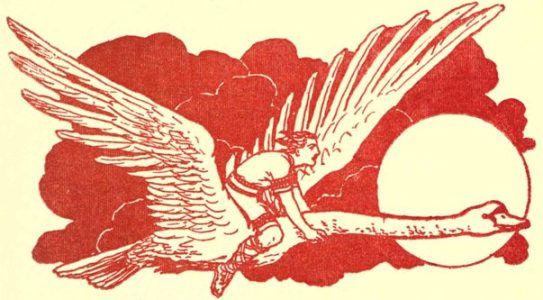
Then he leaped up on her back. She took wing, and off and away with her through the air. She brought him across hills and hollows, over a great sea, and over woods, till he thought that he was at the end of the world. When the sun was going under the shadow of the hills, she came to earth in the midst of a great desert, and said to him, “Follow the path on your right-hand side, and it will bring you to the house of a friend. I must return again to provide for my birds.”
He followed the path, and it was not long till he came to the house, and he went in. There was a grey old man sitting in the corner. He rose and said, “A hundred thousand welcomes to you, King’s son, from Rathcroghan of Connacht.”
“I have no knowledge of you,” said the King’s son.
“I was acquainted with your grandfather,” said the grey old man. “Sit down; no doubt there is hunger and thirst on you.”
“I’m not free from them,” said the King’s son.
The old man then smote his two palms against one another, and two servants came and laid a board with beef, mutton, pork, and plenty of bread before the King’s son, and the old man said to him:
at and drink your enough. Perhaps it may be a long time before you get the like again.”
He ate and drank as much as he desired, and thanked him for it.
Then the old man said, “You are going seeking for the King of the Black Desert. Go to sleep now, and I will go through my books to see if I can find out the dwelling-place of that King.” Then he smote his palms together, and a servant came, and he told him, “Take the King’s son to his chamber.” He took him to a fine chamber, and it was not long till he fell asleep.
On the morning of the next day the old man came and said:
“Rise up, there is a long journey before you. You must do five hundred miles before midday.”
“I could not do it,” said the King’s son.
“If you are a good rider I will give you a horse that will bring you over the journey.”
“I will do as you say,” said the King’s son.
The old man gave him plenty to eat and to drink, and, when he was satisfied, he gave him a little white garron, and said, “Give the garron his head, and when he stops look up into the air, and you will see three swans as white as snow. Those are the three daughters of the King of the Black Desert. There will be a green napkin in the mouth of one of them: that is the youngest daughter, and there is not anyone alive except her who could bring you to the house of the King of the Black Desert. When the garron stops you will be near a lake. The three swans will come to land on the brink of that lake, and they will make three young women of themselves, and they will go into the lake swimming and dancing. Keep your eye on the green napkin, and when you get the young women in the lake, go and get the napkin, and do not part with it. Go into hiding under a tree, and when the young women will come out, two of them will make swans of themselves, and will go away in the air. Then the youngest daughter will say, “I will do anything for him who will give me my napkin.” Come forward then and give her the napkin, and say there is nothing you want but to bring you to her father’s house, and tell her you are a king’s son from a powerful country.”
The King’s son did everything as the old man desired him, and when he gave the napkin to the daughter of the King of the Black Desert, he said, “I am the son of O’Conor, King of Connaught. Bring me to your father. Long am I seeking him.”
“Would not it be better for me to do something else for you?” said she.
“I do not want anything else,” said he.
“If I show you the house will you not be satisfied?” said she.
“I will be satisfied,” said he.
“Now,” said she, “upon your life do not tell my father that it was I who brought you to his house, and I shall be a good friend to you; but let on,” said she, “that you have great powers of enchantment.”
“I will do as you say,” says he.
Then she made a swan of herself, and said, “Leap up on my back and put your hands under my neck, and keep a hard hold.”
e did so, and she shook her wings, and off and away with her over hills and over glens, over sea and over mountains, until she came to earth as the sun was going under. Then she said to him, “Do you see that great house yonder? That is my father’s house. Farewell. Any time that you are in danger I shall be at your side.” Then she went from him.
The King’s son went to the house and went in, and who should he see sitting in a golden chair but the grey old man who had played the cards and the ball with him.
“King’s son,” said he, “I see that you have found me out before the day and the year. How long since you left home?”
“This morning, when I was rising out of my bed, I saw a rainbow. I gave a leap, spread my two legs on it, and slid as far as this.”
“By my hand, it was a great feat you performed,” said the old King.
“I could do a more wonderful thing than that if I chose,” said the King’s son.
“I have three things for you to do,” says the old King, “and if you are able to do them, you shall have the choice of my three daughters for wife, and unless you are able to do them, you shall lose your head, as a good many other young men have lost it before you.”
“Then,” he said, “there be’s neither eating nor drinking in my house except once in the week, and we had it this morning.”
“It’s all one to me,” said the King’s son. “I could fast for a month if I were on a pinch.”
“No doubt you can go without sleep also,” says the old King.
can, without doubt,” said the King’s son.
“You shall have a hard bed to-night, then,” says the old King. “Come with me till I show it to you.” He brought him out then and showed him a great tree with a fork in it, and said, “Get up there and sleep in the fork, and be ready with the rise of the sun.”
He went up into the fork, but as soon as the old King was asleep the young daughter came and brought him into a fine room, and kept him there until the old King was about to rise. Then she put him out again into the fork of the tree.
With the rise of the sun the old King came to him, and said, “Come down now and come with me until I show you the thing that you have to do to-day.”
He brought the King’s son to the brink of a lake and showed him an old castle, and said to him, “Throw every stone in that castle out into the loch, and let you have it done before the sun goes down in the evening.” He went away from him then.
The King’s son began working, but the stones were stuck to one another so fast that he was not able to raise one of them, and if he were to be working until this day, there would not be one stone out of the castle. He sat down then, thinking what he ought to do, and it was not long until the daughter of the old King came to him and said, “What is the cause of your grief?” He told her the work which he had to do. “Let that put no grief on you; I will do it,” said she. Then she gave him bread, meat, and wine, pulled out a little enchanted rod, struck a blow on the old castle, and in a moment every stone of it was at the bottom of the lake. “Now,” said she, “do not tell my father that it was I who did the work for you.”
When the sun was going down in the evening, the old King came and said, “I see that you have your day’s work done.”
“I have,” said the King’s son; “I can do any work at all.”
The old King thought now that the King’s son had great powers of enchantment, and he said to him, “Your day’s work for to-morrow is to lift the stones out of the loch, and to set up the castle again as it was before.”
He brought the King’s son home, and said to him, “Go to sleep in the place where you were last night.”
When the old King went to sleep the young daughter came and brought him into the fine chamber, and kept him there till the old King was about to rise in the morning. Then she put him out again in the fork of the tree.
At sunrise the old King came and said, “It’s time for you to get to work.”
“There’s no hurry on me at all,” says the King’s son, “because I know I can readily do my day’s work.”
e then went to the brink of the lake, but he was not able to see a stone, the water was that black. He sat down on a rock, and it was not long until Finnuala—that was the name of the old King’s daughter—came to him and said, “What have you to do to-day?” He told her, and she said, “Let there be no grief on you. I can do that work for you.” Then she gave him bread, beef, mutton, and wine. After that she drew out the little enchanted rod, smote the water of the lake with it, and in a moment the old castle was set up as it had been the day before. Then she said to him, “On your life, don’t tell my father that I did this work for you, or that you have any knowledge of me at all.”
On the evening of that day the old King came and said, “I see that you have the day’s work done.”
“I have,” said the King’s son; “that was an easy-done job.”
Then the old King thought that the King’s son had more power of enchantment than he had himself, and he said, “You have only one other thing to do.” He brought him home then, and put him to sleep in the fork of the tree, but Finnuala came and put him into the fine chamber, and in the morning she sent him out again into the tree. At sunrise the old King came to him, and said, “Come with me till I show you your day’s work.”
He brought the King’s son to a great glen, and showed him a well, and said, “My grandmother lost a ring in that well, and do you get it for me before the sun goes under this morning.”
Now, this well was one hundred feet deep and twenty feet round about, and it was filled with water, and there was an army out of hell watching the ring.
hen the old King went away Finnuala came and asked, “What have you to do to-day?” He told her, and she said, “That is a difficult task, but I shall do my best to save your life.” Then she gave him beef, bread, and wine. Then she made a diver of herself, and went down into the well. It was not long till he saw smoke and lightning coming up out of the well, and he heard a sound like thunder, and anyone who would be listening to that noise, he would think that the army of hell was fighting.
At the end of a while the smoke went away, the lightning and thunder ceased, and Finnuala came up with the ring. She handed the ring to the King’s son, and said, “I won the battle, and your life is saved. But, look, the little finger of my right hand is broken. But perhaps it’s a lucky thing that it was broken. When my father comes do not give him the ring, but threaten him stoutly. He will bring you, then, to choose your wife, and this is how you shall make your choice. I and my sisters will be in a room; there will be a hole in the door, and we shall all put our hands out in a cluster. You will put your hand through the hole, and the hand that you will keep hold of when my father will open the door, that is the hand of her you shall have for wife. You can know me by my broken little finger.”
“I can; and the love of my heart you are, Finnuala,” says the King’s son.
On the evening of that day the old King came and asked, “Did you get my grandmother’s ring?”
“I did, indeed,” says the King’s son. “There was an army out of hell guarding it, but I beat them; and I would beat seven times as many. Don’t you know I’m a Connachtman?”
ive me the ring,” says the old King.
“Indeed, I won’t give it,” says he. “I fought hard for it. But do you give me my wife; I want to be going.”
The old King brought him in, and said, “My three daughters are in that room before you. The hand of each of them is stretched out, and she on whom you will keep your hold until I open the door, that one is your wife.”
The King’s son thrust his hand through the hole that was in the door, and caught hold of the hand with the broken little finger, and kept a tight hold of it until the old King opened the door of the room.
“This is my wife,” said the King’s son. “Give me now your daughter’s fortune.”
“She has no fortune to get, but the brown slender steed to bring you home, and that ye may never come back, alive or dead!”
The King’s son and Finnuala went riding on the brown slender steed, and it was not long till they came to the wood where the King’s son left his hound and his hawk. They were there before him, together with his fine black horse. He sent the brown slender steed back then. He set Finnuala riding on his horse, and leaped up himself—
His hound at his heel, His hawk on his hand—
and he never stopped till he came to Rathcroghan.
There was great welcome before him there, and it was not long till himself and Finnuala were married. They spent a long, prosperous life. But it is scarcely that even the track of this old castle is to be found to-day in Rathcroghan of Connacht.
Douglas Hyde.
n the old times there was a half fool living in Dunmore, in the county Galway, and though he was excessively fond of music, he was unable to learn more than one tune, and that was the “Black Rogue.” He used to get a good deal of money from the gentlemen, for they used to get sport out of him. One night the Piper was coming home from a house where there had been a dance, and he half drunk. When he came up to a little bridge that was by his mother’s house, he squeezed the pipes on, and began playing the “Black Rogue.” The Púca came behind him, and flung him on his own back. There were long horns on the Púca, and the Piper got a good grip of them, and then he said: “Destruction on you, you nasty beast; let me home. I have a tenpenny-piece in my pocket for my mother, and she wants snuff.” “Never mind your mother,” said the Púca, “but keep your hold. If you fall, you will break your neck and your pipes.” Then the Púca said to him, “Play up for me the ‘Shan Van Vocht.’” “I don’t know it,” said the Piper.
ever mind whether you do or you don’t,” said the Púca. “Play up, and I’ll make you know.”
The Piper put wind in his bag, and he played such music as made himself wonder.
“Upon my word, you’re a fine music-master,” says the Piper, then; “but tell me where you’re for bringing me.”
“There’s a great feast in the house of the Banshee, on the top of Croagh Patric, to-night,” says the Púca, “and I’m for bringing you there to play music, and, take my word, you’ll get the price of your trouble.”
“By my word, you’ll save me a journey, then,” says the Piper, “for Father William put a journey to Croagh Patric on me because I stole the white gander from him last Martinmas.”
The Púca rushed him across hills and bogs and rough places, till he brought him to the top of Croagh Patric.
Then the Púca struck three blows with his foot, and a great door opened and they passed in together into a fine room.
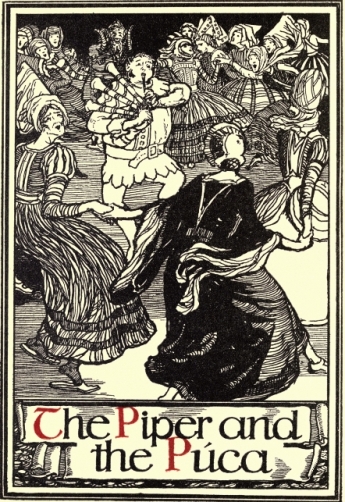
The Piper saw a golden table in the middle of the room, and hundreds of old women sitting round about it.
The old women rose up, and said, “A hundred thousand welcomes to you, you Púca of November. Who is this you have with you?”
“The best Piper in Ireland,” says the Púca.
One of the old women struck a blow on the ground, and a door opened in the side of the wall, and what should the Piper see coming out but the white gander which he had stolen from Father William.
y my conscience, then,” says the Piper, “myself and my mother ate every taste of that gander, only one wing, and I gave that to Red Mary, and it’s she told the priest I stole his gander.”
The gander cleaned the table, and carried it away, and the Púca said, “Play up music for these ladies.”
The Piper played up, and the old women began dancing, and they were dancing till they were tired. Then the Púca said to pay the Piper, and every old woman drew out a gold piece and gave it to him.
“By the tooth of Patric,” says he, “I’m as rich as the son of a lord.”
“Come with me,” says the Púca, “and I’ll bring you home.”
They went out then, and just as he was going to ride on the Púca, the gander came up to him and gave him a new set of pipes.
The Púca was not long until he brought him to Dunmore, and he threw the Piper off at the little bridge, and then he told him to go home, and says to him, “You have two things now that you never had before—you have sense and music.” The Piper went home, and he knocked at his mother’s door, saying, “Let me in, I’m as rich as a lord, and I’m the best Piper in Ireland.”
“You’re drunk,” says the mother.
“No, indeed,” says the Piper, “I haven’t drunk a drop.”
The mother let him in, and he gave her the gold pieces, and, “Wait now,” says he, “till you hear the music I’ll play.”
e buckled on the pipes, but instead of music there came a sound as if all the geese and ganders in Ireland were screeching together. He wakened the neighbours, and they were all mocking him, until he put on the old pipes, and then he played melodious music for them; and after that he told them all he had gone through that night.
The next morning, when his mother went to look at the gold pieces, there was nothing there but the leaves of a plant.
The piper went to the priest and told him his story, but the priest would not believe a word from him, until he put the pipes on him, and then the screeching of the ganders and the geese began.
“Leave my sight, you thief,” says the priest.
But nothing would do the Piper till he put the old pipes on him to show the priest that his story was true.
He buckled on the old pipes, and he played melodious music, and from that day till the day of his death there was never a Piper in the county Galway was as good as he was.
Douglas Hyde.
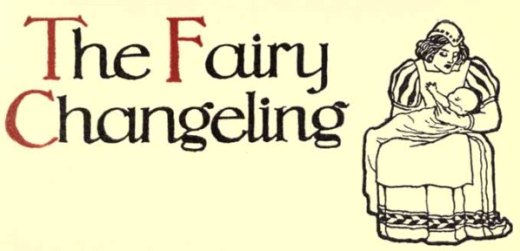
ermod O’Byrne of Omah town In his garden strode up and down; He pulled his beard, and he beat his breast; And this is his trouble and woe confessed: “The good-folk came in the night, and they Have stolen my bonny wean away; Have put in his place a changeling, A weashy, weakly, wizen thing! “From the speckled hen nine eggs I stole, And lighting a fire of a glowing coal, I fried the shells, and I spilt the yolk; But never a word the stranger spoke. “A bar of metal I heated red To frighten the fairy from its bed, To put in the place of this fretting wean My own bright beautiful boy again. “But my wife had hidden it in her arms, And cried, ‘For shame!’ on my fairy charms; She sobs, with the strange child on her breast, ‘I love the weak, wee babe the best!’” To Dermod O’Byrne’s, the tale to hear, The neighbours came from far and near; Outside his gate, in the long boreen, They crossed themselves, and said between Their muttered prayers, “He has no luck! For sure the woman is fairy-struck, To leave her child a fairy guest, And love the weak, wee wean the best!” Dora Sigerson.
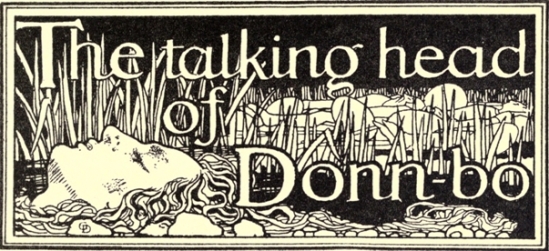
here is an old tale told in Erin of a lovable and bright and handsome youth named Donn-bo, who was the best singer of “Songs of Idleness” and the best teller of “King Stories” in the world. He could tell a tale of each king who reigned in Erin, from the “Tale of the Destruction of Dind Righ,” when Cova Coelbre was killed, down to the kings who reigned in his own time.
On a night before a battle, the warriors said, “Make minstrelsy to-night for us, Donn-bo.” But Donn-bo answered, “No word at all will come on my lips to-night; therefore, for this night let the King-buffoon of Ireland amuse you. But to-morrow, at this hour, in whatsoever place they and I shall be, I will make minstrelsy for the fighting men.” For the warriors had said that unless Donn-bo would go with them on that hosting, not one of them would go.
The battle was past, and on the evening of the morrow at that same hour Donn-bo lay dead, his fair young body stretched across the body of the King of Ireland, for he had died in defending his chief. But his head had rolled away among a wisp of growing rushes by the waterside.
At the feasting of the army on that night a warrior said, “Where is Donn-bo, that he may make minstrelsy for us, as he promised us at this hour yesternight, and that he may tell us the ‘King Stories of Erin’?”
A valiant champion of the men of Munster answered, “I will go over the battle-field and seek for him.” He enquired among the living for Donn-bo, but he found him not, and then he searched hither and thither among the dead.
t last he came where the body of the King of Erin lay, and a young, fair corpse beside it. In all the air about there was the sound of minstrelsy, low and very sweet; dead bards and poets reciting in faint whispers old tales and poems to dead chiefs.
The wild, clear note of the battle-march, the dord fiansa, played by the drooping hands of slain warriors upon the points of broken spears, low like the echo of an echo, sounded in the clump of rushes hard by; and, above them all, a voice, faint and very still, that sang a song that was sweeter than the tunes of the whole world beside.
The voice that sang was the voice of the head of Donn-bo. The warrior stooped to pick up the head.
“Do not touch me,” said the head, “for we are commanded by the King of the Plains of Heaven to make music to-night for our lord, the King of Erin, the shining one who lies dead beside us; and though all of us are lying dead likewise, no faintness or feebleness shall prevent us from obeying that command. Disturb me not.”
“The hosts of Leinster are asking thee to make minstrelsy for them, as thou didst promise yesternight,” said the messenger.
“When my minstrelsy here is done, I will go with thee,” saith the head; “but only if Christ, the Son of God, in whose presence I now am, go with me, and if thou takest me to my body again.” “That shall be done, indeed,” saith the messenger, and when it had ceased chanting for the King of Erin he carried away the head.
When the messenger came again amongst the warriors they stopped their feasting and gathered round him. “Hast thou brought anything from the battle-field?” they cried.
“I have brought the head of Donn-bo,” said the man.
“Set it upon a pillar that we may see and hear it,” cried they all; and they said, “It is no luck for thee to be like that, Donn-bo, and thou the most beautiful minstrel and the best in Erin. Make music, for the love of Jesus Christ, the Son of God. Amuse the Leinster men to-night as thou didst amuse thy lord a while ago.”
Then Donn-bo turned his face to the wall, that the darkness might be around him, and he raised his melody in the quiet night; and the sound of that minstrelsy was so piteous and sad that the hosts sat weeping at the sound of it. Then was the head taken to his body, and the neck joined itself to the shoulders again, and Donn-bo was at rest.
This is the story of the “Talking Head of Donn-bo.”
Eleanor Hull.
I wrote this story carefully down, word for word, from the telling of two men—the first, Shawn Cunningham, of Ballinphuil, and the second, Martin Brennan of Ballinlocha, in the barony of Frenchpark. They each told the same story, but Martin Brennan repeated the end of it at greater length than the other. The first half is written down word for word from the mouth of Cunningham, the second half from that of Brennan. An Chraoibhin Aoibhinn.
here was a man in it long ago, and long ago it was, and if he was in it then he would not be in it now. He was married, and his wife was lost (i.e., died), and he had only one son by the first wife. Then he married the second wife. This second wife had not much regard for the son, and he was obliged to go out on the mountain, far from the house, to take care of the cattle.
There was a bracket (speckled) bull amongst the cows out on the mountain, and of a day that there was great hunger on the lad, the bracket bull heard him complaining and wringing his two hands, and he moved over to him and said to him, “You are hungry, but take the horn off me and lay it on the ground; put your hand into the place where the horn was and you will find food.”
When he heard that he went over to the bull, took hold of the horn, twisted it, and it came away with him in his hand. He laid it on the ground, put in his hand, and drew out food and drink and a table-cloth. He spread the table-cloth on the ground, set the food and drink on it, and then he ate and drank his enough. When he had his enough eaten and drunk, he put the table-cloth back again, and left the horn back in the place where it was before.
hen he came home that evening he did not eat a bit of his supper, and his stepmother said to herself that he (must have) got something to eat out on the mountain since he was not eating any of his supper.
When he went out with his cattle the next day his stepmother sent her own daughter out after him, and told her to be watching him till she should see where he was getting the food. The daughter went and put herself in hiding, and she was watching him until the heat of the day came: but when the middle of the day was come she heard every music more excellent than another, and she was put to sleep by that truly melodious music. The bull came then, and the lad twisted the horn off him and drew out the table-cloth, the food, and the drink, and ate and drunk his enough. He put back the horn again then. The music was stopped and the daughter woke up, and was watching him until the evening came, and he drove the cows home then. The mother asked her did she see anything in the field, and she said that she did not. The lad did not eat two bites of his supper, and there was wonder on the stepmother.
The next day when he drove out the cows the stepmother told the second daughter to follow him, and to be watching him till she would see where he was getting things to eat. The daughter followed him and put herself in hiding, but when the heat of the day came the music began and she fell asleep. The lad took the horn off the bull, drew out the table-cloth, the food, and drink, ate and drank his enough, and put back the horn again. The girl woke then, and was watching him until the evening. When the evening came he drove the cows home, and he was not able to eat his supper any more than the two evenings before. The stepmother asked the daughter did she see anything, and she said she did not. There was wonder on the stepmother.
The next day, when the lad went out herding the cows, the stepmother sent the third daughter out after him, and threatened her not to fall asleep, but to have a good watch. The daughter followed the lad, and went into hiding. This daughter had three eyes, for she had an eye in the back of her head. When the bracket bull began playing every music more excellent than another, he put the other eyes to sleep, but he was not able to put the third eye to sleep. When the heat of the day came she saw the bracket bull coming to the boy, and the boy taking the horn off him and eating.
She ran home then, and said to her mother that there wasn’t such a dinner in the world as was being set before the boy out of the horn of the bracket bull.
Then the mother let on that she was sick, and she killed a cock, and she let down its blood into her bed, and she put up a sup of the blood into her mouth, and she sent for her husband, saying that she was finding death (dying). Her husband came in, and he saw the blood, and he said, “Anything that is in the world that would save her that she must get it.” She said that there wasn’t a thing in the world that would save her but a piece of the bracket bull that was on the mountain.
“You must get that,” said he.
The bracket bull used to be the first one of the cattle that used to come in every night, and the stepmother sent for two butchers, and she set them on each side of the gate to kill the bracket bull when he would come.
he bracket bull said to the boy, “I’ll be swept (done for) to-night, unless another cow goes before me.” He put another cow out before him, and the two butchers were standing on each side of the gate to kill the first one that would come in. The bull sent the cow out before him, going through the gate, and they killed her: and then the stepmother got a piece of her to eat, and she thought that it was the bracket bull that she was eating, and she got better then.