Preface (continued 5)
Reading edition
The next night, when the lad came home with the cattle, he ate no more of his supper than any other night, and there was wonder on the stepmother. She heard after this that the bracket bull was in it (i.e., alive) all through, and that he was not killed at that time.
When she heard that she killed a cock, and she let down some of its blood into her bed, and she put a sup of the blood into her mouth, and she played the same trick over again, and said that there was nothing at all to cure her but a piece of the bracket bull.
The butchers were sent for, and they were ready to kill the bracket bull as soon as he came in. The bracket bull sent another one of the cattle in before himself, and the butchers killed it. The woman got part of its flesh, and she thought it was part of the bracket bull she was eating, and she got better.
She found out afterwards that it was not the bracket bull that was dead, and she said, “Never mind; I’ll kill the bracket bull yet!”
he next day, when the lad was herding the cows on the mountain, the bracket bull came and said to him, “Take the horn off me and eat your enough now. That’s the last time for you. They are waiting to kill me to-night, but don’t you be afraid. It is not they who shall kill me, but another bull shall kill me. Get up on my back now.”
The lad got up on his back then and they went home. The two butchers were on each side of the gate waiting for him. The bracket bull struck a horn on each side of him, and he killed the two butchers. Out with him then, and the lad on his back.
He went into a wild wood, and he himself and the lad spent the night in that wood. He was to fight with the other bull on the next day.
When the day came, the bracket bull said, “Take the horn off me and eat your enough—that’s the last luck you have. I am to fight with the other bull immediately, and I shall escape from him to-day, but he will have me dead to-morrow by twelve o’clock.”
Himself and the other bull fought that day, and the bracket bull came back in the evening, and he himself and the lad passed that night in the wood.
When the next day came, the bracket bull said to him, “Twist the horn off me and eat your enough—that’s the last luck you’ll have. Listen now to the thing that I’m telling you. When you’ll see me dead, go and cut a strip of skin of the back and a strip of the stomach off me, and make a belt of it, and at any time at all there will be any hard pinch on you, you shall have my power.”
he bracket bull went then to fight with the other bull, and the other bull killed him. The other bull went away then. The lad came to the bracket bull where he was lying on the ground, and he was not dead, out-and-out. When he saw the boy coming he said, “Oh,” said he, “make haste as well as you can in the world, and take out your knife and cut that strip off me, or you will be killed as well as myself.”
There was a trembling in the poor creature’s hand, and he was not able to cut a piece at all off the bull, after his feeding him for so long, and after the kindness he had got from him.
The bracket bull spoke again, and told him to cut the strip off him on the instant, and that it would assist him as long as he would be alive. He cut a strip off the back then, and another strip off the belly, and he went away.
There was plenty of trouble and of grief on him, going of him, and he ought to have that on him too, and he departing without any knowledge of where he was making for, or where he would go.
A gentleman met him on the road, and asked him where he was going. The lad said that he did not himself know where he was going, but that he was going looking for work.
“What are you able to do?” says the gentleman.
“I’m as good a herd as ever you saw, but I’ll not tell you a lie—I can do nothing but herding; but, indeed, I’ll do that as well as any man that ever you saw.”
t’s you I want,” says the gentleman. “There are three giants up by my land, on the one mearing with me, and anything that will go in on their land they will keep it, and I cannot take it off them again. That’s all they’re asking—my cattle to go in across the mearing to them.”
“Never mind them. I’ll go bail that I’ll take good heed of them, and that I’ll not let anything in to them.”
The gentleman brought him home then, and he went herding for him. When the grass was getting scarce, he was driving the cows further out. There was a big stone wall between the land of the giants and his master’s land. There was fine grass on the other side of the wall. When he saw that, he threw down a gap in the wall and let in the pigs and the cows. He went up into a tree then, and was throwing down apples and all sorts (of fruit) to the pigs.
A giant came out, and when he saw the lad up on the tree throwing down the apples to the pigs, the head rose on him (i.e., he got furious). He came to the tree. “Get down out of that,” says he. “I think you big for one bite and small for two bites; come down till I draw you under my long cold teeth.”
“Arrah, take yourself easy,” says the boy; “perhaps it’s too quick I’d come down to you.”
“I won’t be talking to you any longer,” says the giant. He got a leverage on the tree and drew it up out of the roots.
o down, black thong, and squeeze that fellow,” says the lad, for he remembered the advice of the bracket bull. On the instant the black thong leaped out of his hand, and squeezed the giant so hard that the two eyes were going out on his head, for stronger was the power of the bull than the power of the giant. The giant was not able to put a stir out of himself, and he promised anything at all—only to save his life for him. “Anything at all you want,” says he to the lad, “you must get it from me.”
“I’m not asking anything at all except the loan of the sword that’s under your bed,” says he.
“I give it to you, and welcome,” says the giant. He went in, and brought out the sword with him.
“Try it on the three biggest trees that are in the wood, and you won’t feel it in your hand going through them,” says the giant.
“I don’t see any tree in the wood bigger or uglier than yourself,” says he, drawing the sword and whipping the head off him, so that he sent it seven furrows and seven ridges with that stroke.
“If I were to get on the body again,” said the head, and it talking, “and the men of the world wouldn’t get me off the trunk again.”
“I’ll take good care myself of that,” says the lad.
When he drove the cows home in the evening, they had that much milk that they had not half enough of vessels, and two coopers were obliged to make new vessels to hold the quantity of milk they had.
“You’re the best lad that ever I met,” says the gentleman, and he was thankful to him.
The giants used to put—each man of them—a shout of him every evening. The people only heard two shouts that evening. “There’s some change in the caher[2] to-night,” said the gentleman, when he heard the two shouts.
h,” says the lad, “I saw one of them going away by himself to-day, and he did not come home yet.”
On the next day the lad drove out his cattle until he came to the big stone wall, and he threw a gap in it, and let the cattle into the same place. He went up into a tree and began throwing down the apples. The second giant came running, and said, “What’s the meaning of throwing my wall and letting in your cattle on my estate? Get down out of that at once. You killed my brother yesterday.”
“Go down, black thong, and bind that one,” says the lad. The thong squeezed him so that he was not able to put a stir out of himself, and he promised the lad anything at all—only to spare his life.
“I am asking nothing of you but the loan of the old sword that is under your bed.”
“I’ll give you that, and welcome.” He went in, and brought out the sword with him. Each man of them had a sword, and every sword better than another.
“Try that sword on the six biggest trees that are in the wood, and it will go through them without turning the edge.”
“I don’t see any tree in the wood bigger or uglier than yourself,” says he, drawing the sword and whipping the head off him, so that he sent it seven furrows and seven ridges from the body.
“Oh,” said the head, “if I were to get going on the body again, and the men of the world wouldn’t get me off it again.”
h, I’ll take care of that myself,” says the boy.
When he drove the cows home that night there was wonder on the people when they saw the quantity of milk they had. The gentleman said that there was another change in the caher that day again, as he did not hear but only one shout, but the lad said that he saw another one going away that day, and that it was likely that he did not come back yet.
On the next day he went out, and drove the pigs and the cows up to the hall door, and was throwing down the apples to them. The third giant came out—the eldest man of them—and he was full mad after his two brothers being dead, and the teeth that were in his head were making a hand-stick for him. He told the boy to come down; that he did not know what he would do to him after his having killed his two brothers. “Come down,” says he, “till I draw you under my long, cold teeth”; and it was on him the long, cold teeth were, and no lie.
“Go down, black thong, and bind that one till the eyes will be going out on his head with the power of the squeezing that you’ll give him.”
The black thong leaped from him, and it bound the giant until the two eyes were going out on his head with the squeezing and with the tightening it gave him, and the giant promised to give him anything at all; “but spare my life,” says he.
“I’m only asking the loan of the old sword that’s under your bed,” said the lad.
ave it, and welcome,” says the giant. He went in, and brought out the sword with him. “Now,” says the giant, “strike the two ugliest stumps in the wood, and the sword will cut them without getting a bent edge.”
“Musha, then, by Mary,” says the boy, “I don’t see any stump in the wood uglier than yourself,” and he struck him so that he sent his head seven furrows and seven ridges from the body.
“Ochone for ever!” says the head. “If I were to get going on the body again, the men of the world—they wouldn’t get me off the body again.”
“I’ll take care of that myself,” says the boy.
When he came home that night the coopers were not able to make enough of vessels for them to hold the quantity of milk that the cows had, and the pigs were not able to eat with the quantity of apples that they had eaten before that.
He was a while in that way herding the cows and everything that was in the castle, he had it. There was no one at all going near the castle, for there was fear on them.
There was a fiery dragon in that country, and he used to come every seven years, and unless there would be a young woman ready bound before him he would drive the sea through the land, and he would destroy the people. The day came when the dragon was to come, and the lad asked his master to let him go to the place where the dragon was coming. “What’s the business you have there?” says the master. “There will be horsemen and coaches and great people there, and the crowds will be gathered together in it out of every place. The horses would rise up on top of you, and you would be crushed under their feet; and it’s better for you to stop at home.”
’ll stop,” said the lad. But when he got them all gone he went to the castle of the three giants, and he put a saddle on the best steed they had, and a fine suit on himself, and he took the first giant’s sword in his hand, and he went to where the dragon was.
It was like a fair there, with the number of riders and coaches and horses and people that were gathered in it. There was a young lady bound to a post on the brink of the sea, and she waiting for the dragon to come to swallow her. It was the King’s daughter that was in it, for the dragon would not take any other woman. When the dragon came out of the sea the lad went against him, and they fought with one another, and were fighting till the evening, until the dragon was frothing at the mouth, and till the sea was red with its blood. He turned the dragon out into the sea at last. He went away then, and said that he would return the next day. He left the steed again in the place where he found it, and he took the fine suit off him, and when the other people returned he was before them. When the people came home that night they were all talking and saying that some champion came to fight with the dragon and turned him out into the sea again. That was the story that every person had, but they did not know who was the champion who did it.
he next day, when his master and the other people were gone, he went to the castle of the three giants again, and he took out another steed and another suit of valour (i.e., armour), and he brought with him the second giant’s sword, and he went to the place where the dragon was to come.
The King’s daughter was bound to a post on the shore, waiting for him, and the eyes going out on her head looking would she see the champion coming who fought the dragon the day before. There were twice as many people in it as there were on the first day, and they were all waiting till they would see the champion coming. When the dragon came the lad went in face of him, and the dragon was half confused and sickened after the fight that he had made the day before. They were beating one another till the evening, and then he drove away the dragon. The people tried to keep him, but they were not able. He went from them.
When his master came home that evening the lad was in the house before him. The master told him that another champion came that day, and that he had turned the dragon into the sea. But no doubt the lad knew the story better himself than he did.
On the next day, when the gentleman was gone, he went to the caher of the giants, and he took with him another steed and another suit and the sword of the third giant, and when he came to fight with the dragon the people thought it was another champion who was in it.
He himself and the dragon were beating each other, then, and the sorra such a fight you ever saw. There were wings on the dragon, and when he was getting it tight he rose up in the air, and he was thrusting and beating the boy in his skull till he was nearly destroyed. He remembered the black thong then, and said, “Black thong, bind that one so hard that they’ll be listening to his screeching in the two divisions of the world with the squeezing that you’ll give him.” The black thong leapt away, and she bound him, and then the lad took the head off him, and the sea was red with his blood, and the waves of blood were going on the top of the water.
The lad came to the land, then, and they tried to keep him; but he went from them, and as he was riding by the lady snatched the shoe off him.
He went away, then, and he left the horse and the sword and the suit of armour in the place where he found them, and when the gentleman and the other people came home he was sitting before them at the fire. He asked them how the fight went, and they told him that the champion killed the fiery dragon, but that he was gone away, and that no one at all knew who he was.
When the King’s daughter came home she said that she would never marry a man but the man whom that shoe would fit.
There were sons of kings, and great people among them, and they saying that it was themselves who killed the dragon; but she said it was not they, unless the shoe would fit them. Some of them were cutting the toes off their feet, and some of them taking off a piece of the heel, and more of them cutting the big toe off themselves, trying would the shoe fit them. There was no good for them in it. The King’s daughter said that she would not marry one man of them.
She sent out soldiers, then, and the shoe with them, to try would it fit anyone at all. Every person, poor and rich, no matter where he was from, must try the shoe on him.
he lad was stretched out lying on the grass when the soldiers came, and when they saw him they said to him, “Show your foot.”
“Oh, don’t be humbugging me,” says he.
“We have orders,” said they, “and we cannot return without trying the shoe on everyone, poor and rich, so stretch out your foot.” He did that, and the shoe went in on his foot on the moment.
They said to him that he must come with them.
“Oh, listen to me” (i.e., give me time), said he, “till I dress myself.”
He went to the caher of the giants, and he got a fine new suit on him, and he went with them then.
That’s where the welcome was for him, and he as dressed up as e’er a man of them. They had a wedding for three days and three nights.
They got the pond and I the lakelet. They were drowned, and I came through. And as I have it (i.e., the story) to-night, that ye may not have it to-morrow night, or if ye have it itself, that ye may only lose the back teeth by it!
Douglas Hyde.
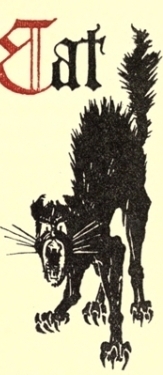
here was a woman in Connemara, the wife of a fisherman; as he had always good luck, she had plenty of fish at all times stored away in the house ready for market. But, to her great annoyance, she found that a great cat used to come in at night and devour all the best and finest fish. So she kept a big stick by her, and determined to watch. One day, as she and a woman were spinning together, the house suddenly became quite dark; and the door was burst open as if by the blast of the tempest, when in walked a huge black cat, who went straight up to the fire, then turned round and growled at them.

“Why, surely this is the devil,” said a young girl who was by, sorting fish.
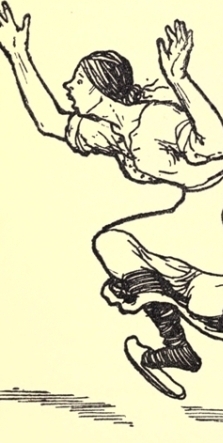
“I’ll teach you to call me names,” said the cat; and, jumping at her, he scratched her arm till the blood came. “There, now,” he said, “you will be more civil another time when a gentleman comes to see you.” And, with that, he walked over to the door, and shut it close to prevent any of them going out, for the poor young girl, while crying loudly from fright and pain, had made a desperate rush to get away.
Just then a man was going by, and, hearing the cries, he pushed open the door, and tried to get in; but the cat stood on the threshold and would let no one pass. On this the man attacked him with a stick, and gave him a sound blow; the cat, however, was more than a match in the fight, for it flew at him, and tore his face and hands so badly that the man at last took to his heels, and ran away as fast as he could.
“Now, it’s time for my dinner,” said the cat, going up to examine the fish that was laid out on the tables. “I hope the fish is good to-day. Now, don’t disturb me, or make a fuss; I can help myself.” With that, he jumped up, and began to devour all the best fish, while he growled at the woman.
“Away out of this, you wicked beast!” she cried, giving it a blow with the tongs that would have broken its back, only it was a devil; “out of this; no fish shall you have to-day!”
But the cat only grinned at her, and went on tearing and despoiling and devouring the fish, evidently not a bit the worse for the blows. On this both the women attacked it with sticks, and struck hard blows enough to kill it, on which the cat glared at them and spit fire; then, making a leap, it tore their heads and arms till the blood came, and the frightened women rushed shrieking from the house.
But presently the mistress of the house returned, carrying with her a bottle of holy water; and, looking in, she saw the cat still devouring the fish, and not minding. So she crept over quietly, and threw holy water on it without a word. No sooner was this done than a dense, black smoke filled the place, through which nothing was seen but the two red eyes of the cat burning like coals of fire. Then the smoke gradually cleared away, and she saw the body of the creature burning slowly, till it became shrivelled and black like a cinder, and finally disappeared. And from that time the fish remained untouched and safe from harm, for the power of the Evil One was broken, and the Demon Cat was seen no more.
Lady Wilde.
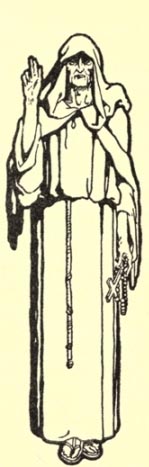
(A Legend of Killarney.) I. he Abbot of Inisfalen awoke ere dawn of day; Under the dewy green leaves went he forth to pray, The lake around his island lay smooth and dark and deep, And wrapt in a misty stillness the mountains were all asleep. Low kneel’d the Abbot Cormac when the dawn was dim and gray; The prayers of his holy office he faithfully ’gan to say. Low kneel’d the Abbot Cormac while the dawn was waxing red; And for his sins’ forgiveness a solemn prayer he said; Low kneel’d that holy Abbot while the dawn was waxing clear; And he pray’d with loving-kindness for his convent-brethren dear. Low kneel’d that blessed Abbot while the dawn was waxing bright; He pray’d a great prayer for Ireland, he pray’d with all his might. Low kneel’d that good old Father while the sun began to dart; He pray’d a prayer for all men, he pray’d it from his heart. His blissful soul was in Heaven, tho’ a breathing man was he; He was out of Time’s dominion, so far as the living may be. II. The Abbot of Inisfalen arose upon his feet; He heard a small bird singing, and O but it sung sweet! It sung upon a holly-bush, this little snow-white bird; A song so full of gladness he never before had heard. It sung upon a hazel, it sung upon a thorn; He had never heard such music since the hour that he was born. It sung upon a sycamore, it sung upon a briar; To follow the song and hearken this Abbot could never tire. Till at last he well bethought him; he might no longer stay; So he blessed the little white singing-bird, and gladly went his way. III. But, when he came to his Abbey, he found a wondrous change; He saw no friendly faces there, for every face was strange. The strange men spoke unto him; and he heard from all and each The foreign tongue of the Sassenach, not wholesome Irish speech. Then the oldest monk came forward, in Irish tongue spake he: “Thou wearest the holy Augustine’s dress, and who hath given it to thee?” “I wear the holy Augustine’s dress, and Cormac is my name, The Abbot of this good Abbey by grace of God I am. I went forth to pray, at the dawn of day; and when my prayers were said, I hearken’d awhile to a little bird that sung above my head.” The monks to him made answer, “Two hundred years have gone o’er, Since our Abbot Cormac went through the gate, and never was heard of more. Matthias now is our Abbot, and twenty have pass’d away. The stranger is lord of Ireland; we live in an evil day.” “Days will come and go,” he said, “and the world will pass away, In Heaven a day is a thousand years, a thousand years are a day.” IV. “Now, give me absolution; for my time is come,” said he. And they gave him absolution as speedily as might be. Then, close outside the window, the sweetest song they heard That ever yet since the world began was utter’d by any bird. The monks look’d out and saw the bird, its feathers all white and clean; And there in a moment, beside it, another white bird was seen. Those two they sang together, waved their white wings, and fled; Flew aloft, and vanished; but the good old man was dead. They buried his blessed body where lake and greensward meet; A carven cross above his head, a holly-bush at his feet; Where spreads the beautiful water to gay or cloudy skies, And the purple peaks of Killarney from ancient woods arise.
William Allingham.

(As told by an Irish Peasant.) orraha rose in the morning, and washed his hands and face, and said his prayers, and ate his food; and he asked God to prosper the day for him; and he went down to the brink of the sea, and he saw a currach, short and green, coming towards him; and in it there was but one youthful champion, and he playing hurly from prow to stern of the currach. He had a hurl of gold and a ball of silver; and he stopped not until the currach was in on the shore; and he drew her up on the green grass, and put fastening on her for a day and a year, whether he should be there all that time, or should only be on land for an hour by the clock. And Morraha saluted the young man in words intelligent, intelligible, such as were spoken at that time; and the other saluted him in the same fashion, and asked him would he play a game of cards with him; and Morraha said he had not the wherewithal; and the other answered that he was never without a candle or the making of it; and he put his hand in his pocket and drew out a table and two chairs and a pack of cards, and they sat down on the chairs and went to the card-playing. The first game Morraha won, and the slender red champion bade him make his claim; and he said that the land above him should be filled with stock of sheep in the morning. It was well, and he played no second game, but home he went.
he next day Morraha went to the brink of the sea, and the young man came in the currach and asked him would he play cards; and they played, and Morraha won. And the young man bade him make his claim; and he said that the land above should be filled with cattle in the morning. It was well, and he played no other game, but went home.
And on the third morning Morraha went to the brink of the sea, and he saw the young man coming. And he drew up his boat on the shore, and asked him would he play cards. And they played, and Morraha won the game; and the young man bade him give his claim. And he said he should have a castle, and of women the finest and fairest; and they were his. It was well, and the young man went away.
On the fourth day the woman asked him how he had found himself, and he told her. “And I am going out,” said he, “to play again to-day.”
“I cross (forbid) you go again to him. If you have won so much, you will lose more; and have no more to do with him.”
But he went against her will, and he saw the currach coming, and the young man was driving his balls from end to end of the currach. He had balls of silver and a hurl of gold, and he stopped not till he drew his boat on the shore, and made her fast for a year and a day. And Morraha and he saluted each other; and he asked Morraha if he would play a game of cards, and they played and he won. And Morraha said to him, “Give your claim, now.”
aid he, “You will hear it too soon. I lay on you the bonds of the art of the Druid not to sleep two nights in one house, nor finish a second meal at the one table, till you bring me the sword of light and news of the death of Anshgayliacht.”
He went down to his wife, and sat down in a chair, and gave a groan, and the chair broke in pieces.
“It is the son of a king under spells you are,” said his wife; “and you had better have taken my counsel than that the spells should be on you.” He said to her to bring news of the death of Anshgayliacht and the sword of light to the slender red champion.
“Go out,” said she, “in the morning of the morrow, and take the bridle in the window and shake it; and whatever beast, handsome or ugly, puts the head in it, take that one with you. Do not speak a word to her till she speaks to you; and take with you three pint bottles of ale and three sixpenny loaves, and do the thing she tells you; and when she runs to my father’s land, on a height above the court, she will shake herself, and the bells will ring, and my father will say Brown Allree is in the land. And if the son of a king or queen is there, bring him to me on your shoulders; but if it is the son of a poor man, let him come no further.”
He rose in the morning, and took the bridle that was in the window and went out and shook it, and Brown Allree came and put her head in it. And he took the three loaves and three bottles of ale, and went riding; and when he was riding, she bent her head down to take hold of her feet with her mouth, in hopes he would speak in ignorance; but he spoke not a word during the time, and the mare at last spoke to him, and said to him to dismount and give her her dinner. He gave her the sixpenny loaf toasted and a bottle of ale to drink. “Sit up, now, riding and take good heed of yourself: there are three miles of fire I have to clear at a leap.”
She cleared the three miles of fire at a leap, and asked if he were riding, and he said he was. They went on then, and she told him to dismount and give her a meal; and he did so, and gave her a sixpenny loaf and a bottle; and she consumed them, and said to him there were before them three miles of hill covered with steel thistles, and that she must clear it. And she cleared the hill with a leap, and she asked him if he were still riding, and he said he was. They went on, and she went not far before she told him to give her a meal, and he gave her the bread and the bottleful. And she went over three miles of sea with a leap, and she came then to the land of the King of France; and she went up on a height above the castle, and she shook herself and neighed, and the bells rang; and the King said that it was Brown Allree was in the land. “Go out,” said he, “and if it is the son of a king or queen, carry him in on your shoulders; if it is not, leave him there.”
They went out, and the stars of the son of a king were on his breast; and they lifted him high on their shoulders and bore him in to the King. And they passed the night cheerfully with playing and with drinking, with sport and with diversion, till the whiteness of the day came upon the morrow morning.
hen the young King told the cause of his journey, and he asked of the Queen her counsel and consent, and to give him counsel and good luck, and the woman told him everything she advised him to do. “Go now,” said she, “and take with you the best mare in the stable, and go to the door of Rough Niall of the speckled rock, and knock, and call on him to give you news of the death of Anshgayliacht and the sword of light; and let the horse’s back be to the door, and apply the spurs, and away with you!”
And in the morning he did so, and he took the best horse from the stable and rode to the door of Niall, and turned the horse’s back to the door, and demanded news of the death of Anshgayliacht, and the sword of light; and he applied the spurs, and away with him. And Niall followed him, and as he was passing the gate cut the horse in two. And the mother was there with a dish of puddings and flesh, and she threw it in his eyes and blinded him, and said, “Fool, whatever kind of man it is that’s mocking you, isn’t that a fine condition you have got into on your father’s horse?”
On the morning of the next day Morraha rose and took another horse from the stable, and went again to the door of Niall, and knocked and demanded news of the death of Anshgayliacht, and the sword of light, and applied the spurs to the horse, and away with him. And Niall followed, and as he was passing the gate cut the horse in two, and took half the saddle with him, and his mother met him, and threw the flesh in his eyes and blinded him.
And on the third day Morraha went also to the door of Niall; and Niall followed him, and as he was passing the gate cut away the saddle from under him and the clothes from his back. Then his mother said to Niall:
hatever fool it is that’s mocking you, he is out yonder in the little currach, going home; and take good heed to yourself, and don’t sleep one wink for three days.”

And for three days the little currach was there before him, and then his mother came to him and said:
“Sleep as much as you want now. He is gone.”
And he went to sleep, and there was heavy sleep on him, and Morraha went in and took hold of the sword that was on the bed at his head. And the sword thought to draw itself out of the hand of Morraha, but it failed. And then it gave a cry, and it wakened Niall, and Niall said it was a rude and rough thing to come into his house like that; and Morraha said to him:
“Leave your much talking, or I will cut the head off you. Tell me the news of the death of Anshgayliacht.”
“Oh, you can have my head.”
“But your head is no good to me. Tell me the story.”
“Oh,” said Niall’s wife, “you must get the story.”
“Oh,” said Morraha, “is the woman your wife?”
“Oh,” said the man, “is it not you that have the story?”
“Oh,” said she, “you will tell it to us.”
“Well,” said the man, “let us sit down together till I tell the story. I thought no one would ever get it, but now it will be heard by all.”
hen I was growing up my mother taught me the language of the birds, and when I got married I used to be listening to their conversation; and I would be laughing; and my wife would be asking me what was the reason of my laughing, but I did not like to tell her, as women are always asking questions. We went out walking one fine morning, and the birds were arguing with one another. One of them said to another:

“Why should you be making comparison with me, when there is not a king nor knight that does not come to look at my tree?”
“Oh, what advantage has your tree over mine, on which there are three rods of magic and mastery growing?”
When I heard them arguing, and knew that the rods were there, I began to laugh.
“Oh,” said my wife, “why are you always laughing? I believe it is at myself you are jesting, and I’ll walk with you no more.”
“Oh, it is not about you I am laughing. It is because I understand the language of the birds.”
Then I had to tell her what the birds were saying to one another; and she was greatly delighted, and she asked me to go home, and she gave orders to the cook to have breakfast ready at six o’clock in the morning. I did not know why she was going out early, and breakfast was ready in the morning at the hour she appointed. She asked me to go out walking. I went with her. She went to the tree, and asked me to cut a rod for her.
“Oh, I will not cut it. Are we not better without it?”
“I will not leave this till I get the rod, to see if there is any good in it.”
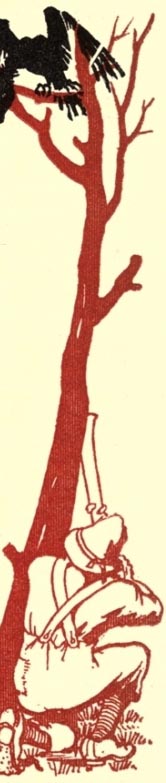
cut the rod, and gave it to her. She turned from me, and struck a blow on a stone and changed it; and she struck a second blow on me, and made of me a black raven, and she went home, and left me after her. I thought she would come back; she did not come, and I had to go into a tree till morning. In the morning, at six o’clock, there was a bellman out, proclaiming that everyone who killed a raven would get a fourpenny bit. At last you would not find man or boy without a gun, nor, if you were to walk three miles, a raven that was not killed. I had to make a nest in the top of the parlour chimney, and hide myself all day till night came, and go out to pick up a bit to support me, till I spent a month. Here she is herself (to say) if it is a lie I am telling.
“It is not,” said she.
Then I saw her out walking. I went up to her, and I thought she would turn me back to my own shape, and she struck me with the rod and made of me an old white horse, and she ordered me to be put to a cart with a man to draw stones from morning till night. I was worse off then. She spread abroad a report that I had died suddenly in my bed, and prepared a coffin, and waked me, and buried me. Then she had no trouble. But when I got tired, I began to kill everyone who came near me, and I used to go into the haggard every night and destroy the stacks of corn; and when a man came near me in the morning, I would follow him till I broke his bones. Everyone got afraid of me. When she saw I was doing mischief, she came to meet me, and I thought she would change me. And she did change me, and made a fox of me. When I saw she was doing me every sort of damage, I went away from her. I knew there was a badger’s hole in the garden, and I went there till night came, and I made great slaughter among the ducks and geese. There she is herself to say if I am telling a lie.
“Oh, you are telling nothing but the truth, only less than the truth.”
When she had enough of my killing the fowl, she came out into the garden, for she knew I was in the badger’s hole. She came to me, and made me a wolf. I had to be off, and go to an island, where no one at all would see me, and now and then I used to be killing sheep, for there were not many of them, and I was afraid of being seen and hunted; and so I passed a year, till a shepherd saw me among the sheep, and a pursuit was made after me. And when the dogs came near me, there was no place for me to escape to from them; but I recognised the sign of the King among the men, and I made for him, and the King cried out to stop the hounds. I took a leap upon the front of the King’s saddle, and the woman behind cried out, “My King and my lord, kill him, or he will kill you.”
“Oh, he will not kill me. He knew me; and must be pardoned.” And the King took me home with him, and gave orders that I should be well cared for. I was so wise when I got food I would not eat one morsel until I got a knife and fork. The man told the King, and the King came to see if it was true, and I got a knife and fork, and I took the knife in one paw and the fork in the other, and I bowed to the King. The King gave orders to bring him drink, and it came; and the King filled a glass of wine, and gave it to me. I took hold of it in my paw, and drank it, and thanked the King. “Oh, on my honour, it is some king that has lost him when he came on the island; and I will keep him, as he is trained; and perhaps he will serve us yet.”
And this is the sort of King he was—a King who had not a child living. Eight sons were born to him and three daughters, and they were stolen the same night they were born. No matter what guard was placed over them, the child would be gone in the morning. The Queen was now carrying the twelfth child, and when she was lying-in, the King took me with him to watch the baby. The women were not satisfied with me. “Oh,” said the King, “what was all your watching ever? One that was born to me I have not; and I will leave this one in the dog’s care, and he will not let it go.”
coupling was put between me and the cradle, and when everyone went to sleep I was watching till the person woke who attended in the daytime; but I was there only two nights when, it was near the day, I saw the hand coming down through the chimney, and the hand was so big that it took round the child altogether, and thought to take him away. I caught hold of the hand above the wrist, and, as I was fastened to the cradle, I did not let go my hold till I cut the hand from the wrist, and there was a howl from the person without. I laid the hand in the cradle with the child, and, as I was tired, I fell asleep; and when I awoke I had neither child nor hand; and I began to howl, and the King heard me, and he cried out that something was wrong with me, and he sent servants to see what was the matter with me, and when the messenger came he saw me covered with blood, and he could not see the child; and he went to the King, and told him the child was not to be got. The King came, and saw the cradle coloured with the blood, and he cried out, “Where was the child gone?” and everyone said it was the dog had eaten it.
The King said, “It is not: loose him, and he will get the pursuit himself.”
hen I was loosed, I found the scent of the blood till I came to a door of the room in which the child was. I went to the King, and took hold of him, and went back again, and began to tear at the door. The King followed me, and asked for the key. The servant said it was in the room of the stranger woman. The King caused search to be made for her, and she was not to be found. “I will break the door,” said the King, “as I can’t get the key.” The King broke the door, and I went in, and went to the trunk, and the King asked for a key to unlock it. He got no key, and he broke the lock. When he opened the trunk the child and the hand were stretched side by side, and the child was asleep. The King took the hand, and ordered a woman to come for the child, and he showed the hand to everyone in the house. But the stranger woman was gone, and she did not see the King; and here she is herself to say if I am telling lies of her.
“Oh, it’s nothing but the truth you have.”
The King did not allow me to be tied any more. He said there was nothing so much to wonder at as that I cut the hand off, and I tied.
The child was growing till he was a year old, and he was beginning to walk, and there was no one caring for him more than I was. He was growing till he was three, and he was running out every minute; so the King ordered a silver chain to be put between me and the child, so that he might not go away from me. I was out with him in the garden every day, and the King was as proud as the world of the child. He would be watching him every place we went, till the child grew so wise that he would loose the chain and get off. But one day that he loosed it I failed to find him; and I ran into the house and searched the house, but there was no getting him for me. The King cried to go out and find the child, that he had got loose from the dog. They went searching for him, but they could not find him. When they failed altogether to find him, there remained no more favour with the King towards me, and everyone disliked me, and I grew weak, for I did not get a morsel to eat half the time. When summer came I said I would try and go home to my own country. I went away one fine morning, and I went swimming, and God helped me till I came home. I went into the garden, for I knew there was a place in the garden where I could hide myself, for fear she should see me. In the morning I saw my wife out walking, and my child with her, held by the hand. I pushed out to see the child, and, as he was looking about him everywhere, he saw me, and called out, “I see my shaggy papa. Oh,” said he; “oh, my heart’s love, my shaggy papa, come here till I see you.”
I was afraid the woman would see me, as she was asking the child where he saw me, and he said I was up in a tree; and the more the child called me, the more I hid myself. The woman took the child home with her, but I knew he would be up early in the morning.
I went to the parlour window, and the child was within, and he playing. When he saw me, he cried out, “Oh, my heart’s love, come here till I see you, shaggy papa.” I broke the window, and went in, and he began to kiss me. I saw the rod in front of the chimney, and I jumped up at the rod and knocked it down. “Oh, my heart’s love, no one would give me the pretty rod.” I thought he would strike me with the rod, but he did not. When I saw the time was short, I raised my paw, and I gave him a scratch below the knee. “Oh, you naughty, dirty, shaggy papa; you have hurt me so much—I’ll give yourself a blow of the rod.” He struck me a light blow, and as there was no sin on him, I came back to my own shape again. When he saw a man standing before him he gave a cry, and I took him up in my arms. The servants heard the child. A maid came in to see what was the matter with him. When she saw me she gave a cry out of her, and she said, “Oh, my soul to God, if the master isn’t come to life again.”
Another came in, and said it was he, really. And when the mistress heard of it, she came to see with her own eyes, for she would not believe I was there; and when she saw me she said she’d drown herself. And I said to her, “If you yourself will keep the secret, no living man will ever get the story from me until I lose my head.”
Many’s the man has come asking for the story, and I never let one return; but now everyone will know it, but she is as much to blame as I. I gave you my head on the spot, and a thousand welcomes, and she cannot say I have been telling anything but the truth.
“Oh, surely, nor are you now.”
When I saw I was in a man’s shape I said I would take the child back to his father and mother, as I knew the grief they were in after him. I got a ship, and took the child with me; and when I was journeying I came to land on an island, and I saw not a living soul on it, only a court, dark and gloomy. I went in to see was there anyone in it. There was no one but an old hag, tall and frightful, and she asked me, “What sort of person are you?” I heard someone groaning in another room, and I said I was a doctor, and I asked her what ailed the person who was groaning.
“Oh,” said she, “it is my son, whose hand has been bitten from his wrist by a dog.”
I knew then it was the boy who was taking the child from me, and I said I would cure him if I got a good reward.
have nothing, but there are eight young lads and three young women, as handsome as anyone laid eyes on, and if you cure him I will give you them.”
“But tell me in what place his hand was cut from.”
“Oh, it was out in another country twelve years ago.”
“Show me the way, that I may see him.”
She brought me into a room, so that I saw him, and his arm was swelled up to the shoulder. He asked if I would cure him; and I said I could cure him if he would give me the reward his mother promised.
“Oh, I will give it, but cure me.”
“Well, bring them out to me.”
The hag brought them out of the room. I said I would burn the flesh that was on his arm. When I looked on him he was howling with pain. I said that I would not leave him in pain long. The thief had only one eye in his forehead. I took a bar of iron, and put it in the fire till it was red, and I said to the hag, “He will be howling at first, but will fall asleep presently, and do not wake him until he has slept as much as he wants. I will close the door when I am going out.” I took the bar with me, and I stood over him, and I turned it across through his eye as far as I could. He began to bellow, and tried to catch me, but I was out and away, having closed the door. The hag asked me, “Why is he bellowing?”
“Oh, he will be quiet presently, and will sleep for a good while, and I’ll come again to have a look at him; but bring me out the young men and the young women.”
I took them with me, and I said to her, “Tell me where you got them.”
h, my son brought them with him, and they are the offspring of the one King.”
I was well satisfied, and I had no liking for delay to get myself free from the hag, and I took them on board the ship, and the child I had myself. I thought the King might leave me the child I nursed myself; but when I came to land, and all those young people with me, the King and Queen were out walking. The King was very aged, and the Queen aged likewise. When I came to converse with them, and the twelve with me, the King and Queen began to cry. I asked, “Why are you crying?”
“Oh, it is for good cause I am crying. As many children as these I should have, and now I am withered, grey, at the end of my life, and I have not one at all.”
“Oh, belike, you will yet have plenty.”
I told him all I went through, and I gave him the child in his hand, and: “These are your other children who were stolen from you, whom I am giving to you safe. They are gently reared.”
When the King heard who they were, he smothered them with kisses and drowned them with tears, and dried them with fine cloths, silken, and the hairs of his own head, and so also did their mother, and great was his welcome for me, as it was I who found them all. And the King said to me, “I will give you your own child, as it is you who have earned him best; but you must come to my court every year, and the child with you, and I will share with you my possessions.”
“Oh, I have enough of my own, and after my death I will leave it to the child.”
I spent a time till my visit was over, and I told the King all the troubles I went through, only I said nothing about my wife. And now you have the story of the death of Anshgayliacht, the hag’s son.
And Morraha thanked Rough Niall for the story, and he struck the ground with the Sword of Light, and Brown Allree was beside of him and she said to him, “Sit up, now, riding, and take good heed of yourself,” and at one leap she cleared the sea and at the next the three miles of hill covered with steel thistles and at the third the three miles of fire, and then he was home and he told the tale of the death of Anshgayliacht to the Slender Red Champion and gave him the Sword of Light, and he was well pleased to get them, and he took the spells of Morraha, and he had his wife and his castle back again, and by-and-by the five children; but he never put his hand to card-playing with strangers again.
W. Larminie.
(From “West Irish Folk Tales.”)
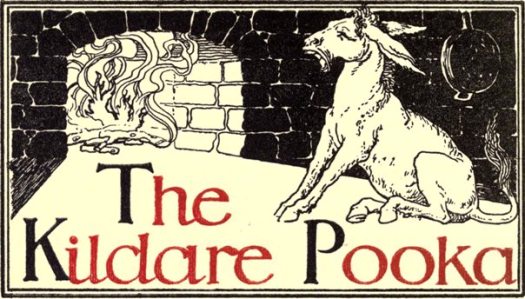
r. H—— R——, when he was alive, used to live a good deal in Dublin, and he was once a great while out of the country on account of the “ninety-eight” business. But the servants kept on in the big house at Rath—— all the same as if the family was at home. Well, they used to be frightened out of their lives, after going to their beds, with the banging of the kitchen door and the clattering of fire-irons and the pots and plates and dishes. One evening they sat up ever so long keeping one another in heart with stories about ghosts and that, when—what would you have of it?—the little scullery boy that used to be sleeping over the horses, and could not get room at the fire, crept into the hot hearth, and when he got tired listening to the stories, sorra fear him, but he fell dead asleep.
Well and good. After they were all gone, and the kitchen raked up, he was woke with the noise of the kitchen door opening, and the trampling of an ass on the kitchen floor. He peeped out, and what should he see but a big ass, sure enough, sitting on his curabingo and yawning before the fire. After a little he looked about him, and began scratching his ears as if he was quite tired, and says he, “I may as well begin first as last.” The poor boy’s teeth began to chatter in his head, for, says he, “Now he’s going to ate me”; but the fellow with the long ears and tail on him had something else to do. He stirred the fire, and then he brought in a pail of water from the pump, and filled a big pot that he put on the fire before he went out. He then put in his hand—foot, I mean—into the hot hearth, and pulled out the little boy. He let a roar out of him with the fright; but the pooka only looked at him, and thrust out his lower lip to show how little he valued him, and then he pitched him into his pew again.
Well, he then lay down before the fire till he heard the boil coming on the water, and maybe there wasn’t a plate, or a dish, or a spoon on the dresser that he didn’t fetch and put in the pot, and wash and dry the whole bilin’ of ’em as well as e’er a kitchen maid from that to Dublin town. He then put all of them up on their places on the shelves; and if he didn’t give a good sweepin’ to the kitchen, leave it till again. Then he comes and sits fornent the boy, let down one of his ears, and cocked up the other, and gave a grin. The poor fellow strove to roar out, but not a dheeg ’ud come out of his throat. The last thing the pooka done was to rake up the fire and walk out, giving such a slap o’ the door that the boy thought the house couldn’t help tumbling down.
Well, to be sure, if there wasn’t a hullabuloo next morning when the poor fellow told his story! They could talk of nothing else the whole day. One said one thing, another said another, but a fat, lazy scullery girl said the wittiest thing of all. “Musha!” says she, “if the pooka does be cleaning up everything that way when we are asleep, what should we be slaving ourselves for doing his work?” “Sha gu dheine,” says another, “them’s the wisest words you ever said, Kauth; it’s meeself won’t contradict you.”
o said, so done. Not a bit of a plate or dish saw a drop of water that evening, and not a besom was laid on the floor, and everyone went to bed soon after sundown. Next morning everything was as fine as fine in the kitchen, and the lord mayor might eat his dinner off the flags. It was great ease to the lazy servants, you may depend, and everything went on well till a foolhardy gag of a boy said he would stay up one night and have a chat with the pooka. He was a little daunted when the door was thrown open and the ass marched up to the fire.
“And then, sir,” says he at last, picking up courage, “if it isn’t taking a liberty, might I ax who you are, and why you are so kind as to do half of the day’s work for the girls every night?” “No liberty at all,” says the pooka, says he: “I’ll tell you, and welcome. I was a servant in the time of Squire R——’s father, and was the laziest rogue that ever was clothed and fed, and done nothing for it. When my time came for the other world, this is the punishment was laid on me to come here and do all this labour every night, and then go out in the cold. It isn’t so bad in the fine weather; but if you only knew what it is to stand with your head between your legs, facing the storm from midnight to sunrise, on a bleak winter night.” “And could we do anything for your comfort, my poor fellow?” says the boy. “Musha, I don’t know,” says the pooka; “but I think a good quilted frieze coat would help me to keep the life in me them long nights.” “Why, then, in troth, we’d be the ungratefullest of people if we didn’t feel for you.”
To make a long story short, the next night the boy was there again; and if he didn’t delight the poor pooka, holding a fine warm coat before him, it’s no mather! Betune the pooka and the man, his legs was got into the four arms of it, and it was buttoned down the breast and the belly, and he was so pleased he walked up to the glass to see how it looked. “Well,” says he, “it’s a long lane that has no turning. I am much obliged to you and your fellow-servants. You have made me happy at last. Good night to you.”
So he was walking out, but the other cried, “Och! sure you’re going too soon. What about the washing and sweeping?” “Ah, you may tell the girls that they must now get their turn. My punishment was to last till I was thought worthy of a reward for the way I done my duty. You’ll see me no more.” And no more they did, and right sorry they were for having been in such a hurry to reward the ungrateful pooka.
Patrick Kennedy.

ho rideth through the driving rain At such a headlong speed? Naked and pale he rides amain Upon a naked steed. Nor hollow nor height his going bars, His wet steed shines like silk, His head is golden to the stars And his limbs are white as milk. But, lo, he dwindles as the light That lifts from a black mere, And, as the fair youth wanes from sight, The steed grows mightier. What wizard by yon holy tree Mutters unto the sky Where Macha’s flame-tongued horses flee On hoofs of thunder by?
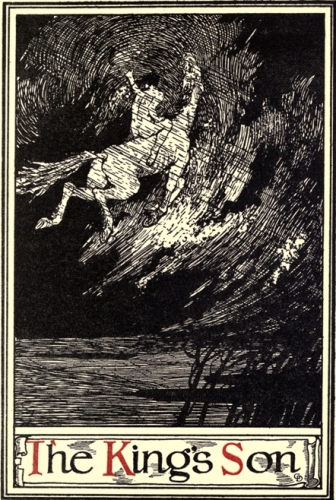
Ah, ’tis not holy so to ban The youth of kingly seed: Ah! woe, the wasting of a man Who changes to a steed. Nightly upon the Plain of Kings, When Macha’s day is nigh, He gallops; and the dark wind brings His lonely human cry.
Thomas Boyd.


n the days when Murtough Mac Erca was in the High Kingship of Ireland, the country was divided between the old beliefs of paganism and the new doctrines of the Christian teaching. Part held with the old creed and part with the new, and the thought of the people was troubled between them, for they knew not which way to follow and which to forsake. The faith of their forefathers clung close around them, holding them by many fine and tender threads of memory and custom and tradition; yet still the new faith was making its way, and every day it spread wider and wider through the land. The family of Murtough had joined itself to the Christian faith, and his three brothers were bishops and abbots of the Church, but Murtough himself remained a pagan, for he was a wild and lawless prince, and the peaceful teachings of the Christian doctrine, with its forgiveness of enemies, pleased him not at all. Fierce and cruel was his life, filled with dark deeds and bloody wars, and savage and tragic was his death, as we shall hear.
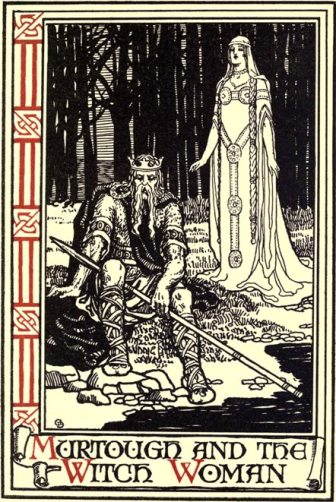
ow Murtough was in the sunny summer palace of Cletty, which Cormac, son of Art, had built for a pleasure house on the brink of the slow-flowing Boyne, near the Fairy Brugh of Angus the Ever Young, the God of Youth and Beauty. A day of summer was that day, and the King came forth to hunt on the borders of the Brugh, with all his boon companions around him. But when the high-noon came the sun grew hot, and the King sat down to rest upon the fairy mound, and the hunt passed on beyond him, and he was left alone.
There was a witch woman in that country whose name was “Sigh, Sough, Storm, Rough Wind, Winter Night, Cry, Wail, and Groan.” Star-bright and beautiful was she in face and form, but inwardly she was cruel as her names. And she hated Murtough because he had scattered and destroyed the Ancient Peoples of the Fairy Tribes of Erin, her country and her fatherland, and because in the battle which he fought at Cerb on the Boyne her father and her mother and her sister had been slain. For in those days women went to battle side by side with men.
She knew, too, that with the coming of the new faith trouble would come upon the fairy folk, and their power and their great majesty would depart from them, and men would call them demons, and would drive them out with psalm-singing and with the saying of prayers, and with the sound of little tinkling bells. So trouble and anger wrought in the witch woman, and she waited the day to be revenged on Murtough, for he being yet a pagan, was still within her power to harm.
o when Sheen (for Sheen or “Storm” was the name men gave to her) saw the King seated on the fairy mound and all his comrades parted from him, she arose softly, and combed her hair with her comb of silver adorned with little ribs of gold, and she washed her hands in a silver basin wherein were four golden birds sitting on the rim of the bowl, and little bright gems of carbuncle set round about the rim. And she donned her fairy mantle of flowing green, and her cloak, wide and hooded, with silvery fringes, and a brooch of fairest gold. On her head were tresses yellow like to gold, plaited in four locks, with a golden drop at the end of each long tress. The hue of her hair was like the flower of the iris in summer or like red gold after the burnishing thereof. And she wore on her breasts and at her shoulders marvellous clasps of gold, finely worked with the tracery of the skilled craftsman, and a golden twisted torque around her throat. And when she was decked she went softly and sat down beside Murtough on the turfy hunting mound. And after a space Murtough perceived her sitting there, and the sun shining upon her, so that the glittering of the gold and of her golden hair and the bright shining of the green silk of her garments, was like the yellow iris-beds upon the lake on a sunny summer’s day. Wonder and terror seized on Murtough at her beauty, and he knew not if he loved her or if he hated her the most; for at one moment all his nature was filled with longing and with love of her, so that it seemed to him that he would give the whole of Ireland for the loan of one hour’s space of dalliance with her; but after that he felt a dread of her, because he knew his fate was in her hands, and that she had come to work him ill. But he welcomed her as if she were known to him and he asked her wherefore she was come. “I am come,” she said, “because I am beloved of Murtough, son of Erc, King of Erin, and I come to seek him here.” Then Murtough was glad, and he said, “Dost thou not know me, maiden?” “I do,” she answered, “for all secret and mysterious things are known to me and thou and all the men of Erin are well known.”
fter he had conversed with her awhile, she appeared to him so fair that the King was ready to promise her anything in life she wished, so long as she would go with him to Cletty of the Boyne. “My wish,” she said, “is that you take me to your house, and that you put out from it your wife and your children because they are of the new faith, and all the clerics that are in your house, and that neither your wife nor any cleric be permitted to enter the house while I am there.”
“I will give you,” said the King, “a hundred head of every herd of cattle that is within my kingdom, and a hundred drinking horns, and a hundred cups, and a hundred rings of gold, and a feast every other night in the summer palace of Cletty. But I pledge thee my word, oh, maiden, it were easier for me to give thee half of Ireland than to do this thing that thou hast asked.” For Murtough feared that when those that were of the Christian faith were put out of his house, she would work her spells upon him, and no power would be left with him to resist those spells.
“I will not take thy gifts,” said the damsel, “but only those things that I have asked; moreover, it is thus, that my name must never be uttered by thee, nor must any man or woman learn it.”
“What is thy name,” said Murtough, “that it may not come upon my lips to utter it?”
nd she said, “Sigh, Sough, Storm, Rough Wind, Winter Night, Cry, Wail, Groan, this is my name, but men call me Sheen, for ‘Storm’ or Sheen is my chief name, and storms are with me where I come.”
Nevertheless, Murtough was so fascinated by her that he brought her to his home, and drove out the clerics that were there, with his wife and children along with them, and drove out also the nobles of his own clan, the children of Niall, two great and gallant battalions. And Duivsech, his wife, went crying along the road with her children around her to seek Bishop Cairnech, the half-brother of her husband, and her own soul-friend, that she might obtain help and shelter from him.
But Sheen went gladly and light-heartedly into the House of Cletty, and when she saw the lovely lightsome house and the goodly nobles of the clan of Niall, and the feasting and banqueting and the playing of the minstrels and all the joyous noise of that kingly dwelling, her heart was lifted within her, and “Fair as a fairy palace is this house of Cletty,” said she.
“Fair, indeed, it is,” replied the King; “for neither the Kings of Leinster nor the Kings of mighty Ulster, nor the lords of the clans of Owen or of Niall, have such a house as this; nay, in Tara of the Kings itself, no house to equal this house of mine is found.” And that night the King robed himself in all the splendour of his royal dignity, and on his right hand he seated Sheen, and a great banquet was made before them, and men said that never on earth was to be seen a woman more goodly of appearance than she. And the King was astonished at her, and he began to ask her questions, for it seemed to him that the power of a great goddess of the ancient time was in her; and he asked her whence she came, and what manner was the power that he saw in her. He asked her, too, did she believe in the God of the clerics, or was she herself some goddess of the older world? For he feared her, feeling that his fate was in her hands.
She laughed a careless and a cruel laugh, for she knew that the King was in their power, now that she was there alone with him, and the clerics and the Christian teachers gone. “Fear me not, O Murtough,” she cried; “I am, like thee, a daughter of the race of men of the ancient family of Adam and of Eve; fit and meet my comradeship with thee; therefore, fear not nor regret. And as to that true God of thine, worker of miracles and helper of His people, no miracle in all the world is there that I, by mine own unaided power, cannot work the like. I can create a sun and moon; the heavens I can sprinkle with radiant stars of night. I can call up to life men fiercely fighting in conflict, slaughtering one another. Wine I could make of the cold water of the Boyne, and sheep of lifeless stones, and swine of ferns. In the presence of the hosts I can make gold and silver, plenty and to spare; and hosts of famous fighting men I can produce from naught. Now, tell me, can thy God work the like?”
“Work for us,” says the King, “some of these great wonders.” Then Sheen went forth out of the house, and she set herself to work spells on Murtough, so that he knew not whether he was in his right mind or no. She took of the water of the Boyne and made a magic wine thereout, and she took ferns and spiked thistles and light puff-balls of the woods, and out of them she fashioned magic swine and sheep and goats, and with these she fed Murtough and the hosts. And when they had eaten, all their strength went from them, and the magic wine sent them into an uneasy sleep and restless slumbers. And out of stones and sods of earth she fashioned three battalions, and one of the battalions she placed at one side of the house, and the other at the further side beyond it, and one encircling the rest southward along the hollow windings of the glen. And thus were these battalions, one of them all made of men stark-naked and their colour blue, and the second with heads of goats with shaggy beards and horned; but the third, more terrible than they, for these were headless men, fighting like human beings, yet finished at the neck; and the sound of heavy shouting as of hosts and multitudes came from the first and the second battalion, but from the third no sound save only that they waved their arms and struck their weapons together, and smote the ground with their feet impatiently. And though terrible was the shout of the blue men and the bleating of the goats with human limbs, more horrible yet was the stamping and the rage of those headless men, finished at the neck.
And Murtough, in his sleep and in his dreams, heard the battle-shout, and he rose impetuously from off his bed, but the wine overcame him, and his strength departed from him, and he fell helplessly upon the floor. Then he heard the challenge a second time, and the stamping of the feet without, and he rose again, and madly, fiercely, he set on them, charging the hosts and scattering them before him, as he thought, as far as the fairy palace of the Brugh. But all his strength was lost in fighting phantoms, for they were but stones and sods and withered leaves of the forest that he took for fighting men.
ow Duivsech, Murtough’s wife, knew what was going on. She called upon Cairnech to arise and to gather together the clans of the children of his people, the men of Owen and of Niall, and together they went to the fort; but Sheen guarded it well, so that they could by no means find an entrance. Then Cairnech was angry, and he cursed the place, and he dug a grave before the door, and he stood up upon the mound of the grave, and rang his bells and cursed the King and his house, and prophesied his downfall. But he blessed the clans of Owen and of Niall, and they returned to their own country.
Then Cairnech sent messengers to seek Murtough and to draw him away from the witch woman who sought his destruction, but because she was so lovely the King would believe no evil of her; and whenever he made any sign to go to Cairnech, she threw her spell upon the King, so that he could not break away. When he was so weak and faint that he had no power left, she cast a sleep upon him, and she went round the house, putting everything in readiness. She called upon her magic host of warriors, and set them round the fortress, with their spears and javelins pointed inwards towards the house, so that the King would not dare to go out amongst them. And that night was a night of Samhain-tide, the eve of Wednesday after All Souls’ Day.
hen she went everywhere throughout the house, and took lighted brands and burning torches, and scattered them in every part of the dwelling. And she returned into the room wherein Murtough slept, and lay down by his side. And she caused a great wind to spring up, and it came soughing through the house from the north-west; and the King said, “This is the sigh of the winter night.” And Sheen smiled, because, unwittingly, the King had spoken her name, for she knew by that that the hour of her revenge had come. “’Tis I myself that am Sigh and Winter Night,” she said, “and I am Rough Wind and Storm, a daughter of fair nobles; and I am Cry and Wail, the maid of elfin birth, who brings ill-luck to men.”
After that she caused a great snowstorm to come round the house; and like the noise of troops and the rage of battle was the storm, beating and pouring in on every side, so that drifts of deep snow were piled against the walls, blocking the doors and chilling the folk that were feasting within the house. But the King was lying in a heavy, unresting sleep, and Sheen was at his side. Suddenly he screamed out of his sleep and stirred himself, for he heard the crash of falling timbers and the noise of the magic hosts, and he smelled the strong smell of fire in the palace.
He sprang up. “It seems to me,” he cried, “that hosts of demons are around the house, and that they are slaughtering my people, and that the house of Cletty is on fire.” “It was but a dream,” the witch maiden said. Then he slept again, and he saw a vision, to wit, that he was tossing in a ship at sea, and the ship floundered, and above his head a griffin, with sharp beak and talons, sailed, her wings outspread and covering all the sun, so that it was dark as middle-night; and lo! as she rose on high, her plumes quivered for a moment in the air; then down she swooped and picked him from the waves, carrying him to her eyrie on the dismal cliff outhanging o’er the ocean; and the griffin began to pierce him and to prod him with her talons, and to pick out pieces of his flesh with her beak; and this went on awhile, and then a flame, that came he knew not whence, rose from the nest, and he and the griffin were enveloped in the flame. Then in her beak the griffin picked him up, and together they fell downward over the cliff’s edge into the seething ocean; so that, half by fire and half by water, he died a miserable death.
When the King saw that vision, he rose screaming from his sleep, and donned his arms; and he made one plunge forward seeking for the magic hosts, but he found no man to answer him. The damsel went forth from the house, and Murtough made to follow her, but as he turned the flames leaped out, and all between him and the door was one vast sheet of flame. He saw no way of escape, save the vat of wine that stood in the banqueting hall, and into that he got; but the burning timbers of the roof fell upon his head and the hails of fiery sparks rained on him, so that half of him was burned and half was drowned, as he had seen in his dream.
The next day, amid the embers, the clerics found his corpse, and they took it up and washed it in the Boyne, and carried it to Tuilen to bury it. And they said, “Alas! that Mac Erca, High King of Erin, of the noble race of Conn and of the descendants of Ugaine the Great, should die fighting with sods and stones! Alas! that the Cross of Christ was not signed upon his face that he might have known the witchdoms of the maiden what they were.”
s they went thus, bewailing the death of Murtough and bearing him to his grave, Duivsech, wife of Murtough, met them, and when she found her husband dead, she struck her hands together and she made a great and mournful lamentation; and because weakness came upon her she leaned her back against the ancient tree that is in Aenech Reil; and a burst of blood broke from her heart, and there she died, grieving for her husband. And the grave of Murtough was made wide and deep, and there they laid the Queen beside him, two in the one grave, near the north side of the little church that is in Tuilen.
Now, when the burial was finished, and the clerics were reciting over his grave the deeds of the King, and were making prayers for Murtough’s soul that it might be brought out of hell, for Cairnech showed great care for this, they saw coming towards them across the sward a lonely woman, star-bright and beautiful, and a kirtle of priceless silk upon her, and a green mantle with its fringes of silver thread flowing to the ground. She reached the place where the clerics were, and saluted them, and they saluted her. And they marvelled at her beauty, but they perceived on her an appearance of sadness and of heavy grief. They asked of her, “Who art thou, maiden, and wherefore art thou come to the house of mourning? For a king lies buried here.” “A king lies buried here, indeed,” said she, “and I it was who slew him, Murtough of the many deeds, of the race of Conn and Niall, High King of Ireland and of the West. And though it was I who wrought his death, I myself will die for grief of him.”
nd they said, “Tell us, maiden, why you brought him to his death, if so be that he was dear to thee?” And she said, “Murtough was dear to me, indeed, dearest of the men of the whole world; for I am Sheen, the daughter of Sige, the son of Dian, from whom Ath Sigi or the ‘Ford of Sige’ is called to-day. But Murtough slew my father, and my mother and sister were slain along with him, in the battle of Cerb upon the Boyne, and there was none of my house to avenge their death, save myself alone. Moreover, in his time the Ancient Peoples of the Fairy Tribes of Erin were scattered and destroyed, the folk of the underworld and of my fatherland; and to avenge the wrong and loss he wrought on them I slew the man I loved. I made poison for him; alas! I made for him magic drink and food which took his strength away, and out of the sods of earth and puff-balls that float down the wind, I wrought men and armies of headless, hideous folk, till all his senses were distraught. And, now, take me to thee, O Cairnech, in fervent and true repentance, and sign the Cross of Christ upon my brow, for the time of my death is come.” Then she made penitence for the sin that she had sinned, and she died there upon the grave of grief and of sorrow after the King. And they digged a grave lengthways across the foot of the wide grave of Murtough and his spouse, and there they laid the maiden who had wrought them woe. And the clerics wondered at those things, and they wrote them and revised them in a book.
Eleanor Hull.
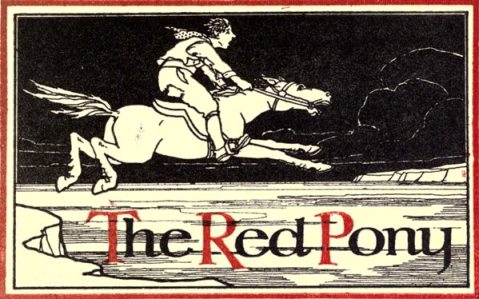
(As told by an Irish Peasant.)
here was a poor man there. He had a great family of sons. He had no means to put them forward. He had them at school. One day, when they were coming from school, he thought that whichever of them was last at the door he would keep him out. It was the youngest of the family that was last at the door. The father shut the door. He would not let him in. The boy went weeping. He would not let him in till night came. The father said he would never let him in—that he had boys enough.
The lad went away. He was walking till night. He came to a house on the rugged side of a hill on a height, one feather giving it shelter and support. He went in. He got a place till morning. When he made his breakfast in the morning he was going. The man of the house made him a present of a red pony, a saddle, and bridle. He went riding on the pony. He went away with himself.
“Now,” said the pony, “whatever thing you may see before you, don’t touch it.”
They went on with themselves. He saw a light before him on the high road. When he came as far as the light, there was an open box on the road, and a light coming out of it. He took up the box. There was a lock of hair in it.
“Are you going to take up the box?” said the pony.
“I am. I cannot go past it.”
“It’s better for you to leave it,” said the pony.
e took up the box. He put it in his pocket. He was going with himself. A gentleman met him.
“Pretty is your little beast. Where are you going?”
“I am looking for service.”
“I am in want of one like you among the stable-boys.”
He hired the lad. The lad said he must get room for the little beast in the stable. The gentleman said he would get it. They went home then. He had eleven boys. When they were going out into the stable at ten o’clock each of them took a light with him but he. He took no candle at all with him.
Each of them went into his own stable. When he went into his stable, he opened the box. He left it in a hole in the wall. The light was great. It was twice as much as in the other stables. There was wonder on the boys—what was the reason of the light being so great, and he without a candle with him at all. They told the master they did not know what was the cause of the light with the last boy. They had given him no candle, and he had twice as much light as they had.
“Watch to-morrow night what kind of light he has,” said the master.
They watched the night of the morrow. They saw the box in the hole that was in the wall, and the light coming out of the box. They told the master. When the boys came to the house, the King asked him what was the reason why he did not take a candle with him to the stable, as well as the other boys. The lad said he had a candle. The King said he had not. He asked him how he got the box from which the light came. He said he had no box. The King said he had, and that he must give it to him; that he would not keep him, unless he gave him the box. The boy gave it to him. The King opened it. He drew out the lock of hair, in which was the light.
“You must go,” said the King, “and bring me the woman to whom the hair belongs.”
The lad was troubled. He went out. He told the red pony.
“I told you not to take up the box. You will get more than that on account of the box. When you have made your breakfast to-morrow, put the saddle and bridle on me.”
When he made his breakfast on the morning of the morrow, he put saddle and bridle on the pony. He went till they came to three miles of sea.
“Keep a good hold now. I am going to give a jump over the sea. When I arrive yonder, there is a fair on the strand. Everyone will be coming up to you to ask for a ride, because I am such a pretty little beast. Give no one a ride. You will see a beautiful woman drawing near you, her in whose hair was the wonderful light. She will come up to you. She will ask you to let her ride for a while. Say you will, and welcome. When she comes riding, I will be off.”
hen she came to the sea, she cleared the three miles at a jump. She came upon the land opposite, and everyone was asking for a ride upon the beast, she was that pretty. He was giving a ride to no one. He saw that woman in the midst of the people. She was drawing near. She asked him would he give her a little riding. He said he would give it, and a thousand welcomes. She went riding. She went quietly, till she got out of the crowd. When the pony came to the sea, she made the three-mile jump again, the beautiful woman along with her. She took her home to the King. There was great joy on the King to see her. He took her into the parlour. She said to him she would not marry anyone until he would get the bottle of healing water that was in the eastern world. The King said to the lad he must go and bring the bottle of healing water that was in the eastern world to the lady. The lad was troubled. He went to the pony. He told the pony he must go to the eastern world for the bottle of healing water that was in it, and bring it to the lady.
“My advice was good,” said the pony, “on the day you took the box up. Put saddle and bridle on me.”
He went riding on her. They were going till they came to the sea. She stood then.
“You must kill me,” said the pony. “That, or I must kill you!”
“It is hard to me to kill you,” said the boy. “If I kill you, there will be no way to myself.”
He cut her down. He opened her up. She was not long opened when there came two black ravens and one small one. The two ravens went into the body. They drank their fill of the blood. When they came out, the little raven went in. He closed up the pony. He would not let the little bird come out till he got the bottle of healing water that was in the eastern world. The ravens were very troubled. They were begging him to let the little bird out. He said he would not let it out till they brought him the bottle. They went to seek the bottle. They came back, and there was no bottle with them. They were entreating him to let the bird out to them. He would not let out the bird till he got the bottle. They went away again for the bottle. They came again at evening. They were tossed and scorched, and they had the bottle. They came to the place where the pony was. They gave the bottle to the boy. He rubbed the healing water to every place where they were burned. Then he let out the little bird. There was great joy on them to see him. He rubbed some of the healing water to the place where he cut the pony. He spilt a drop into her ear. She arose as well as she ever was. He had a little bottle in his pocket. He put some of the healing water into it. They went home.