Chapter XV · OPERATIONS.
Reading edition
The veterinary art is by no means rendered more successful by the cunning of its stratagems. Many of its objects are accomplished after the rudest and the most primitive methods. Not one, perhaps, is more coarse than the present method of casting or throwing an animal previous to an operation. The reader has only to ask himself what condition the body must be in when, with the sight blinded, it is suddenly jerked to the earth; and how far it is fitly prepared by so violent a practice to be submitted to the knife of an operator?
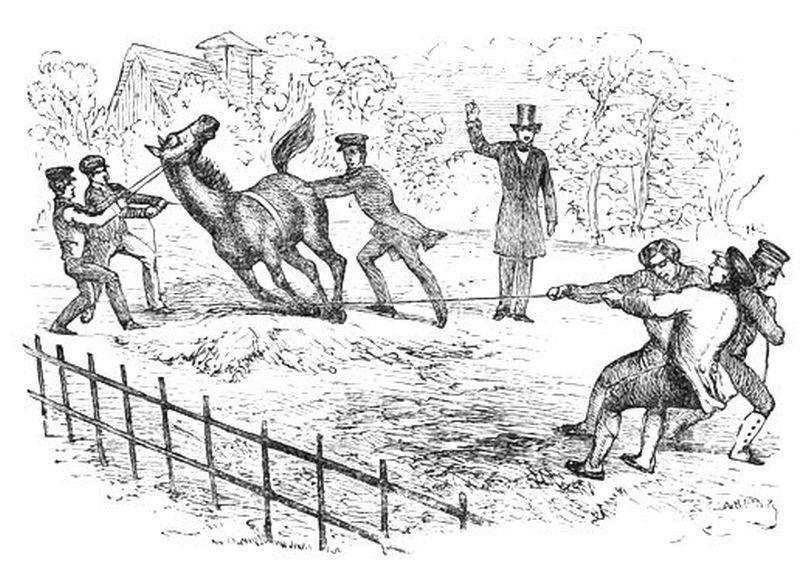
THE PRESENT MANNER OF CASTING A HORSE FOR OPERATION.
There are few operations in veterinary surgery which a person of moderate nerve and average intelligence might not himself perform. The author has seen gentlemen with titles, and others holding high rank in the army, indulge in the strange pleasure of singeing living flesh with the heated iron. But he has never beheld horsemen handling the knife. The latter would better become their hands than the first severe and disfiguring instrument, which, however useful it may have been found in certain cases met with in human surgery, nevertheless would be well abolished from veterinary practice, because of its indiscriminate abuse. Firing is employed for every and for no reason. Now recourse is had to it because the joints are weak. Then it is adopted because a gentleman is fond of seeing his horses scored. Next, it is used to gain time, and thus prolong the treatment. Generally it is brought forward because the practitioner does not know what else to do. Lastly, it is esteemed the crowning measure of routine practice.
The author, however, has never been necessitated to resort to so violent an agent. It is a most unseemly ornament in unprofessional hands; in this book, which is intended for the general public, the use of the firing-iron is altogether omitted.
The knife, especially to the animal, is the most humane of remedies. It often affords instant or immediate relief. The animal seems to suffer more from the restraint imposed than from the wounds inflicted. The chief sensation, with all forms of life, resides in the skin; so that the integument be quickly and effectually divided, the soft parts underneath have but little feeling. The interference with these last rather produces faintness or sickness than acute suffering; the knowledge of which fact will embolden many a humane person, though the writer trusts it will not be credited by all who are of an opposite character, since boldness, unrestrained by humanity, only renders the individual a savage without the savage's excuse.
Such operations as embriotomy, castration, and lithotomy are intentionally omitted, from a conviction that no gentleman would undertake them; and because, in every instance, they had better be intrusted to a regular veterinary surgeon.
Before undertaking any operation, always reflect on what you are about to do, and make up your mind how you design to do it. Irresolution causes more suffering than the most perverted determination can inflict. It is always well (however much in practice the operator may consider himself) to first perform the intended operation upon the dead subject. This is a custom which the writer invariably adopted; and frequently it has supplied his memory with a refresher which, in the hurry of practice, was found a most timely warning.
Never use small knives. Such things look pretty. The sight of a large blade may appear very ugly; but it does at one movement that work which an instrument of notching smallness would not in twenty hacks accomplish. Understand thoroughly that which you are about to perform, and always choose the tool likely to get through the business quickly. Periosteotomy cases were formerly sold by veterinary instrument makers which contained a knife of moderate doll's dimension. The writer, to accomplish the purpose which that little knife was specially made for, was accustomed to employ a bistoury larger than those in ordinary use among gentlemen of his profession.
Where you anticipate much bleeding, always endeavor, if possible, to divide the main artery with the first incision. This is by far the most humane, and therefore the safest practice. The vessel, being divided, can be taken up, and all further flow of blood thereby checked. But if the artery be left to the last, it remains to fill the smaller branches. These are of necessity frequently severed. Each, as it is cut, bleeds more or less freely; thus the hemorrhage is far greater, and the operation far more difficult, than if the main trunk had been secured at the earliest possible period.
Always tie both ends of an artery; because, though the main stream flows through that portion of the vessel nearest the heart, yet the other half, being fed by the smaller trunks, and the current having a tendency to regurgitate, a considerable quantity of the vital fluid may flow out of the mouth, which, in general opinion, has no medium of supply.
If, during an operation, you make an accidental incision into a vessel, either take it up, (which is the better way,) or cut it short off when there is a chance of its retracting and of the bleeding being thus arrested. Vessels of large size may, when requisite, be excised and tied; the vital current being afterward carried on by the dilatation of the lesser ducts.
To tie an artery it is imperative to secure the end of the vessel; this, if possible, should be accomplished with the forceps. When the mouth of the vessel is much retracted, it may be necessary to employ the knife; but that practice should be viewed only as the last resort of the proficient surgeon.
The end of the artery being fixed and drawn forth, a piece of strong silk, thrice twisted, (after the method represented in the inferior circle of the annexed illustration,) is passed over the vessel. The silk is then drawn tight, and will generally remain fixed. However, sad accidents have occurred by operators trusting to so doubtful a security; for that reason it is always advisable to make another twist, (as shown in the smaller circle of the illustration,) which will render the knot secure.
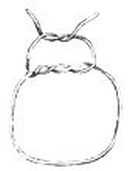
THE LOUP BY MEANS OF WHICH THE ENDS OF RTERIES ARE SECURED.
Even a vessel of the second magnitude may be obliterated, as the carotid artery or the jugular vein, without life being necessarily sacrificed. However, it is always well to spare these parts, or when either is lost to arrange so that the absence of them may entail the least possible inconvenience upon the animal. Thus, if the carotid artery be lost, place the food low down, and thereby aid the flow of blood to the head. If the jugular vein be destroyed, then put the fodder high up, that the current from the head may be facilitated.
Never, on any account, remove any portion of skin which is not involved in some fearful injury, or separated from its attachments by the action of disease.
Skin is the part of the body which is never reproduced, and even the place whence it is absent always heals slowly. However loose the skin may appear, however disproportioned it may seem after some tumor has been removed, respect every particle of it. Before the wound can heal, inflammation must set in. That process ended, the skin, under its action, will have contracted, and in the end there will be only sufficient integument to cover the part; whereas, if the slightest amount be excised, to such an extent there will for a long time remain a gaping sore.
Never spare the knife. Think well before you touch that tool; but, having it in hand, assure yourself its edge is sharp, and never do at two cuts that which might have been accomplished in one.
Always slit up a sinus where such a proceeding is possible. When the sinus is too long, supposing the pipe to take an internal direction, as from the withers to the chest, insert a seton with the guarded seton needle, a representation of which is given below.

THE GUARDED SETON NEEDLE.
The blade of this instrument is generally about two feet long. Before using it, the cutting head is always retracted by pulling back the nut at the extremity, and securing it in its place by means of the screw situated on the middle of the handle. The blade then reposes upon a blunt companion, and may with impunity be inserted down any sinus or false canal. Having reached the bottom of the pipe, and all important vessels being passed, the screw is loosened, and the projecting end of the blade at the extremity of the handle is struck forcibly, when the sharp point is driven forward, and this pierces the flesh.

THE SETON NEEDLE PROTRUDED, AND SECURED WITHIN THE HANDLE BY MEANS OF A SCREW.
Behind the cutting head there is a free space. Through that opening a long piece of tape is threaded, and the instrument is withdrawn, pulling the tape into the sinus, in which it remains. A knot is made at either end of the tape; thus a seton is with safety placed in situations where the depth to be penetrated would defy ordinary measures, and the vessels to be passed would render such measures more than doubly hazardous.
The use of a seton is to act as a drain, or to stimulate an unhealthy canal—to provoke a sinus to secrete healthy pus, instead of a thin and often a foul discharge—and thus to cause the diseased pipe to heal or to become obliterated.
When operating, always make your first incision through the skin rather too large than in the least too small; remember, the division from within outward occasions much less pain than the separation, made after the ordinary fashion, from without inward.
Never spare hair; the substance is readily reproduced. It can be wished to be spared only to conceal the fact of an operation having been performed. Always refuse to become a party to dishonesty. Do what is necessary for the proper performance of your office. The removal of hair, which may otherwise interfere with your sight, is essential: therefore cut it off, regardless of any wish to the contrary.
Instruct your assistants beforehand how to cast the horse; leave that business to them: never meddle yourself. The writer has seen veterinary surgeons, in their operating dresses, push and haul with the utmost energy. Such silly people have doubtless thought themselves exalted by this exhibition of violence. It would have been more to their credit had they devoted half the energy to teaching their people beforehand. But in what condition must their hands and temper be after having taken a lead in a struggle with a horse for mastery!
A surgeon should always be cool. His head should direct his hand; his knife should be held lightly; his eye should be quick, and his mind prepared to meet any accident. He should do his office neatly, and, if possible, without soiling his person. The ripping cut and the bloody hands alone distinguish the ignorant butcher from the scientific operator.
During every operation enjoin the strictest silence upon the spectators. The horse is never vicious, but it is always timid. Sounds have a powerful effect upon animals which cannot understand speech. Every word uttered, even in a whisper, should be of assurance to the sufferer; for the horse is only to be feared in its efforts to escape from some supposed peril. It becomes mad in its alarm. It then puts forth its strength and exerts it without regard to consequences. Man has everything to hope from the fortitude and noble forbearance of the creature. It responds to kindness with something more than submission; it answers sympathy by the most entire confidence and utter dependence. The life, the feeling, the natural powers are all subservient to the great love which is embodied in a horse's attachment. There is not among created beings one which has so large a sympathy; the horse must attach itself to something; to love seems essential to its being. The stable in which it is captive the patient prisoner learns to regard, as it were, a palace. The pace is always more willing when returning to captivity; freedom has no charm; the field has no allurement to the horse which has lived any time in the most crimped, confined, and uncomfortable of stalls. It will quit the spring grass to be fastened once more in the place to which it has been accustomed and has grown attached.
Then, however much removed from itself, it must pour the richest of its affections on some animal, should man, in pride, refuse to accept the offering. Creatures the most opposite have been the horse's favorite. How often do we hear of the liking formed between a goat, a dog, a cat, and the horse! Love has a strange freemasonry of its own; how else can we account for the larger creature being able to make its longing understood by the smaller life? There may, however, be between animals some substitute for language; but we can hardly suppose any recognized signs exist between birds and the equine species. Yet a famous animal-painter had a pony which formed a violent and lasting affection for a bantam cock. These two used to march side by side up and down the field in which the larger animal was confined; for so very expansive is the horse's love that it will embrace not only its abode, but some life, however distant apparently from its own.
The voice of the person who is accustomed to groom and feed the animal, if he has been only ordinarily humane in the performance of his office, will at all times reassure the beating heart of a prostrated horse. But vast injustice to the animal's better qualities is done by the mode of casting it. It is violently jerked off its legs; by a sudden pull it is thrown "with a burster" upon its side. There it struggles. If mastery sides with the animal, then let the men be speedy in their flight. The quadruped, in its fear, designs no harm to any person. It means only to escape from the terrible danger which encompasses it. Still, it is regardless in its alarm, and may do more injury than the most evil intention could accomplish. There is an engraving of the method of casting horses commencing this chapter. Let the capable reader imagine the effect produced upon the timid quadruped when it is violently flung upon the earth with a sound well denominated "a burster."
The horse is much better made to lie down gently, after the method adopted by Mr. Rarey. Half, and far more than half, the terror excited by an operation may thus be avoided. The confusion and bustle, conjoined with violence, which naturally attend "casting," must make a lasting impression upon the retentive mind of the animal, and, we may suppose, must aggravate the pain, thus materially endangering the result of an operation. The hobbles may be fixed quite as readily when the horse is down as when the animal is standing. Nay, they may be fixed more readily, as the horse, when down, has lost three-fourths of its power.
Mr. Rarey's method of throwing the most unruly animal is thus described by that gentleman:—
"Everything that we want to teach the horse must be commenced in some way to give him an idea of what you want him to do, and then be repeated till he learns it perfectly. To make a horse lie down, bend his left fore leg and slip a loop over it, so that he cannot get it down. Then put a surcingle around his body, and fasten one end of a long strap around the other fore leg just above the hoof. Place the other end under the surcingle, so as to keep the strap in the right direction; take a short hold of it with your right hand; stand on the left side of the horse, grasp the bit in your left hand, pull steadily on the strap with your right; bear against his shoulder till you cause him to move. As soon as he lifts his weight, your pulling will raise the other foot, and he will have to come on his knees. Keep the strap tight in your hand, so that he cannot straighten his leg if he rises up. Hold him in this position, and turn his head toward you; bear against his side with your shoulder—not hard, but with a steady, equal pressure—and in about ten minutes he will lie down. As soon as he lies down he will be completely conquered, and you can handle him as you please. Take off the straps, and straighten out his legs; rub him lightly about the face and neck with your hand the way the hair lies; handle all his legs; and, after he has lain ten or twenty minutes, let him get up again. After resting him a short time, make him lie down as before. Repeat the operation three or four times, which will be sufficient for one lesson. Give him two lessons a day; and when you have given him four lessons, he will lie down by taking hold of one foot. As soon as he is well broken to lie down in this way, tap him on the opposite leg with a stick when you take hold of his foot, and in a few days he will lie down from the mere motion of the stick."
What prevents the hobbles being buckled on? What prevents all necessary arrangements being carried out? What, indeed, but the stubbornness inseparable from ignorance! Veterinary surgeons, as a rule, are not an educated class. In proportion as their information is limited, so is their adherence to established custom likely to be intractable.
There are, besides the hobbles, two other inventions designed to limit the capability of resistance. One is the side line. A soft collar is put over the horse's head and a hobble is fastened to the foot it is desired to have elevated. From the collar is dependant a metal loop, ring, or other contrivance. By the side of this a strong rope is attached. The cord is then passed through the D of the hobble; afterward it is brought back and ran through the side ring or loop. A man then takes hold of the end of the rope, and, by gradual traction, causes the leg to be advanced. It is neither wise nor humane to drag the foot off the ground. A horse which will stand quiet with both feet resting on the earth, is rendered restless when one leg is fastened in the air.
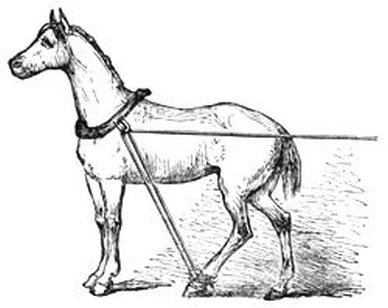
THE SIDE LINE.
The occasion which makes it imperative to apply the side line is, when the hocks or hinder parts are examined. Many unbroken horses, though quiet in other respects, will not allow these portions of the body to be touched. By causing one leg to be advanced, the other is deprived of all power as a weapon of offense. The horse would obviously fall, if he were to project the only free hind member; and the timidity of the creature indisposes it to incur so vast an indignity.
The other invention is the double side line. A rope is fixed to a loop on either side. The loop or ring is attached to a soft collar. The rope is afterward threaded through a hobble on each pastern. Both legs are then gently pulled forward, and the animal, having its posterior supports drawn from under it, comes to the earth. The ropes are held tight while the horse is turned upon its back. The instant it is in that position, somebody seats himself upon the head, while the body of the animal is propped up by numerous trusses of straw.
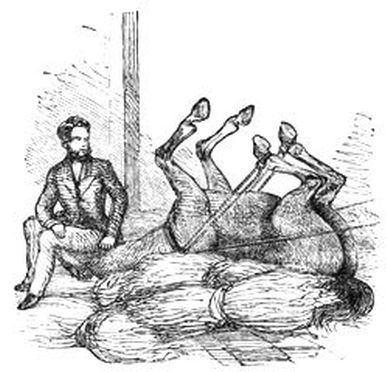
THE DOUBLE SIDE LINE.
This last is but an imperfect method of casting. In general it is rendered still more cruel by the abuse to which it is subject. The ropes are commonly pulled with an utter disregard to the living body upon which they operate. The hind legs are often drawn to the shoulders, and frequently additional cords are employed to make the poor creatures more distorted and more fixed. Has man any cause to wonder at a horse being occasionally what is called "vicious," when the unreasoning creature is thus fearfully operated upon? Is it not rather a proof of the horse's intelligence that it can recognize the cause of its suffering, and study ever after to repel its tormentor?
Let the horse be thrown down after the admirable method introduced by Mr. Rarey. Let it then be hobbled, and never, during the operation, hear any sound but soothing accents. Animals do not understand words, but they are quick readers of characteristics. The language itself these creatures may not be able to literally interpret; but they comprehend all which the manner conveys. When kindness is expressed, the meaning is felt, though the verbiage be lost: it is astonishing how animals will enter into the intention of speech! How home kind language seems to go to the ignorant heart, and how true it is that a gentle word is never thrown away! It is surprising to observe the affection by which the human race is surrounded; they live and walk among animals eager for permission to adore them, anxious to love and to serve them; but it is lamentable to see how an evil spirit repels the feeling which pervades all nature.
There is another point upon which the writer presumes to offer advice. Veterinary surgeons display ignorance in nothing more than in being servile copyists. They do not view their sphere of science as a separate and distinct branch. They always will strive to follow the example of human practitioners even to particulars. There is no difference in the dissecting knives used at the King's College and the Royal Veterinary establishment, though bodies of different bulks are studied in each school. The operating knives of most veterinary surgeons are ridiculously small for such purposes. The consequence is, the animal is much longer down than is absolutely necessary. The author has known one hour employed in dressing a quittor; whereas six sinuses ought to be laid open and dressed in less than five minutes. A vast deal of time is thus wasted; although the opposition to Mr. Rarey's method of throwing will, doubtless, be the length of time it would occupy. However, granting the objection; which is the surgeon bound to consider—the welfare of his patient or his own convenience? It is not every day that the gentleman who enjoys the largest practice has to cast a horse. It is, in fact, a somewhat rare and an exceptional occurrence. Could not the most engaged man devote an occasional half hour to the benefit of his profession?
When operating upon living flesh, always have your knives rather too large than in any measure too small. The work is performed quicker; besides, the hands are kept at some distance from the wound, and the eyes thereby are enabled to direct their movements. The probability of mistakes is thus lessened, and no man, with a knife in his hand and bleeding flesh under his eyes, has a right to expose himself to the possibility of an error which, of course, is not to be erased or atoned for.
Should a horse, when under the knife, struggle, do not attempt to contend with the animal. Immediately leave hold of your instruments, and withdraw your person out of danger. Allow your knife, etc. to remain; it will seldom be displaced, or, if cast out of the wound, can be easily reintroduced; whereas, did you endeavor to snatch away or to retain your hold, the most lamentable consequences might be the result.
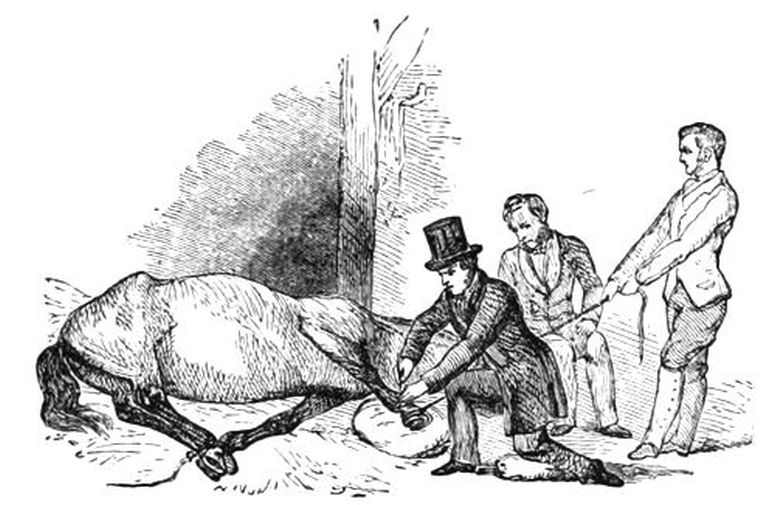
Another caution, and this part of the writer's office is concluded. When you operate upon a leg, have that limb uppermost, unless your incision is made upon the inner side. Have the foot placed upon a pillow or sack stuffed with straw, and a strong webbing put around the hoof. The webbing give to a man who is to pull at it. The dragging sensation renders the horse inclined to retract the member; therefore place yourself in front of the limb, or on the same side as the man who holds the webbing. The fore leg, when advanced, cannot be readily employed as a weapon of offense, and the hind limb is always, when used in defense, projected backward.
OPERATIONS—TRACHEOTOMY.
This operation is, perhaps, the most humane recourse of veterinary surgery. Neurotomy may save the horse from greater and longer suffering; but tracheotomy is performed, unlike the former operation, upon an animal in an unconscious state. Difficult respiration, either from tumor pressing upon the larynx, infiltration upon the lining membrane of the larynx, or choking from various causes, produces imperfect oxygenation of the blood. The vital current being impure, of course the brain which it nurtures is not in a condition of health or activity. The consciousness is impaired or altogether destroyed; and immediate relief is experienced after the performance of the operation. The recovery is as rapid as the previous symptoms were alarming. The altered aspect of the animal is as though the body were resuscitated. In certain cases, where every breath is drawn in pain, the ease afforded by tracheotomy is most marked. It makes little difference to Nature, by what means the air is inhaled, so that a sufficiency of diluted oxygen come in contact with the absorbing membrane of the lungs. This, when the larynx is closed or diseased, tracheotomy permits to be accomplished. It is equally beneficial, safe, and humane. However ugly its description may read, it is in practice to be strongly recommended.
The general fault with veterinary surgeons is the delay which commonly pushes off the operation to the last moment. In this delay the proprietor is, perhaps, equally or even more at fault. Hope leads the owner on to the very last, and even then it is with reluctant horror that consent is given "to cut the horse's throat." Such is the term by which certain practitioners characterize tracheotomy; and though it is uttered merely as a joke, yet it creates an impression which acts against a harmless operation.
In agricultural districts, the veterinarian is frequently knocked up at night by a messenger, who announces "Farmer Hodges's horse be a dying." The farmer may live several miles off in the country; and the reluctant sleeper hurries on his clothes to obey the implied summons.
In due time the pair reach farmer Hodge's homestead. It needs no finger to point out the stable. The sound of laborious breathing effectually notifies it. However, the practitioner, upon entrance into the place, is horrified to find himself there with no better company than a boy and a rapidly-sinking animal. The circumstances demand other assistance. The horse doctor cannot help giving voice to his requirements. The lad hearing this, says hastily he will fetch somebody very soon—hangs up the lantern and vanishes into the darkness.
Minutes pass and no footfall greets the ear. The divisions of the hour are struck by the village church, and still no sound of returning steps. The animal becomes worse and worse. In its disabled state it fears to lie down, as that position impedes the breathing. In its efforts to stand, it reels about—now falling to one side and then to the other. Yet the departed messenger does not return. The veterinarian finds the limits of delay are passed: ten minutes more and the quadruped will be down. He takes out his lancet. One foot from the breast-bone, and as near the center of the neck as the rocking motion of the horse or the flickering light of the lantern will allow him to aim, he plunges the blade deeply into the flesh, if possible at one cut dividing the cartilages of the trachea. He has little control over the incision. Frequently a gash results from the tottering of the animal. Mostly he divides more than he would have done had daylight and assistance been afforded him.
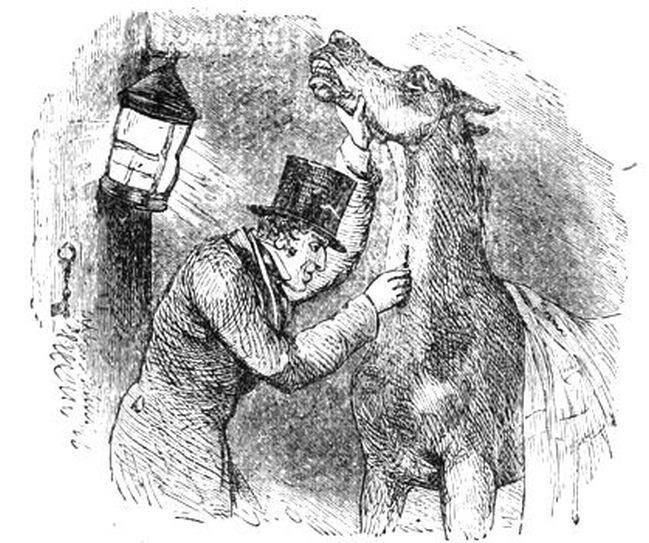
TRACHEOTOMY, AS PERFORMED UNDER DIFFICULTIES—A COMMON OCCURRENCE.
The incision being made, the fingers are thrust into the wound to keep the division open. At first this may be difficult; but as time proceeds, the standing of the horse becomes firmer and the breathing less noisy. The veterinarian is, however, impatient at the delay and his enforced position. He is just beginning to despair, when the messenger returns, accompanied by a sleepy companion. Both are surprised at the condition of the horse, and, not observing the wound, imagine the animal has been cured by magic. However, to the demands of the equine medical attendant, nothing like a tracheotomy tube is to be invented. At last the spout of the tea kettle is thought of; and the good dame awakens in the morning to find her kettle demolished and its spout thrust into the "plaguy horse's throat."
It is the curse of veterinary surgery, that nobody appears to understand when an operation is required. The practitioner, therefore, is seldom prepared for its performance. The circumstances allow him little time to think, and none to return or to fetch the necessary instruments.
However, when he has proper time and choice, he should always make a free incision through the skin and panniculus carnosus. Make this opening about one-third up the neck, measuring from the chest. It is more general to open the windpipe at a similar distance from the jaw, and, assuredly, the superior incision has this advantage, that there is less to cut through. But where no important nerves or vessels are endangered, surgery cares little about the depth of a wound, the chief attention being given to the probable after-consequences.
The superior portion of the neck is especially the seat of motion; it varies with every turn and movement of the head. Hence the end of the tube is apt to be brought into constant contact with the lining membrane of the trachea, and horses have been slaughtered with huge tracheal abscesses, to all appearance produced solely by wearing the tracheotomy tube.
To avoid this danger the author chooses for incision a spot nearer to the chest, where the motion is less constant and not so varied. Even at this last place all danger is not entirely surmounted, in consequence of which a horse, while wearing a tracheotomy tube, should never be permitted to feed from the ground.
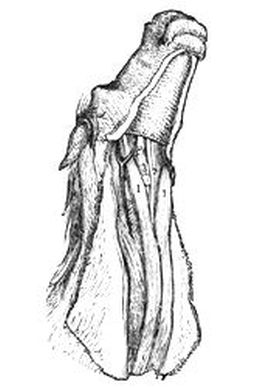
DIAGRAM, SHOWING THE STRUCTURES TO BE INTERFERED WITH DURING THE PERFORMANCE OF TRACHEOTOMY.
1. 1. The sterno-maxillares muscles—a pair—have to be separated, being joined by fine cellular tissue.
2. The sterno-thyro-hyoidei muscles, lying under the first pair, also have to be divided, being similarly united.
3. The trachea, which is fully exposed when the above muscles are disunited.
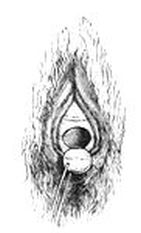
THE MANNER IN WHICH THE CARTILAGES OF THE TRACHEA ARE TO BE EXCISED.
At the commencement, when the operator has leisure, he generally does not cut too deep. The first incision fairly divides the skin and panniculus carnosus quite in the middle of the neck, and is rather longer than a by-stander would deem to be absolutely necessary. The elasticity of the skin will somewhat shorten the opening, while the torture of repeated enlargements will be avoided, and the more important structures beneath the skin will be fairly brought into view.
In the center of your division will appear two long muscles, joined together by a fine cellular union; that union you are to separate; it consists only of cellular tissue, and will necessitate more care than exertion. Underneath the divided muscles will be found two others, smaller and paler, but also joined together by means of fine cellular tissue. These are also to be sundered, and then the trachea lies exposed. There is neither nerve, nor artery, nor vein to avoid, nor to take up in the performance of tracheotomy. All consists in making your primary incision large enough, and, subsequently, in not attempting more than the division of two pairs of muscles.
The commencement of the incision should be made at the spot already indicated. After the skin is cut through and the muscles are divided, two assistants should be obtained to hold them back, while a circular piece is excised from the cartilages of the exposed trachea.
The trachea is formed of numerous cartilaginous rings each half an inch wide, but so united by elastic tissue that the whole forms one continuous tube reaching from the head to the chest of a horse. If possible, only two of these rings are to be interfered with; that is, a half circle, should be cut out of each, which, with the elastic connecting medium, will make an opening of one inch in diameter. Both the rings, however, should be perfectly divided; but a half circle should be excised from one, leaving a portion of cartilage to keep the remainder in its place. This matter, probably, may be made more clear by the engraving on the opposite page.
After the first half circle is made, or when a portion is cut off the first cartilage, that piece should be bent outward. The elastic connecting substance will readily permit this to be done, and the current of fresh air admitted will considerably refresh the animal. The cartilage being bent outward, it should be leisurely transfixed by means of a sharp needle armed with strong twine. The string may be fastened to the button-hole of the operator's waistcoat, and afterward the circle be leisurely completed.
The twine is necessary because the spasmodic breathing has drawn the excised portion of cartilage upon the lungs, and thereby done as much mischief as the operator designed to do good. By bending the half circle outward, some relief is afforded to the breathing, and the character of the respiration partially benefited. The process is, however, rendered more safe by the employment of the loop; but care should be taken, when subsequently using the knife, not to cut the string. Therefore, before the circle is completed, the cartilage should be bent backward, as shown in the previous engraving, then laid hold of, and, when firmly grasped, the excision ought to be perfected.
A tube has to be worn afterward; this is put into the opening, and fastened in by means of a strap or tape passed round the neck. There are many tubes sold by the instrument makers for this purpose; the majority, however, are far too large. None should be beyond one inch in diameter. The horse only requires to inhale part of the air through the canula, the remainder coming, as before, through the larynx. A free space of one inch is, therefore, plenty to admit the deficient oxygen; for no animal could live through an operation, were air, previous to its commencement or during its continuance, altogether excluded.
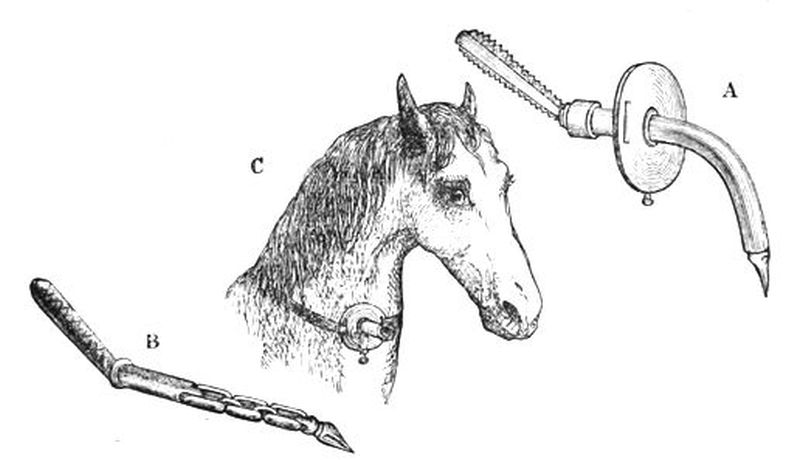
MR. T. W. GOWING'S TRACHEOTOMY TUBE.
A. The canula, with a shifting shield, armed with the pointed trocar.
B. The trocar withdrawn from the canula, showing its peculiar construction.
C. The canula fitted into the horse's trachea, showing how the movable shield may be adapted, by means of a screw, to the size of the horse or the swollen condition of the parts.
The best instrument for hasty and temporary tracheotomy is the invention of Mr. T. W. Gowing, of Camden Town. To insert this canula no cartilage need be excised; a puncture is made with a knife through the connecting medium of the tracheal rings, and through this puncture the tube is driven. It is of all use for temporary or immediate service, but obviously would not do for a continuance.
The objection to tracheotomy, when designed to last for any period, is that the canula, by irritating the lining membrane of the larynx, is apt to provoke abscess, which impedes the breathing to a degree that destroys the life. The author has seen some fearful instances of this effect; but of all tubes, that invented by the French seems to be least open to this objection.
OPERATIONS—PERIOSTEOTOMY.
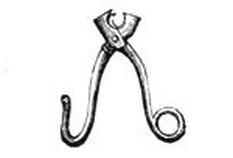
A PAIR OF ROWELING SCISSORS, FOR MAKING SMALL INCISIONS THROUGH THE HORSE'S SKIN.

A SETON NEEDLE ARMED WITH A TAPE, A, AND FIXED INTO A HOLLOW HANDLE BY MEANS OF A SCREW, B.
A BLUNT SETON NEEDLE.
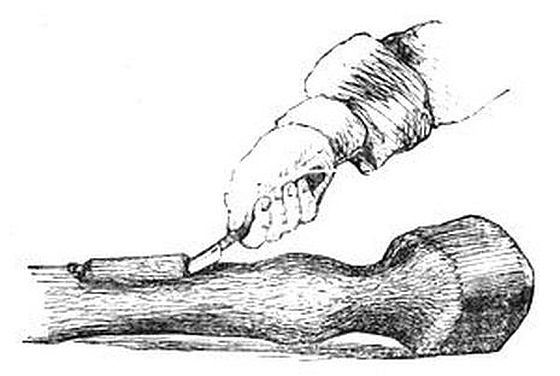
A TUMOR BEING CUT WITH A PROBE-POINTED KNIFE.
This operation was first applied to the horse by the late Professor Sewell. It is intended to relieve the lameness consequent upon exostosis situated on the shin-bone. A pair of roweling scissors are first employed to snip the skin above and below the tumor. Then a blunt seton needle, being fixed into a hollow handle by means of a screw, and armed with a tape knotted at one end, is to be used. The needle is violently driven through, and breaks down the cellular tissue which attaches the skin to the tumor. The point is forced to enter at one snip and come out at the other, after which the needle is withdrawn by the first opening. A probe-pointed knife is then introduced into the space thus made; the tumor is sliced into as many pieces as may please the operator or the nature of the growth will admit of. The knife is afterward retracted, and the needle, released from the handle, is passed through the openings, or in at one snip and out at the other. The knot at the end of the tape prevents that being drawn after the needle. The unknotted end is next withdrawn from the needle and tied into a large knot—the whole forming a seton. The operation is occasionally varied by smearing the tape with terebinthinate of cantharides, and sometimes by blistering over tumor, seton and all. This last practice may add to the severity of the operation, but it seems calculated to do little good. Breaking down the attachment of the skin and slicing the tumor appear designed to deprive the growth of blood, while a blister seems calculated to draw to the part an excess of that which the operation was intended to dispel.
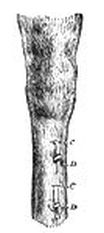
A HORSE'S LEG WITH TWO SNIPS UPON IT, c c, OUT OF WHICH HANG THE TWO KNOTTED ENDS OF A SETON, D D.
Periosteotomy is not very highly esteemed by the vast majority of practitioners. It is, however, sometimes very successful. A horse is thrown, being dead lame; the animal gets up from the hands of the surgeon and trots sound. It is difficult, however, to predicate the quadruped on which it will thus act. Certainly the operation is best adapted to young horses; but even to all of these it will not prove beneficial. It is therefore looked upon as a surgical experiment, quite as apt to disappoint as to please. The seton, moreover, is disposed to cause the edges of the holes through which it passes to indurate. A blemish which it takes some months to eradicate is the consequence; and this, added to the expense attendant upon treatment, is not apt to prove pleasing to horse proprietors, especially when the operation altogether fails.
A modification of periosteotomy might perhaps be tried. Omit the seton altogether; make an inferior snip with the scissors; introduce a sharp-pointed needle, and cut a channel. Then insert a probe-pointed bistoury, and incise the tumor. If periosteotomy were to prove successful, it probably would be so in this shape. The author has seen small benefit result from the after-use of the seton, and by operating in the manner proposed all the subsequent blemish would be avoided. The cut would soon heal and leave no scar behind: thus the grand objection to the performance of periosteotomy, as it now stands, would be removed.
The motive for the above proposal is to spare the suffering of the animal. If the hair is cut short previously, and pressure made above the snip of the scissors, the wound need occasion little pain. A sharp point cutting its way through the cellular tissue would not cause one tithe of the agony which follows the use of a blunt instrument necessarily tearing, stretching, and breaking a passage through a living body. Cartilage or bone in a state of health has small sensibility. The employment of the knife would therefore provoke no struggle, while all the after-torture of a seton applied directly to the surface of a wound would be avoided.
Perhaps it would be best to bind a broad tape, with a cork under it and upon the vessels, round the leg before the operation, thereby pressing on the nerve and cutting off the supply of blood. This would probably deprive the leg of all sensation. The most severe part of this method of periosteotomy would be the after-consequences. The incised tumor would inflame; the vacant channel would have to unite. The one would occasion agony, the other be probably attended with violent itching. The limb, therefore, should be bandaged, even though a wound upon the horse's body does not do so well when covered up. The bandage, however, will prevent the animal from injuring the sore leg with the opposite shoe, which a horse may be provoked to attempt by that irritation which attends the healing process.
OPERATIONS—NEUROTOMY.
Neurotomy is the division of the nerve which supplies the hoof of the fore leg with sensation. The foot of the horse being moved through tendons by muscles from above, and having in itself no muscular power, obviously has no occasion for a motor nerve. Consequently the nerve running to the foot is wholly sentient. It is the means of communication through which pain or pleasure is transmitted from the hoof to the brain.
To take away a portion of this nerve is evidently to separate the medium of such communication. Feeling can no more travel along a divided nerve than electricity can along a broken wire. The knowledge of this fact has led to a portion of the nerve being excised; and the doing of this has been named neurotomy.
A nerve is a very compound structure. It is composed of numerous fine filaments or small threads bound together by a cellular sheath called neurilema. Healthy nerve feels firm, and has a brilliant white appearance; unhealthy nerve is of a yellowish tint, and is of a less solid texture.
The operation of neurotomy is certain relief, but that relief is of uncertain duration. The divided nerve, after a time, reunites. The junction thus formed carries on all the functions of the perfect structure; but a bulb is left behind at the place of union. This bulb is to be easily felt by pressing upon the seat of neurotomy externally with the points of the fingers; and the bulb being felt leads to a knowledge that the horse has been subjected to the operation. Neurotomy, therefore, can never be concealed, if pains are bestowed upon its detection. The operation, however, is not successful in every case.
In some animals, the wound has just closed when junction seems to be formed between the divided ends of the nerve. The lameness then returns as acutely as ever.
In others, the horse will proceed to work, and continue sound ever after—the restored power to use the foot having, in the last case, seemingly destroyed the affection.
Some animals are subjected to operation so late that disease has had time to weaken the pedal structures. The consequence is that no sooner does the absence of feeling tempt the horse to throw his entire weight upon the foot than the navicular bone fractures or the perforans tendon ruptures.
Certain horses, from a tingling sensation in the neurotomized foot—similar to that felt by men in the imaginary fingers of an arm which has been amputated—will stamp violently till they injure it and provoke suppuration; while other feet are so irritable that the head is bent downward and large pieces from the hoof literally bitten off. To account for this last circumstance the reader must remember that, though the foot seems to itch, it in reality has no sensation to preserve it from the teeth of the provoked animal.
Cases occasionally happen of horses having picked up nails, or having incurred wounds in the foot, which, being deprived of feeling, the animal wanted the power to recognize. No lameness was exhibited, and the injury was necessarily unattended to. The foot has been left alone till the hurt has induced mortification.
Weak feet have not been able to endure the consequences of operation. They have sustained no external injury, but the heaviness of tread attendant on a loss of sensation has so battered the senseless member that suppuration has been induced. The hoof has therefore been cast off and the horse been destroyed, although it was discovered in the stable standing with the utmost composure upon the bleeding and exposed flesh.
These are a few of the disagreeables attending a most humane and successful operation. The first requisite for the performance of neurotomy is a sound knowledge of anatomy. A familiar acquaintance with the course of the nerve is essential. It descends in two main branches from the knee, one on either side of the leg. It travels in company with and behind the artery and vein on the inner side of the fore limb. On the outer side it is accompanied by no vessel. About the center of the leg, however, the two nerves are united by a branch which travels over the perforans tendon, connecting the sentient fibers of either side. It is therefore essential, in the performance of neurotomy, to make the primary incision rather low down, especially if it is meant that the high operation should be accomplished, or that all sensation should be destroyed on one side by a single division.
At the pastern the nerve divides; the posterior branch runs direct to the frog. The anterior branch travels in front of the artery for some distance, when it takes a more forward course, dividing into several separate branches.
The generality of operators remove about an inch of the main trunk before the nerve divides, or above the pastern; and the result certainly confirms the soundness of such a practice.
The nerve of the frog is, however, frequently excised. The objection to this is the junction of a filament of the anterior branch with the nerve below the excision. That union should deprive the operation of all effect; but, notwithstanding, the division is sometimes beneficial. The operation is, however, never certain; and to that circumstance the proprietor must make up his mind when he sanctions its performance.
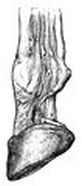
THE COURSE OF THE NERVE EXPOSED.
a. Denotes the nerve of the frog.
Always examine minutely any horse submitted to you for neurotomy. Do this to discover if the operation has been previously performed—the object being that you may thereby be prepared for some trouble in mastering the retentive consciousness of the animal; likewise, that by such inquiries you may decide upon the benefit likely to result from the operation; also, that you may be warned of a bloody and tedious job. The leg which has previously been subjected to neurotomy becomes doubly vascular. We know of no reason to account for this phenomenon, excepting it may denote the cost at which nature repairs her higher order of structures.
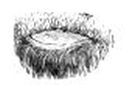
A HORIZONTAL INCISION, WITH THE HAIR CLIPPED ABOVE THE OPENING.
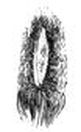
A PERPENDICULAR INCISION, WITH THE HAIR CUT OFF ABOVE AND ON THE SIDES OF THE WOUND.
Before you consent to operate upon any animal, examine the feet. If the hoof is weak or even weakly, refuse at once. If the hoof be strong and thick, the wall upright, and the frog small, you may consent, with the best hopes of success. Have such a horse put into the stable, and the diseased foot or feet kept wet for a week prior to the operation. This frequently has the effect of constringing the arteries, greatly depriving the part of blood. That result renders the use of the knife more cleanly and more easy. Two days prior to the important one have the hair cut short over the place or places where you design to make your incisions. By so doing, all chance of hair getting into and irritating the wound will be effectually destroyed. This may happen, and, should the hair be left on, much delay will be occasioned, while the animal's sufferings must be augmented if the hair be clipped after the horse is down for operation.
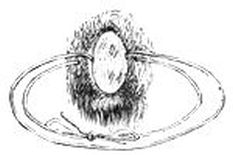
THE MODE OF FASTENING BACK THE SIDE OF A PERPENDICULAR WOUND.
Never operate upon a horse with the hair uncut—leave that to parties who league with the lowest class of horse-cheats. Cut off hair two days beforehand. Make an incision through the skin about three-quarters to one inch long. Have a needle and thread ready—a strong surgeon's needle and a stout twine. Pierce the divided skin from the inside to the outside, leaving a moderate piece of twine hanging out of the wound. Carry the twine under the leg, and pierce the integument on the other margin of the wound—also from the interior to the exterior. Then bring the piece of twine left hanging out of the first puncture and the needle together, at the back of the leg. Slightly tighten the twine; fasten these two ends in a bow, and the effect will be to keep the sides of the incision asunder.
If you design to perform the high operation, choose a spot a little above the pastern, and incise the skin at one cut, if possible. The high operation is most approved of for general purposes, and, as before remarked, destroys sensation in the entire hoof. Some proprietors think it well to leave a little feeling in the forward portion of the foot, which is free from disease. This is done to escape those results that have already been enumerated as the effects of total insensibility. The high operation is, therefore, performed only on one side, and the posterior or low division on the other. There are two spots at which the low operation may be accomplished. The author has given the reader a representation of the anatomy of the leg. He presents a view on page 455, of the places where the incisions can be made.
Either of the lower operations, regarded by itself, is very uncertain in its effect; and, if taken both together, they present no advantage over the superior opening.
These remarks may be better comprehended, by comparing this engraving with the course of the nerve shown in the previous illustration.
When the skin is divided—supposing the horse is neurotomized for the first time—nothing is visible but white-looking cellular tissue. This must be carefully dissected away with a pair of forceps and a scalpel. Dissect on until the nerve and artery are exposed plainly to view. Then take a crooked needle and thread. Pierce the nerve—this you may do fearlessly. The author has not known it to produce pain. The fibers composing the nerve are so fine that the needle's point is blunt when compared with them. It, therefore, glides through them without pricking any of the filaments.
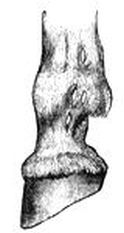
The superior opening represents the place where one side of the foot may be deprived of sensation by a single division.
The two middle incisions denote the part where either the fore or after portion of the foot may, perhaps, be rendered void of sensation.
The two inferior cuts suggest the situations where, probably, the parts of the foot toward which the incisions point may be made insensible.
If the horse has been operated upon before, you must expect a tedious and sanguinary business. It is then of all importance to obtain a very attentive and equally nimble man to take the sponge. Blood will follow every movement of the knife. However, with each cut you must retract the hand, and the man who has care of the sponge must quickly, surely, and forcibly cleanse the wound. When the sponge is withdrawn, for an instant, and for an instant only, is there a clear view of the part. The operator must be ready to make the most of that glimpse; for, the next moment, blood flows over the lips of the orifice and all is concealed from view. Thus we proceed, rather snipping than cutting, taking away particles instead of flakes of cellular tissue, till the nerve is exposed. Then it is fixed with the needle as before directed.
The nerve being caught, withdraw the needle, leaving the thread behind. Tie both ends of the thread together, and insert the first finger of your left hand into the loop thus formed. By gentle traction raise the nerve a little, and with the knife release its inferior attachments. Then let the man who held the sponge make pressure with all his force upon the artery and nerve above the incision. After this has been done about a minute, and by the stoppage of the circulation you may conclude the sensation to be in some degree numbed, insert the blade of the knife under that portion of the nerve which is nearest the body, and cut boldly upward.
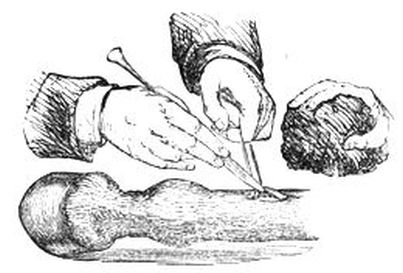
THE LOOP RAISING THE NERVE WHILE THE KNIFE LOOSENS ITS INFERIOR ATTACHMENTS.
A spasm mostly follows the division; but it is of short duration. Afterward dissect about one inch of the nerve from its attachments, and remove this inch from the main trunk. No sign of feeling will follow the excision when made lower down. All communication with the brain has been cut off by the previous division, and the sensorium no longer takes notice of any violence offered to that part of the body which has been isolated.
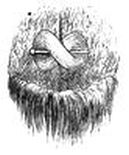
THE BEST WAY TO CLOSE THE WOUND CONSEQUENT UPON NEUROTOMY.
Next, having sponged the part, close the wound by means of a pin forced through the lips of the orifice. Then twist a little tow round it in the form of a figure of 8. That being finished, so much of the point as protrudes is to be removed with a pair of wire nippers; a bandage is then put on; and, if both sides of the limb are to be neurotomized, the horse is turned over. All being accomplished, return the horse to the stable, but watch the pin which fastens the wound. If the incision continues dry, the pin may not be removed till six days have expired; but if the slightest appearance of pus be suspected, immediately withdraw the pin, and remove the tow, treating the part with solution of chloride of zinc, as though it were a common wound.
There are various knives invented for the performance of neurotomy. That the writer most approves of was the invention of Mr. Woodger, the admirably practical veterinary surgeon of Bishops Mews, Paddington. The author has used this instrument himself, and seen it guided by other hands. In every case it has expedited the operation and thereby shortened the period of the animal's suffering.
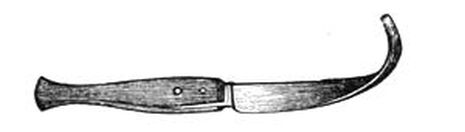
MR. WOODGER'S NEUROTOMY KNIFE.
To use this instrument.—After the nerve is raised, insert the crooked point, with the edge toward the body of the horse; then drive the knife forward. By this simple means the cutting portion of the blade is brought violently in contact with the nerve, which is excised at the proper point, and about an inch is left hanging out below the incision.
The after-treatment of neurotomy consists in letting well alone, if all goes on rightly. Should pus make its appearance, bathe the wounds, thrice daily, with the solution of chloride of zinc, one grain to the ounce of water. Remove the bandages from the legs after the horse has entered the stable. The incisions heal more readily when exposed to the stimulating effects of the air. Place a cradle round the horse's neck, and feed liberally. Avoid all purgative medicine; you now want an injury repaired, and do not desire to reduce the vital energy.
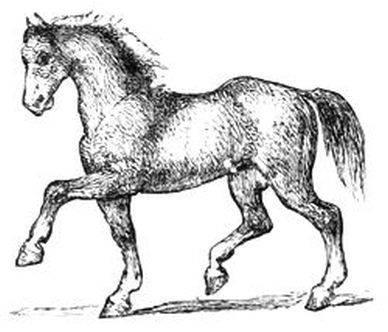
THE AWKWARD TREAD OF A HORSE WHEN NEWLY NEUROTOMIZED.
When the wounds have healed, the horse may be gradually taken once more to work, but it should not be fully used. Excessive and too early labor is the cause of the many serious objections taken to a merciful operation. The horse for some period does not feel his foot. He does not flex the pastern as the hoof nears the ground. The foot is placed flat upon the earth, and with a kind of sensible jar, as though the animal had made "a false step." This peculiarity unfits the quadruped to trot upon stones, or hard roads, until it has learned "to handle its feet," or to accommodate the tread to the new condition of the hoof.
OPERATIONS—DIVISION OF THE TENDONS.
Many horses when standing knuckle over to such an extent as threatens to throw them upon their knees. Others can only put the toe of the hind leg to the ground. The natural use of the limb is equally injured in each case: the fore legs of the horse support the body and the burden: the hind legs propel the carcass and the load. Both are deformed by contraction of the perforans tendon; and both deformities are generally produced by excessive labor, inducing strain, though a few cases have come to the author's knowledge of animals being born thus afflicted. When we contemplate the huge frame of the horse, it seems more than fitted for all man's ordinary purposes. But country carriers have vans proportioned only to the extent of their custom; their carts are enlarged as their trade increases; but very seldom is the power which draws the load augmented in the same proportion. The horse, so agile and so beautiful, as long as it can move the cart is esteemed to be not over-weighted. It labors up hill, and then the carrier congratulates himself that the worst of the work is over; it may be for him, but it is not for his horse. All the stress in going down hill lies upon the back sinews; the animal has to put forth all its strength to check the downward impetus of the load. It is the same with other horses in the shafts of other vehicles. Three or four animals—according to the usual English fashion—may be attached to a load; but the weight which three strengths can draw upon level ground, when descending an inequality, then, never bears equally upon the leaders.
Clap of the back sinews is a common accident with all horses. The equine delight is the pleasure of the master. So entirely is the horse the slave of man, that it, by instinct, puts forth its utmost strength to attain anything in which its owner takes enjoyment. It does so regardless of its own probable sufferings. In racing, in hunting, in all kinds of pastime the horse will strain every nerve and even burst its strong vessels laboring to gratify an ungrateful proprietor. Who does not remember the old coaching days? The animals then appeared happy in their vocation. A well-appointed coach, trotting by the White Horse Cellar, was a sight to contemplate. However, follow the vehicle to the termination of the first stage. See the poor panting carcasses unharnessed—the perspiration lathering their sides, their veins swelling, their tails quivering, their nostrils jerking, and their limbs stiffened. Who then could regret that railroads were invented to indulge man's desire for speed? See, as the coach leaves the metropolis behind it, the cattle deteriorate. At last, behold life with swollen legs, stiff joints, and diseased feet made to propel the loaded vehicle. Who, properly regarding such a spectacle, and having a heart to feel, does not rejoice that a method of traveling has at length been invented which renders the employment of the lash to overcome the agonies of breathing flesh no longer imperative?
These fast abuses induced contraction of the perforans tendon in the front legs. There is, however, this difference between contraction in the anterior and posterior extremities—one hind leg only may be affected; but the author remembers no instance of one fore leg being alone involved.
When a tendon is sprained, it is usual to apply stimulating or fiery mixtures to that part, winding up the treatment with blisters and the heated iron. Notwithstanding such measures are very seldom successful, man seems incapable of learning anything where another has to bear the torture, and he will often endure a great deal of agony himself before an obvious idea can be awakened.
Such slowness is, however, very lamentable in the case of the horse. Division of the tendons was borrowed from the human surgeon by the veterinary practitioner. The operation, however, till very lately, remained as it was originally adopted. Human surgery had advanced; but veterinary practice stood motionless. At length, Mr. Varnell came from America, and instructed veterinarians in an improved mode of operating, which at this date should be universally practiced.
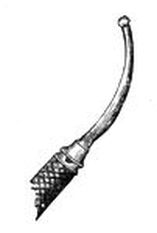
THE KNIFE EMPLOYED BY MR. VARNELL, ASSISTANT PROFESSOR AT THE ROYAL VETERINARY COLLEGE.
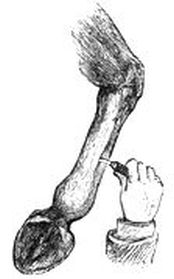
THE POSITION OF THE LEG WHEN THE KNIFE IS INSERTED.
A stout knife with a probed point, a curved blade, and a smooth, rounded back, is first obtained. Before the blade is inserted, the skin is divided, at the point selected for the operation, by the slight puncture of a lancet.
The leg is then flexed; the tendons are, by the position of the limb, rendered flaccid. The knife is next inserted sideways, behind the nerve and artery, under the tendons. This last act is not, however, in practice, very easy or very safe.
The edge of the knife is now toward the shoulder or haunch, and the vessels lie upon that side of the blade which is nearest to the bone. The operator now, by a simple motion of the hand, turns the cutting edge of the knife toward the posterior part of the limb. A man at the same moment takes hold of the leg and forces it straight; the perforans tendon is thus dragged against the knife, while the suspensory ligament and vessels are safe at the back of the blade. If the tendon be not divided without any effort on the part of the operator, he makes a sawing motion as he withdraws the knife. A slight sensation or a feeble sound often testifies the separation of the structure.
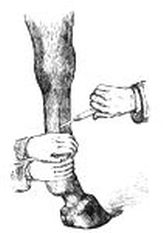
THE TENDON DIVIDED.
Often, if the contraction be not chronic, the strength of the extensor pedis muscle, when released from its opponent's force, is sufficient to straighten the fetlock. When the disease, however, has existed for any time, it requires some violence to break down the false attachments which have been formed. For this purpose the knee of a strong man is placed in front of the fetlock-joint, and the horse's foot is, by pulling hard, drawn forward.
The wound is then closed with a pin and twisted thread, as in neurotomy, and the animal, till junction is perfected, should be kept in the stable, as the shoe to be worn afterward is not favorable to progression. One week after the operation, a shoe, with a projecting piece at the toe about one inch and a half long, is to be put on the foot of the diseased limb. Five weeks after this, the shoe is to be replaced by one having the projecting point twice as long; and this last is to be worn till union is supposed to be perfected—till the expiration of three months at least.
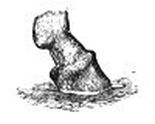
THE SHOE TO BE WORN ONE WEEK AFTER DIVISION OF THE TENDON HAS BEEN ACCOMPLISHED.
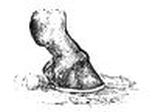
THE SHOE TO BE PUT ON SIX WEEKS AFTER DIVISION OF THE TENDON, AND TO BE WORN UNTIL UNION IS PERFECTED.
The horse, after having the tendon divided, is said to be as strong as ever. The author would, however, object to such an animal being put into the shafts with even a light load behind it, or to its being again used for saddle purposes. The animal, though forbidden these uses, has still a large field of service open to it.
This operation is alike effectual and humane. That the last assertion may not appear based upon a single opinion, the author presents the reader with an engraving taken from a park near Lewes. That animal seemed to have all four limbs contracted, or the hind limbs were flexed and much advanced, to take the weight off the fore members. A foal ran by the side of the creature thus crippled; though it would be supposed no sane person would select such a dam to breed from.
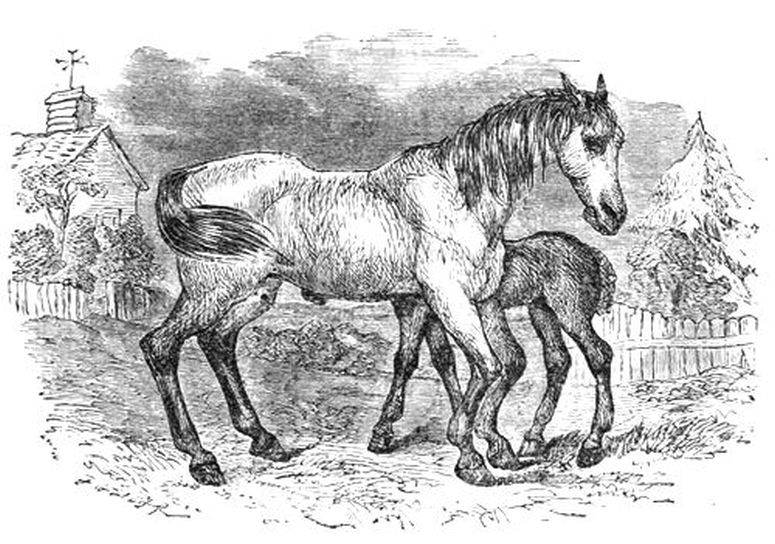
Now had this mare been operated upon, slight pain would have been inflicted. Tendon, unless in a state of inflammation, has no sensation. Relief would have been afforded for the remainder of the life, and though, from her make and shape, the animal might never have held a high station among her breed, still, with straight legs she must have been worth as much for work as with bent limbs she could be valuable for stock purposes.
LAYING OPEN THE SINUSES OF A QUITTOR.
Give no opening medicine to any horse previous to this operation. Every member of the equine race is more likely to be too low from excess of work, than in any degree inflammatory from over-indulgence. Therefore, discard the general practice of preparing the horse with a dose of compound aloes. If the bowels are costive, get them open. But before employing the drastic drug, try what bran mashes and green-meat can effect. The entire strength will be needed to repair the injuries effected with the knife.
Give tonics and high feeding where the symptoms declare the body to be enervated. It is at all times better to operate upon a system having a superabundance of vital energy than upon one in which the powers are at all tardy. Collapse is the greatest enemy the surgeon has to dread. It is true, animals do not, like men, often "shut up" or die while under the operator; but frequently the most skillful surgery is defeated by the horse, after it has been released from the hobbles, never thriving. There may be no disease to be detected; but the body seems to want the strength requisite for recovery. To make this apparent to the reader—two gentlemen shall each perform neurotomy. One shall bungle, yet his patient shall do well. The wounds shall heal by the first intention, and the horse in a fortnight be again delighting its owner. The other shall display the perfection of scientific attainment; yet the horse shall never thrive. The wounds shall ulcerate, and the animal either gnaw the foot or cast the hoof. How can such differences be accounted for but by believing the horse is subject to a peculiar species of chronic collapse?
Rasp the quarter of the horse's foot which has quittor, until the soft, light-colored horn of the laminæ is exposed. Then let the hair be cut off around the opening on the coronet, and the foot be carefully cleansed. Afterward throw the horse. Release the quittored leg from the hobbles, and with a steel director probe each sinus. So soon as the instrument is well in, take a sharp-pointed knife and run it carefully down the groove of the director. Then ascertain, with a grooved probe, whether the sinus decreased in diameter, or whether the whole extent of the pipe be laid open. If the smallest portion remains, to which the knife has not reached, use the groove of the probe as a director, and slit it up. Do this to as many sinuses as may exist.
Next place in each sinus a small piece of tow. These pieces of tow should be already divided into short and thin skeins. They should be saturated with chloride of zinc dissolved in spirits of wine, one scruple to the ounce. Put one of these into each sinus, and let the horse up. In three days such of the pieces of tow as have not been removed by the sloughing process may be taken from the wounds, and the foot simply dressed with chloride of zinc and water, one grain to the ounce, squeezed from a sponge, as in the case of open joint.
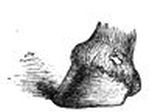
THE QUARTER RASPED BENEATH THE OPENING OF A QUITTOR.
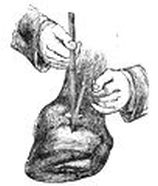
THE SINUSES OF A QUITTOR BEING OPERATED UPON.
This operation, when described, reads abhorrent; but it is really most humane. It is a common thing for a horse to be three, or even six months under treatment, on account of an ordinary quittor. During the entire space, the foot—the tenderest part of the horse's body—is burned with violent caustics, and has had heated wires thrust down its sinuses. By the operation proposed, the affair is settled in a few minutes. The horse seldom evinces much sensibility while the knife is being employed; in three days the animal is so far recovered as to allow the diseased member almost to be left to nature. The horse should, however, on no account do any work before the hoof is in some measure restored. Until the outer covering of dark horn has grown down, a bar shoe, well eased off the diseased quarter, should be worn. When the hoof is reproduced, instead of false quarter or other deformities, the usual results of quittor, it is all but impossible to decide which has been the affected foot, and which was operated upon.
The author has now stated at length that treatment which the horse for its own sake deserves, and which, for the honor of the being whom it serves, the animal should receive. He has, designedly, rather appealed to the reason of his readers than sought to enlist their feelings. The subject was, indeed, a wide one. Man has hitherto been too content to consider animals as something given absolutely to him to be treated according to his sovereign will or merest pleasure. He has not reflected that, when he was created lord of this earth, he was invested with a title which had its responsibilities as well as its privileges.