Chapter XIV · (continued 2)
Reading edition
When the quadruped has remained sufficient time in the slings to have become familiar with them, pull up the cloth so that it may slightly touch but not press against the belly. Then well secure it, and leave the animal to rest its wearied limbs, or not, as it pleases. Its suffering joints will soon teach the horse to bear the entire weight upon such a support, and to sleep comfortably in the contrivance. With a few, and only a few examples, living in slings has induced such confirmed constipation as necessitated a daily resort to bran mashes. Most horses, however, speedily accept and grow fat, enjoying the relief thus afforded. Only one caution need be given—look well to the tackle. The horse is very heavy, and should a single fastening prove insecure, the result might convert a healing wound into a hopeless injury.
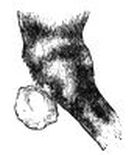
THE ALBUMINOUS BALL, WHICH FORMS IN SHAPE OF AN OPEN JOINT WHEN TREATED WITH A SOLUTION OF CHLORIDE OF ZINC.
With the employment of slings, change the lotion for one composed of chloride of zinc, one scruple; water, one pint; this need be applied only during the day. It is too weak to occasion pain, and should be used with the saucer and sponge, after the manner of washing a broken knee or open joint, which has been previously illustrated. The strength, nevertheless, is sufficient to coagulate the albumen of the synovia. Thus it forms a species of natural bandage which excludes the air, while at the same time it stimulates the flesh and causes that to heal under the protection of its own albuminous secretion.
The coagulated albumen frequently accumulates in front of the knee. The author has seen it attached to the part quite of the size and very near to the form of the largest apple. It must on no account be touched, however large it may grow or however insecure it may appear. Respect it, and it will fall off when its service is accomplished. The cure is nearly completed when the white ball falls. Shortly after the wounds being closed, and pressure made with the fingers—not with the thumb—can be endured, the slings may be removed; though the healing should be further confirmed before the horse is allowed to stand opposite to any substance against which it may strike what recently has been a fearful open joint.
WOUNDS.
To this species of injury the horse is much exposed from the recklessness or incompetence of those who assume to hold the reins of authority. Occurrences which are politely termed "accidents," generally entail suffering upon the blameless animal. The common provocatives of such accidents are either the drunkenness of man or his utter ignorance of the mental attributes of the quadruped he has possession of. The first cause shall be passed over in disgust; the second merits some consideration, being rather a universal than an individual fault.
When a horse pauses, always endeavor to ascertain the motive; the reason may be groundless. By gentleness, convince the creature that its fears are without foundation, and you earn a supremacy as well as win a gratitude which will always be cheerfully acknowledged. Never employ the whip to correct "the obstinacy of the brute." The horse is naturally very fearful; were it not so, man would never have obtained that mastery which is imperative for domestication. Elderly gentlemen should never thrust their heads out of carriage windows and shout to the driver to "go on." Such implied chiding may urge the coachman to display severity, and the horse is dangerous when alarmed. So long as the animal continues calm, the superiority of man is submitted to; but once excite the terror of the quadruped, and all earthly restraint is powerless. Dread assumes the form of the wildest fury, and the horse tears onward, insensible to mortal punishment and blind to every danger.
It is in this manner the most terrible wounds are produced. Such injuries, in surgical language, are defined to be "solutions of continuity," or "separations of the skin and soft parts underneath." Neither of these definitions, however, includes a bruise or a contused wound. Therefore, for the present purpose, a wound will be interpreted an injury inflicted by external violence.
A lacerated wound may be too trivial to attract the surgeon's notice, as a scratch. It may also be a very serious affair, as when a cart-wheel runs against a horse's thigh, tearing the flesh asunder. Laceration is generally accompanied by contusion, though contusion forms no necessary part of a lacerated wound. When such injuries are inflicted, they are mostly followed by little hemorrhage; yet it is far from unusual for an animal thus hurt to perish. Shock to the system is the most serious of the primary effects. Beyond that the immediate consequence appears to be insignificant. Little blood is lost, for the vessels are stimulated by the violence which rends these tubes and the soft structures asunder. Stimulation causes the torn mouths of the arteries and veins to close or to retract. The ragged coats of the vessels, the loose fibers of the flesh, and the jagged cellular tissue likewise fall over the orifices, and help to stay the flow of the vital current.
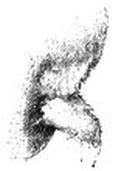
DIAGRAM OF A SEVERE LACERATED WOUND.
The dangers attending lacerated wounds spring, in the first instance, from collapse. This possibility being overcome, the immediate peril has been surmounted; all injuries of this nature are commonly attended, however, with more or less contusion. The force necessary to tear open a portion of the body will, of necessity, bruise or kill some part of the flesh. Any animal substance, when deprived of vitality, must be cast off by a living body; a slough must follow. Now that process is attended with hazard in proportion as it is tardily accomplished. The period of its occurrence is always one of anxiety; for when this process takes place, the stimulation that originally caused the vessels to retract no longer exists. All mechanical opposition to hemorrhage is, with the loss of the dead matter, generally removed. Everything, therefore, depends upon the fibrinous deposit—a sort of glutinous material secreted by the body, which is commonly largely poured forth when any slough by natural and speedy action is effected. Should the frame be so far debilitated as to prevent all secretion of fibrin, the most frightful bleeding must ensue.
The horse which has not recovered from the original injury will then sink under the terrible depletion. Therefore, it is impossible to form any opinion of the injurious effects or of the consequences likely to follow a lacerated wound before some time has elapsed.
An incised wound implies a division, more or less deep, of the soft parts. This form of injury produces less shock to the system, and generally heals more quickly than any other. The principal danger is encountered at the moment when the wound is inflicted; vessels may be sundered, and they are cut in twain with the least possible irritation to the parts within which they are situated. The veins and arteries, therefore, do not generally retract any more than do the soft structures. A gash into a fleshy substance always produces a gaping wound, which is wide in proportion to the depth and length of the injury. From that hurt the dark-colored venous blood drains in a stream, while the bright scarlet or arterial blood is propelled forth in jets, sometimes to a considerable distance. These jets correspond with the pulsations of the heart; but as syncope or fainting takes place, the emission ceases with the beating of the circulatory center.
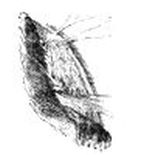
DIAGRAM OF AN INCISED WOUND.
The danger consequent upon an incised wound is ever measured by the extent of the hemorrhage. When large arteries are divided, that fact is easily told by the size and the force of the jets sent forth. A strong horse may, from that cause, be dead in ten minutes. To enforce the difference between a lacerated and an incised wound, the reader is reminded of those painful cases, frequently recorded in the newspapers, where a limb is by machinery torn from a poor man's body, and scarcely a drop of blood marks the deprivation; also of death by severing a throat, when sensation ceases ere the stream has flowed forth. The last is an incised, the first is a lacerated wound.
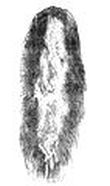
DIAGRAM OF AN ABRADED WOUND.
An abraded wound, in its mildest form, is simply a graze. The reader will, however, remember how acutely painful such accidents always are. The horse's sufferings are not highly estimated by the generality of people; nevertheless, an injury of this description is not to be despised, even when witnessed on the animal. A broken knee, as it generally is exhibited, is nothing more than an abrasion. An abraded wound may simply mean that the insensible outer covering of the skin has been injured; it may also imply that the soft structures beneath have been sundered. Wounds of this kind are not free from danger when of magnitude. Little blood may flow, but the cutis is the most sensitive structure of the entire body. A needle's point cannot enter any part of the skin without sensation warning the person of a puncture. In human operations, division of the skin, or separation of the cutis, is known to constitute the major portion of the patient's agony.
The suffering attendant on the latter class of injuries is increased by almost every abrasion forcing grit or dirt into the substance of the cutis. This, of course, is generally washed out. The torture accompanying a large abraded surface is, therefore, very great; and horses when suffering from accidents of such a nature sometimes sink from the irritation consequent upon the injury. When the animals survive, the roots of the hair too often have been destroyed, and a perpetual blemish is the result.
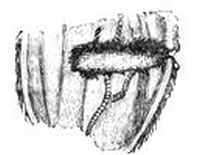
DIAGRAM OF A PUNCTURED WOUND.
The engraving supposes the soft parts to have been divided, in order to show the ragged nature and large extent of the injury, with the comparatively small opening by which this amount of harm is characterized.
A punctured wound is always dangerous; the hazard in this, as in every species of injury, is greatly increased when inflicted on parts liable to any vast amount of motion. Thus, punctures occurring over the stifle-joint too often set our best surgery at defiance. The muscles of the hind leg contract with every movement of the body. Added to that, the part abounds with fascia.
The majority of these wounds heal by suppuration. Fascia is a substance no pus can penetrate, and which is more easily rent than punctured. The exit of the secretion, therefore, is opposed in many directions, while the ceaseless motion occasions the matter to burrow. The sinuses thus produced are by the fascia guided to the stifle-joint; and, when once the synovial cavity is polluted by the intrusion of the unhealthy pus, all the best efforts of science are useless.
When a punctured wound occurs, the skin, being elastic, stretches before the instrument by which the wound is inflicted. The soft parts beneath the skin, not being elastic to the same degree as the integument, break down before the penetrating force. They are torn or lacerated; for generally the muscles receive a larger injury than would be calculated from the size of the instrument by which the blow was inflicted. The rent flesh must be cast off by a slough—corruption generally attends that process. Much of the pus secreted cannot find an exit through the opening in the skin; a large portion of it is confined within the puncture. There it decays, and, being impelled by the motion of the limb, readily finds its way in all directions save the upward one.
No judgment approaching to accuracy can be formed at the first sight of a punctured wound. The probe may ascertain the depth of the injury, but it cannot tell the extent of damage done to the interior of the body. Therefore, whether the hoof is pierced by a nail, or the muscles are lacerated by the shaft of a cart—be the instrument large or small—the consequences likely to follow upon the injury cannot be foretold.
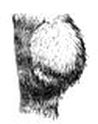
DIAGRAM OF A CONTUSED WOUND.
A contusion, in its mildest form, is simply a bruise. Injuries of this class, when of magnitude, are very deceptive; the surface is unstained by blood, and there is no flesh exposed. For these reasons the ignorant are apt to disregard such accidents, and to express surprise when they terminate otherwise than kindly. When a bruise happens, blood is effused in smaller or larger quantities according to the extent of the injury. A small quantity of effused blood, sufficient to discolor the human skin, may be absorbed; but when the amount is large, the powers of nature are defied. The blood thrown out, not being taken up again, congeals, and ultimately corrupts. Then an abscess or a slough is necessitated; both are attended with danger: the first may be deep seated or superficial; either form is attended by much weakness. That generates considerable irritation, and may even be the cause of fatal hemorrhage; or it may lead to sinuses, the direction, the number, or extent of which, when they do occur, is not to be predicated. A bruise is, consequently, not to be judged of hastily. The amount of pain which it provokes is even unworthy dependence, as the injury may have hurt the bone or the tendon; and then, though the accident is rendered very serious, in the first instance no sign of agony announces the extent of the evil.
With regard to treatment, when a lacerated wound occurs, the first attention should be paid to the system, which has always been much shaken. Give, therefore, the drink composed of one ounce each of laudanum and sulphuric ether, with half a pint of water; repeat it every quarter of an hour till the shivering natural to the horse on these occasions has disappeared, and the pulse has recovered its healthy tone.
Avoid all poultices of the ordinary kind; one composed of one-fourth yeast and three-fourths of any coarse grain, excepting bran, may be applied. So also may a lotion thus composed:—
Lotion for Lacerated Wounds.
Tincture of cantharides One ounce.
Chloride of zinc Two drachms.
Water Three pints.
Mix. Keep a rag constantly wet over the part.
Either will stimulate the parts, and probably prevent any tendency to unhealthy action. The yeast poultice produces this effect by giving off carbonic acid; the lotion accomplishes this intention by both its active ingredients. Each is stimulating, also disinfectant, and will counteract any filthy odor which may attend the sloughing process; but the lotion is perhaps to be preferred, as it is more easily applied. When the slough has taken place, should hemorrhage ensue, dash upon the part jug after jug of the coldest water; or, should no very cold water be at hand, drive upon the mouths of the vessels a current of wind from the nozzle of the bellows. Continue to do this till the bleeding ceases, or until a surgeon can be obtained to take up the arteries.
The after-treatment is simple: apply frequently the solution of chloride of zinc, one grain to an ounce of water; that lotion will cleanse the wound and prevent unpleasant smells.
As respects feeding, this must be regulated by the character of the pulse. Should the beat of the artery be quick and feeble, no hay should be given; good, thick gruel should constitute the only drink excepting in extreme cases, when two pots of porter may be allowed each day. Good oats and old beans, both crushed and scalded, should then constitute the food, and the utmost gentleness should be exercised toward the animal.
Should the pulse be natural, allow three feeds of oats each day, as, in every kind of injury to the horse, more danger is to be apprehended from debility than from any excess of energy.
Incised wounds.—When these happen, always dash the part with plenty of cold water or blow upon them with the bellows. Place the horse in the nearest shed; motion promotes hemorrhage, therefore a walk is not to be hazarded. The bleeding being arrested—for, in severe accidents of this kind, there is no time to send for assistance—let the animal remain perfectly quiet until the exposed surface has become almost dry, but on being touched by the finger feels sticky. Then draw the edges together, and keep them in that position by means of sutures.
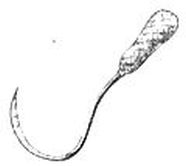
FIXED SUTURE NEEDLE: VERY USEFUL FOR INCISED WOUNDS OF NO GREAT DEPTH.
The best means of inserting these sutures is with a curved needle fixed into a handle. The handle is wanted to obtain the necessary power, and the needle's point should be sharp to penetrate the hide of the horse, which in places is of considerable thickness. The needle is thrust through the integument about one inch and a half from one margin of the incision; it is brought out about the same distance within the divided soft parts. It enters the opposite side of the sundered flesh even with the place whence it came forth, and afterward it appears through the skin about equally distant from the opposite edge of the wound. There is a hole near the point of the needle; through this opening a piece of strong twine or narrow tape is threaded; when, the instrument being withdrawn, the twine or tape is pulled into the puncture which has been made. The needle is then released, the suture being left in.
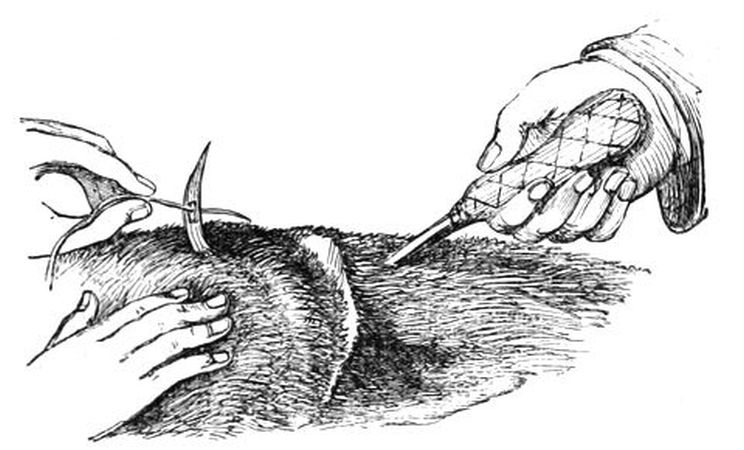
THE MANNER OF USING THE FIXED SETON NEEDLE.
A second person pushes the wound together, and, when the point of the needle appears, threads it with a piece of zinc wire or soft string. The needle is then retracted, and released from the wire or string, whereby a suture is left in the wound.
So many sutures as may be necessary are thus inserted—in small wounds, these being about two inches asunder, but in larger injuries, three inches apart. All are duly placed before any are tied; the whole being ready, the wound is forced together by an assistant, while the strings are fastened—care being exercised not to bring any of them actually tight, lest the motion of the body or the swelling of the part should drag the sutures through the flesh and thereby tear them out.
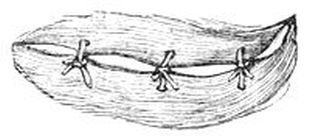
DIAGRAM OF SUTURES WHEN TIED AND LEFT IN A WOUND.
A wound thus united may possibly heal by first intention, or the divided parts, when brought together, may join, and give no further trouble to the surgical attendant.
Union by first intention is, however, somewhat rare in the horse; and should not that take place, suppuration will be established. So soon as the pus flows freely forth, and the sutures appear to tighten or drag, cut them out by snipping the twine; but allow the strings to loosen before you attempt their withdrawal.
If this is not done, the sutures will speedily find an exit for themselves by causing the flesh against which the tension acts to be absorbed; thus the original injury will be rendered more complicated, and the ultimate blemish must be altogether greater.
All that is required after the establishment of suppuration is to bathe the part with the solution of chloride of zinc, one grain to the ounce of water. This lotion will suppress any fetor, and gently stimulate the healing process, as well as prevent the sprouting of fungoid granulations; it is necessary also to attend strictly to the directions laid down for feeding during the curing of wounds.
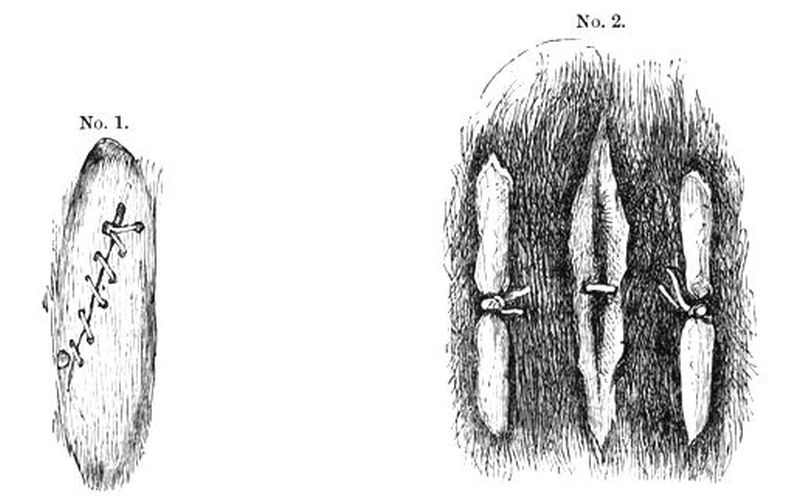
TWO KINDS OF SUTURES RARELY EMPLOYED UPON THE HORSE.
No. 1. The continuous suture, which is employed for sewing up portions of bowel when the intestines are injured and exposed.
No. 2. The deep suture or the quill suture. In the horse pieces of wood are substituted for quills. The wood is notched in the center; and upon the indentations the sutures are fixed, to prevent the movements of the animal from displacing them. It is sometimes employed to bring the sides of deep and gaping wounds closer together.
The treatment of an abraded wound chiefly consists in cleansing the surface with plenty of cold water, which should be allowed by its own weight to wash off any loose particles of dirt. No cloth or other aid should be employed to scrub the living flesh as though it were an insensitive board. The matter which cannot be removed by simply sluicing, had better remain to be expelled by the secretion of pus. The horse, especially when terrified, endures pain very badly; indeed, the animal is so timid and so delicately framed that it is always good surgery to spare all unnecessary suffering.
Support the body with laudanum and ether drinks, one ounce of each to the pint of water, as often as they may be needed. Let the food be generous, unless fever should arise, when the directions already given must be attended to.
Punctured wounds require only one kind of treatment, whether a nail be driven into the flesh of the foot, or the shaft of a cart be forced into the substance of the thigh. Here the knife must be employed; and, unless the animal shows evident symptoms of excessive weakness, it is better, perhaps, to operate while the parts are partially numbed by the shock, than to wait until a morbid sensibility is provoked. Always enlarge the opening; do this in the foot by cutting away the horn of the sole around the small puncture left by the nail. When the soft parts are penetrated, probe the wound first; then, if possible, insert a knife to the bottom of the puncture, and, with the edge downward, draw it forth. By this means a wound resembling a subverted < will be instituted. It will be narrowest toward the extremity, and widest at the mouth. A free opening affords a ready egress for all sloughs and pus. It materially aids the healing process, and effectually prevents the establishment of sinuses; while the clean incision left by the knife is of small import, when taken into consideration with the other consequences of a punctured wound.
Support the animal if necessary, or regulate the food by the symptoms.
A contused wound, when slight, may be rubbed with the iodide of lead ointment, one drachm of the active agent to the ounce of lard; when all enlargement will sometimes subside, and the effused blood may be absorbed. However, the horse commonly receives injuries of magnitude. In the last case, take a sharp knife and draw it along the entire length of the swelling. Make a long gash, only through the integument, at every eighth inch, and be careful to carry the knife through the integument, or to the lowest portion of the detached skin. Any sac that may be left is certain to retain corruption, and may produce fearful after-consequences. The attendant measures consist in bathing the contusion with a lotion composed of chloride of zinc, one grain, water, one ounce, and diminishing the food or supporting the body as nature demands such treatment.
The after-treatment of all injuries consists in keeping any external orifices open till all sloughs and pus have disappeared. In surgery, a large and depending opening, by means of which the interior may drain, is always to be preserved, and the knife, to this end, may be employed so often as the healing process threatens to prematurely close the wound.
Formerly it was the practice to bleed after every injury; this was done to prevent fever. However, observation has shown that the vital powers are more often weakened than increased by the shock attendant on severe accidents. Whenever the contrary happens, it is far better to lower the pulse by repeated doses of aconite, than to abstract that which will subsequently be necessary to repair injury.
It was also once the custom to fill wounds with tents or lumps of tow, and to bandage every injured part. These habits only served to confine that which nature was striving to cast out. They consequently did much harm, and are now happily discarded.
A piece of loose rag, saturated in the oil or the solution of tar, should, during summer, be suspended over the mouth of every wound, to keep off the flies. The only tent which the author approves of is when an incised wound happens where assistance is far away, and difficult to procure. Then, to arrest the hemorrhage, let the horse rug, a man's coat, or anything else be violently thrust into the gash, and forcibly held there until proper assistance can be obtained.
Such is the present method of treating wounds; this to the reader may appear very cruel; but could he have walked through and have inhaled the atmosphere of the wards in hospitals appropriated to such injuries as they existed in former times, he would thoroughly understand that apparent want of feeling is, in reality, the height of charity.
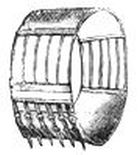
A BANDAGE DESIGNED FOR WOUNDS ON THE TRUNK OF THE HORSE.
To conclude this part, the author lays before his readers the following bandage, intended to meet an inconvenience hitherto experienced when a horse has the walls of the abdomen punctured. The constant motion of the part renders ordinary sutures of no avail, and for that reason bandages, unless so tight as to check circulation, are of little use. The annexed is made like a broad belt, and is buckled round the body. The bars are composed of vulcanized India-rubber; they will yield to the movements of the abdomen, and yet serve as sutures supporting any pendant flap, while at the same time they will allow the wound to be dressed without disturbing the bandage. They also offer the advantage of permitting the attendant to pull one support aside without removing the whole.
Every part in the horse subjected to much motion when wounded, should have an adhesive plaster placed over it, and retained there until the suppurative action is confirmed. By this means is excluded the atmosphere, which, when this precaution was neglected, has entered the wound, penetrated between the muscles, and by distending the body increased the suffering, as well as led to the worst of consequences.
Wounds in veterinary surgery rank among the most formidable cases with which the practitioner has to contend. They are not so because the flesh of the horse is slower to heal than that of the human being. Indeed, the scale in this respect inclines toward the animal; but they are rendered slow to heal and difficult to cure by two causes. The horse is always impatient of restraint; any effort to confine the creature is more likely to provoke dangerous resistance than to induce the slightest symptom of amendment. The quadruped naturally delights in motion. It was formed for activity. Even when in its stall the body is never absolutely still; the position is being changed; the legs are frequently stamped; the head, eyes, ears, and tail are never quiet. This innate quality retards the union of sundered flesh. It favors the gravitation of pus between the muscles, and thus generates sinuses. These are the torments of veterinary surgery. Could the sinus be anticipated, or in all cases eradicated, the principal difficulty would be removed; but intelligent as the horse is, it proves impossible to make the animal comprehend the necessity for quietude. Hence any trivial accident may lead to injuries of so extensive a character and so malignant a nature as will set the best endeavors or the most consummate skill at defiance.