Chapter XIII · (continued 2)
Reading edition
A man may lose a leg; he can live, enjoy life, and to a certain extent effect progression with a wooden substitute. Touch the heart of a man, however, and being ends. The heart is guarded by the ribs, and so securely is it protected that, even in battle, the organ is seldom punctured; the hoof of the horse is almost as important to the animal as is the heart to the human being. In a free state progression is necessary to the support of the body; when domesticated, the horse is valued according to its power to progress.
Yet, the member so important to the creature is, by the nature of laminitis, frequently disorganized, and a valuable quadruped, by the affliction, may be reduced from the highest price to a knacker's purchase money.
There is some dispute about the kind of hoof most liable to this disease. English authors incline toward the weak or slanting hoof. Continental writers, however, suppose the strong or upright hoof is most exposed to the affliction. Neither party, however, assert any kind of hoof to be exempt; therefore, it may be supposed, were all circumstances similar, every kind of foot would be equally subjected to laminitis.
There is but one cause for acute laminitis—man's brutality. Horses driven far and long over hard, dry roads, frequently exhibit the disease. Cab and post, as well as gentlemen's horses, after a fine day at Epsom or at Ascot, not unfrequently display the disorder. Animals which have to stand and strain the feet for any period, as cavalry horses upon a long sea voyage, if, upon landing, they are imprudently used without sufficient rest, will assuredly fail with this incapacitating malady. Any extraordinary labor may induce laminitis. Hunters, after a hard run, and racers, subsequently to heats, are liable to be attacked; especially should the ground be in the state we have before intimated.
Acute laminitis does not immediately declare itself; the pace of the animal, when its work is drawing to a close, may be remarkable; but this is attributed to the effects of exhaustion. The creature reaches the stable; the surface of the body is rubbed over; the manger and the rack are filled; a fresh bed is quickly shaken down, for, in the opinion of grooms, quiet does horses extreme good. The animal is left for the night, under the impression that it has everything one of the race could require.
The next morning the horse is found all of a heap, and the food untouched; the flesh is quivering; the eyes are glaring; the nostrils are distended, and the breath is jerking. The flanks are tucked up, the back is roached, the head is erect, and the mouth is firmly closed; the hind legs are advanced, to take the bearing from the inflamed fore members; the front feet are pushed forward, so as to receive the least possible amount of weight, and that upon the heels; but the feet thus placed are constantly on the move. Now, one leg is slightly bent; then, that is down and the other is raised; the horse is, according to a vulgar phrase, "dancing on hot irons."
The first indications—food untouched, glaring eyes, etc.—represent only excessive agony; the position of the body is symptomatic. The hind feet are thrust under the body in order to take the weight from the front, or the diseased organs; the fore feet are thrust forward and the head held erect, that the inflamed parts may be as much as possible beyond the center of gravity. In this attitude the wretched quadruped will stand, its sides heaving and its flesh creeping with the pain within the hoofs, and with the fire that burns within the blood. The teeth are occasionally heard to grind against each other; expressive sounds sometimes issue from the throat, and partial perspirations burst forth upon the body; it is a horrible picture of the largest agony!
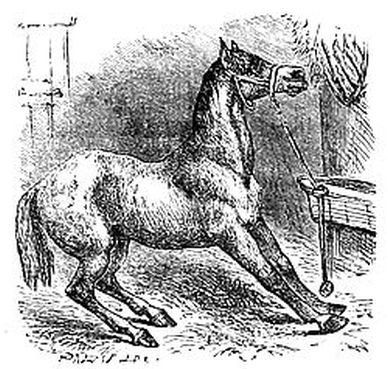
ACUTE LAMINITIS, OR FEVER IN THE FEET.
The fore feet are mostly the seat of the disorder; all four may be involved, but the author has only witnessed the two front affected. The implication of the others are rather recorded wonders than general facts. The writer, in his professional experience, has met no one to whom a case of laminitis involving all four hoofs has been submitted.
Everything concerning laminitis is in confusion. It is not yet authoritatively ascertained whether horses lie down or stand up—whether the shoes should be taken off or left on—and what kind of treatment it is proper to adopt. Any dispute about general facts pronounces both parties wrong; it assures us that the experience of the disputants is somewhat limited. The circumstances cannot be very marked where the recognition is not universal: the treatment can only be not confirmed, because none attended with conspicuous benefit has been proposed.
Horses do often lie down in laminitis; but they more generally stand. When down, they should be suffered to remain; and when up, the first thing done should be the employment of slings. Place the cloth under the belly with the least possible noise; the man the horse is accustomed to, with orders to soothe the animal when alarm is excited, should be stationed at the head. The men who are arranging the slings should pause on the slightest sign of fear, and only resume their labor when confidence is restored. The ropes, however, must not be drawn tight and fixed. The ends of the cords should, by means of two extra pulleys, be carried to some distance from the animal. To the end of each rope ought to be fastened a stout ring, and on this, by means of hooks, weights should be suspended. As the weights are added, the man should caress the sufferer till sufficient counterpoise be attached to take the principal bearing from the feet without offering much obstacle to the breathing.
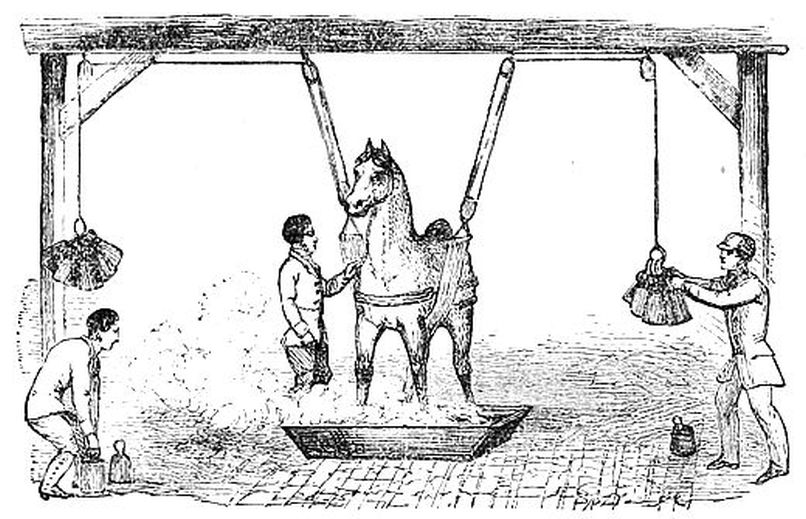
A HORSE IN SLINGS, WITH THE FORE FEET IN HOT WATER, FOR ACUTE LAMINITIS.
With regard to the shoes, we should first soften the hoof by allowing the feet to soak in warm water in which a portion of any alkali has been dissolved. The slings being applied, the fore feet are to be placed in a trough of hot, soft water, and allowed to remain there till the hoof is quite pulpy. Then one foot is to be gently raised and the trough partially removed. All this must be done very quietly—not a word being spoken—and all operation suspended at the appearance of the smallest alarm. The man at the head must not for an instant quit his post.
The foot being released from the water, a sharp-pointed knife is to be employed and the horn cut, so as to free every nail, till the shoe drops off; but the iron should not be allowed to clatter on the ground.
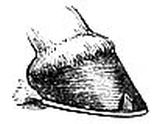
THE MANNER IN WHICH THE NAILS, WHICH FASTEN ON THE SHOE, ARE TO BE RELEASED FROM THE HORSE'S HOOF DURING ACUTE LAMINITIS.
This method is infinitely better than the common practice of taking off the horse's shoe. The smith removes the shoe by a wrench, using his pliers for the purpose of gaining extra power. No doubt the metal had much better remain on than be thus rudely displaced. But, in removing the shoe from a softened foot, no smith is necessary, and no smith should be employed: the veterinary surgeon should himself cut out the nails; and no matter if an hour or two be occupied over each foot. In laminitis there must be no hurry.
Before the shoes are removed, half a drachm of belladonna and fifteen grains of digitalis should be placed in the horse's mouth. Both drugs should be gently introduced, not as a draught or a ball, but in substance, or in the smallest possible bulk. These medicines should be repeated every half hour, till the breathing is easier and the pulse somewhat altered in character. Then some additional weight may be added to the slings; and, by taking advantage of similar opportunities, the animal may be eventually lifted almost off the ground without displaying any inclination to resist.
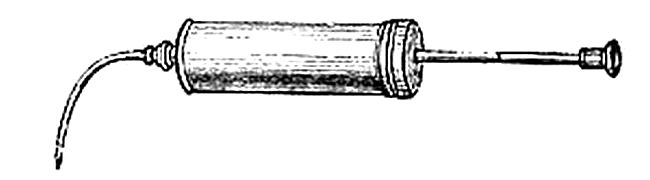
THE SYRINGE TO BE EMPLOYED TO INJECT BLOOD-WARM WATER INTO THE VEINS DURING ACUTE LAMINITIS. THE MARK ON THE ROD DENOTES HOW FAR THE HANDLE IS TO BE PUSHED DOWN. (See Enteritis, p. 170.)
When the horse is in this position, open the jugular vein with a lancet, making the least possible flurry. Abstract one quart of blood, which may be obtained with the greatest ease. Have ready a quart syringe filled with water; inject one pint into the orifice whence two pints of blood have been abstracted. The effect will be produced in a few minutes. Copious purgation and perspiration will ensue, and the fever will be greatly abated. Clothe the horse well up. Place before him a pail of thin gruel with a bundle of green-meat, and enough has been done for one day. But mind and leave two men to watch in the stable throughout the first three nights.
On the following morning give a dose of ether and laudanum—two ounces of both in a pint of water. Let the horse take his own time in swallowing: do not care if half the drink should be lost. In fact, if the attempt to give the physic should call forth much opposition, abstain from administering it: quiet is of more importance than medicine. On that account, strict orders should be given to admit no visitors, and the strictest injunction concerning silence should be enforced.
The pulse and breathing must be watched; and, as either appear to augment, the drugs before recommended must be introduced. Should the artery on either side of the pastern throb, that sign indicates the foot to be congested. This condition must be relieved. With a lancet open both pastern veins, which are sure to be in a swollen state, and plunge the foot up to the fetlock in warm water. A little blood abstracted by this method does more good than the ample venesections so generally advised, but which, from their tendency to lower the system, are apt to prepare the way for the worst terminations to acute laminitis. Our object should be to conquer the disease without reducing the strength; had the horse ten times its natural vigor, such an affliction as acute laminitis would more than exhaust it all. The failure of former practitioners has been chiefly owing to their inattention to this fact.
While the affection lasts, these measures must be pertinaciously adopted; the feet, the entire time, must be repeatedly put in warm water, not only to soften the horn, but because the chief pain is caused by the congested or swollen condition of the secretive portion of the foot; congestion, likewise, induces the terminations to be most feared; heat or warmth is perhaps the best means of relieving loaded vessels. Cover over the water or blind the horse's eyes while in the slings, because acute disease is likely to disorder the vision, and a sick, imprisoned animal is too apt to be startled by the reflection of its own image. The author has had reason to lament the neglect of such necessary precaution.
The termination to be feared is disorganization—either from the casting of the hoof or the descent of the coffin-bone from its natural situation. The first result is preceded by chronic suppuration. A slight division is observed between hair and horn; and from the opening thus occasioned a small quantity of unhealthy pus issues, mingled with much bloody serum. Ultimately the entire hoof loosens and drops off, exposing the fleshy parts beneath. Now, all these fleshy parts must have been diseased before they could have separated from their secretion, and such fleshy parts are not the laminæ only, but all those represented in the engravings on page 373.
The sudden exposure of parts which, during health, are covered and protected, cannot otherwise than cause an extraordinary effect upon the body of the sufferer. Persons who have lost a nail seldom have that substance renewed in all its original integrity. Deformity or an imperfect secretion is generally retained to mark the deprivation. Nature appears averse to the restoration of any of her original structures.
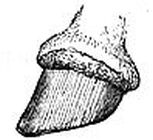
THE SENSITIVE LAMINA AND CORONET DIVESTED OF THEIR HORNY COVERING.
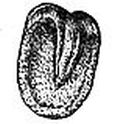
THE SENSITIVE SOLE—FROG AND BARS DIVESTED OF THEIR HORNY COVERING.
Such a catastrophe is denominated sloughing of the hoof. After that has occurred it is useless to prolong the suffering by permitting the horse to live. Doubtless in time a sort of new hoof would be produced, but it would only be a deformity. It would want the toughness and strength of the original formation.
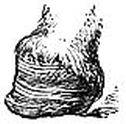
DIAGRAM.
The new horny covering which invests the foot of the horse after sloughing of the hoof, as a termination to acute laminitis.
Such was the hoof which used to succeed sloughing under the old plan of treatment; the author is happy to state he has not witnessed such a misfortune since he has followed the practice which he here recommends.
The suppuration just spoken of was not of the copious kind, but was a tardy secretion mingled with bloody serum; it is astonishing such a fact should not have warned veterinary surgeons against following depletive measures. The effusion, however, of which the writer has next to speak is entirely the result of weakness. It does appear most strange that exhausting treatment should have been pursued as with infatuation, despite of so evident a warning. The parts which in health only secrete horn, during exhaustion throw out serum, or the thinner portion of the blood. This separates the coffin-bone from its attachments, while the imposed weight forces the loosened bone from its natural position. To make this more clear, diagrams of a natural foot, and of one which has suffered distortion from acute laminitis, are represented on page 374. In the natural foot, the pedal bone is situated close to the outer crust; in the laminitic foot, the bone is forced downward toward the sole, which it ultimately penetrates. There is an artery running around the lower edge of the coffin-bone; upon this artery the animal, if suffered to live, would, after displacement of the coffin-bone, be obliged to tread. The consequence is that a horse, having a foot thus distorted, cannot by any possibility take a sound step; it lives in torture and moves in anguish.
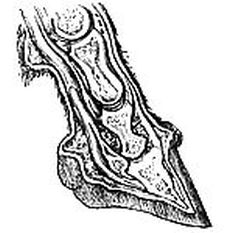
DIAGRAM.
A section of the horse's foot, showing the natural and relative situations of the bones which enter into the formation of the horse's foot when in a healthy state.
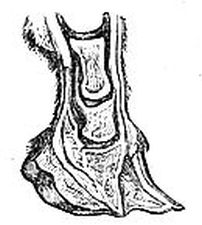
DIAGRAM.
A section of the horse's foot after one of the terminations to acute laminitis, exposing the interior of the hoof when the coffin-bone has fallen from its original situation.
This formation has been too generally spoken of as pumice foot, whereas that peculiarity is altogether distinct. Pumice foot does not entirely incapacitate the horse for labor; it is a chronic disease leading to a very opposite species of distortion, or to a bulging of the sole such as is here illustrated.
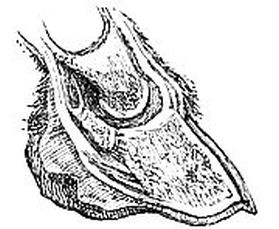
A SECTION OF THE HORSE'S FOOT, ILLUSTRATING THE DISTORTION WHICH CONSTITUTES PUMICE FOOT.
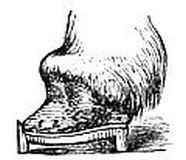
THE DEFORMITY WHICH ENSUES UPON DROPPING OF THE COFFIN-BONE.
After dropping of the coffin-bone has taken place, it is commonly said that the hoof, struck upon the spot once occupied by the coffin-bone, emits a hollow sound; such is not the fact.
The space supposed to be empty is immediately filled by an impure horn—a soft, transparent substance, which, if the animal be permitted to live, dries, or diminishes in bulk, and the front of the hoof falls in. The author once beheld, working in a lime-pit near Reigate, an aged animal which, some time previous, had suffered dropping of the coffin-bone; the animal was shod with leather, and had a shoe lifted from the ground by means of large calkins both before and behind. The hoof, however, was terribly misshapen; it hardly admits of such a description as would be readily understood; therefore the hoof is represented from a sketch made upon the spot.
The other terminations to acute laminitis are metastasis and mortification.
Metastasis is when the fever leaves the feet to fix upon some other and remote part, as the lungs, bowels, brain, eyes, etc. Or, fever of the feet is frequently asserted to be caused by the inflammation "dropping" from those parts into the hoofs; when such changes ensue, the body being already weakened, the attack is seldom of a very acute type; but, nevertheless, it may be attended by disorganization, by distortion, or even by death.
It is a bad symptom should no change be observed in the course of the disorder before the expiration of the fifth day; some sad ending may then be expected, but it does not invariably follow. The animal should be watched night and day; all that can possibly be done to alleviate its suffering should be put into practice. For that end, the writer has found nothing equal in its soothing effects to perfect quietude, and good gruel made with a portion of linseeds and of beans mixed with oatmeal. But be sure that laminitis has departed from the feet before the slings are removed; then, even supposing no metastasis to have occurred, do not suddenly take all support from the horse, but remove a weight every day, so that the restored parts may become gradually used to their original functions. On the first sign indicative of a return to the disorder, restore the full counterpoise and recommence treatment; for acute laminitis is somewhat treacherous. Very cautiously exercise the invalid upon a piece of meadow land and, as the health appears restored, gradually return to the usual method of treatment.
SUBACUTE LAMINITIS.
This is a variety of the former disease; the characteristic differences between the two are thus stated by the esteemed late William Percival:—
"In neither form is laminitis the disease of the unbroken or unused horse. Now and then acute laminitis will appear in the four or five year old horse when newly taken into work; more commonly it is witnessed incapacitating the horse when at work, and during the middle period of life. Subacute laminitis, on the other hand, is very apt to select the aged and worked animal. Secondly, acute laminitis is the immediate effect of labor, hard either from its distressful character or its endurance. Subacute laminitis, on the contrary, will make its appearance in the stable where the horse has been for some time living in a state of idleness or absolute rest. Thirdly, acute laminitis makes its attack directly or shortly after the application of the exciting cause; subacute laminitis approaches so gradually that it is often present some days before its existence is discovered. Fourthly, acute laminitis is marked by great suffering and accompanied by raging fever; in subacute laminitis fever is not to be detected, and the mode of progression alone indicates suffering. Fifthly, acute laminitis may terminate in metastasis, suppuration, and mortification; in subacute laminitis neither of these issues is to be dreaded, for, if we do not succeed in producing resolution, dropping of the coffin-bone is the customary ending to the disorder."
The above, quoted from memory, presents a graphic contrast and an admirable portrait of the disorder. It is so eloquent in its brevity that it leaves nothing to be added; therefore the author will at once proceed to state his views of the subject.
Subacute laminitis is always first noticed in the manner of progressing. The master complains that the horse has become slower; that the whip has lost influence over the body; and that the animal, when progressing, appears to jolt more than usual. This last observation indicates the kind of horses to which subacute laminitis is principally confined. Acute laminitis is almost the property of fast saddle-horses; the subacute variety more especially belongs to harness-horses. The author has lately seen specimens of the subacute disease tugging those vehicles which were once fashionable and which were called "cabriolets." The animal suffering this disorder endeavors to bring the heels only to the ground. All its fumbling gait, its supposed sluggishness, and want of appreciation for the whip are to be attributed to this desire—to take the weight as much as possible from the seat of agony.
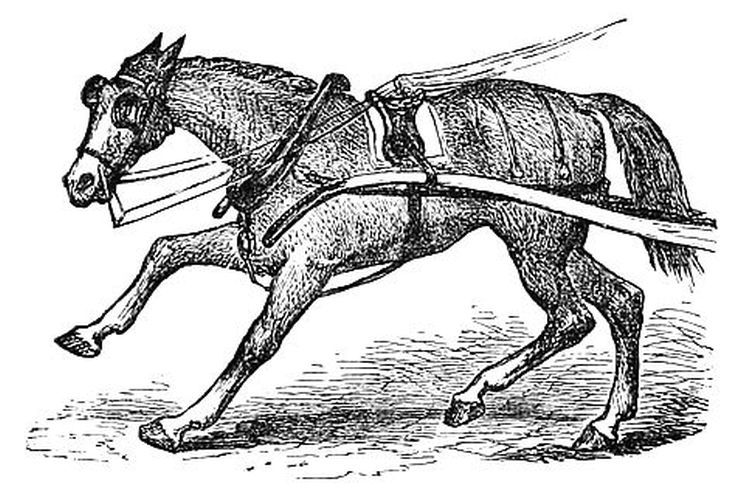
THE MANNER OF PROGRESSING WHEN SUFFERING UNDER SUBACUTE LAMINITIS.
The success of treatment, in a great measure, depends upon the disorder being early detected. Get the horse immediately into slings, as was directed for acute laminitis, and proceed in the same manner with the removal of the shoe. Omit all bleeding. If the bowels are costive, allow a portion of green-meat until the evil is removed; but do not produce purgation. All medicine of a debilitating character must be withheld. Give, night and morning, a quart of stout; allow two drinks, each containing one ounce of ether, in half a pint of water, during the day. This, with half-drachm doses of belladonna as needed to allay any symptoms of pain, will constitute the whole of the treatment.
As regards food, it should consist of sound oats previously ground, and a moderate allowance of crushed, old beans. The water should be whitened, and all hay strictly withheld. The animal should not be left night or day, and gentleness should be enjoined upon its attendant. The food, however, should not be without limit; five feeds of corn are enough for one day, if the horse will eat so much.
Should dropping of the coffin-bone end the attack, it is only charity to terminate the existence. In Mr. W. Percival's admirable work the reader will find described at length a method proposed for restoring the bone to its original position. The author has seen that plan tried more than once, but never beheld any good result. The knacker has, in every case, been called in to finish the unsuccessful experiment.
The horse, however, which recovers from an attack of laminitis, either in the acute or subacute form, should ever after be shod with leather; and were this admirable practice universal, probably, by deadening concussion, it might altogether eradicate the disease. The expense is the objection to its adoption; but against the cost, the horse proprietor has to ask himself, What are a few shillings extra, at each shoeing, to secure immunity from that horrible disorder to which the servant of his pleasure is exposed?
NAVICULAR DISEASE.
This is the scourge of willing horse-flesh; it is the disease from which favorite steeds mostly suffer; it is not less fatal in its termination than vexatious in its course and painful during its existence.
The malignancy of the disorder is expended upon the substances which in health are without feeling, but which occasion the most acute anguish when affected by disease—namely, bone, tendon, and synovial membrane. Strictly confined to these structures, and frequently limited to a space not half an inch in diameter, the suffering it occasions is such as often provokes the sacrifice of the life, and invariably renders the animal next to useless.
It is confined to the interior of the foot, being, as its name implies, strictly located upon the navicular bone. The navicular bone is a small bone attached to the posterior portion of the os pedis, and resting upon the perforans tendon, which is inserted into the inferior surface of the coffin-bone. A synovial sac is placed between the navicular bone and superior surface of the tendon, on which the ossoeus structure reposes. Synovial sacs are only found in places where motion is great and almost incessant; thus the existence of this formation apprises us that the bone and tendon, in a healthy state, are designed to move freely upon each other. They do this while unaffected by disease; the foot, indeed, cannot be flexed, extended, retracted, or placed upon the ground without this busy little joint being put into motion. It is, perhaps, as essential a part—though of small size—as any of the larger structures which enter into the horse's body.
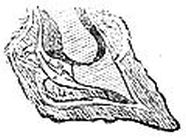
A DIAGRAM TO EXPLAIN THE SEAT OF NAVICULAR DISEASE.
a. The perforans tendon running beneath the bone, and on which the bone reposes.
b. The comparative size and relative situation of the navicular bone.
c. The synovial sac which facilitates the motion of the bone on the tendon; upon the superior surface of this sac navicular disease is alone exhibited.
Navicular disease, however, affects only the lower surface of the bone; the upper surface shares another synovial sac, which lubricates the articulation of the coffin-bone with the lower bone of the pastern. This upper surface is never affected; the navicular bone may diminish or wither through disease, still the affection remains confined to its original situation; disease may lead to fracture of the bone or to rupture of the perforans tendon, still the superior portion of the navicular bone to the last exhibits a healthful condition.
This most annoying and terrible disorder springs from two causes. The first was a very favorite crotchet of the late Professor Coleman, who was always theorizing to the injury of the animal it was his office to cure. The disease is now largely distributed through that gentleman's favorite maxim concerning the absolute necessity that there should be pressure upon the frog. Every smith thus instructed tried to bring the frog as near the ground as possible, and the consequence was the spread of navicular disease. It is true, the frog, in a state of nature, was designed to bear pressure; but surely it is folly to talk about the natural condition of the horse when nothing like a wild horse exists. Here was Coleman's error; he legislated for the most artificial of living creatures, which consumes only prepared food, and which moves only over laboriously manufactured roads, as if it had been in an undomesticated condition, gamboling upon the unfilled earth.
The second cause is, the parsimony of most horse proprietors. Would these gentlemen have their favorites shod with leather, the smith would be obliged to slightly raise the frog; while the leather—if good, stout, sole leather—and the stopping would protect the seat of navicular disease from injury. With regard to the first cause, it was recognized by the late W. Percival, one of Coleman's most enthusiastic pupils; and, as concerns the last, its efficacy as a preventive needs no pleading nor any reference to establish its merits.
The horse, when attacked, commonly has a good open foot—in fact, before disease commences, the foot is healthy. An animal in this condition is being ridden or slowly led out of the stable. In the last case it, being fresh, may rejoice to feel and sniff the cool air of heaven. It may prance about, and we may admire its attitudes; but in an instant it becomes dead lame. So a horse may be mounted by a kind master; the creature may be going its own pace, when, of a sudden, the movement shall change, and the rider will be made conscious that his steed is lame.
In either case the foot is examined. It is cool, quite cool; no stone appears to have injured it—nor is any pebble sticking between the web of the shoe and the sole. Yet the lameness is acute and does not pass off. Now, to explain this, let the reader turn to the illustration which was last presented.
The portion of the foot, immediately under the navicular bone, has been placed upon a stone; the stone has been forced against the foot by the immense weight of the horse imposed upon it. The stone, under this impulse, has bruised the navicular bone. But the fleshy frog and the perforans tendon would have to be passed before this effect could reach the bone. Are neither of these also hurt? Doubtless they are. But the fleshy frog is a highly organized, secretive organ, and probably, by its innate energy, soon recovers from the effect. The tendon is, on the contrary, too soft and yielding to retain any harsh impression. The bone is firm and solid; and thus that which failed to act upon either of the intervening parts, leaves a lasting injury upon the osseous structure, which, moreover, is held stationary by the coronary bone, and which is disposed to display injury, being covered by synovial membrane.
The navicular bone belongs to a peculiar class called "sesimoid, or floating bones." These are more highly organized than the generality of osseous structures—in short, quite as much, or rather more, than the human tooth. Everybody must be acquainted with the anguish occasioned by unexpectedly biting upon a hard substance. The tooth, however, is coated with crystalline enamel. The bone is covered by delicate synovial membrane. The impression is, therefore, more likely to be lasting with the last than the first.
After the expiration of a week, however, the lameness disappears, and the proprietor fondly hopes all is over. The animal may work soundly for months—sometimes it never fails again. Generally, however, after some period, extending from six to nine months, the lameness reappears. This time the treatment occupies a longer space; and the subsequent soundness is of shorter duration. Thus the malady progresses; the period occupied in curative measures lengthens, while the season of usefulness diminishes; till, in the end, the horse becomes lame for life.
The worst of it is, that the pain in the lame foot occasions greater stress to be thrown upon the sound member; the result generally is that both legs ultimately become affected with the like disease: such is ordinarily the case. The horse with a tender foot will always bring it gently to the earth; but this circumstance obliges the animal to cast the other foot to the ground with heedless impetuosity. The consequence is, the sound foot is sooner or later forced upon some stone or other inequality; from the law of sympathy, the disease subsequently makes rapid strides; for at death both feet are usually found in a similar condition.
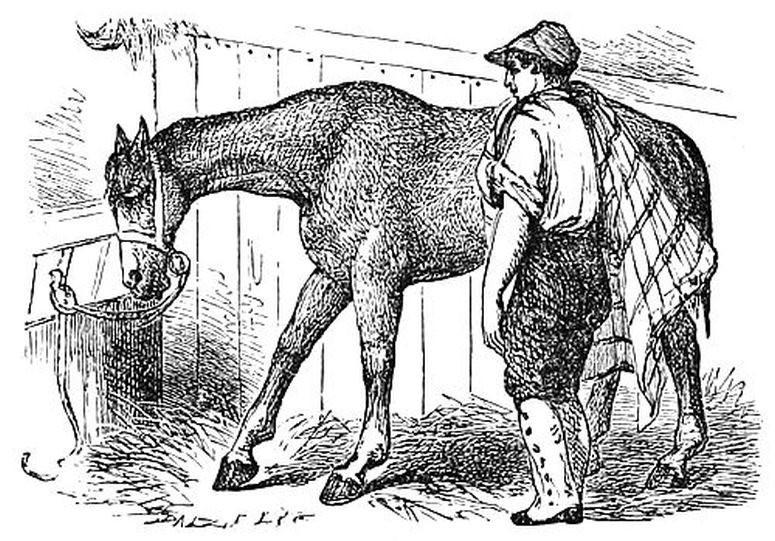
A HORSE, WITH NAVICULAR DISEASE, POINTING IN THE STABLE.
The effect of these repeated attacks is soon shown. The anguish has been likened to toothache, only it must assuredly be a toothache twenty times magnified. All people know "there never yet was philosopher who could withstand the toothache;" but think of the poor horse with twenty toothaches compressed into one agony! The man can seek a thousand changes to divert his suffering; the simple horse cannot even drink intoxicating fluids, and has hitherto not learned to smoke. The suffering, therefore, continues. And as man strives to spare a decayed tooth by masticating on the other side of the mouth, the horse endeavors to ease an aching foot by leaning all its weight upon a sound limb. Thus it learns to point in the stable or to advance one leg beyond the center of gravity, leaving the healthy member to support the entire weight of the body.
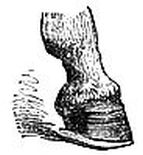
THE UPRIGHT PASTERN AND HARD, UNYIELDING HOOF, INDICATIVE OF CONFIRMED NAVICULAR DISEASE.
A foot thrown out of use decreases in size. Nature has given certain parts for certain purposes; and if these purposes are avoided, those parts diminish in bulk. Wear the arm in a sling for any extended period, and the arm will sensibly grow smaller, or become withered. So the horse's foot, spared in progression and pointed in the stable, obviously changes its shape. The quarters draw inward; the heels narrow; the frog hardens and decreases; the sole thickens and heightens; the crust becomes marked by rims and grows considerably higher. In fact, the foot, from being an open, healthy foot, becomes a strong, contracted, or diseased member.
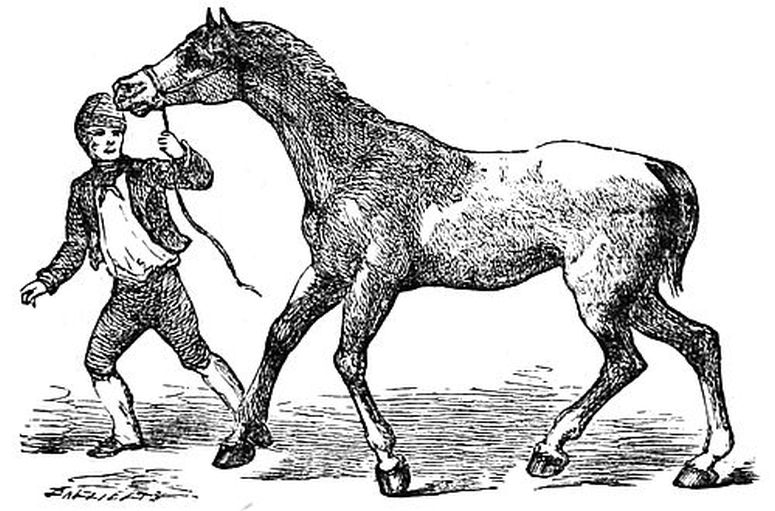
THE TROT, PECULIAR TO NAVICULAR DISEASE, GENERALLY TERMED GROGGINESS.
The effect of the disease is speedily shown by the animal progressing entirely upon the toe, whereby the front of the shoe becomes much worn, as shown in the following engraving. Indeed, it is not unusual to see shoes taken from horses having navicular disease with their front edges worn positively to a cutting sharpness. When the animal is in this stage, the mode of progression is usually what is termed groggy—that is, the hind feet, which are never affected, step out as boldly as ever; but the fore feet are limited in their action. They cannot be advanced far, because extension causes the perforans tendon to press upon the navicular bone; the leg cannot be bent, because flexion moves the perforans tendon upon the navicular bone. The animal, thus doubly disabled, endeavors to make up by quickened movement for that which it lacks in perfect action. It dare not bring the heel to the ground or take long steps. It therefore progresses upon the toes, and indulges in very short but quick movements of the fore feet; and a horse thus affected may be challenged, though unseen, by the "patter, patter! clatter, clatter!" which it makes.
Navicular disease appears to the author to have been entirely mistaken as regards its treatment. It is administered to as though it consisted in violent and acute inflammation, whereas it is caused by a different process—namely, ulceration. Inflammation excites the whole system, and occurs in strong bodies: ulceration is a diseased condition peculiar to the aged and to the weakly. Navicular disease is, so far as the writer's knowledge extends, unknown in the unbroken animal. It mostly affects the adult or the aged. It is not inflammatory; for the foot, in the first instance, exhibits no heat, and, in the after-stages, never becomes more than warm. Often the warmth is so very slight that practitioners have to adopt a kind of stratagem to determine which is the more hot of the fore feet. A pail of water is brought forward, and sufficient to thoroughly wet both hoofs is thrown over the feet. The parts are then watched; and that which becomes dry the sooner is reasonably considered the warmer hoof of the two.
Moreover, the consequences of this disease are absorption, which it takes years to effect—not deposition, which is accomplished in a few days. The bone lessens in size, sometimes grows thin, till ultimately it may fracture; the tendon loses in substance, and its fibers separate, till at length they may rupture. All internal structures which enter into the composition of the foot grow less and less, till the hoof becomes obviously small or contracted; for it is a law of nature that, in the living creature, the contents should govern the covering: thus the brain controls the skull, the lungs regulate the chest, etc. etc. The horn alone increases; but it is a curious fact that Nature always endeavors to protect the part she allows to suffer from disease: thus in rickets, with children, the bones of the legs frequently curve; but Nature, true to her principles, strives, by extra deposition, to strengthen the parts which threaten to break through weakness.
All tokens declare the navicular disease to be a chronic affection, attended by symptoms of bodily weakness. The accompanying example of the disorder, taken from the body of a horse which was killed for incurable lameness, will illustrate fully this fact.
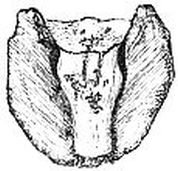
A MORBID PREPARATION, KINDLY LENT TO THE AUTHOR BY T. W. GOWING, ESQ.
The diseased surface of the navicular bone exposed, and the affected tendon turned back upon the lower part of the os pedis.
In this specimen, the navicular bone occupies its natural situation between the wings of the os pedis. That portion of the tendon which once shared and concealed the disease is turned back upon the sole of the coffin-bone. What does the inspection disclose? Three small holes within the bone, and a few stains of blood, which denote irritation upon the tendon. For, as the disease progresses, synovia ceases to be secreted, the navicular joint becomes dry, and is subject to the most torturing irritation every time the leg is moved.
That the one presented may not by the reader be supposed an extreme case, produced to support the writer's opinions, another specimen of the disease is given; but, on this last occasion, both sides of the navicular bone shall be exhibited. The upper surface appears perfectly healthy; the lower surface only displays a large clot of blood, and a small but comparatively a deep hole.

THE SUPERIOR SURFACE OF THE NAVICULAR BONE. THE INFERIOR SURFACE OF THE SAME BONE.
Supposing the reader to be convinced of the justness of the writer's views, the treatment which these recommend shall be stated. Ulceration in any form proves the body to be weak or exhausted. Feed liberally, chiefly upon crushed oats and old beans. Attend to any little matter in which the horse's body may be wrong; but do little to the foot beyond, every other night, soaking it one hour in hot water, for the first fortnight. Afterward apply flannel bandages to the leg, put tips upon the hoofs, and wrap the feet up in a sponge boot, having first smeared the horn with glycerin. This, with a very long rest, is all it is in our power to accomplish. The rest, however, should be proportioned only to the proprietor's pocket or to his powers of endurance. In the first instance, six months' rest in a well-aired stable, and three subsequent months at slow agricultural employment, will not be thrown away, but will be likely to prevent future annoyances. After one relapse, the treatment is all but hopeless. The horse may be again restored to soundness; but the disease, which has with time gained strength, will be all but certain to reappear.
This, probably, may be the fittest place for stating the writer's reason for objecting to the treatment generally adopted.
Bleeding from the toe is decidedly objected to, because there never are any signs of inflammation present, but rather those symptoms which favor the belief that too little blood circulates within the foot. Blistering the coronet is more likely to augment the crusts than to reach the disease; and the tendency of navicular derangement is to thicken the horn. The same reasoning applies to paring out the foot and placing the hoof in poultices; it is more likely to act upon, and lead to activity in, the secreting membrane, which is near the surface, than to operate beneficially upon a remote joint. Objection is taken to the feet standing in clay, because the cold produced by evaporation is disposed to drive blood from the parts, which already have too little.
In extreme cases, neurotomy, or division of the nerve, is the only resort. For a detailed account of that operation the reader is referred to the next chapter. It permits the horse to be of some service to the master, and allows the animal an escape from the agonies of a cruel disease; it is, however, not final. It conceals the lameness; it rarely cures the disorder. The internal ravages may still go on; and, though the nerve of the leg has been properly divided, yet at an uncertain period nerves generally reunite, and the part which was deprived of sensation may become once more sensitive to pain. Moreover, no eye can look upon the internal ravage. Sensation destroyed in a foot tempts the horse to throw even more than its proportion of weight on a part weakened by disease. The bone has fractured, or the tendon has ruptured, under too sudden a test of their integrity.
For the above reasons, neurotomy is always most successful when early performed. In the primary state of the disorder, a restoration of the foot to its healthy functions has seemed to banish the affection. Pressure being given to the neurotomized organ, health has occasionally returned; and when the time has arrived for the reunion of the nerve, that event has been signalized by no reappearance of lameness.
But when the disorder has continued so long as to weaken the structures of the foot, operation is always attended with hazard. The nerve may be properly divided; the operation shall be admirably performed; still the parts, weakened by the joint actions of active disease and of long rest, have become disorganized. Pressure being suddenly restored, the debilitated structures could not sustain the restoration of that burden they were originally formed to endure. Rupture or fracture was the result; and the veterinary surgeon, despite his admirable talent, is disgraced by being obliged to order the immediate destruction of that animal which it was intended he should have benefited.
For the above reasons, and because the sound member is always disposed to exhibit the disorder which incapacitates one foot, never delay adopting the only chance of certain relief. If from pecuniary motives, or from better but mistaken feelings, the proprietor hesitates to subject his dumb companion to the surgeon's knife, never afterward should he repent of such a resolve. With delay the opportunity of benefit has passed; the operation, to be successful, should be resorted to upon the second appearance of acute and decided lameness.