Chapter XIII
Reading edition
THE FEET—THEIR ACCIDENTS AND THEIR DISEASES.
LAMENESS.
Of all inventions intended to mitigate the sufferings of the horse, none, perhaps, is so generally useful as the foot-bath; certainly, not one is so decidedly beneficial in its operation. It consists merely of a wooden or iron trough, one foot deep; the shoes of the animal should, if possible, be taken off before the hoof is allowed to tread within the bath; or, if such a measure be not possible, then the burden of the horse's body should be counterpoised by means of weights. This precaution is always prudent, for, should the shod horse occasion fracture or breakage, an alarm might be excited which probably would ever after prevent the employment of the foot-bath with the same quadruped.
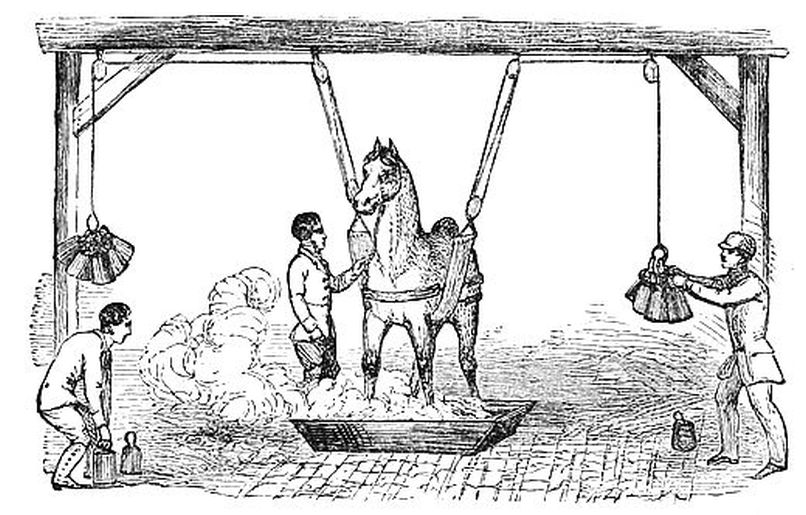
A READY MEANS OF SOFTENING THE HORN, WHERE PRESSURE OF THE HOOF AGGRAVATES THE LAMENESS.
The water should always be mixed without the building; it is never well to excite an animal's fears by allowing it to witness unnecessary preparation. The author is fully aware that most people assert the horse has a very limited comprehension: so it may have; but it has an active terror, which is apt to misconstrue the simplest of motives. Whoever has seen the busy eye of the quadruped watching all that takes place around it, and noting every triviality whenever any unusual movement gives intimation to the animal that something is about to be attempted, will readily allow the need there is for excessive caution. The horse may comprehend nothing, but it is not, therefore, the less to be propitiated. Its terror has to be soothed and its confidence has to be gained; the last is soonest won by avoiding anything which possibly might excite the first.
Always have the heat of the water ascertained by a thermometer. Sensation is only a relative test with regard to the presence or absence of warmth; were it not so, the coarse hand of a groom, nevertheless, might easily endure that degree of temperature which should pain the foot and leg of a horse. Let the fluid in the first instance stand at 70°; after the animal has entered the bath, gradually and without noise increase the temperature up to 90°.
At that standard the water ought to be maintained; the hoof should remain soaking from four to six hours at each operation; the groom, doubtless, will complain of having frequently to fetch warm water, and when not so employed, of being obliged to watch a thermometer; but the present book is not written to please the likings of any individual. To contribute to the welfare of the horse is the object of the writer; that he has not unnecessarily imposed an irksome duty upon any human being, the purpose for which the bath is introduced into the stable should be sufficient evidence.
The horse's hoof is of considerable thickness; it is far from unusual with stablemen to saturate the healthy hoof with various greasy preparations; therefore it will require some time before the heat and water can soften that which is, as it were, prepared to resist their action. The hoof should be rendered perceptibly soft when the object is to relieve a painful lameness; the warmth and moisture should not only saturate the covering to the foot, but should also soothe the internal structures. The pressure of the horn may thus be mitigated, and the deep-seated inflammation likewise be ameliorated.
When the bath is removed, the foot should not be left exposed to the air, as the horn then quickly dries; it soon becomes harsh and brittle. In this condition, it is likely to do more injury to the sensitive parts than good was anticipated as the consequence of its immersion. The hoof, when taken from the water, should be incased in warm and air-proof bandages—the intention being to retain the heat, while evaporation is prevented. The bandages likewise answer another purpose; they protect the foot, which, being without a shoe, and covered by horn that has been deprived of its resistant property, is therefore much exposed to accidents.
To obtain the full benefit of the bath, the foot should enter it night and morning; the animal should be subjected to its operation for at least four hours each time, and the ingenuity ought to be exerted to prevent the hoof from becoming dry in the interim. Perhaps nothing is better for this purpose than the leather case, which is lined with sponge, and which can be procured of most tradesmen who deal in veterinary instruments; it is made to fit the foot, also to envelop the pastern. The bottom portion is formed of the stoutest leather, and will afford all desirable protection; while the sponge will retain the moisture, which this material permits to be renewed, should circumstances, such as the heat of the hoof or the warmth of the weather, cause the fluid to evaporate. However, such additions must always be made with warm, cold water being unsuited for the purpose.
These particulars have been thus fully detailed because lameness constitutes no inconsiderable portion of equine misery, and because such ailments are more frequently encountered than special forms of disease. To judge quickly and surely of such affections proves in no small degree veterinary proficiency; in every shade of lameness, the gentleman, unless more than usually practiced in such ailments, had better be guided by an educated opinion. Where it is possible to mistake another's misery, it displays no boldness to risk chances upon our own judgment.
Lameness is simply the difference of bearing cast, during progression, upon the several legs. Pain in the joints, bones, or tendons is most severe. It is even more terrible when inflammation of such structures is confined within the horny hoof; of this torture man can know nothing—he may rest the angry limb, may recline the body, or may seek consolation in friendly converse and in mental diversion. From all the higher pleasures the horse is excluded. It cannot rest the leg; and the instinctive dread which the sick animal displays of being unable to rise again prevents the quadruped seeking that relief a change of posture might afford.
The horse always stands when seriously diseased; often the erect position is continued to the last, for the sufferer ceases to maintain it only with the relinquishment of life. During severe lameness in one foot, the animal seldom lies down; it stands and stands, often for months. How the limbs must ache! Yet the relief which the slightest motion might induce is avoided with the tenacity which pain begets when operating upon excessive timidity. Often one spot is occupied for months! During this tedious period one foot is held from the earth. The mind shrinks from conjecturing the torture which could prompt such an act; the reason retreats from contemplating the agony by which the deed can alone be occasioned; we shudder as the imagination remotely pictures the pains by which it must be accompanied! Yet who has been much among stables, and has not witnessed many such sights?
It requires small knowledge to recognize those lamenesses to which the heavy breed of horses is particularly exposed. Agony, being excessive, always obliges this species of animal to indicate the limb, or to attract the attention of the spectator toward it. These creatures, when thus affected, if compelled to move, hop onward upon three legs; the weight is never thrown upon the foot which has been severely injured.
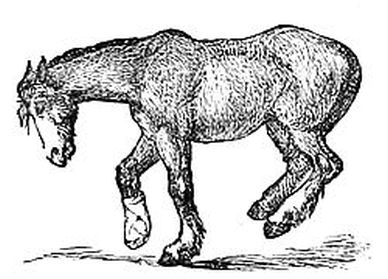
THE MANNER IN WHICH THE HORSE PROGRESSES WHEN ONE FORE LEG IS INCAPACITATED.
Illustrating this subject is the annexed figure of a horse which has been hurt upon the off fore foot; the figure is supposed to be desirous of progressing, or to be in the act of bringing the hind limbs forward. The entire weight having for a certain space to rest upon a single support, some time is spent in accurately balancing the body before this action is hazarded. The slightest mistake would necessitate a fall, of which it has been observed the sick horse is endued with a particular dread. Therefore, after a certain time spent in preparation, the legs are, with much muscular exertion, lifted from the ground, and the sufferer hops onward.
The wretchedness of the quadruped, however, is not complete until one or both hind legs are implicated. From some hidden cause, the anguish of the animal, great as it may be, is not perfected while the lameness resides in front. The horse, suffering in a fore limb, has even laid on flesh during the period of enforced idleness. But when the posterior extremities are injured, the constitution is involved. The body wastes rapidly, and every fiber within the huge framework seems to quiver with sensibility.
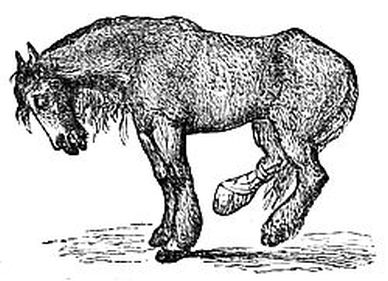
THE MANNER OF ADVANCING THE HIND MEMBERS WHEN ONE POSTERIOR FOOT IS INJURED.
If the creature, thus disabled in one leg, is obliged to advance, the chief difficulty is to so place the sound limb upon the earth that the balance shall not be destroyed. There are the two fore legs to rest upon, and the head to act as a kind of counterpoise; therefore there is little impediment to raising of the trunk; but the obstacle consists in the peril to be surmounted when the sound member reaches the ground. A certain shock has then to be sustained, and the fear apparently is lest the slightest want of preparation should bring the body to the earth.
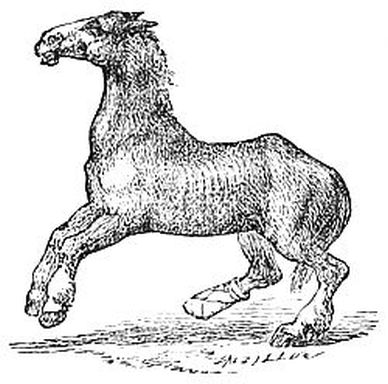
A HORSE, HAVING ONE HIND LEG RENDERED USELESS, BY A SUDDEN EFFORT ADVANCES THE FORE LIMBS.
The next motion delineated necessitates the greatest care and the mightiest exertion. There are several signs which declare such to be the case. To advance the two sound fore legs is an effort of despair always preceded by a pause. During the time the feet are from the earth, the entire weight, unrelieved by the slightest counterpoise, must be supported by one sound limb. The muscles on that side have to raise the trunk, or to perform double labor, for the step invariably is a species of leap. The body has not only to be lifted, but the strain must be maintained to continue or rectify the balance. A pause of more than ordinary length declares the magnitude of the approaching struggle. The teeth are clinched; the head is thrown backward; a deep inspiration is inhaled; the muscles are powerfully excited; and, with a spasmodic suddenness, the feet are projected onward.
The step accomplished, the breath is released in a kind of heavy sigh; the animal remains quiescent for a brief space, as though the greatness of the late effort had partially deprived it of consciousness. It is, however, an exceptional ease for a horse of the lighter breed to be thus "hopping lame." In all animals, nevertheless, lameness is a heavy affliction; in all, the manner of progressing is characteristic of pain. Suffering, more or less intense, is declared every time the injured foot touches the ground.
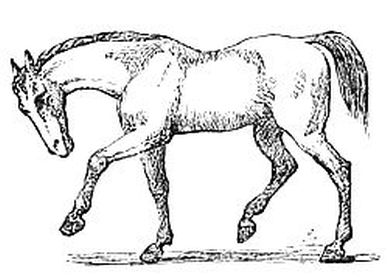
A HORSE, IN THE ACT OF TROTTING, BEARS THE WEIGHT UPON THE SOUND FORE FOOT.
One fore foot being affected, the head and body drop, or slightly sink, whenever the sound member rests upon the earth. This peculiarity a little reflection will readily account for. Of course the desire of a lame animal is to spare the disabled foot as much as possible. The injured part scarcely touches the earth, before, with an effort which raises the head and body, it is lifted again into the air. The least possible burden is thrown upon the disabled foot. However, the weight must be cast somewhere; and by how much less one leg has to carry, so much more must the other support. Consequently, when the sound hoof comes to the ground, the extra burden rests upon it; the head and body perceptibly drop, and the footfall emits an emphatic sound, the accent of which is increased by the all but inaudible tread of the opposite member.
The indication, however, is in some measure reversed when the lameness is situated behind. The movements of the head no longer accompany those of the fore legs; for, although the head be not steady, it evidently is not influenced by the forward members. If, however, the motion be closely observed, it will be found to be regulated by the movements of the posterior extremities, only with a difference. When the sound hind limb rests upon the earth, the head is raised; but the sinking or elevation of the whole body is never so marked as it is in the previous case of anterior injury. The movements characteristic of posterior lameness are, however, well shown in the haunches. When the sound limb reaches the ground, the hind portion of the body obviously drops upon that side; when the painful member is caught up, that side of the haunch on which resides the disabled foot is also jerked upward.
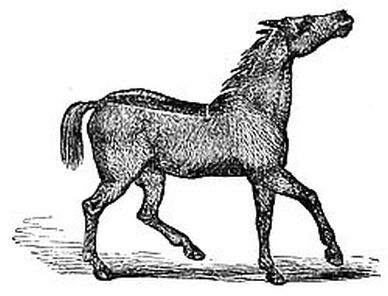
A HORSE, BEING LAME IN ONE HIND FOOT, RESTS THE WEIGHT UPON THE SOUND LIMB WHILE TROTTING.
There are other sorts of lameness to be described. A horse is sometimes returned by the smith lame all round. The gait is peculiar, because it is caused by the shoes being too small or tight. It has been likened to skating; and the author thinks the term so applicable that he has no desire to change it. There can, however, be then no difficulty in detecting the cause of the affliction. The horse was, a short time before, sent to the forge a sound animal, and it has been returned a positive cripple.
It is lamentable to remark the number of horses which are driven through the streets of London in a disabled condition. People appear to be without feelings or recognitions when the sufferings of horse-flesh are before them. An animal with scarcely a sound limb, or else "hopping lame," may frequently be seen, in broad daylight, attached to some gentleman's carriage or tradesman's cart, to a hired vehicle or a costermonger's "all sorts." From the highest to the lowest, all are equally disgraced; the toil of a life seems incapable of purchasing a day's commiseration. A little forbearance might be a profitable investment in these cases; but no person seems able to keep a horse and to allow the animal a day of rest. So long as it can crawl, so long must patience work!
Other forms of suffering than those confined to the feet affect the progression of the horse; the "whirl-bone" or hip-joint is sometimes visited by ulceration. The symptoms then in a degree resemble those exhibited when occult spavin is present; the affected limb is, however, after touching the earth, caught up more sharply when the hip is diseased. The hoof, moreover, is presented more fully during motion in the last-mentioned affection. The best method, however, to ascertain the existence of the ulceration, is to hold some soft substance over the joint, then to strike it with a mallet; the shock will be communicated to the seat of lameness, and elicit an energetic response.
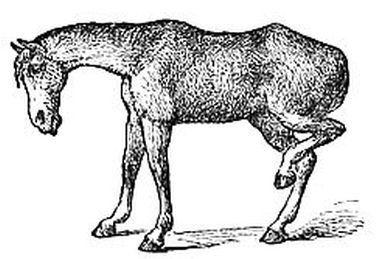
ACUTE LAMENESS CAUSED BY ULCERATION WITHIN THE HIP-JOINT.
Nothing can be done for such a condition; certain barbarities are proposed as experiments by continental veterinarians; but man obviously has no right to run chances with cruelty practiced upon breathing life. Hip-joint disease is decidedly incurable, and renders every step a separate agony.
The shoulder is a very favorite seat of injury with those who pretend to a knowledge of equine ailments; with such simple folk, if a horse be lame behind, the cause is always traced to the whirl-bone; should an animal have partially lost the use of an anterior limb, the injury is invariably found in the shoulder. The proof of their correctness is always exhibited in the lessened bulk of the parts referred to; but throw a limb out of use, as lameness in the horse always does, and the absorption of the whole extremity, from want of exercise, naturally ensues.
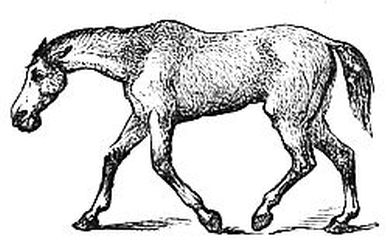
DRAGGING THE LIMB, THE INDICATION OF SHOULDER LAMENESS.
The shoulder-joint is occasionally ulcerated; but more often disease is found upon the tendon of the flexor brachii, a muscle which, arising from the shoulder-joint, is of service in flexing the radius. In both cases the seeming length of the arm is remarkable; so also is the fixedness of the shoulder, and the obstinate refusal to advance or to flex the arm. The consequence is, that a horse with disease of the shoulder drags the limb, and never lifts the toe from the ground.
Ulceration is sometimes, though rarely, witnessed within the elbow-joint; a case of this description is recorded by the late W. Percival. The chief symptom indicated subacute laminitis; the affection appeared gradually, and, without intermission, proceeded from simple bad to the very worst. The foot was, however, neither hot nor tender; by this sign the affection was distinguished from every form of fever in the feet, although the animal endeavored to bear only upon the heels of the fore extremities, and brought the hind legs as far under the body as was possible.
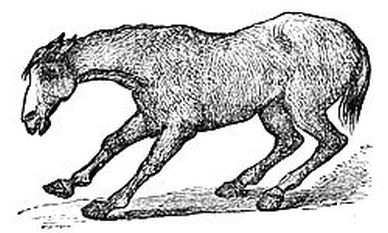
THE MANNER IN WHICH A HORSE HAVING ULCERATION OF THE ELBOW-JOINT ENDEAVORS TO PROGRESS.
Disease of the knee-joint is far from unusual. Mr. Cherry first directed attention to this fact; for, although dissection had frequently exhibited the carpal bones united, no one prior to Mr. Cherry drew any inference from the obvious indication.
Mr. Cherry describes the symptoms of the affection to be a stiffened protrusion of the fore leg, a long step, and an entire want of flexion in the diseased limb.
The author is unable to corroborate the above observations, possibly from his attention only having been directed to a few cases, and those not of a very acute character. The writer has, however, remarked, in certain instances, a perpetual knuckling over, without deposit in the knee or contraction in the tendons being present to account for the assumption of so uncomfortable an attitude. A want of power to bend the leg was noted in a few animals. Such horses either placed the limb outside the body when they lay down, or rested upon their sides; and lameness, though always present, was never witnessed in an aggravated shape.
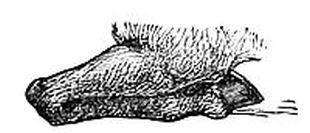
THE HEALTHY LEG WHEN THE HORSE IS LYING DOWN.
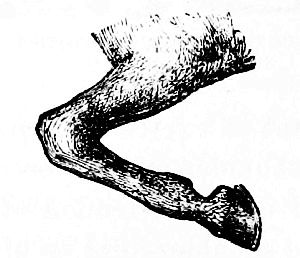
THE NEAREST APPROACH MADE BY THE HEEL TO THE ELBOW IN CERTAIN CONDITIONS OF THE KNEE-JOINT.
No human lamentation could embody the deep sorrow which the crippled condition of one leg occasions to the horse. The creature thereby is left a clog upon the earth. Its existence is deprived of the power which alone made it pleasant. Progression is laborious, and even rest is painful. The quadruped, thus disabled, stands motionless on one spot; the head is lowered; the eyes are dejected; the breathing is fitful; and the entire frame is apparently resigned to a huge sense of degradation. All the pride of life is lost. Every trace of animation has fled. The animal evidently is, in its own conviction, useless and disgraced. A horse in such a state is, indeed, a melancholy spectacle; and the feelings of that man who, understanding the image, can contemplate it unmoved are not to be envied. Still, for how many years has such a sight been before the eyes of mankind, without any individual possessing the heart to interpret it!
Surely in all life there exists no other creature so willing to obey—so happy in its labor, and so entirely obedient under command—which is equally subjected to abuse! All the horse demands, in requital for its manifold services, is food and shelter: kindness it does not insist upon, and even bad usage it submits to. For permission to live, it mildly pleads; and in return for the liberality which merely supports the strength, it contentedly resigns its body and relinquishes its intelligence. Yet the natural wants are often stinted, although the toil is always bitterly exacted. Surely in all life there exists no other creature equally subjected to abuse!
The patience of the reader is solicited, while the author notices a circumstance connected with the present subject, which has repeatedly come under his observation. Nothing can so entirely subdue the spirit of a horse as an acute lameness: the suffering must be intense. To a distant conception of the agony endured man cannot excite his imagination. Still, all of the effect upon the quadruped is not to be attributed to that cause. Other diseases are painful, but by them the constitution is affected. Lameness, generally, is a local affliction—it is not a general involvement; it leaves the constitution healthy. Yet a high-mettled, or even a savage animal, is often quieted as by a charm when the foot is disabled. The intractable of the species has, by a sudden visitation of this nature, been rendered passive. The existence seems then to be given up to misery, and the horse becomes disregardful of whoever approaches it. On such a sufferer expend but a little time striving to convince it of your intent. It is astonishing how quick affliction is to comprehend humanity; and the painful foot is given up to man's desires—nay, sometimes it is even advanced for his inspection.
The writer has applied to the crippled feet of horses certain remedies which must have augmented what previously appeared to be the extreme of anguish. The author has been painfully conscious of the agony attendant on the operation; but to his surprise the animals have not flinched, neither have the feet been withdrawn. The quadruped appeared to suffer torture with the patience of stoicism, influenced by the abandonment of utter confidence. The most caustic dressings have been freely employed upon the most sensitive part; yet the creature which, when in health, seemed made up of the acutest sensibilities, has submitted to the torture with more than mortal fortitude. Once win the reliance of timidity, and so beautiful, so entire, so self-nugatory is its confidence.
Little can be said concerning the cure of lameness. The causes are various, and, of course, the remedies are as numerous as the provocatives. One thing may, however, be advised: have the shoe taken off and the foot searched. Never mind the horn being pared away—many a horse limps upon a whole hoof; and it is astonishing upon how small a portion of horn an animal may go sound. The seat of the injury being ascertained, and so much of the inorganic covering removed as may be necessary to afford some relief, always soak the foot in the bath before permitting the final use of the knife. The water cleanses the part, favors the discharge of pus, lowers the inflammatory action, softens the anguish, and destroys the harsh character of the dry horn. This last substance, as was observed, by the united action of warmth and moisture loses its resistant property. It cuts easily when newly released from the bath; and if the knife be sharp, it may be excised without any of that dragging sensation which frequently provokes the animal to snatch away the member while it is being operated upon.
PUMICE FOOT.
Pumice foot is a deformity produced by hard work; it does certainly appear strange, when we regard the beauty and strength united in the frame of the horse, that man's barbarity should exceed Nature's ingenuity. A more captivating present—heightening human pleasures, lessening human toil—than the horse, it is impossible to imagine; but its beauty seems only given for man to deface. A stronger helpmate, when speed is considered, it appeared beyond the most excited imagination to fancy. But the cruelty of the master found it easy to incapacitate the power so exquisitely endowed. The speed was too slow for the eagerness of the rider; the docility was not apt enough for the impatience of the possessor; in every particular the servant seems to have been at fault; and now we hear men gravely lamenting the invention of railroads, because these will interfere with the breeding of horses. Let us hope the establishment of railroads may supply a deficiency which the willingness of flesh and blood was unable to gratify.
Animals bred on a marshy land, and of a loose habit of body, are apt to have weak feet, a specimen of which is given on next page, though not of one belonging to the heavy cart-horse. All the delineations inserted in this book are necessarily extreme cases; it is easy for the imagination to soften the evil when the mind is impressed with characteristics of the thing which is depicted; but not always so free from difficulty for an untutored imagination to magnify a reduced portrait.
A weak foot has a long, slanting pastern; the hoof is marked by rings, showing the irregularity of the horny secretion, and the crust is broken in those places where nails have been driven to fasten on the shoe, proving the brittle nature of the hoof.
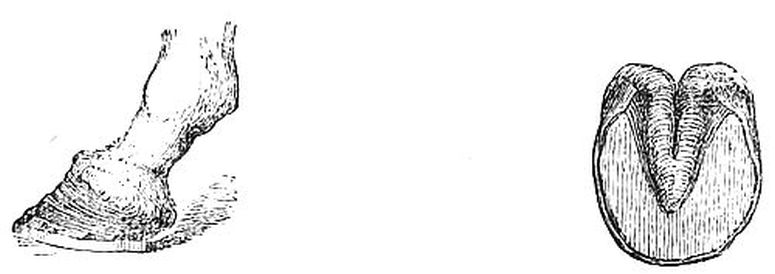
A WEAK FOOT. THE SOLE OF A WEAK FOOT.
Such are the outward signs of a weak hoof; but if the person beholding that sort of foot be in any doubt, let him lift it from the ground and inspect the sole. That part will also present peculiarities which can hardly fail to attract attention.
The sole of a weak foot has a thin and irregular margin of crust; a flat surface; well-developed bars, and a healthy frog. Creatures with this kind of hoof, when brought to work upon hard roads or London stones, are apt to throw the foot down with heedless force at every step, and thereby soon to bruise the sole. These horses generally have high action, and this circumstance lends additional force to the blow; the injury reaches the coffin-bone, which begins to enlarge, and ultimately forces the horny sole outward. A pumice foot has the appearance of the member represented on the next page, though the reader must not anticipate the illustration will accurately indicate every stage of the disorder.
Feet of the above description generally have very weak and brittle crusts; but the frog almost invariably is large and prominent; there is no kind of foot which so generally exhibits a healthy frog, and the next page shows an engraving of the ground surface of a pumice foot, in illustration of the fact.
There are many methods proposed for amending a pumiced foot. One is the removal of the shoe; then allowing the deformed foot to stand a certain portion of time upon flat flag-stones. But as stamping the foot upon stones produced pumice foot, prolonged stress thereon does not seem calculated to remove the deformity. A pumice foot is not a lump of pudding, to be flattened by simple pressure. In the horse's hoof there is bone and flesh to operate upon. Even supposing the standing upon flag-stones was beneficial, what immediate result could be anticipated from a medicine which was to be administered once in three weeks, and for half an hour only at each application?
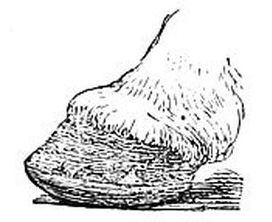
THE SIDE VIEW OF A PUMICED FOOT.
Showing the swollen or rounded state of the sole, with the brittle and uneven condition of the crust.
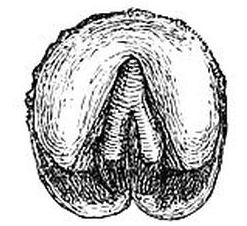
THE SOLE OF A PUMICED FOOT.
Displaying a ragged wall, and exhibiting a very healthy frog and a bulging sole.
Another artifice is to draw a hot iron over the sole at every shoeing. The intention is to stimulate the horn and thus render the sole of greater thickness. But that which may affect the secreting membrane of the foot may also stimulate the bone to which that membrane is attached. Thus the intended remedy may turn out to be a positive aggravation. There are also other methods of intended relief, but all are equally useless.
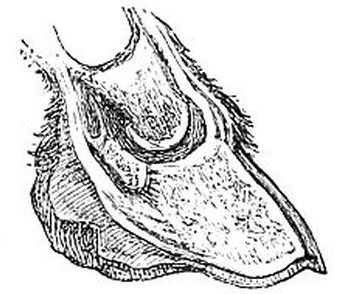
A PUMICED FOOT DIVIDED.
Showing the altered state of the internal structures.
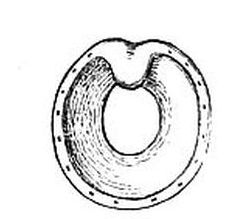
A DISH SHOE.
Employed in cases of severe pumice foot.
The only means of real benefit lies in the treatment of the hoof and in the mode of shoeing. For the last, select what is denominated a "dish" shoe; that is, a bar shoe, having the web hollowed out like to the sides of a pie-dish. The only part of this shoe which touches the ground is the rim of the inner circle.
This kind of shoe will protect the bulging sole, and if shod with leather, the protection will be greater, though the shoe will, in that case, be more difficult to retain. The flat surface at the posterior part of the shoe presents a point for the bearing of the frog, which can afford almost any amount of pressure. The many nail holes made around the shoe denote the difficulty the smith encounters when fixing a protection of this sort upon the pumiced hoof. The crust of the foot is always brittle, and the weight of iron employed being greater than usual requires an extra number of nails to fasten it securely. The smith consequently, in such cases, has no choice. He must drive a nail wherever he can find the horn which will sustain one.
With regard to the horn, keep that continually dressed with equal parts of animal glycerin and tar. Moisten the hoof with this mixture twice a day. No improvement may be remarked in a week; but in two or three months the crust will have become perceptibly less brittle, and the labor of the smith will be rendered far less perplexing. For the abnormal condition of the foot—that is permanent and nothing can be done beyond employing such artifices as are calculated to relieve the affliction.
SANDCRACK.
Any cause which weakens the body of the horse by interfering with the health of its secretions may induce sandcrack. Treading for any length of time upon ground from which all moisture is absent, by rendering the horn hard or dry, may cause the hoof to be brittle and give rise to sandcrack. However, this last provocative seldom operates in this country; when sandcrack occurs in an English horse, it is generally generated by debility, which leads to the secretion of faulty horn. So far, however, is this from being the prevailing opinion, and so little sympathy does the horse receive in its diseases, that the endeavor, indeed the custom, of all veterinary surgeons is to continue at work the horse having a division running completely through the hoof.
Sandcracks are of two sorts. Quarter crack, which chiefly happens among the lighter breed of animals; toe crack, which occurs principally with cart-horses, and mostly with those which work between the shafts.
Quarter sandcrack is of the least importance of the two. It is oftenest seen upon the inner quarter of the hoof, where the horn, being thinnest, is most subjected to motion. Usually it commences at the coronet, extending to the sole, and also to the sensitive laminæ.
A horse thus affected should be thrown up; should be placed in a large, loose box, and receive soft, nutritious food, such as boiled oats, boiled linseed, and scalded hay. A little green-meat occasionally should be allowed to regulate the bowels; greased swabs should be placed over the hoof and under the sole. A bar shoe should be worn upon the affected foot. This treatment should be continued till the horse has recovered from its debility.
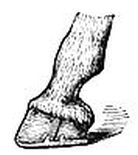
QUARTER SANDCRACK.
Generally met with, in fast horses, upon the inner side of the fore foot.
With regard to the crack itself, take a fine knife and gradually scrape off the sharp edges till the division assumes the appearance of a groove. If the crack does not reach through to the flesh, no fear need be entertained concerning the lower edges of the crack, because the horn secreted by the laminæ is of a soft nature, and will most readily yield. Besides, paring the outer horn often prevents the inner layer being cracked by the motion of the foot; this being done, should the division not descend the entire length of the hoof, or reach from the ground to the coronet, with a firing-iron, heated to redness, draw a line at each extremity of the fissure. The line need not be made so deep as will occasion pain; it is only necessary that the mark should go through the hard outer crust of the foot to prevent extension of the division.
Should the separation be the whole way down the hoof, it is as well to adopt either the plan followed by the late Mr. Read, or the mode pursued by Mr. Woodger, the clever practical veterinarian, well known in Paddington. Mr. Read used to make a semicircular line near the coronet with the hot iron: Mr. Woodger has for years been accustomed to draw lines from the coronet to the crack in the shape of a V, with the same instrument. Both methods have a like intention, namely, to cut off the coronet from the inferior portion of the hoof, thereby preventing the movements of the foot from operating upon the newly secreted horn. However, Mr. Woodger's plan being the easiest, and quite as effective as that of the late Mr. Read, is certainly the best.
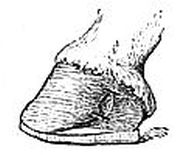
A PARTIAL QUARTER SANDCRACK DRESSED AND SHOD.
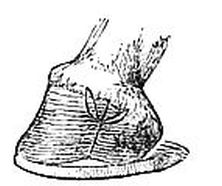
THE METHODS OF ERADICATING A SANDCRACK: EITHER THE SEMICIRCULAR OR THE ANGULAR LINES ARE EQUALLY EFFECTIVE.
Sandcrack, when it occurs at the toe, usually extends the entire length of the foot, and leaves a portion of bleeding flesh exposed. The laminæ, being opened to the stimulating effects of the air, are very apt to throw out a crop of luxuriant granulations. These, of course, are pinched between the two sides of the division. They bleed freely; often, from the pressure, they turn black, and then smell abominably. The putrid action, having once commenced, is apt to extend, and portions of the coffin-bone are likely to exfoliate.
Now to prevent this, so soon as the horse is brought in with a sandcrack, wash the part thoroughly with the chloride of zinc lotion, one grain to the ounce of water. The bleeding having ceased, pare down the outward edges of the separation, and put on a bar shoe, eased off at the toe, and with a clip on either side of the division. If the injury has not extended the length of the hoof, you must make a line at each extremity with a heated iron, as in quarter crack, than which it is also of more consequence that the coronet should be isolated; because the external horn being thickest at the toe, is the more likely by its movements to be influential upon the new and plastic horn of the coronet.
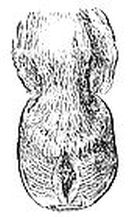
A FOOT WITH TOE SANDCRACK.
Illustrating the mode of shoeing with clips, and of easing off at the toe; also exemplifying the manner of paring down the hoof, and showing the part where granulations are likely to appear.
Should, however, the granulations have appeared, and the horse, with appetite lost and the head dejected, the pulse thumping and the injured foot held in the air, appear the picture of a living misery, first cleanse the wound thoroughly with the chloride of zinc lotion. Then apply a firing-iron, of a black heat, to the hoof, near to the crack. The intention, in doing this, is to warm and thus to soften the horn. This effect being accomplished, pare down or scoop off the edges—using the heated iron again, if necessary. Do all this leisurely, and with every consideration for the animal, which endures intense agony; for anything like violence or impatience tells fearfully upon the sufferer's system.
The horn being lowered, take a very sharp drawing-knife, and, with one movement of the wrist, excise the granulation. Set down the foot, and leave it to bleed; the loss of blood will lower the inflammation and will benefit the internal parts. Give a little green-meat to cool the system and act upon the bowels. Then, with the constant use of the lotion, enough has been done for one day.
The following morning you may again apply the lotion, and continue to use it afterward thrice daily. Any further lowering may also be accomplished to the edges of the crack, as well as the coronal portion of the horn be separated from the lower part of the hoof, by means of lines drawn as before illustrated.
If the horse must go to work, remember, it should not be in the shafts, upon long journeys, or with a heavy load behind it. Before the animal quits the stable, lay a piece of tow saturated with the lotion within the crack, and bind that in with a wax-end; tie a strip of cloth over all; give this bandage a coating of tar; and, when the horse returns, be sure to inspect the part. Should any grit have penetrated, wash it out with the lotion, and do not begrudge a minute or two to remove that which, if allowed to remain, may cause the animal much additional anguish. Then give the suffering creature a nice, deep bed, some scalded hay, and a mash made of bruised oats, into which has been thrown a handful each of linseed and of crushed beans; moisten these last constituents with the water drawn from the scalded hay, and, if the horse should not appear hungry, throw among the hay half a handful of common salt.
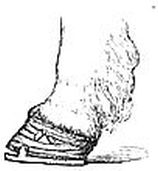
A HORSE'S FOOT DRESSED FOR TOE SANDCRACK.
Showing the way in which it should be bound up when work is imperative.
The poor man may have some excuse for working an animal with sandcrack; such a person cannot afford to keep the horse in idleness for the months which the cure will occupy. But the worst cases of this kind the author ever beheld have always been in quadrupeds belonging to wealthy tradesmen, who had ample means to gratify their desires, but wanted the heart to feel for mute affliction.
FALSE QUARTER.
False quarter is the partial absence of the outer and harder portion of the hoof; the consequence is, that the sensitive laminæ, in the seat of the false quarter, are only protected by their own soft or spongy horn. This is frequently insufficient to save the foot from severe accident; it is apt to crack, being strained by the motion of the hoof. The fleshy parts are then exposed; bleeding ensues, and fungoid granulations sometimes spring up; these are often pinched by the two sides of the divided horn, between which they protrude. When such occurs, the treatment should be the same as that recommended for sandcrack.
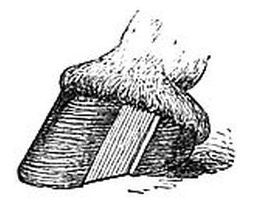
FALSE QUARTER, OR A DEFICIENCY OF THE OUTER WALL.
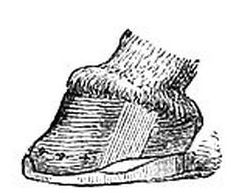
THE ONLY POSSIBLE RELIEF FOR FALSE QUARTER.
No art can cure a false quarter; a portion of the coronary substance has been lost, and no medicine can restore it. All that can be done is to mitigate the suffering; a bar shoe with a clip at the toe may be used, the bearing being taken off at the seat of false quarter. The portion of crust near to the weakened part should be beveled off, so as to join the soft horn with an insensible edge. Some persons recommend a mixture of pitch, tar, and rosin to be poured over the exposed quarter; the author has not found this compound to answer; it peels and breaks off upon the horse being put in motion. A piece of gutta-percha, of proportionate thickness, fastened over the place, has sometimes remained on for a week, and answered to admiration.
SEEDY TOE.
It appears not to have occurred to writers upon veterinary subjects that the horse, which breathes but to work—for the instant its ability to toil ceases the knacker becomes its possessor—that an animal which exists under so severe a law, should occasionally be "used up;" that a creature which is sold from master to master, all of whom become purchasers with a view only to "the work" each can get out of the "thews and muscles," should occasionally be debilitated to that stage which might interfere with the healthiness of its secretions, is a notion that seems to have been beyond the reach of those writers who have hitherto composed books upon the equine race. A separation between the union of the two layers of horn which compose the crust has been long known; it has been much thought about, and the fancy has been somewhat racked to account for its origin. Still, although the human physician has recorded the brittle state and abnormal condition of man's nails in peculiar stages of disease, no one seems thence to have argued that a certain condition of body might possibly affect the hoofs of our stabled servant.
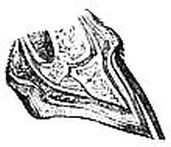
SECTION OF A HORSE'S FOOT AFFECTED WITH SEEDY TOE.
The method of cure which the author adopted, led thereto by the admirable lectures of Mr. Spooner, and the success it met, soon made apparent the fact of its origin; but, before describing this, it may be as well to inform the reader in what consists a seedy state of the horse's toe.
The wall of the foot is composed of two layers—the outer one, the hardest, the darkest, and the thinnest, is secreted by the coronet; the inner layer, the softest, thickest, and most light in color, is derived from the sensitive laminæ. These different kinds of horn, in a healthy state, unite one with the other, so that the two apparently form one substance. The junction makes a thick, elastic, and strong body, whereto an iron shoe can be safely nailed, and whereon the enormous bulk of the horse's frame may with safety rest.
But when overwork affects the natural functions of the body, the two kinds of horn do not unite; their division invariably begins at the toe, as it always commences in the nail of the human being at the outer margin. If the seedy toe be tapped or gently struck, it emits a hollow sound; and if the shoe be removed, there will be found a vacant space between the two layers of horn; into this space a nail, a piece of broom, or a straw is commonly pushed, to ascertain the depth of the lesion.
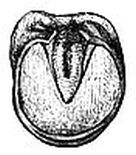
THE APPEARANCE PRESENTED BY SEEDY TOE WHEN THE SHOE IS REMOVED, AND THE GROUND SURFACE OF THE WALL IS INSPECTED.
Mr. Spooner advised that the whole of the detached horn should be cut away. The writer, however, insists that the horse should be thrown up—not turned out to grass, but placed in an airy, loose box, and liberally fed, or otherwise so treated as its condition may require. Once every fortnight, for two months, the smith should inspect the foot, and should cut away so much of the outer wall as may still be disunited. It commonly takes three or four months for the hoof to grow down or to become perfect; and rest, with liberal feeding, during this time, is sufficient to renovate an exhausted frame. A new and sound covering for the hoof of the invigorated horse is secreted by the expiration of the period named; nor has it reached the knowledge of the writer that any animal, after such a mode of treatment, has been liable to a second attack.
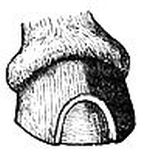
THE APPEARANCE OF THE HOOF AFTER THE SEEDY TOE HAS BEEN REMOVED WITH THE KNIFE.
The ordinary method of cure is to cut away the hoof; then, having nailed a shoe on, to send the disfigured horse to resume labor. Under this form of treatment, the seedy division, once confined to the toe, has extended to the quarters; the structure of the hoof being destroyed, the horn was unfitted for its purposes. The weight of the body forced the sensitive laminæ from the coronary secretion, and the foot, after long treatment, became a deformity. The author has never beheld so lamentable a termination; but it is described by writers upon seedy toe with a complacency which seems to regard so grievous a result as the natural consequence of an intractable disorder.
TREAD AND OVERREACH.
Tread is a very rare occurrence with light horses; the author has met with but one instance. Then, from the horse being a good stepper, and from the accident happening toward the end of a long journey, as well as from certain indications of the wound itself, it was conjectured to have occurred in the manner depicted below.
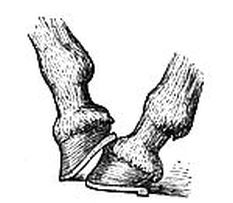
TREAD IN LIGHT HORSES.
The hind foot, from fatigue, not being removed soon enough, is wounded by the heel of the fore shoe being placed upon its coronet.
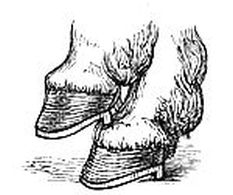
TREAD UPON THE HIND FOOT OF CART-HORSES.
The animal become unsteady from exhaustion; the feet cross, and a wound results.
However, among cart-horses such a form of injury is more frequent; these poor animals have to drag heavy loads, at a slow pace, it is true, but to long distances; they are generally badly fed. Farmers' horses, especially during the spring and summer months, being supported upon green-meat, the watery nourishment impoverishes the blood, and the exhausting labor undermines the system. Often the load has to be taken down hill, toward the end of a tedious journey; the whole burden then rests upon the shafts, and the wretched horse which is between them rocks under the weight like a drunken man. The legs cross, till at last the calkin belonging to the shoe of one hind foot tears away a large lump of the opposite coronet. A piece of flesh is commonly left upon the ground; the hemorrhage is extreme, and the wagon is brought to a stand.
The worst case of the kind the writer ever saw occurred after the preceding fashion; and the carter—who, by-the-by, was proprietor of the sufferer—left the poor horse in a forge, giving orders that the smith was to do what he could, or to have it killed, as he pleased. The smith consulted the writer, and he treated the wound after the method recommended for open joint, or by bathing it thrice daily with the solution of chloride of zinc, one grain to the ounce of water. In a week a large slough took place; this opened the coffin-joint, and left a portion of the extensor pedis tendon hanging from the orifice. The treatment was continued; the lameness, which at first was excessive, gradually grew less; the piece of tendon sloughed out, and the wound began to heal. It had closed when the animal was fetched away by the owner; but the writer was unable afterward to learn whether false quarter ensued upon the injury. This, from the extent of the wound, the writer would conjecture to have been probable; indeed, false quarter and quittor are the general consequences of severe tread.
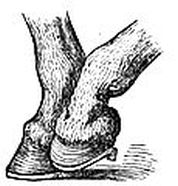
OVERREACH OCCURRING DURING THE EXHAUSTION OF LIGHT HORSES.
Overreach is confined to fast horses; it happens to those which are good steppers. When tired, the feet are apt to be moved irregularly; thus, one foot is often in its place before the other has been lifted; the result is, that the inner part of the hind foot strikes the outer side of the fore coronet. A wound, and frequently a severe one, is the consequence. False quarter or quittor is likely to ensue; the treatment must be the same as was before described. No poultices are required; these only add to the weight of the injured limb, and augment the distress of the animal. No harsh measures should be allowed; the horse has enough to bear; a slough has to take place. This is a severe tax upon the strength; all the good food and prepared water the animal can consume will not now be thrown away; the treatment is materially shortened by the nourishment being sustaining of its kind, and liberal in quantity; but the injury should be treated only with the knife, and the chloride of zinc lotion described in the course of this article.
CORNS.
Corns are of four kinds—the old, the new, the sappy, and the suppurating; all are caused by bruises to the sensitive sole. The shoe is the passive agent in their production, when they occur in large, fleshy feet; the thick, unyielding, horny sole is the passive agent, when they are present in contracted feet. The coffin-bone, in both cases, is the active agent; the wings, or posterior portions of this bone, project backward nearly as far as the bars, or immediately over the seat of corn. When the horse is in motion, the coffin-bone can never remain still; it rises, or rather the wings are drawn upward by the flexor tendon, every time the foot is lifted from the earth, and sinks, because of the weight cast upon it, every time the foot touches the ground. The wings of the bone, thus in constant action, when the horny sole is weak, often descend upon the fleshy sole, and bruise that substance upon the iron shoe; what is called a corn is the consequence. In contracted feet, where the sole is high, thick, and resistant, the horny sole does not descend, even when the immense weight of the horse's body rests upon it. It remains firm and fixed during every action of the animal—not so, however, the coffin-bone, which is in continuous motion. The result, of course, is, the imposed burden forces the wings of the coffin-bone downward. The horny sole will not yield, and the fleshy sole is therefore bruised between the wings of the coffin-bone and the horn bottom of the hoof; a corn is thereby established.
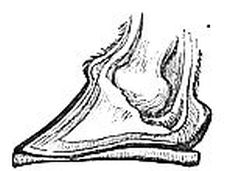
DIAGRAM
Showing the position of the hindermost part of the coffin-bone when in a passive state; also portraying the shoe in the fleshy or flat foot.
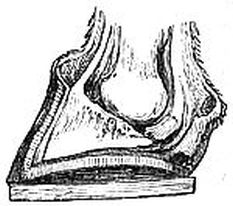
DIAGRAM
Illustrating the relative positions of the wings of the coffin-bone, and the thick, concave, horny sole of the contracted foot when not in motion.
Corns in a horse do not answer to those excrescences found upon the feet of man; being bruises, they consist of effusion in every instance. The effusion may either be of blood or of serum; blood constitutes the old and the new corn, serum gives rise to the sappy corn. The suppurative corn is an after-consequence of either of those just named; when the effusion has been so large as to defy absorption, a new action is started up—pus is secreted, and a suppurative corn is then created.
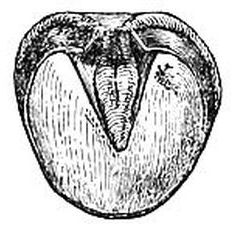
THE SITUATION AND ASPECT OF AN OLD CORN UPON A LARGE, FLAT FOOT.
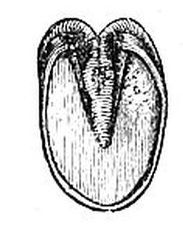
THE DEEPLY-SEATED AND SMALL, SCARLET SPOT WHICH DECLARES THE PRESENCE OF A NEW CORN.
An old corn is the least serious, especially when it is easily cut away; it appears as a black mark upon the surface of the horny sole, and is little thought of when it can be speedily removed by the knife, because this shows the horse had a corn, but at present is free from such an annoyance. When, however, a superficial corn cannot be scooped out with the drawing-knife, but becomes brighter and brighter as more and more horn is cut away, till it assumes the scarlet aspect of a new corn, the matter is rather grave, because it denotes the horse to have had, and not to have been free from, corns during the growth of the present sole.
The new corn, as has been just intimated, consists of a portion of blood effused into the pores of the horn, and is of a bright-scarlet color. The size is of some consequence, as it best intimates the extent of the injury; if the stain be small and deep seated, it is of least moment.
The sappy corn is the consequence of a more gentle bruise, when serum and lymph only are effused—the horn being thereby merely rendered moist, not discolored. This species of corn is not very common, and by proper shoeing is readily removed.
The suppurating corn is the worst of all; it engenders heat in the foot, and causes excessive lameness; it creates all that anguish, a shadowy taste of which the human being endures when pus is confined beneath the substance of the finger-nail. The foot cannot be put to the ground; the arteries of the pastern throb forcibly; the countenance is dejected; and every symptom of acute suffering in a large body is exhibited.
Corns, which in man are found on the lower members, in the horse are generally witnessed only upon the fore feet. The writer has rarely seen an instance of their presence behind; but in whichever foot they appear, they must be the production of an instant, though, probably, the suppurative may be an exception; yet from these always being suddenly observed, even this species are said to be of instantaneous origin. A horse, when progressing, makes a false step; a sanguineous or sappy corn is by that faulty action established. The same horse may trot home perfectly sound, and be put into the stable for the night a healthy animal; but on the following morning it may be discovered standing on three legs. Pus may, in the interval, have been secreted, and the corn may have assumed the suppurative character.
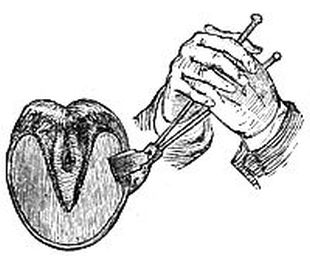
THE SOLE OF THE HORSE'S FOOT BEING TESTED FOR CORNS.
The manner to examine for corn is, in the first place, to mark the age of the horse; then observe if, in the trot, either leg is favored. The animal being young, splint is the common cause of uneven action; if old, corns are more generally expected; the horse is brought to a stand and the smith sent for. The man raises the fore foot, and, taking a portion of crust and sole between the teeth of the pincers, gradually increases the pressure; he thus proceeds till he has by successive trials squeezed the sole all round. If the leg, while undergoing the operation, be withdrawn near either of the nails, the ideas take a different direction to that of corn; but if the foot be held steady, the seat of corn is lastly squeezed. Should no flinching be witnessed, the examination is not esteemed satisfactory until the smith has, with a small drawing-knife, denominated a searcher, cut away a portion of the sole at the seat of corn.
The sensibility will be extreme should suppurating corn be present; in that case the sole must be gradually removed until the pus is released. That being done, the shoe should be taken off and the foot put into a bran poultice. By this means the horn will be rendered more soft and the wound cleansed. The smith, on the following day, must again cut the foot, every portion of detached horn being very carefully excised.
The horn is itself a secretion, and, in a healthy state, is intimately united with the source of its origin. When, however, pus is effused, this always lies between the secreting membrane and the horn, which has been already secreted. The horn so displaced by the presence of a foreign substance is called under-run or detached; and all horn, so under-run or detached, must be removed. When this operation is properly performed, all signs of lameness will have generally disappeared. It is usual, however, to tack the old shoe on again; and having dressed the injury with chloride of zinc and water—one grain to the ounce—there remains only to examine the foot from time to time till new horn covers the surface; merely taking precaution for the present to shield the wound with a little tow, fastened in its place by a couple of cross splints.
When sanguineous or sappy corns are found, the method is, firstly to thin the sole, so as to render it pliable, especially over the seat of corn. Should a sappy corn have rendered the horn moist for any space, or should the discoloration caused by sanguineous corn be of any size, it is as well always to open the center of the part indicated: no matter should the cut release only a small quantity of serum or a little blood. Take away a small portion of horn; pare the sole till it yield to the pressure of the thumb. When such a proceeding is necessary, the bars may be entirely removed, and the wounds should be covered with some tar spread upon a pledget of fine tow. As soon as the orifice is protected by new horn, the horse may be shod with a leathern sole and returned to its proprietor.
Such a course would occupy little time—a week at most. Yet the great majority of horse proprietors appear to have "flinty hearts," as nearly all of them begrudge the necessary day of rest to the maimed animal which has been injured in their employment. The cry, where the horse is concerned, is "toil, toil!" The veterinary surgeon is often asked "if absolute rest is imperative." He is frequently solicited to patch up the poor animal, so that it may do a little work. As day after day passes onward, the tone becomes more and more authoritative. The horse is at last too often demanded from the hospital, and taken to resume ordinary labor before the injury is effaced. Should no evil effect ensue on such a culpable want of caution, the proprietor is apt to chuckle over his daring with another's sufferings, and to blame the science which would not incur risk, even to propitiate an employer.
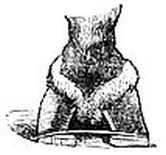
THE POSTERIOR OF A HORSE'S FOOT SHOD WITH LEATHER.
The central angular mark indicates the place into which the liquid stopping should be poured.
Corn is not generally reckoned unsoundness. If a horse be lame from corn, the lameness renders the horse unsound; but the corn does not. Such is the beauty of horse logic when pronounced in a court of justice! A corn may suppurate, or may provoke lameness at any moment. Still the corn, in the bleared eye of the law, is no sufficient objection to the purchase of a horse. The suppurated corn may lead to quittor—still, corn is not legal unsoundness. It is a pity such is the case, since it leads men to neglect that which is removable. When the sole is high, the shoe should always be accompanied by a leathern sole. Liquid stopping should be poured into the open space at the back of the foot; and at every time of shoeing, the smith should pare the sole quite thin, even until drops of blood bedew the surface of the horn. When corns appear in flat or fleshy feet, as shoeing time comes round, only have the very ragged portions of the frog taken away. Have the web of the shoe narrowed so as to remove all chance of pressure against the iron. Lower the heels of the shoe, or try a bar shoe with the bearing taken off over the seat of corn; should that not answer, next put on a three-quarter shoe: many horses, however, will go sound in tips, that cannot endure any other sort of protection to the foot. By resort to one or the other of these measures, that injury, which in the learned eye of the law is of no consequence, but which, nevertheless, may lead to terrible lameness, or even lay the foundation for a quittor, may be greatly mitigated.
Bruise of the sole is an accident leading to effusion of blood—so far it resembles corn; but it is dissimilar in not occurring on a part subject to the same degree of motion, and, therefore, is not so severe in the consequences to which it leads. It is caused by treading on a stone, and is removed by paring off the horn which has been discolored or lies immediately beneath the injury. It seldom leads to great lameness or gives rise to serious results. It is treated after the manner directed for corn; but it is always advisable to shoe once, with leather, the horse which has suffered from bruise of the sole. The difference between corn and bruise of the sole is simply this: the first is an injury produced by a cause which is always within the control of the proprietor, and which, if neglected, is likely to lead to the most disastrous maladies; the last is purely an accident, to which any horse at any time is liable, and with ordinary care is not likely to give rise to any serious consequences.
Prick of the foot is an injury incurred while the horse is being shod. There are two sorts of this accident: one, when the nail penetrates the fleshy substance of the sensitive laminæ and draws blood; the other is when a nail is driven too fine, or among the soft horn which lines the interior of the hoof, and consequently lies near to the sensitive laminæ. The first is of the more immediate importance; but the last may be equally serious in its effect. As the horse works, the strain upon the shoe bends the nail fixed into soft horn. It thus is made to press upon the sensitive laminæ, and may provoke suppuration.
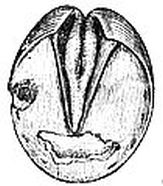
PRICK OF THE FOOT AND BRUISE OF THE SOLE.
The smaller opening represents prick of the foot: the larger space indicates bruise of the sole. The extent to which the horn may be removed, in the generality of cases, is also indicated.
To detect whether the smith is at fault, the foot should be first squeezed between the pincers as for common corn; then have the nails withdrawn one by one, and mark each as it is removed. If one appears moist or wet, have the hole of that nail freely opened. Let the shoe be replaced, leaving that nail out. Put a little tow, covered with tar, over the wound, and shoe with leather. If, however, lameness should still be present, the shoe must again be taken off and the injury treated as recommended for suppurating corn.
Blame the smith who pricks a horse and conceals the fact; punish the fellow to the extent of your power. But the man who pricks a foot and acquaints you with the circumstance, deserves civility. The last enables you to take proper measures, such as paring out, etc., and thereby you avoid all unpleasantness. The first braves chances with your living property, and deserves to suffer if the hazard go against him.
QUITTOR.
This is a severe and painful disease. Many a horse is, at the present moment, working with a suppurative wound above the hoof, within the interior of which run numerous sinuses. The police arrest the driver of the horse when the condition is so bad as permits the collar to wring the shoulders. Of all other shapes of misery they seem ignorant. Animals limp over the stones, every step being an agony; but the policemen look on at such pictures with placid countenances. Horses are driven at night in a state of glanders which renders them dangerous to mankind; yet no officer thinks of looking at the head of an animal for the sign of suffering or the warning of public peril. Creatures, in every stage of misery, may be seen openly progressing along the streets of the metropolis; but so the shoulders be sound, the brute who goads them forward performs his office with impunity. Still, it is something gained, that the law has recognized the want of man's absolute power over the feelings of those creatures intrusted to his care. Let us hope, as knowledge extends, the legal perceptions will be quickened. It is partly with this view that the present "illustrated work" is published.
Quittor is a terrible disorder. To comprehend thoroughly the pain which accompanies it, the reader must understand the structures through which it has to penetrate, and the substances it has to absorb. All parts are slowly acted upon in proportion as they are lowly organized. Cartilage is the structure into the composition of which no blood-vessels enter. Next to cartilage is bone, which, though supplied with vessels, is, on account of its mixture with inorganic matter, exposed only to slow decay, and the exfoliation of which is effected at a vast expense to the vital energy. These substances mainly compose the foot of the horse. In addition, there is ligament, almost as slowly acted upon as bone; disease in which substance is accompanied by the greatest anguish. Horn is an external protection; but that material, though an animal secretion, is strictly inorganic: when cut it does not occasion pain—neither does it bleed. If a portion of horn should press upon the flesh it must be removed by the knife; for, unlike the more highly-gifted structures, there is no chance of its being absorbed.
The hoof, therefore, being the external covering to the foot of the horse, and not being liable to the same action as organic secretions, serves to confine pus or matter when generated within its substance. Pus could work through the largest organized body; but it cannot escape through the thinnest layer of horn. Now, most of the other substances which enter into the composition of the horse's foot are such as slowly decay; but those parts which slowly decay being without sensation during health, occasion the most extreme agony when diseased.
The cause of quittor always is confined pus or matter, which, in its effort to escape, absorbs and forms sinuses in various directions within the sensitive substances of the hoof. In the hind feet of cart-horses quittor generally commences at the coronet; the coronet is wounded or bruised by the large calkins or pieces of iron turned up at the back of the hind shoes, which are universally worn by animals of heavy draught. Any one who has punctured or cut the coronet of a dead horse knows this structure is as difficult to penetrate and as hard to divide as cartilage itself; the consequence of an injury to such a part is, the bruise produces death of some deep-seated portion of the compact coronet. Nature, after her own fashion, proceeds to cast off that which is without vitality, or, in other words, she divides the dead from the living tissues by a line of suppuration; but the matter thus located cannot readily escape through the harsh material of the horse's coronet. It is confined and becomes corrupt, while the constant motion of the foot and the higher organization of the secreting membrane of the horn inclines the pus to take a downward direction. However, it is more difficult for pus to pierce the horny sole than to penetrate the coronet; so the effort is renewed above; numerous pipes or sinuses are thus formed upon the sensitive laminæ; the fleshy sole is often under-run, and this mischief goes on until the coronet, which becomes of enormous size, at last yields to the increasing evil.
Another cause is pricking the sensitive part of the foot with a nail during shoeing; the wound generates pus, the pus cannot penetrate the horn, and the motion of the coffin-bone causes it to absorb upward, until after some time it breaks forth at the coronet.
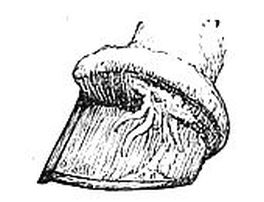
DIAGRAM.
Which supposed the outward covering of the coronet and the horny wall of the hoof removed, to expose the ravages of quittor, when commencing in the coronet of a heavy horse.
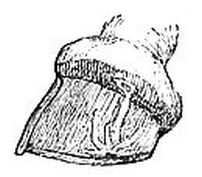
DIAGRAM.
The covering of the coronet and horny crust supposed to be absent, and exposing the manner in which any suppurating injury to the sole of the foot ultimately causes a wound above the hoof.
Another cause is corn; the horse's corn is nothing more than a bruise; the bruise, in some instances, is severe, and takes on the suppurative action. The pus, as before, is confined, and by the motion of the coffin-bone it is propelled upward till it breaks forth at the coronet, which, as before, enlarges to deformity; in short, any injury done to the sole of the foot or to the coronet above it may produce quittor.
The leading sign of quittor, before it breaks, is a large swelling at the coronet, attended with heat and excessive lameness. In cart-horses, it is usually present in the hind feet; but in the lighter species it more frequently occurs in the fore feet. It generally appears upon the inner side of the hoof, though, of course, it has often been witnessed upon the outer coronet. Quittor becomes a huge swelling before it breaks. The amount of tumefaction symbolizes the amount of anguish; it is, indeed, a most painful disorder.
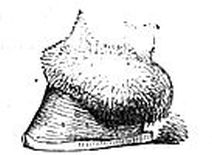
A QUITTOR, AS IT DENOTES ITS EXISTENCE BEFORE THE PUS ABSORBS ITS WAY THROUGH THE CORONET.
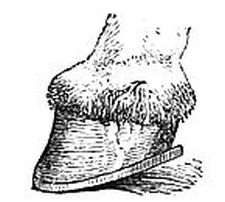
A QUITTOR, AFTER THE PUS HAS FOUND AN EXIT AT THE CORONET.
The animal, after the pus has found vent, becomes easier; fever departs; the appetite returns, and the enlargement greatly diminishes.
In the cure of a quittor, all depend upon the time during which the disease has been allowed to exist; if brought under notice at first, and from an examination a belief is confirmed that the sinuses are wholly superficial, no treatment is comparable to the plan of slitting them up, the method of doing which will be described in a subsequent chapter; this at once affords relief. The horse, which was limping lame, upon getting up puts the foot fearlessly to the ground, and trots sound.
If we have reason to believe the matter has burrowed inwardly, and that one or more sinuses have penetrated the cartilages and threaten the deeper-seated parts, still we should settle with the knife all those pipes which are superficial. This gives a better view of the structures supposed to be diseased; then, if among the matter thrown out by the healing wounds there is seen a speck or two of fluid, which, being gelatinous and transparent, looks dark among the opaque creamy pus, be sure there remains further work to be accomplished.
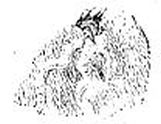
DIAGRAM.
An attempt to depict the small size of the transparent fluid, indicating the existence of a sinus, when it appears at the wound whence issues the stream of thick and creamy pus.
Cut a small twig from the stable broom; this is pliable, and, where a sinus is concerned, makes the best possible probe. With a knife, render it perfectly clean, as well as round or blunt at one end; then, while an assistant holds up the foot, insert it in the center of the dark fluid. If it should not at first detect an opening, you must not give up the trial; the probe must be moved about, and even a smaller one procured. A sinus does exist; of that you have positive proof; the pipe being found, mix some powdered corrosive sublimate with three times its bulk of flour; then wet the probe; dip the probe into the powder and afterward insert it into the sinus. Do this several times till you feel certain that every portion of the pipe is brought in contact with the caustic.
The horse, subsequently, will become very dull; the foot will grow very painful: thus it will continue for two days. About the third day, a white, curd-like matter is discharged from the orifice. The lameness disappears, and the spirits are regained.
It is against our inclination to publish such directions; but the author has knowledge of no gentler or more speedy measure. The better plan for the gentleman who is tender of his servants' feelings, and infinitely the cheaper for the person who is regardful of his pocket, is to have every animal inspected by a qualified veterinary surgeon so soon as it displays acute lameness. Were such the practice, corn, prick of the foot, or wound of the coronet need not run on to quittor. That is an affection which loudly pronounces man to utterly disregard the welfare of his most willing slave. It always originates in neglect. It always requires time for its development. It springs from that idle and silly maxim which, when a horse falls lame, treats the circumstance as though the honest animal were shamming, and teaches a hard-hearted proprietor to work the poor drudge sound again.
CANKER.
Thrush is a disease that causes a certain liquid to be secreted which has the property of decomposing the horn. Canker is a disease which not only is attended with a liquid having a like property, but the last-named affection also causes fungoid horn to be secreted. Canker, therefore, appears to be an aggravation of thrush; and anybody who has been much among the animals of the poorer classes may have observed these diseases lapse into each other: thrush will, through neglect, become canker.
Thrush appears to be the commencement of the disorganization of the food. Canker is the total perversion of the secreting powers belonging to the same organ. In thrush, a foul humor having a corruptive property is poured forth. In canker, something is superadded to this. The horn itself is sent forth in large quantity as a soft, unhealthy material, totally divested of elasticity and devoid of all healthy resistance.
Any animal, being exposed to the exciting cause, may exhibit thrush; but, before canker seems capable of being produced, poor living must have undermined the constitution. Old horses—pensioners, as they are humanely termed—when turned out to grass, frequently have canker, which otherwise should be confined to the animals of poverty, on which bad lodging, no grooming, stinted food, and hard work produce sad effects. The stable in which a case of canker occurs is lamentably disgraced. Every attendant in it ought to be discharged, as the surest evidence of a gross want of industry is thereby afforded.
A horse, perhaps once the pride of the favorite daughter, may descend to be the hack of some bawling dust collector. Its wants increase as age progresses; but with the accumulation of years its hardships augment. It is sad, very sad, to stand within the shed of some corn-chandler, and witness, as the day draws in, ragged boys advance and shout out, "Three pen'orth o' 'ay bunds." Upon those hay-bands it is even more sad to reflect what creature will be obliged to subsist—probably the darling once of some aristocratic children! Now, cramped and diseased, it may receive no other food between this time and the following evening. The diet being meager, all the rest is on a parallel. The wretched animal is purchased only for such a space as it may pull through before it passes to the knackers. Every day of life is looked upon as a clear gain, for the carcass may be sold for very nigh the price which has been paid for the living body. The commonest attention is denied; its bed is filth, and its nightly hay-bands are cast upon the flooring.
What, the humane reader may inquire, can be done to prevent such a state of things? Something surely might be accomplished. To make men good, it is first necessary to educate them by communicating knowledge and also by preventing the commission of wickedness. Were the sanitary laws enforced in their spirit, no man would keep an animal who had not proper accommodation for the creature he possessed as a property. A horse or a donkey consumes much more air than any human being. The air ejected from the lungs of a quadruped is deprived of all life-sustaining qualities. The filth of a stable is as corruptive as any cess-pool connected with a laborer's cottage. The atmosphere which can in the horse engender disease cannot promote health in the superior animal. Yet how does it happen that, while sanitary reports are eloquent upon filth and fluent about cess-pools—while they descant learnedly upon foul abodes, and enter into all particulars concerning corrupted atmosphere—the close, contaminated stables in which all costermongers, and some gentlemen, shut up their drudges when the labor of the day is over, are never alluded to, are altogether abjured, as though such nuisances had no existence?
Canker, like thrush, is not generally attended with much lameness. It often astonishes us that, with a foot in such a condition, the animal can progress so soundly. It invariably commences at the seat of thrush or in the cleft of the frog. A liquid more abominable than that of thrush, and rather more abundant, issues from that part. Likewise it frequently exudes from the commissures, which unite the horny sole to the frog. The horn, also, becomes not only disorganized, but more ragged than in thrush. It bulges out at first, and ultimately flakes off, exposing a substance not much more resistant than orange-peel. The substance is horn in a fungoid state. Its fibers run from the center to the circumference; and between the space of each fiber is lodged a clear liquid, which becomes tainted and dark colored by mingling with the horn that it dissolves and corrupts.
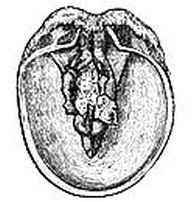
THE PRIMARY ESTABLISHMENT OF CONFIRMED CANKER.
The horn turned back, so as to display the altered state of the frog, which indicates a severe attack of the disease.
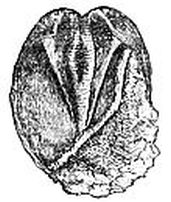
THE SECOND STAGE OF CANKER.
Showing the great abundance of fungoid horn secreted around the margin of the foot. No notice is purposely taken of the frog in this illustration.
The fungus is secreted in quantity, and always is most abundant when located about the edge of the sole. Here the papillæ are largest, and here the granulations attain their greatest magnitude. The unresistant horn of canker becomes somewhat hard upon the surface of the sole, and large flakes peel off. Cut into, it displays no sensation; and this is fortunate, inasmuch as it considerably reduces the difficulties surrounding the treatment of a badly-cankered foot.
Concerning treatment, when the disease is confined to one hind foot, or even affects both posterior feet, the case may be undertaken with some degree of confidence. When it has involved one or more of the fore feet, it is always difficult to eradicate; and, in the majority of cases—being guided by the age of the animal—a cure had better not be attempted.
When a horse is cankered all round, the disease is apt to seem capricious. It may be cured in three feet; but it will linger in the fourth, resisting art's resources. Suddenly measures before tried in vain seem to be endowed with marvelous efficacy. The diseased member, which hitherto no treatment could touch, now heals as by its own accord. However, before we can express the full of our satisfaction, canker once more breaks out again in one of the feet which had been cured; thus the affection dodges about till patience is exhausted.
Canker has hitherto been reckoned an intractable disorder. It is mostly seen in heavy horses, with weak, flat feet. These creatures proverbially receive but little grooming. They are esteemed only for their labor, and honored with small attention, which does not decidedly fit them for their work. Their stables are seldom to be cited as examples of what a horse's home should be. Their beds are never too clean; and a number of foul disorders, as thrush, grease, etc., are located among them. Their food is generally measured by the scale of profit and loss; for few cart-horses, in the generality of establishments, can boast of any extraordinary care being lavished on their comfort.
For the treatment of canker, the first thing is to attend to the stable. See that the building is lofty and well drained; that the ventilation is perfect, and the bedding unexceptionable. Then inspect the water, the oats, and the hay. Allow the horse a liberal support, and with each feed of oats mingle a handful of old beans. These things being arranged, order the animal into the forge. Cut away every portion of detached horn. When that is done, pare off carefully so much of the soft, diseased horn as the knife can readily separate. Then apply a dressing of the following strength to the diseased parts:—
Chloride of zinc Half an ounce.
Common flour Four ounces.
Mix, and apply dry on the foot.
To the sound parts use—
Chloride of zinc Four grains.
Flour One ounce.
Cover over the sound parts before you begin to dress the fungoid granulations.
Afterward tack on the shoe. Pad well, so as to obtain all the pressure possible; and fasten the padding on the foot by means of cross pieces of iron driven firmly under the shoe. Let the horse be carefully groomed, and receive four hours' exercise daily.
On the second day remove the padding. Cut off so much of the granulations as appear to be in a sloughing condition. Repeat the dressing, and continue examining and redressing the foot every second day. When some places appear to be in a state of confirmed health, an application of the following strength should be employed to such parts; but where the granulations continue to sprout, or the horn appears to be of a doubtful character, the caustic mixtures of the original strength must be used:—
Chloride of zinc Two grains.
Flour One ounce.
After some time, the dressings may be lengthened to every third day, but should not be carried to the distance which some practitioners recommend. When so long a period elapses between each examination, the foul and irritating discharge, being confined, does more injury than the delay can possibly produce good.
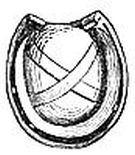
THE BOTTOM OF A HORSE'S FOOT WHICH HAS BEEN DRESSED FOR CANKER, SHOWING HOW THE CROSS PIECES ARE PLACED AND FIXED.
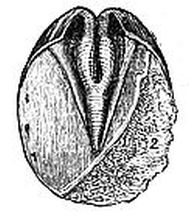
AN IMPROVEMENT IN A CANKERED FOOT.
1. That portion of a cankered foot which is advancing toward a healthy condition.
2. Canker in a mitigated form, but still present.
In the plan of treatment here proposed, the chief reliance is placed on the action of chloride of zinc. It is the peculiar property of that agent to suppress fungoid granulations. The author has some experience in the use of this salt. Whenever he gave it to a groom to apply, and subsequently he found the wound clogged with proud flesh, the man was accused of having neglected to employ the lotion. The evidence on which the charge was made never, in a single instance, proved erroneous. To suppress fungoid granulation is to cure canker.
The application here advised is, moreover, cleanly. It is the most powerful disinfectant. It does not discolor, like the messes now in general use. It is more gentle in its action than undiluted sulphuric acid, etc. etc. It will cause none of those terrible fits of agony, during which all applications have to be removed, while the foot has to be bathed and poulticed. Notwithstanding all authors agree that the absence of water and the presence of pressure are indispensable to the cure of canker, the frequent dressings will not endanger the life, nor leave the foot in that condition which entails a deformed hoof upon the horse for the remainder of its existence.
THRUSH.
Veterinary writers are very fond of splitting hairs about words. Thrush, therefore, in most books, becomes "frush;" notwithstanding, if the reader should consult any professional authority, or a professor at either of the colleges, the person so appealed to will decidedly designate the disease as it is here spelled. The disorder therefore bears, in these pages, the name it carries in ordinary speech, and all far-fetched distinctions are discarded.
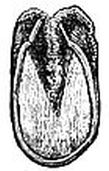
THRUSH IN THE FORE FOOT, WITH A THICK CRUST, A CONCAVE SOLE, AND A SMALL FROG.
Thrush is a foul discharge issuing from the cleft of the frog, and attended with disorganization of the horn. It is derived from two causes—either internal disease or bad stable management. When internal disease gives rise to thrush, it is present in the fore foot. The quarters of the hoof are strong and high; the sole is thick and concave; the frog small and ragged. When bad stable management provokes the disorder, it shows itself in the hind foot, which may be of any shape; but the frog is generally large, while the discharge is more copious than in the former instance.
It is sad to think that the creature which lives but to toil, and whose existence is a type of such slavery that its greatest freedom is to labor, should be begrudged the bed whereon it reposes, or be doomed to stand in filth which will generate disease. The horse's foot is not very susceptible to external influences. It is incased in a hard and inorganic, yet elastic substance. Thus protected, it appears like praising the ingenuity of man when we say such a body is not proof against his neglect. The hoof is made to travel through mud and through water; it is created to canter over sand and over stones. It is capable of all its purposes; but it only seems not fitted to be soaking days and nights in the filth of a human lazar-house. The drainage of the stable is too often clogged; the ventilation bad; the bedding rotten, and more than half composed of excrement. All that passes through the body, from the inclination of the flooring, tends toward the hind feet. Over this muck the animal breathes. In it the creature stands, and on it the victim reposes.
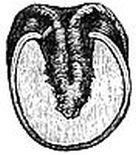
THRUSH IN THE HIND FOOT.
No wonder the horn rots when implanted in a mass of fermenting filth. The fleshy, secreting parts, which it is the office of the hoof to protect, ultimately become affected; they take on a peculiar form of irritation; from the cleft of the frog a discharge issues; it becomes colored and offensive through being mixed with the decaying horn; the smell is most abhorrent; frequently it taints the interior of the place, and to the educated nose thus makes known its presence.
The first thing is to clear the stable, then to cleanse it thoroughly. Bed down the stalls with new straw, and attend to the animals themselves. Wash the feet well with water, in every pint of which is dissolved two scruples of chloride of zinc. The fetor will thus be destroyed, and the animal be made approachable. Place some of the fluid, to be used as required, near the smith, while the man cuts away the diseased frog. All the ragged parts are to be excised. The knife is to be employed until all the white, powdery substance is effectually removed.
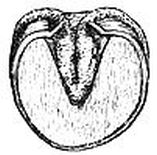
AN ILLUSTRATION OF THE ABUNDANCE OF WHITE POWDER INVESTING DECAYED HORN, AND OFTEN FOUND AFTER THE RAGGED PORTIONS OF A THRUSHY FROG HAVE BEEN REMOVED.
The knife must then be used fearlessly. Every particle of the colorless investment of the frog must be excised. This is absolutely necessary toward the cure. It must be accomplished, although the flesh be exposed, or a large, bulging frog be reduced to the dimensions indicated in the annexed engraving.
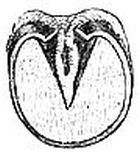
Then the shoe is to be nailed on, and the horse to be returned to a clean stall.
The cause being removed, the effect will soon cease. No ointments are required. A little of the chloride of zinc lotion, three grains to the ounce of water, may be left in the stable, and the keeper should receive directions to bathe the frog with this once a day, or oftener if required. A piece of stick, having a little tow wrapped round one end, should also be given to the man, so that he may force the fluid between the cleft of the frog. No greasy dressing need be employed. The ordinary shoe is to be used. The diseased part is to be left perfectly uncovered, so that it may be the more exposed to the sweetening effects of pure air, while the earliest indication of any further necessity for the knife may be readily perceived. When the stench has disappeared, a little of the liquor of lead, of its original strength, will perfect the cure; and all that is requisite to prevent a return of the disorder is a reasonable attention to the cleanliness of the stable.
At this place, however, the reader may well reflect that, if the filth of the stable is capable of rotting the resistant and insensitive horn of the horse's foot, how much more is it likely to affect some of those delicate structures of which the bulky frame of the animal is composed! The air in which a man might object to live is altogether unfit for a horse to inhale. It is true, animals have breathed such an atmosphere, and continued to exist. So, also, is it true that men have been scavengers, and have followed that calling on account of what they esteemed its extraordinary healthfulness. Neither case establishes aught. The animal is by nature formed for large draughts of pure air. All other sustenance is as nothing, if the primary necessity of life be withheld. Tainted atmosphere is the source of more than half the evils horse-flesh is exposed to. Glanders, farcy, inflammation of the air-passages, indigestion, bowel complaints,—in fact, all diseases save those of a local character may spring from such a parent. Let every horse-keeper, therefore, if from no higher motive, at all events to conserve his property and to promote his pecuniary interest, be especially careful about the purity of his stables.
When thrush occurs in the fore feet, it is generally significant of navicular disease, and is most frequent in horses which step short or go groggily. The hoof feels hot and hard; a slight moisture bedews the central parting of the very much diminished frog. No odor may be smelt when the foot is taken up; but by inserting a piece of tow into the cleft of the frog, the presence of the characteristic symptom will be made unpleasantly apparent.
In this case, it is best to remove the ragged thrush and unsound horn, doing so, if required, even to the exposure of the sensitive frog. Afterward, simply wash the part with a little of the chloride of zinc and water, previously recommended. Repeat the cleansing every morning; the intention being, not to remove the thrush, as the horse mostly goes lame the instant that is stopped, but merely to correct the pungency of the morbid discharge, and thus prevent it in some measure from decaying the horn.
Clay, cow-dung, and other favorite filths, employed for stopping the horse's feet, if long continued, will produce thrush.
The worst specimen of the affection the author has encountered, was in a horse which had been turned into a moist straw-yard and neglected. The thrush generally witnessed in the hind feet may be present in all four; but the writer knows of no instance in which the thrush peculiar to the fore feet was also observed in the posterior limbs.
Thrush does not generally provoke lameness. In its more aggravated forms, however, it interferes with the pace; and the horse having only incipient thrush is liable to drop suddenly, if the foot be accidentally placed upon a rolling stone. Now, knowing our roads are made of stones, and that the bottom of the horse's foot is, in the ordinary manner of shoeing, entirely unprotected, it is curious to state that this disease is commonly not esteemed unsoundness. Any thrush, when present, may lead to acute lameness; then the lameness would be unsoundness; if thrush simply interferes with the action, although it endanger the safety of the rider, it is, by the code of veterinary legislation, esteemed no reasonable objection to the soundness of a horse. In the author's opinion, any animal should be esteemed unsound which has suffered from loss of or from change of any structure that ought to be present, or has any affection which reasonably could subject it to remedial treatment.
OSSIFIED CARTILAGES.
This signifies a conversion into osseous structure of the cartilages naturally developed upon the wings of the coffin-bone, or the bone of the foot. Here is a drawing of the largest specimen of this transformation which the writer ever witnessed. This was borrowed from the museum of T. W. Gowing, Esq.; and, from the magnitude of the disease, the writer should imagine the posterior of the pastern must have been in the living animal somewhat deformed.
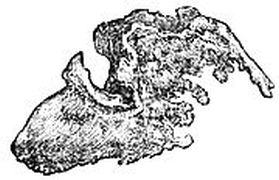
OSSIFIED CARTILAGES.
The lateral cartilages of the horse's foot have undergone change and become bone; being now continuous with the os pedis.
In heavy horses, working upon London stones, so certain are the cartilages to become ossified that several large firms pay no attention to this defect. They prefer an animal with a confirmed disease to a sound horse, which will be certain to be ill during the change, and the extent of whose subsequent alteration no one can predicate. So far these purchasers act wisely; but, in horses designed for fast work, ossified cartilages are a serious defect. They frequently occasion lameness, and always interfere with the pleasantness of the rider's seat. When accompanied by ring-bone, ossified cartilages give rise to the most acute and irremediable lameness.
Ossified cartilages are incurable. No drugs can force Nature to restore the original structure which has been destroyed. Once let a cartilage become ossified, and it remains in that condition for the creature's life. There is little difficulty in ascertaining when this change has taken place. The hand grasps the foot just above the coronet; the fingers are on one side, and the thumb upon the other. The cartilages lie at this place, immediately under the skin. Cartilage is soft, pliable, and semi-elastic. It yields very readily to pressure. However, when the thumb and fingers forcibly press the part, if, instead of feeling the substance under them yield, the hand is sensible only of something as hard as stone, or any way approaching to such a character, that is proof positive the cartilages are ossified, or are approaching change. If the horse has recently gone lame, and the seat of cartilages feels of a mixed nature—partly soft and partly hard—apply a blister to the coronet, so as to convert that which is a subacute process into an acute action, and with the cessation of activity hope to stop the deposit. Repeat the blister if absolutely necessary; but there is no occasion to subject more than the coronet, and a couple of inches above that structure, to the operation of the vesicatory. Indeed, blisters act more effectually upon confined spaces. This is all that can be accomplished, save by good feeding and liberal usage: these are essential, because every abnormal change denotes a deranged system; and this is, in the animal, soonest mended by generous diet. Perfect rest and two pots of stout per day may even be allowed, should the pulse be at all feeble.
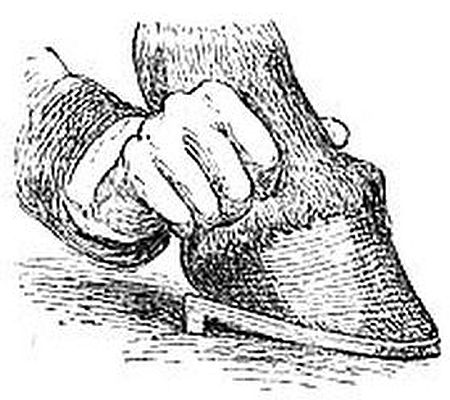
THE CERTAIN TEST FOR OSSIFIED CARTILAGES.
ACUTE LAMINITIS, OR FEVER IN THE FEET.
This term implies that the disease is confined to the laminæ; the word certainly warrants an inference that the other secreting surfaces within the hoof are not implicated; such a meaning is generally conceived to be intended. The name, by inducing erroneous opinion, does much injury; the old appellation of fever in the feet is, therefore, much more characteristic and altogether more correct.
The entire of the fleshy portion of the foot is involved in this terrible affliction; any man, who has had an abscess beneath some part where the cuticle is strong, or who has endured a whitlow, may very distantly imagine the pain suffered by the horse during fever of the feet. Such an individual, if his creative powers be very brilliant, may vaguely conjecture the torture sustained by the quadruped; but no power possibly can realize to the full the anguish sustained by the animal. Man does not, like the horse, rest upon his finger's end, and, if he did, the pain he would then suffer could not be likened to the terrible affliction borne by the animal, for the following reasons: What is the weight of any man to that of a quadruped? What is the thickness of his skin or the substance of his nail to the hardness and stoutness of the horse's hoof? The human skin is elastic, and the end of the finger permits some swelling of its fleshy portion; but the secreting membrane of the horse's foot lies between two materials almost equally unyielding. Bone is within, and horn is without; the heat soon dries the last and deprives it of its elasticity; the first is naturally unyielding; thus the secreting substance, largely supplied with blood, because of inflammation, and acutely endowed with sensation when swollen and diseased, is compressed between the two bodies as in a vice. To conceive the amount of anguish and to imagine the violence of the disorder, we have only to recognize the pathological law, that Nature is conservative in all her organizations; she protects parts in proportion to their importance to the welfare of her creatures, and reluctantly allows injury to be inflicted on any vital organ, though she may even permit deprivation of those members which are not essential to the animal economy.