Chapter XII · (continued 2)
Reading edition
CAPPED ELBOW.
This is very common, especially among cart-horses; it is attributed to the calkin of the fore foot; to the point of the hind hoof; or to a stable floor, thinly bedded, and composed of sharp stones. So, likewise, blows with the butt-end of the whip will induce it; but the harness probably guards the elbow, which therefore can be struck only in exceptional cases.
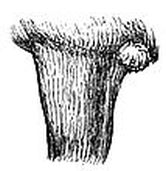
A CAPPED ELBOW.
It consists of a bursa, which, as in the former instance, has been injured, and has consequently enlarged; in appearance and in its subsequent course it greatly resembles capped hock, from which it differs only in a greater liability to ulcerate and become sinuous when allowed to remain until it is of extreme magnitude. It is said to derive that unenviable peculiarity from being situated nearer to the center of circulation. Capped hock is so little disposed to take on such a form of disease that the author cannot remember having seen a case of the kind; with a tumor on the elbow, however, ulceration is unfortunately too common. That probability should forbid the owner to allow the tumor to attain any great size; when large, moreover, it is apt to encircle the elbow-joint, and then its size seems to render the removal apparently impossible. It, however, may be extirpated. All said of capped hock applies to capped elbow.
LUXATION OF THE PATELLA.
That is displacement of the whirl-bone of the stifle, (which answers to the knee-cap of the human being.) Such an accident, fortunately, few horses incur; there are many veterinary surgeons who, during a practice extending over many years, have not encountered a single case; whereas other gentlemen will have hardly started in their profession before luxation of the patella is submitted to their notice. It is not peculiar to any district, it is not confined to any special breed; it may affect all kinds of horses in all sorts of places; for it is produced more by the parsimony or the uncharitableness of mankind than by any fault in the structure of the animal.
In several localities throughout the country agriculturists, under the notion of saving money, determine to rear horses on short grass. The creatures are out in the fields during all kinds of weather; the body becomes debilitated under such a starvation system; those parts which are naturally weak become weaker, while those structures which were originally endowed with strength grow comparatively stronger. The beautiful balance of nature is overthrown, and each portion becomes at discord with all the rest; any trivial disease may destroy the life thus at war within its own dominion. Colts frequently exhibit luxation of the patella before they are broken; but it is always provoked by weakness, and commonly only seen where the management is faulty or the food is stinted.
When the whirl-bone is displaced, it is always found as an unnatural lump upon the outer side of the thigh; it cannot, for three sufficient reasons, be drawn to the inner part of the leg. The inner condyle of the humerus, over which the patella plays, is sufficiently large to oppose any unnatural motion in that direction; the inner ligaments are the weakest, and are, therefore, most readily stretched in the outward direction; the circumstances permit the bone to be displaced from the inside of the leg. Then, moreover, the muscles are altogether more powerful upon the outer side. Any force acts more energetically as debility increases, and, to favor it, there is less resistance in the direction opposite to which the force pulls; for these reasons the bone is invariably luxated upon the outer side of the animal's haunch.
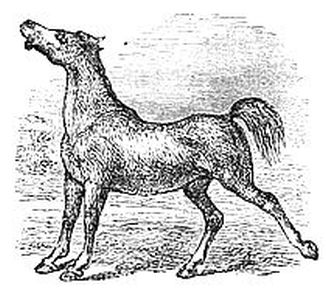
THE PATELLA, OR WHIRL-BONE DISPLACED.
The symptoms denoting luxation of the patella are: the leg thrust out behind, and remaining fixed; the horse's entire frame is affected; the head is erect; the muscles quiver; the pastern of the protruded leg is violently flexed; there is an unnatural swelling upon the outer and lower part of the buttock. If the animal be forced to move, it can only imperfectly hop upon three legs; such an accident may occur at any time, and never be repeated. It may, however, become so common as to be mistaken for a species of habit; for luxation of the patella, when by frequency confirmed, will take place upon the slightest possible cause.
In stinted colts the most trivial motion will often give rise to this accident; the creature can hardly move without its leg being thrust out behind it. The cure is, in these cases, anything which may flurry the animal. A noise, made by moving the hand quickly and rather energetically from side to side within a hat, the crack of a whip, or any sudden and loud sound, will occasion the bone to return, with apparent ease and the utmost rapidity, to its natural situation. The colt, however, may the next moment exhibit the misfortune which, in young life, can only be cured by kindly treatment and liberal sustenance.
Probably the author will best describe the nature of the affection in old animals, by narrating a case which a few years ago happened to himself.
At the request of a friend he visited one of those auction marts for the sale of horses which in London are somewhat notorious. The object of his visit being, if possible, to purchase, his attention was directed to certain animals. As usual, a glance enabled him to pass by all the marked "lots," and he had reached the third stable, when his eye rested on a horse which seemed wrongly placed among such companions. It was lively, young, clean legged, short backed, well ribbed up—in fact, one of those rare creatures every inch of which seems made for service. The height was fifteen hands three inches; the color was a dark brown. The author tried in vain to discover if it had any "vice." It appeared perfectly quiet. He examined the feet; he could detect no unsoundness. He went to the office and ascertained the price—twenty-four guineas! It was too cheap! Such an animal would be thrown away if sold for fifty guineas. "Would they give a warranty?" "It was not their custom to give any warranty." "Had the horse megrims?" "No." "Would they grant a trial?" "It was contrary to their rules." Still the author wanted to buy; he would "deposit the cash, and if all proved right take the horse." "They never granted trials; but there stood the owner—the writer could talk to him."
The person alluded to was lounging close to the writer's elbow, and was habited in that half-blackleg, half-blackguard costume which characterizes the low London dealer. The contemplation of this individual did not improve any previous opinion of the matter. However, the man's eye was firmly fixed upon that of his would-be customer, and, rather than encounter a disturbance, the author approached the fellow, to whom he repeated his request. The answers given were too similar to those received from the clerk for the likeness to be purely accidental. The dealer nevertheless saw a trial was imperative to convert the inquirer into a purchaser; and, rightly judging from appearance that there was little of the jocky in the writer's attainments, reluctantly consented to afford the demanded test.
The horse was speedily between the shafts of a very light gig. The man took the reins, placed the whip behind him, and we moved off at the gentlest of possible trots. No objection was taken to the pace; it gave the better opportunity of examining into the soundness. All was right in that particular. The steps were loud and even. After some time, during which the man frequently inquired if "I had had trial enough now?" we left the paved streets, but no entreaty could cause the pace to be improved. At length we came to a rise in the ground, and, as it was approached, my companion turned sulky. Hardly had the horse began to ascend the inequality, before it suddenly stood quite still. The gig was brought to with a jerk, which almost threw both of its occupants upon the footboard. The author was the first out of the vehicle; there stood the horse—the leg out, the foot flexed, the head erect—displaying the evident symptom of luxation of the patella.
An inn was fortunately near the spot. To the yard of the hostelry the animal was with difficulty led. Being sheltered in an unoccupied building, a groom was placed at the horse's head. A long rope, thrown over a beam, was fastened to the fetlock of the protruded limb. By this rope the owner stood; and while he pulled the leg upward and forward, the writer was by the quarters, with both hands pushing the luxated bone inward. The patella soon slipped into its situation; and the horse was afterward sold by auction for four guineas more than the author had refused to pay for it.
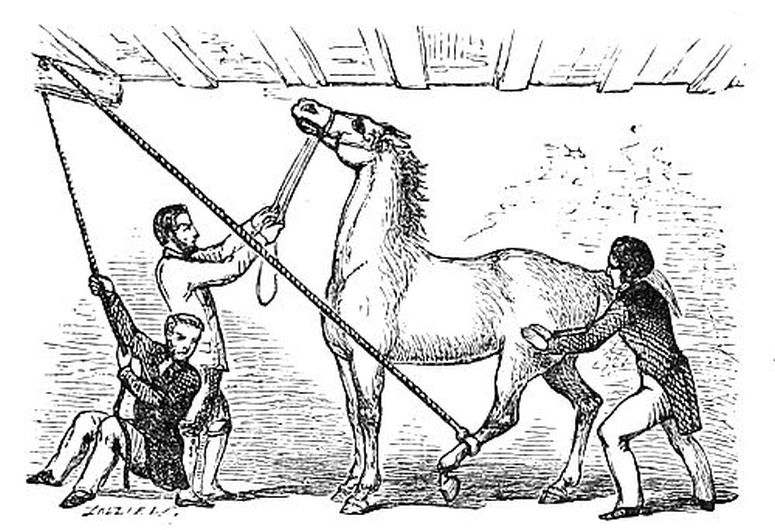
THE MANNER OF RETURNING THE PATELLA OF AN ADULT ANIMAL.
Mr. Spooner, in his lectures at the Royal Veterinary College, always recommends his hearers, after this bone has been returned, to place an assistant by the horse's side, with strict orders to hold the patella in its situation for some hours. Such advice is most excellent; to which we can only add, perfect rest, and as much strengthening food as the animal can consume. If such measures are pursued, and the horse be not used for six weeks subsequent to the accident, there need be little fear entertained of a second luxation of the patella.
BLOOD SPAVIN.
This disease is, happily, with the past; the writer has not seen an instance. Neither had the late Mr. Percival—the highest veterinary authority—after a life laboriously passed in scientific research. It is described to have existed as varicosity of the vena saphena, where the vessel crosses the hock. The cause is said to have been bog spavin when of magnitude: this, it is asserted, opposed circulation within the vessel; but the author conjectures the swelling must have assumed the callous state, before it could have offered sufficient resistance to the flow of blood to occasion the vessel to enlarge or to become varicose.
There is no cure for such a disease. The knife may remove the deformity but a larger blemish was often left as the consequence of the operation. Should such a case be known to any of the present readers, the author would advise the enlargement should be left alone, and trust placed in the absorbing powers of nature for its removal.
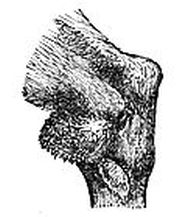
A BLOOD SPAVIN, AS IT IS REPORTED TO HAVE ONCE EXISTED.