Act 2 — THE RECOLLECTIONS OF ONÉSIME CHENAPAN.
E. L. (Ethel Lillian) Voynich translation
“Une triste histoire. Souvenirs d’un voyage dans les steppes du Nord,” par Onésime Chenapan, ancien agent provocateur, ayant servi sous les ordres de Monseigneur Maupas, Préfet de Police, 1853. Paris: Librairie nouvelle, 1 vol.
From “Opinions of distinguished foreigners concerning Pompadours,”—(Appendix to “Pompadours and Pompadouresses.”)
By “SHCHEDRÌN” (SALTYKÒV).
I take up my pen to show how one rash step may ruin a man’s whole life, destroy all the fruits gained at the cost of long-continued humiliation, and turn to dust all hopes of further advancement in his special career—nay, it may even rob from a man his dearest earthly right—the right to be called a faithful son of the holy Roman Church!
All this was brought upon me by a worthless being who called himself a Pompadour; he did it simply, calmly, without an instant’s hesitation, leaving me without even the faintest hope of obtaining any recompense whatsoever for all the losses he caused me!
Oh, young man! Thou who readest these tear-stained pages, consider them and ponder deeply. And if ever, in the Closerie de Lilas, or any other such place, thou meetest 186with a man called a Pompadour, flee from him! For the name of that man is frivolity and hardness of heart!
In the year 1852, not long after the famous coup d’état of December, chance brought me together with the Prince de la Klioukwà, a man still young although a little tarè, a man whom I, seeing only his personal appearance and cheerful manners, should never have guessed to be a high official. It appeared, however, that such he was.
We met in one of the Parisian cafés chantans which I frequented in the exercise of my professional duties, as these agreeable places were the favourite resorts of those mistaken young people who failed to show due unconditional confidence in the changes of December 2nd. Here also were to be found many foreigners, acquainting themselves with Paris from the point of view of the dolce far niente.
Our conversation began à propos of the song, “Ah! j’ai un pied qui r’mue,” which at that time had just come into fashion, and was charmingly sung by Mdlle. Rivière. It appeared that my neighbour (we were sitting at the same table, in leisurely enjoyment of our petits verres) was not only a fine connoisseur of genre, but himself performed admirably the principal pieces of the Cascade repertoire. I cannot explain how it was, but, to my sorrow, I experienced a kind of blind, unreasoning attraction towards this man, and, after not more than a quarter of an hour’s conversation, I frankly acknowledged to him that I was an agent provocateur, honoured by the peculiar confidence of Monseigneur Maupas. To my astonishment, he not only did not start up to strike me (as mistaken young people almost invariably do), but he even held out both his hands to me, and, in his turn, informed me that he was a Russian, occupying in his native land the rank of Pompadour.
187
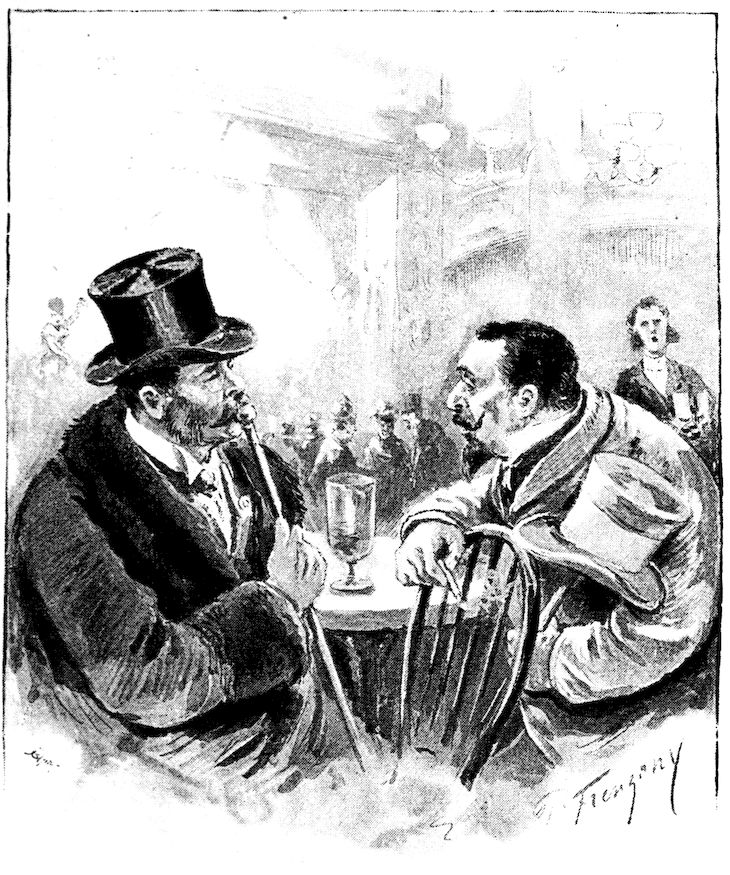
“WE MET IN ONE OF THE PARISIAN CAFÉS CHANTANS.”
188“I will explain to you afterwards,” said he, observing the perplexity expressed in my face, “what constitute the attributes and jurisdiction of a Pompadour’s office; at present I will only say that no other meeting could cause me such pleasure as this meeting with you. I was just seeking to make the acquaintance of a good, thoroughly reliable agent provocateur. Tell me, is your business a profitable one?”
“Monseigneur,” I replied, “I receive a regular salary of 1,500 francs a year, and, besides that, as encouragement, extra pay for every denunciation.”
“Why ... that’s not bad!”
“If I were paid by the line, though only at the rate of the newspaper penny-a-liners, it would really be not bad; but the thing is, monseigneur, that I am paid by the job.”
“But, no doubt, at Christmas or Easter there are some little perquisites?”
“No, monseigneur. All the perquisites go to Monseigneur Maupas, and his most gracious Majesty the Emperor Napoleon III. The only addition to the salary I told you of consists in a special sum, reserved for cases of mutilation and fatal injuries, which are very common occurrences in my profession. On the 2nd of December I literally presented the appearance of a mass of flesh streaming with blood, so that in one day I earned more than a thousand francs!”
“A thousand francs ... mais c’est très joli!”
“But I have an aged mother, monseigneur! I have a maiden sister, whom I do my utmost to settle in life!”
“Oh! quant à cela ... the deuce take them!”
This exclamation was very noteworthy, and should have served as a warning to me. But it pleased Providence to darken my reason, doubtless in order that I might drain to the very dregs the chalice of bitterness which this terrible man was to bring to me.
“Well, and now tell me, has it ever happened to you—in the exercise of your functions, s’entend—to open other 189people’s letters?” he continued, after a momentary silence, which followed his exclamation.
“Very often, excellence!”
“Understand my idea. Formerly, when letters were fastened down merely with sealing-wax, when envelopes were not gummed at the edges, it was quite simple, of course. All that was necessary was to insert a thin wooden needle, roll the letter upon it and draw it out of the envelope. But now that the envelope presents an unbroken, impenetrable surface, what is one to do? I have repeatedly tried the use of saliva, but I confess that my efforts have never once been crowned with success. The persons who received the letters have always observed it and made complaints.”
“And yet nothing is simpler, excellence. Here, in such cases, we take the following course: we approach the letter to boiling water and hold in the steam that side of the envelope on which are the gummed edges, until the gum melts. Then we open it, take out the letter, read it, and replace it in the envelope; and there remain no signs of indiscretion.”
“So simple—and I never knew! Yes, the French are in advance of us in all respects! Oh, generous nation! How sad that revolutions so often disturb thee! Et moi, qui, à mes risques et périls, me consumais à dépenser ma salive! Quelle dérision!”[30]
“But does the opening of other people’s letters appertain to your ... attributes, monseigneur?”
“Everything connected with internal policy appertains to my duties, especially the opening of private letters and the exaction of nedoimki.[31]
190“Do you know, my new friend, that you have helped me out of a very great difficulty?”
He pressed my hand warmly, and was so generous as to invite me to supper with him at the Café Anglais, where we passed the time in the most agreeable manner till almost morning. Finally, he very amiably proposed that I should accompany him to his native Steppes, where, according to him, a highly advantageous career was open to me.
“You will travel with me, and at my expense,” said he; “your salary will amount to four hundred francs a month; besides that, you will live with me and receive free board, light, and fuel. Your duties will be as follows: to teach me all the secrets of your profession and to find out all that is said about me in the town. And, in order to attain my purpose more easily, you will frequent society and the clubs, and there abuse me right and left.”
I was bewildered and delighted. Oh, ma pauvre mère! Oh, ma soeur, dont la jeunesse se consume dans la vaine attente d’un mari!...[32]
Yet, notwithstanding my agitation, I observed a certain inconsistency in his proposition, and instantly remarked it to him.
“Permit me to make one respectful comment, monseigneur,” said I. “You were so kind as to say that I should live in your house, yet at the same time you desire me to malign you. Although I fully understand that the latter measure may be one of utility (for ascertaining the direction of public 191opinion), still, would it not be better if I were to live, not in your house, but in a separate lodging—just in the character of a distinguished foreigner living on his income?”
“That’s of no consequence,” he replied, with a fascinating smile. “Please do not disturb yourself about that. In our Steppes it is a customary thing to foul your own nest; when you eat a man’s bread, you’re supposed to abuse him.”...
I decided.
Parting with thee, oh, my beloved France, I felt that my heart was torn in pieces!
Oh, ma mère!
Oh, ma pauvre sœur chérie!
But I said to myself, “Oh, ma belle France! If only the Steppes do not swallow me up, I will scrape together a small capital, and will set up in Paris a matrimonial and divorce agency. Then shall nothing ever separate us more, oh, beloved—oh, incomparable native land!”
Looking forward to that longed-for moment, I decided to give up all my salary to my poor mother. For myself, I intended to live on casual gains, of which, by the exercise on my part of a certain amount of skill and inventive capacity, there would certainly be no lack.
On the journey the prince was exceedingly obliging. He always permitted me to sit at the same table with him, and gave me good food. Several times he attempted to explain to me in detail in what consist the “attributes of a Pompadour”; but I must confess that these explanations produced on me no other effect than complete bewilderment. This bewilderment was still further increased by the fact that during these explanations his face wore so ambiguous an expression that I never was able to make out whether he was speaking seriously or romancing.
“The Pompadourical profession,” said he, “is almost a superfluous one, but just that very superfluity is what gives to it the piquante significance which it has in our 192country. It is unnecessary, and yet it is ... you understand me?”
“Not quite, monseigneur.”
“I will try to express myself more clearly. A Pompadour has no special business; it would be better to say no business,” he added, correcting himself. “He produces nothing, manages nothing directly, and decides nothing. But he has internal policy and time to spare. The former gives him the right to interfere in the affairs of others; the latter enables him to vary that right without limit. I hope that now you understand me?”
“Pardon me, excellence, but I am so imperfectly initiated into the wire-pulling of the policy of the Steppes that there is much which I cannot comprehend. Thus, for instance, why do you interfere in other people’s affairs? Surely all those ‘others’ are servants of the same bureaucratic principle of which you are a representative. For, in so far as I understand, the constitution of the Steppes——”
“First of all, we have no constitution whatever. Our Steppes are free—as Steppes should be—or as the hurricane that sweeps across them from end to end. Who shall control the hurricane? I ask you, What constitution can attain to it?”
He interrupted me so sternly that I became somewhat embarrassed and felt it necessary to apologise.
“I expressed myself badly, monseigneur,” said I; “I used the word ‘constitution’ in quite another sense from the one you were pleased to give to it. According to the opinion of scientific men, any state, when once constituted, by that very fact declares itself to have a constitution. It is a matter admitting of no doubt that there may be constitutions which are pernicious, and others again which are useful——”
“All that is very fine, but I beg of you not to employ in our conversations the hateful word ‘constitution’—never! 193Entendez vous: jamais! Et maintenant que vous êtes averti, continuons.”
I therefore explained that I could not understand of what use the interference of one set of bureaucrats in the affairs of another set could possibly be. I was just going to add: “Possibly you share? In that case ... I understand. Oh, comme je comprends cela, monseigneur!” But, not being, as yet, quite intimate with my illustrious friend, I refrained from that remark. Apparently, however, he guessed my secret thought, for he grew as red as a boiled lobster, and exclaimed, in an agitated voice—
“I protest with all my soul! Do you hear—I protest!”
“But, in that case, I really do not understand what is the purpose of this constant interference.”
“You are stupid, Chenapan!” (Yes, he said that to me, although at that time he was still very polite to me.) “You don’t understand that the more interference there is on my part, the more right I attain to the notice of the higher authorities. If I put down one revolution a year, that is well; but if I put down two in a year, that is excellent! And you, who are in the service of the greatest of suppressors of revolutions—you cannot understand that!”
“I understand—I understand that very well, monseigneur. But I confess I had supposed that the condition of your country——”
“All countries are in the same condition for a man who desires to attract to himself the attention of the authorities—vous m’entendez! But that is not all! I have my personal amour-propre.... Sacrebleu! I have my internal policy; I have my prerogatives! I wish to introduce my view—sapristi! I wish that people should act in harmony with my views, not in contradiction to them. It is my right; if you like to put it so, it is my caprice. You lay a responsibility on me; you demand of me this and that ... allow me, too, to have my caprice. I hope that this does 194not amount to any monstrous pretentiousness on my part?”
“But the law, monseigneur? How can you reconcile caprices with the law?”
“La loi! Parlez moi de ça! nous en avons quinze volumes, mon cher!”[33]
Here our conversation broke off. Although the administrative theory expressed in the last exclamation of my interlocutor was quite new to me, still I acknowledge frankly that the coolness with which he spoke of the law pleased me. Monseigneur Maupas had often said to me, “In case of need, mon cher, even the law can alter,” but he said it softly, as if afraid that any one should hear. And now suddenly—this clearness, this daring, this élan—how could one fail to be charmed by them! The Cossacks are a bold race altogether, and inclined to see enemies where we, people of an older civilisation, see only protection and surety. These people are absolutely fresh, and are free from all those prejudices which burden the life of a Western. They look upon the so-called “moral duties” with the most easy-going cheerfulness, but, on the other hand, no one can compare with them in matters of physical exertion; and as for their activity at table, with the bottle, with women—there they are undoubtedly the first warriors in the whole world. I, for instance, have never once seen my amphytrion drunk, although the quantity of liquor consumed by him before my eyes is, indeed, hardly credible. Never once did he lay down his arms before the enemy, and all the effect that wine ever produced on him consisted in a change of colour and a certain extra animation in romancing.
195
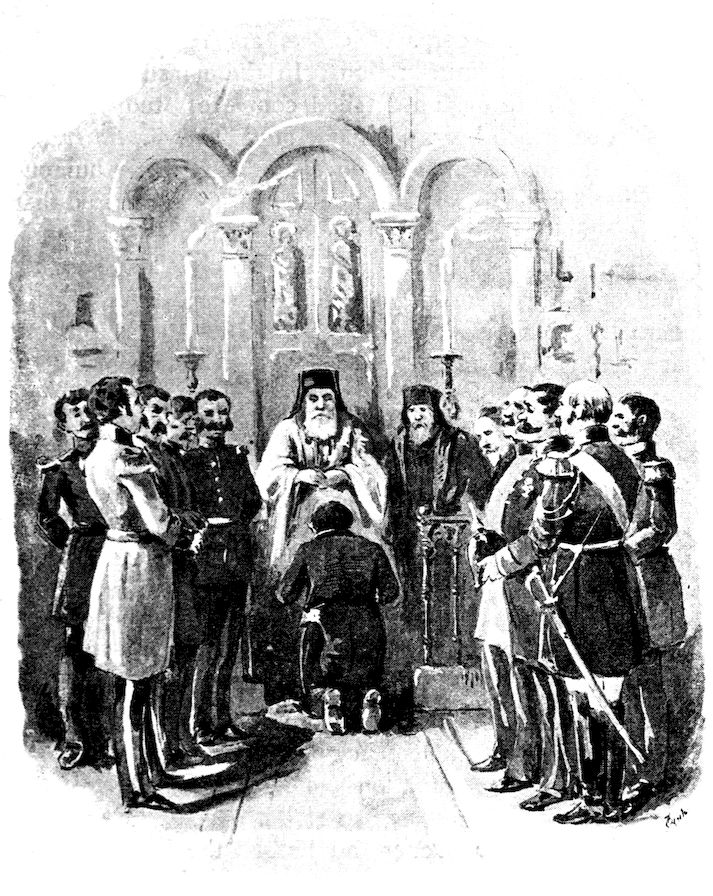
“I CANNOT REMEMBER HOW THE CEREMONY WAS PERFORMED.”
I am none the less bound to acknowledge that the significance of Pompadours in Russian society continued to appear to me wanting in clearness. I could not conceive that there could exist anywhere an administrative caste, the duties of which should consist in hindering (I consider the word “intervene” too serious for such an occupation), and which, when reminded of the law, could answer, “’Pristi! nous en avons quinze volumes!” For the rest, I ascribed my doubts, not to my own want of comprehension, but 196rather to the prince’s incapacity to formulate his thought clearly. It was evident that he himself did not understand in what his administrative rôle consists; and this is quite comprehensible if we remember that in Russia up to the present time[34] the corps of cadets are regarded as the nurseries of the administration. In these institutions the pupils are put through a detailed course of study in only one science, which bears the name of “Zwon popêta razdawaiss”[35] (the prince was in an exceedingly merry humour when he told me this long name, and I am convinced that in no other European country is there a science with such a name); the other sciences, without which it is impossible to get on in any human society, are passed over more than superficially. It is, therefore, not in the least surprising that persons who have received such an education prove incapable of expressing their thoughts coherently and consequentially, but get along how they can with such senseless exclamations as “Sapristi!” “Ventre de biche!” “Parlez moi de ça!” and so on.
Only when the inhospitable Steppe received us in its stern embrace, that is to say, when we arrived at our destination, did I even to some extent realise what my exalted amphytrion meant by his prerogatives.
Until we entered the confines of that tract of country over which the Prince de la Klioukwà’s Pompadourical sway extended, his conduct was in some degree moderate. He beat the drivers with a leniency of which I can only speak with the greatest admiration (as for his behaviour when abroad, of that I need not speak—it was the very pink of courtesy). But no sooner did he see the boundary-post 197which marks the beginning of his jurisdiction, than he drew his sword from its scabbard, made the sign of the cross, and, turning to the driver, uttered a cry of gloomy significance. We flew along like an arrow from the bow, and the remaining fifteen versts to the posting station were taken at a gallop. He, however, considered that we were not going fast enough, for every five minutes he would encourage the driver with violent blows of his sword.
I was unable to understand the cause of his anger, but I have never seen any human being so enraged. I confess that I was very much afraid the axle-tree of our carriage would break, as, if that had happened, we should inevitably have perished. But to persuade him not to hurry the driver was impossible, for furious driving along the roads is one of those prerogatives to which the Pompadours most passionately cling.
“I’ll teach him how to drive—canaille!” he repeated, addressing me, and appearing to enjoy the terror depicted on my countenance.
And indeed we travelled more than two hundred versts in twelve hours, and yet, notwithstanding this unheard of speed, at the stations he used to order the drivers to be flogged, remarking to me:
“C’est notre manière de leur donner le pourboire!”[36]
On arriving at the principal town we stopped at a large state building, in which we were absolutely lost, as in a desert. (The Prince had no family.) It was early morning, and I was dying for want of sleep; but he insisted on having the official reception at once, and despatched couriers in all directions with the news of his arrival. Two hours later the state-rooms of the house were filled with trembling officials.
Although prerogatives play an important part in our fair 198France, yet I could never have conceived of anything like what I saw here. Among us such words as “scoundrel” (“vaurien,” “polisson” and—unfortunately—“Chenapan”) constitute the severest reprimand which a guilty official can possibly deserve from an angry superior. Here, on the contrary, independently of plenteously-scattered personal insults, it is customary to add emphatic remarks concerning the genealogy of the person abused.
The prince was as scarlet as a boiled lobster, and hurried on from one subordinate to another, pouring out deluges of virulent abuse. He was especially hard upon a certain lame major, whom he ironically introduced to me with the remark, “This is my Maupas.” I at first imagined that this unhappy man must have attempted to usurp the prince’s power during his absence (which, of course, would have justified his wrath), but it appeared that nothing of the kind had happened. Up to this day I cannot explain to myself what was the cause of those grievous scenes which I witnessed on that memorable morning. The prince explained them to me as resulting from a desire to defend his prerogatives, but that reason appeared to me insufficient, as no one, apparently, had infringed those prerogatives. In a word, the official reception ended in a complete victory for my exalted amphytrion, who paced about the rooms, bridling like a spirited horse and proudly rejoicing in his easily-won triumph.
It was only at dinner that I began to feel at ease. It went off rather pleasantly, for there were present several favourites of the prince, young men, evidently very well educated. One of them, who had lately returned from St. Petersburg, very cleverly mimicked Mdlle. Paget,[37] at her soirées intimes, singing, “Un soir à la barrière.” This song, 199though far from new, and almost gone from my memory, gave me the greatest pleasure.
That evening the prince introduced me to the lady of his affections, whom he had taken away a short time before from one of the local municipal counsellors.[38] This most charming woman produced on me a profound impression, which was still further strengthened when I felt under the table the pressure of her foot against mine. Her husband was present, and greatly amused us by his jests at the expense of betrayed husbands, from which category the simple-hearted man did not exclude himself. Some of these jests, under the mask of naïveté, were so biting that the Pompadour reddened and lost his temper; but his morganatic friend, apparently, was accustomed to such scenes, for she looked on as if she had been an unconcerned outsider.
Our merry supper was drawing to a close, when suddenly some one came running in to announce that a fire had broken out at the end of the town.
“That is capital!” said the Pompadour to me. “Vous allez me voir à l’œuvre!”[39]
But I, for my part, was far from glad, for I observed that the prince, for the first time in our acquaintance, was quite drunk. Whether the proximity of the object of his affections acted on him as a stimulant, or whether it was the direct result of the intoxication of power—be that as it may, he could hardly keep on his feet. It turned out, however, that even this was to his advantage. As a general rule, no fire ever occurred without his beating somebody, but on this occasion he slept through the whole affair, and only woke up when the flames were fully extinguished.
As we returned home he startled me so distressingly that 200my heart seemed to contract as under the influence of some dark presentiment.
“Well, Monsieur Chenapan” (he did not even conceal the insulting double meaning that he put into my name), “how do you (tu) like my place?” asked he.
However deeply I was wounded by this deliberate jest, and by his unceremonious “thou,” addressed to a man who was no subordinate of his, I nevertheless felt it wise to submit.
“I am more than enchanted, monseigneur,” said I.
“H’m!... I should just like to see you not enchanted, you hound!”
As he said that he laughed so strangely that I suddenly understood—I was not a guest, but a captive!
Oh, ma France bien aimée! Oh, ma mère!
The prince very soon learned from me all the secrets of the craft, but, as he became more sure and confident in them, I fell lower and lower in his estimate. The first two months he paid my salary punctually, but the third month he told me right out that the whole of me was not worth two sous. When I tried to move him with entreaties, referring to my aged mother and my maiden sister, whose only treasure on earth is her virtue, he not only refused to hear the voice of generosity, but even permitted himself certain ambiguities concerning the virtue of my poor dear sister.
201
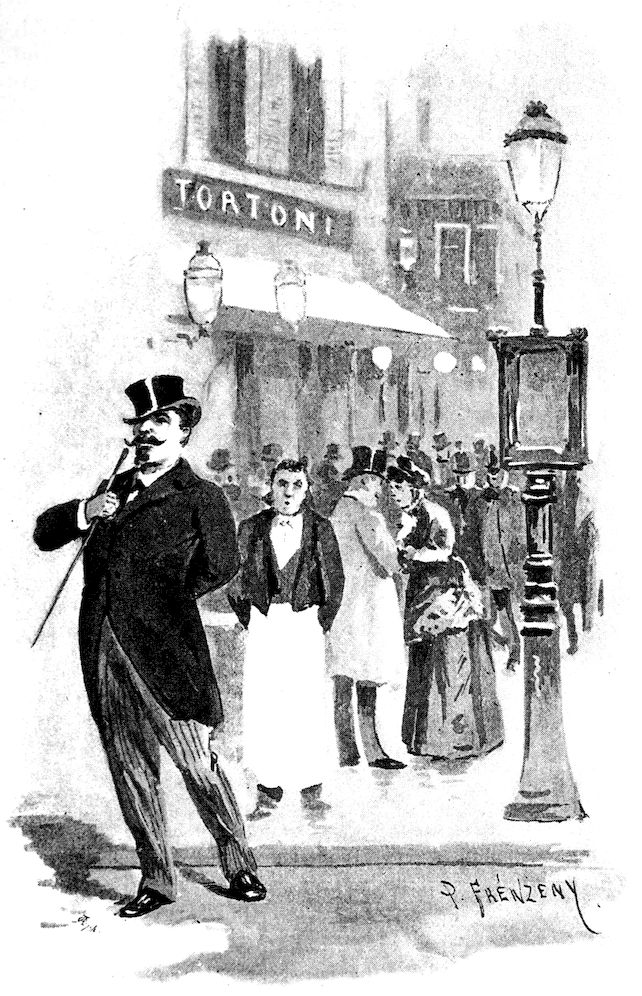
“STROLLING ABOUT THE BOULEVARDS.”
202While waiting till God should soften his heart, I was forced to be content with receiving my board and lodging. Yet even this much cost me bitter insults. They took away my former bed and replaced it by a thing for which in our sweet language there is no name. At table they constantly mocked and jeered at me, and took to habitually calling me “rascal.” Unhappily, I was so imprudent as to let out on one occasion that I had sometimes been beaten in Paris when fulfilling my duties, and by this needless frankness I, as it were, laid myself open to the most monstrous and outrageous jests, in which these people (who have no inventive capacity of their own) indulged at my expense. Moreover, at every meal they would purposely leave me without some particular dish (as a general rule, with a refinement of cruelty, they would choose whichever dish I liked best); and when I complained of hunger they would unceremoniously send me into the servants’ hall. But what hurt me most of all was the fact that they insulted in my presence my most gracious sovereign and emperor, Napoleon III., and in his person my dear, beautiful France. Thus, for instance, they would ask me was it true that Napoleon (they purposely pronounced his name Napoleòschka—a contemptuous diminutive) sold geese in London? or was it true that he and Morny together had kept a house of tolerance in New York? etc.... And all this frivolous jesting at the moment when the terrible Eastern Question stood before us!...
So it went on until autumn. The cold weather began, but they neither put double windows into my room nor heated it. I was never of a rebellious temperament, but at the first cruel grasp of cold, even my self-abnegation broke down. Only then did I become fully convinced that the hope that God would touch the heart of my exalted amphytrion was a hope in the last degree illusory and vain. Gathering up my courage, I decided to brave the inhospitable Steppes and appealed to the prince to grant me the necessary sum to reach the banks of the Seine.
“I no longer demand the payment of what is due to me, monseigneur,” said I; “the payment of what I have earned, far away from my beloved country, while subsisting on the bitter bread of exile....”
“You’re wise not to demand it—Chenapan!” he remarked, coldly.
203“I beg for only one favour. Give me a sufficient sum to enable me to return to my country and embrace my beloved mother.”
“All right; I’ll think it over ... Chenapan!”
Day after day passed—still they did not heat my room, and still he thought. During that time I reached the last degree of prostration, and no longer complained to any one, but my eyes shed tears of themselves. If any dog had been in my position it might have aroused compassion—but he was silent!
Afterwards I learned that such things are called in the Russian language “jokes.” But if these are their jokes, what must their cruelties be?
At last he sent for me.
“All right,” he said; “I will give you four hundred francs, but only on condition that you become a convert to the Greek faith.”
I looked into his eyes with amazement, but those eyes expressed nothing, save an inflexibility that admits of no reply.
I cannot remember how the ceremony was performed.... I am even not quite certain whether it was a real ceremony, and whether the priest’s part was not played by the Pompadour’s adjutant disguised.
Justice compels me to add, however, that, after the ceremony was over, he behaved to me like a grand seigneur, that is, he gave me not only the whole of the sum agreed upon, but also two beautiful, hardly-worn suits, and ordered that I should be driven free of expense to the boundary of the next Pompadourdom. My hope did not deceive me. God had touched his heart at last!
Twelve days later I had reached the banks of the Seine, and, graciously received back into the service by Monseigneur Maupas, was strolling about the boulevards, humming merrily—
204“Les lois de la France,
Votre Excellence!
Mourir, mourir,
Toujours mourir!”
Oh, ma France!
Oh, ma mère!
205