Act I. Scene I.
E. L. (Ethel Lillian) Voynich translation
(A bachelor’s apartment. Podkolyòssin, alone, lying on the sofa smoking a pipe.)
Pod. Really when a man’s alone, and thinks about it at his leisure, it does seem after all as if one ought to get married. Indeed, if you think of it, here one goes on, living and living; and one ends by getting quite disgusted 2with everything. There, I’ve let the time slip by once more; and it’s holy season[1] again. It’s too bad! Everything’s ready, and the matchmaker’s been coming for the last three months. It makes me feel quite ashamed. Hi! Stepàn! (Enter Stepàn.) Hasn’t the matchmaker come?
Step. No, your honour.
Pod. Have you been to the tailor?
Step. Yes.
Pod. Is he making the dress-coat?
Step. Yes, sir.
Pod. How far has he got on with it?
Step. He is making the button-holes.
Pod. What do you say?
Step. I said he’s begun to make the button-holes.
Pod. And didn’t he ask you what your master wants with a dress-coat?
Step. No, sir; he didn’t.
Pod. Perhaps he asked you whether your master wasn’t going to get married?
Step. No; he didn’t say anything about it.
Pod. Did you see any other dress-coats in the workshop? I suppose he makes for other people too?
Step. Yes; there were a lot of coats hanging up.
Pod. But I’ll be bound the cloth of them isn’t as good as mine!
Step. No, sir; the stuff of yours looks nicer.
Pod. What do you say?
Step. I say the stuff of yours is nicer, sir.
Pod. That’s all right. Well, and didn’t the tailor ask why your master wants a dress-coat of such fine cloth?
Step. No.
Pod. Didn’t he say anything about whether your master thought of getting married?
3Step. No; he didn’t talk about it at all.
Pod. But I suppose you told him what my position is, and where I serve?
Step. Yes, sir.
Pod. What did he say to that?
Step. He said, “I’ll do my best.”
Pod. That’s all right. Now you may go. (Exit Stepàn.) I am inclined to think that a black dress-coat is the most decorous. Coloured coats are all very well for secretaries, and clerks, and all that small fry—they look just fit for milksops. People higher up in the service ought to observe what is called a—a—a—a——There! I’ve forgotten the word! It’s a fine word; and I’ve forgotten it! It’s all very well to put on airs, little father, but an aulic counsellor takes the rank of colonel too; the only difference is that he has a uniform without epaulettes. Hi! Stepàn! (Enter Stepàn.) Did you buy the blacking?
Step. Yes, sir.
Pod. Where did you buy it? In the shop I told you about, on the Voznesènsky Prospect?
Step. Yes, that was the shop.
Pod. And is it good?
Step. Very good.
Pod. Did you try it on the boots?
Step. Yes, sir.
Pod. And does it shine?
Step. It takes a beautiful shine, sir.
Pod. And when you bought it, didn’t the man ask you what your master wants with such good blacking?
Step. No.
Pod. Perhaps he asked you whether your master was going to be married?
Step. No; he didn’t say anything.
Pod. All right; you can go. (Exit Stepàn.) One would think boots were a trifling thing; and yet if they 4are badly made, or not properly blacked, no one will respect you in good society. It makes a great difference, somehow.... Another horrid thing is, if one has corns. I’d be ready to put up with almost anything rather than have corns. Hi! Stepàn! (Enter Stepàn.)
Step. What’s your honour’s pleasure?
Pod. Did you tell the shoemaker that the boots musn’t give me corns?
Step. Yes, sir.
Pod. And what did he say?
Step. He said, “All right.” (Exit.)
Pod. The deuce take it all! It’s a difficult business, this getting married. What with one thing and another—first this has to be set right, and then that—the devil take it all! it’s not half so easy as people say. Hi! Stepàn! (Enter Stepàn.) There’s another thing I wanted to say——
Step. The old woman’s come.
Pod. Ah! she’s come? Send her in. (Exit Stepàn.) Yes; it’s a sort of thing—a sort of—a hard matter. (Enter Fèkla.) Ah! good-morning, Fèkla Ivànovna! Well? What have you got to say? There’s a chair; sit down and tell me about it. I want to hear all about her. What’s her name? Melània——
Fèkla. Agàfia Tikhònovna.
Pod. Yes, yes, Agàfia Tikhònovna. I suppose she’s some old maid of forty?
Fèkla. Well, then, you’re just wrong. I can tell you, if you marry her, you’ll come to thank me and praise her up every day of your life.
Pod. I suppose that’s a lie, Fèkla Ivànovna?
Fèkla. I’m old to tell lies, little father; lying’s a dog’s work.
Pod. But the dowry? What about the dowry?
Fèkla. The dowry? Well, there’s a stone house in the 5Moscow borough,[2] two-storied; it brings in such a profit that it’s a pleasure to think of: one corndealer pays seven hundred for his shop; then there are wine-vaults that attract plenty of customers; two wooden wings, one entirely wooden and the other with a stone basement: they bring in an income of four hundred roubles each. Well then, there’s a market-garden on the Vỳborgskaya[3] side. The year before last a merchant took it for cabbage-farming; and such a good sober fellow—never touches a drop of drink—and he’s got three sons; he has married two of them, “but the third,” says he, “is too young; he can stay in the shop and see after the business. I’m getting old,” says he, “so it’s time for my son to stay in the shop and see that the business goes on all right.”
Pod. Well, but tell me what she’s like to look at.
Fèkla. Like sugar-candy! Pink and white, like roses and cream.... Sweeter than honey; sweeter than I can say! I tell you, you’ll be over head and ears in love with her; you’ll go about to all your friends and enemies and say, “I’ve got something to thank Fèkla Ivànovna for.”
Pod. Well, I don’t know; she’s not a staff-officer’s daughter.
Fèkla. No; but she belongs to the third guild. And then she’s one that even a general needn’t be ashamed of. Why, she won’t even hear of a merchant. “I don’t care,” says she, “what my husband’s like; I don’t even care if he’s ugly, but he must be a noble.” There’s a real lady for you! And you should just see her on Sundays, when she puts on a silk dress. Dear Lord! How it rustles! Like any princess.
6Pod. Well, you see, that’s why I asked you, because I’m an aulic counsellor; and so—you understand....
Fèkla. Of course I understand. There was an aulic counsellor that tried for her already, but she refused him; she didn’t like him. But then he had such a strange way with him; he was all right to look at, but he couldn’t speak a word without telling lies. It wasn’t his fault, poor fellow; the Lord made him so. He was sorry enough himself about it, but he just couldn’t help lying; it was God’s will, that’s clear.
Pod. And is she the only girl you’ve got on hand?
Fèkla. Why, what do you want with another? She’s the best you could possibly have.
Pod. You don’t really mean that?
Fèkla. If you look all over the world, you won’t find another like her.
Pod. Well, little mother, we’ll think it over, we’ll think it over. You’d better come again to-morrow. I’ll tell you what: you come again, and we’ll have a comfortable time; I’ll lie on the sofa, and you shall tell me about her.
Fèkla. Come, little father, that’s too much of a good thing! I’ve been at your beck and call for more than two months, and nothing’s come of it yet; all you ever do is to sit in your dressing-gown and smoke a pipe.
Pod. I suppose you think to get married is no more than to say “Hi! Stepàn, bring my boots!” and just put them on, and go out. No, no! one must think it over, and look about one.
Fèkla. Oh! there’s no harm in that. If you want to look, who minds your looking? The goods are in the market to be looked at. Call for your coat, and go off now, without wasting the morning!
Pod. Now? Why just look how dull the weather is. If I go out, I may get caught in the rain.
Fèkla. Dear me! What a misfortune! Why, little 7father, the grey hairs are coming on your head already. If you wait much longer, you won’t be a marriageable man at all. A fine prize! An aulic counsellor! I can tell you, we can get hold of such grand suitors, that we shan’t care to look at you!
Pod. What rubbish are you talking? What’s put it into your head all of a sudden that I’ve got a grey hair? Where’s a grey hair? (Feels his hair.)
Fèkla. Why shouldn’t you have grey hairs? Most people do, when they live long enough. Take care, though; you won’t have this girl, and you don’t like that girl—but I can tell you, I’ve got a captain in my eye that’s a head and shoulders taller than you, and he talks just like a brass trumpet. He serves in the ammaralty....
Pod. It’s not true! I’ll look in the glass: you’re only pretending there are grey hairs! Hi! Stepàn! Bring the looking-glass!... No! wait—I’ll go myself. What next? Heaven defend us! that’s worse than small-pox! (Exit into adjoining room. Enter Kochkaryòv, running.)
Koch. Where’s Podkolyòssin? (Seeing Fèkla.) You here! Ah! you!... Look here! What the devil did you marry me for?
Fèkla. What’s the harm? It’s right and lawful.
Koch. Right and lawful! What do you suppose a man wants with a wife? Did you suppose I couldn’t get on without one?
Fèkla. Why, it was you yourself that wouldn’t let me alone. It was always “Granny, find me a wife!”
Koch. Yah!... You old rat!... And what are you here for, I should like to know! You don’t mean to say Podkolyòssin wants to get married?
Fèkla. And why not? God has blessed him.
Koch. No! really? What a rascal! he never told me a word about it! Now what do you think of that, if you please? Isn’t he a sly rogue? (Enter Podkolyòssin, 8holding a mirror, and gazing into it intently. Kochkaryòv slips up behind, and startles him.)
Koch. Booh!
Pod. (cries out, and drops the mirror). Ah! you crazy fellow! Now what is the use of doing that? Now what a silly thing to do! You just brought my heart into my mouth!
Koch. There, I was only joking!
Pod. Fine sort of joke! I can’t get my breath yet; and there, you’ve smashed the looking-glass! And it was an expensive one—I got it in the English shop.
Koch. There, never mind! I’ll buy you another looking-glass.
Pod. Yes, I dare say! I know what those other looking-glasses are like! One’s face comes out crooked, and they make one look ten years older.
Koch. Look here! it’s I that ought to be angry with you, not you with me. You hide everything from me, your friend. You think of marrying?
Pod. What nonsense! I never thought of such a thing.
Koch. My friend, you’re caught in the act! (Points to Fèkla.) There she stands; everybody knows what sort of bird she is. Ah, well! never mind; there’s nothing to be ashamed of; it’s a good Christian action—indeed, it’s necessary for the good of the State. I don’t mind; I’ll take the whole responsibility of it. (To Fèkla.) Well, tell me who she is, and all about her. What class does she belong to?—noble, official, merchant? And what’s her name?
Fèkla. Agàfia Tikhònovna.
Koch. Agàfia Tikhònovna Brandakhlỳstova?
Fèkla. No, no! Kouperdyàgina.
Koch. Ah! she lives in the Shestilàvochna, doesn’t she?
9Fèkla. No, she doesn’t, then! She lives near Peskì, in the Mỳlny Row.
Koch. Oh, yes; in the Mỳlny Row; a wooden house, next door to a shop, isn’t it?
Fèkla. No, it isn’t. It’s beyond the wine-vaults.
Koch. Beyond the wine-vaults! Then I don’t remember.
Fèkla. Well, when you turn into the Row, you see a stall; and you pass the stall and turn to the left; and there, straight in front of you, just right before your eyes, there’s a wooden house, where a dressmaker lives; you don’t go into the dressmaker’s, you go on to the next house but one; it’s a stone house, and that’s where she lives—Agàfia Tikhònovna.
Koch. All right, all right! now I can manage it all. You can go now; we don’t want you any more.
Fèkla. What’s that? Do you mean to say that you mean to settle a wedding yourself?
Koch. Yes, yes, myself—only don’t you interfere.
Fèkla. Oh, for shame! for shame! That’s not a man’s business! Little father, keep out of it.
Koch. Be off! be off! you don’t understand anything about it; don’t interfere; mind your own business, and get along with you!
Fèkla. All you care for is to take the bread out of people’s mouths;—you’re no better than an infidel! A man! and to mix up in things like that! If I’d known, I wouldn’t have told you a word. (Exit sulkily.)
Koch. Now, my lad, this business musn’t be put off—put on your hat and come along.
Pod. Well, but I—I—I haven’t decided—I was only thinking——
Koch. Fiddle-de-dee! Only don’t be bashful: I’ll get you married as finely as you like. We’ll go straight off to the lady now, and you’ll see how fast we’ll get it all settled.
10Pod. What, go off now! What next will you want?
Koch. Bless my soul, man, what would you have? Now, just think yourself what comes of not being married. Look at the condition of your room—there’s a muddy boot—there’s a washing basin—there’s a heap of tobacco on the table; and here you lie on your side, the whole day long, like a regular stick-in-the-mud.
Pod. It’s quite true; I know myself everything’s in a muddle in this house.
Koch. Well now, when you have a wife everything’ll be so different that you’ll hardly know yourself. Here there’ll be a sofa, there a lap-dog, then a birdcage, and fancy-work lying about.... And just imagine—you sit on the sofa, and suddenly a little woman comes and sits down beside you, a pretty little girl ... and puts up a little hand——
Pod. Ah! the devil take it! when one thinks of it, what beautiful hands there are—just as white as milk!
Koch. How you talk! Anybody would think women had got nothing but hands!... My lad, they’ve got——in fact the deuce knows what they haven’t got!
Pod. Do you know—I confess it to you—I do like to have a pretty woman sit beside me.
Koch. There now! there you see! Then all that’s wanted is to make the arrangements. You needn’t take any trouble about that, though; I’ll manage the wedding and the dinner, and all that.... You can’t possibly do with less than a dozen of champagne—that there’s no question about. We must have half a dozen of Madeira too; I expect the lady’s got a whole tribe of aunts and cousins and all the rest of it, and they won’t want to be done out of their share. Then there’s the Rhine-wine—what the devil do you call it, eh? And as for the dinner, I’ll tell you what, old chap: there’s a butler I know of that’ll settle it all for us; the dog will give you such a feed as you never saw in your life.
11
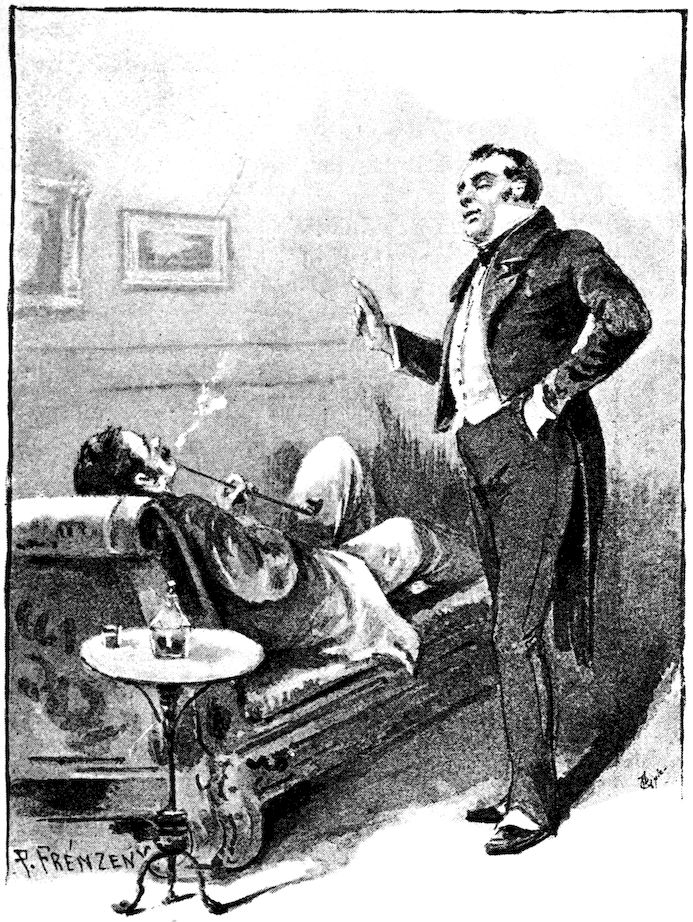
PODKOLYÒSSIN: “DO YOU KNOW—I CONFESS IT TO YOU—I DO LIKE TO HAVE A PRETTY WOMAN BESIDE ME.” KOCHKARYÒV: “THERE NOW! THERE YOU SEE! THEN ALL THAT’S WANTED IS TO MAKE THE ARRANGEMENTS.”
12Pod. But my dear fellow! you set about the business as if I were going to be married at once!
Koch. And why not? What’s the use of putting it off? You’ve decided?
Pod. Me? Oh, dear no! I haven’t decided at all!
Koch. Well I never did! But you just said you wanted to marry.
Pod. I only said it wouldn’t be a bad idea.
Koch. Well now, really! And we were just settling up everything.... What’s come to you? Don’t you like the idea of a married life?
Pod. Oh, yes, I like it.
Koch. Well then, what’s it all about? Where’s the difficulty?
Pod. There isn’t any difficulty; only it seems so strange....
Koch. What’s there strange about it?
Pod. Of course it’s strange. One’s always been a bachelor, and now to be a married man——
Koch. Tut, tut, tut! I wonder you’re not ashamed of yourself. No, my friend, I see I must talk to you seriously. I’ll be quite frank with you, like a father with a son. Now just look at yourself—look at yourself attentively and seriously, just as you’re looking at me now—what do you think of yourself? What are you like? You’re no better than a log; you’re a mere cypher. Tell me what you live for? Now just look in the glass and tell me what you see—nothing but a very stupid face. Well now, suppose that you’ve got children round you, not just two or three—you know, but a whole half-dozen—and every one as like you as two peas. Here you are alone, an aulic counsellor, or a head of a department, or director of some kind—what do you call yourself? But now just suppose yourself surrounded with little directorkins, and tiny rascals and small fry generally; and there they hold out their chubby little 13fists and tug at your whiskers; and you’ll play doggie with them: Bow—wow—wow! Now, can you imagine anything more delightful?
Pod. Ye-e-s, only you know they are such mischievous little monkeys; they’ll spoil everything, and pull all my papers about.
Koch. Oh! that doesn’t matter! But just think; they’ll all be like you—that’s the beauty of it.
Pod. After all, it really is a deucedly funny notion—a little white puff-ball of a thing—no bigger than a puppy-dog—and yet it’s like you!
Koch. Of course it’s funny, tremendously funny; there, make haste and come along!
Pod. All right; I don’t mind.
Koch. Hi! Stepàn! Come and help your master dress.
(Enter Stepàn.)
Pod. (dressing before the glass). I almost think, though, that I ought to put on a white waistcoat.
Koch. Oh, nonsense! What does it matter?
Pod. (putting on his collar). Confound that washerwoman! How badly she’s starched my collar! It won’t stand up a bit, Stepàn! You tell the stupid woman that if she’s going to do her work that way, I shall find another washerwoman. I expect she spends her time philandering with sweethearts instead of ironing clothes.
Koch. There! there! man, make haste! What a dawdle you are!
Pod. All right—all right! (Puts on coat, and sits down.) Look here, Ilia Fòmich, do you know what? I think you’d better go alone.
Koch. What next! The man’s gone daft! I go? Why, which of us is going to get married—you or I?
Pod. The fact is, I don’t feel inclined for it to-day; let’s go to-morrow.
14Koch. Now, have you got one single grain of sense? Now, are you anything in the world but a moon-calf? You get ready, and then, suddenly, don’t want to go! Now be so kind as to tell me, don’t you call yourself a pig and a camel after that?
Pod. Look here—what’s the use of bad language? I haven’t done you any harm.
Koch. You’re a booby, a perfect booby, any fellow will tell you that. I don’t care if you are an aulic counsellor—you’re nothing in the world but a fool. What do you suppose I’m taking all this trouble for? Only for your good. Don’t I see that you’ll let the prize slip through your fingers? And there you lie, you confounded old bachelor! Now just have the kindness to tell me, what do you call yourself? You’re a dummy, a milksop, a nincompoop, a—I’d tell you what you are if I could only find a civil word for it. You’re worse than any old woman!
Pod. Look here, that’s too much of a good thing. (Softly.) Are you gone off your head? There’s a serf in the room, and you let him hear you say bad words! Can’t you find another place to quarrel in?
Koch. I should like to know who could help quarrelling with you! Bad language! What else could anybody turn their tongue to? You begin by behaving reasonably, and arrange to get married, as any sensible man would; and then, all of a sudden, without why or wherefore, you must get a bee in your bonnet, and there’s no more sense in you than in a wooden post....
Pod. There, that’ll do! I’ll come; why, you needn’t fly at me like that!
Koch. Come? Of course you will—what else should you do? (To Stepàn.) Give him his hat and cloak.
Pod. (at the door). What a queer fellow it is! There’s no making him out at all. All of a sudden he sets to work 15and abuses you without rhyme or reason. Doesn’t understand how to speak to a fellow.
Koch. There! I’m not going to scold you now. (Exeunt.)