Act 2 — The Eagle as Mecænas.
E. L. (Ethel Lillian) Voynich translation
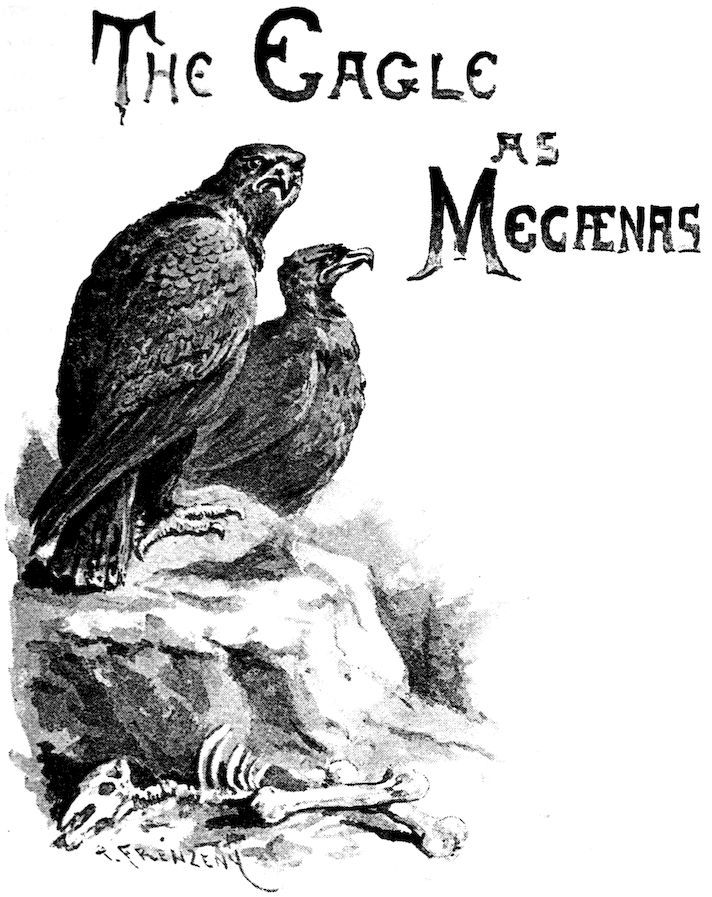
A FABLE.
BY
“Shchedrìn”
(Saltykòv).
A great deal is written by various poets about Eagles; and always in praise of them. The Eagle has invariably a form of indescribable beauty, piercing vision, and a majestic flight. In fact, he does not fly like other birds, but “sails” or “soars” through the air; moreover, he can gaze upon the sun and battle with the thunders. Some writers speak of the magnanimity of his soul. For instance, 336if you want to write an ode in praise of a policeman, it is quite essential to compare him to an Eagle. Thus: “Like the majestic Eagle, Police-sergeant No. So-and-so looked on the suspected person, seized him, heard his explanation, and magnanimously pardoned him.”
I, personally, long cherished a belief in these panegyrics. I used to think: After all, it really is a grand idea! “Seized him and ... pardoned!” Pardoned! That was what really fascinated me. Whom did he pardon? A mouse! A miserable mouse! And then I would rush off to some one of my poetical friends to tell him of this new act of magnanimity on the part of the Eagle. And my poetical friend would strike an attitude, breathe hard for a moment, and then ... would become affected with the sea-sickness of versification.
One day, though, the idea occurred to me: What did the Eagle “pardon” in the mouse? All that the mouse had done was to run across the road on its own private business; and the Eagle saw it, swooped, squeezed it half to death, and ... pardoned it! Why in the world did the Eagle pardon the mouse and not the mouse the Eagle?
Well, I began to look about me and take notice of things; and the more I saw, the more muddled I got. There certainly was something askew about the whole business. In the first place, it is evident that the Eagle does not catch mice for the purpose of pardoning them. In the next place, even if the Eagle did pardon the mouse, I cannot help thinking that it would have been still better if he had taken no interest in its affairs at all. And, finally, in the third place, granted he is an Eagle—an Arch-eagle for that matter—all the same he’s a bird. Indeed, he is so essentially a bird that, even for a policeman, a comparison with him can be considered complimentary only in virtue of a misunderstanding.
My present opinion concerning Eagles is as follows:—Eagles 337are Eagles—and that is the long and short of the matter. They are simply carnivora, birds of prey; but, it is true, they have this justification: that Nature herself made them anti-vegetarians. As they are, moreover, powerful, long-sighted, agile, and merciless, it is perfectly natural that, whenever they appear, the entire feathered kingdom does its best to hide itself away. This is simply the effect of terror, and not at all of admiration, as the poets maintain. Eagles habitually live in solitary and inaccessible places; never exchange bread-and-salt with any one;[60] but live by robbery; and, when not engaged in burgling, go to sleep.
There turned up, however, a certain Eagle who grew sick of living in solitude. So one day he said to his mate: “It’s a fearful bore to live in this fashion, tête-à-tête; if one does nothing but gaze at the sun the whole day long, it muddles one’s head.”
He set to work to meditate. The more he thought about it, the more it seemed to him that it would be very nice to live as the landed proprietors used to live in the old days. He could get a whole suite of servants and be as happy as the day is long. The rooks would provide him with scandal; the parrot would turn upside down and do tricks; the magpie would cook his porridge; the robins would sing songs in praise of him; the owls and night-jars would serve as watchmen and sentinels; and the hawks and falcons would bring him food. For himself he would keep no speciality but bloodthirstiness.
He thought and thought; and at last he made up his mind. One day he called a hawk, a kite, and a falcon, and said to them—
“Collect for me a staff of servants, such as the old landlords used to have; they will amuse me, and I will keep them in order. That will be pleasant for me and good for them.”
338
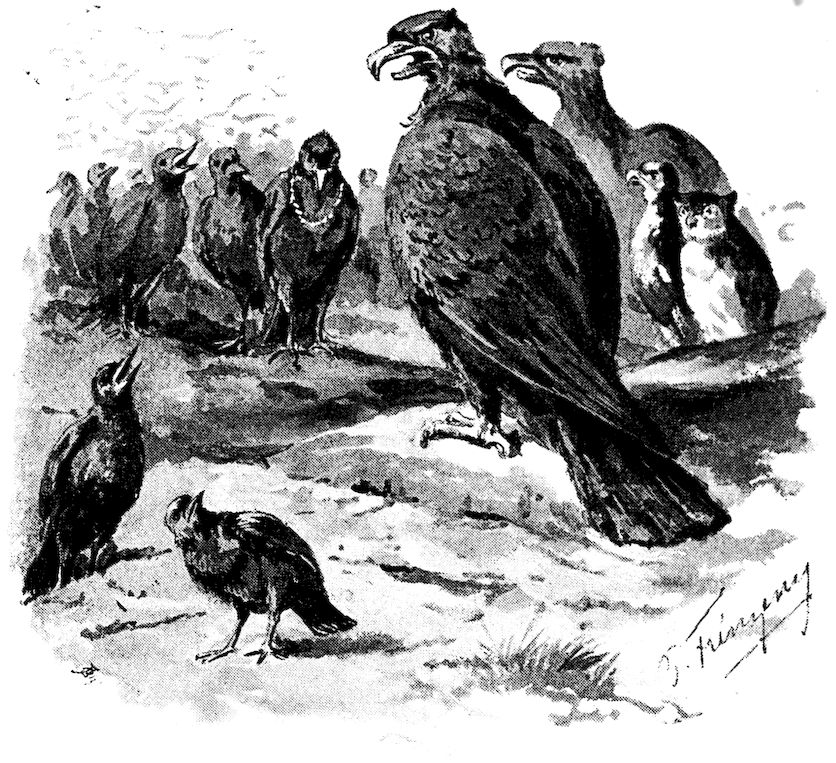
“THEY DROVE IN A WHOLE FLIGHT OF ROOKS.”
So the birds of prey flew off in all directions to fulfil the Eagle’s commands. No one can say they dawdled over their business. First of all they drove in a whole flight of rooks, registered their names, and gave them out passports. The rook, you see, is a fertile bird, and puts up with everything. Its best quality is that it admirably represents the peasant class; and everybody knows that if once you have got the peasants settled, all the rest is a matter of detail and quite easily managed. And they certainly managed beautifully. The corn-crakes and mud-suckers were trained for an orchestra; the parrots were dressed up for acrobats; the white-feathered magpie, being a notorious thief, was intrusted with the keys 339of the treasury; and the owls and night-jars were put on duty as sentinels. In a word, the whole thing was arranged in a manner that would have done credit to any nobleman’s establishment. Even the cuckoo was not forgotten; employment was found for her as fortune-teller to the female Eagle; and a foundling hospital was instituted for orphan cuckoos.
But before the whole arrangement was fairly in working order the managing directors realised that something was wanting. For a long time they could not think what it could be; but at last they remembered that in all high-class establishments Science and Art are supposed to be represented, and they had made no provision for either the one or the other. Three birds especially felt themselves aggrieved by this omission—the robin, the woodpecker, and the nightingale.
The robin was a smart little soul and had practised whistling since his fledgling days. He had received his earliest education in an ecclesiastical school; then he had served as regimental clerk; and as soon as he had learned the rules of correct punctuation he had begun to edit, without preliminary censorship, a newspaper: The Forest Gazette. But, somehow or other, he could never get it right: whenever he touched upon a subject, it turned out to be taboo; whenever he refrained from mentioning a subject, that subject particularly ought to have been mentioned; and for all these mistakes he used to get hard knocks on his poor little head. So at last he decided: “I will enter the service of the Eagle; all I shall have to do will be to sing his praises every morning; and no one will punish me for that.”
The thrush was a modest and studious person, who led a strictly solitary life; he had no acquaintances (many even believed him to be a drunkard, like all very learned persons), but would sit for whole days alone upon a fir-branch, 340cramming up information. He managed to plod through a perfect desert of historical investigations: “The Ancestral Records of a Bogie,” “Was the old Woman who rode on a Broomstick married?” “What Sex should be ascribed to Witches in the Register-Papers?” and so forth. But, however hard the poor bird crammed, he could not find a publisher for his pamphlets. At last it occurred to him too: “I’ll engage myself as Court-Historiographer to the Eagle; perhaps he will print my investigations in rook’s dung!”
As for the nightingale, he couldn’t complain of the cruelty of fate; he sang so exquisitely that not only the mighty fir-trees, but even the Moscow shopkeepers were quite touched when they heard him. All the world adored him; all the world held its breath to listen when he poured out torrents of divine song from among the branches of some silent grove. But the nightingale was ambitious beyond measure, and desperately given to falling in love. He was not content with making the forest ring with his wild melodies, or filling sad hearts with the harmony of sound ... he kept on thinking how the Eagle would hang round his neck a shining chain of ants’ eggs, and decorate his breast with live beetles, and how the female Eagle would appoint secret meetings with him by moonlight.... In short, all three birds gave the falcon no peace till he undertook to speak on their behalf.
The Eagle listened attentively to the falcon’s assurances of the necessity of encouraging science and art; but did not quite understand. He sat sharpening his claws, and his eyes flashed back the sunlight like polished gems. He had never seen a newspaper in his life; he had never taken the slightest interest in either witches or the old woman who rode on a broomstick; and about the nightingale he had only heard that it was a little bit of a bird not worth soiling one’s beak over.
341“I daresay you don’t even know that Buonaparte is dead,” said the falcon.
“Who was Buonaparte?”
“There you are! And you certainly ought to know about that. Supposing visitors come and begin a polite conversation; they’ll say: ‘In Buonparte’s days so-and-so happened’; and you’ll just have to sit and blink your eyes. That won’t do.”
They called in the owl as adviser, and she agreed with the falcon that science and art must be introduced into the establishment; for they amuse Eagles, and it does ordinary mortals no harm to enjoy them from a distance either. Knowledge is light, and ignorance is darkness. Any fool knows how to eat and sleep; but just try and work out a problem; take the one about the flock of geese, for instance, that’s a very different matter. In the old days the clever landowners understood that; they knew that forewarned was forearmed; they were sharp enough to see which side their bread was buttered. Just take the case of the finch: all the learning he has is how to draw water in a little bucket, and yet see what a high price he fetches just for that one trick! “I,” concluded the owl, “can see in the dark, and I am called wise for that; now, you can stare at the sun for hours together without ever blinking; and all people say about you is: ‘That Eagle’s a bit of a blockhead.’”
“Well, I have no objection to science,” said the Eagle, rather snappishly.
No sooner said than done. On the next day the “Golden Age” began in the Eagle’s establishment. The starlings set to work to learn by heart the hymn: “Let our youth be fed with science”; the corn-crakes and mud-suckers began practising the trumpet; the parrots invented new tricks. A new tax was laid upon the rooks, to be called “Public Instruction Tax.” A Corps des Cadets was founded 342for fledgling falcons and vultures; and an Academy of Science for owls. They even went the length of buying a farthing alphabet apiece for the baby rooks. Last but not least, the oldest patriarch among the starlings was appointed poet-laureate, with the honorary title of “Vasìli Kirìlych Trediakòvsky,”[61] and commanded to prepare for a public competition with the nightingale, to be held on the next morning.
At last the great day dawned. The newly-elected flunkeys were admitted into the presence of the Eagle, and the tournament of arts began.
The most successful competitor was the robin. Instead of reciting his compliments, he read aloud an article, so clear and simple that even the Eagle fancied he understood. The robin said that people ought to live in happiness and prosperity; and the Eagle remarked, “Exactly so.” He said that if he could make his paper sell properly he would be quite indifferent to all other questions; and the Eagle repeated, “Exactly so.” He said that the life of a servant is preferable to that of a master; for the master has many responsibilities, whereas the servant lives under his master’s protection, free from care; and the Eagle again repeated, “Exactly so!” He said that, in the days when he kept a conscience, he could not get a pair of trousers to wear, but, now that he had got rid of his conscience, he was in the habit of putting on two pair at once; and the Eagle once more repeated, “Exactly so!”
At last the Eagle began to get bored, and snappishly commanded: “The next one.”
The woodpecker began by tracing the pedigree of the Eagle back to the Sun, and the Eagle confirmed his statements with the remark: “That’s just what I used to hear from poor papa.” According to the woodpecker, the Sun had three children: two sons, the Lion and the Eagle; and 343one daughter, the Shark. The Shark misconducted herself; and her father, as a punishment, sent her to rule the depths of ocean; the Lion turned aside from his father’s way, and the father made him ruler of the deserts; but the Eagle was a son after his father’s heart, and the father kept him nearest to himself and gave to him the realms of air for a kingdom. But before the poor woodpecker had got through even the prosy introduction to his history, the Eagle called out impatiently: “The next one! The next one!”
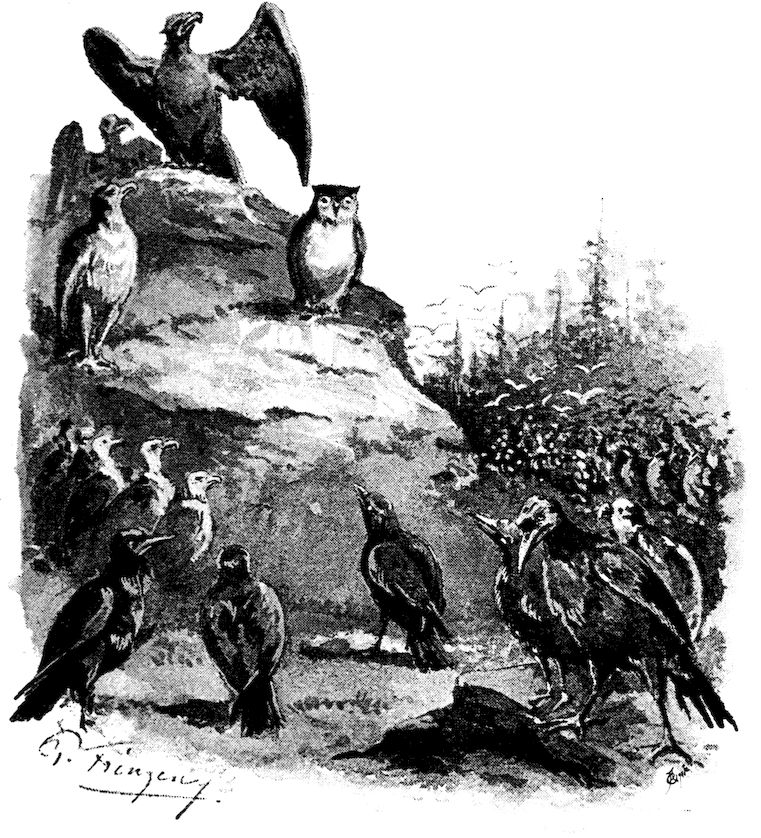
Then the nightingale began his song, and made a mess of 344it from the very first note. He sang of the joy of the flunkey hearing that God has sent him a master; he sang of the magnanimity of Eagles, and of their liberality in tipping flunkeys.... But, however desperately he tried to pitch his voice in the true flunkey tone, the art that dwelt within his breast somehow or other would not be controlled. He himself was a flunkey from beak to tail (he had even got hold, somehow, of a second-hand white cravat, and had ruffled up the feathers on his little head into a hairdresser’s curl), but his art refused to be confined within flunkeyish bounds, and kept on bursting forth in spite of all his efforts. It wasn’t any use for him to sing; he could not give satisfaction anyhow.
“What’s that booby droning about?” cried the Eagle; “call Trediakòvsky!”
Vasìli Kirìlych was quite in his element. He chose just the same toadyish subjects, but gave so clear an exposition of them that the Eagle kept on all the time repeating—
“Exactly so! Exactly so!”
When the competition was over, the Eagle hung upon Trediakòvsky’s neck a chain of ants’ eggs, and flashed his eyes at the nightingale, exclaiming—
“Take away that scoundrel!”
Thus ended the nightingale’s, ambitious dreams. He was quickly hustled into a hen-coop and sold out of the way to the tavern “Parting Friends,” where, to this day, he fills with sweet poison the hearts of tipsy “meteors.”
Nevertheless, the work of public instruction was not abandoned. The fledgling vultures and falcons attended the gymnasium regularly; the Academy of Science began to publish a dictionary, and got half through the letter A; the woodpecker finished the tenth volume of “The History of Bogies.” The robin, however, kept very quiet. From the first day he had felt an instinctive conviction that all this 345educational rage would come to a speedy and grievous end; and apparently his presentiments were well founded.
The troubles began with a grave mistake on the part of the owl and falcon, who had accepted the management of the work of education: they took it into their heads to teach the Eagle himself to read and write. They taught him upon the easy and agreeable phonetic system; but, notwithstanding all their efforts, after a whole year’s training, instead of “Eagle,” he signed his name “Agull”; the result of which was that he could not get a single respectable financier to accept his bonds. The owl and falcon also made another great mistake: like all pedagogues, they never gave their pupil any peace. Every minute of the day the owl would follow at the poor Eagle’s heels, screaming out, “B-b-b-b; Z-z-z; D-d-d; K-k-k;” while the falcon as incessantly dinned into his ears that it is impossible to divide the prey one has caught without knowing the first four rules of arithmetic.
“Suppose you have stolen ten goslings, of which you have given two to the police-inspector’s clerk, and eaten one yourself, how many have you left?” asked the falcon, in a reproachful voice.
The Eagle was not able to work this problem, so he remained silent; but anger against the falcon burned in his heart more and more fiercely with every day.
All this resulted in a condition of general tension, which was at once taken advantage of by intriguing adventurers. The ringleader of the conspiracy was the kite; he enticed over the cuckoo, who took to whispering in the ear of the female Eagle—
“They are simply killing our dear master with their learning.”
Whereupon the female Eagle began ironically calling her mate “Wiseacre! Wiseacre!” The conspirators next turned their energies to the business of arousing “evil passions” in the vulture.
346One morning, just at dawn, and while the Eagle was still sleepily rubbing his eyes, the owl, as usual, slipped behind him and began her eternal buzzing in his ear—
“V-v-v.... Z-z-z.... R-r-r——”
“Oh! go away, you awful bore!” murmured the Eagle, wearily.
“Be so good, your worship, as to repeat B-b-b.... K-k-k.... M-m-m——”
“I tell you, for the second time, go away!”
“P-p-p.... H-h-h.... Sh-sh-sh——”
“For the third time, go away!”
“S-s-s.... F-f-f.... J-j-j——”
With the quickness of lightning the Eagle turned upon the owl and tore her in pieces. An hour later the falcon, knowing nothing of what had happened, returned from the morning hunt.
“Here is a problem for you,” said he. “We have brought back 60 lbs. of game. Now, suppose we divide the game into two equal parts, one half for you and the other half for the remainder of the establishment, how much of the 60 lbs. will fall to your share?”
“All of it,” replied the Eagle.
“No, no; answer properly,” persisted the falcon. “If it had been “all,” I shouldn’t have asked you!”
It was not the first time that he had set his pupil such problems; but on this occasion the tone in which the question was asked struck the Eagle as quite intolerable. All his blood boiled at the thought that, when he said “all,” his slave should dare to answer “not all.” Now, it is a well-known peculiarity of Eagles that, when their blood begins to boil, they become incapable of distinguishing pedagogical disquisitions from revolution. The Eagle acted accordingly.
Nevertheless, after finishing up the falcon, the Eagle announced—
347“The Scientific ’Cademy is to stop as it is.”
The choir of starlings once more repeated their hymn, “Let our youth be fed with science.” But it was already plain to every one that the “Golden Age” was drawing to its close. In the near future darkness and ignorance were at hand, with their inevitable train—civil war and general confusion.
The disturbances began with the competition of two candidates for the post of the defunct falcon—the vulture and the kite. As the attention of the two rivals was absorbed exclusively in their personal interest, the affairs of the establishment were to some extent shoved aside and gradually fell into a neglected condition. In a month there remained not a trace of the “Golden Age.” The starlings had grown lazy; the corn-crakes played all out of tune; the white-feathered magpie took to stealing right and left; and the rooks got so hopelessly behindhand with the taxes that there was nothing for it but an “execution.”[62] Matters went so far that the servants began to bring the Eagle and his mate bad meat for dinner.
In order to exculpate themselves from responsibility in all this mismanagement, the vulture and the kite, for the moment, played into each other’s claws, and threw all the blame upon education.
“Science,” said they, “is undoubtedly a useful thing, but only under the right conditions. Our ancestors,” said they, “managed to live without any science; and we can do the same.”
And, to prove that all the troubles came from science, they set to work to hunt up conspiracies, and particularly conspiracies in which some book, if only a prayer-book, was concerned. There began a perfect rain of searches, police-investigations, and trials.
348“Drop it!” suddenly rang through the aerial heights.
It was the Eagle who said that. The process of education broke off short. Throughout the whole establishment there reigned such dead silence that one could even hear the whispers of slander creeping along the earth.
The first victim of the new tendency of affairs was the woodpecker. Indeed, indeed the poor bird was not guilty; but he knew how to read and write, and that was quite sufficient ground for an accusation.
“Do you know the rules of punctuation?”
“Not only the rules of ordinary punctuation, but even those for extra signs, such as quotation marks, hyphens, parentheses; on my conscience, I always put them right.”
“And can you distinguish the feminine from the masculine gender?”
“I can. I should not make a mistake, even by night.”
And that was all. The woodpecker was chained and placed in solitary confinement for life in a hollow tree. On the next day, being devoured by ants, he gave up the ghost in his prison. His sorrows were hardly over when the thunderbolt fell on the Academy of Science.
The owls and night-jars, however, defended themselves sturdily; they did not wish to be evicted from their cosy free quarters. They said that they followed scientific pursuits, not in order to popularise science, but to protect it from the evil eye. But the kite instantly demolished their arguments by asking—
“What’s the use of having science at all?”
This being an unexpected question, they could give no answer. They were then separated and sold to market-gardeners, who killed and stuffed them and set them up in their nurseries for scarecrows. The farthing alphabets were next taken away from the baby rooks, and mashed up in a mortar, to form a homogeneous mass of pulp, which was then made into playing-cards.
349Matters grew worse and worse. After the owls and the night-jars came the turn of the starlings; then the corn-crakes, parrots, and finches. Even the deaf heath-cock was suspected of “a certain way of thinking,” on the ground that he held his tongue all day and slept all night.
The staff of the establishment gradually dwindled away. At last there was no one left to serve the Eagle and his mate but the vulture and the kite. In the background there remained, of course, a crowd of rooks, who multiplied at a pace that was perfectly disgraceful; and the faster they multiplied the more their arrears of taxes accumulated.
Finally the kite and vulture, having no one else to intrigue against (of course you don’t count the vulgar rooks), began to intrigue one against the other; and all on the ground of science. The vulture denounced the kite as reading the prayer-book in secret; and the kite invented against the vulture the slander that he kept the “New Song-Book” hidden in a hollow tree.
The Eagle began to grow uneasy.
But just at this moment an extraordinary thing happened. Finding themselves left without supervision, the rooks suddenly raised the question—
“By the by, what did the farthing alphabet say about all this?”
And, without stopping to remember clearly what was said, they all left their nests in a body and flew away.
The Eagle started off to pursue them, but it was no use; the indolent life he had been living had so enervated him that he could hardly flap his wings.
He returned to his mate, and uttered these words of wisdom—
“Be this a lesson to Eagles!”
But in what exactly the “lesson” consisted—whether it were that education is injurious to Eagles, or that Eagles are injurious to education, or, finally, that each is injurious to the other—that he never explained.
THE WALTER SCOTT PRESS, NEWCASTLE-ON-TYNE.
PROSPECTUS.
LIBRARY
OF
HUMOUR.
London: Walter Scott, Ltd., Paternoster Square.
SPECIMEN ILLUSTRATION
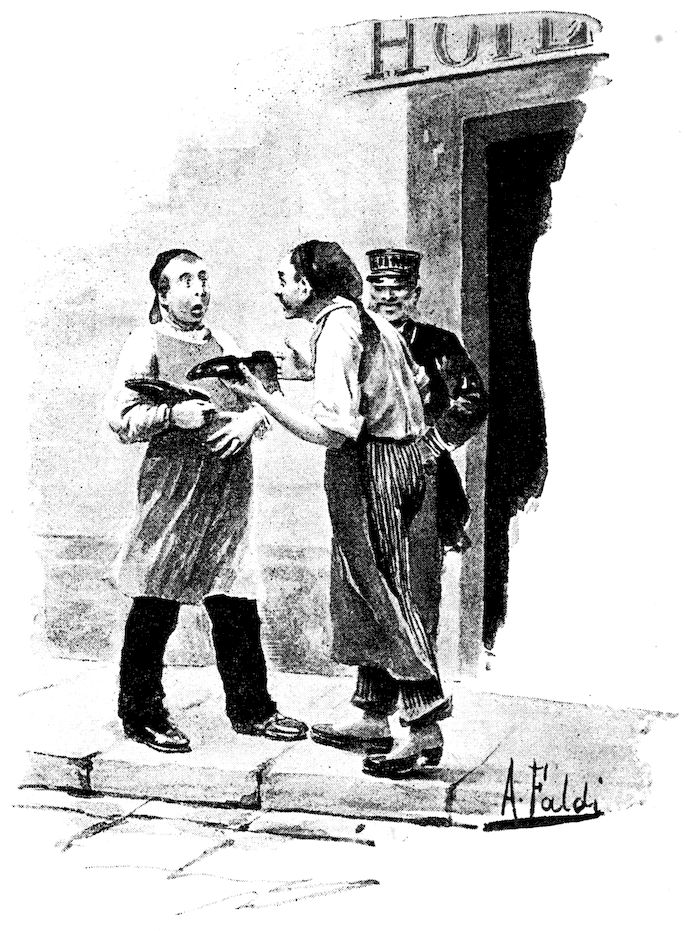
WHEN GREEK MEETS GREEK.
“The books are delightful in every way, and are notable for the high standard of taste and the excellent judgment that characterise their editing, as well as for the brilliancy of the literature that they contain.”—Boston (U.S.A.) Gazette.
LIBRARY OF HUMOUR
Copiously Illustrated.
Cloth Elegant, Large Crown 8vo, Price 3s. 6d. per Vol.
Each volume deals with the humour of the literature of a particular nation, the aim in making the various selections being to produce volumes as representative as possible in each case of the particular national humour, as it appears throughout the literature dealt with.
Illustrations to the different volumes by Dudley Hardy, H. R. Millar, C. E. Brock, Arturo Faldi, Paul Frénzeny, Oliver Paque, etc.
SPECIMEN ILLUSTRATION.
(FROM THE HUMOUR OF FRANCE.)
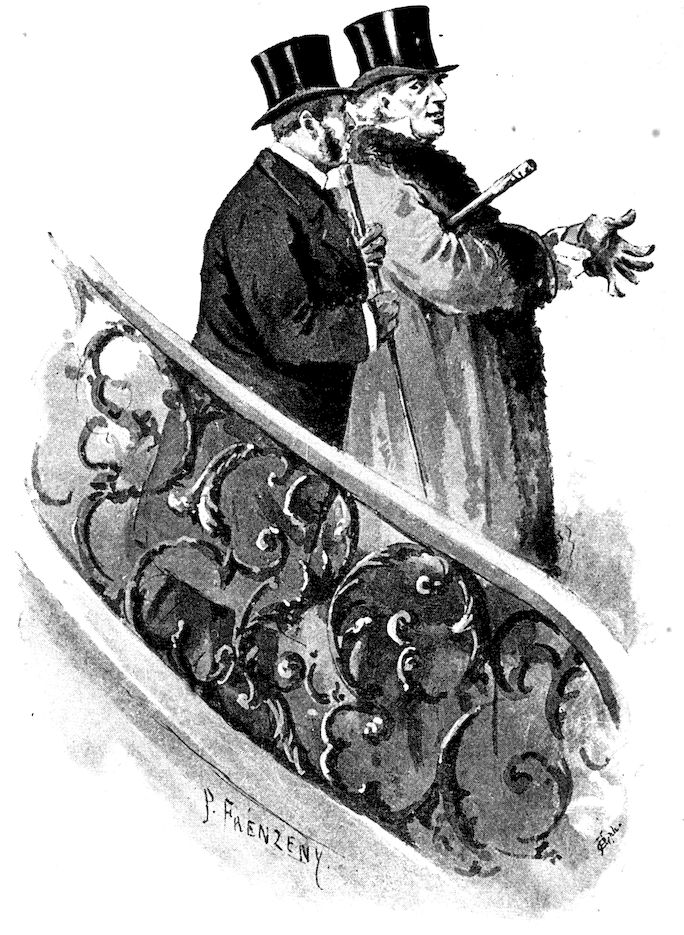
DOCTOR DECHAR: “AND YET YOU DECLARED THE OPERATION MUST BE DONE?” DOCTOR RAPPASS: “OF COURSE. YOU MUST ALWAYS OPERATE.”
THE HUMOUR OF FRANCE.
Selected and Translated, with Introduction and Biographical Index, by Elizabeth Lee. With 70 Illustrations by Paul Frénzeny.
“From Villon to Paul Verlaine, from dateless fabliaux to newspapers fresh from the kiosk, we have a tremendous range of selections.”—Birmingham Daily Gazette.
“The work of translation has been well done, and the book sparkles from beginning to end.”—Globe.
“Miss Lee has compiled a very entertaining volume, traversing the whole world of French literature from the thirteenth to the nineteenth centuries gleaning from novelists, dramatists, poets, essayists, writers of fabliaux, newspapers. The result is a very readable and amusing volume.”—Birmingham Post.
“A most agreeable and entertaining volume.”—Scottish Leader.
“There is not a dull page in the volume from beginning to end, is a piece of praise too often lavished on a book by the indolent, unconscientious, or over tender-hearted reviewer; nevertheless, at the risk of ranking ourselves with him, we will make that assertion concerning these specimens of ‘The Humour of France.’”—St. James’s Gazette.
SPECIMEN ILLUSTRATION.
(FROM THE HUMOUR OF GERMANY.)
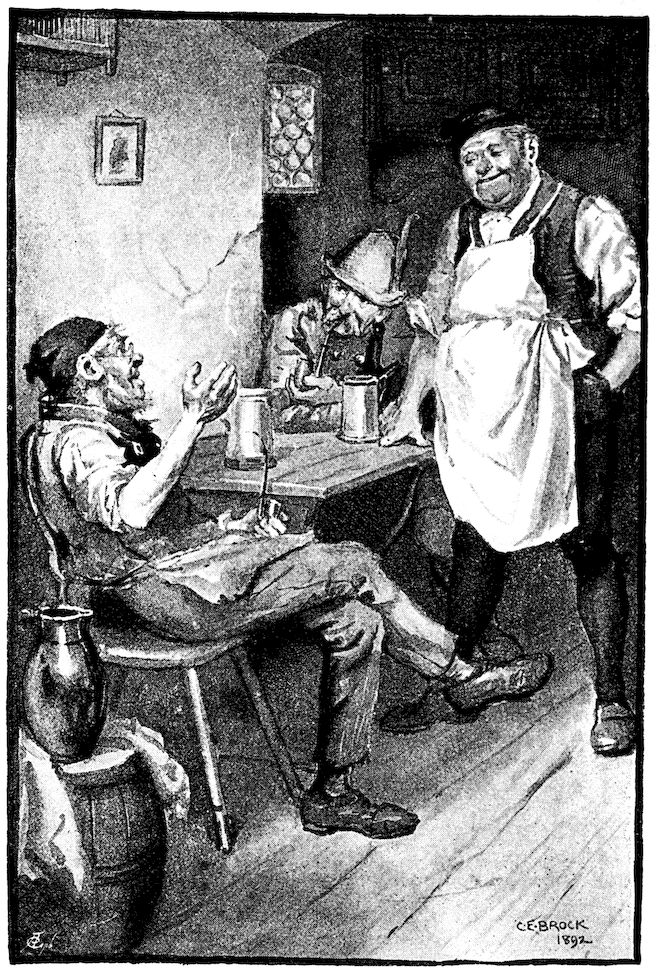
“HE WAS TOO FOND OF DELIVERING LONG SPEECHES AT THE ALEHOUSE.”
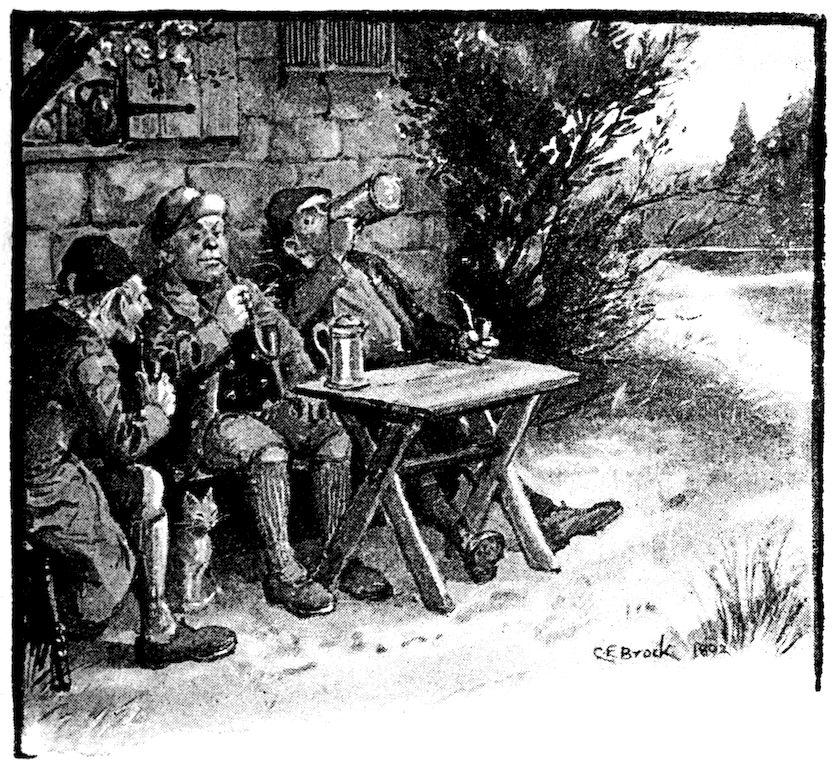
“SIT THE GOOD TOWNSPEOPLE OF A SUMMER EVENING.”
THE HUMOUR OF GERMANY.
Selected and Translated, with Introduction and Biographical Index, by Hans Müller-Casenov. With 60 Illustrations by C. E. Brock.
“It is an excellently representative volume, comprising selections from all the best writers in the humoristic vein, whether high or low German. Of course Heinrich Heine figures largely, and in addition are capital extracts from Hauff, Zschokke, Ludwig Tieck, Chamisso, Fritz Reuter, and others.”—Daily Telegraph.
“Can be recommended to all in quest of amusing literature. The illustrations are delightful.”—Literary World.
“The book throws eloquent and entertaining side-lights upon the characteristics of the German people. The text is amply and aptly illustrated.”—Manchester Examiner.
“One of the brightest books that has come to this country.”—Boston (U.S.A.) Herald.
“The reader may feel assured of having quite a treasury of novelty in each volume of this beautiful series as it appears.”—Liverpool Mercury.
SPECIMEN ILLUSTRATION.
(FROM THE HUMOUR OF ITALY.)
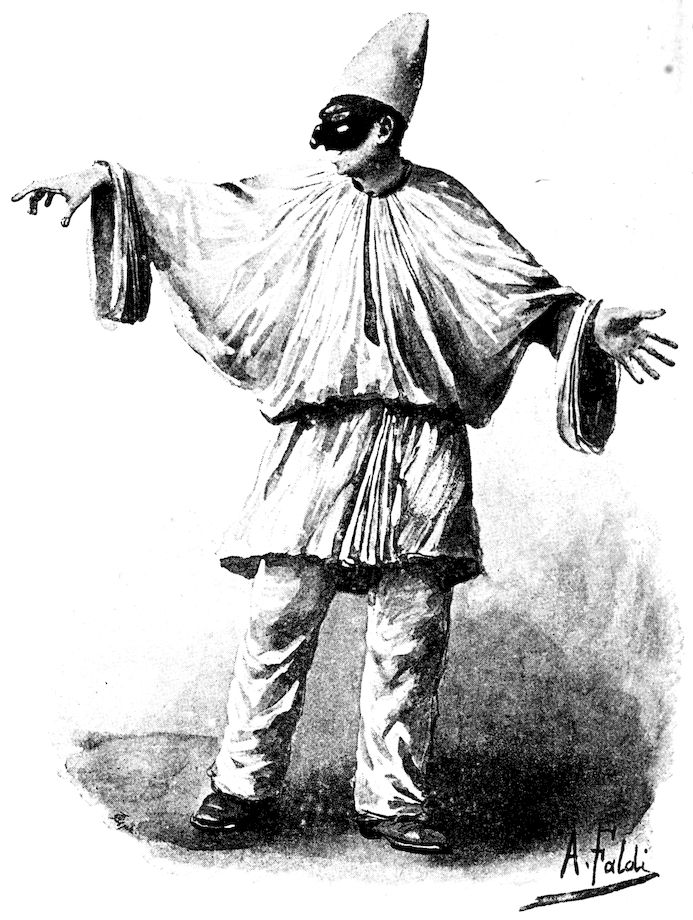
PULCINELLA’S DUEL.
THE HUMOUR OF ITALY.
Selected and Translated, with Introduction, Biographical Index, and Notes, by A. Werner. With 55 Illustrations by Arturo Faldi.
“Modern Italian light literature is very rich, and those who cannot read the language easily, and yet would like to obtain some notion of what contemporary Italian writers are doing, cannot do better than turn to these pages.... Will reveal to English readers a whole new world of literature.”—Athenæum.
“The book contains some delightful modern short stories and sketches. We may particularly mention those by Verga, Capuana, and De Amicis.”—Literary World.
“Most readers will think that it affords ample proof of the abundance of genuine wit in the Italian literature of the nineteenth century. It has plenty of capital stories, and the man who is not tickled by Capuana’s ‘Rival Earthquakes,’ or Castelnuovo’s ‘Theorem of Pythagoras,’ can have little sense of the ridiculous.”—Morning Post.
SPECIMEN ILLUSTRATION.
(FROM THE HUMOUR OF AMERICA.)
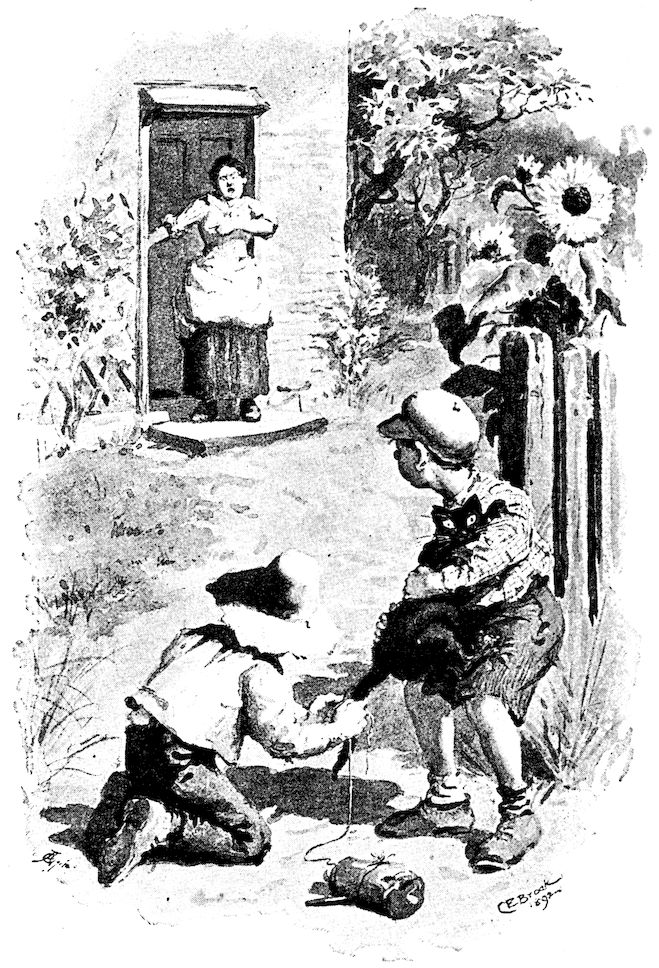
“SHE SHRILLY OBSERVES, THOMAS JEFFERSON, COME RIGHT INTO THE HOUSE THIS MINIT.”
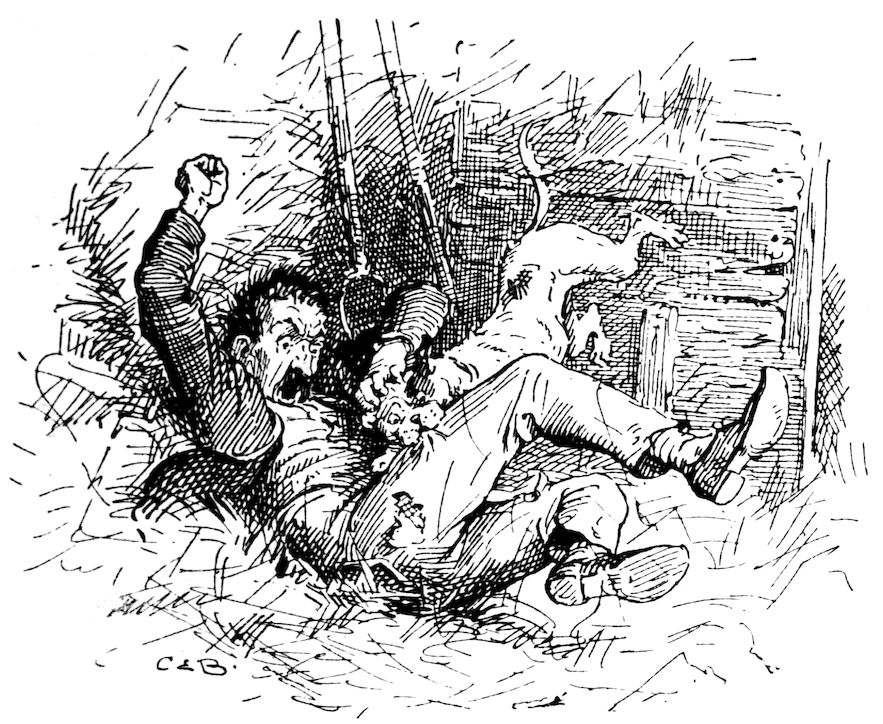
“KOSCIUSKO AND I FROLICKED AROUND.”
THE HUMOUR OF AMERICA.
Selected by James Barr. With an Introduction and a Comprehensive Biographical Index of American Humorists. Eighty Illustrations by Charles E. Brock.
“Certainly these 462 pages of queer stories and good illustrations are as exceptional for amusing narration as they are for excellence of printing and binding.”—Liverpool Mercury.
“Sparkles and ripples with good things.”—Manchester Examiner.
“Mr. Barr has made his volume as representative as it could well be, and it would be difficult to mention any American writer having a claim to be considered a humorist, who has not had that claim recognised.”—Glasgow Herald.
“The selection is judiciously made, and displays a catholic taste.... The book is a really representative collection of humour, and what passes for humour, in America.”—The Academy.
SPECIMEN ILLUSTRATION.
(FROM THE HUMOUR OF HOLLAND.)
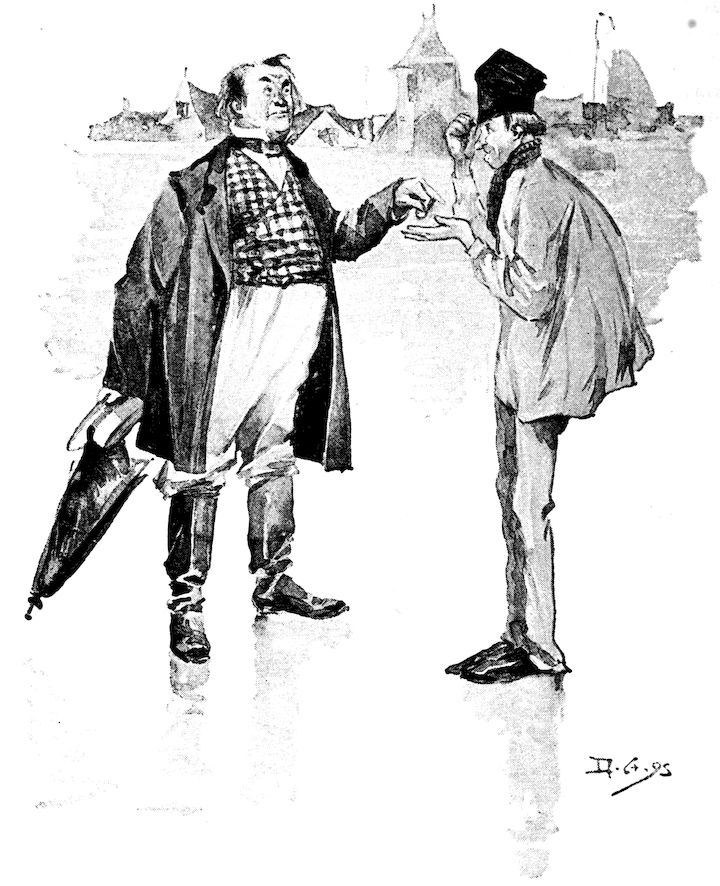
“AND HE WAS QUITE SATISFIED.”
THE HUMOUR OF HOLLAND.
Translated, with an Introduction and Notes, by A. Werner. With numerous Illustrations by Dudley Hardy.
“Apart from the quality of humour, one is much struck by the evidence that in Holland during the present day there is a genial literature, of which we know nothing at all.”—Bookman.
“There are some quite irresistible pieces in the volume. The illustrations are excellent, and the whole style in which the book is produced reflects credit on the publishers.”—British Weekly.
“There are really good things in the book—things of quaint or pretty fancy, things of strong or subtle satire.... Even Mark Twain, in ‘Tom Sawyer’ and ‘Huck Finn’ does not show a finer knowledge of the humours of imaginative boyhood than is displayed by Conrad van der Liede in ‘My Hero.’”—Daily Chronicle.
“The new humour has grown wearisomely old, but here is something to again stimulate.”—The Graphic.
“Interesting sketches of life and manners.”—Daily News.
“The pictures are numerous and good, the dramatic literature of the people is well represented, and the work altogether is so truly excellent that it will always be in season.”—Liverpool Mercury.
“Those who wish to compare the humour of several countries must needs have in their possession such a rich storehouse as this is of the Humour of Holland.”—Irish Times.
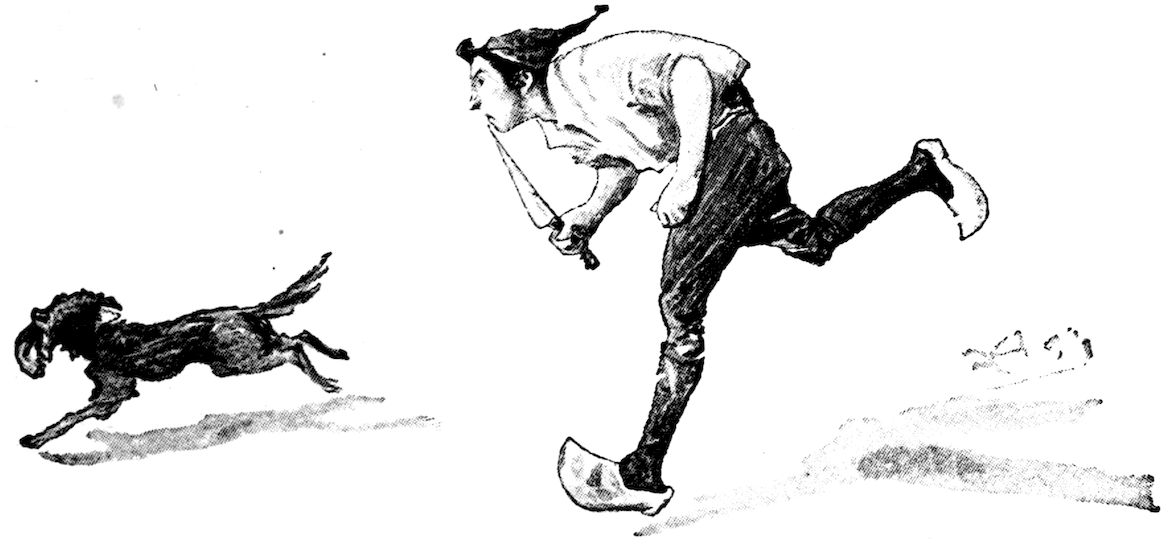
“KAPBLOK, THE BUTCHER’S MAN.”
SPECIMEN. (FROM THE HUMOUR OF IRELAND.)
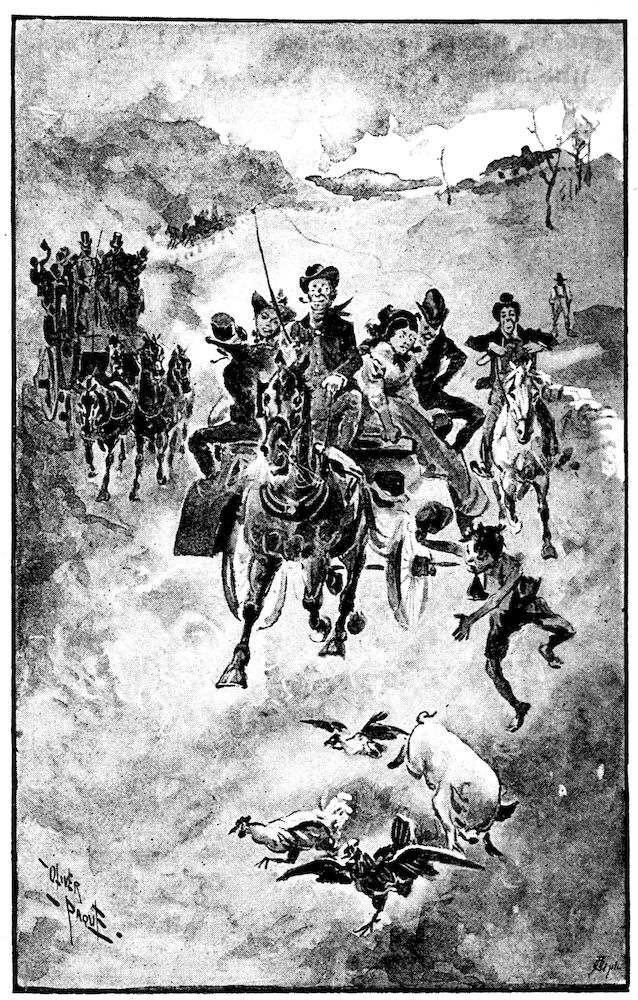
LIBRARY OF HUMOUR
Cloth Elegant, Large Crown 8vo, Price 3/6 per vol.
VOLUMES ALREADY ISSUED.
THE HUMOUR OF FRANCE. Translated, with an Introduction and Notes, by Elizabeth Lee. With numerous Illustrations by Paul Frénzeny.
THE HUMOUR OF GERMANY. Translated, with an Introduction and Notes, by Hans Müller-Casenov. With numerous Illustrations by C. E. Brock.
THE HUMOUR OF ITALY. Translated, with an Introduction and Notes, by A. Werner. With 50 Illustrations and a Frontispiece by Arturo Faldi.
THE HUMOUR OF AMERICA. Selected with a copious Biographical Index of American Humorists, by James Barr.
THE HUMOUR OF HOLLAND. Translated, with an Introduction and Notes, by A. Werner. With numerous Illustrations by Dudley Hardy.
THE HUMOUR OF IRELAND. Selected by D. J. O’Donoghue. With numerous Illustrations by Oliver Paque.
THE HUMOUR OF SPAIN. Translated, with an Introduction and Notes, by S. Taylor. With numerous Illustrations by H. R. Millar.
THE HUMOUR OF RUSSIA. Translated, with Notes, by E. L. Boole, and an Introduction by Stepniak. With 50 Illustrations by Paul Frénzeny.
THE HUMOUR OF JAPAN. Translated, with an Introduction, by A. M. With Illustrations by George Bigot (from Drawings made in Japan). [In preparation.
London: Walter Scott, Limited, Paternoster Square.
SPECIMEN. (FROM THE HUMOUR OF SPAIN.)
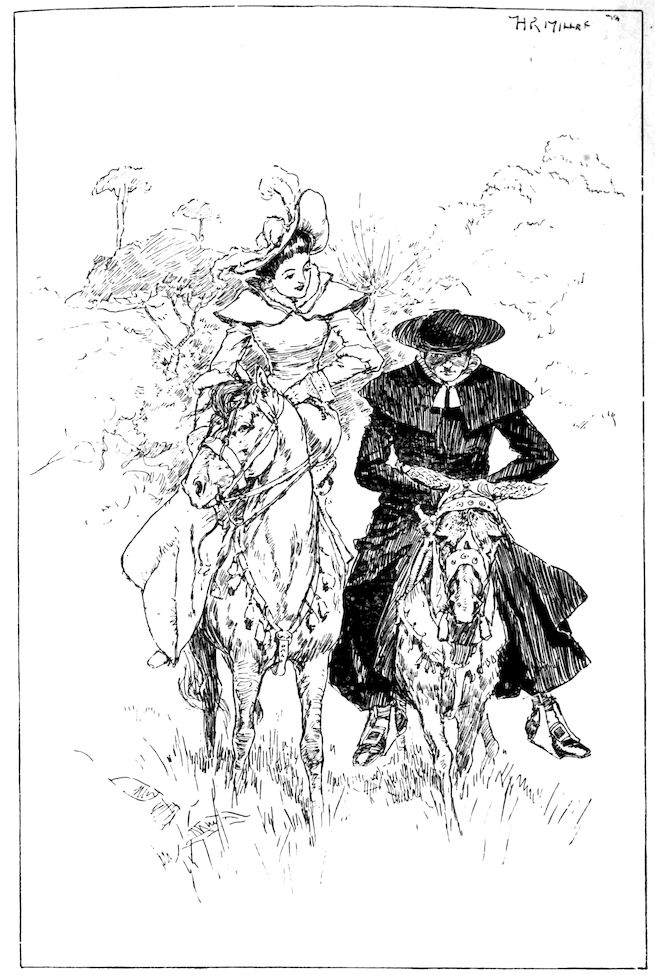
PEPITA AND THE YOUNG PRIEST.
TRANSCRIBER’S NOTES
Silently corrected obvious typographical errors and variations in spelling.
Retained archaic, non-standard, and uncertain spellings as printed.
Re-indexed footnotes using numbers and collected together at the end of the last chapter.