Act 1 — Scene II.
E. L. (Ethel Lillian) Voynich translation
(A room in Agàfia Tikhònovna’s house. Agàfia Tikhònovna spreading cards for fortune-telling, Arìna Pantelèymovna looking over her shoulder.)
Agàfia. Why, auntie! there’s a journey again! Some king of diamonds takes an interest in me; then there are tears, and a love-letter; on the left-hand side the king of clubs expresses great sympathy—but there’s a wicked woman that stands between.
Arìna. Whom do you think the king of clubs stands for?
Agàfia. I don’t know.
Arìna. I know who it is.
Agàfia. Who?
Arìna. A good, honest cloth merchant, my girl—Alexièy Dmìtrievich Starikòv.
Agàfia. That I know it isn’t; I’m positive it isn’t he.
Arìna. You can’t get out of it, Agàfia Tikhònovna; I can tell by the fair hair. There’s only one king of clubs, you see.
Agàfia. Then you’re just wrong; the king of clubs here means a nobleman—there’s a good deal of difference between a tradesman and a king of clubs.
Arìna. Ah! Agàfia Tikhònovna! you wouldn’t talk like that, my girl, if your poor papa, Tìkhon Pantlèymònovich, were alive. I remember how he used to bang his fist on the table and shout out—“I don’t care a rap for any man that’s ashamed to be a merchant; and I won’t give my daughter to an officer. Other people can do that if they’re fools enough! And my son shan’t be an 16officer, neither,” says he; “isn’t a merchant as good a servant of the State as any one else?” And he’d bang his fist on the table again, and, my girl, he had got a fist of his own! Indeed, if the truth must be told, your poor mother would have lived longer if he hadn’t had such a heavy fist.
Agàfia. There you see! And you think I’d put up with such a brute of a husband? I won’t marry a merchant for anything in the world!
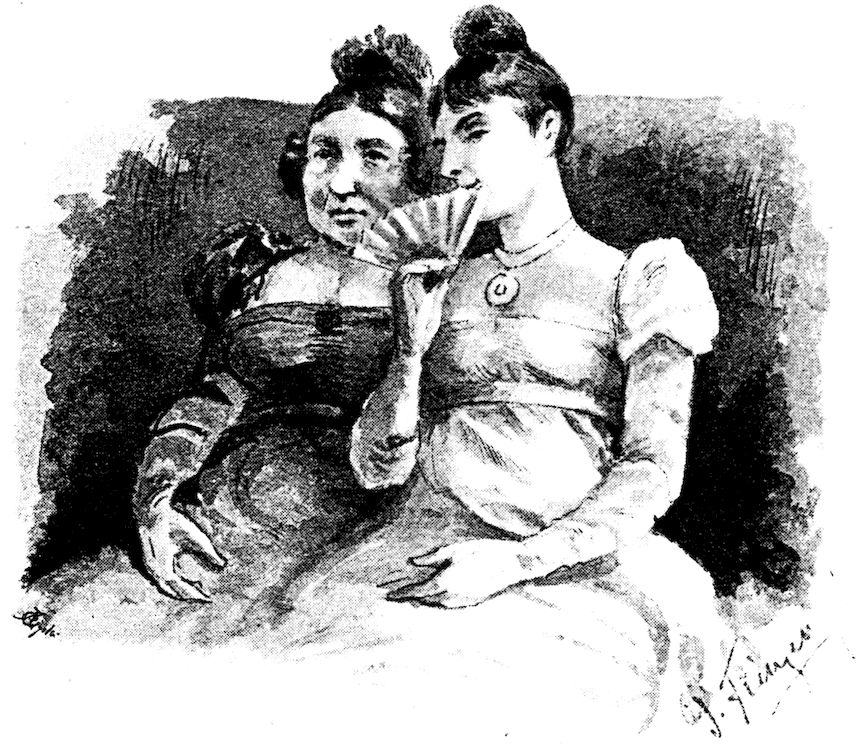
ARÌNA: “BUT WHERE ARE YOU GOING TO GET HOLD OF ANY NOBLE THAT’S WORTH HAVING?”
Arìna. But Alexièy Dmìtrievich isn’t one of that kind.
Agàfia. No, no! not for the world! He’s got a beard! And when he eats soup, it’ll all run down his beard. No, no, no! I won’t, I won’t!
Arìna. But where are you going to get hold of any 17noble that’s worth having? You can’t go and pick him up in the street!
Agàfia. Fèkla Ivànovna will find me one; she promised to find me a splendid one.
Arìna. But, my precious one, she’s a liar.
(Enter Fèkla.)
Fèkla. Oh no, Arìna Pantelèymovna; it’s a sin to give people a bad name for nothing.
Agàfia. Ah! Fèkla Ivànovna! Now then, tell me quick, have you found any one?
Fèkla. Yes, yes; only don’t hurry me. I’ve been tearing about so—let me get my breath! I’ve been all over everywhere on your business—at the Departments, at the Ministries, running all over the place.... Why, do you know, little mother, I nearly got beaten on your account—it’s true! That old woman that arranged the Afèrov’s marriage—you know—she just flew at me. “What are you after here?” says she, “taking the bread out of other people’s mouths. Keep to your own quarter!” says she. And I told her right out, “I’ll do anything for my young lady,” says I, “so you needn’t put yourself out about it.” However, I don’t mind the trouble; I’ve got you a fine set of suitors. I can tell you there never were such fine ones since the world began, and never will be. Some of them will come to-day—that’s why I ran in to tell you.
Agàfia. To-day! Oh, Fèkla Ivànovna, I’m afraid!
Fèkla. There’s nothing to be afraid of, little mother. It’s a thing that’s got to be. They’ll only come and take a look at you—nothing more. Then you can take a look at them, and if you don’t like them they can go away.
Arìna. I hope you are bringing good, respectable gentlemen?
Agàfia. And how many are there?
18Fèkla. Let me see—there are six of them.
Agàfia (screams). Oh!
Fèkla. Dear heart, you needn’t jump like that! It’s best to have a choice; if you don’t like one you can take another.
Agàfia. Are they of noble birth?
Fèkla. Every one! The very noblest birth that ever was.
Agàfia. Well, what are they like?
Fèkla. Oh, regular good ones—nice and neat, all of them. First there’s Baltazàr Baltazàrovich Zhevàkin—a splendid gentleman—he used to serve in the fleet—he would just do nicely for you. He wants a wife with a nice plump figure—he hates bony women. Then there’s Ivàn Pàvlovich—he’s a Court usher, and such a grand gentleman, that one’s afraid to go near him. Big and stout, you know; just grand to look at. And you should have heard him shout at me—“I don’t want to hear any nonsense about what the girl’s like; just tell me plainly how much moveable and real estate she’s got.”—“So much and so much, little father.”—“That’s a lie, you old hag!” and, a—a—he said another word, little mother, that I don’t quite like to repeat. I saw in a minute that he must be a real grand gentleman!
Agàfia. Well, and who else is there?
Fèkla. Then there’s Nikanòr Ivànovich Anoùchkin—he’s a nice, fair, pretty gentleman; and oh! little mother, such sweet lips, like cherries! “All I want,” says he, “is that my bride should be pretty and refined; and that she should be able to talk French.” He’s a gentleman with a lot of breeding, and all sorts of fine Frenchified ways. Oh! he’s mighty particular! And he’s got such slim little legs.
Agàfia. N—n—no; somehow or other these overparticular people ... I don’t know ... I can’t see anything much in them
19Fèkla. Well, if you want a more solid husband, you’d better take Ivàn Pàvlovich; you couldn’t make a better choice; he’s a gentleman ... what you may call a real gentleman; he could hardly get in at that door, he’s so big and grand.
Agàfia. And how old is he?
Fèkla. Oh! he’s a young man still—about fifty, or not quite fifty even.
Agàfia. And what’s his name?
Fèkla. Ivàn Pàvlovich Yaìchnitza.[4]
Agàfia. Do you mean to say that’s a name?
Fèkla. Of course it’s a name.
Agàfia. Goodness gracious! What a funny name! Why, Fèkloushka, supposing I were to marry him, I should have to be called Agàfia Tikhònovna Yaìchnitza—it sounds like I don’t know what!
Fèkla. Eh-h-h! little mother; there are such names in Russia, that all you can do when you hear them is to spit and cross yourself. But if you don’t like the name you may as well take Baltazàr Baltazàrovich Zhevàkin—he’d be a fine bridegroom.
Agàfia. What sort of hair has he got?
Fèkla. Very nice hair.
Agàfia. And his nose?
Fèkla. H-m-m ... his nose is all right; everything’s in its right place, and he’s a very nice gentleman. Only you musn’t mind one thing: there’s no furniture in his rooms, only a pipe and nothing else at all.
Agàfia. And who else is there?
Fèkla. Àkinf Stepánovich Pantelèyev—he’s an official, a titular counsellor.[5] He stutters a little; but then he’s such a very modest gentleman.
Arìna. You always keep on “official” and “official” you’d better tell us whether he doesn’t drink.
20Fèkla. Yes, he does drink; I wouldn’t tell you a lie—he drinks. But then, you see, he’s a titular counsellor. And then he’s so quiet and gentle.
Agàfia. No, no; I don’t want to have a drunkard for a husband.
Fèkla. As you like, little mother. If you don’t care for one you can take another. But after all, what does it matter if a man takes a drop too much sometimes? He’s not drunk the whole week round, you know; some days he’ll come home sober.
Agàfia. And who else is there?
Fèkla. There is one more, only he’s not quite the sort.... Never mind him, the others will do better.
Agàfia. Well, but who is he?
Fèkla. Really, it’s not worth while talking about him. He’s in a good position—aulic counsellor and all that—but such a slow stick-in-the-mud, there’s no getting him out of the house.
Agàfia. Well, and who else? You have only told us about five, and you said there were six.
Fèkla. Surely you don’t want any more? Why, a minute ago you were frightened at so many, and now they’re not enough!
Arìna. What’s the use of all your noblemen? Even if you have got half a dozen of them, one shopkeeper’s worth the whole lot.
Fèkla. Oh, no, Arìna Pantelèymovna, a noble is more distinguished, somehow.
Arìna. What’s the use of being distinguished? Just look at Alexièy Dmìtrievich—what a beautiful sledge he can drive in, and his cap is real sable!...
Fèkla. Yes, but a nobleman with epaulettes on can drive past and call out, “Out of the road, counterjumper!” or, “Show me your best velvet, shopman!” and then the merchant will have to say, “Certainly, little father!” and 21the nobleman will say, “Take off your hat, you clown!” That’s what he’ll say.
Arìna. And if the merchant likes, he won’t give him the stuff; and there’s your nobleman in rags without a thing to put on.
Fèkla. Then the nobleman will give the shopkeeper a black eye.
Arìna. Well then, the shopkeeper will go and complain to the police.
Fèkla. Then the nobleman will complain to the senator.
Arìna. And the merchant to the governor.
Fèkla. And the nobleman——
Arìna. Fiddlesticks! Fiddlesticks! You and your noblemen! The governor’s grander than any senator! You’re just off your head about noblemen! Don’t tell me—a nobleman can take off his hat as well as any shopkeeper, when there’s a reason why.... (Door-bell rings.) There’s some one at the door.
Fèkla. Bless me! It must be they!
Arìna. Who?
Fèkla. They.... Some of the suitors.
Agàfia (screams). Oh!
Arìna. Holy Saints! Have mercy on us sinners! The room’s in such a muddle! (Catches up all the things on the table, and runs about the room.) And the table-cloth! Just look at the table-cloth! It’s perfectly black. Douniàshka! Douniàshka! (Enter Douniàshka.) Bring a clean table-cloth—quick! (Pulls off table-cloth and rushes about the room.)
Agàfia. Oh, aunt! What shall I do? I’m half undressed!
Arìna. Little mother! Run and dress, quick! (Rushes frantically about room. Douniàshka brings table-cloth. Door-bell rings.) Run! Make haste! Say “Directly.” (Douniàshka exit, and calls without “Directly.”)
22Agàfia. Auntie, my dress isn’t ironed!
Arìna. Oh! Merciful Heaven! Spare us! Put on another.
Fèkla (running in). What are you standing about for? Agàfia Tikhònovna! Little mother! Make haste! (Door-bell rings). There! there! he’s waiting all this time.
Arìna. Douniàshka! Let him in, and ask him to wait. (Douniàshka runs into hall and opens door. Voices without: “At home?” “At home; come in, please.” All stoop down and try to look through keyhole.)
Agàfia (screams). Oh! what a fat man!
Fèkla. He’s coming! he’s coming. (Exeunt in a headlong rush. Enter Douniàshka and Ivàn Pàvlovich Yaìchnitza.)
Doun. Wait here, please. (Exit.)
Yaìch. It’s all very well to say “Wait,” but I can’t spend much time waiting about for her; I only got a few minutes’ leave from the Department. Supposing the General were to ask, “Where’s the usher gone?” “Gone to look for a wife!” Tut, tut, tut! The general would give her what for, I know.... I may as well look through the list again. (Reads.) “Two-storied stone house.” (Looks up and examines room.) Yes! (Reads.) “Two wings—one wooden, one with stone basement.”... H’m.... The wooden one is not up to much. (Reads.) “Carriage; carved two-horse sledge, with large and small rugs.”... I daresay they’ll be only fit to break up. However, the old woman declares they’re first-rate; well, let’s suppose they are. (Reads.) “Two dozen silver spoons.”... Of course one must have silver spoons for the house.... “Two fox-fur cloaks.”... H’m.... “Four large feather-beds; two small ones.” (Compresses lips expressively.) “Twelve silk dresses; twelve cotton ditto; two dressing-jackets; two....” H’m.... those are trifles. “Under-linen; table-cloths....” All that’s 23her business. However, I shall have to verify it all. It’s very likely they’ll promise a house and carriage and all sorts of things now, and when once you’re married, you find there’s not a thing but feather-beds and pillows. (Door-bell rings; Douniàshka runs hastily through room into hall, and opens door. Voices without, “At home?” “At home.” Enter Anoùchkin and Douniàshka.)
Doun. Wait here, please; they’ll come presently. (Exit. Anoùchkin and Yaìchnitza bow to each other.)
Yaìch. Your servant, sir!
Anoùch. Have I the honour to address the papa of the charming lady of the house?
Yaìch. Certainly not, sir, I have not the pleasure of having any children.
Anoùch. Oh! I beg your pardon! I really beg your pardon!
Yaìch (aside). That man’s face looks to me very suspicious; I shouldn’t wonder if he’s come about the same business that I have. (Aloud.) You doubtless have some ... some ... business with the lady of the house?
Anòuch. N-n-no.... Oh, no! I have no business.... I just came in as I was taking a walk.
Yaìch (aside). He’s a liar! taking a walk, indeed! The scoundrel wants to get married! (Door-bell rings, Douniàshka runs through into hall and opens door. Voices without: “At home?” “At home.” Enter Zhevàkin and Douniàshka.)
Zhev. (to Douniàshka). Just give me a brush, will you, my dear? One gets so dusty in the street. And take off that cobweb, please. (Turns round.) That’s right; thank you, my dear. Just look on the other side; I fancy there’s a spider running up me. Are you sure there’s nothing on the back of my collar? Thank you, child. There! I’m sure there’s something! (Smooths coat-sleeve with his hand, and looks at Anoùchkin and Yaìchnitza.) 24It’s real English cloth. In ’95, when I was only a midshipman, and our squadron was in Sicily, I bought it and had a uniform made; in 1801, under his late Majesty, Paul Petròvich, when I was made lieutenant, the cloth was as good as new; in 1814, I went on an expedition round the world, and it only began to get a little worn at the seams; in 1815, when I retired from the service, I just had it turned; and now I’ve worn it ten years, and it looks almost new still. Thank you, my dear! My little beauty! (Kisses his hand to her, goes up to mirror, and arranges his hair.)
Anoùch. If I may take the liberty to ask, Sicily.... You were just mentioning Sicily—it is a fine country, is it not?
Zhev. Oh, beautiful! We spent thirty-four days there. I can assure you it’s a most charming place—such mountains; and the most beautiful trees ... what they call granite trees. And the loveliest Italian girls—perfect little rosebuds, ... one can hardly refrain from kissing them.
Anoùch. And are they well educated?
Zhev. Magnificently; as highly educated as any countess here. I remember, when I used to go along the street,—well, of course you know, a Russian lieutenant, epaulettes here (points to his shoulder), gold embroidery, and all that,—well, and these little black-eyed beauties,—I must tell you, they have verandahs to every house, and roofs as flat as this floor—well, you look up as you pass, and there sits a little rosebud; and of course one must keep up one’s reputation (makes a salute and waves his hand), and she just answers like that (makes gesture with his hand). Of course she’s always beautifully dressed—little silk cords, and taffeta stuff, and earrings, and all sorts of feminine trifles, ... in a word, the daintiest little sugar-plum——
Anoùch. Allow me to ask you one more question. In what language do people converse in Sicily?
Zhev. Oh, always in French, of course.
25Anoùch. And do all the young ladies speak French?
Zhev. All, without exception. You perhaps will hardly believe me; but we lived there thirty-four days, and in all that time I never heard one of them speak a single word of Russian.
Anoùch. Not a word?
Zhev. Not one. And mind, I am not speaking of the nobles, and what they call the Signors—those are their officers, you know—but just pick out any common peasant that brings loads on his head, and try him; just say: “Dai, bràtetz, khlyeba,”[6] he won’t understand—I assure you he won’t understand. But if you say in French: “Dateci del pane,” or “Portate vino,” he’ll understand you, and he’ll run and bring it at once.
Yaìch. This same Sicily must be a very interesting country, I think. You were talking about the peasants. What are they like? Do they have broad shoulders, and plough the land like our Russian peasants?
Zhev. That I can’t tell you; I didn’t notice whether they ploughed or not. But about the question of taking snuff, I can inform you that they not only smell snuff, but even put it in their mouths. The carriage of goods is very cheap there, too; you see there’s water everywhere, and gondolas ... and in the gondola there’ll sit a sweet little rosebud of an Italian girl, beautifully dressed, with the daintiest little kerchief and camisole.... There were some English officers with us—sailors like ourselves.... It seemed so strange at first; we couldn’t understand each other. But after a bit, when we got to know each other well, we began to understand all right. You just point to a bottle or a glass, you know, and the Englishman knows at once that that means “Drink;” then you put your fist up to your mouth, and just do so with your lips—“Puff, puff,” and he knows you mean “Smoke a pipe.” Indeed, I 26assure you, it’s rather an easy language; the crews got to understand each other in about three days.
Yaìch. Life must be very interesting in foreign parts. It is a great pleasure to me to become acquainted with a travelled gentleman. Allow me to ask whom I have the honour of addressing?
Zhev. Zhevàkin, retired lieutenant. Permit me, on my side, to ask with whom I have the pleasure to converse.
Yaìch. Ivàn Pàvlovich Yaìchnitza, government usher.
Zhev. (not hearing well). Thank you, I have already lunched. It’s cold weather, and I knew I had a long walk before me, so I had a marinated herring.
Yaìch. You have not quite understood me, I think; I said my name is Yaìchnitza.
Zhev. (bows). Oh! I beg your pardon; I am a little hard of hearing. I ... really ... understood you to say ... that you had lunched on an omelette.
Yaìch. Yes; it’s very unfortunate. I thought of asking the General to allow me to change my name to Yaìchnitzyn; but my friends dissuaded me; they said it would sound like Sobachi Syn.[7]
Zhev. Yes, there are such cases. All our squadron, both officers and crew, had the most extraordinary names: Pomòykin,[8] Yarỳzhkin,[9] Lieutenant Pereprèyev;[10] and there was one midshipman—a very good midshipman too—whose name was just Dỳrka;[11] it was so odd; the captain would call, “Come here, Dỳrka;” and we all of us used to tease him, and call him stop-gap, and bung-hole, and all sorts of things. (Door-bell rings, Fèkla runs across stage.)
Yaìch. Ah! Good-morning, little mother!
Zhev. Good-morning! How are you, my dear?
Anoùch. Glad to see you, little mother, Fèkla Ivànovna.
Fèkla (hurriedly). Thank you, thank you; same to you. 27(Exit into hall; opens door. Voices without: “At home?” “At home.” Then several half-inaudible words; Fèkla’s voice answers angrily: “Just you take care!” Enter Kochkaryòv, Podkolyòssin, and Fèkla.)
Koch. (to Podkolyòssin). Now just keep up your courage—that’s all that’s wanted. (Glances round, and salutes the company with a surprised expression.) (Aside.) Oho! What a lot of people! What’s the meaning of this? They can’t all be suitors. (Nudges Fèkla, and speaks to her softly.) Where did all these crows come from, eh?
Fèkla (softly). There are no crows here; they are all honest people.
Koch. (to her). There are plenty of them, but they’re precious draggletailed.
Fèkla (softly). I doubt they’ll fly better than yours, for all he’s so grand. ’Tisn’t fine feathers make fine birds.
Koch. (softly). Yes, every crow thinks her own children the fairest. (Aloud.) What’s she doing now? I suppose that door leads to her bedroom? (Approaches door.)
Fèkla. For shame! I tell you she’s dressing.
Koch. Well, dear me! there’s no harm in that! I’ll only just look in—nothing more. (Peeps through keyhole.)
Zhev. Permit me to satisfy my curiosity too!
Yaìch. Let me have one little peep.
Koch. (continuing to look). There’s nothing to be seen, gentlemen; there’s something white, but I can’t make out whether it’s a woman or a pillow. (They all crowd round door and try to peep through keyhole.)
Koch. There’s ... some one coming! (All start back. Enter Arìna Pantelèymovna and Agàfia Tikhònovna. All bow.)
Arìna. To what are we indebted for the honour of this visit?
Yaìch. I read in the newspapers that you wished to enter into a contract to supply timber; and therefore, as I 28hold the post of usher in a Government Department, I called to inquire what kind of timber you can supply, what quantity, and at what date.
Arìna. We don’t take contracts; but we are very glad to see you. Allow me to ask your name.
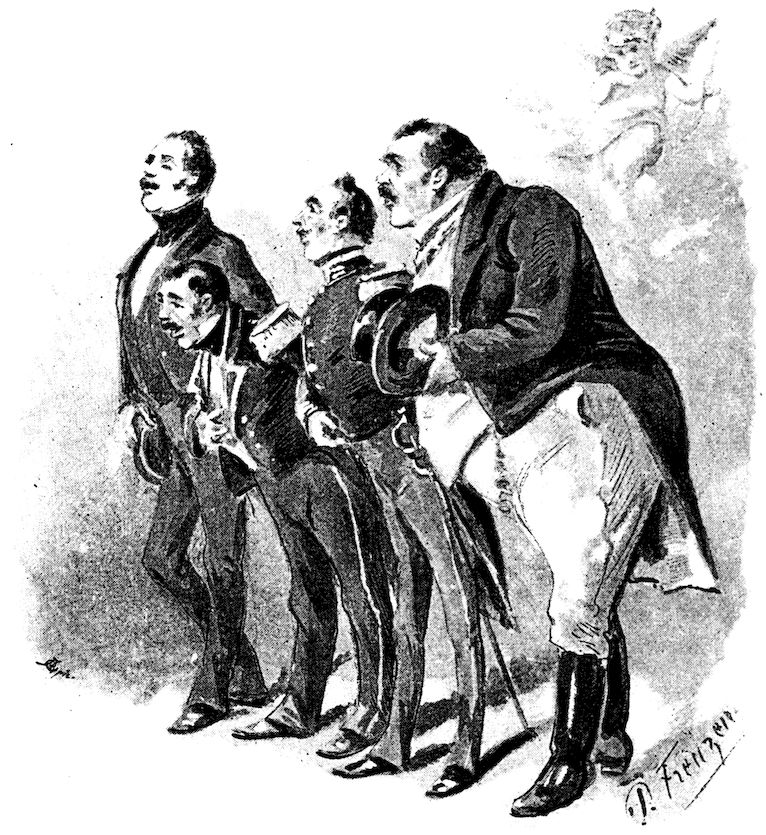
“ALL BOW.”
Yaìch. Ivàn Pàvlovich Yaìchnitza, collegiate assessor.
Arìna. Be so kind as to take a seat. (Turns to Zhevàkin and looks at him.) And may I ask——
Zhev. I ... you know ... I saw an advertisement about something.... I thought I might as well look in.... 29It’s such fine weather to-day, and the grass is growing so nicely along the road....
Arìna. And your name, if you please?
Zhev. Retired naval lieutenant Baltazàr Baltazàrovich Zhevàkin, Number 2. There was another Zhevàkin in the service, but he retired before I did; he got a wound in the knee, and the ball went through it such an odd way—it didn’t touch the knee itself, but it injured a vein, and drew it all up, so that, if you were standing near him, it always seemed as if he were going to kick you.
Arìna. Be so kind as to sit down. (To Anoùchkin.) May I ask the reason——
Anoùch. As a neighbour ... as I live so very near ... you see——
Arìna. Perhaps you live in widow Touloùbova’s house opposite?
Anoùch. No—n—no; I live at Peskì just now, but I have the intention of moving to this quarter of the town sooner or later.
Arìna. Be so kind as to sit down. (To Kochkaryòv.) Allow me to ask——
Koch. Why, surely you recognise me? (Turns to Agàfia.) And you, madam?
Agàfia. I—I—don’t remember ever seeing you.
Koch. Why, think a minute; I’m sure we’ve met somewhere.
Agàfia. I don’t know, really. Was it at the Biriòushkins’?
Koch. Of course it was!
Agàfia. Oh! do you know what’s happened to her?
Koch. Of course I do—she’s married.
Agàfia. Oh no! that would be nothing; but she’s broken her leg.
Arìna. And very badly too. She was coming home late at night in a drozhki, and the coachman was tipsy and overturned it.
30Koch. Ah! yes; I remember, of course; I knew she’d got married, or broken her leg, or something of that kind!
Arìna. And your name?
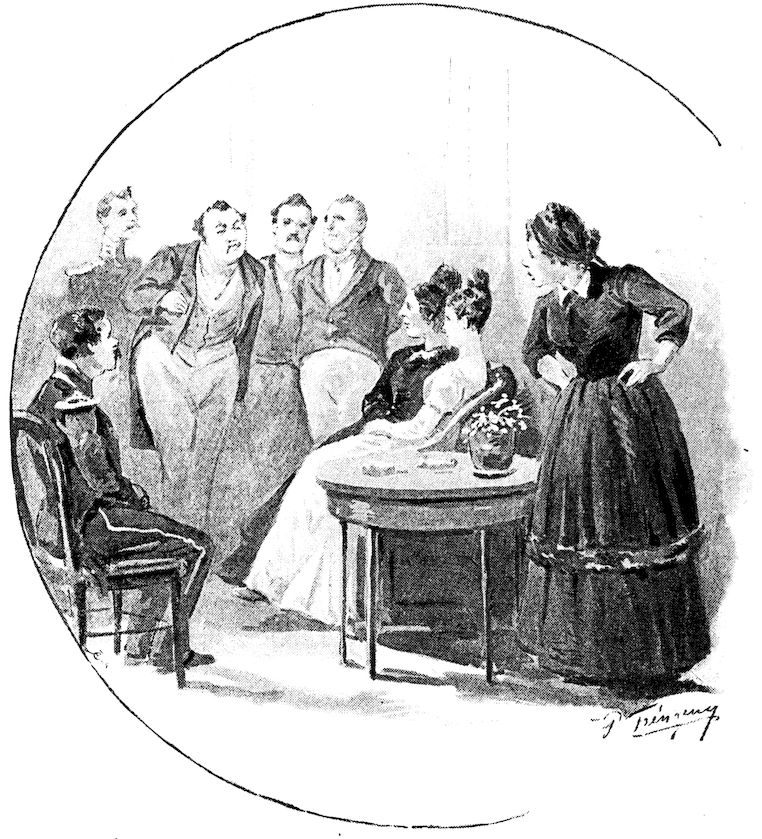
ARÌNA: “WHAT IS THE GENTLEMAN’S NAME?” KOCHKARYÒV: “PODKOLYÒSSIN—IVÀN KOUZMÌCH PODKOLYÒSSIN.”
Koch. My name? Why Ilia Fòmich Kochkaryòv. We’re almost relations, you know. My wife is always talking about—but allow me, allow me. (Takes Podkolyòssin by the arm and leads him forward.) My friend Ivàn Kouzmìch Podkolyòssin, aulic counsellor, sub-director in a Department. 31It’s he that does all the business and manages everything in the most admirable way.
Arìna. What is the gentleman’s name?
Koch. Podkolyòssin—Ivàn Kouzmìch Podkolyòssin. The director is simply put there as a figure head: all the business is done by Ivàn Kouzmìch.
Arìna. Indeed? Be so kind as to sit down.
(Enter Starikòv.)
Star. (bows to the company in a rapid, off-hand, business manner, with one arm akimbo). Arìna Pantelèymovna, how do you do, little mother? The lads on the Arcade told me that you had some wool to sell.
Agàfia (turning her back contemptuously and speaking under her breath, but so that he hears). This isn’t a stall in a bazaar!
Star. Oh, oh! Seems I’ve come at the wrong time! I doubt you’ve settled your business without me.
Arìna. Sit down, sit down, Alexièy Dmìtrievich; we’ve no wool to sell, but we’re glad to see you; please sit down. (All sit down; silence.)
Yaìch. It’s very strange weather to-day. Early in the morning it looked quite like rain, but now it seems to have gone over.
Agàfia. Yes, indeed, this weather is quite extraordinary; sometimes it’s bright, and then again it gets wet and rainy—it’s very disagreeable.
Zhev. Ah, little mother! When our squadron was in Sicily it was spring-time—with us it would be February—they have the new calendar, you know—when we went out into the street it would be quite sunny, and then it would begin to rain, and it would be just like real ordinary rain.
Yaìch. The most disagreeable thing is to sit alone in such weather. It’s all very well for a married man—that’s quite another thing—but when one lives alone it’s really——
Zhev. Oh! it’s more than any one can stand!
32Anoùch. Yes, indeed, one may say——
Koch. Oh yes, it’s altogether unbearable—life’s not worth having. Heaven defend anybody from such a position!
Yaìch. Now supposing, madam, that you were asked to choose who should be the object of your affections. Allow me to ask, what would be your taste? You will excuse my directness. What ... occupation ... do you consider ... most ... worthy of respect in a husband?
Zhev. Would you choose, madam, a husband acquainted with the storms of the ocean?
Koch. No! no! In my opinion the best sort of husband is a man who has almost the whole management of a Department in his hands.
Anoùch. Why anticipate? Why treat with contumely a man capable of appreciating the social intercourse of high-class society?
Yaìch. Madam, it is for you to decide! (Silence.)
Fèkla. Speak up, little mother! Tell them something.
Yaìch. What have you to say?
Koch. What is your opinion, Agàfia Tikhònovna?
Fèkla (aside to her). Make haste! say “Thank you,” or “With the greatest pleasure,” or something.... It’s not proper to sit like that!
Agàfia. I’m ashamed, I’m ashamed, really. I shall go away. Auntie! stop here instead of me!
Fèkla. No, no, you musn’t go away; it’s improper, it’s disgraceful. They’ll think ... I don’t know what!
Agàfia (aside). No, no, I can’t stand it, I can’t—I can’t! (Runs away. Arìna and Fèkla follow her.)
Yaìch. Well, that’s a good one—everybody’s gone away. What’s the meaning of that?
Koch. I expect something’s happened.
Zhev. Oh, no doubt it’s some little matter of feminine toilet.... They want to pin something, or to put the camisole straight, or—— (Enter Fèkla.)
33All (crowding round her). What is it? What’s the matter?
Koch. Has anything happened?
Fèkla. Of course not! What should happen?
Koch. Then why did she go away?
Fèkla. Why, you made the poor girl bashful, all of you—frightened and upset her till she couldn’t stand it. She sends you her excuses, and asks you to come in for a cup of tea in the evening. (Exit.)
Yaìch. (aside). Oh! now they’re going to begin with cups of tea! That’s what I hate about all this match-making business—it’s such a worry. To-day won’t do; and come again to-morrow; and the day after to-morrow a cup of tea; and then they have to think it over, and can’t make up their minds! But dear me! the matter’s simple enough; there’s nothing to rack one’s brains over! Confound it all! I’m a busy man, I’ve no time for this sort of thing!
Koch. (to Podkolyòssin). She’s a nice-looking girl, isn’t she?
Pod. Yes, she’s nice-looking.
Zhev. I think the young lady is pretty.
Koch. (aside). The deuce take it, if that idiot hasn’t fallen in love! He’ll be getting in the way! (Aloud.) I don’t think she’s pretty at all, not at all.
Yaìch. Her nose is too big.
Zhev. Now, there I don’t agree with you: she’s a regular rosebud.
Anoùch. I quite agree with you. The only thing is, she’s not quite—I am inclined to doubt whether she is acquainted with the manners of high-class society. Do you think she knows French?
Zhev. If I may take the liberty of asking, why didn’t you speak French to her yourself, and try?—very likely she knows it.
Anoùch. You think I speak French? No, I did not 34enjoy such educational advantages. My father was an eccentric personage, he never even thought of having me taught French. I was a child in those days; it would have been easy to teach me—a few good whippings were all that was needed, and I should have known it perfectly well.
Zhev. Well, but as you don’t know French, why do you particularly want——
Anoùch. Ah! no, no; it’s quite another matter with a woman. It’s quite necessary that she should know it; otherwise, one thing and another—(helps himself out with gestures)—nothing is as it should be.
Yaìch. (aside). Well, those that like can care about that. For my part, I shall go round the house and look at the wings from the courtyard; if everything’s all right, I’ll settle the matter this very evening. I’m not afraid of all these suitors; they’re nothing but milksops, all the lot of them. Girls don’t like that sort of men.
Zhev. I think I’ll go and have a smoke. Perhaps our way lies in the same direction. May I ask where you live?
Anoùch. At Peskì; in the Petròvski Row.
Zhev. Yes; it’s a bit out of my way; I live on the Island,[12] in the Eighteenth Line. But all the same I’ll walk with you.
Star. No no; they’re getting too proud for me here. Ah! you’ll remember your own folk some day, Agàfia Tikhònovna! Your servant, gentlemen. (Bows and exit. Exeunt all but Podkolyòssin and Kochkaryòv.)
Pod. What are we waiting for?
Koch. Well, what do you think? She’s a charming girl, isn’t she?
Pod. Do you think so? I’m bound to confess that she doesn’t take my fancy.
Koch. Come now, that’s too much! You agreed with me yourself a minute ago that she was pretty.
35Pod. Yes; but, you see ... her nose is too long; and she doesn’t know French.
Koch. What next? What do you want with French?
Pod. After all, a girl ought to know French.
Koch. What for?
Pod. Why, because ... really I don’t know why. But it isn’t the same if she doesn’t know French.
Koch. Well, you’re a simpleton! Somebody makes a remark, and you get it into your head, and there it sticks! She’s a beauty; she’s a downright beauty; you won’t find another such a girl anywhere.
Pod. Well, I thought she was very pretty. But afterwards, when they began to talk so much about her nose being long, I thought it over, and I see she really has a long nose.
Koch. Oh, you blind bat! Can’t you see through that trick? They talked like that on purpose to get rid of you; and I abused her too; one always does that. My lad, she’s a splendid girl! Just you look at her eyes! There’s the very devil in eyes like that; they can talk, and breathe, and anything. And as for her nose, it’s an exquisite nose; it’s as white as alabaster; there’s plenty of alabaster that wouldn’t come up to it. You should look with your own eyes, my man.
Pod. Yes; when I think of it, she really is pretty.
Koch. Of course she’s pretty. Look here—they’ve all gone away now; let’s go to her and propose, and settle it all up.
Pod. That I certainly sha’n’t do.
Koch. Why not?
Pod. It would be downright effrontery. There are a lot of us; it’s for her to choose.
Koch. What’s the use of taking any notice of them? You’re not afraid of rivals, surely; if you like, I’ll get rid of them all in one minute.
36Pod. How can you get rid of them?
Koch. That’s my business. Only give me your word that you won’t wriggle out of it afterwards.
Pod. I’ve no objection to that; I’m willing.
Koch. Your hand on it!
Pod. (gives hand). My hand on it!
Koch. That’s all I ask of you. (Exeunt.)