Chapter IV · The Sabbat
Reading edition
The Assemblies of the witches differed very much from each other in an almost infinite number of ways. On certain ancient anniversaries the meeting was always particularly solemn, with as large an attendance as possible, when all who belonged to the infernal cult would be required to present themselves and punishment was meted out to those who proved slack and slow; at other times these gatherings would be occasional, resorted to by the company who resided within a certain restricted area, it might be by only one coven of thirteen, it might be by a few more, as opportunity served. There were also, as is to be expected, variations proper to each country, and a seemingly endless number of local peculiarities. There does not clearly appear to be any formal and fair order in the ceremonies throughout, nor should we look for this, seeing that the liturgy of darkness is of its essence opposed to the comely worship of God, wherein, as the Apostle bids, all things are to be done “decently and in order.”[1] The ceremonial of hell, sufficiently complex, obscure, and obscene, is even more confused in the witches’ narratives by a host of adventitious circumstances, often contradictory, nay, even mutually exclusive, and so although we can piece together a very complete picture of their orgies, there are some details which must yet remain unexplained, incomprehensible, and perhaps wholly irrational and absurd. “Le burlesque s’y mêle à l’horrible, et les puérilités aux abominations.” (Ribet, La Mystique Divine, III. 2. Les Parodies Diaboliques.) (Mere clowning and japery are mixed up with circumstances of extremest horror; childishness and folly with loathly abominations.) In the lesser Assemblies much, no doubt, depended upon the fickle whim and unwholesome caprice of the officer or president at the moment. The conduct of the more important Assemblies was to a certain extent regularized and more or less loosely ran upon traditional lines. The name Sabbat may be held to cover every kind of gathering,[2] although it must continually be borne in mind that a Sabbat ranges from comparative simplicity, the secret rendezvous of some half a dozen wretches devoted to the fiend, to a large and crowded congregation presided over by incarnate evil intelligences, a mob outvying the very demons in malice, blasphemy, and revolt, the true face of pandemonium on earth.
The derivation of the word Sabbat does not seem to be exactly established. It is perhaps superfluous to point out that it has nothing to do with the number seven, and is wholly unconnected with the Jewish festival. Sainte-Croix and Alfred Maury[3] are agreed to derive it from the debased Bacchanalia. Sabazius (Σαβάζιος) was a Phrygian deity, sometimes identified with Zeus, sometimes with Dionysus, but who was generally regarded as the patron of licentiousness and worshipped with frantic debaucheries. He is a patron of the ribald old Syrian eunuch in Apuleius: “omnipotens et omniparens Dea Syria et sanctus Sabadius et Bellona et Mater Idaea (ac) cum suo Adone Venus domina”[4] are the deities whom Philebus invokes to avenge him of the mocking crier. Σαβαζεῖν is found in the Scholiast on Aristophane (Birds, 874), and σαβαῖ, a Bacchic yell, occurs in a fragment of the Baptæ of Eupolis; the fuller phrase εὐοῖ Σαβοῖ being reported by Strabo the geographer. The modern Greeks still call a madman ζαβός. But Littré entirely rejects any such facile etymology. “Attempts have been made to trace the etymology of the Sabbat, the witches’ assembly, from Sabazies; but the formation of the word does not allow it; besides, in the Middle Ages, what did they know about Sabazies?”[5]
Even the seasons of the principal Assemblies of the year differ in various countries. Throughout the greater part of Western Europe one of the chief of these was the Eve of May Day, 30 April;[6] in Germany[7] famous as Die Walpurgis-Nacht. S. Walburga (Walpurgis; Waltpurde; at Perche Gauburge; in other parts of France Vaubourg or Falbourg) was born in Devonshire circa 710. She was the daughter of S. Richard, one of the under-kings of the West Saxons, who married a sister of S. Boniface. In 748 Walburga, who was then a nun of Wimbourne, went over to Germany to found claustral life in that country. After a life of surpassing holiness she died at Heidenheim, 25 February, 777. Her cultus began immediately, and about 870 her relics were translated to Eichstadt, where the Benedictine convent which has charge of the sacred shrine still happily flourishes. S. Walburga was formerly one of the most popular Saints in England, as well as in Germany and the Low Countries. She is patroness of Eichstadt, Oudenarde, Furnes, Groningen, Weilburg, Zutphen, and Antwerp, where until the Roman office was adopted they celebrated her feast four times a year. In the Roman martyrology she is commemorated on 1 May, but in the Monastic Kalendar on 25 February. The first of May was the ancient festival of the Druids, when they offered sacrifices upon their sacred mountains and kindled their May-fires. These magic observances were appropriately continued by the witches of a later date. There was not a hill-top in Finland, so the peasant believed, which at midnight on the last day of April was not thronged by demons and sorcerers.
The second witches’ festival was the Eve of S. John Baptist, 23 June. Then were the S. John’s fires lit, a custom in certain regions still prevailing.[8] In olden times the Feast was distinguished like Christmas with three Masses; the first at midnight recalled his mission as Precursor, the second at dawn commemorated the baptism he confessed, the third honoured his sanctity.
Other Grand Sabbat days, particularly in Belgium and Germany, were S. Thomas’ Day (21 December) and a date, which seems to have been movable, shortly after Christmas. In Britain we also find Candlemas (2 February), Allhallowe’en (31 October), and Lammas (1 August), mentioned in the trials. Wright, Narratives of Sorcery and Magic (I. p. 141), further specifies S. Bartholomew’s Eve, but although a Sabbat may have been held on this day, it would seem to be an exceptional or purely local use.
During a famous trial held in the winter of 1610 at Logrono, a town of Old Castille, by the Apostolic Inquisitor, Alonso Becerra Holguin, an Alcantarine friar, with his two assessors Juen Valle Alvarado and Alonso de Salasar y Frias, a number of Navarrese witches confessed that the chief Sabbats were usually held at Zugarramurdi and Berroscoberro in the Basque districts, and that the days were fixed, being the vigils of the “nine principal feasts of the year,” namely, Easter, Epiphany, Ascension Day, the Purification and Nativity of Our Lady, the Assumption, Corpus Christi, All Saints, and the major festival of S. John Baptist (24 June). It is certainly curious to find no mention of Christmas and Pentecost in this list, but throughout the whole of the process not one of the accused—and we have their evidence in fullest detail—named either of these two solemnities as being chosen for the infernal rendezvous.[9]
Satan is, as Boguet aptly says, “Singe de Dieu en tout,”[10] and it became common to hold a General Sabbat about the time of the high Christian festivals in evil mockery of these holy solemnities, and he precisely asserts that the Sabbat “se tient encor aux festes les plus solemnelles de l’année.”[11] (Is still held on the greatest festivals of the year.) So he records the confession of Antide Colas (1598), who “auoit esté au Sabbat à vn chacun bon iour de l’an, comme à Noel, à Pasques, à la feste de Dieu.” The Lancashire witches met on Good Friday; and in the second instance (1633) on All Saints’ Day; the witches of Kinross (1662) held an assembly on the feast of Scotland’s Patron, S. Andrew, 30 November, termed “S. Andrew’s Day at Yule,” to distinguish it from the secondary Feast of the Translation of S. Andrew, 9 May. The New England witches were wont to celebrate their chief Sabbat at Christmas. In many parts of Europe where the Feast of S. George is solemnized with high honour and holiday the vigil (22 April) is the Great Sabbat of the year. The Huzulo of the Carpathians believe that then every evil thing has power and witches are most dangerous. Not a Bulgarian or Roumanian farmer but closes up each door and fastens close each window at nightfall, putting sharp thorn-bushes and brambles on the lintels, new turf on the sills, so that no demon nor hag may find entry there.
The Grand Sabbats were naturally held in a great variety of places, whilst the lesser Sabbats could be easily assembled in an even larger number of spots, which might be convenient to the coven of that district, a field near a village, a wood, a tor, a valley, an open waste beneath some blasted oak, a cemetery, a ruined building, some solitary chapel or semi-deserted church, sometimes a house belonging to one of the initiates.
It was advisable that the selected locality should be remote and deserted to obviate any chance of espionage or casual interruption, and in many provinces some wild ill-omened gully or lone hill-top was shudderingly marked as the notorious haunt of witches and their fiends. De Lancre says that the Grand Sabbat must be held near a stream, lake, or water of some kind,[12] and Bodin adds: “The places where Sorcerers meet are remarkable and generally distinguished by some trees, or even a cross.”[13] These ancient cromlechs and granite dolmens, the stones of the Marais de Dol, the monolith that lies between Seny and Ellemelle (Candroz), even the market-crosses of sleepy old towns and English villages, were among the favourite rendezvous of the pythons and warlocks of a whole countryside. On one occasion, which seems exceptional, a Sabbat was held in the very heart of the city of Bordeaux. Throughout Germany the Blocksburg or the Brocken, the highest peak of the Hartz Mountains, was the great meeting-place of the witches, some of whom, it was said, came from distant Lapland and Norway to forgather there. But local Blocksburgs existed, or rather hills so called, especially in Pomerania, which boasted two or three such crags. The sorcerers of Corrières held their Sabbat at a deserted spot, turning off the highway near Combes; the witches of la Mouille in a tumbledown house, which had once belonged to religious; the Gandillons and their coven, who were brought to justice in June, 1598, met at Fontenelles, a forsaken and haunted spot near the village of Nezar. Dr. Fian and his associates (1591) “upon the night of Allhollen-Even” assembled at “the kirke of North-Berrick in Lowthian.” Silvain Nevillon, who was executed at Orleans, 4 February, 1615, confessed “que le Sabbat se tenoit dans vne maison,” and the full details he gave shows this to have been a large château, no doubt the home of some wealthy local magnate, where above two hundred persons could assemble. Isobel Young, Christian Grinton, and two or three other witches entertained the Devil in Young’s house in 1629. Alexander Hamilton, a “known warlock” executed at Edinburgh in 1630, confessed that “the pannel took him one night to a den betwixt Niddrie and Edmiston, where the devill had trysted hir.” Helen Guthrie, a Forfar witch, and her coven frequented a churchyard, where they met a demon, and on another occasion they “went to Mary Rynd’s house, and sat doune together at the table ... and made them selfes mirrie, and the divell made much of them all” (1661). The Lancashire witches often held their local Sabbat at Malking Tower. From the confession of the Swedish witches (1670) at Mohra and Elfdale they assembled at a spot called Blockula “scituated in a delicate large Meadow.... The place or house they met at, had before it a Gate painted with divers colours; ... In a huge large Room of this House, they said, there stood a very long Table, at which the Witches did sit down; And that hard by this Room was another Chamber in which there were very lovely and delicate Beds.”[14] Obviously a fine Swedish country house, perhaps belonging to a wealthy witch, and in the minds of the poorer members of the gang it presently became imaginatively exaggerated and described.
Christian Stridtheckh De Sagis (XL) writes: “They have different rendezvous in different districts; yet their meetings are generally held in wooded spots, or on mountains, or in caves, and any places which are far from the usual haunts of men. Mela, Book III, chapter 44, mentions Mount Atlas; de Vaulx, a warlock executed at Etaples in 1603, confessed that the witches of the Low Countries were wont most frequently to meet in some spot in the province of Utrecht. In our own country, the Mountain of the Bructeri, which some call Melibœus, in the duchy of Brunswick, is known and notorious as the haunt of witches. In the common tongue this Mountain is called the Blocksberg or Heweberg, Brockersburg or Vogelsberg, as Ortelius notes in his Thesaurus Geographicus.”[15] The day of the week whereon a Sabbat was held differed in the various districts and countries, although Friday seems to have been most generally favoured. There is indeed an accumulation of evidence for every night of the week save Saturday and Sunday. De Lancre records that in the Basses-Pyrénées “their usual rendezvous is the spot known as Lane du Bouc, in the Basque tongue Aquelarre de verros, prado del Cabron, & there the Sorcerers assemble to worship their master on three particular nights, Monday, Wednesday, Friday.”[16] Boguet says that the day of the Sabbat varied, but usually a Thursday night was preferred.[17] In England it was stated that the “Solemn appointments, and meetings ... are ordinarily on Tuesday or Wednesday night.”[18] Saturday was, however, particularly avoided as being the day sacred to the immaculate Mother of God.
It is true that the hysterical and obscene ravings of Maria de Sains, a witness concerned in the trial of Louis Gaufridi and who was examined on 17-19 May, 1614, assert that the Sabbat used to be held on every day of the week. Wednesday and Friday were the Sabbats of blasphemy and the black ass. To the other days the most hideous abominations of which humanity is capable were allotted. The woman was obviously sexually deranged, affected with mania blasphematoria and coprolalia.
Night was almost invariably the time for the Sabbat, although, as Delrio says, there is no actual reason why these evil rites should not be performed at noon, for the Psalmist speaks of “the terror of the night,” the “business that walketh about in the dark,” and of “the noonday devil.”[19] (“Non timebis a timore nocturno ... a negotio perambulante in tenebris; ab incursu et dæmonio meridiano.”) And so Delrio very aptly writes: “Their assemblies generally are held at dead of night when the Powers of Darkness reign; or, sometimes, at high noon, even as the Psalmist saith, when he speaks of ‘the noonday devil.’ The nights they prefer are Monday and Thursday.”[20]
The time at which these Sabbats began was generally upon the stroke of midnight. “Les Sorciers,” says Boguet, “vont enuiron la minuict au Sabbat.”[21] It may be remembered that in the Metamorphoseon of Apuleius, I, xi, the hags attack Socrates at night “circa tertiam ferme uigiliam.” Agnes Sampson, “a famous witch”—as Hume of Godscroft in his Account of Archibald, ninth Earl of Angus, calls her—commonly known as the wise wife of Keith, who made a prominent figure[22] in the Fian trials, 1590, confessed that the Devil met her, “being alone, and commanded her to be at North-Berwick Kirk the next night,” and accordingly she made her way there as she was bid “and lighted at the Kirk-yard, or a little before she came to it, about eleven hours at even.”[23] In this case, however, the Sabbat was preceded by a dance of nearly one hundred persons, and so probably did not commence until midnight. Thomas Leyis, Issobell Coky, Helen Fraser, Bessie Thorn, and the rest of the Aberdeen witches, thirteen of whom were executed in 1597, and seven more banished, generally met “betuixt tuell & ane houris at nycht.”[24] Boguet notes that in 1598 the witch Françoise Secretain “adioustoit qu’elle alloit tousiours au Sabbat enuiron la minuit, & beaucoup d’autres sorciers, que i’ay eu en main, ont dit le mesme.” In 1600 Anna Mauczin of Tubingen confessed that she had taken part in witch gatherings which she dubbed Hochzeiten. They seem to have been held by a well just outside the upper gate of Rotenburg, and her evidence insists upon “midnight dances” and revelling. A Scotch witch, Marie Lamont, “a young woman of the adge of Eighteen Yeares, dwelling in the parish of Innerkip” on 4 March, 1662, confessed most ingenuously “that when shee had been at a mietting sine Zowle last, with other witches, in the night, the devill convoyed her home in the dawing.”[25]
The Sabbat lasted till cock-crow, before which time none of the assembly was suffered to withdraw, and the advowal of Louis Gaufridi, executed at Aix, 1610, seems somewhat singular: “I was conveyed to the place where the Sabbat was to be held, and I remained there sometimes one, two, three, or four hours, for the most part just as I felt inclined.”[26] That the crowing of a cock dissolves enchantments is a tradition of extremest antiquity. The Jews believed that the clapping of a cock’s wings will make the power of demons ineffectual and break magic spells. So Prudentius sang: “They say that the night-wandering demons, who rejoice in dunnest shades, at the crowing of the cock tremble and scatter in sore affright.”[27] The rites of Satan ceased because the Holy Office of the Church began. In the time of S. Benedict Matins and Lauds were recited at dawn and were actually often known as Gallicinium, Cock-crow. In the exquisite poetry of S. Ambrose, which is chanted at Sunday Lauds, the praises of the cock are beautifully sung:
Light of our darksome journey here, With days dividing night from night! Loud crows the dawn’s shrill harbinger, And wakens up the sunbeams bright. Forthwith at this, the darkness chill Retreats before the star of morn; And from their busy schemes of ill The vagrant crews of night return. Fresh hope, at this, the sailor cheers; The waves their stormy strife allay; The Church’s Rock at this, in tears, Hastens to wash his guilt away. Arise ye, then, with one accord! No longer wrapt in slumber lie; The cock rebukes all who their Lord By sloth neglect, by sin deny. At his clear cry joy springs afresh; Health courses through the sick man’s veins; The dagger glides into its sheath; The fallen soul her faith regains.[28]
A witch named Latoma confessed to Nicolas Remy that cocks were most hateful to all sorcerers. That bird is the herald of dawn, he arouses men to the worship of God; and many an odious sin which darkness shrouds will be revealed in the light of the coming day. At the hour of the Nativity, that most blessed time, the cocks crew all night long. A cock crew lustily at the Resurrection. Hence is the cock placed upon the steeple of churches. Pliny and Ælian tell us that a lion fears the cock; so the Devil “leo rugiens” flees at cock-crow.
“Le coq,” says De Lancre, “s’oyt par fois es Sabbats sonna̅t la retraicte aux Sorciers.”[29]
The witch resorted to the Sabbat in various manners. If it were a question of attending a local assembly when, at most, a mile or two had to be traversed, the company would go on foot. Very often the distance was even less, for it should be remembered that in the sixteenth and seventeenth centuries, and indeed, as a matter of fact, up to a quite recent date, when the wayfarer had gone a few steps outside the gates of a town or beyond the last house in the village he was enfolded in darkness, entirely solitary, remote, eloined. If footmen with flambeaux, at least the humbler linkboy, were essential attendants after nightfall in the streets of the world’s great cities, London, Rome, Paris, Madrid,[30] how black with shadows, dangerous, and utterly lonesome was the pathless countryside! Not infrequently the witches of necessity carried lanterns to light them on their journey to the Sabbat. The learned Bartolomeo de Spina, O.P.,[31] in his Tractatus de Strigibus et Lamiis (Venice, 1533), writes that a certain peasant, who lived at Clavica Malaguzzi, in the district of Mirandola, having occasion to rise very early one morning and drive to a neighbouring village, found himself at three o’clock, before daybreak, crossing a waste tract of considerable extent which lay between him and his destination. In the distance he suddenly caught sight of what seemed to be numerous fires flitting to and fro, and as he drew nearer he saw that these were none other than large lanthorns held by a bevy of persons who were moving here and there in the mazes of a fantastic dance, whilst others, as at a rustic picnic, were seated partaking of dainties and drinking stoups of wine, what time a harsh music, like the scream of a cornemuse, droned through the air. Curiously no word was spoken, the company whirled and pirouetted, ate and drank, in strange and significant silence. Perceiving that many, unabashed, were giving themselves up to the wildest debauchery and publicly performing the sexual act with every circumstance of indecency, the horrified onlooker realized that he was witnessing the revels of the Sabbat. Crossing himself fervently and uttering a prayer he drove as fast as possible from the accursed spot, not, however, before he had recognized some of the company as notorious evil-doers and persons living in the vicinity who were already under grave suspicion of sorcery. The witches must have remarked his presence, but they seem to have ignored him and not even to have attempted pursuit. In another instance Fra Paolo de Caspan, a Dominican of great reputation for piety and learning, reports that Antonio de Palavisini, the parish priest of Caspan in the Valtellina, a territory infected with warlocks, most solemnly affirmed that when going before daybreak to say an early Mass at a shrine hard by the village he had seen through clearings in the wood an assembly of men and women furnished with lanterns, who were seated in a circle and whose actions left no doubt that they were witches engaged in abominable rites. In both the above cases the lanterns were not required in the ceremonies of the Sabbat, and they must have been carried for the purely practical purpose of affording light.
Very often when going to a local Sabbat the coven of witches used to meet just beyond the village and make their way to the appointed spot in a body for mutual help and security. This is pointed out by Bernard of Como, a famous scholar, who says: “When they are to go to some spot hard by they proceed thither on foot cheerily conversing as they walk.”[32] The fact that the dark initiates walked to the Sabbat is frequently mentioned in the trials. Boguet, who is most exact in detail, writes: “Sorcerers, nevertheless, sometimes walk to the Sabbat, and this is generally the case when the spot where they are to assemble does not lie very far from their dwellings.”[33] And in the interrogatory, 17 May, 1616, of Barthélemi Minguet of Brécy, a young fellow of twenty-five, accused with seventeen more, we have: “He was then asked in what place the Sabbat was held the last time he was present there.
“He replied that it was in the direction of Billcron, at a cross-road which is on the high-road leading to Aix, in the Parish of Saint Soulange. He was asked how he proceeded thither. He replied that he walked to the place.”[34]
When Catharine Oswald of Niddrie (1625) one night took Alexander Hamilton “a known warlock” “to a den betwixt Niddrie and Edmiston, where the devill had trysted hir,” it is obvious that the couple walked there together.
On one occasion the truly subtle point was raised whether those who walked to the Sabbat were as guilty as those who were conveyed thither by the Devil. But De Lancre decides: “It is truly as criminal & abominable for a Sorcerer to go to the Sabbat on foot as to be voluntarily conveyed thither by the Devil.”[35]
Major Weir and his sister seem to have gone to a meeting with the Devil in a coach and six horses when they thus drove from Edinburgh to Musselburgh and back again on 7 September, 1648. So the woman confessed in prison, and added “that she and her brother had made a compact with the devil.”[36]
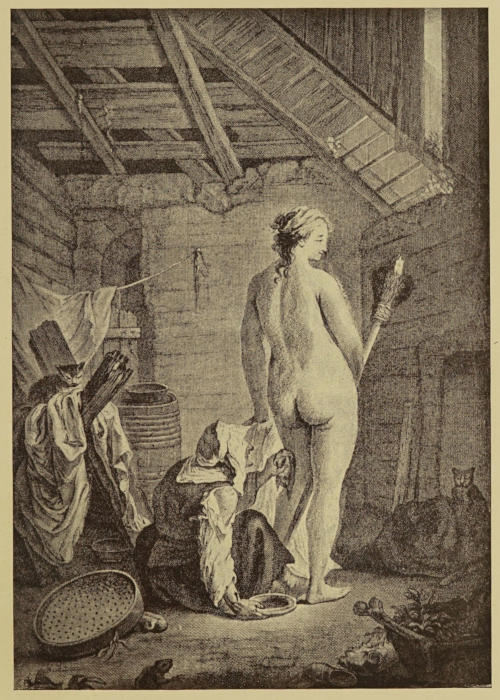
PLATE IV
OFF TO THE SABBAT. Queverdo
[face p. 120
Agnes Sampson, the famous witch of North Berwick (1590), confessed “that the Devil in mans lickness met her going out to the fields from her own house at Keith, betwixt five and six at even, being alone and commanded her to be at North-berwick Kirk the next night. To which place she came on horse-back, conveyed by her Good-son, called Iohn Couper.”[37] The Swedish witches (1669) who carried children off to Blockula “set them upon a Beast of the Devil’s providing, and then they rid away.” One boy confessed that “to perform the Journey, he took his own Fathers horse out of the Meadow, where it was feeding.”[38] Upon his return one of the coven let the horse graze in her own pasture, and here the boy’s father found it the next day.
In the popular imagination the witch is always associated with the broomstick, employed by her to fly in wild career through mid-air. This belief seems almost universal, of all times and climes. The broomstick is, of course, closely connected with the magic wand or staff which was considered equally serviceable for purposes of equitation. The wood whence it was fashioned was often from the hazel-tree, witch-hazel, although in De Lancre’s day the sorcerers of Southern France favoured the “Souhandourra”—Cornus sanguinea, dog-wood. Mid hurricane and tempest, in the very heart of the dark storm, the convoy of witches, straddling their broomsticks, sped swiftly along to the Sabbat, their yells and hideous laughter sounding louder than the crash of elements and mingling in fearsome discord with the frantic pipe of the gale.
There is a very important reference to these beliefs from the pen of the famous and erudite Benedictine Abbot, Regino of Prüm (A.D. 906), who in his weighty De ecclesiasticis disciplinis writes: “This too must by no means be passed over that certain utterly abandoned women, turning aside to follow Satan, being seduced by the illusions and phantasmical shows of demons firmly believe and openly profess that in the dead of night they ride upon certain beasts along with the pagan goddess Diana and a countless horde of women, and that in those silent hours they fly over vast tracts of country and obey her as their mistress, whilst on certain other nights they are summoned to do her homage and pay her service.”[39] The witches rode sometimes upon a besom or a stick, sometimes upon an animal, and the excursion through the air was generally preceded by an unction with a magic ointment. Various recipes are given for the ointment, and it is interesting to note that they contain deadly poisons: aconite, belladonna, and hemlock.[40] Although these unguents may in certain circumstances be capable of producing definite physiological results, it is Delrio who best sums up the reasons for their use: “The Demon is able to convey them to the Sabbat without the use of any unguent, and often he does so. But for several reasons he prefers that they should anoint themselves. Sometimes when the witches seem afraid it serves to encourage them. When they are young and tender they will thus be better able to bear the hateful embrace of Satan who has assumed the shape of a man. For by this horrid anointing he dulls their senses and persuades these deluded wretches that there is some great virtue in the viscid lubricant. Sometimes too he does this in hateful mockery of God’s holy Sacraments, and that by these mysterious ceremonies he may infuse, as it were, something of a ritual and liturgical nature into his beastly orgies.”[41]
Although the witch is universally credited with the power to fly through the air[42] to the Sabbat mounted upon a besom or some kind of stick, it is remarkable in the face of popular belief to find that the confessions avowing this actual mode of aerial transport are extraordinarily few. Paul Grilland, in his tractate De Sortilegiis (Lyons, 1533), speaks of a witch at Rome during whose trial, seven years before, it was asserted she flew in the air after she had anointed her limbs with a magic liniment. Perhaps the most exactly detailed accounts of this feat are to be found in Boguet,[43] than whom scarcely any writer more meticulously reports the lengthy and prolix evidence of witches, such evidence as he so laboriously gathered during the notorious prosecutions throughout Franche-Comté in the summer of 1598. He records quite plainly such statements as: “Françoise Secretain disoit, que pour aller au Sabbat, elle mettoit un baston blanc entre ses iambes & puis prononçait certaines paroles & dés lors elle estoit portée par l’air iusques en l’assemblée des Sorciers.” (Françoise Secretain avowed that in order to go to the Sabbat she placed a white stick between her legs & then uttered certain words & then she was borne through the air to the sorcerers’ assembly). In another place she confessed “qu’elle avoit esté vne infinité de fois au Sabbat ... & qu’elle y alloit sur vn baston blanc, qu’elle mettoit entre ses iambes.” (That she had been a great number of times to the Sabbat ... and that she went there on a white stick which she placed between her legs.) It will be noticed that in the second instance she does not explicitly claim to have been borne through the air. Again: “Françoise Secretain y estoit portée [au Sabbat] sur vn baston blanc. Satan y tra̅sporta Thieuenne Paget & Antide Colas estant en forme d’vn homme noir, sortans de leurs maison le plus souuent par la cheminée.” “Claudine Boban, ieune fille confessa qu’elle & sa mère montoient sur vne ramasse, & que sortans le contremont de la cheminée elles alloient par l’air en ceste façon au Sabbat.” (Françoise Secretain was carried [to the Sabbat] on a white stick. Satan, in the form of a tall dark man conveyed thither Thieuenne Paget & Antide Colas, who most often left their house by way of the chimney.... Claudine Boban, a young girl, confessed that both she and her mother mounted on a besom, & that flying out by the chimney they were thus borne through the air to the Sabbat.) A marginal note explains ramasse as “autrement balai, & en Lyonnois coiue.”
Glanvill writes that Julian Cox, one of the Somerset coven (1665), said “that one evening she walkt out about a Mile from her own House and there came riding towards her three persons upon three Broom-staves, born up about a yard and a half from the ground. Two of them she formerly knew, which was a Witch and a Wizzard.” It might easily be that there is some exaggeration here. We know that a figure in one of the witch dances consisted of leaping as high as possible into the air, and probably the three persons seen by Julian Cox were practising this agile step. A quotation from Bodin by Reginald Scot is very pertinent in this connexion. Speaking of the Sabbat revels he has: “And whiles they sing and dance, euerie one hath a broome in his hand, and holdeth it vp aloft. Item he saith, that these night-walking or rather night-dansing witches, brought out of Italie into France, that danse which is called La Volta.”[44] Sir John Davies in his Orchestra or A Poeme on Dauncing (18mo, 1596) describes the lavolta as “A loftie iumping, or a leaping round.” De Lancre observes that after the regular country dance at the Sabbat the witches sprang high into the air. “Après la dance ils se mettent par fois à sauter.”[45] At their assembly certain of the Aberdeen witches (1597) “danced a devilish dance, riding on trees, by a long space.” In an old representation of Dr. Fian and his company swiftly pacing round North Berwick church withershins the witches are represented as running and leaping in the air, some mounted on broomsticks, some carrying their besoms in their hands.
There was discovered in the closet of Dame Alice Kyteler of Kilkenny, who was arrested in 1324 upon the accusation of nightly meeting a familiar Artisson and multiplied charges of sorcery, a pipe of ointment, wherewith she greased a staff “upon which she ambolled and gallopped thorough thicke and thin, when and what manner she listed.”[46] In the trial of Martha Carrier, a notorious witch and “rampant hag” at the Court of Oyer and Terminer, held by adjournment at Salem, 2 August, 1692, the eighth article of the indictment ran: “One Foster, who confessed her own share in the Witchcraft for which the Prisoner stood indicted, affirm’d, that she had seen the prisoner at some of their Witch-meetings, and that it was this Carrier, who perswaded her to be a Witch. She confessed that the Devil carry’d them on a pole, to a Witch-meeting: but the pole broke, and she hanging about Carriers neck, they both fell down, and she then received an hurt by the Fall, whereof she was not at this very time recovered.”[47]
In many of these instances it is plain that there is no actual flight through the air implied; although there is a riding a-cock-horse of brooms or sticks, in fact, a piece of symbolic ritual.
It is very pertinent, however, to notice in this connexion the actual levitation of human beings, which is, although perhaps an unusual, yet by no means an unknown, phenomenon in the séances of modern spiritism, where both the levitation of persons, with which we are solely concerned, and the rising of tables or chairs off the ground without contact with any individual or by any human agency have occurred again and again under conditions which cannot possibly admit of legerdemain, illusion, or charlatanry. From a mass of irrefutable evidence we may select some striking words by Sir William Crookes, F.R.S., upon levitation. “This has occurred,” he writes, “in my presence on four occasions in darkness; but ... I will only mention cases in which deductions of reason were confirmed by the sense of sight.... On one occasion I witnessed a chair, with a lady sitting on it, rise several inches from the ground.... On another occasion the lady knelt on the chair in such manner that the four feet were visible to us. It then rose about three inches, remained suspended for about ten seconds, and then slowly descended....
“The most striking case of levitation which I have witnessed has been with Mr. Home. On three separate occasions have I seen him raised completely from the floor of the room.... On each occasion I had full opportunity of watching the occurrence as it was taking place. There are at least a hundred recorded instances of Mr. Home’s rising from the ground.”[48]
Writing in July, 1871, Lord Lindsay said: “I was sitting with Mr. Home and Lord Adare and a cousin of his. During the sitting Mr. Home went into a trance, and in that state was carried out of the window in the room next to where we were, and was brought in at our window. The distance between the windows was about seven feet six inches, and there was not the slightest foothold between them, nor was there more than a twelve-inch projection to each window, which served as a ledge to put flowers on. We heard the window in the next room lifted up, and almost immediately after we saw Home floating in air outside our window.”[49]
William Stainton Moses writes of his levitation in August, 1872, in the presence of credible witnesses: “I was carried up ... when I became stationary I made a mark [with a lead pencil] on the wall opposite to my chest. This mark is as near as may be six feet from the floor.... From the position of the mark on the wall it is clear that my head must have been close to the ceiling.... I was simply levitated and lowered to my old place.”[50]
When we turn to the lives of the Saints we find that these manifestations have been frequently observed, and it will suffice to mention but a few from innumerable examples.
S. Francis of Assisi was often “suspended above the earth, sometimes to a height of three, sometimes to a height of four cubits”; the same phenomenon has been recorded by eye-witnesses in many instances throughout the centuries. Among the large number of those who are known to have been raised from the ground whilst wrapt in prayer are the stigmatized S. Catherine of Siena; S. Colette; Rainiero de Borgo San-Sepolcro; S. Catherine de Ricci; S. Alphonsus Rodriguez, S.J.; S. Mary Magdalen de Pazzi; Raimond Rocco; Bl. Charles de Sezze; S. Veronica Giuliani the Capuchiness; S. Gerard Majella, the Redemptorist thaumaturge; that wondrous mystic Anne Catherine Emmerich; Dominica Barbagli (died in 1858), the ecstatica of Montesanto-Savino (Florence), whose levitations were of daily occurrence. S. Ignatius Loyola whilst deeply contemplative was seen by John Pascal to be raised more than a foot from the pavement; S. Teresa and S. John of the Cross were levitated in concurrent ecstasies in the shady locutorio of the Encarnacion, as was witnessed by Beatriz of Jesus and the whole convent of nuns;[51] S. Alphonsus Liguori whilst preaching in the church of S. John Baptist at Foggia was lifted before the eyes of the whole congregation several feet from the ground;[52] Gemma Galgani of Lucca, who died 11 April, 1903, was observed whilst praying one evening in September, 1901, before a venerated Crucifix, to rise in the air in a celestial trance and to remain several minutes at some distance from the floor.[53] Above all, S. Joseph of Cupertino (1603-63), one of the most extraordinary mystics of the seventeenth century, whose whole life seemed one long series of unbroken raptures and ecstasies, was frequently lifted on high to remain suspended in mid-air. Such notice was attracted by this marvel that his superiors sent him from one lonely house of Capuchins or Conventuals to another, and he died at the little hill town of Osimo, where his remains are yet venerated. For many years he was obliged to say Mass at a private altar so inevitable were the ecstasies that fell upon him during the Sacrifice. There are, I think, few sanctuaries more sweet and more fragrant with holiness than this convent at Osimo. During a most happy visit to the shrine of S. Joseph I was deeply touched by the many memorials of the Saints, and by the kindness of the Fathers, his brethren to-day. S. Philip Neri and S. Francis Xavier were frequently raised from the ground at the Elevation, and of the ascetic S. Paul of the Cross the Blessed Strambi writes: “Le serviteur de Dieu s’éleva en l’air à la hauteur de deux palmes, et cela, à deux reprises, avant et après la consecration.”[54] (The servant of God during Holy Mass was twice elevated in the air to a height of two hand-breadths from the ground both before and after the Consecration.) It is well known that in a certain London church a holy religious when he said Mass was not unseldom levitated from the predella, which manifestation I have myself witnessed, although the father was himself unconscious thereof until the day of his death.
But, as Görres most aptly remarks,[55] although many examples may be cited of Saints who have been levitated in ecstasy, and although it is not impossible that this phenomenon may be imitated by evil powers—as, indeed, it undoubtedly is in the cases of spiritistic mediums—yet nowhere do we find in hagiography that a large number of Saints were in one company raised from the earth together or conveyed through the air to meet at some appointed spot. Is it likely, then, that the demons would be allowed seemingly to excel by their power a most extraordinary and exceptional manifestation? It must be remembered, also, that save in very rare and singular instances, such as that of S. Joseph of Cupertino, levitation is only for a height of a foot or some eighteen inches, and even this occurs seldom save at moments of great solemnity and psychic concentration.
A question which is largely discussed by the demonologists then arises: Do the witches actually and in person attend the Sabbat or is their journey thither and assistance thereat mere diabolic illusion? Giovanni Francesco Ponzinibio, in his De Lamiis,[56] wholly inclines to the latter view, but this is superficial reasoning, and the celebrated canonist Francisco Peña with justice takes him very severely to task for his temerity. Peña’s profound work, In Bernardi Comensis Dominicani Lucernam inquisitorum notæ et eiusdem tractatum de strigibus,[57] a valuable collection of most erudite glosses, entirely disposes of Ponzinibio’s arguments, and puts the case in words of weighty authority.
Sprenger in the Malleus Maleficarum, I, had already considered “How witches are bodily transported from one place to another,” and he concludes “It is proven, then, that sorcerers can be bodily transported.”[58] Paul Grilland inquires: “Whether magicians & witches or Satanists are bodily & actually conveyed to and fro by the Devil, or whether this be merely imaginary?” He freely acknowledges the extraordinary difficulty and intricacy of the investigation, beginning his answer with the phrase “Quæstio ista est multum ardua et famosa.”[59] (This is a very difficult and oft-discussed question.) But S. Augustine, S. Thomas, S. Bonaventure, and a score of great names are agreed upon the reality of this locomotion, and Grilland, after balancing the evidence to the nicety of a hair wisely concludes: “Myself I hold the opinion that they are actually transported.”[60]
In his Compendium Maleficarum Francesco Maria Guazzo discusses (Liber I. 13) “Whether Witches are actually and bodily conveyed from place to place to attend their Sabbats”; and lays down: “The opinion which many who follow Luther & Melancthon hold is that Witches only assist at these assemblies in their imagination, & that they are choused by some trick of the devil, in support of which argument the objectors assert that the Witches have very often been seen lying in one spot and not moving thence. Moreover, what is related in the life of S. Germain is not impertinent in this connexion, to wit, when certain women declared that they had been present at a banquet, & yet all the while they slumbered and slept, as several persons attested. That women of this kind are very often deceived in such a way is certain; but that they are always so deceived is by no means sure.... The alternative opinion, which personally I hold most strongly, is that sometimes at any rate Witches are actually conveyed from one place to another by the Devil, who under the bodily form of a goat or some other unclean & monstrous animal himself carries them, & that they are verily and indeed present at their foul midnight Sabbats. This opinion is that generally held by the authoritative Theologians and Master Jurisprudists of Italy and Spain, as also by the Catholic divines and legalists. The majority of writers, indeed, advance this view, for example, Torquemada in his commentary on Grilland, Remy, S. Peter Damian, Silvester of Abula, Tommaso de Vio Gaetani, Alfonso de Castro, Sisto da Siena, O.P., Père Crespet, Bartolomeo Spina in his glosses on Ponzinibio, Lorenzo Anania, and a vast number of others, whose names for brevity’s sake I here omit.”[61]
This seems admirably to sum up the whole matter. In the encyclopædic treatise De Strigibus[62] by an earlier authority, Bernard of Como, the following remarkable passage occurs: “The aforesaid abominable wretches actually & awake & in full enjoyment of their normal senses attend these assemblies or rather orgies, and when they are to go to some spot hard by they proceed thither on foot, cheerily conversing as they walk. If, however, they are to meet in some distant place then are they conveyed by the Devil, yet by whatsoever means they proceed to the said place whether it be on foot or whether they are borne along by the Devil, it is most certain that their journey is real and actual, and not imaginary. Nor are they labouring under any delusion when they deny the Catholic Faith, worship and adore the Devil, tread upon the Cross of Christ, outrage the Most Blessed Sacrament, and give themselves up to filthy and unhallowed copulations, fornicating with the Devil himself who appears to them in a human form, being used by the men as a succubus, & carnally serving the woman as an incubus.”[63]
The conclusion then is plain and proven. The witches do actually and individually attend the Sabbat, an orgy of blasphemy and obscenity. Whether they go thither on foot, or horseback, or by some other means is a detail, which in point of fact differs according to the several and infinitely varied circumstances.
It is not denied that in some cases hallucination and self-deception played a large part, but such examples are comparatively speaking few in number, and these, moreover, were carefully investigated and most frequently recognized by the judges and divines. Thus in the Malleus Maleficarum Sprenger relates that a woman, who had voluntarily surrendered herself to be examined as being a witch, confessed to the Dominican fathers that she nightly assisted at the Sabbat, and that neither bolts nor bars could prevent her from flying to the infernal revels. Accordingly she was shut fast under lock and key in a chamber whence it was impossible for her to escape, and all the while carefully watched by lynx-eyed officers through a secret soupirail. These reported that immediately the door was closed she threw herself on the bed where in a moment she was stretched out perfectly rigid in all her members. Select members of the tribunal, grave and acute doctors, entered the room. They shook her, gently at first, but presently with considerable roughness. She remained immobile and insensible. She was pinched and pulled sharply. At last a lighted candle was brought and placed near her naked foot until the flesh was actually scorched in the flame. She lay stockish and still, dumb and motionless as a stone. After a while her senses returned to her. She sat up and related in exact detail the happenings at the Sabbat she had attended, the place, the number of the company, the rites, what was spoken, all that was done, and then she complained of a hurt upon her foot. Next day the fathers explained to her all that had passed, how that she had never stirred from the spot, and that the pain arose from the taper which to ensure the experiment had been brought in contact with her flesh. They admonished her straightly but with paternal charity, and upon the humble confession of her error and a promise to guard against any such ill fantasies for the future, a suitable penance was prescribed and the woman dismissed.
In the celebrated cases investigated by Henri Boguet, June, 1598, young George Gandillon confessed to having walked to the Sabbat at a deserted spot called Fontenelles, near the village of Nezar, and also to having ridden to the Sabbat. Moreover, in his indictment the following occurs: “George Gandillon, one Good Friday night, lay in his bed, rigid as a corpse, for the space of three hours, & then on a sudden came to himself. He has since been burned alive here with his father & his sister.”[64]
Since Boguet, who is one of our chief authorities, discusses the Sabbat with most copious details in his Discours des Sorciers it will not be impertinent to give here the headings and subdivisions of his learned and amply documented chapters.[65]
Chapter XVI. How, & in what way Sorcerers are conveyed to the Sabbat.
1. They are sometimes conveyed there mounted on a stick, or a broom, sometimes on a sheep or a goat, & sometimes by a tall black man.
2. Sometimes they anoint themselves with ointment, & sometimes not.
3. There are some people, who although they are not Sorcerers, if they are anointed, are none the less carried off to the Sabbat. The reason for this.
4. The unguent, & the ointment are actually of no use to the Sorcerers, and do not in effect carry them to the Sabbat.
5. Sorcerers are sometimes conveyed to the Sabbat by a blast of wind & a sudden storm.
Chapter XVII. Sorcerers may sometimes walk to the Sabbat on foot.
Chapter XVIII. Is the journey of Sorcerers to the Sabbat merely imagination?
1 & 3. Reasons for supposing this to be the case, & examples.
2. Indications, owing to which it may be supposed, that a certain woman paid a purely imaginary visit to the Sabbat.
4. Reasons for supposing that the journey of Sorcerers to the Sabbat, is a real expedition and not imaginary.
5. How we are to understand what is related concerning Erichtho, & Apollonius; the first of whom raised a soldier to life, & the latter a young girl.
6. Sorcerers cannot raise the dead to life. Examples.
7. Neither can heretics perform miracles. Examples.
8. The Author’s opinion concerning the subject of this chapter.
9. Satan most frequently deceives mankind. Examples.
Chapter XIX.
1. Sorcerers go to the Sabbat about midnight.
2. The reason why the Sabbat is generally held at night.
3. Satan delights in darkness & blackness, which are opposite to the whiteness and light that please Heaven.
4. At the Sabbat Sorcerers dance back to back. For the most part they wear masks.
5 & 8. When the cock crows the Sabbat immediately comes to an end, and vanishes away. The reason for this.
6. The voice of the cock frightens Satan in the same way as it terrifies lions & serpents.
7. Several authors relate that demons fear a naked sword.
Chapter XX. The days on which the Sabbat is held.
1. The Sabbat may be held on any day of the week, but particularly on a Friday.
2. It is also held on the greatest festivals of the year.
Chapter XXI. The places where the Sabbat is held.
1. According to many writers the place where the Sabbat is held is distinguished by a clump of trees, or sometimes by a cross. The Author’s opinion on this point.
2. A remarkable account of a place where the Sabbat was held.
3. There must be water near the place where the Sabbat is held. The reason for this.
4. If there is no water in the place, the Sorcerers dig a hole in the ground and urinate in this.
Chapter XXII. The proceedings at the Sabbat.
1. The Sorcerers worship the Devil who appears under the form of a tall black man, or as a goat. They offer him candles & kiss his posterior.
2. They dance. A description of their dances.
3. They give themselves up to every kind of filthy abomination. The Devil transforms himself into an Incubus & into a Succubus.
4. The hideous orgies & foul copulations practised by the Euchites, & Gnostics.
5. The Sorcerers feast at the Sabbat. Their meat & their drink. The way in which they say grace before and after table.
6. However, this food never satisfies their appetites, & they always arise from table as hungry as before.
7. When they have finished their meal, they give the Devil a full account of all their actions.
8. They again renounce God, their baptism, &c. How Satan incites them to do evil.
9. They raise dark storms.
10. They celebrate their mass. Of their vestments, & holy water.
11. Sometimes to conclude the Sabbat Satan seems to be consumed in a flame of fire, & to be completely reduced to ashes. All present take a small part of these ashes, which the Sorcerers use for their charms.
12. Satan is always the Ape of God in everything.
As the procedure in the various Sabbats differed very greatly according to century, decade, country, district, nay, even in view of the station of life and, it would seem, the very temperaments of the assembly, it is only possible to outline in a general way some of the most remarkable ceremonies which took place on the occasions of these infernal congregations. An intimate and intensive study of the Sabbat would require a large volume, for it is quite possible to reconstruct the rites in every particular, although the precise order of the ritual was not always and everywhere the same.
Dom Calmet, it is true, has very mistakenly said: “To attempt to give a description of the Sabbat, is to attempt a description of what does not exist, & what has never existed save in the fantastic & disordered imagination of warlocks & witches: the pictures which have been drawn of these assemblies are merely the phantasy of those who dreamed that they had actually been borne, body & soul, through the air to the Sabbat.”[66] Happy sceptic! But unfortunately the Sabbat did—and does—take place; formerly in deserted wastes, on the hill-side, in secluded spots, now, as often as not, in the privacy of vaults and cellars, and in those lone empty houses innocently placarded “To be Sold.”
The President of the Sabbat was in purely local gatherings often the Officer of the district; in the more solemn assemblies convened from a wider area, the Grand Master, whose dignity would be proportionate to the numbers of the company and the extent of his province. In any case the President was officially known as the “Devil,” and it would seem that his immediate attendants and satellites were also somewhat loosely termed “devils,” which formal nomenclature has given rise to considerable confusion and not a little mystification in the reports of witch trials and the confessions of offenders. But in many instances it is certain—and orthodoxy forbids us to doubt the possibility—that the Principle of Evil, incarnate, was present for the hideous adoration of his besotted worshippers. Such is the sense of the Fathers, such is the conclusion of the theologians who have dealt with these dark abominations. Metaphysically it is possible; historically it is indisputable.
When a human being, a man, occupied the chief position at these meetings and directed the performance of the rites, he would sometimes appear in a hideous and grotesque disguise, sometimes without any attempt at concealment. This masquerade generally took the shape of an animal, and had its origin in heathendom, whence by an easy transition through the ceremonial of heretics, it passed to the sorcerer and the witch. As early as the Liber Pœnitentialis of S. Theodore, Archbishop of Canterbury, 668-690, we have a distinct prohibition of this foul mummery. Capitulum xxvii denounces the man who “in Kalendas Ianuarii in ceruulo et in uitula uadit.” “If anyone at the kalends of January goes about as a stag or a bull; that is making himself into a wild animal and dressing in the skin of a herd animal, and putting on the head of beasts; those who in such wise transform themselves into the appearance of a wild animal, penance for three years because this is devilish.”
Among the many animal forms which the leader of the Sabbat (the “Devil”) assumed in masquerade the most common are the bull, the cat, and above all the goat. Thus the Basque term for the Sabbat is “Akhelarre,” “goat pasture.” Sometimes the leader is simply said to have shown himself in the shape of a beast, which possibly points to the traditional disguise of a black hairy skin, horns, hoofs, claws, and a tail, in fact the same dress as a demon wore upon the stage.[67] In an old German ballad, Druten Zeitung, printed at Smalcald in 1627, “to be sung to the tune of Dorothea,” it is said that the judges, anxious to extort a confession from a witch, sent down into her twilight dungeon the common hangman dressed in a bear’s skin with horns, hoofs, and tail complete. The miserable prisoner thinking that Lucifer had indeed visited her at once appealed to him for help:
Man shickt ein Henkersnecht Zu ihr in Gefängniss n’unter, Den man hat kleidet recht, Mit einer Bärnhaute, Als wenns der Teufel wär; Als ihm die Drut anschaute Meints ihr Bühl kam daher.
Here we have a curious and perhaps unique example of the demoniac masquerade subtly used to obtain evidence of guilt by a trick. The Aberdeen witch Jonet Lucas (1597) said that the Devil was at the Sabbat “beand in likenes of ane beist.” But Agnes Wobster of the same company declared that “Satan apperit to them in the likenes of a calff,” so possibly two masquerades were employed. Gabriel Pellé (1608) confessed that he attended a Sabbat presided over by the Devil, and “le Diable estoit en vache noire.”[68] Françoise Secretain, who was tried in August, 1598, saw the Devil “tantost en forme de chat.” Rolande de Vernois acknowledged “Le Diable se presenta pour lors au Sabbat en forme d’vn groz chat noir.”[69] To the goat there are innumerable allusions. In the Basses-Pyrénées (1609): “Le Diable estoit en forme de bouc ayant vne queue & audessous vn visage d’homme noir.” (The Devil appeared in the form of a goat having a tail & his fundament was the face of a black man.) Iohannis d’Aguerre said that the Devil was “en forme de bouc.”[70] “Marie d’Aguerre said that there was in the midst of the ring an immense pitcher whence the Devil issued in the form of a goat.” Gentien le Clerc, who was tried at Orleans in 1614, “said that, as he was told, his mother when he was three years old presented him at the Sabbat to a goat whom they saluted as l’Aspic.”[71] “Sur le trône,” writes Görres, “est assis un bouc, ou du moins la forme d’un bouc, car le démon ne peut cacher ce qu’il est.”[72]
In 1630 Elizabeth Stevenson, alias Toppock, of Niddrie, avowed to her judges that in company with Catharine Oswald, who was tried for being by habite and repute a witch, and Alexander Hamilton, “a known warlock,” she went “to a den betwixt Niddrie and Edmiston, where the devill had trysted hir, where he appeared first to them like a foall, and then like a man, and appointed a new dyet at Salcott Muire.” When one of Catharine Oswald’s intimates, Alexander Hunter, alias Hamilton, alias Hattaraick, a “Warlok Cairle” who “abused the Countrey for a long time,”[73] was apprehended at Dunbar he confessed that the Devil would meet him riding upon a black horse, or in the shape of a corbie, a cat, or a dog. He was burned upon Castle Hill, Edinburgh, 1631.
Sometimes those who are present at the Sabbat are masked. Canon Ribet writes: “Les visiteurs du sabbat se cachent quelquefois sous des formes bestiales, on se couvrent le visage d’un masque pour demeurer inconnus.”[74] (Those who attend the Sabbat sometimes disguise themselves as beasts, or cover their faces to conceal their identities.)
At the famous Sabbat of one hundred and forty witches in North Berwick churchyard on All Hallow e’en, 1590, when they danced “endlong the Kirk-yard” “John Fian, missellit [masked] led the ring.” The Salamanca doctors mention the appearance at the Sabbats of persons “aut aperta, aut linteo uelata facie,”[75] “with their faces sometimes bare, sometimes shrouded in a linen wimple.” And Delrio has in reference to this precaution: “Facie interdum aperta, interdum uelata larua, linteo, uel alio uelamine aut persona.”[76] (Sometimes their faces are bare, sometimes hidden, either in a vizard, a linen cloth, or a veil, or a mask.)
In the latter half of the eighteenth century the territory of Limburg was terrorized by a mysterious society known as “The Goats.” These wretches met at night in a secret chapel, and after the most hideous orgies, which included the paying of divine honours to Satan and other foul blasphemies of the Sabbat, they donned masks fashioned to imitate goats’ heads, cloaked themselves with long disguise mantles, and sallied forth in bands to plunder and destroy. From 1772 to 1774 alone the tribunal of Foquemont condemned four hundred Goats to the gallows. But the organization was not wholly exterminated until about the year 1780 after a regime of the most repressive measures and unrelaxing vigilance.
Among certain tribes inhabiting the regions of the Congo there exists a secret association of Egbo worshippers. Egbo or Ekpé is the evil genius or Satan. His rites are Obeeyahism, the adoration of Obi, or the Devil, and devil-worship is practised by many barbarous races, as, for instance, by the Coroados and the Tupayas, in the impenetrable forests between the rivers Prado and Doce in Brazil, by the Abipones of Paraguay, as well as by the Bachapins, a Caffre race, by the negroes on the Gold Coast and the negroes of the West Indies. In the ju-ju houses of the Egbo sorcerers are obscene wooden statues to which great veneration is paid, since by their means divination is solemnly practised. Certain festivals are held during the year, and at these it is interesting to note that the members wear hideous black masks with huge horns which it is death for the uninitiated to see.
The first ceremony of the Sabbat was the worship of, and the paying homage to the Devil. It would seem that sometimes this was preceded by a roll-call of the evil devotees. Agnes Sampson confessed that at the meeting in North Berwick, when the whole assembly had entered the church, “The Devil started up himself in the Pulpit like a mickle black man, and calling the Row, every one answered Here. Mr. Robert Grierson being named, they all ran hirdie girdie, and were angry: for it was promised he should be called Robert the Comptroller, alias Rob the Rower, for expriming of his name. The first thing he demanded was whether they had been good servants, and what they had done since the last time they had convened.”
The witches adored Satan, or the Master of the Sabbat who presided in place of Satan, by prostrations, genuflections, gestures, and obeisances. In mockery of solemn bows and seemly courtesies the worshippers of the Demon approach him awkwardly, with grotesque and obscene mops and mows, sometimes straddling sideways, sometimes walking backwards, as Guazzo says: Cum accedunt ad dæmones eos ueneraturi terga obuertunt & cessim eum cancrorum more supplicaturi manus inuersas retro applicant.[77] But their chief act of homage was the reverential kiss, osculum infame. This impious and lewd ritual is mentioned in detail by most authorities and is to be found in all lands and centuries. So Delrio writes: “The Sabbat is presided over by a Demon, the Lord of the Sabbat, who appears in some monstrous form, most generally as a goat or some hound of hell, seated upon a haughty throne. The witches who resort to the Sabbat approach the throne with their backs turned, and worship him ... and then, as a sign of their homage, they kiss his fundament.” Guazzo notes: “As a sign of homage witches kiss the Devil’s fundament.” And Ludwig Elich says: “Then as a token of their homage—with reverence be it spoken—they kiss the fundament of the Devil.”[78] “Y al tiempo que le besan debajo de la cola, da una ventosidad de muy horrible olor,” adds the Spanish Relacion, “fetid, foul, and filthy.”
To cite other authorities would be but to quote the same words. Thomas Cooper, indeed, seems to regard this ceremony as a part of the rite of admission, but to confine it to this occasion alone is manifestly incorrect, for there is continual record of its observance at frequent Sabbats by witches of many years standing. “Secondly,” he remarks, “when this acknowledgement is made, in testimoniall of this subiection, Satan offers his back-parts to be kissed of his vassall.”[79] But in the dittay of the North Berwick witches, all of whom had long been notorious for their malpractices, “Item, the said Agnis Sampson confessed that the divell being then at North Barrick Kerke, attending their comming, in the habit or likenesse of a man,[80] and seeing that they tarried over long, hee at their comming enjoyned them all to a pennance, which was, that they should kisse his buttockes, in sign of duety to him, which being put over the pulpit bare, every one did as he had enjoyned them.”[81]
One of the principal charges which was repeatedly brought against the Knights Templars during the lengthy ecclesiastical and judicial processes, 1307-1314, was that of the osculum infame given by the juniors to their preceptors. Even so prejudiced a writer as Lea cannot but admit the truth of this accusation. In this case, however, it has nothing to do with sorcery but must be connected with the homosexuality which the Order universally practised.
There are some very important details rehearsed in a Bull, 8 June, 1303, of the noble but calumniated Boniface VIII, with reference to the case of Walter Langton, Bishop of Lichfield and Coventry (1296-1322), and treasurer of Edward I, when this prelate was accused of sorcery and homage to Satan: “For some time past it has come to our ears that our Venerable Brother Walter Bishop of Coventry and Lichfield has been commonly defamed, and accused, both in the realm of England and elsewhere, of paying homage to the Devil by kissing his posterior, and that he hath had frequent colloquies with evil spirits.”[82] The Bishop cleared himself of these charges with the compurgators. Bodin refers to Guillaume Edeline, who was executed in 1453 as a wizard. He was a doctor of the Sorbonne, and prior of St. Germain en Laye: “The aforesaid sire Guillaume confessed ... that he had done homage to the aforesaid Satan, who appeared in the shape of a ram, by kissing his buttocks in token of reverence and homage.”[83] A very rare tract of the fourteenth century directed against the Waldenses among other charges brings the following: “Item, in aliquibus aliis partibus apparet eis dæmon sub specie et figura cati, quem sub cauda sigillatim osculantur.” (The Devil appears to them as a cat, and they kiss him sub cauda.)[84]
Barthélemy Minguet of Brécy, a young man of twenty-five, who was tried in 1616, said that at the Sabbat “he often saw [the Devil] in the shape of a man, who held a horse by its bridle, & that they went forward to worship him, each one holding a pitch candle of black wax in their hands.”[85] These candles, as Guazzo tells us, were symbolic and required by the ritual of the Sabbat, not merely of use for the purpose of giving light: “Then they made an offering of pitch black candles, and as a sign of homage kissed his fundament.”[86] The candles were ordinarily black, and one taper, larger than the rest, was frequently carried by the Devil himself. At the North Berwick meeting when the witches were all to assemble in the church, “Iohn Fein blew up the Kirk doors, and blew in the lights, which wer like Mickl black candles sticking round about the Pulpit.”[87] Boguet relates that the witches whom he tried confessed that the Sabbat commenced with the adoration of Satan, “who appeared, sometimes in the shape of a tall dark man, sometimes in the shape of a goat, & to express their worship and homage, they made him an offering of candles, which burned with a blue light.”[88] John Fian, also, when doing homage to the Devil “thought he saw the light of a candle ... which appeared blue lowe.” This, of course, was on account of the sulphurous material whence these candles were specially compounded. De Lancre expressly states that the candles or flambeaux used at the Sabbat were made of pitch.
An important feature of the greater Sabbats was the ritual dance, for the dance was an act of devotion which has descended to us from the earliest times and is to be found in every age and every country. Dancing is a natural movement, a primitive expression of emotion and ideals. In the ancient world there can have been few things fairer than that rhythmic thanksgiving of supple limbs and sweet voices which Athens loved, and for many a century was preserved the memory of that day when the young Sophocles led the choir in celebration of the victory of Salamis.[89] The Mystæ in the meadows of Elysium danced their rounds with the silver clash of cymbals and with madly twinkling snow-white feet. At the solemn procession of the Ark from Cariathiarim (Kirjath Jearim) King David “danced with all his might before the Lord, ... dancing and leaping before the Lord.” S. Basil urges his disciples to dance on earth in order to fit themselves for what may be one of the occupations of the angels in heaven. As late as the seventeenth century the ceremonial dance in church was not uncommon. In 1683 it was the duty of the senior canon to lead a dance of choir-boys in the Paris cathedral. Among the Abyssinian Christians dancing forms no inconsiderable part of worship. Year by year on Whit Tuesday hundreds of pilgrims dance through the streets of Echternach (Luxemburg) to the shrine of S. Willibrod in S. Peter’s Church. Formerly the devotees danced three times round the great Abbey Courtyard before proceeding to the sanctuary. But beyond all these the dance has its own place in the ritual of Holy Church even yet. Three times a year in Seville Cathedral—on Holy Thursday, upon Corpus Christi and the Immaculate Conception—Los Seises dance before a specially constructed altar, exquisitely adorned with flowers and lights, erected near the outer door of the grand western entrance of the cathedral. The ceremony in all probability dates from the thirteenth century.
The dresses of the boys, who dance before the improvised altar at Benediction on Corpus Christi, are of the period of Philip III, and consist of short trousers and jackets that hang from one shoulder, the doublets being of red satin, with rich embroidery. Plumed white hats with feathers are worn, also shoes with large scintillating buckles. On Holy Thursday the costume is also red and white, whilst it is blue and white for “the day of the Virgin.”
The eight boy choristers—with eight others as attendants—dance, with castanets in their hands, to a soft organ obbligato, down the centre of the cathedral to the decorated altar, advancing slowly and gracefully. Here they remain for about a quarter of an hour, singing a hymn, and accompanying it (as the carols of the olden time) with dance and castanets. They sing a two-part hymn in front of the altar, forming in two eights, facing each other, the clergy kneeling in a semicircle round them.
Assuredly I cannot do better than quote Mr. Arthur Symons’ verdict on this dance as he saw it a few years back in Seville: “And, yes, I found it perfectly dignified, perfectly religious, without a suspicion of levity or indecorum. This consecration of the dance, this turning of a possible vice into a means of devotion, this bringing of the people’s art, the people’s passion, which in Seville is dancing, into the church, finding it a place there, is precisely one of those acts of divine worldly wisdom which the Church has so often practised in her conquest of the world.”
Not too fantastically has a writer suggested that High Mass itself in some sense enshrines a survival of the ancient religious dance—that stately, magnificent series of slow movements which surely may express devotion of the most solemn and reverent kind, as well as can the colour of vestment or sanctuary, or the sounds of melody.
Since the dance is so essentially religious it must needs be burlesqued and buffooned by God’s ape. For the dance of the witches is degraded, awkward, foul, and unclean. These very movements are withershins, as Guazzo points out: “Then follow the round dances in which, however, they always tread the measure to the left.”[90] “The Sorcerers,” says Boguet, “dance a country-dance with their backs turned one to the other.”[91] This, of course, being the exact reverse of the natural country-dance. “Sometimes, although seldom,” he adds, “they dance in couples, & sometimes one partner is there, another here, for always everything is in confusion.”[92] De Lancre writes of witches’ revels: “They only dance three kinds of brawls.... The first is à la Bohémienne ... the second with quick trippings: these are round dances.”[93] In the third Sabbat measure the dancers were placed one behind another in a straight line.
An old Basque legend reported by Estefanella Hirigaray describes how the witches were wont to meet near an old limekiln to dance their rounds, a ceremony regarded throughout that district as an essential feature of the Sabbat. De Lancre notes the brawls à la Bohémienne as especially favoured by sorcerers in Labourd. Sylvester Mazzolini, O.P. (1460-1523), Master of the Sacred Palace, and the great champion of orthodoxy against the heresiarch Luther, in his erudite De Strigimagia[94] relates that in Como and Brescia a number of children between eight and twelve years old, who had frequented the Sabbat, but had been happily converted by the unsparing patience of the Inquisitors, at the request of the Superiors gave exhibitions of these dances when they showed such extraordinary adroitness and skill in executing the most intricate and fantastic figures that it was evident they had been instructed by no mere human tutelage. Marco de Viqueria, the Dominican Prior of the Brussels monastery, closely investigated the matter, and he was a religious of such known acumen and exceptional probity that his testimony soon convinced many prelates at Rome who were inclined to suspect some trickery or cunning practice. In Belgium this Sabbat dance was known as Pauana.
In the Fian trial Agnes Sampson confessed that “They danced along the Kirk-yeard, Geilic Duncan playing on a Trump, and John Fein mussiled led the Ring. The said Agnes and her daughter followed next. Besides these were Kate Gray, George Noilis his wife, ... with the rest of their Cummers above an hundred Persons.”[95] She further added “that this Geillis Duncane did goe before them, playing this reill or daunce uppon a small trumpe, called a Jewe’s trumpe, untill they entered into the Kerk of North Barrick.”[96] “These confessions made the King [James I, then James VI of Scotland] in a wonderfull admiration, and sent for the saide Geillis Duncane, who, upon the like trumpe, did play the saide daunce before the kinges maiestie.”
Music generally accompanied the dancers, and there is ample evidence that various instruments were played, violins, flutes, tambourines, citterns, hautboys, and, in Scotland, the pipes. Those of the witches who had any skill were the performers, and very often they obliged the company awhile with favourite airs of a vulgar kind, but the concert ended in the most hideous discords and bestial clamour; the laws of harmony and of decency were alike rudely violated. In August, 1590, a certain Nicolas Laghernhard, on his way to Assencauria, was passing through the outskirts of a wood when he saw through the trees a number of men and women dancing with filthy and fantastic movements. In amaze he signed himself and uttered the Holy Name, whereupon the company perceiving him took to flight, but not before he had recognized many of these wretches. He was prompt to inform the ecclesiastical tribunals, and several persons being forthwith questioned freely acknowledged their infamies. Amongst these a shepherd named Michael, who enjoyed a considerable reputation for his musical talents and strangely fascinating voice, confessed that he was the piper at the local Sabbat and that his services were in constant requisition. At the lesser Sabbats (aquelarre) of Zugarramurdi, a hamlet of Navarre, some six hundred souls, in the Bastan valley, some twelve leagues from Pampluna, one Juan de Goyburu was wont to play upon the flute, and Juan de Sansin the tambourine. These two unhappy wretches, having shown every sign of sincerest contrition, were reconciled to the Church.
Sinclar in his Relation XXXV, “Anent some Prayers, Charms, and Avies, used in the Highlands,” says: “As the Devil is originally the Author of Charms, and Spells, so is he the Author of several baudy Songs, which are sung. A reverend Minister told me, that one who was the Devils Piper, a wizzard confest to him, that at a Ball of dancing, the Foul Spirit taught him a Baudy song to sing and play, as it were this night, and ere two days past all the Lads and Lasses of the town were lilting it throw the street. It were abomination to rehearse it.” Philip Ludwig Elich precisely sums up the confused scene: “The whole foul mob and stinkard rabble sing the most obscene priapics and abominable songs in honour of the Devil. One witch yells, Harr, harr; a second hag, Devil, Devil; jump hither, jump thither; a third, Gambol hither, gambol thither; another, Sabaoth, Sabaoth, &c.; and so the wild orgy waxes frantic what time the bedlam rout are screeching, hissing, howling, caterwauling, and whooping lewd wassail.”[97] Of all the horrors of the Sabbat the climax was that appalling blasphemy and abominable impiety by which the most Holy Sacrifice of the Altar was mocked and burlesqued in hideous fashion. And since no Christian will receive the Blessed Sacrament save he be duly fasting as the Church so strictly enjoins, the witches in derision of Christ’s ordinance satiate their appetites with a wolfish feast and cram themselves to excess with food of all kinds, both meat and drink, before they proceed to the ritual of hell. These orgies were often prolonged amid circumstances of the most beastly gluttony and drunkenness.
Guazzo writes: “Tables are laid and duly furnished, whereupon they set themselves to the board & begin to gobbet piecemeal the meats which the Devil provides, or which each member of the party severally brings with him.”[98] De Lancre also says: “Many authors say that sorcerers at the Sabbat eat the food which the Devil lays before them: but very often the table is only dressed with the viands they themselves bring along. Sometimes there are certain tables served with rare dainties, at others with orts and offal.” “Their banquets are of various kinds of food according to the district & the quality of those who are to partake.”[99] It seems plain that when the local head of the witches, who often presided at these gatherings absente diabolo, was a person of wealth or standing, delicacies and choice wines would make their appearance at the feast, but when it was the case of the officer of a coven in some poor and small district, possibly a meeting of peasants, the homeliest fare only might be served. The Lancashire witches of 1613, when they met at Malking Tower, sat down to a goodly spread of “Beefe, Bacon, and roasted Mutton,” the sheep having been killed twenty-four hours earlier by James Device; in 1633 Edmund Robinson stated that the Pendle witches offered him “flesh and bread upon a trencher, and drink in a glass,” they also had “flesh smoaking, butter in lumps, and milk,” truly rustic dainties. Alice Duke, a Somerset witch, tried in 1664, confessed that the Devil “bids them Welcome at their Coming, and brings them Wine, Beer, Cakes, and Meal, or the like.”[100] At the trial of Louis Gaufridi at Aix in 1610 the following description of a Sabbat banquet was given: “Then they feasted, three tables being set out according to the three aforesaid degrees. Those who were employed in serving bread had loaves made from wheat privily stolen in various places. They drank malmsey in order to excite them to venery. Those who acted as cup-bearers had filched the wine from cellars where it was stored. Sometimes they ate the tender flesh of little children, who had been slain and roasted at some Synagogue, and sometimes babes were brought there, yet alive, whom the witches had kidnapped from their homes if opportunity offered.”[101] In many places the witches were not lucky enough to get bumpers of malmsey, for Boguet notes that at some Sabbats “They not unseldom drink wine but more often water.”[102]
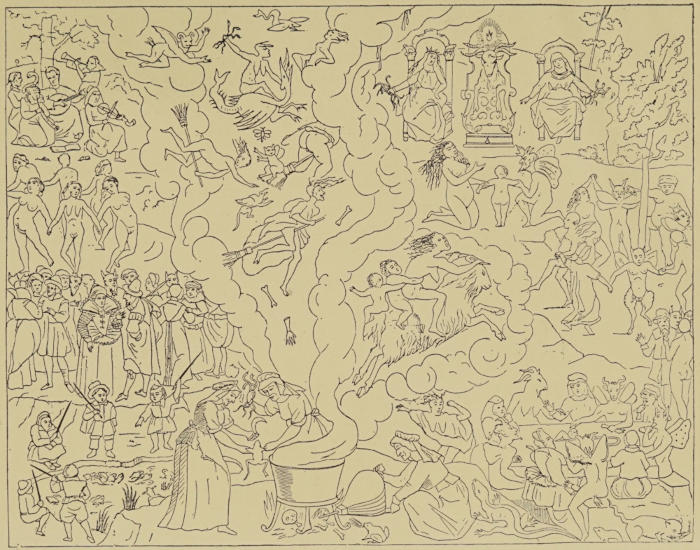
PLATE V
THE SABBAT. Ziarnko
[face p. 144
There are occasional records of unsavoury and tasteless viands, and there is even mention of putrefying garbage and carrion being placed before his evil worshippers by their Master. Such would appear to have been the case at those darker orgies when there was a manifestation of supernatural intelligences from the pit.
The Salamanca doctors say: “They make a meal from food either furnished by themselves or by the Devil. It is sometimes most delicious and delicate, and sometimes a pie baked from babies they have slain or disinterred corpses. A suitable grace is said before such a table.”[103] Guazzo thus describes their wine: “Moreover the wine which is usually poured out for the revellers is like black and clotted blood served in some foul and filthy vessel. Yet there seems to be no lack of cheer at these banquets, save that they furnish neither bread nor salt. Isabella further added that human flesh was served.”[104]
Salt never appeared at the witches’ table. Bodin gives us the reason that it is an emblem of eternity,[105] and Philip Ludwig Elich emphatically draws attention to the absence of salt at these infernal banquets.[106] “At these meals,” remarks Boguet, “salt never appears.”[107] Gentien le Clerc, who was tried in Orleans in 1615, confessed: “They sit down to table, but no salt is ever seen.”[108] Madeleine de la Palud declared that she had never seen salt, olives, or oil at the Devil’s feasts.[109]
When all these wretches are replete they proceed to a solemn parody of Holy Mass.
At the beginning of the eighteenth century Marcelline Pauper of the Congregation of the Sisters of Charity of Nevers was divinely called to offer herself up as a victim of reparation for the outrages done to the Blessed Sacrament, especially by sorcerers in their black masses at the Sabbat. In March, 1702, a frightful sacrilege was committed in the convent chapel. The tabernacle was forced open, the ciborium stolen, and those of the Hosts which had not been carried away by the Satanists were thrown to the pavement and trampled under foot. Marcelline made ceaseless reparation, and at nine o’clock of the evening of 26 April, she received the stigmata in hands, feet, and side, and also the Crown of Thorns. After a few years of expiation she died at Tulle, 25 June, 1708.
The erudite Paul Grilland tells us that the liturgy is burlesqued in every detail: “Those witches who have solemnly devoted themselves to the Devil’s service, worship him in a particular manner with ceremonial sacrifices, which they offer to the Devil, imitating in all respects the worship of Almighty God, with vestments, lights, and every other ritual observance, and with a set liturgy in which they are instructed, so that they worship and praise him eternally, just as we worship the true God.”[110] This abomination of blasphemy is met with again and again in the confessions of witches, and although particulars may differ here and there, the same quintessence of sacrilege persisted throughout the centuries, even as alas! in hidden corners and secret lairs of infamy it skulks and lurks this very day.
What appears extremely surprising in this connexion is the statement of Cotton Mather that the New England witches “met in Hellish Randezvous, wherein the Confessors (i.e. the accused who confessed) do say, they have had their Diabolical Sacraments, imitating the Baptism and the Supper of our Lord.”[111] At the trial of Bridget Bishop, alias Oliver, at the Court of Oyer and Terminer, held at Salem, 2 June, 1692, Deliverance Hobbs, a converted witch, affirmed “that this Bishop was at a General Meeting of the Witches, in a Field at Salem-Village, and there partook of a Diabolical Sacrament in Bread and Wine then administered.” In the case of Martha Carrier, tried 2 August, 1692, before the same court, two witnesses swore they had seen her “at a Diabolical Sacrament ... when they had Bread and Wine Administered unto them.” Abigail Williams confessed that on 31 March, 1692, when there was a Public Fast observed in Salem on account of the scourge of sorcery “the Witches had a Sacrament that day at an house in the Village, and that they had Red Bread and Red Drink.” This “Red Bread” is certainly puzzling. But the whole thing, sufficiently profane no doubt, necessarily lacks the hideous impiety of the black mass. A minister, the Rev. George Burroughs, is pointed to by accumulated evidence as being the Chief of the Salem witches; “he was Accused by Eight of the Confessing Witches as being an Head Actor at some of their Hellish Randezvouses, and one who had the promise of being a King in Satan’s kingdom”; it was certainly he who officiated at their ceremonies, for amongst others Richard Carrier “affirmed to the jury that he saw Mr. George Burroughs at the witch meeting at the village and saw him administer the sacrament,” whilst Mary Lacy, senr., and her daughter Mary “affirmed that Mr. George Burroughs was at the witch meetings with witch sacraments.”[112]
The abomination of the black mass is performed by some apostate or renegade priest who has delivered himself over to the service of evil and is shamefully prominent amongst the congregation of witches. It should be remarked from this fact that it is plain the witches are as profoundly convinced of the doctrines of Transubstantiation, the Totality, Permanence, and Adorableness of the Eucharistic Christ, and of the power also of the sacrificing priesthood, as is the most orthodox Catholic. Indeed, unless such were the case, their revolt would be empty, void at any rate of its material malice.
One of the gravest charges brought against the Templars and in the trials (1307-1314) established beyond any question or doubt was that of celebrating a blasphemous mass in which the words of consecration were omitted. It has, indeed, been suggested that the liturgy used by the Templars was not the ordinary Western Rite, but that it was an Eastern Eucharist. According to Catholic teaching the Consecration takes place when the words of institution are recited with intention and appropriate gesture, the actual change of the entire substances of bread and wine into the Body and Blood of Christ being effected in virtue of the words Hoc est enim Corpus meum; Hic est enim Calix sanguinis mei.... This has been defined by a decree of the Council of Florence (1439): “Quod ilia uerba diuina Saluatoris omnem uirtutem transsubstantiationis habent.” (These divine words of Our Saviour have full power to effect transubstantiation.) But the Orthodox Church holds that an Epiklesis is necessary to valid consecration, the actual words of Our Lord being repeated “as a narrative” [διηγηματικῶς],[113] which would seem logically to imply that Christ’s words have no part in the form of the Sacrament. In all Orthodox liturgies the words of Consecration are found together with the Epiklesis, and there are in existence some few liturgies, plainly invalid, which omit the words of Consecration altogether. These are all of them forms which have been employed by heretical sects; and it may be that the Templars used one of these. But it is far more probable that the words were purposely omitted; the Templars were corroded with Gnostic doctrines, they held the heresies of the Mandæans or Johannites who were filled with an insane hatred of Christ in much the same way as witches and demonolaters, they followed the tenets of the Ophites who venerated the Serpent and prayed to him for protection against the Creator, they adored and offered sacrifice before an idol, a Head, which, as Professor Prutz holds, represented the lower god whom Gnostic bodies worshipped, that is Satan. At his trial in Tuscany the knight Bernard of Parma confessed that the Order firmly believed this idol had the power to save and to enrich, in fine, flat diabolism. The secret mass of the Templars may have burlesqued an Eastern liturgy rather than the Western rite, but none the less it was the essential cult of the evil principle.
In 1336 a priest who had been imprisoned by the Comte de Foix, Gaston III Phébus, on a charge of celebrating a Satanic mass, was sent to Avignon and examined by Benedict XII in person. The next year the same pontiff appointed his trusty Guillaume Lombard to preside at the trial of Pierre du Chesne, a priest from the diocese of Tarbes, accused of defiling the Host.
Gilles de Sillé, a priest of the diocese of S. Malo, and the Florentine Antonio Francesco Prelati, formerly of the diocese of Arezzo, were wont to officiate at the black masses of Tiffauges and Machecoul, the castles of Gilles de Rais, who was executed in 1440.
A priest named Benedictus in the sixteenth century caused great scandal by the discovery of his assistance at secret and unhallowed rites. Charles IX employed an apostate monk to celebrate the eucharist of hell before himself and his intimates, and during the reign of his brother the Bishop of Paris burned in the Place de Grève a friar named Séchelle who had been found guilty of participating in similar profane mysteries. In 1597 the Parliament of Paris sentenced Jean Belon, curé of S. Pierre-des-Lampes in the Bourges diocese, to be hanged and his body burned for desecration of the Sacrament and the repeated celebration of abominable ceremonies.[114] The Parliament of Bordeaux in 1598 condemned to the stake Pierre Aupetit, curé of Pageas, near Chalus Limousin. He confessed that for more than twenty years he had frequented Sabbats, especially those held at Mathe-goutte and Puy-de-Dôme, where he worshipped the Devil and performed impious masses in his honour.[115] August 14, 1606, a friar named Denobilibus was put to death at Grenoble upon a similar conviction. In 1609 the Parliament of Bordeaux sent Pierre De Lancre and d’Espagnet to Labourd in the Bayonne district to stamp out the sorcerers who infested that region. No less than seven priests were arrested on charges of celebrating Satan’s mass at the Sabbat. Two, Migalena, an old man of seventy, and Pierre Bocal, aged twenty-seven, were executed, but the Bishop of Bayonne interfered, claimed the five for his own tribunal and contrived that they should escape from prison. Three other priests who were under restraint were immediately set free, and wisely quitted the country. A twelvemonth later Aix and the whole countryside rang with the confessions of Madeleine de la Palud who “Dit aussi que ce malheureux Loys magicien ... a controuvé le premier de dire la messe au sabatt et consacrer Véritablement et présenter le sacrifice à Lucifer.”[116] It was, of course, mere ignorance on her part to suppose that “that accursed Magician Lewes did first inuent the saying of Masse at the Sabbaths,” although Gaufridi may have told her this to impress her with a sense of his importance and power among the hierarchies of evil. Certainly in her evidence the details of the Sabbat worship are exceptionally detailed and complete.
They are, however, amply paralleled, if not exceeded, by the narrative of Madeleine Bavent, a Franciscan sister of the Third Order, attached to the convent of SS. Louis and Elizabeth at Louviers. Her confessions, which she wrote at length by the direction of her confessor, des Marets, an Oratorian, meticulously describe scenes of the most hideous blasphemy in which were involved three chaplains, David, Maturin Picard, the curé of Mesnil-Jourdain, and Thomas Boullé, sometime his assistant. Amongst other enormities they had revived the heresy of the Adamites, an early Gnostic sect, and celebrated the Mass in a state of stark nudity amid circumstances of the grossest indecency. Upon one Good Friday Picard and Boullé had compelled her to defile the crucifix and to break a consecrated Host, throwing the fragments upon the ground and trampling them. David and Picard were dead, but Boullé was burned at Rouen, 21 August, 1647.[117]
During the reign of Louis XIV a veritable epidemic of sacrilege seemed to rage throughout Paris.[118] The horrors of the black mass were said in many houses, especially in that of La Voisin (Catherine Deshayes) who lived in the rue Beauregard. The leading spirit of this crew was the infamous abbé Guibourg, a bastard son—so gossip said—of Henri de Montmorency. With him were joined Brigallier, almoner of the Grande Mademoiselle; Bouchot, director of the convent of La Saussaye; Dulong, a canon of Notre-Dame; Dulausens, vicar of Saint-Leu; Dubousquet; Seysson; Dussis; Lempérier; Lépreux; Davot, vicar of Notre-Dame de Bonne-Nouvelle; Mariette, vicar of Saint-Séverin, skilled in maledictions; Lemeignan, vicar of Saint-Eustache, who was convicted of having sacrificed numberless children to Satan; Toumet; Le Franc; Cotton, vicar of St. Paul, who had baptized a baby with the chrism of Extreme Unction and then throttled him upon the altar; Guignard and Sébault of the diocese of Bourges, who officiated at the black mass in the cellars of a house at Paris, and confected filthy charms under conditions of the most fearful impiety.
In the eighteenth century the black mass persisted. In 1723 the police arrested the abbé Lecollet and the abbé Bournement for this profanity; and in 1745 the abbé de Rocheblanche fell under the same suspicion. At the hotel of Madame de Charolais the vilest scenes of the Sabbat were continued. A gang of Satanists celebrated their monstrous orgies at Paris on 22 January, 1793, the night after the murder of Louis XVI. The abbé Fiard in two of his works, Lettres sur le diable, 1791, and La France Trompée ... Paris, 8vo, 1803, conclusively shows that eucharistic blasphemies were yet being perpetrated but in circumstances of almost impenetrable secrecy. In 1865 a scandal connected with these abominations came to light, and the Bishop of Sens, in whose diocese it occurred, was so horrified that he resigned his office and retired to Fontainebleau, where he died some eighteen months later, practically of shock. Similar practices were unmasked at Paris in 1874 and again in 1878, whilst it is common knowledge that the characters of Joris Karl Huysmans’ Là-Bas were all persons easy of identification, and the details are scenes exactly reproduced from contemporary life.[119] The hideous cult of evil yet endures. Satanists yet celebrate the black mass in London, Brighton, Paris, Lyons, Bruges, Berlin, Milan, and alas! in Rome itself. Both South America and Canada are thus polluted. In many a town, both great and small, they have their dens of blasphemy and evil where they congregate unsuspected to perform these execrable rites. Often they seem to concentrate their vile energies in the quiet cathedral cities of England, France, Italy, in vain endeavour to disturb the ancient homes of peace with the foul brabble of devil-worship and all ill.
They have even been brought upon the public stage. One episode of Un Soir de Folie, the revue (1925-6) at the Folies Bergère, Paris, was “Le Sabbat et la Herse Infernale,” where in a Gothic cathedral an actor (Mons. Benglia) appeared as Satan receiving the adoration of his devotees.
At the more frequented Sabbats the ritual of Holy Mass was elaborately burlesqued in almost every detail. An altar was erected with four supports, sometimes under a sheltering tree, at others upon a flat rock, or some naturally convenient place, “auprès d’vn arbre, ou parfois auprès d’vn rocher, dressant quelque forme d’autel sur des colonés infernales,” says De Lancre.[120] In more recent times and to-day when the black mass is celebrated in houses such an altar is often permanent and therefore the infernal sanctuary can be builded with a display of the full symbolism of the hideous cult of evil. The altar was covered with the three linen cloths the ritual enjoins, and upon it were six black candles in the midst of which they placed a crucifix inverted, or an image of the Devil. Sometimes the Devil himself occupied this central position, standing erect, or seated on some kind of monstrous throne. In 1598, at a celebrated witch-trial before the Parliament of Bordeaux with the Vicar-general of the Bishop of Limoges and a learned councillor Peyrat as assessors, Antoine Dumons of Saint-Laurent confessed that he had frequently provided a large number of candles for the Sabbat, both wax lights to be distributed among those present and the large black tapers for the altar. These were lit by Pierre Aupetit, who held a sacristan’s reed, and apparently officiated as Master of the Ceremonies when he was not actually himself saying the Mass.[121]