Chapter III · Demons and Familiars
Reading edition
One of the most authoritative of the older writers upon Witchcraft, Francesco-Maria Guazzo, a member of the Congregation of S. Ambrose ad Nemus,[1] in his encyclopædic Compendium Maleficarum, first published at Milan, 1608, has drawn up under eleven heads those articles in which a solemn and complete profession of Witchcraft was then held to consist:
First: The candidates have to conclude with the Devil, or some other Wizard or Magician acting in the Devil’s stead, an express compact by which, in the presence of witnesses they devote themselves to the service of evil, he giving them in exchange his pledge for riches, luxury, and such things as they desire.
Secondly: They abjure the Catholic Faith, explicitly withdraw from their obedience to God, renounce Christ and in a particular manner the Patronage and Protection of Our Lady, curse all Saints, and forswear the Sacraments. In Guernsey, in 1617, Isabel Becquet went to Rocquaine Castle, “the usual place where the Devil kept his Sabbath: no sooner had she arrived there than the Devil came to her in the form of a dog, with two great horns sticking up: and with one of his paws (which seemed to her like hands) took her by the hand: and calling her by her name told her that she was welcome: then immediately the Devil made her kneel down: while he himself stood up on his hind legs; he then made her express detestation of the Eternal in these words: I renounce God the Father, God the Son, and God the Holy Ghost; and then caused her to worship and invoke himself.”[2] De Lancre tells us that Jeannette d’Abadie, a lass of sixteen, confessed that she was made to “renounce & deny her Creator, the Holy Virgin, the Saints, Baptism, father, mother, relations, Heaven, earth, & all that the world contains.”[3] In a very full confession made by Louis Gaufridi on the second of April, 1611, to two Capuchins, Father Ange and Father Antoine, he revealed the formula of his abjuration of the Catholic faith. It ran thus: “I, Louis Gaufridi, renounce all good, both spiritual as well as temporal, which may be bestowed upon me by God, the Blessed Virgin Mary, all the Saints of Heaven, particularly my Patron S. John-Baptist, as also S. Peter, S. Paul, and S. Francis, and I give myself body and soul to Lucifer, before whom I stand, together with every good that I may ever possess (save always the benefit of the sacraments touching those who receive them). And according to the tenour of these terms have I signed and sealed.”[4] Madeleine de la Palud, one of his victims, used a longer and more detailed declaration in which the following hideous blasphemies occurred: “With all my heart and most unfeignedly and with all my will most deliberately do I wholly renounce God, Father, Son, and Holy Ghost; the most Holy Mother of God; all the Angels and especially my Guardian Angel, the Passion of Our Lord Jesus Christ, His Precious Blood and the merits thereof, my lot in Paradise, all the good inspirations which God may give me in the future, all prayers which are made or may be made for me.”[5]
Thirdly: They cast away with contempt the most Holy Rosary, delivered by Our Lady to S. Dominic;[6] the Cord of S. Francis; the cincture of S. Augustine; the Carmelite scapular bestowed upon S. Simon Stock; they cast upon the ground and trample under their feet in the mire the Cross, Holy Medals, Agnus Dei,[7] should they possess such or carry them upon their persons. S. Francis girded himself with a rough rope in memory of the bonds wherewith Christ was bound during His Passion, and a white girdle with three knots has since formed part of the Franciscan habit. Sixtus IV, by his Bull Exsupernæ dispositionis, erected the Archconfraternity of the Cord of S. Francis in the basilica of the Sacro Convento at Assisi, enriching it with many Indulgences, favours which have been confirmed by pontiff after pontiff. Archconfraternities are erected not only in Franciscan but in many other churches and aggregated to the centre at Assisi. The Archconfraternity of Our Lady of Consolation, or of the Black Leathern Belt of S. Monica, S. Augustine and S. Nicolas of Tolentino, took its rise from a vision of S. Monica, who received a black leathern belt from Our Lady. S. Augustine, S. Ambrose, and S. Simplicianus all wore such a girdle, which forms a distinctive feature of the dress of Augustinian Eremites. After the canonization of S. Nicolas of Tolentino it came into general use as an article of devotion, and Eugenius IV in 1439 erected the above Archconfraternity. A Bull of Gregory XIII Ad ea (15 July, 1575) confirmed this and added various privileges and Indulgences. The Archconfraternity is erected in Augustinian sanctuaries, from the General of which Order leave must be obtained for its extension to other churches.
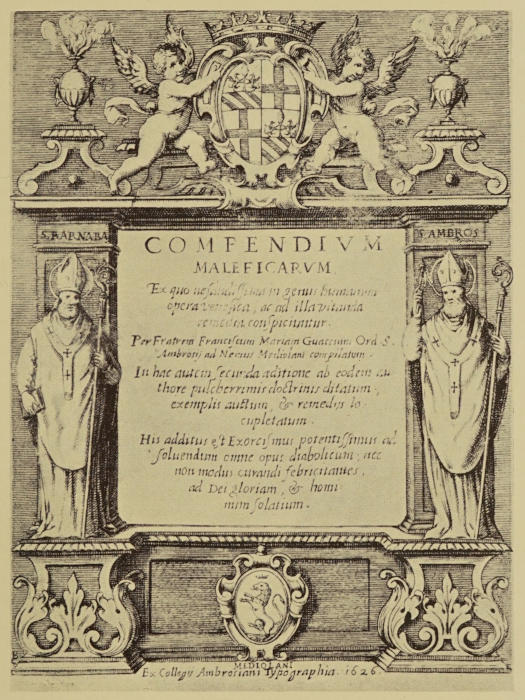
PLATE III
COMPENDIVM MALEFICARVM. Francesco-Maria Guazzo. Title-page of Second Edition
[face p. 82
Fourthly: All witches vow obedience and subjection into the hands of the Devil; they pay him homage and vassalage (often by obscene ceremonies), and lay their hands upon a large black book which is presented to them. They bind themselves by blasphemous oaths never to return to the true faith, to observe no divine precept, to do no good work, but to obey the Demon only and to attend without fail the nightly conventicles. They pledge themselves to frequent the midnight assemblies.[8] These conventicles or covens[9] (from conuentus) were bands or companies of witches, composed of men and women, apparently under the discipline of an officer, all of whom for convenience’ sake belonged to the same district. Those who belonged to a coven were, it seems from the evidence at trials, bound to attend the weekly Esbat. The arrest of one member of a coven generally led to the implication of the rest. Cotton Mather remarks, “The witches are organized like Congregational Churches.”
Fifthly: The witches promise to strive with all their power and to use every inducement and endeavour to draw other men and women to their detestable practices and the worship of Satan.
The witches were imbued with the missionary spirit, which made them doubly damnable in the eyes of the divines and doubly guilty in the eyes of the law. So in the case of Janet Breadheid of Auldearne, we find that her husband “enticed her into that craft.”[10] A girl named Bellot, of Madame Bourignon’s academy, confessed that her mother had taken her to the Sabbat when she was quite a child. Another girl alleged that all worshippers of the Devil “are constrained to offer him their Children.” Elizabeth Francis of Chelmsford, a witch tried in 1566, was only about twelve years old when her grandmother first taught her the art of sorcery.[11] The famous Pendle beldame, Elizabeth Demdike “brought vp her owne Children, instructed her Graundchildren, and tooke great care and paines to bring them to be Witches.”[12] At Salem, George Burroughs, a minister, was accused by a large number of women as “the person who had Seduc’d and Compell’d them into the snares of Witchcraft.”
Sixthly: The Devil administers to witches a kind of sacrilegious baptism, and after abjuring their Godfathers and Godmothers of Christian Baptism and Confirmation they have assigned to them new sponsors—as it were—whose charge it is to instruct them in sorcery: they drop their former name and exchange it for another, generally a scurrilous and grotesque nickname.
In 1609 Jeanette d’Abadie, a witch of the Basses-Pyrénées, confessed “that she often saw children baptized at the Sabbat, and these she informed us were the offspring of sorcerers and not of other persons, but of witches who are accustomed to have their sons and daughters baptized at the Sabbat rather than at the Font.”[13] June 20, 1614, at Orleans, Silvain Nevillon amongst other crimes acknowledged that he had frequented assemblies of witches, and “that they baptize babies at the Sabbat with Chrism.... Then they anoint the child’s head therewith muttering certain Latin phrases.”[14] Gentien le Clerc, who was tried at the same time, “said that his mother, as he had been told, presented him at the Sabbat when he was but three years old, to a monstrous goat, whom they called l’Aspic. He said that he was baptized at the Sabbat, at Carrior d’Olivet, with fourteen or fifteen other children....”[15]
Among the confessions made by Louis Gaufridi at Aix in March, 1611, were: “I confess that baptism is administered at the Sabbat, and that every sorcerer, devoting himself to the Devil, binds himself by a particular vow that he will have all his children baptized at the Sabbat, if this may by any possible means be effected. Every child who is thus baptized at the Sabbat receives a name, wholly differing from his own name. I confess that at this baptism water, sulphur, and salt are employed: the sulphur renders the recipient the Devil’s slave whilst salt confirms his baptism in the Devil’s service. I confess that the form and intention are to baptize in the name of Lucifer, Belzebuth and other demons making the sign of the cross beginning backwards and then tracing from the feet and ending at the head.”[16]
A number of Swedish witches (1669) were baptized: “they added, that he caused them to be baptized too by such Priests as he had there, and made them confirm their Baptism with dreadful Oaths and Imprecations.”[17]
The giving of a new name seems to have been very general. Thus in May, 1569, at S. Andrews “a notabill sorceres callit Nicniven was condemnit to the death and burnt.” Her Christian name is not given merely her witch’s name bestowed by the demon. In the famous Fian case it was stated that when at the meeting in North Berwick kirk Robert Grierson was named great confusion ensued for the witches and warlocks “all ran hirdie-girdie, and were angry, for it was promised that he should be called Robert the Comptroller, for the expriming of his name.”[18] Euphemia McCalyan of the same coven was called Cane, and Barbara Napier Naip. Isabel Goudie of Auldearne (1662) stated that many witches known to her had been baptized in their own blood by such names as “Able-and-Stout,” “Over-the-dike-with-it,” “Raise-the-wind,” “Pickle-nearest-the-wind,” “Batter-them-down-Maggy,” “Blow-Kate,” and similar japeries.
Seventhly: The witches cut off a piece of their own garments, and as a token of homage tender it to the Devil, who takes it away and keeps it.
Eighthly: The Devil draws on the ground a circle wherein stand the Novices, Wizards, and Witches, and there they confirm by oath all their aforesaid promises. This has a mystical signification. “They take this oath to the Demon standing in a circle described upon the ground, perchance because a circle is the Symbol of Divinity, & the earth God’s footstool and thus he assuredly wishes them to believe that he is the lord of Heaven and earth.”[19]
Ninthly: The sorcerers request the Devil to strike them out of the book of Christ, and to inscribe them in his own. Then is solemnly brought forward a large black book, the same as that on which they laid their hands when they did their first homage, and they are inscribed in this by the Devil’s claw.
These books or rolls were kept with great secrecy by the chief officer of the coven or even the Grand Master of a district. They would have been guarded as something as precious as life itself, seeing that they contained the damning evidence of a full list of the witches of a province or county, and in addition thereto seems to have been added a number of magic formulæ, spells, charms, and probably, from time to time, a record of the doings of the various witches. The signing of such a book is continually referred to in the New England trials. So when Deliverance Hobbs had made a clean breast of her sorceries, “She now testifi’d, that this Bishop [Bridget Bishop, condemned and executed as a long-continued witch] tempted her to sign the Book again, and to deny what she had confess’d.” The enemies of the notorious Matthew Hopkins made great capital out of the story that by some sleight of sorcery he had got hold of one of these Devil’s memorandum-books, whence he copied a list of witches, and this it was that enabled him to be so infallible in his scent. The Witch-Finder General was hard put to it to defend himself from the accusation, and becomes quite pitiful in his whining asseverations of innocence. There is a somewhat vague story, no dates being given, that a Devil’s book was carried off by Mr. Williamson of Cardrona (Peebles), who filched it from the witches whilst they were dancing on Minchmoor. But the whole coven at once gave chase, and he was glad to abandon it and escape alive.
Sometimes the catalogue of witches was inscribed on a separate parchment, and the book only used to write down charms and spells. Such a volume was the Red Book of Appin known to have actually been in existence a hundred years ago. Tradition said it was stolen from the Devil by a trick. It was in manuscript, and contained a large number of magic runes and incantations for the cure of cattle diseases, the increase of flocks, the fertility of fields. This document, which must be of immense importance and interest, when last heard of was (I believe) in the possession of the now-extinct Stewarts of Invernahyle. This strange volume, so the story ran, conferred dark powers on the owner, who knew what inquiry would be made ere the question was poised; and the tome was so confected with occult arts that he who read it must wear a circlet of iron around his brow as he turned those mystic pages.
Another volume, of which mention is made—one that is often confused[20] with, but should be distinguished from, these two—is what we may term the Devil’s Missal. Probably this had its origin far back in the midst of the centuries among the earliest heretics who passed down their evil traditions to their followers, the Albigenses and the Waldenses or Vaudois. This is referred to by the erudite De Lancre, who in his detailed account of the Black Mass as performed in the region of the Basses-Pyrénées (1609) writes: “Some kind of altar was erected upon the pillars of infernal design, and hereon, without reciting the Confiteor or Alleluya, turning over the leaves of a certain book which he held, he began to mumble certain phrases of Holy Mass.”[21] Silvain Nevillon (Orleans, 1614) confessed that “the Sabbat was held in a house.... He saw there a tall dark man opposite to the one who was in a corner of the ingle, and this man was perusing a book, whose leaves seemed black & crimson, & he kept muttering between his teeth although what he said could not be heard, and presently he elevated a black host and then a chalice of some cracked pewter, all foul and filthy.”[22] Gentien le Clerc, who was also accused, acknowledged that at these infernal assemblies “Mass was said, and the Devil was celebrant. He was vested in a chasuble upon which was a broken cross. He turned his back to the altar when he was about to elevate the Host and the Chalice, which were both black. He read in a mumbling tone from a book, the cover of which was soft and hairy like a wolf’s skin. Some leaves were white and red, others black.”[23] Madeleine Bavent, who was the chief figure in the trials at Louviers (1647), acknowledged: “Mass was read from the book of blasphemies, which contained the canon. This same volume was used in processions. It was full of the most hideous curses against the Holy Trinity, the Holy Sacrament of the Altar, the other Sacraments and ceremonies of the Church. It was written in a language completely unknown to me.”[24] Possibly this blasphemous volume is the same as that which Satanists to-day use when performing their abominable rites.
Tenthly: The witches promise the Devil sacrifices and offerings at stated times; once a fortnight, or at least once a month, the murder of some child, or some mortal poisoning, and every week to plague mankind with evils and mischiefs, hailstorms, tempest, fires, cattle-plagues and the like.
The Liber Pœnitentialis of S. Theodore, Archbishop of Canterbury 668-690, the earliest ecclesiastical law of England, has clauses condemning those who invoke fiends, and so cause the weather to change “si quis emissor tempestatis fuerit.” In the Capitaluria of Charlemagne (died at Aachen, 28 January, 814), the punishment of death is declared against those who by evoking the demon, trouble the atmosphere, excite tempests, destroy the fruits of the earth, dry up the milk of cows, and torment their fellow-creatures with diseases or any other misfortune. All persons found guilty of employing such arts were to be executed immediately upon conviction. Innocent VIII in his celebrated Bull, Summis desiderantes affectibus, 5 December, 1484, charges sorcerers in detail with precisely the same foul practices. The most celebrated occasion when witches raised a storm was that which played so important a part in the trial of Dr. Fian and his coven, 1590-1, when the witches, in order to drown King James and Queen Anne on their voyage from Denmark, “tooke a Cat and christened it,” and after they had bound a dismembered corpse to the animal “in the night following the said Cat was convayed into the middest of the sea by all these witches, sayling in their riddles or cives, ... this doone, then did arise such a tempest in the sea, as a greater hath not bene seene.”[25] The bewitching of cattle is alleged from the earliest time, and at Dornoch in Sutherland as late as 1722, an old hag was burned for having cast spells upon the pigs and sheep of her neighbours, the sentence being pronounced by the sheriff-depute, Captain David Ross of Little Dean. This was the last execution of a witch in Scotland.
With regard to the sacrifice of children there is a catena of ample evidence. Reginald Scot[26] writes in 1584: “This must be an infallible rule, that euerie fortnight, or at the least euerie month, each witch must kill one child at the least for hir part.” When it was dangerous or impossible openly to murder an infant the life would be taken by poison, and in 1645 Mary Johnson, a witch of Wyvenhoe, Essex, was tried for poisoning two children, no doubt as an act of sorcery.[27] It is unknown how many children Gilles de Rais devoted to death in his impious orgies. More than two hundred corpses were found in the latrines of Tiffauges, Machecoul, Champtocé. It was in 1666 that Louis XIV was first informed of the abominations which were vermiculating his capital “des sacrilèges, des profanations, des messes impies, des sacrifices de jeunes enfants.” Night after night in the rue Beauregard at the house of the mysterious Catherine la Voisin the abbé Guibourg was wont to kill young children for his hideous ritual, either by strangulation or more often by piercing their throats with a sharp dagger and letting the hot blood stream into the chalice as he cried: “Astaroth, Asmodée, je vous conjure d’accepter le sacrifice que je vous présente!” (Astaroth! Asmodeus! Receive, I beseech you, this sacrifice I offer unto you!) A priest named Tournet also said Satanic Masses at which children were immolated; in fact the practice was so common that la Chaufrein, a mistress of Guibourg, would supply a child for a crown[28] piece.
Eleventhly: The Demon imprints upon the Witches some mark.... When this has all been performed in accordance with the instructions of those Masters who have initiated the Novice, the latter bind themselves by fearful oaths never to worship the Blessed Sacrament; to heap curses on all Saints and especially to abjure our Lady Immaculate; to trample under foot and spit upon all holy images, the Cross and Relics of Saints; never to use the Sacraments or Sacramentals unless with some magical end in view; never to make a good confession to the priest, but always to keep hidden their commerce with hell. In return the Demon promises that he will at all times afford them prompt assistance; that he will accomplish all their desires in this world and make them eternally happy after their death. This solemn profession having been publicly made each novice has assigned to him a several demon who is called Magistellus (a familiar). This familiar can assume either a male or a female shape; sometimes he appears as a full-grown man, sometimes as a satyr; and if it is a woman who has been received as a witch he generally assumes the form of a rank buck-goat.
It is obvious that there is no question here of animal familiars, but rather of evil intelligences who were, it is believed, able to assume a body of flesh. The whole question is, perhaps, one of the most dark and difficult connected with Witchcraft and magic, and the details of these hideous connexions are such—for as the Saints attain to the purity of angels, so, on the other hand, will the bond slaves of Satan defile themselves with every kind of lewdness—that many writers have with an undue diffidence and modesty dismissed the subject far too summarily for the satisfaction of the serious inquirer. In the first place, we may freely allow that many of these lubricities are to be ascribed to hysteria and hallucinations, to nightmare and the imaginings of disease, but when all deductions have been made—when we admit that in many cases the incubus or succubus can but have been a human being, some agent of the Grand Master of the district,—none the less enough remains from the records of the trials to convince an unprejudiced mind that there was a considerable substratum of fact in the confessions of the accused. As Canon Ribet has said in his encyclopædic La Mystique Divine, a work warmly approved by the great intellect of Leo XIII: “After what we have learned from records and personal confessions we can scarcely entertain any more doubts, and it is our plain duty to oppose, even if it be but by a simple affirmation on our part, those numerous writers who, either through presumption or rashness, treat these horrors as idle talk or mere hallucination.”[29] Bizouard also in his authoritative Rapports de l’homme avec le démon writes of the incubus and succubus: “These relations, far from being untrue, bear the strongest marks of authenticity which can be given them by official proceedings regulated and approved with all the caution and judgement brought to bear upon them by enlightened and conscientious magistrates who, throughout all ages, have been in a position to test plain facts.”[30]
It seems to me that if unshaken evidence means anything at all, if the authority of the ablest and acutest intellects of all ages in all countries is not to count for merest vapourings and fairy fantasies, the possibility—I do not, thank God, say the frequency—of these demoniacal connexions is not to be denied. Of course the mind already resolved that such things cannot be is inconvincible even by demonstration, and one can only fall back upon the sentence of S. Augustine: “Hanc assidue immunditiam et tentare et efficere, plures talesque asseuerant, ut hoc negare impudentiæ uideatur.”[31] In which place the holy doctor explicitly declares: “Seeing it is so general a report, and so many aver it either from their own experience or from others, that are of indubitable honesty and credit, that the sylvans and fawns, commonly called incubi, have often injured women, desiring and acting carnally with them: and that certain devils whom the Gauls call Duses, do continually practise this uncleanness, and tempt others to it, which is affirmed by such persons, and with such confidence that it were impudence to deny it.”
The learned William of Paris, confessor of Philip le Bel, lays down: “That there exist such beings as are commonly called incubi or succubi and that they indulge their burning lusts, and that children, as it is freely acknowledged, can be born from them, is attested by the unimpeachable and unshaken witness of many men and women who have been filled with foul imaginings by them, and endured their lecherous assaults and lewdness.”[32]
Francisco Suarez, the famous Jesuit theologian, writes with caution but with directness: “This is the teaching on this point of S. Thomas, who is generally followed by all other theologians.... The reason for their opinion is this: Such an action considered in its entirety by no means exceeds the natural powers of the demon, whilst the exercise of such powers is wholly in accordance with the malice of the demon, and it may well be permitted by God, owing to the sins of some men. Therefore this teaching cannot be denied without many reservations and exceptions. Wherefore S. Augustine has truly said, that inasmuch as this doctrine of incubi and succubi is established by the opinion of many who are experienced and learned, it were sheer impudence to deny it.”[35] The Salmanticenses—that is to say, the authors of the courses of Scholastic philosophy and theology, and of Moral theology, published by the lecturers of the theological college of the Discalced Carmelites at Salamanca—in their weighty Theologia Moralis[36] state: “Some deny this, believing it impossible that demons should perform the carnal act with human beings,” but they affirm, “None the less the opposite opinion is most certain and must be followed.”[37] Charles René Billuart, the celebrated Dominican, in his Tractatus de Angelis expressly declares: “The same evil spirit may serve as a succubus to a man, and as an incubus to a woman.”[38] One of the most learned—if not the most learned—of the popes, Benedict XIV, in his erudite work De Seruorum Dei Beatificatione, treats this whole question at considerable length with amplest detail and solid references, Liber IV, Pars i. c. 3.[39] Commenting upon the passage “The sons of God went unto the daughters of men” (Genesis vi. 4), the pontiff writes: “This passage has reference to those Demons who are known as incubi and succubi.... It is true that whilst nearly all authors admit the fact, some writers deny that there can be offspring.... On the other hand, several writers assert that connexion of this kind is possible and that children may be born from it, nay, indeed, they tell us that this has taken place, although it were done in some new and mysterious way which is ordinarily unknown to man.”[40]
S. Alphonsus Liguori in his Praxis confessariorum, VII, n. 111, writes: “Some deny that there are evil spirits, incubi and succubi; but writers of authority for the most part assert that such is the case.”[41]
In his Theologia Moralis he speaks quite precisely when defining the technical nature of the sin witches commit in commerce with incubi.[42] [43] This opinion is also that of Martino Bonacina,[44] and of Vincenzo Filliucci, S.J.[45] “Busembaum has excellently observed that carnal sins with an evil spirit fall under the head of the technical term bestialitas.”[46] This is also the conclusion of Thomas Tamburini, S.J. (1591-1675); Benjamin Elbel, O.F.M. (1690-1756);[47] Cardinal Cajetan, O.P. (1469-1534) “the lamp of the Church”; Juan Azor, S.J. (1535-1603); “in wisdom, in depth of learning and in gravity of judgement taking deservedly high rank among theologians” (Gury); and many other authorities.[48] What a penitent should say in confession is considered by Monsignor Craisson, sometime Rector of the Grand Seminary of Valence and Vicar-General of the diocese, in his Tractate De Rebus Uenereis ad usum Confessariorum.[49] Jean-Baptiste Bouvier (1783-1854) the famous bishop of Le Mans, in his Dissertatio in Sextum Decalogi Præceptum[50] (p. 78) writes: “All theologians speak of ... evil spirits who appear in the shape of a man, a woman, or even some animal. This is either a real and actual presence, or the effect of imagination. They decide that this sin ... incurs particular guilt which must be specifically confessed, to wit an evil superstition whereof the essence is a compact with the Devil. In this sin, therefore, we have two distinct kinds of malice, one an offence against chastity; the other against our holy faith.”[51] Dom Dominic Schram,[52] O.S.B., in his Institutiones Theologiæ Mysticæ poses the following: “The inquiry is made whether a demon ... may thus attack a man or woman, whose obsession would be suffered if the subject were wholly bent upon obtaining perfection and walking the highest paths of contemplation. Here we must distinguish the true and the false. It is certain that—whatever doubters may say—there exist such demons, incubi and succubi: and S. Augustine asserts (The City of God, Book XV, chapter 23) that it is most rash to advance the contrary.... S. Thomas, and most other theologians maintain this too. Wherefore the men or women who suffer these impudicities are sinners who either invite demons ... or who freely consent to demons when the evil spirits tempt them to commit such abominations. That these and other abandoned wretches may be violently assaulted by the demon we cannot doubt ... and I myself have known several persons who although they were greatly troubled on account of their crimes, and utterly loathed this foul intercourse with the demon, were nevertheless compelled sorely against their will to endure these assaults of Satan.”[53]
It will be seen that great Saints and scholars and all moral theologians of importance affirm the possibility of commerce with incarnate evil intelligences. The demonologists also range themselves in a solid phalanx of assent. Hermann Thyraus, S.J.,[54] in his De Spirituum apparitione says: “It is so rash and inept to deny these (things) that so to adopt this attitude you must needs reject and spurn the most weighty and considered judgements of most holy and authoritative writers, nay, you must wage war upon man’s sense and consciousness, whilst at the same time you expose your ignorance of the power of the Devil and the empery evil spirits may obtain over man.”[55] Delrio, in his Disquisitiones Magicæ, is even more emphatic: “So many sound authors and divines have upheld this belief that to differ from them is mere obstinacy and foolhardiness; for the Fathers, theologians, and all the wisest writers on philosophy agree upon this matter, the truth of which is furthermore proved by the experience of all ages and peoples.”[56] The erudite Sprenger in the Malleus Maleficarum has much the same.[57] John Nider, O.P. (1380-1438) in his Formicarius, which may be described as a treatise on the theological, philosophical, and social problems of his day, with no small acumen remarks: “The reason why evil spirits appear as incubi and succubi would seem to be that ... they inflict a double hurt on man, both in his soul and body, and it is a supreme joy to devils thus to injure humankind.”[58] Paul Grilland in his De Sortilegio (Lyons, 1533) writes: “A demon assumes the form of the succubus.... This is the explicit teaching of the theologians.”[59]
“It has often been known by most certain and actual experience that women in spite of their resistance have been overpowered by demons.” Such are the words of the famous Alfonso de Castro, O.F.M.,[60] whose authoritative pronouncements upon Scripture carried such weight at the Council of Trent, and who was Archbishop-elect of Compostella when he died. Pierre Binsfeld, De confessione maleficarum, sums up: “This is a most solemn and undoubted fact not only proved by actual experience, but also by the opinion of all the ages, whatever some few doctors and legal writers may suppose.”[61]
Gaspar Schott, S.J. (1608-66), physicist, doctor, and divine, “one of the most learned men of his day, his simple life and deep piety making him an object of veneration to the Protestants as well as to the Catholics of Augsburg,” where his declining years were spent, lays down: “So many writers of such high authority maintain this opinion, that it were impossible to reject it.”[62] Bodin, de Lancre, Boguet, Görres, Bizouard,[63] Gougenot des Mousseaux,[64] insist upon the same sad facts. And above all sounds the solemn thunder of the Bull of Innocent VIII announcing in no ambiguous phrase: “It has indeed come to our knowledge and deeply grieved are we to hear it, that many persons of both sexes, utterly forgetful of their souls’ salvation and straying far from the Catholic Faith, have (had commerce) with evil spirits, both incubi and succubi.”[65]
I have quoted many and great names, men of science, men of learning, men of authority, men to whom the world yet looks up with admiration, nay, with reverence and love, inasmuch as to-day it is difficult, wellnigh inconceivable in most cases, for the modern mind to credit the possibility of these dark deeds of devilry, these foul lusts of incubi and succubi.[66] They seem to be some sick and loathly fantasy of dim mediæval days shrieked out on the rack by a poor wretch crazed with agony and fear, and written down in long-forgotten tomes by fanatics credulous to childishness and more ignorant than savages. “Even if such horrors ever could have taken place in the dark ages,”—those vague Dark Ages!—men say, “they would never be permitted now.” And he who knows, the priest sitting in the grated confessional, in whose ears are poured for shriving the filth and folly of the world, sighs to himself, “Would God that in truth it were so!” But the sceptics are happier in their singleness and their simplicity, happy that they do not, will not, realize the monstrous things that lie only just beneath the surface of our cracking civilization.
It may not impertinently be inquired how demons or evil intelligences, since they are pure spiritual beings, can not only assume human flesh but perform the peculiarly carnal act of coition. Sinistrari, following the opinion of Guazzo, says that either the evil intelligence is able to animate the corpse of some human being, male or female, as the case may be, or that, from the mixture of other materials he shapes for himself a body endowed with motion, by means of which he is united to the human being: “ex mixtione aliarum materiarum effingit sibi corpus, quod mouet, et mediante quo homini unitur.”[67] In the first instance, advantage might be taken, no doubt, of a person in a mediumistic trance or hypnotic sleep. But the second explanation seems by far the more probable. Can we not look to the phenomena observed in connexion with ectoplasm as an adequate explanation of this? It must fairly be admitted that this explanation is certainly borne out by the phenomena of the materializing séance where physical forms which may be touched and handled are built up and disintegrated again in a few moments of time. Miss Scatcherd, in a symposium, Survival,[68] gives certain of her own experiences that go far to prove the partial re-materialization of the dead by the utilization of the material substance and ectoplasmic emanations of the living. And if disembodied spirits can upon occasion, however rare, thus materialize, why not evil intelligences whose efforts at corporeality are urged and aided by the longing thoughts and concentrated will power of those who eagerly seek them?
This explanation is further rendered the more probable by the recorded fact that the incubus can assume the shape of some person whose embraces the witch may desire.[69] Brignoli, in his Alexicacon, relates that when he was at Bergamo in 1650, a young man, twenty-two years of age, sought him out and made a long and ample confession. This youth avowed that some months before, when he was in bed, the chamber door opened and a maiden, Teresa, whom he loved, stealthily entered the room. To his surprise she informed him that she had been driven from home and had taken refuge with him. Although he more than suspected some delusion, after a short while he consented to her solicitations and passed a night of unbounded indulgence in her arms. Before dawn, however, the visitant revealed the true nature of the deceit, and the young man realized he had lain with a succubus. None the less such was his doting folly that the same debauchery was repeated night after night, until struck with terror and remorse, he sought the priest to confess and be delivered from this abomination. “This monstrous connexion lasted several months; but at last God delivered him by my humble means, and he was truly penitent for his sins.”[70]
Not infrequently the Devil or the familiar assigned to the new witch at the Sabbat when she was admitted must obviously have been a man, one of the assembly, who either approached her in some demoniacal disguise or else embraced her without any attempt at concealment of his individuality, some lusty varlet who would afterwards hold himself at her disposition. For we must always bear in mind that throughout these witch-trials there is often much in the evidence which may be explained by the agency of human beings; not that this essentially meliorates their offences, for they were all bond-slaves of Satan, acting under his direction and by the inspiration of hell. When the fiend has ministers devoted to his service there is, perhaps, less need for his interposition in propria persona. Howbeit, again and again in these cases we meet with that uncanny quota, by no means insignificant and unimportant, which seemingly admits of no solution save by the materialization of evil intelligences of power. And detailed as is the evidence we possess, it not unseldom becomes a matter of great difficulty, when we are considering a particular case, to decide whether it be an instance of a witch having had actual commerce and communion with the fiend, or whether she was cheated by the devils, who mocked her, and allowing her to deem herself in overt union with them, thus led the wretch on to misery and death, duped as she was by the father of lies, sold for a delusion and by profitless endeavour in evil. There are, of course, also many cases which stand on the border-line, half hallucination, half reality. Sylvine de la Plaine, a witch of twenty-three, who was condemned by the Parliament of Paris, 17 May, 1616, was one of these.[71] Antoinette Brenichon, a married woman, aged thirty, made a confession in almost exactly the same words. Sylvine, her husband Barthélemi Minguet, and Brenichon were hanged and their bodies burned.
Henri Boguet, a Judge of the High Court of Burgundy, in his Discours des Sorciers, devotes chapter xii to “The carnal connexion of the Demons with Witches and Sorcerers.” He discusses: 1. The Devil knows all the Witches, & why. 2. He takes a female shape to pleasure the Sorcerers, & why. 3. Other reasons why the Devil (has to do) with warlocks and witches.[72] Françoise Secretain, Clauda Ianprost, Iaquema Paget, Antoine Tornier, Antoine Gandillon, Clauda Ianguillaume, Thieuenne Paget, Rolande du Vernois, Ianne Platet, Clauda Paget, and a number of other witches confessed “their dealings with the Devil.”[73] Pierre Gandillon and his son George also confessed to commerce with the Demon. Under his third division Boguet lays down explicit statements on the matter.[74][75]
This unnatural physical coldness of the Demon is commented upon again and again by witches at their trials in every country of Europe throughout the centuries. I have already suggested that in some cases there was a full materialization due to ectoplasmic emanations. Now, ectoplasm is described[76] as being to the touch a cold and viscous mass comparable to contact with a reptile, and this certainly seems to throw a flood of light upon these details. It may be that here indeed we have a solution of the whole mystery. In 1645 the widow Bash, a Suffolk witch, of Barton, said that the Devil who appeared to her as a dark swarthy youth “was colder than man.”[77] Isobel Goudie and Janet Breadheid, of the Auldearne coven, 1662, both asserted that the Devil was “a meikle, blak, rock man, werie cold; and I fand his nature als cold, a spring-well-water.”[78] Isabel, who had been rebaptized at a Sabbat held one midnight in Auldearne parish church, and to whom was assigned a familiar named the Red Riever, albeit he was always clad in black, gave further details of the Devil’s person: “He is abler for ws that way than any man can be, onlie he ves heavie lyk a malt-sek; a hudg nature, uerie cold, as yce.”[79]
In many of the cases of debauchery at Sabbats so freely and fully confessed by the witches their partners were undoubtedly the males who were present; the Grand Master, Officer, or President of the Assembly, exercising the right to select first for his own pleasures such women as he chose. This is clear from a passage in De Lancre: “The Devil at the Sabbat performs marriages between the warlocks and witches, and joining their hands, he pronounces aloud
Esta es buena parati Esta parati lo toma.”[80]
And in many cases it is obvious that use must have been made of an instrument, an artificial phallus employed.[81]
The artificial penis was a commonplace among the erotica of ancient civilizations; there is abundant evidence of its use in Egypt, Assyria, India, Mexico, all over the world. It has been found in tombs; frequently was it to be seen as an ex-voto; in a slightly modified form it is yet the favourite mascot of Southern Italy.[82] Often enough they do not trouble to disguise the form. Aristophanes mentions the object in his Lysistrata (411 B.C.), and one of the most spirited dialogues (VI) of Herodas (circa 300-250 B.C.) is that where Koritto and Metro prattle prettily of their βαύβων, whilst (in another mime, VII) the ladies visit Kerdon the leather-worker who has fashioned this masterpiece. Truly Herodas is as modern to-day in London or in Paris as he ever was those centuries ago in the isle of Cos. Fascinum, explains the Glossarium Eroticum Linguæ Latinæ,[83] “Penis fictitius ex corio, aut pannis lineis uel sericis, quibus mulieres uirum mentiebantur. Antiquissima libido, lesbiis et milesiis feminis præsertim usitatissima. Fascinis illis abutebantur meretrices in tardos ascensores.” As one might expect Petronius has something to say on the subject in a famous passage where that savage old hag[84] Œnothea fairly frightened Encolpius with her scorteum fascinum, upon which an erudite Spanish scholar, Don Antonio Gonzalez de Salas, glosses: “Rubrum penem coriaceum ut Suidas exsertim tradit uoce φαλλόι. Confecti & ex uaria materia uarios in usus olim phalli ex ligno, ficu potissimum qui ficulnei sæpius adpellati, ex ebore, ex auro, ex serico, & ex lineo panno, quibus Lesbiæ tribades abutebantur.”[85] And Tibullus, speaking of the image of Priapus, has:[86]
Placet Priape? qui sub arboris coma Soles sacrum reuincte pampino caput Ruber sedere cum rubente fascino.
The Church, of course, condemned with unhesitating voice all such practices, whether they were connected (in however slight a degree) with Witchcraft or not. Arnobius, who regards all such offences as detestable, in his Aduersus Nationes, V (circa A.D. 296), relates a curiously obscene anecdote which seems to point to the use of the fascinum by the Galli, the priests of Berecynthian Cybele,[87] whose orgies were closely akin to those of Dionysus. And the same story is related by Clement of Alexandria Προτρεπτικὸς πρὸς Ἕλληνας (circa A.D. 190); by Julius Firmicus Maternus, De Errore profanarum Religionum (A.D. 337-350); by Nicetas (ob. circa A.D. 414) in a commentary on S. Gregory of Nanzianzus, oratio XXXIX; and by Theodoret (ob. circa A.D. 457) Sermo octaua de Martyribus. Obviously some very primitive rite is in question.
Lactantius, in his De Falsa Religione (Diuinarum Institutionum, I, circa A.D. 304), speaks of a phallic superstition, akin to the fascinum, as favoured by the vestals, and implies it was notoriously current in his day. That eminent father, S. Augustine, De Ciuitate Dei, VII, 21, gives some account of the fascinum as used in the rites of Bacchus, and when he is detailing the marriage ceremonies (VI, 9), he writes: “Sed quid hoc dicam, cum tibi sit et Priapus nimius masculus, super cuius immanissimum et turpissimum fascinum sedere nona nupta iubeatur, more honestissimo et religiosissimo matronarum.” The historian, Evagrius Scholasticus (ob. post A.D. 504), in his Historia Ecclesiastica (XI, 2), says that the ritual of Priapus was quite open in his day, and the fascinum widely known. Nicephorus Calixtus, a later Byzantine, who died about the middle of the fourteenth century but whose Chronicle closed with the death of Leo Philosophus, A.D. 911, speaks of phallic ceremonies and of the use of ithy-phalli.[88]
Council after council forbade the use of the fascinum, and their very insistence of prohibition show how deeply these abominations had taken root. The Second Council of Châlon-sur-Saône (813) is quite plain and unequivocal; so are the synods of de Mano (1247) and Tours (1396). Burchard of Worms (died 25 Aug., 1025) in his famous Decretum has: “Fecisti quod quædam mulieres facere solent, ut facere quoddam molimen aut mechinamentum in modum uirilis membri, ad mensuram tuæ uoluptatis, et illud loco uerendorum tuorum, aut alterius, cum aliquibus ligaturis colligares, et fornicationem faceres cum aliis mulierculis, uel aliæ eodem instrumento, siue alio, tecum? Si fecisti, quinque annos per legitimas ferias pœniteas.” And again: “Fecisti quod quædam mulieres facere solent, ut iam supra dicto molimine uel alio aliquo machinamento, tu ipsa in te solam faceres fornicationem? Si fecisti, unum annum per legitimas ferias pœniteas.”
Other old Penitentials have: “Mulier qualicumque molimine aut per seipsum aut cum altera fornicans, tres annos pœniteat; unum ex his in pane et aqua.”
“Cum sanctimoniali per machinam fornicans annos septem pœniteat; duos ex his in pane et aqua.”
“Mulia qualicumque molimine aut seipsam polluens, aut cum altera fornicans, quatuor annos. Sanctimonialis femina cum sanctimoniali per machinamentum polluta, septem annos.”
It is demonstrable, then, that artificial methods of coition, common in pagan antiquity, have been unblushingly practised throughout all the ages, as indeed they are at the present day, and that they have been repeatedly banned and reprobated by the voice of the Church. This very fact would recommend them to the favour of the Satanists, and there can be no doubt that amid the dark debaucheries which celebrated the Sabbats such practice was wellnigh universal. Yet when we sift the evidence, detailed and exact, of the trials, we find there foul and hideous mysteries of lust which neither human intercourse nor the employ of a mechanical property can explain. Howbeit, the theologians and the inquisitors are fully aware what unspeakable horror lurks in the blackness beyond.
The animal familiar was quite distinct from the familiar in human shape. In England particularly there is abundance of evidence concerning them, and even to-day who pictures a witch with nut-cracker jaws, steeple hat, red cloak, hobbling along on her crutch, without her big black cat beside her? It is worth remark that in other countries the domestic animal familiar is rare, and Bishop Francis Hutchinson even says: “I meet with little mention of Imps in any Country but ours, where the Law makes the feeding, suckling, or rewarding of them to be Felony.”[89] Curiously enough this familiar is most frequently met with in Essex, Suffolk, and the Eastern counties. We find that animals of all kinds were regarded as familiars; dogs, cats, ferrets, weasels, toads, rats, mice, birds, hedgehogs, hares, even wasps, moths, bees, and flies. It is piteous to think that in many cases some miserable creature who, shunned and detested by her fellows, has sought friendship in the love of a cat or a dog, whom she has fondled and lovingly fed with the best tit-bits she could give, on the strength of this affection alone was dragged to the gallows or the stake. But very frequently the witch did actually keep some small animal which she nourished on a diet of milk and bread and her own blood in order that she might divine by its means. The details of this particular method of augury are by no means clear. Probably the witch observed the gait of the animals, its action, the tones of its voice easily interpreted to bear some fanciful meaning, and no doubt a dog, or such a bird as a raven, a daw, could be taught tricks to impress the simplicity of inquirers.
The exceeding importance of blood in life has doubtless been evident to man from the earliest times. Man experienced a feeling of weakness after the loss of blood, therefore blood was strength, life itself, and throughout the ages blood has been considered to be of the greatest therapeutic, and the profoundest magical, value. The few drops of blood the witch gave her familiar were not only a reward, a renewal of strength, but also they established a closer connexion between herself and the dog, cat, or bird as the case might be. Blood formed a psychic copula.
At the trial of Elizabeth Francis, Chelmsford, 1556, the accused confessed that her familiar, given to her by her grandmother, a notorious witch, was “in the lykenesse of a whyte spotted Catte,” and her grandmother “taughte her to feede the sayde Catte with breade and mylke, and she did so, also she taughte her to cal it by the name of Sattan and to kepe it in a basket. Item that euery tyme that he did any thynge for her, she sayde that he required a drop of bloude, which she gaue him by prycking herselfe, sometime in one place and then in another.”[90] It is superfluous to multiply instances; in the witch-trials of Essex, particularly whilst Matthew Hopkins and his satellite John Stearne were hot at work from 1645 to 1647 the animal familiar is mentioned again and again in the records. As late as 1694 at Bury St. Edmunds, when old Mother Munnings of Hartis, in Suffolk, was haled before Lord Chief Justice Holt, it was asserted that she had an imp like a polecat. But the judge pooh-poohed the evidence of a pack of clodpate rustics and directed the jury to bring a verdict of Not Guilty.[91] “Upon particular Enquiry,” says Hutchinson, “of several in or near the Town, I find most are satisfied it was a very right Judgement.” In 1712 the familiar of Jane Wenham, the witch of Walkerne, in Hertfordshire, was, at her trial, stated to be a cat.
In Ford and Dekker’s The Witch of Edmonton the familiar appears upon the stage as a dog. This, of course, is directly taken from Henry Goodcole’s pamphlet The Wonderfull Discouerie of Elizabeth Sawyer (London, 4to, 1621), where in answer to this question the witch confesses that the Devil came to her in the shape of a dog, and of two colours, sometimes of black and sometimes of white. Some children had informed the Court that they had seen her feeding imps, two white ferrets, with white bread and milk, but this she steadfastly denied. In Goethe’s Faust, Part I, Scene 2, Mephistopheles first appears to Faust outside the city gates as a black poodle and accompanies him back to his study, snarling and yelping when In Principio is read. This is part of the old legend. Manlius (1590), in the report of his conversation with Melanchthon, quotes the latter as having said: “He [Faust] had a dog with him, which was the devil.” Paolo Jovio relates[92] that the famous Cornelius Agrippa always kept a demon attendant upon him in the shape of a black dog. But John Weye, in his well-known work De Præstigiis Dæmonum,[93] informs us that he had lived for years in daily attendance upon Agrippa and that the black dog, Monsieur, respecting which such strange stories were spread was a perfectly innocent animal which he had often led about himself in its leash. Agrippa was much attached to his dog, which used to eat off the table with him and of nights lie in his bed. Since he was a profound scholar and a great recluse he never troubled to contradict the idle gossip his neighbours clacked at window and door. It is hardly surprising when one considers the hermetic works which go under Agrippa’s name that even in his lifetime this great man should have acquired the reputation of a mighty magician.
Grotesque names were generally given to the familiar: Lizabet; Verd-Joli; Maître Persil (parsley); Verdelet; Martinet; Abrahel (a succubus); and to animal familiars in England, Tissy; Grissell; Greedigut; Blackman; Jezebel (a succubus); Ilemanzar; Jarmara; Pyewackett.
The familiar in human shape often companied with the witch and was visible to clairvoyants. Thus in 1324 one of the accusations brought against Lady Alice Kyteler was that a demon came to her “quandoque in specie cuiusdam æthiopis cum duobus sociis.” The society met with at Sabbats is not so easily shaken off as might be wished.