Chapter VII · The Witch in Dramatic Literature
Reading edition
The English theatre, in common with every other form of the world’s drama, had a religious, or even more exactly a liturgical, origin. At the Norman Conquest as the English monasteries began to be filled with cultured French scholars there is evidence that Latin dialogues, the legends of saints and martyrs, something after the fashion of Hrotsvitha’s comedies, which we do not imagine to have been a unique phenomenon, found their way here also, and from recitation to the representation of these was an easy and indeed inevitable step. For it is almost impossible to declaim without appropriate action. From the very heart of the liturgy itself arose the Mystery Play.
The method of performing these early English guild plays has been frequently and exactly described, and I would only draw attention to one feature of the movable scaffold which passed from station to station, that is the dark cavern at the side of the last of the three sedes, Hell-mouth. No pains were spared to make this as horrible and realistic as might be. Demons with hideous heads issued from it, whilst ever and anon lurid flames burst forth and dismal cries were heard. Thus the Digby S. Mary Magdalen play has the stage-direction: “a stage, and Helle ondyrneth that stage.” At Coventry the Cappers had a “hell-mouth” for the Harrowing of Hell, and the Weavers another for Doomsday. This was provided with fire, a windlass, and a barrel for the earthquake. In the stage-directions to Jordan’s Cornish Creation of the World Lucifer descends to hell “apareled fowle wᵗʰ fyre about hem” and the place is filled with “every degre of devylls of lether and spirytis on cordis.” Among the “establies” required for the Rouen play of 1474 was “Enfer fait en maniere d’une grande gueulle se cloant et ouvrant quant besoing en est.” The last stage-direction of the Sponsus, a liturgical play from Limoges,—assigned by M. M. W. Cloetta and G. Paris to the earlier half of the twelfth century—which deals with the Wise and Foolish Virgins runs as follows: “Modo accipiant eas [fatuas uirgines] dæmones et præcipitentur in infernum.”
The Devil himself is one of the most prominent characters in the Mystery, the villain of the piece. So the York cycle commences with The Creation and the Fall of Lucifer. Whilst the Angels are singing “Holy, Holy, Holy” before the throne of God, Satan appears exulting in his pride to be cast down speedily into hell whence he howls his complaint beginning “Owte, owte! harrowe!” There is a curious incident in the episode of the Dream of Pilate’s wife. Whilst she sleeps Satan whispers in her ear the vision which moves her to try to stay the condemnation of Jesus whereby mankind is to be redeemed. The last play of the York cycle is the Day of Judgement.
In like manner the Towneley cycle opens with The Creation, and presently we have the stage-direction hic deus recedit à suo solio & lucifer sedebit in eodem solio. The scene soon shifts to hell when we hear the demons reproaching Lucifer for his pride. After the creation of Adam and Eve follows Lucifer’s lament. In the long episode of Doomsday a number of demons appear and are kept inordinately busy.
The Devil was represented as black, with goat’s horns, ass’s ears, cloven hoofs, and an immense phallus. He is, in fact, the Satyr of the old Dionysiac processions, a nature-spirit, the essence of joyous freedom and unrestrained delight, shameless if you will, for the old Greek knew not shame. He is the figure who danced light-heartedly across the Aristophanaic stage, stark nude in broad midday,[1] animally physical, exuberant, ecstatic, crying aloud the primitive refrain, Φαλῆς, ἑταῖρε Βακχίου, ξύγκωμε, νυκτεροπλάνητε, μοιχε, παιδεραστά, (Phales, boon mate of Bacchus, joyous comrade in the dance, wanton wanderer o’ nights, fornicating Phales), in a word he was Paganism incarnate, and Paganism was the Christian’s deadliest foe; so they took him, the Bacchic reveller, they smutted him from horn to hoof, and he remained the Christian’s deadliest foe, the Devil.[2]
It was long before the phallic demon was banished the stage, for strange as it may seem, positive evidence exists that he was known there as late as Shakespeare’s day. In 1620 was published in London by Edward Wright A Courtly Masque: The Deuice called, The World tost at Tennis. “As it hath beene diuers times Presented to the Contentment of many Noble and Worthy Spectators: By the Prince his Seruants.” It was “Inuented and set downe by Tho: Middleton, Gent, and William Rowley, Gent.” The title-page presents a rough engraving of the various characters in this masque, doubtless from a sketch made at the actual performance. Outside the main group stands a hideous black figure “The Diuele,” who made his appearance towards the end to take part in the last dance, furnished with horns, hoofs, talons, tail, and a monstrous phallus. It may be remarked that these horns are prominent on the goat-like head (a clear satyr) of the Devil in Doctor Faustus as depicted on the title-page of the Marlovian quarto. A phallus, to which reference is made in the text, was also worn by the character dressed up as the monkey (Bavian) in the May-dance scene in Shakespeare & Fletcher’s The Two Noble Kinsman, Act III, 5, 1613. It is worth remembering that troops of phallic demons formed a standing characteristic of the old German carnival comedy. Moreover, several of the grotesque types of the Commedia dell’ arte in the second decade of the seventeenth century were traditionally equipped in like manner.[3] That the Devil was so represented in the English theatre is important. It gives us the popular idea of the Prince of Evil, and incidentally throws a side-light upon much of the grotesque and obscene evidence in the contemporary witch-trials.
In Skelton’s lost Nigramansir one of the stage directions is stated to have been “Enter Balsebub with a beard,” no doubt the black vizard with an immense goatish beard familiar to the old religious drama. Presumably the chief use of the Necromancer, who gives his name to this play, was indeed but to speak the Prologue which summons the Devil who buffets and kicks him for his pains. However, we only know the play from Warton, who describes it as having been shown him by William Collins, the poet, at Chichester, about 1759. He says: “It is the Nigramansir, a morall Enterlude and a pithie, written by Maister Skelton laureate, and plaid before the King and other estatys at Woodstoke on Palme Sunday. It was printed by Wynkyn de Worde in a thin quarto, in the year 1504. It must have been presented before Henry VII, at the royal manor or palace at Woodstock in Oxfordshire, now destroyed. The characters are a Necromancer or conjurer, the devil, a notary public, Simony, and Philargyria or Avarice. It is partly a satire on some abuses in the Church.... The story, or plot, is the trial of Simony and Avarice.” Beyond what Warton tells us nothing further is known of the play. Ritson, Bibliographia Poetica, 106, declared: “it is utterly incredible that the Nigramansir ... ever existed.” It has been shown, too, that Warton as a literary historian is not infrequently suspect, and E. G. Duff, Hand Lists of English Printers, can trace no extant copy of this “morall Enterlude.”
In the English moralities the Devil plays an important part, and, as in their French originals or analogues, he is consistently hampering and opposing the moral purpose or lesson which the action of these compositions is designed to enforce. In the later English plays also which evolved with added regularity from these interludes the Devil is always a popular character. He is generally attended by the Vice, who although in some sort a serving-man or jester in the fiend’s employ, devotes his time to twitting, teazing, tormenting, and thwarting his master for the edification, not unmixed with fun, of the audience. In The Castell of Perseverance Lucifer appears shouting in good old fashion “Out herowe I rore,” just as he was wont to announce himself in the Mysteries, and he is wearing his “devil’s array” over the habit of a “prowde galaunt.” Wever’s Lusty Juventus has unmistakable traces of the slime of the evil days of Edward VI, in whose reign it was written, and when the Devil calls Hipocrisy to his aid we are prepared for a flood of empty but bitter abuse which embodies the sour Puritan hatred against the Catholic Church, and towards the end, under the misnomer God’s Merciful Promises, we are not surprised to meet a tiresome old gentleman who cantingly expounds the doctrine of Justification by Faith.
In the interlude to which Collier has assigned the name Mankind Mischief summons to her aid the fiend Titivillus, who had appeared in the Judicium of the Towneley Mysteries. Once the Devil’s registrar and tollsman, he is best known as “Master Lollard.” According to a silly old superstition Titivillus was an imp whose business it was to pick up the words any priest might drop and omit whilst saying Mass.
When we pass to the beginnings of the regular drama we find an extremely interesting play that introduces, if not magic, at least fortune-telling, John Lyly’s “Pleasant Conceited Comedie” Mother Bombie, acted by the children of Paul’s and first printed in 1594. Although the plot is of the utmost complexity and artificiality it does not seem to be derived, as are most of Lyly’s stories, from any classical or pseudo-classical source, whilst the cunning old woman of Rochester, who supplies the title, has in fact little to say or do, except that her intervention helps to bring about the unravelling of a perfect maze and criss-cross of incidents. When Selena addresses the beldame with “They say, you are a witch,” Mother Bombie quickly retorts “They lie, I am a cunning woman,” a passage not without significance.
Upon a very different level from Lyly’s play stands Marlowe’s magnificent drama The Tragical History of Dr. Faustus. The legend of a man who sells his soul to the Devil for infinite knowledge and absolute power seems to have crystallized about the sixth century, when the story of Theophilus was supposed to have been related in Greek by his pupil Eutychianus. Of course, every warlock had bartered his soul to Satan, and throughout the whole of the Middle Ages judicial records, the courts of the Inquisition, to say nothing of popular knowledge, could have told of a thousand such. But this particular legend seems to have captured the imagination of both Western and Eastern Christendom; it is met with in a variety of forms; it was introduced into the collections of Jacopo à Voragine; it found its way into the minstrel repertory through Rutebeuf, a French trouvère of the thirteenth century; it reappeared in early English narrative and in Low-German drama. Icelandic variants of the story have been traced. It was made the subject of a poem by William Forrest, priest and poet, in 1572; and it also formed the material for two seventeenth-century Jesuit “comedies.”
That the original Faust was a real personage,[4] a wandering conjurer and medical quack, who was well known in the south-west of the German Empire, as well as in Thuringia, Saxony, and the adjoining countries somewhere between the years 1510-1540, does not now admit of any serious doubt. Philip Begardi, a physician of Worms, author of an Index Sanitatis (1539), mentions this charlatan, many of whose dupes he personally knew. He says that Faust was at one time frequently seen, although of later years nothing had been heard of him. It has indeed been suggested the whole legend originated in the strange history of Pope S. Clement I and his father Faustus, or Faustinianus, as related in the Recognitions, which were immensely popular throughout the Middle Ages. But Melanchthon knew a Johannes Faustus born at Knütlingen, in Wurtemberg, not far from his own home, who studied magic at Cracow, and afterwards “roamed about and talked of secret things.” There was a doctor Faustus in the early part of the sixteenth century, a friend of Paracelsus and Cornelius Agrippa, a scholar who won an infamous reputation for the practice of necromancy. In 1513 Conrad Mutt, the Humanist, came across a vagabond magician at Erfurt named Georgius Faustus Hermitheus of Heidelberg. Trithemius in 1506, met a Faustus junior whose boast it was that if all the works of Plato and Aristotle were burned he could restore them from memory. It seems probable that it was to the Dr. Faustus, the companion of Paracelsus and Cornelius[5] Agrippa, that the legend became finally and definitely attached. The first literary version of the story was the Volksbuch, which was published by Johann Spies in 1587, at Frankfort-on-the-Main, who tells us that he obtained the manuscript “from a good friend at Spier,” and it soon afterwards appeared in England as The History of the Damnable Life and Deserved Death of Dr. John Faustus, a chap-book to which Marlowe mainly adhered for the incidents in his play. The tragedy was carried across to Germany by the English actors who visited that country in the last years of the sixteenth and the earlier part of the seventeenth century, and thus, while it was itself derived from a German source, it greatly influenced, if it did not actually give rise to, the treatment of the same theme by the German popular drama and puppet-play. These were seldom printed, and usually for the most part extemporized, keeping all the while more or less closely to the theme. Scheible in his Kloster (1847), Volume V, gives the excellent Ulm piece, and there are marionette versions edited by W. Hamm (1850; English translation by T. C. H. Hedderwick, 1887), O. Schade (1856), K. Engel (1874), Bielschowsky (1882), and Kralik and Winter (1885).
Lessing projected two presentations of the story, and Klinger worked the subject into a romance, Fausts Leben, Thaten, und Höllenfahrt (1791; translated into English by George Barrow in 1826). A bombast tragedy was published by Klingemann in 1815, whilst Lenau issued his epico-dramatic Faust in 1836. Heine’s ballet Der Doctor Faust, ein Tanzpoem appeared in 1851. The libretto for Spohr’s opera (1814) was written by Bernard.
Goethe’s masterpiece, planned as early as 1774, was given to the world in 1808, but the second part was delayed until 1831.
General evidence points to 1588 as the date of the first production of Marlowe’s Doctor Faustus, for it seems certain that the ballad of the Life and Death of Doctor Faustus the great Conjurer, entered in the Stationers’ Register, February, 1589, did not precede but was suggested by the drama. The first extant quarto is 1604, but already it had been subjected to more than one revision. Upon the stage Doctor Faustus long remained popular, and in England, at least, however fragmentary Marlowe’s tragedy may be it has never been supplemented by any other literary handling of its theme. Old Prynne in his Histriomastix (1633) retails an absurd story to the effect that the Devil in propria persona “appeared on the stage at the Belsavage Playhouse in Queen Elizabeth’s days” whilst the tragedy was being performed, “the truth of which I have heard from many now alive who well remember it.” It was revived after the Restoration, and on Monday, 26 May, 1662, Pepys and his wife witnessed the production at the Red Bull, “but so wretchedly and poorly done that we were sick of it.” It was being performed at the Theatre Royal in the autumn of 1675, but no details are recorded. In 1685-6 at Dorset Garden appeared William Mountfort’s The Life and Death of Doctor Faustus, Made into a Farce, with the Humours of Harlequin and Scaramouch, a queer mixture of Marlowe’s scenes with the Italian commedia dell’ arte. Harlequin was acted by nimble Thomas Jevon, the first English harlequin, and Scaramouch by Antony Leigh, the most whimsical of comedians. At the end of the third act after Faustus has been carried away by Lucifer and Mephistopheles, his body is discovered torn in pieces. Then “Faustus Limbs come together. A Dance and Song.” This farce was continually revived with great applause, and during the whole of the eighteenth century Faust was the central figure of pantomime after pantomime. Nearly forty dramatic versions of the Faust legend might be enumerated. Many are wildly romantic and were especially beloved of the minor theatres: such are Faustus by G. Soane and D. Terry, produced at Drury Lane 16 May, 1825, with “O” Smith as Mephistopheles; H. P. Grattan’s Faust, or The Demon of the Drachenfels performed at Sadlers Wells, 5 September, 1842, with Henry Marston, Mephistopheles, T. Lyon, Faust, “the Magician of Wittenberg,” Caroline Rankley, Marguerite; T. W. Robertson’s Faust and Marguerite, played at the Princess’s Theatre in April, 1854: some are operatic; the ever-popular Faust of Gounod, with libretto by Barbier and Carré, first seen at the Théâtre Lyrique, Paris, in 1859; and Hector Berlioz’ The Damnation of Faust, which, adapted to the English stage by T. H. Friend, was performed at the Court, Liverpool, 3 February, 1894; many more are burlesques, descendants of the eighteenth-century farces, amongst which may be remembered F. C. Burnard’s Faust and Marguerite, S. James, 9 July, 1864; C. H. Hazlewood’s Faust: or Marguerite’s Mangle, Britannia Theatre, 25 March, 1867; Byron’s Little Doctor Faust (1877); Faust in Three Flashes (1884); Faust in Forty Minutes (1885); and the most famous of all the travesties Faust Up to Date, produced at the Gaiety, 30 October, 1888, with E. J. Lonnen as Mephistopheles and Florence St. John as Marguerite. In France the Faust—après Goethe—of Theaulou and Gondelier first seen at the Nouveautés, 27 October, 1827, had a great success, and in the following year no less than three pens, Antony Béraud, Charles Nodier, and Merle, combined to produce a Faust in three acts, the music of which is by Louis Alexandre Piccini, the grandson of Gluck’s famous rival. In 1858 Adolphe Dennery gave the Parisian stage Faust, a “drame fantastique” in five acts and sixteen tableaux, a drama of the Grattan school, effective enough in a lurid Sadlers Wells way, which is, at any rate, a vein greater dramatists have exploited with profit and applause.
Of more recent English dramas which have the Faust legend as their theme the most striking is undoubtedly the adaptation by W. G. Wills from the first part of Goethe’s tragedy, which was produced at the Lyceum 19 December, 1885, with H. H. Conway as Faust; George Alexander, Valentine; Mrs. Stirling, Martha; Miss Ellen Terry, Margaret; and Henry Irving, Mephistopheles. Not merely in view of the masterpieces of Marlowe and Goethe, but even by the side of theatrical versions of the legend from far lesser men the play itself was naught, a superb pantomime, a thing helped out by a witches’ kitchen, by a bacchanalia of demons, by chromo-lithographic effects, by the mechanist and the brushes of Telbin and Hawes Craven, but it was informed throughout and raised to heights of greatness, nay, even to awe and terror, by the genius of Irving as the red-plumed Mephistopheles, that sardonic, weary, restless figure, horribly unreal yet mockingly alert and alive, who dominated the whole.
To attempt a comparison between Marlowe and Goethe were not a little absurd, and it is superfluous to expatiate upon the supreme merits of either masterpiece. In Goethe’s mighty and complex work the story is in truth refined away beneath a wealth of immortal philosophy. Marlowe adheres quite simply to the chap-book incidents, and yet in all profane literature I scarcely know words of more shuddering dread and complete agony than Faust’s last great speech:
Ah, Faustus, Now hast thou but one bare hour to live. And then thou must be damned perpetually!
The scene becomes intolerable. It is almost too painful to be read, too overcharged with hopeless darkness and despair.
As it is in some sense at least akin to the Faust story it may not be impertinent briefly to mention here an early Dutch secular drama, which has been called “one of the gems of Dutch mediæval literature,” A Marvellous History of Mary of Nimmegen, who for more than seven years lived and had ado with the Devil,[6] printed by William Vorsterman of Antwerp about 1520. It is only necessary to call attention to a few features of the legend. Mary, the niece of the old priest Sir Gysbucht, one night meets the Devil in the shape of Moonen with the single eye. He undertakes to teach her all the secrets of necromancy if she will but refrain from crossing herself and change her name to Lena of Gretchen. But Mary, who has had a devotion to our Lady, insists upon retaining at least the M in her new nomenclature, and so becomes Emmekin. “Thus Emma and Moonen lived at Antwerp at the sign of the Golden Tree in the market, where daily of his contrivings were many murders and slayings together with every sort of wickedness.” Emma then resolves to visit her uncle, and insists upon Moonen accompanying her to Nimmegen. It is a high holiday and she sees by chance the mystery of Maskeroon on a pageant-waggon in a public square. Our Lady is pleading before the throne of God for mankind, and Emma is filled with strange remorse to hear such blessed words. Moonen carries her off, but she falls and is found in a swoon by the old priest, her uncle. No priest of Nimmegen dared shrive her, not even the Bishop of Cologne, and so she journeyed to Rome, where the Holy Father heard her confession and bade her wear in penitence three strong bands of iron fastened upon neck and arms. Thus she returned to Maestricht to the cloister of the Converted Sinners, and there her sorrow was so prevailing and her humility so unfeigned that an Angel in token of Divine forgiveness removed the irons as she slept.
And go ye to Maestricht, an ye be able And in the Converted Sinners shall ye see The grave of Emma, and there all three The rings be hung above her grave.[7]
Magic and fairy-land loom large in the plays of Robert Greene, whose place in English literature rests at least as much upon his prose-tracts as on his dramas. It seems to me fairly obvious that The Honourable History of Friar Bacon and Friar Bungay, which almost certainly dates from 1589, although the first quarto is 1594, was composed owing to the success of Marlowe’s Doctor Faustus. Greene was not the man to lose an opportunity of exploiting fashion, and with his solid British bent I have no doubt he considered an old English tale of an Oxford magician would be just as effective as imported legends from Frankfort and Wittenberg. To say that the later play is on an entirely different level is not to deny it interest and considerable charm. But in spite of Bacon’s avowal
Thou know’st that I have divèd into hell And sought the darkest palaces of fiends; That with my magic spells great Belcephon, Hath left his lodge and kneeled at my cell,
his sorceries are in lighter vein than those of Faustus; moreover neither his arts nor the magic of Friar Bungay form the essential theme of the play, which also sketches the love of Edward, Prince of Wales (afterwards Edward I) for Margaret, “the fair Maid of Fressingfield.” It is true Bacon conjures up spirits enough, and we are shown his study at Brasenose with the episode of the Brazen Head. It may be noted that Miles, Bacon’s servant, is exactly the Vice of the Moralities, and at the end he rides off farcically enough on the Devil’s back, whilst Bacon announces his intention of spending the remainder of his years in becoming penitence for his necromancy and magic.
In Greene’s Orlando Furioso, 4to, 1594, which is based on Ariosto, canto XXIII, we meet Melissa, an enchantress: and in Alphonsus, King of Arragon, 4to, 1599, which is directly imitative of Tamburlaine, a sibyl with the classical name Medea, conjures up Calehas “in a white surplice and cardinal’s mitre,” and here we also have a Brazen Head through which Mahomet speaks. A far more interesting play is A Looking Glasse for London and England, 4to, 1594, an elaborated Mystery upon the history of the prophet Jonah and the repentance of Nineveh. Among the characters are a Good Angel, an Evil Angel, and “one clad in Devil’s attire,” who is soundly drubbed by Adam the buffoon. In 1598 was published, “As it hath bene sundrie times publikely plaide,” The Scottish Historic of Iames the fourth, slaine at Flodden. Entermixed with a pleasant Comedie, presented by Oboram, King of Fayeries. But the fairies only appear in a species of prose prologue, and in brief interludes between the acts.
George Peele’s charming piece of folk-lore The Old Wives’ Tale introduces among its quaint commixture of episodes the warlock Sacripant, son of a famous witch Meroe,[8] who has stolen away and keeps under a spell the princess Delia. His power depends upon a light placed in a magic glass which can only be broken under certain conditions. Eventually Sacripant is overcome by the aid of a friendly ghost, Jack, the glass broken, the light extinguished, and the lady restored to her lover and friends.
Other magicians who appear in various dramas of the days of Elizabeth and her immediate successors are Brian Sansfoy in the primitive Sir Clyomon and Sir Clamydes, 4to, 1599; the Magician in The Wars of Cyrus; Friar Bacon, Friar Bungay, and Jaques Vandermast in Greene’s Friar Bacon and Friar Bungay, Merlin and Proximus in the pseudo-Shakespearean The Birth of Merlin, where the Devil also figures; Ormandini and Argalio in The Seven Champions of Christendom, where we likewise have Calib, a witch, her incubus Tarpax, and Suckabus their clownish son; Comus in Milton’s masque; Mago the conjurer with his three familiars Eo, Meo, and Areo in Cokain’s Trappolin Creduto Principe, Trappolin suppos’d a Prince, 4to, 1656, excellent light fare, which Nahum Tate turned into A Duke and No Duke and produced at Drury Lane in November, 1684, and which in one form or another, sometimes “a comic melodramatic burletta,” sometimes a ballad opera, sometimes a farce, was popular until the early decades of the nineteenth century.
Seeing that actors are “the abstracts and brief chronicles of the time,” it is not surprising to find that Witchcraft has a very important part in the theatre of Shakespeare. Setting aside such a purely fairy fantasy as A Midsummer-Night’s Dream, such figures as the “threadbare juggler” Pinch in The Comedy of Errors, such scenes as the hobgoblin mask beneath Herne’s haunted oak, such references as that to Mother Prat, the old woman of Brainford, who worked “by charms, by spells, by the figure,” or the vile abuse by Richard, Duke of Gloucester, of “Edward’s wife, that monstrous witch, Consorted with that harlot strumpet Shore,” we have one historical drama King Henry VI, Part II, in which an incantation scene plays no small part; we have one romantic comedy The Tempest, one tragedy Macbeth, the very motives and development of which are due to magic and supernatural charms. It must perhaps be remarked that King Henry VI, Part I, is defiled by the obscene caricature of S. Joan of Arc, surely the most foul and abominable irreverence that shames English literature. It is too loathsome for words, and I would only point out the enumeration in one scene where various familiars are introduced of the most revolting details of contemporary witch-trials, but to think of such horrors in connexion with S. Joan revolts and sickens the imagination.
In King Henry VI (Part II) the Duchess of Gloucester employs John Hume and John Southwell, two priests; Bolingbroke, a conjurer; and Margery Jourdemain, a witch, to raise a spirit who shall reveal the several destinies of the King, and the Dukes of Suffolk and Somerset. The scene is written with extraordinary power and has not a little of awe and terror. Just as the demon is dismissed ’mid thunder and lightning the Duke of York with his guards rush in and arrest the sorcerers. Later the two priests and Bolingbroke are condemned to the gallows, the witch in Smithfield is “burn’d to ashes,” whilst the Duchess of Gloucester after three days’ public penance is banished for life to the Isle of Man.
The incidents as employed by Shakespeare are fairly correct. It is certain that the Duchess of Gloucester, an ambitious and licentious woman, called to her counsels Margery Jourdemain, commonly known as the Witch of Eye, Roger Bolingbroke an astrologer, Thomas Southwell, Canon of S. Stephen’s, a priest named Sir John Hume or Hun, and a certain William Wodham. These persons frequently met in secret, and it was discovered that they had fashioned according to the usual mode a wax image of the King which they melted before a slow fire. Bolingbroke confessed, and Hume also turned informer; and in 1441 Bolingbroke was placed on a high scaffold before Paul’s Cross together with a chair curiously carved and painted, found at his lodging, which was supposed to be an instrument of necromancy, and in the presence of Cardinal Beaufort of Winchester, Henry Chicheley, Archbishop of Canterbury, and an imposing array of bishops, he was compelled to make abjuration of his wicked arts. The Duchess of Gloucester, being refused sanctuary at Westminster, was arrested and confined in Leeds Castle, near Maidstone. She was brought to trial with her accomplices in October, when sentence was passed upon her as has been related above. Margery Jourdemain perished at the stake as a witch and relapsed heretic; Thomas Southwell died in prison; and Bolingbroke was hanged at Tyburn, 18 November.
In The Tempest Prospero is a philosopher rather than a wizard, and Ariel is a fairy not a familiar. The magic of Prospero is of the intellect, and throughout, Shakespeare is careful to insist upon a certain detachment from human passions and ambitions. His love for Miranda, indeed, is exquisitely portrayed, and once—at the base ingratitude of Caliban—his anger flashes forth, but none the less, albeit superintending the fortunes of those over whom he watches tenderly, and utterly abhorring the thought of revenge, he seems to stand apart like Providence divinely guiding the events to the desired issue of reconciliation and forgiveness. Even so, the situation was delicate to place before an Elizabethan audience, and how nobly and with what art does Shakespeare touch upon Prospero’s “rough magic”! In Sycorax we recognize the typical witch, wholly evil, vile, malignant, terrible for mischief, the consort and mistress of devils.
There are few scenes which have so caught the world’s fancy as the wild overture to Macbeth. In storm and wilderness we are suddenly brought face to face with three mysterious phantasms that ride on the wind and mingle with the mist in thunder, lightning, and in rain. They are not agents of evil, they are evil; nameless, spectral, wholly horrible. And then, after the briefest of intervals, they reappear to relate such exploits as killing swine and begging chestnuts from a sailor’s wife, to brag of having secured such talismans as the thumb of a drowned pilot, businesses proper to Mother Demdike or Anne Bishop of Wincanton, Somerset. Can this change have been intentional? I think not, and its very violence and quickness are jarring to a degree. The meeting with Hecate, who is angry, and scolds them “beldames as you are, Saucy and overbold” does not mend matters, and in spite of the horror when the apparitions are evoked, the ingredients of the cauldron, however noisome and hideous, are too material for “A deed without a name.” There is a weakness here, and it says much for the genius of the tragedy that this weakness is not obtrusively felt. Nevertheless it was upon this that the actors seized when for theatrical effect the incantation scenes had to be “written up” by the interpolation of fresh matter. Davenant also in his frankly operatic version of Macbeth, produced at Dorset Garden in February, 1672-3 elaborated the witch scenes to an incredible extent, although by ample conveyance from Middleton’s The Witch together with songs and dances he was merely following theatrical tradition.[9]
There seems no reasonable doubt that The Witch is a later play than Macbeth, but it is only fair to say that the date of The Witch is unknown—it was first printed in 1778 from a manuscript now in the Bodleian—and the date of Macbeth (earlier than 1610, probably 1606) is not demonstrably certain. The Witch is a good but not a distinguished play. Owing to the incantation scenes and its connexion with Macbeth it has acquired an accidental interest, and an enduring reputation. The witches themselves, Hecate and her crew, stand midway between the mystic Norns of the first scene in Macbeth, and the miserable hag of Dekker in The Witch of Edmonton; they are just a little below the Witches in Macbeth as they appear after the opening lines. There is a ghastly fantasy in their revels which is not lessened by the material grossness of Firestone the clown, Hecate’s son. They raise “jars, jealousies, strifes, and heart-burning disagreements, like a thick scurf o’er life,” and although their figures are often grotesque their power for evil is not to be despised. Much of their jargon, their charms and gaucheries complete, are taken word for word from Reginald Scott’s Discoverie of Witchcraft, London, 1584.
The village witch, as she appeared to her contemporaries, a filthy old doting crone, hunch-backed, ignorant, malevolent, hateful to God and man, is shown with photographic detail in The Witch of Edmonton; A known True Story by Rowley, Dekker, and Ford, produced at the Cockpit in Drury Lane during the autumn or winter of 1621. It seems to have been very popular at the time, and not only was it applauded in the public theatre, but it was presented before King James at Court. It did not, however, find its way into print until as late as 1658.
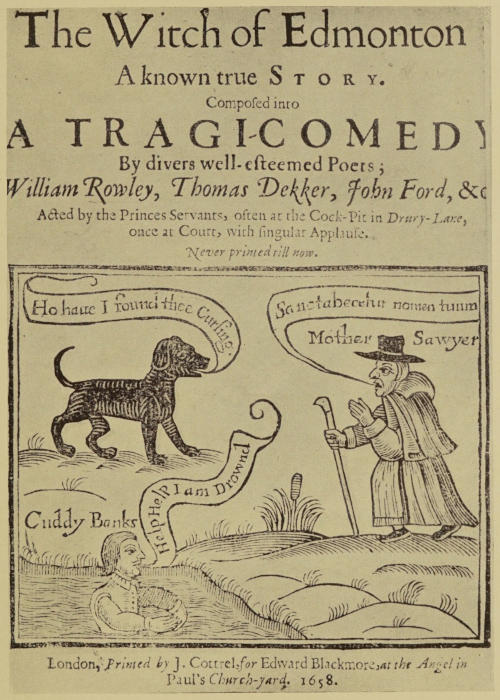
PLATE VIII
THE WITCH OF EDMONTON. The First Quarto
[face p. 290
The trial and execution (19 April, 1621) of Elizabeth Sawyer attracted a considerable amount of attention. Remarkable numbers of ballads and doggerel songs were made upon the event, detailing her enchantments, how she had blighted standing corn, how a ferret and an owl constantly attended her, and of many demons and familiars who companied with her in the prison. Not only were these ditties trolled out the day of the execution but many were published as broadsides, and sold widely. Accordingly the Newgate Ordinary hastened to pen The Wonderfull Discoverie of Elizabeth Sawyer, a Witch, Late of Edmonton, Her Conviction, and Condemnation, and Death, Together with the Relation of the Divels Accesse to Her, and Their Conference Together, “Written by Henry Goodcole, Minister of the Word of God, and her Continual Visiter in the Gaole of Newgate,” Published by Authority, 4to, 1621. This tractate is in the form of a dialogue, question and answer, between Goodcole and the prisoner, who makes ample confession of her crimes.
In some ways The Witch of Edmonton is the most interesting and valuable of the witch dramas, because here we have the hag stripped of the least vestige of glamour and romance presented to us in the starkest realism. We see her dwelling apart in a wretched hovel, “shunned and hated like a sickness,” miserably poor, buckl’d and bent together, dragging her palsied limbs wearily through the fields, as she clutches her dirty rags round her withered frame. And if she but dare to gather a few dried sticks in a corner she is driven from the spot with hard words and blows. What wonder her mouth is full of cursing and revenge?
’Tis all one To be a witch as to be counted one.
Then appears the Black Dog and seals a contract with her blood. She blights the corn and sends a murrain on the cattle of her persecutors; here a horse has the glanders, there a sow casts her farrow; the maid churns butter nine hours and it will not come; above all a farmer’s wife, whom she hates, goes mad and dies in frantic agony; mischief and evil run riot through the town. But presently her familiar deserts her, she falls into the hands of human justice, and after due trial is dragged to Tyburn shrieking and crying out in hideous despair. It is a sordid and a terrible, but one cannot doubt, a true picture.
It is obvious that in this drama[10] Frank Thorney, a most subtle and minute study of weakness and degeneracy, is wholly Ford’s. Frank Thorney may be closely paralleled with Giovanni in ’Tis Pity She’s a Whore. Winnifride, too, has all the sentimental charm of Ford’s heroines, Annabella and Penthea.
Carter is unmistakably the creation of Dekker. Simon Eyre and Orlando Friscobaldo are the same hearty, bluff, hospitable, essentially honest old fellows. To Dekker also I would assign Mother Sawyer herself.
Rowley’s hand is especially discernible in the scenes where Cuddy Banks and the clowns make their appearance.
It may be mentioned that Elizabeth Sawyer figures in Caulfield’s Portraits, Memoirs, and Characters of Remarkable Persons, 1794; and she is also referred to in Robinson’s History and Antiquities of the Parish of Edmonton with a woodcut “from a rare print in the collection of W. Beckford, esq.”
A second drama which was also actually founded upon a contemporary trial is Heywood and Brome’s The Late Lancashire Witches, “A Well Received Comedy” produced at the Globe in 1634.[11] In the previous year, 1633, a number of trials for Witchcraft had drawn the attention of all England to Pendle Forest. A boy, by name Edmund Robinson, eleven years of age, who dwelt here with his father, a poor wood-cutter, told a long and detailed story which led to numerous arrests throughout the district. Upon All Saints’ Day when gathering “bulloes” in a field he saw two greyhounds, one black, the other brown, each wearing a collar of gold. They fawned upon him, and immediately a hare rose quite near at hand. But the dogs refused to course, whereupon he beat them with a little switch, and the black greyhound started up in the shape of an old woman whom he recognized as Mother Dickenson, a notorious witch, and the other as a little boy whom he did not know. The beldame offered him money, either to buy his silence or as the price of his soul, but he refused. Whereupon taking something like a Bridle “that gingled” from her pocket she threw it over the little boy’s head and he became a white horse. Seizing young Robinson in her arms they mounted and were conveyed with the utmost speed to a large house where had assembled some sixty other persons. A bright fire was burning on the hearth with roast meat before it. He was invited to partake of “Flesh and Bread upon a Trencher and Drink in a Glass,” which he tasted, but at once rejected. He was next led into an adjoining barn where seven old women were pulling at seven halters that hung from the roof. As they tugged large pieces of meat, butter in lumps, loaves of bread, black puddings, milk, and all manner of rustic dainties fell down into large basins which were placed under the ropes. When the seven hags were tired their places were taken by seven others. But as they were engaged at their extraordinary task their faces seemed so fiendish and their glances were so evil that Robinson took to his heels. He was instantly pursued, and he saw that the foremost of his enemies was a certain Mother Lloynd. But luckily for himself two horsemen, travellers, came up, whereupon the witches vanished. A little later when he was sent in the evening to fetch home two kine, a boy met him in the dusk and fought him, bruising him badly. Looking down he saw that his opponent had a cloven foot, whereupon he ran away, only to meet Mother Lloynd with a lantern in her hand. She drove him back and he was again mauled by the cloven-footed boy.[12]
Such was the story told to the justices and corroborated by Robinson’s father. A reign of terror ensued. Mother Dickenson and Mother Lloynd were at once thrown into jail, and in the next few days more than eighteen persons were arrested. The informer and his father netted a good sum by going round from church to church to point out in the congregations persons whom he recognized as having been in the house and barn to which he was led. A little quiet blackmail of the wealthier county families, threats to disclose the presence of various individuals at the witches’ feast, brought in several hundreds of pounds.
The trial took place at Lancaster Assizes and seventeen of the accused were incontinently found guilty. But the judge, completely dissatisfied with so fantastic a story, obtained a reprieve. Four of the prisoners were sent up to London, where they were examined by the Court physicians. King Charles himself also questioned one of these poor wretches and, discerning that the whole history was a fraud, forthwith pardoned all who had been involved. Meantime Dr. John Bridgeman, the Bishop of Chester, had also been holding a special inquiry into the case. Young Robinson was lodged separately, being allowed to hold no communication with his relatives, and when closely interrogated he gave way and confessed that the scare from beginning to end had been manœuvred by his father, who carefully coached him in his lies. In spite of this fiasco the talk did not die down immediately, and there were many who continued to maintain that Mother Dickenson was indeed a witch, however false the evidence on this occasion might be. It must be remembered, moreover, that twenty-two years before, in the very same district, a coven of thirteen witches, of whom the chief was Elizabeth Demdike, had been brought to justice, “at the Assizes and Generall Gaole-Delivery, holden at Lancaster, before Sir Edward Bromley and Sir James Eltham.” Old Demdike herself—she was blind and over eighty years of age—died in prison, but ten of the accused were executed, and the trial, which lasted two days, occasioned a tremendous stir.
It seems not at all improbable that Heywood had written a topical play in 1612 dealing with this first sensational prosecution, and that when practically the same events repeated themselves in the same place less than a quarter of a century after he and the ever-ready Brome fashioned anew the old scenes. In the character of the honourable country-gentleman Master Generous, whose wife is discovered to be guilty of Witchcraft, there is something truly noble, and his tender forgiveness of her crime when she repents is touched with the loving pathos that informs A Woman Kilde with Kindnesse, whilst his agony at her subsequent relapse is very real, although Heywood has wisely refrained from any attempt to show a broken heart save by a few quite simple but poignant words. The play as a whole is a faithful picture of country life, homely enough, yet not without a certain winsome beauty. The comic episodes are sufficiently broad in their humour; we have a household turned topsy-turvy by enchantment, a wedding-breakfast bewitched: the kitchen invaded by snakes, bats, frogs, beetles, and hornets, whilst to cap all the unfortunate bridegroom is rendered impotent. In Act II we have the incident of a Boy with a switch (young Edmund Robinson) and the two greyhounds. Gammer Dickison carries him off against his will “to a brave feast,” where we see the witches pulling ropes for food:
Pul for the poultry, foule and fish, For emptie shall not be a dish.
In Act V the Boy tells Doughty the story of his encounter with the Devil: “He came to thee like a boy, thou sayest, about thine owne bisnesse?” they ask him, and the whole scene meticulously follows the detailed evidence given before the judge at Lancaster. Of the witches, Goody Dickison, Mal Spencer, Mother Hargrave, Granny Johnson, Meg, Mawd, are actual individuals who were accused by Robinson; Mrs. Generous alone is the poet’s fiction. When Robin, the blunt serving-man, refuses to saddle the grey gelding she shakes a bridle over his head and using him as a horse makes him carry her to the satanical assembly. There is a mill, which is haunted by spirits in the shape of cats, and here a soldier undertakes to watch. For two nights he is undisturbed, but on the third “Enter Mrs. Generous, Mal, all the Witches and their Spirits (at severall dores).” “The Spirits come about him with a dreadfull noise,” but he beats them thence with his sword, lopping off a tabby’s paw in the hurly-burly. In the morning a hand is found, white and shapely, with jewels on the fingers. These Generous recognizes as being his wife’s rings, and Mrs. Generous, who is in bed ill, is found to have one hand cut off at the wrist. This seals her fate. All the witches are dragged in and in spite of their charms and bug-words are identified by several witnesses including the boy who “saw them all in the barne together, and many more, at their feast and witchery.”
The play was evidently produced just after the Lancaster Assizes, whilst four of the accused were in the Fleet prison, London, for further examination, and the King’s pardon had not as yet been pronounced. This is evident from the Epilogue, which commences:
Now while the witches must expect their due, By lawfull justice, we appeale to you For favourable censure; what their crime May bring upon ’em ripens yet of time Has not reveal’d. Perhaps great mercy may, After just condemnation, give them day Of longer life.
It will be convenient to consider in this connexion a drama largely founded upon Heywood and Brome, and produced nearly half a century later at the Duke’s House, Dorset Garden, Shadwell’s The Lancashire Witches and Teague o Divelly, the Irish Priest, which was first seen in the autumn of 1681 (probably in September). The idea of using magic in a play was obviously suggested to Shadwell by his idolized Ben Jonson’s Masque of Queens, performed at Whitehall, 2 February, 1609. In close imitation of his model Shadwell has further appended copious notes to Acts one, two, three, and five, giving his references for the details of his enchantments. In the Preface (4to, 1682) he naïvely confesses: “For the magical part I had no hopes of equalling Shakespear in fancy, who created his witchcraft for the most part out of his own imagination (in which faculty no man ever excell’d him), and therefore I resolved to take mine from authority. And to that end there is not one action in the Play, nay, scarce a word concerning it, but is borrowed from some antient, or modern witchmonger. Which you will find in the notes, wherein I have presented you a great part of the doctrine of witchcraft, believe it who will.” And he has indeed copious citations from Vergil, Horace, Ovid, Propertius, Juvenal, Tibullus, Seneca, Tacitus, Lucan, Petronius, Pliny, Apuleius, Aristotle, Theocritus, Lucian, Theophrastus; S. Augustine, S. Thomas Aquinas; Baptista Porta; Ben Jonson (The Sad Shepherd); from the Malleus Maleficarum of James Sprenger, O.P., and Henry Institor (Heinrich Kramer), written circa 1485-89, from Jean Bodin’s (1520-96) La Demonomanie des Sorciers, 1580; the Dæmonolatria, 1595, of Nicolas Remy; Disquisitionum Magicarum libri six of Martin Delrio, S.J. (1551-1608); Historia Rerum Scoticarum, Paris, 1527, of Hector Boece (1465-1536); Formicarius, 5 vols., Douai, 1602, of John Nider, O.P. (1380-1438); De Præstigiis Dæmonum, 1563, by the celebrated John Weyer, physician to the Duke of Cleves; De Gentibus Septentrionalibus,[13] Rome, 1555, by Olaus Magnus, the famous Archbishop of Upsala; Discoverie of Witchcraft, 1584, by Reginald Scot; Dæmonomagia, by Philip Ludwig Elich, 1607; De Strigimagis, by Sylvester Mazzolini, O.P. (1460-1523), Master of the Sacred Palace and champion of the Holy See against the heresiarch Luther; Compendium Maleficarum (Milan, 1608), by Francesco Maria Guazzo of the Congregation of S. Ambrose; Disputatio de Magis (Frankfort, 1584), by Johan Georg Godelmann; Tractatus de Strigiis et Lamiis of Bartolommeo Spina, O.P.; the Decretum (about 1020) of Burchard, Bishop of Worms; the De Sortilegiis (Lyons, 1533) of Paolo Grilland; the De Occulta Philosophia (Antwerp, 1531) of Cornelius Agrippa; the Apologie pour tous les Grands Hommes qui ont este faussement supconnez de Magie (1625) of Gabriel Naudé, librarian to Cardinal Mazarin; De Subtilitate (libri XXI, Nuremberg, 1550) of Girolamo Cardano, the famous physician and astrologer; De magna et occulta Philosophia of Paracelsus; IIII Livres des Spectres (Angers, 1586) by Pierre le Loyer, Sieur de Brosse, of which Shadwell used the English version (1605) A treatise of Specters ... translated by Z. Jones.
It will be seen that no less than forty-one authors, authorities on magic, are quoted by Shadwell in these notes, whilst not infrequently the same author is cited again and again, and extracts of some length, not merely general references, are given.
But for all this parade of learning, perchance because of all this parade of learning, Shadwell’s witch scenes are intolerably clumsy, they are gross without being terrible. Shadwell was a clever dramatist, he was able to draw a character, especially a crank, with quite remarkable vigour, and his scenes are a triumph of photographic realism. True, he could not discriminate and select; he threw his world en masse higgledy piggledy on to the stage, and as even in the reign of the Merry Monarch there were a few tedious folk about, so now and again—but not very often—one chances upon heavy passages in Shadwell’s robust comedies. On the other hand The Sullen Lovers, Epsom Wells, The Virtuoso, Bury Fair, The Squire of Alsatia, The Volunteers, in fact all his native plays, are full of bustle and fun, albeit a trifle riotous and rude as the custom was. Dryden, who very well knew what he was about, for purposes of his own cleverly dubbed Shadwell dull. And dull he has been dubbed ever since by those who have not read him. But Shadwell had not a spark of poetry in his whole fat composition. And so his witches become farcical, yet farcical in a grimy unpleasant way, for we are spared none of the loathsome details of the Sabbat, and should anyone object, why, there is the authority of Remy or Guazzo, the precise passage from Prierias or Burchard to support the author. Indeed we feel that these witches are very real in spite of their materialism. They present a clear picture of one side of the diabolic cult, however crude and crass.
Even so, these incantation scenes are not, I venture to think, the worst thing in the play. The obscene caricature of the Catholic priest, Teague o Divelly, is frankly disgusting beyond words. He is represented as ignorant, idle, lecherous, a liar, a coward, a buffoon, too simiously cunning to be a fool, too basely mean to be a villain. It is a filthy piece of work, malignant and harmful prepense.[14]
But Shadwell showed scant respect for the Protestants too, since Smerk, Sir Edward Hartfort’s chaplain, is described as “foolish, knavish, popish, arrogant, insolent; yet for his interest, slavish.”
It is hardly a matter for surprise that after the play had been in the actors’ hands about a fortnight complaints from such high quarters were lodged with Charles Killigrew, the Master of the Revels, that he promptly sent for the script, which at first he seems to have passed carelessly enough, and would only allow the rehearsals to proceed on condition that a quantity of scurrilous matter was expunged. Even so the dialogue is sufficiently offensive and profane. There was something like a riot in the theatre at the first performance, and the play was as heartily hissed as it deserved. Yet it managed to make a stand: those were the days of the Third Exclusion Bill and rank disloyalty, but the tide was on the turn, a rebel Parliament had been dissolved on the 28th March, on the 31st of August Stephen College, a perjured fanatic doubly dyed in treason and every conceivable rascality, had met his just reward on the gallows, whilst the atrocious Shaftesbury himself was to be smartly laid by the heels in the November following. That part of the dialogue which was not allowed to be spoken on the stage Shadwell has printed in italic letter,[15] and so we plainly see that the censor was amply justified in his demands. The political satire is of the muddiest; the railing against the Church is lewd and rancorous.
Such success as The Lancashire Witches had in the theatre—and it was not infrequently revived—was wholly due to the mechanist and the scenic effects, the “flyings” of the witches, and the music, this last so prominent a feature that Downes does not hesitate to call it “a kind of Opera.”
In Shadwell’s Sabbat scenes the Devil himself appears, once in the form of a Buck Goat and once in human shape, whilst his satellites adore him with disgusting ceremonies. The witches are Mother Demdike, Mother Dickenson, Mother Hargrave, Mal Spencer, Madge, and others unnamed.
Elizabeth Demdike and Jennet Hargreaves belonged to the first Lancashire witch-trials, the prosecutions of 1612; Frances Dickenson and Mal Spencer were involved in the Robinson disclosures of 1633; so it is obvious that Shadwell has intermingled the two incidents. In his play we have a coursing scene where the hare suddenly changes to Mother Demdike; the witches raise a storm and carouse in Sir Edward’s cellar something after the fashion of Madge Gray, Goody Price, and Goody Jones in The Ingoldsby Legends; Mal Spencer bridles Clod, a country yokel, and rides him to a witches’ festival, where Madge is admitted to the infernal sisterhood; the witches in the guise of cats beset a number of persons with horrible scratchings and miauling, Tom Shacklehead strikes off a grimalkin’s paw and Mother Hargreave’s hand is found to be missing: “the cutting off the hand is an old story,” says Shadwell in his notes. It will be seen that the later dramatist took many of his incidents from Heywood and Brome, although it is only fair to add that he has also largely drawn from original sources.
Shortly after the Restoration was published a play dealing with one of the most famous of English sibyls, The Life of Mother Shipton. “A New Comedy. As it was Acted Nineteen dayes together with great Applause.... Written by T[homas] T[homson].” Among the Dramatis Personæ appear Pluto, the King of Hell, with Proserpina, his Queen; Radamon, A chief Spirit; Four other Devils. The scene is “The City of York, or Naseborough Grove in Yorkshire.” It is a rough piece of work, largely patched together from Middleton’s A Chaste Maid in Cheapside and Massinger’s The City Madam, whilst the episodes in which Mother Shipton is concerned would seem to be founded on one of the many old chap-books that relate her marvellous adventures and prophetic skill. Agatha Shipton (her name is usually given as Ursula) is complaining of her hard lot when she encounters Radamon, a demon who holds high rank in the court of Dis. He arranges to meet her later, and returns to his own place to boast of his success. He reappears to her dressed as a wealthy nobleman; he marries her; and for a while she is seen in great affluence and state. At the commencement of Act III she finds herself in her poor cottage again. As she laments Radamon enters, he informs her who he really is, and bestows upon her magical powers. Her fame spreads far and wide, and as popular story tells, the abbot of Beverley in disguise visits her to make trial of her art. She at once recognizes him, and foretells to his great chagrin the suppression of the monasteries with other events. In the end Mother Shipton outwits and discomforts the devils who attempt to seize her, she is vouchsafed a heavenly vision, and turns to penitence and prayer. The whole thing is a crude enough commixture, of more curiosity than value.
There are some well-written episodes in Nevil Payne’s powerful tragedy The Fatal Jealousie,[16] produced at Dorset Garden early in August, 1672. Among the characters we have Witch, Aunt of Jasper, the villain of the piece. Jasper, who is servant to Antonio, applies to his aunt to help him in his malignant schemes. At first he believes she is a genuine sorceress, but she disabuses him and frankly acknowledges:
I can raise no Devils, Yet I Confederate with Rogues and Taylors, Things that can shape themselves like Elves, And Goblins——
Her imps Ranter and Swash, Dive, Fop, Snap, Gilt, and Picklock, are slim lads in masquing habits, trained to trickery. None the less they manage an incantation scene to deceive Antonio and persuade him that his wife, Caelia, is false. An “Antick Dance of Devils” which follows is interrupted by the forcible entry of the Watch. The Aunt shows Jasper a secret hiding-place, whereupon he murders her and conceals the body in the hole. He pretends that she was in truth a witch and has vanished by magic. The Captain of the Watch, however, had detected her charlatanry long before, and presently a demon’s vizor and a domino are found on the premises. Later a little boy, who is caught in his devil’s attire, confesses the impostures, and trembling adds that in one of their secret chambers they have discovered their mistress’s corpse stabbed to death. Finally Jasper is unmasked, and only escapes condign punishment by his dagger. The character of the Witch is not unlike that of Heywood’s Wise Woman of Hogsdon, although in The Fatal Jealousie the events take a tragic and bloody turn. Smith acted Antonio; Mrs. Shadwell, Caelia; Mrs. Norris, the Witch; and Sandford was famous in the rôle of Jasper.
There are incantation scenes in Dryden’s tragedies, but these hardly come within our survey, as the magicians are treated romantically, one might even say decoratively, and certainly here no touch of realism is sought or intended. We have the famous episode in The Indian-Queen (produced at the Theatre Royal in January, 1663-4), when Zempoalla seeks Ismeron the prophet who raises the God of Dreams to prophesy her destiny;[17] in the fourth act of Tyrannick Love (Theatre Royal, June, 1669), the scene is an Indian cave, where at the instigation of Placidius the magician Nigrinus raises a vision of the sleeping S. Catharine, various astral spirits appear only to fly before the descent of Amariel, the Saint’s Guardian-Angel; in Œdipus, by Dryden and Lee (Dorset Garden, December, 1678), Teresias plays a considerable part, and Act III is mainly concerned with a necromantic spell that raises the ghost of Laius in the depths of a hallowed grove. In The Duke of Guise, moreover (Theatre Royal, December, 1682), there is something of real horror in the figures of Malicorne and his familiar Melanax, and the scene[18] when the miserable wizard, whose bond is forfeit, is carried shrieking to endless bale, cannot be read without a shudder even after the last moments of Marlowe’s Faustus. Act IV of Lee’s Sophonisba (Theatre Royal, April, 1675) commences with the temple of Bellona, whose priestesses are shown at their dread rites. Cumana is inspired by the divinity, she raves in fury of obsession, there is a dance of spirits, and various visions are evoked.
In Otway’s curious rehandling of Romeo and Juliet which he Latinized as The History and Fall of Caius Marius produced at Dorset Garden in the autumn of 1679, the Syrian witch Martha only appears for a moment to prophesy good fortune to Marius and to introduce a dance of spirits by the waving of her wand.
Charles Davenant’s operatic Circe (Dorset Garden, March, 1676-7) is an amazing distortion of mythological story. There are songs without number, a dance of magicians, storms, dreams, an apparition of Pluto in a Chariot drawn by Black Horses, but all these are very much of the stage, stagey, born of candle-light and violins, hardly to be endured in cold print. Ragusa, the Sorceress in Tate’s Brutus of Alba: or the Enchanted Lovers (Dorset Garden, May, 1678) is a far more formidable figure. Tate has managed his magic not without skill, and the conclusion of Act III, an incantation, was deservedly praised by Lamb. Curiously enough the plot of Brutus of Alba is the story of Dido and Æneas, Vergil’s names being altered “rather than be guilty of a breach of Modesty,” Tate says. But Tate supplied Henry Purcell with the libretto for his opera Dido and Æneas, wherein also witches appear. It must not be forgotten that Macbeth was immensely popular throughout the whole of the Restoration period, when, as has been noted above, the witch scenes were elaborated and presented with every resource of scenery, mechanism, dance, song, and meretricious ornament. Revival followed revival, each more decorative than the last, and the theatre was unceasingly thronged. Duffett undertook to burlesque this fashion, which he did in an extraordinary Epilogue to his skit The Empress of Morocco, produced at the Theatre Royal in the spring of 1674, but for all his japeries Macbeth never waned in public favour.
Spirits in abundance appear in the Earl of Orrery’s unpublished tragedy Zoroastres,[19] the principal character being described as “King of Persia, the first Magician.” He is attended by “several spirits in black with ghastly vizards,” and at the end furies and demons arise shaking dark torches at the monarch whom they pull down to hell, the sky raining fire upon them. It was almost certainly never acted, and is the wildest type of transpontine melodrama.
Edward Ravenscroft’s “recantation play” Dame Dobson, or, The Cunning Woman (produced at Dorset Garden in the early autumn of 1683) is an English version of La Devineresse; ou les faux Enchantements (sometimes known as Madame Jobin), a capital comedy by Thomas Corneille and Jean Donneau de Vise. This French original had been produced in 1679, and both the stage-craft and the adroit way in which the various tricks and conjurations are managed must be allowed to be consummately clever. An English comedy on a similar theme is The Wise Woman of Hogsdon, the intricacies of which are a triumph of technique. La Devineresse was published in 1680 with a frontispiece picturing a grimalkin, a hand of glory, noxious weeds, two blazing torches and other objects beloved of necromancy. There are, moreover, eight folding plates which embellish the little book, and these have no small interest as they depict scenes in the comedy. But Dame Dobson cannot be accounted a play of witchcraft; it is no more than an amusing study of dextrous charlatanry. The protagonist herself[20] is of that immortal sisterhood graced by Heywood’s sibyl, of whom it is said “She is a cunning woman, neither hath she her name for nothing, who out of her ignorance can fool so many that think themselves wise.”
Mrs. Behn, in her amusing comedy The Luckey Chance; or, An Alderman’s Bargain, produced at Drury Lane in the late winter of 1686, 4to, 1687, has made some play with pretended magic in the capital scenes where Gayman (Betterton) is secretly brought by the prentice Bredwel (Bowman), disguised as a devil, to the house of Lady Fulbank (Mrs. Barry). Here he is received by Pert, the maid, who is dressed as an old witch, and conducted to his inamorata’s embraces. But the whole episode is somewhat farcically treated, and it is, of course, an elaborate masquerade for the sake of an intrigue.[21]
Shadwell in 1681 took Witchcraft seriously, and notwithstanding the half-hearted disclaimer in his address “To the Reader” that prefaces The Lancashire Witches I think he was sensible enough to recognize the truth which lies at the core of the matter in spite of the grotesqueness of the formulæ and spells doting hags and warlocks are wont to employ. Witchcraft was still a capital offence when some fifteen years later Congreve lightly laughed it out of court. Foresight (Love for Love), “an illiterate old Fellow, peevish and positive, superstitious, and pretending to understand Astrology, Palmistry, Phisiognomy, Omens, Dreams, etc.,” is in close confabulation with his young daughter’s Nurse, when Angelica his niece trips in to ask the loan of his coach, her own being out of order. He says no, and presses her to remain at home, muttering to himself some old doggerel which bodes no good to the house if all the womenfolk are gadding abroad. The lady fleers him, twits him with jealousy of his young wife: “Uncle, I’m afraid you are not Lord of the Ascendant, ha! ha! ha!” He is obstinate in his refusal; and she retorts: “I can make Oath of your unlawful Midnight Practices; you and the Old Nurse there.... I saw you together, through the Key-hole of the Closet, one Night, like Saul and the Witch of Endor, turning the Sieve and Sheers, and pricking your Thumbs to write poor innocent Servants’ Names in Blood about a little Nutmeg-Grater, which she had forgot in the Caudle-Cup.” “Hussy, Cockatrice,” storms the old fellow beside himself with rage. Angelica mocks him even more bitterly, accuses him and the Nurse of nourishing a familiar, “a young Devil in the shape of a Tabby-Cat,” and with a few last thrusts she departs, trilling with merriment, in a sedan-chair.
To return for a brief space to an earlier generation when it would have hardly been possible, or at least highly inadvisable, to treat Witchcraft in this blithesome mood, of two plays that would almost certainly have been of great interest in this connexion we have only the names, The Witch of Islington, acted in 1597, and The Witch Traveller, licensed in 1623.
In addition to The Masque of Queens, which as has already been noted, served to some extent for a model to Shadwell when inditing his encyclopædic notes on magic, Ben Jonson in that sweet pastoral The Sad Shepherd introduces a Scotch witch, Maudlin. The character is drawn with vigorous strokes; realism mingles with romance.
During the quarrel scene which opens The Alchemist Face threatens Subtle:
I’ll bring thee, rogue, within The statute of sorcerie, tricesimo tertio Of Harry the Eight.
Dapper the gull asks Subtle for a familiar, as Face explains (I, 2):
Why, he do’s aske one but for cups, and horses, A rifling flye: none o’ your great familiars.
And later in order to trick him thoroughly Dol Common appears as the “Queene of Faerie.” The Queen of Elphin or Elfhame, who is particularly mentioned in the Scotch witch-trials, seems to be identical with the French Reine du Sabbat. In 1670 Jean Weir confessed: “That when she keeped a school at Dalkeith, and teached childering, ane tall woman came to the declarant’s hous when the childering were there; and that she had, as appeared to her, ane chyld upon her back, and one or two at her foot; and that the said woman disyred that the declarant should imploy her to spick for her to the Queen of Farie, and strik and battle in her behalf with the said Queen, (which was her own words).”[22]
Beaumont and Fletcher afford us but few instances of witchcraft in the many dramas that conveniently go under their names. We have, it is true, a she-devil, Lucifera, in The Prophetess, but the incident is little better than clowning. Delphia herself is a severely classical pythoness far removed from the Sawyers, Demdikes, and Dickensons Sulpitia, in The Custom of the County dons a conjurer’s robe and at Hippolita’s bidding blasts Zenocia almost to death by her spells, but yet she is more bawd than witch. Peter Vecchio in The Chances, “a reputed wizard,” is as sharp and cozening a practitioner as Forobosco, the mountebank, a petty pilferer, who is exposed and sent to the galleys at the end of The Fair Maid of the Inn; or Shirley’s Doctor Sharkino[23] whom silly serving-men consult about the loss of silver spoons and napkins; or Tomkis’s Albumazar; nay, Jonson’s Subtle himself.[24]
In Marston’s Sophonisba (4to, 1606) appears Erictho, borrowed from Lucan. The Friar in Chapman’s Bassy d’Ambois (4to, 1607) puts on a magician’s habit, and after a sonorous Latin invocation raises the spirits Behemoth and Cartophylax in the presence of Bussy and Tamyra.
A far more interesting drama than these is Shirley’s S. Patrick for Ireland, acted in Dublin, 1639-40, which has as its theme the conversion of Ireland by S. Patrick and the opposition of the Druids under their leader Archimagus. The character of S. Patrick moves throughout with a quiet spiritual dignity that has true beauty, and the magicians in their baffled potency for evil are only less effective. This drama is a work of stirling merit, to which I would unhesitatingly assign a very high place in Shirley’s theatre. We are shown the various attempts upon S. Patrick’s life: poison is administered in a cup of wine, the Saint drinks and remains unharmed; Milcho, a great officer, whose servant S. Patrick once was, locks him and his friends in a house and fires it. The Christians pass out unscathed through the flames which devour the incendiary. In the last scene whilst S. Patrick sleeps Archimagus summons a vast number of hideous serpents to devour him, but the Apostle of Ireland wakes, and expels for ever all venomous reptiles from his isle, whereon the earth gapes and swallows the warlock alive. Particularly impressive is the arrival of S. Patrick, when as the King and his two sons, his druids and nobles, are gathered in anxious consultation at the gates of their temple, they see passing in solemn procession through the woods a fair company with gleaming crosses, silken banners, bright tapers and incense, what time the sweet music of a hymn strikes upon the ear:
Post maris sæui fremitus Iernæ (Nauitas cœlo tremulas beante) Uidimus gratum iubar enatantes Littus inaurans.
(Now that we have crossed the fierce waves of ocean to Ireland’s coast, and Heaven has blessed its poor fearful wanderers, wending our way along with joy do we see a sunbeam of light gilding these shores.)
As Marlowe’s Dr. Faustus has already been treated in this connexion it may not be altogether impertinent very briefly to consider some three or four other Elizabethan plays in which the Devil appears among the Dramatis Personæ, even if he act no very prominent part. These for the most part fluctuate between the semi-serious and merest buffoonery. Thus the prologue of The Merry Devil of Edmonton (4to, 1608), in which the enchanter Peter Fabell tricks the demon who has come to demand the fulfilment of his contract, is at the opening managed with due decorum, but it soon adopts a lighter, and even trivial, vein. William Rowley’s The Birth of Merlin, or The Childe hath found his Father (not printed until 1662) is a curious medley of farce and romance, informed with a certain awkward vigour and not wholly destitute of poetry. Dekker’s If it be not good, the Divel is in it (4to, 1612), which may be traced to the old prose History of Friar Rush, depicts the exploits of three lesser fiends who are dispatched to spread their master’s kingdom in Naples. It is an unequal play, the satire of which falls very flat, since it is obvious that the poet was not sincere in his extravagant theme.[25]
Ben Jonson’s The Devil is an Ass, acted in 1616, is wholly comic. Pug, “the less devil,” who visits the earth, and engages himself as servant to a Norfolk squire, Fabian Fitzdottrel, is hopelessly outwitted on every occasion by the cunning of mere mortals. Eventually he finds himself lodged in Newgate, and in imminent danger of the gallows were he not rescued by the Vice, Iniquity, by whom he is carried off rejoicing to the nether regions. His fate may be compared with that of Roderigo in Wilson’s excellent comedy Belphegor: or, The Marriage of the Devil (produced at Dorset Garden in the summer of 1690), who with his two attendant devils flies back to his native hell to escape the woes of earth.
In The Devil’s Charter, however, by Barnaby Barnes (1607), we have what is undoubtedly a perfectly serious tragedy, which if not exactly modelled upon, at least owes many hints to Marlowe’s Faustus. It is flamboyant melodrama and wildly unhistorical throughout, a very tophet of infernal horror. The chief character is a loathsome caricature of Pope Alexander VI,[26] and, as we might expect, all the lies and libels of Renaissance satirists and Protestant pamphleteers are heaped together to portray an impossible monster of lust and crime. The filthiest scandals of Burchard, Sanudo, Giustiniani, Filippo Nerli, Guicciardini, Paolo Giovio, Sannazzaro and the Neapolitans, have been employed with one might almost say a scrupulous conscientiousness. The black art, in particular, occupies a very prominent place in these lurid scenes. Alexander has signed a bond with a demon Astaroth, and it is to this contract that all his success is ascribed. In Act IV there is a long incantation when the Pope puts on his magical robes, takes his rod and pentacle, and standing within the circle he has traced conjures in strange terms, commencing a Latin exorcism which tails off into mere gibberish. Various devils appear, and he is shown a vision of Gandia’s murder by Cæsar,[27] with other atrocities. At the climax of the piece we have the banquet with Cardinal Adrian of Corneto, and whilst the guests talk “The Devill commeth and changeth the Popes bottles.” The Borgias are poisoned, and in a far too protracted “Scena Ultima” Alexander discourses and disputes frantically with the demons who appear to mock and torment him. There is the old device of an ambiguous contract; presently a “Devil like a Poast” enters winding a horn to summon the unhappy wretch, who raves and shrieks out meaningless ejaculations as he is dragged away amid thunder and lightning. This sort of thing pandered to the most brutalized appetites of the groundlings, and The Devil’s Charter may be summed up as a disgusting burlesque not without its quota of vile stuff that is so repulsive as to be physically sickening.
Upon a careful consideration of those seventeenth-century plays which have Witchcraft as their main theme, and leaving on one side, for our purpose, the essentially romantic treatment of the subject, however realistic some details of the picture may be, it is, I think, beyond dispute that The Witch of Edmonton in the figure of Mother Sawyer offers us the best contemporary illustration of the Elizabethan witch. The drama itself is one of no ordinary merit and power, whilst the understanding and restraint which set the play apart from its fellows also raises it to the level of genuine tragedy. It should be noticed that we see a witch, so to speak, in the process of making. Mother Sawyer is in truth the victim of the prejudices of the village hinds and ignorant yokels. When she first appears it is merely as a poor old crone driven to desperation by her brutal neighbours; the farmers declare she is a witch, and at length persecution makes her one. She is malignant and evil enough once the compact with the demon has been confirmed; she longs from the first to be revenged upon her enemies and mutters to herself “by what art May the thing called Familiar be purchased?” But, in one sense, she is urged and hounded to her destiny, and the authors, although never doubting her compact with the powers of darkness, her vile and poisonous life, show a detached but very real sympathy for her. It is this touch of humanity, the pathos and pity of the poor old hag, repulsive, wicked, and baleful as she may be, which must place The Witch of Edmonton in my opinion among the greatest and most moving of all Elizabethan plays.
It is no pleasant task to turn now to the theatre of the eighteenth century in this connexion. The witch became degraded; she was comic, burlesqued, buffooned; a mere property for a Christmas pantomime: Harlequin Mother Bunch, Mother Goose, Harlequin Dame Trot, Charles Dibdin’s The Lancashire Witches, or The Distresses of Harlequin[28] whose tinsel, music, and mummery drew all the macaronis and cyprians in London to the Circus during the winter of 1782-3.
Some subtle premonition of the great success of Harrison Ainsworth’s powerful story The Lancashire Witches—for this and the macabre Rookwood are probably the best of the work of a talented writer now unduly depreciated and decried—seems to have suggested to the prolific Edward Fitzball his “Legendary Drama in Three Acts,” The Lancashire Witches, A Romance of Pendle Forest, produced at the Adelphi Theatre, 3 January, 1848. It was quick work, for it was only a month before, 3 December, 1847, that Ainsworth, writing to his friend Crossley of Manchester, states that he has accepted the liberal offer of the Sunday Times—£1000 and the copyright to revert to the author on the completion of the work—that his new romance The Lancashire Witches should make its appearance as a serial in the paper. He had already sketched out the plan, and he must have given Fitzball an idea of this, or at least have allowed the dramatist the use of some few rough notes, for although the play and the novel have little, one might say nothing essential, in common, the chief character in the theatre, Bess of the Woods, “140 years old, formerly Abbess of S. Magdalen’s, doomed for her crimes to an unearthly age,” is none other than the anchoress Isolde de Heton.[29] The fourth scene of the second act presents the ruins of Whalley Abbey by moonlight. During an incantation the picture gradually changes; the broken arches form themselves into perfect masonry; the ivy disappears from the windows to show the ruby and gold of coloured glass; the decaying altar glitters with piled plate and the gleam of myriad tapers. A choir of nuns rises from the grave to dance with spectral gallants. Among the votaries are Nutter, Demdike, and Chattox “Three Weird Sisters, doomed for their frailties to become Witches.” But they utter no word, and have no part save this in the action. This scene must have proved extraordinarily effective upon the stage. It owes much to the haunted convent in Meyerbeer’s Robert le Diable, produced at the Académie Royale in November, 1831, and given in a piratical form both at Drury Lane and Covent Garden within a few weeks. Nor is it comparable to its original. In Fitzball’s melodrama O. Smith appeared as Gipsy Dalian, a new character; and Miss Faucit (Mrs. Bland) as Bess of the Woods. The play, for what it is, a luridly theatrical and Surrey-side sensation, has merit; but to speak of it in the same breath as Middleton or even as Barnes would be absurd.
Shelley’s genius has with wondrous beauty translated for us scenes from Calderon’s El Magico Prodigioso, one of the loveliest songs of the Spanish nightingale. On another plane, admittedly, but yet, I think, far from lacking a simple comeliness of its own and surely not without most poignant pathos, is Longfellow’s New England Tragedy Giles Corey of the Salem Farms.[30] The honest sincerity of Cotton Mather, the bluff irascible heartiness of Corey himself, the inopportune scepticism of his wife—which to many would seem sound common sense—the hysteria of Mary Walcot, the villainy of John Gloyd, all these are sketched with extraordinary power, a few quiet telling touches which make each character, individual, alert, alive.
In the French theatre we have an early fourteenth-century Miracle de Nostre Dame de Robert le Dyable, and in 1505 was acted Le mystère du Chevalier qui donna sa femme au Diable, à dix personnages. As one might well expect during the long classical period of the drama Witchcraft could have found no place in the scenes of the French dramatists. It would have been altogether too wild, too monstrous a fantasy. And so it is not until the 24 floréal, An XIII (11 June, 1805) that a play which interweaves sorcery as its theme is seen at the Théâtre français, when Les Templiers of Raynouard was given there. A few years later Le Vampire, a thrilling melodrama by Charles Nodier and Carmouche, produced on 13 August, 1820, was to draw all idle Paris to the Porte-Saint-Martin. In 1821 two facile writers quick to gauge the public appetite, Frédéric Dupetit-Mèré and Victor Ducagne, found some favour with La Sorcière, ou l’Orphelin écossais. Alexandre Dumas, and one of his many ghosts Auguste Maquet, collaborated (if one may use the term) in a grandiose five-act drama Urbain Grandier, 1850. La Sorcière Canidie, a one-act play by Aurélien Vivie, produced at Bordeaux in 1888 is of little account. La Reine de l’Esprit (1891) of Maurice Pottecher is founded to some extent on the Comte de Gabalis, whilst the same author’s three-act Chacun cherche son Trésor, “histoire des sorciers” (1899) was not a little helped by the music of Lucien Michelet. There are many excuses for passing over with a mere mention Les Noces de Sathan (1892), a “drama ésoterique,” by Jules Bois, and Les Basques ou la Sorcière d’Espelette, a lyric drama in three acts by Loquin and Mégret de Belligny, produced at Bordeaux in 1892, has an interest which is almost purely local. Alphonse Tavan’s Les Mases (sorciers), a legendary drama of five acts of alternating prose and verse seen in 1897 was helped out by every theatrical resource, a ballet, chorus, mechanical effects, and confident advertisement. Serge Basset’s Vers le Sabbat “évocation de sorcellerie en un acte” which appeared in the same year need not be seriously considered. Nor does an elaborate episode “Le Sabbat et la Herse Infernale,” wherein Mons. Benglia appeared as Satan, that was seen in the Folies Bergère revue, Un Soir de Folie, 1925-6, call for more than the briefest passing mention.
In more recent days Victor Sardou’s La Sorcière is a violent, but effective, melodrama. Produced at the Théâtre Sarah-Bernhardt, 15 December, 1903, with De Max as Cardinal Ximenes and Sarah Bernhardt as the moresque Zoraya, it obtained a not undeserved success. The locale of the tragedy is Toledo, anno domini 1506; Act IV, the Inquisition scene; and Act V, the square before the Cathedral with the grim pyre ready for the torch, were—owing to the genius of a great actress—truly harrowing. Of course it is very flamboyant, very unbalanced, very unhistorical, but in its gaudy theatrical way—all the old tricks are there—La Sorcière had an exciting thrill for those who were content to be unsophisticated awhile.
John Masefield’s adaptation from the Norwegian of Wiers-Jennsen, The Witch,[31] a drama in four acts, is a very different thing. Here we have psychology comparable to that of Dekker and Ford. Nor will the performances of Miss Janet Achurch as Merete Beyer and Miss Lillah McCarthy as Anne Pedersdotter easily be forgotten. As a picture of the horror of Witchcraft in cold Scandinavia, the gloom and depression of formidable fanaticism engendered by Lutheran dogma and discipline with the shadow of destiny lowering implacably over all, this is probably the finest piece of work dealing in domestic fashion with the warlock and the sorceress that has been seen on the English stage since the reign of wise King James three hundred years ago.