Front matter (continued 9)
Reading edition
Courbet has positively realised the programme which he issued in that pamphlet of 1855. When he began his activity, eclectic idealism had overgrown the tree of art. But Courbet stripped off the parasitic vegetation to reach the firm and serviceable timber. And having once grasped it he showed the muscles of an athlete in making its power felt. Something of the old Flemish sturdiness lived once more in his bold creations. If he and Delacroix were united, the result would be Rubens. Delacroix had the fervour and passionate tamelessness, while Courbet contributed the Flemish weight. Each made use of blood, purple, thrones, and Golgothas in composing the dramas they had imagined. The latter pictured creation with the absolutism of complete objectivity. Delacroix rose on the horizon like a brilliant meteor catching flame from the light of vanished suns; he reflected their radiance, had almost their magnitude, and followed the same course amid the same coruscation and blaze of light. Courbet stands firm and steady upon the earth. The former had the second sight known to visionaries, the latter opened his eyes to the world that can be felt and handled. Neurotic and distempered, Delacroix worked feverishly. As a sound, full-blooded being Courbet painted, as a man drinks, digests, and talks, with an activity that knows no exertion, a force that knows no weariness. Delacroix was a small, weakly man, and his whole power rested in his huge head. That of Courbet, as in animals of beauty and power, was dispersed through his whole frame; his big arms and athletic hands render the same service to his art as his eyes and his brain. And as, like all sincere artists, he rendered himself, he was the creator of an art which has an irrepressible health and overflows with an exuberant opulence. His pictures brought a savour of the butcher’s shop into French painting, which had become anæmic. He delighted in plump shoulders and sinewy necks, broad breasts heaving over the corset, the glow of the skin dripping with warm drops of water in the bath, the hide of deer and the coat of hares, the iridescent shining of carp and cod-fish. Delacroix, all brain, caught fire from his inward visions; Courbet, all eye and maw, with the sensuousness of an epicure and the satisfaction of a gourmet, gloats over the shining vision of things which can be devoured—a Gargantua with a monstrous appetite, he buried himself in the navel of the generous earth. Plants, fruit, and vegetables take voluptuous life beneath his brush. He triumphs when he has to paint a déjeuner with oysters, lemons, turkeys, fish, and pheasants. His mouth waters when he heaps into a picture of still-life all manner of delicious eatables. The only drama that he has painted is “The Battle of the Stags,” and this will end in brown sauce amid a cheerful clatter of knives and forks.
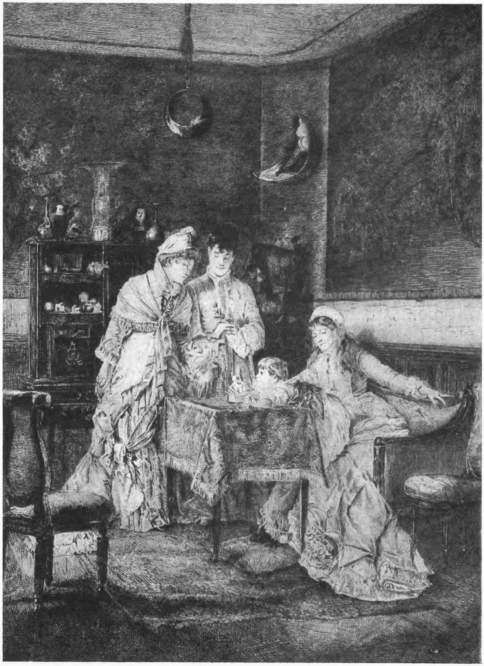
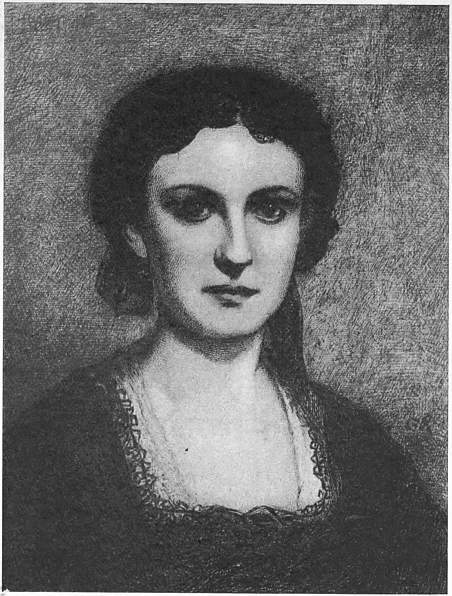
L’Art. Baschet.
STEVENS. THE VISITORS. RICARD. MADAME DE CALONNE.
(By permission of M. Faure, the owner of the picture.)
Even as a landscape painter he is luxurious and phlegmatic. In his pictures the earth is a corpulent nurse, the trees fine and well-fed children, and all nature healthy and contented. His art is like a powerful body fed with rich nourishment. In such organisms the capacity for enthusiasm and delicacy of sentiment are too easily sacrificed to their physical satisfaction, but their robust health ensures them the longer life. Here is neither the routine and external technique and the correct, academic articulation of form belonging to mannerists, nor the strained, neurotic, sickly refinement of the decadents, but the powerful utterance of inborn, instinctive talent, and the strong cries of nature which rise out of it will be understood at all times, even the most distant. It is hardly necessary to add that the appearance of a genius of this kind was fraught with untold consequences to the further development of French painting.
What is held beautiful in nature must likewise be beautiful in pictorial art when it is faithfully represented, and nature is beautiful everywhere. In announcing this and demonstrating it in pictures of life-size, Courbet won for art all the wide dominion of modern life which had hitherto been so studiously avoided—the dominion in which it had to revel if it was to learn to see with its own eyes. One fragment of reality after another would then be drawn into the sphere of representation, and no longer in the form of laboriously composed genre pictures, but after the fashion of really pictorial works of art.
What Millet had done for the peasant, and Courbet for the artisan, Alfred Stevens did for “society”: he discovered the Parisienne. Until 1850 the graceful life of the refined classes, which Gavarni, Marcellin, and Cham had so admirably drawn, found no adequate representation in the province of painting. The Parisienne, who is so chic and piquant, and can hate and kiss with such fervour, fascinated every one, but Grecian profile was a matter of prescription. Auguste Toulmouche painted little women in fashionable toilette, but less from any taste he had for the graceful vision than from delight in genre painting. They were forced to find forbidden books in the library, to resist worldly marriages, or behave in some such interesting fashion, to enter into the kingdom of art. It was reserved for a foreigner to reveal this world of beauty, chic, and grace.
Alfred Stevens was a child of Brussels. He was born in the land of Flemish matrons on 11th May 1828, and was the second of three children. Joseph, the elder brother, became afterwards the celebrated painter of animals; Arthur, the youngest, became an art-critic and a picture-dealer; he was one of the first who brought home to the public comprehension the noble art of Rousseau, Corot, and Millet. Stevens’ father fought as an officer in the great army at the battle of Waterloo, and is said to have been an accomplished critic. Some of the ablest sketches of Delacroix, Devéria, Charlet, and Roqueplan found their way into his charming home. Roqueplan, who often came to Brussels, took the younger Stevens with him to his Parisian studio. He was a tall, graceful young man, who, with his vigorous upright carriage, his finely chiselled features, and his dandified moustache, looked like an officer of dragoons or cuirassiers. He was a pleasure-loving man of the world, and was soon the lion of Parisian drawing-rooms. The grace of modern life in great cities became the domain of his art. The Parisienne, whom his French fellow-artists passed by without heed, was a strange, interesting phenomenon to him, who was a foreigner—an exotic and exquisitely artistic bibelot, which he looked upon with eyes as enraptured as those with which Decamps had looked upon the East.
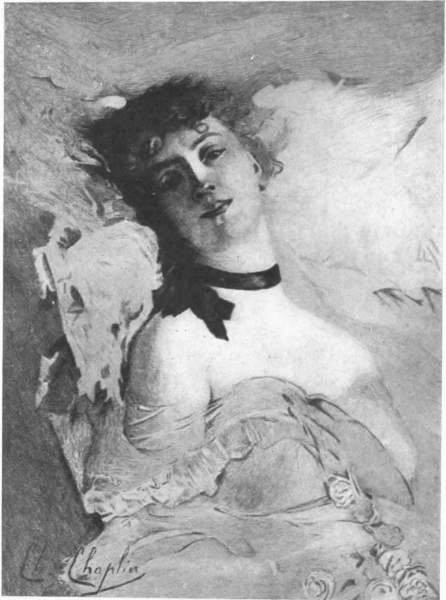
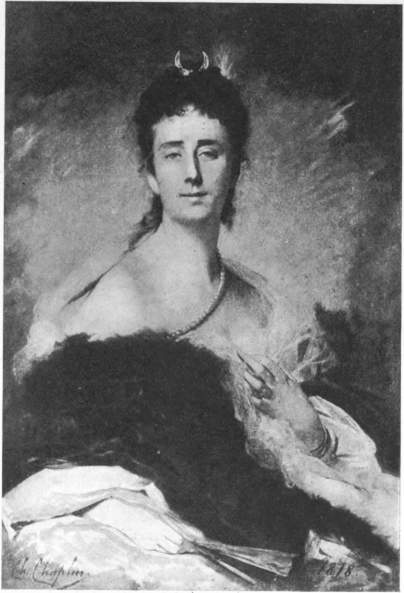
L’Art. Baschet.
CHAPLIN. THE GOLDEN AGE. CHAPLIN. PORTRAIT OF COUNTESS AIMERY DE LA ROCHEFOUCAULD.
(By permission of Messrs. Goupil & Co., the owners of the copyright.)
His very first picture, exhibited in 1855, was called “At Home.” A charming little woman is warming her feet at the fire; she has returned from visiting a friend, and it has been raining or snowing outside. Her delicate hands are frozen in spite of her muff, her cheeks have been reddened by the wind, and she has a pleasant sense of comfort as her rosy lips breathe the warm air of the room. From the time of this picture women took possession of Stevens’ easel. His way was prescribed for him, and he never left it. Robert Fleury, the president of the judging committee in the Salon, said to him: “You are a good painter, but alter your subjects; you are stifling in a sphere which is too small; how wide and grand is that of the past!” Whereon Stevens is said to have showed him a volume of photographs from Velasquez. “Look here at Velasquez,” he said. “This man never represented anything but what he had before his eyes—people in the Spanish dress of the seventeenth century. And as the justification of my genre may be found in this Spanish painter, it may be found also in Rubens, Raphael, Van Dyck, and all the great artists. All these masters of the past derived their strength and the secret of their endurance from the faithful reproduction of what they had themselves seen: it gives their pictures a real historical as well as an artistic value. One can only render successfully what one has felt sincerely and seen vividly before one’s eyes in flesh and blood.” In these sentences he is at one with Courbet, and by not allowing himself to be led astray into doing sacrifice to the idols of historical painting he continues to live as the historical painter of the Parisienne.
In his whole work he sounds a pæan to the delicate and all-powerful mistress of the world, and it is significant that it was through woman that art joined issue with the interests of the present. Millet, the first who conquered a province of modern life, was at the same time the first great painter of women in the century. Stevens shows the other side of the medal. In Millet woman was a product of nature; in Stevens she is the product of modern civilisation. The woman of Millet lives a large animal life, in the sweat of her brow, bowed to the earth. She is the primæval mother who works, bears children, and gives them nourishment. She stands in the field like a caryatid, like a symbol of fertile nature. In Stevens woman does not toil and is seldom a mother. He paints the woman who loves, enjoys, and knows nothing of the great pangs of child-birth and hunger. The one woman lives beneath the wide, open sky, dans le grand air; the other is only enveloped in an atmosphere of perfume. She is ancient Cybele in the pictures of Millet; in those of Stevens the holy Magdalene of the nineteenth century, to whom much will be forgiven, because she has loved much. The pictures of Stevens represent, for the first time, the potent relations of woman to the century. Whilst most works of this time are silent concerning ourselves, his art will speak of our weaknesses and our passions. In a period of archaic painting he upheld the banner of modernity. On this account posterity will honour him as one of the first historians of the nineteenth century, and will learn from his pictures all that Greuze has revealed to the present generation about the civilisation of the eighteenth century.
Baschet. Gaz. des Beaux-Arts.
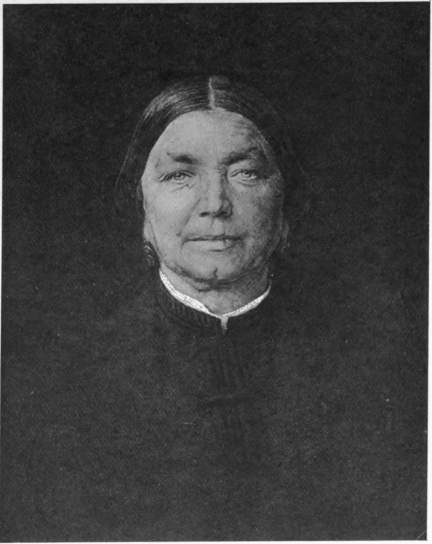
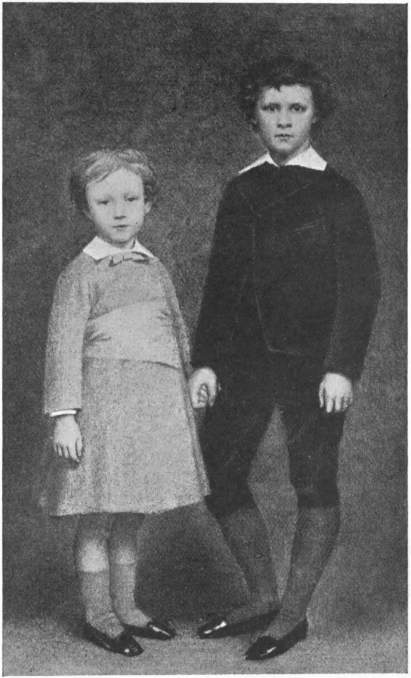
GAILLARD. PORTRAIT. DUBOIS. PORTRAIT OF MY SONS.
(By permission of the Artist.)
And perhaps more, for Stevens never moralised—he merely painted. Painter to his finger tips, like Delacroix, Roqueplan, and Isabey, he stood in need of no anecdotic substratum as an adjunct. The key of his pictures was suggested by no theme of one sort or another, but by his treatment of colour. The picture was evolved from the first tone he placed upon the canvas, which was the ground-note of the entire scale. He delighted in a thick pasty handling, in beautiful hues, and in finely chased detail. And he was as little inclined to sentimentality as to pictorial novels. Everything is discreet, piquant, and full of charm. He was a delicate spirit, avoiding tears and laughter. Subdued joy, melancholy, and everything delicate and reserved are what he loves; he will have nothing to do with stereotyped arrangement nor supernumerary figures, but although a single person dominates the stage he never repeats himself. He has followed woman through all her metamorphoses—as mother or in love, weary or excited, proud or humbled, fallen or at the height of success, in her morning-gown or dressed for visiting or a promenade, now on the sea-shore, now in the costume of a Japanese, or dallying with her trinkets as she stands vacantly before the glass. The surroundings invariably form an accompaniment to the melody. A world of exquisite things is the environment of the figures. Rich stuffs, charming petit-riens from China and Japan, the most delicate ivory and lacquer-work, the finest bronzes, Japanese fire-screens, and great vases with blossoming sprays, fill the boudoir and drawing-room of the Parisienne. In the pictures of Stevens she is the fairy of a paradise made up of all the most capricious products of art. A new world was discovered, a painting which was in touch with life; the symphony of the salon was developed in a delicate style. A tender feminine perfume, something at once melancholy and sensuous, was exhaled from the pictures of Stevens, and by this shade of demi-monde haut-goût he won the great public. They could not rise to Millet and Courbet, and Stevens was the first who gave general pleasure without paying toll to the vicious taste for melodramatic, narrative, and humorous genre painting. Even in the sixties he was appreciated in England, France, Germany, Russia, and Belgium, and represented in all public and private collections; and through the wide reception offered to his pictures he contributed much to create in the public a comprehension for good painting.
In the same way James Tissot achieved the representation of the modern woman. Stevens, a Belgian, painted the Parisienne; Tissot, a Frenchman, the Englishwoman. It was not till they went into foreign countries that these artists perceived the grace of what was not deemed suitable to art at home. In Paris from the year 1859 Tissot had painted scenes from the fifteenth century, to which he was moved by Leys, and he studied with archæological accuracy the costume and furniture of the late Gothic period. When he migrated to England in 1871 he gave up the romantic proclivities of his youth, and devoted himself to the representation of fashionable society. His oil paintings fascinate us by their delicate feeling for cool transparent tone values, whilst his water-colours—restaurant, theatre, and ball scenes—assure him a place among the pioneers of modernity.
At first Stevens found no successors amongst Parisian painters. A few, indeed, painted interiors in graceful Paris, but they were only frigid compositions of dresses and furniture, without a breath of that delicate aroma which exhales from the works of the Belgian. The portrait painters alone approached that modern grace which still awaited its historian and poet.
An exceedingly delicate artist, Gustave Ricard, in whose portraits the art of galleries had a congenial revival, was called the modern Van Dyck in the sixties. Living nature did not content him; he wished to learn how it was interpreted by the old masters, and therefore frequented galleries, where he sought counsel sometimes from the English portrait-painters, sometimes from Leonardo, Rubens, and Van Dyck. In this way Ricard became a gourmet of colour, who knew the technique of the old masters as few others have done, and his works have an attractive golden gallery-tone of great distinction.
Gaz. des Beaux-Arts. L’Art.
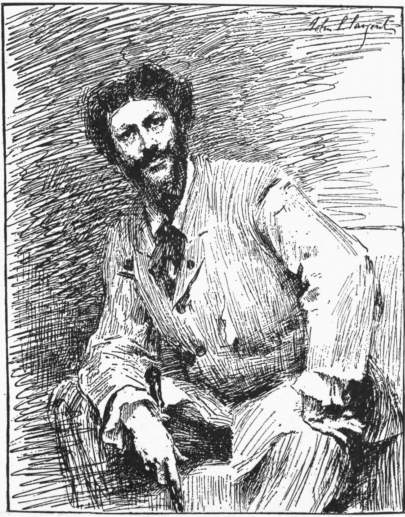
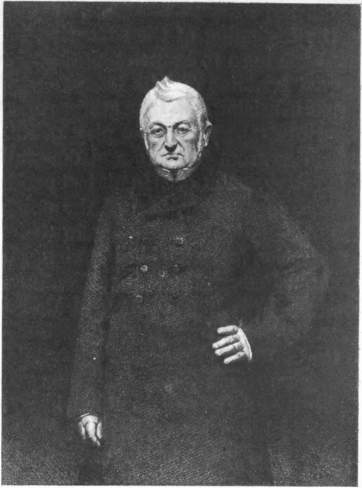
CAROLUS DURAN. BONNAT. ADOLPHE THIERS.
(By permission of the Artist.)
In Charles Chaplin Fragonard was revived. He was the specialist of languishing flesh and poudre de riz, the refined interpreter of aristocratic beauty, one on whose palette there might still be found a delicate reflection of the fêtes galantes of the eighteenth century. In Germany he was principally known by those dreamy, frail, and sensual maidens, well characterised by the phrase of the Empress Eugénie. “M. Chaplin,” she said, “I admire you. Your pictures are not merely indecorous, they are more.” But Chaplin had likewise the other qualities of the rococo painter. He was a decorative artist of the first rank, and, like Fragonard, he carelessly scattered round him on all sides grace and beauty, charm and fascination. In 1857 he decorated the Salon des Fleurs in the Tuileries, in 1861-65 the bathroom of the Empress in the Palais de l’Elysée, and from 1865 a number of private houses in Paris, Brussels, and New York; and there is in all these works a refined haut-goût of modern Parisian elegance and fragrant rococo grace. He revived no nymphs, and made no pilgrimage to the island of Cythera; he was more of an epicurean. But Fragonard’s fine tones and Fragonard’s sensuousness were peculiar to him. He had a method of treating the hair, of introducing little patches, of setting a dimple in the chin, and painting the arms and bosom, which had vanished since the rococo period from the power of French artists. Rosebuds and full-blown roses blossom like girls à la Greuze, and fading beauties, who are all the more irresistible, are the elements out of which his refined, indecorous, and yet fragrant art is constituted.
The great engraver Gaillard brought Hans Holbein once more into honour. He was the heir of that method of painting, the eternal matrix of which Jan van Eyck left to the world in unapproachable perfection. His energetic but conscientiously minute brush noted every wrinkle of the face, without doing injury to the total impression by this labour of detail. Indeed, his pictures are as great in conception and as powerful in characterisation as they are small in size. Gaillard is a profound physiognomist who attained the most vivid analysis of character by means of the utmost precision.
Paul Dubois takes us across the Alps; in his portraits he is the same great quattrocentist that he was from the beginning in his plastic works. His ground is that of the excellent and subtle period when Leonardo, who had been in the beginning somewhat arid, grew delicate and allowed a mysterious sphinx-like smile to play round the lips of his women. Manifestly he has studied Prudhon and had much intercourse with Henner in those years when the latter, after his return from Italy, directed attention once more to the old Lombards. From the time when he made his début in 1879, with the portrait of his sons, he received great encouragement, and stands out in these days as the most mature painter of women that the present age has to show. Only the great English portrait painters Watts and Millais, who are inferior to him in technique, have excelled him in the embodiment of personalities.
As the most skilful painter of drapery, the most brilliant decorator of feminine beauty, Carolus Duran was long celebrated. The studies which he had made in Italy had not caused him to forget that he took his origin from across the Flemish border; and when he appeared with his first portraits, in the beginning of the seventies, it was believed that an eminent colourist had been born to French painting. At that time he had a fine feeling for the eternal feminine and its transitory phases of expression, and he was as dexterous in seizing a fleeting gesture or a turn of the head as he was in the management of drapery and the play of its hues. Then, again, he made a gradual transition from delicate and discreetly coquettish works to the crude arts of upholstery. Yet even in his last period he has painted some masculine portraits—those of Pasteur, and of the painters Français, Fritz Thaulow, and René Billotte—which are striking in their vigorous simplicity and unforced characterisation after the glaring virtuosity of his pictures of women.
Gaz. des Beaux-Arts. L’Art.
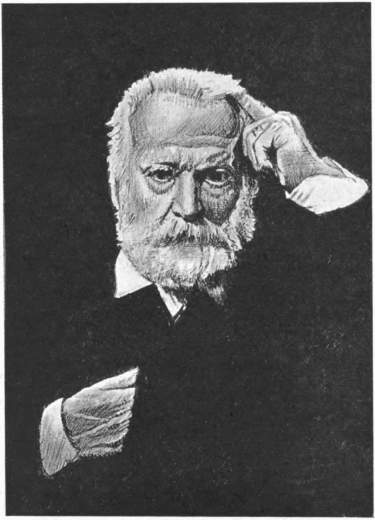
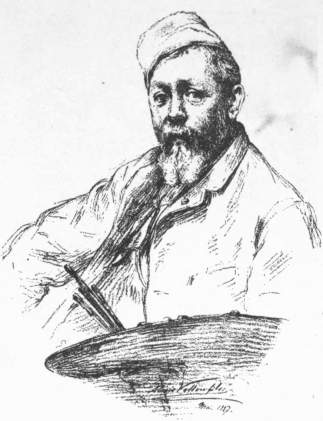
BONNAT. VICTOR HUGO. ANTOINE VOLLON.
(By permission of the Artist.)
Léon Bonnat, the pupil of Madrazos, brought about the fruitful connection between French painting and that of the old Spaniards. By this a large quantity of the fresh blood of naturalism was poured into it once more. Born in the South of France and educated in Spain, he had conceived there a special enthusiasm for Ribera, and these youthful impressions were so powerful that he remained faithful to them in Paris. As early as his residence in Italy, which included the three years from 1858 to 1860, his individuality had been fortified in a degree which prevented him from wasting himself on large academical compositions like the holders of the Prix de Rome; on the contrary, he painted scenes from the varied life of the Roman people. Several religious pictures, such as “The Martyrdom of Saint Andrew” (1863), “Saint Vincent de Paul” (1866), and the “Job” of the Luxembourg, showed that he was steadily progressing on the road paved by Spagnoletto. He had a virtuosity in conjuring on to the canvas visages furrowed by the injustices of life—grey hair, waving grey beards, and the starting sinews and muscles of old weather-beaten frames. In the beginning of the seventies, when he had to paint a Crucifixion for the jury-chamber in the Paris Palais de Justice, he executed a virile figure, the muscles and anatomy of which were as clearly marked as the buttresses in a Gothic cathedral. As in the paintings of Caravaggio, a sharp, glaring light fell upon certain parts of the body, whilst others remained dark and colourless in the gloomy background. He applied the same principles to his portraits. A French Lenbach, he painted in France a gallery of celebrated men. With an almost tangible reality he painted Hugo, Madame Pasta, Dumas, Gounod, Thiers, Grévy, Pasteur, Puvis de Chavannes, Jules Ferry, Carnot, Cardinal Lavigerie, and others. Over two hundred persons, famous or not, have sat to him, and he has painted them with an exceedingly intelligent power, masculine taste, and a learning which never loses itself in unnecessary detail.
The delicate physiognomy of women, the frou-frou of exquisite toilettes, the dreaminess, the fragrance, the coquetry of the modern Sphinx, were no concern of his. On the other hand, his masculine portraits will always keep their interest, if only on historical grounds. In all of them he laid great stress on characteristic accessories, and could indicate in the simplest way the thinker, the musician, the scholar, and the statesman. One remembers his pictures as though they were phrases uttered with conviction, though a German does not hesitate to place Lenbach far above Bonnat as a psychologist. The latter has not the power of seizing the momentary effect, the intimacy, the personal note, the palpitating life peculiar to Lenbach. With the intention of saying all things he often forgets the most important—the spirit of the man and the grace of the woman. His pictures are great pieces of still-life—exceedingly conscientious, but having something of the conscientiousness of an actuary copying a tedious protocol. The portrait of Léon Cogniet, the teacher of the master, with his aged face, his spectacled eyes, and his puckered hands (Musée Luxembourg), is perhaps the only likeness in which Bonnat rivals Lenbach in depth of characterisation. His pictorial strength is always worthy of respect; but, for the sake of variety, the esprit is for once on the side of the German.
Ruled by a passion for the Spanish masters, such as Bonnat possessed, Roybet painted cavaliers of the seventeenth century, and other historical pictures of manners, which are distinguished, to their advantage, from older pictures of their type, because it is not the historical anecdote but the pictorial idea which is their basis. All the earlier painters were rather bent upon archæological accuracy than on pictorial charm in the treatment of such themes. Roybet revelled in the rich hues of old costumes, and sometimes attained, before he strained his talent in the Procrustean bed of pictures of great size, a bloom and a strong, glowing tone which rival the old masters.
L’Art. L’Art.
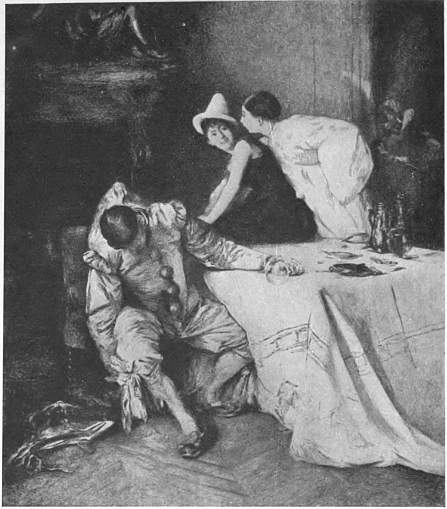
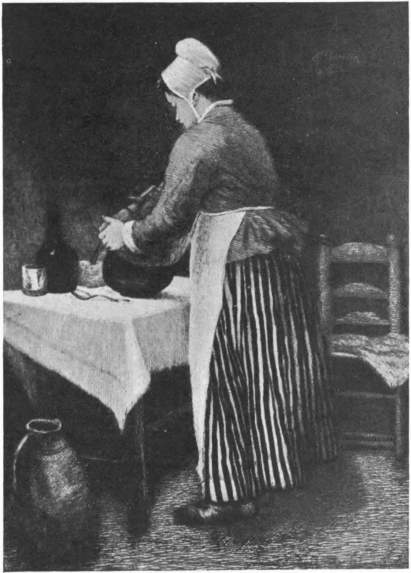
VOLLON. A CARNIVAL SCENE. BONVIN. THE COOK.
In all periods which have learnt to see the world through a pictorial medium, still-life has held an important place in the practice of art. A technical instinct, which is in itself art, delights in investing musical instruments, golden and silver vessels, fruit and other eatables, glasses and goblets, coverings of precious work, gauntlets and armour, all imaginable petit-riens, with an artistic magic, in recognising and executing pictorial problems everywhere. After the transition from historical and genre painting had been made to painting proper there once more appeared great painters of still-life in France as there did in Chardin’s days.
Yet Blaise Desgoffe, who painted piecemeal and with laborious patience goldsmith’s work, crystal vases, Venetian glass, and such things, is certainly rather petty. In France he was the chief representative of that precise and detailed painting which understands by art a deceptive imitation of objects, and sees its end attained when the holiday public gathers round the pictures as the birds gathered round the grapes of Zeuxis.
It is as if an old master had revived in Philippe Rousseau. He had the same earnest qualities as the Dutch and Flemish Classic masters—a broad, liquid, pasty method of execution, a fine harmony of clear and powerful tones—and with all this a marvellous address in so composing objects that no trace of “composition” is discernible. His work arose from the animal picture. His painting of dogs and cats is to be ranked with the best of the century. He makes a fourth with Gillot, Chardin, and Decamps, the great painters of monkeys. As a decorator of genius, like Hondekoeter, he embellished a whole series of dining-halls with splendidly coloured representations of poultry, and, like Snyders, he heaped together game, dead and living fowl, fruit, lobsters, and oysters into huge life-size masses of still-life. Behind them the cook may be seen, and thievish cats steal around. But, like Kalf, he has also painted, with an exquisite feeling for colour, Japanese porcelain bowls with bunches of grapes, quinces, and apricots, metal and ivory work, helmets and fiddles, against that delicate grey-brown-green tone of background which Chardin loved.
Antoine Vollon became the greatest painter of still-life in the century. Indeed, Vollon is as broad and nervous as Desgoffe is precise and pedantic. Flowers, fruit, and fish—they are all painted in with a firm hand, and shine out of the dark background with a full liquid freshness of colour. He paints dead salt-water fish like Abraham van Beyeren, grapes and crystal goblets like Davids de Heem, dead game like Frans Snyders, skinned pigs like Rembrandt and Maes. He is a master in the representation of freshly gathered flowers, delicate vegetables, copper kettles, weapons, and suits of armour. Since Chardin no painter depicted the qualities of the skin of fresh fruit, its life and its play of colour, and the moist bloom that rests upon it, with such fidelity to nature. His fish in particular will always remain the wonder of all painters and connoisseurs. But landscapes, Dutch canal views, and figure-pictures are also to be found amongst his works. He has painted everything that is picturesque, and the history of art must do him honour as, in a specifically pictorial sense, one of the greatest in the century. A soft grey-brown wainscoting, a black and white Pierrot costume, and a white table-cloth and dark green vegetables—such is the harmony of colour which he chiefly loved in his figure-pictures.
On the same purely pictorial grounds nuns became very popular in painting, as their white hoods and collars standing out against a black dress gave the opportunity for such a fine effect of tone. This was the province in which poor François Bonvin laboured. Deriving from the Dutch, he conceived an enthusiasm for work, silence, the subdued shining of light in interiors, cold days, the slow movements and peaceful faces of nuns, and painted kitchen scenes with a strong personal accent. Before he took up painting he was for a long time a policeman, and was employed in taking charge of the markets. Here he acquired an eye for the picturesqueness of juicy vegetables, white collars, and white hoods, and when he had a day free he studied Lenain and Chardin in the Louvre. Bonvin’s pictures have no anecdotic purport. Drinkers, cooks, orphan children in the schoolroom, sempstresses, choristers, sisters of mercy, boys reading, women in church, nuns conducting a sewing-class—Bonvin’s still, picturesque, congenial world is made up of elements such as these. What his people may think or do is no matter: they are only meant to create an effect as pictorial tones in space. During his journey to Holland he had examined Metsu, Frans Hals, Pieter de Hoogh, Terborg, and Van der Meer with an understanding for their merits, but it was Chardin in both his phases—as painter of still-life and of familiar events—who was in a special sense revived in Bonvin. All his pictures are simple and quiet; his figures are peaceful in their expression, and have an easy geniality of pose; his hues have a beauty and fulness of tone recalling the old masters.
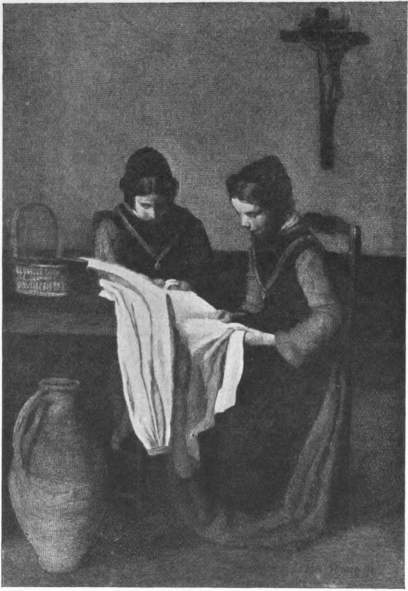
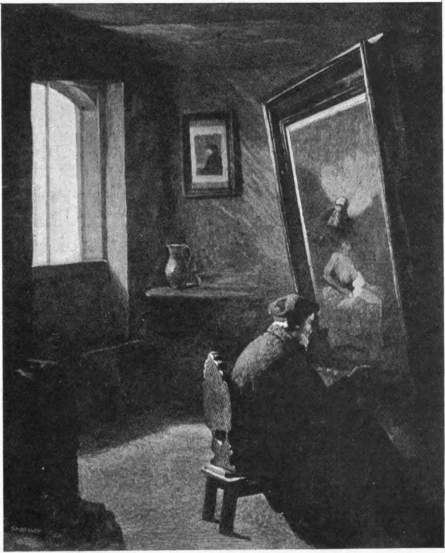
L’Art.
BONVIN. THE WORK-ROOM. RIBOT. THE STUDIO.
Even Théodule Ribot, the most eminent of the group, one of the most dexterous executants of the French school, a master who for power of expression is worthy of being placed between Frans Hals and Ribera, made a beginning with still-life. He was born in 1823, in a little town of the department of Eure. Early married and poor, he supported himself at first by painting frames for a firm of mirror manufacturers, and only reserved the hours of the evening for his artistic labours. In particular he is said to have accustomed himself to work whole nights through by lamplight, while he nursed his wife during a long illness, watching at her bedside. The lamplight intensified the contrasts of light and shadow. Thus Ribot’s preference for concentrated light and strong shadows is partially due, in all probability, to what he had gone through in his life, and in later days Ribera merely bestowed upon him a benediction as his predecessor in the history of art.
His first pictures from the years 1861 to 1865 were, for the most part, scenes from household and kitchen life: cooks, as large as life, plucking poultry, setting meat before the fire, scouring vessels, or tasting sauces; sometimes, also, figures in the streets; but even here there was a strong accentuation of the element of still-life. There were men with cooking utensils, food, dead birds, and fish. Then after 1865 there followed a number of religious pictures which, in their hard, peasant-like veracity and their impressive, concentrated life, stood in the most abrupt contrast with the conventionally idealised figures of the academicians. His “Jesus in the Temple,” no less than “Saint Sebastian” and “The Good Samaritan”—all three in the Musée Luxembourg—are works of simple and forceful grandeur, and have a thrilling effect which almost excites dismay. Sebastian is no smiling saint gracefully embellished with wounds, but a suffering man, with the blood streaming from his veins, stretched upon the earth; yet half-raising himself, a cry of agony upon his lips, and his whole body contorted by spasms of pain. In his “Jesus in the Temple,” going on parallel lines with Menzel, he proclaims the doctrine that it is only possible to pour new life-blood into traditional figures by a tactful choice of models from popular life around. And in “The Good Samaritan,” also, he was only concerned to paint, with naturalistic force, the body of a wounded man lying in the street, a thick-set French peasant robbed of his clothes. From the seventies his specialty was heads—separate figures of weather-beaten old folk, old women knitting or writing, old men reading or lost in thought; and these will always be ranked with the greatest masterpieces of the century. Ribot attains a remarkable effect when he paints those expressive faces of his, which seem to follow you with their looks, and are thrown out from the darkness of his canvas. A black background, in which the dark dresses of his figures are insensibly lost, a luminous head with such eyes as no one of the century has ever painted, wrinkled skin and puckered old hands rising from somewhere—one knows not whence—these are things which all lend his figures something phantasmal, superhuman, and ghostly. Ribot is the great king of the under-world, to which a sunbeam only penetrates by stealth. Before his pictures one has the sense of wandering in a deep, deep shaft of some mine, where all is dark and only now and then a lantern glimmers. No artist, not even Ribera, has been a better painter of old people, and only Velasquez has painted children who have such sparkling life. Ribot worked in Colombes, near Paris, to which place he had early withdrawn, in a barn where only tiny dormer-windows let in two sharp rays of light.
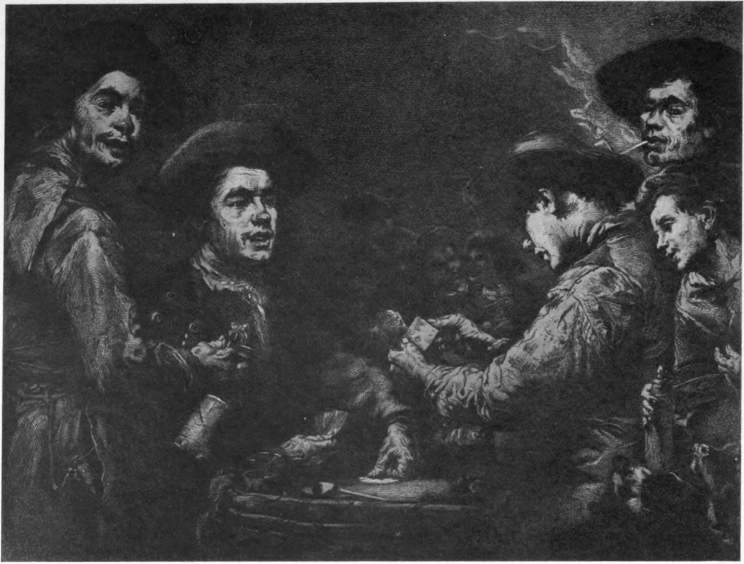
L’Art.
RIBOT. AT A NORMAN INN.
By placing his canvas beneath one window and his model beneath the other, in a dim light which allowed only one golden ray to fall upon the face, he isolated it completely from its surroundings, and in this way painted the parts illuminated with the more astonishing effect. No one had the same power in modelling a forehead, indicating the bones beneath the flesh, and rendering all the subtleties of skin. A terrible and intense life is in his figures. His old beggars and sailors especially have something kingly in the grand style of their noble and quiet faces. An old master with a powerful technique, a painter of the force and health of Jordaens, has manifested himself once more in Ribot.
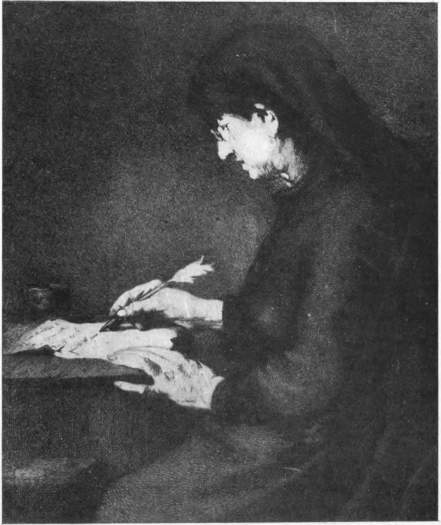
L’Art.
RIBOT. KEEPING ACCOUNTS.
Courbet’s principles, accordingly, had won all down the line, in the course of a few years. “It is only Ribera, Zurbaran, and Velasquez that I admire; Ostade and Craesbeeck also allure me; and for Holbein I feel veneration. As for M. Raphael, there is no doubt that he has painted some interesting portraits, but I cannot find any ideas in him.” In these words he had prophesied as early as 1855 the course which French art would take in the next decade. When Courbet appeared the grand painting stood in thraldom to the beauté suprême, and the æsthetic conceptions of the time affected the treatment of contemporary subjects. Artists had not realism enough to give truth and animation to these themes. When Cabanel, Hamon, and Bouguereau occasionally painted beggars and orphans, they were bloodless phantoms, because by beautifying the figures they deprived them of character in the effort to give them, approximately, the forms of historical painting. Because painters did not regard their own epoch, because they had been accustomed to consider living beings merely as elements of the second and third rank, they never discovered the distinctiveness of their essential life. Like a traveller possessed by one fixed mania, they made a voyage round the world, thinking only how they might adapt living forms to those which their traditional training recommended as peculiarly right and alone worthy of art. Even portrait painting was dominated by this false method, of rendering figures as types, of improving the features and the contour of bodies, and giving men the external appearance of fair, ideal figures.
But now the sway of the Cinquecento has been finally broken. A fresh breeze of realism from across the Pyrenees has taken the place of the sultry Italian sirocco. From the pictures of the Neapolitans, the Spaniards, and the Dutch it has been learnt that the joys and sorrows of the people are just as capable of representation as the actions of gods and heroes, and under the influence of these views a complete change in the cast has taken place.
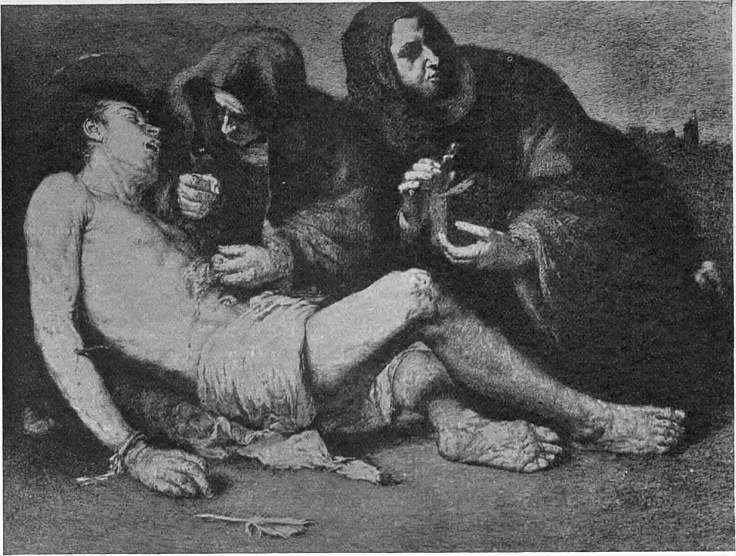
L’Art.
RIBOT. ST. SEBASTIAN, MARTYR.
The figures which in 1855 filled Courbet’s picture “The Studio”—beggar-women, agricultural labourers, artisans, sailors, tippling soldiers, buxom girls, porters, rough members of the proletariat of uncouth stature—now crowd the stage of French art, and impart even to the heroes of history, bred through centuries from degenerated gods, something of their full-blooded, rough, hearty, and plebeian force of life. The artists of Italian taste only gave the rights of citizenship to “universal forms”; every reminiscence of national customs or of local character was counted vulgar; they did not discover the gold of beauty in the rich mines of popular life, but in the classic masters of foreign race. But now even what is unearthly is translated into the terms of earth. If religious pictures are to be painted, artists take men from the people for their model, as Caravaggio did before them—poor old peasants with bones of iron, and bronzed, weather-beaten faces, porters with figures bowed and scarred by labour, men of rough, common nature, though of gnarled and sinewy muscles. The pictures of martyrs, once artificial compositions of beautiful gesture and vacant, generalised countenances, receive a tone local to the scaffold, a trait of merciless veracity—the heads the energy of a relief, the gestures force and impressiveness, the bodies a science in their modelling which would have rejoiced Ribera. As Caravaggio said that the more wrinkles his model had the more he liked him, so no one is any longer repelled by horny hands, tattered rags, and dirty feet. In the good periods of art it is well known that the beauty or uncomeliness of a work has nothing to do with the beauty or uncomeliness of the model, and that the most hideous cripple can afford an opportunity for making the most beautiful work. The old doctrine of Leonardo, that every kind of painting is portrait painting, and that the best artists are those who can imitate nature in the most convincing way, comes once more into operation. The apotheosis of the model has taken the place of idealism. And during these same years England reached a similar goal by another route.

BIBLIOGRAPHY
BIBLIOGRAPHY
CHAPTER XVI
Leopold Boilly:
Jules Houdoy: “L’Art,” 1877, iv 63, 81.
On the History of Caricature in General:
J. P. Malcolm: An Historical Sketch of the Art of Caricaturing. London, 1813.
Th. Wright: A History of Caricature and Grotesque in Literature and Art. London, 1875.
Arsène Alexandre: L’Art du rire. Paris, 1892.
E. Bayard: La caricature et les caricaturistes. Paris, 1900.
Fuchs und Krämer: Die Karikatur der europäischen Völker vom Altertum bis zur Neuzeit. Berlin, 1901.
On the English Caricaturists:
Victor Champier: La caricature anglaise contemporaine, “L’Art,” 1875, i 29, 293, ii 300, iii 277 and 296.
Ernest Chesneau: Les livres à caricatures en Angleterre, “Le Livre,” Novembre 1881.
Augustin Filon: La caricature en Angleterre, W. Hogarth, “Revue des Deux Mondes,” 15 Janvier 1885.
Graham Everitt: English Caricaturists and Graphic Humorists of the Nineteenth Century. How they illustrated and interpreted their Times. With 67 Illustrations. London, 1886.
Rowlandson:
C. M. Westmacott: The Spirit of the Public Journals. 3 vols. 1825-1826.
Joseph Grego: Thomas Rowlandson, the Caricaturist. A selection from his works, with anecdotal descriptions of his famous Caricatures and a sketch of his Life, Times, and Contemporaries. With about 400 Illustrations. 2 vols. London, 1880.
F. G. Stephens: Thomas Rowlandson the Humorist, “Portfolio,” 1891, 141.
Cruikshank:
Cruikshankiana. Engravings by Richard Dighton. London, 1855.
F. G. Stephens: G. Cruikshank, “Portfolio,” 1872, 77.
G. W. Reid: Complete Catalogue of the Engraved Works of George Cruikshank. London, 1873.
G. A. Sala: George Cruikshank, a Life Memory, “Gentleman’s Magazine,” 1878.
William Bates: George Cruikshank, the Artist, the Humorist, and the Man. With Illustrations and Portraits. London and Birmingham, 1878.
Frederick Wedmore: Cruikshank, “Temple Bar,” April 1878.
W. B. Jerrold: The Life of George Cruikshank. 2 vols. 1882.
H. Thornber: The Early Work of George Cruikshank. 1887.
F. G. Stephens: A Memoir of George Cruikshank. London, 1891.
R. F. H. Douglas: Catalogue of Works by Cruikshank. London, 1903.
John Leech:
Ernest Chesneau: Un humoriste anglais, “Gazette des Beaux-Arts,” 1875, i 532.
John Brown: John Leech, and Other Papers. Edinburgh, 1882.
F. G. Kitton: John Leech, Artist and Humorist. London, 1884.
George Du Maurier:
“L’Art,” 1876, iv 279. See also English Society at Home. Fol. London, 1880.
Charles Keene:
Claude Phillips: Charles Keene, “Gazette des Beaux-Arts,” 1891, i 327.
G. L. Layard: The Life and Letters of Charles Keene. London, 1892.
On the German Draughtsmen:
Beiträge zur Geschichte der Caricatur, “Zeitschrift für Museologie,” 1881, 13 ff.
J. Grand-Carteret: Les mœurs et la caricature en Allemagne, en Autriche, en Suisse. Paris, 1885.
R. v. Seydlitz: Die moderne Caricatur in Deutschland, “Zur guten Stunde,” Mai 1891.
Hermann: Die deutsche Karikatur im 19 Jahrhundert. Bielefeld, 1901.
Johann Christian Erhard:
Alois Apell: Das Werk von Johann Christian Erhard. Leipzig, 1866-75.
Johann Adam Klein:
F. M.: Verzeichniss der von Johann Adam Klein gezeichneten und radirten Blätter. Stuttgart, 1853.
John: Das Werk von Johann Adam Klein. Munich, 1863.
Ludwig Richter:
Richter-Album. 2 vols. Leipzig, 1861.
Jahn, in Richter-Album, and in the Biographische Aufsätze. Leipzig, 1867.
W. Heinrichsen: Ueber Richters Holzschnitte. Carlsruhe, 1870.
Johann F. Hoff: Adrian Ludwig Richter, Maler und Radirer. List and description of his works, with a biographical sketch by H. Steinfeld. Dresden, 1871.
L. Richter’s Landschaften. Text by H. Lücke. Leipzig, 1875.
Georg Scherer: Aus der Jugendzeit. Leipzig, 1875. Ernst und Scherz. Leipzig, 1875.
Deutsche Art und Sitte. Published by G. Scherer. Leipzig, 1876.
Friedrich Pecht: Deutsche Künstler des 19 Jahrhunderts, i. Nördlingen, 1877, pp. 57 ff.
A. Springer: Zum 80 Geburtstag Ludwig Richter’s, “Zeitschrift für bildende Kunst,” 1883, pp. 377-386.
J. E. Wessely: Adrian Ludwig Richter zum 80 Geburtstag. A Monograph. “Graphische Künste,” 1884, vi 1.
Obituary: “Allgemeine Zeitung,” 1884, No. 175; “Allgemeine Kunst-Chronik,” 1884, 26; G. Weisse, “Deutsches Künstlerblatt,” iii 1.
Lebenserinnerungen eines deutschen Malers: Autobiography of Ludwig Richter. Published by Heinrich Richter. Frankfurt a. M., 1886.
Robert Waldmüller: Ludwig Richter’s religiöse Entwickelung. “Gegenwart,” 37, pp. 198, 218.
Veit Valentin: Kunst, Künstler, und Kunstwerke. 1889.
Richard Meister: Land und Leute in Ludwig Richter’s Holzschnitt-Bildern. Leipzig, 1889.
Die vervielfältigende Kunst der Gegenwart. Edited by C. v. Lützow. Vol. i. Woodcut Engravings. Wien, 1890.
H. Gerlach: Ludwig Richters Leben, dem deutschen Volke erzählt. Dresden, 1891.
Budde: Ludwig Richter, “Preussische Jahrbücher.” Bd. 87. Berlin, 1897.
P. Mohn: Ludwig Richter, “Künstlermonographien,” Edited by Knackfuss. Bd. 14. 2 Aufl. Bielefeld, 1898.
J. Erler: Ludwig Richter, der Maler des deutschen Hauses. Leipzig, 1898.
David Ludwig Koch: Ludwig Richter. Stuttgart, 1903.
Albert Hendschel:
J. E. Wessely: Aus Albert Hendschels Bildermappe, “Vom Fels zum Meer,” 1883, iii 3.
Obituary: “Le Portefeuille,” 1884, 30.
F. Luthmer: Albert Hendschel. “Vom Fels zum Meer,” December 1884.
W. Busch:
Paul Lindau: “Nord und Süd,” 1878, iv 257.
Eduard Daelen: W. Busch, “Kunst für Alle,” 1887, ii 217.
See Busch-Album, Humoristischer Hausschatz. Collection of the twelve most popular works, with 1400 pictures. München, 1885.
Adolf Oberländer:
Adolf Bayersdorfer: Adolf Oberländer, “Kunst für Alle,” 1888, iv 49.
Robert Stiassny: Zur Geschichte der deutschen Caricatur, “Neue Freie Presse,” 20th August 1889.
Hermann Essenwein: Adolf Oberländer, “Moderne Illustratoren.” Bd. 5. Munich, 1903.
See Oberländer-Album. 7 vols. Munich, Braun & Schneider, 1881-89.
On the French Draughtsmen:
Champfleury: Histoire générale de la caricature. 5 vols. Paris, 1856-80.
J. Grand-Carteret: Les mœurs et la caricature en France. Paris, 1888.
Armand Dayot: Les Maîtres de la caricature au XIX siècle. 115 facsimilés de grand caricatures en noir, 5 facsimilés de lithographies en couleurs. Paris, 1888.
Henri Béraldi: Les graveurs du XIX siècle. Paris, 1885.
Paul Mantz: La caricature moderne, “Gazette des Beaux-Arts,” 1888, i 286.
Augustin de Buisseret: Les caricaturistes français, “L’Art,” 1888, ii 91.
Moreau:
J. F. Mahérault: L’œuvre de Moreau le jeune. Paris, 1880.
A. Moureau: Les Moreau in “Les artistes célèbres.” 1903.
Emanuel Bocher: Jean Michel Moreau le jeune. Paris, 1882.
Debucourt:
Roger Portalis and Henri Béraldi: Les graveurs du XVIII siècle, vol. i. Paris, 1880.
Henri Bouchot, in “Les artistes célèbres.” 1905.
Carle Vernet:
Amédée Durande: Joseph Carle, et Horace Vernet. Paris, 1865.
A. Genevay: Carle Vernet, “L’Art,” 1877, i 73, 96.
Henri Monnier:
Philippe Burty: “L’Art,” 1877, ii 177.
Champfleury: “Gazette des Beaux-Arts,” 1877, i 363.
Champfleury: Henri Monnier, sa vie et son œuvre. Paris, 1879.
Daumier:
Champfleury: L’œuvre de Daumier, Essai de catalogue, “L’Art,” 1878, ii 217, 252, 294.
Eugène Montrosier: La caricature politique, H. Daumier, “L’Art,” 1878, ii 25.
H. Billung: H. Daumier, “Kunstchronik,” 24, 1879.
Arsène Alexandre: Honoré Daumier, l’homme et son œuvre. Paris, 1890.
H. Frantz: Daumier and Gavarni. London, 1904.
Erich Klossowski: H. Daumier. Stuttgart, 1906.
Guys:
Baudelaire: Le peintre de la vie moderne, in the volume “L’Art romantique” of his complete works. Paris, 1869.
Gavarni:
Manières de voir et façons de penser, par Gavarni, précédé d’une étude par Charles Yriarte. Paris, 1869.
Edmond et Jules de Goncourt: Gavarni, l’Homme et l’Œuvre. Paris, 1873.
Armelhault et Bocher: Catalogue raisonné de l’Œuvre de Gavarni. Paris, 1873.
G. A. Simcox: “Portfolio,” 1874, p. 56.
Georges Duplessis: “Gazette des Beaux-Arts,” 1875, ii 152, 211.
Georges Duplessis: Gavarni, Étude, ornée de 14 dessins inédits. Paris, 1876.
Ph. de Chennevières: Souvenirs d’un Directeur des Beaux-Arts, IIIième partie. Paris, 1876.
Bruno Walden: “Unsere Zeit,” 1881, ii 926.
Eugène Forgues: Gavarni, in “Les artistes célèbres.” Paris, 1887.
See also Sainte-Beuve, Nouveaux Lundis. Henri Béraldi, Graveurs du XIX siècle. Œuvres choisies de Gavarni. 4 vols. Paris, 1845-48.
Gustave Doré:
K. Delorme, Gustave Doré, peintre, sculpteur, dessinateur, graveur. Avec gravures et photographies hors texte. Paris, Baschet, 1879.
Jules Claretie: Peintres et sculpteurs contemporains, II Série. Paris, 1884, p. 105.
Obituary: “Magazine of Art,” March 1883; Fernand Brouet: “Revue artistique,” March 1883; Dubufe: “Nouvelle Revue,” March and April 1883; A. Michel: “Revue Alsacienne,” February 1883; “Chronique des Arts,” 1883, p. 4; “Zeitschrift für bildende Kunst,” 1883; A. Hustin, “L’Art,” 1883, p. 424.
Van Deyssel: Gustave Doré, “De Dietsche Warande,” iv 5.
Blanche Roosevelt: Life and Reminiscences of Gustave Doré. London, 1885.
Claude Phillips: Gustave Doré, “Portfolio,” 1891, p. 249.
Cham:
Marius Vachon: “Gazette des Beaux-Arts,” 1879, ii 443.
Felix Ribeyre: Cham, sa vie et son œuvre. Paris, 1884.
Cham-Album. 3 vols. Paris. Without date.
Grévin:
Ad. Racot: Portraits d’aujourd’hui. Paris, 1891.
CHAPTER XVII
Barry:
The Works of James Barry, Esq.—to which is prefixed some account of the Life and the Writings of the Author. 2 vols. London, 1809.
J. J. Hittorf: Notice historique et biographique de Sir J. Barry. 1860.
Alfred Barry: The Life and Works of Sir J. Barry. London, 1867.
Sidney Colvin: James Barry, “Portfolio,” 1873, p. 150.
H. Trueman Wood: Pictures of James Barry at the Society of Arts. London, 1880.
Benjamin West:
John Galt: The Life, Studies, and Works of Benjamin West. London, 1820. Second Edition, 1826.
Sidney Colvin: “Portfolio,” 1873, p. 150.
See also Cornelius Gurlitt: Die amerikanische Malerei in Europa, “Die Kunst unserer Zeit,” 1893.
Fuseli:
J. Knowles: Life and Works of Henry Fuseli. 3 vols. London, 1831.
Sidney Colvin: Henry Fuseli, “Portfolio,” 1873, p. 50.
Stothard:
Anna Eliza Bray: Life of Thomas Stothard. London, 1851.
Opie:
John J. Rogers: Opie and his Works, being a Catalogue of 760 Pictures by John Opie, R. A. Preceded by a biographical sketch. London, 1878.
Claude Phillips: John Opie, “Gazette des Beaux-Arts,” 1892, i 299.
Northcote:
John Thackeray Bunce: James Northcote, R. A., “Fortnightly Review,” June 1876.
Copley:
A. T. Perkins: A Sketch of the Life and a List of the Works of John Singleton Copley. London, 1873.
Haydon:
Life of B. R. Haydon, Historical Painter, from his Autobiography, edited by Tom Taylor. 3 vols. London, 1853.
Maclise:
James Dafforne: Pictures by Maclise. London, 1871.
James Dafforne: Leslie and Maclise. London, 1872.
Etty:
A. Gilchrist: Life of W. Etty, R. A. 2 vols. London, 1855.
P. G. Hamerton: Etty, “Portfolio,” 1875, p. 88.
W. C. Monkhouse: Pictures by William Etty, with Descriptions. London, 1874.
Edward Armitage:
J. Beavington-Atkinson: “Portfolio,” 1870, p. 49.
Romney:
William Hagley: The Life of George Romney. London, 1809.
Rev. John Romney (son of the painter): Memoirs of the life and Writings of George Romney. London, 1830.
P. Selvatico: Il pittore Sir Giorgio Romney ed Emma Lyon, “Arte ed Artisti,” p. 143. Padova, 1863.
Sidney Colvin: George Romney, “Portfolio,” 1873, pp. 18 and 34.
Lord Ronald Gower: Romney and Lawrence. London, 1882.
T. H. Ward and W. Roberts: Romney, A biographical and critical essay, with a catalogue raisonné of his works. London, 1904.
G. Paston: George Romney, etc. (Little Books on Art). London, 1903.
Thomas Lawrence:
D. E. Williams: The Life and Correspondence of Sir Thomas Lawrence. 2 vols. With 3 Portraits. London, 1831.
F. Lewis: Imitations of Sir Thomas Lawrence’s Finest Drawings. 1 vol. Reproductions in crayon. London, 1839.
A. Genevay: “L’Art,” 1875, iii 385.
Th. de Wyzewa: Thomas Lawrence et la Société anglaise de son temps, “Gazette des Beaux-Arts,” 1891, i 119, ii 112, 335.
Lord Ronald Gower: Romney and Lawrence. London, 1882.
Raeburn:
Portraits by Sir Henry Raeburn, photographed by Thomas Asman, with biographical sketches. Fol. Edinburgh. No date.
Exhibition of Portraits by Sir Henry Raeburn, “Art Journal,” 1876, p. 349.
Alexander Fraser: Henry Raeburn, “Portfolio,” 1879, p. 200.
Andrew William Raeburn: Life of Sir Henry Raeburn. With 2 Portraits. London, 1886.
Sir W. Armstrong: Sir Henry Raeburn, etc. London, 1901.
George Morland:
John Hassell: Life of the late George Morland. London, 1804.
William Collins, Memoirs of George Morland. London, 1806.
F. W. Blagdon: Authentic Memoirs of the late George Morland. London, 1806.
G. Dawe: The Life of George Morland. London, 1807.
Walter Armstrong: George Morland, “Portfolio,” 1885, p. 1.
Some Notes on George Morland: From the Papers of James Ward, R. A., “Portfolio,” 1886, p. 98.
Other Biographies by R. Richardson, 1895. J. T. Nettleship, 1898; and Williamson, 1904.
James Ward:
F. G. Stephens: “Portfolio,” 1886, pp. 8, 32, 45.
Landseer:
F. G. Stephens: The Early Works of Edwin Landseer. 16 Photographs. London, 1869. New Edition under the title: Memoirs of Sir Edwin Landseer. London, 1874.
F. G. Stephens: “Portfolio,” 1871, p. 165.
James Dafforne: Pictures by Sir Edwin Landseer, R. A. With descriptions and a biographical sketch of the painter. London, 1873.
James Dafforne: Studies and Sketches by Sir Edwin Landseer, “Art Journal,” 1875, passim.
Catalogue of the Works of Sir Edwin Landseer, “Art Journal,” 1875, p. 317.
J. Beavington-Atkinson: “Zeitschrift für bildende Kunst,” 1875, pp. 129 and 163.
M. M. Heaton: “Academy,” 1879, p. 378.
Edw. Leonidas: Sir Edwin Landseer, “Nederlandsche Kunstbode,” 1881, p. 50.
F. G. Stephens: Sir Edwin Landseer. London, 1881.
F. G. Stephens: Landseer, the Dog Painter, “Portfolio,” 1885, p. 32.
J. A. Manson: Sir Edwin Landseer. London, 1902.
On the English Genre Painters:
Frederick Wedmore: The Masters of Genre Painting. With 16 Illustrations. London, 1880.
Wilkie:
Allan Cunningham: Life of Wilkie. 3 vols. London, 1843.
Mrs. C. Heaton: The Great Works of Sir David Wilkie. 26 Photographs. London and Cambridge, 1868.
A. L. Simpson: The Story of Sir David Wilkie. London, 1879.
J. W. Mollet: Sir David Wilkie. London, 1881.
Feuillet de Conches: Sir David Wilkie, “Artiste,” August 1883.
F. Rabbe, in “Les artistes célèbres.”
E. Pinnington: Sir David Wilkie, etc. (Famous Scots Series). London, 1900.
W. Bayne: Sir David Wilkie, etc. (Makers of British Art). London, 1903.
William Collins:
W. Wilkie Collins: Memoirs of the Life of William Collins, Esq. 2 vols. London, 1848.
William Powell Frith:
My Autobiography and Reminiscences. London, 1887.
Further Reminiscences. London, 1898.
Mulready:
Sir Henry Cole: Biography of William Mulready, R. A. Notes of Pictures, etc. No date.
F. G. Stephens: Memorials of Mulready. 14 Photographs. London, 1867.
James Dafforne: Pictures by Mulready. London, 1873.
F. G. Stephens: William Mulready, “Portfolio,” 1887, pp. 85 and 119.
R. Liebreich: Turner and Mulready. London, 1888.
Leslie:
James Dafforne: Pictures by Leslie. Plates. London, 1873.
Autobiographical recollections, edited by Tom Taylor. London, 1860.
CHAPTER XVIII
In General:
Arsène Alexandre: Histoire de la peinture militaire en France. Paris, 1890.
Horace Vernet:
L. Ruutz-Rees: Horace Vernet and Paul Delaroche. Illustrations. London, 1879.
Amédée Durande: Josephe, Carle, et Horace Vernet, Correspondence et Biographies. Paris, 1865.
Theophile Silvestre: Les artistes français, p. 355.
Jules Claretie: Peintres et sculpteurs contemporains. Paris, 1873, p. 65.
A. Dayot: Les Vernet. Paris, 1898.
Charlet:
De la Combe: Charlet, sa vie et ses lettres. Paris, 1856.
Eugène Veron: “L’Art,” 1875, i 193, 217.
F. L’homme, in “Les artistes célèbres.” Paris, 1893.
Raffet:
Auguste Bry: Raffet, sa vie et ses œuvres. Paris, 1874.
Georges Duplessis: “L’Art,” 1879, i 76.
Notes et croquis de Raffet, mis en ordre et publiés par Auguste Raffet fils. Paris, Amand-Durand, 1879.
Henri Béraldi: Raffet, Peintre National. Paris, 1891.
F. L’homme, in “Les artistes célèbres.”
A. Dayot: Raffet et son œuvre, etc. Paris, 1892.
On the Young Military Painters:
Eugène Montrosier: Les Peintres militaires, contenant les biographies de Neuville, Detaille, Berne-Bellecour, Protais, etc. Paris, 1881.
Jules Richard: En campagne. Tableaux et dessins de Meissonier, Detaille, Neuville, etc. 2 vols. Paris, 1889.
Bellangé:
Francis Wey: Exposition des œuvres d’Hippolyte Bellangé, Étude biographique. Paris, 1867.
Jules Adeline: Hippolyte Bellangé et son œuvre. Paris, 1880.
Protais:
Jules Claretie: Peintres et sculpteurs contemporains. Paris, 1873, p. 150.
Pils:
L. Becq de Fouquières: Isidore Pils, sa vie et ses œuvres. Paris, 1876.
Roger-Ballu: L’œuvre de Pils, “L’Art,” 1876, i 232-258.
Neuville:
Alfred de Lostalot: “Gazette des Beaux-Arts,” 1885, ii 164.
Detaille:
Jules Claretie: L’Art et les artistes français contemporains. Paris, 1876, p. 56.
Jules Claretie: Peintres et sculpteurs contemporains, II Série. Paris, 1884, p. 249.
G. Goetschy: Les jeunes peintres militaires. Paris, 1878.
Régamey:
E. Chesneau: Notice sur G. Régamey. Paris, 1870.
Eugène Montrosier: “L’Art,” 1879, ii 25.
Albrecht Adam:
Albrecht Adam: Autobiography, 1786-1862. Edited by H. Holland. Stuttgart, 1886.
Das Werk der Münchener Künstlerfamilie Adam. Reproductions after originals by the painters Albrecht, Benno, Emil, Eugen, Franz and Julius Adam. Text by H. Holland. Nuremberg, Soldan, 1890.
P. Hess:
H. Holland: P. v. Hess. München, 1871. Originally in “Oberbayerisches Archiv,” vol. xxxi.
F. Krüger:
A. Rosenberg: Aus dem alten Berlin, Franz Krüger-Ausstellung, “Zeitschrift für bildende Kunst,” 1881, xvi 337.
H. Mackowski, in “Das Museum,” vi 41. See Vor 50 Jahren, Porträtskizzen berühmter und bekannter Persönlickkeiten von F. Krüger. Berlin, 1883.
Franz Adam:
Friedrich Pecht: Franz Adam, “Kunst für Alle,” 1887, ii 120.
Théodor Horschelt:
Ed. Ille: Zur Erinnerung an den Schlachtenmaler Théodor Horschelt. München, 1871.
H. Holland: Théodor Horschelt, sein Leben und seine Werke. München, 1889.
Heinrich Lang:
H. E. von Berlepsch: “Zeitschrift für bildende Kunst,” 1892.
On the more recent Düsseldorf Painters:
Adolf Rosenberg: Düsseldorfer Kriegs- und Militärmaler, “Zeitschrift für bildende Kunst,” 1889, xxiv 228.
CHAPTER XIX
Leopold Robert:
E. J. Delécluze: Notice sur la vie et les ouvrages de Leopold Robert. Paris, 1838.
Feuillet de Conches: Leopold Robert, sa vie, ses œuvres, et sa correspondance. Paris, 1848.
Charles Clement: Leopold Robert d’après sa correspondance inédite. Paris, 1875.
Riedel:
H. Holland, in the “Allgemeine Deutsche Biographie,” 1889, and books which are there cited.
On the Painters of the East in General:
Charles Gindriez: L’Algérie et les artistes, “L’Art,” 1875, iii 396; 1876, i 133.
Hermann Helferich: Moderne Orientmaler, “Freie Bühne,” 1892.
Decamps:
Marius Chaumelin: Decamps, sa vie et son œuvre. Marseilles, 1861.
Ernest Chesneau: Mouvement moderne en peinture: Decamps. Paris, 1861.
Ad. Moreau: Decamps et son œuvre, avec des gravures en facsimilé des planches originales les plus rares. Paris, 1869.
M. E. Im-Thurn: Scheffer et Decamps. Nîmes, 1876. (Extr. des Mém. de l’Académie du Gard, année 1875.)
Charles Clement, in “Les artistes célèbres.” Paris, 1886.
Marilhat:
G. Gonnot: Marilhat et son œuvre. Clermont, 1884.
Fromentin:
Jean Rousseau: “L’Art,” 1877, i 11, 25.
L. Gonse: “Gazette des Beaux-Arts,” 1878-1880. Published separately under the title “Eugène Fromentin peintre et écrivain. Ouvrage augmenté d’un Voyage en Egypte et d’autres notes et morçeaux inédits de Fromentin, et illustré de 16 gravures hors texte et 45 dans le texte.” Paris, Quantin, 1881.
Guillaumet:
Paul Leroi: “L’Art,” 1882, iii 228.
Exposition des œuvres de Guillaumet. Préface par Roger-Ballu. Paris, 1888.
Gustave Guillaumet: Tableaux algériens. Précédé d’une notice sur la vie et les œuvres de Guillaumet. Paris, 1888.
Adolphe Badin: “L’Art,” 1888, i 3, 39, 53.
Ary Renan: “Gazette des Beaux-Arts,” 1887, i 404.
Wilhelm Gentz:
L. v. Donop: Ausstellung der Werke von Gentz in der Berliner Nationalgalerie. Berlin, Mittler, 1890.
Obituary in “Chronique des Arts,” 1890, 29.
Adolf Rosenberg: “Zeitschrift für bildende Kunst,” 1891, p. 8.
Adolf Schreyer:
Richard Graul: “Zeitschrift für bildende Kunst,” 1888, xxiii 153.
Richard Graul, in “Graphische Künste,” 1889, xii 121, and in “Velhagen und Klasings Monatshefte,” 1893.
CHAPTER XX
H. Bürkel:
C. A. R.: “Zeitschrift für bildende Kunst,” 1870, v 161.
Alfred Lichtwark: Hermann Kauffmann und die Kunst in Hamburg. München, 1893.
Spitzweg:
C. A. Regnet: “Münchener Künstler,” 1871, ii 268-276.
Graf Schack: “Meine Gemäldegalerie,” 1881, pp. 189-191.
O. Berggruen: “Graphische Künste,” 1883, v.
F. Pecht, Supplement “Allgemeine Zeitung,” October 1885, and “Geschichte der Münchener Kunst,” 1888, p. 154.
“Münchener Kunstvereinsbericht,” 1885, p. 69.
C. A. Regnet: “Zeitschrift für bildende Kunst,” 1886, xxi 77.
Spitzweg-Album. München, Hanfstaengl, 1890.
Spitzweg-Mappe, with preface by F. Pecht. München, Braun & Schneider, 1890.
H. Holland: Allgemeine deutsche Biographie, 1893.
Hermann Kauffmann:
Alfred Lichtwark: Hermann Kauffmann und die Kunst in Hamburg, 1800-1850. München, 1893.
Eduard Meyerheim:
Autobiography, supplemented by P. Meyerheim. Introduction by L. Pietsch. With preface by B. Auerbach and the likeness of Eduard Meyerheim. Berlin, Stilke, 1880.
A. Rosenberg: “Zeitschrift für bildende Kunst,” 1881, xvi 1.
Ludwig Pietsch: Die Künstlerfamilie Meyerheim, “Westermanns Monatshefte,” 1889, p. 397.
Enhuber:
Friedrich Pecht: “Zeitschrift für bildende Kunst,” 1868, iii 53
On the Viennese Genre Picture:
C. v. Lützow: Geschichte der k. k. Akademie der bildenden Künste. Vienna, 1877.
R. v. Eitelberger: Das Wiener Genrebild vor dem Jahre 1848, “Zeitschrift für bildende Kunst,” 1877, xii 106. Also in his collected studies on the history of art, i 66.
Dr. Cyriak Bodenstein: Hundert Jahre Kunstgeschichte Wiens, 1788-1888. Wien, 1888.
Albert Ilg: Kunstgeschichtliche Charakterbilder aus Oesterreich-Ungarn (The Nineteenth Century, by A. Nossig). Wien, 1893.
Ludwig Hevesi: Die österreichische Kunst im 19 Jahrhundert. Leipzig, 1902.
Danhauser:
Albert Ilg: Raimund und Danhauser, in Kabdebo’s “Osterreichisch-ungarische Kunstchronik.” Vienna, 1880, iii 161.
Waldmüller:
“Zeitschrift für bildende Kunst,” 1866, i 33.
Oskar Berggruen: “Graphische Künste,” x 57.
R. v. Eitelberger: J. Danhauser und Ferdinand Waldmüller, in “Kunst und Künstler Wiens,” p. 73. (Vol. i of his works on the history of art. Vienna, 1879.)
Gauermann:
R. v. Eitelberger: Friedrich Gauermann, in “Kunst und Künstler Wiens,” 1878, p. 92. (Vol. i of his works on the history of art. Vienna, 1879.)
Schrödter:
Obituary by Kaulen in the “Deutsches Kunstblatt,” 1884, 11 and 12.
M. G. Zimmermann, in the “Allgemeine Deutsche Biographie.”
Hasenclever:
A. Fahne: Hasenclevers Illustrationen zur Jobsiade. Bonn, 1852.
Rudolf Jordan:
Friedrich Pecht: “Kunst für Alle,” 1887, ii 241.
Tidemand:
C. Dietrichson: Adolf Tidemand, hans Liv og hans Vaerker. 2 vols. Christiania, 1878-79.
Adolf Tidemand, utvalgte Vaerker. 24 etchings by L. H. Fischer. Christiania, 1878.
Madou:
Camille Lemonnier: “Gazette des Beaux-Arts,” 1870, i 385.
Ferdinand de Braekeleer:
L. v. Keymeulen: Ferdinand de Braekeleer, “Revue artistique,” 1883, pp. 170, 171.
Biard:
L. Boivin: Notice sur M. Biard, ses aventures, son voyage en Japonie avec Mme. Biard, Examen critique de ses tableaux. Paris, 1842.
Obituary in the “Zeitschrift für bildende Kunst,” ix 1874. Supplementary Sheet, p. 769.
CHAPTER XXI
In General:
Emil Reich: Die bürgerliche Kunst und die besitzlosen Klassen. Leipzig, 1892.
Tassaert:
Bernard Prost: “Gazette des Beaux-Arts,” 1886, i 28.
Carl Hübner:
M. Blanckarts: “Zeitschrift für bildende Kunst,” xv 1312.
Wiertz:
Louis Labarre: Antoine Wiertz, étude biographique. Brussels, 1866.
Ed. F.: “Zeitschrift für bildende Kunst,” 1866, i 273.
H. Grimm: Der Maler Wiertz, in “15 Essays,” New Series, Berlin, 1875, p. 1.
J. Beavington-Atkinson: “Portfolio,” 1875, pp. 124, 133, 152.
C. E. Clement: Antoine Jos. Wiertz, “American Art Review,” 1881, 13.
Catalogue du Musée Wiertz, précédé d’une notice biographique par Em. de Laveleye. Brussels, 1882.
L. Schulze Waldhausen: Anton Wiertz, “Deutsches Kunstblatt,” 1882, 5; 1883, 12.
W. Claessens: Wiertz. Brussels, L. Hochsteyn, 1883.
L. Dietrichson: En abnorm Kunstner. Fra Kunstverden, Kopenhagen, 1885, p. 209.
Max Nordau: Vom Kreml bis zur Alhambra. Leipzig, 1886, pp. 201-250.
Robert Mielke: Antoine Wiertz, “Das Atelier,” 1893, No. 66.
CHAPTER XXII
Knaus:
Alfred de Lostalot: Louis Knaus, “Gazette des Beaux-Arts,” 1882, i 269, 316.
V. K. Schembera: Louis Knaus, “Die Heimath,” vii 40.
L. Pietsch: Ludwig Knaus. Photographs after originals by the master. Berlin Photographische Gesellschaft.
Friedrich Pecht: Zu Knaus 60 Geburtstag, “Kunst für Alle,” 1890, v 65.
G. Voss: “Tägliche Rundschau,” 1889, p. 233.
L. Pietsch, Louis Knaus in the “Künstlermonographien,” ed. by Knackfuss. Bielefeld, 1896.
Vautier:
Friedrich Pecht: Deutsche Künstler des 19 Jahrhunderts. Third Series. Nördlingen, 1881, p. 351.
E. Heilbuth: Knaus und Vautier. Text to Behrens’ work upon the gallery, reprinted in “Kunst für Alle,” 1892, 2.
Adolf Rosenberg, Vautier in the “Künstlermonographien,” ed. by Knackfuss. Bd. 23. Bielefeld, 1897.
Defregger:
P. K. Rosegger: Wie Defregger Maler wurde. “Oesterr.-ungarische Kunstchronik,” 1879, iii 2.
Friedrich Pecht: Franz Defregger, sein Leben und Wirken, “Vom Fels zum Meer,” iii 1.
K. Raupp: Franz Defregger und seine Schule, “Wartburg,” viii 4, 5.
Ludwig Pietsch: Franz Defregger, “Westermanns Monatshefte,” February 1889.
F. Pecht: Deutsche Künstler des 19 Jahrhunderts. München, 1888.
Adolf Rosenberg, in the “Künstlermonographien,” ed. by Knackfuss. Bd. 18. Bielefeld, 1893.
Franz Hermann Meissner in the “Kunstlerbuch.” Berlin, 1901.
See also Karl Stieler und F. Defregger, Von Dahoam. München, 1888.
Riefstahl:
H. Holland: Wilhelm Riefstahl. Altenburg, 1889.
M. Haushofer: “Kunst für Alle,” 1889, iv 97.
W. Lübke: “Nord und Süd,” 1890, 163.
H. E. v. Berlepsch: “Zeitschrift für bildende Kunst,” 1890, 8.
Grützner:
G. Ramberg: “Vom Fels zum Meer,” 1890, 2.
Friedrich Pecht: “Kunst für Alle,” 1890, 12.
J. Janitsch: “Nord und Süd,” 1892, 182.
Fritz von Ostini, in the “Künstlermonographien,” ed. by Knackfuss. Bd. 58. Leipzig, 1902.
Bokelmann:
Adolf Rosenberg: “Zeitschrift für bildende Kunst,” 1892.
Gustave Brion:
Paul Leroi: “L’Art,” 1878, i 10.
Jules Breton:
Autobiography. Vie d’un artiste. Paris, 1891.
The Swedish Genre Painters:
Georg Nordensvan: Svensk Konst och Svenska Konstnärer i 19^de Arhundradet. Stockholm, 1892. (German Translation:) Die schwedische Kunst im 19 Jahrhundert. Leipzig, 1903.
The Hungarian Genre Painters:
A. Ipolyi: Die bildende Kunst in Ungarn, “Ungarische Revue,” 1882, 5.
Szana Tamáz: Magyar Müvészek. Budapest, 1887.
Heinrich Glücksmann: Die ungarische Kunst der Gegenwart, “Kunst für Alle,” 1892, vii 129, 145.
CHAPTER XXIII
J. A. Koch:
David Friedrich Strauss: Kleine Schriften biographischen, literarischen, und kunstgeschichtlichen Inhalts. Leipzig, 1862, p. 303.
Th. Frimmel, in Dohmes Kunst und Künstler des 19 Jahrhunderts, No. 9. Leipzig, 1884.
C. v. Lützow: Aus Kochs Jugendzeit, “Zeitschrift für bildende Kunst,” 1874, ix 65.
See also J. A. Koch: Moderne Kunstchronik. Briefe zweier Freunde in Rom und in der Tartarei über das moderne Kunstleben. Karlsruhe, 1834.
Reinhart:
Otto Baisch: Johann Christian Reinhart und seine Kreise, ein Lebens- und Kulturbild. Leipzig, 1882.
Friedrich Schiller und der Maler Johann Christian Reinhart. Supplement to the “Leipziger Zeitung,” 1883, 89, 90.
Rottmann:
A. Teichlein: “Zeitschrift für bildende Kunst,” 1869, iv 7, 72.
A. Bayersdorfer: Karl Rottmann. München, 1871. Reprinted in A. Bayersdorfer’s Leben und Schriften. München, 1902.
O. Berggruen: Die Galerie Schack, “Graphische Künste,” v 1.
Friedrich Pecht: Deutsche Künstler des 19 Jahrhunderts. Nördlingen, 1879, ii pp. 1-26.
C. A. Regnet, in Dohmes Kunst und Künstler des 19 Jahrhunderts, No. 10.
See also Rottmann’s Italienische Landschaften. After the Frescoes in the Arcades of the Royal Garden in Munich, carried out by Steinbock. München, Bruckmann, 1876.
Preller:
R. Schöne: Fr. Preller’s Odysseelandschaften. Leipzig, 1863.
L. v. Donop: Der Genelli-Fries von Fr. Preller. “Zeitschrift für bildende Kunst,” 1874, ix 321.
Friedrich Pecht: Deutsche Künstler des 19 Jahrhunderts. Nördlingen, 1877, vol. i pp. 271-289.
C. Ruland: Zur Erinnerung an Friedrich Preller. Weimar, 1878.
Obituary in “Unsere Zeit,” 1879, 8.
M. Jordan: Katalog der Preller Ausstellung in der Berliner Nationalgalerie, 1879.
A. Dürr: Preller und Goethe, “Zeitschrift für bildende Kunst,” 1881, xvi 357-365.
J. Beavington-Atkinson: Frederick Preller, “Art Journal,” 1881, 9.
W. Lübke: Friedrich Preller, “Allgemeine Zeitung,” 1882, No. 117.
Preller und Goethe, “Allgemeine Zeitung,” 1882, No. 342.
O. Roquette: Preller und Goethe, “Gegenwart,” 1883, 42.
Friedrich J. Frommann: Zur Charakteristik Friedrich Prellers, “Zeitschrift für bildende Kunst,” 1884, No. 31.
See also Homer’s Odyssee mit 40 Original compositionen von Friedrich Preller. Leipzig, 1872. Popular edition with biography, Leipzig, 1881. Italienisches Landschaftsbuch, zehn Originalzeichnungen von Friedrich Preller. Carried out in wood-cut by H. Kaeseberg and K. Oertel, with Text by Max Jordan. Leipzig, 1875. Friedrich Prellers Figurenfries zur Odyssee. 16 Compositions reproduced in 24 coloured lithographs. Leipzig, 1875.
K. F. Lessing:
Karl Koberstein: Karl Friedrich Lessing, “Nord und Süd,” 14, 1880, p. 312.
K. F. Lessing’s Briefe mitgetheilt von Th. Frimmel, “Zeitschrift für bildende Kunst,” 1881, 6.
Rudolf Redtenbacher: “Zeitschrift für bildende Kunst,” 1881, xvi 2.
M. Schasler: “Unsere Zeit,” 1880, 10.
W. Dohme: “Westermanns illustrierte Monatshefte,” 1880, ix 729.
A. Rosenberg: Lessing-Ausstellung in der Berliner Nationalgalerie, “Zeitschrift für bildende Kunst,” 1880, No. 5.
Friedrich Pecht: Deutsche Künstler des 19 Jahrhunderts, iii. Nördlingen, 1881, p. 294.
Blechen:
Robert Dohme, in “Allgemeine Deutsche Biographie,” 1875.
Ludwig Pietsch: Wie ich Schriftsteller wurde. Berlin, 1893, passim.
H. Mackowsky, in the “Museum,” viii. Berlin, Spemann.
Schirmer:
Johann Wilhelm Schirmer: Düsseldorfer Lehrjahre, “Deutsche Rundschau,” 1878.
Alfred Woltmann, in “Allgemeine Deutsche Biographie.” Works cited in it.
Dahl:
Andreas Aubert: Maleren Professor Dahl 1788-1857, et Stykke av aarhundredets Kunst- og Kulturhistorie. Kristiania, Aschehoug, 1893.
Morgenstern:
Obituary by Pecht: “Zeitschrift für bildende Kunst,” 1867, ii 80.
Alfred Lichtwark: Hermann Kauffmann und die Kunst in Hamburg von 1800 bis 1850. München, 1893.
Andreas Achenbach:
Ludwig Pietsch: “Nord und Süd,” 1880, xv 381.
Friedrich Pecht: Deutsche Künstler des 19 Jahrhunderts. Third Series. Nördlingen, 1881, p. 328.
Theodor Levin: “Zeitschrift für bildende Kunst,” 1886, xxi, No. 1.
Eduard Schleich:
C. A. Regnet: Zu Eduard Schleichs Gedächtniss, “Zeitschrift für bildende Kunst,” 1874, ix 161.
O. Berggruen: Die Galerie Schack, “Graphische Künste,” v 1.
Alexander Calame:
E. H. Gaullier: Alexander Calame. Genève, 1854. (Le Musée Suisse, vol. i.)
H. Delaborde: La peinture de paysage en Suisse; Alexander Calame: “Revue des Deux Mondes,” Février, 1865.
J. M. Ziegler: Mittheilungen über den Landschaftsmaler Alexander Calame. Zurich, 1866.
C. Meyer: Alexander Calame, “Dioskuren.” Stuttgart, 1866.
A. Bachelin: Alexander Calame. Lausanne, 1880.
Wilhelm Rossmann, in the text to work of engravings from the Dresden Gallery. 1881, etc.
E. Rambert: Alexander Calame, sa vie et son œuvre d’après les sources originales. Paris, 1884.
Adolf Rosenberg: “Grenzboten,” 1884, ii 371.
Gude:
A. Rosenberg: Die Düsseldorfer Schule. “Grenzboten,” 1881, 35.
Af. Dietrichson: H. Gude liv og vœrker. Kristiania, 1899.
Eduard Hildebrandt:
Bruno Meyer: “Zeitschrift für bildende Kunst,” 1869, iv 261, 336.
F. Arndt: Eduard Hildebrandt, der Maler des Kosmos, Sein Leben und seine Werke. Second Edition. Berlin, 1869.
Ada Pinelli: Hildebrandt und Schirmer. Berlin, 1871.
Louis Douzette:
Adolf Rosenberg: “Graphische Künste,” 1891, xiv 13.
CHAPTER XXIV
In General:
Victor de Laprade: Le sentiment de la nature chez les modernes. Second Edition. Paris, 1870.
Aligny:
Aligny et la paysage historique, “L’Art,” 1882, i 251; ii 33.
See also the etchings Vues des Sites les plus célèbres de la Grèce antique. Paris, 1845.
Victor Hugo:
Les dessins de Victor Hugo, “L’Art,” 1877, i 50.
H. Helferich: Malende Dichter, “Kunst für Alle,” 1891, 21.
Paul Huet:
Philippe Burty: Paul Huet, Notice biographique. Paris, 1869.
E. Legouvé: Notice sur Paul Huet. Paris, 1878.
Ernest Chesneau: Peintres et statuaires romantiques. Paris, 1880.
Léon Mancino: Un précurseur, “L’Art,” 1883, i 49.
On the English:
William Bell Scott: Our British Landscape-Painters, from Samuel Scott to D. Cox. With 16 Engravings. London, 1876.
J. Comyns Carr: Modern Landscape. With Illustrations. Paris and London, 1883.
Turner:
Alice Watts: J. M. W. Turner. London, 1851.
John Burnet and Peter Cunningham: Turner and his Works. London, 1852. Edition of Henry Murray. London, 1859.
John Ruskin: Notes on the Turner Collection. London, 1857.
Walter Thornbury: J. M. W. Turner. 2 vols. London, 1862. New Edition, 1897.
Philip G. Hamerton: Turner et Claude Lorrain, “L’Art,” 1876, iv pp. 270, 289.
Philip G. Hamerton: Turner, “Portfolio,” 1876, pp. 28-188; 1877, pp. 44-145; 1878, pp. 2-178.
A. Brunet-Desbaines: The Life of Turner. London, 1878.
John Ruskin: Notes on his Collection of Drawings by the late J. M. W. Turner, also a list of the engraved works of that master. London. Fine Art Society, 1878.
F. Wedmore: Turner’s Liber Studiorum, “Academy,” 1879, Nos. 377, 389, 399, and in “L’Art,” 1879, 232-234.
Philip G. Hamerton: J. M. W. Turner. London, 1879.
Cosmo Monkhouse: J. M. W. Turner. London, 1879.
Hart: Turner, the Dream-Painter. London, 1879.
A. W. Hunt: Turner in Yorkshire, “Art Journal,” 1881, New Series, 1, 2.
W. G. Rawlinson: Turner’s Liber Studiorum, “Art Journal,” 1881, New Series, 4.
James Dafforne: The Works of J. M. W. Turner. With a biographical sketch. London, 1883.
G. Radford: Turner in Wharfedale, “Portfolio,” May, 1884.
Philip G. Hamerton: J. M. W. Turner, in “Les artistes célèbres.” Paris, 1889.
Robert de la Sizeranne: Deux heures à la Turner Gallery. Paris, 1890.
F. Wedmore: Turner and Ruskin. 2 vols. London, 1900.
Reproductions:
The Harbours of England. London, 1856.
Liber Studiorum, illustrative of Landscape Composition. London, 1858-59.
The Turner Gallery. London, 1862.
Turner’s Celebrated Landscapes. Reproduced by the Autotype Process. London, 1870.
A. W. Callcott:
Sir A. W. Callcott’s Italian and English Landscapes. Lithographed by T. C. Dibdin. London, 1847.
James Dafforne: Pictures by Sir A. W. Callcott, R. A. With descriptions and a biographical sketch of the painter. London. No date.
John Crome:
Etchings of Views in Norfolk. With a biographical memoir by Dawson Turner. Norwich, 1838.
J. Wodderspoon: John Crome and his Works. Norwich, 1858.
Frederick Wedmore: John Crome, “L’Art,” 1876, iii 288.
Mary M. Heaton: John Crome, “Portfolio,” 1879, pp. 33 and 48.
R. L. Binyon: John Crome and John Sell Colman. London, 1897.
On English Water-Colour Painting:
Cosmo Monkhouse: The Earlier English Water-Colour Painters. London, Seeley & Co., 1890.
John Lewis Roget: A History of the “Old Water-Colour Society.” 2 vols. London, Longmans, Green & Co., 1891.
Samuel Palmer:
The Life and Letters of Samuel Palmer, Painter and Etcher. Edited by A. H. Palmer. With Illustrations. 1891.
Constable:
Charles Robert Leslie: The Memoirs of John Constable. London, 1845.
H. Perrier: De Hugo v. d. Goes à Constable, “Gazette des Beaux-Arts,” March, 1873.
Frederick Wedmore, “L’Art,” 1878, ii 169.
G. M. Brock-Arnold: Thomas Gainsborough and John Constable, in “Illustrated Biographies of the Great Artists.” London, Low, 1881.
P. G. Hamerton: Constable’s Sketches, “Portfolio,” 1890, p. 162.
Robert Hobart: in “Les artistes célèbres.”
Reproductions:
Various subjects of Landscape, characteristic of English Scenery, from pictures painted by John Constable. 22 Plates. London, 1830. Second Edition, London, 1833.
English Landscape, from pictures painted by John Constable. 20 Plates engraved by D. Lucas. London. No date.
English Landscape Scenery: 40 mezzotinto engravings from pictures painted by John Constable. Fol. London, 1855.
David Cox:
N. Neal Solly: Memoir of the Life of David Cox. London, 1873.
Basil Champneys: David Cox, “Portfolio,” 1873, p. 89.
J. Beavington-Atkinson, “Portfolio,” 1876, p. 9.
Frederick Wedmore: “Gentleman’s Magazine,” March, 1878.
W. Hall: David Cox. London, 1881.
William J. Muller:
N. Neal Solly: Memoir of the Life of William James Muller. London, 1875.
J. Beavington-Atkinson: William Muller, “Portfolio,” 1875, pp. 164, 185.
Frederick Wedmore: W. Muller and his Sketches, “Portfolio,” 1882, p. 7.
Peter de Wint:
Walter Armstrong: Memoir of Peter de Wint. Illustrated by 24 Photogravures. London, Macmillan & Co., 1888.
Henry Dawson:
Alfred Dawson: The Life of Henry Dawson, Landscape Painter, 1811-1878. London, 1891.
John Linnell:
F. G. Stephens: “Portfolio,” 1872, p. 45.
Bonington:
Al. Bouvenne: Catalogue de l’œuvre gravé et lithographié de R. P. Bonington. Paris, 1873.
Paul Mantz: “Gazette des Beaux Arts,” 1876, ii 288.
Edmond Saint-Raymond: Bonington et les côtes normandes de Saint Jouin, “L’Art,” 1879, i 197.
P. G. Hamerton: A Sketchbook of Bonington at the British Museum, “Portfolio,” 1881, p. 68.
CHAPTER XXV
In General:
Roger-Ballu: Le paysage français au XIX siècle, “Nouvelle Revue,” 1881.
John W. Mollet: The Painters of Barbizon. (1. Corot, Daubigny, Dupré; 2. Millet, Rousseau, Diaz.) In “Illustrated Biographies of the Great Artists.” London, Low, 1890.
David Croal Thomson: The Barbizon School of Painters: Corot, Rousseau, Diaz, Millet, Daubigny, etc. With One Hundred and Thirty Illustrations. London, 1891.
See also the articles by G. Gurlitt in “Die Gegenwart,” 1891, the Text of H. Helferich to Behrens’ work on the gallery, etc.
Théodore Rousseau:
A. Teichlein: Théodore Rousseau und die Anfänge des Paysage intime, “Zeitschrift für bildende Kunst,” 1868, iii 281.
Alfred Sensier: Souvenirs sur Théodore Rousseau, suivis d’une conférence sur le Paysage et orné du portrait du maître. Paris, 1872.
Philippe Burty: Théodore Rousseau, paysagiste, “L’Art,” 1881, p. 374.
Emile Michel, in “Les artistes célèbres.”
Walter Gensel: Millet und Rousseau, Bd. 57 in the “Künstlermonographien” ed. by Knackfuss. Bielefeld, 1902.
Corot:
Edmond About: Voyage à travers L’Exposition des Beaux-Arts. Paris, 1855.
Henri Dumesnil: Corot, souvenirs intimes: avec un portrait dessiné par Aimé Millet, gravé par Alphonse Leroy. Paris, Rapilly, 1875.
Charles Blanc: Les Artistes de mon temps. Paris, 1879.
Leleux: Corot à Montreux, “Bibliothèque universelle et Revue suisse,” September 1883.
Alfred Robaut: Corot, peintures décoratives, “L’Art,” 1883, p. 407.
Jean Rousseau: Camille Corot: avec gravures. Paris, 1884.
Armand Silvestre: Galerie Durand-Ruel: avec 28 gravures à l’eauforte d’après des tableaux de Corot. Paris. No date.
Albert Wolff: La capitale de l’Art. Paris, 1886.
Charles Bigot: Peintres contemporains. Paris, 1888.
L. Roger-Milès: Corot, in “Les artistes célèbres.” Paris, 1891.
Album classique des chefs d’œuvre de Corot. Paris, 1896.
Julius Meier-Gräfe: Corot und Courbet. Stuttgart, 1906.
Dupré:
Les hommes du jour: M. Jules Dupré, 1811-1879, par un critique d’art. Paris, 1879.
R. Ménard: “L’Art,” 1879, iii 311; iv 241.
A. Michel: “L’Art,” 1883, p. 460.
Jules Claretie: Peintres et sculpteurs contemporains, II Série. Paris, 1884, p. 177.
A. Hustin, in “Les artistes célèbres.”
Diaz:
Jules Claretie: Narcisse Diaz, “L’Art,” 1875, iii 204.
Exposition des œuvres de Narcisse Diaz à l’école des Beaux-Arts. Notice biographique par M. Jules Claretie. Paris, 1877.
Roger-Ballu: “Gazette des Beaux-Arts,” 1877, i 290.
Jean Rousseau: “L’Art,” 1877, i 49.
T. Chasrel: L’exposition de Narcisse Diaz, “L’Art,” 1877, ii 189.
Hermann Billung: Narcisse Virgilio Diaz, ein Lebensbild, “Zeitschrift für bildende Kunst,” 1879, xiv 97.
A. Hustin, in “Les artistes célèbres.”
Daubigny:
Karl Daubigny: Ch. Daubigny et son œuvre. Paris, 1875.
Frédéric Henriet: Charles Daubigny et son œuvre. Paris, 1878.
Frédéric Henriet, in “L’Art,” 1881, p. 330.
A. Hustin, in “Les artistes célèbres.”
Robert J. Wickenden: Charles François Daubigny, “Century Magazine,” July 1892.
Chintreuil:
Frédéric Henriet: Chintreuil: Esquisse biographique. Paris, 1858.
A. de la Fisèliere, Champfleury, et F. Henriet: La vie et l’œuvre de Chintreuil. Paris, 1874.
“Portfolio,” 1874, p. 99.
Harpignies:
Charles Tardieu: Henry Harpignies, “L’Art,” 1879, xvi 269, 281.
Français:
J. G. Prat: François Louis Français, “L’Art,” 1882, i 48, 81, 368.
Brascassat:
M. Cabat: Notice sur Brascassat. Paris, 1862.
Charles Marionneau: R. Brascassat, sa vie et son œuvre. Paris, 1872.
Troyon:
Henri Dumesnil: Constant Troyon, Souvenirs intimes. Paris, 1888.
A. Hustin: “L’Art,” 1889, i 77; ii 85.
A. Hustin, in “Les artistes célèbres.” Paris, 1893.
Rosa Bonheur:
Laruelle: Rosa Bonheur, sa vie, ses œuvres. Paris, 1885.
René Peyrol: Rosa Bonheur, her Life and Work. With three engraved Plates and Illustrations, “The Art Annual.” London, 1889.
Roger-Milès: Rosa Bonheur. Paris, 1901.
Emile van Marcke:
Emile Michel: “L’Art,” 1891, i 145.
Eugène Lambert:
Chiens et chats, Text by G. de Cherville. Paris, 1888.
Lancon:
Alfred de Lostalot: Un peintre animalier, “Gazette des Beaux-Arts,” 1887, ii 319.
Charles Jacque:
Jules Claretie: Peintres et sculpteurs contemporains, II Série. Paris, 1884, p. 297.
CHAPTER XXVI
Ernest Chesneau: Jean François Millet, “Gazette des Beaux-Arts,” 1875, i 429.
Ph. L. Couturier: Millet et Corot. Saint-Quentin, 1876.
A. Piedagnel: Jean François Millet. Souvenirs de Barbizon. Avec 1 portrait, 9 Eaux-fortes, et un facsimilé d’autographe. Paris, 1876.
A. Sensier: La vie et l’œuvre de Jean François Millet. Manuscrit publié par P. Mantz, avec de nombreux fascimilés, 12 heliographies hors texte, et 48 gravures. Paris, Quantin, 1881.
W. E. H.: Millet as an Art-Critic, “Magazine of Art,” 1883, p. 27.
Charles Yriarte: Jean François Millet. Portrait et 24 Gravures. Paris, 1885.
André Michel: Jean François Millet et l’exposition de ses œuvres a l’école des Beaux-Arts, “Gazette des Beaux Arts,” 1887, ii 5.
Charles Bigot: Peintres contemporains. Paris, 1888.
R. Graul: Jean François Millet, “Zeitschrift für bildende Kunst,” New Series, ii 29.
Le livre d’or de Jean François Millet. Illustré de 17 Eaux-fortes par Frédéric Jacque. Paris, 1892.
Emile Michel, in “Les artistes célèbres.”
H. Naegely: Millet and Rustic Art. London, 1897.
W. Gensel: Millet und Rousseau. Leipzig, 1902.
Julia Cartwright: Jean François Millet, His Life and Letters. London, 1901. German Edition. Leipzig, 1902.
Arthur Thomson: Jean-François Millet and the Barbizon School. London, 1903.
Richard Muther in his series “Die Kunst.” Berlin, 1904.
CHAPTER XXVII
Courbet:
Champfleury: Grandes figures d’hier et d’aujourd’hui. (Balzac, Wagner, Courbet.) Paris, Poulet-Malassis, 1861.
Th. Silvestre: Les artistes français, p. 109. Paris, 1878.
P. d’Abrest: Artistische Wanderungen durch Paris, “Zeitschrift für bildende Kunst,” 1876, xi 183, 209.
Comte H. d’Jdeville: Gustave Courbet: Notes et documents sur sa vie et son œuvre. Paris, 1878.
T. Chasrel: “L’Art,” 1878, i 145.
Paul Mantz: Gustave Courbet, “Gazette des Beaux-Arts,” 1878, i 514; ii 17, 371.
Émile Zola: Mes Haines. Proudhon et Courbet. Paris, 1879, p. 21.
Gros-Kost: Courbet, Souvenirs intimes. Paris, 1880.
H. Billung: Supplement to the “Allgemeine Zeitung,” 1880, p. 240.
Eug. Véron: G. Courbet, Un enterrement à Ornans, “L’Art,” 1882, i 363, 390; ii 226.
A. de Lostalot: L’exposition des œuvres de Courbet, “Gazette des Beaux-Arts,” 1882, i 572.
Carl v. Lützow: “Zeitschrift für bildende Kunst,” 1889.
Camille Lemonnier: Les peintres de la vie. Cap. I, Courbet et son œuvre. Paris, 1888.
Abel Patoux, in “Les artistes célèbres.”
Julius Meier-Gräfe: Corot und Courbet. Stuttgart, 1906.
Stevens:
Paul d’Abrest: Artistische Wanderungen durch Paris. Ein Besuch bei Alfred Stevens, “Zeitschrift für bildende Kunst,” 1875, x 310.
L. Cardon: Les modernistes: Alfred Stevens, “La fédération artistique,” 23-26.
Camille Lemonnier: Alfred Stevens, “Gazette des Beaux-Arts,” 1878, i 160, 335.
Camille Lemonnier: Les peintres de la vie. Cap. II, Alfred Stevens. Paris, 1888.
Ricard:
Moriz Hartmann: Büsten und Bilder. Frankfurt-a-M., 1860.
Paul de Musset: Notice sur la vie de Gustave Ricard. Paris, 1873.
Louis Brés: Gustave Ricard et son œuvre. Paris, 1873.
Bonvin:
L. Gauchez, “L’Art,” 1888, i 249, ii 41, 61.
Paul Lefort: Philippe Rousseau et François Bonvin, “Gazette des Beaux-Arts,” 1888, i 132.
Charles Chaplin:
Paul Lefort: “Gazette des Beaux-Arts,” 1891, i 246.
Gaillard:
G. Dargenty: “L’Art,” 1887, i 149, 179.
L. Gonse: “Gazette des Beaux-Arts,” 1887, i 221.
V. Guillemin: F. Gaillard, graveur et peinture, originaire de la Franche-Comté, 1834-1887. Notice sur sa vie et son œuvre. Besançon, 1891.
Georges Duplessis, in “Les artistes célèbres.”
Bonnat:
Roger Ballu: Les peintures de M. Bonnat, “L’Art,” 1876, iii p. 122.
B. Day: L’atelier Bonnat, “Magazine of Art,” 1881, p. 6.
Jules Claretie, Peintres et sculpteurs contemporains, II Série. Paris, 1884, p. 129.
Carolus Duran:
Jules Claretie: Peintres et sculpteurs contemporains, II Série. Paris, 1884, p. 153.
Vollon:
Jules Claretie: Peintres et sculpteurs contemporains, II Série. Paris, 1884, p. 201.
Philippe Rousseau:
Paul Lefort: “Gazette des Beaux-Arts,” 1888, i 132.
Paul Dubois:
Jules Claretie: Peintres et sculpteurs contemporains, II Série. Paris, 1884, p. 321.
Delaunay:
Georges Lafenestre: Elie Delaunay, “Gazette des Beaux-Arts,” 1891, ii 353, 484.
Ribot:
E. Véron: Théodule Ribot, Exposition générale de ses œuvres, “L’Art,” 1880, p. 281.
Firmin Javel: Théodule Ribot, “Revue des Musées,” 1890, iii 55.
L. Fourcaud: Maîtres modernes: Théodule Ribot, sa vie et ses œuvres. With Illustrations. Paris, 1890.
Paul Lefort: Théodule Ribot, “Gazette des Beaux-Arts,” 1891, ii 298.
Printed by Morrison & Gibb Limited, Edinburgh