Front matter (continued 8)
Reading edition
For a time he exerted himself to make concessions to the public. At seven-and-twenty he had married a Cherbourg girl, who died of consumption three years afterwards. Without acquaintances in Paris, and habituated to domestic life from his youth upwards, he married a second time in 1845. He had to earn his bread, to please, to paint what would sell. So he toiled over pretty pictures of nude women, like those which Diaz had painted with such great success—fair shepherdesses and gallant herdsmen, and bathing girls, in the genre of Boucher and Fragonard. And he who did this spoke of both of them afterwards as pornographists. But the attempt was vain, for he satisfied neither others nor himself. The peasant of Gruchy could not be piquant, easy, and charming; on the contrary, he remained helpless, awkward, and crude. “Your women bathing come from the cow-house” was the appropriate remark of Diaz in reference to these pictures. When Burger-Thoré, who was the first to take notice of Millet, declared, on the occasion of “The Milkmaid” being exhibited in 1844, that Boucher himself was surpassed in this picture, the critic took a literary licence, because he had a human pity for the poor painter. How little the picture has of the fragrance of the old masters! how laboured it seems! how obvious it is that it was painted without pleasure! Millet was not long at pains to conceal his personality. An “Œdipus” and “The Jewish Captives in Babylon” were his last rhetorical exercises. In 1848 he came forward with a manifesto—“The Winnower,” a peasant in movement and bearing, in his whole character and in the work on which he is employed. Millet returns here to the thoughts and feelings of his youth; for the future he will paint nothing but peasants in all the situations of their rude and simple life. In 1849 he made a great resolve.
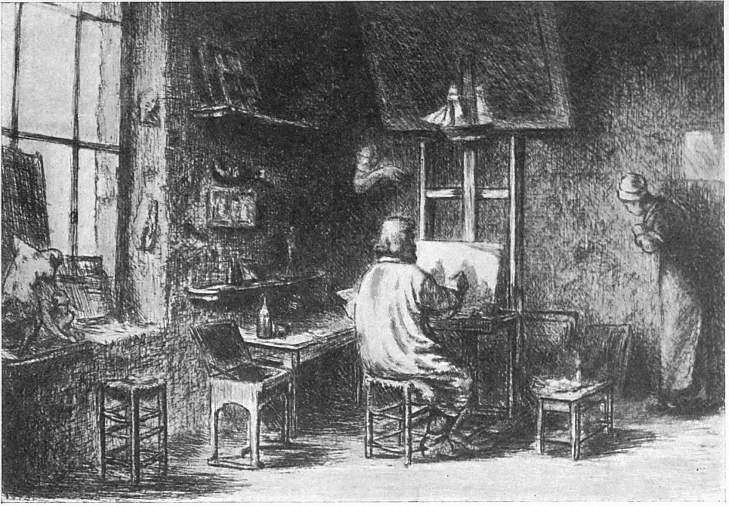
F. JACQUE. MILLET AT WORK IN HIS STUDIO.
(By permission of M. F. Jacque, the owner of the copyright.)
The sale of his “Winnower” had brought him five hundred francs, and these five hundred francs gave him courage to defy the world. “Better turn bricklayer than paint against conviction.” Charles Jacque, the painter of animals, who lived opposite to him in the Rue Rochechouard, wanted to quit Paris in 1849 on account of the outbreak of cholera. He proposed that Millet should go with him into the country for a short time; he did so, and the peasant’s son of former times became once more a peasant, to end his days amongst peasants. “In the middle of the forest of Fontainebleau,” said Jacque, “there is a little nest, with a name ending in ‘zon’—not far off and cheap,—Diaz has been telling me a great deal about it.” Millet consented. One fine June day they got into a heavy, rumbling omnibus, with their wives and their five children, and they arrived in Fontainebleau that evening after two hours’ journey. “To-morrow we are going in search of our ‘zon.’” And the next day they went forward on foot to Barbizon, Millet with his two little girls upon his shoulders, and his wife carrying in her arms the youngest child, a boy of five months old, having her skirt drawn over her head as a protection against the rain.
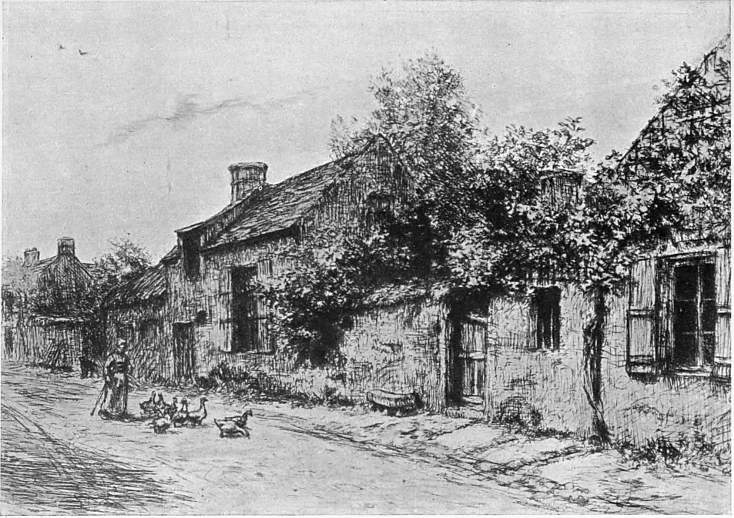
F. JACQUE. MILLET’S HOUSE AT BARBIZON.
(By permission of M. F. Jacque, the owner of the copyright.)
As yet the forest had no walks laid out as it has to-day; it was virgin nature, which had never been disturbed. “Mon Dieu, mon Dieu, que c’est beau!” cried Millet, exulting. Once more he stood in the presence of nature, the old love of his youth. The impressions of childhood rushed over him. Born in the country, he had to return to the country to be himself once again. He arrived at Ganne’s inn just as the dinner-hour had assembled twenty persons at the table, artists with their wives and children. “New painters! The pipe, the pipe!” was the cry which greeted the fresh arrivals. Diaz rose, and, in spite of his wooden leg, did the honours of the establishment to the two women with the dignity of a Spanish nobleman, and then turned gravely to Millet and Jacque, saying: “Citizens, you are invited to smoke the pipe of peace.” Whenever the colony of Barbizon received an addition this was always taken down from its sacred place above the door. An expressly appointed jury had then to decide from the ascending rings of smoke whether the new-comer was to be reckoned amongst the “Classicists” or the “Colourists.” Jacque was with one voice declared to be a “Colourist.” As to Millet’s relation to the schools, there was a discrepancy of opinion. “Eh bien,” said Millet, “si vous êtes embarrassés, placez-moi dans la mienne.” Whereupon Diaz, as the others would not let this pass, cried: “Be quiet; it is a good retort, and the fellow looks powerful enough to found a school which will bury us all.” He was right, even though it was late before his prophecy was fulfilled.
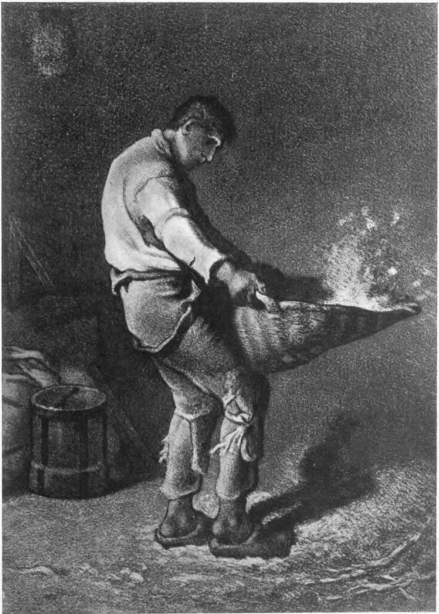
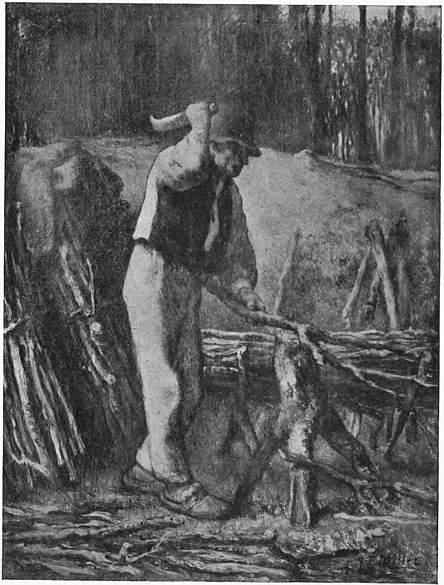
Quantin, Paris. Neurdein Frères, photo.
MILLET. THE WINNOWER. MILLET. A MAN MAKING FAGGOTS.
(By permission of M. Charles Millet.)
Millet was thirty-five when he settled in Barbizon; he had reached the age which Dante calls the middle point of life. He had no further tie with the outward world; he had broken all the bridges behind him, and relied upon himself. He only went back to Paris on business, and he always did so unwillingly and for as short a time as possible. He lived at Barbizon in the midst of nature and in the midst of his models, and to his last day unreservedly gave himself up to the work which in youth he had felt himself called to fulfil. Neither criticism, mockery, nor contempt could lead him any more astray; even if he had wished it, he would have been incapable of following the paths of official art. “Mes critiques,” said he as though by way of excuse, “sont gens instruits et de goût, mais je ne peux me mettre dans leur peau, et comme je n’ai jamais vu de ma vie autre chose que les champs, je tâche de dire comme je peux ce que j’y ai éprouvé quand j’y travaillais.” When such a man triumphs, when he succeeds in forcing upon the world his absolutely personal art, it is not Mahomet who has come to the mountain, but the mountain to Mahomet.
Millet’s life has been, in consequence, a continuous series of renunciations. It is melancholy to read in Sensier’s biography that such a master, even during his Paris days, was forced to turn out copies at twenty francs and portraits at five, and to paint tavern signs or placards for the booths of rope-dancers and horse-dealers, each one of which brought him in a roll of thick sous. When the Revolution of June broke out his capital consisted of thirty francs, which the owner of a small shop had paid him for a sign, and on this he and his family lived for a fortnight. In Barbizon he boarded with a peasant and lived with his family in a tiny room where wheat was stored and where bread was baked twice in the week; then he took a little house at a hundred and sixty francs a year. In winter he sat in a workroom without a fire, in thick straw shoes and with an old horse-cloth over his shoulders. Living like this he painted “The Sower,” that marvellous strophe in his great poem on the earth. By the produce of a vegetable garden he endeavoured to increase his income, lived on credit with grocer and butcher, and at last had creditors in every direction—in particular Gobillot, the baker of Chailly, from whom he often hid at his friend Jacque’s.
He was forced to accept a loaf from Rousseau for his famishing family, and small sums with which he was subsidised by Diaz. “I have received the hundred francs,” he writes in a letter to Sensier, “and they came just at the right time; neither my wife nor I had tasted food for four-and-twenty hours. It is a blessing that the little ones, at any rate, have not been in want.”
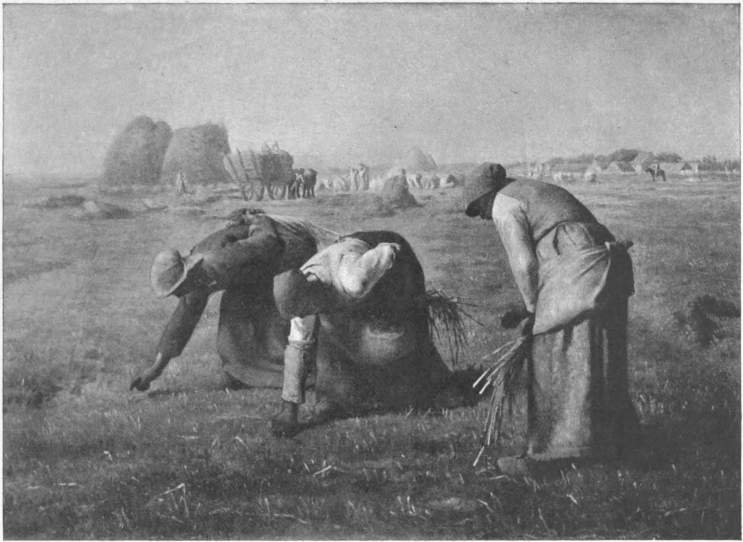
Levy et ses Fils, photo.
MILLET. THE GLEANERS.
All his efforts to exhibit in Paris were vain. Even in 1859 “Death and the Woodcutter” was rejected by the Salon. The public laughed, being accustomed to peasants in a comic opera, and, at best, his pictures were honoured by a caricature in a humorous paper. Even the most delicate connoisseurs had not the right historical perspective to appreciate the greatness of Millet, so far was it in advance of the age. And all this is so much the sadder when one thinks of the price which his works fetched at a later period, when one reads that drawings for which he could get with difficulty from twenty to forty francs are the works for which as many thousands are now offered. It was only from the middle of the fifties that he began to sell at the rate of from two hundred and fifty to three hundred francs a picture. Rousseau was the first to offer him a large sum, buying his “Woodcutter” for four thousand francs, on the pretext that an American was the purchaser. Dupré helped him to dispose of “The Gleaners” for two thousand francs. An agreement which the picture-dealer Arthur Stevens, brother of Stevens the painter, concluded with him had to be dissolved six months afterwards, since Millet’s time had not yet come. At last, in 1863, when he painted four large decorative pictures—“The Four Seasons,” which are, by the way, his weakest works—for the dining-room of the architect Feydau, superfluity came in place of need. He was then in a position, like Rousseau and Jacque, to buy himself a little house in Barbizon, close to the road by which the place is entered and opposite Ganne’s inn. Wild vine, ivy, and jessamine clambered round it, and two bushes of white roses twisted their branches around the window. It was surrounded by a large garden, in which field-flowers bloomed amongst vegetables and fruit-trees, whilst a border of white roses and elders led to another little house which he used as a studio. Behind was a poultry-yard, and behind that again a thickly grown little shrubbery. Here he lived, simple and upright, with his art and his own belongings, as a peasant and a father of a family, like an Old Testament patriarch. His father had had nine children, and he himself had nine. While he painted the little ones played in the garden, the elder daughters worked, and when the younger children made too much noise, Jeanne, who was seven years old, would say with gravity, “Chut! Papa travaille.” After the evening meal he danced his youngest boy upon his knee and told Norman tales, or they all went out together into the forest, which the children called la forêt noire, because it was so wild, gloomy, and magnificent.
Millet’s poverty was not quite so great as might be supposed from Sensier’s book. Chintreuil, Théodore Rousseau, and many others were acquainted with poverty likewise, and bore it with courage. It may even be said that, all things considered, success came to Millet early. The real misfortune for an artist is to have had success, to have been rich, and later to see himself forgotten when he is stricken with poverty. Millet’s course was the opposite. From the beginning of the sixties his reputation was no longer in question. At the World Exhibition of 1867 he was showered with all outward honours. He was represented by nine pictures and received the great medal. The whole world knew his name, subsistence was abundantly assured to him, and all the younger class of artists honoured him like a god. In the Salon of 1869 he was on the hanging committee. The picture-dealers, who had passed him by in earlier days, now beset his doors; he lived to see his “Woman with the Lamp” for which he had received a hundred and fifty francs, sold for thirty-eight thousand five hundred at Richard’s sale. “Allons, ils commencent à comprendre que c’est de la peinture serieuse.” M. de Chennevières commissioned him to take part in the paintings in the Panthéon, and he began the work. But strength was denied him; he was prostrated by a violent fever, and on 20th January 1875, at six o’clock in the morning, Millet was dead. He was then sixty.
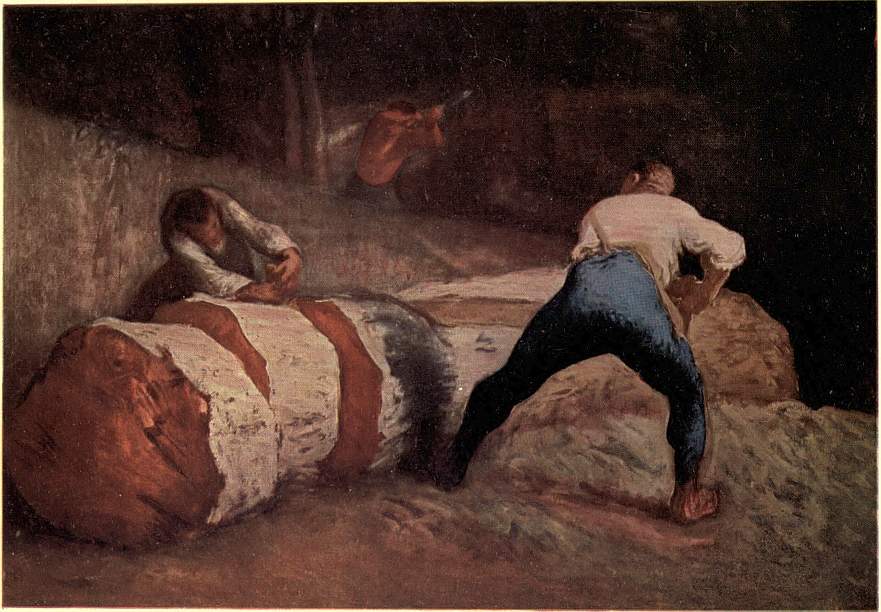
Mansell & Co.
MILLET. THE WOOD SAWYERS.
His funeral, indeed, was celebrated with no great parade, for it took place far from Paris. It was a cold, dull morning, and there was mist and rain. Not many friends had come, only a few painters and critics. At eleven o’clock the procession was set in order. And it moved in the rain quickly over the two centimètres from Barbizon to Chailly. Even those who had hastened from various villages, drawn by curiosity, could not half fill the church. But in Paris the announcement of death raised all the greater stir. When forty newspapers were displayed in a picture-dealer’s shop on the morning after his demise, all Paris assembled and the excitement was universal. In the critical notices he was named in the same breath with Watteau, Leonardo, Raphael, and Michael Angelo. The auction which was held soon afterwards in the Hôtel Drouot for the disposal of the sketches which he had left behind him brought his family three hundred and twenty-one thousand francs. And in these days, the very drawings and pastels which were bought for six thousand francs immediately after his death have on the average risen in value to thirty thousand, while the greater number of his pictures rose to a figure beyond the reach of European purchasers, and passed across the ocean to the happy land of dollars. Under such circumstances to speak any longer of Millet being misunderstood, or to sing hymns of praise upon him as a counterblast to the undervaluation of Millet in the beginning, would be knocking at an open door. It is merely necessary to inquire in an entirely objective spirit what position he occupies in the history of modern painting, and what future generations will say of him.
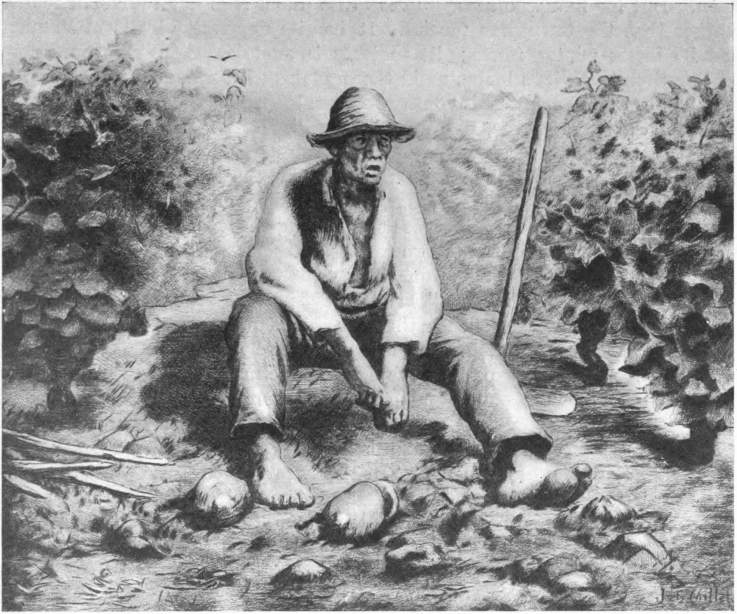
L’Art.
MILLET. VINE-DRESSER RESTING.
(By permission of M. Charles Millet.)
Millet’s importance is to some extent ethical; he is not the first who painted peasants, but he is the first who has represented them truthfully, in all their ruggedness, and likewise in their greatness—not for the amusement of others, but as they claim a right to their own existence. The spirit of the rustic is naturally grave and heavy, and the number of his ideas and emotions is small. He has neither wit nor sentimentalism. And when in his leisure moments he sometimes gives way to a broad, noisy merriment, his gaiety often resembles intoxication, and is not infrequently its consequence. His life, which forces him to earn his bread by the sweat of his brow, always reminds him of the hard fundamental conditions of existence. He looks at everything in a spirit of calculation and strict economy. Even the earth he stands on wakens in him a mood of seriousness. It is gravely sublime, this nature with its wide horizon and its boundless sky. At certain seasons it wears a friendly smile, especially for those who have escaped for a few hours from town. But for him who always lives in its midst it is not the good, tender mother that the townsman fancies. It has its oppressive heats in summer and its bitter winter frosts; its majesty is austere. And nowhere more austere than in Millet’s home, amid those plains of Normandy, swept by the rude wind, where he spent his youth as a farm labourer.
From this peasant life, painting, before his time, had collected merely trivial anecdotes with a conventional optimism. It was through no very adequate conception of man that peasants, in those earlier pictures, had always to be celebrating marriages, golden weddings, and baptisms, dancing rustic dances, making comic proposals, behaving themselves awkwardly with advocates, or scuffling in the tavern for the amusement of those who frequent exhibitions. They had really won their right to existence by their labour. “The most joyful thing I know,” writes Millet in a celebrated letter to Sensier in 1851, “is the peace, the silence, that one enjoys in the woods or on the tilled lands. One sees a poor, heavily laden creature with a bundle of faggots advancing from a narrow path in the fields. The manner in which this figure comes suddenly before one is a momentary reminder of the fundamental condition of human life, toil. On the tilled land around one watches figures hoeing and digging. One sees how this or that one rises and wipes away the sweat with the back of his hand. ‘In the sweat of thy face shalt thou eat bread.’ Is that merry, enlivening work, as some people would like to persuade us? And yet it is here that I find the true humanity, the great poetry.”
Perhaps in his conception of peasant life Millet has been even a little too serious; perhaps his melancholy spirit has looked too much on the sad side of the peasant’s life. For Millet was altogether a man of temperament and feelings. His family life had made him so even as a boy. To see this, one needs only to read in Sensier’s book of his old grandmother, who was his godmother likewise, to hear how he felt in after-years the news of his father’s death and of his mother’s, and how he burst into tears because he had not given his last embrace to the departed. Of course, a man who was so sad and dreamy might be expected to lay special stress on the dark side of rustic life, its toil and trouble and exhaustion. He had not that easy spirit which amara lento temperat risu. The passage beneath the peasant-picture in Holbein’s “Dance of Death” might stand as motto for his whole work—
“À la sueur de ton visage Tu gagneras ta pauvre vie; Après travail et long usage Voici la mort qui te convie.”
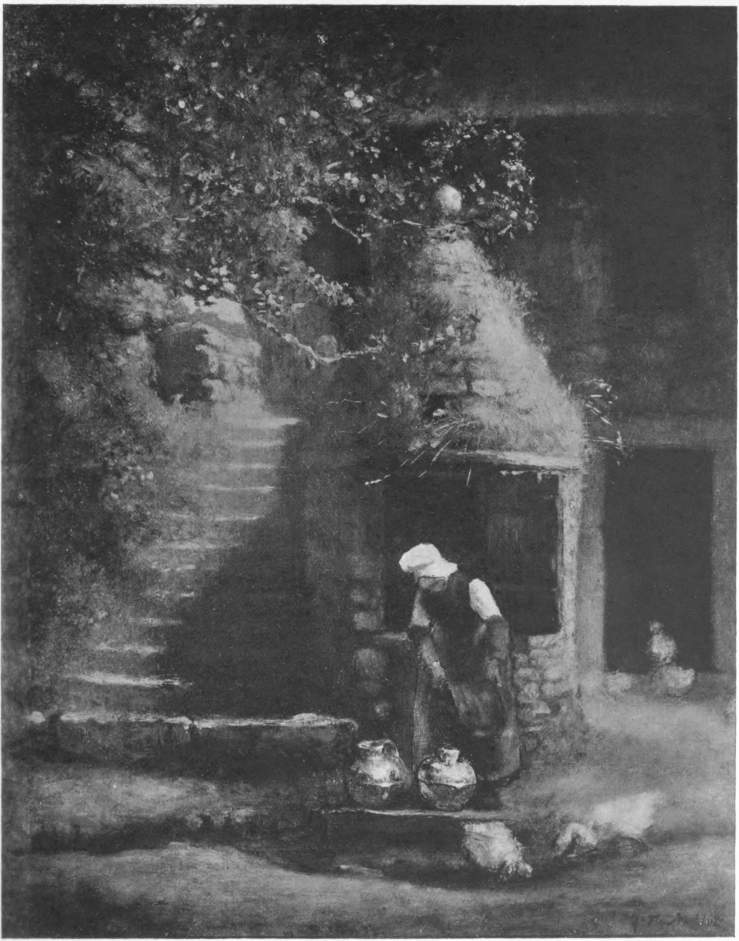
Mansell, photo.
MILLET. AT THE WELL.
Neudein Frères, photo.
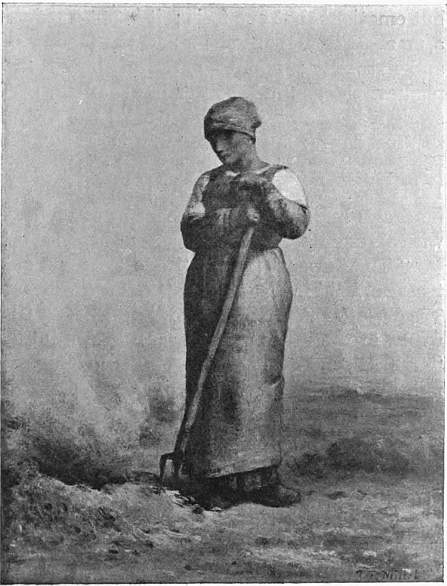
MILLET. BURNING WEEDS.
This grave and sad trait in Millet’s character sets him, for example, in abrupt contrast with Corot. Corot had a cheerful temperament, which noticed what was kindly in nature everywhere. His favourite hour was morning, when the sun rises and the lark exults, when the mists are dissipated and the shining dew lies upon the grass like pearls. His favourite season was spring, bringing with the new leaves life and joy upon the earth. And if he sometimes peopled this laughing world with peasant lads and maidens in place of the joyous creatures of his fancy, they were only those for whom life is a feast rather than a round of hard toil. Compared with so sanguine a man as Corot, Millet is melancholy all through; whilst the former renders the spring, the latter chooses the oppressive and enervating sultriness of summer. From experience he knew that hard toil which makes men old before their time, which kills body and spirit, and turns the image of God into an ugly, misshapen, and rheumatic thing; and perhaps he has been one-sided in seeing only this in the life of the peasant. Nevertheless, it is inapposite to cite as a parallel to Millet’s paintings of the peasant that cruel description of the rustic made in the time of Louis XIV by Labruyère: “One sees scattered over the field dwarfed creatures that look like some strange kind of animal, black, withered, and sun-burnt, fastened to the earth, in which they grub with invincible stubbornness; they have something resembling articulate language, and when they raise themselves they show a human countenance,—as a matter of fact they are men. At night they retire to their holes, where they live on black bread, water, and roots. They save other men the trouble of sowing, ploughing, and gathering in the harvest, and so gain the advantage of not themselves being in want of the bread that they have sown.” Yes, Millet’s peasants toil, and they toil hard, but in bowing over the earth at their work they are, in a sense, proudly raised by their whole peasant nature. Millet has made human beings out of the manikins of illustrated humour, and in this lies his ethical greatness.
As his whole life passed without untruth or artificiality, so his whole endeavour as an artist was to keep artificiality and untruth at a distance. After a period of genre painting which disposed of things in an arbitrary manner, he opened a way for the new movement with its unconditional devotion to reality. The “historical painters” having conjured up the past with the assistance of old masterpieces, it was something to the credit of the genre painters that, instead of looking back, they began to look around them. Fragments of reality were arranged—in correspondence with the principle of Classical landscape painting—according to the rules of composition known to history to make tableaux vivants crowded with figures; and such pictures related a cheerful or a moving episode of the painter’s invention. Millet’s virtue is to have set emotion in the place of invention, to have set a part of nature grasped in its totality with spontaneous freshness in the place of composition pieced together from scattered observation and forcing life into inconsistent relations—to have set painting in the place of history and anecdote. As Rousseau and his fellows discovered the poetry of work-a-day nature, Millet discovered that of ordinary life. The foundation of modern art could only be laid on painting which no longer subjected the world to one-sided rules of beauty, but set itself piously to watch for the beauty of things as they were, and renounced all literary episodes. Millet does not appear to think that any one is listening to him; he communes with himself alone. He does not care to make his ideas thoroughly distinct and salient by repetitions and antitheses; he renders his emotion, and that is all. And thus painting receives new life from him: his pictures are not compositions that one sees, but emotions that one feels; it is not a painter who speaks through them, but, a man. From the first he had the faculty of seeing things simply, directly, and naturally; and to exercise himself in this faculty he began with the plainest things: a labourer in the field, resting upon his spade and looking straight before him; a sower amid the furrows, on which flights of birds are settling down; a man standing in a ploughed field, putting on his coat; a woman stitching in a room; a girl at the window behind a pot of marguerites. He is never weary of drawing land broken up for cultivation, and oftener still he draws huddled flocks of sheep upon a heath, their woolly backs stretching with an undulatory motion, and a shepherd lad or a girl in their midst.
“The Sower” (1850), “The Peasants going to their Work,” “The Hay-trussers,” “The Reapers,” “A Sheep-shearer,” “The Labourer grafting a Tree” (1855), “A Shepherd,” and “The Gleaners” (1857) are his principal works in the fifties. And what a deep intuition of nature is to be found in “The Gleaners”! They have no impassioned countenances, and their movements aim at no declamatory effect of contrast. They do not seek compassion, but merely do their work. It is this which gives them loftiness and dignity. They are themselves products of nature, plants of which the commonest is not without a certain pure and simple beauty. Look at their hands. They are not hands to be kissed, but to be cordially pressed. They are brave hands, which have done hard work from youth upwards—reddened with frost, chapped by soda, swollen with toil, or burnt by the sun.
Seemann, Leipzig.
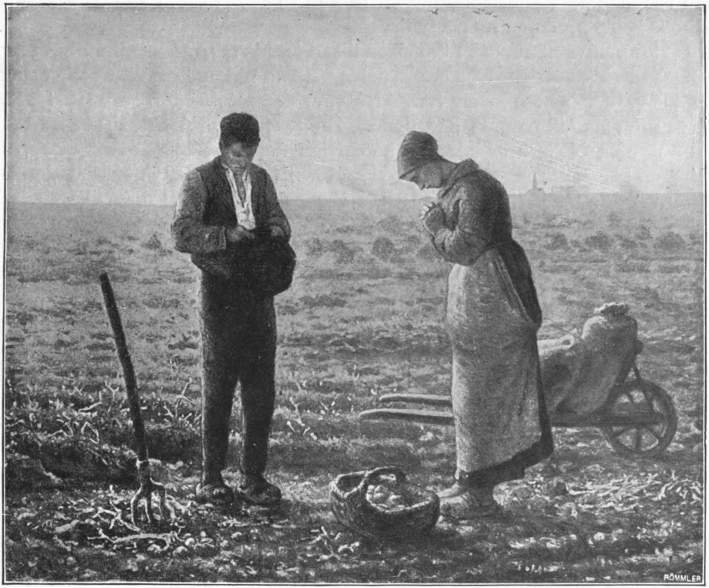
MILLET. THE ANGELUS.
(By permission of M. Georges Petit, the owner of the copyright.)
L’Art.
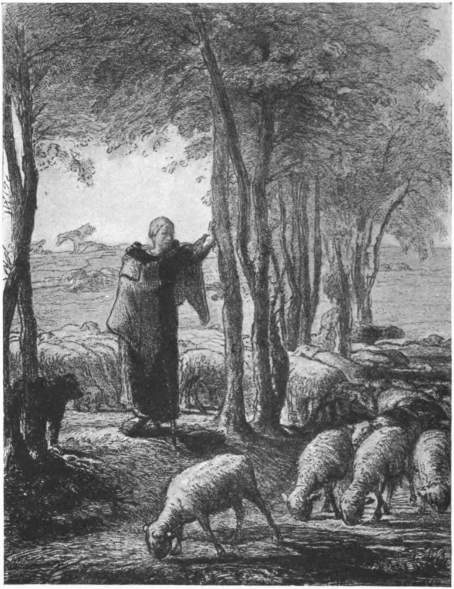
MILLET. THE SHEPHERDESS AND HER SHEEP.
(By permission of M. Charles Millet.)
“The Labourer grafting a Tree” of 1855 is entirely idyllic. In the midst of one of those walled-in spaces which are half courtyard and half garden, separating in villages the barns from the house, there is standing a man who has cut a tree and is grafting a fresh twig. His wife is looking on, with their youngest child in her arms. Everything around bears the mark of order, cleanliness, and content. Their clothes have neither spot nor hole, and wear well under the anxious care of the wife. Here is the old French peasant, true to the soil, and living and dying in the place of his birth: it is a picture of patriarchal simplicity. In 1859 appeared “The Angelus,” that work which chimes like a low-toned and far-off peal of bells. “I mean,” he said—“I mean the bells to be heard sounding, and only natural truth of expression can produce the effect.” Nothing is wanting in these creations, neither simplicity nor truth. The longer they are looked at, the more something is seen in them which goes beyond reality. “The Man with the Mattock,” the celebrated picture of 1863, is altogether a work of great style; it recalls antique statues and the figures of Michael Angelo, without in any way resembling them. In his daring veracity Millet despised all the artificial grace and arbitrary beatification which others introduced into rustic life; and while, in turning from it, he rested only on the most conscientious reverence for nature, his profound draughtsmanlike knowledge of the human form has given a dignity and a large style to the motions of the peasant which no one discovered before his time. There is a simplicity, a harmony, and a largeness in the lines of his pictures such as only the greatest artists have had. He reached it in the same way as Rousseau and Corot reached their style in landscape: absorbed and saturated by reality, he was able, in the moment of creation, to dispense with the model without suffering for it, and to attain truth and condensation without being hindered by petty detail.
He himself went about in Barbizon like a peasant. And he might have been seen wandering over the woods and fields with an old, red cloak, wooden shoes, and a weather-beaten straw hat. He rose at sunrise, and wandered about the country as his parents had done. He guarded no flocks, drove no cows, and no yokes of oxen or horses; he carried neither mattock nor spade, but rested on his stick; he was equipped only with the faculty of observation and poetic intuition. He went about like the people he met, roamed round the houses, entered the courtyards, looked over the hedges, knew the gleaners and reapers, the girls who took care of the geese, and the shepherds in their big cloaks, as they stood motionless amongst their flocks, resting on a staff. He entered the wash-house, the bake-house, and the dairies where the butter was being churned. He witnessed the birth of a calf or the death of a pig, or leant with folded arms on the garden wall and looked into the setting sun, as it threw a rosy veil over field and forest. He heard the chime of vesper bells, watched the people pray and then return home. And he returned also, and read the Bible by lamplight, while his wife sewed and the children slept. When all was quiet he closed the book and began to dream. Once more he saw all that he had come across in the course of the day. He had gone out without canvas or colours; he had merely noted down in passing a few motives in his sketch-book: as a rule he never took his pencil from his pocket, but merely meditated, his mind being compelled to notice all that his eye saw. Then he went through it again in his memory. On the morrow he painted.
Quantin, Paris.
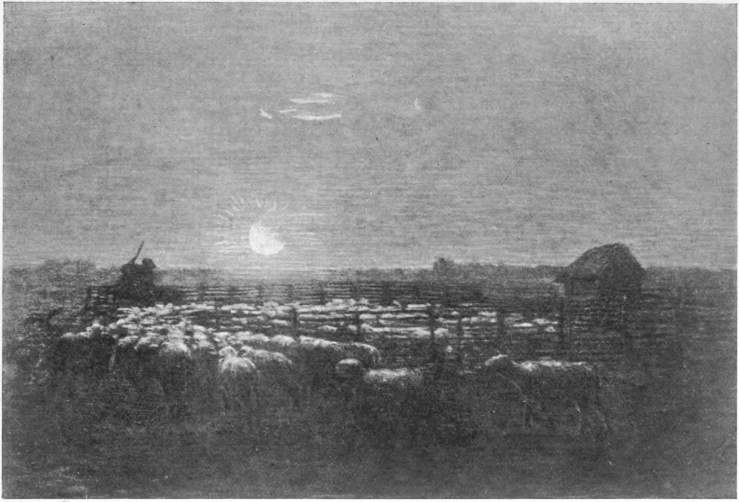
MILLET. THE SHEPHERD AT THE PEN AT NIGHTFALL.
(By permission of M. Charles Millet.)
His study seems to have been an incessant exercise of the eye to see and to retain the essential, the great lines in nature as in the human body. Advancing upon Daumier’s path, he divested figures of all that is merely accidental, and simplified them, to bring the character and ground-note more into relief. This simplification, this marvellous way of expressing forcibly as much as possible with the smallest means, no one has ever understood like Millet. There is nothing superfluous, nothing petty, and everything bears witness to an epic spirit attracted by what is great and heroic. His drawing was never encumbered by what was subsidiary and anecdotic; his mind was fixed on the decisive lines which characterise a movement, and give it rhythm. It was just this feeling for rhythm which his harmonious nature possessed in the very highest degree. He did not give his peasants Grecian noses, and he never lost himself in arid and trivial observation; he simplified and sublimated their outlines, making them the heroes and martyrs of toil. His figures have a majesty of style, an august grandeur; and something almost resembling the antique style of relief is found in his pictures. It is no doubt characteristic that the only works of art which he had in his studio were plaster casts of the metopes of the Parthenon. He himself was like a man of antique times, both in the simplicity of his life and in his outward appearance—a peasant in wooden shoes who had, set upon his shoulders, the head of the Zeus of Otricoli. And as his biography reads like an Homeric poem, so his great and simple art sought for what was primitive, aboriginal, and heroic. Note the Michelangelesque motions of “The Sower.” The peasant, striding on with a firm tread, seems to show by his large movements his consciousness of the grandeur of his daily toil: he is the heroic embodiment of man, swaying the earth, making it fruitful and subservient to his own purposes.
“Il marche dans la plaine immense, Va, vient, lance la graine au loin, Rouvre sa main et recommence; Et je médite, obscur témoin, Pendant que déployant ses voiles L’ombre où se mêle une rumeur Semble élargir jusqu’aux étoiles Le geste auguste du semeur.”
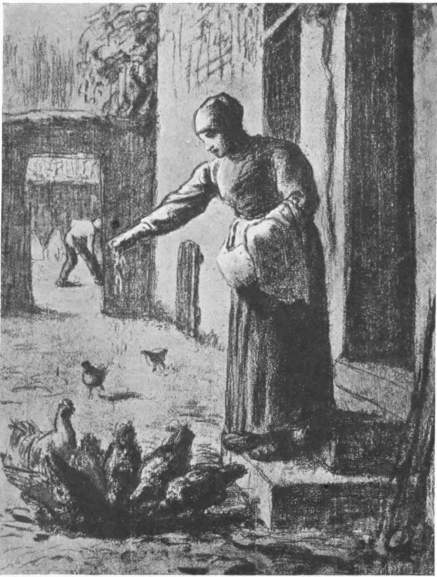
L’Art.
MILLET. A WOMAN FEEDING CHICKENS.
Note the epical quietude of “The Gleaners,” the three Fates of poverty, as Gautier called them, the priestly dignity of “The Woodcutter,” the almost Indian solemnity of “The Woman leading her Cow to Grass.” She stands in her wooden shoes as if on a pedestal, her dress falls into sculpturesque folds, and a grave and melancholy hebetude is imprinted on her countenance. Millet is the Michael Angelo of peasants. In their large simplicity his pictures make the appeal of religious painting, at once plastic and mystical.
But it is in no sense merely through instinct that Millet has attained this altitude of style. Although the son of a peasant, and himself a peasant and the painter of peasants, he knew thoroughly well what he wanted to do; and this aim of his he has not only formulated practically in his pictures, but has made theoretically clear in his letters and treatises. For Millet was not simply a man who had a turn for dreaming; he had, at the same time, a brooding, philosophic mind, in which the ideas of a thinker were harboured beside the emotions of a poet. In the portrait of himself, given on the title-page of Sensier’s book, a portrait in which he has something sickly, something ethereal and tinged with romance, only one side of his nature is expressed. The great medallion of Chappu reveals the other side: the keen, consecutive thinker, to be found in the luminous and remorselessly logical letters. In this respect he is the true representative of his race. In opposition to the esprit and graceful levity of the Parisian, a quieter and more healthy human understanding counts as the chief characteristic of the Norman; and this clear and precise capacity for thought was intensified in Millet by incessant intellectual training.
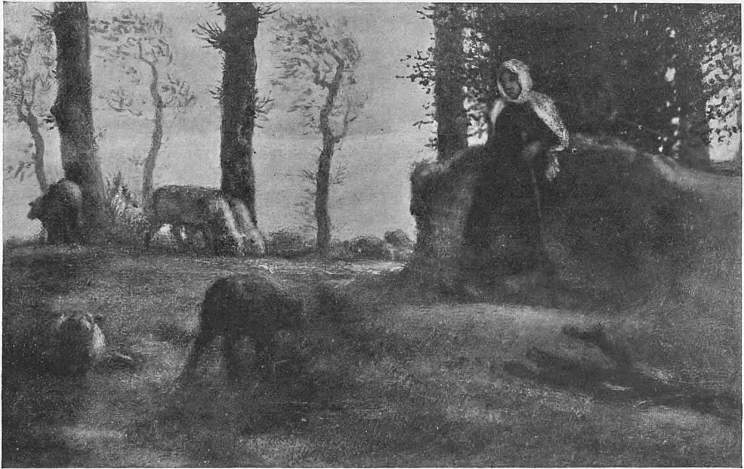
Mansell, photo.
MILLET. THE SHEPHERDESS.
Even as a child he had received a good education from his uncle, who was an ecclesiastic, and he learnt enough Latin to read the Georgics of Virgil and other ancient authors in the original text. He knows them almost by heart, and cites them continually in his letters. When he came to Paris he spent long hours in the galleries, not copying this or that portion of a picture, but fathoming works of art to their inmost core with a clear eye. In Cherbourg he devoured the whole of Vasari in the library, and read all he could find about Dürer, Leonardo, Michael Angelo, and Poussin. Even in Barbizon he remained throughout his whole life an eager reader. Shakespeare fills him with admiration; Theocritus and Burns are his favourite poets. “Theocritus makes it evident to me,” he says, “that one is never more Greek than when one simply renders one’s own impressions, let them come whence they may.” When not painting or studying nature he had always a book in his hand, and knew no more cordial pleasure than when a friend increased his little library by the present of a fresh one. Though in his youth he tilled the ground and ploughed, and in later days lived like a peasant, he was better instructed than most painters; he was a philosopher, a scholar. His manner in speaking was leisurely, quiet, persuasive, full of conviction, and impregnated by his own peculiar ideas, which he had thoroughly thought out.
“My dear Millet,” wrote a critic, “you must sometimes see good-looking peasants and pretty country girls.” To which Millet replied: “No doubt; but beauty does not lie in the face. It lies in the harmony between man and his industry. Your pretty country girls prefer to go up to town; it does not suit them to glean and gather faggots and pump water. Beauty is expression. When I paint a mother I try to render her beautiful by the mere look she gives her child.” He goes on to say that what has been once clearly seen is beautiful if it is simply and sincerely interpreted. Everything is beautiful which is in its place, and nothing is beautiful which appears out of place. Therefore no emasculation of characters is ever beautiful. Apollo is Apollo and Socrates is Socrates. Mingle them and they both lose, and become a mixture which is neither fish nor flesh. This was what brought about the decadence of modern art. “Au lieu de naturaliser l’art, ils artialisent la nature.” The Luxembourg Gallery had shown him that he ought not to go to the theatre to create true art. “Je voudrais que les êtres que je représente aient l’air voués à leur position; et qu’il soit impossible d’imaginer qu’il leur puisse venir à l’idée d’être autre chose que ce qu’ils sont. On est dans un milieu d’un caractère ou d’un autre, mais celui qu’on adopte doit primer. On devrait être habitué à ne recevoir de la nature ses impressions de quelque sorte qu’elles soient et quelque temperament qu’on ait. Il faut être imprégné et saturé d’elle, et ne penser que ce qu’elle vous fait penser. Il faut croire qu’elle est assez riche pour fournir à tout. Et où puiserait-on, sinon à la source? Pourquoi donc à perpétuité proposer aux gens, comme but suprême à atteindre, ce que de hautes intelligences ont découvert en elle. Voila donc qu’on rendrait les productions de quelques-uns le type et le but de toutes les productions à venir. Les gens de génie sont comme doués de la baguette divinatoire; les uns découvrent que, dans la nature, ici se trouve cela, les autres autre chose ailleurs, selon le temperament de leur flair. Leurs productions vous assurent dans cette idée que celui-là trouve qui est fait pour trouver, mais il est plaisant de voir, quand le trésor est déterré et enlevé, que des gens viennent à perpétuité gratter à cette place-là. Il faut savoir découvrir où il y a des truffes. Un chien qui n’a pas de flair ne peut que faire triste chasse, puisqu’il ne va qu’en voyant chasser celui qui sent la bête et qui naturellement va le premier.... Un immense orgueil ou une immense sottise seulement peut faire croire à certains hommes qu’ils sont de force à redresser les prétendus manques de goût et les erreurs de la nature. Les œuvres que nous aimons, ce n’est qu’à cause qu’elles procèdent d’elle. Les autres ne sont que des œuvres pédantes et vides. On peut partir de tous les points pour arriver au sublime, et tout est propre à l’exprimer, si on a une assez haute visée. Alors ce que vous aimez avec le plus d’emportement et de passion devient votre beau à vous et qui s’impose aux autres. Que chacun apporte le sien. L’impression force l’expression. Tout l’arsenal de la nature est à la disposition des hommes. Qui oserait décider qu’une pomme de terre est inférieure à une grenade.”
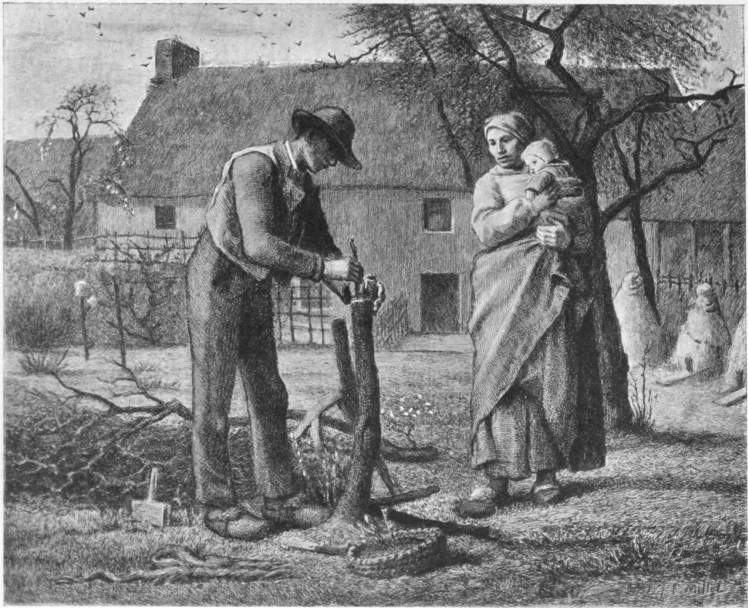
Gaz. des Beaux-Arts.
MILLET. THE LABOURER GRAFTING A TREE.
(By permission of M. Charles Millet.)
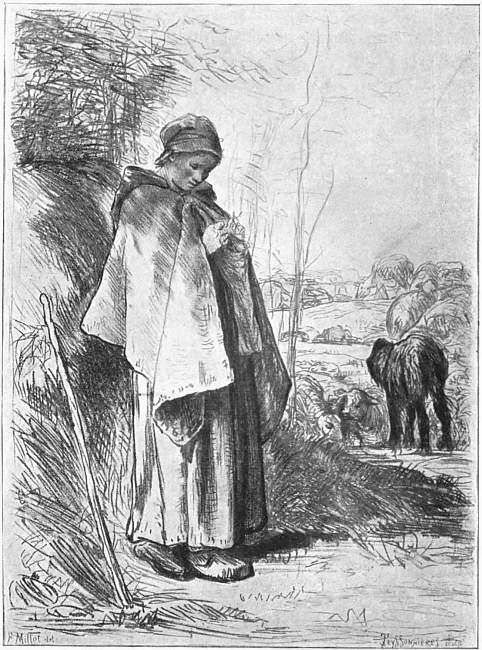
L’Art.
MILLET. A WOMAN KNITTING.
(By permission of M. Charles Millet.)
Thus he maintains that when a stunted tree grows upon sterile soil it is more beautiful in this particular place, because more natural, than a slender tree artificially transplanted. “The beautiful is that which is in keeping. Whether this is to be called realism or idealism I do not know. For me, there is only one manner of painting, and that is to paint with fidelity.” In what concerns poetry old Boileau has already expressed this in the phrase: “Nothing is beautiful except truth”; and Schiller has thrown it into the phrase, “Let us, ultimately, set up truth for beauty.” For the art of the nineteenth century Millet’s words mean the erection of a new principle, of a principle that had the effect of a novel force, that gave the consciousness of a new energy of artistic endeavour, that was a return to that which the earth was to Antæus. And by formulating this principle—the principle that everything is beautiful so far as it is true, and nothing beautiful so far as it is untrue, that beauty is the blossom, but truth the tree—by clearly formulating this principle for the first time, Millet has become the father of the new French and, indeed, of European art, almost more than by his own pictures.
For—and here we come to the limitations of his talent—has Millet as a painter really achieved what he aimed at? No less a person than Fromentin has put this question in his Maîtres d’autrefois. On his visit to Holland he chances for a moment to speak of Millet, and he writes:—
“An entirely original painter, high-minded and disposed to brooding, kind-hearted and genuinely rustic in nature, he has expressed things about the country and its inhabitants, about their toil, their melancholy, and the nobleness of their labour, which a Dutchman would never have discovered. He has represented them in a somewhat barbaric fashion, in a manner to which his ideas gave a more expressive force than his hand possessed. The world has been grateful for his intentions; it has recognised in his method something of the sensibility of a Burns who was a little awkward in expression. But has he left good pictures behind him or not? Has his articulation of form, his method of expression, I mean the envelopment without which his ideas could not exist, the qualities of a good style of painting, and does it afford an enduring testimony? He stands out as a deep thinker if he is compared with Potter and Cuyp; he is an enthralling dreamer if he is opposed to Terborch and Metsu, and he has something peculiarly noble compared with the trivialities of Steen, Ostade, and Brouwer. As a man he puts them all to the blush. Does he outweigh them as a painter?”
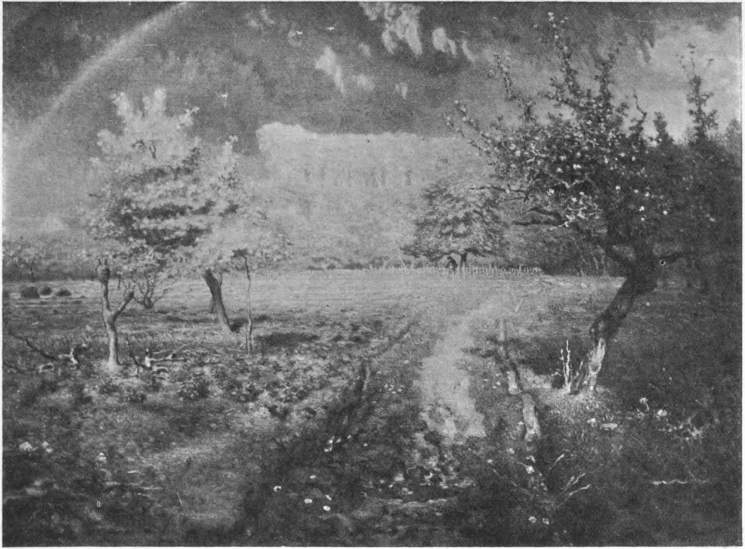
Neurdein Frères, photo.
MILLET. THE RAINBOW.
If any one thinks of Millet as a draughtsman he will answer this question without hesitation in the affirmative. His power is firmly rooted in the drawings which constitute half his work. And he has not merely drawn to make sketches or preparations for pictures, like Leonardo, Raphael, Michael Angelo, Watteau, or Delacroix; his drawings were for him real works of art complete in themselves; and his enduring and firmly grounded fame rests upon them. Michael Angelo, Raphael, Leonardo, Rubens, Rembrandt, Prudhon, Millet; that is, more or less, the roll of the greatest draughtsmen in the history of art. His pastels and etchings, his drawings in chalk, pencil, and charcoal, are astonishing through their eminent delicacy of technique. The simpler the medium the greater is the effect achieved. “The Woman Churning” in the Louvre; the quietude of his men reaping, and of his woman-reaper beside the heaps of corn; “The Water Carriers,” who are like Greek kanephoræ; the peasant upon the potato-field, lighting his pipe with a flint and a piece of tinder; the woman sewing by the lamp beside her sleeping child; the vine-dresser resting; the little shepherdess sitting dreamily on a bundle of straw near her flock at pasture,—in all these works in black and white he is as great as he is as a colourist and as a painter in open air. There are no sportive and capricious sunbeams, as in Diaz. Millet’s sun is too serious merely to play over the fields; it is the austere day-star, ripening the harvest, forcing men to sweat over their toil and with no time to waste in jest. And as a landscape painter he differs from Corot in the same vital manner.
Corot, the old bachelor, dallies with nature; Millet, nine times a father, knows her only as the fertile mother, nourishing all her children. The temperament of the brooding, melancholy man breaks out in his very conception of nature: “Oh, if they knew how beautiful the forest is! I stroll into it sometimes of an evening, and always return with a sense of being overwhelmed. It has a quiet and majesty which are terrible, so that I have often a feeling of actual fear. I do not know what the trees talk about amongst themselves, but they say to each other something which we do not understand, because we do not speak the same language. That they are not making bad jokes seems certain.” He loved what Corot has never painted—the sod, the sod as sod, the sod which steams beneath the rays of the fertilising sun. And yet, despite all difference of temperament, he stands beside Corot as perhaps the greatest landscape painter of the century. His landscapes are vacant and devoid of charm; they smell of the earth rather than of jessamine, yet it is as if the Earth-Spirit itself were invisibly brooding over them. A few colours enable him to attain that great harmony which is elsewhere peculiar to Corot alone, and which, when his work was over, he so often discussed with his neighbour Rousseau. With a few brilliant and easily executed shadings he gives expression to the vibration of the atmosphere, the lustre of the sky at sunset, the massive structure of the ground, the blissful tremor upon the plain at sunrise. At one time he renders the morning mist lying over the fields, at another the haze of sultry noon, veiling and as it were absorbing the outlines and colours of all objects, the light of sunset streaming over field and woodland with a tender, tremulous glimmering, the delicate silver tone which veils the landscape on clear moonlight nights.
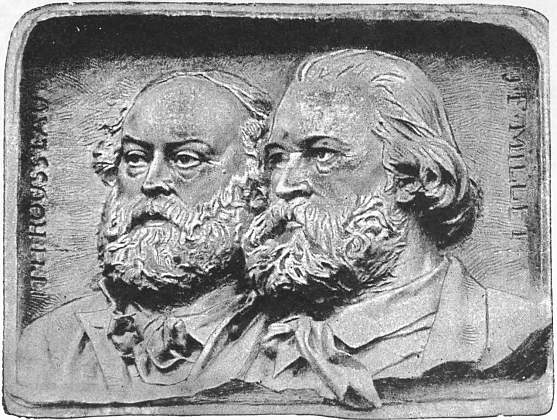
S. Low & Co.
THE BARBIZON STONE.
There is not another artist of the century who renders night as Millet does in his pastels. One of the most charming and poetic works is the biblical and mystical night-piece “The Flight into Egypt.” As he strides forward Saint Joseph holds upon his arm the Child, whose head is surrounded by a shining halo, whilst the Mother moves slowly along the banks of the Nile riding upon an ass. The stars twinkle, the moon throws its tremulous light uncertainly over the plain. Joseph and Mary are Barbizon peasants, and yet these great figures breathe of the Sistine Chapel and of Michael Angelo. And which of the old masters has so eloquently rendered the sacred silence of night as Millet has done in his “Shepherd at the Pen”? The landscapes which he has drawn awaken the impression of spaciousness as only Rembrandt’s etchings have done, and that of fine atmosphere as only Corot’s pictures. A marvellously transparent and tender evening sky rests over his picture of cows coming down to drink at the lake, and a liquid moonlight washes over the crests of the waves around “The Sailing Boat.” The garden in stormy light with a high-lying avenue spanned by a rainbow—the motive which he developed for the well-known picture in the Louvre—is found again and again in several pastels, which progress from a simple to a more complicated treatment of the theme. Everything is transparent and delicate, full of air and light, and the air and light are themselves full of magic and melting charm.
But it is a different matter when one attempts to answer Fromentin’s question in the form in which it is put. For without in any way detracting from Millet’s importance, one may quietly make the declaration: No, Millet was not a good painter. Later generations, with which he will no longer be in touch through his ethical greatness, if they consider his paintings alone, will scarcely understand the high estimation in which he is held at present. For although many works which have come into private collections in Boston, New York, and Baltimore are, in their original form, withdrawn from judgment, they are certainly not better than the many works brought together in the Millet Exhibition of 1886 or the World Exhibition of 1889. And these had collectively a clumsiness, and a dry and heavy colouring, which are not merely old-fashioned, primitive, and antediluvian in comparison with the works of modern painters, but which fall far below the level of their own time in the quality of colour. The conception in Millet’s paintings is always admirable, but never the technique; he makes his appeal as a poet only, and never as a painter. His painting is often anxiously careful, heavy, and thick, and looks as if it had been filled in with masonry; it is dirty and dismal, and wanting in free and airy tones. Sometimes it is brutal and hard, and occasionally it is curiously indecisive in effect. Even his best pictures—“The Angelus” not excepted—give no æsthetic pleasure to the eye. The most ordinary fault in his painting is that it is soft, greasy, and woolly. He is not light enough with what should be light, nor fleeting enough with what is fleeting. And this defect is especially felt in his treatment of clothes. They are of a massive, distressing solidity, as if moulded in brass, and not woven from flax and wool. The same is true of his air, which has an oily and material effect. Even in “The Gleaners” the aspect is cold and gloomy; it is without the intensity of light which is shed through the atmosphere, and streams ever changing over the earth.
And this is a declaration of what was left for later artists to achieve. The problem of putting real human beings in their true surroundings was stated by Millet, solved in his pastels, and left unsolved in his oil paintings. This same problem had to be taken up afresh by his successors, and followed to its furthest consequences. At the same time, it was necessary to widen the choice of subject.
For it is characteristic of Millet, the great peasant, that his art is exclusively concerned with peasants. His sensitive spirit, which from youth upwards had compassion for the hard toil and misery of the country folk, was blind to the sufferings of the artisans of the city, amid whom he had lived in Paris in his student days. The ouvrier, too, has his poetry and his grandeur. As there is a cry of the earth, so is there also a cry, as loud and as eloquent, which goes up from the pavement of great cities. Millet lived in Paris during a critical and terrible time. He was there during the years of ferment at the close of the reign of Louis Philippe. Around him there muttered all the terrors of Socialism and Communism. He was there during the February Revolution and during the days of June. While the artisans fought on the barricades he was painting “The Winnower.” The misery of Paris and the sufferings of the populace did not move him. Millet, the peasant, had a heart only for the peasantry. He was blind to the sufferings, blind to the charms of modern city life. Paris seemed to him a “miserable, dirty nest.” There was no picturesque aspect of the great town that fascinated him. He felt neither its grace, its elegance and charming frivolity, nor remarked the mighty modern movement of ideas and the noble humanity which set their seal upon that humanitarian century. The development of French art had to move in both of these directions. It was partly necessary to take up afresh with improved instruments the problem of the modern conception of colour, touched on by Millet; it was partly necessary to extend from the painting of peasants to modern life the principle formulated by Millet, “Le beau c’est le vrai,” to transfer it from the forest of Fontainebleau to Paris, from the solitude to life, from the evening gloom to sunlight, from the softness of romance to hard reality.
The fourth book of this work will be devoted to the consideration of those masters who, acting on this principle, extended beyond the range of Millet and brought the art which he had created to fuller fruition.

BOOK IV
THE REALISTIC PAINTERS AND THE MODERN IDEALISTS
CHAPTER XXVII
REALISM IN FRANCE
To continue in Paris what Millet had begun in the solitude of the forest of Fontainebleau there was need of a man of the unscrupulous animal power of Gustave Courbet. The task assigned to him was similar to that which fell to Caravaggio in the seventeenth century. In that age, when the eclectic imitation of the Cinquecento had reached the acme of mannerism, when Carlo Dolci and Sassoferato devoted themselves in mythological pictures to watering down the types of Raphael by idealising, Caravaggio painted scenes amongst dregs of the people and the unbridled soldiery of his age. At a period when these artists indulged in false, artificial, and doctrinaire compositions, which, on a barren system, merely traced the performances of classic masters back to certain rules of art, Caravaggio created works which may have been coarse, but which had an earnest and fruitful veracity, and gave the entire art of the seventeenth century another direction by their healthy and powerful naturalism.
When Courbet appeared the situation was similar: Ingres, in whose frigid works the whole Cinquecento had been crystallised, was at the zenith of his fame. Couture had painted his “Decadent Romans” and Cabanel had recorded his first successes. Beside these stood that little Neo-Grecian school with Louis Hamon at its head—a school whose prim style of china painting had the peculiar admiration of the public. Courbet, with all his brutal weight, pushed between the large symmetrical figures of the thoroughbred Classicists and the pretty confectionery of the Neo-Grecian painters of beauty. But the old panacea is never without effect: in all periods when art has overlived its bloom and falls into mannerism it is met by a strong cross-current of realism pouring into it new life-blood. In painting, nature had been made artificial, and it was time for art to be made natural. Painters still strayed in the past, seeking to awaken the dead, and give life once more to history. The time had come for accentuating the claims of the present more sharply than before, and for setting art amid the seething life of modern cities: it was a development naturally and logically following that of political life; it is historically united with the unintermittent struggle for universal suffrage. Courbet merely fought the decisive battle in the great fight which Jeanron, Leleux, Octave Tassaert, and others had begun as skirmishing outposts. As a painter he towered over these elder artists, whose sentimental pictures had not been taken seriously as works of art, and challenged attention all the more by painting life-size. In this manner the last obstacle was removed which had stood in the way of the treatment of modern subjects. Scanty notice had been taken of Millet’s little peasant figures, which were merely reckoned as accessories to the landscape. But Courbet’s pictures first taught the Academy that the “picture of manners,” which had seemed so harmless, had begun to usurp the place of historical painting in all its pride.
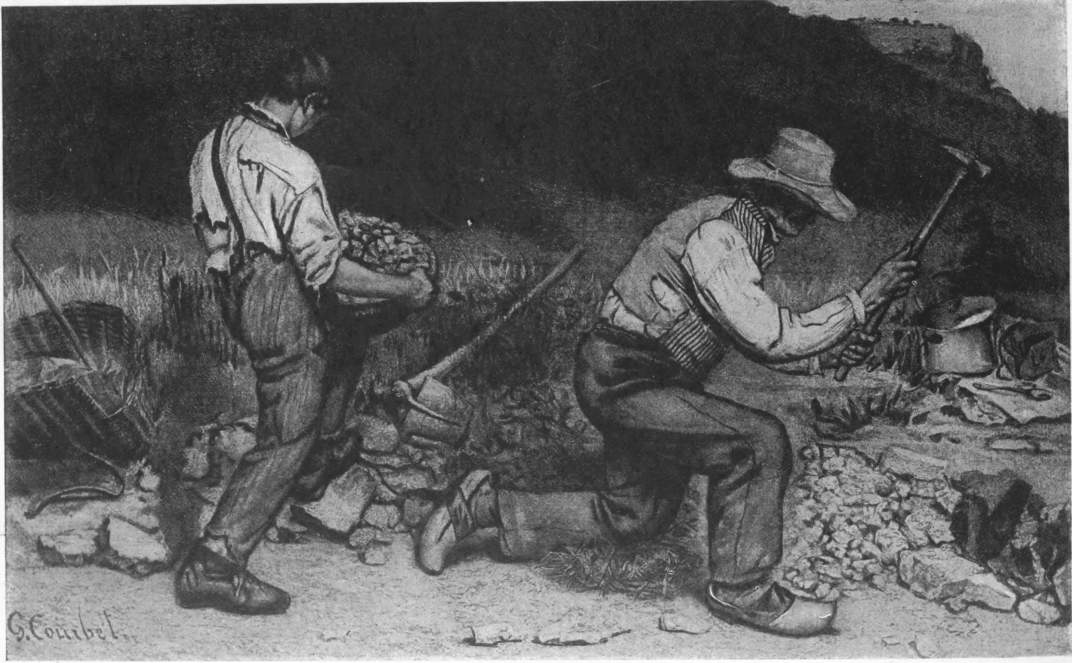
At the same time—and this made Courbet’s appearance of still more consequence than that of his predecessors—a most effective literary propaganda went hand in hand with that which was artistic. Millet had been silent and was known only by his friends. He had never arranged for an exhibition of his works, and quietly suffered the rejections of the hanging committee and the derision of the public. Courbet blustered, beat the big drum, threw himself into forcible postures like a strong man juggling with cannon-balls, and announced in the press that he was the only serious artist of the century. No one could ever embêter le bourgeois with such success, no one has called forth such a howl of passion, no one so complacently surrendered his private life to the curiosity of the great public, with the swaggering attitude of an athlete displaying his muscles in the circus. As regards this method of making an appearance—a method by which he became at times almost grotesque—one may take whatever view one pleases; but when he came he was necessary. In art revolutions are made with the same brutality as in life. People shout and sing, and break the windows of those who have windows to break. For every revolution has a character of inflexible harshness. Wisdom and reason have no part in the passions necessary for the work of destruction and rebuilding. Caravaggio was obliged to take to his weapons, and make sanguinary onslaughts. In our civilised nineteenth century everything was accomplished according to law, but not with less passion. One has to make great demands to receive even a little; this has been true in all times, and this is precisely what Courbet did. He was a remarkable character striving for high aims, an eccentric man of genius, a modern Narcissus for ever contemplating himself in his vanity, and yet he was the truest friend, the readiest to sacrifice himself; for the crowd a cynic and a reckless talker; at home an earnest and mighty toiler, bursting out like a child and appeased the very next moment; outwardly as brutal as he was inwardly sensitive, as egotistic as he was proud and independent; and being what he was, he formulated his purposes as incisively by his words as in his works. Full of fire and enthusiasm, destroying and inciting to fresh creation—a nature like Lorenz Gedon, whom he also resembled in appearance—he became the soul and motive power of the great realistic movement which flooded Europe from the beginning of the fifties. Altogether he was the man of whom art had need at that time: a doctor who brought health with him, shed it abroad, and poured blood into the veins of art. Both as man and artist his entry upon the arena is in some degree like the breaking in of an elemental force of nature. He comes from the country in wooden shoes, with the self-reliance of a peasant who is afraid of nothing. He is a great and powerful man, as sound and natural as the oxen of his birthplace. He had broad shoulders, with which he pushed aside everything standing in his way. His was an instinct rather than a reflecting brain, a peintre-animal, as he was called by a Frenchman. And such a plebeian was wanted to beat down the academic Olympus. In making him great and strong, nature had herself predestined him for the part he had to play: a man makes a breach the more easily for having big muscles. Furnished with the strength of a Samson wrecking the temple of the Philistines, he was himself “The Stone-breaker” of his art, and, like the men he painted, he has done a serviceable day’s work.
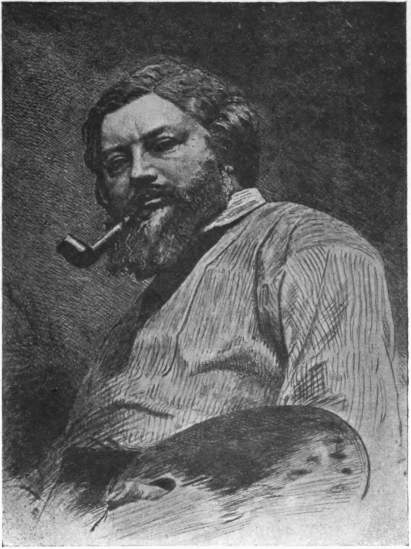
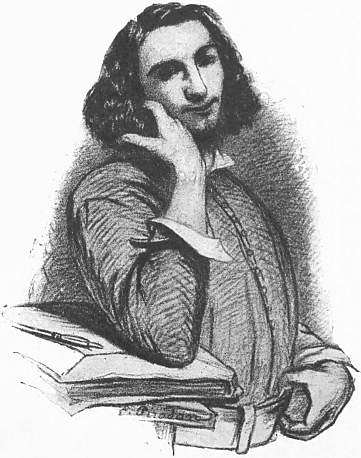
L’Art. Gaz. des Beaux-Arts.
GUSTAVE COURBET. COURBET. THE MAN WITH A LEATHER BELT.
PORTRAIT OF HIMSELF AS A YOUTH.
Gustave Courbet, the strong son of Franche-Comté, was born in 1819, in Ornans, a little town near Besançon. Like his friend and fellow-countryman Proudhon, the socialist, he had a strain of German blood in his veins, and in their outward appearance it gave them both something Teutonic, rugged, and heavy, contrasting with French ease and elegance. On his massive frame was set a thick, athletic neck, and a broad countenance with black hair, and big, strong eyes like those of a lion-tamer, which sparkled like black diamonds. A strong man, who had never been stinted, he was of medium height, broad-shouldered, bluff, ruddy like a slaughterman, and, as the years passed, disposed to acquire a more liberal circumference of body. He went about working like Sisyphus, and never without a short pipe in his mouth, the classic brûle-gueule, loaded with strong caporal. His movements were broad and heavy, and, being a little short in his breathing, he wheezed when he was excited, and perspired over his painting. His dress was comfortable, but not elegant; and his head was formed for a cap rather than the official tall hat. In speech he was cynical, and often broke into a contemptuous laugh. Both in his studio and at his tavern he moved more freely in his shirt-sleeves, and at the Munich Exhibition of 1869 he seemed to the German painters like a thorough old Bavarian, when he sat down to drink with them at the Deutsches Haus in his jovial way, and, by a rather Teutonic than Latin capacity for disposing of beer, threw the most inveterate of the men of Munich into the shade.
Originally destined for the law, he determined in 1837 to become a painter, and began his artistic studies under Flageoulot, a mediocre artist of the school of David, who had drifted into the provinces, and boastfully called himself le roi du dessin. In 1839 he came to Paris, already full of self-reliance, fire and strength. On his first turn through the Luxembourg Gallery he paused before Delacroix’s “Massacre of Chios,” glowing as it is in colour, and said it was not bad, but that he could do that style of thing whenever he liked. After a short time he acquired a power of execution full of bravura by studying the old masters in the Louvre. Self-taught in art, he was in life a democrat and in politics a republican. In 1848, during a battle in June, he had a fair prospect of being shot with a party of insurgents whom he had joined, if certain “right-minded” citizens had not interceded for their neighbour, who was popular as a man and already much talked about as a painter. In the beginning of the fifties he was to be found every evening at a brasserie much frequented by artists and students in the Rue Hautefeuille in the Quartier Latin, in the society of young authors of the school of Balzac. He had his studio at the end of the street, and is said to have been at the time a strong, fine, spirited young man, who made free use of the drastic slang of the studios.
“His notable features,” writes Théophile Silvestre of Courbet at this time,—“his notable features seem as though they had been modelled from an Assyrian bas-relief. His well-shaped and brilliant dark eyes, shadowed by long silken lashes, have the soft quiet light of an antelope’s. The moustache, scarcely traceable beneath his slightly curved aquiline nose, is joined by a fan-shaped beard, and borders his thick, sensuous lips; his complexion is olive-brown, but of a changing, sensitive tone. The round, curiously shaped head and prominent cheek-bones denote stubbornness, and the flexible nostrils passion.”
A great dispute over realism usually took the place of dessert at meal-times. Courbet never allowed himself to be drawn into controversy. He threw his opinion bluntly out, and when he was opposed cut the conversation short in an exceedingly forcible manner. It was another murder of the innocents when he spoke of the celebrities of his time. He designated historical painting as nonsense, style as humbug, and blew away all ideals, declaring that it was the greatest impudence to wish to paint things which one has never seen, and of the appearance of which one cannot have the faintest conception. Fancy was rubbish, and reality the one true muse.
L’Art.
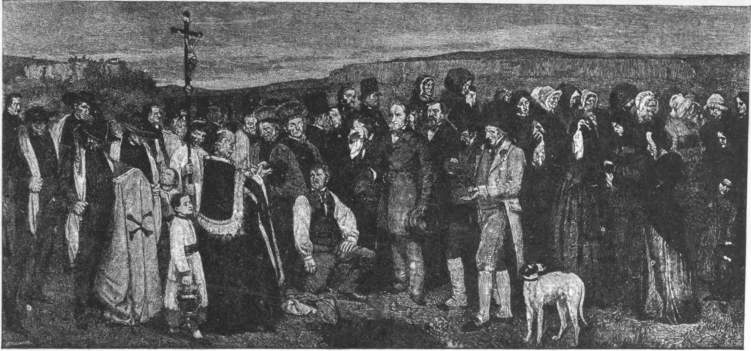
COURBET. A FUNERAL AT ORNANS.
“Our century,” he says, “will not recover from the fever of imitation by which it has been laid low. Phidias and Raphael have hooked themselves on to us. The galleries should remain closed for twenty years, so that the moderns might at last begin to see with their own eyes. For what can the old masters offer us? It is only Ribera, Zurbaran, and Velasquez that I admire; Ostade and Craesbeeck also allure me; and for Holbein, I feel veneration. As for M. Raphael, there is no doubt that he has painted some interesting portraits, but I cannot find any ideas in him. And the artistic kin, the heirs, or more properly the slaves of this great man, are really preceptors of the lowest art. What do they teach us? Nothing. A good picture will never come from their École des Beaux-Arts. The most precious thing is the originality, the independence of an artist. Schools have no right to exist; there are only painters. Independently of system and without attaching myself to any party, I have studied the art of the old masters and of the more modern. I have tried to imitate the one as little as I have tried to copy the other, but out of the total knowledge of tradition I have wished to draw a firm and independent sense of my own individuality. My object was by gaining knowledge to gain in ability; to have the power of expressing the ideas, the manners, and the aspect of our epoch according to an appreciation of my own, not merely to be a painter, but a man also—in a word, to practise living art is the compass of my design. I am not only a socialist, but also a democrat and a republican—that is to say, a supporter of every revolution; and moreover, a sheer realist, which means a loyal adherent to the vérité vraie. But the principle of realism is the negation of the ideal. And following all that comes from this negation of the ideal, I shall arrive at the emancipation of the individual, and, finally, at democracy. Realism, in its essence, is democratic art. It can only exist by the representation of things which the artist can see and handle. For painting is an entirely physical language, and an abstract, invisible, non-existent object does not come within its province. The grand painting which we have stands in contradiction with our social conditions, and ecclesiastical painting in contradiction with the spirit of the century. It is nonsensical for painters of more or less talent to dish up themes in which they have no belief, themes which could only have flourished in some epoch other than our own. Better paint railway stations with views of the places through which one travels, with likenesses of great men through whose birthplace one passes, with engine-houses, mines, and manufactories; for these are the saints and miracles of the nineteenth century.”
These doctrines fundamentally tallied with those which the Neapolitan and Spanish naturalists vindicated in the seventeenth century against the eclectics. For men like Poussin, Leseur, and Sassoferato, Raphael was “an angel and not a man,” and the Vatican “the academy of painters.” But Velasquez when he came to Rome found it wearisome. “What do you say of our Raphael? Do you not think him best of all, now that you have seen everything that is fair and beautiful in Italy?” Don Diego inclined his head ceremoniously, and observed: “To confess the truth, for I like to be candid and open, I must acknowledge that I do not care about Raphael at all.” There are reported utterances of Caravaggio which correspond almost word for word with those of Courbet. He, too, declaimed against the antique and Raphael, in whose shadow he saw so many shallow imitators sitting at their ease, and he declared, in a spirit of sharp opposition, that the objects of daily life were the only true teachers. He would owe all to nature and nothing to art. He held painting without the model to be absurd. So long as the model was out of sight, his hands and his spirit were idle. Moreover, he called himself a democratic painter, who brought the fourth estate into honour; he “would rather be the first of vulgar painters than second amongst the superfine.” And just as these naturalists in the seventeenth century were treated by the academical artists as rhyparographists, Courbet’s programme did not on the whole facilitate his acceptance in formal exhibitions as he desired that it should. A play must be acted, a manuscript printed, and a picture viewed. So Courbet had no desire to remain an outsider. When the picture committee of the World Exhibition of 1855 gave his pictures an unfavourable position, he withdrew them and offered them to public inspection separately in a wooden hut in the vicinity of the Pont de Jena, just at the entry of the exhibition. Upon the hut was written in big letters: REALISM—G. COURBET. And in the interior the theories which he had urged hitherto by his tongue and his pen, at the tavern and in his pamphlets, were demonstrated by thirty-eight large pictures, which elucidate his whole artistic development.
Baschet.
COURBET. THE STONE-BREAKERS.
“Lot’s Daughters” and “Love in the Country” were followed in 1844 by the portrait of himself and the picture of his dog, in 1845 by “A Guitarrero,” in 1846 by the “Portrait of M. M——,” and in 1847 by “The Walpurgisnacht”; all works in which he was still groping his way. “The Sleeping Bathers,” “The Violoncello Player,” and a landscape from his native province, belonging to the year 1848, made a nearer approach to his realistic aim, and with the date 1849 there are seven portraits, landscapes, and pictures from popular national life: “The Painter,” “M. H. T—— looking over Engravings,” “The Vintage in Ornans below the Roche du Mont,” “The Valley of the Bue seen from the Roche du Mont,” “View of the Château of Saint-Denis,” “Evening in the Village of Scey-en-Varay,” and “Peasants returning from Mass near Flagey.” All these works had passed the doors of the Salon without demur.
The first picture which brought about a collision of opinion was “A Fire in Paris,” and, according to the account given by contemporaries, it must have been one of his finest works. Firemen, soldiers, artisans in jacket and blouse, were exerting themselves, according to Paul d’Abrest who describes the picture, around a burning house; even women helped in the work of rescue, and formed part of the chain handing buckets from the pump. Opposite stood a group of young dandies with girls upon their arms looking inactively upon the scene. An artillery captain, who was amongst Courbet’s acquaintances, had through several nights sounded the alarm for his men and exercised them on the scaffolding of a wall, so that the painter could make his studies. Courbet transferred his studio to the barracks and made sketches by torch-light. But he had reckoned without the police; scarcely was the picture finished before it was seized, as the Government recognised in it, for reasons which did not appear, “an incitement to the people of the town.” This was after the coup d’état of 1851.
So Courbet’s manifesto was not “The Fire in Paris.” “The Stone-breakers,” two men in the dress of artisans, in a plain evening landscape, occupied once more the first place in the exhibition of 1855, having already made the effect, amongst its classical surroundings in the Salon of 1851, of a rough, true, and honest word, spoken amid elaborate society phrases. There was also to be seen “Afternoon at Ornans,”—a gathering of humble folk sitting after meal-time at a table laid out in a rustic kitchen. A picture which became celebrated under the title of “Bonjour, M. Courbet” dealt with a scene from Courbet’s native town. Courbet, just arrived, is alighting from a carriage in his travelling costume, looking composedly about him with a pipe in his mouth. A respectable prosperous gentleman, accompanied by a servant in livery, who is carrying his overcoat, is stretching out his hand to him. This gentleman is M. Bryas, the Mæcenas of Ornans, who for long was Courbet’s only patron, and who had a whim for having his portrait taken by forty Parisian painters in order to learn the “manners” of the various artists. And there was further to be seen the “Demoiselles de Village” of 1852, three country beauties giving a piece of cake to a peasant-girl. Finally, as masterpieces, there were “The Funeral at Ornans,” which now hangs in the Louvre, and that great canvas, designated in the catalogue as “a true allegory,” “My Studio after Seven Years of Artistic Life,” the master himself painting a landscape. Behind him is a nude model, and in front of him a beggar-woman with her child. Around are portrait figures of his friends, and the heroes of his pictures, a poacher, a parson, a sexton, labourers, and artisans.
L’Art.
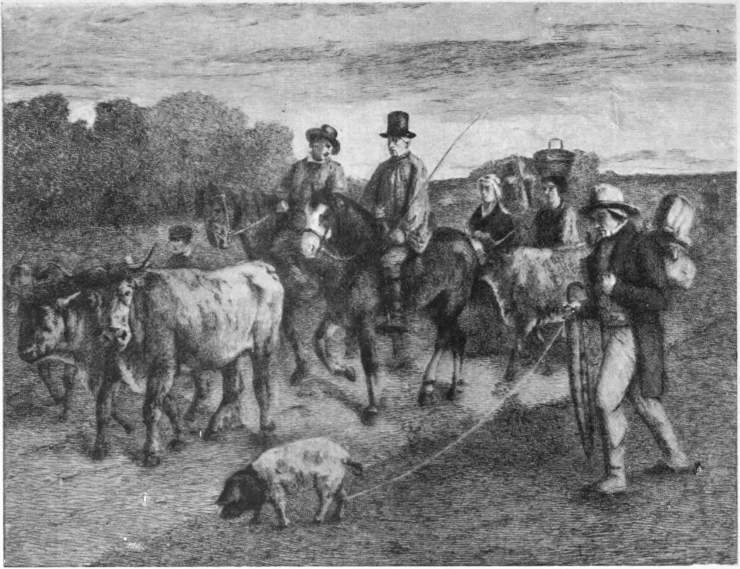
COURBET. THE RETURN FROM MARKET.
The exhibition was, at all events, a success with young painters, and Courbet set up a teaching studio, at the opening of which he again issued a kind of manifesto in the Courrier du Dimanche. “Beauty,” he wrote, “lies in nature, and it is to be met with under the most various forms. As soon as it is found it belongs to art, or rather to the artist who discovers it. But the painter has no right to add to this expression of nature, to alter the form of it and thereby weaken it. The beauty offered by nature stands high above all artistic convention. That is the basis of my views of art.” It is said that his first model was an ox. When his pupils wanted another, Courbet said: “Very well, gentlemen, next time let us study a courtier.” The break-up of the school is supposed to have taken place when one day the ox ran away and was not to be recaptured.
Gaz. des Beaux-Arts.
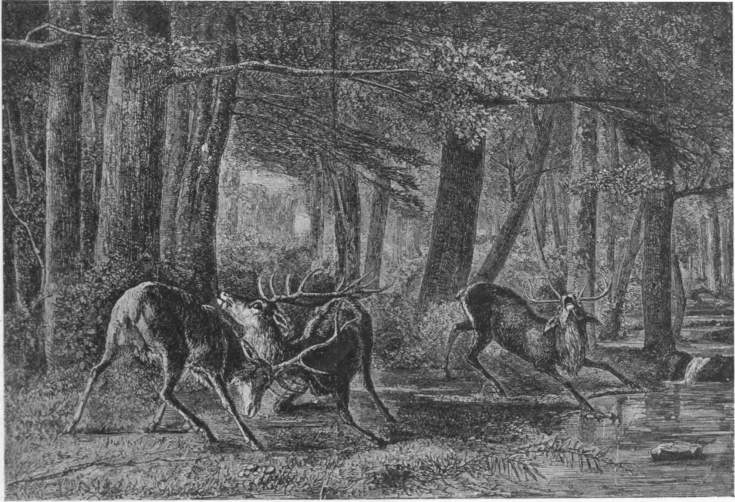
COURBET. THE BATTLE OF THE STAGS.
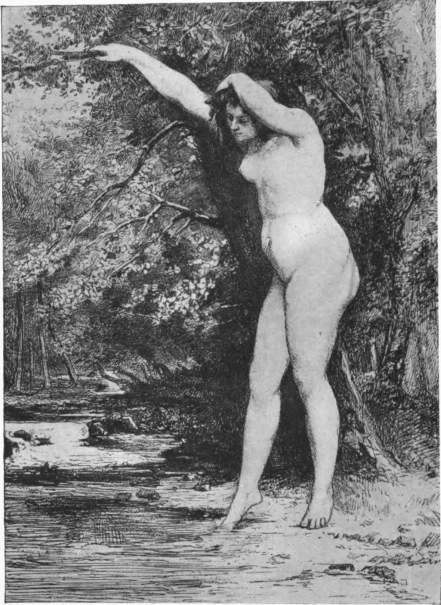
Gaz. des Beaux-Arts.
COURBET. A WOMAN BATHING.
(By permission of M. Sainctelette, of Brussels, the owner of the picture.)
Courbet did not trouble himself over such ridicule, but painted quietly on, the many-sidedness of his talent soon giving him a firm seat in every saddle. After the scandal of the separate exhibition of 1855 he was excluded from the Salon until 1861, and during this time exhibited in Paris and Besançon upon his own account. “The Funeral at Ornans” was followed by “The Return from Market,” a party of peasants on the high-road, and in 1860 by “The Return from the Conference,” in which a number of French country priests have celebrated their meeting with a hearty lunch and set out on the way back in a condition which is far too jovial. In 1861, when the gates of the Champs Elysées were thrown open to him once more, he received the medal for his “Battle of the Stags,” and regularly contributed to the Salon until 1870. In these years he attempted pictures with many figures less frequently, and painted by preference hunting and animal pieces, landscapes, and the nude figures of women. “The Woman with the Parrot,” a female figure mantled with long hair, lying undressed amid the cushions of a couch playing with her gaudily feathered favourite, “The Fox Hunt,” a coast scene in Provence, the portrait of Proudhon and his family, “The Valley of the Puits-Noir,” “Roche Pagnan,” “The Roe Hunt,” “The Charity of a Beggar,” the picture of women bathing in the gloom of the forest, and “The Wave,” afterwards acquired by the Luxembourg, belong to his principal works in the sixties.
These works gradually made him so well known that after 1866 his pictures came to have a considerable sale. The critics began to take him seriously. Castagnary made his début in the Siècle with a study of Courbet; Champfleury, the apostle of literary realism, devoted to him a whole series of feuilletons in the Messager de l’Assemblée, and from his intercourse with him Proudhon derived the fundamental principles of his book on Realism. The son of Franche-Comté triumphed, and there was a beam in his laughing eyes, always like those of a deer. His talent began more and more to unfold its wings in the sun of success, and his power of production seemed inexhaustible. When the custom arose of publishing in the Parisian papers accounts of the budget of painters, he took care to communicate that in six months he had made a hundred and twenty-three thousand francs. Incessantly busy, he had in his hand at one moment the brush and at another the chisel. And when he gave another special exhibition of his works in 1867, at the time of the great World Exhibition—he had a mania for wooden booths—he was able to put on view no less than a hundred and thirty-two pictures in addition to numerous pieces of sculpture. In 1869 the committee of the Munich Exhibition set apart a whole room for his works. With a self-satisfied smile he put on the Order of Michael, and was the hero of the day whom all eyes followed upon the boulevards.
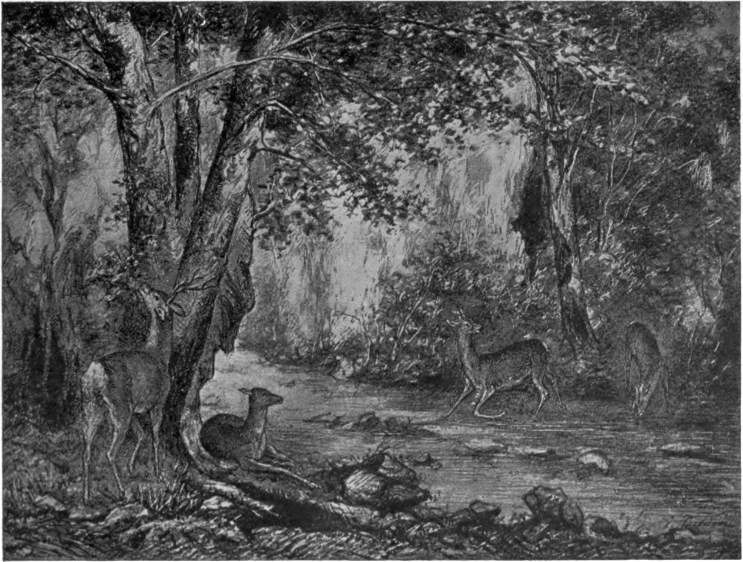
Gaz. des Beaux-Arts.
COURBET. DEER IN COVERT.
The nature of the bullfighter was developed in him more strongly than before, and he stretched his powerful limbs, prepared to do battle against all existing opinions. Naturally the events of the following years found no idle spectator in such a firebrand as Courbet; and accordingly he rushed into those follies which embittered the evening of his life. The maître peintre d’Ornans became Courbet le colonnard. First came the sensational protest with which he returned to the Emperor Napoleon the Order of the Legion of Honour. Four weeks after Courbet had plunged into this affair the war broke out. Eight weeks later came Sedan and the proclamation of the Republic, and shortly afterwards the siege of Paris and the insurrection. On 4th September 1870 the Provisional Government appointed him Director of the Fine Arts. Afterwards he became a member of the Commune, and dominated everywhere, with the brûle-gueule in his mouth, by the power of his voice; and France has to thank him for the rescue of a large number of her most famous treasures of art. He had the rich collections of Thiers placed in the Louvre, to protect them from the rough and ready violence of the populace. But to save the Luxembourg he sacrificed the column of the Vendôme. When the Commune fell, however, Courbet alone was held responsible for the destruction of the column. He was brought before the court-martial of Versailles, and, although Thiers undertook his defence, he was condemned to six months’ imprisonment. Having undergone this punishment he received his freedom once more, but the artist had still to suffer a mortal blow. The pictures which he had destined for the Salon of 1873 were rejected by the committee, because Courbet was held morally unworthy to take part in the exhibition.
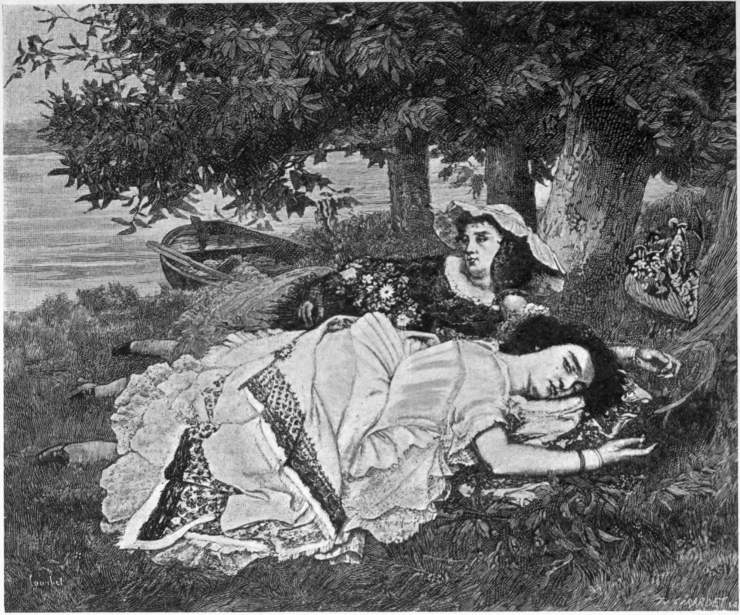
Baschet.
COURBET. GIRLS LYING ON THE BANK OF THE SEINE.
Soon after this an action was brought against him, on the initiative of certain reactionary papers, for the payment of damages connected with the overthrow of the Vendôme column, and the painter lost his case. For the recovery of these damages, which were assessed at three hundred and thirty-four thousand francs, the Government brought to the hammer his furniture and the pictures that were in his studio, at a compulsory sale at the Hôtel Drouot, where they fetched the absurdly trifling figure of twelve thousand one hundred and eighteen francs fifty centimes. The loss of his case drove him from France to Switzerland. He gave the town of Vevay, where he settled, a bust of Helvetia, as a mark of his gratitude for the hospitality it had extended towards him. But the artist was crushed in him. “They have killed me,” he said; “I feel that I shall never do anything good again.” And thus the jovial, laughing Courbet, that honoured leader of a brilliant pleiad of disciples, the friend and companion of Corot, Decamps, Gustave Planché, Baudelaire, Théophile Gautier, Silvestre, Proudhon, and Champfleury; the enthusiastic patriot and idol of the fickle Parisians, passed his last years in melancholy solitude, forgotten by his adherents and scorned by his adversaries. He was attacked by a disease of the liver, and privation, disillusionment, and depression came all at once. Moreover, the French Government began again to make claims for indemnification. His heart broke in a prolonged mortal struggle. Shortly before his death he said to a friend: “What am I to live upon, and how am I to pay for the column? I have saved Thiers more than a million francs, and the State more than ten millions, and now they are at my heels—they are baiting me to death. I can do no more. To work one must have peace of spirit, and I am a ruined man.” And Champfleury writes, referring to the last visit which he paid to the dying exile on 19th December 1877: “His beard and hair were white, and all that remained of the handsome, all-powerful Courbet whom I had known was that notable Assyrian profile, which he raised to the snow of the Alps, as I sat beside him and saw it for the last time. The sight of such pain and misery as this premature wreck of the whole man was overwhelming.”
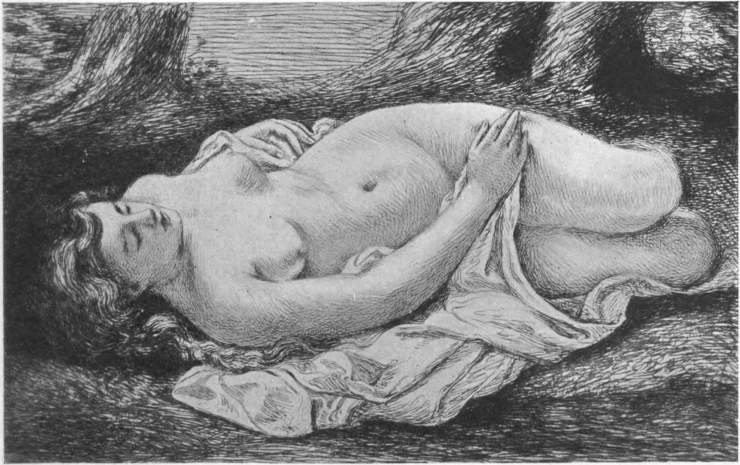
Gaz. des Beaux-Arts.
COURBET. A RECUMBENT WOMAN.
Gaz. des Beaux-Arts.
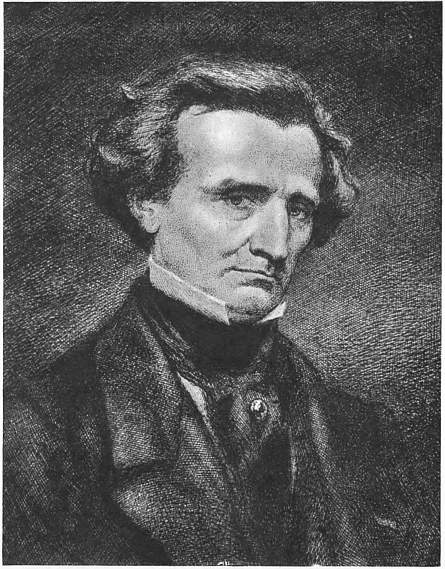
COURBET. BERLIOZ.
The Lake of Geneva, over which he looked from his window in Vevay, was the subject of the last picture that he painted in Switzerland. Far from home and amid indifferent strangers he closed his eyes, which had once been so brilliant, in endless grief of spirit. The apostle of Realism died of a broken heart, the herculean son of Franche-Comté could not suffer disillusionment. Courbet passed away, more or less forgotten, upon New Year’s Eve in 1877, in that chilly hour of morning when the lake which he had learnt to love trembles beneath the first beams of the sun. It was only in Belgium, where he had often stayed and where his influence was considerable, that the intelligence of his death woke a painful echo. In Paris it met with no word of sympathy. Courbetism was extinguished; as impressionists and independents his adherents had gathered round new flags. Zola has done him honour in L’Œuvre in the person of old Bongrand, that half-perished veteran who is only mentioned now and then with veneration.
And the course of development has indeed been so rapid since Courbet’s appearance that in these days one almost fails to understand, apart from historical reasons, the grounds which in 1855 made his separate exhibition of his works an event of epoch-making importance. It was not Cham alone who at that time devoted a large cartoon to Courbet, as he did in “The Opening of Courbet’s Studio and Concentrated Realism.” All the comic journals of Paris were as much occupied with him as with the crinoline, the noiseless pavement, the new tramways, or the balloon. Haussard, the principal representative of criticism, in discussing “The Funeral at Ornans,” spoke of “these burlesque masks with their fuddled red noses, this village priest who seems to be a tippler, and the harlequin of a veteran who is putting on a hat which is too big for him.” All this, he continued, suggested a masquerade funeral, six metres long, in which there was more to laugh at than to weep over. Even Paul Mantz declared that the most extravagant fancy could not descend to such a degree of jejune triviality and repulsive hideousness. In a revue d’année produced at the Odéon, the authors, Philoxène Hoyer and Théodore de Banville, make “a realist” say—
“Faire vrai ce n’est rien pour être réaliste, C’est faire laid qu’il faut! Or, monsieur, s’il vous plait, Tout ce que je dessine est horriblement laid! Ma peinture est affreuse, et, pour qu’elle soit vraie, J’en arrache le beau comme on fait de l’ivraie. J’aime les teints terreux et les nez de carton, Les fillettes avec de la barbe au menton, Les trognes de Varasque et de coquecigrues, Les dorillons, les cors aux pieds et les verrues! Voilà le vrai!”
Gaz. des Beaux-Arts.
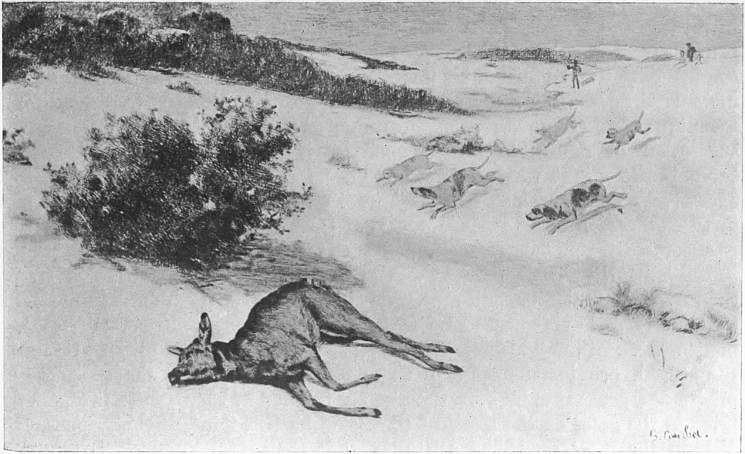
COURBET. THE HIND ON THE SNOW.
So it went on through the sixties also. When the Empress Eugénie passed through the exhibition on the opening day of the Salon of 1866, with an elegant walking-stick in her hand, she was so indignant at Courbet’s “Naked Women” that the picture had to be immediately removed. In the beginning of the seventies, when he exhibited in Germany, a few young Munich painters recognised in his pictures something like the cry of a conscience. But otherwise “artists and laymen shook their heads, not knowing what to make of them. Some smiled and went indifferently on, while others were indignant in their condemnation of this degradation of art.” For “Courbet went to the lowest depths of society, and took his themes from a class where man really ceases to be man, and the image of God prolongs a miserable existence as a moving mass of flesh. Living bodies with dead souls, which exist only for the sake of their animal needs; in one place sunk in misery and wretchedness, and in another having never risen from their brutal savagery—that is the society from which Courbet chooses his motives, to gloss over the debility of his imagination and his want of any kind of training. Had he possessed the talent for composition, then perhaps his lifeless technique would have become interesting; as it is he offers a merely arbitrary succession of figures in which coherence is entirely wanting.” In “The Stone-breakers” it was an offence that he should have treated such “an excessively commonplace subject” at all as mere artisans in ragged and dirty clothes. And by “The Funeral at Ornans” it was said that he meant to sneer at the religious ceremony, since the picture had a defiant and directly brutal vulgarity. The painter was alleged to have taken pains to expose the repulsive, ludicrous, and grotesque elements in the members of the funeral party, and to have softened no feature which could excite an unseasonable merriment. In the “Demoiselles de Village” the design had been to contrast the stilted, provincial nature of these village misses with the healthy simplicity of a peasant child. In the picture, painted in 1857, of the two grisettes lying in the grass on the bank of the Seine he had “intentionally placed the girls in the most unrefined attitudes, that they might appear as trivial as possible.” And umbrage was taken at his two naked wrestlers because he “had not painted wrestlers more or less like those of classic times, but the persons who exhibit the strength of their herculean frames at the Hippodrome,” and therefore given “the most vulgar rendering of nudity that was at all possible.” And in his naked women it was said that this love of ugly and brutal forms became actually base.
All these judgments are characteristic symptoms of the same sort of taste which rose in the seventeenth century against Caravaggio. Even his principal work, the altar-piece to St. Matthew, which now hangs in the Berlin Museum, excited so much indignation that it had to be removed from the Church of St. Luigi dei Francesi in Rome. Annibale Carracci has a scornful caricature in which the Neapolitan master appears as a hairy savage, with a dwarf at his side and two apes upon his knees, and, in this fashion, intended to brand the hideousness of his rival’s art and his ape-like imitation of misshapen nature. Francesco Albani called him the “Antichrist of Painting,” and “a ruination to art.” And Baglione adds: “Now a number of young men sit down to copy a head after nature; they study neither the foundations of drawing, nor concern themselves about the more profound conditions of art, merely contenting themselves with a crude reproduction of nature, and therefore they do not even know how to group two figures appropriately, nor to bring any theme into an artistic composition. No one any longer visits the temples of art, but every one finds his masters and his models for a servile imitation of nature in the streets and open places.” The nineteenth century formed a different estimate of Caravaggio. In opposing his fortune-telling gipsies, his tipplers, gamblers, musicians, and dicing mercenaries to the noble figures of the academical artists, with their generalised and carefully balanced forms, their trivial, nugatory countenances, and their jejune colouring, he accomplished the legitimate and necessary reaction against a shallow and empty idealistic mannerism. No one is grateful to the eclectic artists for the learned efforts which it cost them to paint so tediously: in Caravaggio there is the fascination of a strong personality and a virile emphasis in form, colour, and light. The Carracci and Albani were the issue of their predecessors; Caravaggio is honoured as a fearless pioneer who opened a new chapter in the history of art.
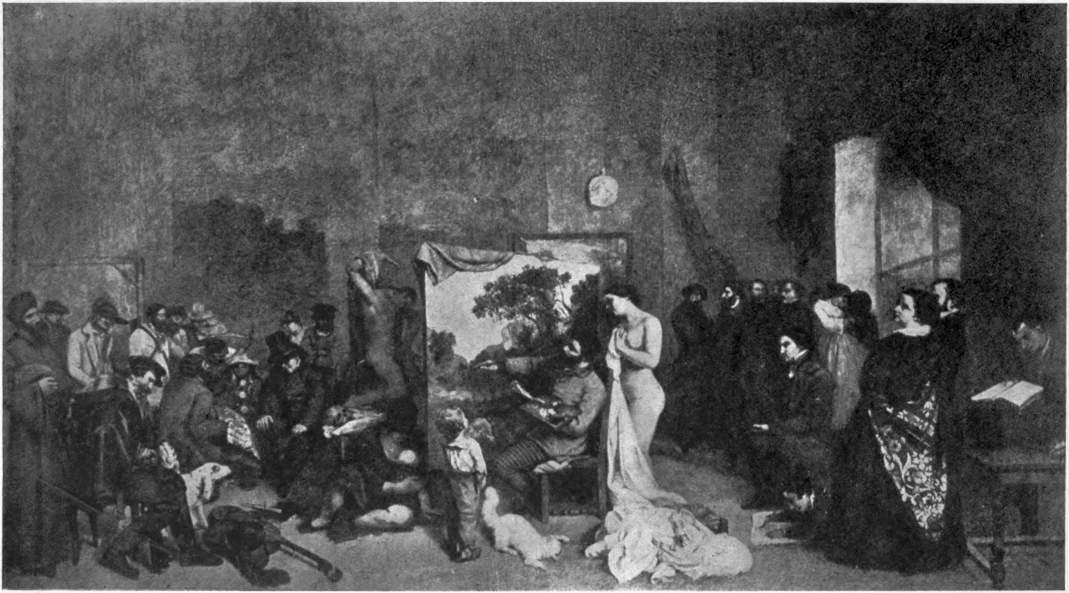
COURBET. MY STUDIO AFTER SEVEN YEARS OF ARTISTIC LIFE.
Courbet met with a similar fate.
If one approaches him after reading the criticisms of his pictures already cited, a great disillusionment is inevitable. Having imagined a grotesque monster, one finds to one’s astonishment that there is not the slightest occasion either for indignation or laughter in the presence of these powerful, sincere, and energetic pictures. One has expected caricatures and a repulsive hideousness, and one finds a broad and masterly style of painting. The heads are real without being vulgar, and the flesh firm and soft and throbbing with powerful life. Courbet is a personality. He began by imitating the Flemish painters and the Neapolitans. But far more did he feel himself attracted by the actual world, by massive women and strong men, and wide fertile fields smelling of rich, rank earth. As a healthy and sensuously vigorous man he felt a voluptuous satisfaction in clasping actual nature in his herculean arms. Of course, by the side of his admirable pictures there are others which are heavy and uncouth. But if one is honest one paints according to one’s inherent nature, as old Navez, the pupil of David, was in the habit of saying. Courbet was honest, and he was also a somewhat unwieldy being, and therefore his painting too has something bluff and cumbrous. But where in all French art is there such a sound painter, so sure of his effects and with such a large bravura, a maître peintre who was so many-sided, extending his dominion as much over figure-painting as landscape, over the nude as over nature morte? There is no artist so many of whose pictures may be seen together without surfeit, for he is novel in almost every work. He has painted not a few pictures of which it may be said that each one is sui generis, and on the variations of which elsewhere entire reputations might have been founded. With the exception of Millet, no one had observed man and nature with such sincere and open eyes. With the great realists of the past Courbet shares the characteristic of being everywhere and exclusively a portrait painter. A pair of stone-breakers, kneeling as they do in his picture, with their faces protected by wire-masks, were figures which every one saw working at the street corner, and Courbet represented the scene as faithfully as he could, as sincerely and positively as was at all possible. “Afternoon in Ornans” is a pleasant picture, in which he took up again the good tradition of Lenain. And in “The Funeral at Ornans” he has painted exactly the manner in which such ceremonies take place in the country. The peasants and dignitaries of a little country town—portrait figures such as the masters of the fifteenth century brought into their religious pictures—have followed the funeral train, and behave themselves at the grave just as peasants would. They make no impassioned gesticulations, and form themselves into no fine groups, but stand there like true rustics, sturdy and indifferent. They are men of flesh and blood, they are like the people of real life, and they have been subjected to no alteration: on the one side are the women tearfully affected by the words of the preacher, on the other are the men bored by the ceremony or discussing their own affairs. In the “Demoiselles de Village” he gives a portrait of his own sisters, as they went to a dance of a Sunday afternoon. The “Girls lying on the Bank of the Seine” are grisettes of 1850, such as Gavarni often drew; they are both dressed in doubtful taste, one asleep, the other lost in a vacant reverie. His naked women make a very tame effect compared with the colossal masses of human flesh in that cascade of nude women of the plumpest description who in Rubens’ “Last Judgment” plunge in confusion into hell, like fish poured out from a bucket. But they are amongst the best nude female figures which have been created in the nineteenth century. Courbet was a painter of the family of Rubens and Jordaens. He had the preference shown by the old Flemish artists for healthy, plump, soft flesh, for fair, fat, and forty, the three F’s of feminine beauty, and in his works he gave the academicians a lesson well worth taking to heart; he showed them that it was possible to attain a powerful effect, and even grace itself, by strict fidelity to the forms of reality.
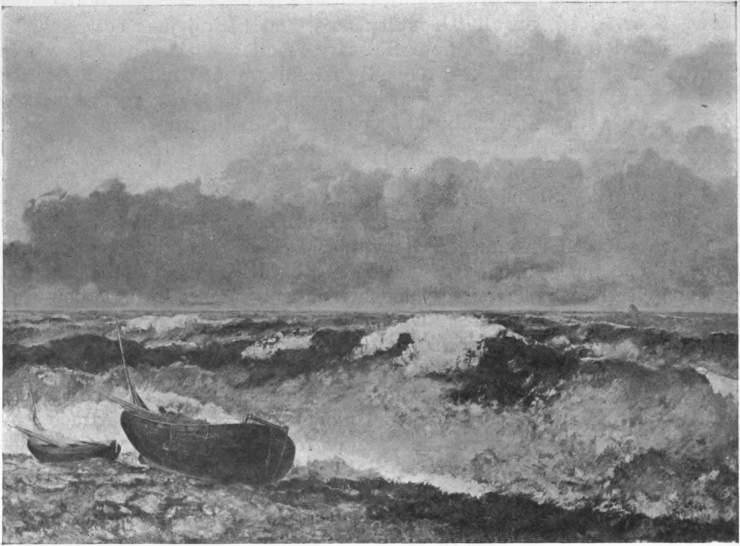
Neuerdein, photo.
COURBET. THE WAVE.
His portraits—and he had the advantage of painting Berlioz and Baudelaire, Champfleury and Proudhon—are possibly not of conspicuous eminence as likenesses. As Caravaggio, according to Bellori, “had only spirit, eyes and diligence for flesh-tints, skin, blood, and the natural surface of objects,” a head was merely a morceau like anything else for Courbet too, and not the central point of a thinking and sensitive being. The physical man, Taine’s human animal, was more important in his eyes than the psychical. He painted the epidermis without giving much suggestion of what was beneath. But he painted this surface in such a broad and impressive manner that the pictures are interesting as pictorial masterpieces if not as analyses of character.
L’Art. L’Art.
STEVENS. THE LADY IN PINK. STEVENS. LA BÊTE À BON DIEU.
L’Art.
STEVENS. THE JAPANESE MASK.
To these his landscapes and animal pieces must be added as the works on which his talent displayed itself in the greatest purity and most inherent vigour: “The Battle of the Stags,” that most admirable picture “The Hind on the Snow,” “Deer in Covert,” views of the moss-grown rocks and sunlit woods of Ornans and the green valleys of the Franche-Comté. He had the special secret of painting with a beautiful tone and a broad, sure stroke dead plumage and hunting-gear, the bristling hide of wild-boars, and the more delicate coat of deer and of dogs. As a landscape painter he does not belong to the family of Corot and Dupré. His landscapes are green no doubt, but they have limitations; the leaves hang motionless on the branches, undisturbed by a breath of wind. Courbet has forgotten the most important thing, the air. Whatever the time of the year or the day may be, winter or summer, evening or morning, he sees nothing but the form of things, regarding the sun as a machine which has no other purpose than to mark the relief of objects by light and shade. Moreover, the lyricism of the Fontainebleau painters was not in him. He paints without reverie, and knows nothing of that tender faltering of the landscape painter in which the poet awakes, but has merely the equanimity of a good and sure worker. In regard to nature, he has the sentiments of a peasant who tills his land, is never elegiac or bucolic, and would be most indignant if a nymph were to tread on the furrows of his fields. He paints with a pipe in his mouth and a spade in his hand, the plain and the hills, potatoes and cabbages, rich turf and slimy rushes, oxen with steaming nostrils heavily ploughing the clods, cows lying down and breathing at ease the damp air of the meadows drenched with rain. He delights in fertile patches of country, and in the healthy odour of the cow-house. A material heaviness and a prosaic sincerity are stamped upon all. But his painting has a solidity delightful to the eye. It is inspiriting to meet a man who has such a resolute and simple love of nature, and can interpret her afresh in powerful and sound colour without racking his brains. His attachment to the spot of earth where he was born is a leading characteristic of his art. He borrowed from Ornans the motives of his most successful creations, and was always glad to return to his parents’ house. The patriotism of the church-spire, provincialism, and a touching and vivid sense of home are peculiar to all his landscapes. But in his sea-pieces, to which he was incited by a residence in Trouville in the summer of 1865, he has opened an altogether new province to French art. Eugène Le Poittevin, who exhibited a good deal in Berlin in the forties, and therefore became very well known in Germany, cannot count as a painter. Théodore Gudin, whose signature is likewise highly valued in the market, was a frigid and rough-and-ready scenical painter. His little sea-pieces have a professional manner, and the large naval battles and fires at sea which he executed by the commission of Louis Philippe for the Museum of Versailles are frigid, pompous, and spectacular sea-pieces parallel with Vernet’s battle-pieces. Ziem, who gave up his time to Venice and the Adriatic, is the progenitor of Eduard Hildebrandt. His water and sky take all the colours of the prism, and the objects grouped between these luminous elements, houses, ships, and men, equally receive a share of these flattering and iridescent tones. This gives something seductive and dazzling to his sketches, until it is at last perceived that he has only painted one picture, repeating it mechanically in all dimensions. Courbet was the first French painter of sea-pieces who had a feeling for the sombre majesty of the sea. The ocean of Gudin and Ziem inspires neither wonder nor veneration; that of Courbet does both. His very quietude is expressive of majesty; his peace is imposing, his smile grave; and his caress is not without a menace.