Front matter (continued 4)
Reading edition
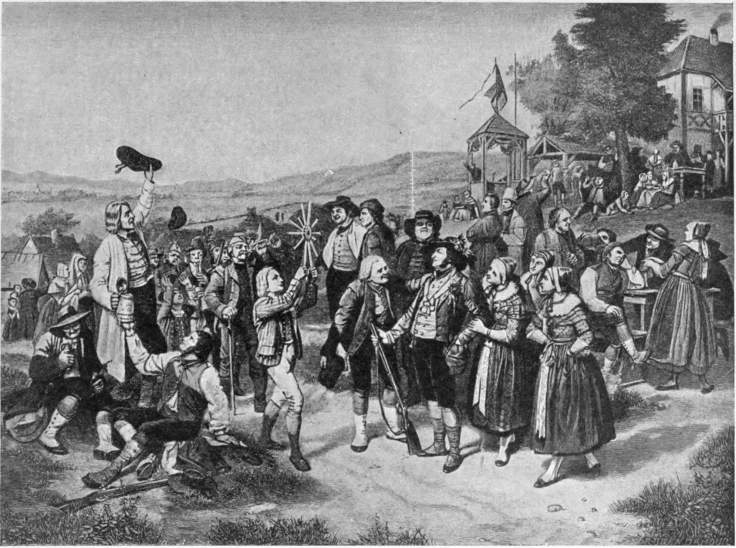
MEYERHEIM. THE KING OF THE SHOOTING MATCH.
A homely, idyllic poetry is to be found in his figures and his interiors. His women and girls are chaste and gracious. It is evident that Meyerheim had a warm sympathy for the sorrows and joys of humble people; that he had an understanding for this happy family life, and liked himself to take part in these merry popular festivals; that he did not idealise the world according to rules of beauty, but because in his own eyes it really was so beautiful. His “King of the Shooting Match” of 1836 (Berlin National Gallery) has as a background a wide and pleasant landscape, with blue heights in the distance and the cheerful summer sunshine resting upon them. In the foreground are a crowd of figures, neatly composed after studies. The crowned king of the match, adorned for a festival, stands proudly on the road by which the procession of marksmen is advancing, accompanied by village music. An old peasant is congratulating him, and the pretty village girls and peasant women, in their gay rustic costumes, titter as they look on, while the neighbours are merrily drinking his health. Then there is the “Morning Lesson,” representing a carpenter’s house, where an old man is hearing his grandson repeat a school task; “Children at Play,” a picture of a game of hide-and-seek amongst the trees; “The Knitting Lesson,” and the picture of a young wife by the bed of a naked boy who has thrown off the bedclothes and is holding up one of his rosy feet; and “The Road to Church,” where the market-place is shadowed with lime trees and the fresh young girlish figures adorned in their Sunday best. These are all pictures which in lithograph and copperplate engraving once flooded all Germany and enraptured the public at exhibitions.
But the German genre picture of peasant life only became universally popular after the village novel came into vogue at the end of the thirties. Walter Scott was not only a Romanticist, but the founder of the peasant novel: he was the first to study the life and the human character of the peasantry of his native land, their rough and healthy merriment, their humorous peculiarities, and their hot-headed love of quarrelling; and he led the Romanticists from their idyllic or sombre world of dreams nearer to the reality and its poetry. A generation later Immermann created this department of literature in Germany by the Oberhof-Episode of his Münchhausen. “The Village Magistrate” was soon one of those typical figures which in literature became the model of a hundred others. In 1837 Jeremias Gotthelf began in his Bauernspiegel those descriptions of Bernese rustic life which found general favour through their downright common sense. Berthold Auerbach, Otto Ludwig, and Gottfried Keller were then active, and Fritz Reuter lit upon a more clear-cut form for his tales in dialect.
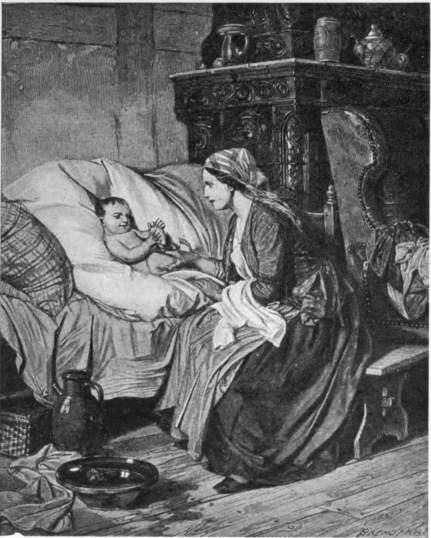
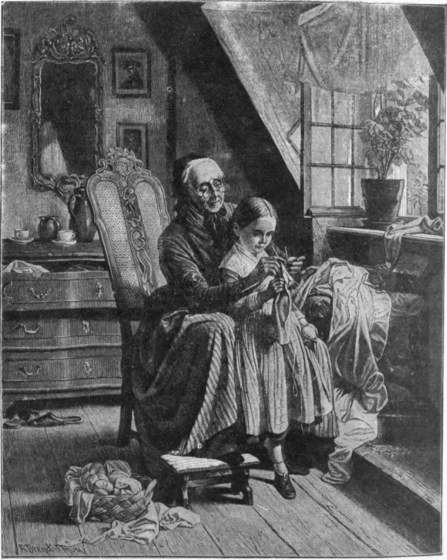
MEYERHEIM. THE MORNING HOUR. MEYERHEIM. THE KNITTING LESSON.
The influence which these writers had upon painting was enormous. It now turned everywhere to the life of the people, and took its joy and pleasure in devoting itself to reality. And the rustic was soon a popular figure much sought after in the picture market. Yet this reliance on poetry and fiction had its disadvantage. For in Germany, also, a vogue was given to that “genre painting” which, instead of starting with a simple, straightforward representation of what the artist had seen, offered an artistically correct composition of what he had invented, and indulged in a rambling display of humorous narrative and pathetic pieces.
In Carlsruhe Johann Kirner was the first to work on these lines, adapting the life of the Swabian peasantry to the purposes of humorous anecdote. In Munich Carl Enhuber was especially fertile in the invention of comic episodes amongst the rustics of the Bavarian highlands, and his ponderous humour made him one of the favourite heroes of the Art Union. Every one was in raptures over his “Partenkirche Fair,” over the charlatan in front of the village inn, who (like a figure after Gerhard Dow) is bringing home to the multitude by his lofty eloquence the fabulous qualities of his soap for removing spots; over that assembly of peasants which gave the painter an opportunity for making clearly recognisable people to be found everywhere in any little town, from the judge of the county court and the local doctor down to the watchmen. His second hit was “The Interrupted Card Party”: the blacksmith, the miller, the tailor, and other dignitaries of the village are so painfully disturbed in their social reunion by the unamiable wife of the tailor that her happy spouse makes his escape under the table. The house servant holds out his blue apron to protect his master, whilst the miller and the blacksmith try to look unconcerned; but a small boy who has accompanied his mother with a mug discovers the concealed sinner by his slipper, which has come off. The “Session Day” contains a still greater wealth of comical types: here is the yard of a country assize court, filled with people, some of them waiting their turn, some issuing in contentment or dejection. Most contented, of course, are a bridal pair from the mountains—a stout peasant lad and a buxom maiden—who have just received official consent to their marriage. Disastrous country excursions—townspeople overtaken by rain on their arrival in the mountains—were also a source of highly comical situations.
In Düsseldorf the reaction against the prevailing sentimentality necessarily gave an impulse to art on these humorous lines. When it seemed as if the mournfulness of the thirties would never be ended, Adolf Schroedter, the satirist of the band of Düsseldorf artists in those times, broke the spell when he began to parody the works of the “great painters.” When Lessing painted “The Sorrowing Royal Pair,” Schroedter painted “The Triumphal Procession of King Bacchus”; when Hermann Stilke produced his knights and crusaders, Schroedter illustrated Don Quixote as a warning; and when Bendemann gave the world “The Lamentation of Jeremiah” and “The Lamentation of the Jews,” Schroedter executed his droll picture “The Sorrowful Tanners,” in which the tanners are mournfully regarding a hide carried away by the stream. Since he was a humorist, and humour is rather an affair for drawing than painting, the charming lithographs, “The Deeds and Opinions of Piepmeyer the Delegate,” published in conjunction with Detmold, the Hanoverian barrister, and author of the Guide to Connoisseurship, are perhaps to be reckoned as his best performances. Hasenclever followed the dilettante Schroedter as a delineator of the “stolid Peter” type, and painted the “Study” and similar pictures for Kortum’s Jobsiade with great technical skill, and, at the same time, with little humour and much complacency. By the roundabout route of illustration artists were gradually brought more directly into touch with life, and painted side by side with melodramatic brigands, rustic folk, or a student at a tavern on the Rhine, absurd people reading the newspapers, comic men sneezing, or the smirking Philistine tasting wine.
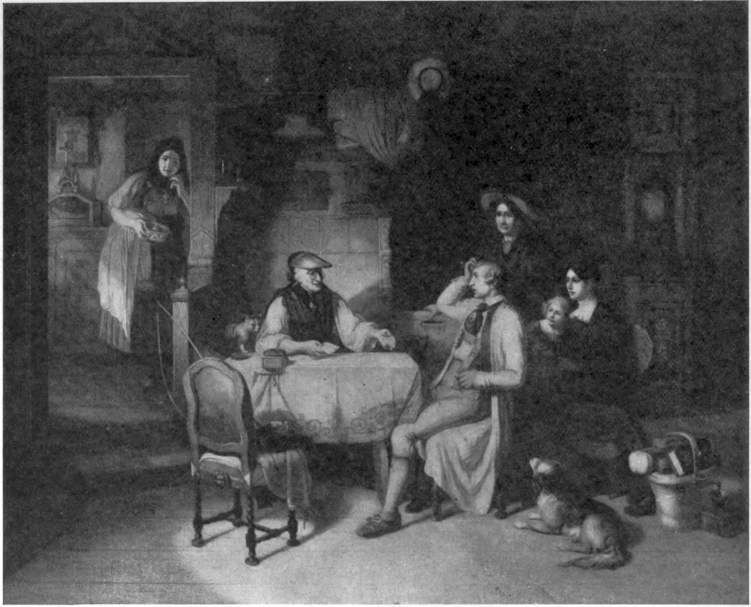
KIRNER. THE FORTUNE TELLER.
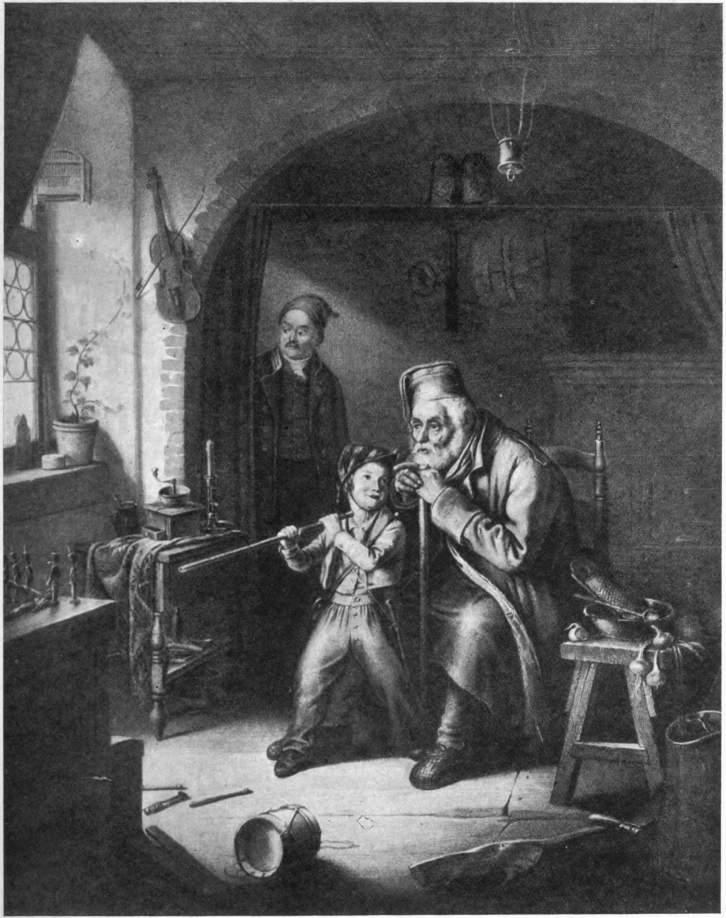
ENHUBER. THE PENSIONER AND HIS GRANDSON.
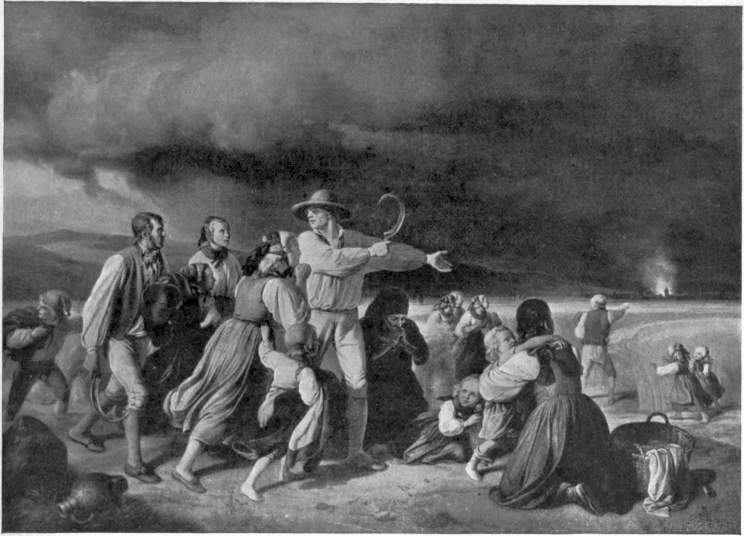
JACOB BECKER. A TEMPEST.
Jacob Becker went to the Westerwald to sketch little village tragedies, and won such popularity with his “Shepherd Struck by Lightning” that for a long time the interest of the public was often concentrated on this picture in the collection of the Staedel Institute. Rudolf Jordan of Berlin settled on Heligoland, and became by his “Proposal of Marriage in Heligoland” one of the most esteemed painters of Düsseldorf. And in 1852 Henry Ritter, his pupil, who died young, enjoyed a like success with his “Middy’s Sermon,” which represents a tiny midshipman with comical zeal endeavouring to convert to temperance three tars who are staggering against him. A Norwegian, Adolf Tidemand, became the Leopold Robert of the North, and, like Robert, attained an international success when, after 1845, he began to present his compatriots, the peasants, fishers, and sailors of the shores of the North Sea, to the public of Europe. There was no doubt that a true ethnographical course of instruction in the life of a distant race, as yet unknown to the rest of Europe, was to be gathered from his pictures, as from those of Robert, or from the Oriental representations of Vernet. In Tidemand’s pictures the Germans learnt the Norwegian usage of Christmas, accompanied the son of the North on his fishing of a night, joined the bridal party on the Hardanger Fjord, or listened to the sexton giving religious instruction; sailed with fishing girls in a skiff to visit the neighbouring village, or beheld grandmother and the children dance on Sunday afternoon to father’s fiddle. Norwegian peasant life was such an unknown world of romance, and the costume so novel, that Tidemand’s art was greeted as a new discovery. That the truth of his pictures went no further than costume was only known at a later time. Tidemand saw his native land with the eyes of a Romanticist, as Robert saw Italy, and, in the same one-sided way, he only visited the people on festive occasions. Though a born Norwegian, he, too, was a foreigner, a man who was never familiar with the life of his country people, who never lived at home through the raw autumn and the long winter, but came only as a summer visitor, when nature had donned her bridal garb, and naturally took away with him the mere impressions of a tourist. As he only went to Norway for recreation, it is always holiday-tide and Sabbath peace in his pictures. He represents the same idyllic optimism and the same kindly view of “the people” as did Björnson in his earliest works; and it is significant that the latter felt himself at the time so entirely in sympathy with Tidemand that he wrote one of his tales, The Bridal March, as text to Tidemand’s picture “Adorning the Bride.”
To seek the intimate poetry in the monotonous life of the peasant, and to go with him into the struggle for existence, was what did not lie in Tidemand’s method of presentation; he did not live amongst the people sufficiently long to penetrate to their depths. The sketches that resulted from his summer journeys often reveal a keen eye for the picturesque, as well as for the spiritual life of this peasantry; but later in Düsseldorf, when he composed his studies for pictures with the help of German models, all the sharp characterisation was watered down. What ought to have been said in Norwegian was expressed in a German translation, where the emphasis was lost. His art is Düsseldorf art with Norwegian landscapes and costumes; a course of lectures on the manners and customs of Norwegian villages composed for Germans. The only thing which distinguishes Tidemand to his advantage from the German Düsseldorfers is that he is less humorously and sentimentally disposed. Pictures of his, such as “The Lonely Old People,” “The Catechism,” “The Wounded Bear Hunter,” “The Grandfather’s Blessing,” “The Sectarians,” etc., create a really pleasant and healthy effect by a certain actual simplicity which they undoubtedly have. Other men would have made a melodrama out of “The Emigrant’s Departure” (National Gallery in Christiania). Tidemand portrays the event without any sort of emphasis, and feels his way with tact on the boundary between sentiment and sentimentality. There is nothing false or hysterical in the behaviour of the man who is going away for life, nor in those who have come to see him off.
In Vienna the genre painters seem to owe their inspiration especially to the theatre. What was produced there in the province of grand art during the first half of the century was neither better nor worse than elsewhere. The Classicism of Mengs and David was represented by Heinrich Füger, who had a more decided leaning towards the operatic. The representative-in-chief of Nazarenism was Josef Führich, whose frescoes in the Altlerchenfeld Church are, perhaps, better in point of colour than the corresponding efforts of the Munich artists, though they are likewise in a formal way derivative from the Italians. Vienna had its Wilhelm Kaulbach in Carl Rahl, its Piloty in Christian Ruben, who, like the Munich artist, had a preference for painting Columbus, and was meritorious as a teacher. It was only through portrait painting that Classicism and Romanticism were brought into some sort of relation with life; and the Vienna portraitists of this older régime are even better than their German contemporaries, as they made fewer concessions to the ruling idealism. Amongst the portrait painters was Lampi, after whom followed Moritz Daffinger with his delicate miniatures; but the most important of them all was Friedrich Amerling, who had studied under Lawrence in London and under Horace Vernet in Paris, and brought back with him great acquisitions in the science of colour. In the first half of the century these assured him a decided advantage over his German colleagues. It was only later, when he was sought after as the fashionable painter of all the crowned heads, that his art degenerated into mawkishness.
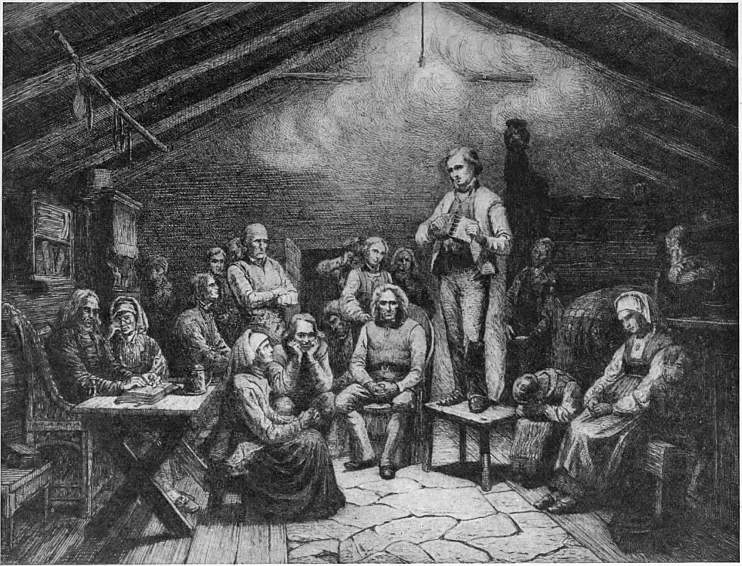
TIDEMAND. THE SECTARIANS.
Genre painting was developed here as elsewhere from the military picture. As early as 1813 Peter Krafft, an academician of the school of David, had exhibited a great oil-painting, “The Soldier’s Farewell”—the interior of a village room with a group of life-size figures. The son of the family, in grey uniform, with a musket in his hand, is tearing himself from his young wife, who has a baby on her arm and is trying in tears to hold him back. His old father sits in a corner with folded hands beside his mother, who is also crying, and has hid her face. In 1820 Krafft added “The Soldier’s Return” as a pendant to this picture. It represents the changes which have taken place in the family during the warrior’s absence: his old mother is at rest in her grave; his grey-headed father has become visibly older, his little sister has grown up, and the baby in arms is carrying the musket after his father. They are both exceedingly tiresome pictures; the colour is cold and grey, the figures are pseudo-classical in modern costume, and the pathos of the subject seems artificial and forced. Nevertheless a new principle of art is declared in them. Krafft was the first in Austria to recognise what a rich province had been hitherto ignored by painting. He warned his pupils against the themes of the Romanticists. These, as he said, were worked out, since no one would do anything better than the “Last Supper of Leonardo da Vinci or the Madonnas of Raphael.” And he warmly advocated the conviction “that nothing could be done for historical painting so long as it refused to choose subjects from modern life.” Krafft was an admirable teacher with a sober and clear understanding, and he invariably directed his pupils to the immediate study of life and nature. The consequence of his career was that Carl Schindler, Friedrich Treml, Fritz L’Allemand, and others set themselves to treat in episodic pictures the military life of Austria, from the recruiting stage to the battle, and from the soldier’s farewell to his return to his father’s house. A further result was that the Viennese genre painting parted company with the academical and historic art.
Just at this time Tschischka and Schottky began to collect the popular songs of the Viennese. Castelli gave a poetic representation of bourgeois life, and Ferdinand Raimund brought it upon the stage in his dramas. Bauernfeld’s types from the life of the people enjoyed a rapid popularity. Josef Danhauser, Peter Fendi, and Ferdinand Waldmüller went on parallel lines with these authors. In their genre pictures they represented the Austrian people in their joys and sorrows, in their merriment and heartiness and good-humour; the people, be it understood, of Raimund’s popular farces, not those of the pavement of Vienna.
Josef Danhauser, the son of a Viennese carpenter, occupied himself with the artisan and bourgeois classes. David Wilkie gave him the form for his work and Ferdinand Raimund his ideas. His studio scenes, with boisterous art students caught by their surly teacher at the moment when they are playing their worst pranks, gave pleasure to the class of people who, at a later date, took so much delight in Emanuel Spitzer. His “Gormandizer” is a counterpart to Raimund’s Verschwender; and when, in a companion picture, the gluttonous liver is supping up the “monastery broth” amongst beggars, and his former valet remains true to him even in misfortune, Grillparzer’s Treuer Diener seines Herrn serves as a model for this type. Girls confessing their frailty to their parents had been previously painted by Greuze. Amongst those of his pictures which had done most to amuse the public was the representation of the havoc caused by a butcher’s dog storming into a studio. In his last period he turned with Collins to the nursery, or wandered through the suburbs with a sketch-book, immortalising the doings of children in the streets, and drawing “character heads” of the school-teacher tavern habitués and the lottery adventurer.
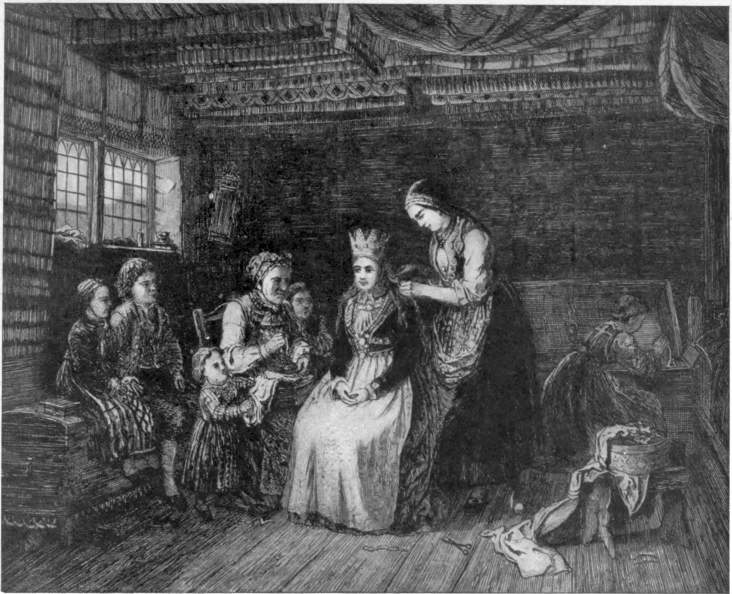
TIDEMAND. ADORNING THE BRIDE.
And this was likewise the province to which Waldmüller devoted himself. Chubby peasant children are the heroes of almost all his pictures. A baby is sprawling with joy on its mother’s lap, while it is contemplated with proud satisfaction by its father, or it is sleeping under the guardianship of a little sister; a boy is despatched upon the rough path which leads to school, and brings the reward of his conduct home with rapturous or dejected mien, or he stammers “Many happy returns of the day” to grandpapa. Waldmüller paints “The First Step,” the joys of “Christmas Presents,” and “The Distribution of Prizes to Poor School Children”; he follows eager juveniles to the peep-show; he is to be met at “The Departure of the Bride” and at “The Wedding”; he is our guide to the simple “Peasant’s Room,” and shows the benefit of “Almsgiving.” Though his pictures may seem old-fashioned in subject nowadays, their artistic qualities convey an entirely modern impression. Born in 1793, he anticipated the best artists of later days in his choice of material. Both in his portraits and in his country scenes there is a freshness and transparency of tone which was something rare among the painters of that time.
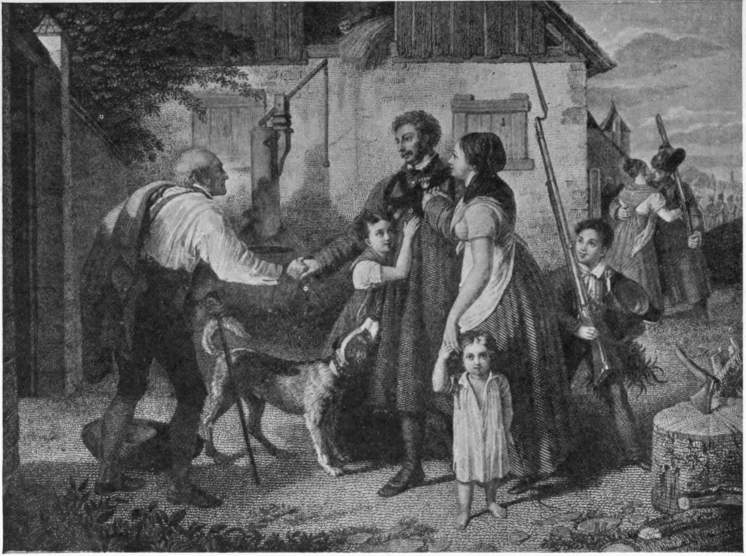
PETER KRAFFT. THE SOLDIER’S RETURN.
Friedrich Gauermann wandered in the Austrian Alps, in Steiermark, and Salzkammergut, making studies of nature, the inhabitants, and the animal world. In contradistinction from Waldmüller, painter of idylls, and the humorist Danhauser, he aimed above all at ethnographical exactness. With sincere and unadorned observation Gauermann represents the local peculiarities of the peasantry, differentiated according to their peculiar valleys; life on the pasture and at the market, when some ceremonial occasion—a shooting match, a Sunday observance, or a church consecration—has gathered together the scattered inhabitants.
Genre painting in other countries worked with the same types. The costume was different, but the substance of the pictures was the same.
In Belgium Leys had already worked in the direction of painting everyday life; for although he had painted figures from the sixteenth century, they were not idealised, but as rough and homely as in reality. When the passion for truthfulness increased, as it did in the following years, there came a moment when the old German tradition, under the shelter of which Leys yet took refuge, was shaken off, and artists went directly to nature without seeking the mediation of antiquated style. At that time Belgium was one of the most rising and thriving countries in Europe. It had private collections by the hundred. Wealthy merchants rivalled one another in the pride of owning works by their celebrated painters. This necessarily exerted an influence on production. Pretty genre pictures of peasant life soon became the most popular wares; as for their artistic sanction, it was possible to point to Brouwer and Teniers, the great national exemplars.
At first, then, the painters worked with the same elements as Teniers. The common themes of their pictures were the ale-house with its thatched roof, the old musician with his violin, the mountebank standing in the midst of a circle of people, lovers, or drinkers brawling. Only the costume was changed, and everything coarse, indecorous, or unrestrained was scrupulously excluded ad usum Delphini. That the deep colouring of the old masters became meagre and motley was in Belgium also an inevitable result of the helplessness in regard to colour which had been brought on by Classicism. The pictorial furia of Adriaen Brouwer gave way to a polished porcelain painting which hardly bore a trace of the work of the hand. Harsh and gaudy reds and greens were especially popular.
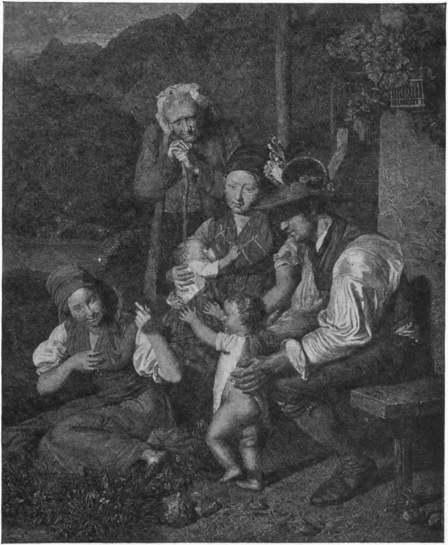
WALDMÜLLER. THE FIRST STEP.
The first who began a modest career on these lines was Ignatius van Regemorter. As one recognises the pictures of Wouwerman by the dappled-grey horse, Regemorter’s may be recognised by the violin. Every year he turned out one picture at least in which music was being played, and people were dancing with a rather forced gaiety. Then came Ferdinand de Braekeleer, who painted the jubilees of old people, or children and old women amusing themselves at public festivities. Teniers was his principal model, but his large joviality was transformed into a chastened merriment, and his broad laughter into a discreet smile. Braekeleer’s peasantry and proletariat are of an idyllic mildness; honest, pious souls who, with all their poverty, are as moral as they are happy. Henri Coene elaborated such themes as “Oh, what beautiful Grapes!” or “A Pinch of Snuff for the Parson!”
Madou’s merit lies in having extended Belgian genre painting somewhat beyond these narrow bounds; he introduced a greater variety of types verging more on reality than that everlasting honest man painted by Ferdinand de Braekeleer. Madou was a native of Brussels. There he was born in 1796, and he died there in 1877. When he began his career Wappers had just made his appearance. Madou witnessed his successes, but did not feel tempted to follow him. Whilst the latter in his large pictures in the grand style aimed at being Rubens redivivus, Madou embodied his ideas in fleeting pencil sketches. A great number of lithographs of scenes from the past bore witness to his conception of history. There was nothing in them that was dignified, nothing that was stilted, no idealism and no beauty; in their tabards and helmets the figures moved with the natural gestures of ordinary human beings. By the side of great seigneurs, princes, and knights, and amid helmets and hose, drunken scoundrels, tavern politicians, and village cretins started into view, and grimaced and danced and scuffled. In Belgium his plates occupy a position similar to that of the first lithographs of Menzel in Germany. But Madou lingered for a still briefer period in the Pantheon of history; the tavern had for him a yet greater attraction. The humorous books which he published in Paris and Brussels first showed him in his true light. Having busied himself for several years exclusively with drawings, he made his début in 1842 as a painter. It is difficult to decide how much Madou produced after that date. The long period between 1842 and 1877 yields a crowded chronicle of his works. Even in the seventies he was just as vigorous as at the beginning, and though he was regarded as a jester during his lifetime he was honoured as a great painter after his death. At the auction of his unsold works, pictures fetched 22,000 francs, sketches reached 3200, water-colours 2150, and drawings 750. The present generation has reduced this over-estimation to its right measure, but it has not shaken Madou’s historical importance. He has a firm position as the man who conquered modern life in the interests of Belgian art, and he is the more significant for the genre painting of his age, as he eclipsed all his contemporaries, even in Germany and England, in the inexhaustible fund of his invention.
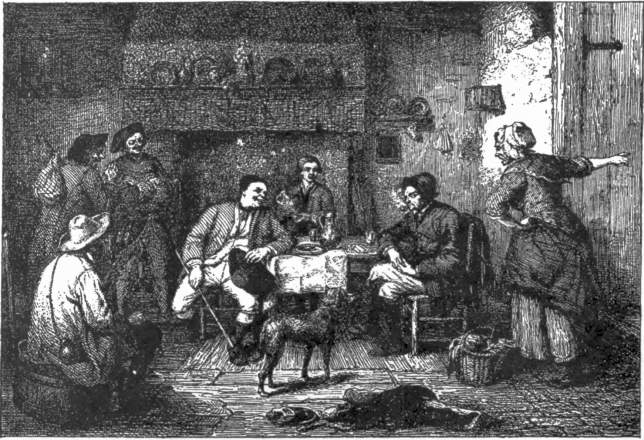
MADOU. IN THE ALE-HOUSE.
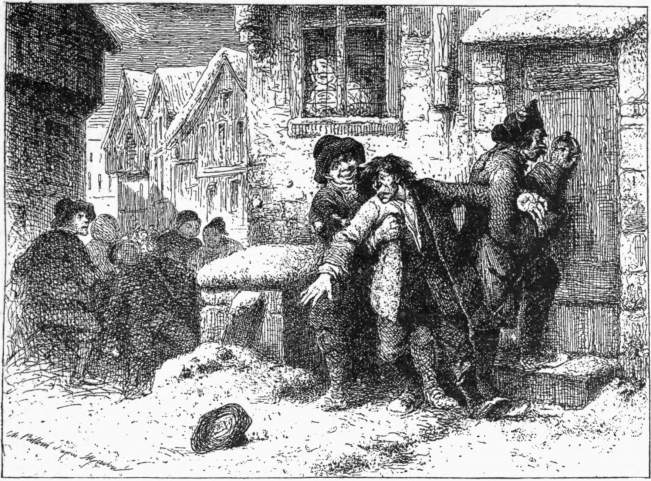
MADOU. THE DRUNKARD.
A merry world is reflected in his pictures. One of his most popular figures is the ranger, a sly old fox with a furrowed, rubicund visage and huge ears, who roves about more to the terror of love-making couples than of poachers, and never aims at any one except for fun at the rural justice, a portly gentleman in a gaudy waistcoat, emerging quietly at the far end of the road. He introduces a varied succession of braggarts, poor fellows, down-at-heel and out-at-elbows, old grenadiers joking with servant girls, old marquesses taking snuff with affected dignity, charlatans at their booth, deaf and dumb flute-players, performing dogs, and boys sick over their first pipe. Here and there are fatuous or over-wise politicians solemnly opening a newly printed paper, with their legs astraddle and their spectacles resting on their noses. Rascals with huge paunches and blue noses fall asleep on their table in the ale-house, and enliven the rest of the company by their snoring. At times the door is opened and a scolding woman appears with a broom in her hand. On these occasions the countenance of the toper is a comical sight. At the sound of the beloved voice he endeavours to raise himself, and anxiously follows the movements of his better half as he clings reeling to the table, or plants himself more firmly in his chair with a resigned and courageous “J’y suis, j’y reste.”
Being less disposed to appear humorous, Adolf Dillens makes a more sympathetic impression. He, too, had begun with forced anecdotes, but after a tour to Zealand opened his eyes to nature; he laid burlesque on one side, and depicted what he had seen in unhackneyed pictures: sound and healthy men of patriarchal habits. Even his method of painting became simpler and more natural; his colouring, hitherto borrowed from the old masters, became fresher and brighter. He emancipated himself from Rembrandt’s chiaroscuro, and began to look at nature without spectacles. There is something poetic in his method of observation: he really loved these good people and painted them in the unadorned simplicity of their life—cheery old age that knows no wrinkles and laughing youth that knows no sorrows. He is indeed one-sided, for a good fairy has banished all trouble from his happy world; but his pictures are the product of a fresh and amiable temperament. His usual themes are a friendly gathering at the ale-house, a conversation beneath the porch, skating, scenes in cobblers’ workshops, a gust of wind blowing an umbrella inside out; and if he embellishes them with little episodic details, this tendency is so innocent that nobody can quarrel with him.
In France it was François Biard, the Paul de Kock of French painting, who attained most success in the thirties by humorous anecdote. He devoted his whole life to the comical representation of the minor trespasses and misfortunes of the commonplace bourgeoisie. He had the secret of displaying his comicalities with great aptitude, and of mocking at the ridiculous eccentricities of the Philistine in an obvious and downright fashion. Strolling players made fools of themselves at their toilette; lads were bathing whilst a gendarme carried off their clothes; a sentry saluted a decorated veteran, whose wife gratefully acknowledged the attention with a curtsey; the village grandee held a review of volunteers with the most pompous gravity; a child was exhibited at the piano to the admiration of its yawning relatives. One of his chief pictures was called “Posada Espagnol.” The hero was a monk winking at a beauty of forty who was passing by while he was being shaved. Women were sitting and standing about, when a herd of swine dashing in threw everything over and put the ladies to flight, and so called forth one of those comic effects of terror in which Paul de Kock took such delight.
Biard was inexhaustible in these expedients for provoking laughter; and as he had travelled far he had always in reserve a slave-market, a primeval forest, or an ice-field to appease the curiosity of his admirers when there was nothing more to laugh at. From the German standpoint he had importance as an artist whose flow of ideas would have furnished ten genre painters; and if he is the only representative of the humorously anecdotic picture in France, the reason is that there earlier than elsewhere art was led into a more earnest course by the tumult of ideas on social politics.

CHAPTER XXI
THE PICTURE WITH A SOCIAL PURPOSE
That modern life first entered art, in all countries, under the form of humorous anecdote is partly the consequence of the one-sided æsthetic ideas of the period. In an age that was dominated by idealism it was forgotten that Murillo had painted lame beggars sitting in the sun, Velasquez cripples and drunkards, and Holbein lepers; that Rembrandt had so much love for humble folk, and that old Breughel with a strangely sombre pessimism turned the whole world into a terrible hospital. The modern man was hideous, and art demanded “absolute beauty.” If he was to be introduced into painting, despite his want of beauté suprême, the only way was to treat him as a humorous figure which had to be handled ironically. Mercantile considerations were also a power in determining this form of humour. At a time when painting was forced to address itself to a public which was uneducated in art, and could only appreciate anecdotes, such comicalities had the best prospect of favour and a rapid sale. The object was to provoke laughter, at all hazards, by drollness of mien, typical stupidity, and absurdity of situation. The choice of figures was practically made according as they were more or less serviceable for a humorous purpose. Children, rustics, and provincial Philistines seemed to be most adapted to it. The painter treated them as strange and naïve beings, and brought them before the public as a sort of performing dogs, who could go through remarkable tricks just as if they were human beings. And the public laughed over whimsical oddities from another world, as the courtiers of Louis XIV had laughed in Versailles when M. Jourdain and M. Dimanche were acted by the king’s servants upon the stage of Molière.
Meanwhile painters gradually came to remark that this humour à l’huile was bought at too dear a price. For humour, which is like a soap-bubble, can only bear a light method of representation, such as Hokusai’s drawing or Brouwer’s painting, but becomes insupportable where it is offered as a laborious composition executed with painstaking realism. And ethical reasons made themselves felt independently of these artistic considerations.
The drollness of these pictures did not spring from the characters, but from an effort to amuse the public at the expense of the painted figures. As a general rule a peasant is a serious, square-built, angular fellow. For his existence he does battle with the soil; his life is no pleasure to him, but hard toil. But in these pictures he appeared as a figure who had no aim or purport; in his brain the earnestness of life was transformed into a romping game. Painters laughed at the little world which they represented. They were not the friends of man, but parodied him and transformed life into a sort of Punch and Judy show.
And even when they did not approach their figures with deliberate irony, they never dreamed of plunging with any sincere love of truth into the depths of modern life. They painted modern matter without taking part in it, like good children who know nothing of the bitter facts that take place in the world. When the old Dutch painters laughed, their laughter had its historical justification. In the pictures of Ostade and Dirk Hals there is seen all the primitive exuberance and wild joy of life belonging to a people who had just won their independence and abandoned themselves after long years of war with a sensuous transport to the gladness of existence. But the smile of these modern genre painters is forced, conventional, and artificial; the smile of a later generation which only took the trouble to smile because the old Dutch had laughed before them. They put on rose-coloured glasses, and through these gaudy spectacles saw only a gay masque of life, a fair but hollow deception. They allowed their heroes to pass such a merry existence that the question of what they lived upon was never touched. When they painted their tavern pictures they anxiously suppressed the thought that people who drained their great mugs so carelessly possibly had sick children at home, hungry and perishing with cold in a room without a fire. Their peasants are the favoured sons of fortune: they sowed not, neither did they reap, nor gathered into barns, but their Heavenly Father fed them. Poverty and vice presented themselves merely as amiable weaknesses, not as great modern problems.
Just at this time the way was being paved for the Revolution of 1848: the people fought and suffered, and for years before literature had taken part in this struggle. Before the Revolution the battle had been between the nobility and the middle class; but now that the latter had to some extent taken the place of the nobility of earlier days, there rose the mighty problem of strife between the unproductive and the productive, between rich and poor.
In England, the birthplace of the modern capitalistic system, in a country where great industry and great landed property first ousted the independent yeomanry and called forth ever sharper division between those who possessed everything and those who possessed nothing, the unsolved problem of the nineteenth century found its earliest utterance. More than sixty years ago, in the year of Goethe’s death, a new literature arose there, the literature of social politics. With Ebenezer Elliott, who had been himself a plain artisan, the Fourth Estate made its entry into literature; a workman led the train of socialistic poets. Thomas Hood wrote his Song of the Shirt, that lyric of the poor sempstress which soon spread all over the Continent. Carlyle, the friend and admirer of Goethe, came forward in 1843 as the burning advocate of the poor and miserable in Past and Present. He wrote there that this world was no home to the working-man, but a dreary dungeon full of mad and fruitless plagues. It was an utterance that shook the world like a bomb. Benjamin Disraeli’s Sybil followed in 1845. As a novel it is a strange mixture of romantic and naturalistic chapters, the latter seeming like a prophetic announcement of Zola’s Germinal. As a reporter Charles Dickens had in his youth the opportunity of learning the wretchedness of the masses in London, even in the places where they lurked distrustfully in dark haunts. In his Christmas stories and his London sketches he worked these scenes of social distress into thrilling pictures. The poor man, whose life is made up of bitter weeks and scanty holidays, received his citizenship in the English novel.
In France the year 1830 was an end and a beginning—the close of the struggles begun in 1789, and the opening of those which led to the decisive battle of 1848. With the roi bourgeois, whom Lafayette called “the best of republicans,” the Third Estate came into possession of the position to which it had long aspired; it rose from the ranks of the oppressed to that of the privileged classes. As a new ruling class it made such abundant capital with the fruits of the Revolution of July that even in 1830 Börne wrote from Paris: “The men who fought against all aristocracy for fifteen years have scarcely conquered—they have not yet wiped the sweat from their faces—and already they want to found for themselves a new aristocracy, an aristocracy of money, a knighthood of fortune.” To the same purpose wrote Heine in 1837: “The men of thought who, during the eighteenth century, were so indefatigable in preparing the Revolution, would blush if they saw how self-interest is building its miserable huts on the site of palaces that have been broken down, and how, out of these huts, a new aristocracy is sprouting up which, more ungraciously than the old, has its primary cause in money-making.”
There the radical ideas of modern socialism were touched. The proletariat and its misery became henceforward the subject of French poetry, though they were not observed with any naturalistic love of truth, but from the romantic standpoint of contrast. Béranger, the popular singer of chansons, composed his Vieux Vagabond, the song of the old beggar who dies in the gutter; Auguste Barbier wrote his Ode to Freedom, where la sainte canaille are celebrated as immortal heroes, and with the scorn of Juvenal “lashes those who drew profit from the Revolution, those bourgeois in kid gloves who watched the sanguinary street fights comfortably from the window.” In 1842-43 Eugène Sue published his Mystères de Paris, a forbidding and nonsensical book, but one which made an extraordinary sensation, just because of the disgusting openness with which it unveiled the life of the lower strata of the people. Even the great spirits of the Romantic school began to follow the social and political strife of the age with deep emotion and close sympathy. Already in the course of the thirties socialistic ideas forced their way into the Romantic school from every side. Their source was Saint Simon, whose doctrines first found a wide circulation under Louis Philippe.
According to Saint Simon, the task of the new Christianity consisted in improving as quickly as possible the fate of the class which was at once the poorest and the most numerous. His pupils regarded him as the Messiah of the new era, and went forth into the world as his disciples. George Sand, the boldest feminine genius in the literature of the world, mastered these seething ideas and founded the artisan novel in her Compagnon du Tour de France. It is the first book with a real love of the people—the people as they actually are, those who drink and commit deeds of violence as well as those who work and make mental progress. In her periodical, L’Éclaireur de l’Indre, she pleads the cause both of the artisan in great towns and of the rustic labourer; in 1844 she declared herself as a Socialist, without qualification, in her great essay Politics and Socialism, and she brought out her celebrated Letters to the People in 1848.
The democratic tide of ideas came to Victor Hugo chiefly through the religious apostle Lamennais, whose book, written in prison, De l’Esclavage Moderne, gave the same fuel to the Revolution of 1848 as the works of Rousseau had done to that of 1789. “The peasant bears the whole burden of the day, exposes himself to rain and sun and wind, to make ready by his work the harvest which fills our barns in the late autumn. If there are those who think the lighter of him on that account, and will not accord him freedom and justice, build a high wall round them, so that their noisome breath may not poison the air of Europe.” From the forties there mutters through Hugo’s poems the muffled sound of the Revolution which was soon to burst over Paris, and thence to move, like a rolling thunderstorm, across Europe. In place of the tricolor under which the bourgeoisie and the artisan class had fought side by side eighteen years before, the banner of the artisan was hoisted blood-red against the ruling bourgeoisie.
This Zeitgeist, this spirit of the age which had grown earnest, necessarily guided art into another course; the painted humour and childlike optimism of the first genre painters began to turn out a lie. In spite of Schiller, art cannot be blithe with sincerity when life is earnest. It can laugh with the muscles of the face, but the laughter is mirthless; it may haughtily declare itself in favour of some consecrated precinct, in which nothing of the battles and struggles of the outside world is allowed to echo; but, for all that, harsh reality demands its rights. Josef Danhauser’s modest little picture of 1836, “The Gormandizer,” is an illustration of this. In a sumptuously furnished room a company of high station and easy circumstances are seated at dinner. The master of the house, a sleek little man, is draining his glass, and a young dandy is playing the guitar. But an unwelcome disturbance breaks in. The figure of a beggar, covered with rags and with a greasy hat in his hand, appears at the door. The ladies scream, and a dog springs barking from under a chair, whilst the flunkey in attendance angrily prepares to send the impudent intruder about his business. That was the position which art had hitherto taken up towards the social question. It shrank peevishly back as soon as rude and brutal reality disturbed its peaceful course. People wished to see none but cheerful pictures of life around them.
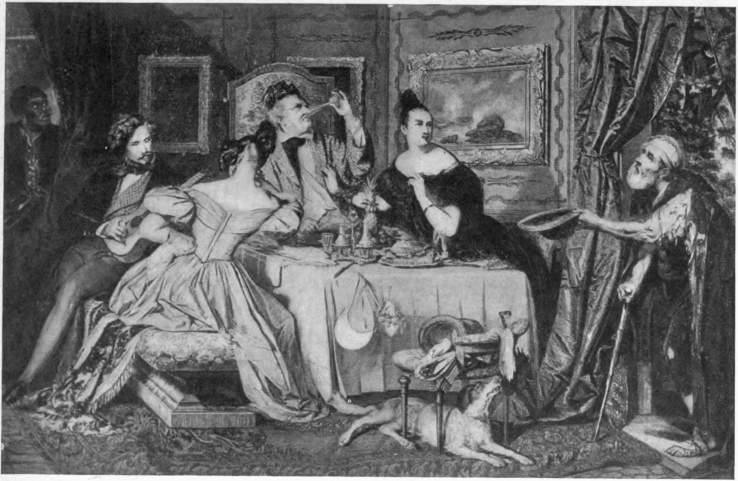
DANHAUSER. THE GORMANDIZER.
For this reason peasants were invariably painted in neat and cleanly dress, with their faces beaming with joy, an embodiment of the blessing of work and the delights of country life. Even beggars were harmless, peacefully cheerful figures, sparkling with health and beauty, and enveloped in æsthetic rags. But as political, religious, and social movements have always had a vivid and forcible effect on artists, painters in the nineteenth century could not in the long run hold themselves aloof from this influence. The voice of the disinherited made itself heard sullenly muttering and with ever-increasing strength. The parable of Lazarus lying at the threshold of the rich man had become a terrible reality. Conflict was to be seen everywhere around, and it would have been mere hardness of heart to have used this suffering people any longer as an agreeable subject for merriment. A higher conception of humanity, the entire philanthropic character of the age, made the jests at which the world had laughed seem forced and tasteless. Modern life must cease altogether before it can be a humorous episode for art, and it had become earnest reality through and through. Painting could no longer affect trivial humour; it had to join issue, and speak of what was going on around it. It had to take its part in the struggle for aims that belonged to the immediate time.
Powerfully impressed by the Revolution of July, it made its first advance. The Government had been thrown down after a blood-stained struggle, and a liberated people were exulting; and the next Salon showed more than forty representations of the great events, amongst which that of Delacroix took the highest place in artistic impressiveness. The principal figure in his picture is “a youthful woman, with a red Phrygian cap, holding a musket in one hand and a tricolor in the other. Naked to the hip, she strides forward over the corpses, giving challenge to battle, a beautiful vehement body with a face in bold profile and an insolent grief upon her features, a strange mixture of Phryne, poissarde, and the goddess of Liberty.” Thus has Heine described the work while still under a vivid impression of the event it portrayed. In the thick of the powder smoke stands “Liberty” upon the barricade, at her right a Parisian gamin with a pistol in his hand, a child but already a hero, at her left an artisan with a gun on his arm: it is the people that hastens by, exulting to die the death for the great ideas of liberty and equality.
The painter himself had an entirely unpolitical mind. He had drawn his inspiration for the picture, not from experience, but out of La Curée, those verses of Auguste Barbier that are ablaze with wrath—
“C’est que la Liberté n’est pas une comtesse Du noble faubourg Saint-Germain, Une femme qu’un cri fait tomber en faiblesse, Qui met du blanc et du carmin; C’est un forte femme aux puissantes mamelles, À la voix rauque, aux durs appas, Qui, du brun sur la peau, du feu dans les prunelles, Agile et marchant à grands pas, Se plait aux cris du peuple, aux sanglantes mêlées, Aux longs roulements des tambours, À l’odeur de la poudre, aux lointaines volées Des cloches et des canons sourds.”
And by this allegorical figure he has certainly weakened its grip and directness; but it was a bold, naturalistic achievement all the same. By this work the great Romanticist became the father of the naturalistic movement, which henceforward, supported by the revolutionary democratic press, spread more and more widely.
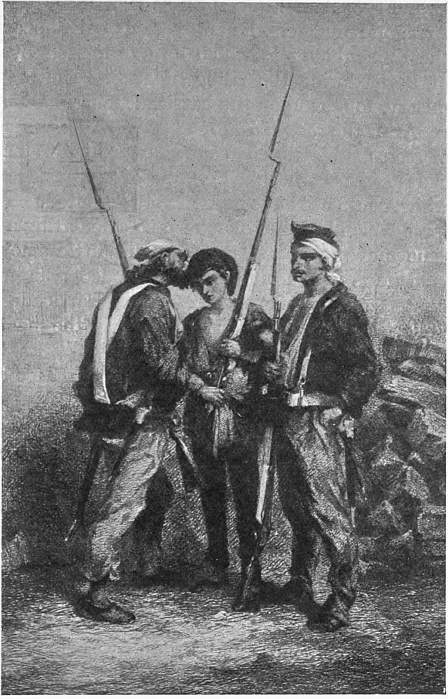
LELEUX. MOT D’ORDRE.
The critics on these journals began to reproach painters with troubling themselves too little about social and political affairs. “The actuality and social significance of art,” it was written, “is the principal thing. What is meant by Beauty? We demand that painting should influence society, and join in the work of progress. Everything else belongs to the domain of Utopias and abstractions.” The place of whimsicalities is accordingly taken by sentimental and melodramatic scenes from the life of the poor. Rendered enthusiastic by the victory of the people, and inspired by democratic sentiments, some painters came to believe that the sufferings of the artisan class were the thing to be represented, and that there was nothing nobler than work.
One of the first to give an example was Jeanron. His picture of “The Little Patriots,” produced in connection with the Revolution of July, was a glorification of the struggle for freedom; his “Scene in Paris” a protest against the sufferings of the people. He sought his models amongst the poor of the suburb, painted their ragged clothes and their rugged heads without idealisation. For him the aim of art was not beauty, but the expression of truth—a truth, no doubt, which made political propaganda. It was Jeanron’s purpose to have a socialistic influence. One sees it in his blacksmiths and peasants, and in that picture “The Worker’s Rest” which in 1847 induced Thoré’s utterance: “It is a melancholy and barren landscape from the neighbourhood of Paris, a plebeian landscape which hardly seems to belong to itself, and which gives up all pretensions to beauty merely to be of service to man. Jeanron is always plebeian, even in his landscapes: he loves the plains which are never allowed to repose, on which there is always labour; there are no beautiful flowers in his fields, as there is no gold ornament on the rags of his beggars and labourers.”
And afterwards, during the early years of the reign of Louis Philippe, when the tendency became once more latent, the Revolution of February worked out what the Revolution of July had begun. Mediocre painters like Antigna became famous because they bewailed the sorrows of the “common man” in small and medium-sized pictures. Others began to display a greater interest in rustics, and to take them more seriously than they had done in earlier works. Adolphe Leleux made studies in Brittany, and discovered earnest episodes in the daily life of the peasant, which he rendered with great actuality. And after sliding back into Romanticism, as he did with his Arragon smugglers, he enjoyed his chief success in 1849 with that picture at the Luxembourg to which he was incited by the sad aspect of the streets of Paris during the rising of 1848. The men who, driven by hunger and misery, fought upon the barricades may be found in Leleux’s “Mot d’Ordre.”
After the coup d’état of 1851 even Meissonier, till then exclusively a painter of rococo subjects, encroached on this province. In his picture of the barricades (2 December 1851) heaps of corpses are lying stretched out in postures which could not have been merely invented. The execution, too, has a nervous force which betrays that even so calculating a spirit as Meissonier was at one time moved and agitated. In his little smokers and scholars and waiting-men he is an adroit but cold-blooded painter: here he has really delivered himself of a modern epic. His “Barricade” (formerly in the Van Praet Collection) is the one thrilling note in the master’s work, which was elsewhere so quiet. Alexandre Antigna, originally an historical painter, turned from historical disasters to those which take place in the life of the lower strata of the people. A dwelling of a poor family is struck by lightning; poor people pack up their meagre goods with the haste of despair on the outbreak of fire; peasants seek refuge from a flood upon the roof of their little house; petty shopkeepers are driving with their wares across the country, when their nag drops down dead in the shafts; or an old crone, cowering at the street corner, receives the pence which her little daughter has earned by playing on the fiddle.
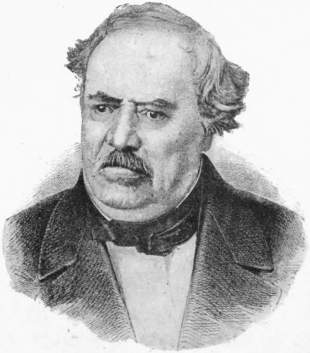
L’Art.
OCTAVE TASSAERT.
But the artist in whose works the philanthropic if sentimental humour of the epoch is specially reflected is that remarkable painter, made up of contradictions, Octave Tassaert. Borrowing at one and the same time from Greuze, Fragonard, and Prudhon, he painted subjects mythological, ribald, and religious, boudoir pictures, and scenes of human misery. Tassaert was a Fleming, a grandson of that Tassaert who educated Gottfried Schadow and died as director of the Berlin Academy in 1788. His name has been for the most part forgotten; it awakes only a dim recollection in those who see “The Unhappy Family” in the Luxembourg Musée. But forty years ago he was amongst the most advanced of his day, and enjoyed the respect of men like Delacroix, Rousseau, Troyon, and Diaz. He took Chardin and Greuze as his models, and is a real master in talent. He was the poet of the suburbs, who spoke in tender complaining tones of the hopes and sufferings of humble people. He painted the elegy of wretchedness: suicide in narrow garrets, sick children, orphans freezing in the snow, seduced and more or less repentant maidens—a sad train. He was called the Correggio of the attic, the Prudhon of the suburbs. His labours are confined to eleven years, from 1846 to 1857. After that he sent no more to the Salon and sulkily withdrew from artistic life. He had no wish ever to see his pictures again, and sold them—forty-four altogether—to a dealer for two thousand francs and a cask of wine. With a glass in his hand he forgot his misanthropy. He lived almost unknown in a little house in the suburbs with a nightingale, a dog, and a little shop-girl for his sole companions.
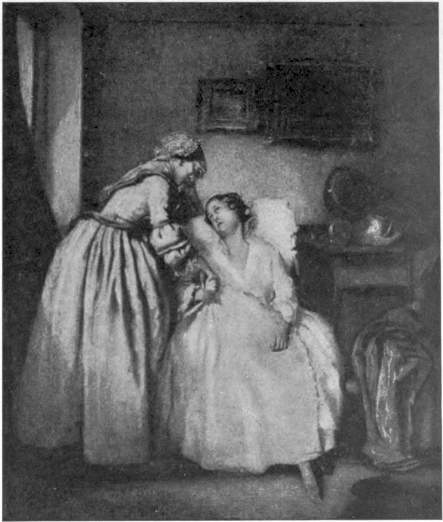
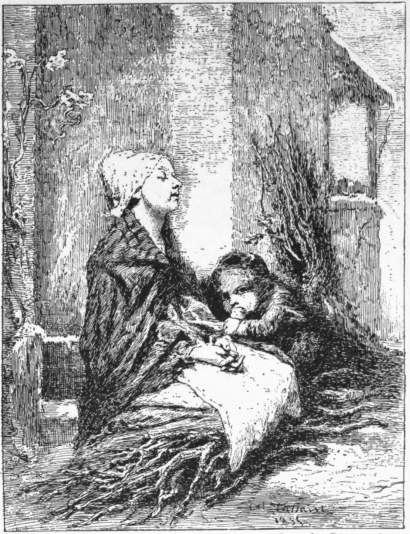
Baschet. Gaz. des Beaux-Arts.
TASSAERT. AFTER THE BALL. TASSAERT. THE ORPHANS.
But his nightingale died, and then the dog, who should have followed at his funeral. He could not survive the blow. He broke his palette, threw his colours into the fire, lit a pan of charcoal that he might die like “The Unhappy Family,” and was found suffocated on the following day. On a scrap of paper he had written, without regard to metre or orthography, a few verses to his nightingale and his dog.
There is much that is magniloquent and sentimental in Tassaert’s pictures. His poor women perish with the big eyes of the heroines of Ary Scheffer. Nevertheless he belongs to the advance line of modern art, and suffered shipwreck merely because he gave the signal too early. The sad reality prevails in his work. Merciless as a surgeon operating on a diseased limb, he made a dissecting-room of his art, which is often brutal where his brush probes the deepest wounds of civilisation. There is nothing in his pictures but wretched broken furniture, stitched rags, and pale faces in which toil and hunger have ploughed their terrible furrows. He painted the degeneration of man perishing from lack of light and air. Himself a Fleming, he has found his greatest follower in another Netherlander, Charles de Groux, whose sombre pessimism dominates modern Belgian art.
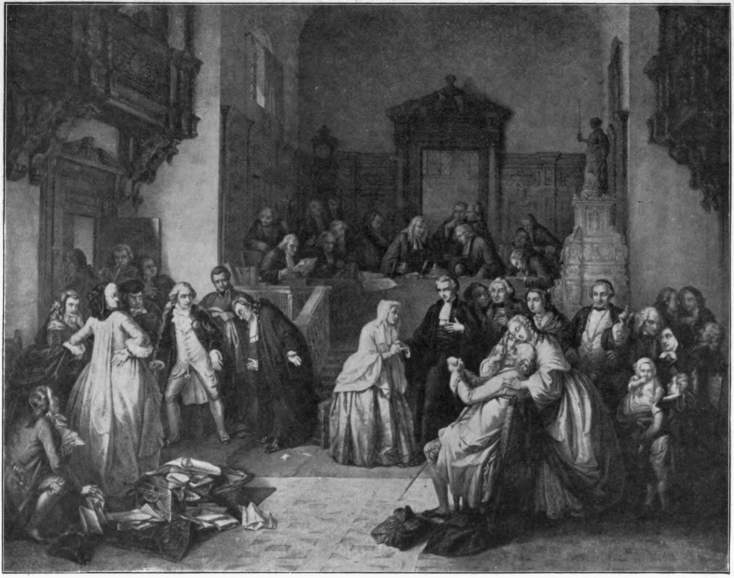
In Germany, where the socialistic writings of the French and English had a wide circulation, Gisbert Flüggen, in Munich known as the German Wilkie, was perhaps the first who as early as the forties went somewhat further than the humorous representation of rustics, and entered into a certain relation with the social ideas of his age in such pictures as “The Interrupted Marriage Contract,” “The Unlucky Gamester,” “The Mésalliance,” “Decision of the Suit,” “The Disappointed Legacy Hunter,” “The Execution for Rent,” and the like. Under his influence Danhauser in Vienna deserted whimsicalities for the representation of social conflicts in middle-class life. To say nothing of his “Gormandizer,” he did this in “The Opening of the Will,” where in a somewhat obtrusive manner the rich relations of the deceased are grouped to the right and the poor relations to the left, the former rubicund, sleek, and insolent, the latter pale, spare, and needily clad. An estimable priest is reading the last testament, and informs the poor relatives with a benevolent smile that the inheritance is theirs, whereon the rich give way to transports of rage.
Yet more clearly, although similarly transposed into a sentimental key, is the mood of the time just previous to 1848, reflected in the works of Carl Hübner of Düsseldorf. Ernest Wilkomm in the beginning of the forties had represented in his sensational genre pictures, particularly in the “White Slaves,” the contrast between afflicted serfs and cruel landlords, between rich manufacturers and famishing artisans; Robert Prutz had written his Engelchen, in which he had announced the ruin of independent handicraft by the modern industrial system. Soon afterwards the famine among the Silesian weavers, the intelligence of which in 1844 flew through all Germany, set numbers of people reflecting on the social question. Freiligrath made it the subject of his verses, Aus dem Schlesischen Gebirge, the song of the poor weaver’s child who calls on Rübezahl—one of his most popular poems. And yet more decisively does the social and revolutionary temper of the age find an echo in Heine’s Webern, composed in 1844. Even Geibel was impelled to his poem Mene Tekel by the spread of the news, though it stands in curious opposition to his manner of writing elsewhere. Carl Hübner therefore was acting very seasonably when he likewise treated the distress of the Silesian weavers in his first picture of 1845.
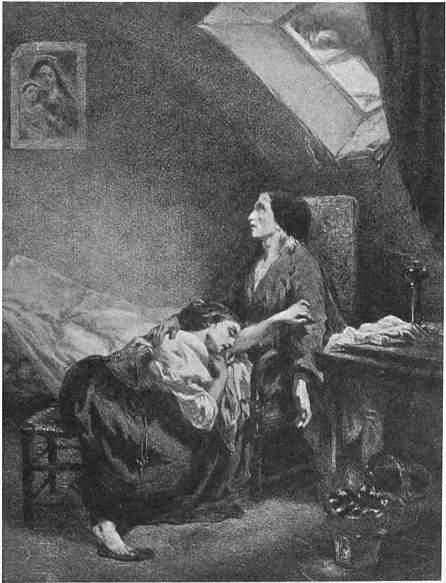
TASSAERT. THE SUICIDE.
Hübner knew the life of the poor and the heavy-laden; his feelings were with them, and he expressed what he felt. This gives him a position above and apart from the rest in the insipidly smiling school of Düsseldorf, and sets his name at the beginning of a new chapter in the history of German genre painting. His next picture, “The Game Laws,” sprang from an occasion which was quite as historical: a gamekeeper had shot a poacher. In 1846 followed “The Emigrants,” “The Execution for Rent” in 1847, and in 1848 “Benevolence in the Cottage of the Poor.” These were works in which he continued to complain of the misery of the working classes, and the contrast between ostentatious wealth and helpless wretchedness, and to preach the crusade for liberty and human rights. In opposition to the usual idyllic representations, he spoke openly for the first time of the material weight oppressing large classes of men. Undoubtedly, however, the artistic powers of the painter corresponded but little to the good intentions of the philanthropist.
In 1853 even the historical painter Piloty entered this path in one of his earliest pictures, “The Nurse”: the picture represents a peasant girl in service as a nurse in the town, with her charge on her arm, entering the dirty house of an old woman with whom she is boarding her own child. The rich child, already dressed out like a little lady, is exuberant in health, whilst her own is languishing in a dark and cold room without food or warm clothing.
In Belgium Eugène de Block first took up these lines. The artistic development of his character is particularly interesting, inasmuch as he went through various transformations. First he had come forward in 1836 with the representation of a brawl amongst peasants, a picture which contrasted with the tameness of contemporary painting by a native power suggestive of Brouwer. Then, following the example of Madou and Braekeleer, he occupied himself for a long time with quips and jests. At a time when every one had a type to which he remained true as long as he lived, Block chose poachers and game-keepers, and represented their mutual cunning, now enveloping them, after the example of Braekeleer, in the golden light and brown shadows of Ostade, now throwing over them a tinge of Gallait’s cardinal red. But this forced humour did not satisfy him long; he let comicalities alone, and became the serious observer of the people. A tender compassion for the poor may be noticed in his works, though without doubt it often turns to a tearful sentimentalism. He was an apostle of humanity who thundered against pauperism and set himself up as spokesman on the social question; a tribune of the people, who by his actions confirmed his reputation as a democratic painter. This it is which places him near that other socialistic agitator who in those days was filling Brussels with his fame.
Hanfstaengl.
FLÜGGEN. THE DECISION OF THE SUIT.
It was in 1835 that a young man wrote to one of his relatives from Italy the proud words: “I will measure my strength with Rubens and Michael Angelo.”
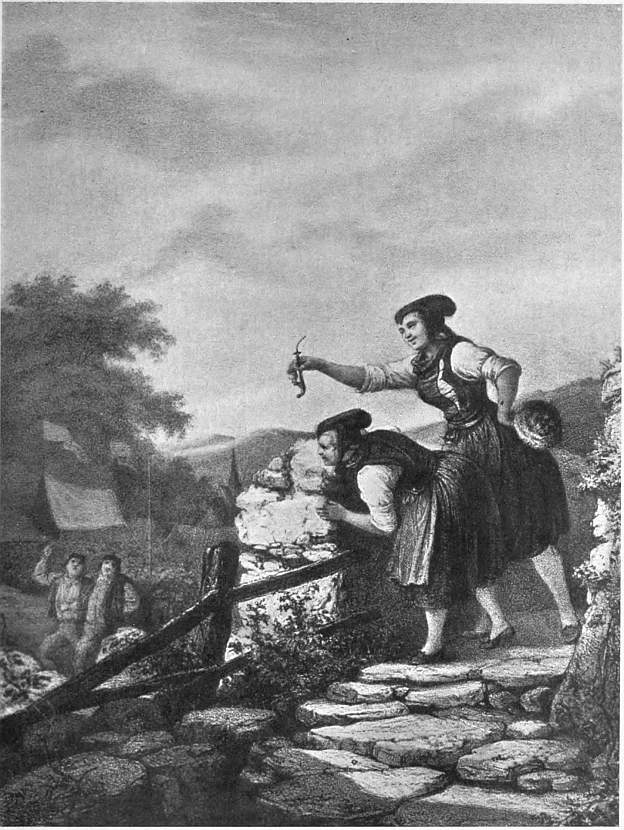
HÜBNER. JULY.
Having gained the Prix de Rome, he was enabled to make a sojourn in the Eternal City. He was thinking of his return. He was possessed of a lofty ambition, and dreamt of rivalling the fame of the old masters. As a victor he made an entry into his native land, into the good town of Dinant, which received him like a mother. He was accompanied by a huge roll of canvas like a declaration of war. But he needed a larger battle-field for his plans. “I imagine,” said he, “that the universe has its eyes upon me.” So he went on to Paris with his “Patroclus” and a few other pictures. No less than six thousand artists had seen the work in Rome: a prince of art, Thorwaldsen, had said when he beheld it: “This young man is a giant.” And the young man was himself of that opinion. With the gait of a conqueror he entered Paris, in the belief that artists would line the streets to receive him. But when the portals of the Salon of 1839 were opened he did not see his picture there. It was skied over a door, and no one noticed it. Théophile Gautier, Gustave Planché, and Bürger-Thoré wrote their articles without even mentioning it with one word of praise or blame.
For one moment he thought of exhibiting it out of doors in front of the Louvre, of calling together a popular assembly and summoning all France to decide. But an application to the minister was met with a refusal, and he returned to Brussels hanging his head. There he puffed his masterpiece, “The Fight round the Body of Patroclus,” in magniloquent phrases upon huge placards. A poet exclaimed, “Hats off: here is a new Homer.” The Moniteur gave him a couple of articles. But when the Exhibition came, artists were again unable to know what to make of it. The majority were of an opinion that Michael Angelo was brutally parodied by these swollen muscles and distorted limbs. And no earthquake disturbed the studios, as the painter had expected. However, he was awarded a bronze medal and thanked in an honest citizen-like fashion “for the distinguished talent which he had displayed.” Then his whole pride revolted. He circulated caricatures and cried out: “This medal will be an eternal blot on the century.” Then he published in the Charivari an open letter to the king. “Michael Angelo,” he wrote, “never allowed himself to pass final judgment on the works of contemporary artists, and so His Majesty, who hardly understands as much about art as Michael Angelo, would do well not to decide on the worth of modern pictures after a passing glance.”
Antoine Wiertz, the son of a gendarme who had once been a soldier of the great Republic, was born in Dinant in 1806. By his mother he was a Walloon, and he had German blood in him through his father, whose family had originally come from Saxony. German moral philosophy and treatises on education had formed the reading of his youthful years. He had not to complain of want of assistance. At the declaration of Belgian independence he was five-and-twenty; so his maturity fell in the proud epoch when the young nation laid out everything to add artistic to political splendour. Even as a boy, their only child, he was idolised by his parents, the old gendarme and the honest charwoman. His first attempts were regarded by his relations as marvels. The neighbours went into raptures over a frog he had modelled, “which looked just as if it were alive.” The landlord of a tavern ordered a signboard from him, and when it was finished the whole population stood before it in admiration. A certain Herr Maibe, who was artistically inclined, had his attention directed to the young genius, undertook all the expenses of his education, and sent him to the Antwerp Academy. There he obtained a government scholarship, and gained in 1832 the Prix de Rome. From the first he was quite clear as to his own importance.
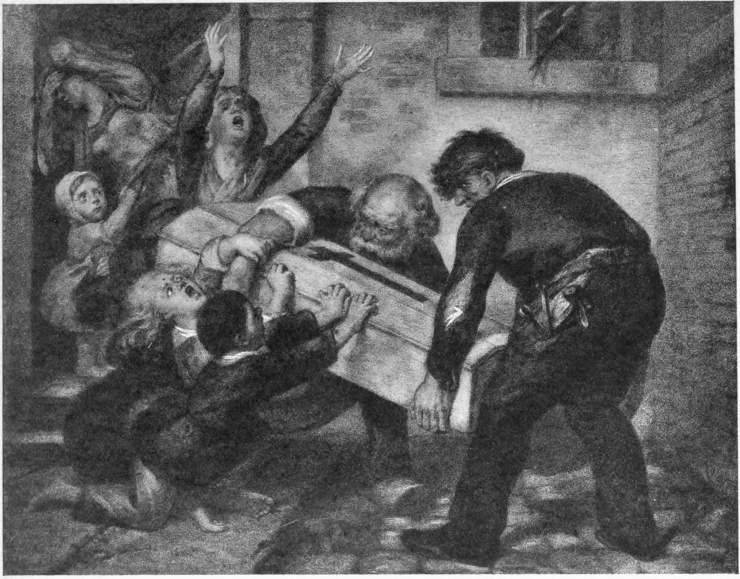
American Art Review.
WIERTZ. THE ORPHANS.
Even as a pupil at the Antwerp Academy he wrote in a letter to his father contemptuously of his fellow-students’ reverence for the old masters. “They imagine,” said he, “that the old masters are invincible gods, and not men whom genius may surpass.” And instead of admonishing him to be modest, his father answered with pride: “Be a model to the youth of the future, so that in later centuries young painters may say, ‘I will raise myself to fame as the great Wiertz did in Belgium.’” Such dangerous flattery would have affected stronger characters. It needed only the Italian journey to send him altogether astray. Michael Angelo made him giddy, as had been the case with Cornelius, Chenavard, and many another. With all the ambition of a self-taught man he held every touch of his brush to be important, and was indignant if others refused to think the same. After his failures in Paris and Brussels he began to find high treason in every criticism, and started a discussion on “the pernicious influence of journalism upon art and literature.” We find him saying: “If any one writes ill of me when I am dead, I will rise from the grave to defend myself.”
In his hatred of criticism he resolved to exhibit no more, lived a miserable existence till his death in 1865, and painted hasty and careless portraits, pour la soupe, when he was in pressing need of money. These brought him at first from three to four hundred, and later a thousand francs. He indulged in colossal sketches, for the completion of which the State built him in 1850 a tremendous studio, the present Musée Wiertz. It stands a few hundred paces from the Luxembourg station, to the extreme north of the town, in a beautiful though rather neglected little park, a white building with a pillared portico and a broad perron leading up to it. Here he sat in a fantastically gorgeous costume, for ever wearing his great Rubens hat. Philanthropic lectures on this world and the next, on the well-being of the people and the diseases of modern civilisation, were the fruits of his activity. Whoever loves painting for painting’s sake need never visit the museum.
There there are battles, conflagrations, floods, and earthquakes; heaven and earth are in commotion. Giants hurl rocks at one another, and try, like Jupiter, to shake the earth with their frown. All of them delight in force, and bring their muscles into play like athletes. But the painter himself is no athlete, no giant as Thorwaldsen called him, and no genius as he fancied himself to be. Le singe des génies, he conceived the notion of “great art” purely in its relation to space, and believed himself greater than the greatest because his canvases were of greater dimensions. When the ministry thought of making him Director of the Antwerp Academy, after the departure of Wappers, he wrote the following characteristic sentences: “I gather from the newspapers that I may be offered the place of Wappers.” If in the moment when the profound philosopher is pondering over sublime ideas people were to say to him, “Will you teach us the A, B, C? I believe that he whose dwelling-place is in the clouds would fall straight from heaven to earth.” Living in an atmosphere of flattery at home, and overpowered by the incense which was there offered to his genius, he could not set himself free from the fixed idea of competing with Michael Angelo and Rubens. Below his picture of “The Childhood of Mary” he placed the words: “Counterpart to the picture by Rubens in Antwerp treating the same subject.” He offered his “Triumph of Christ” to the cathedral there under the condition of its being hung beside Rubens’ “Descent from the Cross.” “The Rising up of Hell” he wished to exhibit of an evening in the theatre when it was opened for a performance. During the waits the audience were to contemplate the picture while a choir sang with orchestral accompaniment. But all these offers were declined with thanks.
Such failures make men pessimists; but it was through them that Wiertz, after being an historical painter, became the child of his age. He began to hurl thunderbolts against the evils of modern civilisation. He preaches and lashes and curses and suffers. The forms of which he makes use are borrowed from the old masters. The man of Michael Angelo, with his athletic build, his gigantic muscles, his nude body, the man of the Renaissance and not the man of the nineteenth century, strides through his works; it is only in the subject-matter of his pictures that the modern spirit has broken through the old formula. All the questions which have been thrown out by the philosophy and civilisation of the nineteenth century are reflected as vast problems in his vast pictures. He fashions his brush into a weapon with which he fights for the disinherited, for the pariahs, for the people. He is bent on being the painter of democracy—a great danger for art.
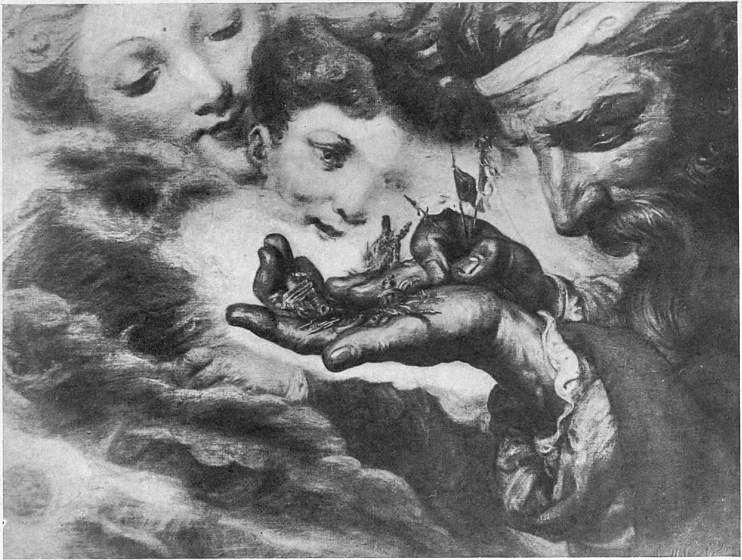
WIERTZ. THE THINGS OF THE PRESENT AS SEEN BY FUTURE AGES.
He agitates in an impassioned way against the horrors of war. His picture “Food for Powder” begins this crusade. A cannon is lying idle on the wall of a fortress, and around this slumbering iron monster children are playing at soldiers, with no suspicion that their sport will soon be turned into bitter earnest, and that in war they will themselves become food for this demon. In another picture, “The civilisation of the Nineteenth Century,” soldiers intoxicated with blood and victory have broken into a chamber by night and are stabbing a mother with her child. A third, “The Last Cannon Shot,” hints dimly at the future pacification of the world. “A Scene in Hell,” however, is the chief of the effusions directed against war. The Emperor Napoleon in his grey coat and his historical three-cornered hat is languishing in hell; wavering flames envelop him as with a flowing purple mantle, and an innumerable multitude of mothers and sisters, wives and betrothed maidens, children and fathers, from whom he has taken their dearest are pressing round him. Fists are clenched against him, and screams issue from toothless, raging mouths. He, on the other hand, with his arms crossed on his breast, and his haughty visage stern and gloomy, stands motionless, looking fixedly with satanic eyes upon the thousands whose happiness he has destroyed.
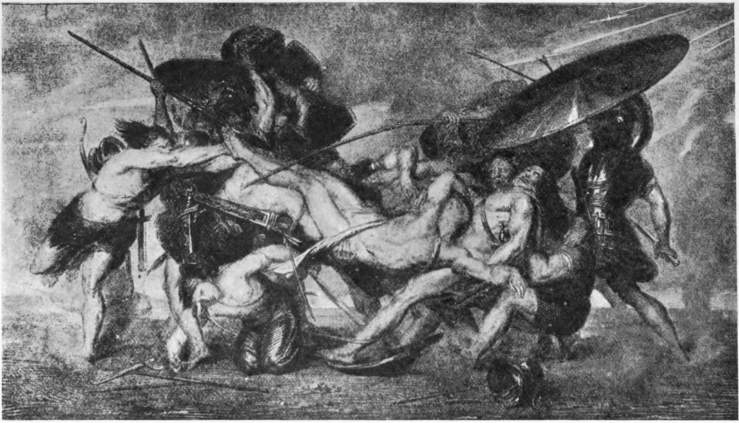
WIERTZ. THE FIGHT ROUND THE BODY OF PATROCLUS.
In his “Thoughts and Visions of a Decapitated Head”, Wiertz, moved by Victor Hugo’s Le dernier jour d’un condamné, makes capital punishment a subject of more lengthy disquisition. The picture, which is made up of three parts, is supposed to represent the feelings of a man, who has been guillotined, during the first three minutes after execution. The border of the picture contains a complete dissertation: “The man who has suffered execution sees his body dried up and in corruption in a dark corner; and sees also, what it is only given to spirits of another world to perceive, the secrets of the transmutation of matter. He sees all the gases which have formed his body, and its sulphurous, earthy, and ammoniacal elements, detach themselves from its decaying flesh and serve for the structure of other living beings.... When that abominable instrument the guillotine is one day actually abolished, may God be praised,” and so on.
Beside this painted plea against capital punishment hangs “The Burnt Child,” as an argument in favour of crêches. A poor working woman has for one moment left her garret. Meanwhile a fire has broken out, and she returns to find the charred body of her boy. In the picture “Hunger, Madness, and Crime” he treats of human misery in general, and touches on the question of the rearing of illegitimate children. There is a young girl forced to live on the carrots which a rich man throws into the gutter. In consequence of a notification to pay taxes she goes out of her mind, and with hellish laughter cuts to pieces the baby who has brought her to ruin. Cremation is recommended in the picture “Buried too soon”: there is a vault, and in it a coffin, the lid of which has been burst open from the inside; through the cleft may be seen a clenched hand, and in the darkness of the coffin the horror-stricken countenance of one who is piteously crying for help.
In the “Novel Reader” he endeavours to show the baneful influence of vicious reading upon the imagination of a girl. She is lying naked in bed, with loosened hair and a book in her hand; her eyes are reddened with hysterical tears, and an evil spirit is laying a new book on the couch, Antonine, by Alexandre Dumas Fils. “The Retort of a Belgian Lady”—an anticipation of Neid—glorifies homicide committed in the defence of honour. A Dutch officer having taken liberties with a Belgian woman, she blows out his brains with a pistol. In “The Suicide” the fragments of a skull may be seen flying in all directions. How the young man who has just destroyed himself came to this pass may be gathered from the book entitled Materialism, which lies on his table. And thus he goes on, though the spectator feels less and less inclined to take any serious interest in these lectures. For although the intentions of Wiertz had now and then a touch of the sublime, he was neither clear as to the limits of what could be represented nor did he possess the capacity of expressing what he wished in artistic forms. Like many a German painter of those years, he was a philosopher of the brush, a scholar in disguise, who wrote out his thoughts in paint instead of ink.
Wiertz made painting a vehicle for more than it can render as painting: with him it begins to dogmatise; it is a book, and it awakens a regret that this rich mind was lost to authorship. There he might, perhaps, have done much that was useful towards solving the social and philosophical questions of the day; as he is, he has nothing to offer the understanding, and only succeeds in offending the eye. A human brain with both great and trivial ideas lays itself bare. But, like Cornelius, from the mere fulness of his ideas he was unable to give them artistic expression. He groped from Michael Angelo to Rubens, and from Raphael to Ary Scheffer, without realising that the artistic utterance of all these masters had been an individual gift. The career of Wiertz is an interesting psychological case. He was an abnormal phenomenon, and he cannot be passed over in the history of art, because he was one of the first who treated subjects from modern life in large pictures. Never before had a genuinely artistic age brought forth such a monster, yet it is impossible to ignore him, or deny that he claims a certain degree of importance in the art history of the past century.
CHAPTER XXII
THE VILLAGE TALE
During the decade following the year 1848 genre painting in Germany threw off the shackles of the anecdotic style, and continued a development similar to that of history, which, in the same country, flourished long after it was moribund elsewhere. After the elder artists, who showed so much zeal in producing perfectly ineffective little pictures, executed with incredible pains and a desperate veracity of detail, there followed, from 1850, a generation who were technically better equipped. They no longer confined themselves to making tentative efforts in the manner of the old masters, but either borrowed their lights directly from the historical painters in Paris, or were indirectly made familiar with the results of French technique through Piloty. Subjects of greater refinement were united with a treatment of colour which was less offensive.
The childlike innocence which had given pleasure in Meyerheim and Waldmüller was now thought to be too childlike by far. The merriment which radiated from the pictures of Schroedter or Enhuber found no echo amidst a generation which was tired of such cheap humour: the works of Carl Hübner were put aside as lachrymose and sentimental efforts. When the world had issued from the period of Romanticism there was no temptation to be funny over modern life nor to make socialistic propaganda; for after the Revolution of 1848 people had become reconciled to the changed order of affairs and to life as it actually was—its cares and its worries, its mistakes and its sins. It was the time when Berthold Auerbach’s village tales ran through so many editions; and, hand in hand with these literary productions, painting also set itself to tell little stories from the life of sundry classes of the people, amongst which rustics were always the most preferable from their picturesqueness of costume.
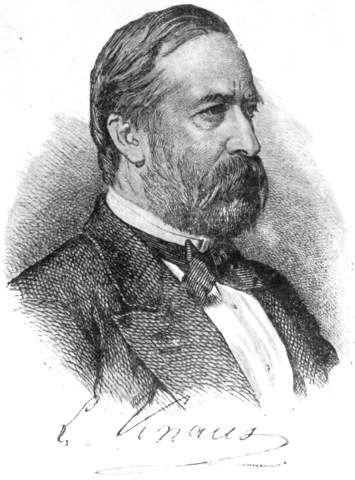
At the head of this group of artists stands Louis Knaus, and if it is difficult to hymn his praises at the present day, that is chiefly because Knaus mostly drew upon that sarcastic and ironical characteristic which is such an unpleasant moral note in the pictures of Hogarth, Schroedter, and Madou. The figures of the old Dutch masters behave as if the glance of no stranger were resting upon them: it is possible to share their joys and sorrows, which are not merely acted. We feel at our ease with them because they regard us as one of themselves. In Knaus there is always an artificial bond between the figures and the frequenters of the exhibition. They plunge into the greatest extravagances to excite attention, tickle the spectator to make him laugh, or cry out to move him to tears. With the exception of Wilkie, no genre painter has explained his purpose more obtrusively or in greater detail. Even when he paints a portrait, by way of variation, he stands behind with a pointer to explain it. On this account the portraits of Mommsen and Helmholtz in the Berlin National Gallery are made too official. Each of them is visibly conscious that he is being painted for the National Gallery, and by emphasis and the accumulation of external characteristics Knaus took the greatest pains to lift these personalities into types of the nineteenth-century scholar.
Since popular opinion is wont to represent the philologist as one careless of outward appearance, and the investigator of natural philosophy as an elegant man of the world,—Mommsen must wear boots which have seen much service, and those of Helmholtz must be of polished leather; the shirt of the one must be genially rumpled, and that of the other must fit him to perfection. By such obvious characterisation the Sunday public was satisfied, but those who were represented were really deprived of character. It is not to be supposed that in Mommsen’s room the manuscripts of all his principal works would lie so openly upon the writing-table and beneath it, so that every one might see them: it is not probable that his famous white locks would flutter so as he sat at the writing-table. Even the momentary gesture of the hand has in both pictures something obtrusively demonstrative. “Behold, with this pen I have written the history of Rome,” says Mommsen. “Behold, there is the famous ophthalmometer which I invented,” says Helmholtz.
But as a genre painter Knaus has fallen still more often into such intolerable stage gesticulation. The picture “His Highness upon his Travels” is usually mentioned as that in which he reached his zenith in characterisation. Yet is not this characterisation in the highest degree exaggerated? Is not the expression apportioned to every figure, like parts to a theatrical company, and does not the result seem to be strained beyond all measure? Just look at the children, see how each plays a part to catch your eye. A little girl is leaning shyly on her elder sister, who has bashfully thrust her finger into her mouth: some are looking on with rustic simplicity, others with attention: a child smaller than the others is puckering up its face and crying miserably. The prince, in whose honour the children are drawn up, passes the group with complete indifference, while his companion regards “the people” haughtily through his eyeglass. The schoolmaster bows low, in the hope that his salary may be raised, whilst the stupid churchwarden looks towards the prince with a jovial smile, as though he were awaiting his colleague from the neighbouring village. Of course, they are all very intelligible types; but they are no more than types. For the painter the mere accident of the moment is the source of all life. Would that six-year-old peasant child who stands with the greatest dignity in Knaus’s picture as “The Village Prince” have ever stood in that fashion, with a flower between his teeth and his legs thrust apart, unless he had been carefully taught this self-conscious pose by the painter himself? So that there may not be the slightest doubt as to which of the shoemaker’s apprentices is winning and which is losing, one of them has to have a knowing smirk, whilst the other is looking helplessly at his cards. And how that little Maccabee is acting to the public in “The First Profit!” The old man in threadbare clothes, who stands in an ante-chamber rubbing his hands in the picture “I can Wait”; the frightened little girl who sees her bit of bread-and-butter imperilled by geese in “In Great Distress,”—they have all the same deliberate comicality, they are all treated with the same palpable carefulness, the same pointed and impertinently satirical sharpness. Even in “The Funeral” he is not deserted by the humorous proclivity of the anecdotist, and the schoolmaster has to brandish the bâton with which he is conducting the choir of boys and girls as comically as possible. Knaus uses too many italics, and underlines as if he expected his public to be very dull of understanding. In this way he appeals to simple-minded people, and irritates those of more delicate taste. The peasant sits in his pictures like a model; he knows that he must keep quiet, and neither alter his pose nor his grimace, because otherwise Knaus will be angry. All his pictures show signs of the superior and celebrated city gentleman, who has only gone into the country to interest himself in the study of civilisation: there he hunts after effectively comical features, and, having arranged his little world in tableaux vivants, he coolly surrenders it to the derision of the cultivated spectator.
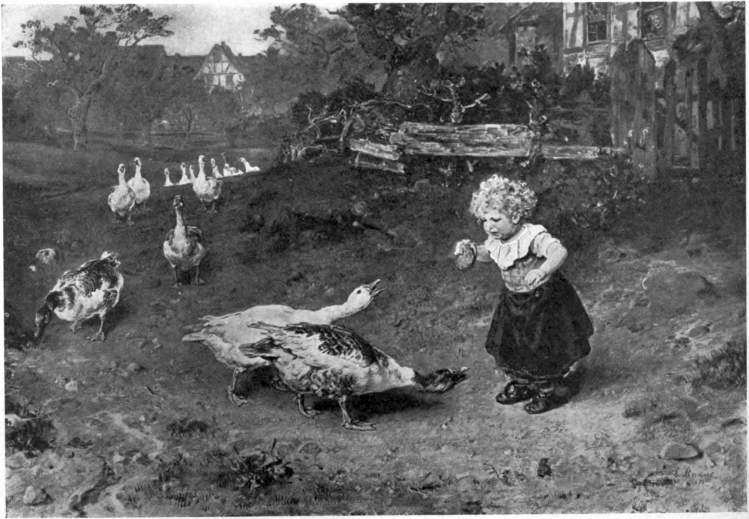
KNAUS. IN GREAT DISTRESS.
(By permission of the Berlin Photographic Co., the owners of the copyright.)
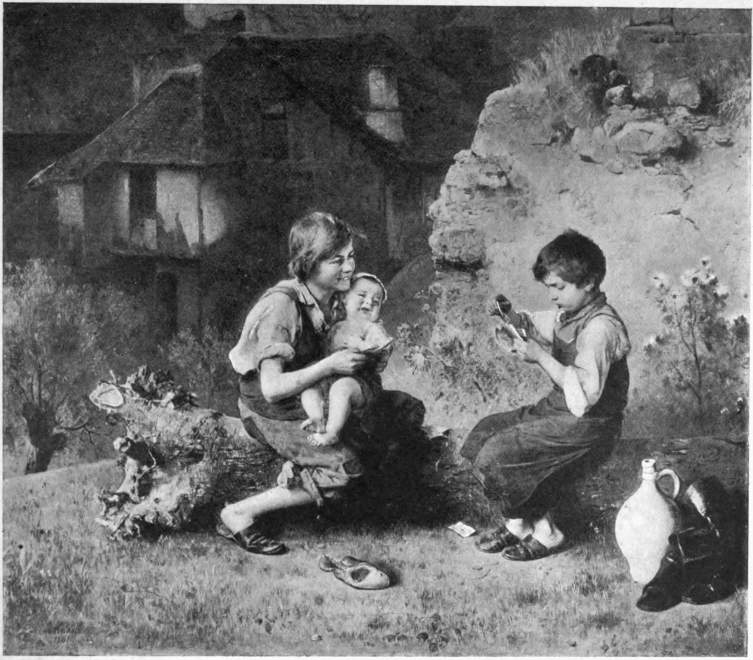
KNAUS. THE CARD PLAYERS.
(By permission of the Berlin Photographic Co., the owners of the copyright.)
But such a judgment, which seems like a condemnation, could not be maintained from the historical standpoint. Germany could not forget Knaus, if it were only for the fact that in the fifties he sided with those who first spread the unusual opinion that painting was incomprehensible without sound ability in the matter of colour. He was not content, like the elder generation, to arrange the individual characters in his pictures in well-disposed groups. He took care to make his works faultless in colouring, so that in the fifties he not only roused the enthusiasm of the great public by his “poetic invention,” but made even the Parisian painters enthusiastic by his easy mastery of technique.
To the following effect wrote Edmond About in 1855: “I do not know whether Herr Knaus has long nails; but even if they were as long as those of Mephistopheles, I should still say that he was an artist to his fingers’ ends. His pictures please the Sunday public and the Friday public, the critics, the bourgeois, and (God forgive me!) the painters. What is seductive to the great multitude is the clearly expressed dramatic idea, while artists and connoisseurs are won by his knowledge and thorough ability. Herr Knaus has the capacity of satisfying every one. His pictures attract the most incompetent eyes, because they tell pleasant anecdotes; but they likewise fascinate the most jaded by perfect execution of detail. The whole talent of Germany is contained in the person of Herr Knaus. So Germany lives in the Rue de l’Arcade in Paris.”
In the fifties all the technical ability which was to be gained from the study of the old Dutch masters and from constant commerce with the modern French reached its highest point in Knaus. Even in his youth the great Netherlandish painters, Ostade, Brouwer, and Teniers, must have had more effect upon him than his teachers, Sohn and Schadow, since his very first pictures, “The Peasants’ Dance” of 1850 and “The Card Sharpers” of 1850, had little in common with the Düsseldorf school, and therefore so much the more with the Netherlandish chiaroscuro. “The Card Sharpers” is precisely like an Ostade modernised. By his migration to Paris in 1852 he sought to acquire the utmost perfection of finish; and when he returned home, after a sojourn of eight years, he had at his command such a sense for effect and fine harmony of tone, such a knowledge of colour, and such a disciplined and refined taste, that his works indicate an immeasurable advance on the motley harshness of his predecessors. His “Golden Wedding” of 1858—perhaps his finest picture—had nothing of the antiquated technique of the older type of Düsseldorf pictures of peasant life; technically it stood on a level with the works of the French.
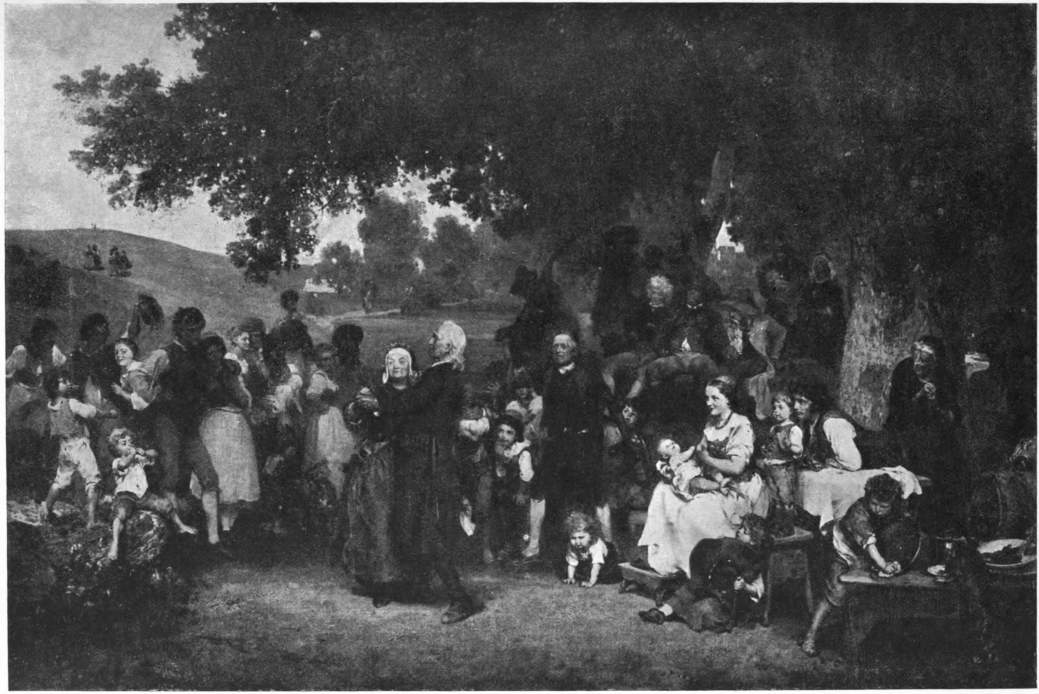
KNAUS. THE GOLDEN WEDDING.
(By permission of Messrs. Goupil & Co., the owners of the copyright.)
And Knaus has remained the same ever since: a separate personality which belongs to history. He painted peasant pictures of tragic import and rustic gaiety; he recognised a number of graceful traits in child-life, and, having seen a great deal of the world, he made a transition, after he had settled in Berlin, from the character picture of the Black Forest to such as may be painted from the life of cities. He even ventured to touch on religious subjects, and taught the world the limitations of his talent by his “Holy Families,” composed out of reminiscences of all times and all schools, and by his “Daniel in the Lions’ Den.” Knaus is whole-heartedly a genre painter; though that, indeed, is what he has in common with many other people. But thirty years ago he had a genius for colour amid a crowd of narrative and character painters, and this makes him unique. He is a man whose significance does not merely lie in his talent for narrative, but one who did much for German art. It may be said that in giving the genre picture unsuspected subtleties of colour he helped German art to pass from mere genre painting to painting pure and simple. In this sense he filled an artistic mission, and won for himself in the history of modern painting a firm and sure place, which even the opponent of the illustrative vignette cannot take from him.
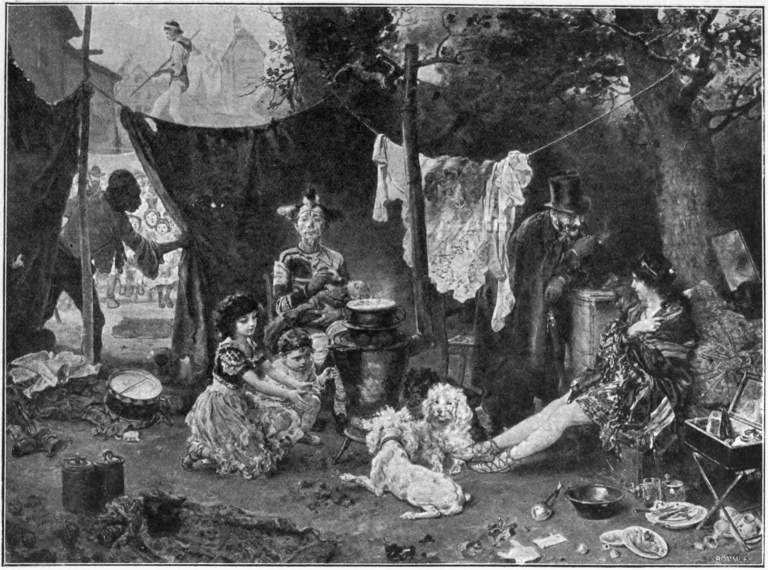
Seemann, Leipzig.
KNAUS. BEHIND THE SCENES.
Vautier, who must always be named in the same breath with Knaus, is in truth the exact opposite of the Berlin master. He also is essentially a genre painter, and his pictures should not be merely seen but studied in detail; but where Knaus has merits Vautier is defective, and where Knaus is jarring Vautier has merits. In technique he cannot boast of similar qualities. He is always merely a draughtsman who tints, but has never been a colourist. As a painter he has less value, but as a genre painter he is more sympathetic. In the pictures of Knaus one is annoyed by the deliberate smirk, by his exaggerated and heartlessly frigid observation. Vautier gives pleasure by characterisation, more delicately reserved in its adjustment of means, and profound as it is simple, by his wealth of individual motives and their charm, and by the sensitiveness with which he renders the feelings and relationship of his figures. A naïve, good-humoured, and amiable temperament is betrayed in his works. He is genially idyllic where Knaus creates a pungently satirical effect, and a glance at the portraits of the two men explains this difference.
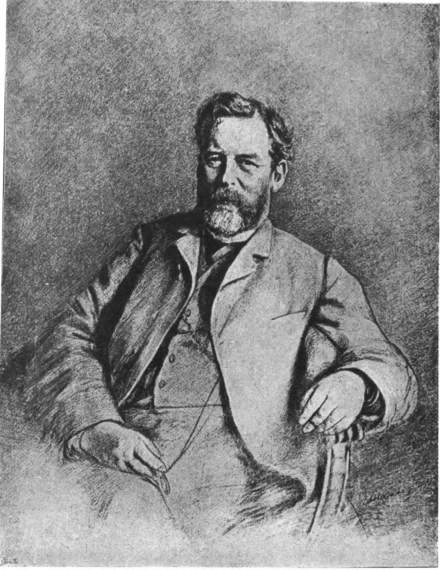
Kunst für Alle.
BENJAMIN VAUTIER.
Knaus with his puckered forehead, and his searching look shooting from under heavy brows, is like a judge or a public prosecutor. Vautier, with his thoughtful blue eyes, resembles a prosperous banker with a turn for idealism, or a writer of village tales à la Berthold Auerbach. Knaus worried himself over many things, brooded much and made many experiments; Vautier was content with the acquisition of a plain and simple method of painting, which appeared to him a perfectly sufficient medium for the expression of that which he had realised with profound emotion. The one is a reflective and the other a dreamy nature. Vautier was a man of a happy temperament, one with whom the world went well from his youth upwards, who enjoyed an existence free from care, and who had accustomed himself as a painter to see the world in a rosy light. There is something sound and pure in his characters, in his pictures something peaceful and cordial; it does not, indeed, make his paltry pedantic style of painting any the better, but from the human standpoint it touches one sympathetically. His countrymen may be ashamed of Vautier as a painter when they come across him amongst aliens in foreign exhibitions, but they rejoice in him none the less as a genre painter. It is as if they had been met by the quiet, faithful gaze of a German eye amid the fiery glances of the Latin nations. It is as if they suddenly heard a simple German song, rendered without training, and yet with a great deal of feeling. A generation ago Knaus could exhibit everywhere as a painter; as such Vautier was only possible in Germany during the sixties. But in Knaus it is impossible to get rid of the impress of the Berlin professor, while from Vautier’s pictures there smiles the kindly sentiment of German home-life. Vautier’s world, no doubt, is as one-sided as that of old Meyerheim. His talkative Paul Prys, his brides with their modest shyness, his smart young fellows throwing amorous glances, his proud fathers, and his sorrow-stricken mothers are, it may be, types rather than beings breathing positive and individual life. Such a golden radiance of grace surrounds the pretty figures of his bare-footed rustic maidens as never pertained to those of the real world, but belongs rather to the shepherdess of a fairy tale who marries the prince. His figures must not be measured by the standard of realistic truth to nature. But they are the inhabitants of a dear, familiar world in which everything breathes of prettiness and lovable good-humour. It is almost touching to see with what purity and beauty life is reflected in Vautier’s mind.
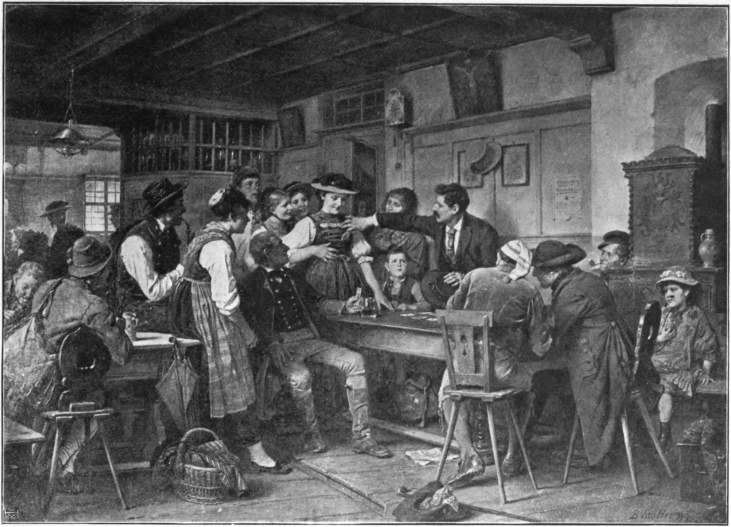
Hanfstaengl.
VAUTIER. THE CONJURER.
How dainty are these brown-eyed Swabian peasant girls, how tender and sympathetic the women, and how clean and well-behaved the children! You could believe that Vautier mixed with his peasants like a friend or a benevolent god-father, that he delighted in their harmless pleasures, that he took part in their griefs and cares. In his pictures he does not give an account of his impressions with severity or any deliberate attempt to amuse, but with indulgence and cordiality. It is not his design to excite or to thrill, to waken comedy through whimsicalities or mournfulness by anything tragical. Life reveals to him “merely pleasant things,” as it did to Goethe during his tour in Italy, and even in its tragedies only people “who bear the inevitable with dignity.” He never expressed boisterous grief: everything is subdued, and has that tenderness which is associated with the mere sound of his Christian name, Benjamin. Knaus has something of Menzel, Vautier of Memlinc: he has it even in the loving familiarity with which he penetrates minute detail. In their religious pictures the old German and Netherlandish masters painted everything, down to the lilies worked on the Virgin’s loom, or the dust lying on the old service-book; and this thoroughly German delight in still life, this complacent rendering of minutiæ, is found again in Vautier.
Men and their dwellings, animated nature and atmosphere, combine to make a pleasant world in his pictures. Vautier was one of the first to discover the magic of environment, the secret influence which unites a man to the soil from which he sprang, the thousand unknown, magnetic associations existing between outward things and the spirit, between the intuitions and the actions of man. The environment is not there like a stage scene in front of which the personages come and go; it lives and moves in the man himself. One feels at home in these snug and cosy rooms, where the Black Forest clock is ticking, where little, tasteless photographs look down from the wall with an honest, patriarchal air, where the floor is scoured so clean, and greasy green hats hang on splendid antlers. There is the great family bed with the flowered curtains, the massive immovable bench by the stove, the solid old table, around which young and old assemble at meal-times. There are the great cupboards for the treasures of the house, the prayer-book given to grandmother at her confirmation, the filigree ornaments, the glasses and coffee-cups, which are kept for show, not for daily use. Over the bedstead are hung the little pictures of saints painted on glass, and the consecrated tokens. From the window one overlooks other appurtenances of the house; gaudy scarlet runners clamber in from the little garden, blossoming fruit-trees stand in its midst, and the gable of the well-filled barn rises above it. Everything has an air of peace and prosperity, the mood of a Sunday forenoon; one almost fancies that one can catch the chime of the distant church bells through the blissful stillness. But completeness of effect and pictorial harmony are not to be demanded: the illustrated paper is better suited to his style than the exhibition.
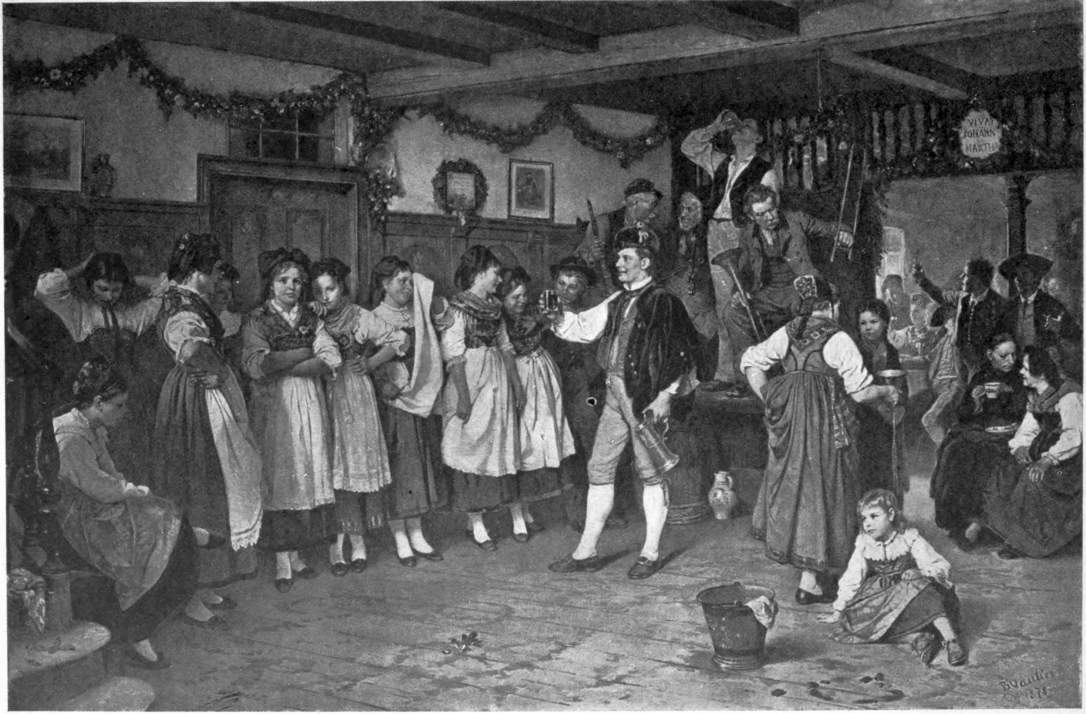
VAUTIER. THE DANCING LESSON.
(By permission of the Berlin Photographic Co., the owners of the copyright.)
The third member of the alliance is Franz Defregger, a man of splendid talent; of all the masters of the great Munich school of Piloty, he is at once the simplest and the healthiest. True it is, no doubt, that when posterity sifts and weighs his works, much of him, also, will be found too light. Defregger’s art has suffered from his fame and from the temptations of the picture market. Moreover, he had not Vautier’s fine sense of the limitations of his ability, but often represented things which he did not understand. He was less of a painter than any of the artists of Piloty’s school, and more completely tethered by the size of his picture. He could not go beyond a certain space of canvas without suffering for it; and he bound his talent on the bed of Procrustes when he attempted to paint Madonnas, or placed himself with his Hofer pictures in the rank of historical painters. But as a genre painter he stands beside Vautier, in the first line; and by these little genre pictures—the simpler and quieter the better—and some of his genially conceived and charming portrait studies, he will survive. Those are things which he understood and felt. He had himself lived amid the life he depicted, and so it was that what he depicted made such a powerful appeal to the heart.
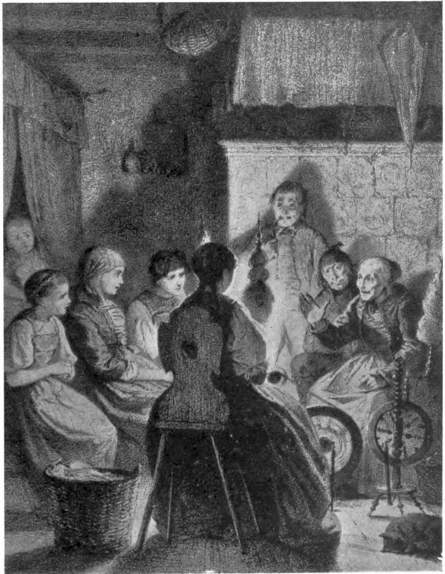
VAUTIER. NOVEMBER. FRANZ DEFREGGER.
The year 1869 made him known. The Munich Exhibition had in that year a picture on a subject from the history of the Hofer rising of 1809. It represented how the little son of Speckbacher, one of the Tyrolese leaders, had come after his father, armed with a musket; and at the side of an old forester he is entering the room in which Speckbacher is just holding a council of war. The father springs up angry at his disobedience, but also proud of the little fellow’s pluck. From this time Defregger’s art was almost entirely devoted to the Tyrolese people. To paint the smart lads and neat lasses of Tyrol in joy and sorrow, love and hate, at work and merry-making, at home or outside on the mountain pasture, in all their beauty, strength, and robust health, was the life-long task for which he more than any other man had been created. He had, over Knaus and most other painters of village tales, the enormous advantage of not standing personally outside or above the people, and not regarding them with the superficial curiosity of a tourist—for he belonged to them himself. Others, if ironically disposed, saw in the rustic the stupid, comic peasant; or, if inclined to sentimentalism, introduced into the rural world the moods and feelings of “society,” traits of drawing-room sensitiveness, the heavy air of the town. Models in national costume were grouped for pictures of Upper Bavarian rustic life. But Defregger, who up to the age of fifteen had kept his father’s cattle on the pastures of the Ederhof, had shared the joys and sorrows of the peasantry long enough to know that they are neither comic nor sentimental people.
The roomy old farmhouse where he was born in 1835 lay isolated amid the wild mountains. He went about bare-footed and bare-headed, waded through deep snow when he made his way to school in winter, and wandered about amid the highland pastures with the flocks in summer. Milkmaids and wood-cutters, hunters and cowherds, were his only companions. At fifteen he was the head labourer of the estate, helped to thresh the corn, and worked on the arable land and in the stable and the barn like others. When he was twenty-three he lost his father and took over the farm himself: he was thus a man in the full sense of the word before his artistic calling was revealed to him. And this explains his qualities and defects. When he came to Piloty after the sale of his farm and his aimless sojourn in Innsbruck and Paris he was mature in mind; he was haunted by the impressions of his youth, and he wanted to represent the land and the people of Tyrol. But he was too old to become a good “painter.” On the other hand, he possessed the great advantage of knowing what he wanted. The heroes of history did not interest him; it was only the Tyrolese woodmen who persisted in his brain. He left Piloty’s studio almost as he had entered it—awkward, and painting heavily and laboriously, and but very little impressed by Piloty’s theatrical sentiment. His youth and his recollections were rooted in the life of the people; and with a faithful eye he caught earnest or cheerful phases of that life, and represented them simply and cordially: and if he had had the strength to offer a yet more effectual resistance to the prevalent ideal of beauty, there is no doubt that his stories would seem even more fresh and vigorous.