Front matter (continued 2)
Reading edition
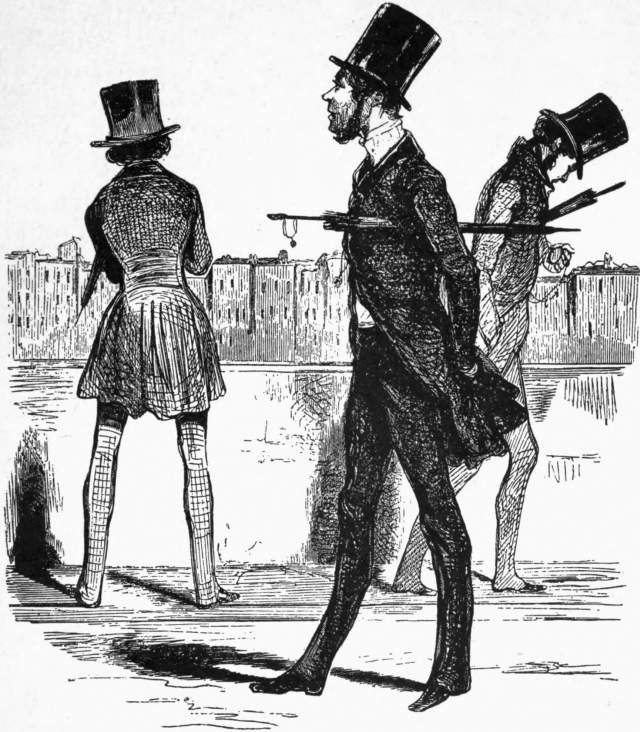
Hetzel, Paris.
GAVARNI. FOURBERIES DE FEMMES.
Au premier Mosieu.—“Attendez-moi ce soir, de quatre à cinq heures, quai de l’Horloge du Palais.—Votre Augustine.”
Au deuxième Mosieu.—“Ce soir, quai des Lunettes, entre quatre et cinq heures.—Votre Augustine.”
Au troisième Mosieu.—“Quai des Morfondus, ce soir, de quatre heures à cinq.—Votre Augustine.”
À un quatrième Mosieu.—“Je t’attends ce soir, à quatre heures.—Ton Augustine.”
Gustave Doré, to the lessening of his importance, moved on this ground only in his earliest period. He was barely sixteen and still at school in his native town Burg, in Alsace, when he made an agreement with Philippon, who engaged him for three years on the Journal pour rire. His first drawings date from 1844: “Les animaux socialistes,” which were very suggestive of Grandville, and “Désagréments d’un voyage d’agrément”—something like the German Herr und Frau Buchholz in der Schweiz—which made a considerable sensation by their grotesque wit. In his series “Les différents publics de Paris” and “La Ménagerie Parisienne” he represented with an incisive pencil the opera, the Théâtre des Italiens, the circus, the Odéon and the Jardin des Plantes. But since that time the laurels of historical painting have given him no rest. He turned away from his own age as well as from caricature, and made excursions into all zones and all periods. He visited the Inferno with Dante, lingered in Palestine with the patriarchs of the Old Testament, and ran through the world of wonders with Perrault. The facility of his invention was astonishing, and so too was the aptness with which he seized for illustration on the most vivid scenes from all authors. But he has too much Classicism to be captivating for very long. His compositions dazzle by an appearance of the grand style, but attain only an outward and scenical effect. His figures are academic variations of types originally established by the Greeks and the Cinquescentisti. He forced his talent when he soared into regions where he could not stand without the support of his predecessors. Even in his “Don Quixote” the figures lose in character the larger they become. Everything in Doré is calligraphic, judicious, without individuality, without movement and life, composed in accordance with known rules. There is a touch of Wiertz in him, both in his imagination and in his design, and his youthful works, such as the “Swiss Journey,” in which he merely drew from observation without pretensions to style, will probably last the longest.
In broad lithographs and charming woodcuts, Cham has been the most exhaustive in writing up the diary of modern Parisian life during the period 1848-78. The celebrated caricaturist—he has been called the most brilliant man in France under Napoleon III—had worked in the studio of Delaroche at the same time as Jean François Millet. After 1842 he came forward as Cham (his proper name was Count Amadée de Noë) with drawings which soon made him the artist most in demand on the staff of the Charivari. Neither so profound nor so serious as Gavarni, he has a constant sparkle of vivacity, and is a draughtsman of wonderful verve. In his reviews of the month and of the year, everything which interested Paris in the provinces of invention and fashion, art and literature, science and the theatre, passes before us in turn: the omnibuses with their high imperials, table-turning and spirit-rapping, the opening of the Grands Magasins du Louvre, Madame Ristori, the completion of the Suez Canal, the first newspaper kiosks, New Year’s Day in Paris, the invention of ironclads, the tunnelling of Mont Cenis, Gounod’s Faust, Patti and Nilsson, the strike of the tailors and hat-makers, jockeys and racing. Everything that excited public attention had a close observer in Cham. His caricatures of the works of art in the Salon were full of spirit, and the International Exhibition of 1867 found in him its classic chronicler. Here all the mysterious Paris of the third Napoleon lives once more. Emperors and kings file past, the band of Strauss plays, gipsies are dancing, equipages roll by, and every one lives, loves, flirts, squanders money, and whirls round in a maëlstrom. But the end of the exhibition betokened the end of all that splendour. In Cham’s plates which came next one feels that there is thunder in the air. Neither fashions nor theatres, neither women nor pleasure, could prevent politics from predominating more and more: the fall of Napoleon was drawing near.
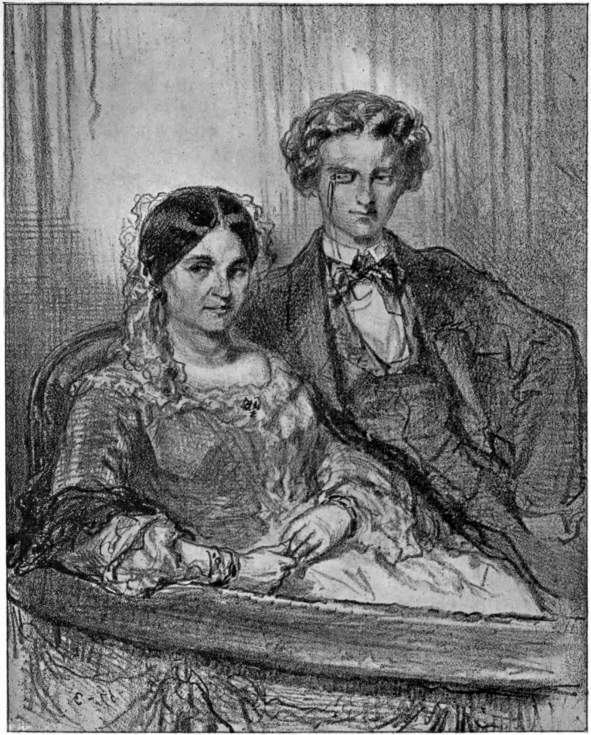
Quantin, Paris.
GAVARNI. PHÈDRE AT THE THÉÂTRE FRANÇAIS.
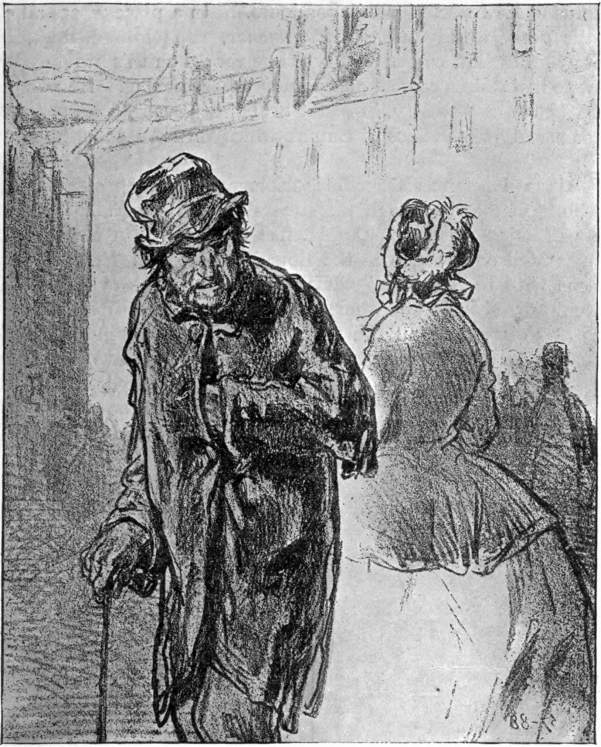
Quantin, Paris.
GAVARNI. “CE QUI ME MANQUE À MOI? UNE ’TITE MÈRE COMME ÇA, QU’AURAIT SOIN DE MON LINGE.”
There was a greater division of labour amongst those who followed Cham, since one chose “little women” as a speciality, another the theatre, and another high-life. Assisted by photography, Nadar turned again to portraiture, which had been neglected since Daumier, and enjoyed a great success with his series “Les Contemporains de Nadar.” Marcellin is the first who spread over his sketches from the world of fashions and the theatre all the chic and fashionable glitter which lives in the novels of those years. He is the chronicler of the great world, of balls and soirées; he shows the opera and the Théâtre des Italiens, tells of hunting and racing, attends the drives in the Corso, and at the call of fashion promptly deserts the stones of Paris to look about him in châteaux and country-houses, seaside haunts in France, and the little watering-places of Germany, where the gaming-tables formed at that time the rendezvous of well-bred Paris. Baden-Baden, where all the lions of the day, the politicians and the artists and all the beauties of the Paris salons, met together in July, offered the draughtsman a specially wide field for studies of fashion and chic. Here began the series “Histoires des variations de la mode depuis le XVI siècle jusqu’à nos jours.” In a place where all classes of society, the great world and the demi-monde, came into contact, Marcellin could not avoid the latter, but even when he verged on this province he always knew how to maintain a correct and distinguished bearing. He was peculiarly the draughtsman of “society,” of that brilliant, pleasure-loving, tainted, and yet refined society of the Second Empire which turned Paris into a great ball-room.
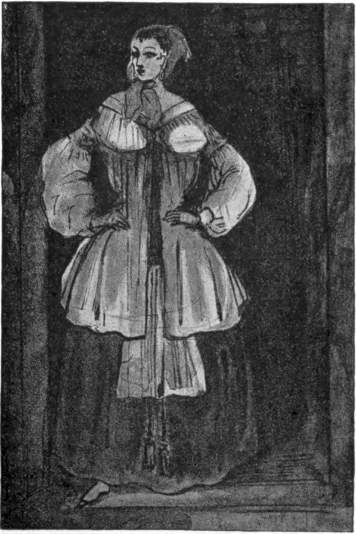
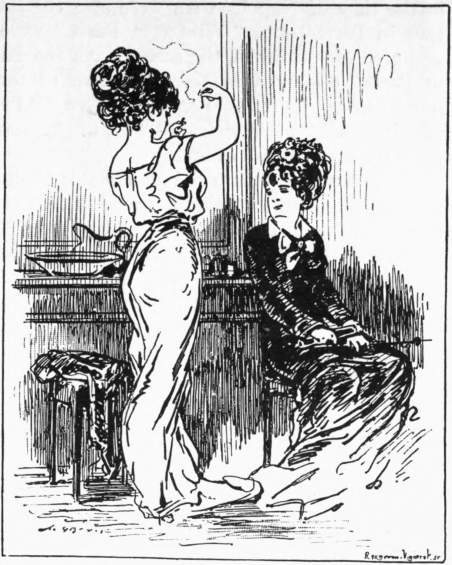
Quantin, Paris. Journal Amusant.
GUYS. STUDY OF A WOMAN. GRÉVIN. NOS PARISIENNES.
“Tiens! ne me parle pas de lui, je ne peux pas le souffrir, même en peinture!” “Cependant, s’il t’offrait de t’epouser?” “Ça, c’est autre chose.”
Randon is as plebeian as Marcellin is aristocratic. His speciality is the stupid recruit who is marched through the streets with his “squad,” or the retired tradesman of small means, as Daudet has hit him off in M. Chèbe, the old gentleman seated on a bench in the Bois de Boulogne: “Let the little ones come to me with their nurses.” His province includes everything that has nothing to do with chic. The whole life of the Parisian people, the horse-fairs, the races at Poissy, and all the more important occurrences by which the appearance of the city has been transformed, may be followed in his drawings. When he travelled he did not go to watering-places, but to the provinces, to Cherbourg and Toulon, or to the manufacturing towns of Belgium and England, where he observed life at the railway stations and the custom-house, at markets and in barracks, at seaports and upon the street. Goods that are being piled together, sacks that are being hoisted, ships being brought to anchor, storehouses, wharfs, and docks—everywhere there is as much life in his sketches as in a busy beehive. Nature is a great manufactory, and man a living machine. The world is like an ant-hill, the dwelling of curious insects furnished with teeth, feelers, indefatigable feet, and marvellous organs proper for digging, sawing, building, and all things possible, but furnished also with an incessant hunger.
Soon afterwards there came Hadol, who made his début in 1855, with pictures of the fashions; Stop, who specially represented the provinces and Italy; Draner, who occupied himself with the Parisian ballet and designed charming military uniforms for little dancing girls. Léonce Petit drew peasants and sketched the charms of the country in a simple, familiar fashion—the mortal tedium of little towns, poor villages, and primitive inns, the gossip of village beldames before the house-door, the pompous dignity of village magistrates or of the head of the fire brigade. He is specially noteworthy as a landscape artist. The trees on the straight, monotonous road rise softly and delicately into the air, and the sleepy sameness of tortuous village streets is pregnantly rendered by a few strokes of the pencil. The land is like a great kitchen garden. The fields and the arable ground with their dusty, meagre soil chant a mighty song of hard labour, of the earnest, toilsome existence of the peasant folk.
Andrieux and Morland discovered the femme entretenue, though afterwards her best known delineator was Grévin, an able, original, facile, and piquant draughtsman, whom some—exaggerating beyond a doubt—called the direct successor of Gavarni. Grévin’s women are a little monotonous, with their ringleted chignons, their expressionless eyes which try to look big, their perverse little noses, their defiant, pouting lips, and the cheap toilettes which they wear with so much chic. But they too have gone to their rest with the grisettes of Monnier and Gavarni, and have left the field to the women of Mars and Forain. In these days Grévin’s work seems old-fashioned, since it is no longer modern and not yet historical; nevertheless it marks an epoch, like that of Gavarni. The bals publics, the bals de l’Opéra, those of the Jardin Mabille, the Closerie des Lilas, the races, the promenades in the Bois de Vincennes, the seaside resorts, all places where the demi-monde pitched its tent in the time of Napoleon III, were also the home of the artist. “How they love in Paris” and “Winter in Paris” were his earliest series. His finest and greatest drawings, the scenes from the Parisian hotels and “The English in Paris,” appeared in 1867, the year of the Exhibition. His later series, published as albums—“Les filles d’Ève,” “Le monde amusant,” “Fantaisies parisiennes,” “Paris vicieux,” “La Chaîne des Dames”—are a song of songs upon the refinements of life.
It does not lie within the plan of this book to follow the history of drawing any further. Our intention was merely to show that painting had to follow the path trodden by Rowlandson and Cruikshank, Erhard and Richter, Daumier and Gavarni, if it was to be art of the nineteenth century, and not to remain for ever dependent on the old masters. Absolute beauty is not good food for art; to be strong it must be nourished on the ideas of the century. When the world had ceased to draw inspiration from the masterpieces of the past merely with the object of depicting by their aid scenes out of long-buried epochs, there was for the first time a prospect that mere discipleship would be overcome, and that a new and original painting would be developed through the fresh and independent study of nature. The passionate craving of the age had to be this: to feel at home on the earth, in this long-neglected world of reality, which hides the unsuspected treasure of vivid works of art. The rising sun is just as beautiful now as on the first day, the streams flow, the meadows grow green, the vibrating passions are at war now as in other times, the immortal heart of nature still beats beneath its rough covering, and its pulsation finds an echo in the heart of man. It was necessary to descend from ideals to existing fact, and the world had to be once more discovered by painters as in the days of the first Renaissance. The question was how by the aid of all the devices of colour to represent the multifarious forms of human activity: the phases and conditions of life, fashion as well as misery, work and pleasure, the drawing-room and the street, the teeming activity of towns and the quiet labour of peasants. The essential thing was to write the entire natural history of the age. And this way, the way from museums to nature, and from the past to the world of living men, was shown by the English to the French and German painters.
Mansell Photo
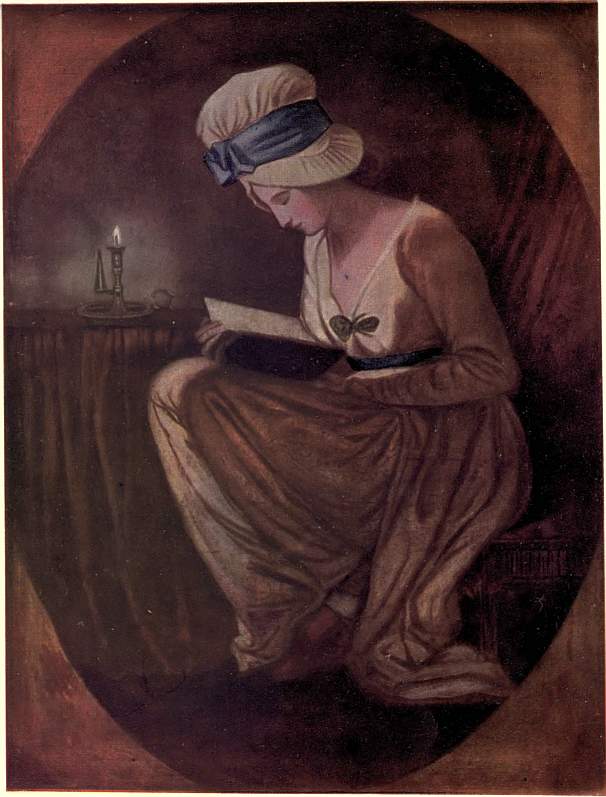
ROMNEY. SERENA.

CHAPTER XVII
ENGLISH PAINTING TO 1850
“The English school has an advantage over others in being young: its tradition is barely a century old, and, unlike the Continental schools, it is not hampered by antiquated Greek and Latin theories. What fortunate conditions it has for breaking away into really modern work! whereas in other nations the weight of tradition presses hard on the boldest innovators. The English do not look back; on the contrary, they look into life around them.” So wrote Burger-Thoré in one of his Salons in 1867.
Yet England was not unaffected by the retrospective tendency on the Continent. Perhaps it might even be demonstrated that this movement had its earliest origin on British soil. England had its “Empire style” in architecture fifty years before there was any empire in France; it had its Classical painting when David worked at Cupids with Boucher, and it gave the world a Romanticist at the very time when the literature of the Continent became “Classical.” The Lady of the Lake, Marmion, The Lord of the Isles, The Fair Maid of Perth, Old Mortality, Ivanhoe, Quentin Durward, who is there that does not know these names by heart? We have learnt history from Walter Scott, and that programme of the artistic crafts which Lorenz Gedon drew up in 1876, when he arranged the department Works of our Fathers in the Munich Exhibition, had been carried out by Scott as early as 1816. For Scott laid out much of the money he received for his romances in building himself a castle in the style of the baronial strongholds of the Middle Ages: “Towers and turrets all imitated from a royal building in Scotland, windows and gables painted with the arms of the clans, with lions couchant,” rooms “filled with high sideboards and carved chests, targes, plaids, Highland broadswords, halberts, and suits of armour, and adorned with antlers hung up as trophies.” Here was a Makartesque studio very many years before Makart.
Amongst the painters there were Classicists and Romanticists; but they were neither numerous nor of importance. What England produced in the way of “great art” in the beginning of last century could be erased from the complete chart of British painting without any essential gap being made in the course of its development. Reynolds had had to pay dear for approaching the Italians in his “Ugolino,” his “Macbeth,” and his “Young Hercules.” And a yet more arid mannerism befell all the others who followed him on the way to Italy, among them James Barry, who, after studying for years in Italy, settled down in London in 1771, with the avowed intention of providing England with a classical form of art. He believed that he had surpassed his own models, the Italian classic painters, by six pompous representations of the “Culture and Progress of Human Knowledge,” which he completed in 1783, in the theatre of the Society for the Encouragement of Arts. The many-sided James Northcote, equally mediocre in everything, survives rather by his biographies of Reynolds and Titian than by the great canvases which he painted for Boydell’s Shakespeare Gallery. That which became best known was “The Murder of the Children in the Tower.” Henry Fuseli, who was also much occupied with authorship and as preceptor Britanniæ, always mentioned with great respect by his numerous pupils, produced a series of exceedingly thoughtful and imaginative works, to which he was incited by Klopstock and Lavater. By preference he illustrated Milton and Shakespeare, and amongst this series of pictures his painting of “Titania with the Ass,” from Shakespeare’s Midsummer Night’s Dream, in the London National Gallery, is probably the best. His pupil William Etty was saturated with the traditions of the Venetian school; he is the British Makart, and followed rather heavily and laboriously in the track of Titian, exploring the realms of nude beauty, and toiling to discover that secret of blooming colour which gleams from the female forms of the Venetians. The assiduous Benjamin Robert Haydon, a spirit ever seeking, striving, and reflecting, became, like Gros in France, a victim of the grand style. He would naturally have preferred to paint otherwise, and more simply. The National Gallery possesses a charming picture by him of a London street (for some years past on loan at Leicester), which represents a crowd watching a Punch and Judy show. But, like Gros, he held it a sin against the grand style to occupy himself with such matters. He thought it only permissible to paint sacred subjects or subjects from ancient history upon large spaces of canvas; and he sank ever deeper into his theories, reaching the profoundest abyss of abstract science when he made diligent anatomical studies of the muscles of a lion, in order to fashion the heroic frames of warriors on the same plan. His end, on 26th June 1846, was like that of the Frenchman. There was found beside his body a paper on which he had written: “God forgive me. Amen. Finis,” with the quotation from Shakespeare’s Lear: “Stretch me no longer on the rack of this rough world.” All these masters are more interesting for their human qualities than for their works, which, with their extravagant colour, forced gestures, and follies of every description, contain no new thing worthy of further development. Even when they sought to make direct copies from Continental performances, they did not attain the graceful sweep of their models. The refinements which they imitated became clumsy and awkward in their hands, and they remained half bourgeois and half barbaric.
The liberating influence of English art was not found in the province of the great painting, and it is probably not without significance that the few who tried to import it came to grief in the experiment. There can be no doubt that such art goes more against the grain of the English nature than of any other. Even in the days of scholastic philosophy the English asserted the doctrine that there are only individuals in nature. In the beginning of modern times a new era, grounded on the observation of nature, was promulgated from England. Bacon had little to say about beauty: he writes against the proportions and the principle of selection in art, and therefore against the ideal. Handsome men, he says, have seldom possessed great qualities. And in the same way the English stage had just as little bent for the august and rhythmical grandeur of classical literature. When he stabbed Polonius, Garrick never dreamed of moving according to the taste of Boileau, and was probably as different from the Greek leader of a chorus as Hogarth from David. The peculiar merits of English literature and science have been rooted from the time of their first existence in their capacity for observation. This explains the contempt for regularity in Shakespeare, the feeling for concrete fact in Bacon. English philosophy is positive, exact, utilitarian, and highly moral. Hobbes and Locke, John Stuart Mill and Buckle, in England take the place of Descartes, Spinoza, Leibnitz, and Kant upon the Continent. Amongst English historians Carlyle is the only poet: all the rest are learned prose-writers who collect observations, combine experiences, arrange dates, weigh possibilities, reconcile facts, discover laws, and hoard and increase positive knowledge. The eighteenth century had seen the rise of the novel as the picture of contemporary life; in Hogarth this national spirit was first turned to account in painting. In the beginning of the nineteenth century, again, the good qualities of English art consisted not in bold ideality, but in sharpness of observation, sobriety, and flexibility of spirit.
Mag. of Art.
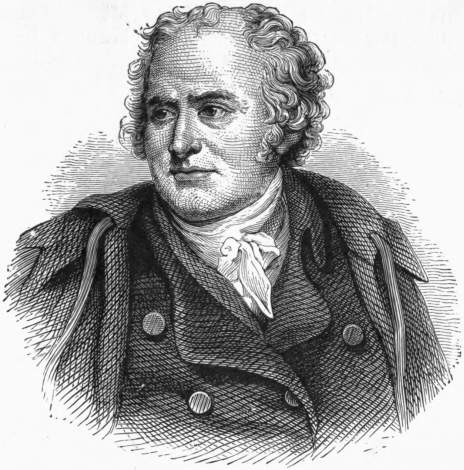
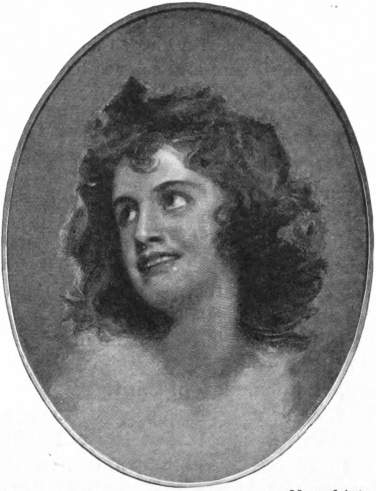
GEORGE ROMNEY. ROMNEY. LADY HAMILTON AS EUPHROSYNE.
Their proper domain was still to be found in portraiture, and if none of the new portrait painters can be compared with the great ancestors of English art, they are none the less superior to all their contemporaries on the Continent. George Romney, who belongs rather to the eighteenth century, holds the mean course between the refined classic art of Sir Joshua and the imaginative poetic art of Thomas Gainsborough. Less personal and less profound in characterisation, he was, on the other hand, the most dexterous painter of drapery in his age: a man who knew all the secrets of the trade, and possessed, at the same time, that art which is so much valued in portrait painters—the art of beautifying his models without making his picture unlike the original. Professional beauties beheld themselves presented in their counterfeit precisely as they wished to appear, and accorded him, therefore, a fervent adoration. And after his return from Italy in 1775 his fame was so widespread that it outstripped Gainsborough’s and equalled that of Reynolds. Court beauties and celebrated actresses left no stone unturned to have their portraits introduced into one of his “compositions”; for Romney eagerly followed the fashion of allegorical portraiture which had been set by Reynolds, representing persons with the emblem of a god or of one of the muses. Romney has painted the famous Lady Hamilton, to say nothing of others, as Magdalen, Joan of Arc, a Bacchante, and an Odalisque.
Gaz. des Beaux-Arts.
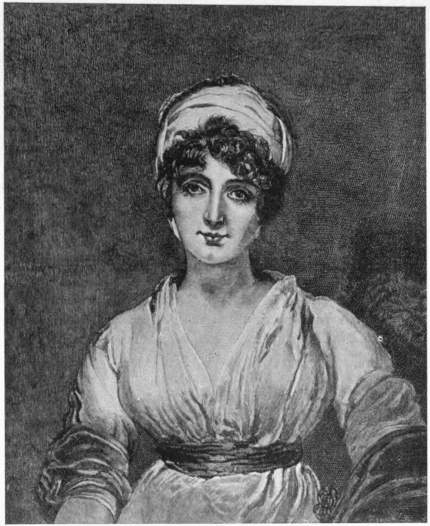
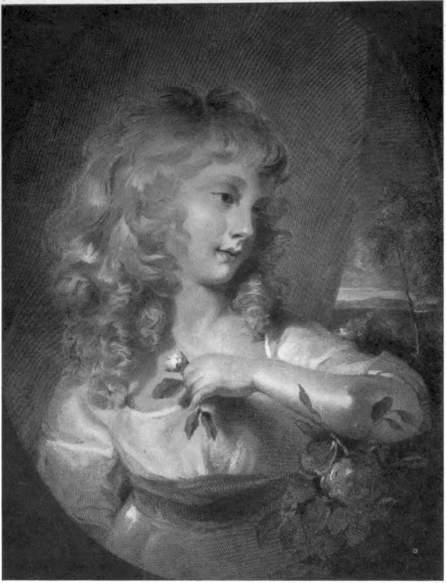
LAWRENCE. MRS. SIDDONS. LAWRENCE. PRINCESS AMELIA.
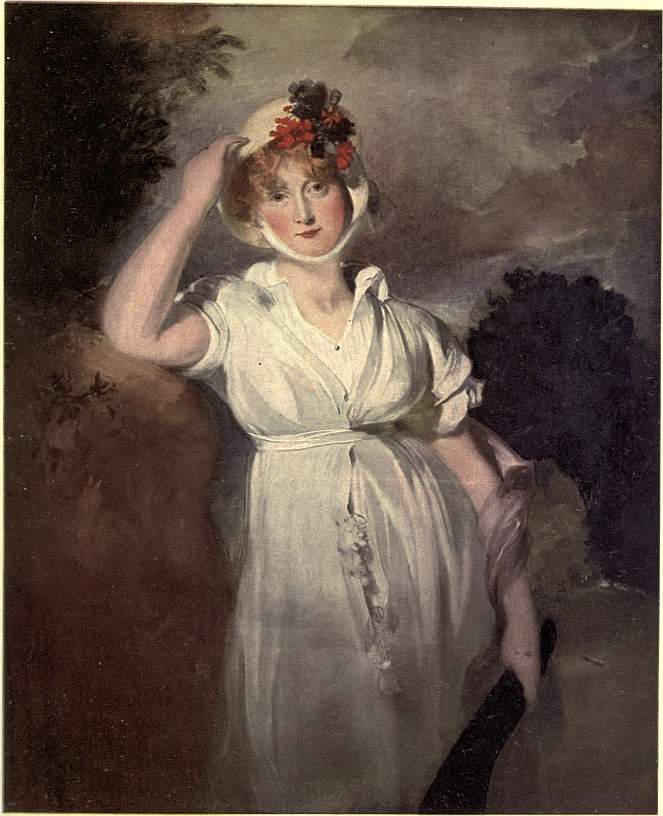
Great as his reputation had been at the close of the eighteenth century, it was outshone twenty years later by that of Sir Thomas Lawrence. Born in Bristol in 1769, Lawrence had scarcely given up the calling of an actor before he saw all England in raptures over his genius as a painter. The catalogue of his portraits is a complete list of all who were at the time pre-eminent for talent or beauty. He received fabulous sums, which he spent with the grace of a man of the world. In 1815 he was commissioned to paint for the Windsor Gallery the portraits of all the “Victors of Waterloo,” from the Duke of Wellington to the Emperor Alexander. The Congress at Aix-la-Chapelle gave him an opportunity for getting the portraits of representatives of the various Courts. All the capitals of Europe, which he visited for this purpose, received him with princely honours. He was member of all the Academies under the sun, and President of that in London; but, as a natural reaction, this over-estimation of earlier years has been followed by an equally undeserved undervaluation of his works in these days. Beneath the fashionable exterior of his ceremonial pictures naturalness and simplicity are often wanting, and so too are the deeper powers of characterisation, firm drawing, and real vitality. A feminine coquetry has taken the place of character. His drawing has a banal effect, and his colouring is monotonous in comparison with that realism which Reynolds shares with the old masters. It is easy to confound the majority of his pictures of ceremonies with those of Winterhalter, and his smaller portraits with pretty fashion plates; yet one cannot but admire his ease of execution and nobility of composition. Several of his pictures of women, in particular, are touched by an easy grace and a fine charm of poetic sensuousness in which he approaches Gainsborough. Not many at that time could have painted such pretty children’s heads, or given young women such an attractive and familiar air of life. With what a girlish glance of innocence and melancholy does Mrs. Siddons look out upon the world from the canvas of Lawrence: how piquant is her white Greek garment, with its black girdle and the white turban. And what subtle delicacy there is in the portrait of Miss Farren as she flits with muff and fur-trimmed cloak through a bright green summer landscape. The reputation of Lawrence will rise once more when his empty formal pieces have found their way into lumber-rooms, and a greater number of his pictures of women—pictures so full of indescribable fascination, so redolent of mysterious charm—are accessible to the public.
As minor stars, the soft and tender John Hoppner, the attractively superficial William Beechey, the celebrated pastellist John Russell, and the vigorously energetic John Jackson had their share with him in public favour, whilst Henry Raeburn shone in Scotland as a star of the first magnitude.
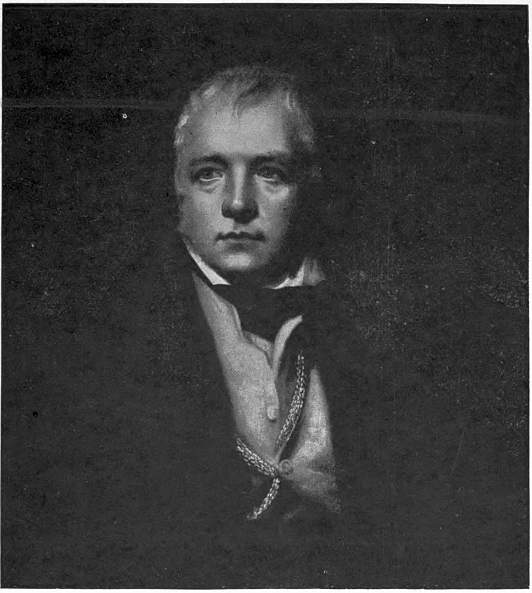
He was a born painter. Wilkie says in one of his letters from Madrid, that the pictures of Velasquez put him in mind of Raeburn; and certain works of the Scot, such as the portrait of Lord Newton, the famous bon vivant and doughty drinker, are indeed performances of such power that comparison with this mighty name is no profanation. At a time when there was a danger that portrait painting would sink in the hands of Lawrence into an insipid painting of prettiness, Raeburn stood alone by the simplicity and naturalistic impressiveness of his portraiture. The three hundred and twenty-five portraits by him which were exhibited in the Royal Scottish Academy in 1876, gave as exhaustive a picture of the life of Edinburgh at the close of the century as those of Sir Joshua gave of the life of London. All the celebrated Scotchmen of his time—Robertson, Hume, Ferguson, and Scott—were painted by him. Altogether he painted over six hundred portraits; and, small though the number may seem compared with the two thousand of Reynolds, Raeburn’s artistic qualities are almost the greater. The secret of his success lies in his vigorous healthiness, in the indescribable furia of his brush, in the harmony and truth of his colour-values. His figures are informed by a startling intensity of life. His old pensioners, and his sailors in particular, have something kingly in the grand air of their calm and noble countenances. Armstrong has given him a place between Frans Hals and Velasquez, and occasionally his conception of colour even recalls the modern Frenchmen, as it were Manet in his Hals period. He paints his models, just as they come into contact with him in life, in the frank light of day and without any attempt at the dusk of the old masters; of raiment he gives only as much as the comprehension of the picture demands, and depicts character in large and simple traits.
The importance of West and Copley, two Americans who were active in England, is that they were the first to apply the qualities acquired in English portrait painting to pictures on a large scale.
Benjamin West has undoubtedly been over-praised by his contemporaries, and by a critic of the present day he has, not unfairly, been designated “the king of mediocrity.” At his appearance he was interesting to Europeans merely as an anthropological curiosity,—as the first son of barbaric America who had used a paint brush. A thoroughly American puff preceded his entry into the Eternal City in 1760. It was reported that as the son of a quaker farmer he had grown up amongst his father’s slaves in the immediate neighbourhood of the Indians, and had painted good portraits in Philadelphia and New York without having ever seen a work of art. People were delighted when, on being brought into the Vatican, he clapped his hands and compared the Apollo Belvidere to an Indian chief. In the art of making himself interesting “the young savage” was ahead of all his patrons; and as he followed the ruling classical tendency with great aptitude, within the course of a year he was made an honorary member of the Academies of Parma, Bologna, and Florence, and praised by the critics of Rome as ranking with Mengs as the first painter of his day. In 1763, at a time when Hogarth and Reynolds, Wilson and Gainsborough, were in the fulness of their powers, he went to London; and as people are always inclined to value most highly what they do not possess, he soon won an important position for himself, even beside these masters. Hogarth produced nothing but “genre pictures,” Wilson only landscapes, and Reynolds and Gainsborough portraits: West brought to the English what they did not as yet possess—a “great art.”
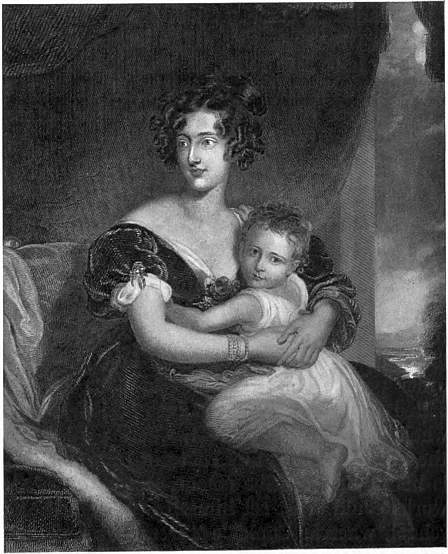
LAWRENCE. THE ENGLISH MOTHER.
His first picture—in the London National Gallery—“Pylades and Orestes brought as Hostages before Iphigenia,” is a tiresome product of that Classicism which upon the Continent found its principal representatives in Mengs and David: it is stiff in drawing, its composition is suggestive of a bas-relief, and its cold grey colouring is classically academic. His other pictures from antique and sacred history stand much on the same level as those of Wilhelm Kaulbach, with whose works they share their stilted dignity, their systematically antiquarian structure, and their mechanical combination of forms borrowed in a spiritless fashion from the Cinquecentisti.
Fortunately West has left behind him something different from these ambitious attempts; for on the occasions when he turned away from the great style he created works of lasting importance. This is specially true of some fine historical pictures dealing with his own age, which will preserve his name for ever. “The Death of General Wolfe” at the storming of Quebec on 13th September 1759—exhibited at the opening of the Royal Academy in 1768—is by its very sobriety a sincere, honest, and sane piece of work, which will maintain its value as an historical document. It was just at this time that so great a part was played by the question of costume, and West encountered the same difficulties which Gottfried Schadow was obliged to face when he represented Ziethen and the Old Dessauer in the costume of their age. The connoisseurs held that such a sublime theme would only admit of antique dress. If West in their despite represented the general and his soldiers in their regulation uniform, it seems at the present time no more than the result of healthy common sense, but at that time it was an artistic event of great importance, and one which was only accomplished in France after the work of several decades. In that country Gérard and Girodet still clung to the belief that they could only raise the military picture to the level of the great style by giving the soldiers of the Empire the appearance of Greek and Roman statues. Gros is honoured as the man who first ceased from giving modern soldiers an air of the antique. But the American Englishman had anticipated him by forty years. As in Géricault’s “Raft of the Medusa,” it was only the pyramidal composition in West’s picture that betrayed the painter’s alliance with the Classical school; in other respects it forecast the realistic programme for decades to come, and indicated the course of development which leads through Gros onwards. If in Gros men are treated purely as accessories to throw a hero into relief, in West they stand out in action. They behave in the picture spontaneously as they do in life. That is to say, there is in West’s work of 1768 the element through which Horace Vernet’s pictures of 1830 are to be distinguished from those of Gros.
This realistic programme was carried out with yet greater consistency by West’s younger compatriot John Singleton Copley, who after a short sojourn in Italy migrated to England in 1775. His chief works in the London National Gallery depict in the same way events from contemporary history—“The Death of the Earl of Chatham, 7th April 1778” and “The Death of Major Pierson, 6th January 1781,”—and it is by no means impossible that when David, in the midst of the classicising tendencies of his age, ventured to paint “The Death of Marat” and “The Death of Lepelletier,” he was led to do so by engravings after Copley. In the representation of such things other painters of the epoch had draped their figures in antique costume, called genii and river-gods into action, and given a Roman character to the whole. Copley, like West, offers a plain, matter-of-fact representation of the event, without any rhetorical pathos. And what raises him above West is his liquid, massive colour, suggestive of the old masters. In none of his works could West set himself free from the dead grey colour of the Classical school, whereas Copley’s “Death of William Pitt” is the result of intimate studies of Titian and the Dutch. The way the light falls on the perukes of the men and the brown, wainscoted walls puts one in mind of Rembrandt’s “Anatomical Lecture”; only, instead of a pathetic scene from the theatre, we have a collection of good portraits in the manner of the Dutch studies of shooting matches.
Mansell Photo
LAWRENCE. CAROLINE OF BRUNSWICK, QUEEN OF GEORGE IV.
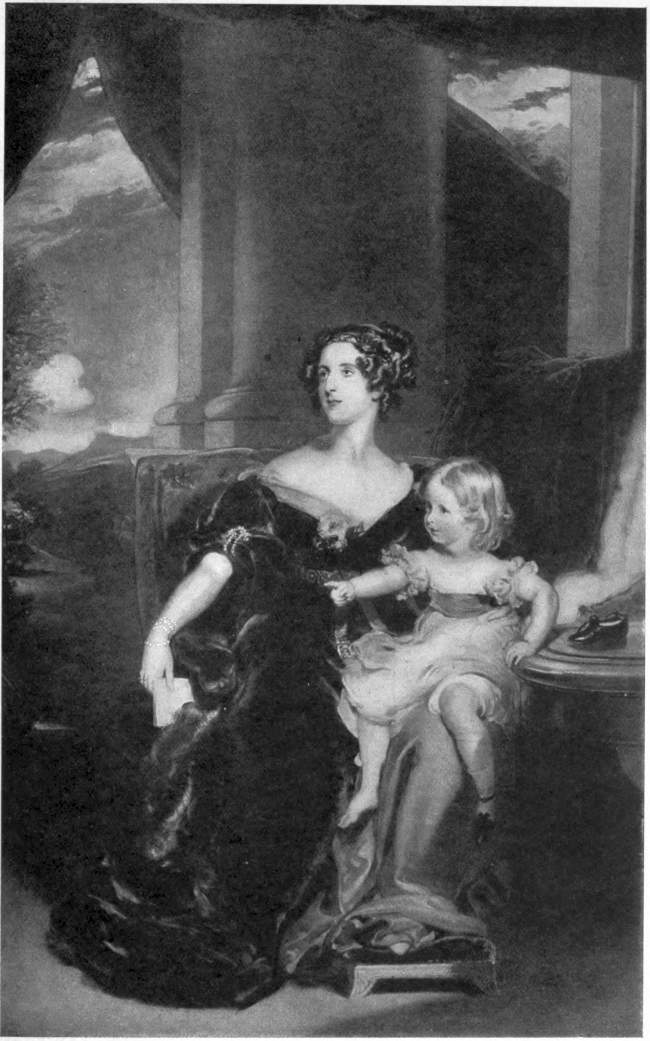
LAWRENCE. THE COUNTESS GOWER.
Cassell & Co.
RAEBURN. SIR WALTER SCOTT.
That this unhackneyed conception of daily life has its special home in England is further demonstrated by the work of Daniel Maclise, who depicted “The Meeting of Wellington and Blücher,” “The Death of Nelson,” and other patriotic themes upon walls and canvases several yards square, with appalling energy, promptitude, and expenditure of muscle. By these he certainly did better service to national pride than to art. Nevertheless, with their forcible, healthy realism they contrast favourably with the mythological subjects so universally produced on the Continent at that time.
Beside the portrait painters of men stand the portrait painters of animals. Since the days of Elias Riedinger animal painting had fallen into general disesteem on the Continent. Thorwaldsen, the first of the Classicists who allowed animals to appear in his works (as he did in his Alexander frieze), dispensed with any independent studies of nature, and contented himself with imitating the formal models on the frieze of the Parthenon; or, in lack of a Grecian exemplar, simply drew out of the depths of his inner consciousness. Especially remarkable is the sovran contempt with which he treated the most familiar domestic creatures. German historical painting knew still less what to make of the brute creation, because it only recognised beauty in the profundity of ideas, and ideas have nothing to do with beasts. Its four-footed creatures have a philosophic depth of contemplation, and are bad studies after nature. Kaulbach’s “Reinecke” and the inclination to transplant human sentiments into the world of brutes delayed until the sixties any devoted study of the animal soul. France, too, before the days of Troyon, had nothing to show worth mentioning. But in England, the land of sport, animal painting was evolved directly from the old painting of the chase, without being seduced from its proper course. Fox-hunting has been popular in England since the time of Charles I. Racing came into fashion not long after, and with racing came that knowledge of horseflesh which has been developed in England further than elsewhere. Since the seventeenth century red deer have been preserved in the English parks. It is therefore comprehensible that English art was early occupied with these animals, and since it was sportsmen who cared most about them, the painter was at first their servant. He had not so much to paint pictures as reminiscences of sport and the chase. His first consideration in painting a horse was to paint a fine horse; as to its being a fine picture, that was quite a secondary matter. John Wootton and George Stubbs were in this sense portrayers of racehorses. The latter, however, took occasion to emancipate himself from his patrons by representing the noble animal, not standing at rest by his manger, or with a groom on his back and delighting in the consciousness of his own beauty, but as he was in action and amongst pictorial surroundings.
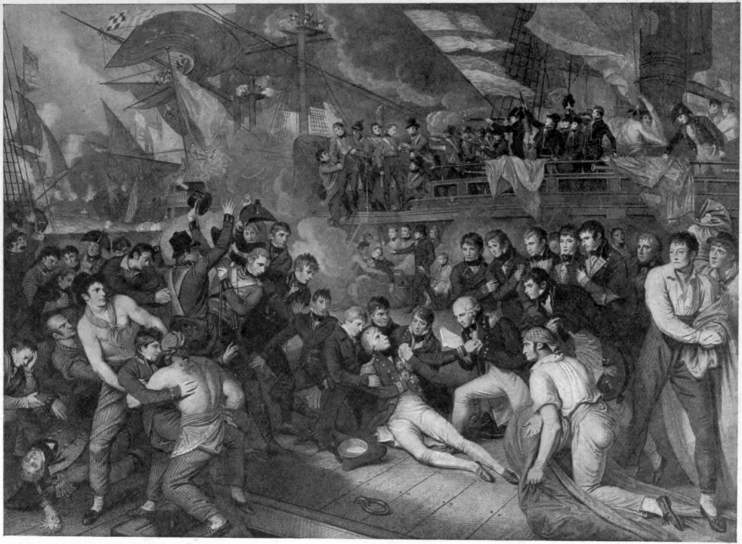
WEST. THE DEATH OF NELSON.
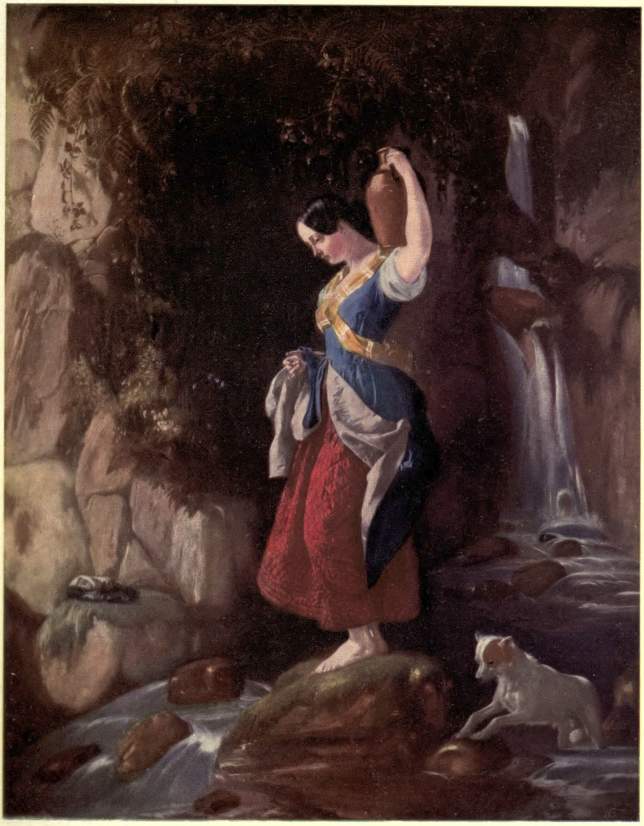
Mansell Photo
MACLISE. THE WATERFALL, CORNWALL.
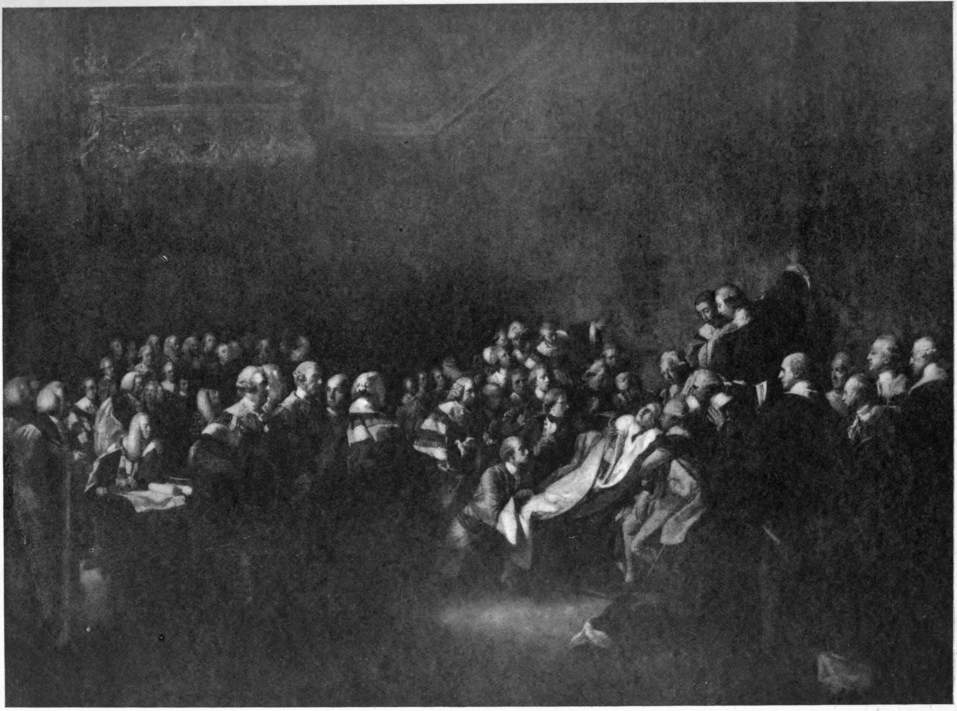
COPLEY. THE DEATH OF THE EARL OF CHATHAM.
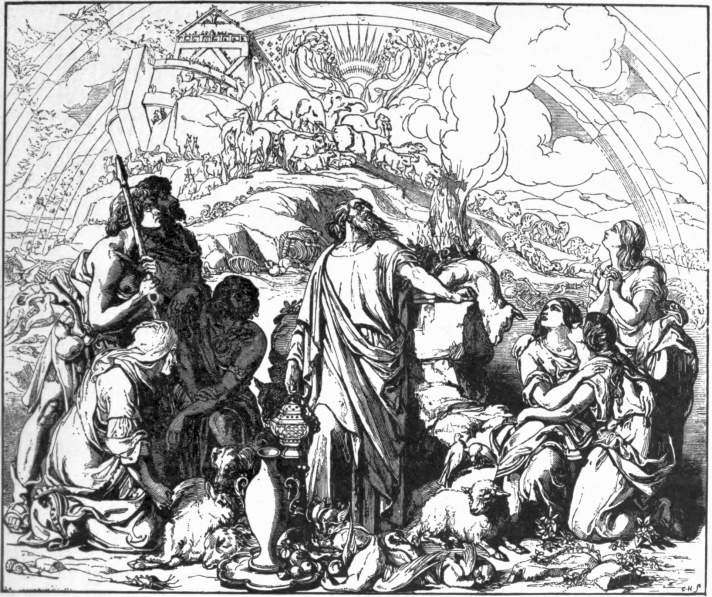
MACLISE. NOAH’S SACRIFICE.
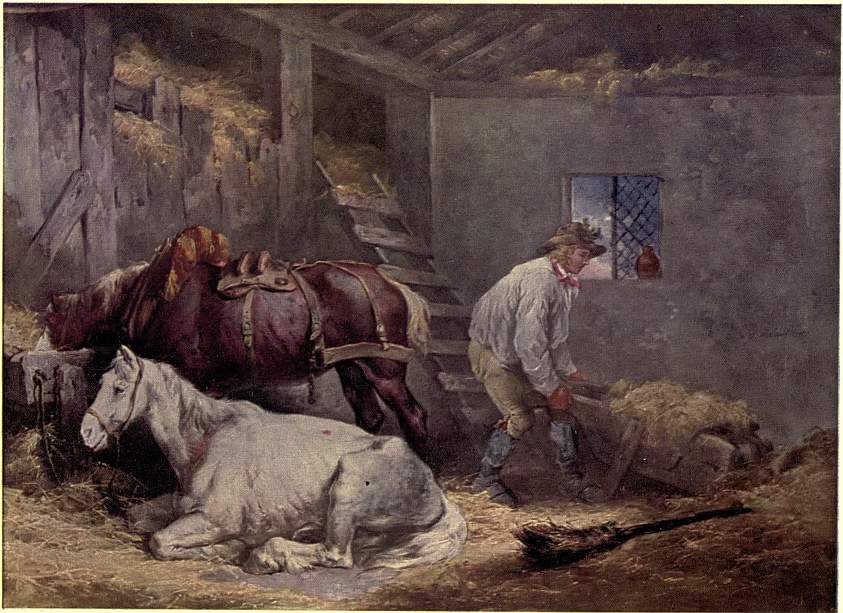
Soon afterwards George Morland made his appearance. He made a specialty of old nags, and was perhaps the most important master of the brush that the English school produced at all. His pictures have the same magic as the landscapes of Gainsborough. He painted life on the high-road and in front of village inns—scenes like those which Isaac Ostade had represented a century before: old horses being led to water amid the sunny landscape of the downs, market carts rumbling heavily through the rough and sunken lanes, packhorses coming back to their stalls of an evening tired out with the day’s exertions, riders pulling up at the village inn or chatting with the pretty landlady. And he has done these things with the delicacy of an old Dutch painter. It is impossible to say whether Morland had ever seen the pictures of Adriaen Brouwer; but this greatest master of technique amongst the Flemings can alone be compared with Morland in verve and artistic many-sidedness; and Morland resembled him also in his adventurous life and his early death. To the spirit and dash of Brouwer he joins the refinement of Gainsborough in his landscapes, and Rowlandson’s delicate feeling for feminine beauty in his figures. He does not paint fine ladies, but women in their everyday clothes, and yet they are surrounded by a grace recalling Chardin: young mothers going to see their children who are with the nurse, smart little tavern hostesses in their white aprons and coquettish caps busily serving riders with drink, and charming city madams in gay summer garb sitting of a Sunday afternoon with their children at a tea-garden. Over the works of Morland there lies all the chivalrous grace of the time of Werther, and that fine Anglo-Saxon aroma exhaled by the works of English painters of the present day. Genuine as is the fame which he enjoys as an animal painter, it is these little social scenes which show his finest side; and only coloured engraving, which was brought to such a high pitch in the England of those days, is able to give an idea of the delicacy of hue in the originals.
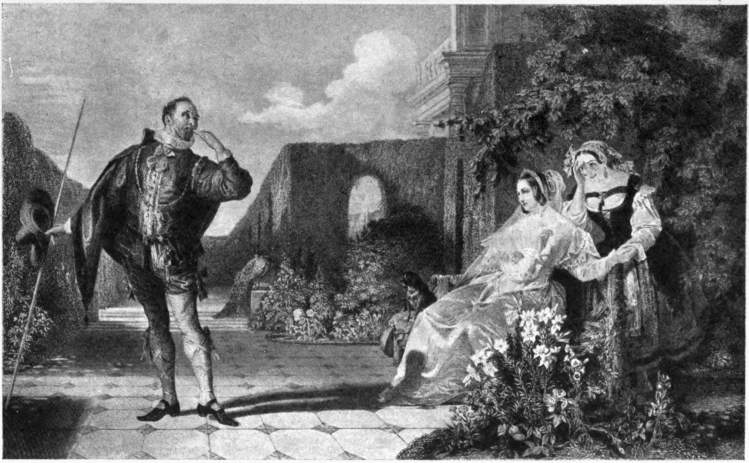
MACLISE. MALVOLIO AND THE COUNTESS.
Mansell & Co.
MORLAND. HORSES IN A STABLE.
Morland’s brother-in-law, the painter and engraver James Ward, born in 1769 and dying in 1859, united this old English school with the modern. The portrait which accompanies the obituary notice in the Art Journal is that of a very aged gentleman, with a grey beard and thick, white, bristly hair. The pictures which he painted when he had this appearance—and they are the most familiar—were exceedingly weak and insipid works. In comparison with Morland’s broad, liquid, and harmonious painting, that of Ward seems burnished, sparkling, flaunting, anecdotic, and petty. But James Ward was not always old James Ward. In his early days he was one of the greatest and manliest artists of the English school, with whom only Briton Rivière can be compared amongst the moderns. When his “Lioness” appeared in the Royal Academy Exhibition of 1816 he was justly hailed as the best animal painter after Snyders, and from that time one masterpiece followed another for ten long years. What grace and power there are in his horses and dogs! In pictures of this sort Stubbs was graceful and delicate; Ward painted the same horse in as sporting a manner and with the same knowledge, but with an artistic power such as no one had before him. His field of work was wide-reaching. He painted little girls with the thoroughly English feeling of Morland, and had the whole animal world for his domain. Lions, snakes, cats, pigs, oxen, cows, sheep, swans, fowls, frogs are the characters in his pictures. And characters they were, for he never humanised the looks of his four-footed models, as others did later. The home of his animals is not the drawing-room, but the woods and meadows, the air and the gardens. His broad, weighty manner was transformed first into extravagant virtuosity and then into pettiness of style during the last thirty years of his life, when he became senile. His reputation paled more than he deserved before the star of the world-famous Landseer.
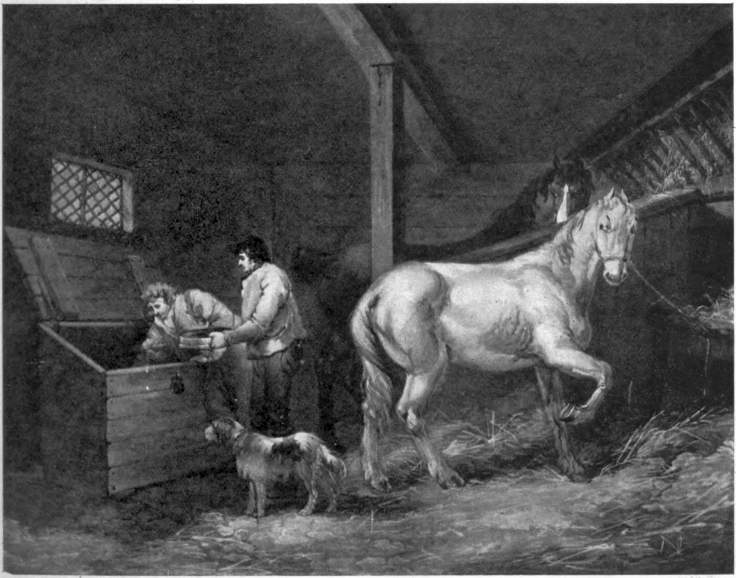
MORLAND. THE CORN BIN.
The most popular animal painter, not merely of England but of the whole century, was Edwin Landseer. For fifty years his works formed the chief features of attraction in the Royal Academy. Engravings from him had such a circulation in the country that in the sixties there was scarcely a house in which there did not hang one of his horses or dogs or stags. Even the Continent was flooded with engravings of his pictures, and Landseer suffered greatly from this popularity. He is much better than the reproductions with their fatal gloss allow any one to suppose, and his pictures can be judged by them just as little as can Raphael’s “School of Athens” from Jacobi’s engraving.
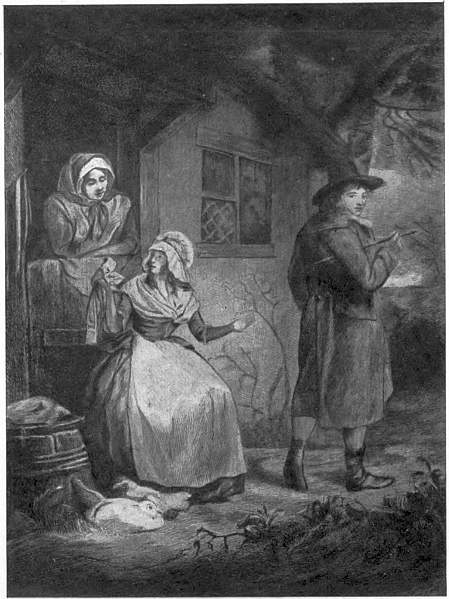
Portfolio.
MORLAND. GOING TO THE FAIR.
Edwin Landseer came of a family of artists. His father, who was an engraver, sent him out into the free world of nature as a boy, and made him sketch donkeys and goats and sheep. When he was fourteen he went to Haydon, the prophet on matters of art; and, on the advice of this singular being, studied the sculptures of the Parthenon. He “anatomised animals under my eyes,” writes Haydon, “copied my anatomical drawings, and applied my principles of instruction to animal painting. His genius, directed in this fashion, has, as a matter of fact, arrived at satisfactory results.” Landseer was the spoilt child of fortune. There is no other English painter who can boast of having been made a member of the Royal Academy at twenty-four. In high favour at Court, honoured by the fashionable world, and tenderly treated by criticism, he went on his way triumphant. The region over which he held sway was narrow, but he stood out in it as in life, powerful and commanding. The exhibition of his pictures which took place after his death in 1873 contained three hundred and fourteen oil paintings and one hundred and forty-six sketches. The property which he left amounted to £160,000; and a further sum of £55,000 was realised by the sale of his unsold pictures. Even Meissonier, the best paid painter of the century, did not leave behind him five and a half million francs.
One reason of Landseer’s artistic success is perhaps due to that in him which was inartistic—to his effort to make animals more beautiful than they really are, and to make them the medium for expressing human sentiment. All the dogs and horses and stags which he painted after 1855, and through which he was made specially familiar to the great public, are arrayed in their Sunday clothes, their glossiest hide and their most magnificent horns. And in addition to this he “Darwinises” them: that is to say, he tries to make his animals more than animals; he lends a human sentimental trait to animal character; and that is what distinguishes him to his disadvantage from really great animal painters like Potter, Snyders, Troyon, Jadin, and Rosa Bonheur. He paints the human temperament beneath the animal mask. His stags have expressive countenances, and his dogs appear to be gifted with reason and even speech. At one moment there is a philosophic dignity in their behaviour, and at another a frivolity in their pleasures. Landseer discovered the sentimentality of dogs, and treated them as capable of culture. His celebrated picture “Jack in Office” is almost insulting in its characterisation: there they are, Jack the sentry, an old female dog like a poor gentlewoman, another dog like a professional beggar, and so on. And this habit of bringing animals on the stage, as if they were the actors of tragical, melodramatic, or farcical scenes, made him a peculiar favourite with the great mass of people. Nor were his picture-stories merely easy to read and understand; the characteristic titles he invented for each of them—“Alexander and Diogenes,” “A Distinguished Member of the Humane Society,” and the like—excited curiosity as much as the most carefully selected name of a novel. But this search after points and sentimental anecdotes only came into prominence in his last period, when his technique had degenerated and given way to a shiny polish and a forced elegance which obliged him to provide extraneous attractions. His popularity would not be so great, but his artistic importance would be quite the same, if these last pictures did not exist at all.
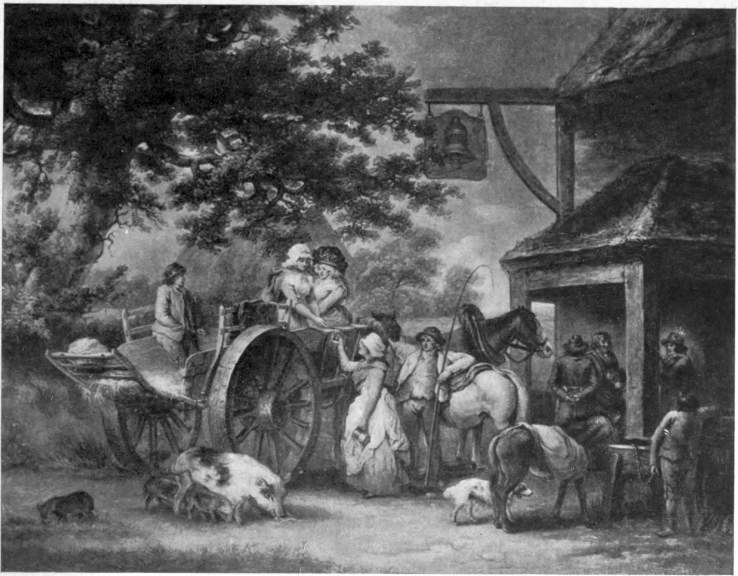
MORLAND. THE RETURN FROM MARKET.
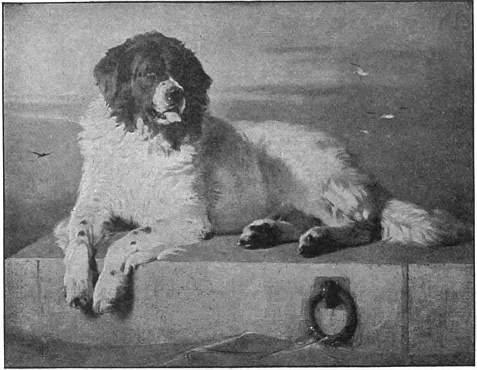
Cassell & Co.
LANDSEER. A DISTINGUISHED MEMBER OF THE HUMANE SOCIETY.
But the middle period of Landseer, ranging from 1840 to 1850, contains masterpieces which set him by the side of the best animal painters of all times and nations. The well-known portrait of a Newfoundland dog of 1838; that of the Prince Consort’s favourite greyhound of 1841; “The Otter Speared” of 1844, with its panting and yelping pack brought to a standstill beneath a high wall of rock; the dead doe which a fawn is unsuspectingly approaching, in “A Random Shot,” 1848; “The Lost Sheep” of 1850, that wanders frightened and bleating through a wide and lonely landscape covered with snow,—these and many other pictures, in their animation and simple naturalness, are precious examples of the fresh and delicate observation peculiar to him at that time. Landseer’s portrait reveals to us a robust and serious man, with a weather-beaten face, a short white beard, and a snub bulldog nose. Standing six feet high, and having the great heavy figure of a Teuton stepping out of his aboriginal forest, he was indeed much more like a country gentleman than a London artist. He was a sportsman who wandered about all day long in the air with a gun on his arm, and he painted his animal pictures with all the love and joy of a child of nature. That accounts for their strength, their convincing power, and their vivid force. It is as if he had become possessed of a magic cap with which he could draw close to animals without being observed, and surprise their nature and their inmost life.
Landseer’s subject-matter and conception of life are indicated by the pictures which have been named. Old masters like Snyders and Rubens had represented the contrast between man and beast in their boar and lion hunts. It was not wild nature that Landseer depicted, but nature tamed. Rubens, Snyders, and Delacroix displayed their horses, dogs, lions, and tigers in bold action, or in the flame of passion. But Landseer generally introduced his animals in quiet situations—harmless and without fear—in the course of their ordinary life.
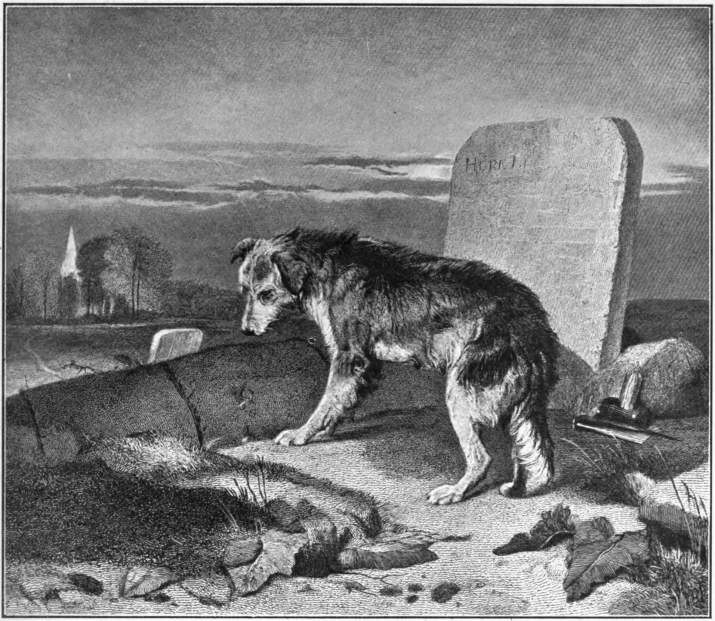
Mag. of Art.
LANDSEER. THE LAST MOURNER AT THE SHEPHERD’S GRAVE.
Horses, which Leonardo, Rubens, Velasquez, Wouwerman, and the earlier English artists delighted to render, he painted but seldom, and when he painted them it was with a less penetrating comprehension. But lions, which had been represented in savage passion or in quiet dignity by artists from Rubens to Decamps, were for him also a subject of long and exhaustive studies, which had their results in the four colossal lions round the base of the Nelson Column in Trafalgar Square. Here the Englishman makes a great advance on Thorwaldsen, who designed the model for the monument in Lucerne without ever having seen a lion. Landseer’s brutes, both as they are painted and as they are cast in bronze, are genuine lions, cruel and catlike, although in savageness and bold passion they are not to be compared with those of Delacroix, nor with those of his elder compatriot, James Ward. On the other hand, stags and roes were really first introduced into painting by Landseer. Those of Robert Hills, who had previously been reckoned the best painter of stags, are timid, suspicious creatures, while Landseer’s are the true kings of the forest, the shooting of which ought to be punished as an act of assassination. His principal field of study was the Highlands. Here he painted these proud creatures fighting on the mountain slopes, swimming the lake, or as they stand at a gaze in their quiet beauty. With what a bold spirit they raise their heads to snuff the mountain air, whilst their antlers show their delight in battle and the joy of victory. And how gentle and timid is the noble, defenceless roe in Landseer’s pictures.
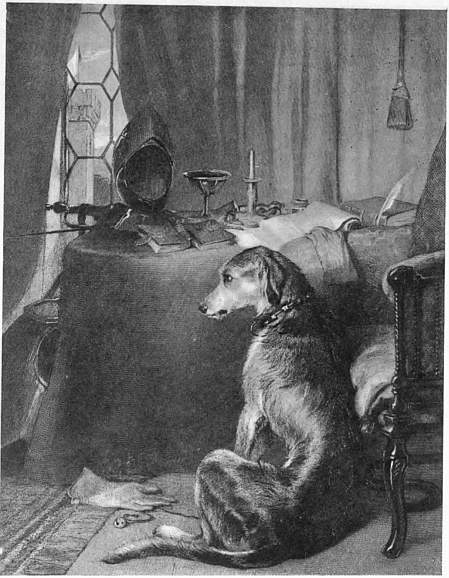
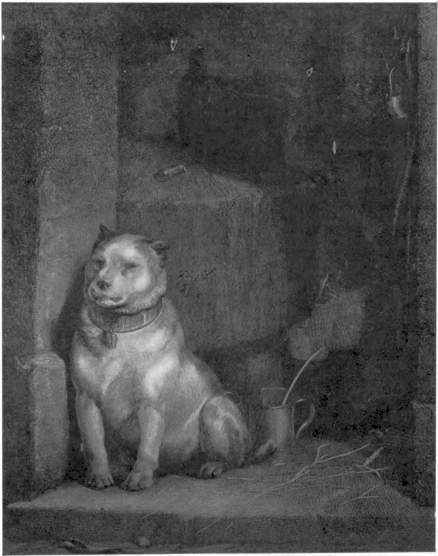
LANDSEER. HIGH LIFE. LANDSEER. LOW LIFE.
He had also a delight in painting sheep lost in a snow-storm. But dogs were his peculiar specialty. Landseer discovered the dog. That of Snyders was a treacherous, snarling cur; that of Bewick a robber and a thief. Landseer has made the dog the companion of man, an adjunct of human society, the generous friend and true comrade who is the last mourner at the shepherd’s grave. Landseer first studied his noble countenance and his thoughtful eyes, and in doing so he opened a new province to art, in which Briton Rivière went further at a later period.
But yet another and still wider province was opened to continental nations by the art of England. In an epoch of archæological resuscitations and romantic regrets for the past, it brought French and German painters to a consciousness that the man of the nineteenth century in his daily life might be a perfectly legitimate subject for art. Engravings after the best pictures of Wilkie hang round the walls of Louis Knaus’s reception-room in Berlin. And that in itself betrays to us a fragment of the history of art. The painters who saw the English people with the eyes of Walter Scott, Fielding, Goldsmith, and Dickens were a generation in advance of those who depicted the German people in the spirit of Immermann, Auerbach, Gustav Freytag, and Fritz Reuter. The English advanced quietly on the road trodden by Hogarth in the eighteenth century, whilst upon the Continent the nineteenth century had almost completed half its course before art left anything which will allow future generations to see the men of the period as they really were. Since the days of Fielding and Goldsmith the novel of manners had been continually growing. Burns, the poet of the plough, and Wordsworth, the singer of rustic folk, had given a vogue to that poetry of peasant life and those village tales which have since gone the round of all Europe. England began at that time to become the richest country in the world, and great fortunes were made. Painters were thus obliged to provide for the needs of a new and wealthy middle class. This fact gives us the explanation both of the merits and the faults which are characteristic of English genre painting.
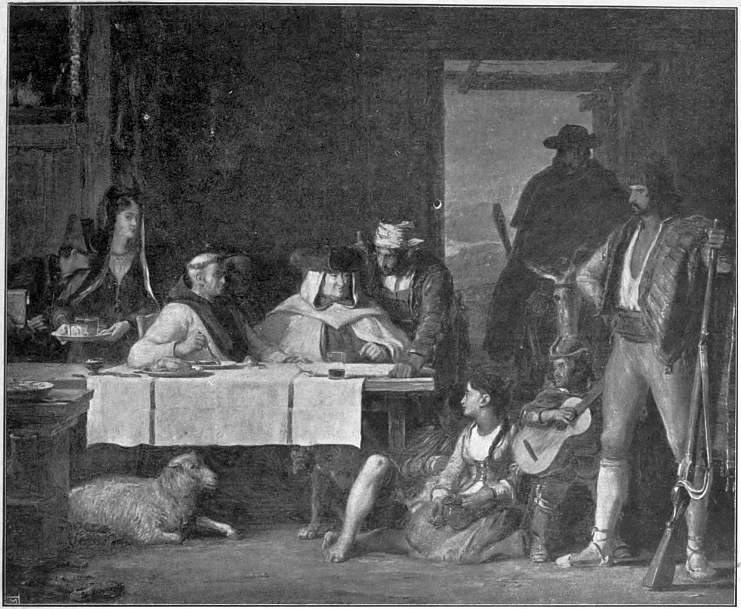
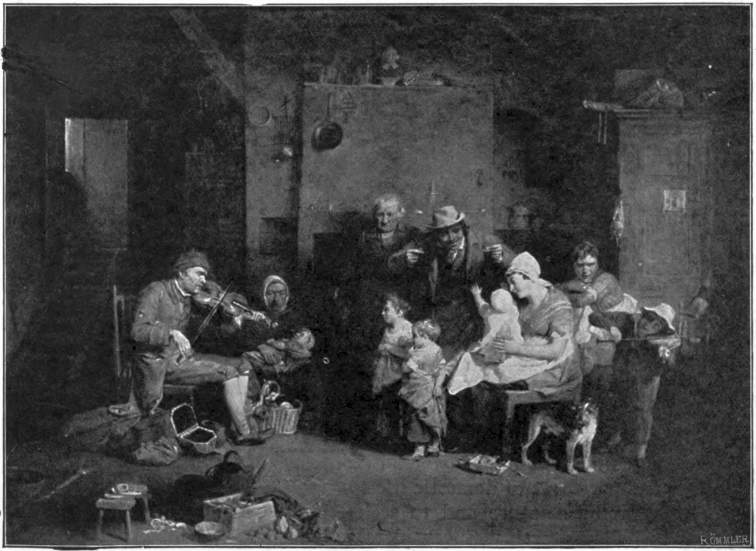
In the first quarter of the nineteenth century David Wilkie, the English Knaus, was the chief genre painter of the world. Born in 1785 in the small Scotch village of Cults, where his father was the clergyman, he passed a happy childhood, and possibly had to thank his youthful impressions for the consistent cheerfulness, the good-humour and kindliness that smile out of his pictures, and make such a contrast with Hogarth’s biting acerbity. At fourteen he entered the Edinburgh School of Art, where he worked for four years under the historical painter John Graham. Having returned to Cults, he painted his landscapes. A fair which he saw in the neighbouring village gave the impulse for his earliest picture of country life, “Pitlessie Fair.” He sold it for five and twenty pounds, and determined in 1805 to try his luck with this sum in London. In the very next year his “Village Politicians” excited attention in the exhibition. From that time he was a popular artist. Every one of his numerous pictures—“The Blind Fiddler,” “The Card Players,” “The Rent Day,” “The Cut Finger,” “The Village Festival”—called forth a storm of applause. After a short residence in Paris, where the Louvre gave him a more intimate knowledge of the Dutch, came his masterpieces, “Blind-Man’s Buff,” “Distraining for Rent,” “Reading the Will,” “The Rabbit on the Wall,” “The Penny Wedding,” “The Chelsea Pensioners,” and so forth. Even later, after he had become an Academician, he kept to plain and simple themes, in spite of the reproaches of his colleagues, who thought that art was vulgarised by the treatment of subjects that contained so little dignity. It was only at the end of his life that he became untrue to himself. His reverence for Teniers and Ostade was not sufficient to outweigh the impression made on him during a tour taken in 1825 through Italy, Spain, Holland, and Germany, by the artistic treasures of the Continent, and especially Murillo and Velasquez. He said he had long lived in darkness, but from that time forth could say with the great Correggio: “Anch’ io sono pittore.” He renounced all that he had painted before which had made him famous, and showed himself to be one of the many great artists of those years who had no individuality, or ventured to have none. He would have been the Burns of painting had he remained as he was. And thus he offered further evidence that the museums and the Muses are contradictory conceptions; since the modern painter always runs the risk of falling helplessly from one influence into another, where he is bent on combining the historical student of art with the artist. Of the pictures that he exhibited after his return in 1829, two dealt with Italian and three with Spanish subjects. The critics were loud in praise; he had added a fresh branch of laurel to his crown. Yet, historically considered, he would stand on a higher pedestal if he had never seen more than a dozen good pictures of Teniers, Ostade, Metsu, Jan Steen, and Brouwer. Now he began to copy his travelling sketches in a spiritless fashion; he only represented pifferari, smugglers, and monks, who, devoid of all originality, might have been painted by one of the Düsseldorfers. Even “John Knox Preaching,” which is probably the best picture of his last period, is no exception.
“He seemed to me,” writes Delacroix, who saw him in Paris after his return from Spain,—“he seemed to me to have been carried utterly out of his depth by the pictures he had seen. How is it that a man of his age can be so influenced by works which are radically opposed to his own? However, he died soon after, and, as I have been told, in a very melancholy state of mind.” Death overtook him in 1841, on board the steamer Oriental, just as he was returning from a tour in Turkey. At half-past eight in the evening the vessel was brought to, and as the lights of the beacon mingled with those of the stars the waters passed over the corpse of David Wilkie.
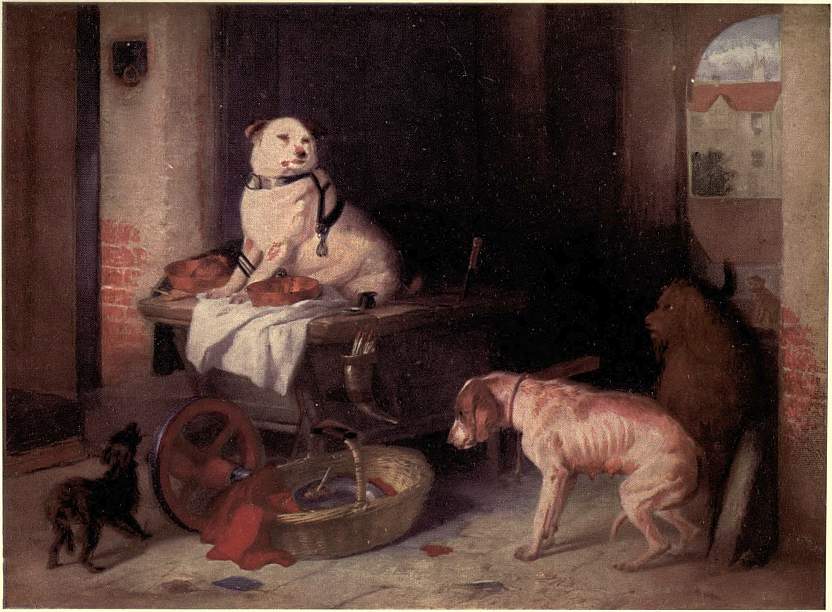
Mansell Photo
LANDSEER. JACK IN OFFICE.
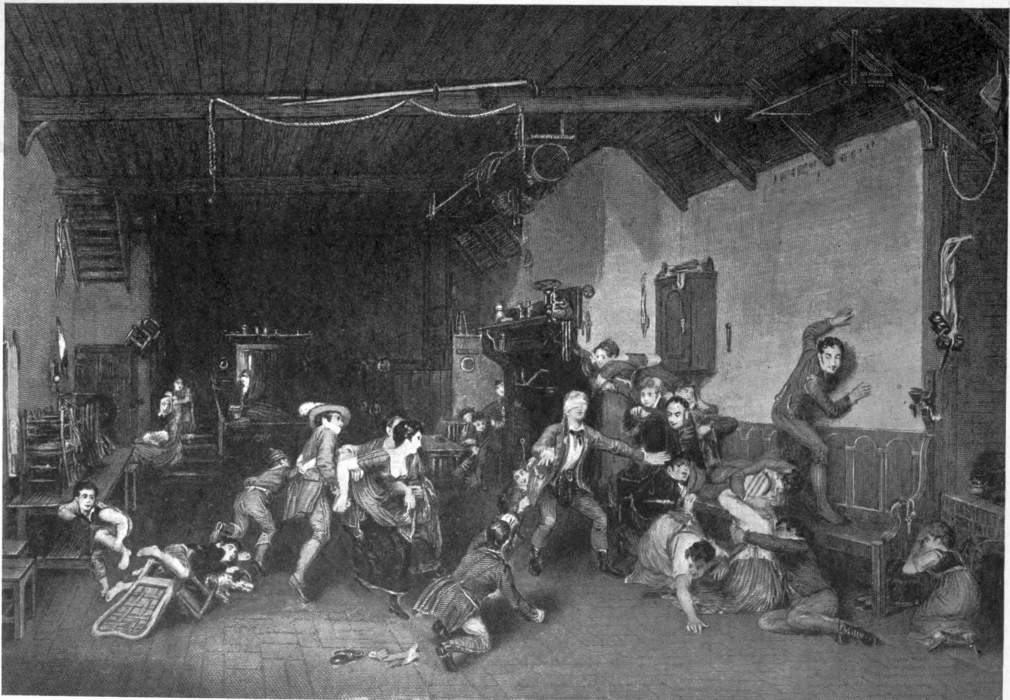
WILKIE. BLIND-MAN’S BUFF.
In judging his position in the history of art, only those works come into consideration which he executed before that journey of 1825. Then he drew as a labour of love the familiar scenes of the household hearth, the little dramas, the comic or touching episodes that take place in the village, the festivals, the dancing, and the sports of the country-folk, and their meeting in the ale-house. At this time, when as a young painter he merely expressed himself and was ignorant of the efforts of continental painting, he was an artist of individuality. In the village he became a great man, and here his fame was decided; he painted rustics. Even when he first saw the old masters in the National Gallery their immediate effect on him was merely to influence his technique. And by their aid Wilkie gradually became an admirable master of technical detail. His first picture, “Pitlessie Fair,” in its hardness of colour recalled a Dutch painter of the type of Jan Molenaer; but from that time his course was one of constant progress. In “The Village Politicians” the influence of Teniers first made itself felt, and it prevailed until 1816. In this year, when he painted the pretty sketch for “Blind-Man’s Buff,” a warm gold hue took the place of the cool silver tone; and instead of Teniers, Ostade became his model. The works in his Ostade manner are rich in colour and deep and clear in tone. Finally, it was Rembrandt’s turn to become his guiding-star, and “The Parish Beadle,” in the National Gallery—a scene of arrest of the year 1822—clearly shows with what brilliant success he tried his luck with Rembrandt’s dewy chiaroscuro. It was only in his last period that he lost all these technical qualities. His “Knox” of 1832 is hard and cold and inharmonious in colour.
Hanfstaengl.
WILKIE. A GUERILLA COUNCIL OF WAR IN A SPANISH POSADA.
So long as he kept from historical painting, art meant for him the same thing as the portrayal of domestic life. Painting, he said, had no other aim than to reproduce nature and to seek truth. Undoubtedly this must be applied to Wilkie himself with considerable limitation. Wilkie painted simple fragments of nature just as little as Hogarth; he invented scenes. Nor was he even gifted with much power of invention. But he had a fund of innocent humour, although there were times when it was in danger of becoming much too childlike. “Blind-Man’s Buff,” “The Village Politicians,” and “The Village Festival,” pictures which have become so popular through the medium of engraving, contain all the characteristics of his power of playful observation. He had no ambition to be a moralist, like Hogarth, but just as little did he paint the rustic as he is. He dealt only with the absurdities and minor accidents of life. His was one of those happy dispositions which neither sorrow nor dream nor excite themselves, but see everything from the humorous side: he enjoyed his own jests, and looked at life as at a pure comedy; the serious part of it escaped him altogether. His peasantry know nothing of social problems; free from want and drudgery, they merely spend their time over trifles and amuse themselves—themselves and the frequenters of the exhibition, for whom they are taking part in a comedy on canvas. If Hogarth had a biting, sarcastic, scourging, and disintegrating genius, Wilkie is one of those people who cause one no lasting excitement, but are always satisfied to be humorous, and laugh with a contented appreciation over their own jokes.
Seemann, Leipzig.
WILKIE. THE BLIND FIDDLER.
And in general such is the keynote of this English genre. All that was done in it during the years immediately following is more or less comprised in the works of the Scotch “little master”; otherwise it courts the assistance of English literature, which is always rich in humorists and excellent writers of anecdote and story. In painting, as in literature, the English delight in detail, which by its dramatic, anecdotic, or humorous point is intended to have the interest of a short story. Or perhaps one should rather say that, since the English came to painting as novices, they began tentatively on that first step on which art had stood in earlier centuries as long as it was still “the people’s spelling-book.” It is a typical form of development, and repeats itself constantly. All painting begins in narrative. First it is the subject which has a fascination for the artist, and by the aid of it he casts a spell over his public. The simplification of motives, the capacity for taking a thing in at a single glance, and finding a simple joy in its essentially pictorial integrity, is of later growth. Even with the Dutch, who were so eminently gifted with a sense for what is pictorial, the picture of manners was at first epical. Church festivals, skating parties, and events which could be represented in an ample and detailed fashion were the original materials of the genre picture, which only later contented itself with a purely artistic study of one out of countless groups. This period of apprenticeship, which may be called the period of interesting subject-matter, was what England was now going through; and England had to go through it, since she had the civilisation by which it is invariably produced.
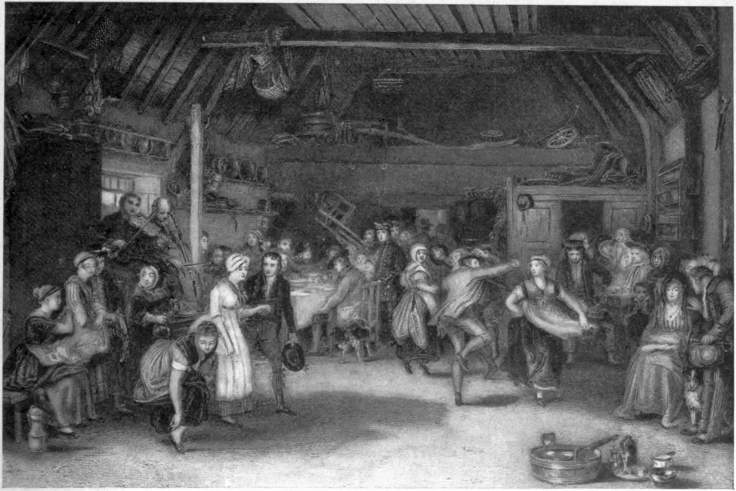
WILKIE. THE PENNY WEDDING.
Just as the first genre pictures of the Flemish school announced the appearance of a bourgeoisie, so in the England of the beginning of the century a new plebeian, middle-class society had taken the place of the patrons of earlier days, and this middle class set its seal upon manners and communicated its spirit to painting. Prosperity, culture, travel, reading, and leisure, everything which had been the privilege of individuals, now became the common property of the great mass of men. They prized art, but they demanded from it substantial nourishment. That two colours in connection with straight and curved lines are enough for the production of infinite harmonies was still a profound secret. “You are free to be painters if you like,” artists were told, “but only on the understanding that you are amusing and instructive; if you have no story to tell we shall yawn.” When they comply with these demands, artists are inclined to grow fond of sermonising and develop into censors of the public morals, almost into lay preachers.
Or, if the aim of painting lies in its narrative power, there is a natural tendency to represent the pleasant rather than the unpleasant facts of life, which is the cause of this one-sided character of genre painting. Everything that is not striking and out of the way—in other words, the whole poetry of ordinary life—is left untouched. Wilkie only paints the rustic on some peculiar occasion, at merry-making and ceremonial events; and he depicts him as a being of a different species from the townsman, because he seeks to gain his effects principally by humorous episodes, and aims at situations which are proper to a novel.
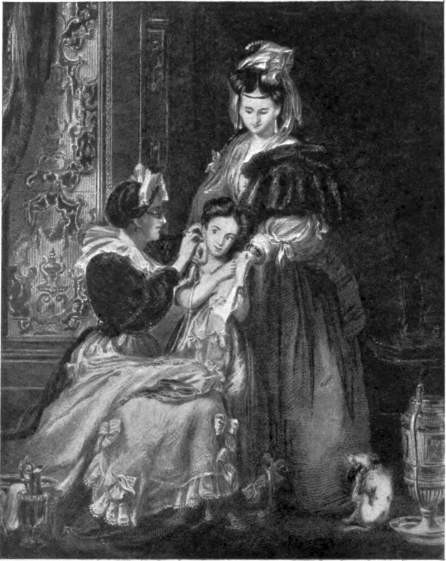
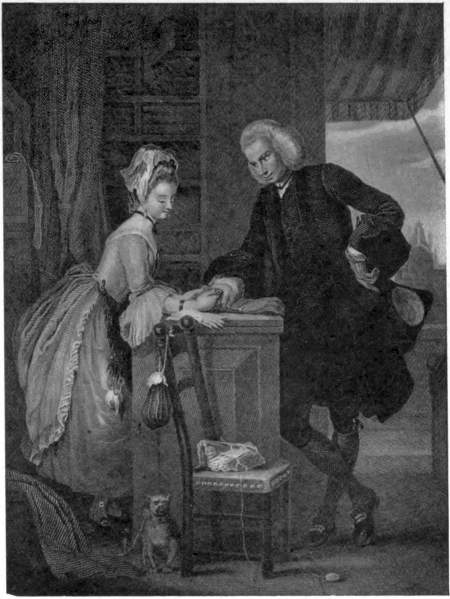
WILKIE. THE FIRST EARRING. NEWTON. YORICK AND THE GRISETTE.
Baptisms and dances, funerals and weddings, carousals and bridal visits are his favourite subjects; to which may be added the various contrasts offered by peasant life where it is brought into contact with the civilisation of cities—the country cousin come to town, the rustic closeted with a lawyer, and the like. A continual roguishness enlivens his pictures and makes comical figures out of most of these good people. He amuses himself at their expense, exposes their little lies, their thrift, their folly, their pretensions, and the absurdities with which their narrow circle of life has provided them. He pokes fun, and is sly and farcical. But the hard and sour labour of ordinary peasant life is left on one side, since it offers no material for humour and anecdote.
Through this limitation painting renounced the best part of its strength. To a man of pictorial vision nature is a gallery of magnificent pictures, and one which is as wide and far-reaching as the world. But whoever seeks salvation in narrative painting soon reaches the end of his material. In the life of any man there are only three or four events that are worth the trouble of telling; Wilkie told more, and he became tiresome in consequence. We are willing to accept these anecdotes as true, but they are threadbare. Things of this sort may be found in the gaily-bound little books which are given as Christmas presents to children. It is not exhilarating to learn that worldly marriages have their inconveniences, that there is a pleasure in talking scandal about one’s friends behind their backs, that a son causes pain to his mother by his excesses, and that egoism is an unpleasant failing. All that is true, but it is too true. We are irritated by the intrusiveness of this course of instruction. Wilkie paints insipid subjects, and by one foolery after another he has made painting into a toy for good children. And good children play the principal parts in these pictures.
As a painter, one of George Morland’s pupils, William Collins, threw the world into ecstasies by his pictures of children. Out of one hundred and twenty-one which he exhibited in the Academy in the course of forty years the principal are: the picture of “The Little Flute-Player,” “The Sale of the Pet Lamb,” “Boys with a Bird’s Nest,” “The Fisher’s Departure,” “Scene in a Kentish Hop-Garden,” and the picture of the swallows. The most popular were “Happy as a King”—a small boy whom his elder playmates have set upon a garden railing, from which he looks down laughing proudly—and “Rustic Civility”—children who have drawn up like soldiers, by a fence, so as to salute some one who is approaching. But it is clear from the titles of such pictures that in this province English genre painting did not free itself from the reproach of being episodic. Collins was richer in ideas than Meyer of Bremen. His children receive earrings, sit on their mother’s knee, play with her in the garden, watch her sewing, read aloud to her from their spelling-book, learn their lessons, and are frightened of the geese and hens which advance in a terrifying fashion towards them in the poultry-yard. He is an admirable painter of children at the family table, of the pleasant chatter of the little ones, of the father watching his sleeping child of an evening by the light of the lamp, with his heart full of pride and joy because he has the consciousness of working for those who are near to him. Being naturally very fond of children, he has painted the life of little people with evident enjoyment of all its variations, and yet not in a thoroughly credible fashion. Chardin painted the poetry of the child-world. His little ones have no suspicion of the painter being near them. They are harmlessly occupied with themselves, and in their ordinary clothes. Those of Collins look as if they were repeating a copybook maxim at a school examination. They know that the eyes of all the sightseers in the exhibition are fixed upon them, and they are doing their utmost to be on their best behaviour. They have a lack of unconsciousness. One would like to say to them: “My dear children, always be good.” But no one is grateful to the painter for taking from children their childishness, and for bringing into vogue that codling which had its way for so long afterwards in the pictures of children.
Gilbert Stuart Newton, an American by birth, who lived in England from 1820 to 1835, devoted himself to the illustration of English authors. Like Wilkie, he has a certain historical importance, because he devoted himself with great zeal to a study of the Dutchmen of the seventeenth century and to the French painters of the eighteenth, at a time when these masters were entirely out of fashion on the Continent and sneered at as representatives of “the deepest corruption.” Dow and Terborg were his peculiar ideals; and although the colour of his pictures is certainly heavy and common compared with that of his models, it is artistic, and shows study when one thinks of contemporary productions on the Continent. His works (“Lear attended by Cordelia,” “The Vicar of Wakefield restoring his Daughter to her Mother,” “The Prince of Spain’s Visit to Catalina” from Gil Blas, and “Yorick and the Grisette” from Sterne), like the pictures of the Düsseldorfers, would most certainly have lost in actuality but for the interest provided by the literary passages; yet they are favourably distinguished from the literary illustrations of the Düsseldorfers by the want of any sort of idealism. While the painters of the Continent in such pictures almost invariably fell into a rounded, generalising ideal of beauty, Newton had the scene played by actors and painted them realistically. The result was a theatrical realism, but the way in which the theatrical effects are studied and the palpableness of the histrionic gestures are so convincingly true to nature that his pictures seem like records of stage art in London about the year 1830.
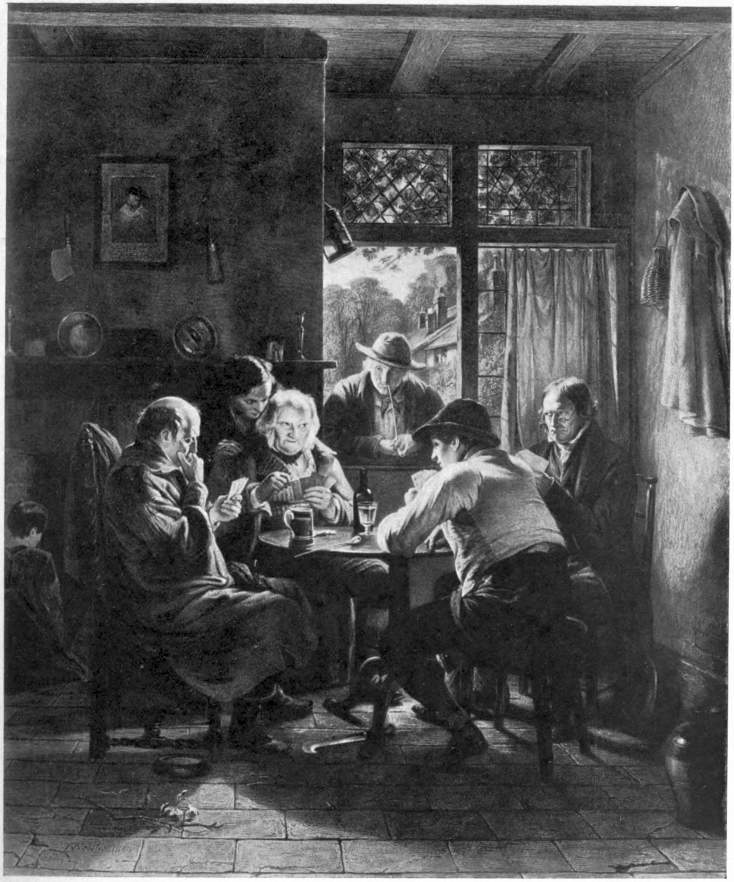
WEBSTER. THE RUBBER.
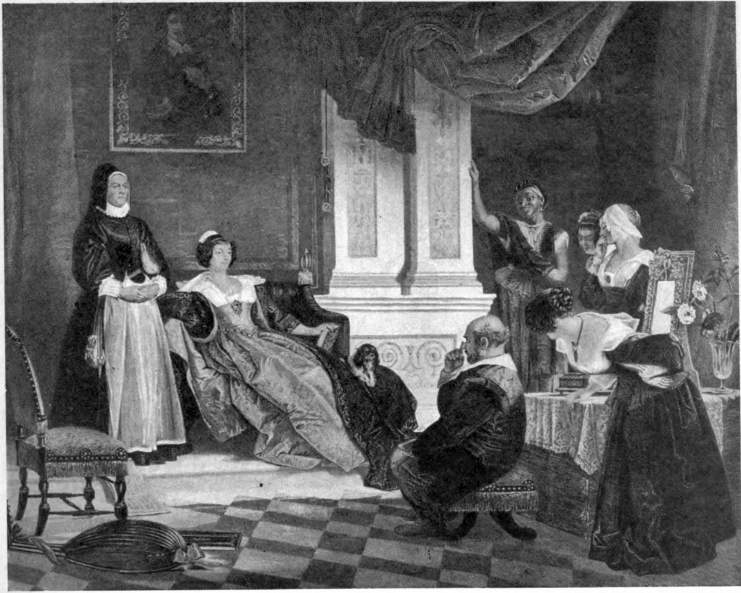
C. R. LESLIE. SANCHO AND THE DUCHESS.
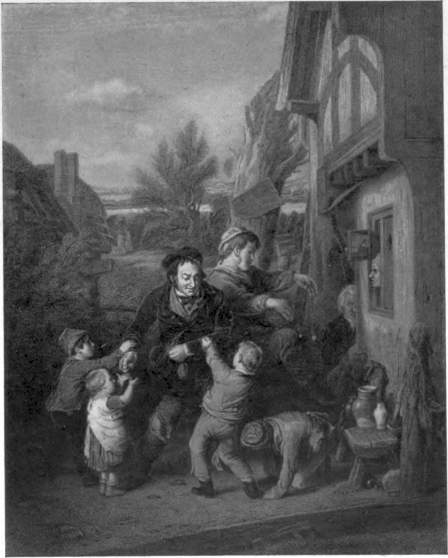
MULREADY. FAIR TIME.
Charles Robert Leslie, known as an author by his pleasant book on Constable and a highly conservative Handbook for Young Painters, had a similar repértoire, and rendered in oils Shakespeare, Cervantes, Fielding, Sterne, Goldsmith, and Molière, with more or less ability. The National Gallery has an exceedingly prosaic and colourless picture of his, “Sancho Panza in the Apartment of the Duchess.” Some that are in the South Kensington Museum are better; for example, “The Taming of the Shrew,” “The Dinner at Mr. Page’s House” from The Merry Wives of Windsor, and “Sir Roger de Coverley.” His finest and best-known work is “My Uncle Toby and the Widow Wadman,” which charmingly illustrates the pretty scene in Tristram Shandy: “’I protest, madam,’ said my Uncle Toby, ‘I can see nothing whatever in your eye.’ ‘It is not in the white!’ said Mrs. Wadman. My Uncle Toby looked with might and main into the pupil.” As in Newton’s works, so in Leslie’s too, there is such a strong dose of realism that his pictures will always keep their value as historical documents—not for the year 1630 but for 1830. As a colourist he was—in his later works at any rate—a delicate imitator of the Dutch chiaroscuro; and in the history of art he occupies a position similar to that of Diez in Germany, and was esteemed in the same way, even in later years, when the young Pre-Raphaelite school began its embittered war against “brown sauce”—the same war which a generation afterwards was waged in Germany by Liebermann and his followers against the school of Diez.
Mulready, thirty-two of whose pictures are preserved in the South Kensington Museum, is in his technique almost more delicate than Leslie, and he has learnt a great deal from Metsu. By preference he took his subjects out of Goldsmith. “Choosing the Wedding Gown” and “The Whistonian Controversy” would make pretty illustrations for an édition de luxe of The Vicar of Wakefield. Otherwise he too had a taste for immortalising children, by turns lazy and industrious, at their tea or playing by the water’s edge.
From Thomas Webster, the fourth of these kindly, childlike masters, yet more inspiriting facts are to be obtained. He has informed the world that at a not very remote period of English history all the agricultural labourers were quite content with their lot. No one ever quarrelled with his landlord, or sat in a public-house and let his family starve. The highest bliss of these excellent people was to stay at home and play with their children by the light of a wax-candle. Webster’s rustics, children, and schoolmasters are the citizens of an ideal planet, but the little country is a pleasant world. His pictures are so harmless in intention, so neat and accurate in drawing, and so clear and luminous in colour that they may be seen with pleasure even at the present day.
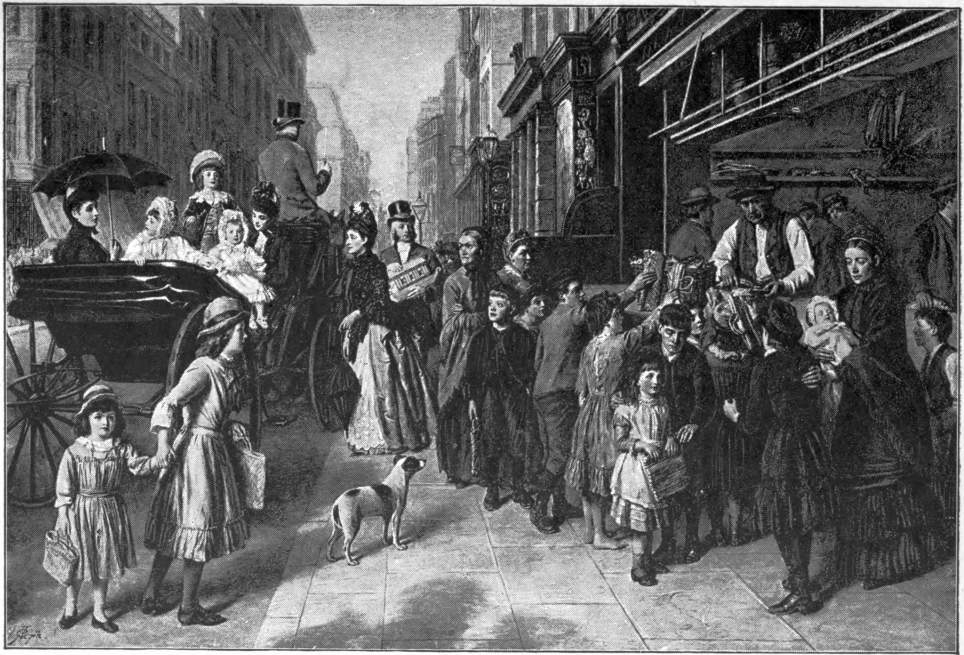
Cassell & Co.
FRITH. POVERTY AND WEALTH.
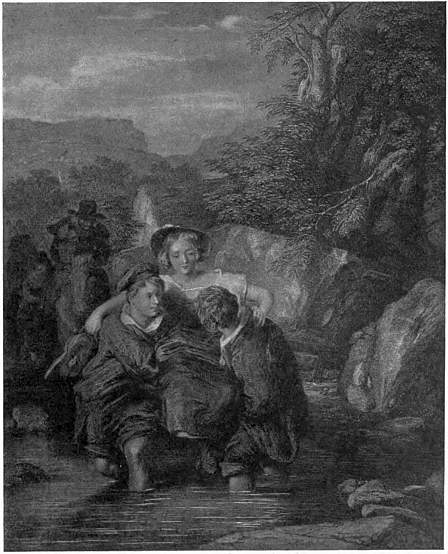
MULREADY. CROSSING THE FORD.
The last of the group, William Powell Frith, was the most copious in giving posterity information about the manners and costumes of his contemporaries, and would be still more authentic if life had not seemed to him so genial and roseate. His pictures represent scenes of the nineteenth century, but they seem like events of the good old times. At that period people were undoubtedly good and innocent and happy. They had no income-tax and no vices and worries, and all went to heaven and felt in good spirits. And so they do in Frith’s pictures, only not so naturally as in Ostade and Beham. For example, he goes on the beach at a fashionable English watering-place during the season, in July or August. The geniality which predominates here is quite extraordinary. Children are splashing in the sea, young ladies flirting, niggers playing the barrel-organ and women singing ballads to its strains; every one is doing his utmost to look well, and the pair of beggars who are there for the sake of contrast have long become resigned to their fate. In his racecourse pictures everything is brought together which on such occasions is representative of London life: all types, from the baronet to the ragman; all beauties, from the lady to the street-walker. A rustic has to lose his money, or a famished acrobat to turn his pockets inside out to assure himself that there is really nothing in them. His picture of the gaming-table in Homburg is almost richer in such examples of dry observation and humorous and spirited episode.
This may serve to exemplify the failures of these painters of genre. Not light and colour, but anecdote, comedy, and genial tale-telling are the basis of their labours. And yet, notwithstanding this attempt to express literary ideas through the mediums of a totally different art, their work is significant. While continental artists avoided nothing so much as that which might seem to approach nature, the English, revolting from the thraldom of theory, gathered subjects for their pictures from actual life. These men, indeed, pointed out the way to painters from every country; and they, once on the right road, were bound ultimately to arrive at the point from which they no longer looked on life through the glasses of the anecdotist, but saw it with the eye of the true artist.
CHAPTER XVIII
THE MILITARY PICTURE
While English painting from the days of Hogarth and Wilkie embraced rustic and middle-class life, the victory of modernity on the Continent could only be accomplished slowly and by degrees. The question of costume played an important part in it. “Artists love antiquated costume because, as they say, it gives them greater sweep and freedom. But I should like to suggest that in historical representations of their own age an eye should be kept on propriety of delineation rather than on freedom and sweep. Otherwise one might just as well allow an historian to talk to us about phalanxes, battlements, triarii, and argyraspids in place of battalions, squadrons, grenadiers, and cuirassiers. The painters of the great events of the day ought, especially, to be more true to fact. In battle-pieces, for example, they ought not to have cavalry shooting and sabreing about them in leather collars, in round and plumed hats, and the vast jack-boots which exist no longer. The old masters drew, engraved, and painted in this way because people really dressed in such a manner at the time. It is said that our costume is not picturesque, and therefore why should we choose it? But posterity will be curious to know how we clothed ourselves, and will wish to have no gap from the eighteenth century to its own time.”
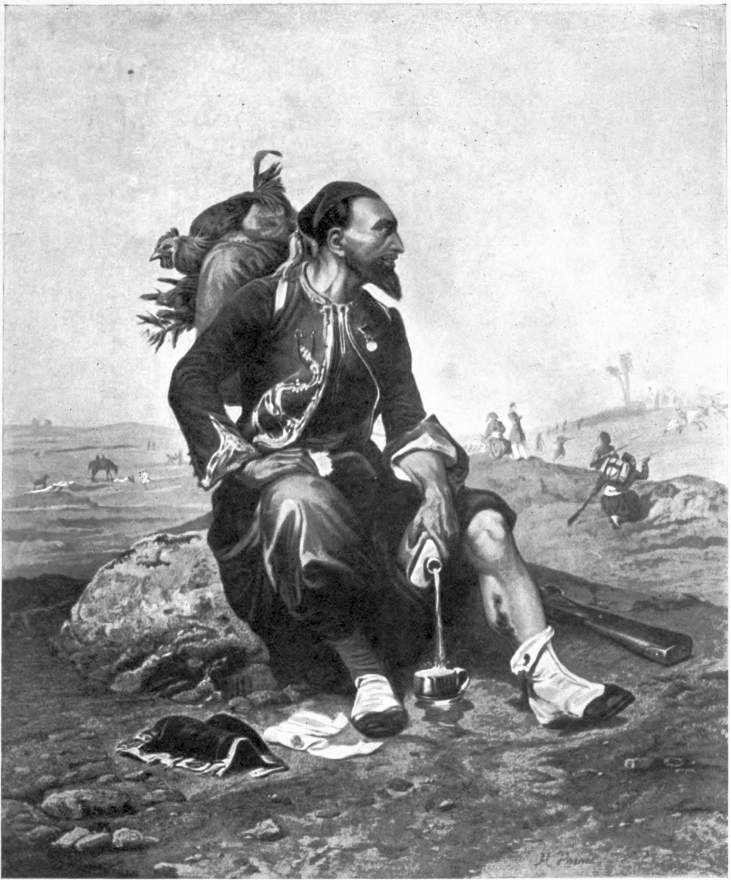
VERNET. THE WOUNDED ZOUAVE.
These words, which the well-known Vienna librarian Denis wrote in 1797 in his Lesefrüchte, show how early came the problem which was at high-water mark for a generation afterwards. The painting of the nineteenth century could only become modern when it succeeded in recognising and expressing the characteristic side of modern costume. But to do that it took more than half a century. It was, after all, natural that to people who had seen the graceful forms and delicate colours of the rococo time, the garb of the first half of the century should seem the most unfortunate and the least enviable in the whole history of costume. “What person of artistic education is not of the opinion,” runs a passage in Putmann’s book on the Düsseldorf school in 1835,—“what person of artistic education is not of the opinion that the dress of the present day is tasteless, hideous, and ape-like? Moreover, can a true style be brought into harmony with hoop-petticoats and swallow-tail coats and such vagaries? In our time, therefore, art is right in seeking out those beautiful fashions of the past, about which tailors concern themselves so little. How much longer must we go about, unpicturesque beings, like ugly black bats, in swallow-tail coats and wide trousers? The peasant’s blouse, indeed, can be accepted as one of the few picturesque dresses which have yet been preserved in Germany from the inauspicious influence of the times.” The same plaint is sung by Hotho in his history of German and Netherlandish painting; the costume of his age he declares to be thoroughly prosaic and tiresome. It is revolting to painters and an offence to the educated eye. Art must necessarily seek salvation in the past, unless it is to wait, and give brush and palette a holiday, until that happy time when the costume of nations comes to its pictorial regeneration. Only one zone, the realm of blouse and military uniform, was beyond the domain of tail-coat and trousers, and still furnished art with rich material.
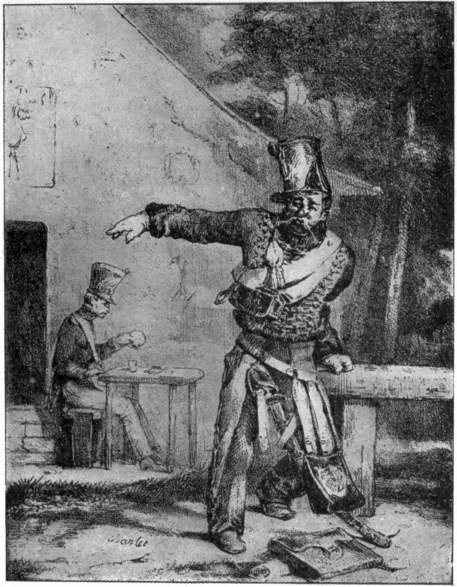
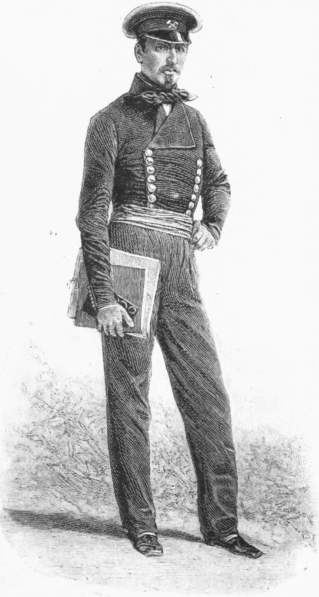
Gaz. des Beaux-Arts.
CHARLET. UN HOMME QUI BOÎT SEUL N’EST PAS DIGNE DE VIVRE. AUGUSTE MARIE RAFFET.
Since it was by working on uniform that plastic artists first learnt how to treat contemporary costume, so it was the military picture that first entered the circle of modern painting. By exalting the soldier into a warrior, and the warrior into a hero, it was here possible, even in the times of David and Carstens, to effect a certain compromise with the ruling classical ideas. Gérard, Girodet—to some extent even Gros—made abundant use of the mask of the Greek or Roman warrior, with the object of admitting the battle-piece into painting in the grand style. The real heroes of the Napoleonic epoch had not this plastic appearance nor these epic attitudes. Classicism altered their physiognomies and gave them, most illogically, the air of old marble statues. It was Horace Vernet who freed battle painting from this anathema. This, but little else, stands to his credit.
Together with his son-in-law Paul Delaroche, Horace Vernet is the most genuine product of the Juste-milieu period. The king with the umbrella founded the Museum of Versailles, that monstrous depôt of daubed canvas, which is a horrifying memory to any one who has ever wandered through it. However, it is devoted à toutes les gloires de la France. In a few years a suite of galleries, which it takes almost two hours merely to pass through from end to end, was filled with pictures of all sizes, bringing home the history of the country, from Charlemagne to the African expedition of Louis Philippe, under all circumstances which are in any way flattering to French pride. For miles numberless manufacturers of painting bluster from the walls. As pictor celerrimus Horace Vernet had the command-in-chief, and became so famous by his chronicle of the conquest of Algiers that for a long time he was held by trooper, Philistine, and all the kings and emperors of Europe as the greatest painter in France. He was the last scion of a celebrated dynasty of artists, and had taken a brush in his hand from the moment he threw away his child’s rattle. A good deal of talent had been given him in his cradle: sureness of eye, lightness of hand, and an enviable memory. His vision was correct, if not profound; he painted his pictures without hesitation, and is favourably distinguished from many of his contemporaries by his independence: he owes no one anything, and reveals his own qualities without arraying himself in those of other people. Only these qualities are not of an order which gives his pictures artistic interest. The spark of Géricault’s genius, which seems to have been transmitted to him in the beginning, was completely quenched in his later years. Having swiftly attained popularity by the aid of lithography which circulated his “Mazeppa” through the whole world, he became afterwards a bad and vulgar painter, without poetry, light, or colour; a reporter who expressed himself in banal prose and wounded all the finer spirits of his age. “I loathe this man,” said Baudelaire, as early as 1846.
Devoid of any sense of the tragedy of war, which Gros possessed in such a high degree, Vernet treated battles like performances at the circus. His pictures have movement without passion, and magnitude without greatness. If it had been required of him, he would have daubed all the boulevards; his picture of Smala is certainly not so long, but there would have been no serious difficulty in lengthening it by half a mile. This incredible stenographical talent won for him his popularity. He was decorated with all the orders in the world. The bourgeois felt happy when he looked at Vernet’s pictures, and the paterfamilias promised to buy a horse for his little boy. The soldiers called him “mon colonel,” and would not have been surprised if he had been made a Marshal of France. A lover of art passes the pictures of Vernet with the sentiment which the old colonel owned to entertaining towards music. “Are you fond of music, colonel?” asked a lady. “Madame, I am not afraid of it.”
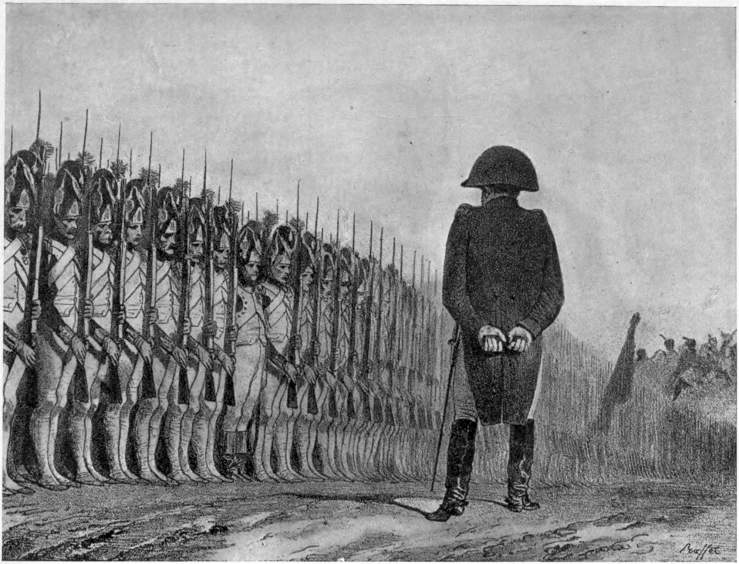
RAFFET. THE PARADE.
The trivial realism of his workmanship is as tedious as the unreal heroism of his soldiers. In the manner in which he conceived the trooper, Vernet stands between the Classicists and the moderns. He did not paint ancient warriors, but French soldiers: he knew them as a corporal knows his men, and by this respect for prescribed regulation he was prevented from turning them into Romans. But though he disregarded Classicism, in outward appearance, he did not drop the heroic tone. He always saw the soldier as the bold defender of his country, the warrior performing daring deeds, as in the “Battle of Alexander”; and in this way he gave his pictures their unpleasant air of bluster. For neither modern tactics nor modern cannon admit of the prominence of the individual as it is to be seen in Vernet’s pictures. The soldier of the nineteenth century is no longer a warrior, but the unit in a multitude; he does what he is ordered, and for that he has no need of the spirit of an ancient hero; he kills or is killed, without seeing his enemy or being seen himself. The course of a battle advances, move by move, according to mathematical calculation. It is therefore false to represent soldiers in heroic attitudes, or even to suggest deeds of heroism on the part of those in command. In giving his orders and directing a battle a general has to behave pretty much as he does at home at his writing-table. And he is never in the battle, as he is represented by Horace Vernet; on the contrary, he remains at a considerable distance off. Therefore, even with the dimensions of which Vernet availed himself, the exact portrait of a modern battle is exclusively an affair for panorama, but never for the flat surface of a picture. A picture must confine itself, either to the field-marshal directing the battle from a distance upon a hill in the midst of his staff, or else to little pictorial episodes in the individual life of the soldier. The gradual development from unreal battle-pieces to simple episodic paintings can be followed step by step in the following works.
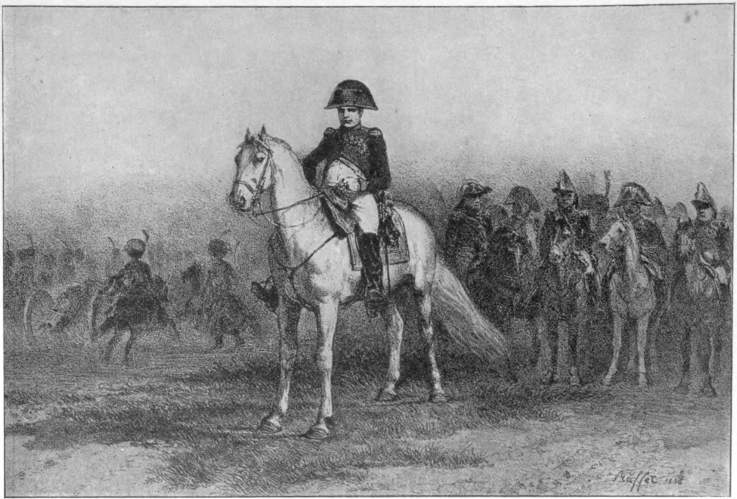
RAFFET. 1807.
What was painted for the Versailles Museum in connection with deeds of arms in the Crimean War and the Italian campaign kept more or less to the blustering official style of Horace Vernet. In the galleries of Versailles the battles of Wagram, Loano, and Altenkirche (1837-39), and an episode from the retreat from Russia (1851), represent the work of Hippolyte Bellangé. These are huge lithochromes which have been very carefully executed. Adolphe Yvon, who is responsible for “The Taking of Malakoff,” “The Battle of Magenta,” and “The Battle of Solferino,” is a more tedious painter, and remained during his whole life a pupil of Delaroche; he laid chief stress on finished and rounded composition, and gave his soldiers no more appearance of life than could be forced into the accepted academic convention. The fame of Isidor Pils, who immortalised the disembarkation of the French troops in the Crimea, the battle of Alma, and the reception of Arab chiefs by Napoleon III, has paled with equal rapidity. He could paint soldiers, but not battles, and, like Yvon, he was too precise in the composition of his works. In consequence they have as laboured an effect in arrangement as they have in colour. He was completely wanting in sureness and spontaneity. It is only his water-colours that hold one’s attention; and this they do at any rate by their unaffected actuality, and in spite of their dull and heavy colour. Alexandre Protais verged more on the sentimental. He loved soldiers, and therefore had the less toleration for war, which swept the handsome young fellows away. Two pendants, “The Morning before the Attack” and “The Evening after the Battle,” founded his reputation in 1863. The first showed a group of riflemen waiting in excitement for the first bullets of the enemy; the second represented the same men in the evening delighted with their victory, but at the same time—and here you have the note of Protais—mournful over the loss of their comrades. “The Prisoners” and “The Parting” of 1872 owed their success to the same lachrymose and melodramatic sensibility.
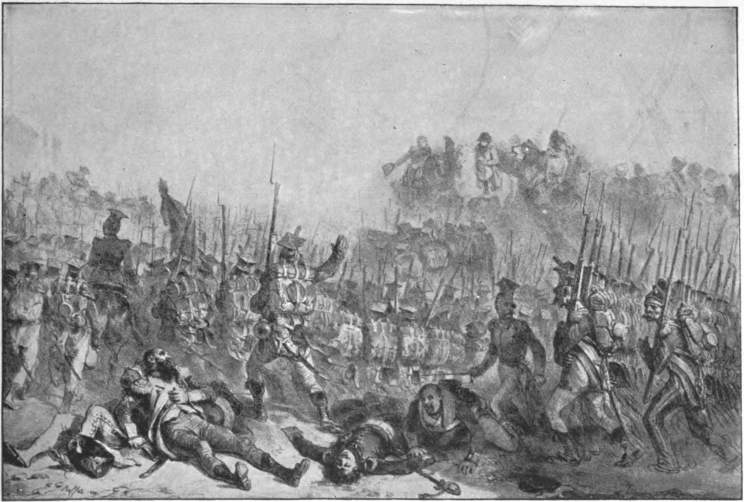
Cassell & Co.
RAFFET. POLISH INFANTRY.
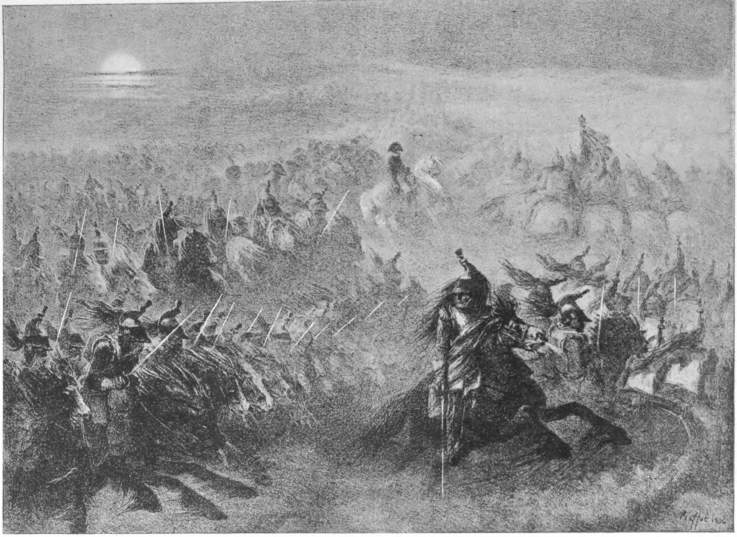
RAFFET. THE MIDNIGHT REVIEW.
C’est la grande revue A l’heure de minuit
Qu’aux Champs-Elysées Tient César décédé.
A couple of mere lithographists, soldiers’ sons, in whom a repining for the Napoleonic legend still found its echo, were the first great military painters of modern France. “Charlet and Raffet,” wrote Bürger-Thoré in his Salon of 1845, “are the two artists who best understand the representation of that almost vanished type, the trooper of the Empire; and after Gros they will assuredly endure as the principal historians of that warlike era.”
Charlet, the painter of the old bear Napoleon I, might almost be called the Béranger of painting. The “little Corporal,” the “great Emperor” appears and reappears in his pictures and drawings without intermission; his work is an epic in pencil of the grey coat and the little hat. From his youth he employed himself with military studies, which were furthered in Gros’ studio, which he entered in 1817. The Græco-Roman ideal did not exist for him, and he was indifferent to beauty of form. His was one of those natures which have a natural turn for actual fact; he had a power for characterisation, and in his many water-colours and lithographs he was merely concerned with the proper expression of his ideas. How it came that Delacroix had so great a respect for him was nevertheless explained when his “Episode in the Retreat from Russia,” in the World Exhibition of 1889, emerged from the obscurity of the Lyons Museum; it is perhaps his best and most important picture. When it appeared in the Salon of 1836, Alfred de Musset wrote that it was “not an episode but a complete poem”; he went on to say that the artist had painted “the despair in the wilderness,” and that, with its gloomy heaven and disconsolate horizon, the picture gave the impression of infinite disaster. After fifty years it had lost none of its value. Since the reappearance of this picture it has been recognised that Charlet was not merely the specialist of old grey heads with their noses reddened with brandy, the Molière of barracks and canteens, but that he understood all the tragical sublimity of war, from which Horace Vernet merely produced trivial anecdotes.
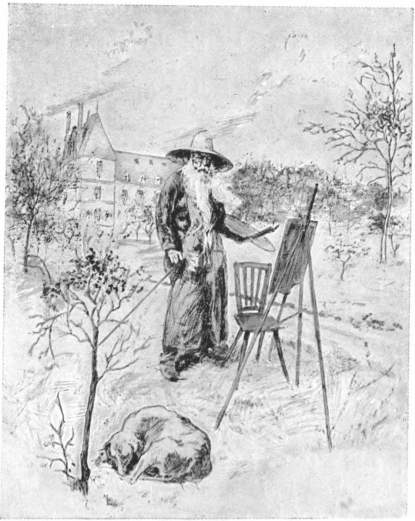
Mag. of Art.
ERNEST MEISSONIER.
Beside him stands his pupil Raffet, the special painter of the grande armée. He mastered the brilliant figure of Napoleon; he followed it from Ajaccio to St. Helena, and never left it until he had said everything that was to be said about it. He showed the “little Corsican” as the general of the Italian campaign, ghastly pale and consumed with ambition; the Bonaparte of the Pyramids and of Cairo; the Emperor Napoleon on the parade-ground reviewing his Grenadiers; the triumphal hero of 1807 with the Cuirassiers dashing past, brandishing their sabres with a hurrah; the Titan of Beresina riding slowly over the waste of snow, and, in the very midst of disaster, spying a new star of fortune; the war-god of 1813, the great hypnotiser greeted even by the dying with a cry of “Long life to the Emperor”; the adventurer of 1814, riding at the head of shattered troops over a barren wilderness; the vanquished hero of 1815, who, in the midst of his last square, in the thick of his beloved battalions, calls fickle fate once more into the lists; and the captive lion who, from the bridge of the ship, casts a last look on the coast of France as it fades in the mist. He has called the Emperor from the grave, as a ghostly power, to hold a midnight review of the grande armée. And with love and passion and enthusiasm he has followed the instrument of these victories, the French soldiers, the swordsmen of seven years’ service, through bivouac and battle, on the march and on parade, as patrols and outposts. The ragged and shoeless troops of the Empire are portrayed in his plates, with a touch of real sublimity, in defeat and in victory. The empty inflated expression of martial enthusiasm has been avoided by him; everything is true and earnest.
In a masterly fashion he could make soldiers deploy in masses. No one has known in the same way how to render the impression of the multitude of an army, the notion of men standing shoulder to shoulder, the welding of thousands of individuals into one complete entity. In Raffet a regiment is a thousand-headed living being that has but one soul, one moral nature, one spirit, one sentiment of willing sacrifice and heroic courage. His death was as adventurous as his life; he passed away in a hotel in Genoa, and was brought back to French soil as part of the cargo of a merchant ship. For a long time his fame was thrown into the shade, at first by the triumphs of Horace Vernet, and then by those of Meissonier, until at length a fitting record was devoted to him by the piety of his son Auguste.
Never had Ernest Meissonier to complain of want of recognition. After his rococo pictures had been deemed worth their weight in gold he climbed to the summit of his fame, his universal celebrity and his popularity in France, when he devoted himself in the sixties to the representation of French military history. The year 1859 took him to Italy in the train of Napoleon III. Meissonier was chosen to spread the martial glory of the Emperor, and, as the nephew was fond of drawing parallels between himself and his mighty uncle, Meissonier was obliged to depict suitable occasions from the life of the first Napoleon. His admirers were very curious to know how the great “little painter” would acquit himself in such a monumental task. First came the “Battle of Solferino,” that picture of the Musée Luxembourg which represents Napoleon III overlooking the battle from a height in the midst of his staff. After lengthy preparations it appeared in the Salon of 1864, and showed that the painter had not been untrue to himself: he had simply adapted the minute technique of his rococo pictures to the painting of war, and he remained the Dutch “little master” in all the battle-pieces which followed.
Napoleon III had no further deeds of arms to record, so the intended parallel series was never accomplished. It is true, indeed, that he took the painter with the army in 1870; but after the first battle was lost, Meissonier went home: he did not wish to immortalise the struggles of a retreat. Henceforward his brush was consecrated to the first Napoleon. “1805” depicts the triumphant advance to the height of fame; “1807” shows Napoleon when the summit has been reached and the soldiers are cheering their idol in exultation; “1814” represents the fall: the star of fortune has vanished; victory, so long faithful to the man of might, has deserted his banners. There is still a look of indomitable energy on the pale face of the Emperor, as, in utter despair, he aims his last shot against the traitor destiny; but his eyes seem weary, his mouth is contorted, and his features are wasted with fever.
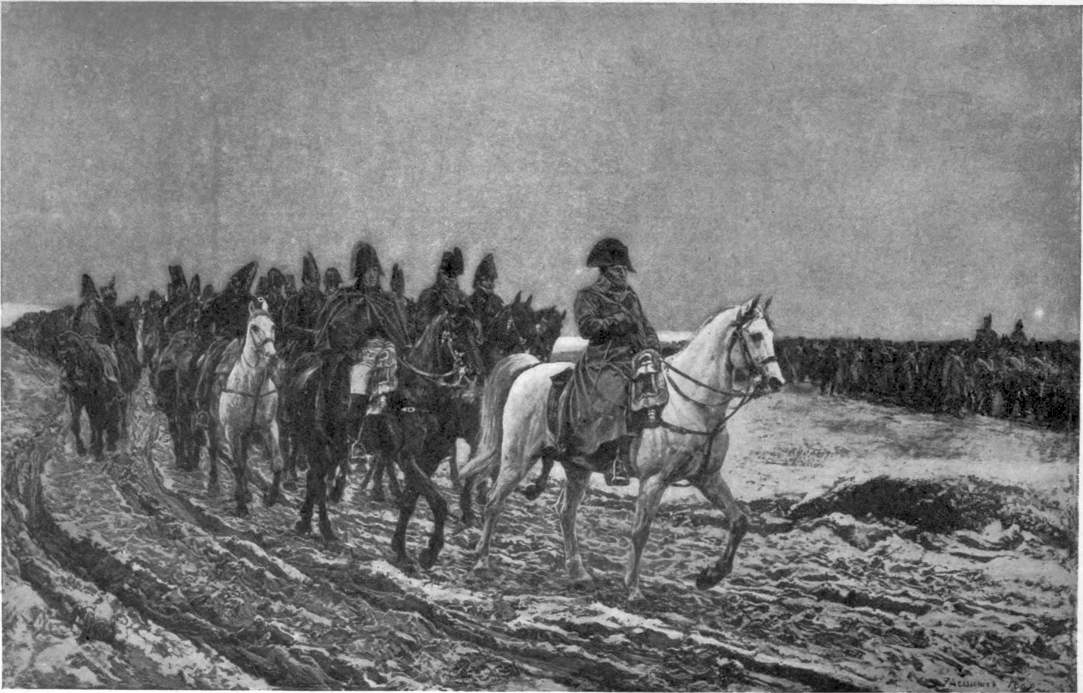
(By permission of M. Georges Petit, the owner of the copyright.)
MEISSONIER. 1814.
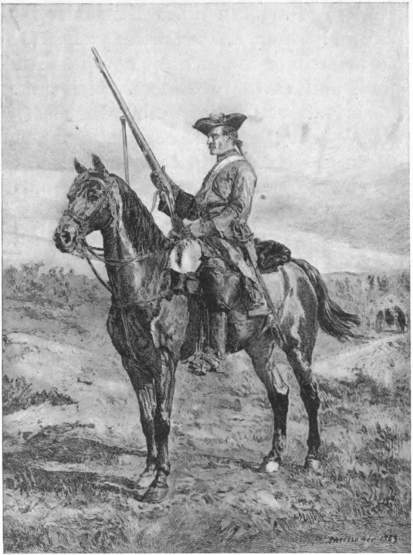
Gaz. des Beaux-Arts.
MEISSONIER. THE OUTPOST.
(By permission of M. Georges Petit, the owner of the copyright.)
Meissonier has treated all these works with the carefulness which he expended on his little rococo pictures. To give an historically accurate representation of Napoleon’s boots he did not content himself with borrowing them from the museum. Walking and riding—for he was a passionate horseman—he wore for months together boots of the same make and form as those of the “little Corporal.” To get the colour of the horses of the Emperor and his marshals, in their full-grown winter coat, and to paint them just as they must have appeared after the hardships and negligence of a campaign, he bought animals of the same race and colour as those ridden by the Emperor and his generals, according to tradition, and picketed them for weeks in the snow and rain. His models were forced to wear out the uniforms in sun and storm before he painted them; he bought weapons and harness at fancy prices when he could not borrow them from museums. And there is no need to say that he copied all the portraits of Napoleon, Ney, Soult, and the other generals that were to be had, and read through whole libraries before beginning his Napoleon series. To paint the picture “1814,” which is generally reckoned his greatest performance—Napoleon at the head of his staff riding through a snow-clad landscape—he first prepared the scenery on a spot in the plain of Champagne, corresponding to the original locality, just as he did in earlier years with his interiors of the rococo period; he even had the road laid out on which he wished to paint the Emperor advancing. Then he waited for the first fall of snow, and had artillery, cavalry, and infantry to march for him upon this snowy path, and actually contrived that overturned transport waggons, discarded arms, and baggage should be decoratively strewn about the landscape.
From these laborious preparations it may be understood that he spent almost as many millions of francs upon his pictures as he received. In his article, What an Old Work of Art is Worth, Julius Lessing has admirably dealt with the hidden ways of taste and commerce applied to art. Amongst all painters of modern times Meissonier is the only one whose pictures, during his own lifetime, fetched prices such as are only reached by the works of famous old masters of the greatest epochs. And yet he sold them straight from his easel, and never to dealers. Meissonier avenged himself magnificently for the privations of his youth. In 1832, when he gave up his apprenticeship with Menier, the great chocolate manufacturer, to become a painter, he had fifteen francs a month to spend. He had great difficulty in disposing of his drawings and illustrations for five or ten francs, and was often obliged to console himself with a roll for the want of a dinner. Only ten years later he was able to purchase a small place in Poissy, near St. Germain, where he went for good in 1850, to give himself up to work without interruption. Gradually this little property became a pleasant country seat, and in due course of time the stately house in Paris, in the Boulevard Malesherbes, was added to it. His “Napoleon, 1814,” for which the painter himself received three hundred thousand francs, was bought at an auction by one of the owners of the “Grands Magasins du Louvre” for eight hundred and fifty thousand francs; “Napoleon III at Solferino” brought him two hundred thousand, and “The Charge of the Cuirassiers” three hundred thousand. And in general, after 1850, he only painted for such sums. It was calculated that he received about five thousand francs for every centimetre of painted canvas, and left behind him pictures which, according to present rate, were worth more than twenty million francs, without having really become a rich man; for, as a rule, every picture that he painted cost him several thousand.