Front matter (continued 5)
Reading edition
“The Dance” was the first picture which followed that of “Speckbacher,” and it was circulated through the world in thousands of reproductions. There are two delightful figures in it: the pretty milkmaid who looks around her, radiant with pleasure, and the wiry old Tyrolese who is lifting his foot, cased in a rough hobnail shoe, to dance to the Schuhplattler. At the same time he painted “The Prize Horse” returning to his native village from the show decked and garlanded and greeted exultantly by old and young as the pride of the place. “The Last Summons” was again a scene from the Tyrolese popular rising of 1809. All who can still carry a rifle, a scythe, or a pitchfork have enrolled themselves beneath the banners, and are marching out to battle over the rough village street. The wives and children are looking earnestly at the departing figures, whilst a little old woman is pressing her husband’s hand. Everything was simply and genially rendered without sentimentality or emphasis, and the picture even makes an appeal by its colouring. As a sequel “The Return of the Victors” was produced in 1876: a troop of the Tyrolese levy is marching through its native mountain village, with a young peasant in advance, slightly wounded, and looking boldly round. Tyrolese banners are waving, and the fifes and drums and clarionet players bring up the rear. The faces of the men beam with the joy of victory, and women and children stand around to welcome those returning home. Joy, however, is harder to paint faithfully than sorrow. It is so easy to see that it has been artificially worked up from the model; nor is Defregger’s picture entirely innocent on this charge.
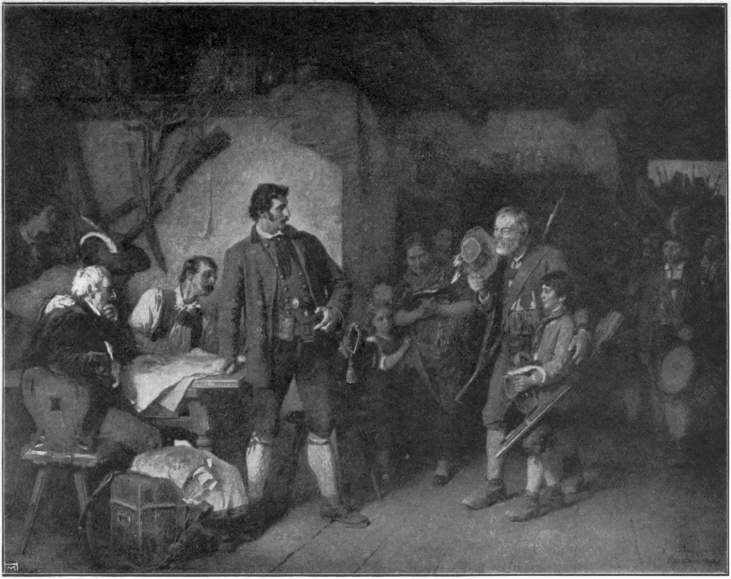
Hanfstaengl.
DEFREGGER. SPECKBACHER AND HIS SON.
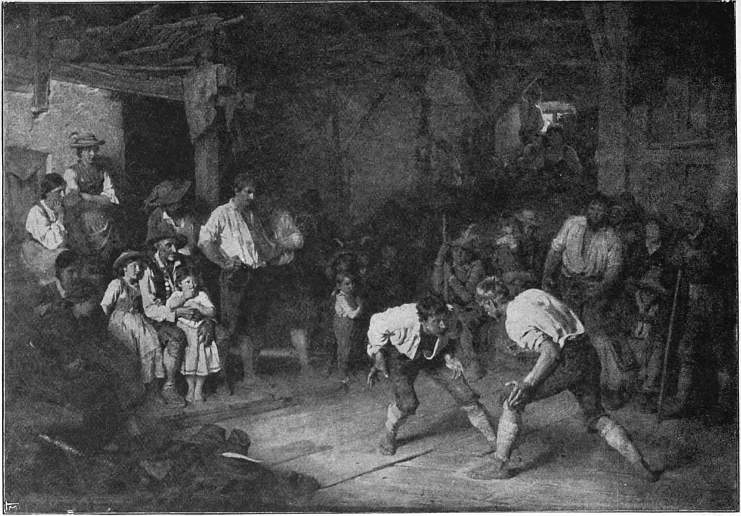
Hanfstaengl.
DEFREGGER. THE WRESTLERS.
“Andreas Hofer going to his Death” was his first concession to Piloty. Defregger had become professor at the Munich Academy, and was entered in the directory as “historical painter.” The figures were therefore painted life size; and in the grouping and the choice of the “psychic moment” the style aimed at “grand painting.” The result was the same emptiness which blusters through the historical pictures of the school of Delaroche, Gallait, and Piloty. The familiar stage effect and stilted passion has taken the place of simple and easy naturalism. Nor was he able to give life to the great figures of a large canvas as he had done in the smaller picture of the “Return of the Victors.” This is true of “The Peasant Muster” of 1883—which represented the Tyrolese, assembled in an arms manufactory, learning that the moment for striking had arrived—and of the last picture of the series, “Andreas Hofer receiving the Presents of the Emperor Francis in the Fortress of Innsbruck.” All the great Hofer pictures, which in earlier days were honoured as his best performances, have done less for his memory than for that of the sturdy hero. The genre picture was Defregger’s vocation. There lay his strength, and as soon as he left that province he renounced his fine qualities.
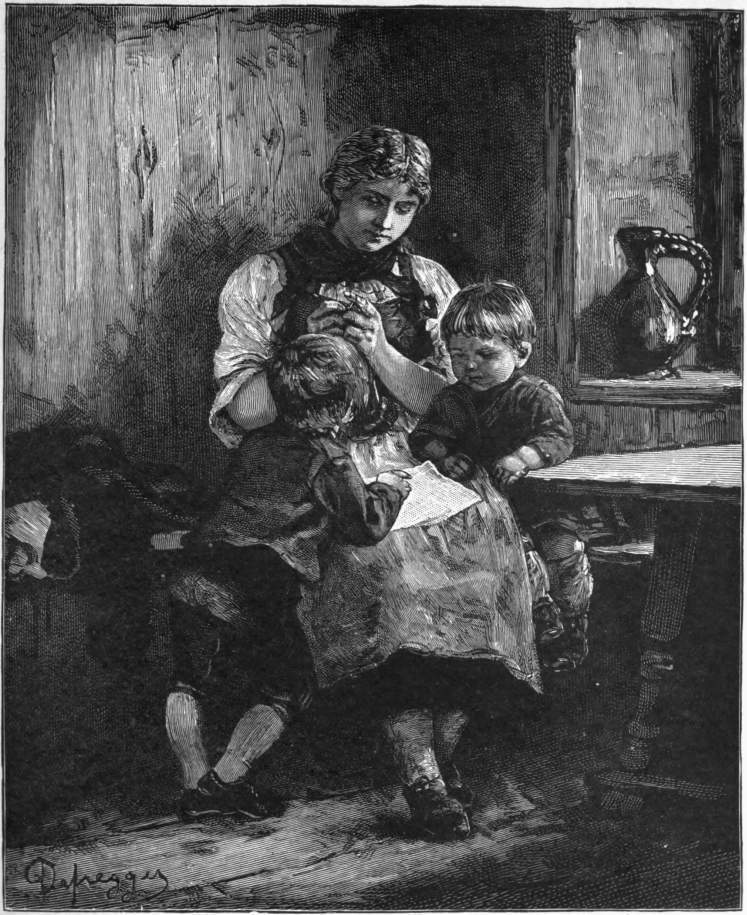
Cassell & Co.
DEFREGGER. SISTER AND BROTHERS.
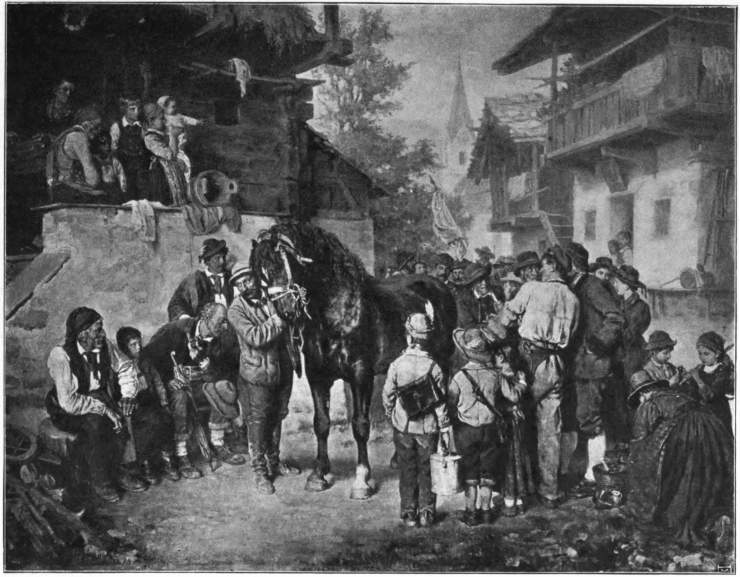
Hanfstaengl.
DEFREGGER. THE PRIZE HORSE.
And a holiday humour, a tendency to beautify what he saw, is spread over even his genre pictures. They make one suppose that there is always sunshine in the happy land of Tyrol, that all the people are chaste and beautiful, all the young fellows fine and handsome, all the girls smart, every household cleanly and well-ordered, all married folk and children honest and kind; whereas in reality these milk-maids and woodmen are far less romantic in their conduct; and so many a townsman who avoids contact with the living people goes into raptures over them as they are pictures. With Vautier he shares this one-sidedness as well as his defective colour. Almost all his pictures are hard, dry, and diffident in colouring, but, as with Vautier, the man atones for the painter. From Defregger one asks for no qualities of colour and no realistic Tyrolese, since he has rendered himself in his pictures, and gives one a glimpse into his own heart; and a healthy, genial, and kindly heart it is. His idealism is not born of laboriously acquired principles of beauty; it expresses the temperament of a painter—a temperament which unconsciously sees the people through a medium whereby they are glorified. A rosy glow obscures sadness, ugliness, wretchedness, and misery, and shows only strength and health, tenderness and beauty, fidelity and courage. He treasured sunny memories of the cheerful radiance which rested on his home in the hour of his return; he painted the joy which swelled in his own breast as he beheld again the rocks of his native country, heard once more the peaceful chime of its Sabbath bells. And this is what gives his works their human, inward truth, little as they may be authentic documents as to the population of Tyrol.
Later this will be more impartially recognised than it possibly can be at present. The larger the school of any artist, the more it will make his art trivial; and thus for a time the originality of the master himself seems to be mere trifling. The Tyrolese were depreciated in the market by Defregger’s imitators; only too many have aped his painting of stiff leather breeches and woollen bodices, without putting inside them the vivid humanity which is so charming in a genuine Defregger. But his position in the history of art is not injured by this. He has done enough for his age; he has touched the hearts of many by his cheerful, fresh, and healthy art, and he would be certain of immortality had he thrown aside his brush altogether from the time when the progress of painting left him in the rear.
With Defregger, the head of the Tyrolese school, Gabl and Mathias Schmidt, standing at a measurable distance from him, may find a well-merited place. Mathias Schmidt, born in the Tyrolese Alps in the same year as Defregger, began with satirical representations of the local priesthood. A poor image-carver has arrived with his waggon at an inn, on the terrace of which are sitting a couple of well-fed ecclesiastics, and by them he is ironically called to account as he offers a crucifix for sale. A young priest, as an austere judge of morals, reproves a pair of lovers who are standing before him, or asks a young girl such insidious questions at the bridal examination that she lowers her eyes, blushing. His greatest picture was “The Emigration of the Zillerthal Protestants.” Amongst later works, without controversial tendencies, “The Hunter’s Greeting” and “The Lathered Parson” may be named. The latter is surprised by two pretty girls while shaving. To these may be added “The Parson’s Patch,” a picture of a robust housekeeper hastily mending a weak spot in the pastor’s inexpressibles just before service.
Shortly after Defregger had painted his picture of “Speckbacher,” Alois Gabl came forward with his “Haspinger preaching Revolt,” and followed it up by smaller pictures with a humorous touch, representing a levy of recruits in Tyrol, the dance at the inn interrupted by the entrance of the parson, magnates umpiring at the shooting butts, a bar with laughing girls, and the like.
In 1870, Eduard Kurzbauer, who died young, in his “Fugitives Overtaken” executed a work representing an entire class of painted illustrations. A young man who has eloped with a girl is discovered with her by her mother in a village inn. The old lady is looking reproachfully at her daughter, who is overwhelmed by shame and penitence; the young man is much moved, the old servant grave and respectful, the young landlady curious, and the postilion who has driven the eloping pair has a sly smirk. Elsewhere Kurzbauer, who is a fresh and lively anecdotist, painted principally episodes, arraying his figures in the peasant garb of the Black Forest: a rejected suitor takes a sad farewell of a perverse blonde who disdains his love; or the engagement of two lovers is hindered by the interference of the father.
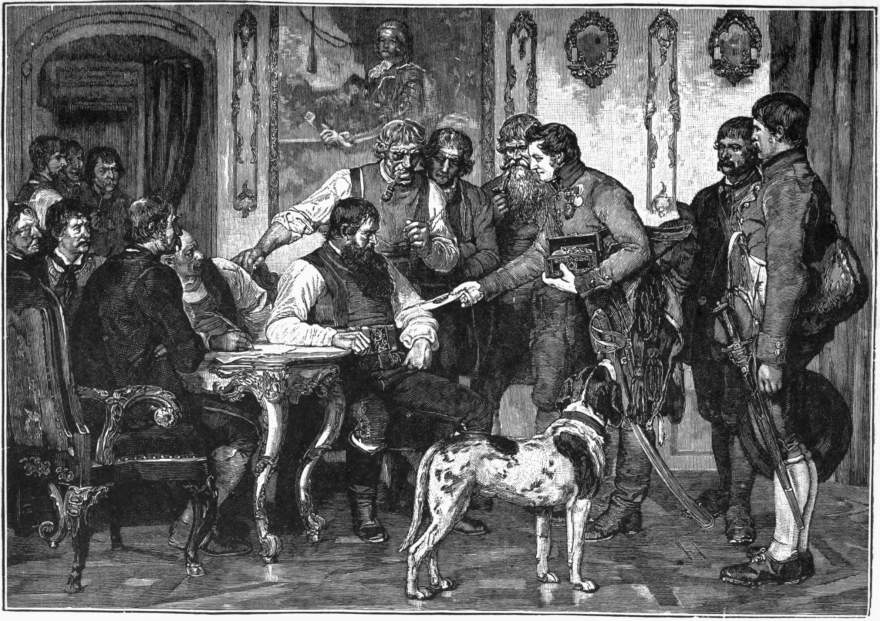
Cassell & Co.
DEFREGGER. ANDREAS HOFER APPOINTED GOVERNOR OF THE TYROL.
Hugo Kauffmann, the son of Hermann Kauffmann, planted himself in the interior of village taverns or in front of them, and made his dressed-up models figure as hunters, telling incredible tales, dancing to the fiddle, or quarrelling over cards.
Another North German, Wilhelm Riefstahl, showed how the peasants in Appenzell or Bregenz conduct themselves at mournful gatherings, at their devotions in the open air, and at All Souls’ Day Celebrations, and afterwards extended his artistic dominion over Rügen, Westphalia, and the Rhine country with true Mecklenburg thoroughness. He was a careful, conscientious worker, with a discontent at his own efforts in his composition, a certain ponderousness in his attempts at genre; but his diligently executed pictures—full of colour and painted in a peculiarly German manner—are highly prized in public galleries on account of their instructive soundness.
After the various classes of the German peasantry had been naturalised in the picture market by these narrative painters, Eduard Grützner, when religious controversy raged in the seventies, turned aside to discover drolleries in monastic life. This he did with the assistance of brown and yellowish white cowls, and the obese and copper-nosed models thereto pertaining. He depicts how the cellarer tastes a new wine, and the rest of the company await his verdict with anxiety; how the entire monastery is employed at the vintage, at the broaching of a wine cask or the brewing of the beer; how they tipple; how bored they are over their chess or their dice, their cards or their dominoes; how they whitewash old frescoes or search after forbidden books in the monastery library. This, according to Grützner, is the routine in which the life of monks revolves. At times amidst these figures appear foresters who tell of their adventures in the chase, or deliver hares at the cloister kitchen. And the more Grützner was forced year after year to make up for his decline as a colourist, by cramming his pictures with so-called humour, the greater was his success.
It was only long afterwards that genre painting in broad-cloth came into vogue by the side of this genre in peasant blouse and monastic cowl, and stories of the exchange and the manufactory by the side of village and monastic tales. Here Düsseldorf plays a part once more in the development of art. The neighbourhood of the great manufacturing towns on the Rhine could not but lead painters to these subjects. Ludwig Bokelmann, who began by painting tragical domestic scenes—card players, and smoking shop-boys, in the style of Knaus—made the pawnshop a theme for art in 1875, and dexterously crowded into his picture all the types which popular fancy brings into association with the conception: business-like indifference, poverty ashamed, fallen prosperity, bitter need, avarice, and the love of pleasure. In 1877, when the failure of the house of Spitzeder made a sensation in the papers, he painted his picture “The Savings Bank before the Announcement of Failure,” which gave him another opportunity for ranging in front of the splendid building an assembly of deluded creditors of all classes, and of showing how they expressed their emotion according to temperament and education, by excited speeches, embittered countenances, gloomy resignation, or vivid gesticulation. Much attention was likewise excited by “The Arrest.” In this picture a woman was being watched for by a policeman, whilst the neighbours—male and female—loitered round with the requisite expression of horror, indignation, sympathy, or indifferent curiosity. The opening of a will, the last moments of an electioneering struggle, scenes in the entrance hall of a court of justice, the emigrants’ farewell, the gaming-table at Monte Carlo, and a village fire, were other newspaper episodes from the life of great towns which he rendered in paint.
His earlier associate in Düsseldorf, Ferdinand Brütt, after first painting rococo pictures, owed his finest successes to the Stock Exchange. It, too, had its types: the great patrician merchants and bankers of solid reputation, the jobbers, break-neck speculators, and decayed old stagers; and, as Brütt rendered these current figures in a very intelligible manner, his pictures excited a great deal of attention. Acquittals and condemnations, acts of mortgage, emigration agents, comic electors, and prison visits, as further episodes from the social, political, and commercial life of great towns, fill up the odd corners of his little local chronicle.
Thus the German genre painting ran approximately the same course as the English had done at the beginning of the century. At that time the kingdom of German art was not of this world. Classicism taught men to turn their eyes on the art of a past age. Art in Germany had progressed slowly, and at first with an uncertain and hesitating step, before it learnt that what blossoms here, and thrives and fades, should be the subject of its labours. Gradually it brought one sphere of reality after the other into its domain. Observation took the place of abstraction, and the discoverer that of the inventor. The painter went amongst his fellow-creatures, opened his eyes and his heart to share their fortunes and misfortunes, and to reproduce them in his own creation. He discovered the peculiarities of grades of life and professional classes. Every one of the beautiful German landscapes with its peasantry, every one of the monastic orders and every manufacturing town found its representative in genre painting. The country was mapped out. Each one took over his plot, which he superintended, conscientiously, like an ethnographical museum. And just as fifty years before, Germany had been fertilised by England, so it now gave in its turn the principles of genre painting to the powers of the second rank in art.
Even France was in some degree influenced. As if to indicate that Alsace would soon become German once more, after 1850 there appeared in that province certain painters who busied themselves with the narration of anecdote from rustic life quite in the manner of Knaus and Vautier.
Gustave Brion, the grand-nephew of Frederica of Sesenheim, settled in the Vosges, and there gave intelligence of a little world whose life flowed by, without toil, in gentle, patriarchal quietude, interrupted only by marriage feasts, birthdays, and funeral solemnities. He appears to have been rather fond of melancholy and solemn subjects. His interiors, with their sturdy and honest people, bulky old furniture, and large green faïence stoves, which are so dear to him, are delightful in their familiar homeliness and their cordial Alsatian and German character, and recall Vautier; in fact, he might well be termed the French Vautier. He lives in them himself—the quiet old man, who in his last years occupied himself solely with the management of his garden and the culture of flowers, or sat by the hour in an easy-chair at the window telling stories to his old dog Putz. But pictorial unity of effect must be asked from him as little as from Vautier.
Charles Marchal, too, was no painter, but an anecdotist, with a bias towards the humorous or sentimental; and so very refined and superior was he that he saw none but pretty peasant girls, who might easily be mistaken for “young ladies,” if they exchanged their kerchiefs and bodices for a Parisian toilette. His chief picture was “The Hiring Fair” of 1864: pretty peasant girls are standing in a row along the street, bargaining with prospective masters before hiring themselves out.
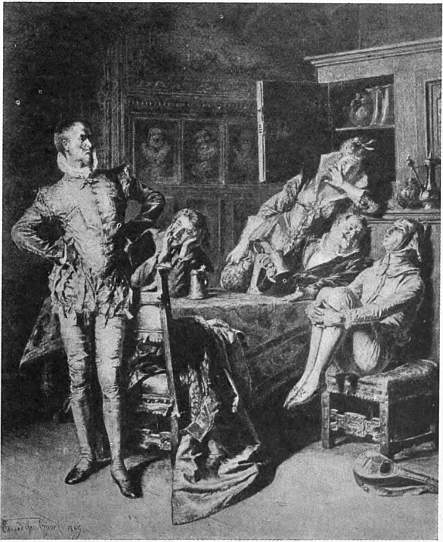
GRÜTZNER. TWELFTH NIGHT.
The most famous of this group of artists is Jules Breton, who after various humorous and sentimental pieces placed himself in 1853 in the front rank of the French painters of rustics by his “Return of the Reapers” (Musée Luxembourg). His “Gleaners” in 1855, “Blessing the Fields” in 1857, and “The Erection of the Picture of Christ in the Churchyard” were pretty enough to please the public, and sufficiently sound in technique not to be a stumbling-block to artists. After 1861 he conceived an enthusiasm for sunsets, and was never weary of depicting the hour when the fair forms of peasant maidens stand gracefully out against the quiet golden horizon. Jules Breton wrote many poems, and a vein of poetry runs through his pictures. They tell of the sadness of the land when the fields sleep dreamily beneath the shadows of the evening, touched by the last ray of the departing sun; but they tell of it in verses where the same rhymes are repeated with wearisome monotony. Breton is a charming and sympathetic figure, but he never quite conquered Classicism. His gleaners moving across the field in the evening twilight bear witness to an attentive, deliberate study of the works of Leopold Robert; and unfortunately much of the emphasis and classical style of Robert has been transmitted to Breton’s rustic maidens. They have most decidedly a lingering weakness for pose, and a sharp touch of the formula of the schools. There is an affectation of style in their garb, and their hands are those of bonnes who have never even handled a rake. Breton, as Millet said of him, paints girls who are too beautiful to remain in the country. His art is a well-bred, idyllic painting, with gilt edges; it is pleasing and full of delicate figures which are always elegant and always correct, but it is a little like flat lemonade; it is monotonous and only too carefully composed, destitute of all masculinity and seldom avoiding the reef of affectation.
Norway and Sweden were fructified from Düsseldorf immediately. When Tidemand had shown the way, the academy on the Rhine was the high school for all the sons of the North during the fifties. They set to translating Knaus and Vautier into Swedish and Norwegian, and caught the tone of their originals so exactly that they almost seem more Düsseldorfian than the Düsseldorfers themselves.
Karl D’Uncker, who arrived in 1851 and died in 1866, was led by the influence of Vautier to turn to little humorous incidents. After “The Two Deaf Friends” (two old people very hard of hearing, who are making comical efforts to understand each other) and “The Vagabond Musician and his Daughter before the Village Magistrates” there followed in 1858 the scene in “The Pawnshop,” which divided the honours of the year with Knaus’s “Golden Wedding.” He is an artistic compromise between Knaus and Schroedter, a keen observer and a humorous narrator, who takes special pleasure in the sharp opposition of characteristic figures. In his “Pawnshop” and his “Third Class Waiting Room” vagabonds mingle in the crowd beside honest people, beggars beside retired tradesmen, old procuresses beside pure and innocent girls, and heartless misers beside warm-hearted philanthropists. In these satirically humorous little comedies Swedish costume has been rightly left out of sight. This ethnographical element was the forte of Bengt Nordenberg, who as a copyist of Tidemand gradually became the Riefstahl of the North. His “Golden Wedding in Blekingen,” his “Bridal Procession,” his “Collection of Tithes,” “The Pietists,” and “The Promenade at the Well,” are of the same ethnographical fidelity and the same anecdotic dryness. He gets his best effects when he strikes an idyllic, childlike note or one of patriarchal geniality. The “Bridal Procession” received in the village with salvoes and music, “The Newly Married Pair” making a first visit to the parents of one of them, the picture of schoolboys playing tricks upon an old organist, that of children mourning over a lamb slain by a wolf, are, in the style of the sixties, the works of a modest and amiable anecdotist, who had a fine sense for the peaceful, familiar side of everyday life in town and country.
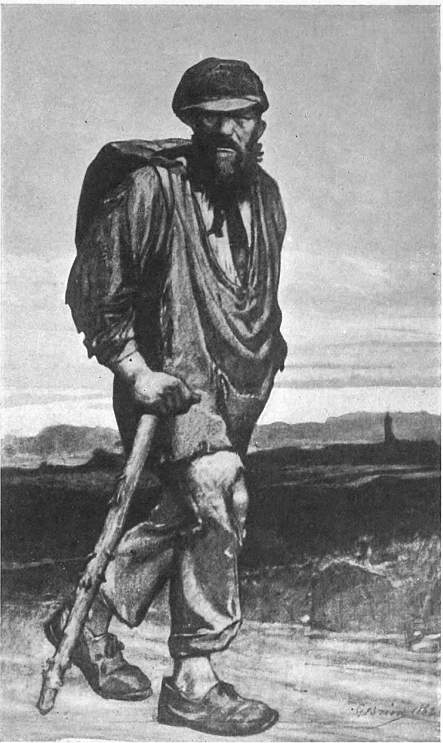
BRION. JEAN VALJEAN.
In Wilhelm Wallander, as in Madou, noise and frolic and jest have the upper hand. His pictures are like saucy street ditties sung to a barrel-organ. The crowd at the market-place, the gossip in the spinning-room on a holiday evening, hop-pickings, dances, auctions on old estates, weddings, and the guard turning out, are his favourite scenes. Even when he came to Düsseldorf he was preceded by his fame as a jolly fellow and a clever draughtsman, and when he exhibited his “Market in Vingaker” he was greeted as another Teniers. His “Hop-Harvest” is like a waxwork show of teasing lads and laughing lasses. He was an incisive humorist and a spirited narrator, who under all circumstances was more inclined to jest than to touch idyllic and elegiac chords. In his pictures peasant girls never wander solitary across the country, for some lad who is passing by always has a joke to crack with them; it never happens that girls sit lonely by the hearth, there is always a lover to peep out laughing from behind the cupboard door.
Anders Koskull cultivated the genre picture of children in a more elegiac fashion; he has poor people sitting in the sun, or peasant families in the Sunday stillness laying wreaths upon the graves of their dear ones in the churchyard. Kilian Zoll, like Meyer of Bremen, painted very childish pictures of women spinning, children with cats, the joys of grandmother, and the like. Peter Eskilson turned to the representation of an idyllic age of honest yeomen, and has given in his best known work, “A Game of Skittles in Faggens,” a pleasant picture from peasant life in the age of pig-tails. The object of August Jernberg’s study was the Westphalian peasant with his slouching hat, long white coat, flowered waistcoat, and large silver buttons. He was specially fond of painting dancing bears surrounded by a crowd of amused spectators, or annual fairs, for which a picturesque part of old Düsseldorf served as a background. Ferdinand Fagerlin has something attractive in his simplicity and good-humour. If he laughs, as he delights in doing, his laughter is cordial and kind-hearted, and if he touches an elegiac chord he can guard against sentimentalism. In contrast with D’Uncker and Wallander, who always hunted after character pieces, he devotes himself to expression with much feeling, and interprets it delicately even in its finer nuances. Henry Ritter, who influenced him powerfully in the beginning of his career, drew his attention to Holland, and Fagerlin’s quiet art harmonises with the Dutch phlegm. Within the four walls of his fishermen’s huts there are none but honest grey-beards and quiet women, active wives and busy maidens, vigorous sailors and lively peasant lads. But his pictures are sympathetic in spite of this one-sided optimism, since the sentiment is not too affected nor the anecdotic points too heavily underlined.
Amongst the Norwegians belonging to this group is V. Stoltenberg-Lerche, who with the aid of appropriate accessories adapted the interiors of cloisters and churches to genre pictures, such as “Tithe Day in the Cloister,” “The Cloister Library,” and “The Visit of a Cardinal to the Cloister,” and so forth. Hans Dahl, a juste-milieu between Tidemand and Emanuel Spitzer, carried the Düsseldorf village idyll down to the present time. “Knitting the Stocking” (girls knitting on the edge of a lake), “Feminine Attraction” (a lad with three peasant maidens who are dragging a boat to shore in spite of his resistance), “A Child of Nature” (a little girl engaged to sit as model to a painter amongst the mountains, and running away in alarm), “The Ladies’ Boarding School on the Ice,” “First Pay Duty,” etc., are some of the witty titles of his wares, which are scattered over Europe and America. Everything is sunny, everything laughs, the landscapes as well as the figures; and if Dahl had painted fifty years ago, his fair maidens with heavy blond plaits, well-bred carriage, and delicate hands that have never been disfigured by work, would undoubtedly have assured him no unimportant place beside old Meyerheim in the history of the development of the genre picture.
An offshoot from the Munich painting of rustics shot up into a vigorous sapling in Hungary. The process of refining the raw talents of the Magyar race had been perfected on the shores of the Isar, and the Hungarians showed gratitude to their masters by applying the principles of the Munich genre to Magyar subjects when they returned home. The Hungarian rooms of modern exhibitions have consequently a very local impress. Everything seems aboriginal, Magyar to the core, and purely national. Gipsies are playing the fiddle and Hungarian national songs ring forth, acrobats exhibit, slender sons of Pusta sit in Hungarian village taverns over their tokay, muscular peasant lads jest with buxom, black-eyed girls, smart hussars parade their irresistible charms before lively damsels, and recruits endeavour to imbibe a potent enthusiasm for the business of war from the juice of the grape. Stiff peasants, limber gipsies, old people dancing, smart youths, the laughing faces of girls and bold fellows with flashing eyes, quarrelsome heroes quick with the knife, tipsy soldiers and swearing sergeants, drunkards, suffering women and poor orphans, pawnshops and vagabonds, legal suits, electioneering scenes, village tragedies and comic proposals, artful shop-boys, and criminals condemned to death, the gay confusion of fairs and the merry return from the harvest and the vintage, waxed moustaches, green and red caps and short pipes, tokay, Banat wheat, Alfoeld tobacco, and Sarkad cattle,—such are the elements worked up, as the occasion demanded, either into little tales or great and thrilling romances. And the names of the painters are as thoroughly Magyar as are the figures. Beside Ludwig Ebner, Paul Boehm, and Otto von Baditz, which have a German sound, one comes across such names as Koloman Déry, Julius Aggházi, Alexander Bihari, Ignaz Ruskovics, Johann Jankó, Tihamér Margitay, Paul Vagó, Arpad Fessty, Otto Koroknyai, D. Skuteczky, etc.
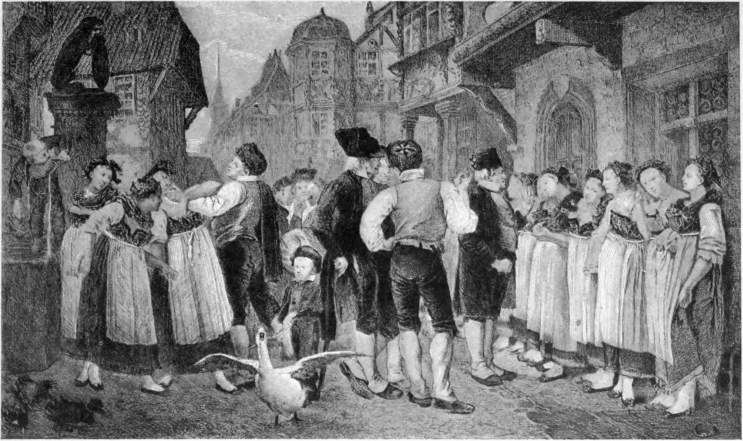
L’Art.
MARCHAL. THE HIRING FAIR.
But setting aside the altered names and the altered locality and garb, the substance of these pictures is precisely the same as that of the Munich pictures of twenty years before: dance and play, maternal happiness, wooing, and the invitation to the wedding. Instead of the Schuhplattler they paint the Czarda, instead of the drover’s cottage the taverns of Pesth, instead of the blue Bavarian uniform the green of the Magyar Hussars. Their painting is tokay adulterated with Isar water, or Isar water with a flavour of tokay. What seems national is at bottom only their antiquated standpoint. It is a typical development repeating itself in the nineteenth century through all branches of art; the sun rises in the West and sets in the East. Any other progress than that of the gradual expansion of subject-matter cannot be established in favour of the productions of all this genre painting. In colour and in substance they represent a phase of art which the leading countries of Europe had already left behind about the middle of the century, and which had to be overcome elsewhere, if painting was again to be what it had been in the old, good periods.
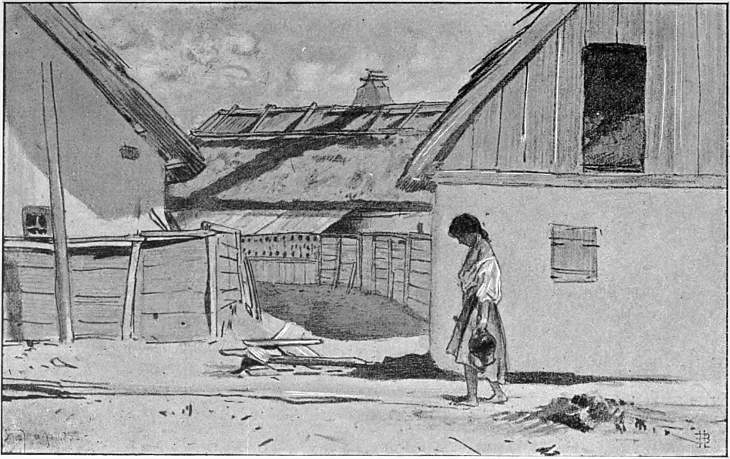
Seemann, Leipzig.
PETTENKOFEN. A HUNGARIAN VILLAGE (PENCIL DRAWING).
For as yet all these genre painters were the children of Hogarth; their productions were the outcome of the same spirit, plebeian and alien to art, which had come into painting when the middle classes began to hold a more important position in society. Yet their artistic significance ought not to be and cannot be contested. In an age which was prouder of its antiquarian knowledge than of its own achievements, which recognised the faithful imitation of the method of all past periods, the mere performance of a delicate task, as the highest aim of art, these genre painters were the first to portray the actual man of the nineteenth century; the first to desert museums and appeal to nature, and thus to lay the foundation of modern painting. They wandered in the country, looked at reality, sought to imitate it, and often displayed in their studies a marvellous directness of insight. But these vigorous initial studies were too modest to find favour and esteem with a public as yet insufficiently educated for the appreciation of art. Whilst in England the exhibitions of the Royal Academy and in France those of the Paris Salon created, comparatively early, a certain ground for the comprehension of art, the genre painters of other countries worked up to and into the sixties without the appropriate social combinations. After 1828 the Art Unions began to usurp the position of that refined society which had formerly played the Mæcenas as the leading dictators of taste.
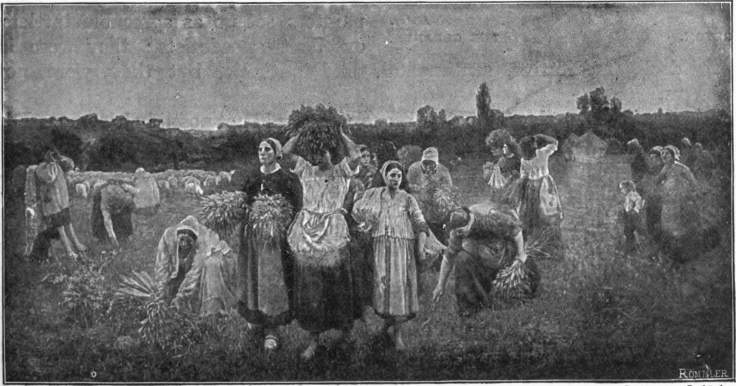
Seemann, Leipzig.
BRETON. THE RETURN OF THE REAPERS.
Albrecht Adam, who was chiefly responsible for the foundation of the Munich Union, has himself spoken clearly in his autobiography of the advantages and disadvantages of this step. “Often,” he writes, “often have I asked myself whether I have done good or not by this scheme, and to this hour I have not been able to make up my mind. The cultivation of art clearly received an entirely different bias from that which it had in earlier days. What was formerly done by artistic and judicious connoisseurs was now placed for the most part in the hands of the people. Like so much else in the world, that had its advantages, but in practice the shady side of the matter became very obvious.” The disadvantages were specially these: “the people” for a long time could only understand such paintings as represented a story in a broad and easy fashion; paintings which in the narrative cohesion of the subject represented might be read off at a glance, since the mere art of reading had been learnt at school, rather than those which deserved and required careful study. The demand for anecdotic subject was only waived in the case of ethnographical painting, in Italian and Oriental genre; for here the singular types, pictorial costumes, and peculiar customs of foreign countries were in themselves enough to provoke curiosity. What was prized in the picture was merely something external, the subject of representation, not the representation itself, the matter and not the manner, that which concerned the theme, that which fell entirely beyond the province of art. The illustrated periodicals which had been making their appearance since the forties gave a further impetus to this phase of taste. The more inducement there was to guess charades, the more injury was done to the sensuous enjoyment of art; for the accompanying text of the author merely translated the pictures back into their natural element. Painters, however, were not unwilling to reconcile themselves to the circumstances, because, as a result of their technical insufficiency, they were forced, on their side, to try to lend their pictures the adjunct of superficial interest by anecdotic additions. Literary humour had to serve the purpose of pictorial humour, and the talent of the narrator was necessary to make up for their inadequate artistic qualities. As the historical painters conveyed the knowledge of history in a popular style, the genre painters set up as agreeable tattlers, excellent anecdotists: they were in turn droll, meditative, sentimental, and pathetic, but they were not painters.
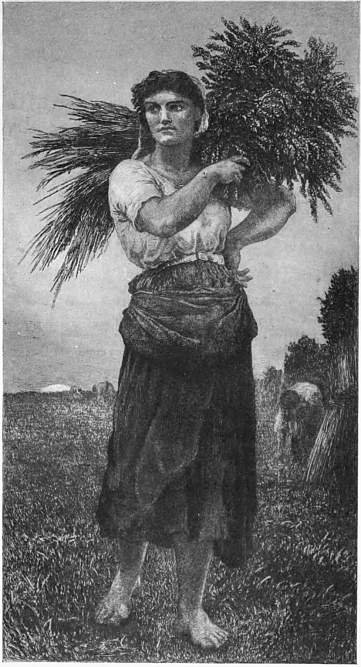
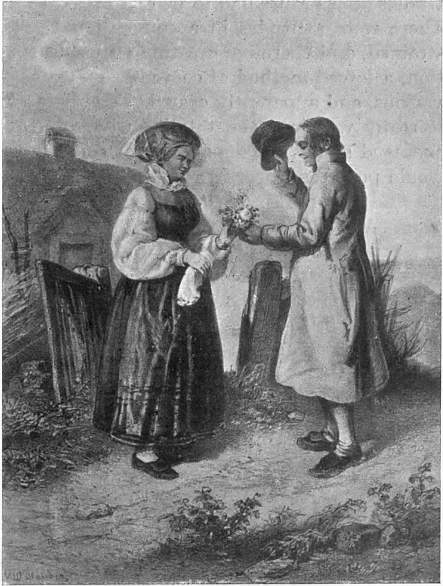
L’Art.
BRETON. THE GLEANER. WALLENDER. THE RETURN.
And painters, under these conditions, they could not possibly become. For though it is often urged in older books on the history of art that modern genre painting far outstripped the old Dutch genre in incisiveness of characterisation, depth of psychological conception, and opulence of invention, these merits are bought at the expense of all pictorial harmony. In the days of Rembrandt the Dutch were painters to their fingers’ ends, and they were able to be so because they appealed to a public whose taste was adequately trained to take a refined pleasure in the contemplation of works of art which had sterling merits of colour. Mieris painted the voluptuous ruffling of silken stuffs; Van der Meer, the mild light stealing through little windows into quiet chambers, and playing upon burnished vessels of copper and pewter, on majolica dishes and silver chattels, on chests and coverings; De Hoogh, the sunbeam streaming like a golden shaft of dust from some bright lateral space into a darker ante-chamber. Each one set before himself different problems, and each ran through an artistic course of development.
The more recent masters are mature from their first appearance; the Hungarians paint exactly like the Swedes and the Germans, and their pictures have ideas for the theme, but never such as are purely artistic. Like simple woodland birds, they sing melodies which are, in some ways, exceedingly pretty; but their plumage is not equal to their song. No man can be painter and genre painter at the same time. The principal difference between them is this: a painter sees his picture, rather than what may be extracted from it by thought; the genre painter, on the other hand, has an idea in his mind, an “invention,” and plans out a picture for its expression. The painter does not trouble his head about the subject and the narrative contents; his poetry lies in the kingdom of colour. There reigns in his works—take Brouwer, for example—an authentic, uniformly plastic, and penetrative life welling from the artist’s soul. But the leading motive for the genre painter is the subject as such. For example, he will paint a children’s festival precisely because it is a children’s festival. But one must be a Jan Steen to accomplish such a task in a soundly artistic manner. The observation of these more recent painters meanwhile ventured no further than detail, and did not know what to do with the picture as a whole. They got over their difficulties because they “invented” the scene, made the children pose in the places required by the situation, and then composed these studies. The end was accomplished when the leading heroes of the piece had been characterised and the others well traced. The colouring was merely an unessential adjunct, and in a purely artistic sense not at all possible. For a picture which has come into being through a piecing together from separate copies of set models, and of costumes, vessels, interiors, etc., may be ever so true to nature in details, but this mosaic work is bound systematically to destroy the pictorial appearance, unity, and quietude of the whole. Knaus is perhaps the only one who, as a fine connoisseur of colour, concealed this scrap-book drudgery, and achieved a certain congruity of colour in a really artistic manner by a subtilised method of harmony. But as regards the pictures of all the others, it is clear at once that, as Heine wrote, “they have been rather edited than painted.” The effectiveness of the picture was lost in the detail, and even the truth of detail was lost in the end in the opulence of subject, seductive as that was upon the first glance. For, as it was held that the incident subjected to treatment—the more circumstantial the better—ought to be mirrored through all grades and variations of emotion in the faces, in the gestures of a family, of the gossips, of the neighbours, of the public in the street, the inevitable consequence was that the artist, to make himself understood, was invariably driven to exaggerate the characterisation, and to set in the place of the unconstrained expression of nature that which has been histrionically drilled into the model. Not less did the attempt to unite these set figures as a composition in one frame lead to an intolerable stencilling. The rules derived from historical painting in a time dominated by that form of art were applied to our chequered and many-sided modern life. Since the structure of this composition prescribed laws from which the undesigned manifestation of individual objects is free, the studies after nature had to be readjusted in the picture according to necessity. There were attitudes in a conventional sense beautiful, but unnatural and strained, and therefore creating an unpleasing effect. An arbitrary construction, a forced method of composition, usurped the place of what was flexible, various, and apparently casual. The painters did not fit the separate part as it really was into the totality which the coherence of life demands: they arranged scenes of comedy out of realistic elements just as a stage manager would put them together.
And this indicates the further course which development was obliged to take. When Hogarth was left behind, painting had once more gained the independence which it had had in the great periods of art. The painter was forced to cease from treating secondary qualities—such as humour and narrative power—as though they were of the first account; and the public had to begin to understand pictures as paintings and not as painted stories. An “empty subject” well painted is to be preferred to an “interesting theme” badly painted. Pictures of life must drive out tableaux vivants, and human beings dislodge character types which curiosity renders attractive. Rather let there be a moment of breathing reality rendered by purely artistic means of expression than the most complete village tale defectively narrated; rather the simplest figure rendered with actuality and no thought of self than the most suggestive and ingenious characterisation. A conception, coloured by the temperament of the artist, of what was simple and inartificial, expressing nature at every step, had to take the place of laborious composition crowded with figures, the plainness and truth of sterling art to overcome what was overloaded and arbitrary, and the fragment of nature seized with spontaneous freshness to supplant episodes put together out of fragmentary observations. Only such painting as confined itself, like that of the Dutch, “to the bare empirical observation of surrounding reality,” renouncing literary byplay, spirited anecdotic fancies, and all those rules of beauty which enslave nature, could really become the basis of modern art: and this the landscape painters created. When once these masters resolved to paint from nature, and no longer from their inner consciousness, there inevitably came a day when some one amongst them wished to place in the field or the forest, which he had painted after nature, a figure, and then felt the necessity of bringing that figure into his picture just as he had seen it, without giving it an anecdote mission or forcing it arbitrarily into his compositions. The landscapist found the woodcutter in the forest, and the woodcutter seemed to him the ideal he was seeking; the peasant seemed to him to have the right to stand amid the furrows he had traced with his plough. He no longer drove the fisher and the sailor from their barks, and had no scruple in representing the good peasant woman, laden with wood, striding forwards in his picture just as she strode through the forest. And so entry was made into the way of simplicity; the top-heavy burden of interesting subject-matter was thrown aside, and the truth of figures and environments was gained. The age contained all the conditions for bringing landscape painting such as this to maturity.

CHAPTER XXIII
LANDSCAPE PAINTING IN GERMANY
That landscape would become for the nineteenth century even more important than it was for the Holland of the seventeenth century had been clearly announced since the days of Watteau and Gainsborough, and since this tendency, in spite of all coercive rules, could be only momentarily delayed by Classicism, it came to pass that the era which began with Winckelmann’s conception of “vulgar nature” ended a generation later with her apotheosis. The thirty years from 1780 to 1810 denoted no more than a brief imprisonment for modern landscape, the luxuriantly blooming child being arbitrarily confined meanwhile in the strait-waistcoat of history. At first the phrase of Gotthold Ephraim Lessing, which declared that landscape was no subject for painting because it had no soul, held painters altogether back from injuring their reputation by such pictures. And when, after the close of the century, some amongst them overcame this dread, Poussin the Classicist was of course set up as the only model. For an age which did not paint men but only statues, nature was too natural. As the figure painter subordinated everything to style and moulded the human body accordingly, landscape became mannered to suit an historical idea, and was used merely as a theatrical background for Greek tragedies. As the draughtsmen of the age freed the human figure from all “individual blemishes,” and thereby abandoned the most essential points of life and credibility which are bound up with personality, the landscapists wished to purify nature from everything “accidental,” with the result that dreary commonplaces were produced from her, the infinitely manifold. As the former sought the chief merit of their works in “well-balanced composition,” the latter regarded trees and mountains, temples and palaces, clouds and rivers, merely as counters which only needed to be changed in their mutual position according to acquired rules of composition to make new pictures. They did not reflect that nature possesses a more original force than the most able self-conscious work of man, or, as Ludwig Richter has so well expressed it, that “what God Almighty has made is always more beautiful than what men can invent.” There were summary rules for landscapes in the Poussin style, the beauty of which was sought above all in an opulent play of noble lines, corresponding to the fine and flowing lines of Carstens’ figures. But the conception was all the more pedantic whilst the drawing was hard and dry and the colour feeble and vitreous. The most familiar of the group is the old Tyrolese Josef Anton Koch, who came to Rome in 1796, and, during two years, had an opportunity of allying himself with Carstens. His pictures are usually composed with motives taken from the Sabine Mountains. A landscape with “The Rape of Hylas” is possessed by the Staedel Institute in Frankfort, a “Sacrifice of Noah” by the Museum in Leipzig, and a landscape from the Sabine Mountains by the New Pinakothek in Munich. All three show little promise in technique; it was only in water-colour that he painted with more freedom.
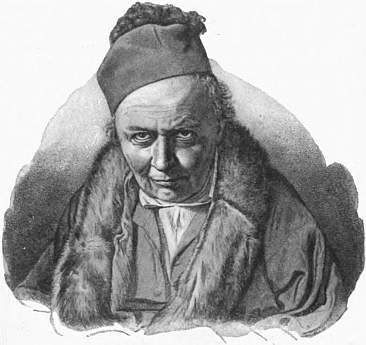
JOSEF ANTON KOCH.
Without a doubt nature in Italy is favourable to this “heroic” style of landscape. In South Italy the country is at once magnificent and peaceful. The naked walls of rock display their majestic lines with a sharp contour; the sea is blue, and there is no cloud in the sky. As far as the eye reaches everything is dead and nugatory in its colour, and rigid and inanimate in form: a plastic landscape, full of style but apparently devoid of soul. Nowhere is there anything either stupendous or familiar, though, at the same time, there is no country on the earth where there is such a sweep of proud majestic lines. It was not the composition of Poussin, but the classic art of Claude—which aimed at being nothing but the transparent mirror of sunny and transparent nature—that gave perfect expression to this classic landscape; and in the nineteenth century Karl Rottmann, according to what one reads, has most completely represented this same classical form of art. His twenty-eight Italian landscapes in the arcades of the Munich Hofgarten are said to display a sense of the beauty of line and a greatness of conception paralleled by few other landscape works of the century. And those who draw their critical appreciations from books will probably continue to make this statement, with all the greater right since the world has been assured that the Arcade pictures are but a shadow of earlier splendour. To a spectator who has not been primed and merely judges with his own eyes without knowing anything about Rottmann’s celebrity, these pictures with their hard, inept colouring and their pompous “synthetic” composition seem in the majority of cases to be excessively childish, though it is not contested that before their restoration by Leopold Rottmann and their present state of decay they may very possibly have been good. Rottmann’s Grecian landscapes in the New Pinakothek are not ranked high even by his admirers. Standing in the beginning entirely upon Koch’s ground, he was led in these pictures to give more importance to colour and light, and even to introduce unusual phenomena, such as lowering skies, with rainbows, sunsets, moonlight scenes, thunderstorms, and the like. This mixture of classical principles of drawing with effect-painting in the style of Eduard Hildebrandt brought a certain confusion into his compositions, to say nothing of the fact that he never got rid of his harsh and heavy colour, Bengal lights, and a crudeness of execution suggestive of tapestry. His water-colours, probably, contain the only evidence from which it may be gathered that Rottmann really had an eminent feeling for great characteristic lines, and did not unsuccessfully go through the school of Claude with his finely moulded, rhythmically perfected, and yet simple conception of nature.
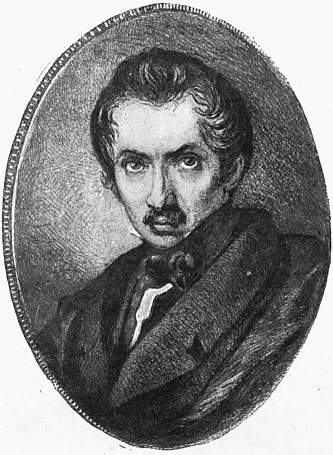
Gräphische Künst.
KARL ROTTMANN.
Otherwise Friedrich Preller is the only one of all the stylists deriving from Koch who rose to works consistent in execution. To him only was it granted to assure his name a lasting importance by exhaustively working out a felicitous subject. The Odyssey landscapes extend through his whole life. During a sojourn in Naples in 1830 he was struck by the first idea. After his return home he composed for Doctor Härtel in Leipzig the first series as wall decoration in tempera in 1832-34. Then there followed his journeys to Rügen and Norway, where he painted wild strand and fell landscapes of a sombre austerity. After this interruption, so profitably extending his feeling for nature, he returned to the Odyssey. The series grew from seven to sixteen cartoons, which were to be found in 1858 at the Munich International Exhibition. The Grand Duke of Weimar then commissioned him to paint the complete sequence for a hall in the Weimar Museum. In 1859-60 Preller prepared himself afresh in Italy, and as an old man completed the work which he had planned in youth. This Weimar series, executed in encaustic painting, is artistically the maturest that he ever did. Of the entire school he only had the secret of giving his figures a semblance of life, and concealed the artificiality of his compositions. Nature in his pictures has an austere, impressive sublimity, and is the worthy home of gods and heroes. During his long life he had made so many and such incessant studies of nature in North and South—even at seventy-eight he was seen daily with his sketch-book in the Campagna—that he could venture to work with great, simple lines without the danger of becoming empty.
At the time when these pictures were painted the rendering of still-life in landscape had in general been long buried, although even to-day it has scattered representatives in the younger Preller, Albert Hertel, and Edmund Kanoldt. As antique monuments came into fashion with Classicism, German ruins became the mode at the beginning of the romantic period and the return to the national past. For Koch and his followers landscape was only of value when, as the background of classical works of architecture, it directed one’s thoughts to the antique: shepherds had to sit with their flock around them on the ruins of the temple of Vesta, or cows to find pasture between the truncated pillars of the Roman Forum. But now it could only find its justification by allying itself with mediæval German history, by the portrayal of castles and strongholds.
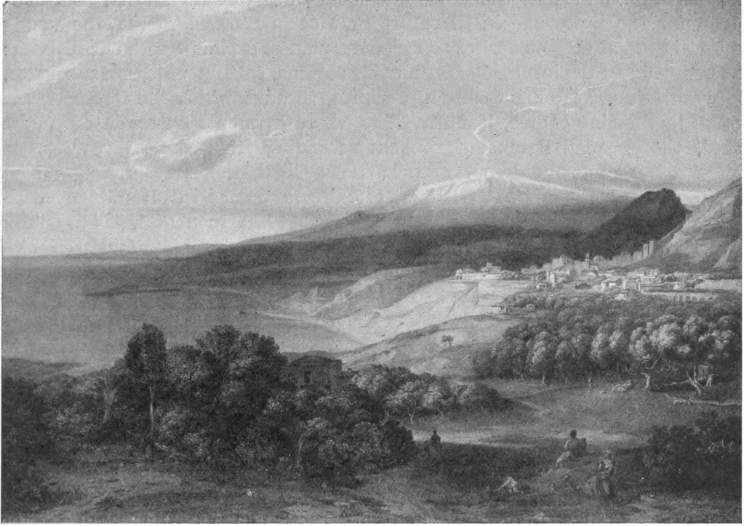
ROTTMANN. THE COAST OF SICILY.
“What is beautiful?—A landscape with upright trees, fair vistas, atmosphere of azure blue, ornamental fountains, stately palaces in a learned architectural style, with well-built men and women, and well-fed cows and sheep. What is ugly?—Ill-formed trees with aged, crooked, and cloven stems, uneven and earthless ground, sharp-cut hills and mountains which are too high, rude or dilapidated buildings, with their ruins lying strewn in heaps, a sky with heavy clouds, stagnant water, lean cattle in the field, and ungraceful wayfarers.”
In these words Gérard de Lairesse, the ancestor of Classicism, defined his ideal of landscape, and in the last clause, where he speaks of ugliness, he prophetically indicated the landscape ideal of the Romanticists, as this is given for the first time in literature in Tieck’s Sternbald. For the young knight in Sternbald who desires to become a painter exclaims with enthusiasm: “Then would I depict lonely and terrible regions, rotting and broken bridges, between two rough cliffs facing a precipice, through which the forest stream forces its foaming course, lost travellers whose garments flutter in the moist wind, the dreaded figures of robbers ascending from the gully, waggons fallen upon and plundered, and battle against the travellers.” Which is all exactly the opposite to what Lairesse demanded from the landscapist. Alexander Humboldt has shown that the men of antiquity only found beauty in nature so far as she was kindly, smiling, and useful to them. But to the Romanticists nature was uncomely where she was the servant of civilisation, and beautiful only in tameless and awe-inspiring savageness. The light, therefore, was never to be that of simple day, but the gloom of night and of the mountain glens. Such phenomena are neither to be seen in Berlin nor in Breslau, and to be a Romanticist was to love the opposite of all that one sees around one. Tieck, who lived in the cold daylight of Berlin with its modern North German rationalism, has therefore—and not by chance—first felt the yearning for moonlight landscapes of primæval forest; Lessing, from Breslau, was the first to give it pictorial expression.
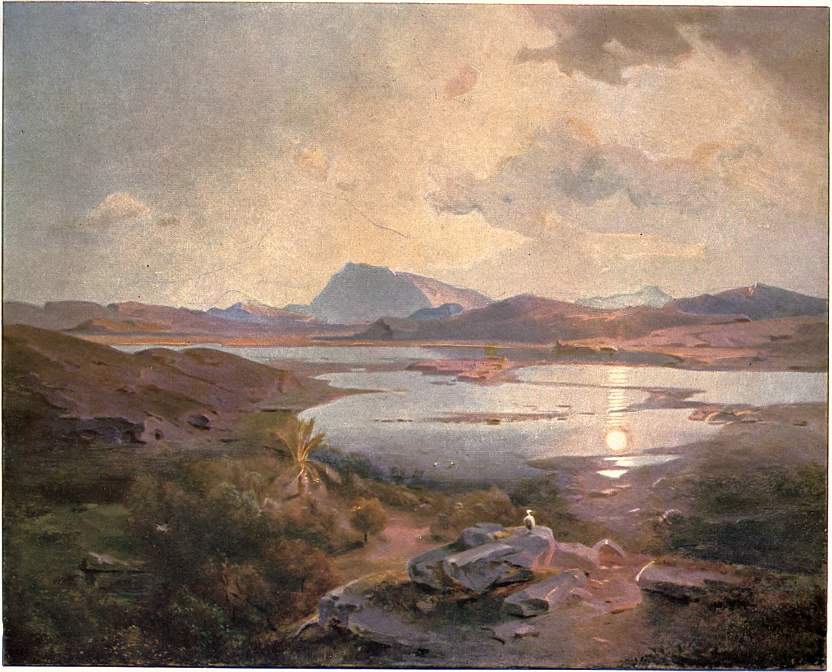
K. ROTTMANN. LAKE KOPAÏS.
Even in the twenties Koch’s classical heroic landscapes, executed with an ideal sweep of line, were contrasted with castle chapels, ruins, and cloister courts composed in a similarly arbitrary manner. Landscape was no longer to make its appeal to the understanding by lines, as in the work of the Classicists, but to touch the spirit by colour. The various hues of moonlight seemed specially made to awaken sombre emotions. But as yet the technique of painting was too inadequately trained to express this preconceived “mood” through nature itself. To make his intentions clearer, therefore, the painter showed the effect of natural scenery on the figures in his pictures, illustrating the “mood” of the landscape in the “accessories.” Lessing’s early works represent in art that self-consciously elegiac and melancholy sentimental rendering of a mood introduced into literature by Sternbald, in his knights, squires, noble maidens, and other romantic requisites. The melancholy lingers upon rocks savagely piled upon each other, tumble-down chapels and ruined castles, in swamps and sombre woods, in old, decaying trees, half-obliterated paths, and ghostly gravestones; it veils the sky with a dark grey cerement. Amid hills and glens with wayside crosses, mills, and charcoal-burners’ huts may be seen lonely wanderers, praying pilgrims, priests hurrying from the cloister to bring the last consolation to the dying, riders who have lost their way, and mercenary soldiers lying dead. His first picture of 1828 revealed a desolate churchyard beneath a dark and lowering heaven, from which a solitary sunbeam bursts forth to illumine a grave-stead. Then followed the castle by the sea standing upon strangely moulded cliffs heaped in confusion; the churchyard in the snow where the nuns in the cloisters are following a dead sister to the grave; the churchyard cloister, likewise in snow, where an old man has dug a fresh grave; the cloister in the light of evening with a priest visiting the sick; the landscape with the weary, grey-headed crusader, riding on a weary horse through a lonely mountain district, probably meant as an illustration to Uhland’s ballad Das Rosennest—
“Rühe hab ich nie gefunden, Als ein Jahr im finstern Thurm”;
and then came the desolate tableland with the robbers’ den burnt to ashes, and the landscape with the oak and the shrine of the Virgin, before which a knight and noble lady are making their devotions. As yet all these pictures were an arbitrary potpourri from Walter Scott, Tieck, and Uhland, and their ideal was the Wolf’s Glen in the Freischütz.
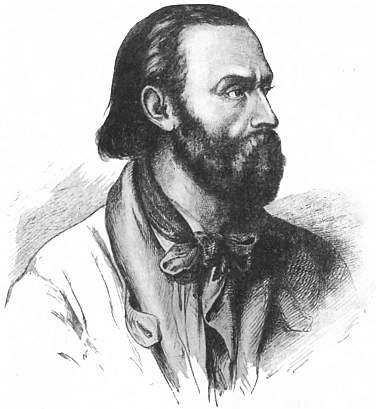
FRIEDRICH PRELLER.
The next step which Romanticism had to take was to discover such primæval woodland scenes in actual nature, and as Italian landscape seems, as it were, to have been made for Claude, nature, as she is in Germany, makes a peculiar appeal to this romantic temperament. In certain parts of Saxon Switzerland the rocks look as if giants of the prime had played ball with them or piled them one on top of the other in sport. Lessing found in 1832 a landscape corresponding to the romantic ideal of nature in the Eifel district, whither he had been induced to go by a book by Nöggerath, Das Gebirge im Rheinland und Westfalen nach Mineralogischem und Chemischem Bezuge. Up to that time he had only known the romantic ideal of nature through Scott, Tieck, and Uhland, just as the Classicists had taken their ideal from Homer, Theocritus, and Virgil: in the Eifel district it came before him in tangible form. Flat, swampy tracts of shrub and spruce alternated with dark woods, where gigantic firs, weird pines, and primæval oaks raised their branches to the sky. At the same time he beheld the rude and lonely sublimity of nature in union with a humanity which was as yet uncultivated, and for that reason all the simpler and the healthier, judged by the Romanticist’s distaste for civilisation. Defiant cones of rock and huge masses of mountain wildly piled upon each other overlooked valleys in which a stalwart race of peasants passed their days in patriarchal simplicity. Here, for the first time, a sense for actual landscape was developed in him; hitherto it had been alloyed by a taste for knights, robbers, and monks. “Oh, had I been born in the seventeenth century,” he wrote, “I would have wandered after the Thirty Years’ War throughout Germany, plundered, ruined, and run wild as she then was.” Hitherto only “composed” Italian landscapes had been painted, the soil of home ostensibly offering no sujets, or, in other words, not suiting those tendencies which subordinated everything to style: so Lessing was now the first painter of German landscape. His “Eifel Landscape” in the Berlin National Gallery, which was followed by a series of such pictures, introduces the first period of German landscape painting. The forms of the ground and of the rough sides of rock are rendered sharply and decisively, from geological knowledge. On principle he became an opponent of all artistic influence derived from Italy, and located himself in the Eifel district. The landscapes which he painted there are founded on immediate studies of nature, and are sustained by large and earnest insight. He draws the picture of this quarter in strong and simple lines: the sadness of the heath and the dark mist, the dull breath of which rises from swampy moorland. Still he painted only scenes in which nature had taken the trouble to be fantastic. The eye of the painter did not see her bright side, approaching her only when she looked gloomy or was in angry humour. Either he veils the sky with vast clouds or plunges into the darkness of an untrodden forest. Gnarled trees spread around, their branches stretching out fantastically twisted; the unfettered tumult of the powers of nature, the dull sultry atmosphere before the burst of the storm or its moaning subsidence, are the only moments which he represents. But the whole baggage of unseasonable Romanticism, the nuns and monks, pious knights and sentimental robbers, at first used to embody the mood of nature, were thrown overboard. A quieter and more melancholy though thoroughly manly seriousness, something strong and pithy, lies in the representations of Lessing. The Romanticists had lost all sense of the dumb silent life of nature. They only painted the changing adornment of the earth: heroes and the works of men, palaces, ruins, and classic temples. Nature served merely as a stage scene: the chief interest lay in the persons, the monuments, and the historical ideas associated with them. Even in the older pictures of Lessing the mood was exclusively given by the lyrical accessories. But now it was placed more and more in nature herself, and rings in power like an organ peal, from the cloudy sky, the dim lights, and the swaying tree-tops. For the first time it is really nature that speaks from the canvas, sombre and forceful. In this respect his landscapes show progress. They show the one-sidedness, but also the poetry of the Romantic view of nature. And they are no less of an advance in technique; for in making the discovery that his haunting ideal existed in reality, Lessing first began to study nature apart from preconceived and arbitrary rules of composition, and—learnt to paint.
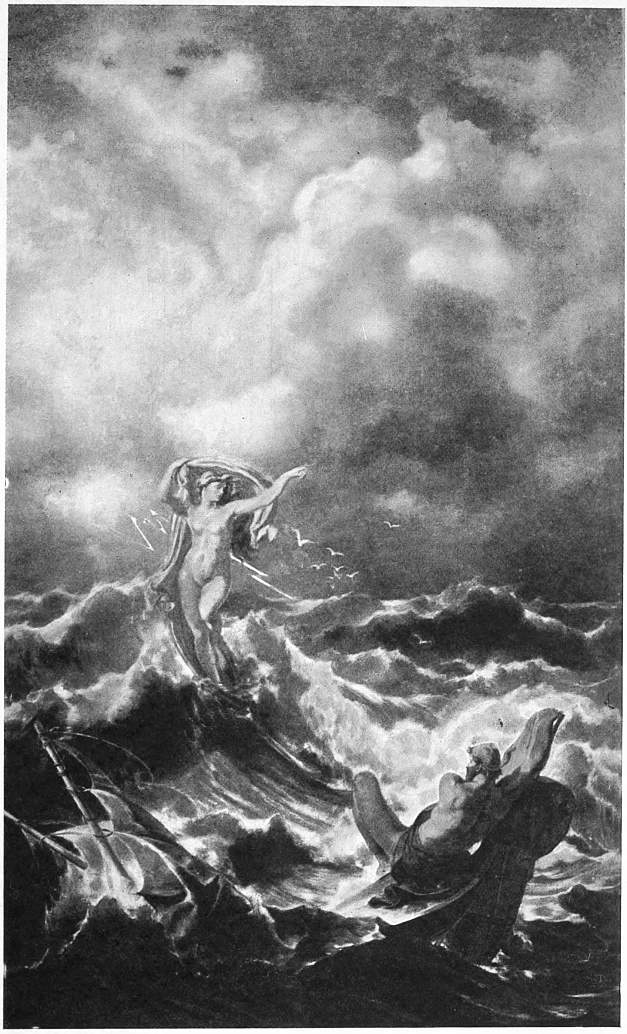
Albert, Munich.
PRELLER. ULYSSES AND LEUCOTHEA.
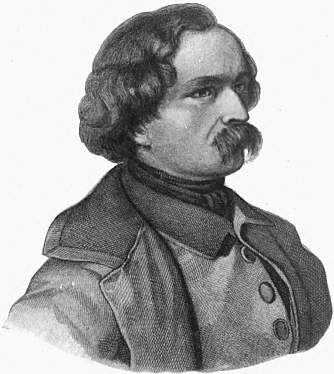
CARL FRIEDRICH LESSING.
Up to 1840 there stood at his side a master no less powerful, the refractory, self-taught Karl Blechen, who only took up painting when he was five-and-twenty, and became one of the most original of German landscapists, in spite of a ruined life prematurely closing in mental darkness and suicide. He possessed a delicate feeling for nature, inspiration, boldness, and a spirited largeness of manner, although his technique was hard, awkward, and clumsy to the very end. He might be called the Alfred Rethel of landscape painting. He was not moved by what was kindly or formally beautiful in nature, but by loneliness, melancholy, and solitude. Many of his landscapes break away from peaceful melancholy, and are like the pictures in some horrible nightmare, ghastly and terrifying; on the other hand, he often surprises us by the pleasure he takes in homely everyday things, a characteristic hitherto of rare occurrence. Whereas Lessing never crossed the Alps for fear of losing his originality, Blechen was the first who saw even modern Italy without the spectacles of ideal style. From his Italian pictures it would not be supposed that he had previously studied the landscapes of the Classicists, or that beside him in Berlin Schinkel worked on the entirely abstract and ideal landscape. As a painter Blechen has even discovered the modern world. For Lessing landscape “with a purpose” was something hideous and insupportable. He cared exclusively for nature untouched by civilisation, painted the murmuring wood and the raging storm, here and there at most a shepherd who indicated the simplest and the oldest employment on the earth’s surface. But the Blechen Exhibition of 1881 contained an entirely singular phenomenon as regards the thirties, an evening landscape before the iron works in Eberswald: a long, monotonous plain with a sluggish river, behind which the dark outlines of vomiting manufactory chimneys rise sullenly into the bright evening sky. Even in that day Blechen painted what others scarcely ventured to draw: nature working in the service of man, and thereby—to use Tieck’s expression—“robbed of her austere dignity.”
Lessing’s most celebrated follower, Schirmer, appears in general as a weakened and sentimental Lessing. He began in 1828 with “A Primæval German Forest,” but a journey to Italy caused him in 1840 to turn aside from this more vigorous path. Henceforth his efforts were directed to nobility of form and line, to turning out Southern ideal landscapes with classically romantic accessories. The twenty-six Biblical landscapes drawn in charcoal, belonging to the Düsseldorf Kunsthalle, the four landscapes in oil with the history of the Good Samaritan in the Kunsthalle of Carlsruhe, and the twelve pictures on the history of Abraham in the Berlin National Gallery, are the principal results of this second period—his period of ideal style. They are tame efforts at a compromise between Lessing and Preller, and therefore of no consequence to the history of the development of landscape painting. Amongst the many who regarded him as a model, Valentin Ruths of Hamburg is one of the most natural and delicate. His pictures, however, did not display any new impulse to widen the boundary by proceeding more in the direction of healthy and honestly straightforward observation of nature, or by emancipating himself from the school of regular composition and the rendering of an arbitrary mood.
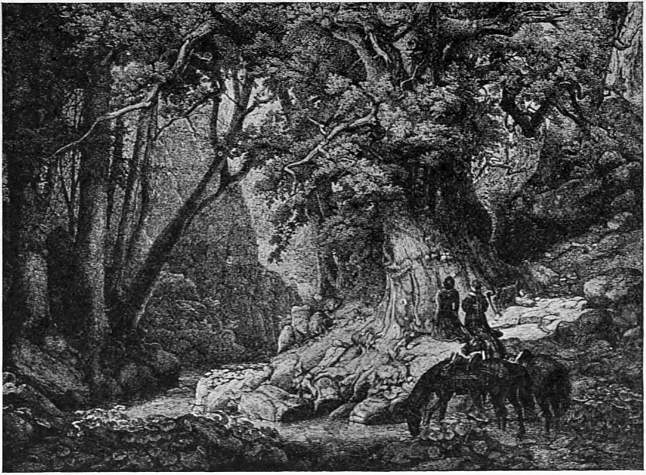
LESSING. THE WAYSIDE MADONNA.
Meanwhile this impulse came from another quarter. At the very time when the genre artists were painting their earliest pictures of rustic life under the influence of Teniers and Ostade, the landscapists also began to return to the old Dutch masters, following Everdingen in particular. Thus another strip of nature was conquered, another step made towards simplicity. The landscape ideal of the Classicists had been architecture, that of the Romanticists poetry; from this time forward it became pure painting. Little Denmark, which fifty years before had exercised through Carstens that fateful influence on Germany which led painters from the treatment of contemporary life and sent them in pursuit of the antique, now made recompense for the evil it had done. During the twenties and thirties it produced certain landscapists who guided the Germans to look with a fresh and unfettered gaze, undisturbed by the ideal, at nature in their own country, after the aberrations of Classicism and the one-sidedness of the Romanticists. Under Eckersberg the Academy of Copenhagen was the centre of a healthy realism founded on the Dutch, and some of the painters who received their training there and laboured in later years in Dresden, Düsseldorf, and Munich spread abroad the principles of this school.
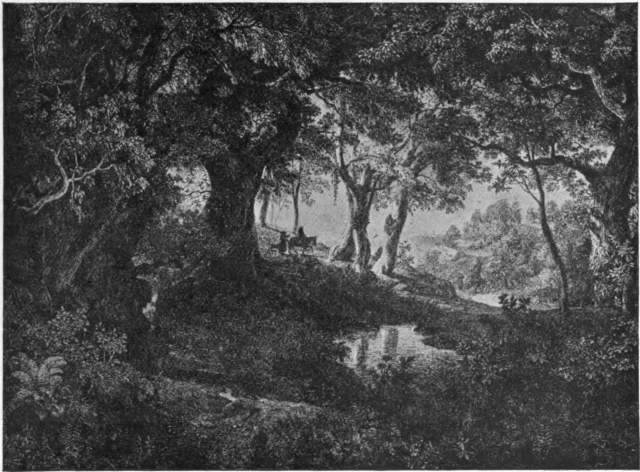
SCHIRMER. AN ITALIAN LANDSCAPE.
J. C. Dahl taught as professor in the Academy of Dresden. At the present time his Norwegian landscapes seem exceedingly old-fashioned, but in the thirties they evidently must have been something absolutely new, for they raised a hue and cry amongst the German painters as “the most wild naturalism.” In 1788 Johann Christian Clausen Dahl was born in Bergen. He was the son of one of those Norwegian giants who are one day tillers of the soil and on the morrow fishers or herdsmen and hunters, who cross the sea in their youth as sailors and clear the waste land when they return home. As he wandered with his father through the dense, solitary pine forests, along abrupt precipices, sullen lakes, rushing waterfalls, silvery shining glaciers, the majesty of Northern nature was revealed to him, and he rendered them in little coloured drawings, which, in spite of their awkward technique, bear witness to an extraordinary freshness of observation. The course of study at the Copenhagen Academy, whither he proceeded in his twentieth year, enabled him to become acquainted with Everdingen and Ruysdael, and these two old masters, who had also painted Norwegian landscapes, stimulated him to further efforts.
Dahl became the first representative of Norwegian landscape painting, and remained true to his country even when in 1819 he undertook a professorship in Dresden. Italy and Germany occupied his brush as much as Norway, but he was only himself when he worked amongst the Norwegian cliffs. Breadth of painting and softness of atmosphere are wanting in all his pictures. They are hard and dry in their effect, and not seldom entirely conventional; especially the large works painted after 1830. In them he gave the impression of a bewildering, babbling personality. They have been swiftly conceived and swiftly painted, but without artistic love and fine feeling. In his later years Dahl did not allow himself the time to bury himself in nature quietly and with devotion, and finally—especially in his moonlight pictures—took to using a violet-blue, which has a very conventional effect. Everdingen sought by preference for what was forceful and violently agitated in nature; Ruysdael felt an enthusiasm for rushing mountain streams. But for Dahl even these romantic elements of Northern nature were not enough. He approached nature, not to interpret her simply, but to arrange his effects. In his picture the wild Norwegian landscape had to be wilder and more restless than in reality it is. Not patient enough to win all its secrets from the savage mountain torrent, he forced together his effects, made additions, brought confusion into his picture as a whole, and a crudeness into the particular incidents. His large pictures have a loud effect contrasted with the simple intuition of nature amongst the Netherlanders. Many of them are merely fantastically irrational compositions of motives which have been learned by heart.
But there were also years in which Dahl stood in the front rank of his age, and even showed it the way to new aims. He certainly held that position from 1820 to 1830 in those pictures in which, instead of making romantic adaptations of Ruysdael and Everdingen, he resembled them by rendering the weirdness and eeriness and the rough and wild features of Norwegian scenery: red-brown heaths and brownish green turf-moors, stunted oaks and dark pine forests, erratic blocks sown without design amid the roots of trees, branches snapped by the storm and hanging as they were broken, and trunks felled by the tempest and lying where they fell. In certain pictures in the Bergen and Copenhagen Galleries he pointed out the way to new aims. The tendency to gloom and seriousness which reigns in those Dutch Romanticists has here yielded to what is simple and familiar, to the homely joy of the people of the North in the crisp, bright day and the wayward sunbeams. He loves the glimmer of light upon the birch leaves and the peacefully rippling sea. Like Adrian van der Neer, he studied with delight the wintry sky, the snow-clad plains, and the night and the moonshine. He began to feel even the charm of spring. Poor peasant cots are brightly and pleasantly perched upon moist, green hills, as though he had quite forgotten what his age demanded in “artistic composition.” Or the summer day spreads opulent and real between the cliffs, and the warm air vibrates over the fields. Peasants and cattle, glimmering birches and village spires, stand vigorously forth in the landscape; even the execution is so simple that with all his richness of detail he succeeds in attaining a great effect. It is felt that this painting has developed amid a virgin nature, surrounded by the poetry of the fjord, the lofty cliff, and the torrent. In the same measure the Dutch had not the feeling for quietude and habitable, humble, and familiar places. And perhaps it was not by chance that this reformer came from the most virgin country of Europe, from a country that had had no share in any great artistic epoch of the past.
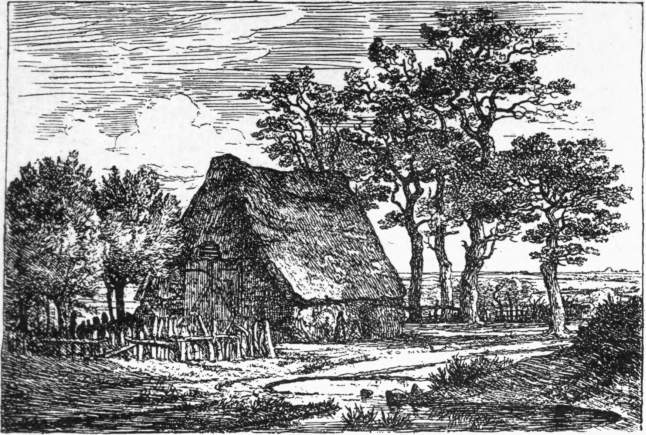
MORGENSTERN. A PEASANT COTTAGE (ETCHING).
Caspar David Friedrich, that singular painter who carried on his artistic work in Greifswald, and later in Dresden also, is, if anything, almost more original and startling. Like Dahl, he studied under Eckersberg, at the Academy in Copenhagen, and it was this elder artist who opened his eyes to nature, in which he saw moods and humours as romantic as they were modern. His work was not seen in a right light until shown in the German Centenary Exhibition of 1906, when his just place was first, in the history of art, assigned to him.
For Munich a similar importance was won by the Hamburg painter Christian Morgenstern, who, like all artists of this group, imitated the Dutch in the tone of his colour, though as a draughtsman he remained a fresh and healthy son of nature. Even what he accomplished in all naïveté between 1826 and 1829, through direct study of Hamburg landscape, is something unique in the German production of that age. His sketches and etchings of these years assure him a high place amongst the earliest German “mood” painters, and show that as a landscapist he had at that time made the furthest advance towards simplicity and intimacy of feeling. A journey to Norway, undertaken in 1829, and a sojourn at the Copenhagen Academy, where he worked up his Norwegian studies, only extended his ability without altering his principles; and when he came to Munich in the beginning of the thirties his new and personal intuition of nature made a revolution in artistic circles. The landscape painters learnt from him that Everdingen, Ruysdael, and Rembrandt were contemporaries of Poussin, that foliage need not be an exercise of style, and is able properly to indicate the nature of the tree. He discovered the beauty of the Bavarian plateau for the Munich school.
Even the first picture that he brought with him from Hamburg displayed a wide plain shadowed by clouds—a part of the Lüneberg heath—and to this type of subject he remained faithful even in later days. Himself a child of the plains, he sought for kindred motives in Bavaria, and found them in rich store on the shore of the Isar, in the quarries near Polling, at Peissenberg, and in the mossy region near Dachau. His pictures have not the power of commanding the attention of an indifferent spectator, but when they have been once looked into they are seen to be poetic, quiet, harmless, sunny, and thoughtful. He delighted in whatever was ordinary and unobtrusive, the gentle nature of the wood, the surroundings of the village, everything homely and familiar. If Rottmann revelled in the forms of Southern nature, Morgenstern abided by his native Germany; where Lessing only listened to the rage of the hurricane, Morgenstern hearkened to the quiet whisper of the breeze. The shadows of the clouds and the radiance of the sun lie over the dark heath, the moonlight streams dreamily over the quiet streets of the village, the waves break, at one moment rushing noisily and at another gently caressing the shore. Later, when he turned to the representation of the mountains, he lost the intimacy of feeling which was in the beginning peculiar to him. In mountain pictures, often as he attempted ravines, waterfalls, and snowy Alpine summits, he never succeeded in doing anything eminently good. These pictures have something petty and dismembered, and not the great, simple stroke of his plains and skies.
What Morgenstern was for Munich, Ludwig Gurlitt was for Düsseldorf—the most eminent of the great Northern colony which migrated thither in the thirties. His name is not to be found in manuals, and the pictures of his later period which represent him in public galleries seldom give a full idea of his importance. After a journey to Greece in 1859 he took to a brown tone, in which much is conventional. Moreover, his retired life—he resided from 1848 to 1852 in a Saxon village, and from 1859 to 1873 in Siebleben, near Gotha—contributed much to his being forgotten by the world. But the history of art which seeks operative forces must do him honour as the first healthy, realistic landscape painter of Germany, and—still more—as one who opened the eyes of a number of younger painters who have since come to fame.
Gurlitt was a native of Holstein, and, like Morgenstern, received his first instruction in Hamburg, where at that time Bendixen, Vollmer, the Lehmanns, and the Genslers formed an original group of artists. After this, as in the case of Morgenstern also, there followed a longer sojourn in Norway and Copenhagen. In Düsseldorf, where he then went, a Jutland heath study made some sensation on his arrival. It was the first landscape seen in Düsseldorf which had not been composed, and Schadow is said to have come to Gurlitt’s studio, accompanied by his pupils, to behold the marvel. In 1836 he migrated to Munich, where Morgenstern had worked before him, and here he produced a whole series of works, which reveals an artist exceedingly independent in sentiment, and one who even preserves his individuality in the presence of the Dutch. His pictures were grey in tone, and not yellowish, like those of the Dutch; moreover, they were less composed and less “intelligently” dressed out with accessories than the pictures of Dahl; they were glances into nature resulting from earnest, realistic striving. Even when he began to paint Italian pictures, as he did after 1843, he preserved a straightforward simplicity which was not understood by criticism in that age, though it makes the more sympathetic appeal at the present day. The strength of his realism lay, as was the case with all artists of those years, rather in drawing; but at times he reaches, even in painting, a remarkable clearness and delicacy, which at one time verges on the silver tone of Canaletto, at another on the fine grey of Constable.
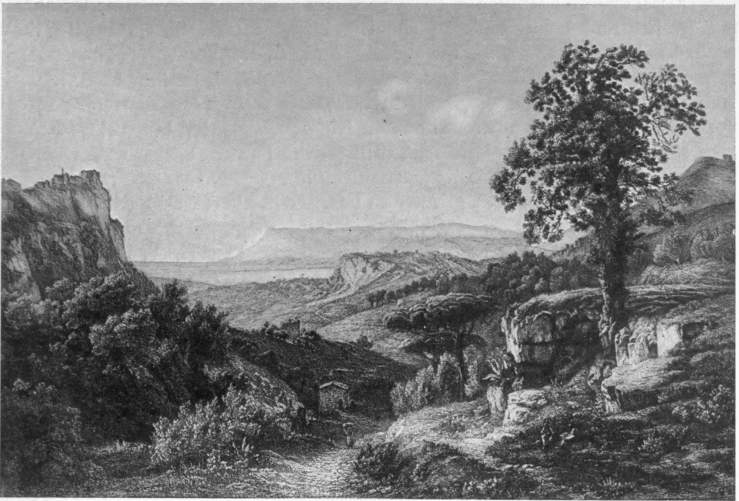
GURLITT. ON THE SABINE MOUNTAINS.
Realism begins in German art with the entry of these Northern painters into Düsseldorf and Munich. They were less affected by æsthetic prejudices, and fresher and healthier than the Germans. Gurlitt was specially their intellectual leader, the soul, the driving force of the great movement which now followed. Roused by him, Andreas Achenbach emancipated himself from the landscape of style, and, in the years from 1835 to 1839, painted Norwegian pictures even before he knew Norway. Roused by Gurlitt, Achenbach set forth upon the pilgrimage thither, the journey which was a voyage of discovery for German landscape painting.
Until Achenbach’s death in 1905 he yearly exhibited works which were no longer in touch with the surrounding efforts of younger men, and there was an inclination to make little of his importance as a pioneer. What is wanting in his pictures is artistic zeal; what he seems to have too much of is routine. Andreas Achenbach is, as his portrait shows, a man of great acuteness. From his clear, light blue eyes he looks sharply and sagaciously into the world around; his short, thick-set figure, proud and firm of carriage, in spite of years, bears witness to his tough energy. His forehead, like Menzel’s, is rather that of an architect than of a poet; and his pictures correspond to his outward appearance. Each one of his earlier good pictures was a battle fought and won. Realism incarnate, a man from whom all visionary enthusiasm lay at a world-wide distance, he conquered nature by masculine firmness and unexampled perseverance. He appears as a maître-peintre, a man of cool, exact talent with a clear and sober vision. The chief characteristic of his organism was his eminent capacity for appreciating the artistic methods of other artists, and adapting what was essential in them to his own manner of production. One breathes more freely before the works of the masters of Barbizon, and merely sees good pictures in those of Achenbach. The former are captivating by their intimate penetration, where he is striking by his bravura of execution. His landscapes have no chance inspiration, no geniality. Everything is harmonised for the sake of pictorial effect. The structure and scaffolding are of monumental stability. Yet fine as his observation undoubtedly is, he has never surprised the innermost working of nature, but merely turned her to account for the production of pictures. For the French artists colour is the pure expression of nature and of her inward humour, but for Achenbach it is just the means for attaining an effectiveness similar to that of the Dutch. Penetrating everything thoroughly with those sparkling blue eyes of his, he learnt to render conscientiously and firmly the forms of the earth and its outward aspect, but the moods of its life appealing to the spirit like music were never disclosed to him. The paintings of the Dutch attracted him to art, not the impulse to give token to his own peculiar temperament. He thinks more of producing pictures which may equal those of his forerunners in their merits than of rendering the impression of nature which he has himself received. His intelligence quickens at the study of the rules and theories set up by the Dutch, and he seeks for spots in nature where he may exercise these principles, but remains chill at the sight of sky and water, trees and mountains. It is not mere love of nature that has guided his brush, but a refined calculation of pictorial effect; and as he never went beyond this endeavour after rounded expression, as it was understood by the Dutch, though he certainly set German landscape free from a romantic subjection to style like Schirmer’s, he never led it to immediate personal observation of nature. It is not the fragrance of nature that is exhaled from his pictures, but the odour of oil and varnish; and as the means he made use of to attain his effects never alter, the result is frequently conventional and methodic.
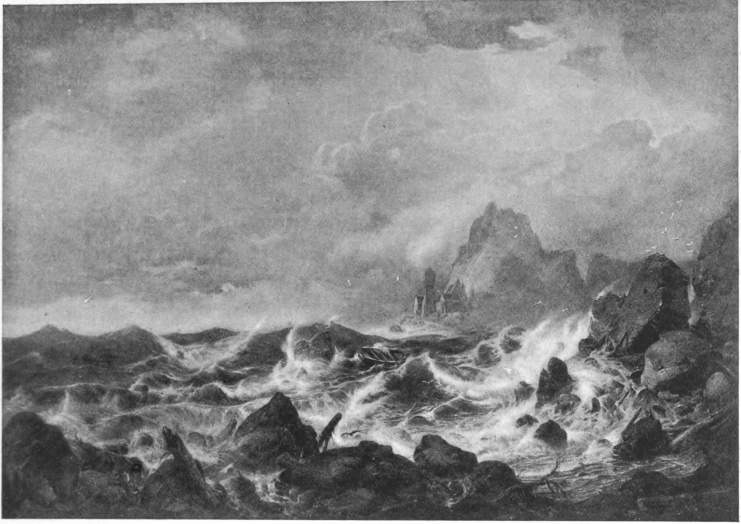
ACHENBACH. SEA COAST AFTER A STORM.
But this does not alter the fact that, when the development of German landscape painting is in question, the name of Andreas Achenbach will be always heard in connection with it. He united technical qualities of the higher order with the capacity of impressing the public, and therefore he completed the work that the Danes had begun. He was the reformer who gave evidence that it was not alone by cliffs and baronial castles and murmuring oaks that sentiment was to be awakened; he hated everything unhealthy, mawkish, and vague, and by showing the claws of the lion of realism in the very heart of the romantic period he came to have the significance of a hero in German landscape painting. He forced demure Lower German landscape to surrender to him its charms; he revealed the fascination of Dutch canal scenes, with their quaint architecture and their characteristic human figures; he went to the stormy, raging North Sea, and opposed the giant forces of boisterous, unfettered nature to the tame pictures of the school of Schirmer. Achenbach’s earliest North Sea pictures were exhibited at the very time when Heine’s North Sea series made its appearance, and they soon ousted the wrecks of the French painter Gudin, which, up to that time, had dominated the picture market. For the first time in the nineteenth century sea-pieces were so painted that the water really seemed a fluent, agitated element, the waves of which did not look as if they had been made of lead, and the froth and foam of cotton wool. The things which he was specially felicitous in painting were Rhine-land villages with red-tiled roofs, Dutch canals with yellow sandbanks and running waves breaking at the wooden buttresses of the harbour, Norwegian scenes with stubborn cliffs and dark pines, wild torrents and roaring waterfalls. He did not paint them better than Everdingen and Ruysdael had done, but he painted them better than any of his contemporaries had it in their power to do.
As Gurlitt is connected with the present by Achenbach, Morgenstern is connected with it by Eduard Schleich. The Munich picture rendering a mood took the place of Rottmann’s architectural pictures. Instead of the fair forms of the earth’s surface, artists began to study the play of sunlight on the plain and amid the flight of the clouds, and instead of the build of the landscape they turned to notice its atmospheric mood. Through Morgenstern Schleich was specially directed to Ruysdael and Goyen. In Ruysdael he was captivated by that profound seriousness and that sombre observation of nature which corresponded to something in his own humour; in Goyen by the pictorial harmony of sunlight, air, water, and earth. Schleich has visited France, Belgium, Hungary, and Italy, yet it is only by exception that he has painted anything but what the most immediate vicinity of Munich might offer. He chose the plainest spot in nature—a newly tilled field, a reedy pond, a stretch of brown moorland, a pair of cottages and trees; and under the guidance of Goyen he observed the changes of the sky with great care—the retreat of thunderclouds, the sun shrouded by thin veils of haze, the tremulous moonlight, or the hovering of the morning and evening mists. The Isar district and the mossy Dachauer soil were his favourite places of sojourn. He had a special preference for rain and moonlight and the mood of autumn, in rendering which he toned brown and grey hues to fine Dutch harmonies. His keynote was predominantly serious and elegiac, but he also loved scenes in which there was a restless and violent change of light. Over a wide plateau the sunlight spreads its radiance, whilst from the side an army of dense thunderclouds approaches, threatening storm and casting dark shadows. Over a monotonous plain, broken by solitary clumps of trees, the warm summer rain falls dripping down. Trees and shrubs throw light shadows, and the plain glistens in the beams of the sun. Or else there is a wide expanse of moor. Darkling the clouds advance, the rushes bend before the wind, and narrow strips of moonlight glitter amid the slender reeds. By such works Schleich became the head of the Munich school of landscape without having ever directed the study of pupils. Through him and through Achenbach capacity for the fresh observation of the life of nature was given to German painters.
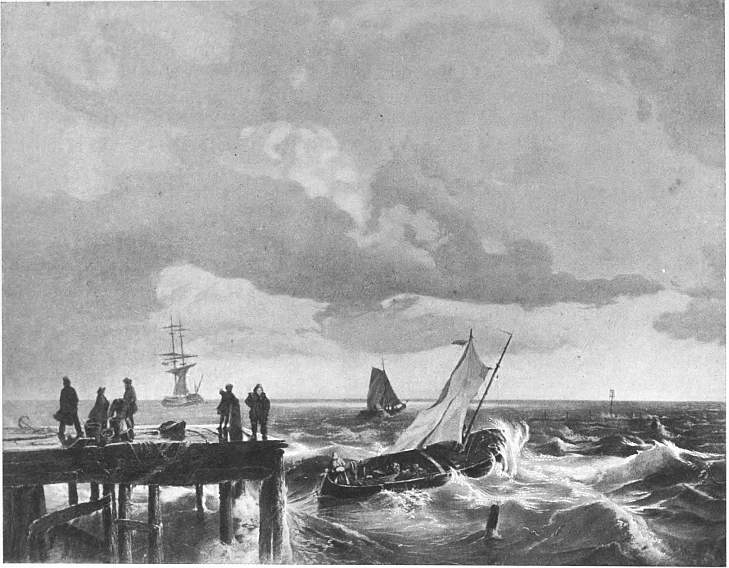
ACHENBACH. FISHING BOATS IN THE NORTH SEA.
Undoubtedly amongst the younger group of artists there was a great difference in regard to choice of subject. The modern rendering of mood has only had its origin in Germany; it could not finally develop itself there. Just as figure painting, after making so vigorous a beginning with Bürkel, turned to genre painting in the hands of Enhuber and Knaus, until it returned to its old course in Leibl, landscape also went through the apprentice period of interesting subject, until it once more recognised the poetry of simpleness. The course of civilisation itself led it into these lines. When Morgenstern painted his first pictures the post-chaise still rattled from village to village, but now the whistle of the railway engine screams shrill as the first signal of a new age throughout Europe. Up to that time the possibility of travelling had been greatly circumscribed by the difficulties of traffic. But facilitated arrangements of traffic brought with them such a desire for travel as had never been before. In literature the revolution displayed itself by the rise of books of travels as a new branch of fiction. Hackländer sent many volumes of touring sketches into the market. Theodor Mügge made Norway, Sweden, and Denmark the scene of his tales. But America was the land where the Sesame was to be found, for Germany had been set upon the war-trail with Cooper’s Indians, it had Charles Sealsfield to describe the grotesque mountain land of Mexico, the magic of the prairie, and the landscapes of Susquehannah and the Mississippi, and read Gerstäcker’s, Balduin Möllhausen’s, and Otto Ruppius’ transatlantic sketches with unwearying excitement. The painters who found their greatest delight in seeing the world with the eyes of a tourist also became cosmopolitan.
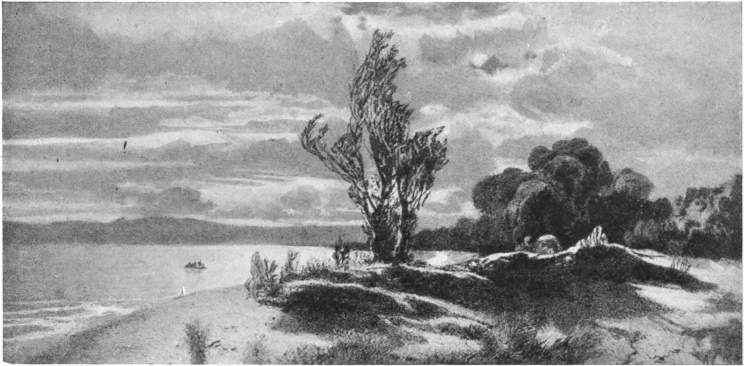
CALAME. LANDSCAPE.
In Geneva Alexander Calame brought Germany to the knowledge of what is to be seen in Switzerland. Calame was, indeed, a dry, unpoetic landscapist. He began as a young tradesman by making little coloured views of Switzerland which foreigners were glad to bring away with them as mementoes of their visits, just as they now do photographs. Even his later pictures can only lay claim to the merit of such “mementoes of Switzerland.” His colour is insipid and monotonous, his atmosphere heavy, his technique laborious. By painting he understood the illumination of drawings, and his drawing was that of an engraver. An excellent drawing-master, he possessed an unusual mastery of perspective. On the other hand, all warmth and inward life are wanting in his works. Sentiment has been replaced by correct manipulation, and in the deep blue mirror of his Alpine lakes, as in the luminous red of his Alpine summits, there is always to be seen the illuminator who has first drawn the contours with a neat pencil and pedantic correctness. His pictures are grandiose scenes of nature felt in a petty way—in science too it is often the smallest spirit that seeks the greatest heroes. “The Ruins of Pæstum,” like “The Thunderstorm on the Handeck” and “The Range of Monte-Rosa at Sunrise,” merely attain an external, scenical effect which is not improved by crude and unnatural contrasts of light. And as, in later years, when orders accumulated, he fell a victim to an astounding fertility, many of his works give one the impression of a dexterous calligrapher incessantly repeating the same ornamental letters. “Un Calame, deux Calame, trois Calame—que de calamités,” ran the phrase every year in the Paris Salon.
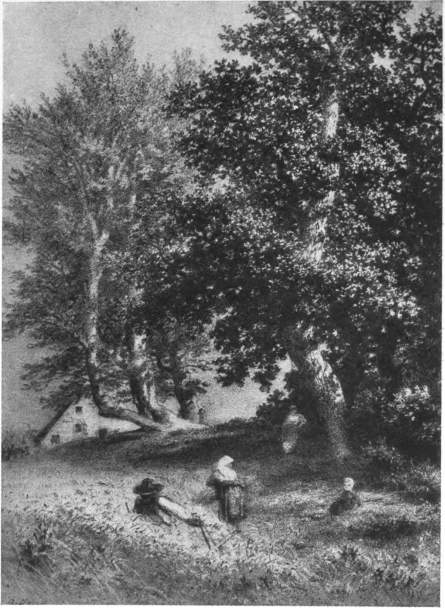
FLAMM. A SUMMER DAY.
But if France remained cool he found the more numerous admirers in Germany. When, in 1835, he exhibited his first pictures in Berlin, a view of the Lake of Geneva, his appearance was at once hailed with the warmest sympathy. The dexterity, the rounded form, the finish of his pictures, were exactly what gave pleasure, and the distinctness of his drawing made its impression. His lithograph studies of trees and his landscape copies attained the importance of canonical value, and for whole decades remained in use as a medium of instruction in drawing. Amongst German painters Carl Ludwig, Otto von Kameke, and Count Stanislaus Kalkreuth were specially incited by Calame to turn to the sublimity of Alpine nature. Desolate wastes of cliffs, still, clear blue lakes, wild, plunging torrents, and mountain summits covered with glaciers and glowing to rose colour in the reflection of the setting sun are the elements of their pictures as of those of the Genevan master.
After Achenbach there came a whole series of artists from the North who began to depict the mountains of their native Norway under the strong colour effects of the Northern sun. The majestic formations of the fjords, the emerald green walls of rock, the cloven valleys, the terrible forest wildernesses, and the mountains of Norway dazzlingly illuminated and reflecting themselves like glittering jewels in the quiet waters of sapphire blue lakes, were interesting enough to afford nourishment for more than one landscapist.
Knud Baade, who worked from 1842 in Munich, after a lengthy sojourn at the Copenhagen Academy and with Dahl in Dresden, delighted in moonlight scenes, gloomy fir forests, and midnight suns. The sea rises in waves mountain high, and tosses mighty vessels like withered leaves or dashes foaming against the cliffs of the shore. Fantastic clouds chase each other across the sky, and the wan moonlight rocks unsteadily upon the waves. More seldom he paints the sea lit up afar by the moon, or the fjord with its meadows and silver birches; and in such plain pictures he makes a far more attractive effect than in those which are wild and ambitious, for his diffident, petty execution is, as a rule, but little suited to restless and, as it were, dramatic scenes of nature.
Having come to Düsseldorf in 1841, Hans Gude became the Calame of the North. Achenbach taught him to approach the phenomena of nature boldly and realistically, and not to be afraid of a rich and soft scale of colour. Schirmer, the representative of Italian still landscape, guided him to the acquisition of a certain large harmony and sense for style in the structure of his pictures, to beauty of line and effective disposition of great masses of light and shade. This quiet, sure-footed, and robust realism, which had, at the same time, a gift of style, became the chief characteristic of his Northern landscapes, in which, however, the mutable and fleeting moods of nature were all the more neglected. Here are Norwegian mountain landscapes with lakes, rivers, and waterfalls, then pictures of the shore under the most varied phases of light, or grand cliff scenery with a sombre sky and a sea in commotion. Hans Gude, living from 1864 in Carlsruhe, and from 1880 in Berlin, is one of those painters whom one esteems, but for whom it is not possible to feel great enthusiasm—one of those conscientious workers who from their very solidity run the risk of becoming tedious. His landscapes are good gallery pictures, soberly and prosaically correct, and never irritating, though at the same time they seldom kindle any warm feeling.
Like Gude, Niels Björnson Möller devoted himself to pictures of the shore and the sea. Undisturbed by men in his sequestered retreat, August Capellen gave way to the melancholy charms of the Norwegian forest. He represented the tremulous clarity of the air above the cliffs, old, shattered tree-trunks and green water plants, sleepy ponds, and far prospects bounded by blue mountains; but he would have made an effect of greater originality had he thought less of Schirmer’s noble line and compositions arranged in the grand style. Morten-Müller became the specialist of the fir forest. His native woods where the valleys stretch towards the high mountain region offered him motives, which he worked up in large and excessively scenical pictures. His strong point was the contrast between sunlight playing on the mountain tops and mysterious darkness reigning in the forest depths, and his pictures have many admirers on account of “their elegiac melancholy, their minor key of touching sadness.” The Norwegian spring changing the earth into one carpet of moorland, broken by marshes, found its delineator in Erik Bodom. Ludwig Munthe became the painter of wintry landscape in thaw, when the snow is riddled with holes and a dirty brown crust of earth peeps from the dazzling mantle. A desolate field, a pair of crippled trees stretching their naked branches to the dark-grey sky, a swarm of crows and a drenched road marked with the tracks of wheels, a tawny yellow patch of light gleaming through the cloud-bank and reflected in the wayside puddles, such are the elements out of which one of Munthe’s landscapes is composed. Through Eilert Adelsten Normann representations of the fjords gained currency in the picture market. His specialty was the delineation of the steep and beetling rocky fastnesses of Lofodden with their various reflections of light and colour, the midnight sun glaring over the deep clear sea, the contrast between the blue-black masses of the mountains and the gleaming fields of snow.
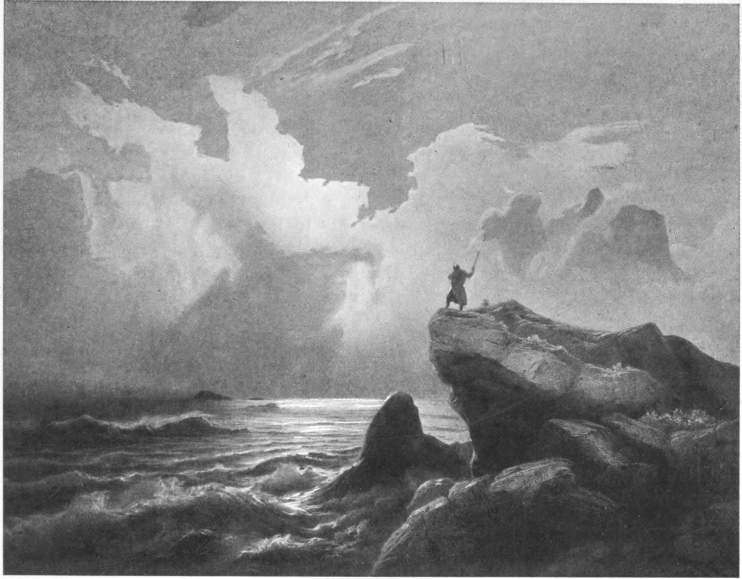
BAADE. MOONLIGHT NIGHT ON THE COAST.
Others, such as Ludwig Willroider, Louis Douzette, and Hermann Eschke, set themselves to observe the German heath and the German forest from similar points of view; the one painted great masses of mountain and giant trees, the other the setting sun, and the third the sea. Oswald Achenbach, Albert Flamm, and Ascan Lutteroth set out once more on the pilgrimage to the South, where, in contrast to their predecessors, they studied no longer the classic lines of nature in Italy, but the splendour of varied effects of colour in the neighbourhood of Vesuvius and the Bay of Naples. The most enterprising turned their backs on Europe altogether, and began to paint the primæval forests of South America, to which Alexander Humboldt had drawn attention, the azure and scarlet wonders of the tropics, and the gleam and sparkle of the icy world at the ultimate limits of the Polar regions. Ferdinand Bellermann was honoured as a new Columbus when in 1842 he returned home with his sketches, botanically accurate as they were, of the marvels of the virgin forest. Eduard Hildebrandt, who in 1843 had already gone through the Canary Islands, Italy, Sicily, North Africa, Egypt, Nubia, Sahara, and the Northern sea of ice, at the mandate of Frederich Wilhelm IV in 1862 undertook a voyage round the world “to learn from personal view the phenomena that the sea, the air, and the solid earth bring forth beneath the most various skies.” Eugen Bracht traversed Egypt, Syria, and Palestine, and returned with a multitude of studies from the sombre and majestic landscape of the desert, and from that world of ruins and mountains in the East, and developed them at home into as many pictures.
A modicum of praise is due to all these masters for having continually widened the circuit of subject-matter, and gradually disclosed the whole world; and if their works cannot be reckoned as the products of a delicate landscape painting, that is a result of the same taste which prescribed anecdotic and narrative subjects to the genre picture of those years. The landscape painters conquered the earth, but, above all, those parts of it which were geographically remarkable. This they did in the interest of the public. They went with a Baedeker in their pocket into every quarter of the globe, brought with them all the carmine necessary for sunsets, and set up their easels at every place marked with an asterisk in the guidebook. And in these fair regions they noted everything that was to be seen with the said Baedeker’s assistance. Through satisfying the interest of the tourist by a rendering, faithful to a hair’s breadth, of topographically instructive points, they could best reckon on the sale of their productions.
At the same time, their pictures betray that, during this generation, historical painting was throned on a summit whence it could dictate the æsthetic catechism. The historical picture represented a humanity that carried about with it the consciousness of its outward presence, draped itself in front of the glass, and made an artificial study of every gesture and every expression of emotion. Genre painting followed, and rendered the true spirit of life, illustrating it histrionically, but without surprising it in its unconstrained working. And so trees, mountains, and clouds also were forced to lay aside the innocence of unconscious being and wrap themselves in the cloak of affectation. Simple reality in its quiet, delicate beauty, the homely “mood” of nature, touching the forms of landscape with the play of light and air, had nothing to tell an age overstrained by the heroics of history and the grimaces of genre painting. A more powerful stimulus was necessary. So the landscapists also were forced to seek nature where she was histrionic and came forth in blustering magnificence; they were forced to send off brilliant pyrotechnics to fire out sun, moon, and stars in order to be heard, or, more literally, seen.
Instruction or theatrical effect—the aim of historical painting—had also to be that of the landscape painter. And as railroads are cosmopolitan arrangements, he was in a position to satisfy both demands with promptitude. As historical painters in the chase of striking subjects directed their gaze to the farthest historical horizon, and the genre painters sought to take their public captive principally through what was alien and strange, Oriental and Italian, the landscape painters, too, found their highest aim in the widest possible expansion of the geographical horizon. “Have these good people not been born anywhere in particular?” asked Courbet, when he contemplated the German landscapes in the Munich Exhibition of 1869. What would first strike the inhabitant of a Northern country in foreign lands was made the theme of the majority of the pictures. But as the historical painting, in illustrating all the great dramatic scenes from the Trojan War to the French Revolution, yielded at one time to a pædagogical doctrinaire tendency and at another to theatrical impassionedness, so landscape painting on its cosmopolitan excursions became partly a dry synopsis of famous regions, only justifiable as a memento of travel, partly a tricked-out piece of effect which, like everything obtrusive, soon lost its charm. Pictures of the first description which chiefly borrowed their motives from Alpine nature, so imposing in its impressiveness of form—grand masses of rock, glaciers, snow-fields, and abrupt precipices—only needed to have the fidelity of a portrait. Where that was given, the public, guided by the instinct for what is majestic and beautiful in nature, stood before them quite content, while Alpine travellers instructed the laity that the deep blue snow of the picture was no exaggeration, but a phenomenon of the mountain world which had been correctly reproduced. In all these cases there can be no possible doubt about geographical position, but there is seldom any need to make inquiries after the artist. The interest which they excite is purely of a topographical order; otherwise they bear the stamp of ordinary prose, of the aridity and unattractiveness which always creeps in as a consequence of pure objectivity. Works of the second description, which depict exotic regions, striking by the strangeness of various phenomena of light and the splendour and glow of colour, are generally irritating by their professional effort to display “mood.” The old masters revealed “mood” without intending to do so, because they approached nature piously and with a wealth of feeling. The new masters obtain a purely external effect, because they strain after a “mood” in their painting without feeling it; and though art does not exclude the choice of exotic subjects, it is not healthy when a tendency of this sort becomes universal. Really superior art will, from principle, never seek the charm of what is strange and distant, since it possesses the magical gift of bestowing the deepest interest on what lies nearest to it. In addition to this, such effects are as hard to seize as the moment of most intense excitement in the historical picture. As an historical painter Delacroix could render it, and Turner as a landscape painter, but geniuses like Delacroix and Turner are not born every day. As these phenomena were painted at the time in Germany, the right “mood” was not excited by them, but merely a frigid curiosity. Almost all landscapes of these years create an effect merely through their subject; they are entertaining, astonishing, instructive, but the poetry of nature has not yet been aroused. It could only reveal itself when the preponderance of interest in mere subject was no longer allowed. As the figure painters at last disdained through narrative and “points” to win the applause of those who had no sensitiveness for art, so the landscape painters were obliged to cease from giving geographical instruction by the representation of nature as beloved by tourists, and to give up forcing a “mood” in their pictures by a subterfuge. The necessary degree of artistic absorption could only go hand in hand with a revolt against purely objective interest of motive, and with a strenuous effort at the representation of familiar nature in the intimate charm of its moods of light and atmosphere. It was necessary for refinement of taste to follow on the expression of subject-matter; and this impulse had to bring artists back to the path struck by Dahl, Morgenstern, and Gurlitt. To unite the simple, moving, and tender observation of those older artists with richer and more complex methods of expression was the task given to the next generation in France, where paysage intime, the most refined and delicate issue of the century, grew to maturity in the very years when German landscape painting roamed through the world with the joy of an explorer.