Front matter (continued 3)
Reading edition
And Meissonier never sacrificed himself to money-making and the trade. He never put a stroke on paper without the conviction that he could not make it better, and for this artistic earnestness he was universally honoured, even by his colleagues, to his very death. As master beyond dispute he let the Classicists, Romanticists, Impressionists, and Symbolists pass by the window of his lonely studio, and always remained the same. A little man with a firm step, an energetic figure, eyes that shone like coals, thick, closely cropped hair, and the beard of a river-god, that always seemed to grow longer, at eighty years of age he was as hale and active as at thirty. By a systematic routine of life he kept his physique elastic, and was able to maintain that unintermittent activity under which another man would have broken down. During long years Meissonier went to rest at eight every evening, slept till midnight, and then worked at his drawings by lamplight into the morning. In the course of the day he made his studies from nature and painted. Diffident in society and hard of access, he did not permit himself to be disturbed in his indefatigable diligence by any social demands. A sharp ride, a swim or a row was his only relaxation. In 1848, as captain of the National Guard, he had taken part in the street and barricade fighting; and again in 1871, when he was sixty-six, he clattered through the streets of the capital, with the dangling sword he had so often painted and a gold-laced cap stuck jauntily on one side, as a smart staff-officer. Even the works of his old age showed no exhaustion of power, and there is something great in attaining ripe years without outliving one’s reputation. As late as the spring of 1890, only a short time before his death, he was the leader of youth, when it transmigrated from the Palais des Champs Elysées to the Champ de Mars; and he exhibited in this new Salon his “October 1806,” with which he closed his Napoleonic epic and his general activity as a painter. Halting on a hill, the Emperor in his historical grey coat, mounted on a powerful grey, is thoughtfully watching the course of the battle, without troubling himself about the Cuirassiers who salute him exultantly as they storm by, or about the brilliant staff which has taken up position behind him. Not a feature moves in the sallow, cameo-like face of the Corsican. The sky is lowering and full of clouds. In the foreground lie a couple of dead soldiers, in whose uniform every button has been painted with the same conscientious care that was bestowed on the buttons of the rococo coats of fifty years before.
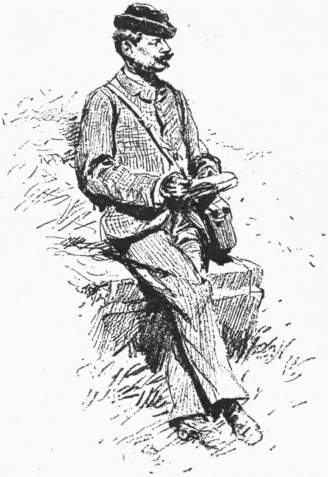
Gaz. des Beaux-Arts.
ALPHONSE DE NEUVILLE.
Beyond this inexhaustible correctness I can really see nothing that can be said for Meissonier’s fame as an artist. He, whose name is honoured in both hemispheres, was most peculiarly the son of his own work. The genius for the infinitesimal has never been carried further. He knew everything that a man can learn. The movements in his pictures are correct, the physiognomies interesting, the delicacy of execution indescribable, and his horses have been so exactly studied that they stand the test of instantaneous photography. But painter, in the proper sense, he never was. Precisely through their marvellous minuteness of execution—a minuteness which is merely attractive as a trial of patience and as an example of what the brush can do—his pictures are wanting in unity of conception, and they leave one cold by the hardness of their contours, the aridness of their colour, and the absence of all vibrating, nervous feeling. In a cavalry charge, with the whirling dust and the snorting horses, who thinks of costume? And who thinks of anything else when Meissonier paints a charge? Here are life and movement, and there a museum of military uniforms. When Manet saw Meissonier’s “Cuirassiers” he said, “Everything is iron here except the cuirasses.”
His rococo pictures are probably his best performances; they even express a certain amount of temperament. His military pictures make one chilly. Reproduced in woodcuts they are good illustrations for historical works, but as pictures they repel the eye, because they lack air and light and spirit. They rouse nothing except astonishment at the patience and incredible industry that went to the making of them. One sees everything in them—everything that the painter can have seen—to the slightest detail; only one does not rightly come into contact with the artist himself. His battle-pieces stand high above the scenic pictures of Horace Vernet and Hippolyte Bellangé, but they have nothing of the warmth of Raffet or the vibrating life of Neuville. There is nothing in them that is contagious and carries one away, or that appeals to the heart. Patience is a virtue: genius is a gift. Precious without originality, intelligent without imagination, dexterous without verve, elegant without charm, refined and subtile without delicacy, Meissonier has all the qualities that interest, and none of those which lay hold of one. He was a painter of a distinctness which causes astonishment, but not admiration; an artist for epicures, but for those of the second order, who pay the more highly for works of art in proportion as they value their artifice. His pictures recall the unseasonable compliment which Charles Blanc made to Ingres: “Cher maître, vous avez deviné la photographie trente ans avant qu’il y eut des photographes.” Or else one thinks of that malicious story of which Jules Dupré is well known as the author. “Suppose,” said he, “that you are a great personage who has just bought a Meissonier. Your valet enters the salon where it is hanging. ‘Ah! Monsieur,’ he cries, ‘what a beautiful picture you have bought! That is a masterpiece!’ Another time you buy a Rembrandt, and show it to your valet, in the expectation that he will at any rate be overcome by the same raptures. Mais non! This time the man looks embarrassed. ‘Ah! Monsieur,’ he says, ‘il faut s’y connaître,’ and away he goes.”
Guillaume Regamey, who is far less known, supplies what is wanting in Meissonier. Sketchy and of a highly strung nervous temperament, he could not adapt himself to the picture-market; but the history of art honours him as the most spirited draughtsman of the French soldier, after Géricault and Raffet. He did not paint him turned out for parade, ironed and smartened up, but in the worst trim. Syria, the Crimea, Italy, and the East are mingled with the difference of their types and the brightness of their exotic costumes. He had a great love for the catlike, quick-glancing chivalry of Turcos and Sapphis; but especially he loved the cavalry. His “Chasseurs d’Afrique” are part and parcel of their horses, like centaurs, and many of his cavalry groups recall the frieze of the Parthenon. Unfortunately he died at thirty-eight, shortly before the war of 1870, the historians of which were the younger painters, who had grown up in the shadow of Meissonier.
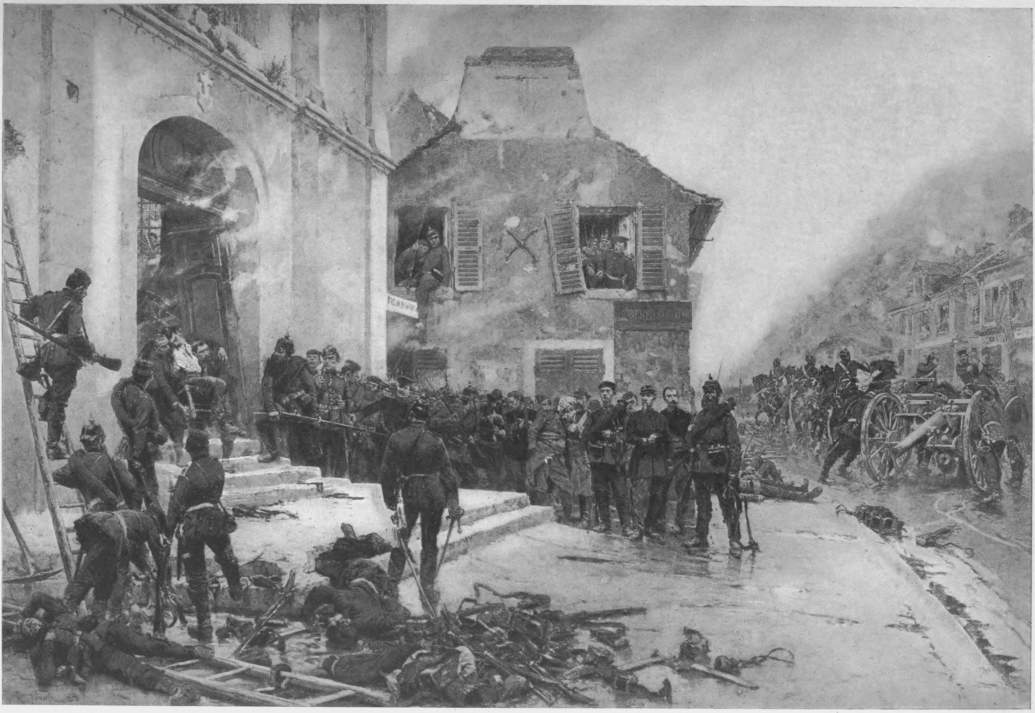
DE NEUVILLE. LE BOURGET.
(By permission of Messrs. Goupil, the owners of the copyright.)
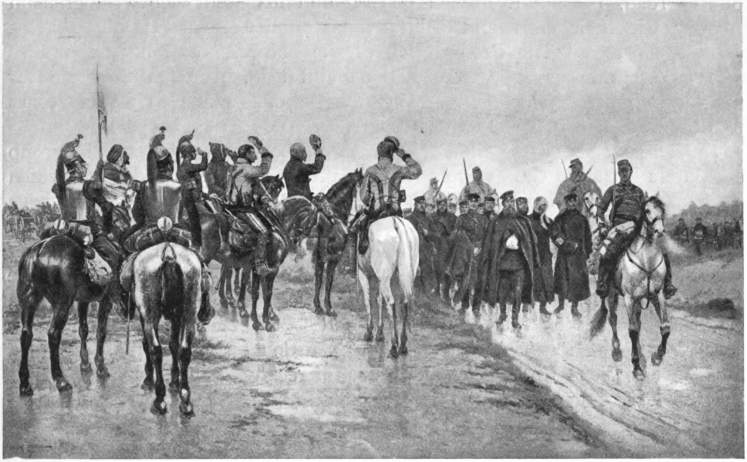
DÉTAILLE. SALUT AUX BLESSÉS.
(By permission of Messrs. Goupil, the owners of the copyright.)
The most important of the group, Alphonse de Neuville, had looked at war very closely as an officer during the siege of Paris, and in this way he made himself a fine illustrator, who in his anecdotic pictures specially understood the secret of painting powder-smoke and the vehemence of a fusillade. The “Bivouac before Le Bourget” brought him his first success. “The Last Cartridges,” “Le Bourget,” and “The Graveyard of Saint-Privat” made him a popular master. Neuville is peculiarly the French painter of fighting. He did not know, as Charlet did, the soldier in time of peace, the peasant lad of yesterday who only cares about his stomach and has little taste for martial adventure. His soldier is an elegant and enthusiastic youthful hero. He even neglected the troops of the line; his preference was for the Chasseur, whose cap is stuck jauntily on his head and whose trousers fall better. He loved the plumes, the high boots of the officers, the sword-knots, canes, and eye-glasses. Everything received grace from his dexterous hand; he even saw in the trooper a gallant and ornamental bibelot, which he painted with chivalrous verve.
The pictures of Aimé Morot, the painter of “The Charge of the Cuirassiers,” possibly smell most of powder. Neuville’s frequently over-praised rival, Meissonier’s favourite pupil, Edouard Détaille, after he had started with pretty little costume pictures from the Directoire period, went further on the way of his teacher with less laboriousness and more lightness, with less calculation and more sincerity. The best of his works was “Salut aux Blessés”—the representation of a troop of wounded Prussian officers and soldiers on a country road, passing a French general and his staff, who with graceful chivalry lift their caps and salute the wounded men. Détaille’s great pictures, such as “The Presentation of the Colours,” and his panoramas were as accurate as they were tedious and arid, although they are far superior to most of the efforts which the Germans made to depict scenes from the war of 1870.
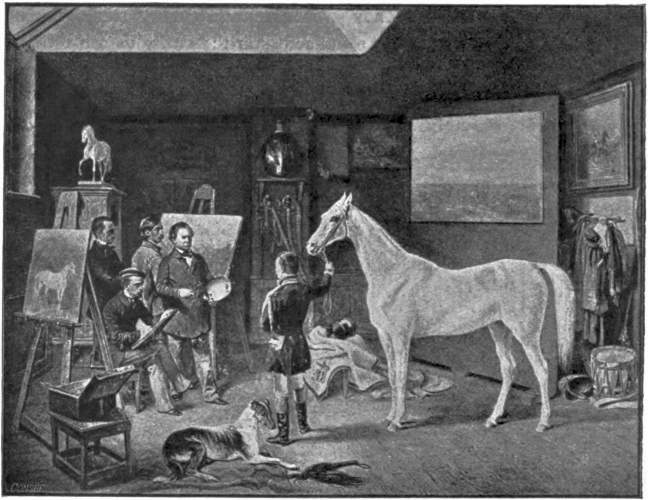
Soldan, Nürnberg.
ALBRECHT ADAM AND HIS SONS.
In Germany the great period of the wars of liberation first inspired a group of painters with the courage to enter the province of battle-painting, which had been so much despised by their classical colleagues. Germany had been turned into a great camp. Prussian, French, Austrian, Russian, and Bavarian troops passed in succession through the towns and villages: long trains of cannon and transport waggons came in their wake, and friends and foes were billeted amongst the inhabitants; the Napoleonic epoch was enacted. Such scenes followed each other like the gay slides in a magic lantern, and once more gave to some among the younger generation eyes for the outer world. There was awakened in them the capacity for receiving impressions of reality and transferring them swiftly to paper. Two hundred years before, the emancipation of Dutch art from the Italian house of bondage had been accomplished in precisely the same fashion. The Dutch struggle for freedom and the Thirty Years’ War had filled Holland with numbers of soldiery. The doings of these mercenaries, daily enacted before them in rich costume and with manifold brightness, riveted the pictorial feeling of artists. Echoes of war, fighting scenes, skirmishes and tumult, the incidents of camp life, arming, billeting, and marauding episodes are the first independent products of the Dutch school. Then the more peaceable doings of soldiers are represented. At Haarlem, in the neighbourhood of Frans Hals, were assembled the painters of social pieces, as they are called; pieces in which soldiers, bold and rollicking officers, make merry with gay maidens at wine and play and love. From thence the artist came to the portrayal of a peasantry passing their time in the same rough, free and easy life, and thence onward to the representation of society in towns.
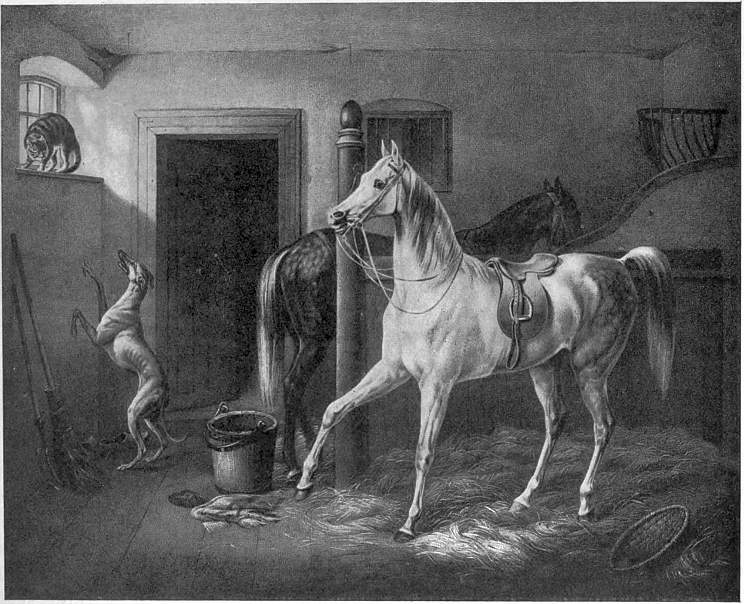
ADAM. A STABLE IN TOWN.
German painting in the nineteenth century took the same road. Eighty years ago foreign troops, and the extravagantly “picturesque and often ragged uniforms of the Republican army, the characteristic and often wild physiognomies of the French soldiers,” gave artists their first fresh and variously hued impressions. Painters of military subjects make their studies, not in the antiquity class of the academy, but upon the parade-ground and in the camp. Later, when the warlike times were over, they passed from the portrayal of soldiers to that of rustics; and so they laid the foundation on which future artists built.
Hanfstaengl.
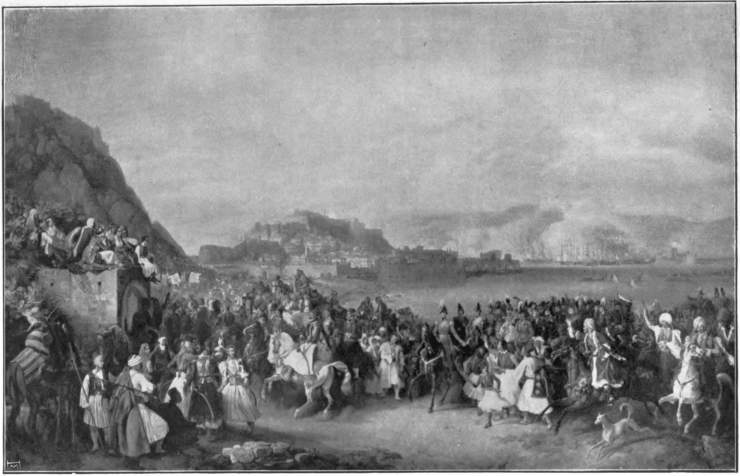
HESS. THE RECEPTION OF KING OTTO IN NAUPLIA.
In Berlin Franz Krüger and in Munich Albrecht Adam and Peter Hess were figures of individual character, belonging to the spiritual family of Chodowiecki and Gottfried Schadow; and, entirely undisturbed by classical theories or romantic reverie, they penetrated the life around them with a clear and sharp glance. They lacked, indeed, the temperament to comprehend either the high poetic tendencies of the old Munich school or the sentimental enthusiasm of the old Düsseldorf.
On the other hand, they were unhackneyed artists, facing facts in a completely unprejudiced spirit: entirely self-reliant, they refused to form themselves upon any model derived from the old masters; they had never had a teacher and never enjoyed academic instruction. This naïve straightforwardness makes their painting a half-barbaric product; something which has been allowed to run wild. But in a period of archæological resuscitations, pedantic brooding over the past and slavish imitation of the ancients, it seems, for this very reason, the first independent product of the nineteenth century. As vigorous, matter-of-fact realists they know nothing of more delicate charms, but represented fact for all it was worth and as honestly and conscientiously as was humanly possible. They are lacking in the distinctively pictorial character, but they are absolutely untouched by the Classicism of the epoch. They never dream of putting the uniforms of their warriors upon antique statues. It is this downright honesty that renders their pictures not merely irreplaceable as documents for the history of civilisation, and in spite of their unexampled frigidity, hardness, and gaudiness, lends them, even from the standpoint of art, a certain innovating quality. In a pleasantly written autobiography Albrecht Adam has himself described the drift of historical events which made him a painter of battles.
He was a confectioner’s apprentice in Nördlingen when, in the year 1800, the marches of the French army began in the neighbourhood. In an inn he began to sketch sergeants and Grenadiers, and went proudly home with the pence that he earned in this way. “Adam, when there’s war, I’ll take you into the field with me,” said an old major-general, who was the purchaser of his first works. That came to pass in 1809, when the Bavarians went with Napoleon against Austria. After a few weeks he was in the thick of raging battle. He saw Napoleon, the Crown-Prince Ludwig, and General Wrede, was present at the battles of Abensberg, Eckmühl, and Wagram, and came to Vienna with his portfolios full of sketches. There his portraits and pictures of the war found favour with the officers, and Eugène Beauharnais, Viceroy of Italy, took him to Upper Italy and afterwards to Russia. He was an eye-witness of the battles at Borodino and on the Moskwa, and saved himself from the conflagration of Moscow by his courage and determination. A true soldier, he mounted a horse when he was sixty-two years of age to be present on the Italian expedition of the Austrian army under Radetzky in 1848. His battle-pieces are therefore the result of personal experience. When campaigning he led the same life as the soldiers whom he portrayed, and as he proceeded in this portrayal with the objective quietness and fidelity of an historian, his artistic productions are invaluable as documents. Even where he could not draw as an eye-witness he invariably made studies afterwards, endeavouring to collect the most reliable material upon the spot, and preparing it with the utmost conscientiousness. The ground occupied by bodies of troops, the marshalling of them, and the conflict of masses, together with the smallest episodes, are represented with simplicity and reality. In the portrayal of the soldier’s life in time of peace he was inexhaustible. Just as vividly could he render horses undergoing the strain of the march and in the tumult of battle as in the stall, the farm-horse of the transport waggon no less than the noble creature ridden for parade. That his colour was sharp and hard, and his pictures therefore devoid of harmony, is to be explained by the helplessness of the age in regard to colouring. Only his last pictures, such as “The Battle on the Moskwa,” have a certain harmony of hue; and there is no doubt that this is to be set to the account of his son Franz.
After Adam, the father of German battle-painters, Peter Hess made an epoch by the earnestness and actuality of his pictures. He too accompanied General Wrede on the 1813-15 campaigns, and has left behind him exceedingly healthy, sane, and objectively viewed Cossack scenes, bivouacs, and the like, belonging to this period; though in his great pictures he aimed at totality of effect just as little as Adam. Confused by the complexity of his material, he only ventured to single out individual incidents, and then put them together on the canvas after the fashion of a mosaic; and, to make the nature of the action as clear as possible, he assumed as his standpoint the perspective view of a bird. Of course, pictures produced in this way make an effect which is artistically childish, but as the primitive endeavours of modern German art they will keep their place. The best known of his pictures are those inspired by the choice of Prince Otto of Bavaria as King of Greece, especially “The Reception of King Otto in Nauplia,” which is to be found in the new Pinakothek in Munich. In spite of its hard, motley, and quite impossible colouring, and its petty pedantry of execution, this is a picture which will not lose its value as an historical source.
Vigorous Franz Krüger had been long known in Berlin, by his famous pictures of horses, before the Emperor of Russia in 1829 commissioned him to paint, on a huge canvas, the great parade on the Opernplatz in Berlin, where he had reviewed his regiment of Cuirassiers before the King of Prussia. From that time such parade pictures became Krüger’s specialty; especially famous is the great parade of 1839, with the likenesses of those who at the time played a political or literary part in Berlin. In these works he has left a true reflection of old Berlin, and bridged over the chasm between Chodowiecki and Menzel: this is specially the case with his curiously objective water-colour portrait heads. Mention should be made of Karl Steffeck as a pupil of Krüger, and Theodor Horschelt—in addition to Franz Adam—as a pupil of Adam. By Steffeck, a healthy, vigorous realist, there are some well-painted portraits of horses, and by Th. Horschelt, who in 1858 took part in the fights of the Russians against the Circassians in the Caucasus, there survive some of the spirited and masterly pen-and-ink sketches which he published collectively in his Memories from the Caucasus. Franz Adam, who first published a collection of lithographs on the Italian campaign of 1848 in connection with Raffet, and in the Italian war of 1859 painted his first masterpiece, a scene from the battle of Solferino, owes his finest successes—although he had taken no part in it—to the war of 1870. In respect of harmony of colouring he is perhaps the finest painter of battle-pieces Germany has produced. As I shall later have no opportunity of doing so, I must mention here the works of Josef Brandt, the best of Franz Adam’s pupils. They are painted with verve and chivalrous feeling. There is a flame and a sparkle, both in the forms of his warriors and of his horses, in his pictures of old Polish cavalry battles. Everything is aristocratic: the distinction of the grey colouring no less than the ductile drawing with its chivalrous sentiment. In everything there breathes life, vigour, fire, and freshness: the East of Eugène Fromentin translated into Polish. Heinrich Lang, a spirited draughtsman, who had the art of seizing the most difficult positions and motions of a horse, embodied the wild tumult of cavalry charges (“The Charge of the Bredow Brigade,” “The Charge at Floing,” etc.) in rapid pictures of incisive power, though otherwise the heroic deeds of the Germans in 1870 resulted in but few heroic deeds in art.

CHAPTER XIX
ITALY AND THE EAST
In the beginning of the century the man who did not wear a uniform was not a proper subject for art unless he lived in Italy as a peasant or a robber. That is to say, painters were either archæologists or tourists; when they did not dive into the past they sought their romantic ideal in the distance. Italy, where monumental painting had first seen the light, was the earliest goal for travellers, and satisfied the desire of artists, since, for the rest of the world, it was still enveloped in poetic mystery. Only in Rome, in Naples, and in Tuscany was it thought possible to meet with human beings who had not become vulgar and hideous under the influence of civilisation. There they still preserved something of the beauty of Grecian statues. There artists were less afraid of being diverted from absolute beauty by the study of nature, and thus an important principle was carried. Instead of copying directly from antique statues, as David and Mengs had done before them, painters began to study the descendants of those who had been the models of the old Roman sculptors; and so it was that, almost against their will, they turned from museums to look rather more closely into nature, and from the past to cast a glance into the present.
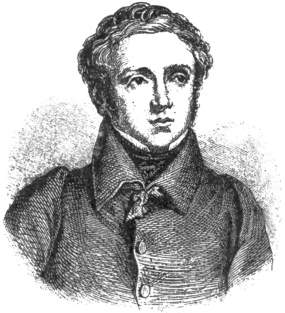
To Leopold Robert belongs the credit of having opened out this new province to an art which was enclosed in the narrow bounds of Classicism. He owes his success with the public of the twenties and his place in the history of art entirely to the fact that in spite of his strict classical training he was one of the first to interest himself, however little, in contemporary life. Hundreds of artists had wandered into Italy and seen nothing but the antique until this young man set out from Neufchâtel in 1818 and became the painter of the Italian people. What struck him at the first glance was the character of the people, together with their curious habits and usages, and their rude and picturesque garb. “He wished to render this with all fidelity,” and especially “to do honour to the absolute nobility of that people which still bore a trace of the heroic greatness of their forefathers.” Above all, he fancied that he could find this phenomenon of atavism amongst the bandits; and as Sonnino, an old brigand nest, had been taken and the inhabitants removed to Engelsburg shortly after his arrival, a convenient opportunity was offered to him for making his studies in this place. The pictures of brigand life which he painted in the beginning of the twenties soon found a most profitable market. “Dear M. Robert,” said the fashionable guests who visited his studio by the dozen, “could you paint a little brigand, if it is not asking too much?” Robbers with sentimental qualms were particularly prized: for instance, at the moment when they were fondling their wives, or praying remorsefully to God, or watching over the bed of a sick child.
From brigands he made a transition to the girls of Sorrento, Frascati, Capri, and Procida, and to shepherd lads, fishers, pilgrims, hermits, and pifferari. Early in the twenties, when he made an exhibition of a number of these little pictures in Rome, it effectually prepared the way for his fame; and when he sent a succession of larger pictures to the Paris Salon in 1824-31 he was held as one of the most brilliant masters of the French school, to whom Romanticists and Classicists paid the same honour. In the first of these pictures, painted in 1824, he had represented a number of peasants listening to a Neapolitan fisherman improvising to the accompaniment of a harmonica. “The Return from a Pilgrimage to the Madonna dell’ Arco” of 1827 is the painting of a triumphal waggon yoked with oxen. Upon it are seated lads and maidens adorned with foliage, and in their gay Sunday best. An old lazzarone is playing the mandolin, and girls are dancing with tambourines, whilst a young man springs round clattering his castanets, and a couple of boys, to complete the seasons of life, head the procession. His third picture, “The Coming of the Reapers to the Pontine Marshes,” was the chief work in the Salon of 1831 after the “Freedom” of Delacroix. Heine accorded him a classical passage of description, and the orthodox academical critics were liberal with most unmerited praise, treating the painter as a dangerous revolutionary who was seducing art into the undignified naturalism of Ribera and Caravaggio. Robert, the honest, lamblike man, who strikes us now as being a conscientious follower of the school of David!
Seemann, Leipzig.
LEOPOLD ROBERT.
How little did the artistic principles which he laid down in his letters accord with his own paintings! “I try,” he wrote to a friend in 1819, “to follow Nature in everything. Nature is the only teacher who should be heard. She alone inspires and moves me, she alone appeals to me: it is Nature that I seek to fathom, and in her I ever hope to find the special impulse for work.” She is a miracle to him, and one that is greater than any other, a book in which “the simple may read as well as the great.” He could not understand “how painters could take the old masters as their model instead of Nature, who is the only great exemplar!” What is to be seen in his pictures is merely an awkward transference of David’s manner of conception and representation to the painting of Italian peasants—a scrupulously careful adaptation of classical rules to romantic subjects. He looked at modern Italians solely through the medium of antique statuary, and conducts us to an Italy which can only be called Leopold Robert’s Italy, since it never existed anywhere except in Robert’s map. All his figures have the movement of some familiar work of antique sculpture, and that expression of cherished melancholy which went out of fashion after the time of Ary Scheffer. Never does one see in his pictures a casual and unhackneyed gesture in harmony with the situation. It seems as if he had dressed up antique statues or David’s Horatii and his Sabine women in the costume of the Italian peasantry, and grouped them for a tableau vivant in front of stage scenery, and in accordance with Parisian rules of composition. His peasants and fishers make beautiful, noble, and often magnificent groups. But one can always give the exact academic rules for any particular figure standing here and not there, or in one position and not in another. His pictures are much too official, and obtrusively affect the favourite pyramid form of composition.
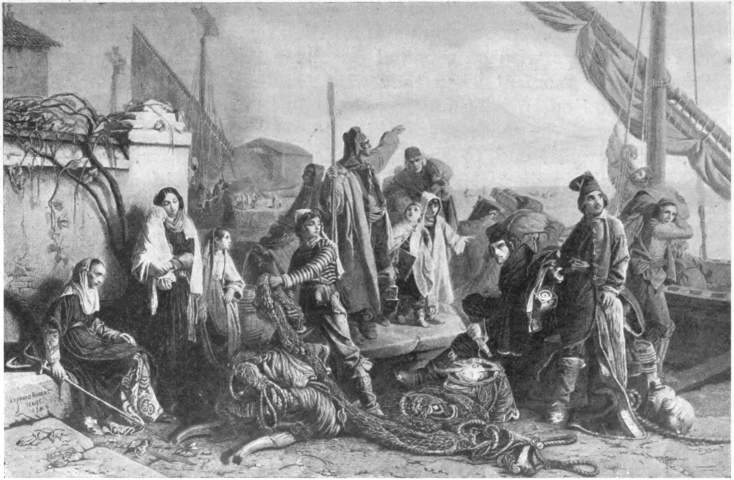
L. ROBERT. FISHERS OF THE ADRIATIC.
But as they are supposed to be pictures of Italian manners, the contrast between nature and the artificial construction is almost more irritating than it is in David’s mythological representations. It is as if Robert had really never seen any Italian peasants, though he maintains all the while that he is depicting their life. The hard outlines and the sharp bronze tone of his works are a ghastly evidence of the extent to which the sense of colour had become extinct in the school of David. It was merely form that attracted him; the sun of Italy left him indifferent. The absence of atmosphere gives his figures an appearance of having been cut out of picture sheets. O great artists of Holland, masters of atmospheric effect and of contour bathed in light, what would you have said to such heartless silhouettes! In his youth Robert had been a line engraver, and he adapted the prosaic technique of line engraving to painting. However, he was a transitional painter, and as such he has an historical interest. He was a modern Tasso, too, and on the strength of the adventurous relationship to Princess Charlotte Napoleon, which ultimately drove him to suicide, he could be used with effect as the hero of a novel. Through the downfall of the school of David his star has paled—one more proof that only Nature is eternal, and that conventional painting falls into oblivion with the age that saw it rise. “I wished to find a genre which was not yet known, and this genre has had the fortune to please. It is always an advantage to be the first.” With these words he has himself indicated, in a way which is as modest as it is accurate, the ground of his reputation amongst contemporaries, and why it is that the history of art cannot quite afford to forget him.
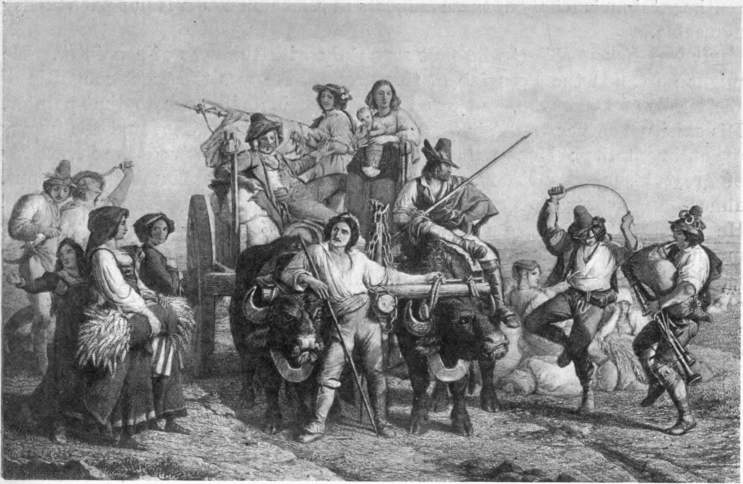
L. ROBERT. THE COMING OF THE REAPERS TO THE PONTINE MARSHES.
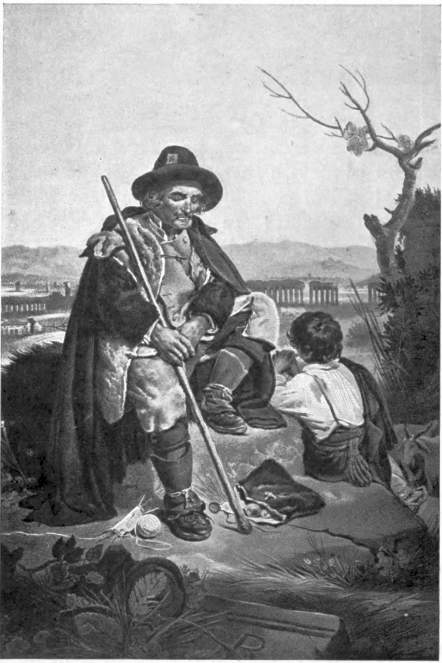
SCHNETZ. AN ITALIAN SHEPHERD.
Amongst the multitude of those who, incited by Robert’s brilliant successes, made the Spanish staircase in Rome the basis of their art, Victor Schnetz, by his “Vow to the Madonna” of 1831, specially succeeded in winning public favour. At a later time his favourite themes were the funerals of children, inundations, and the like; but his arid method of painting contrasts with the sentimental melancholy of these subjects in a fashion which is not particularly agreeable.
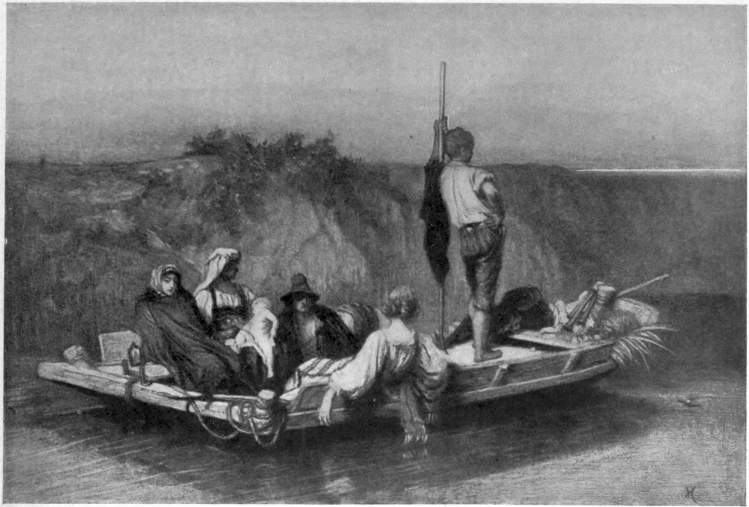
It was Ernest Hébert who first saw Italy with the eyes of a painter. He might be called the Perugino of this group. He was the most romantic of the pupils of Delaroche, and owed his conception of colour to that painter. His spiritual father was Ary Scheffer. The latter has discovered the poetry of sentimentality; Hébert the poetry of disease. His pictures are invariably of great technical delicacy. His style has something femininely gracious, almost languishing: his colouring is delicately fragrant and tenderly melting. He is, indeed, a refined artist who occupies a place by himself, however mannered the melancholy and sickliness of his figures may be. In “The Malaria” of 1850 they were influenced by the subject itself. The barge gliding over the waters of the Pontine Marshes, with its freight of men, women, and children, seems like a gloomy symbol of the voyage of life; the sorrow of the passengers is that of resignation: dying they droop their heads like withering flowers. But later the fever became chronic in Hébert. The interesting disease returned even where it was out of place, as it does still in the pictures of his followers. The same fate befell the painters of Italy which befalls tourists. What Robert had seen in the country as the first comer whole generations saw after him, neither more nor less than that. The pictures were always variations on the old theme, until in the sixties Bonnat came with his individual and realistic vision.
Portfolio.
HÉBERT. THE MALARIA.
In Germany, where “the yearning for Italy” had been ventilated in an immoderate quantity of lyrical poems ever since the time of Wackenroder’s Herzensergiessungen, August Riedel represented this phase of modern painting; and as Leopold Robert is still celebrated, Riedel ought not to be forgotten. Riedel lived too long (1800-1883), and, as he painted nothing but bad pictures during the last thirty years of his life, what he had done in his youth was forgotten. At that time he was the first apostle of Leopold Robert in Germany, and as such he has his importance as an innovator. When he began his career in the Munich Academy in 1819 Peter Langer, a Classicist of the order of Mengs, was still director there. Riedel also painted classical subjects and church pictures—“Christ on the Mount of Olives,” “The Resurrection of Lazarus,” and “Peter and Paul healing the Lame.” But when he returned from Italy in 1823 he reversed the route which others had taken: the classic land set him free from Classicism, and opened his eyes to the beauty of life. Instead of working on saints in the style of Langer, he painted beautiful women in the costume of modern Italy. His “Neapolitan Fisherman’s Family” was for Germany a revelation similar to that which Robert’s “Neapolitan Improvisator” had been for France. The fisherman, rather theatrically draped, is sitting on the shore, while his wife and his little daughter listen to him playing the zither. The blue sea, dotted with white sails, and distant Ischia and Cape Missene, form the background; and a blue heaven, dappled with white clouds, arches above. Everything was of an exceedingly conventional beauty, but denoted progress in comparison with Robert. It already announced that search for brilliant effects of light which henceforward became a characteristic of Riedel, and gave him a peculiar position in his own day. “Even hardened connoisseurs,” wrote Emil Braun from Rome about this time, “stand helpless before this magic of colouring. It is often long before they are able to persuade themselves that such glory of colour can be produced by the familiar medium of oil painting, and with materials that any one can buy at a shop where pigments are sold.” Riedel touched a problem—diffidently, no doubt—which was only taken up much later in its full extent. And if Cornelius said to him, “You have fully attained what I have avoided with the greatest effort during the course of my whole life,” it is none the less true that Riedel’s Italian girls in the full glow of sunlight have remained, in spite of their stereotyped smile, so reminiscent of Sichel, better able to stand the test of galleries than the pictures of the Michael-Angelo of Munich. Before his “Neapolitan Fisherman’s Family,” which went the world over like a melody from Auber’s Masaniello, before his “Judith” carrying the head of Holofernes in the brightest light of morning, before his “Girls Bathing” in the dimness of the forest, and before his “Sakuntala,” painted “with refined effects of light,” the cartoon painters mumbled and grumbled, and raised hue and cry over the desecration of German art; but Riedel’s friends were just as loud in proclaiming the witchery of his colour, and “the Southern sunlight which he had conjured on to his palette,” to be splendid beyond the powers of comprehension. It is difficult at the present day to understand the fame that he once had as “a pyrotechnist in pigments.” But the results which he achieved by himself in colouring, long before the influence of the Belgians in Germany, will always give him a sure place in the history of German art. And these qualities were unconsciously inherited by his successors, who troubled their heads no further about the pioneer and founder.
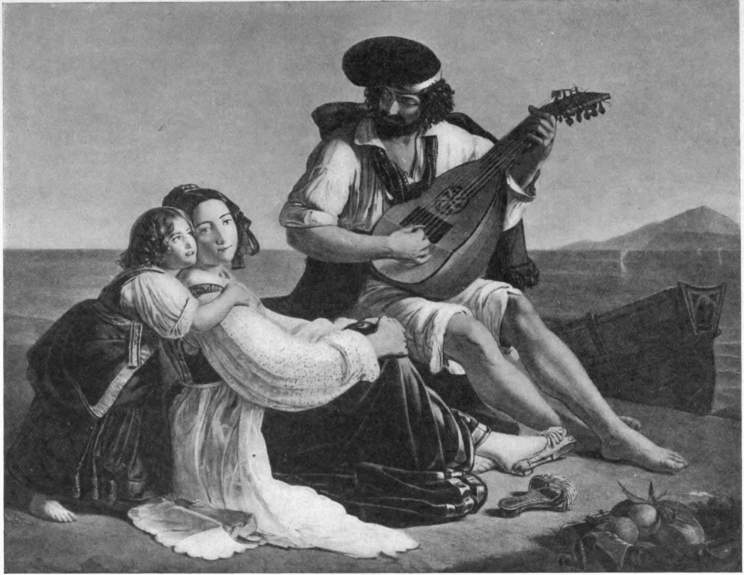
RIEDEL. THE NEAPOLITAN FISHERMAN’S FAMILY.
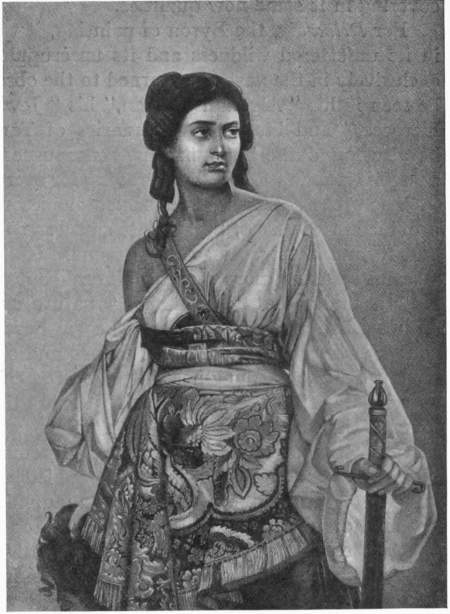
RIEDEL. JUDITH.
Those who painted the East with its clear radiance, its interesting people, and its picturesque localities, stand in opposition to the Italian enthusiasts. They are the second group of travellers. Gros had given French art a vision of that distant magic land, but he had had no direct disciples. Painters were as yet in too close bondage to their classical proclivities to receive inspiration from Napoleon’s expedition into Egypt. But the travels of Chateaubriand and the verse of Byron, and then the Greek war of liberation, and, above all, the conquest of Algiers, once more aroused an interest in these regions, and, when the revolution of the Romanticists had once taken place, taught art a way into the East. Authors, journalists, and painters found their place in this army of travellers. The first view of men and women standing on the shore in splendid costume, with turbans or high sheepskin hats, and surrounded by black slaves, or mounted upon horses richly caparisoned, or listening to the roll of drums and the muezzin resounding from the minarets, was like a scene from The Arabian Nights. The bazaars and the harems, the quarters of the Janizaries and gloomy dungeons were visited in turn. Veiled women were seen, and mysterious houses where every sound was hushed. At first the Moors, obedient to the stern laws of the Koran, fled before the painters as if before evil spirits, but the Moorish women were all the more ready to receive these conquerors with open arms. Artists plunged with rapture into a new world; they anointed themselves with the oil of roses, and tasted all the sweets of Oriental life. The East was for the Byronic enthusiasts of 1830 what Italy had been for the Classicists. Could anything be imagined more romantic? You went on board a steamer provided with all modern comforts and all the appliances of the nineteenth century, and it carried you thousands of years back in the history of the world; you set foot on a soil where the word progress did not exist—in a land where the inhabitants still sat in the sun as if cemented to the ground, and wore the same costumes in which their forefathers had sat there two thousand years ago. Here the Romanticists not only found nature decked in the rich hues which satisfied their passion for colour, but discovered a race of people possessed of that beauty which, according to the Classicists, was only to be seen in the Italian peasants. They beheld “men of innate dignity and remarkable distinction of pose and gesture.” Thus a new experience was added to life. There was the East, where splendour and simplicity, cruelty and beauty, softness of temper and savage austerity, and brilliant colour and blinding light are more completely mingled than anywhere else in the world; there was the East, where rich tints laugh in the midst of squalor and misery, the brightness of earlier days in the midst of outworn usages, and the pride of art in the midst of ruined villages. It was so great, so unfathomable, and so like a fairy tale that it gave every one the chance of discovering in it some new qualities.
For Delacroix, the Byron of painting, it was a splendid setting for passion in its unfettered wildness and its unscrupulous daring. He, who had lived exclusively in the past, now turned to the observation of living beings, as may be seen in his “Algerian Women,” his “Jewish Wedding,” his “Emperor of Morocco,” and his “Convulsionaries of Tangier.” Amongst the Orientals he also found the hotly flaming sensuousness and primitive wildness which beset his imagination with its craving for everything impassioned.
The great charmeur, the master of pictorial caprice, Decamps, found his province in the East, because its sun was so lustrous, its costume so bright, and its human figures so picturesque. If Delacroix was a powerful artist, Decamps was no more than a painter,—but painter he was to his finger-tips. He was indifferent to nothing in nature or history: he showed as much enthusiasm for a pair of tanned beggar-boys playing in the sunshine at the corner of a wall as for Biblical figures and old-world epics. He has painted hens pecking on a dung-heap, dogs on the chase and in the kennel, monkeys as scholars, and musicians in all the situations which Teniers and Chardin loved. His “Battle of Tailleborg” of 1837 has been aptly termed the only picture of a battle in the Versailles Museum. He looked on everything as material for painting, and never troubled as to how another artist would have treated the subject. There is an individuality in every one of his works; not an individuality of the first order, but one that is decidedly charming and that assures him a very high place amongst his contemporaries.
Having made a success in 1829 with an imaginary picture of the East, he had a wish to see how far the reality corresponded with his ideas of Turkey, and in the same year—therefore before Delacroix—he went on that journey to the Greek Archipelago, Constantinople, and Asia Minor which became a voyage of discovery for French painting. In the Salon of 1831 was exhibited his “Patrol of Smyrna,” which at once made him one of the favourite French painters of the time. Soon afterwards came the picture of the “Pasha on his Rounds,” accompanied by a lean troop of running and panting guards, that of the great “Turkish Bazaar,” in which he gave such a charming representation of the gay and noisy bustle of an Oriental fair, those of the “Turkish School,” the “Turkish Café,” “The Halt of the Arab Horsemen,” and “The Turkish Butcher’s Shop.” In everything which he painted from this time forward—even in his Biblical pictures—he had before his eyes the East as it is in modern times. Like Horace Vernet, he painted his figures in the costume of modern Arabs and Egyptians, and placed them in landscapes with modern Arab buildings. But the largeness of line in these landscapes is expressive of something so patriarchal and Biblical, and of such a dreamy, mystical poetry, that, in spite of their modern garb, the figures seem like visions from a far distance.
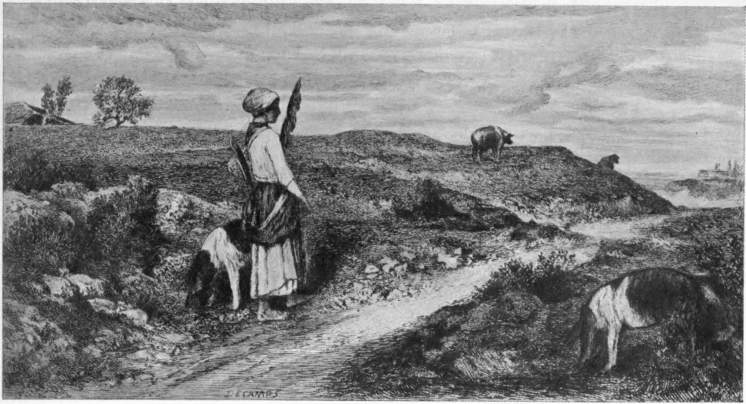
Gaz. des Beaux-Arts.
DECAMPS. THE SWINEHERD.
Decamps’ painting never became trivial. All his pictures soothe and captivate the eye, however much they disappoint, on the first glance, the expectations which the older descriptions of them may have excited. Fifty years ago it was said that Delacroix painted with colour and Decamps with light; that his works were steeped in a bath of sunshine. This vibrating light, this transparent atmosphere, which contemporaries admired, is not to be found in Decamps’ pictures. Their brilliancy of technique is admirable, but he was no painter of light. The world of sunshine in which everything is dipped, the glow and lustre of objects in shining, liquid, and tremulous air, is what Gustave Guillaumet first learnt to paint a generation later. Decamps attained the effect of light in his pictures by the darkening of shadows, precisely in the manner of the old school. To make the sky bright, he threw the foreground into opaque and heavy shade. And as, in consequence of the ground of bole used to produce his beautiful red tones, the dark parts of his pictures gradually became as black as pitch, and the light parts dead and spotty, he will rather seem to be a contemporary of Albert Cuyp than of Manet.
As draughtsman to a German baron making a scientific tour in the East, Prosper Marilhat, the third of the painters of Oriental life, was early in following this career. He visited Greece, Asia Minor, and Egypt, and returned to Paris in 1833 intoxicated with the beauties of these lands. Especially dear to him was Egypt, and in his pictures he called himself, “Marilhat the Egyptian.” Decamps had been blinded by the sharp contrast between light and shadow in Oriental nature, by the vivid blaze of colour in its vegetation, and by the tropical glow of the Southern sky. Marilhat took novelties with a more quiet eye, and kept close to pure reality. He has not so much virtuosity as Decamps, and in colour he is less daring, but he is perhaps more poetic, and on that account, in the years 1833-44, he was prized almost more. The exhibition of 1844, in which eight of his pictures appeared, closed his career. He had expected the Cross of the Legion of Honour, but did not get it, and this disappointment affected him so deeply that he became first hypochondriacal and then mad. His early death at thirty-six set Decamps free from a powerful rival.
Eugène Fromentin went further in the same direction as Marilhat. He knew nothing of the preference for the glowing hues of the tropics nor of the fantastic colouring of the Romanticists. He painted in the spirit of a refined social period in which no loud voice is tolerated, but only light and familiar talk. The East gave him his grace; the proud and fiery nature of the Arab horse was revealed to him. In his portraits Fromentin looks like a cavalry officer. In his youth he had studied law, but that was before his acquaintance with the landscape painter Cabat brought him to his true calling, and a sojourn made on three different occasions—in 1845, 1848, and 1852—on the borders of Morocco decided for him his specialty. By his descriptions of travels, A Year in Sahel, which appeared in the Revue des Deux Mondes, he became known as a writer: it was only after 1857, however, that he became famous as a painter. Fromentin’s East is Algiers. While Marilhat tried to render the marvellous clearness of the Southern light, and Decamps depicted the glowing heat of the East, its dark brooding sky in the sultry hours of summer and the grand outlines of its landscape, Fromentin has tried—and perhaps with too much system—to express the grace and brilliant spirit of the East. Taste, refinement, ductility, distinction of colouring, and grace of line are his special qualities. His Arabs galloping on their beautiful white horses have an inimitable chivalry; they are true princes in every pose and movement. The execution of his pictures is always spirited, easy, and in keeping with their high-bred tone. Whatever he does has the nervous vigour of a sketch, with that degree of finish which satisfies the connoisseur. There is always a coquetry in his arrangement of colour, and his tones are light and delicate if they are not deep. In the landscape his little Arab riders have the effect of flowers upon a carpet.
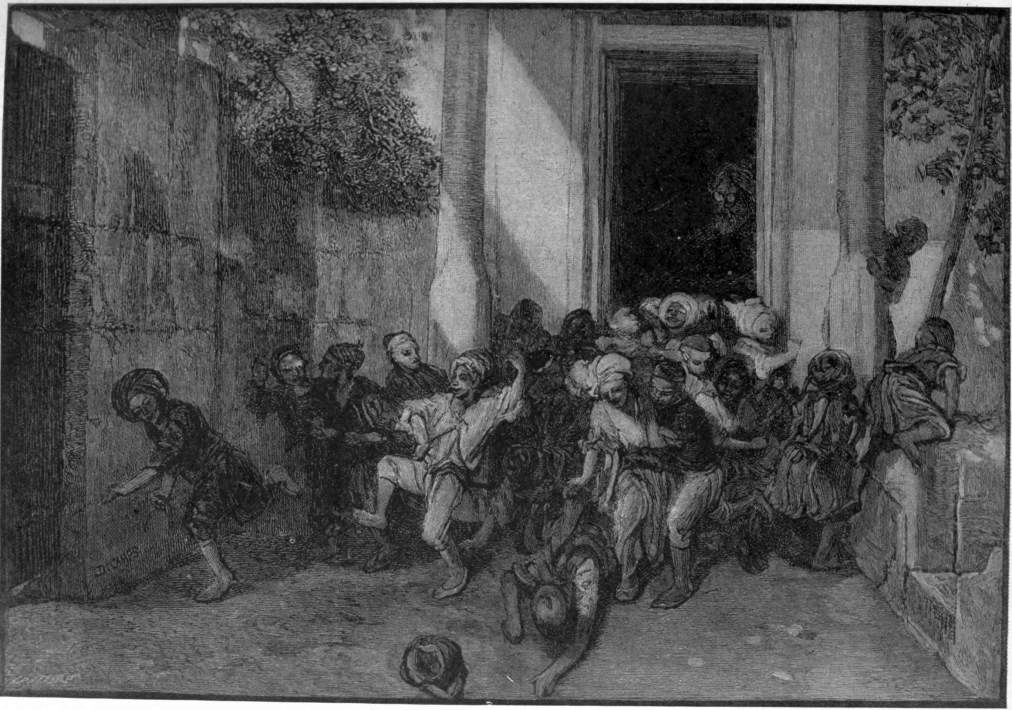
Baschet.
DECAMPS. COMING OUT FROM A TURKISH SCHOOL.
(By permission of Mme. Moreau-Nélaton, the owner of the picture.)
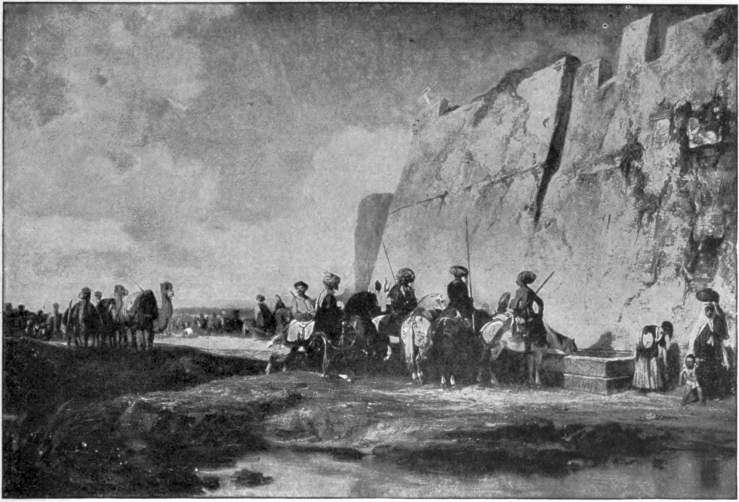
Cassell & Co.
DECAMPS. THE WATERING PLACE.
Afterwards, when naturalism was at its zenith, Fromentin was much attacked for this wayward grace. He was accused of making a superficial appeal to the eye, and of offering everything except truth. And for its substantive fidelity Fromentin’s “East” cannot certainly be taken very seriously. He was a man of fine culture, and in his youth he had studied the old Dutch masters more than nature; he even saw the light of the East through the Dutch chiaroscuro. His pictures are subtle works of art, nervous in drawing and dazzling in brilliancy of construction, but they are washed in rather than painted, and stained rather than coloured. In his book he speaks himself of the cool, grey shadows of the East. But in his pictures they turn to a reddish hue or to brown. An effort after beauty of tone in many ways weakened his Arab scenes. He looked at the people of the East too much with the eyes of a Parisian. And the more his recollections faded, the more did he begin to create for himself an imaginary Africa. He painted grey skies simply because he was tired of blue; he tinted white horses with rosy reflections, chestnuts with lilac, and dappled-greys with violet. The grace of his works became more and more an affair of affectation, until at last, instead of being Oriental pictures, they became Parisian fancy goods, which merely recalled the fact that Algiers had become a French town.
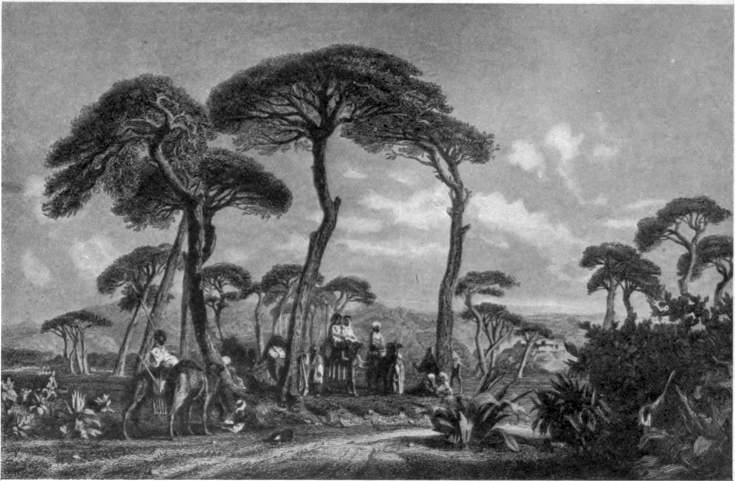
MARILHAT. A HALT.
But after all what does it matter whether pictures of the East are true to nature or not? Other people whose names are not Fromentin can provide such documents. In his works Fromentin has expressed himself, and that is enough. Take up his first book, L’été dans la Sahara: by its grace of style it claims a place in French literature. Or read his classic masterpiece, Les maîtres d’autrefois, published in 1876 after a tour through Belgium and Holland: it will remain for ever one of the finest works ever written on art. A connoisseur of such refinement, a critic who gauged the artistic works of Belgium and Holland with such subtlety, necessarily became in his own painting an epicure of beautiful tones. This man, who never made an awkward movement nor uttered a brutal word, this sensitive, distinguished spirit could be no more than a subtle artist who had eyes for nothing but the aristocratic side of Eastern life. As a painter, however, he might wish to be true to nature; he could be no more than this. His art, compact of grace and distinction, was the outcome of his own nature. He is a descendant of those delicately feminine, seductively brilliant, facile and spontaneous, sparkling and charming painters who were known in the eighteenth century as peintres des fêtes galantes. He is the Watteau of the East, and in this capacity one of the most winning and captivating products of French art.
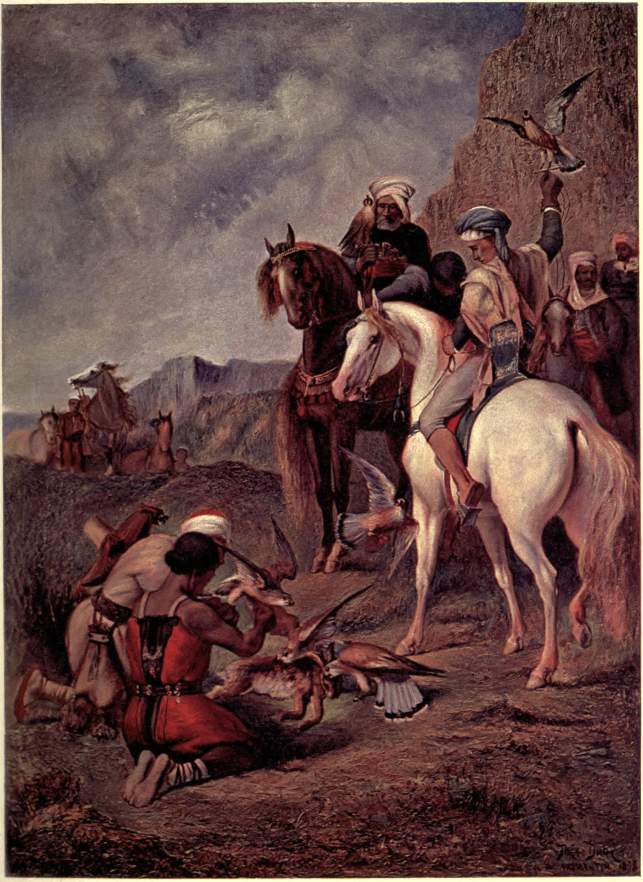
E. FROMENTIN. ARABIAN FALCONERS.
Finally, Guillaumet, the youngest and last of the group, found in the East peace: a scion of the Romanticists, there is none the less a whole world of difference between him and them. While the Romanticists, as sons of a flaccid, inactive period, lashed themselves into enthusiasm for the passion and wild life of the East, Guillaumet, the child of a hurried and neurotic epoch, sought here an opiate for his nerves. Where they saw contrasts he found harmony; and he did not find it, like Fromentin, in what is understood as chic. Manet’s conception of colour had taught him that nature is everywhere in accord and harmoniously delicate.
He writes: “Je commence à distinguer quelques formes: des silhouettes indécises bougent le long des murs enfumés sous des poutres luisantes de sui. Les détails sortent du demi-jour, s’animent graduellement avec la magie des Rembrandt. Même mystère des ombres, mêmes ors dans les reflets—c’est l’aube.... Des terrains poudreux inondés de soleil; un amoncellement de murailles grises sous un ciel sans nuage; une cité somnolente baignée d’une lumière égale, et dans le frémissement visible des atomes aériens quelques ombres venant ça et là détacher une forme, accuser un geste parmi les groupes en burnous qui se meuvent sur les places ... tel m’apparait le ksar, vers dix heures du matin....
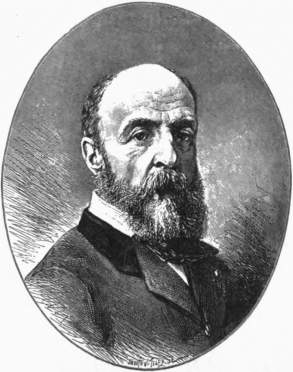
L’Art.
EUGÈNE FROMENTIN.
“L’œil interroge: rien ne bouge. L’oreille écoute: aucun bruit. Pas un souffle, si ce n’est le frémissement presque imperceptible de l’air au-dessus du sol embrasé. La vie semble avoir disparu, absorbée par la lumière. C’est le milieu du jour.... Mais le soir approche.... Les troupeaux rentrent dans les douars; ils se pressent autour des tentes, à peine visibles, confondus sous cette teinte neutre du crépuscule, faite avec les gris de la nuit qui vient et les violets tendres du soir qui s’en va. C’est l’heure mystérieuse, où les couleurs se mèlent, où les contours se noient, où toute chose s’assombrit, où toute voix se tait, où l’homme, à la fin du jour, laisse flotter sa pensée devant ce qui s’éteint, s’efface et s’evanouit.”
This description of a day in Algiers in Guillaumet’s Tableaux algériens interprets the painter Guillaumet better than any critical appreciation could possibly do. For him the East is the land of dreams and melting softness, a far-off health-resort for neurotic patients, where one lies at ease in the sun and forgets the excitements of Paris. It was not what was brilliant and pictorial in sparkling jewels and bright costume that attracted him at all, but the silence, the mesmeric spell of the East, the vastness of the infinite horizon, the imposing majesty of the desert, and the sublime and profound peace of the nights of Africa. “The Evening Prayer in the Desert” was the name of the first picture that he brought back with him in 1863. There is a wide and boundless plain; the straight line of the horizon is broken by a few mountain forms and by the figures of a party belonging to a caravan; but, bowed as they are in prayer, these figures are scarcely to be distinguished. The smoke of the camp ascends like a pillar into the air. The monotony of the wilderness seems to stretch endlessly to the right and to the left, like a grand and solemn Nirvana smiting the human spirit with religious delirium.
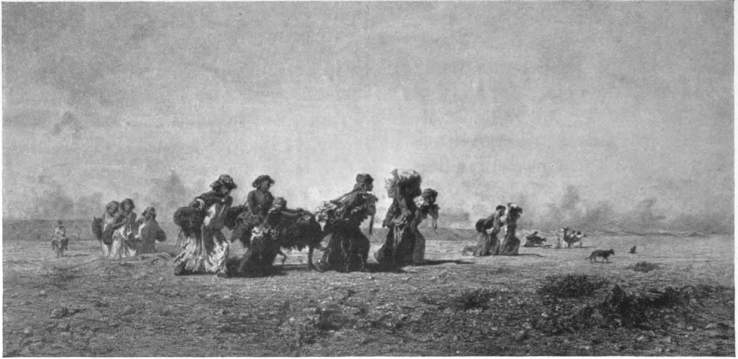
FROMENTIN. ARABIAN WOMEN RETURNING FROM DRAWING WATER.
For Decamps and Marilhat the East was a great, red copper-block beneath a blue dome of steel; a beautiful monster, bright and glittering. Guillaumet has no wish to dazzle. His pictures give one the impression of intense and sultry heat. His light is really “le frémissement visible des atomes aériens.” Moreover, he did not see the chivalry of the East like Fromentin. The latter was fascinated by the nomad, the pure Arab living in tent or saddle, the true aristocrat of the desert, mounted on his white palfrey, hunting wild beasts through fair blue and green landscapes. Poor folk who never owned a horse are the models of Guillaumet. With their dogs—wild creatures who need nothing—they squat in the sun as if with their own kin: they are the lower, primitive population, the pariahs of the wilderness; tattered men whose life-long siesta is only interrupted by the anguish of death, animal women whose existence flows by as idly as in the trance of opium.
After the French Romanticists had shown the way, other nations contributed their contingent to the painters of Oriental subjects. In Germany poetry had discovered the East. Rückert imitated the measure and the ideas of the Oriental lyric, and the Greek war of liberation quickened all that passionate love for the soil of old Hellas which lives in the German soul. Wilhelm Müller sang his songs of the Greeks, and in 1825 Leopold Schefer brought out his tale Die Persierin. But just as the Oriental tale was a mere episode in German literature, an exotic grafted on the native stem, so the Oriental painting produced no leading mind in the country, but merely a number of good soldiers who dutifully served in the troops of foreign commanders.
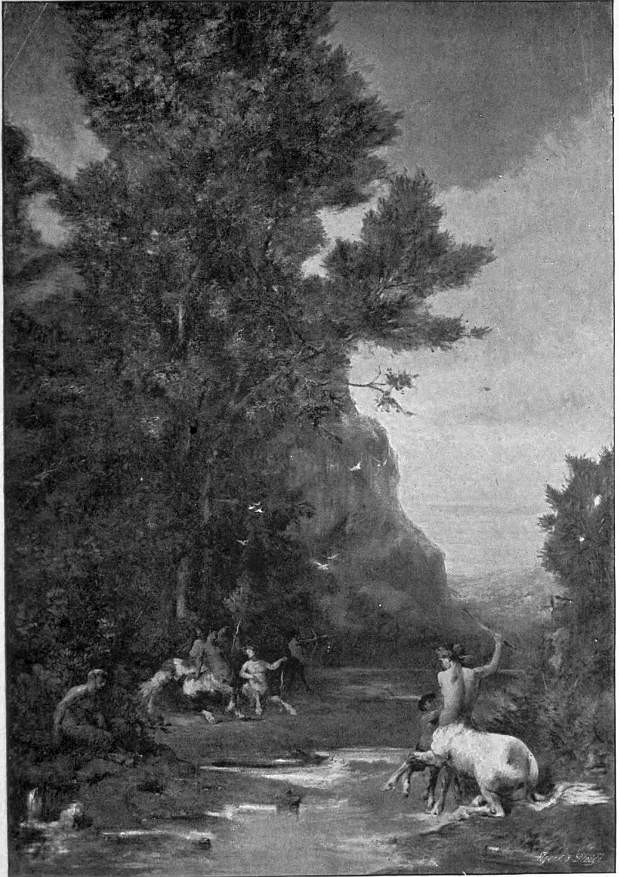
Cassell & Co.
FROMENTIN. THE CENTAURS.
Kretszchmer of Berlin led the way with ethnographical representations, and was joined at a later time by Wilhelm Gentz and Adolf Schreyer of Frankfort. Gentz, a dexterous painter, and, as a colourist, perhaps the most gifted of the Berlin school in the sixties, is, in comparison with the great Frenchmen who portrayed the East, a thoroughly arid realist. He brought to his task a certain amount of rough vigour and restless diversity, together with North German sobriety and Berlin humour. Schreyer, who lived in Paris, belonged to the following of Fromentin. The Arab and his steed interested him also. His pictures are bouquets of colour, dazzling the eye. Arabs in rich and picturesque costume repose on the ground or are mounted on their milk-white steeds, which rear and prance with tossing manes and wide-stretched nostrils. The desert undulates away to the far horizon, now pale and now caressed by the softened rays of the setting sun, which tip the waves of sand with burnished gold. Schreyer was—for a German—a man with an extraordinary gift for technique and a brilliantly effective sense of life. The latter remark is specially true of his sketches. At a later date—in 1875, after being with Lembach and Makart in Cairo—the Viennese Leopold Müller found the domain of his art beneath the clear sky, in the brightly coloured land of the Nile. Even his sketches are often of great delicacy of colour, and the ethnographical accuracy which he also possessed has long made him the most highly valued delineator of Oriental life and a popular illustrator of works on Egypt. The learned and slightly pedantic vein in his works he shares with Gérôme, but by his greater charm of colour he comes still nearer to Fromentin.
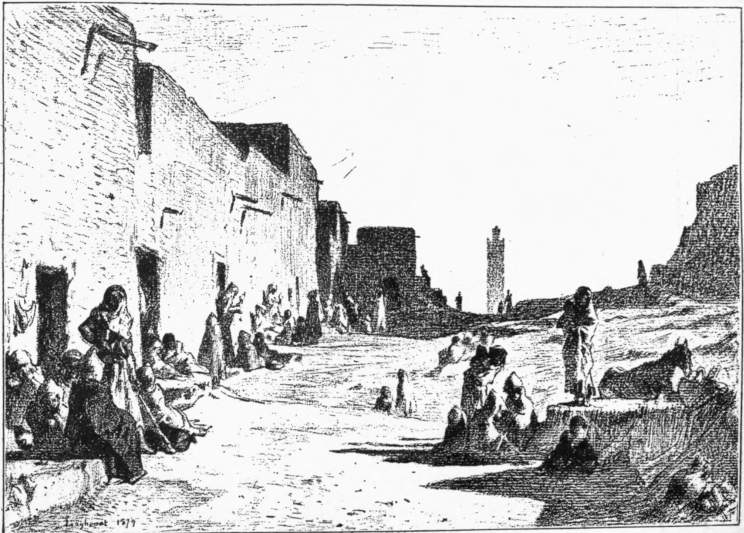
L’Art.
GUILLAUMET. THE SÉGUIA, NEAR BISKRA.
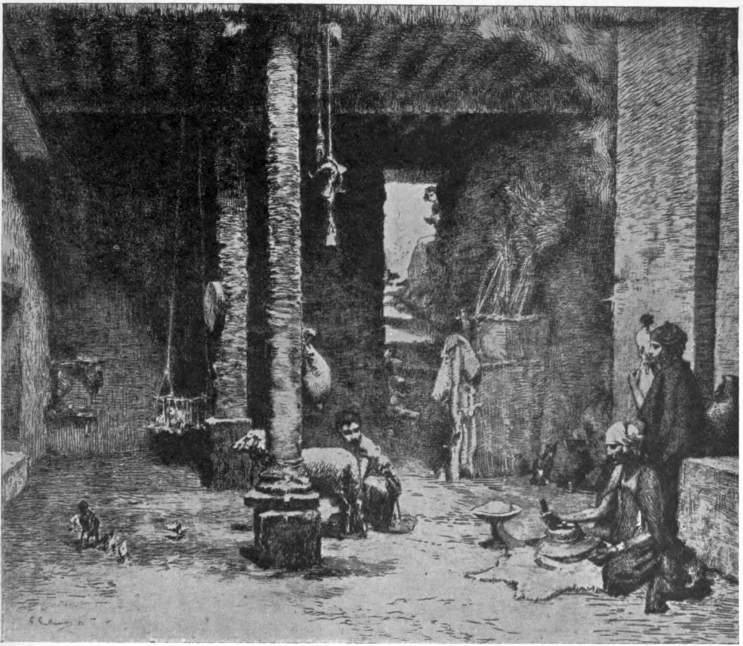
L’Art.
GUILLAUMET. A DWELLING IN THE SAHARA.
The route to the East was shown to the English by the glowing landscapes of William Müller; but the English were just as unable to find a Byron amongst their painters. Frederick Goodall has studied the classical element in the East, and endeavoured to reconstruct the past from the present. Best known amongst these artists was J. F. Lewis, who died in 1876 and was much talked of in earlier days. For long years he wandered through Asia Minor, filling his portfolios with sketches and his trunks with Oriental robes and weapons. When he returned there was a perfect scramble for his pictures. They revealed a new world to the English then, but no one scrambles for them now. John Lewis was exceedingly diligent and conscientious; he studied the implements, the costumes, and the popular types of the East with incredible industry. In his harem pictures as in his representations of Arabian camp life everything is painted, down to the patterns of embroidery, the ornaments of turbans, and the pebbles on the sand. Even his water-colours are triumphs of endurance; but patience and endurance are not sufficient to make an interesting artist. John Lewis stands in respect of colour, too, more or less on a level with Gentz. He has seized neither the dignity of the Mussulman nor the grace of the Bedouin, but has contented himself with a faithful though somewhat glaring reproduction of accessories. Houghton was the first who, moving more or less parallel with Guillaumet, succeeded in delicately interpreting the great peace and the mystic silence of the East.
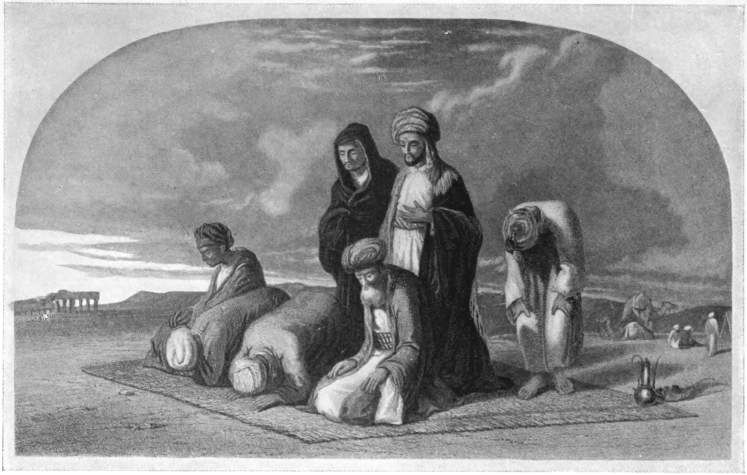
W. MÜLLER. PRAYER IN THE DESERT.
The East was in this way traversed in all directions. The first comers who beheld it with eager, excited eyes collected a mass of gigantic legends, with no decided aim or purpose and driven by no passionate impulse, merely eager to pluck here or there an exotic flower, or lightly to catch some small part of the glamour that overspread all that was Eastern, piled up dreams upon dreams, and gave it a gorgeous and fantastic life. There were deserts shining in the sun, waves lashed by the storm, the nude forms of women, and all the Asiatic splendour of the East: dark-red satin, gold, crystal, and marble were heaped in confusion and executed in terrible fantasies of colour in the midst of darkness and lightning. After this generation had passed like a thunderstorm the chic of Fromentin was delicious. He profited by the taste which others had excited. Painters of all nationalities overran the East. The great dramas were transformed into elegies, pastorals, and idylls; even ethnographical representations had their turn. Guillaumet summed up the aims of that generation. His dreamy and tender painting was like a beautiful summer evening. The radiance of the blinding sky was mitigated, and a peaceful sun at the verge of the horizon covered the steppes of sand, which it had scorched a few hours before, with a network of rosy beams.
They were all scions of the Romantic movement. The yearning which filled their spirits and drove them into distant lands was only another symptom of their dissatisfaction with the present.
Classicism had dealt with Greek and Roman history by the aid of antique statues, and next used the colours of the Flemish masters to paint Italian peasantry. Romanticism had touched the motley life of the Middle Ages and the richly coloured East; but both had anxiously held aloof from the surroundings of home and the political and social relations of contemporaries.
It was obvious that art’s next task was to bring down to earth again the ideal that had hovered so long over the domain of ancient history, and then winged its flight to the realms of the East. “Ah la vie, la vie! le monde est là; il rit, crie, souffre, s’amuse, et on ne le rend pas.” In these words the necessity of the step has been indicated by Fromentin himself. The successful delivery of modern art was first accomplished, the problem stated in 1789 was first solved, when the subversive upheaval of the Third Estate, which had been consummating itself more and more imperiously ever since the Revolution, found distinct expression in the art of painting. Art always moves on parallel lines with religious conceptions, with politics, and with manners. In the Middle Ages men lived in the world beyond the grave, and so the subjects of painting were Madonnas and saints. According to Louis XIV, everything was derived from the King, as light from the sun, and so royalty by the grace of God was reflected in the art of his epoch. The royal sun suffered total eclipse in the Revolution, and with this mighty change of civilisation art had to undergo a new transformation. The 1789 of painting had to follow on the politics of 1789: the proclamation of the liberty and equality of all individuals. Only painting which recognised man in his full freedom, no privileged class of gods and heroes, Italians and Easterns, could be the true child of the Revolution, the art of the new age. Belgium and Germany made the first diffident steps in this direction.
CHAPTER XX
THE PAINTING OF HUMOROUS ANECDOTE
At the very time when the East attracted the French Romanticists, the German and Belgian painters discovered the rustic. Romanticism, driven into strange and tropical regions by its disgust of a sluggish, colourless and inglorious age, now planted a firm foot upon native soil. Amid rustics there was to be found a conservative type of life which perpetuated old usages and picturesque costume.
It is not easy for a dilettante to enter into sympathetic relationship with these early pictures of peasant life. They are gaudy in tone, smooth as metal, and the figures stand out hard against the atmosphere, as if they had been cut from a picture-sheet. But the historian has no right to be merely a dilettante. It would be unfair of him to make the artistic conceptions of the present time the means of depreciating the past. For, after all, works of the past are only to be measured with those of their own age, and when one once remembers what an importance these modest “little masters” had for their time it is no longer difficult to treat them with justice. In an age when futile and aimless intentions lost their way in theory and imitation of the “great painting” there blossomed here, and for the first time, a certain individuality of mind and temper. While Cornelius, Kaulbach, and their fellows formed a style which was ideal in a purely conventional sense, and epitomised the art of the great masters according to method, the “genre painters” seized upon the endless variety of nature, and, after a long period of purely reproductive painting, made the first diffident attempt to set art free from the curse of system and the servile repetition of antiquated forms.
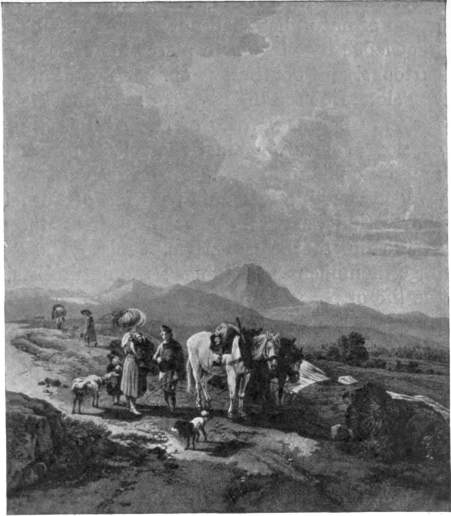
KOBELL. A MEETING.
Even as regards colour they have the honour of preparing the way for a restoration in the technique of painting. Their own defects in technique were not their fault, but the consequence of that fatal interference of Winckelmann through which art lost its technical traditions. They did not enjoy the advantages of issuing from a long line of ancestors. In a certain sense they had to make a beginning in the history of art by themselves; for between them and the older German painting they only met with men who held the ability to paint as a shame and a disgrace. With the example of the old Dutch and Flemish masters before them, they had to knit together the bonds which these men had cut; and considering the æsthetic ideas of the age, this reference to Netherlandish models was an event of revolutionary importance. In doing this they may have been partially influenced by Wilkie, who made his tour in Germany in 1825, and whose pictures had a wide circulation through the medium of engraving. And from another side attention was directed to the old Dutch masters by Schnaase’s letters of 1834. While the entire artistic school which took its rise from Winckelmann gave the reverence of an empty, formal idealism to classical antiquity and the Cinquecento, applying their standards to all other periods, Schnaase was the first to give an impulse to the historical consideration of art. In this way he revealed wide and hitherto neglected regions to the creative activity of modern times. The result of his book was that the Netherlandish masters were no longer held to be “the apes of vulgar nature,” but took their place as exquisite artists from whom the modern painter had a great deal to learn.
In Munich the conditions of a popular, national art were supplied by the very site of the town. Since the beginning of the century Munich had been peculiarly the type of a peasant city, the capital of a peasant province; it had a peasantry abounding in old-fashioned singularities, gay and motley in costume as in their ways of life, full of bright and easy-going good-humour, and gifted with the Bavarian force of character. Here it was, then, that “the resort to national traits” was first made. And if, in the event, this painting of rustic life produced many monstrosities, it remained throughout the whole century an unfailing source from which the art of Munich drew fresh and vivid power.
Even in the twenties there was an art in Munich which was native to the soil, and in later years shot up all the more vigorously through being for a time cramped in its development by the exotic growths of the school of Cornelius. It was as different from the dominant historical painting as the “magots” of Teniers from the mythological machinery of Lebrun, and it was treated by official criticism with the same contempt. Cornelius and his school directed the attention of educated people so exclusively to themselves, and so entirely proscribed the literature of the day, that what took place outside their own circle in Munich was but little discussed. The vigorous group of naturalists had not much to offer critics who wished to display their knowledge by picking to pieces historical pictures, interpreting philosophical cartoons, and pointing to similarities of style between Cornelius and Michael Angelo. But for the historian, seeking the seeds of the present in the past, they are figures worthy of respect. Setting their own straightforward conception of nature against the eclecticism of the great painters, they laid the foundation of an independent modern art.
The courtly, academic painting of Cornelius derived its inspiration from the Sistine Chapel; the naturalism of these “genre painters” was rooted in the life of the Bavarian people. The “great painters” dwelt alone in huge monumental buildings; the naturalists, who sought their inspiration in the life of peasants, in the life of camps, and in landscape, without troubling themselves about antique or romantic subjects, furnished the material for the first collections of modern art. Both as artists and as men they were totally different beings. Cornelius and his school stand on the one side, cultured, imperious, fancying themselves in the possession of all true art, and abruptly turning from all who are not sworn to their flag; on the other side stand the naturalists, brisk and cheery, rough it may be, but sound to the core, and with a sharp eye for life and nature.
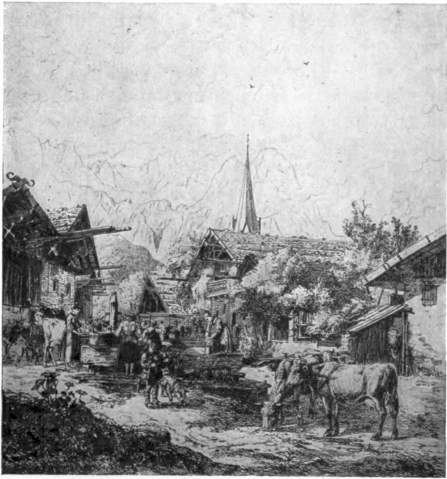
PETER HESS. A MORNING AT PARTENKIRCHE. HEINRICH BÜRKEL. A MORNING AT PARTENKIRCHE.
Painting in the grand style owed its origin to the personal tastes of the king and to the great tasks to which it was occasionally set; independent of princely favour, realistic art found its patrons amongst the South German nobility and, at a later date, in the circle of the Munich Art Union, and seems the logical continuation of that military painting which, at the opening of the century, had its representatives in Nuremberg, Augsburg, and Munich. The motley swarm of foreign soldiers which overran the soil of Germany incited Albrecht Adam, Peter Hess, Johann Adam Klein, and others, to represent what they saw in a fashion which was sincere and simple if it was also prosy. And when the warlike times were over it was quite natural that some of the masters who had learnt their art in camps should turn to the representation of peasant life, where they were likewise able to find gay, pictorial costumes. Wilhelm Kobell, whose etchings of the life of the Bavarian people are more valuable than his battle-pieces, was one of the first to make this transition. In 1820 sturdy Peter Hess painted his “Morning at Partenkirche,” in which he depicted a simple scene of mountain life—girls at a well in the midst of a sunny landscape—in a homely but poetic manner. When this breach had been made, Bürkel was able to take the lead of the Munich painters of rustic subjects.
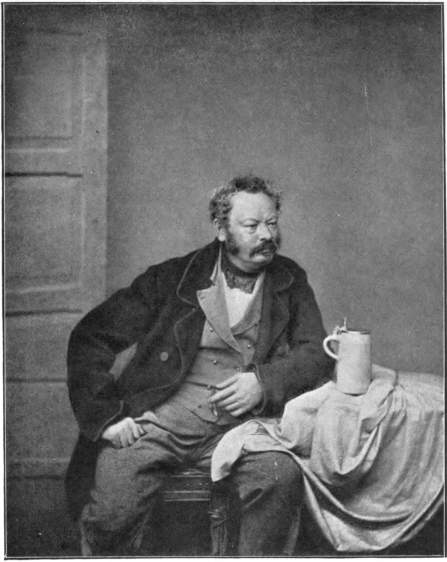
Heinrich Bürkel’s portrait reveals a square-built giant, whose appearance contrasts strangely with that of his celebrated contemporaries. The academic artists sweep back their long hair and look upwards with an inspired glance. Bürkel looks down with a keen eye at the hard, rough, and stony earth. The academic artists had a mantle—the mantle of Rauch’s statues—picturesquely draped about their shoulders; Bürkel dressed like anybody else. No attribute is added which could indicate that he was a painter; neither palette, nor brush, nor picture; beside him on the table there is—a mug of beer. There he sits without any sort of pose, with his hand resting on his knee—rough, athletic, and pugnacious—for all the world as if he were quite conscious of his peculiarities. Even the photographer’s demand for “a pleasant smile” had no effect upon him. This portrait is itself an explanation of Bürkel’s art. His was a healthy, self-reliant nature, without a trace of romance, sentimentality, affected humour, or sugary optimism. Amongst all his Munich contemporaries he was the least academic in his whole manner of feeling and thinking.
Sprung from the people, he became their painter. He was born, 29th May 1802, in Pirmasens, where his father combined a small farm with a public-house and his mother kept a shop; and he had been first a tradesman’s apprentice, and then assistant clerk in a court of justice, before he came to Munich in 1822. Here the Academy rejected him as without talent; but while it shut the door against the pupil, life revealed itself to the master. He went to the Schleissheimer Gallery, and sat there copying the pictures of Wouwerman, Ostade, Brouwer, and Berghem, and developed his powers, by the study of these Netherlandish masters, with extraordinary rapidity. His first works—battles, skirmishes, and other martial scenes—are amateurish and diffident attempts; it is evident that he was without any kind of guidance or direction. All the more astonishing is the swiftness with which he acquired firm command of abilities, admirable for that age, and the defiant spirit of independence with which he went straight from pictures to nature, though hardly yet in possession of the necessary means of expression. He painted and drew the whole new world which opened itself before him: far prospects over the landscape, mossy stones in the sunlight, numbers of cloud-pictures, peasants’ houses with their surroundings, forest paths, mountain tracks, horses, and figures of every description. The life of men and animals gave him everywhere some opportunity for depicting it in characteristic situations. And later, when he had settled down again in Munich, he did not cease from wandering in the South German mountains with a fresh mind. Up to old age he made little summer and winter tours in the Bavarian highlands. Tegernsee, Rottach, Prien, Berchtesgaden, South Tyrol, and Partenkirche were visited again and again, on excursions for the week or the day; and he returned from them all with energetic studies, from which were developed pictures that were not less energetic.
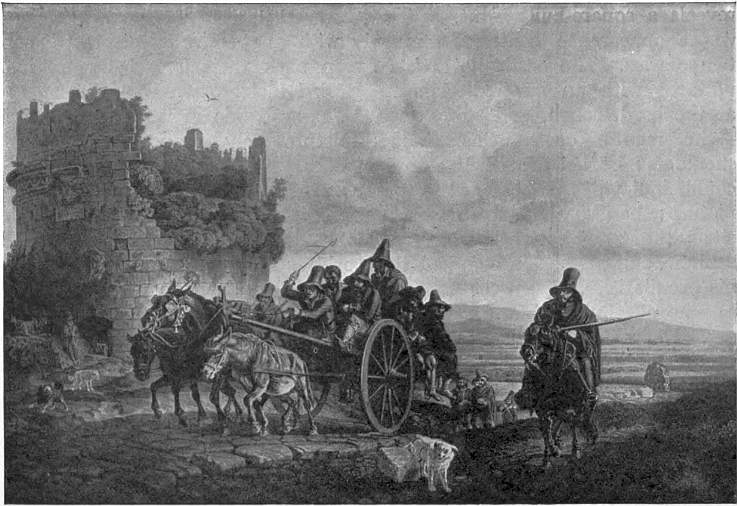
BÜRKEL. BRIGANDS RETURNING.
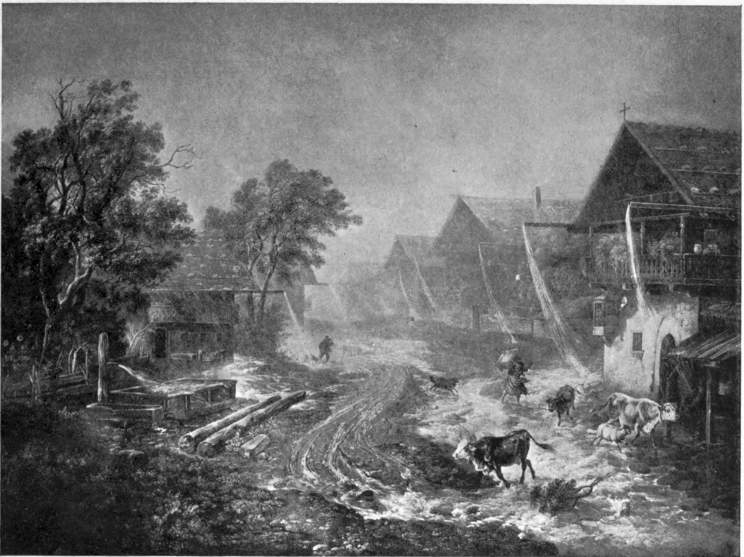
BÜRKEL. A DOWNPOUR IN THE MOUNTAINS.
For, as every artist is the result of two factors, of which one lies in himself and the other in his age and surroundings, the performances of Bürkel are to be judged, not only according to the requirements of the present day, but according to the conditions under which they were produced. What is weak in him he shares with his contemporaries; what is novel is his own most peculiar and incontestable merit. In a period of false idealism worked up in a museum—false idealism which had aped from the true the way in which one clears one’s throat, as Schiller has it, but nothing more indicative of genius—in a period of this accomplishment Bürkel preferred to expose his own insufficiency rather than adorn himself with other people’s feathers; at a time which prided itself on representing with brush and pigment things for which pen and ink are the better medium, he looked vividly into life; at a time when all Germany lost itself aimlessly in distant latitudes, he brought to everything an honest and objective fidelity which knew no trace of romantic sentimentalism; and by these fresh and realistic qualities he has become the father of that art which rose in Munich in a later day. Positive and exact in style, and far too sincere to pretend to raise himself to the level of the old masters by superficial imitation, he was the more industrious in penetrating the spirit of nature and showing his love for everything down to its minutest feature; weak in the sentiment for colour, he was great in his feeling for nature. That was Heinrich Bürkel, and his successors had to supplement what was wanting in him, but not to wage war against his influence.
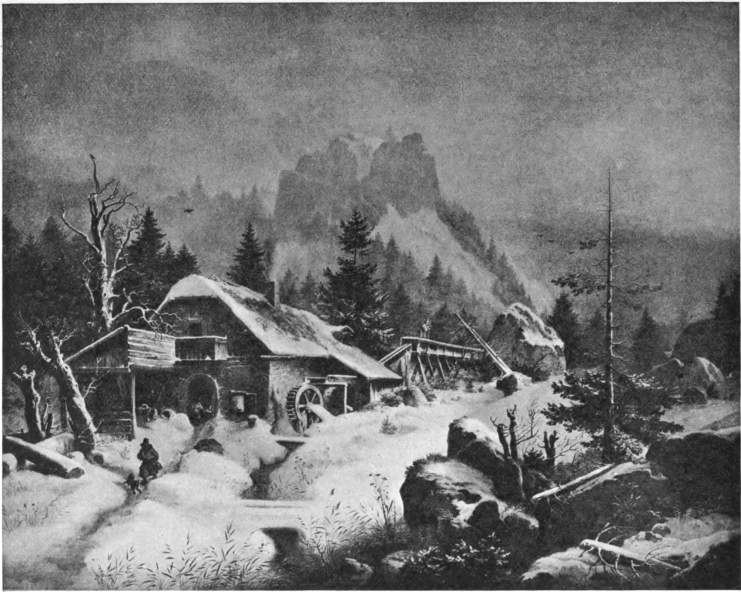
BÜRKEL. A SMITHY IN UPPER BAVARIA.
The peculiarity of all his works, as of those of the early Dutch and Flemish artists, is the equal weight which he lays on figures and on landscape. In his eyes the life of man is part of a greater whole; animals and their scenic surroundings are studied with the same love, and in his most felicitous pictures these elements are so blended that no one feature predominates at the expense of another. Seldom does he paint interiors, almost always preferring to move in free and open nature. But here his field is extraordinarily wide.
Those works in which he handled Italian subjects form a group by themselves. Bürkel was in Rome from 1829 to 1832, the very years in which Leopold Robert celebrated his triumphs there; but curious is the difference between the works of the Munich and those of the Swiss painter. In the latter are beautiful postures, poetic ideas, and all the academical formulas; in the former unvarnished, naturalistic bluntness of expression. Even in Italy he kept romantic and academic art at a distance. They had no power over the rough, healthy, and sincere nature of the artist. He saw nothing in Italy that he had not met with at home, and he painted things as he saw them, honestly and without beatification.
To find material Bürkel did not need to go far. Picture to yourself a man wandering along the banks of the Isar, and gazing about him with a still and thoughtful look. A healthy peasant lass with a basket, or a plough moving slowly in the distance behind a sweating yoke of horses, is quite enough to fill him with feelings and ideas.
His peculiar domain was the high-road, which in the thirties and the forties, before the railways had usurped its traffic, was filled with a much more manifold life than it is to-day. Waggons and mail-carts passed along before the old gateways; in every village there were taverns inviting the wayfarer to rest, and blacksmiths sought for custom on the road. There were vehicles of every description, horses at the forge, posting-stages, change of teams, the departure of marketing folk, and passengers taking their seats or alighting. Here horses were being watered, and an occasion was given for brief dialogues between the coachman and his fares. There travellers surprised by a shower were hurrying under their umbrellas into an inn; or, in wintry weather, they were waiting impatiently, wrapped up in furs, whilst a horse was being shod.
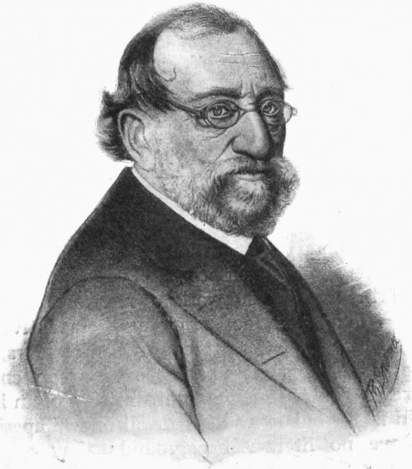
CARL SPITZWEG.
The beaten tracks through field and forest offered much of the same sort. Peasants were driving to market with a cart-load of wood. Horses stood unyoked at a drinking-trough whilst the driver, a muscular fellow with great sinews, quietly enjoyed his pipe. Along some shadowy woodland path a team drew near to a forge or a lonely charcoal-burner’s hut, where the light flickered, and over which there soared a bare and snowy mountain peak.
Such pictures of snow-clad landscape were a specialty of Bürkel’s art, and in their simplicity and harmony are to be ranked with the best that he has done. Heavily freighted wood-carts passing through a drift, waggons brought to a standstill in the snow, raw-boned woodmen perspiring as they load them in a wintry forest, are the accessory objects and figures.
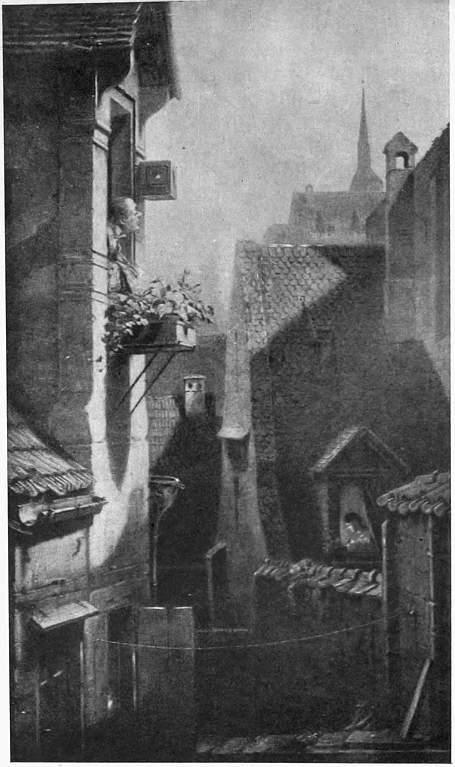
Albert, Munich.
SPITZWEG. AT THE GARRET WINDOW.
But life in the fields attracted him also. Having a love of representing animals, he kept out of the way of mowers, reapers, and gleaners. His favourite theme is the hay, corn, or potato harvest, which he paints with much detail and a great display of accessory incidents. Maids and labourers, old and young, are feverishly active in the construction of hay-cocks, or, in threatening weather, pile up waggons, loaded as high as a house, with fresh trusses.
In this enumeration all the rustic life of Bavaria has been described. It is only the Sunday and holiday themes, the peculiar motives of the genre painter, that are wanting. And in itself this is an indication of what gives Bürkel his peculiar position.
By their conception his works are out of keeping with everything which the contemporary generation of “great painters” and the younger genre painters were attempting. The great painters had their home in museums; Bürkel lived in the world of nature. The genre painters, under the influence of Wilkie, were fond of giving their motive a touch of narrative interest, like the English. Cheerful or mournful news, country funerals, baptisms, and public dinners offered an excuse for representing the same sentiment in varying keys. Their starting-point was that of an illustrator; it might be very pretty in itself, but it was too jovial or whimpering for a picture. Bürkel’s works have no literary background; they are not composed of stories with a humorous or sentimental tinge, but depict with an intimate grasp of the subject the simplest events of life. He neither offered the public lollipops, nor tried to move them and play upon their sensibilities by subjects which could be spun out into a novel. He approached his men, his animals, and his landscapes as a strenuous character painter, without gush, sentimentality, or romanticism. In contradistinction from all the younger painters of rustic subjects, he sternly avoided what was striking, peculiar, or in any way extraordinary, endeavouring to paint everyday life in the house or the farmyard, in the field or upon the highway, in all plainness and simplicity.
At first, indeed, he thought it necessary to satisfy the demands of the age by, at any rate, painting in a broad and epical manner. The public collections chiefly possess pictures of his which contain many figures: “The Return from the Mountain Pasture,” “Coming Back from the Bear Hunt,” “The Cattle Show,” and “From the Fair”; scenes before an inn at festivals, or waggoners setting out, and the like. But in these works the scheme of composition and the multitude of figures have a somewhat overladen and old-fashioned effect. On the other hand, there are pictures scattered about in private collections which are of a simplicity which was unknown at the time: dusty roads with toiling horses, lonely charcoal burners’ huts in the dimness of the forest, villages in rain or snow, with little figures shivering from frost or damp as they flit along the street. From the very beginning, free from the vices of genre and narrative painting and the search after interesting subjects, he has, in these pictures, renounced the epical manner of representing a complicated event. Like the moderns, he paints things which can be grasped and understood at a glance.
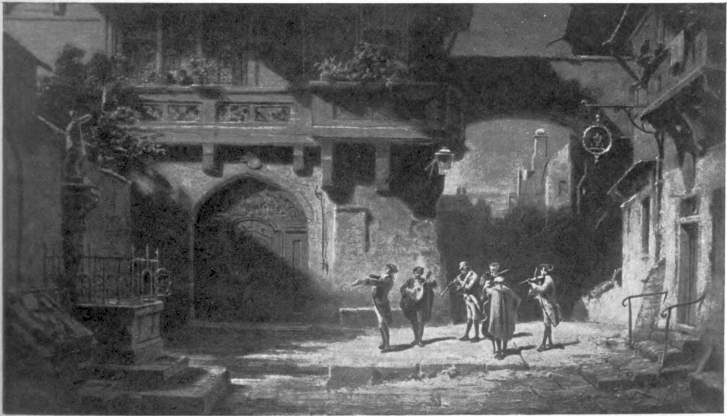
SPITZWEG. A MORNING CONCERT.
But, after all, Bürkel occupies a position which is curiously intermediate. His colour relegates him altogether to the beginning of the century. He was himself conscious of the weakness of his age in this respect, and stands considerably above the school of Cornelius, even where its colouring is best. Yet, in spite of the most diligent study of the Dutch masters, he remained, as a colourist, hard and inartistic to the end. Having far too much regard for outline, he is not light enough with what should be lightly touched, nor fugitive enough with what is fleeting. What the moderns leave to be indistinctly divined he renders sharp and palpable in his drawing. He trims and rounds off objects which have a fleeting form, like clouds. But although inept in technique, his works are more modern in substance than anything that the next generation produced. They have an intimacy of feeling beyond the reach of the traditional genre painting. In his unusually fresh, simple, and direct studies of landscape he did not snatch at dazzling and sensational effects, but tried to be just to external nature in her work-a-day mood; and, in the very same way, in his figures he aimed at the plain reproduction of what is given in nature.
The hands of his peasants are the real hands of toil—weather-stained, heavy, and awkward. There are no movements that are not simple and actual. Others have told droller stories; Bürkel unrolls a true picture of the surroundings of the peasant’s life. Others have made their rustics persons suitable for the drawing-room, and cleaned their nails; Bürkel preaches the strict, austere, and pious study of nature. An entirely new age casts its shadow upon this close devotion to life. In their intimacy and simplicity his pictures contain the germ of what afterwards became the task of the moderns. All who came after him in Germany were the sons of Wilkie until Wilhelm Leibl, furnished with a better technical equipment, started in spirit from the point at which Bürkel had left off.
Carl Spitzweg, in whose charming little pictures tender and discreet sentiment is united with realistic care for detail, must likewise be reckoned with the few who strove and laboured in quiet, apart from the ruling tendency, until their hour came. Thrown entirely on his own resources, without a teacher, he worked his way upwards under the influence of the older painters. By dint of copying he discovered their secrets of colour, and gave his works, which are full of poetry, a remarkable impress of sympathetic delicacy, suggestive of the old masters. One turns over the leaves of the album of Spitzweg’s sketches as though it were a story-book from the age of romance, and at the same time one is astonished at the master’s ability in painting. He was a genius who united in himself three qualities which seem to be contradictory—realism, fancy, and humour. He might be most readily compared with Schwind, except that the latter was more of a romanticist than a realist, and Spitzweg is more of a realist than a romanticist. The artists’ yearning carries Schwind to distant ages and regions far from the world, and a positive sense of fact holds Spitzweg firmly to the earth.
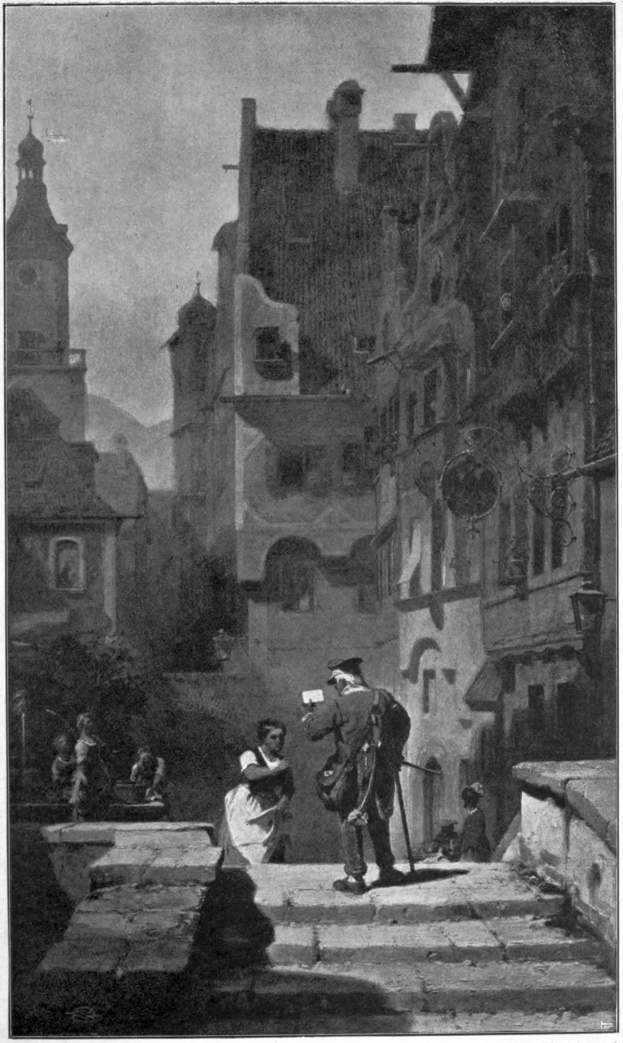
Hanfstaengl.
SPITZWEG. THE POSTMAN.
Like Jean Paul, he has the boundless fancy which revels in airy dreams, but he is also like Jean Paul in having a cheery, provincial satisfaction in the sights of his own narrow world. He has all Schwind’s delight in hermits and anchorites, and witches and magic and nixies, and he plays with dragons and goblins like Boecklin; but, for all that, he is at home and entirely at his ease in the society of honest little schoolmasters and poor sempstresses, and gives shape to his own small joys and sorrows in a spirit of contemplation. His dragons are only comfortable, Philistine dragons, and his troglodytes, who chastise themselves in rocky solitudes, perform their penance with a kindly irony. In Spitzweg a fine humour is the causeway between fancy and reality. His tender little pictures represent the Germany of the forties, and lie apart from the rushing life of our time, like an idyllic hamlet slumbering in Sunday quietude. Indeed, his pictures come to us like a greeting from a time long past.
There they are: his poor poet, a little, lean old man, with a sharp nose and a night-cap, sits at his garret window scanning verses on his frozen fingers, enveloped in a blanket drawn up to his chin, and protected from the inclemency of the weather by a great red umbrella; his clerk, grown grey in the dust of parchments, sharpens his quill with dim-sighted eyes, and feels himself part of a bureaucracy which rules the world; his book-worm stands on the highest ladder in the library, with books in his hand, books in his pockets, books under his arms, and books jammed between his legs, and neglects the dinner-hour in his peaceful enjoyment, until an angry torrent of scolding is poured over his devoted head by the housekeeper; there is his old gentleman devoutly sniffing the perfume of a cactus blossom which has been looked forward to for years; there is his little man enticing his bird with a lump of sugar; the widower glancing aside from the miniature of his better half at a pair of pretty maidens walking in the park; the constable whiling away the time at the town-gate in catching flies; the old-fashioned bachelor, solemnly presenting a bouquet to a kitchen-maid who is busied at the market-well, to the amusement of all the gossips watching him from the windows; the lovers who in happy oblivion pass down a narrow street by the stall of a second-hand dealer, where amidst antiquated household goods a gilded statuette of Venus reposes in a rickety cradle; the children holding up their pinafores as they beg the stork flying by to bring them a little brother.
Spitzweg, like Jean Paul, makes an effect which is at once joyous and tender, bourgeois and idyllic. The postillion gives the signal on his horn that the moment for starting has arrived; milk-maids look down from the green mountain summit into the far country; hermits sit before their cells forgotten by the world; old friends greet each other after years of separation; Dachau girls in their holiday best pray in woodland chapels; school children pass singing through a still mountain valley; maidens chatter of an evening as they fetch water from the moss-grown well, or the arrival of the postman in his yellow uniform brings to their windows the entire population of an old country town.
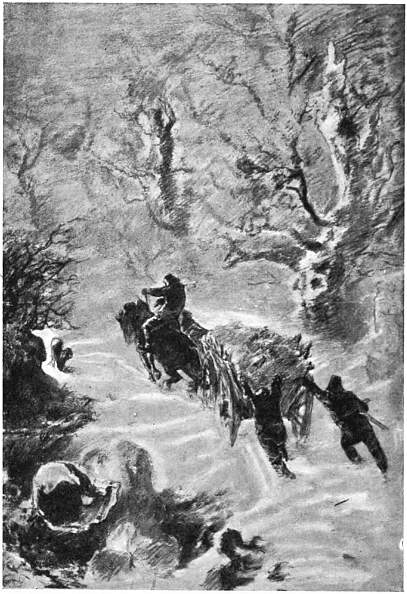
KAUFFMANN. WOODCUTTERS RETURNING.
The little man with the miserable figure of a tailor had been an apothecary until he was thirty years of age, but he had an independent and distinctive artistic nature which impresses itself on the memory in a way that is unforgettable. It is only necessary to see his portrait as he sits at his easel in his dressing-gown with his meagre beard, his long nose, and the droll look about the corners of his eyes, to feel attracted by him before one knows his works. Spitzweg reveals in them his own life: the man and the painter are one in him. There is a pretty little picture of him as an elderly bachelor, looking out of the window in the early morning and nodding across the roofs to an old sempstress who had worked the whole night through without noticing that the day had broken; that is the world he lived in, and the world which he has painted. As a kind-hearted, inflexible Benedick, full of droll eccentricities, he lived in the oldest quarter of Munich in a fourth-storey attic. His only visitor was his friend Moritz Schwind, who now and then climbed the staircase to the little room that looked over the roofs and gables and pinnacles to distant, smoky towers. His studio was an untidy confusion of prosaic discomfort and poetic cosiness.
Here he sat, an ossified hermit, bourgeois, and book-worm, as if he were in a spider’s nest, and here at a little window he painted his delightful pictures. Here he took his homely meal at the rickety little table where he sat alone in the evening buried in his books. A pair of heavy silver spectacles with keen glasses sparkled on his thick nose, and the great head with its ironically twinkling eyes rested upon a huge cravat attached to a pointed stand-up collar. When disturbed by strangers he spoke slowly and with embarrassment, though in the society of Schwind he was brilliant and satirical. Then he became as mobile as quicksilver, and paced up and down the studio with great strides, gesticulating and sometimes going through a dramatic performance in vivid mimicry of those of whom he happened to be talking.
His character has the same mixture of Philistine contentment and genial comedy which gleams from his works with the freshness of dew. A touch of the sturdy Philistinism of Eichendorf is in these provincial idylls of Germany; but at the same time they display an ability which even at the present day must compel respect. The whole of Romanticism chirps and twitters in the Spitzweg Album, as from behind the wires of a birdcage. Everything is here united: the fragrance of the woods and the song of birds, the pleasures of travelling and the sleepy life of provincial towns, moonshine and Sunday quiet, vagabonds, roving musicians, and the guardians of law, learned professors and students singing catches, burgomasters and town-councillors, long-haired painters and strolling players, red dressing-gowns, green slippers, night-caps, and pipes with long stems, serenades and watchmen, rushing streams and the trill of nightingales, rippling summer breezes and comely lasses, stroking back their hair of a morning, and looking down from projecting windows to greet the passers-by. In common with Schwind he shows a remarkable capacity for placing his figures in their right surroundings. All these squares, alleys, and corners, in which his provincial pictures are framed, seem—minutely and faithfully executed as they are—to be localities predestined for the action, though they are painted freely from memory. Just as he forgot none of the characteristic figures which he had seen in his youth, so he held in his memory the whimsical and marvellous architecture of the country towns of Swabia and Upper Bavaria which he had visited for his studies, with such a firm grip that it was always at his command; and he used it as a setting for his figures as a musician composes an harmonious accompaniment for a melody.
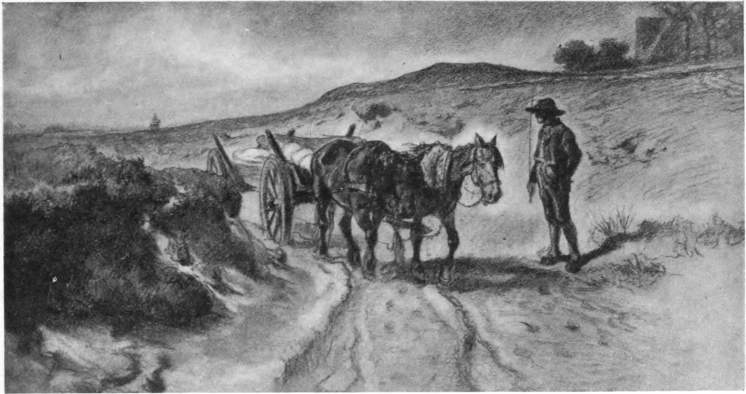
KAUFFMANN. A SANDY ROAD.
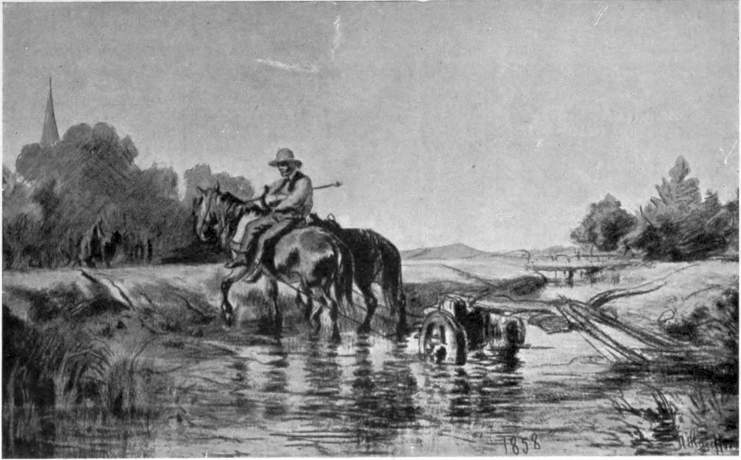
KAUFFMANN. RETURNING FROM THE FIELDS.
To look at his pictures is like wandering on a bright Sunday morning through the gardens and crooked, uneven alleys of an old German town. At the same time one feels that Spitzweg belonged to the present and not to the period of the ingenuous Philistines. It was only after he had studied at the university and passed his pharmaceutical examination that he turned to painting. Nevertheless he succeeded in acquiring a sensitiveness to colour to which nothing in the period can be compared. He worked through Burnett’s Treatise on Painting, visited Italy, and in 1851 made a tour, for the sake of study, to Paris, London, and Antwerp, in company with Eduard Schleich. In the gallery of Pommersfelden he made masterly copies from Berghem, Gonzales Coquez, Ostade, and Poelenburg, and lived to see the appearance of Piloty. But much as he profited by the principles of colour which then became dominant, he is like none of his contemporaries, and stands as far from Piloty’s brown sauce as from the frigid hardness of the old genre painters. He was one of the first in Germany to feel the really sensuous joy of painting, and to mix soft, luxuriant, melting colours. There are landscapes of his which, in their charming freshness, border directly on the school of Fontainebleau. Spitzweg has painted bright green meadows in which, as in the pictures of Daubigny, the little red figures of peasant women appear as bright and luminous patches of colour. His woodland glades penetrated by the sun have a pungent piquancy of colour such as is only to be found elsewhere in Diaz. And where he diversified his desolate mountain glens and steeply rising cliffs with the fantastic lairs of dragons and with eccentric anchorites, he sometimes produced such bold colour symphonies of sapphire blue, emerald green, and red, that his pictures seem like anticipations of Boecklin. Spitzweg was a painter for connoisseurs. His refined cabinet pieces are amongst the few German productions of their time which it is a delight to possess, and they have the savour of rare delicacies when one comes across them in the dismal wilderness of public galleries.
Bürkel’s realistic programme was taken up with even greater energy by Hermann Kauffmann, who belonged to the Munich circle from 1827 to 1833, and then painted until his death in 1888 in his native Hamburg. His province was for the most part that of Bürkel: peasants in the field, waggoners on the road, woodmen at their labour, and hunters in the snowy forest. For the first few years after his return home he used for his pictures the well-remembered motives taken from the South German mountain district. A tour in Norway, undertaken in 1843, gave him the impulse for a series of Norwegian landscapes which were simple and direct, and of more than common freshness. In the deanery at Holstein he studied the life of fishers. Otherwise the neighbourhood of Hamburg is almost always the background of his pictures: Harburg, Kellinghusen, Wandsbeck, and the Alster Valley. Concerning him Lichtwark is right in insisting upon the correctness of intuition, the innate soundness of perception which one meets with in all his works.
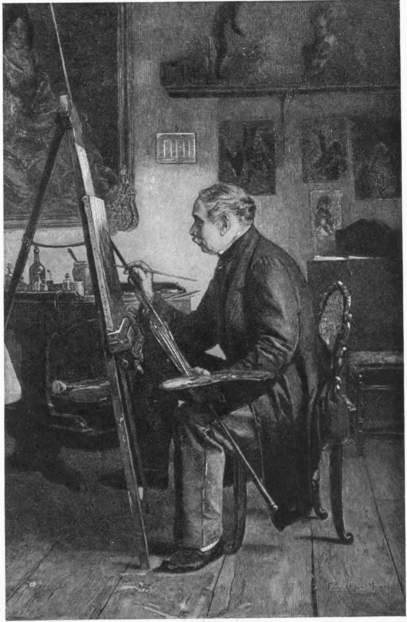
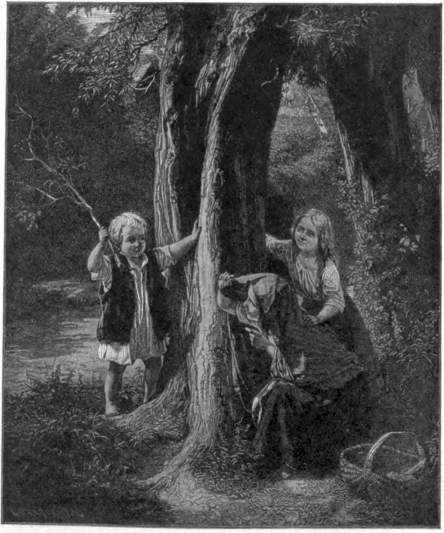
FRIEDRICH EDUARD MEYERHEIM. MEYERHEIM. CHILDREN AT PLAY.
In Berlin the excellent Eduard Meyerheim went on parallel lines with these masters. An old tradition gives him the credit of having introduced the painting of peasants and children into German art. But in artistic power he is not to be compared with Bürkel or Kauffmann. They were energetic realists, teeming with health, and in everything they drew they were merely inspired by the earnest purpose of grasping life in its characteristic moments. But Meyerheim, good-humoured and childlike, is decidedly inclined to a sentimentally pathetic compromise with reality. At the same time his importance for Berlin is incontestable. Hitherto gipsies, smugglers, and robbers were the only classes of human society, with the exception of knights, monks, noble ladies, and Italian women, which, upon the banks of the Spree, were thought suitable for artistic representation. Friedrich Eduard Meyerheim sought out the rustic before literature had taken this step, and in 1836 he began with his “King of the Shooting Match,” a series of modest pictures in which he was never weary of representing in an honest and sound-hearted way the little festivals of the peasant, the happiness of parents, and the games of children.
He had grown up in Dantzic, and played as a child in the tortuous lanes of the old free imperial city, amid trumpery shops, general dealers, and artisans. Later, when he settled down in Berlin, he painted the things which had delighted him in his youth. The travels which he made for study were not extensive: they hardly led him farther beyond the boundaries of the Mark than Hesse, the Harz district, Thüringen, Altenburg, and Westphalia. Here he drew with indefatigable diligence the pleasant village houses and the churches shadowed by trees; the cots, yards, and alleys; the weather-beaten town ramparts, with their crumbling walls; the unobtrusive landscapes of North Germany, lovely valleys, bushy hills, and bleaching fields, traversed by quiet streams fringed with willows, and enlivened by the figures of peasants, who still clung to so much of their old costume. His pictures certainly do not give an idea of the life of the German people at the time. For the peasantry have sat to Meyerheim only in their most pious mood, in Sunday toilette, and with their souls washed clean. Clearness, neatness, and prettiness are to be found everywhere in his pictures. But little as they correspond to the truth, they are just as little untrue through affectation, for their idealism sprang from the harmless and cheerful temperament of the painter, and from no convention of the schools.