Front matter (continued 9)
Reading edition
The present age no longer looks up to these exercises of patience with the same vast admiration, but it should not therefore be forgotten what Meissonier was for his time.
To begin with, though painted at a time when painting was regarded as an auxiliary, and an invaluable one, to history, his pictures tell no story. These personages of Meissonier’s take part in no comedy; they occupy themselves, some in smoking, some in drinking, others in playing cards, and others again in doing nothing whatever. Whether they made their entry as musketeer or philosophers, as lackeys or gallants, as scholars or bonvivants, they did not pose and had no ambition to seem men of wit and spirit, they plunged into no adventurous deeds and related no anecdotes: they were content to be well painted. And so amongst all the French painters of the historical picture of manners Meissonier was the one who had the secret of giving his works an entirely peculiar cachet of striking and realistic truth to nature. His figures, marvellously painted, and at the same time animated and natural in expression, wear the costume of our ancestors with the utmost self-possession, and fit into their modish rococo surroundings as if they had been poured into a mould. Meissonier reached the truth of nature in the total effect of his pictures by first in reality arranging his interiors, and the still-life they contained, as a congruous whole. The rooms, window niches, and firesides which he reproduced in his pictures were in his own house and his studios, with every detail ready to hand. He bought bronzes, trinkets, and ornaments, genuine productions of the rococo period, by the hundred thousand, and kept them by him. His models were obliged, for weeks and often for months, actually to wear the velvet and silken costumes in which he made use of them; then he painted them with the greatest fidelity to nature, and without troubling himself about anecdotic incident. What he rendered was not a story invented and put together piecemeal, but a wholesome piece of reality, pictorially conceived. And if this was primarily composed of costumes and furniture belonging to the eighteenth century, the transition to the natural treatment of modern life was at the same time made possible, and was accomplished by Meissonier himself, at a later period, in his battle pieces.
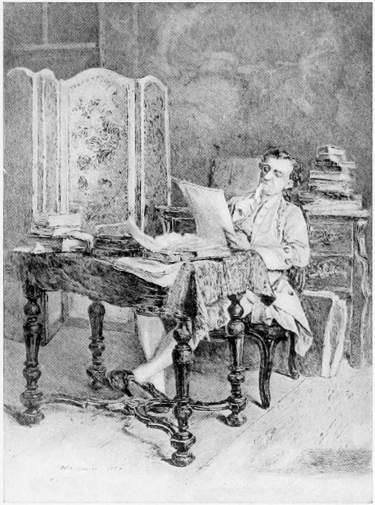
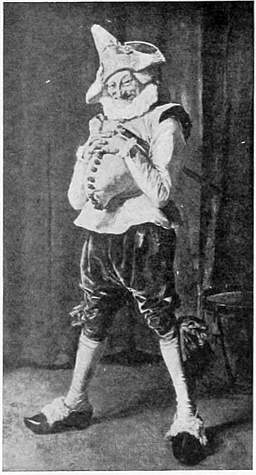
Gaz. des Beaux-Arts. Cassell & Co.
MEISSONIER. READING THE MANUSCRIPT. MEISSONIER. POLCINELLO.
But he had only painted men: the physiognomy of the feminine Sphinx remained for him an eternal riddle. A wide field was here offered to his followers. Fauvelet, Chavet, and Brillouin stepped into Meissonier’s shoes, and gave his rococo fine gentlemen their better halves. The first two made simple imitations. Brillouin devoted himself to the comic genre: he arranged his pictures prettily, was a good observer, and painted tolerably well. The last of these Meissonierists is Vibert, chiefly known in the present day by his cardinals and other scarlet dignitaries, whom he represents in water-colours and oils with a certain touch of malice. He paints them gouty, gluttonising, or tipsy, in one or more cases in every picture—which does not contribute to make his works interesting. But originally he had a sympathetic superior talent, and will always claim a modest place in the group of the modern “little masters.” His “Gulliver Bound,” and also the Spanish and Turkish scenes which occupied him after a tour in the East, are extremely pleasing and delicately painted costume pieces, gleaming in sunlight; and in their sparkling, capricious workmanship they sometimes almost verge on Fortuny.
On the German side of the Rhine Adolf Menzel was the great pioneer of truth. The history of German art must do him honour as one who first had the genius and courage to break away from conventional forms of phrasing, and bring the truth of nature into art: at first, as in the case of Meissonier, it was nature in masquerade; but it was nature seen and rendered with all the sincerity of a man to whom the art of pose was wanting from the very first.
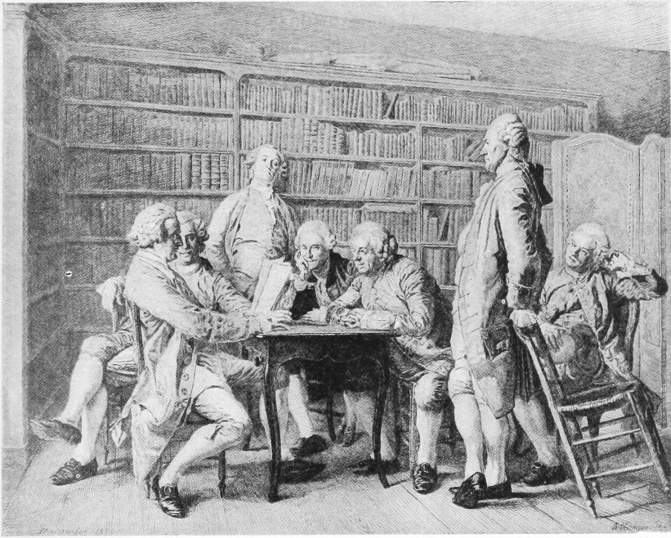
L’Art.
MEISSONIER. A READING AT DIDEROT’S.
(By permission of Baron Edmond de Rothschild, owner of the picture, and of M. Georges Petit, owner of the copyright.)
Even in the thirties, at a time when “The Sorrowing Royal Pair” and the “Leonora” by Lessing, “The Soldier and his Child,” “The Sick Councillor,” and “The Sons of Edward” by Hildebrandt, and “The Lament of the Jews” by Bendemann, together with the works of Cornelius, met with the enthusiastic applause of the million, Menzel looked into the world with a sharp glance, undisturbed by idealism; and what enabled him to do this was his unwavering and thoroughly Prussian healthiness, which knew no touch of sentimentalism—a certain coldness and hardness, that sensible, reflective North German trait, which often expresses itself in these days (when German art has become subtle and superior) by a crude naturalism in the Berlin painting. In the beginning of the century, however, it set the Berlin painting, as art of the healthy human understanding, in salutary contrast to the sickliness of Munich and Düsseldorf. Even eighty years ago the people of Berlin were too acute and practical to be Romanticists. The artists whom Menzel found active and honoured at his arrival were Schadow and Rauch, and beside them, as representatives of the grande peinture, Begas and Wach. But even these, who were most under the influence of the sentimental tendency, were justly recognised by the thorough-going Romanticists on the Rhine as never having given an unqualified homage to their flag. A clear, realistic method was dominant in the art of Berlin. And in this respect it was as much a corrective—and one by no means to be undervalued—against the inflated sentiment of Munich as against the weak and sickly sentimentalism of Düsseldorf, with its knights and monks and noble maidens. Even Cornelius, who had been called to Berlin by Frederick William IV—that King of the Romanticists on the throne of the eminently unromantic Hohenzollerns—found himself helpless against the ruling taste. And here only, in the stronghold of sharply accentuated common sense, where the old Prussian sobriety set bounds to the twilight kingdom of Romanticism, could Adolf Menzel attain to greatness. His Berlinism kept him from lingering in empty space. To the taste of to-day, formed from Fontainebleau, he will seem too much a creature of the understanding and too little a creature of feeling. Boecklin hit him off admirably when, on being asked what he thought of Menzel, he answered: “He is a great scholar.” A comparison between him and Mommsen especially suggests itself—a great scholar, a mordant satirist, and a brilliant journalist. But this sober scepticism, this cool spirit of investigation, this “heartlessness” observing all things with the eye of a judge in a court of judicial inquiry, were what cleared the ground for modern art. No one has done more than Menzel for those rulers in the kingdom of dreams who from pure dreaming have never been able to learn anything. He has helped to set them steadily on their feet, and to accustom their sight, vitiated by idealism, once more to truth and nature.
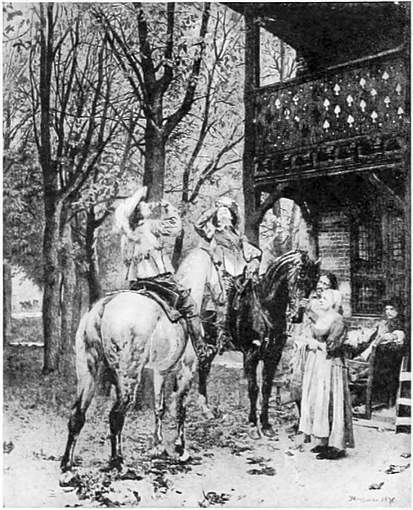
L’Art.
MEISSONIER. A HALT.
Mansell.
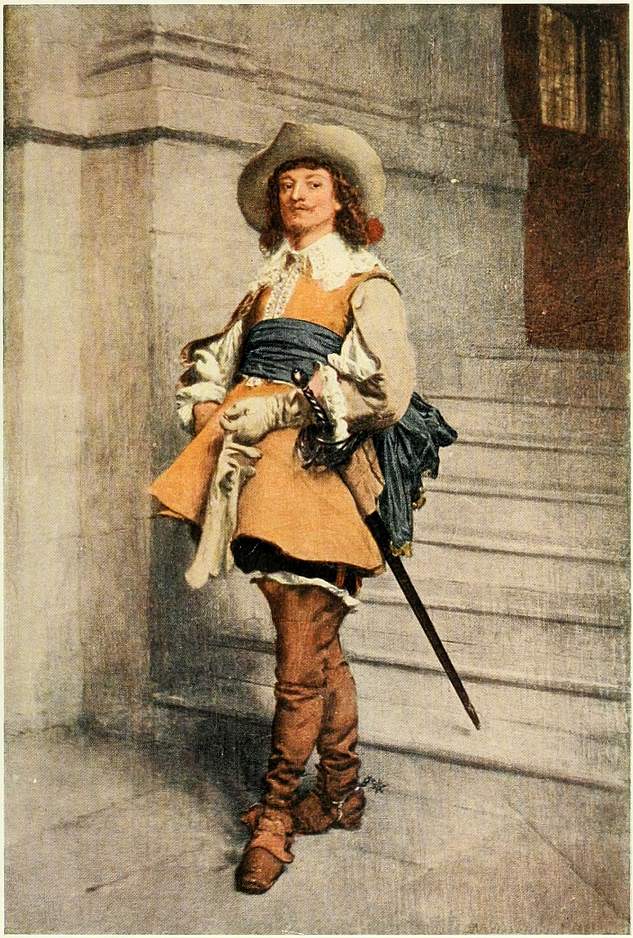
MEISSONIER. A CAVALIER.
Baschet.
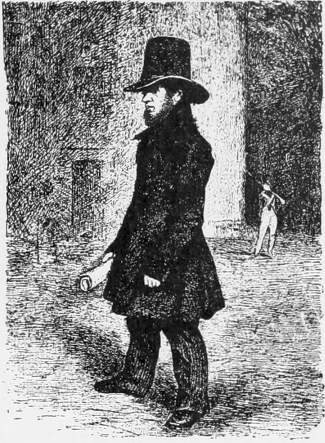
ADOLF MENZEL, 1837.
Menzel was almost the only one in Germany who could draw and paint in the time before the French influence had made itself felt. The struggle for existence had forced him to learn. In the year of Bismarck’s birth there was born in Breslau the man destined to glorify, first the greatness of the old kingdom of the Fredericks, and then that of new imperial Prussia. Cast out at an early age on the inhospitable wilderness of life, he came to Berlin, poor and lonely, and not so much for the sake of art as for gain. There he sat in his cheerless attic, without a servant; and wrapped up in his plaid, with a coffee-pot on one side and a pencil on the other, he looked out over the roofs of the vast town, the most brilliant epoch of which he was predestined to depict and to conquer by his art. Since it brought in profit sooner than anything else, he had made himself familiar with the technique of reproduction; and having devoted himself in particular to the newly discovered art of lithography, he turned out ménus, New Year cards, vignettes for occasional poems, etc., and in things of this sort displayed a genuine affinity of spirit with Chodowiecki and Gottfried Schadow. From his twelfth year onwards he had not only assured his own existence, but even supported his family by such work; and in the hours he spent over it he laid the groundwork for becoming the master of masters amongst the moderns. Menzel is not merely a man who owed to himself everything which he afterwards became, who learnt to draw by his own unassisted endeavours, who mastered oil-painting without a teacher, and went further in it than any one of his generation—a man who found out entirely by himself new methods and combinations in water-colours and gouache; but if it is asked who was the greatest German illustrator, the man who did most in Germany to advance the art of woodcut engraving, the one German historical painter of the century who was entirely original, who really knew a bygone period so exactly that he could venture on painting it, the name of Menzel is invariably uttered.
Even in the twelve simple lithographs which appeared in 1837, “Memorable Events from Prussian History in the Brandenburg Era,” the “scholar” Menzel stands ready as the actual historian of the Prussian kingdom. In an age which took its pleasure in a vaporous, sentimental enthusiasm for the mediæval splendour of the empire, he was the one who as a youth of twenty pointed to the corner-stones of Prussian history in the Brandenburg times; he was the only man of his age who refused to blow the horn of the mawkish Romanticists, and still less that of the impassioned historical painters who came after them. For his were no theatrically tricked out scenes of tragedy, no touching situations; they had nothing poetical; and just as little were they tedious pictures of ceremonies or spectacular pieces. Striking characterisation and sparkling vividness were united here to the most painstaking study of nature and history, carried down to the peculiarities of costume and weapons. History was not arranged in accordance with academic formulæ, but delineated as if from life with absorbing truthfulness. Everything was expressed simply and sincerely, without exciting passages, and without conventional sentiment pumped out of models. Every epoch had its historical physiognomy, and costume was reduced to its proper subordinate place.
Franz Kugler was the first who understood this sincere and pithy art.
The Life of Napoleon had appeared, at that time, in Paris, with illustrations by Horace Vernet, and it had a considerable sale in Germany also. This gave a Berlin publisher the idea of a similar German work, and Kugler commissioned Menzel to illustrate his biography of Frederick the Great. It is almost impossible to pay sufficient honour to the influence which this book on Frederick has had on German art. It made an epoch in the history of wood engraving. The technique of this craft had been completely forgotten in Germany ever since the beginning of the century, or used only for the production of rough trade-marks for tobacco; Menzel had to invent it afresh and teach an engraving school of his own before the four hundred masterly plates of the book were made possible.
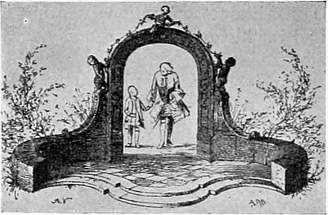
MENZEL. FREDERICK THE GREAT AND HIS TUTOR.
But it became more revolutionary still for the æsthetic ideas of the time. Menzel had not set himself to produce a sequence of pictures, displaying events and heroes in the most ideal situations possible, but made it his business to sift the entire life of Frederick the Great to its minutest particulars. And here began that philological study of records which Menzel has carried on with the strenuous labour of an archivist down to the present day. Old Fritz had been caught by Chodowiecki in the way in which he has since lived in the popular imagination: as the old man on horseback, with his bent shoulders and his crutch-stick, holding a review, and as the philosopher, the statesman, the warrior and hero in the most manifold situations. Menzel, in whom the spirit of Chodowiecki lived again, only needed to begin where the latter left off. Stepping on the antiquarian material of Chodowiecki, he worked his way into the great period on which Frederick and Voltaire have set the stamp of their spirit, as Mommsen worked his way into Roman history. He read through whole libraries; he copied all attainable portraits. With scientific pedantry he did not forget to study the buttons and the cut of the trousers in the uniforms, and did not rest until he knew the old grenadiers as a corporal knows his men. Using these labours as preparation, he proceeded to call up old Fritz and his time with the objectivity of an historian, just as they were, and not as they had better have been. Sureness of treatment even in the finest details, accurate mastery of the surroundings, and everything which had made Meissonier’s appearance so important for France, was attained at one stroke for Germany. But the very simplicity of what was offered—both in style and technique—prevented Menzel from being at the beginning accepted in his own country as an “historical painter.” He was blamed for disregarding “beauty,” and it was said that a “higher” artistic perception was sealed from him. On the other hand, the book laid the foundation of Menzel’s position in France, and was, moreover, the work on which, for a long time, the appreciation of modern German art in foreign countries was based.
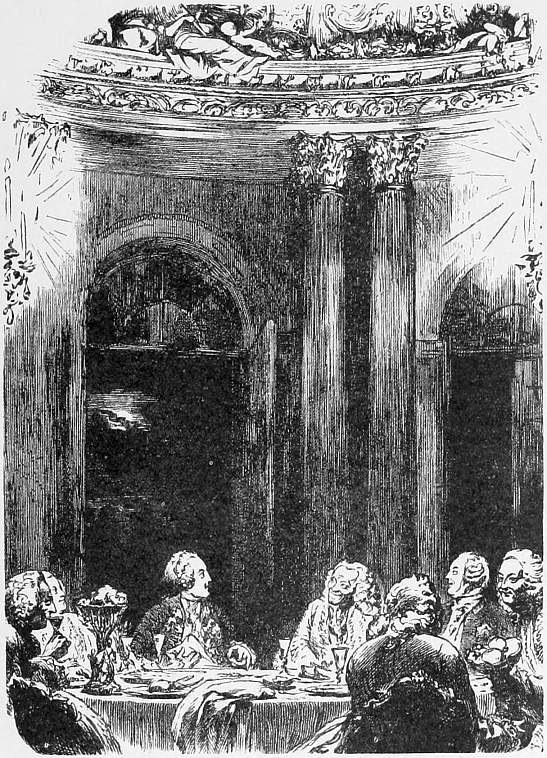
MENZEL. THE ROUND TABLE AT SANS-SOUCI.
Thenceforth Menzel had a kind of monopoly in this subject, and when in 1840 Frederick William IV had the works of the great king published in an édition de luxe, Menzel, amongst others, was entrusted with the illustration. Every one of the thirty volumes contains portraits of Frederick’s contemporaries which were engraved by Mandel and others after original pictures of the period. Menzel had an apparently subordinate task. He was commissioned to make two hundred drawings for wood engraving; these, however, do not appear on separate pages, but were destined to be incorporated in the text as tail-pieces, vignettes, and the like. This was the great work which occupied him during the forties; and in these headings and tail-pieces to the works of Frederick the Great he showed, for the first time, that he was not merely a learned investigator of sources, but was full of brilliant aperçus. One has to read Frederick the Great before one can do full justice to the acuteness and ready resource, the subtlety and pungency of the artist’s pencil. All æsthetic categories of realistic and idealistic art are scattered like dust before these creations, in which the most fantastic ideas are embodied with the whole force of the realistic power of our days.
When he had done honour to the military comrades of the great ruler in his work of wood engraving, “Heroes of War and Peace in the Time of King Frederick,” and thus made the epoch his own through a decade of busy labour, Menzel, draughtsman though he was, turned round and became the painter of Frederick the Great. In the history of art there have never been two names more intimately connected with each other. Menzel was a strenuous worker, who never knew the passion for woman, either because he had no time for it, or because he despised women after being despised by them as a poor, hard-featured student of art; a man whose great bald head appeared at Berlin subscription-balls amid groups of brilliant cavaliers and queens of beauty, fashion, and grace, surrounded by the rustle of their silks and in the whirlpool of a dancing throng, gleaming with colour and sparkling with gold and jewels; and appeared there simply because this world interested him as something to be painted. He was a recluse who went into society solely to make observations for his art, and when there was chary of speech and much feared. He was always a busy experimentalist, so that his two hands gradually became equally dexterous; at the age of eighty he could still sketch with firm and accurate strokes while travelling in a railway carriage.
Though he had hitherto devoted himself to drawing, he had also by his own independent study made himself familiar with the technique of oils; and he now became such a master of colour as few were at that time. In the middle of the century were painted those two masterpieces which now hang in the Berlin National Gallery, “The Round Table at Sans-Souci” and “The Concert of Frederick the Great.” These are historical pictures, the authority and importance of which cannot be shaken by even the most modern of critics. If what is called the spirit of an age has ever been embodied in pictures, it is embodied here, where the master-minds of the eighteenth century are assembled at their genial round table. The scene is the oval dining-room of the castle. The meal is over, and there reigns a genial after-dinner mood, champagne sparkles in the glasses and a smart rivalry of wit is in progress. Afternoon has crept on, and a cold, subdued daylight floods the room, in which every fragment of the architecture, from the inlaid floor to the gilded capitals of the pillars and the stucco of the arched ceiling, every piece of furniture and every chandelier, bears the wayward grace of the high-rococo period; all is comprehended with the most intimate knowledge. In the second picture a fine candlelight is glimmering over the scene. Frederick is just beginning to play the flute, and the musicians of the string quartet pause, to strike in again after the solo. The Court is grouped to the left: the ladies in gilded easy-chairs, and their cavaliers behind them. The tapers of the chandelier and the sconces branching from the wall shed over everything their prismatic, broken light reflected by the mirrors, and fill the fantastic, capricious, graceful, comfortable apartment, here with streaming brightness, there with a finely modulated twilight. Only Menzel could have conjured up in so convincing a manner the brilliancy of this Court festival of the past.
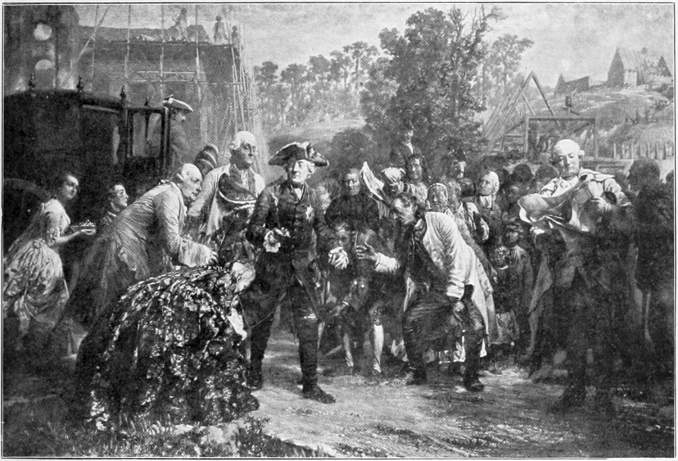
Hanfstängl.
MENZEL. FREDERICK THE GREAT ON A JOURNEY.
Here is that exactness which an historical picture must have if it makes any claim to intrinsic worth. Whilst the ordinary historical painters were content to transmute dressed-up models into types of the universally human, and to put historical labels on their frames, Menzel succeeded in really penetrating a bygone age in an artistic spirit, and in making it live again for the present generation. He did not burrow to discover another dim historical personage every year, but confined himself to one hero—to the figure of the Prussian hero-king, familiar to every child, and still living in the popular imagination; and he learnt to master the time of this favourite hero as if he had been old Fritz himself. Menzel had never heard him blowing on his flute, and never sat at table with him in Sans-Souci, but the painting of these scenes comes out true and life-like in the artist’s work, because the past history of his country had become as vivid to him as his own age. His “Battle of Hochkirch” rises to tragical grandeur, precisely because everything that is outwardly impassioned is far from him. His “Frederick the Great on a Journey,” where the king is inspecting territories alter the war and ordering the rebuilding of demolished houses, his “Frederick’s Meeting with Joseph II in Niesse,” and all the other pictures of the sequence, by their marvellous naturalness and intense vividness, and by their freedom from pompous phrasing, stand alone in an age dominated by empty sentiment. Menzel, who never laid his sketch-book down from the time he was twelve years old, found a subject of pictorial interest in everything that he saw around him, until finally he acquired the power of moving with natural self-possession in a period that was not his own. By the roundabout way through the rococo period he has taught us to understand ourselves. In his pictures an apparently paradoxical problem has been solved. An intense feeling for modern reality waked to new life the past, that same past which no one had approached with success by the way of idealism.
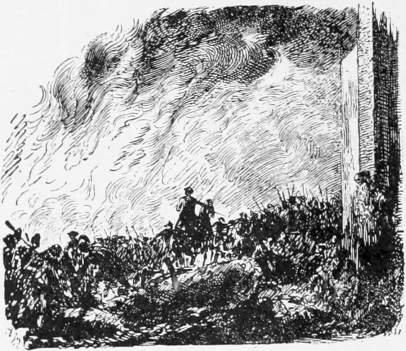
MENZEL. ILLUSTRATION TO KUGLER’S HISTORY OF FREDERICK THE GREAT.
And if we look over the whole development of modern art it strikes us as a remarkable fact that the most concrete spirits, the most thorough masters of technique, like Meissonier and Menzel, were precisely those who ventured to advance into the present. When they had crossed the province of the rococo period, avoided by all scholastic art, they had arrived again at the epoch when Mengs and David had interrupted the natural course of the history of art, one hundred years before. About 1750 the fateful movement towards the antique had been accomplished; in 1820 the Middle Ages had the upper hand; in 1830 the Cinquecento was in the ascendant with Cornelius and Ingres; in 1840 the seventeenth century was awakened through Delacroix and Wappers; and in 1850, after “the courses of the centuries were sphered”—to use the phrase of Cornelius—Meissonier and Menzel painted things which had not appeared worth representing to the painters of 1750, blinded, as they were, by the glory of the antique. Not less striking is it that the nearer the historical subject came to the present the truer to nature did the picture become, and the more did it outwardly change in its features. It has shrivelled from the huge scale of David and Cornelius to the miniature scale of Meissonier and Menzel, and to some extent it thus leaves its further development to be guessed. At no distant time the historical picture will be overthrown, and the picture from modern life, hitherto but shyly handled and on the smallest scale, will swell to life size. History itself, serious history, clings merely to the rock-bed of old costume. One generation had used it with an abstract purpose as a substratum for philosophical ideas; others had made scenical pieces with its aid; a third generation turned it over for piquant traits and anecdotes. The last and greatest generation had finally come to handle it quite familiarly and humanly and without affected dignity. Their works protested against all idealism; and this expressed itself, in drawing, by their making use of the true instead of the “beautiful” line; in colour, by a fresher tint corresponding with nature rather than with the conventional ideal of beauty.
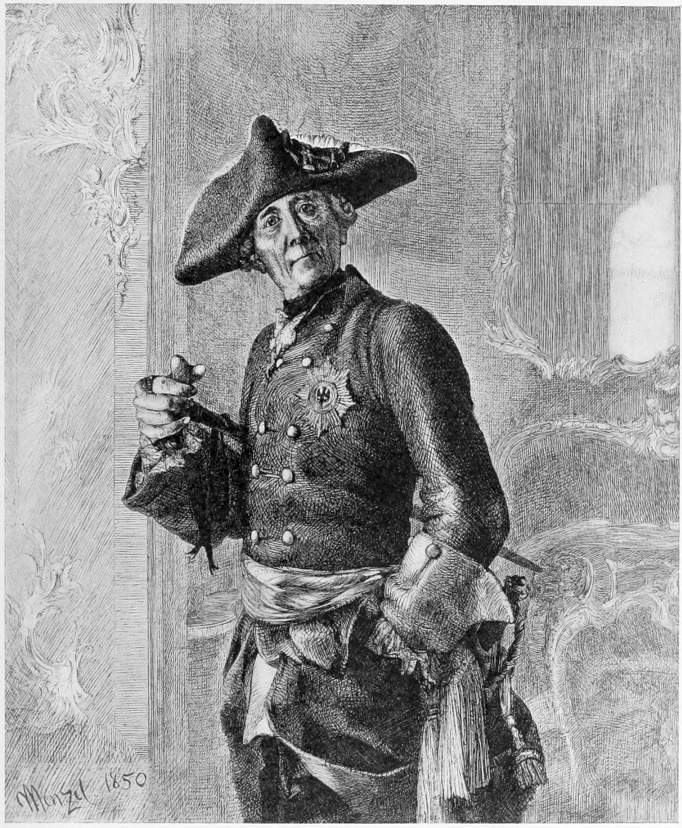
MENZEL. PORTRAIT OF FREDERICK THE GREAT.
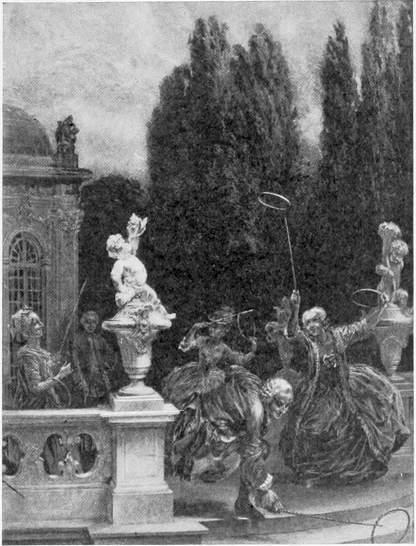
MENZEL. REIFSPIEL.
Nobility of line was paramount in Gallait and Piloty, movement with grand, kingly gestures, lofty dignity, aristocratic bearing, knightliness, and a conventional piling up of rich stuffs, alluring to the eye. Leys, Menzel, and Meissonier were the first who sacrificed beauty to truth, or, more properly, who perceived that a beauty without truth is not really beautiful. They came gradually and by an indirect way to this knowledge as they studied German and Netherlandish masters instead of the Italians, and set up the angular, natural outlines of the Germans against the grace of the Latin masters, which had become banal through a lengthy course of imitation. And thus a return was made to the manner of our true ancestors, which had been forgotten during half a century. The place of the Antinous heads of Gallait was taken by physiognomies of vigorous characterisation; gesticulating heroes made way for peaceful, quiet persons, who did not consider themselves under an obligation to acquire artistic citizenship by a parade of attitude, but appeared in their picture as they were in reality. Impassioned movement yielded quietly to arms hanging downwards and natural postures. Even the traditional rules of concave and convex composition were broken so that the free play of life might more easily come to its rights. Not less did all three show themselves true painters by preferring rightness of observation and truth and delicacy of reproduction to anecdote and richness of invention, and by feeling the need of painting figures in their real surroundings. Instead of the conventional velvet and brocade stuffs, and the folios everywhere and nowhere in place, the settles and the brass caskets, there was a naturally painted fragment of reality, authentically reflecting the whole atmosphere of the period. The treatment of nature, hitherto idealistic and arbitrary, became synthetic and naturalistic. There was no more abstraction, but direct observation of the man and his milieu. And if, for the time being, this milieu was a rococo milieu, artificially reconstructed so that it could be realistically transferred to the picture, Menzel and Meissonier, even on account of this realism, would have to be reckoned as outposts of the modern tendency, and as having very decided points of contact with it; and this, even if they had not themselves actually become the pioneers of modernity, forcing their way through against the literary and historical movement. It is owing to their works in the past that the preference of the public turned less and less to compositions of fine sentiment, even though grounded on more attentive observation, and that artists began to regard reality as the most important element, the point of departure for every picture. Thus life itself came to be painted, and preparation was made for the coming demand of a new generation, who wished no more to see old heroes, but themselves, in the mirror of art.
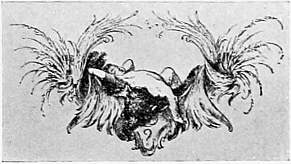
WHEN WILL GENIUS AWAKE? MENZEL.

BIBLIOGRAPHY
BIBLIOGRAPHY
CHAPTER I
General:
Rouquet: L’état des Arts en Angleterre Paris, 1755.
H. Walpole: Anecdotes of Painting in England. With Illustrations. 5 vols. London, Strawberry Hill, 1762-71. New Edition, London, Ward, Lock & Co., 1879.
James Dalloway: Les Beaux-Arts en Angleterre. Paris, 1807.
Edward Edwards: Anecdotes of Painters who have resided or been born in England. London, 1808.
J. D. Fiorillo, Geschichte der Malerei in Grossbritannien, vol. v. Göttingen, 1808.
W. Carey: Progress of the Fine Arts in England and Ireland during the Reigns of George II, III, IV. London, 1826.
William Fletcher: History of Painting in England. London, 1838.
G. Hamilton: Gallery of English Artists. London and Paris, 1839.
Edward Edwards: The Fine Arts in England. London, 1840.
W. B. Taylor: The Origin, Progress, and Present Condition of the Fine Arts in Great Britain and Ireland. 2 vols. London, 1841.
G. Lombardi: Saggio dell’ Istoria Pittorica d’Inghilterra. Firenze, 1843.
J. Dalloway: Anecdotes of Painting in England, with some Account of the Principal Artists. 3 vols. London, 1849.
John Ruskin: Modern Painters. 5 vols. London, 1851-60.
G. F. Waagen: Treasures of Art in Great Britain. London, 1854.
Prosper Mérimée: Les Beaux-Arts en Angleterre, “Revue des Deux Mondes,” 1857.
T. Silvestre: L’Art, Les Artistes, etc., en Angleterre. London, 1857.
C. de Pesquidoux: L’École Anglaise, 1672-1851. Études biographiques et critiques. Paris, 1858.
Our Living Painters: their Lives and Works. London, 1859.
T. Silvestre: Les Artistes Anglais, “L’Artiste,” vol. vi, p. 81. Paris, 1859.
W. Thornbury: British Artists from Hogarth to Turner. 2 vols. London, 1860-61.
J. Milsand: L’esthétique anglaise. Étude sur M. John Ruskin. Trad. franç. Paris, 1864.
R. and S. Redgrave: A Century of Painters of the English School. 2 vols. London, 1866. New Edition, 1890.
W. F. Rae: The History of Painting in England, “The Fine Arts Quarterly Review,” vol. i, p. 241; vol. ii, p. 64. 1866-67.
W. C. Monkhouse: Masterpieces of English Art, with Sketches of some Deceased Painters of the English School. London, 1869.
F. T. Palgrave: Gems of English Art. Plates. London, 1869.
Sarah Tytler: Modern Painters and their Paintings. London, 1873.
Frederick William Fairholt: Homes, Works, and Shrines of English Artists. London, Virtue & Co., 1873.
Frederick Wedmore: The Rise of Naturalism in English Art, “Macmillan’s Magazine,” March and June 1876.
John Ruskin: Lectures on Art, delivered before the University of Oxford, 1870. London, Macmillan, 1876.
English Painters of the Georgian Era: Hogarth to Turner. Biographical Notices of the Artists. With 48 permanent photographs of their most celebrated pictures. London, Low, 1876.
Frederick Wedmore: Studies on English Art. London, Richard Bentley & Son, 1876.
English Painters of the Victorian Era: Mulready to Landseer. Illustrated with 48 photographs of their most popular works. With biographical notices. London, Low, 1877.
James Dafforne: Modern Art. A series of line engravings from the works of distinguished painters of the English and Foreign Schools, selected from galleries and private collections in Great Britain. 60 plates, with descriptive text by J. D. London, 1877.
Samuel Redgrave: A Dictionary of Artists of the English School. New Edition. London, 1878.
The Reflection of English Character in English Art, “The Quarterly Review,” January 1879.
Allan Cunningham: The Lives of the Most Eminent British Painters. Revised edition, annotated and continued to the Present Time by Mrs. Charles Heaton. 3 vols. London, Bell, 1879.
Frederick Wedmore: Studies on English Art. Second Series. (Romney, David Cox, G. Cruikshank, W. Hunt, Prout, B. Jones, A. Moore.) London, Bentley, 1880.
George H. Shepherd: A Short History of the British School of Painting. London, Sampson Low, 1881.
Living Painters of France and England. Plates. London, 1882.
E. Chesneau: La peinture anglaise. Paris, 1882.
J. Faber: La peinture anglaise. “Fédération artistique,” 1883. 11-15.
N. D’Anvers: An Elementary History of Modern Painting. New Edition. London, Sampson Low, 1883.
Wilfrid Meynell: Some Modern Artists and their Work. (Leighton, Boughton, Tadema, Watts, etc.) With portraits and illustrations. London, Cassell & Co., 1883.
Modern Artists. Illustrated Biographies of Modern Artists, published under the direction of F. G. Dumas. (Leighton, Millais, Herkomer, Hook, etc.) 2 vols. London and Paris, 1882-84.
Feuillet de Conches: Histoire de l’école anglaise de peinture jusqu’à Sir Thomas Lawrence et ses émules. Paris, Leroux, 1883.
H. J. Wilmot-Buxton and S. R. Köhler: English and American Painters. Plates. London, 1883.
John Ruskin: The Art of England. Lectures given in Oxford. Orpington, Kent, 1883-84.
Artists at Home. Photographed by J. R. Mayall. With Biographical Notices by F. G. Stephens. London, 1884.
Lord Ronald Gower; Great Historic Galleries of England. London, Sampson Low.
J. Comyns Carr: Papers on Art. London, Macmillan & Co., 1885. (Contains studies of Reynolds, Gainsborough, Rossetti, etc.)
Allan Cunningham: Great English Painters. Selected Biographies from Allan Cunningham’s Lives of Eminent British Painters. Edited by William Sharp. London, 1886.
J. E. Hodgson: Fifty Years of British Art. (Manchester Exhibition, 1887.) Manchester and London, John Heywood, 1887.
Charles Heaton: A Concise History of Painting. London, Bell & Daldy, 1873. Second Edition, 1888.
The Pictorial Record of the Royal Jubilee Exhibition at Manchester, 1887. By Walter Tomlinson. With special articles by Thomas W. Harris, Charles Estcourt, and Joseph Nodal. Edited by John H. Nodal. With Illustrations. Manchester, 1888.
Walter Armstrong: The Nineteenth Century School in Art, “Nineteenth Century,” April, 1887.
Walter Armstrong: Fine Art at the Royal Jubilee Exhibition at Manchester, 1887. 1888.
William Hoe: English Artists of the Day. A Technical Directory. London, 1888.
William Tirebuck: Great Minds in Art. (Studies of Wilson, Wilkie, Landseer, and others.) London, 1888.
Harry Quilter: French and English Art, “Universal Review,” 1888 and 1890.
W. E. Henley: A Century of Artists. A Memorial of the Glasgow International Exhibition, 1888. With Illustrations. Glasgow, 1889.
Hermann Helferich: Ueber die Kunst in England, “Kunst für Alle,” iv, 1888, pp. 161, 177.
Paul Meyerheim: Die englische Malerie in den letzten 50 Jahren, “Nord und Süd,” 1889, p. 17.
J. A. Crowe, Continental and English Painting, “Nineteenth Century,” April 1890.
T. de Wyzewa: Les grands peintres de l’Espagne et de l’Angleterre. Histoire sommaire de la peinture japonaise. Illustrations. Paris, 1891.
T. H. Shepherd: Short History of the British School of Painting. London, 1891.
Robert de la Sizeranne: La peinture anglaise contemporaine. Paris, 1895.
G. Temple: The Art of Painting in the Queen’s Reign. London, 1898.
Richard Muther: Die englische Malerei im 19 Jahrhundert. Berlin, 1902.
See also H. Thomas Buckle: History of Civilisation in England.
H. Taine: Notes sur l’Angleterre. Paris, 1872.
H. Taine: Histoire de la Littérature Anglaise.
Periodicals: “Art Journal,” “Portfolio,” and “Magazine of Art,” passim.
Hogarth:
W. Hogarth: Analyse de la beauté. 2 vols. Paris, 1805.
John Nichols: Biographical Anecdotes of W. Hogarth. London, 1781. Second Edition, 1785.
G. C. Lichtenberg: Erklärung der Hogarth’schen Kupferstiche, mit verkleinerten Copien derselben v. Riepenhausen. Göttingen, 1794-1831.
W. Hogarth: Complete Works, Including the Analysis of Beauty. London, 1837.
Francis Wey: W. Hogarth. Londres il y a cent ans. Paris, 1859.
J. Hannay: Complete Works of Hogarth. Plates. London, 1860.
G. A. Sala: W. Hogarth, Painter, Engraver, and Philosopher. Illustrations. London, 1866.
C. Justi: W. Hogarth, “Zeitschrift für bildende Kunst,” vii, 1872.
A. Dobson: Hogarth. London, Low, New and Enlarged Edition, 1903. (Illustrated Biographies of Great Artists.)
Th. Gautier: Guide de l’amateur, 1882.
Hogarth’s Shrimp Girl, “Portfolio,” 1886, p. 105.
F. Rabbe in the compilation, “Les artistes célèbres.”
Reproductions:
The Original and Genuine Works of W. Hogarth. Atlas fol. London, 1790.
Graphic Illustrations of Hogarth: from Pictures, Drawings, etc. 2 vols. Royal 8vo. London, 1794-99.
The Works of W. Hogarth: from the original plates, restored by James Heath, R.A. Atlas fol. London, 1822.
The Works of W. Hogarth: reproduced from the original engravings in permanent photographs. With an Essay on Hogarth by Charles Lamb. 2 vols. Royal 8vo. London, 1872.
J. Ireland and J. Nichols: Hogarth’s Works, with Life and Anecdotal Descriptions of his Pictures. 3 vols. London. No date.
Reynolds:
J. Northcote: The Life of Sir Joshua Reynolds. London. 1818.
Joseph Farrington: Memoirs of Sir Joshua Reynolds, with some Observations on his Talent and Character. London, 1839.
Edm. Wheatley: A Descriptive Catalogue of all the Prints, etc., from Original Portraits and Pictures by Sir Joshua Reynolds. London, 1825. New Edition, 1850.
Th. Reynolds: Life of Joshua Reynolds, by his Son. London, 1839.
Joshua Reynolds: Discourses on the Fine Arts. Edinburgh, 1840.
Joshua Reynolds: Discourses, illustrated by Explanatory Notes and Plates by J. Burnet. London, 1842.
Edm. Malone: The Literary Works of Sir Joshua Reynolds. Seven Editions. London, 1794-1824. New Editions by H. W. Beechey. London, 1846 and 1851.
W. Cotton: Sir Joshua Reynolds and his Works, edited by John Burnet. London, 1856. New Edition, 1859.
J. Timbs: Anecdotal Biography. (Hogarth, Reynolds, etc.) 1860.
Ch. Rob. Leslie and Tom Taylor: Life and Times of Sir Joshua Reynolds. London, 1865.
Reynolds and the Portrait Painters of the Last Century: “Blackwood’s Magazine,” November 1867.
Sidney Colvin: Joshua Reynolds, “Portfolio,” 1873, pp. 66-82.
J. C. Collins: Sir Joshua Reynolds as a Portrait Painter. An Essay, with 20 Portraits. London, 1874.
Edw. Hamilton: A Catalogue Raisonné of the Engraved Works of Joshua Reynolds, 1755-1820. London, 1874.
Frederick Wedmore: Sir Joshua Reynolds, “Temple Bar,” July 1876.
F. S. Pulling; Sir Joshua Reynolds. London, Sampson Low, 1880.
Th. Gautier; Guide de l’amateur, 1882.
F. G. Stephens: English Children as painted by Sir Joshua Reynolds. London, 1884.
Th. Duret: Sir Joshua Reynolds et Gainsborough aux expositions de la Royal Academy et de la Grosvenor Gallerie, “Gazette des Beaux Arts,” 1884, i 327. (The same reprinted and enlarged. Paris, 1885.)
Various articles in the “Athenæum,” 1883 and 1884.
Helen Zimmern: Sir Joshua Reynolds, in “Westermanns Monatsheften,” May 1884.
William Martin Conway: The Artistic Development of Reynolds and Gainsborough. London, Seeley & Co., 1886.
Ernest Chesneau: Joshua Reynolds. With 18 Illustrations. Paris, 1887 (in the compilation “Les artistes célèbres”).
Lady Blennerhasset: Joshua Reynolds’ Discourses, “Allgemeine Zeitung,” 1889.
Ed. Leisching: Zur Aesthetik u. Technik der bildenden Künste. Akademische Reden von Sir J. R., Uebersetzt u. mit Einleitung, Anmerkungen, Register u. Textvergleichung versehen von Dr. E. L. Leipzig, 1893.
C. Phillips: Sir Joshua Reynolds. With 9 Illustrations from Pictures by the Master. London, 1894.
W. Armstrong: Sir Joshua Reynolds. With 78 Photogravures and 6 Lithographic Facsimiles in colour, 1900; Popular edition, with 52 Plates. London, 1905.
Lord Ronald Gower: Sir Joshua Reynolds. His Life and Art (with Illustrations). British Artists’ Series, 1902.
J. Sime: Reynolds. London, 1904.
F. Benoit: Reynolds. Paris, 1904.
Gainsborough:
Rob. Pratt: Sketch of the Life and Paintings of Thomas Gainsborough. London, 1788.
George William Fulcher: Life of Thomas Gainsborough. London, 1856.
Sidney Colvin: Thomas Gainsborough, “Portfolio,” 1872, pp. 169, 178.
J. Comyns Carr: Thomas Gainsborough, “The English Illustrated Magazine,” December 1884.
George M. Brock-Arnold: Gainsborough. London, Sampson Low, 1889.
Walter Armstrong in the compilation, “Les artistes célèbres.”
Mrs. Bell: Thomas Gainsborough: a Record of his Life and Works, with Illustrations, etc. London, 1897.
W. Armstrong: Gainsborough and his Place in English Art. With 62 Photogravures and 10 Lithographic Facsimiles in colour. London, 1898. Popular edition (with 48 Plates), 1904.
Lord Ronald Gower: Thomas Gainsborough (with Illustrations). British Artists’ Series, 1903.
Reproductions:
Studies of Landscapes by Thomas Gainsborough. Engraved from the Originals by L. Francia. London, 1810.
Studies of Figures by Gainsborough, in exact imitation of the originals, by Richard Lane. London, 1825.
Selected Works of Thomas Gainsborough. One hundred engravings in mezzotint. Fol. London, 1876.
Wilson:
The Works of Richard Wilson, R.A., Landscape Painter. A volume of engravings. Fol. No date.
T. Wright: Some Account of the Life of Richard Wilson. London, 1824.
CHAPTER II
General:
Georg Brandes: Hauptströmungen der Literatur des 19 Jahrhunderts, Bd. i, 2 Aufl. Leipzig, 1887.
Wilhelm Weigand: Essays. (Voltaire, Rousseau, zur Psychologie des 19 Jahrhunderts, etc.) München, 1892.
Goya:
Théophile Gautier: Cabinet de l’amateur, 1842.
Laurent Matheron: Biographie de Fr. Goya. Paris, 1858.
Carderera: “Gazette des Beaux Arts,” 1860 and 1863.
P. Lefort: “Gazette des Beaux Arts,” 1867.
Charles Yriarte: Goya, sa biographie, etc. Paris, 1867.
D. F. Zapater y Gomez: Goya, noticias biograficas. Zaragoza, 1868.
Paul Lefort: “Gazette des Beaux Arts,” 1875, ii 506; 1876, i 336; ii 500. Reprinted and enlarged under the title of Francisco Goya, Étude biographique et critique, suivie de l’essai d’un catalogue raisonné de son œuvre gravé et lithographié. Paris, 1877.
Charles Yriarte: Goya, Aquafortiste, “L’Art,” 1877, ii 3, 33, 56, 78.
P. G. Hamerton: Fr. Goya, “Portfolio.” 1879, 67-99.
Muñoz y Manzano: Francesco de Goya y Lucientes, “Revista contemporanea,” September 1883.
Lucien Solvay: L’Art Espagnol. Paris, 1887. (Bibliothèque internationale de l’Art.)
Con. de la Viñaza: Goya, su tiempo, su vida, sus obras. Madrid, 1887.
P. Lafond: Goya. Paris, 1902.
W. Rothenstein: Goya (with Illustrations). London, 1900.
Valerian von Loga: Francisco de Goya. Berlin, 1903.
Richard Muther in der Sammlung der Kunst, 1904, Berlin.
More Recent Reproductions:
Los Desastres de la Guerra. Colleccion de 80 laminos. Madrid, 1863.
Los Proverbios. Colleccion de 18 laminos. Madrid, 1864.
Los Caprichos. Gravures fac-similé de M. Segui y Riera. Notice biographique et étude critique par Ant. de Nait. Barcelone, 1887.
French Art in the Eighteenth Century:
Edmond et Jules de Goncourt: L’Art du XVIII siècle. Paris, 1850. 3rd Edition, Paris, 1880.
Edmond et Jules de Goncourt: La femme au XVIII siècle. Paris, 1889.
Charles Blanc: Les Peintres des Fêtes galantes. (Watteau, Lancret, Pater, Boucher.) Paris, 1854.
Arsène Houssaye: Histoire de l’Art Français du XVIII siècle. Portraits. Paris, 1860.
E. B. de la Chavignerie: Les Artistes Français du XVIII siècle oubliés ou dédaignés. Paris, 1865.
A. v. Wurzbach: Die französischen Maler des 18 Jahrh. Stuttgart, 1879.
Auguste Nicaise: L’école française au XVIII siècle. Chalons-sur-Marne, 1883.
Paul Seidel: Friedrich d. Gr. u. die französische Kunst seiner Zeit. Berlin, 1892.
Watteau:
Figures de différents caractères de paysage et d’études dessinées d’après nature par A. Watteau. 2 vols., 350 pl. Paris. No date.
D’Argenville: Abrégé de la vie des plus fameux peintres. Paris, 1762.
Mariette: Abecedario. Published in the archives of French Art by Chennevières. 1852, etc.
Caylus: La vie d’Antoine Watteau. Read on 3rd February 1748 before the Paris Academy. Cited by Goncourt, L’Art du XVIII siècle, 1850.
Julienne in the preface to his book of plates, 1755.
Cellier: Antoine Watteau, son enfance, ses contemporains. Valenciennes, 1867.
Edmond de Goncourt: A. Watteau. Paris, 1860. By the same author, Catalogue raisonné de l’œuvre peint, dessiné et gravé d’A. Watteau. Paris, 1875.
Theodor Volbehr: Antoine Watteau, ein Beitrag zur Kunstgeschichte des 18 Jahrh. München, 1885.
Emil Hannover: A. Watteau. Kopenhagen, 1887. Deutsch von Alice Hannover. Berlin, 1889.
G. Dargenty in “Les artistes célèbres.” Paris, 1889.
Paul Mantz: “Gazette des Beaux Arts,” 1889, i 5, 177, 455; ii 5, 129, 222. Reprinted 1892.
Boucher:
P. Mantz: François Boucher, Lemoyne et Natoire (with engravings from their works). Paris, 1880.
André Michel in “Les artistes célèbres.” Paris, 1889.
Lancret:
G. Dargenty in “Les artistes célèbres.”
Pater:
G. Dargenty in “Les artistes célèbres.”
Fragonard:
Baron Roger Portalis: Honoré Fragonard, sa vie et ses œuvres. Paris, 1887.
Felix Naquet in “Les artistes célèbres.” 1893.
C. Mauclair: Fragonard, Biographie critique illustrée de vingt-quatre reproductions hors texte (Les Grands Artistes, etc.), 1904.
Baudouin:
Ch. Normand in “Les artistes célèbres.” Paris, 1892.
Greuze:
Edmond et Jules de Goncourt: L’Art du XVIII siècle.
Charles Blanc: Histoire de peintres des toutes les écoles, ii.
Jules Renouvier: Histoire de l’Art pendant la Révolution, p. 517.
Charles Normand in “Les artistes célèbres.” Paris, 1892.
Quentin La Tour:
Clement de Ris: L’œuvre de Maurice Quentin de Latour, “Gazette des Beaux Arts,” 1882, ii 251.
Champfleury in “Les artistes célèbres.” Paris, 1886.
H. Lapauze. With 87 Plates. Paris, 1885. La Tour et son œuvre au Musée de Saint-Quentin, 1905.
Liotard:
F. Guye: Jean Étienne Liotard, 1702-91. Zofingen, 1890.
Chardin:
Edmond et Jules de Goncourt: L’Art du XVIII siècle.
G. Dargenty: “L’Art,” 1883, ii 3.
H. de Chennevières: Chardin au Musée du Louvre, “Gazette des Beaux Arts,” 1889, i 121.
Charles Normand in “Les artistes célèbres.” Paris, 1892.
G. Schéfer: Chardin ... Biographie critique illustrée de vingt-quatre reproductions hors texte (Les Grands Artistes, etc.), 1904.
Cornelis Troost:
A Ver Huell: Cornelis Troost en zÿn Werken. Arnhem, 1873.
Changes of Taste in Germany:
Hermann Hettner: Literaturgeschichte des 18 Jahrhunderts, Bd. iii. Braunschweig, 1879.
Chodowiecki:
W. Engelmann: Daniel Chodowieckis sämmtliche Kupferstiche. Leipzig, 1857.
Alfred Woltmann: Hogarth und Chodowiecki. From Vier Jahrhunderte niederländisch-deutscher Kunstgeschichte. Berlin, 1878.
Ferdinand Meyer: Daniel Chodowiecki der Peintre-graveur. Berlin, 1888.
W. von Oettingen. Berlin, 1895.
L Kämmerer: Bd. 21 der Künstlermonographien von Knackfuss. Bielefeld, 1897.
See Selection from the artist’s finest engravings, in photography, by A. Frisch. Berlin, 1885.
D. Chodowiecki: Von Berlin nach Danzig, eine Künstlerfahrt im Jahre 1783. 108 Facsimiledrucke nach Ch.’s Zeichnungen. Berlin, 1883.
Tischbein:
Aus meinem Leben. An Autobiography, published by G. G. W. Schiller. Leipzig, 1861.
Fr. v. Alten: Ans Tischbeins Leben und Briefwechsel. Leipzig, 1872.
Edmond Michel: Étude biographique sur les Tischbein. Lyon, 1881.
Pesne:
Paul Seidel: “Gazette des Beaux Arts,” 1891.
Paul Seidel: Die Berliner Kunst unter Friedrich Wilhelm I. “Zeitschrift für bildende Kunst,” 1888, p. 185.
Anton Graft:
R. Muther: Anton Graff, ein Beitrag zur Kunstgeschichte des 18 Jahrhunderts. Leipzig, 1881.
Julius Vogel: A. G., mit 60 Tafeln. Leipzig, 1898.
Joseph Vernet:
Amedée Durande: Joseph, Carl, et Horace Vernet, Correspondence et biographie. Paris, 1863.
L. Lagrange: J. Vernet et la peinture au XVIII siècle. Paris, 1864.
A. Genevay: “L’Art,” 1876, iii 254, 307; iv 61.
Albert Maire: Les Vernet in “Les artistes célèbres.”
Hubert Robert:
C. Gabillot in “Les artistes célèbres.”
Canaletto:
Rudolph Meyer: Die beiden Canaletti. Dresden, 1878.
Francesco Guardi:
Paul Leroi: “L’Art,” 1878, i 103.
Gessner:
Heinrich Wölfflin: Salomon Gessner. Frauenfeld. 1889.
Oudry und Desportes:
Charles Normand in “Les artistes célèbres.”
Riedinger:
Georg Aug. Wilh. Thienemann: Leben und Wirken J. El. Riedingers. Leipzig, 1856.
CHAPTER III
German Art in General:
Raczynski: Geschichte der neueren deutschen Kunst, übersetzt von K. Hagen. 3 Bde. Text, 1 Bd. Tafeln. Berlin, 1836.
Anton Hallmann: Kunstbestrebungen der Gegenwart. Berlin, 1842.
Théophile Gautier: Les Beaux Arts en Europe, 1855. Paris, 1855.
A. Hagen: Die deutsche Kunst in unserm Jahrhundert. Berlin, 1857.
E. Förster: Geschichte der neueren deutschen Kunst. Leipzig, 1863.
Anton Springer: Die bildende Kunst des 19 Jahrhunderts. Leipzig, 1858.
J. Gérard: Considérations sur l’art allemand, ses principes et tendances à propos de l’exposition de Munich. Bruxelles, 1859.
Hermann Riegel: Geschichte des Wiederauflebens der deutschen Kunst seit Carstens. Hannover, 1876.
Friedr. Pecht: Deutsche Künstler des 19 Jahrhunderts, Studien und Erinnerungen. Nördlingen, Beck, 1877-81.
J. Beavington-Atkinson: The Schools of Modern Art in Germany. With numerous Illustrations. London, Seeley, 1880.
A. F. Graf v. Schack: Meine Gemäldesammlung. Stuttgart, Cotta, 1881. Neue Ausgabe als Einleitung zu den Albertschen Heliogravuren der Galerie Schack. München, 1889.
Kunst und Künstler des 19 Jahrhunderts, unter Mitwirkung von Fachgenossen, herausgegeben von R. Dohme. Leipzig, Seemann, 1881 ff.
D. Duncker, Moderne Meister. Charakteristiken aus Kunst und Leben. Berlin, 1883.
Franz Reber: Geschichte der neueren deutschen Kunst, mit Excursen über die parallele Kunstentwicklung der übrigen Länder. 3 Bde. 3 Aufl. Leipzig, 1884.
Anton Springer: Die Wege und Ziele der gegenwärtigen Kunst, in seinen Bildern aus der neueren Kunstgeschichte. 2 Aufl. Bonn, 1886.
Adolf Rosenberg: Die Münchener Malerschule seit 1871. Leipzig, 1887.
Adolf Rosenberg: Geschichte der modernen Malerei. Bd. 2 und 3, Deutschland. Leipzig, 1888 ff.
Hermann Becker: Deutsche Maler von Carstens bis auf die neuere Zeit. Leipzig, 1888.
L. Pfau in “Kunst und Kritik,” Bd. 1. Stuttgart, 1888, pp. 445-535.
Friedrich Pecht: Geschichte der Münchener Kunst. München, 1889.
Hubert Janitscheks, final chapter in his Geschichte der Deutschen Malerei. Berlin, Grote, 1890.
M. de la Mazelière: La peinture allemande au XIX siècle. Paris, 1900.
Cornelius Gurlitt: Die deutsche Kunst des 19 Jahrhunderts. Berlin, 1899.
Max Schmid: Kunstgeschichte des 19 Jahrhunderts. Leipzig, 1904.
Friedrich Haack: Die Kunst des 19 Jahrhunderts. Stuttgart, 1905.
Periodicals chiefly: “Zeitschrift für bildende Kunst,” Leipzig, 1866. “Die Kunst für Alle,” München, 1886. “Die Kunst unserer Zeit” (specially the work of H. E. v. Berlepsch and Corn. Gurlitt), München, 1890. “Der Kunstwart,” Dresden, 1887. “Die Gegenwart” (articles by Floerke, Lichtwark, Gurlitt, etc.), Berlin, 1872 ff. “Die Nation” (articles by Helferich, Elias, etc.), Berlin, 1883 ff. “Die Freie Bühne” (articles by Helferich, B. Becker, etc.), Berlin, 1888 ff. “Die preussischen Jahrbücher” (articles by Carl Neumann, etc.). All cited in particular in the appropriate place.
The Classical Reaction:
Hermann Helferich: Classicität, “Freie Bühne,” 1890.
Carl Neumann: Christian Rauch, Betrachtungen über Ursprung und Anfänge der modernen deutschen Plastik, “Preuss. Jahrbücher,” Bd. 64, 1889.
Heinr. v. Stein: Die Entstehung der neueren Aesthetik. Stuttgart, 1886.
The Theories of Gérard de Lairesse:
Carl Lemcke in his Study of Adriean van der Werff in “Kunst and Künstler Deutschlands und der Niederlande,” vol. ii. Leipzig, 1878.
Winckelmann:
Carl Justi: Winckelmann, sein Leben, seine Werke, seine Zeitgenossen. Bd. 1, Leipzig, 1866; Bd. 2, Leipzig, 1872.
The Influence of Archæological Studies upon Art:
K. Bernh. Stark: Handbuch der Archaeologie, Bd. 1. Leipzig, 1879.
Lessing:
Danzel-Guhrauer: Lessings Leben und Werke. Leipzig. No date.
Heinr. Fischer: Lessings Laokoon und die Gesetze der bildenden Kunst. Berlin, 1887.
Goethe’s Relations to the Plastic Arts:
H. Hettner: Goethes Stellung zur bildenden Kunst seiner Zeit, “Westermanns Monatshefte,” 20, 83.
H. Hettner in his “Deutsche Literaturgeschichte,” ii 457.
R. v. Eithelberger: Goethe als Kunstschriftsteller, in seinen gesammelten kunsthistorischen Schriften. Wien, 1884. Bd. 3, pp. 221-261.
Gustav Ebe: Goethes Beziehungen zur bildenden Kunst, “Gegenwart,” xxvii. Heft 16 und 18.
C. Urlichs: Ueber Goethes Verhältniss zur alten Kunst. “Goethe-Jahrbuch,” iii.
Hermann Uhde: Goethe, J. G. Quandt und der sächsische Kunstverein. Stuttgart, Cotta, 1877.
A. Heusler: Goethe und die italienische Kunst. Basel, Reich, 1891.
E. Dobbert: Goethe und die Berliner Kunst, “Nationalzeitung,” 1891, 1 und 3 Febr.
Bode: Goethes Asthetik. Berlin, 1901.
Julius Vogel: Aus Goethes römischen Tagen. Leipzig, 1906.
Mengs:
Bianconi: Elogio storico del Cavaliere Anton R. Mengs. Pavia, 1759.
Mengs: Gedanken über die Schönheit und über den Geschmack in der Malerei. Zürich, 1765. Seine sämmtlichen hinterlassenen Schriften. Bonn, 1843-44.
Franz Reber in “Kunst und Künstler Deutschl. u. der Niederlande,” 1878.
Friedrich Pecht: “Zeitschrift für bildende Kunst,” xiv, 1879, pp. 33 u. 72.
Woermann: “Zeitschrift für bildende Kunst,” 1894.
Angelica Kauffmann:
Giov. Gher. de Rossi: Vita di Angelica Kauffmann. Firenze, 1810. German by A. Weinhart, Bregenz, 1814.
J. E. Wessely in “Kunst und Künstler Deutschlands und der Niederlande,” 1878.
A. W. Grube: Angelika Kauffmann. Bregenz, 1889.
Wilh. Schram: Die Malerin Angelika Kauffmann. Brünn, 1890.
Fr. A. Gérard: Angelica Kauffmann. London, 1892.
See also F. Guhl: Die Frauen in der Kunstgeschichte. Berlin, 1858.
Oeser:
Alphons Dürr: A. F. Oeser, Ein Beitrag zur Kunstgeschichte des 18 Jahrh. Leipzig, Dürr, 1879.
Carstens:
Karl Ludwig Fernow: Leben des Künstlers J. A. Carstens. Leipzig, 1806. Neuherausgegeben von Hermann Riegel. Hannover, 1867.
Hermann Grimm: Ausgewählte Essays zur Einführung in das Studium der neueren Kunst. 2 Aufl. Berlin, 1883, p. 216.
F. v. Alten: A. F. Carstens. Schleswig, 1865.
H. Grimm: Ueber Künstler und Kunstwerke, i. Berlin, 1865, pp. 73-95.
Schöne: Beiträge zur Lebensgeschichte des Malers Carstens. Leipzig, 1866.
Fr. Eggers: Vier Vorträge aus der neueren Kunstgeschichte. Berlin, 1867, p. 1.
Carstens’ Werke, in Kupferstichen von W. Müller, herausgegeben von Hermann Riegel. Leipzig, Bd. 1, 1869; Bd. 2, 1874; Bd. 3, 1884.
Jul. Lange: Nutids Kunst. Kopenhagen, 1873, pp. 1-15.
Fr. Pauli: A. Carstens. Berlin, 1876.
Hermann Riegel: Kunstgeschichtliche Vorträge und Aufsätze, p. 200, “Carstensiana.” Braunschweig, 1877.
Alfr. Woltmann, from Vier Jahrhunderte niederländisch-deutscher Kunstgeschichte. Berlin, 1878, p. 169.
Fr. Pecht: Deutsche Künstler des 19 Jahrhunderts. III Reihe. Nördlingen, 1881, p. 31 ff.
August Sach: Asmus Jacob Carstens’ Jugend und Lehrjahre nach urkundliche Quellen. Halle, 1881.
D. Schnittgen: A. J. Carstens, “Christliches Kunstblatt,” 1882, 12.
Hermann Lücke in “Kunst und Künstler des 19 Jahrh.” Leipzig, 1886.
The Painter Müller:
C. Seuffert: Maler Müller. Berlin, 1877.
Sauer in “Deutscher Nationallitteratur,” Bd. 81.
Müller’s article against Carstens is in Schiller’s Horen, 1797, iii 21, iv 4.
Luise Seidler:
Hermann Uhde: Erinnerungen aus dem Leben der Malerin Luise Seidler, aus handschriftliche Nachlass zusammengestellt und bearbeitet, 2 Auflage. Berlin, Hertz, 1876.
Wächter:
Dav. Friedr. Strauss: Kleine Schriften. Leipzig, 1862, pp. 333-360.
A. Haakh: Beiträge aus Württemberg zur neueren deutschen Kunstgeschichte. Stuttgart, 1863, pp. vii ff., 10 ff., 133 ff.
Schick:
Dav. Friedr. Strauss: Kleine Schriften, pp. 361-396.
Fr. Eggers: “Deutsches Kunstblatt,” 1858, pp. 129-137.
A. Haakh: Beiträge aus Württernberg zur neueren deutschen Kunstgeschichte, pp. xiv ff., 23-31, 59-312.
H. Kindt: Zu Gottlieb Schicks 100 jährigem Geburtstag. Gegenwart, 1879, 31.
Winterlin: Württenbergische Künstler. Stuttgart, 1895.
Genelli:
H. Riegel: Deutsche Kunststudien. Hannover, 1868, pp. 291 ff.
M. Jordan: Bonaventura Genelli, “Zeitschrift für bildende Kunst,” v pp. 1-19.
H. Riegel: Kunstgeschichtliche Vorträge und Aufsätze. Braunschweig, 1877, pp. 148-170.
L. v. Donop: Briefe von Bonaventura Genelli und Karl Rahl, “Zeitschrift für bildende Kunst,” xii pp. 25 ii.; xiii pp. 115 ff. Letters from Schwind to Genelli, do. xi p. 11.
Fr. Pecht: Deutsche Künstler des 19 Jahrhunderts, II Reihe. Nördlingen, 1879, pp. 271-304.
A. F. Graf v. Schack: Meine Gemäldesammlung. Stuttgart, 1881, pp. 9-40.
O. Berggruen: Die Gallerie Schack in München. Wien, 1883. Also in “Die graph. Künste,” iv, 1881, 1.
O. Baisch: Einzelheiten aus Genellis Leben und Briefwechsel, “Zeitschrift für bildende Kunst,” xviii pp. 257-262.
CHAPTER IV
French Art in General:
Charles Blanc: Histoire des peintres français au XIX siècle. Paris, 1845.
Gustave Planché; Portraits d’artistes. Paris, 1853.
Gustave Planché: Études sur l’école française, 1831-52. Paris, 1855.
A. de la Forge: La Peinture contemporaine en France. Paris, 1856.
T Silvestre: Histoire des Artistes vivants français et étrangers. Paris, 1857.
Théodore Pelloquet: Dictionnaire de poche des Artistes contemporains. Paris, 1858.
L. Laurent-Pichat: L’Art et les Artistes en France. Paris, 1859.
Moritz Hartmann; Bilder und Büsten. Frankfurt-am-Main, 1860.
Ch. Lenormant: Beaux Arts et Voyages. Paris, 1861.
Olivier Merson: La Peinture en France. Paris, 1861.
E. Chesneau: La Peinture Française au XIX siècle. Les Chefs d’École, L. David Gros, Géricault, Decamps, Meissonier, Ingres, H. Flandrin, E. Delacroix. Paris, 1862. New Edition, Paris, 1883.
Charles Blanc: Histoire des peintres de toutes les écoles. Paris, 1861-76.
L. Pfau: Französische Maler und Bilder, in “Freie Studien.” Stuttgart, 1866. Enlarged in “Kunst und Kritik,” Bd. 1, pp. 115-444. Stuttgart, 1888.
Charles Clement: Études sur les Beaux Arts en France. Paris, 1865. Second Edition, 1867.
Julius Meyer: Geschichte der modernen französischen Malerei seit 1789. Leipzig, 1867.
Julius Meyer: Die französische Malerei seit 1848, “Zeitschrift für bildende Kunst,” ii pp. 13, 32, 56, 119. Leipzig, 1867.
A. Bonnin: Études sur l’art contemporain. Les Écoles françaises et étrangères en 1867. Paris, 1868.
P. G. Hamerton: Contemporary French Painters. London, 1868.
H. O’Neil: Modern Art in England and France. London, 1869.
P. G. Hamerton: Painting in France. London, 1869.
W. B. Scott: Gems of French Art, with an Essay on the French School. Plates. London, 1871.
M. Chaumelin: L’Art contemporain. La Peinture à l’Exposition universelle de 1867. Salon de 1868, 1869, 1870. Paris, 1873.
Th. Gautier: Portraits contemporains. Paris, 1874.
Pierre Petroz: L’Art et la critique en France depuis 1822. Paris, 1875.
L. Dussieux: Les Artistes français à l’étranger. Paris, Lecoffre fils et Cie, 1876.
R. Ménard: French Artists of the Present Day. Notices of some Contemporary Painters. 12 engravings. London, 1876.
Charles Blanc: Les Artistes de mon temps. Paris, 1876.
Jules Claretie: L’Art et les Artistes Français contemporains, avec un avant-propos sur le Salon de 1876. Paris, 1876. Deuxième série, Paris, 1881.
Philippe Burty: Maîtres et petits maîtres. Paris, 1877.
Marquet de Vasselot: Recherches sur l’art français. Architecture, Peinture, Sculpture. Paris, 1878.
Lucien Double: Promenade à travers deux siècles et quatorze salons. Paris, 1878.
G. Berger: L’école Française de Peinture. Paris, 1879.
Victor Champier: Les Beaux Arts en France et à l’Étranger. Paris, 1879.
E. Bellier de la Chavignerie et L. Auvray; Dictionnaire générale des Artistes de l’École Française. Paris, 1880.
Ernest Chesneau: Peintres et Statuaires Romantiques. Paris, 1880.
Maurice du Seigneur: L’Art et les artistes au Salon de 1880. Paris, 1880.
Marquet de Vasselot: Histoire du Portrait en France. Paris, 1880.
George Lafenestre: L’Art vivant, la Peinture et la Sculpture aux Salons de 1868 à 1877. Paris, 1881.
E. Leclerq: Caractères de l’École française moderne de Peinture. Paris, 1881.
F. Gosselin: Histoire anecdotique des Salons de peinture depuis 1673. Paris, Dentu, 1881.
L. de Pesquidoux: L’Art au XIX siècle. L’Art dans les deux mondes, Peinture et Sculpture. 2 vols. Paris, 1881.
Eugène Montrasier. Les artistes modernes: 1. Les peintres de genre; 2. Les peintres militaires et les peintres de nu. 40 Biogr., 40 Tables. 2 vols. Paris, 1881.
Adolf Rosenberg: Geschichte der modernen Kunst. 1 Abtheilung. Die franz. Kunst Leipzig, 1882.
H. Houssaye: L’Art français depuis dix ans. Paris, 1882.
Henri de Clenzion: L’Art national en France. Paris, 1882-83.
F. Henriet: Peintres contemporains. Paris, A. Levy, 1883.
Raf. Sinset et Jules d’Auriac: Histoire du Portrait en France. Paris, 1884.
V. Fournal: Les artistes contemporains français, peintres, sculpteurs. With 176 Illustrations. Tours, Mame et fils, 1884.
Jean Gigoux: Causeries sur les artistes de mon temps. Paris, 1885.
Albert Wolff: La capitale de l’Art. Second Edition. Paris, 1886.
Victor d’Halle: Histoire de la peinture en France. Paris, 1886.
Paul Marmottan: L’école française de peinture (1789-1830). Paris, 1886.
J. Comyns Carr: Art in Provincial France. 1883.
Henri Jouin: Maîtres contemporains. Paris, 1887.
Charles Bigot: Peintres français contemporains. Paris, 1888.
C. H. Stranahan: A History of French Painting. New York, 1888.
La peinture française à l’exposition centennaire de 1889. Ouvrage publié sous la direction de Antonin Proust. Paris, 1890.
Les Chefs d’œuvres de l’Art au XIX siècle. 5 vols. Paris, 1890 ff.
1. L’école française de David à Delacroix, par André Michel. 2. L’école française de Delacroix à H. Regnault, par Alfred de Lostalot. 3. La peinture française actuelle, par Paul Lefort. 4. Les écoles étrangères aux XIX siècle, par Th. de Wyzewa. 5. La Sculpture et la Gravure en France au XIX siècle, par Louis Gonse.
Richard Muther, Ein Jahrhundert französischer Malerei. Berlin, 1901.
A. Julius Meier-Gräfe: Der Entwichlungsgeschichte der modernen Kunst. (With Illustrations and a volume of Plates.) Stuttgart, 1904.
Periodicals specially to be noted: “Gazette des Beaux Arts,” Paris, 1865. “L’Art,” Paris, 1875.
The Art of the Revolution Period:
Jules Renouvier: Histoire de l’art pendant la revolution. Paris, 1863.
Edmond et Jules de Goncourt: Histoire de la société française pendant la révolution. Paris, 1854. New Edition, 1889.
Edmond et Jules de Goncourt: Histoire de la société française pendant le Directoire. Paris, 1855.
Anton Springer: Die Kunst während der französischen Revolution, Bilder aus der neueren Kuntsgeschichte. Bonn, 1886.
Paul Marmottan: L’école française de peinture 1789-1850. Paris, 1886.
Carl v. Lützow: Die französische Kunst vor 100 Jahren, “Zeitschrift für bildende Kunst,” xxiv, 1889, p. 181.
Madame Vigée-Lebrun:
Her Autobiography: Souvenirs de ma vie. Paris, 1835-37.
Sophia Beale: Elisabeth Louise Vigée-Lebrun, “Portfolio,” 1891, 89.
Charles Pillet in “Les artistes célèbres.” Paris, 1892.
Vien:
H. Cozik: Vien, sa vie et ses œuvres. Paris. No date.
Elie Roy: Vien et son temps. Paris. No date.
David:
P. A. Coupin: Essai sur J. L. David. Paris, 1827.
E. J. Delécluze: Louis David. Paris, 1855.
Jules David: Le peintre Louis David (1748-1825), souvenirs et documents inédits. Paris, Havard, 1879.
C. A. Regnet in “Kunst und Künstler Spaniens, Frankreichs, und Englands.” Leipzig, 1880.
G. Nieter: Le peintre David, “Revue générale,” March 1881.
“L’Art,” 1889, ii p. 46.
C. Brun: Louis David und die französische Revolution. Zürich, 1886.
Charles Normand in “Les artistes célèbres.”
L. Rosenthal: David. Paris, 1904.
CHAPTER V
The Parallel Movement in Literature:
Georg Brandes, Haupströmungen der Literatur des 19 Jahrhunderts. Vol. ii, Die deutsche romantische Schule. Leipzig, 1887.
Georg Haim: Die romantische Schule. Berlin, 1871.
Hermann Hettner: Die romantische Schule in ihrem Zusammenhang mit Goethe und Schiller. Braunschweig, 1850.
On the Nazarenes in General:
Veit Valentin in “Kunst und Künstler des 19 Jahrh.” Leipzig, 1886.
Alfred Woltmann: Cornelius und seine Genossen in Rom. Aus Vier Jahrhunderte, etc. Berlin, 1878, pp. 208 ff.
Fr. Haack: Die deutschen Romantiker in der bildenden Kunst des 19 Jahrhunderts. Erlangen, 1901.
Overbeck:
A. v. Zahn: “Zeitschrift für bildende Kunst,” vi, 1871, pp. 217-235.
J. R. Beavington-Atkinson, Overbeck (Great Artists). London, Low, 1882.
Margaret Howitt: Friedrich Overbeck. Sein Leben u. Schaffen, etc. 1886.
Amongst minor works: J. N. Sepp: Friedrich Overbeck, Gedächtnissrede. Augsburg, 1869.—Franz Binder: Zur Erinnerung an Friedrich Overbeck. München, 1870.—H. Holland: Zu Friedrich Overbeck’s Heimgang, 1870.—G. Fr. v. Hertling: Zur Erinnerung an Friedrich Overbeck. Köln, 1875.
Führich:
Autobiography in the “Libussa.” Prag, 1844. New Edition, Vienna, Sartori, 1876.
R. Zimmermann: “Zeitschrift für bildende Kunst,” vii, 1868, pp. 189, 209.
F. Pecht: Deutsche Künstler des 19 Jahrh., iii. Nördlingen, 1881, pp. 64-108.
Lucas v. Führich: “Graphische Künste,” viii pp. 1-16, 25-64. Also separate.
C. v. Lützow, from Führichs Nachlass, “Zeitschrift für bildende Kunst,” xvii, 1882, p. 33.
Die Führich-Ausstellung in Frankfurt: “Zeitschrift für bildende Kunst,” 1885, xx, Beiblatt, 32.
L. R. von Kurz: T. von Führich. Graz, 1902.
Veit:
Veit Valentin: Kunst, Künstler, und Kunstwerke; also in “Zeitschrift für bildende Kunst,” xv 2.
Martin Spahn: Philipp Veit. (With 92 Illustrations.) Bielefeld, 1901.
The Frescoes in the Casa Bartholdy:
L. v. Donop: Die Wandgemälde der Casa Bartholdy in der Nationalgalerie. Berlin, 1888.
Steinle:
O. Berggruen: Die Galerie Schack, “Graph. Künste,” iv. 3 and 4.
Constantin v. Wurzbach: Ed. Steinle, ein Madonnenmaler unserer Zeit. Biographische Studie. Wien, 1879.
Veit Valentin: “Zeitschrift für bildende Kunst,” 1888, xxiii 1 and 33.
L. Christiani: Plaudereien über Kunstinteressen der Gegenwart. Berlin, 1871.
A. Reichensperger: Erinnerungen an Steinle. Frankfurt, 1887.
A. M. von Steinle: E. von Steinle und August Reichensperger. Köln, 1890.
Reproductions:
Ausgewählte Werke E. v. Steinles. Frankfurt, 1888.
Ed. Steinles Bilder zu Parcival. Frankfurt, 1884.
Schnorr:
M. Jordan: Aus Julius Schnorrs Lehr-und Wanderjahren, “Zeitschrift für bildende Kunst,” 1867, pp. 1 ff.
H. Riegel, “Kunstgeschichtliche Vorträge und Aufsätze.” Braunschweig, 1877, pp. 210-248.
M. Jordan: Ausstellung von Werken Julius Schnorrs in der Berliner Nationalgalerie, 1878.
Veit Valentin in “Kunst und Künstler des 19 Jahrhunderts.”
Friedrich Haack in “Das 19 Jahrhundert in Bildnissen.” Berlin. Photographische Gesellschaft, 1901.
Briefe aus Italien von Julius Schnorr v. Carolsfeld, geschrieben in den Jahren 1817-1827.
Ein Beitrag zur Gesch. seines Lebens und der Kunstbestrebungen seiner Zeit, herausgegeben von Franz Schnorr v. Carolsfeld. Gotha, 1886.
Compare “Bibel in Bildern.” Leipzig, 1852-62.
Zeichnungen von Jul. Schnorr v. Carolsfeld, mit Einleitung von Jordan. Leipzig, Dürr, 1878.
CHAPTER VI
The Art of Munich under King Ludwig I.:
Alfred Woltmann, from “Vier Jahrhunderte niederländisch-deutscher Kunstgeschichte.” Berlin, 1878, pp. 260 ff.
Hans Reidelbach: König Ludwig I und seine Kunstschöpfungen. München, 1888.
Cornelius:
Herm. Riegel: Cornelius, der Meister der deutschen Malerei. Hannover, 1866.
M. Carrière: Denkrede auf Cornelius. Leipzig, 1867.
A. Teichlein: Betrachtungen über Riegels Buch, “Cornelius, der Meister der deutschen Malerei,” “Zeitschrift für bildende Kunst,” ii. 1867, pp. 128 ff., 189 ff.
Alfred Frhr. v. Wolzogen: Peter v. Cornelius. Berlin, 1867.
Max Lohde: Gespräche mit Cornelius, “Zeitschrift für bildende Kunst,” III 1, 30, 84. 1868.
W. Lübke: Kunsthistorische Studien. Stuttgart, 1869.
Ernst Förster: Peter Cornelius, ein Gedenkbuch aus seinem Leben und Wirken. 2 vols. Berlin, 1874.
Herm. Grimm: Berlin und P. v. Cornelius (Die Cartons von P. v. Cornelius, Cornelius und die ersten 50 Jahre nach 1800), in “15 Essays.” Berlin, 1875.
V. Kaiser: Cornelius und Kaulbach in ihren Lieblingswerken. Basel, 1876.
Fr. Pecht: Deutsche Künstler des 19 Jahrh., Bd. 1. Nördlingen, 1877.
A. Woltmann, from “Vier Jahrhunderte niederländisch-deutscher Kunst.” Berlin, 1878, pp. 208-259.
Fr. Pecht: P. v. Cornelius. “Gartenlaube,” 1879, 29.
M. Carrière in “Deutscher Plutarch,” Bd. vii. Leipzig, 1880, pp. 1-56.
A. Rosenberg: Cornelius im Lichte der Gegenwart. Grenzboten, 1881, I.
A. Berggruen: Die Galerie Schack, P. v. Cornelius, “Die graph. Künste,” 1881, 4, 2.
Rossmann: Briefe von Peter Cornelius. Grenzboten, 1882, 16.
G. Portig: Die sixtinische Madonna und die Camposanto Cartons von Cornelius. Leipzig, 1882.
V. Valentin in “Kunst und Künstler des 19 Jahrh.” Leipzig, 1883-85.
Herm. Riegel: Peter Cornelius, Festschrift zu des grossen Künstlers 100 Geburtstage. Berlin, 1883.
Carl v. Lützow: Zur Erinnerung an P. v. Cornelius, “Zeitschrift für bildende Kunst,” 19, 1.
Der 100 Geburtstag von Cornelius, “Allegemeine Zeitung,” 1883, B. 130.
Cornelius, ein Maler von Gottes Gnaden. Hamburg, 1884.
H. Grimm: Cornelius betreffend, “Deutsche Rundschau,” March 1884.
L. v. Urlichs: Beiträge zur Kunstgeschichte. Leipzig, 1885, p. 119. Cornelius in München und Rom.
A. Frantz in “Kunst und Literatur.” Berlin, 1888, pp. 1-60.
Kaulbach:
Guido Görres: Das Narrenhaus von W. Kaulbach. München. No date.
Max Schasler: Die Wandgemälde Wilhelm von Kaulbachs im Treppenhause des Neuen Museums zu Berlin. Berlin, 1854.
W. v. Kaulbachs Shakespeare-Galerie, by M. Carrière. Berlin, 1856.
V. Kaiser: Kaulbachs Bilderkreis der Weltgeschichte. Berlin, 1879.
Ed. Dobbert: Die monumentale Darstellung der Reformation durch Rietschel und Kaulbach. “Sammlung gemeinverständlicher wissenschaftlicher Vorträge,” No. 74. Berlin, 1869.
A. Teichlein: Zur Charakteristik W. v. Kaulbachs, “Zeitschrift für bildende Kunst,” xi, 1876, pp. 257-264.
V. Kaiser: Macbeth und Lady Macbeth in Shakespeare’s Dichtungen und in Kunstwerken von Cornelius und Kaulbach. Basel, Schweighauser, 1876.
A. Woltmann, from “Vier Jahrhunderte niederländisch-deutscher Kunstgeschichte.” Berlin, 1878, pp. 288-316.
Fr. Pecht: “Deutsche Künstler des 19 Jahrhunderts,” ii. Nördlin gen, 1879, pp. 54-109.
Kaulbachs Wandgemälde im Treppenhause des Neuen Museums zu Berlin, in Kupfer gestochen von G. Eilers, H. Merz, J. L. Raab, A. Schultheiss. Mit erläuterndem Text herausgegeben unter den Auspicien des Meisters. Neue Ausgabe. Berlin, A. Duncker, 1879.
Hans Müller: W. Kaulbach. Berlin, 1893.
CHAPTER VII
The Düsseldorfers:
W. Schadow: Gedanken über folgerichtige Ausbildung des Malers, “Berliner Kunstblatt,” 1828, pp. 264-273.
A. Fahne: Die Düsseldorfer Malerschule, 1835-36. Düsseldorf, 1837.
H. Püttmann: Die Düsseldorfer Malerschule und ihre Leistungen seit der Errichtung des Kunstvereins in Jahre 1829. Leipzig, 1839.
Fr. v. Uechtritz: Blicke in das Düsseldorfer Künst- und Künstlerleben. Düsseldorf, 1839.
Wolfg. Müller v. Königswinter: Düsseldorfer Künstler ans den letzten 25 Jahren. Leipzig, 1854.
W. v. Schadow: Der moderne Vasari, Erinnerungen aus dem Künstlerleben. Berlin, 1854.
R. Wiegmann: Die königliche Kunstakademie zu Düsseldorf, ihre Geschichte, Einrichtung und Wirksamkeit und die Düsseldorfer Künstler. Düsseldorf, 1854.
J. Hübner: Schadow und seine Schule, Festrede bei Enthüllung des Schadowdenkmals zu Düsseldorf, 1869. Bonn, 1869.
M. Blanckarts: Düsseldorfer Künstler, Nekrologe aus den letzten zehn Jahren. Stuttgart, 1877.
K. Woermann: Zur Geschichte der Düsseldorfer Kunstakademie. Düsseldorf, 1880.
A. Rosenberg: Die Düsseldorfer Schule. Grenzboten, 1881, 1 1 ff.
Mor. Blanckarts: Der Künstlerverein Malkasten in Düsseldorf, “Allgemeine Kunstchronik,” 1883, 47.
A. Rosenberg: Die Düsseldorfer Schule. Leipzig, Seemann, 1886.
Schaarschmidt: Geschichte der Düsseldorfer Kunst, 1902.
Bendemann:
Die Ausstellung der Werke von E. Bendemann in der königliche Nationalgalerie v. 3 Nov. bis 15 Dez. 1890. Berlin, 1890.
L. Bund: Ed. Bendemann, “Illustrirte Zeitung,” 1881, 2014.
Hübner:
M. Blanckarts: “Zeitschrift für bildende Kunst,” 1883, 13.
Reumont, “Archiv. storico italiano,” xi 2.
A. Ehrhardt, “Z. f. Museologie,” 1883, 23, “Allg. Kunstchronik,” 1883, 46.
Mintrop:
Ferd. Laufer: Th. Mintrop, der Ackersknecht und Maler, “Allg. Kunstchronik,” 1883, 32.
CHAPTER VIII
Rethel:
Wolfgang Müller v. Königswinter: Alfred Rethel. Blätter der Erinnerung. Leipzig, 1861.
Friedr. Theodor Vischer: Altes und Neues. Drittes Heft. Stuttgart, 1882, pp. 1-24.
Kaulen: Der Historienmaler A. Rethel, “Deutsches Kunstblatt,” 1883, ii 21.
Veit Valentin: A. Rethel, eine Charakteristik, “Aesthet. Schriften I.” Berlin, 1892.
Max Schmid: Bd. 32 der Künstlermonographien von Knackfuss. Bielefeld, 1898.
Schwind:
L. v. Führich: Moriz v. Schwind, Eine Lebensskizze. Leipzig, 1871.
Ed. Ille: Dem Andenken M. Schwinds. München, 1871.
A. W. Müller: M. v. Schwind. Eisenach, 1871.
Hermann Dalton: “Sechs Vorträge.” St. Petersburg, 1872.
Ludwig Hevesi: M. Schwind. “Gegenwart,” 1872.
H. Holland: M. v. Schwind. Stuttgart, 1873.
A. v. Zahn: Zur Charakteristik M. v. Schwinds, “Zeitschrift für bildende Kunst,” vii 1873, p. 287.
F. Pecht: Deutsche Künstler des 19 Jahrh. Nördlingen, 1877, i 195-231.
Bauernfeld: Moriz Schwind zum Gedächtniss, “Nord und Süd,” iii, 1877, p. 353.
Bernh. Schädel: Briefe von Moriz Schwind, “Nord und Süd,” xiv, 1880, p. 23; xv, 1881, p. 357.
Graf v. Schack: Meine Gemäldesammlung. Stuttgart, 1881, pp. 41-73.
O. Berggruen: Die Galerie Schack. Wien, 1883. Mit Radirungen.
Alph. Dürr: Ein halbvergessenes Werk von Schwind (Wandmalereien in Hohenschwangau) in der Festschrift zu Ehren Anton Springers. Leipzig, 1885, pp. 231-239.
Veit Valentin: Kunst, Künstler, und Kunstwerke. Leipzig, 1888.
Briefwechsel zwischen Schwind u. Ed. Mörike, mitgeth. v. J. Baechtold. Leipzig, 1890.
H. W. Riehl: Studien und Charakteristiken. Stuttgart, 1891.
Friedrich Haack: Bd. 31 der Künstlermonographien von Knackfuss. Bielefeld, 1898.
Otto Grantoff, in “Muthers Sammlung Die Kunst.” Berlin, 1903.
Julius Naue: Worte u. Wirken v. M. von Schwind. (With a Portrait and 3 Illustrations.) München, 1904.
Reproductions:
Aschenbrödel, Bildercyclus von M. v. Schwind. Holzschnittausgabe nach den Theaterschen Stichen, mit Text von H. Lücke. 1873.
Die sieben Raben u. die schöne Melusine, zuletzt unter dem Titel “Deutsche Märchen” bei Neff in Stuttgart erschienen.
Operncyclus im Foyer des k. k. Opernhauses in Wien. 14 Compositionen von Moritz Schwind. Mit Text von Ed. Hanslick. München, 1880.
Almanach von Radirungen mit Erklärungen. Text von Feuchtersleben. Zürich, 1844.
Schwinds Wandgemälde in Hohenschwangau. 46 Compositionen nach den Aquarellentwürfen gestochen von J. Naue und K. Walde. Leipzig.
Schwind-Album. München, 1880.
CHAPTER IX
Gérard:
Charles Lenormant: François Gérard, peintre d’histoire. Essai de biographie et de critique. Paris, 1847.
Adam: L’œuvre du Baron Gérard. Paris, 1852-57.
Correspondance de François Gérard, peintre d’histoire. Publiée par Henri Gérard, son neveu, et précédée d’une Notice sur la vie de Gérard par Adolphe Viollet le Duc. Paris, 1867.
Charles Ephrussi: François Gérard d’après les lettres publiées par M. le baron Gérard, “Gazette des Beaux Arts,” 1890, ii 449. 1891, i 57, 201.
Prudhon (besides Jul. Meyer, Renouvier, and Rosenberg):
Voiart: Notice historique sur la vie et les œuvres de P. P. Prudhon, peintre. Paris, 1824. Quatremère de Quincy: Notice lue à l’Institut, 2 Octobre 1824.
Eug. Delacroix: “Revue des Deux Mondes,” 1857.
Charles Clement (chief work): Prudhon, sa vie, ses œuvres, et sa correspondance, first in 1867-68, then in “Gazette des Beaux Arts,” 1872, with 30 Illustrations. Paris, Didier & Co., 3rd Edition, 1880.
Edm. et J. de Goncourt: L’Art au XVIII siècle. Paris, 1875. New Edition, 1882, vol. ii, p. 385.
Edm. de Goncourt: Catalogue raisonné de l’œuvre peint, dessiné et gravé de Prudhon. Paris, 1876.
Ph. Burty: L’œuvre de P. P. Prudhon, “L’Art,” 1877, i p. 33.
Alfred Sensier: Le Roman de Prudhon, “Revue internationale de l’Art et de la Curiosité,” 15 Dec. 1869.
Arséne Houssaye: Artiste, Janvier-Juin 1877. Article in “L’Art,” 1877, i p. 33.
Charles Gueullette: Mlle. Constance Mayer et Prudhon, “Gazette des Beaux Arts,” 1878, p. 476. 1879, p. 268.
Charles Blanc: Histoire des peintres, vol. iii.
Aug. Schmarsow in “Kunst und Künstler der ersten Hälfte des 19 Jahrhunderts,” published by Robert Dohme, vol. ii. Leipzig, Seemann, 1886.
Pierre Gauthiez: Prudhon in “Les artistes célèbres.” Paris, 1891.
Almost all the works of Prudhon are photographed by Braun of Dornach.
Gros (besides Charles Blanc, Jul. Meyer, and Rosenberg):
Jean Baptiste Delestre (pupil of Gros): Gros, sa vie et ses ouvrages. With Illustrations. 2nd Edition. Paris, 1867.
J. Tripier le Franc: Histoire de la vie et de la mort du baron Gros, le grand peintre. Paris, 1880.
Eugène Delacroix: “Revue des Deux Mondes,” 1848. Also in a separate reprint.
Ernest Chesneau: Les chefs d’école. 3rd Edition, 1883, pp. 58-126.
On Gros’ paintings in the Pantheon: Ph. de Chennevières in the “Gazette des Beaux Arts,” xxiii pp. 168-174.
G. Dargenty: Les Chefs-d’œuvre de Gros, “L’Art,” 1886, ii p. 121, and 1889, ii p. 100.
Richard Graul in “Kunst und Künstler der ersten Hälfte des 19 Jahrhunderts,” vol. 2. Leipzig, Seemann, 1886.
G. Dargenty: Le baron Gros. Paris, 1887, in “Les artistes célèbres.”
The chief pictures of Gros are photographed by Braun of Dornach.
CHAPTER X
On the Parallel Movement in Literature:
Georg Brandes: Die Literatur des 19 Jahrhunderts in ihren Hauptströmungen, 2 Auflage Bd. 5. Leipzig, 1883.
On the Romantic Movement in General:
E. Chesneau: Peintres et statuaires romantiques (Huet, Boulanger, Préault, Delacroix, Th. Rousseau, Millet, etc.). Paris, Charavay frères, 1879.
Géricault:
Charles Blanc: Th. Géricault, 1845.
Charles Clement: Th. Géricault, Étude biographique et critique, avec le catalogue raisonné. Paris, 1868. New Edition, 1879.
Delacroix:
E. Galichon: Les Peintures de M. E. Delacroix à Saint-Sulpice, “Gazette des Beaux Arts,” xi, 1861, p. 511.
Amédée Cantaloube: Eugène Delacroix, l’homme et l’artiste. Paris, 1864.
Henri de Cleurion: L’œuvre de Delacroix. Paris, 1865.
Piron: E. Delacroix, sa vie et ses œuvres. Paris, 1865.
Adolphe Moreau: E. Delacroix et son œuvre. Paris, 1873.
Lettres de E. Delacroix (1815-1863), recueillies et publiées par Phil. Burty. Paris, Quantin, 1879.
Alfred Robaut: Peintures décoratives de E. Delacroix. Le Salon du roi au Palais legislatif. Paris, A. Levy, 1879.
Alfred Robaut: Peintures décoratives de E. Delacroix, “L’Art,” 1880, 279.
M. Vachon: E. Delacroix à l’école des Beaux Arts. Paris, 1885.
Ph. Burty: Eugène Delacroix à Alger, “L’Art,” 1880, 422.
Ernest Chesneau: Eugène Delacroix, “L’Art,” 1882, 382.
Ernest Chesneau: L’œuvre complet de E. Delacroix, commenté par E. Chesneau. Paris, 1885.
G. Dargenty: Eug. Delacroix par lui-même. Paris, 1885.
Henri Guet: L’œuvre de E. Delacroix, “Le Salon” de 1885, etc. Paris, 1885.
Maurice Tourneux: Eug. Delacroix, devant ses contemporains, ses écrits, ses biographes, ses critiques. Paris, 1886. (Bibliothèque internationale de l’Art, Sér. II, vol. vi.)
Véron: Eugène Delacroix. Paris, 1887.
See Eugène Delacroix: Journal de E. D. (With Introductory Study, etc., by M. Paul Flat and René Piot, etc.) 3 vols., 1893-1895. Berlin, 1903.
Ingres:
A. Magimel: Œuvres de J. A. I., gravées par A. Réveil. [102 Copperplates.] Paris, 1851.
Charles Lenormant: Beaux Arts et Voyages. Paris, 1861.
Ernest Chesneau: Les chefs d’école. Paris, 1868, p. 253.
Henri Delaborde: Ingres, sa vie et ses travaux. Paris, 1870.
Charles Blanc: Ingres, sa vie et ses ouvrages. Paris, 1870.
Amaury Duval: L’atelier d’Ingres. Souvenirs. Paris, 1878.
Th. Silvestre: Les artistes français. Paris, 1878, p. 139.
R. Balze: Ingres, son école, son enseignement du dessin: avec des notes recueillies par P. et A. Flandrin, Lehman, Delaborde, etc. Paris, Pillet et Dumoulin, 1880.
Ernest Chesneau: Peintres et statuaires romantiques. Paris, 1880, p. 259.
Eugène Montrosier; Peintres modernes: Ingres, H. Flandrin, Robert Fleury. Paris, Baschet, 1883.
August Schmarsow in “Kunst und Künstler des 19 Jahrhunderts.” Leipzig, 1886.
Jules Mommeja in “Les artistes célèbres.”
CHAPTER XI
Ary Scheffer:
Blanche de Saffray: Ary Scheffer. Paris, 1859.
Antoine Etex: Ary Scheffer, étude sur sa vie et ses ouvrages. Paris, 1859.
Miss Grote: Memoir of the Life of A. Scheffer. 2nd Edition. London, 1860.
L. Vitet: L’œuvre de Ary Scheffer reproduit en Photographie par Bingham. Paris, 1860.
Charles Lenormant: Beaux Arts et Voyages, vol. i. Paris, 1861.
Hofstede de Groot: Ary Scheffer, ein Charakterbild. Berlin, 1870.
M. E. Im-Thurn; Scheffer et Decamps. Nîmes, 1876.
Johannot:
Charles Lenormant: Les Johannot, Beaux Arts et Voyages, vol. i. Paris, 1861.
Flandrin:
F. A. Gruyer: Les Conditions de la Peinture en France et les Peintures Murales de H. Flandrin. Paris, 1862.
J. B. Poucet: Hippolyte Flandrin. Paris, 1864.
A. Galimard: Examen des Peintures de l’Eglise de St. Germain des Prés. Paris, 1864.
Charles Clement: Études sur les Beaux Arts en France. Paris, 1865, p. 191.
Anon.: Hippolyte Flandrin, A Christian Painter of the Nineteenth Century. London, 1875.
M. de Montrond: H. Flandrin, Étude biographique et historique. 3rd Edition, with plates. Paris, Lefort, 1876.
Ernest Chesneau: Les chefs d’école, p. 297.
Charles Blanc: Les artistes de mon temps, p. 263.
Henri Delaborde: Lettres et pensées d’Hippolyte Flandrin. Paris, 1877.
Eng. Montrosier: Peintres modernes; Ingres, Flandrin, Robert-Fleury. Paris, 1882.
Hermann Helferich: Etwas über französische Neuidealisten, “Kunst für Alle,” 1892.
Louis Flandrin: Hippolyte Flandrin, sa vie et son œuvre, etc. Paris, 1902.
Chenavard:
Abel Peyrouton: Paul Chenavard et son œuvre. Paris, 1887.
L. Riesener: Les cartons de M. Chenavard, “L’Art,” 1878, i 179.
Charles Blanc: Les artistes de mon temps, p. 191.
Th. Silvestre: Les artistes français, p. 299.
Th. Chassériau:
Arthur Baignières: “Gazette des Beaux Arts,” 1886, i 209.
Cogniet:
“Chronique des Arts,” 1880, 37.
Paul Mantz: “Gazette des Beaux Arts,” 1881, i 33.
Léon Bonnat: “Chronique des Arts,” 1883, 8. Also separate.
Ernest Vinet: Léon Cogniet. Paris. Without date.
H. Delaborde: Notice sur la vie de L. Cogniet. Paris, 1881.
Devéria:
J. Guiffrey: Achille et Eugène Devéria, “L’Art,” 1883, p. 422.
Delaroche:
Œuvre de Paul Delaroche: reproduit en photographie par Bingham, accompagné d’une Notice par H. Delaborde et Jules Goddé. Paris, 1858.
Henri Delaborde: Études sur les Beaux Arts, vol. ii. Paris, 1857.
Charles Blanc: P. Delaroche in “Histoire des peintres.”
Charles Lenormant in “Beaux Arts et Voyages.” Paris, 1861.
J. Runtz-Rees: P. Delaroche. London, 1880.
Adolf Rosenberg in “Kunst und Künstler des 19 Jahrhunderts.”
Couture:
Méthodes et Entretiens d’atelier, par Thomas Couture. Paris, 1868.
Jules Claretie: Peintres et sculpteurs contemporains. Paris, 1873, p. 163.
H. Billung: “Kunst-Chronik,” 1879, 30.
“L’Art,” xvii p. 24. 1879.
Paul Leroy: “L’Art,” 1880, 298. Also separate.
Clara Biller: Zur Erinnerung an Thomas Couture, “Zeitschrift für bildende Kunst,” xvi, 1881, p. 101.
H. C. Angel: Th. Couture, “American Art Review,” 1881, 24.
CHAPTER XII
Cabanel:
Georges Lafenestre: “Gazette des Beaux Arts,” 1889, i 265.
Bouguereau:
Artistes modernes. “Dictionnaire illustré des Beaux Arts.” Paris, 1885. Parts I-V.
Baudry:
Emile Bergerat: Peintures décoratives de Paul Baudry au grand foyer de l’Opéra. Avec preface de Th. Gautier. Paris, 1875.
Edmond About: Paul Baudry, “L’Art,” 1876, iv 169.
Jules Claretie: L’art et les artistes contemporains. Paris, 1876, p. 49.
Edmond About: Peintures décoratives de Paul Baudry. Photogr. Goupil. Paris, 1876.
G. Berger: Les peintures de Paul Baudry dans le Foyer de l’Opéra, “Chronique des Arts,” 1879.
Charles Ephrussi: L’exposition des œuvres de M. P. Baudry, “Gazette des Beaux Arts,” 1882, ii 132.
G. Dargenty: Paul Baudry à propos de l’exposition de ses œuvres à l’orangerie des Tuileries, “Courrier de l’Art,” 28, 1883.
Dubufe: Paul Baudry, “La nouvelle Revue,” 15 Juli 1883.
Henri Delaborde: Notice sur la vie et les ouvrages de M. P. Baudry. Paris, 1886.
Ernest Toudouze: P. Baudry, Notes intimes. Bordeaux, 1886.
Charles Ephrussi: Paul Baudry, sa vie et son œuvre. Paris, 1887.
Richard Graul: Paul Baudry, “Zeitschrift für bildende Kunst,” xxii, 1887, pp. 1 and 65.
A. Bonnin: Paul Baudry. Vannes, 1889.
Benjamin Constant:
Victor Champier: Benjamin Constant, “Art Journal,” August 1883.
F. Naquet: “L’Art,” XLVIII, 237. 1890.
Laurens:
Ferdinand Fabre: Le roman d’un peintre. Paris, 1878.
Regnault:
H. Cazalis: Henri Regnault, sa vie et son œuvre. Paris, 1871.
H. Baillière: H. Regnault. Paris, 1871.
Arthur Duparc: Correspondence de Henri Regnault. Paris, 1873.
Charles Blanc: Les artistes de mon temps. Paris, 1876, p. 347.
Roger-Ballu: Le monument de Henri Regnault à l’école des Beaux Arts. “L’Art,” 1876, iii 176.
Philip G. Hamerton: Modern Frenchmen, 5 biographies. London, 1878, p. 334.
A. Angelier: Étude sur Henri Regnault. Paris, Boulanger, 1879.
Hermann Billung: Henri Regnault, “Zeitschrift für bildende Kunst,” 1880, xv 93. “L’Art,” 1886, ii 48.
Roger Marx: Henri Regnault, in “Les artistes célèbres.” Paris, 1886.
Gustave Larroumet: Henri Regnault, 1848-1871. Paris, 1889.
CHAPTER XIII
The Historical School in Belgium:
Principal work: Camille Lemonnier: Histoire des beaux-arts en Belgique. Cinquante ans de liberté. Bruxelles, 1881, vol. iii. Neue Ausgabe. 1906.
Likewise: Von Hasselt: La Belgique, in “L’Art moderne en Allemagne,” iii. Paris, 1841.
Felix Bogaerts: Esquisse d’une histoire des Arts en Belgique depuis 1640 jusqu’à 1830. Anvers, 1841.
L. Pfau: Die zeitgenössische Kunst in Belgien, “Freie Studien.” Stuttgart, 1866.
F. Reber: Die belgische Malerei, “Deutsche Revue,” vii, 1882, p. 219. “Patria Belgica,” tome iii, Les Expositions de tableaux depuis 1830. Bruxelles, 1875.
Annuaire de l’Académie royale des Sciences, Lettres, et Beaux Arts, passim.
J. A. Wauters: La peinture flamande, 3 éd. Paris, Quantin, 1891.
Compare also the final chapter in Max Rooses’ “Geschichte der Malerschule Antwerpens,” deutsch von Reber. 2 Ausgabe. München, 1889.
M. J. van Bree:
L. Gerrits: Levensbeschrijving van M. J. van Bree. Antwerp, 1852.
Wappers:
Hermann Billung: Gustav Wappers, historisches Taschenbuch, 5 Folge, x. 1880, p. 111.
De Keyzer:
Henri Hymans: Nicaise de Keyzer. Bruxelles, 1891.
Guffens and Swerts:
Hermann Riegel: Geschichte der Wandmalerei in Belgien seit 1856. Nebst Briefen von Cornelius, Kaulbach, Overbeck, Schnorr, Schwind, u. A. an Gottfried Guffens und Jan Swerts. Berlin, Wasmuth, 1883.
Gallait:
A. Teichlein: L. Gallait und die Malerei in Deutschland. München, 1853.
Henne, Louis Gallait: Annales de l’Académie d’arch. de Belgique, 1890, 4.
Nekrolog in “Zeitschrift für bildende Kunst,” 1890.
Bièfve:
Obituary in “L’Art moderne,” 7, 1881.
“Journal des Beaux Arts,” 1881, 4.
CHAPTER XIV
The Germans in Paris:
Edmond About: Voyage à travers l’exposition des Beaux Arts, 1855, p. 56.
Feuerbach:
Ein Vermächtniss von Anselm Feuerbach. 2 Auflage. Wien, 1885. 4 Aufl, 1897.
Fr. Pecht: “Zeitschrift für bildende Kunst,” viii, 1873, p. 161.
Fr. Pecht: Deutsche Künstler des 19 Jahrhunderts. Nördlingen, 1877, pp. 238-268.
Katalog der Ausstellung des Künstlerischen Nachlasses in der Berliner Nationalgalerie, mit Biographie von Max Jordan. Berlin, 1880.
Graf v. Schack: Meine Gemäldesammlung. Stuttgart, 1881, pp. 93-116.
O. Berggruen: Die Galerie Schack in München. Wien, 1883. Mit Radirungen. (Also in “Graphische Künste,” 1880, iii 1.)
A. Wolf: “Zeitschrift für bildende Kunst,” xv Beiblatt, 15.
W. v. Seidlitz: A. Feuerbach, im 4 Heft der “Stichausgabe moderner Meister der Dresdener Galerie.”
Marc Schüssler: Zum Gedächtniss an A. Feuerbach. Nürnberg, 1880.
H. Grimm in “15 Essays,” 3 Folge. Berlin, 1882, p. 337.
Feuerbachs Handzeichnungen. München, Hanfstängl, 1888.
Carl Neumann: A. Feuerbach, “Preussische Jahrbücher,” Bd. 62, 1888.
C. Allgeyer: A. Feuerbach, “Nord und Süd,” 1888.
Emil Hannover: A. Feuerbach, “Tilskueren.” Copenhagen, 1890.
Hauptwerk: Karl Allgeyer, Anselm Feuerbach, sein Leben und seine Kunst. 2 Aufl. besorgt von Karl Neumann. Berlin, 1902.
The Berlin School since 1850:
A. Rosenberg: Die Berliner Malerschule 1819-1879, “Studien und Kritiken.” Berlin, 1879.
R. Henneberg:
H. Riegel: Kunstgeschichtliche Vorträge und Aufsätze. Braunschweig, 1877, p. 367.
Gustav Richter:
Ludwig Pietsch: G. Richter, “Westermanns Monatshefte,” 1883, Oct. and Nov.
Steffeck:
Nekrolog in “Kunstchronik,” 1890, 31.
L. v. Donop: Ausstellung der Werke Karl Steffecks in der Berliner Nationalgalerie. Berlin, Mittler, 1890.
Historical painting in General:
Ernst Guhl: Die neuere geschichtliche Malerei und die Akademien. Stuttgart, 1848.
R. v. Eitelberger: Geschichte und Geschichtsmalerei, Mittheilungen des österreichischen Museums, 1883, 208.
Lessing:
R. Redtenbacher: Erinnerungen an Carl Fr. Lessing, “Zeitschrift für bildende Kunst,” xvi, 1881, p. 33.
Piloty:
F. Pecht: “Westermanns Monatshefte,” 1882, April.
Karl Stieler: Die Pilotyschule. Berlin, 1881.
F. Pecht: “Künstler des 19 Jahrhunderts.” III Reihe. Nördlingen, 1881.
C. A. Regnet: Münchener Künstlerbiographien, Bd. 2.
A. Rosenberg: Die Hauptströmungen in der bildenden Kunst der Gegenwart. Grenzboten, 1880.
H. Helferich, Neue Kunst. Berlin, 1887.
Peter Jessen: Piloty und die deutsche Kunst, “Gegenwart,” xxxi 1.
Makart:
C. Landsteiner: H. Makart und Robert Hamerling. Wien, 1873.
C. v. Lützow; Makarts Entwürfe für den Wiener Festzug, “Zeitschrift für bildende Kunst,” 1879, 7.
S. Feldmann: Hans Makarts neuestes Bild, “Die Gegenwart,” 1881, 24.
B. Worth: Hans Makart and his Studio, “Art Journal,” 1881, 7.
Makart-Album, in 10 Lieferungen, Holzschnitte, und Lichtdrucke, mit Text. Wien, Bondy, 1883.
H. Makart als Architekt. “Wochenblatt für Architekten,” 1884, 89, 90.
Mrs. Schuyler van Rensselaer: Hans Makart, “Portfolio,” 1886, pp. 36-49.
Carl v. Lützow: “Zeitschrift fir bildende Kunst,” xxi, 1886, pp. 181, 214.
Robert Stiassny: H. Makart und seine bleibende Bedeutung, “Sammlung kunstgewerblicher und kunsthistorischer Vorträge,” Nr. 12. Leipzig, 1886.
Max:
Friedrich Pecht: “Zeitschrift für bildende Kunst,” 1879, xiv 225, 375.
Agathon Klemt: “Graphische Künste,” ix 1-12, 25-36.
J. Beavington-Atkinson: Gabriel Max, “Art Journal,” 1881, 6.
Adolf Kohut: Gabriel Max, “Westermanns Monatshefte,” 1883, Mai.
Nic. Mann: Gabriel Max, Eine Kunsthistorische Skizze. 2 Aufl. Leipzig, 1891.
CHAPTER XV
Gleyre:
Charles Clement: Gleyre; Étude biographique. Paris, 1878.
Paul Mantz: “Gazette des Beaux Arts,” 1875, i 233.
Fr. Berthoud: Ch. Gleyre. Genève, 1874 (“Bibliothèque universelle,” vol. 50).
E. Montégut: Ch. Gleyre, “Revue des Deux Mondes,” 1878.
Hofmeister: Das Leben des Kunstmalers Karl Gleyre. Zürich, 1879.
Ch. Berthoud: Ch. Gleyre. Lausanne, 1880.
Hamon:
Walther Fol: Jean Louis Hamon, “Gazette des Beaux Arts,” 1875, i 119.
Georges Lafenestre, “L’Art,” 1875, i 394.
Gérôme:
Charles Timbal: “Gazette des Beaux Arts,” 1876, ii 228, 334.
Leys:
Hermann Billung: “Zeitschrift für bildende Kunst,” xv 333, 370. 1880.
Ludwig Pfau: “Freie Studien,” p. 262.
Meissonier:
Ernest Chesneau: Les chefs d’école, p. 241.
Otto Mündler: “Zeitschrift für bildende Kunst,” 1866.
Charles Clement: Études sur les Beaux Arts en France. Paris, 1869, p. 237.
Jules Claretie: Peintres et sculpteurs contemporains. Paris, 1873, pp. 23, 120.
Roger-Ballu: “1807,” le Meissonier de M. Alexander T. Stewart. “L’Art,” 1875, i 14.
Charles Blanc: Les artistes de mon temps. Paris, 1876, p. 420.
J. Claretie: E. Meissonier. Paris, 1881.
John W. Mollet: Meissonier, in “The Great Artists.” London, 1882.
H. Heinecke: E. Meissonier, “Westermanns Monatshefte,” January 1885.
Lionel Robinson: J. L. E. Meissonier, his Life and Work. “Art Annual” for 1887.
Ch. Bigot: Peintres français contemporains. Paris, 1888.
L. Gonse: Meissonier, “Gazette des Beaux Arts,” 1891, i 177.
G. Larroumet: Meissonier. (Study followed by a Biography by Philippe Burty.) Paris, 1893.
Gréard: Jean-Louis-Ernest Meissonier, Ses souvenirs—Ses entretiens. (With a study of his life and work by M. O. Gréard; with Plates and a Catalogue of the artist’s work.) Paris, 1897.
E. Hubbard: Meissonier. New York, 1899.
Formentin: C. Meissonier: sa vie, son œuvre. Paris, 1901.
Menzel:
Bruno Meyer: Adolf Menzel, “Zeitschrift für bildende Kunst,” xi, 1, 41. 1876.
Alfred Woltmann: Das Preussenthum in der neueren Kunst, “Nord und Süd,” 1877, p. 109.
Ludwig Pietsch: A. Menzel, “Nord und Süd,” 1879, p. 439.
Duranty: Adolphe Menzel, “Gazette des Beaux Arts,” 1880, ii 105.
J. Beavington-Atkinson: Adolph Menzel, “Art Journal,” May 1882, ff.
J. Beavington-Atkinson: Menzel’s Illustrations to the Works of Frederick the Great, “Art Journal,” November 1883.
L. Gonse: Illustrations d’Adolphe Menzel pour les œuvres de Frédéric le Grand, “Gazette des Beaux Arts,” 1882, i 596.
Das Werk A. Menzels. Text by Jordan and Dohme. München, 1885, ff.
Cornelius Gurlitt: A. Menzel, “Die Kunst unserer Zeit,” 1892.
Sondermann: Adolph Menzel, Monographie. Magdeburg, 1896.
Knackfuss: Menzel. (With 141 Illustrations), Künstler Monographien, vii. Bielefeld, 1895.
H. von Tschudi: Das Werk Adolf Menzels. Berlin, 1905.
Julius Meyer-Gräfe: Der junge Menzel. Stuttgart, 1906.
Printed by Morrison & Gibb Limited, Edinburgh