Front matter (continued 6)
Reading edition
And here we may notice a singular exchange of parts. When the word “Romantic” was first heard in Germany it had originally much the same sense as “Roman.” The German Romanticists were moved to enthusiasm by Roman Catholicism and Roman church painting. But when Romanticism reached France, the word came to mean exactly the opposite: a preference for the German and English spirit as compared with the Greek and Latin, and an enthusiasm for the great Anglo-Saxon and German poets, Shakespeare and Goethe, in whom, contrasting with Racine’s correctness, were to be found unrestrained genius and glowing passion. This influence of poetry over art may easily become dangerous, if painters sponge, so to speak, upon the poet, as the Düsseldorf school did, and make use of his work only for the purpose of enabling works, in themselves valueless, to keep their heads, artistically speaking, above water, by means of their extrinsic poetical interest. But Delacroix had no need of any such support. He was not the poets’ pupil, but their brother. He did not study them in order to illustrate their works, but was imbued with their spirit and possessed by their souls. He lived with them; he did not borrow his subjects from them, but rather made use of them to express in his own powerful language the strongest emotions of the human heart. Nor did he ever forget that painting must, before all, be painting. Endowed as he was with a poet’s soul, he conceived things as a painter, not laboriously translating passages from the poets, but simply thinking in colour. What the musician hears, what the poet imagines, he saw. The scenes of which he read appeared at once before his eyes as sketches, in great masses of colour. For him, composition, action, and colour ever united together into one inseparable whole.
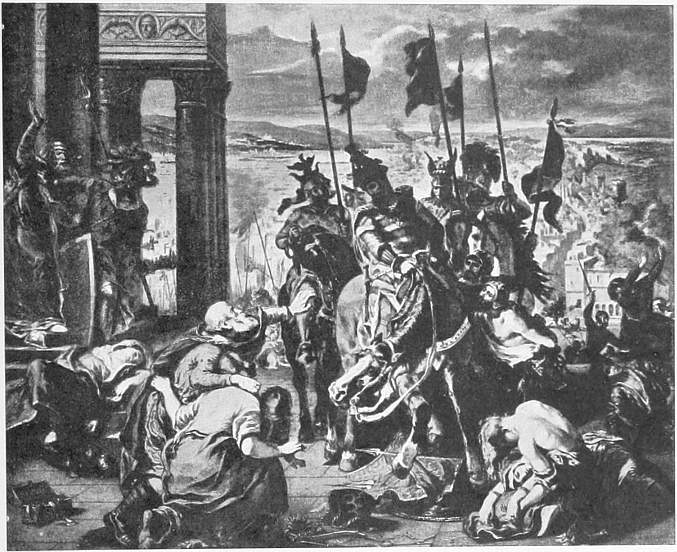
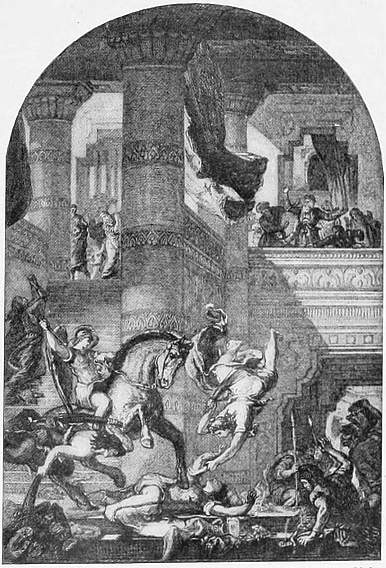
DELACROIX. ENTRY OF THE CRUSADERS INTO CONSTANTINOPLE.
The journey to Morocco, which he made in the spring of 1832, in company with an embassy sent by Louis Philippe to the Emperor Muley Abderrahman, is noteworthy for a further progress in his ability as a colourist and a new broadening of his range of subjects. When he returned to the port of Toulon, on 5th July 1832, he had seen Algiers and Spain, and had assimilated an abundance of sunshine and colour. It is in his Oriental pictures that his painting first reaches its zenith, just as Victor Hugo’s mastery over language was at its highest point in his Orientales. Goethe, in his West-östliches Divan, celebrated what is quiet and contemplative in the Oriental view of life. Obermann sang of the land of legend, of buried treasures, of Aladdin and the wonderful lamp; but for Byron (who was practically the first to introduce into Europe the perfume and colour of the East), for Hugo, and for Delacroix, it was the distant, bright-hued, barbaric land of the rising sun, the land of sanguinary warfare and overthrow, the home of light and colour. Here it was that the French Romanticists found the world that realised their dreams of colour. The East became for them what Rome had been for the Classical school. From the feeble and misty sun of Paris, and from the grey skies of the Boulevard des Italiens, they turned to Africa.
His enthusiasm for this newly discovered world resounds, full and clear, in Delacroix’s letters. “Were I to leave the land in which I have found them,” he wrote, during his stay in Morocco, of the men whom he saw about him there, “they would seem to me like trees torn up by the roots. I should forget the impressions I have received, and should be able only in an incomplete and frigid manner to reproduce the sublime and fascinating life which fills the streets here, and attracts one by the beauty of its appearance. Think, my friend, what it means to a painter to see lying in the sunshine, wandering about the streets and offering shoes for sale, men who have the appearance of ancient consuls, of the reincarnated spirits of Cato and Brutus, who lack not even that proud, discontented look which those lords of the world must have had. They possess nothing save a blanket in which they walk, sleep, and are buried, and yet they look as dignified as Cicero in his curule chair. What truth, what nobility in these figures! There is nothing more beautiful in the antique. And all in white, as with Roman senators or at the Greek Panathenæa.”
His palette was thus further enriched in lucid tints, the contrasts he formerly delighted in became less sharp and glaring, the gloomy background hitherto preferred was superseded by a bright serenity and a golden lustre. The colour-effect of his “Algerian Women” has been not unaptly compared to the impression produced by a glance into an open jewel casket. In his “Convulsionaries of Tangier” he has depicted with wild, demoniac energy the religious frenzy of a Turkish sect. Green, blue, red, and violet hues unite to produce an effect as of a sounding flourish of trumpets, recalling the music of the janizaries. The “Entry of the Crusaders into Constantinople” resembles an old delicately tinted carpet, full of powerful, tranquil harmony. Even in his old age he wrote: “The aspect of that country will be for ever before my eyes; the types of that vigorous race will move in my memory as long as I live; in them I truly found the antique beauty again.”
Baschet.
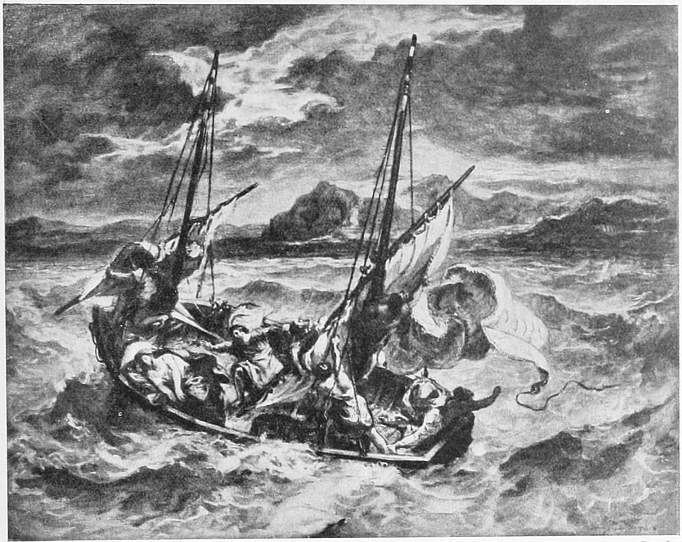
DELACROIX. JESUS ON LAKE GENNESARET.
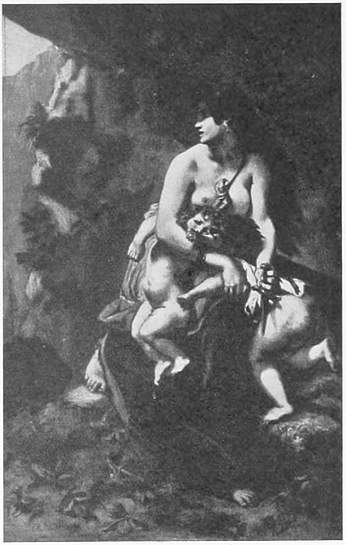
The contemplation of such scenes induced Delacroix to undertake the representation of antique subjects, which he had hitherto avoided, not because he disliked the antique, but because of the aversion he felt for David’s treatment of it. During his sojourn in Africa he had come to the conclusion that the painting of scenes from ancient history should not be based upon the imitation of statues and bas-reliefs, as with David and his pupils; but that it should be imbued with the movement and passion of modern life, since the ancient Greeks were men of flesh and blood like ourselves. Therefore it is that he snatches the marble mask from the faces of David’s puppets. Flemish blood begins to move in the Greek statues, Flemish passion to break through their inflexible rhythm. Paintings such as the “Justice of Trajan” of 1840 represent the antique in a thoroughly personal and modern paraphrase, just as Shakespeare or Byron had seen it. The mad “Medea” is, from the point of view of colour, certainly the chief work of this group.
It was of course impossible that a man so highly endowed with emotional pathos should pass untouched the tragedy of the life of Christ and the sufferings of the Christian martyrs. By the Revolution religious themes had been absolutely excluded from representation, and up to this time the young innovators of the Restoration period had also felt an aversion for them. Their ideas were as little attuned to Catholic as to academic tradition. Delacroix was the first to treat once more of biblical subjects, so far as they are imbued with dramatic and passionate movement. Like Rubens, he regarded the lives of the saints, the story of the Gospels, and the tragedy on Golgotha as a poetical narrative like any other. His Mary, like that of the Flemish painters, is a sorrowing woman, the embodiment of unending grief.
Alongside of these easel pictures he produced, during a period of more than twenty-five years, a long list of monumental and decorative works; and they too were the most inventive, the boldest, and the most original which monumental painting produced during this epoch, not in France only, but in Europe. In this sphere also, where, under the pressure of old traditions and conventional types, it is so difficult to avoid plagiarism, Delacroix maintained his individuality. In 1835, at the suggestion of his friend Thiers, he was commissioned to paint the interior of the Chamber of Deputies in the Palais Bourbon—the most important commission which had fallen to the lot of any French artist since Gros painted the cupola of the Pantheon. Not long afterwards he decorated with verve and enthusiasm the ceiling of the Louvre, choosing for his subject the “Triumph of Apollo.” In the Library of the Luxembourg he had recourse to the Divina Commedia, and treated in a masterly manner the theme so familiar and sympathetic to him. In his works there is something of the joyous and sportive energy of Rubens’ allegorical pictures, but not the least trace of imitation. He understood decorative painting in the sense of the great old masters, Giulio Romano and Veronese, not as wall didactics and lectures on archæology; he knew that descriptive prose has nothing whatever to do with the walls of a building, but that the sole aim of such paintings is to fill the house with their solemn grandeur, to make the whole building resound as it were with sacred organ music. Between 1853 and 1861 came also the wall paintings in the Church of Saint Sulpice, and one would almost think that Delacroix finished them in feverish excitement, to show for the last time how enormous a store of passion and power still lay in the soul of a sexagenarian. Shortly after their completion, on 13th August 1863, he died, who was, in the words of Silvestre, “the painter of the genuine race, who had the sun in his head and a thunderstorm in his heart, who in the course of forty years sounded the entire gamut of human emotion, and whose grandiose and awe-inspiring brush passed from saints to warriors, from warriors to lovers, from lovers to tigers, from tigers to flowers.”
Baschet.
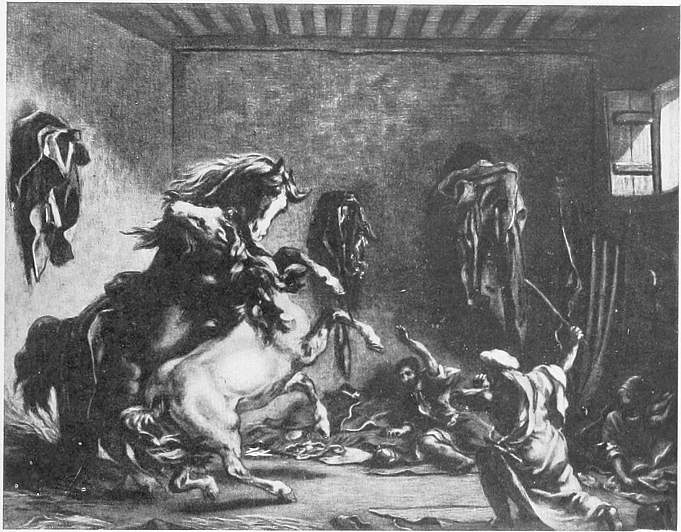
DELACROIX. HORSES FIGHTING IN A STABLE.
In these words Delacroix is very aptly characterised. His range of subjects included everything: decorative, historical, and religious painting, landscape, flowers, animals, sea pieces, classical antiquity and the Middle Ages, the scorching heat of the south and the mists of the north. He left no branch of the art of painting untouched; nothing escaped his lion’s claws. But there is one bond uniting all: to all the figures for which he won the citizenship of art he gave passion and movement. His predominant quality is a passion for the terrible, a kind of insatiability for wild and violent action. His over-excited imagination heaps pain, horror, and pathos one upon another. The critics called him “the tattooed savage who paints with a drunken broom.” There is nothing pretty or lovable about his art; it is a wild art. He depicted passion wherever he found it, in the shape of wild animals, stormy seas, or battling warriors; and he sought it in every sphere, in nature no less than in poetry and the Bible. Hardly any painter—not even Rubens—has depicted with equal power the passions and movements of animals: lions in which he is own brother to Barye; fighting horses, in which he stands side by side with Géricault. No other artist painted waves more grand, wind-beaten, foaming, dashing, towering on high. Looking at them, one divines all the horrors concealed beneath the roar of the blue surface, horrors which were as yet so insufficiently suggested in Géricault’s “Raft of the Medusa.” In his historical pictures there reigns now terror and despair, as in the “Massacre of Chios”; now gloomy horror, as in the “Medea”; now feverish movement, as in the “Death of the Bishop of Liège.” He passes from Dante to Shakespeare, from Goethe to Byron, but only to borrow from them their most moving dramatic situations—Hamlet at Yorick’s grave, his fight with Laertes, Macbeth and the Witches, Lady Macbeth, Gretchen, Angelica, the Prisoner of Chillon, the Giaour, and the Pasha. All time is his domain, all countries are open to him; he hurries through the broad fields of imagination, a lordly reaper of all harvests.
Baschet. L’Art.
DELACROIX. MEDEA. DELACROIX. THE EXPULSION OF HELIODORUS.
And at the same time, in all his great human tragedies, he compels the elements to obey him as if they were his slaves. The passions of men set heaven and earth in motion. The agonising cries of victims find in his paintings an echo in the sullen shadows and the leaden, heavy clouds of the sky. The gloomy shores which Dante’s boat is approaching are as desolate as the spirits who wander through the night. But where splendour and glory reign, as in the “Entry of the Crusaders into Constantinople,” the air, too, glistens and shines as though saturated with dust of gold. In his pictures a human soul which was great and full of meaning, and which possessed such combustibility that it took fire of itself, expressed itself recklessly, with the volcanic strength of an elemental power.
This proud self-reliance explains also how it was that this painter of unruly genius was, as a man, very far from being a revolutionist. For Delacroix the outer world had no existence; that world alone existed which was within him. After his picture of “The Barricades” in 1831 he avoided all political allusions, painted, read, and led a tranquil, measured, uniform life. In society polite and reserved, of aristocratic coldness, gentlemanly in appearance, and well-bred; in his speech curt, mordant, emphatic, and occasionally witty, he could nevertheless show himself, when he chose, an amiable, original talker, full of piquant ideas. Moreover, he was a great writer and critic, whose essays in the Revue des Deux Mondes have the perfect classic stamp. Nevertheless, he was always displeased when any one put him forward as the chief of official Romanticism, and saluted him as the Victor Hugo of painting. Surrounded as he was by young assailants of tradition who would allow no merit to anything old, he found pleasure in acknowledging his admiration for Racine, whom he knew by heart, and whom, when need was, he defended against the younger generation. He was too diplomatic to stir up against himself unnecessarily the hatred of those whom the long-haired Samsons of Romanticism called Philistines.
So far as in him lay, his quiet and methodical life should suffer no interruption. Worshipper though he was of light and colour, he was almost always shut up in his gloomy studio, and it was only when he found himself brush in hand that the reserved man became the passionate, vibrating painter. Then the memories with which his study of the poets had stored his mind grew in his fantasy into grand pictures glowing with life. By these visions he was excited, set on fire, and filled with enthusiasm. His studio was open but to few, for the intrusion of visitors chilled his inspiration, and he found it difficult to recover the proper frame of mind. Not till evening did he take his first meal, for he thought he could work with greater intensity when hungry. During a period of forty years he lived in his various studios, quiet and solitary, inventing, drawing, and painting without intermission, his door always bolted, so that when it suited him he could give out that he was ill of a fever. Every morning before work he drew an arm, a hand, or a piece of drapery after Rubens. He had formed the habit of taking Rubens to himself when other people were drinking their coffee.
Indeed, when one speaks of Delacroix, the name of Rubens rises almost involuntarily to one’s lips; and yet there is a profound difference between him and the great Flemish master. Rubens has the same passion, the same ever-active fancy; yet all his pictures rest in triumphant repose, while every one of Delacroix’s seems to resound as with a cry of battle. Looking at Rubens’ works you feel that he was a happy, healthy man; but by the time you have seen half a score of Delacroix’s it is borne in upon you that the life of the artist was one of strife and suffering. Rubens was the very essence of strength, Delacroix was a sick man; the former full of fleshly joyous sensuality, the latter consumed by a feverish internal fire.
His portrait of himself in the Louvre, with its pale forehead, its large dark-rimmed eyes, its lean, hollow face, its parchment-like skin stretched tightly over the bones, explains his pictures better than any critical appreciation. Delacroix was one of the âmes maladives, the spirits sick unto death, to whom Baudelaire addresses himself in his Fleurs du Mal. Delicate from his youth up, thoroughly nervous by nature, he prolonged his sickly existence throughout his life by sheer energy of will. Even in his childhood he passed through serious illnesses, and later on he suffered in turn from his stomach, throat, chest, and kidneys. Like Goethe in his old age, he felt well only when the temperature was high. He was short in stature. A leonine head, with a lion’s mane, surmounted a body that seemed almost stunted. With his eyes flashing like carbuncles, and his disordered prickly moustache, his was the fascinating ugliness of genius.
It was only by the strictest dieting in his quiet retreat at Champrosay that he prolonged his life for the last few years. In his youth he hovered like a butterfly from flower to flower; when grown old and hypochondriacal he withdrew into solitary retirement, work was the only medicine for diseased conditions of all kinds, to which he found himself daily more and more a victim. Only thus could this sickly man, doomed from his very birth, come to produce no less than two thousand pictures—a number all the more astonishing as Delacroix, even when his health permitted him to work at his easel, by no means possessed Rubens’ sovereign facility of production. The fever of work alternated, in his case, with the extremest exhaustion. There was something morbid, nervous, over-excited in all he did. “Even work,” he writes, “is merely a temporary narcotic, a distraction; and every distraction, as Pascal has said in other words, is only a method which man has invented to conceal from himself the abyss of his suffering and misery. In sleepless nights, in illness, and in certain moments of solitude, when the end of all things discloses itself in its utter nakedness, a man endowed with imagination must possess a certain amount of courage, not to meet the phantom half-way, not to rush to embrace the skeleton.”
The feverish disposition which he brought with him into the world was heightened by the acrimonious feuds in which, as a painter, he was forced to engage, and which left great bitterness behind them in his mind. His life and his art were in accord, in as much as both were battles. It is not easy to live when one is always ill; not easy to meet with recognition when one proclaims the exact opposite of that which for a generation past all the world has held to be true. And Delacroix took not a single step to meet his opponents half-way. He did not trouble himself for a single moment to please the public; and therefore the public did not come to him. Controversies such as that which took place over the “Massacre of Chios” continued decade after decade, and the exhibition of each of his pictures was the signal for a battle. “No work of his,” writes Thoré, “but called forth deafening howls, curses, and furious controversy. Insults were heaped upon the artist, coarser and more opprobrious than one would be justified in applying to a sharper.” At Charenton, where he was born, is the Bedlam of France. Hence the epithet continually hurled at him by the critics, who called him the runaway from Charenton.
Until the year 1847 his pictures could without difficulty be excluded from the Salon. He irritated people by his violence, by the abruptness of his compositions, by his arrangement of figures with a view to pathos at the expense of plastic elegance; he displeased by the incompleteness of his works, which were regarded as sketches, not finished paintings. When Louis Philippe ordered a picture from his brush, it was on the express condition that it should be as little a Delacroix as possible. There was general ill-humour among the academicians when, at Thiers’ suggestion, he was commissioned to decorate the Palais Bourbon. And Delacroix, ambitious and sensitive as he was, was deeply hurt by every mortification of this kind, and affected by every gust of criticism as by a change of wind. Continually denounced in the newspapers, attacked, wounded, delivered over to the wild beasts, as he called it, he never had a moment of rest—he who, with his irritable temperament and fragile health, needed rest more than any man. It was not until almost all his works were brought together in the Universal Exhibition of 1885 that it became evident how great an artist this Delacroix was, whom his country for forty years had not understood, and to whom the Institute had closed its doors to the last. Yet he was no sooner dead than all with one voice proclaimed him a genius; his smallest drawing is to-day worth its weight in gold, while during his lifetime he seldom got more than two thousand francs for his largest paintings. His sketches, great works in small frames, have for the most part found their way to America. The sale of the pictures he left behind him produced three hundred and sixty thousand francs.
Delacroix, therefore, was victorious, but not as Rubens was; and his ceiling of the Louvre, with the “Triumph of Apollo,” one of his most remarkable works, strikes one almost as an allegory of his own life. What especially attracted and inspired the artist in this painting were the spasms and convulsions of the misshapen monsters which the god expels from the earth—the serpent twisting itself in movements of pain and fury, raising its head on high, hissing rage, and vomiting venom and blood. The god himself, who in the midst of a sea of light ascends into heaven in a golden chariot drawn by radiant steeds, shows in his sturdy limbs and attitude ready for defence, and in his wrathful face, no trace of the proud majesty and joyous splendour which Greece connected with the name of Apollo. He is a mortal who has fought and conquered, not a god who triumphs in tranquil power. He is Delacroix, not Rubens; a Titan, not an Olympian god.
L’Art.
J. A. D. INGRES.
The artistic power in Delacroix could in no wise submit to the confinement imposed by the French spirit of his time. It was not possible for a single man, though endowed with the most splendid courage, to overthrow in a moment all the traditions of French art. Any one who knows the French must feel that David’s Latin style could not so suddenly disappear out of their art, that it was not possible at a blow to banish all that had hitherto held sway and to replace it by its opposite. Ever since Poussin they had sought in Roman antiquity the formulæ of their art. The predilection which the Parisians have even to-day for the representation of Racine’s and Corneille’s tragedies, the admiration which even the most extreme Naturalists bestow upon Poussin and Lesueur, prove abundantly how deep Classicism is rooted in the flesh and blood of the French people. Brandes has remarked, very acutely, that, strictly speaking, even Romanticism was on French soil in many respects a Classical phenomenon, a product of French Classical rhetoric. “They never saw the dances of the elves, never heard the delicate harmony of their roundelays.” In Victor Hugo, the great opponent of Corneille, Corneille himself was re-embodied. He too is a draughtsman, constructs his poems like architectural works, chisels the form, polishes the verse, and confines his colouring within powerfully conceived Michelangelesque outlines.
Once the first eager impulse of the Romantic school had subsided, these old Classical tendencies showed themselves anew and with all the greater vehemence. Even Hugo’s dramas, with their predilection for all that is exuberant and monstrous, with their overflowing lyricism and sonorous pathos, became in the long run wearisome. He, who had hitherto been the idol of the young generation, was now called the Pater Bombasticus of the literature of the world.
Classicism found its poet and its muse. An unknown but very worthy young man, not endowed with wealth of imagination, but imbued with the most honourable intentions, came to Paris from the provincial town where he had grown to manhood, with a manuscript in his pocket. And François Ronsard’s Lucrèce, a tragedy from the antique, in its style sober and severe, reminding one of Racine, was represented amid thunders of applause, shortly after Hugo had been hissed off the stage. Enthusiastic admirers saw in it a glorious return to the great tragic drama of France, an emanation from the spirit of Corneille, and praised its clear, measured, and at once “classic and familiar” language. Together with its poet, the Classical reaction found its actress. In 1838 a young untrained child made her début at the Théâtre Français—a Jewish girl who had sung in the streets to the accompaniment of her harp. Rachel appeared upon the boards, and restored its former power of attraction to the old Classical repertoire, to the very tragedies which the Romantic school had banished from the theatre amid mockery and derision. The Cid, Mérope, Chimène, and Phèdre recovered their place upon the stage.
Seemann, Leipzig.
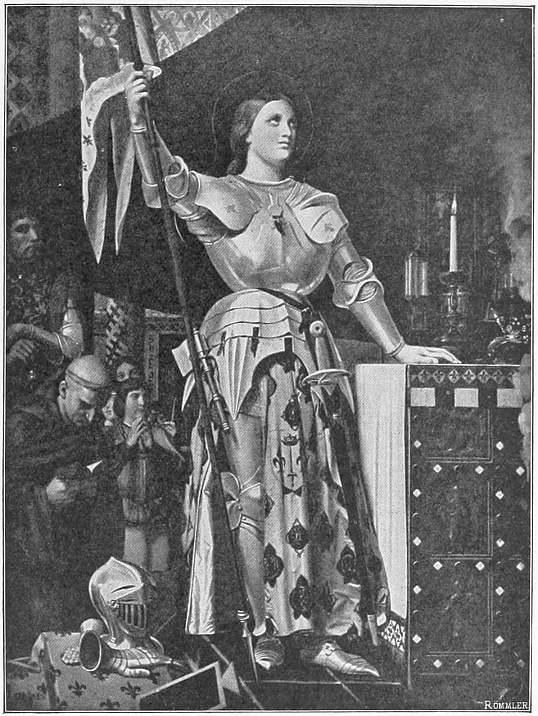
INGRES. THE MAID OF ORLEANS AT RHEIMS.
Painting took the same course. In opposition to the young painters who had burst into the arena with their gay-coloured uniforms, their gilded helmets and waving banners, Ingres came forth in the great tournament of Romanticism in the character of the Black Knight. An old gentleman, a man who in all his being belonged to the generation that was passing away, who was fifty years of age at the time of the Revolution of July, stations himself suddenly as the angel of the flaming sword, or, in the phrase of his opponents, as the gendarme of Classicism, at the gates of the Academy, barring them against every suspicious-looking person. And the young men, eccentric, eager for action as they were, who had recently fought with so much fury, had to retreat before him. Golden sunshine and glow of colour were once more tabooed, and their representative heroes, Veronese, Rubens, and Delacroix, regarded as flickering Will o’ the Wisps, whom every aspiring beginner should avoid as serpents and firebrands. One day when Ingres was taking his pupils through the Louvre he said, on entering the Rubens gallery: “Saluez, messieurs, mais ne regardez pas.” The acrimony of the strife was so great that it extended even to the personal relations of the rival chiefs, and Ingres was attacked by convulsive spasms whenever he heard the name of the painter of the “Massacre of Chios.” When in 1855 he had had a separate room prepared for his own pictures in the Universal Exhibition of that year, and observed Delacroix in the distance, just before the opening ceremony, he asked the attendant: “Has not somebody been here?—there is a smell of brimstone.” “Now the wolf is in the sheepfold” was his observation when Delacroix was elected to the Institute. He regarded him as the “hangman,” as the Robespierre of painting. “I used to love that young man, but he has sold himself to the evil one” (Rubens), said he, in righteous indignation, to his pupils.
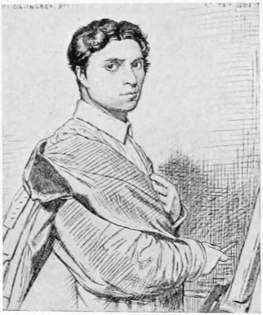
INGRES. PORTRAIT OF HIMSELF AS A YOUTH.
“This famous thing, the Beautiful,” Delacroix had once written, “must be—every one says so—the final aim of art. But if it be the only aim, what then are we to make of men like Rubens, Rembrandt, and, in general, all the artistic natures of the North, who preferred other qualities belonging to their art? Is the sense of the beautiful that impression which is made upon us by a picture by Velasquez, an etching by Rembrandt, or a scene out of Shakespeare? Or again, is the beautiful revealed to us by the contemplation of the straight noses and correctly disposed draperies of Girodet, Gérard, and others of David’s pupils? A satyr is beautiful, a faun is beautiful. The antique bust of Socrates is full of character, notwithstanding its flattened nose, swollen lips, and small eyes. In Paul Veronese’s ‘Marriage at Cana’ I see men of various features and of every temperament, and I find them to be living beings, full of passion. Are they beautiful? Perhaps. But in any case there is no recipe by means of which one can attain to what is called the ideally beautiful. Style depends absolutely and solely upon the free and original expression of each master’s peculiar qualities. Wherever a painter sets himself to follow a conventional mode of expression he will become affected and will lose his own peculiar impress; but where, on the contrary, he frankly abandons himself to the impulse of his own originality, he will ever, whether his name be Raphael, Michael Angelo, Rubens, or Rembrandt, be sure master of his soul and of his art.”
As compared with the principles thus laid down, Ingres represents the revulsion towards that formalism which had borne sway over the greater part of the history of French art. “Painting is nothing more than drawing,” said Poussin. “Had God intended to place colour at the same height as form,” wrote Charles Blanc, “He would not have failed to furnish His masterpiece, Man, with all the hues of the humming-bird.” Once more, instead of the glowing colour of the Romantic school, absorbing the form into itself, the firm stroke of the outline was set forth; instead of its pathos, breathing forth passionate emotion, men returned to study the chill tranquillity of stone. Once more dramatic composition and mastery over movement were held in abhorrence, as incompatible with that pursuit of plastic beauty which was the highest goal of art. The only point in question was, how to avoid the one-sidedness of Classicism. David, as a child of the Revolution, had naturally been limited to Ancient Rome; but now that the legitimate monarchy had been re-established there was no reason why one should not revere, not only pagan, but also Christian Rome, and in Raphael and Michael Angelo the maturest blossom of the latter. Thus the Classical school was enriched by Ingres with features of greater vivacity. He entered into a direct relationship with the great Italian masters, while David had none save with the rigid Roman antique. By him the Classical severity of David was relaxed, the refractory sharpness of the outlines relieved by a treatment of form which had the effect of making every figure appear to be worked in metal.
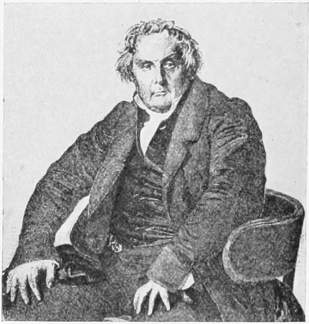
INGRES. BERTIN THE ELDER.
(By permission of M. Jules Bapst, the owner of the picture.)
Ingres was born in 1781, under the Ancien Régime. As a young man he lived through the triumphs of the Empire and the Classical school, and it was only natural that he should become David’s pupil. In 1796 he entered his studio, and studied there with such assiduity that he never noticed what was taking place in that of Gros. When he went to Italy he studied there the masters whom his own teacher had arrogantly despised. He learned from the Cinquecento how to draw and model more accurately, more firmly, and at the same time with a more intimate grasp of the subject than was usual in the school of David. This innovation made him a progressive Classicist, and gave him, during the early years of the Restoration, almost the appearance of an assailant and revolutionary. Himself the incarnation of the academic spirit, he had to resign himself to see his first works rejected by the Salon, a fact which did not deter him from continuing to work obstinately at his easel. “Je compte sur ma vieillesse; elle me vengea.” And this revenge was granted him in the fullest measure.
When one has seen the outward appearance of a man, one knows his character, his spirit, and his genius. Ingres’ portrait of himself contains the analysis of his art. He was quite a small man, of a swarthy complexion, with features sharp and as if cast in bronze. His thick black hair stood up stubbornly on end, so that he had to grease it carefully every day. Under hair of this kind there is almost always an obstinate brain. The jaws projected, as is the case with men endowed with a strong will. The eyes were large and piercing, with that bold eagle-glance which fills parents with fond hopes, but does not touch the hearts of young women. When he appeared to be excited, it was only the excitement of work expressing itself in him. This little man, in his large cloak, seemed to say when he stood at his easel, pencil in hand: “I shall be a great painter, for I am determined to be one.” He kept his word. Strength of will, hard work, study, obstinacy, patience—these are the elements of which Ingres’ talent is compounded. “Vouloir, c’est pouvoir,” was his motto. One would think Buffon had had him in mind in that passage in which he defines genius as patience. The trinity-in-unity of his qualities consisted of correctness, balance, exactness; qualities which go to make rather a great architect or mathematician than an interesting painter.
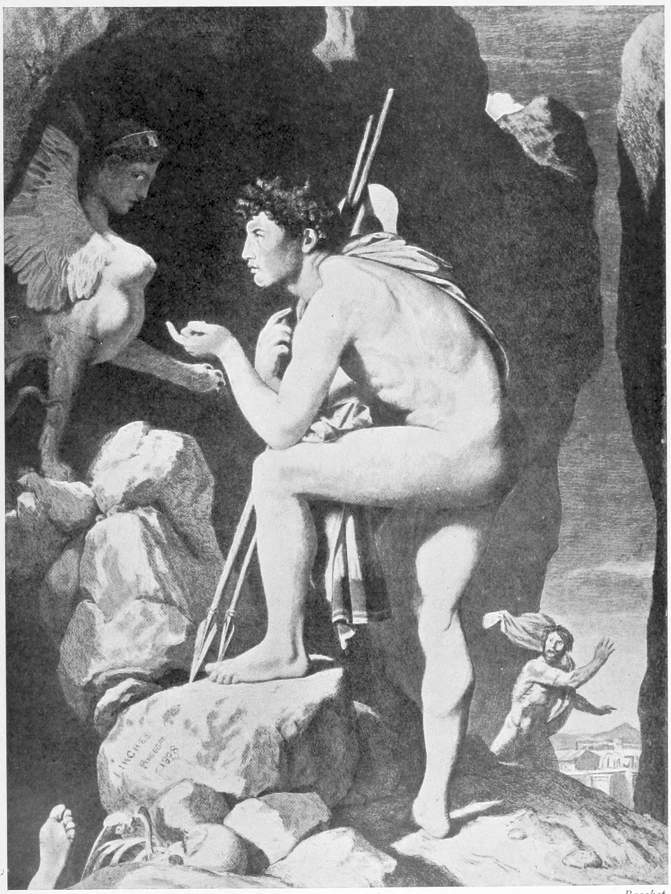
Ingres’ range of subjects was unusually wide. Pictures on themes taken from antiquity (“Œdipus and the Sphinx” and “Virgil reading the Æneid”); costume pictures (“Henry IV and his Children” and the “Entry of Charles V into Paris”); religious paintings (Madonnas, “Christ giving the Keys to St. Peter,” and “St. Symphorian”); nude female figures (the “Odalisque,” the “Liberation of Angelica,” and “The Source”); allegories (“The Apotheosis of Homer” and “The Apotheosis of Napoleon”); pictures of public functions (“Bonaparte as First Consul” and “Napoleon on the Throne”); and even a painting taken from the life (“Pius VII in the Sistine Chapel”), are included in the list. Yet, notwithstanding his astonishing diversity of themes, there is hardly an artist more one-sided in his principles. Ingres thought exclusively of purely plastic art: beauty of form and harmony of line alone attracted him; he was insensible to the charm of colour. His standpoint was the Institute of Rome; the Italian Cinquecento the exclusive object of his worship. He carried this study as far as plagiarism, and as director of the Roman Academy made free with the intellectual property of the Cinquecento masters, as if they had lived only on his account.
When Delacroix was painting the “Expulsion of Heliodorus” in Saint Sulpice, he put forth the whole strength of his creative genius to avoid all reminiscence of Raphael’s fresco. Ingres’ power of invention consisted in discovering, with a weird certainty, whether the subject of which he wished to treat had already been painted by an Italian or other Classical master. The picture “Jupiter and Thetis,” of 1811, is put together after a design on a Greek vase, and represents in its studied archaism the Æginetan period of his art. The “Vow of Louis XIII,” of 1824, was his confession of faith as regards the Cinquecento. The motive was taken from the Madonna di Foligno, the curtains from the Madonna di San Sisto, the floating angels from the Madonna del Baldacchino, and the candlesticks as well as the little angels with the inscribed tablet are from the same source. It is all beautiful, of course, for it is all Raphael; only, it would have been more rational if Ingres had lived in the time of Raphael instead of in the nineteenth century. One would take the picture to have been painted under Raphael’s eyes, and it bears to his works the same relation as Raphael’s earlier pictures do to Perugino’s. The “Christ giving the Keys to St. Peter” is also put together out of elements derived from the school of Urbino. In his “St. Symphorian,” which was belauded as the ne plus ultra of style, he turned by way of variety to the imitation of Michael Angelo: the action is violent, the muscles swollen. The “Apotheosis of Homer” is an admirable lecture in archæology, a sitting of the great academy of genius, in which the poses are so fine and the heads so full of marble idealism that in comparison with it Raphael’s “School of Athens” has the effect of the wildest naturalism.
Gaz. des Beaux-Arts. Gaz. des Beaux-Arts.
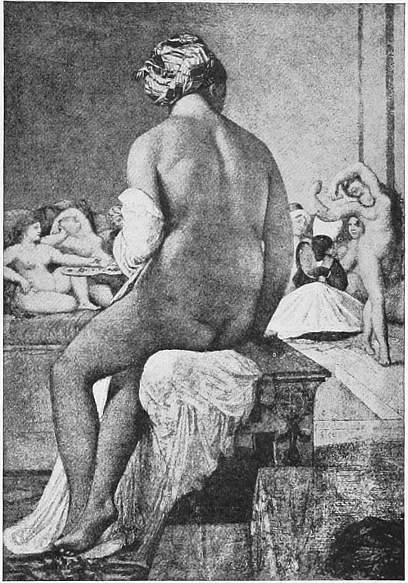
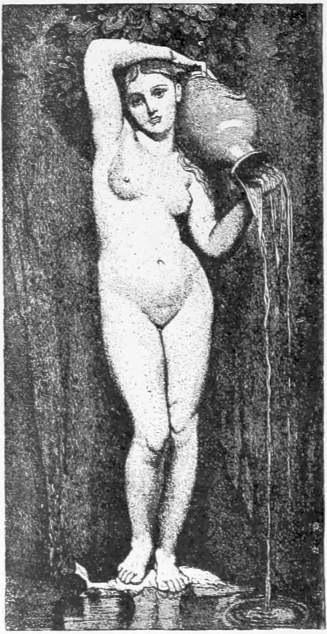
INGRES. STUDY FOR THE ODALISQUE IN THE LOUVRE. INGRES. THE SOURCE.
Thus Father Ingres stands forth as a cold, stiff, academic painter, as a doctrinaire who has not progressed much further than the much-reviled David. He represents, as Th. Rousseau said, only to a moderate degree the good old art which we have lost. In the words of Diaz: “Let him be shut up with me in a tower, without engravings, and I wager that his canvas will remain untouched, whilst I shall succeed in producing a picture.” He possessed an arid ability which leaves one cold in presence of even his most important works. How lifeless is the effect produced by his paintings of nude single figures, his “Odalisque” and his “Freeing of Andromeda,” which brought him especial fame! Ingres could not paint flesh, and in this respect he is indicative of an enormous retrogression as compared with Prudhon. The striving after sculpturesque beauty, and, in connection therewith, the repression of all individuality, became in him almost a religion.
One finds it difficult to-day to account for the fame which once belonged to his picture of “The Source,” the nude figure of a standing girl pouring water out of an urn that rests on her left shoulder and is steadied by her right arm raised over her head. The picture undoubtedly exhibits qualities of draughtsmanship which in recent days Ingres alone possessed in so high a degree. But when, in pursuit of his Classical conception, he had eliminated every touch of nature, he proceeded to destroy the rest of the impression by the cold violet tones which are not only condemned by colourists, but which even Raphael would have considered false and ugly. Here, as in all his female figures, he attains to a certain grace, but it is an animal, expressionless grace. Skilful as he was in delineating the muscles of the human body, he was yet absolutely incapable of painting heads expressive of feeling or emotion. He depicted the form in itself, the abstract, typical, absolute form. He was dominated only by a love for the beauté suprême, so that when he was in presence of nature he could not refrain from purifying and generalising. Everywhere we see beautiful lines, bodies modelled with admirable skill, but we never enter into any closer relationship with his figures. They do not live our life or breathe our atmosphere; they have not our thoughts: they are foreign to all that is human. Jean Auguste Dominique Ingres, Member of the Institute, Senator, etc., the stylist held in honour as a superior being, the high-priest of pure form and outline, will in all times command the esteem, and in some respects the admiration, of the student of the history of art; the enthusiasm, never.
Baschet.
INGRES. ŒDIPUS AND THE SPHINX.
Gaz. des Beaux-Arts. Gaz. des Beaux-Arts.
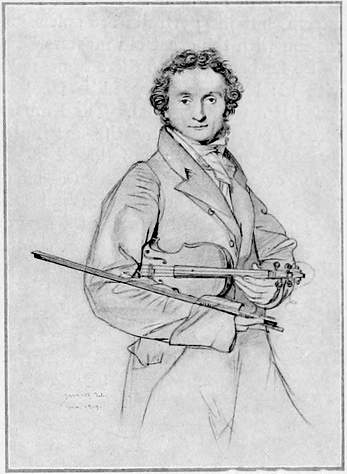
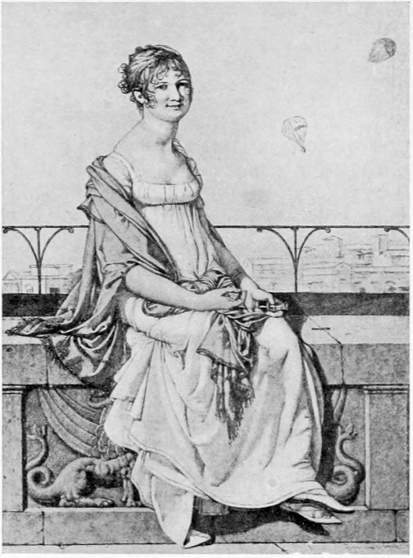
INGRES. PAGANINI. INGRES. MLLE. DE MONTGOLFIER.
And yet, notwithstanding all this, I am an enthusiastic admirer of Ingres. Indeed, it has happened to me, in the collection of engravings at the Louvre, to catch myself saying: “Ingres! great, beloved Master! I have much to ask your pardon; for you were one of the greatest and most refined spirits to whom the century has given birth.” For I doubt whether any one down to the present time has rightly understood the mysterious figure of Ingres, the man who in his youth was enraptured by “l’esprit, la grâce, l’originalité de Vataux et la délicieuse couleur de ses tableaux,” and who, at a later time, not because of failing powers but deliberately and of set purpose, adopted a calmer system of colour tones; of this Classicist par excellence, who is counted among the greatest artists, in the familiar and graceful style, in the history of art.
Ingres is one of the rare masters whom even their opponents are forced to admire. In the stern, sculpturesque modelling of his naked figures he displays remarkable power. His painting, also, has a curiously intimate appeal, due to its cool, metallic harmonies of colour—light blue, rose, and pale yellow in particular.
But above all Ingres commands attention by his portraits. From his first residence at Rome, that is, from the beginning of the century, he painted portraits which imprint themselves on the memory like medals struck in metallic sharpness in the style of Mantegna. Here too he is unequal, at times cold and commonplace, but usually quite admirable. In these paintings, cast as it were in bronze, there is something that comes from the fresh original source of all art; they have that vein of realism by which the vigorous idealism of Raphael is distinguished from the conventional idealism of a professor of historical painting. Here one finds real treasures, creations of remarkable vital power, and in admirable taste. They show that Ingres, apparently so systematic, had a profound love for living nature, and they ensure the immortality of his name. His historical pictures are works which compel our esteem, but his portraits are splendid creations which can truly stand comparison with the great old masters.
So far back as 1806 there appeared in the Salon his likeness of Napoleon I, with his bloodless, corpse-like face, enchased with such art that Delécluze called it a Gothic medal. The Emperor is seated like a wax figure upon the throne, surrounded by the attributes of majesty—stiff, motionless as a Byzantine idol. It was followed in 1807 by the portrait of Mme. Devauçay, which even to-day impresses the beholder most pleasingly, notwithstanding the pedantic style in which it is painted. One feels in it fire and youthfulness, the enthusiasm and ardour of a new convert, who has for the first time discovered in nature beauties other than those he had learnt to see in the Academy. Moreover, he possessed a very distinguished and personal taste in drawing. The face is of exquisite grace, the eyes tenderly seductive and delicately veiled. Ingres is already announced as he was afterwards to be.
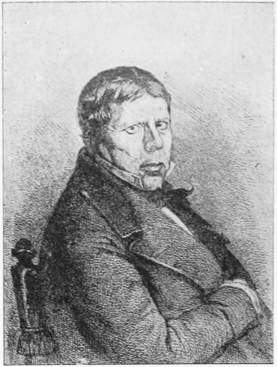
In Holbein’s portraits the whole German community of his time has been handed down to us; in Van Dyck’s, the aristocracy of England under Charles I. So also Ingres has depicted for us, with all its failings and all its virtues, the middle-class hierarchy of Louis Philippe’s reign, which felt itself to be the first estate, the summit of the nation, felt sure of the morrow, was proud of itself, of its intelligence and energy, which pursued with correctness its moral course of life, revered order and hated all excess—including that of the colourist. The same spirit animated this splendid bourgeois of art. His “Bertin the Elder” is justly his most celebrated, enduring work; not the mere painted petrifaction of a newspaper potentate, but one of those portraits which bring a whole epoch home to the mind. It tells of the triumph of the bourgeoisie under the Monarchy of July more fully and clearly than does Louis Blanc’s Histoire de Dix Ans. In the best of humours, with the four-square solidity of a knowledge of his own worth, which is full of character, this modern newspaper demi-god sits on his chair as on a throne, the throne of the Journal des Débats, like a bourgeois Jupiter Tonans, with his hands on his knees.
Baschet.
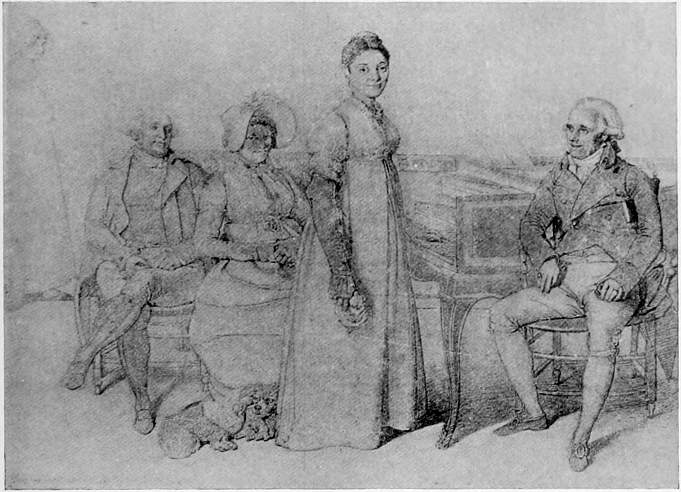
INGRES. THE FORESTIER FAMILY.
But however highly one must estimate the importance of such a work, Ingres is nevertheless at his highest, not in his painted likenesses, but in his portrait drawings. In the former the hard colouring is still, at times, offensive. Almost always the flesh looks like wood, the dress like metal, blue robes like steel. His drawings, from which this defect is absent, are to be admired without criticism. Ingres lived in his youth, at Rome, as a drawer of portraits. For eight scudi he did the bust, for twelve the whole figure, raging inwardly the while at being kept from “great art” by such journey-work. There is a story told of him, that when one day an Englishman knocked at his door and asked, “Does the draughtsman who makes the small portraits live here?” he shut the door in his face, with the words: “No; he who lives here is a painter.” To-day these small masterpieces of which he was ashamed sell for their weight in gold. In the Paris Exhibition of 1889 there was Mme. Chauvin with her Chinese eyes; Mme. Besnard on the terrace of the Pincio with her broad hat and her elegant sunshade; Mrs. Henting with her innocent smile of an “honnête femme”; Mrs. Cavendish, an affected young blonde, with her overladen travelling dress and her crazy coiffure. Strange, that a man like Ingres should rave so about new fashions and pretty toilettes!
In these pieces an artistic eye which was now inexorable, now tender and full of fancy, has looked on nature, and, in flowing pencil-strokes, has caught with spirit and with the certain touch of direct feeling the real fulness of life in what he saw. These drawings, especially the portrait of Paganini and “The Forestier Family,” show that Father Ingres possessed not only a highly cultivated intelligence and an iron strength of will, not only the genius of industry, but also a heart, a genuine, warm, and fine-feeling heart; that he was in his innermost being by no means the cold academician, the stiff doctrinaire he appears in his large pictures, and which he became by his opposition to the Romantic school. Here we have an enchanter such as the Primitives were and the Impressionists are, like Massys and Manet, like Dürer and Degas, like all who have looked Nature in the face. And while these drawings, at once occasional and austere, place him as a draughtsman on a level with the greatest masters in the history of art, they also show him, the reactionary, to be at the same time a man of progress, the connecting link between the great art of the first half and the familiar art which rules over the second half of the nineteenth century.

CHAPTER XI
JUSTE-MILIEU
As is usually the case, the heroes were succeeded by a generation less heroic and more practical. In this, art was in keeping with the deliberate and tranquil course of the state itself, which had fallen back again into the old groove, and with the homely, Philistine character assumed in the course of years by the citizen monarchy of the tricolour. The bourgeoisie which had effected the Revolution of 1830 was soon appalled at its own temerity. Even in literature it inclined towards a temperate and lukewarm mediocrity. It was astonished to find itself admiring Casimir Delavigne. It found in Auber and Scribe its ideal of music and comedy, as in Guizot, Duchâtel, Thiers, and Odilon Barrot its ideal of politics. The intellectual exaltation which had gone before and followed after the Revolution of July had calmed down, and that which was to rise out of the Revolution of February was as yet latent. The same elder generation which had looked upon Napoleon Bonaparte’s stony Cæsarian eye, when, like a god of war, unapproachable in his power he rode by at the head of his staff, now saw the Roi Citoyen, the long-exiled ex-school-master, homely and fond of law and order, as every day at the same hour he passed alone on foot and in plain clothes through the streets of Paris, the famous umbrella in his hand, rewarding each “Vive le Roi!” with a friendly smile and a grateful hand-shake. The umbrella became the symbol of this deedless monarchy, and the word “Juste-milieu,” which Louis Philippe had once employed to indicate the course to be followed, became the nickname of all that was weak and without energy, lustreless and undignified, in the age. The golden mean was triumphant in politics, literature, and painting.
The artists who gave this period its peculiar stamp constitute, as compared with the heaven-assaulting generation of 1830, only, as it were, a collateral female branch of that elder male line of good painting. To reconcile opposite tendencies, to avoid harshness, in short, to bring about an artistic compromise between Ingres and Delacroix, was the end towards which their efforts were chiefly directed.
Jean Gigoux, a remarkable artist, has the merit of having given the most effective support which Delacroix received in his battle against the beauté suprême of the Classical school. When, in the Universal Exhibition of 1889 at Paris, his picture of “The Last Moments of Leonardo da Vinci,” painted in 1835, emerged from the seclusion of a provincial museum, its healthy fidelity to nature was the cause of general astonishment. The personages indeed wear costly costumes, and are surrounded by wealth and magnificence, but they themselves are common, ugly human beings. Here there is no trace of idealism, not even in the sense of Géricault, who, notwithstanding his love of truth, remained faithful to the heroic type. The faces are, with religious devotion, painted exactly after nature by a man who evidently loved the youthful works of Guercino and had zealously studied Dürer. At the same time was exhibited the portrait of the Polish “General Dwernicki,” painted in 1833, whom also Gigoux depicts as a man, not as a hero. War has made him not lean but fat, and in Gigoux’s picture his red nose and prominent stomach are reproduced with cruel fidelity to nature. It is a declaration of war against every kind of idealism. Even in his religious paintings in Saint Germain l’Auxerrois he held fast to this principle, and this circumstance gives him a place to himself, apart from all the productions of his contemporaries. In a period which, with the solitary exception of Delacroix, was still absolutely devoted to the doctrine Exagérer la beauté, his works are of a healthy, soul-refreshing ugliness.
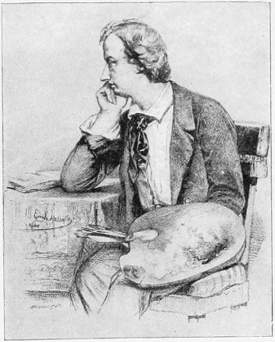
A portion of Delacroix’s charm in colour descended to Eugène Isabey. He is certainly not a great artist, but a delightful, sympathetic individuality, a painter who affords one pleasure even at this day. Amid the group of Classicists of his time he has the effect of a beautiful patch of colour, of a palette on which shades of tender blue, mauve, lilac, brilliant green, silver-grey, red faded by sunshine, and opalescent mother-of-pearl combine in subtle harmony. His pretty, picturesquely costumed ladies are grouped together in luminous gardens, sheltered by delicate half-shadows, or ascend and descend the castle stairs, letting their long trains sweep behind them, and toying gracefully with fan or sunshade; while gallant cavaliers do them homage, and with bent head whisper sweet nothings in their ears. The slender greyhound plays a special part in these aristocratic comedies; its straight lines give a counterpoise to the soft flowing costumes of his figures. Isabey is altogether in his element when he has to portray a ceremony requiring rich attire. Then he binds together, as it were, a bouquet sparkling with colour, shot with the hues of ample damask folds and heavy gold-embroidered silk. Now his colouring is chic, capricious, and coquettish, now it is that of the most delicate faded Gobelin tapestry. If he has to paint a sea-view, he rumples the waves about like a ball-dress and pranks the ships up in bridal attire. His very storms have a festal appearance, like the anger of a beautiful woman. One must not look for life in his pictures; they are to the truth much what Gounod’s Faust is to Goethe’s. Watteau is his spiritual ancestor; but he is not so full of life and wit as the painter of the gallant world of the eighteenth century. He does not depict his contemporaries, but the life of a vanished age; yet he has the same predilection for scenes of high life, and a studied, mannered gracefulness which is often charming and always pleasant to the eye. He shares with Delacroix the latter’s broad style, freedom from constraint, and delight in colour. But where Delacroix is rough and violent, Isabey is caressing and insinuating: they are not brothers, but distant cousins. And, like Delacroix, he had no imitators; he went on his bright and delightful path in solitude, and remained without companions in the little gilded house, lit up with fantastic lanterns, which he assigned to be the coquettish home of charming beings of both sexes.
L’Art.
ARY SCHEFFER.
A curious position, half-way between the Romantic and the Classical schools, was occupied by Ary Scheffer, who was, a generation ago, the favourite of the greater part of the aristocracy of Europe, but is now known, to the German public at least, only because he is said to have painted “with snuff and green soap”—a phrase of Heine’s, which, however, gives a very false impression of him. A German-Dutchman by birth, a Classicist by training, Scheffer in his youth came also in contact with the leading spirits of the Romantic school; and these various influences, of race, education, and intercourse, are clearly reflected in the faces of his figures. His forms are thoroughly classic and generalised; only the expression of the face is ideal, while the eye is romantic, and, Scheffer’s German blood making itself felt—sentimental. It was precisely this mid-way position which his contemporaries found so much to their liking. They called his painting a great art full of style, uniting the sentiment of ideal beauty with a captivating power of expression. But history cares but little for these men of compromise, and regards this indecision as the chief defect of his genius. Scheffer’s draughtsmanship is dry and hard, his colouring without tenderness or charm. These failings are ill-assorted with the attitudes and physiognomy of his figures, which have always an affectation of weakness, exhaustion, and moral suffering. He is a sentimental Classicist, and his subjects the antithesis of the Græco-Roman ideal to which he does homage in his technique. His “Suliote Women” was already, in sentiment, form, and colour, only a subdued and weakened reminiscence of the “Massacre of Chios.” At a later time he entirely forsook historical subjects (such as “Gaston de Foix” and others), and attached himself with enthusiasm to the Gospels and to the works of the poets, especially of one poet. When he had recourse to the Bible as a source of inspiration, he selected tender episodes, the sadness of which he transmuted into tearfulness. So also, when he represented scenes from Faust or Wilhelm Meister, he gave to Goethe’s animated and impassioned characters something melancholy, suffering, and contemplative. Heine said of his “Gretchen”: “You are no doubt Wolfgang Goethe’s Gretchen, but you have read all Friedrich Schiller.” Even before her fall, before she is in love, Marguerite is pensive and sad like a fallen angel. Mignon, Francesca da Rimini, and St. Monica were also favourite figures for his delicate and contemplative spirit. He alone in French art inclines a little, in his tearful sentimentality, to the Romantic school of Düsseldorf.
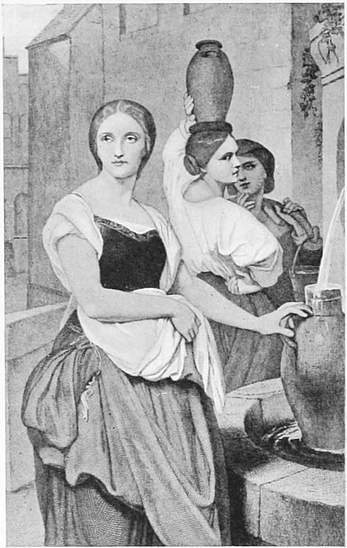
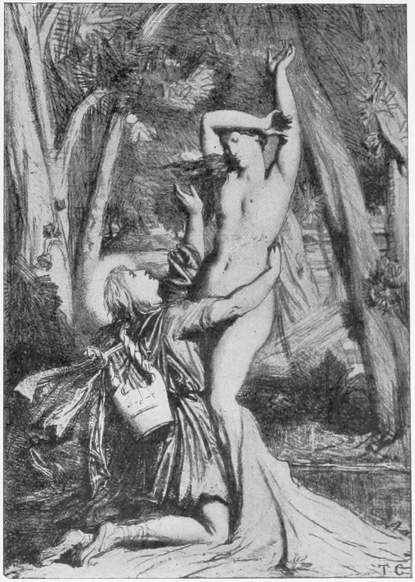
Gaz. des Beaux-Arts. Gaz. des Beaux-Arts.
ARY SCHEFFER. MARGUERITE AT THE WELL. CHASSERIAU. APOLLO AND DAPHNE.
Hippolyte Flandrin was the French counterpart of the German Nazarenes. He is an example of how Ingres’ teaching resulted in stiff conventionality. Ingres was a dangerous master to follow. His pupils formed round him a small, faithful, and submissive band, swore like those of Cornelius by the master’s doctrines, and for that very reason never attained to any distinctive character of their own. None of them possessed Ingres’ many-sided talent. His empire, like that of Alexander the Great, was divided among his successors, each of whom governed his own little realm with greater or less ability. Hippolyte Flandrin devoted himself to religious painting, which in his hands for the first time regained a greater importance in French art; but he followed much more slavishly than Ingres in the paths of the Italian masters of the fourteenth and fifteenth centuries. This painter, worthy of respect, full of conviction, learned and of sterling worth, but colourless and cold, who decorated the churches of St. Vincent de Paul and St. Germain des Prés, has enriched the history of art by no new gift. An indefatigable worker, but endowed with little intellectual power, he went no further than to follow out strictly the rules which Ingres taught his pupils and had himself acquired from the old masters. After Flandrin, as winner of the Prix de Rome in 1831, had become intimately acquainted with the art treasures of Italy, he seldom met with any difficulty. His cartoons are flowingly and correctly executed with a firm hand, like the fair copy of a school essay. Of draughtsmanship he knew all that is to be learned; he remembered much, arranged his reminiscences, and thought little for himself. He was a miniature copy of his master, at once more poorly endowed and more fanatical, a purely mathematical genius; his art is a cold geometrical knowledge, the adaptation of anatomical studies to conventional forms, an arrangement of groups and draperies in strict accordance with celebrated exemplars. Had not the primitive Italian masters, the painters of the ancient Christian catacombs, the saintly Fra Angelico, and the mosaic artists of Ravenna done their work long before him, Flandrin’s paintings would never have seen the light, any more than those of the Nazarene school. In both cases one can assign almost every face and figure to its original in the pictures of the Italian masters. Only a certain blond, tender, slightly melancholy, modern face of a Christian maiden is Flandrin’s peculiar property. He transferred these same ascetic and pure principles to portrait painting, and thereby acquired for himself a large practice as the painter of the femme honnête. These women conversed with him and blushed in his presence; in his pictures we find grace and delicacy, eyes sparkling or meek, tenderness and mocking laughter, all translated into a nun-like, unapproachable appearance, which under the Second Empire gained the greater approbation among ladies, since it was seldom found in real life.
Alongside of this Overbeck, endowed with greater artistic powers than his German congener, there stands as the French Cornelius Paul Chenavard, a man who revolved in his fertile brain philosophical conceptions deeper almost than those of the German master. He dreamed of broad, symbolical, decorative pieces, embracing all time and all space, wherein all the cosmogonies of the universe should be united. Like Cornelius, he wished to be a Michael Angelo, but he succeeded no better than the German. He spent fifteen years in the churches and museums of Italy, pencil in hand, accumulating a vast collection of studies, from which his great painted history of the world was to be built up. But when he went back to Paris his materials from the old masters had grown upon him to such an extent that he never recovered his individuality. For four years he worked with feverish diligence, and completed eighteen cartoons, each six metres in height and four in breadth, intended for the walls of the Pantheon. So far as colour is concerned, they have attained no greater success than the Campo Santo frescoes of Cornelius. Chenavard could draw much better than the German, but was not much better as a painter; the works of both have a literary rather than an artistic value.
Brief and brilliant was the career of Théodore Chassériau, who shot across the heavens of art like a gleaming meteor, first as a devotee of form, in Ingres’ sense of the word, and afterwards, like Delacroix, as an enthusiastic lover of sunshine and the clear light of Africa. Born in 1819 at St. Domingo, he followed his teacher Ingres in 1834 to the Villa Medici; but even in his first picture, the “Susanna” of 1839, now in the Louvre, he proved himself by no means an orthodox pupil. “He has not the least understanding for the ideas or the changes which have entered into art in our time, and knows absolutely nothing of the poets of recent days. He will live on as a reminiscence and a reproduction of certain ages in the art of the past, without having created anything to hand down to the future. My wishes and my ideas do not in the least correspond with his.” In these words Chassériau has himself pointed out what it was that distinguished him from Ingres. Unfortunately he produced but little. Personally a very elegant, blasé gentleman, he plunged on his return from Italy into the whirlpool of Parisian life. He was remarkably ugly; but his black, piercing eyes made him the idol of the ladies, and he hurried through life with such haste that he broke down altogether at the age of thirty-six. Beyond various decorative paintings for the church of Saint Méry and for the Salle des Comptes in the Palais d’Orsay, only a few Eastern pictures, and, best and most characteristic, a couple of lithographs, remain to represent his work. In these delicate mythological compositions a chord is struck which found no echo until, a generation later, it was heard again in the work of the French New Idealists and the English Pre-Raphaelites: there speaks in them a Romantic Hellenism, a something dreamily mystic, which makes him a remarkable link between Delacroix and the most refined spirit in the modern school, Gustave Moreau. It was purely an act of gratitude in Moreau when he affixed the dedication “To Théodore Chassériau” to his fine picture of “The Young Man and Death.”
Léon Benouville will be remembered only for his picture of the “Death of St. Francis,” in the Louvre, a good piece of work in the manner of the Quattrocento. Léon Cogniet deserves to be mentioned because in the fifties he brought together in his studio so many foreign pupils, especially Germans. He enjoyed above all others the reputation of being able to initiate beginners both quickly and with certainty into the peculiar mysteries of craftsmanship. All that a master can teach, and that can be learned from his example, was to be obtained from this kind and fatherly instructor. Even after he had long given up painting, his grateful pupils used to meet together yearly at a banquet given in the patriarch’s honour. As an artist he belongs to the list of the great men who have paid for overpraise in their lifetime by oblivion after their death. His “Massacre of the Innocents” of 1824—a woman who, mad with terror, thinks to hide herself and her child from the assassins of Bethlehem under an open stairway—could give pleasure only in a time which hailed with enthusiasm Ary Scheffer’s heads resembling plaster busts full of expression. Occasionally, too, he painted landscapes—the chimerical, vague creations of a man who had lived but little in the open air. His finest picture, “Tintoretto Painting his Dead Daughter by Lamplight,” of 1843, the engravings of which once enraptured France and Germany, has to-day a somewhat insipid effect, and shows whither his genius was leading him—in technique a coarser Schalcken, in sentiment a weaker Delaroche.
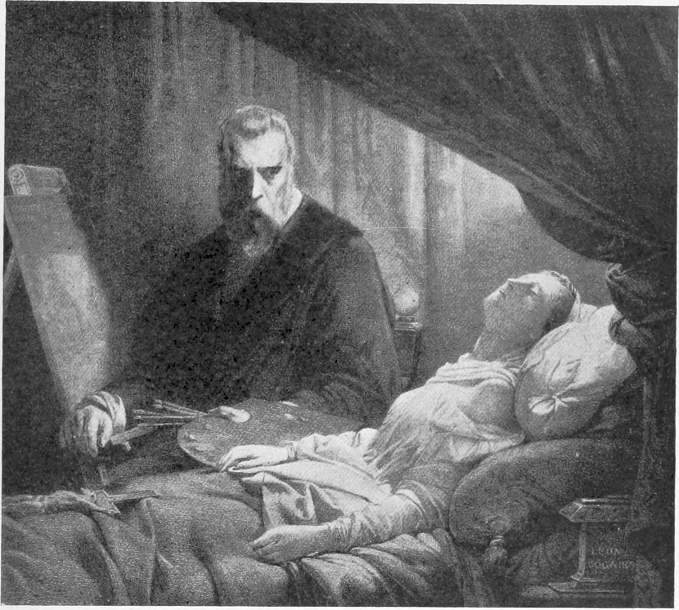
COGNIET. TINTORETTO PAINTING HIS DEAD DAUGHTER.
Delaroche was the Titian of Louis Philippe’s age, the spoiled child of the Juste-milieu, one of the most insignificant and at the same time one of the most famous painters of the century; and in this double capacity is an interesting proof that in art the “Vox populi” is seldom the “Vox Dei.” What a difference between him and the great spirits of the Romantic school! They were enthusiastic poets; their predilection for Mediævalism was concerned only with its æsthetic charm, with the twilight shadows of its picturesque churches, the sounding presage of its bells, the motley processions of that world gleaming bright with uninterrupted colour. And what further allured their imaginative powers was the unruly character of certain epochs, the destructive war of wild factions, and the blazing, consuming power of passion. The historical motive, as such, was with them only a pretext for launching forth into flashing orgies of colour, according to the example, which they followed merely in externals, of the Venetian and Flemish masters. They knew, as genuine painters, that only in the pigment on their palette slumbers that power of exciting emotion by means of which the art of painting touches the chords of men’s souls. Enthusiasts of colour and of passion, they raved about the poets merely because the latter more readily enabled them, by means of the fierce vehemence of the awakened powers of nature, to invest with form the feverish, agitated, and terrible dreams of their fantasy. So it was that Delacroix told of conflagration, of battle and warfare, of murder and pillage, of the bitterness and pains of love. At the same time, no doubt, he studied the vari-coloured costumes of past ages—his drawings show as much—but he made use of them simply as a storehouse of bright hues, as a lexicon by means of which he might embody his visions of colour. To manufacture historical vignettes and play the part of a teacher of history would have been in his eyes a thing to be held in contempt as the work of subservient illustrators. Yet perhaps it was by taking this very course that far greater successes were to be attained, so far as the verdict of the multitude is considered.
The decade following upon 1820 was a season of brilliant blossom for the art of writing history in France. By his History of the English Revolution, in 1826, Guizot won for himself a place in the foremost rank of French authors. He began in 1829 his famous lectures at the Sorbonne, and commenced in 1832 the publication of his Sources of French History. Even before him, Augustin Thierry had written in 1825 his History of the Conquest of England by the Normans, followed by Stories from the Merovingian Times, and was now engaged in the preparation of his great work, the History of the Origin and Progress of the Third Estate. Not unworthy to be compared with these writers, and soon to stand beside them, were two young men working in collaboration—Mignet and Thiers—who came to the front in 1823-24 with their History of the Revolution. At the impulse thus given, historical societies and unions had arisen in every province of France, and were developing an ever-increasing activity.
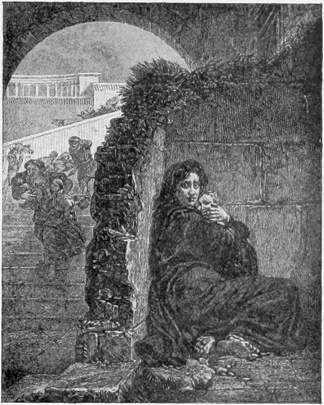
COGNIET. THE MASSACRE OF THE INNOCENTS.
What learning had begun, poetry carried further. A number of writers, young and old, began to consider what poetic use might be made of the materials which these investigations had brought to light, and few years had passed before the number of historical romances and dramas was hardly to be computed. Vitet, the elder Dumas, and de Vigny put historical tragedy in the place of classical, and the modern novel of George Sand, Balzac, and Beyle was ousted by the historical romance. During the same years was completed the process by which grand opera forsook fantastic for historical subjects, such as Auber’s Muette de Portici and Rossini’s Guillaume Tell.
Art also sought to turn to account the new materials furnished by historical science, and æsthetic minds hastened to enumerate the advantages which were to be expected of it. On the one hand—and this was nothing new—the artist, whose curse it was to be born in an inactive and colourless age, would find here all that he sought, for history offered him the contemplation of a magnificent life, full of movement. On the other hand—and this was the chief point—painting might also fulfil an important mission on behalf of culture, if by virtue of its more easily understood method it could supplement the science of history, and by recalling the great memories of the past keep alive that patriotism which in unfavourable conjunctures is so frequently found wanting. Guizot recommended French history, “the history of chivalry,” to painters, as the first and most important source of inspiration. “We want historians in the art of painting,” wrote Vitet; and his cry was not unheard.
While the Romanticists had seen in the old costumes nothing more than elements out of which a dashing colour-symphony could be obtained, troubling themselves little about the meaning or the narrative import of their pictures, their successors went over, bag and baggage, into the camp of the historians. In the place of pure painting, there arose an art laden with scientific documents, which busied itself in reconstructing former times with antiquarian exactness. While the former had produced nought but genuinely artistic colour-improvisations, so now a didactic aim, together with historical accuracy, became the main consideration. The painter was commissioned as a chronicler, an official of the state, to console citizens for the lamentable present by an appeal to the glorious past. He became a professor of history, a theatrical costumier who rummaged records, chose masks, cut out dresses, arranged scenic backgrounds, for no other purpose than to depict correctly and legibly on the canvas an historical event. And Mme. Tout le Monde found in these pictures exactly what she required. On the one hand, the didactic aim of historical painting, with its long explanations in the catalogues, answered precisely to the needs of the educated middle classes. Under the picture there was always a pretty card on which was printed this or that quotation from some historical writer. One read the description, and then satisfied one’s self that the corresponding picture was really there and that it was in keeping with the description. One recalled to mind the lessons in history one had learned at school, and was pleased to be reminded in so pleasant a fashion that before the nineteenth century people did not wear trousers and frock-coats, but knitted hose and mantles. On the other hand, there still survived enough of the Romantic unruliness to allow one to be shocked in a decorous and moderate manner, and with the help of the catalogue a picture might be permitted to make one’s flesh creep in an agreeable way.
L’Art.
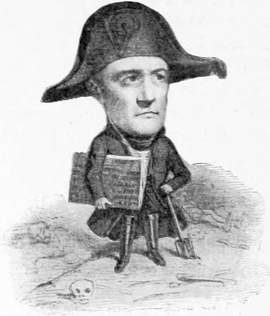
PAUL DELAROCHE.
“Paul Delaroche à la funèbre mine S’entour avec plaisir de cadavres et d’os Jane Grey, Mazarin, héros et héroine Chez lui tout meurt ... excepté ces tableaux.”
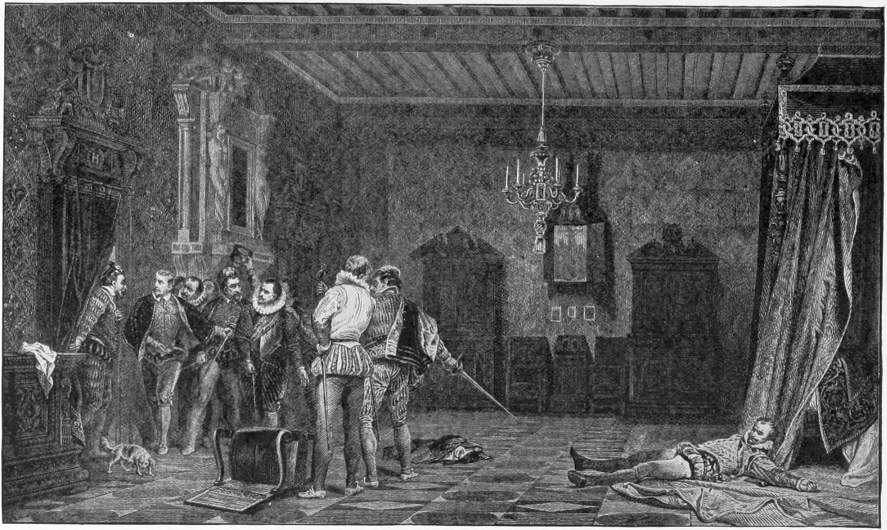
For the average painter of mediocre ability historical exercises of this sort must also have been very alluring, inasmuch as they made no demand upon specially artistic qualities—upon any peculiar aptitude of the fancy, eye, or palette. The historian must indeed possess the power of combination, but much more that of sober investigation; too much imagination or too great a sense of humour would be dangerous to him. So also the historical painter required neither fancy, sentiment, nor power of perception; a certain capacity for compiling facts was all that was necessary. It was enough to ferret out of some popular book on history the story of a murder, and to possess a work upon costumes. By such means, men of a certain ability could easily manage, with the help of the studio technique founded by the Romantic school, to put together the most imposing show-pieces. And even the critics allowed themselves frequently to be so far misled as to give to those models who were decked out in the finest costumes, and labelled with the names of the most celebrated personages, precedence over their more modest companions. Consequently it happened that in the time of the citizen monarchy a great number of painters entirely devoid of talent, whose only merit was that they attached to this or that chapter of universal history pictures showing some laboured animation, became in the twinkling of an eye leaders of the schools.
Eugène Devéria was the first and most important painter deliberately to enter upon this course. When his picture of the “Birth of Henry IV” was exhibited in the Salon of 1827 his appearance was welcomed as that of a new Veronese, and his work joyfully saluted as the first historical picture in which the local colour of the epoch represented was accurately observed. Henceforth Devéria dressed always in the style of Rubens, and his house became the headquarters of the Romantic school. He was perhaps the only member of this group in whom some breath of Delacroix’s spirit survived, but unfortunately he never found again either the Venetian tone or the male accent of his youth, and though he painted many more pictures he never contributed a second notable work to art.
Cassell & Co.
DELAROCHE. THE ASSASSINATION OF THE DUKE OF GUISE.
L’Art.
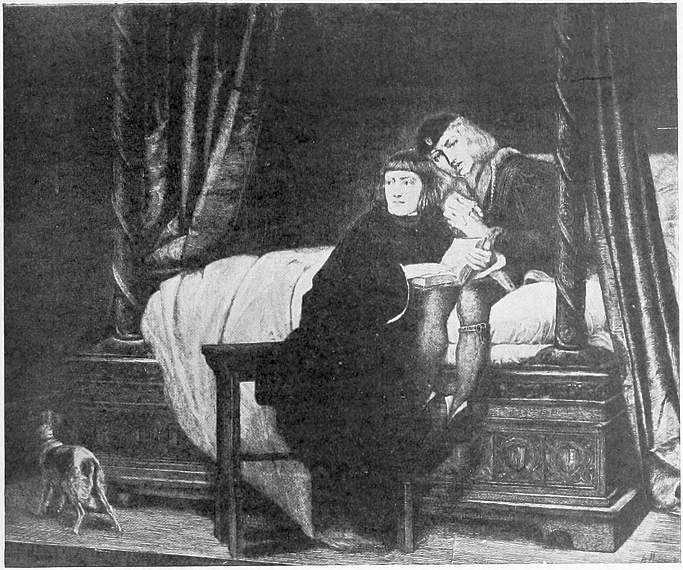
DELAROCHE. THE PRINCES IN THE TOWER.
Shortly afterwards Camille Roqueplan began to alter his manner. Up to that time he had been exclusively a painter who, like Watteau and Terborg, listened with a voluptuous shudder to the piquant rustle of silk, velvet, and satin dresses; now he devoted himself to depicting with perspicuity various scenes from history, renounced his airy and radiant fantasies, and became, in his “Scene from the Massacre of St. Bartholomew,” nothing but a tedious schoolmaster.
Nicolaus Robert Fleury, the painter of “Charles V in the Monastery of St. Just,” of the “Massacre of St. Bartholomew,” of the “Religious Conference at Poissy,” and of other historical anecdotes, carefully conceived and laboriously executed, devoted himself, like Lessing, to the propagation of noble ideas. His pictures were manifestoes against religious fanaticism, and philanthropic discussions concerning the trials and persecutions of the freethinkers. In order to give them the stamp of historical verisimilitude, he buried himself with the zeal of an archivist in the study of the period to be represented; often directly transferred into his pictures figures from Diepenbeeck or Theodor van Thulden; and having the faculty of seizing in old paintings those tones of colour which belong rather to the epoch than the master, he succeeded in giving his works a certain documentary and archaic character for which, on his first appearance, he obtained ample credit.
Louis Boulanger, after his “Mazeppa” of 1827, was a famous painter. But the highest success was that attained by Paul Delaroche, inasmuch as he understood better than any other, not only how to cater for the cultured public by the didactic nature and historical accuracy of his pictures, but also how to touch the heart by means of a lachrymose sentimentality.
Paul Delaroche belongs, by the date of his birth, to the eighteenth century. Being one of Gros’ pupils, he had never borne the yoke of the Classical school in its fullest weight, and therefore had never had occasion to revolt against it. When the Romanticists came to the front, he had gone or rather been dragged along with them, for to his circumspect nature Romanticism was an abomination, and his cool and deliberative spirit felt itself much more at home in the society of the Classicists. The works of the historians opened to him a welcome outlet by which to avoid a rupture with either party, and Delaroche found his vocation. He assumed the rôle of a peacemaker between the quarrelling brothers, placed himself as mediator between Montagues and Capulets, and thus became—like Casimir Delavigne in literature—the head of that “School of Common Sense” on whose banner glittered in golden letters Louis Philippe’s motto of the Juste-milieu. Ingres was cold, reserved, and colourless; Delaroche aspired to an agreeable, sparkling, highly seasoned, bituminous art of painting. Delacroix was genial and sketchy; Delaroche inscribed carefulness and exactness on his banner. The former had given offence by his boldness; Delaroche won the conservatives over to himself by his well-bred bearing and moderate attitude. People thought Delacroix too wild and poetical; Delaroche took care to give them only a touch of the eagerness of Romanticism, and set himself to reduce the passionate vehemence of Delacroix to rational, Philistine limits, and to soften down his native unruliness into sentimental pathos. This position which he assumed as a mediator made him the man of his age. The life of Delacroix was a long struggle. But for the commissions entrusted to him by the state he might have died of starvation, for his sales to dealers and lovers of art brought him scarcely five hundred francs a year. His studio held many pictures, leaning mournfully against each other in corners. Delaroche, on the other hand, was overwhelmed with praise and commissions. The representatives of eclecticism in philosophy and of the Juste-milieu in politics found themselves compelled to praise an artist who was neither revolutionary nor reactionist, neither Romantic nor Classical, who had bound himself over neither to draughtsmanship nor to colouring, but united both elements in vulgar moderation.
Cassell & Co.
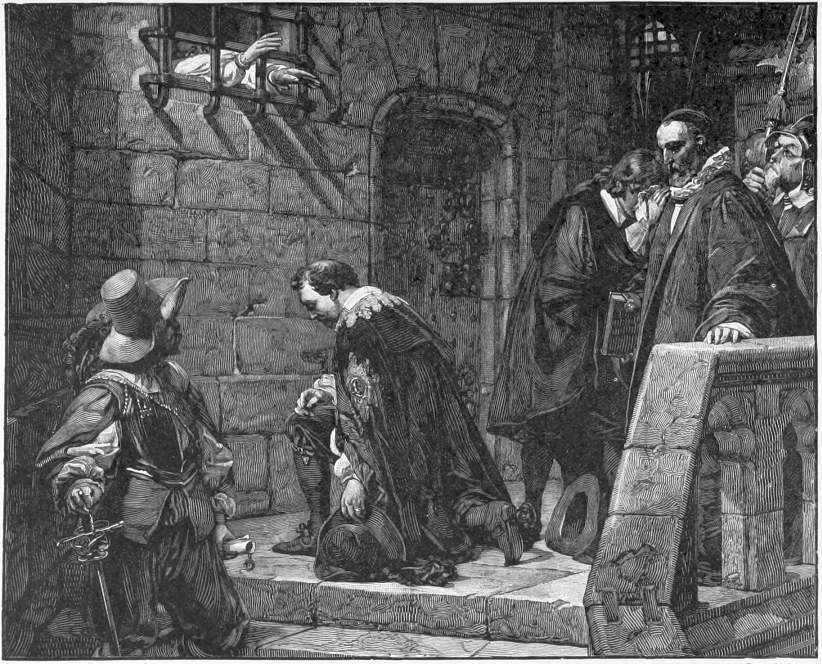
DELAROCHE. STRAFFORD ON HIS WAY TO EXECUTION.
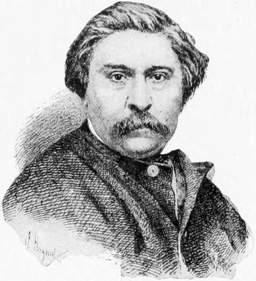
L’Art.
THOMAS COUTURE.
Already in his first notable works, in 1831, “The Princes in the Tower” and “Oliver Cromwell,” he has fully assumed his lukewarm manner. He might have represented the murder of the princes, but fearing that the public would not stand it, he preferred merely to suggest the approaching death of the weeping and terrified children by placing in front of the bed a small dog, which is looking uneasily towards the door, where the red light of torches indicates the approach of the assassins,—a Düsseldorf picture with improved technique. It is just the same with his melodramatic and lachrymose “Cromwell.” It would be hardly possible to represent one of the greatest figures in universal history in a more paltry manner, and to this day it is not quite certain whether the picture was intended to be serious or humorous. The great statesman in whom was embodied the political and ecclesiastical revolution of England must have been extremely busy on the day of Charles I’s funeral, and have had better things to do than stealthily to open the coffin and contemplate, with a mixture of childish curiosity and sentimental pity, the corpse of the king whom he had fought and conquered. Eugène Delacroix had treated this subject in a sketch, in which Cromwell, at the funeral of Charles, gazes in quiet contempt upon the weak monarch who had not known how to keep either his crown or his head. As a work of art this little water-colour is worth ten times as much as Delaroche’s great, long-meditated, carefully executed painting. From the very beginning he had no sense for the passionate or dramatic. From the first day, had the tailor who prepared costumes struck work, his artistic greatness would have fallen away to nothing; from the commencement he produced nothing but large, clumsily conceived illustrations for historical novels. Planché pointed out long ago that all the costumes are glaringly new, that all the victims look as if they had got themselves up for a masked ball, that this sort of painting is much too clean and pretty to give the argument the appearance of probability. Théophile Gautier, who had proclaimed the powerful originality of Delacroix, fumed with rage against these “saliva-polished representations, this art for the half-educated, disguised in false, Philistine realism, this art of historical illustration for the familiar use of the bourgeois.” To rank timorous, half-hearted talent higher than reckless and awe-inspiring genius—this was in Gautier’s eyes the sin against the Holy Ghost, and he sprang like a tiger upon the popularity of talents such as these. He could, as he himself said, have swallowed Delaroche, skin, hair, and all, without remorse; meanwhile, the public raised him upon the shield as its declared favourite.
He won the intellectual middle class over to himself with a rush, as he industriously went on rummaging in manuals of French and English history for royal murders and battle-deaths of kings. With his “Richelieu,” “Mazarin,” and “Strafford,” but especially with his “Execution of Lady Jane Grey” and “Murder of the Duke of Guise in the Castle of Blois,” he made hits such as no other French artist of his time could put to his account. Just then, in his youthful work, The States-General at Blois, Ludovic Vitet had put the murder of the Duke of Guise upon the stage. Nothing could be better-timed than to transform this operatic scene into colour. The historians of civilisation admired the historical accuracy of the courtiers’ dress, all the upholstery of the room, the lofty mantelpiece, the carved wardrobes, the praying-stool with the altar-piece over it, the canopy-bed with its curtains of red silk embroidered with lilies and the king’s initials in gold. Playgoers compared the scene with that which they had witnessed on the stage in Vitet’s piece, and the comparison was not unfavourable to the painter. For Delaroche, in order to be as far as possible in keeping with the stage representation, was accustomed to commission Jollivet, the chief mechanician of the Opera House, to prepare for him small models of rooms, in which he then arranged his lay-figures.
That is the further great difference between Delaroche and Delacroix, between the vagrant painter of history and the artist. The latter had the gift of the inner vision, and only painted things which had intellectually laid hold upon him and had assumed firm shape in his imagination. It was while the organ was playing the Dies iræ that he saw his “Pietà” in a vision—that mighty work which in power of expression almost approaches Rembrandt. “Is not Tasso’s life most interesting?” he writes. “You weep for him, swaying restlessly from side to side on your chair, when you read the story of his life; your eyes assume a threatening aspect, and you grind your teeth with rage.” Such passionate emotion was wholly unknown to Delaroche; he painted deeds of murder with the wildness of Mieris. Delacroix everywhere grasps what is essential, and gives to every scene its poetical or religious character. A couple of lines are for him sufficient means wherewith to produce a deep impression. In presence of his pictures one does not think of costumes; one sees everywhere passion overflowing with love and anger, and is intoxicated with the harmony of sentiment and colour. Delaroche, like Thierry, had merely a predilection for the historical anecdote which, dramatically pointed, keeps the beholder in suspense, or else, simply narrated, amuses him. The colour and spirit of events had no power over his imagination; he merely apprehended them with a cool understanding, and put them laboriously together in keeping with it. Delacroix sought counsel from nature; but in the moment of creation, in front of the canvas, he could not bear direct contact with it. “The influence of the model,” he wrote, “lowers the painter’s tone; a stupid fellow makes you stupid.” Delaroche draped his models as was required, made them posture and pull faces, and while he was painting, laboriously screwed them up to the pathos demanded by the situation. Such a method of procedure must necessarily become theatrical.
Just as in his historical pictures he endeavoured to transform Delacroix’s passion into operatic scenes, so he perfected his position as a man of compromise by imitating the academic style in his “Hemicycle.” Here it was Ingres’ laurels which robbed him of his sleep. The fame which this picture has acquired is mainly due to Henriquel Dupont’s fine engraving. It does not attain to any kind of solemn or serious effect. One might imagine one’s self in some entirely prosaic waiting-room, where all the great men of every age have agreed to meet together for no matter what ceremonial purpose; one sees there a carefully chosen collection of costumes of all epochs, with well-studied but expressionless portraits of the leaders of civilisation. Here also Delaroche has not risen above respectable mediocrity, and his characteristics remain, as ever, thoroughly middle-class.
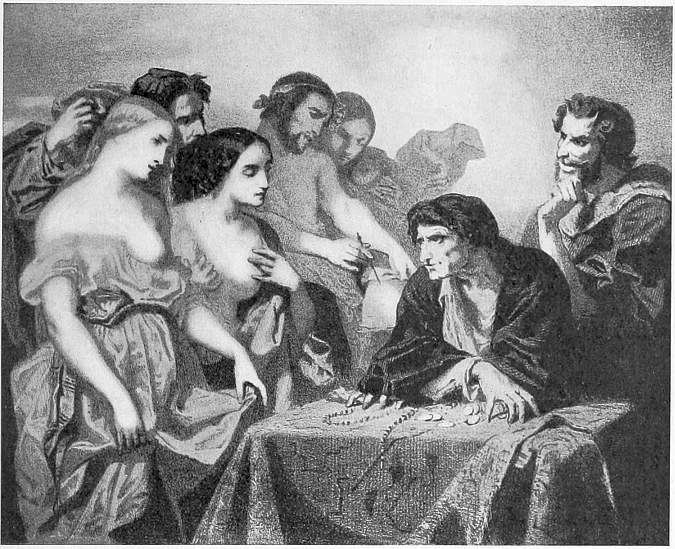
COUTURE. THE LOVE OF GOLD.
His likeness of Napoleon is perhaps that which shows most clearly how paltry a soul this painter possessed. It is not Devastation in human shape, not the man in whom his officers saw the “God of War” and of whom Mme. de Staël said, “There is nothing human left in him.” The intellect of that Corsican, with his great thoughts striding as in seven-leagued boots, thoughts each of which would give any single German writer material for the rest of his life, was hidden to the inquisitive glance of a painter who had never seen in the whole of human history anything more than a series of petty episodes. And one who is not able to paint a good portrait is not justified in intruding into other regions of art.
For similar reasons the religious paintings with which he busied himself in his last days have likewise enriched art with no new element. They are a Philistine remodelling of the Biblical drama, in the same style as his historical pictures. In the end he appears himself to have become conscious how little laborious compilations of this kind have in common with art, and since with the best will in the world he could produce nothing better than he had painted in the thirties, he lost all pleasure in his vocation and abandoned himself to gloom and pessimism, from which death set him free in 1856.
Thomas Couture, who after Delaroche was most in vogue as a teacher in the fifties, was of greater importance as an artist, and in his “Romans of the Decadence” produced a work which, from the point of view of the Juste-milieu, is worthy of consideration even to-day. He was a remarkable man. His parents, shoemakers at Senlis, seem to have regarded the thick-headed, slowly developing boy as a kind of idiot, and are said to have treated him with no excessive gentleness. He was sent away from school because he could not understand the simplest things, and studied without success in the studios of Gros and Delaroche. And yet, after he had made his début in the Salon of 1843 with the “Troubadour,” a fine picture in the style of Devéria, his “Orgie Romaine” of 1847 made him at one stroke the most celebrated painter in France. Pupils thronged to him from every quarter of the globe, and he left a deep and enduring impression upon every one of them. A very short, corpulent, broad-shouldered, thick-set, proletarian figure, with thick disorderly hair, a blouse, a short pipe, and a gruff manner, he used to stride through the lines of his pupils, who regarded him with wonder on account of his ability as a teacher and his remarkable powers.
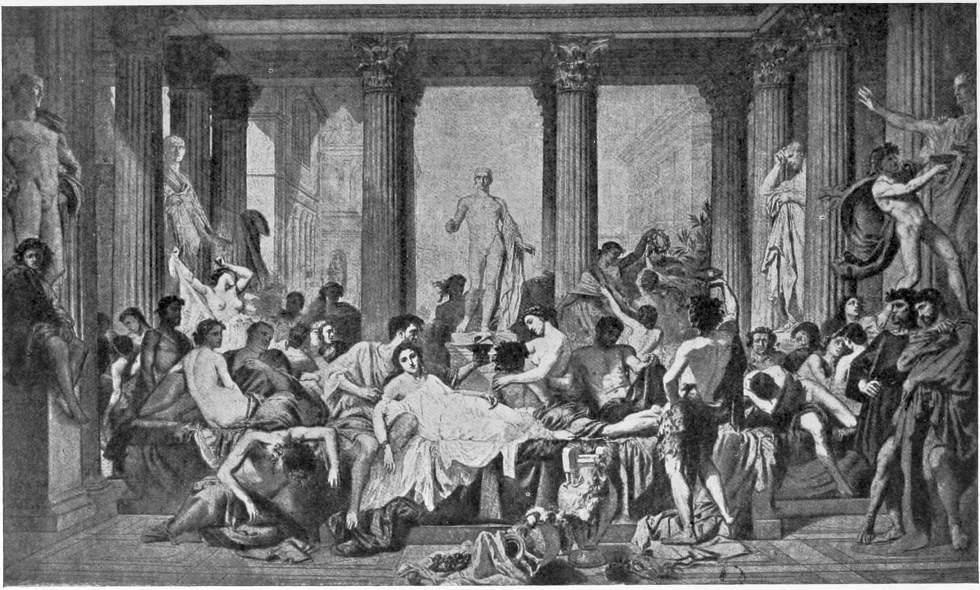
Baschet.
COUTURE. THE ROMANS OF THE DECADENCE.
Yet, when a few years had elapsed, no one heard of him again. After his “Love of Gold” and a couple of portraits, he felt that he was unfruitful, and gave up the battle. “The Falconer,” an excellent picture, with charming qualities of colour, was the last work to give any proof of Couture’s technical mastery. He fell out with Napoleon, who wished to employ him; made many enemies by his writings, especially among the followers of Delacroix, whom he criticised beyond measure; and finally, embittered, and abandoning all artistic work, he buried himself in his country place at Villers de Bel, near Paris. Thither Americans and Englishmen used to come to order pictures of him, and were much astonished to hear that the old gardener’s assistant, as they took him to be, sitting on the grass and mending shoes or old kettles, was Couture. The news of his death in 1879 caused general astonishment; it was as if one long buried had come to life again. It had meanwhile become evident that even his “Romans of the Decadence” was only a work of compromise, the whole novelty of which consisted in forcing the results attained by the Romantic school in colouring into that bed of Procrustes, the formulæ of idealism. The work is undoubtedly very noble in colouring, but what would not Delacroix have made of such a theme! or Rubens, indeed, whose Flemish “Kermesse” hangs not far from it in the Louvre. Couture’s figures have only “absolute beauty,” nothing individual; far less do they exhibit the unnerved sensuality of Romans of the decline engaged in their orgies. They are merely posing, and find their classical postures wearisome. They are not revelling, they do not love; they are only busied in filling up the space so as to produce an agreeable effect, and in disposing themselves in picturesque groups. Even the faces have been vulgarised by idealism: everything is as noble as it is without character. There is something of the hermaphrodite in Couture’s work. His art was male in its subjects, female in its results. His “Decadence” was the work of a decadent, a decadent of Classicism.
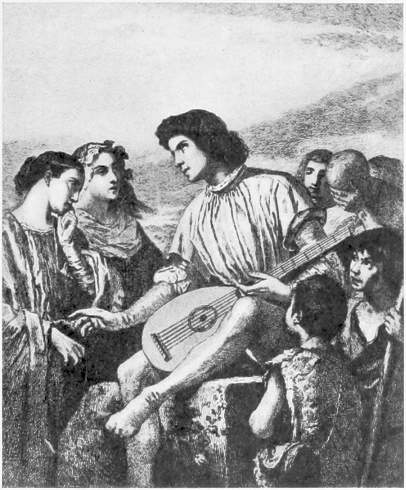
Gaz. des Beaux-Arts.
COUTURE. THE TROUBADOUR.
(By permission of M. Charles Sedelmeyer, the owner of the picture.)
CHAPTER XII
THE POST-ROMANTIC GENERATION
Four years after Couture painted his “Roman Orgy,” Napoleon III ascended the throne, and the Parisian orgy began. It was a remarkable spectacle that the capital offered in those days—a spectacle of fairy-like, flashing and sparkling splendour. Even to-day, when Republican Paris endeavours as much as possible to obliterate every memory of the Empire, Napoleon’s spirit lives in the external appearance of the city and hovers over every conspicuous point. Augustus might say that he had found his capital a city of plaster and lime, and left it one of stone and bronze; Napoleon has the right to maintain that he raised palaces where there had been barracks.
Notwithstanding all the imprecations uttered against his rule, the most thorough-going Republicans reluctantly concede to him the possession of one good quality: he knew how to bring prosperity to the shop; “il faisait marcher le commerce.” One hears it said that the beautiful city on the Seine is but the shadow of what it then was. “Le niveau a baissé!” says the Parisian, when he calls to mind the gorgeous days of the Empire. The extravagant elegance, the magnificent luxury, which used to roll in superb carriages along the Boulevards and the Champs Elysées towards the Bois de Boulogne, and exhibited itself in the evening in the boxes of the theatres; the lustre which emanated from the Court, and the concourse of all the nabobs of the world,—all this must in those days have given to Parisian life a sparkling splendour, a something stupefying and intoxicating, an alacrity of enjoyment which had no parallel elsewhere. To the respectable, pedantic bourgeoisie which ruled under Louis Philippe had succeeded a new generation of men of the world, which drank to the lees all the refined pleasures that a modern great city has to offer. The gentlefolk of the Empire understood the art of living better, cultivated and exhausted it after a more inventive fashion, than any generation that had gone before. In the Tuileries sat the man of the Second of December, the connoisseur and promoter of all refined tastes. In his person the age was embodied, that age depicted by Zola in La Curée, in the passage where he describes the halls, illumined as if by enchantment, of the imperial palace. There, all the splendour of over-civilisation glitters and gleams, with its bright eyes and sparkling jewels, with its breath of intoxicating perfumes floating from naked shoulders and arms and half-veiled voluptuous bosoms; while the green, sphinx-like eye of Napoleon III rests indifferently on the alabaster sea of white shoulders bowing before him, as he reviews all that he has possessed and all that he can yet enjoy. Dumas’ Dame aux Camélias, Diane de Lys and Le Demi-monde, Barrière’s Filles de Marbre, Augier’s Mariage d’Olympe, give the impress of the period upon literature, and the single phrase “The Lady of the Camelias” conjures up a world of forms and of scenery. La Nouvelle Babylone is the title of the fine book in which Joseph Pelletan depicted the mysterious Paris of those years, the great city which cherished in its bosom the lowest and highest extremes of a refined world of pleasure, and was at the same time an inexhaustible fountain of arduous work.
One would have imagined that these new conditions of Imperial France would have left their impress, in some way or other, upon the art of painting also; just as in the works of Rembrandt, Frans Hals, Jan Steen, Terborg, Ostade, Pieter de Hooch, and Van der Meer of Delft the entire seventeenth century is reflected, clearly and with animation, treated with charming familiarity or else with grandiose effect, in its spirit, its manner of feeling, its habits and costumes. What a domain painting would have had; from the official festivals and the bustle of public life down to the complete delineation of the family home! Literature had entered into this course a quarter of a century before, and had shown the path—a path leading to new worlds. But in French art French society is not reflected. Not a single painter has left us a picture of this splendid Paris, dancing on a volcano and yet so amiably delightful. Classicism and historical painting still held the field, as if turned to stone, and show, in essentials, hardly any modification.
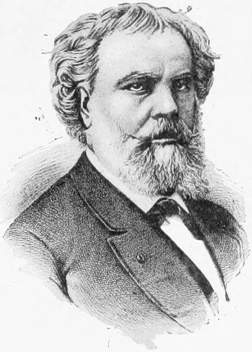
Gaz. des Beaux-Arts.
ALEXANDRE CABANEL.
So far back as in 1833, Charles Lenormant wrote of the school of David: “Even the great painter Ingres was not able to rejuvenate a school which was breaking up from old age, or to restore their full resonance to the slackened and worn-out chords; his only office was to give the old synagogue honourable burial. Take away this last scion of the Classical school, and the curtain may fall—the farce is ended.” He might have said the same thing forty years later, for with Cabanel and Bouguereau Classicism has limped on, almost unchanged, to our own days. Its art was a correct, conventional picture-stencilling, which might just as well have flourished a generation earlier. Classicism—which in David was hard and Spartan, in Ingres cold and correct—has become pretty in Cabanel and Bouguereau, and is completely dissolved in the scent of roses and violets. Only a certain perfume of the demi-monde brings the persons who appear as Venus, as naiads, as Aurora or Diana, into complete accord with the epoch which produced them. For Ingres the female body itself was the exclusive canon of beautiful form; now the swelling limbs begin to stretch themselves voluptuously forth. Ingres still treats the human eye as it was treated in ancient sculpture, as something animal, soulless, and dead; now it begins to twinkle provocatively. A modern refined taste plays round the classical scheme.
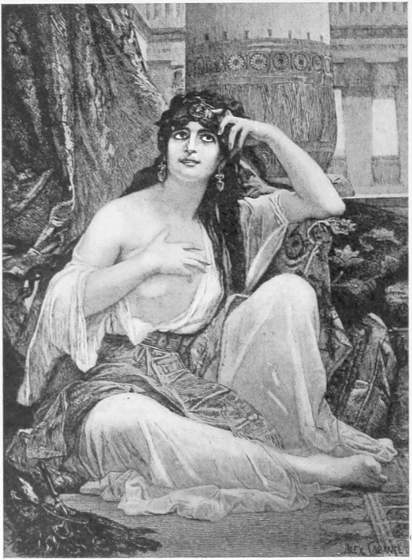
Gaz. des Beaux-Arts.
CABANEL. THE SHULAMITE.
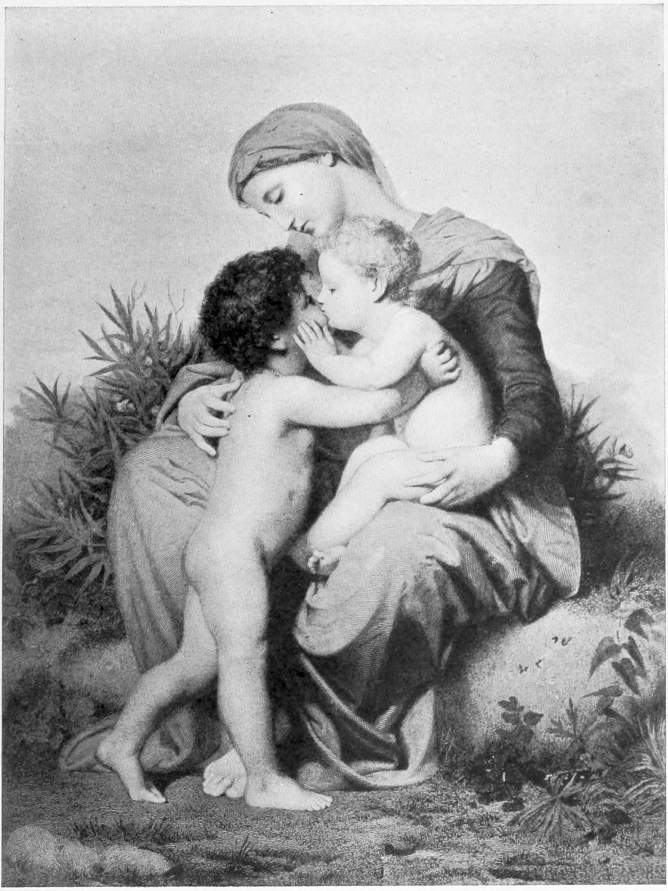
BOUGUEREAU. BROTHERLY LOVE.
Alexandre Cabanel, the incarnation of the academician, was, under Napoleon III, the head of the École des Beaux Arts. He was a fortunate man. Born at Montpellier, the city of professors, nourished from his earliest youth on academic milk, winner of the Grand Prix de Rome in 1845, awarded the first medal at the Universal Exhibition of 1855, he went on his way, laden with orders and offices, amid the tumultuous applause of the public. Among the artists of the nineteenth century none attained in so high a degree all those honours which lie open to a painter in our days. Yet, as an artist, he remained all his life on the plane of the school of Ingres. Even his “Death of Moses,” the first picture which he sent from Rome to the Salon, was entirely pieced together out of Raphael and Michael Angelo. After that he laid himself out to provide England and America with those women, more or less fully attired, who bore sometimes biblical, sometimes literary names: Delilah, the Shulamite woman, Jephthah’s daughter, Ruth, Tamar, Flora, Echo, Psyche, Hero, Lucretia, Cleopatra, Penelope, Phædra, Desdemona, Fiammetta, Francesca da Rimini, Pia dei Tolomei—an endless procession. But the only variety in this poetical seraglio lay in the inscriptions on the labels; the way in which the figures were represented was always the same. His works are pictures blamelessly drawn, moderately well painted, which leave one cold and untouched at heart. They possess that unusual polish and that dexterity of exposition which, like good manners in society, create a favourable impression, but are insufficient in themselves to make a man a pleasant companion. Nowhere is there anything that takes hold upon the soul, nowhere any touch to prove that the artist has felt anything in his painting, or force the beholder to feel for himself. The unvarying faces of his figures, with their eternal dark-rimmed eyes, resemble not living human beings but painted plaster casts. One would take his “Cleopatra,” apathetically observing the operation of the poison, to be stuffed, like the panther at her feet. One seeks in vain for a figure that is sincere or interesting, for a face alluring in its truth to nature. His “Venus” of 1862 made him the favourite painter of the Tuileries, and the insipid, rosy tints of that picture became more and more feeble in the course of years, until his works resembled wearisome cartoons, coloured by no matter what process. He was Picot’s pupil, it is true, but in reality Ingres was his grandfather, a grandfather far, far greater than himself, whose portraits alone show the entire littleness of Cabanel. All his life long Ingres was in his portraits a fresh, animated, and admirable realist. Cabanel indeed also painted in his earliest days likenesses of ladies which were full of serious grace, uniting a powerful fidelity to nature with considerable elegance. But his success was fatal to him. Moreover, as a portrait-painter, he became the depicter of society, and society ruined him. In order to please his distinguished customers, he devoted himself far more than is good for portrait-painting to smooth rosy flesh, large glassy eyes, and dainty fine hands, and over-idealised his sitters till they lost every appearance of life.