Front matter (continued 4)
Reading edition
The frescoes represent, in six mural paintings and two lunettes, the history of Joseph in Egypt, from his sale to his recognition by his brethren. The two latter are the work of Cornelius and Overbeck, the others of Veit and Schadow. The work was prolonged through many years, interrupted by manifold difficulties, and when one stands to-day before the transferred pictures in the Berlin National Gallery one cannot refrain from admiring them.
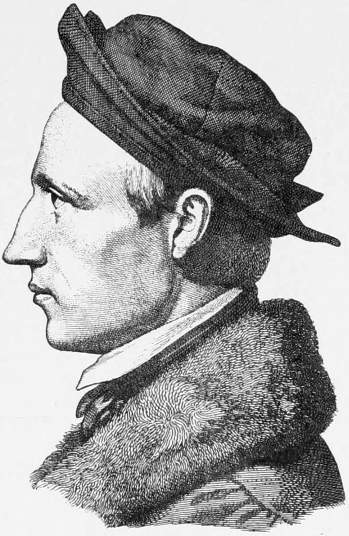
EDWARD STEINLE.
There lives within them an unpretentiousness and sincerity of sentiment, and, in spite of all deficiencies and lack of independence, somewhat of that lofty inspiration which raises the pictures of really earnest artists, even if they are faulty, far above any fabricated productions. An association of young men, which, unconcerned about success and material profit, contended only for ideal products, found here for the first time an opportunity to display what it wanted. In the interpretation of Pharaoh’s dream and in the recognition by the brethren, Cornelius, in formal language, full of character, and without any phrases and posture, displayed all that he had derived from the great Italians in nobility of grouping and fine arrangement of lines. Overbeck reaches the same height in his allegory of the seven lean kine. But it is not only as youthful works of artists, who, if they belonged to a period of decadence, yet were, withal, the greatest representatives of a period of German art, that these pictures are worthy of high esteem; they are essentially the best that these masters have created. Cornelius, notably, shows a study, a care for execution, indeed even a harmony of colouring, that stands in surprising opposition to his later negligence. From the conception that the artistic performance is determined in the invention, and the design, but that the pictorial execution is an indifferent, mechanical accessory which could be supplied even by other people, he was at that time still free.
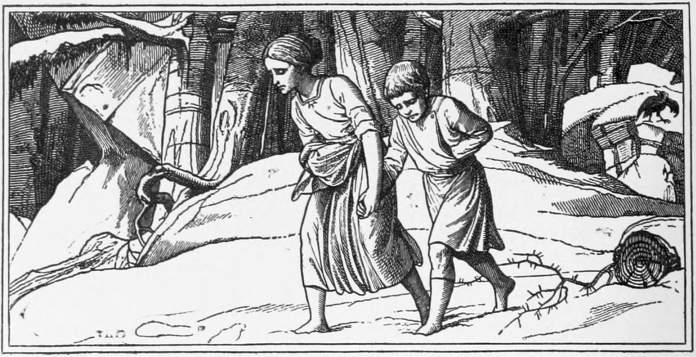
STEINLE. BOOK ILLUSTRATION.
When the pictures had been unveiled in 1819 a festival of German artists was held in Rome. Rückert, Bunsen, the Humboldts, the Herzes were there; Cornelius, Veit, and Overbeck had arranged the transparencies. “The centre of all,” writes the Danish romantic Atterbom, was the Crown Prince Ludwig of Bavaria, “the idol of every German artist, whose ruling passion is for the fine arts and fair ladies. Everything was in old German masques, the ladies in wide ruffs. The Crown Prince was in the utmost good humour, and treated the artists as his equals. A toast was drunk to German unity. The scene struck me like a beautiful dream out of the Middle Ages.” German unity at a Roman fancy ball! The German nation a beautiful dream out of the Middle Ages! The Crown Prince Ludwig, when he took Cornelius and Schnorr out of the Roman circle, at least created a fatherland for German art, and later on the others also found at home a suitable sphere of activity.
Philip Veit, who went to Frankfort in 1830 as Director of the Staedel Institute, was the first to settle down, and for all his energy could only for a very short time make that city into a seat of the Christian tendency in art. Of his pictures there, the fresco painted for the Staedel Institute, “The Introduction of Christianity into Germany by St. Boniface,” is by far the most important. The apostle has hewn down the oak of Thor, and from where it once stood there flows forth the new spring of Christianity. The old Germans shrink back timorously, but the youths listen to the preacher, and follow his direction to the figure of religion which approaches with the palm of peace. In the background a church rises, and in the distance, by a limpid river, a flourishing town, in contrast to the sombre, primeval forest to which the Germans who reject religion are flying.
“The two Marys at the Sepulchre,” in the Berlin National Gallery, and the “Assumption,” in the Frankfort Cathedral, date from a later period. It was of no avail to him that he mingled with his Nazarenism a certain air of the world, which found expression in a less ascetic language of form and a somewhat stronger sense of colour. In 1841 he had already a feeling that the restless, struggling age had passed him by. He abandoned his post and went to meet oblivion as Director of the Gallery at Mayence.
Munich, Albert.
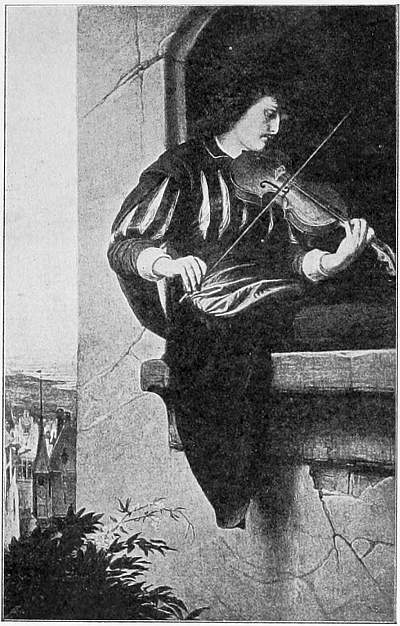
STEINLE. THE VIOLIN PLAYER.
Overbeck, the only one who could not tear himself from Rome, remained, till his death in 1869, the “Young German Raphael,” as his father had called him in a letter from Lübeck in 1811: a devout, religious poet, pure of soul and of fine culture, as one-coloured and one-sided as he was mild and tender. At the outset he knew, at least, how to extract from the old masters a certain naïve piety without positive character, whereas later he lost himself more and more in the arid formalism of dead dogmas. What was in his power to give he has given in pictures such as the “Entry of Christ into Jerusalem” and the “Weeping over the Body of Christ”—both in the Marienkirche at Lübeck, in the “Miracle of Roses,” in Santa Maria Degli Angeli at Assisi, in the “Christ on the Mount of Olives” in the Hospital at Hamburg, and the “Betrothal of Mary” in the Berlin National Gallery—pictures which expressed nothing that would not have been expressed better at the end of the fifteenth century. His “Holy Family with St. John and the Lamb,” of 1825, in the Munich Pinakothek, is in composition and type a complete imitation of the Florentine Raphael; his “Lamentation of Christ” in the Lübeck Marienkirche is reminiscent of Perugino; his “Burial” would never have existed but for Raphael’s picture in the Borghese Gallery. His sentiment coincided exactly in devotion and godliness with that of Fra Angelico or of the old masters of Cologne, and when he devoted himself to programme-painting he lost all intelligibility. In the “Triumph of Religion in the Arts,” which he completed in 1846 for the Staedel Institute, and in which he wished to embody the favourite ideas of Romanticism, that art and religion must flow together in one stream, he has copied the upper part from the “Disputa,” the lower part from the “School of Athens,” and worked up both into a tedious and scholastically elaborated whole. It is only through a series of unpretentious sketches which he prepared for engravings, lithographs, and woodcuts that his name has still a certain lustre. Plates such as the “Rest in the Flight,” the “Preaching of St. John,” or the series “Forty Illustrations to the Gospel,” the “Passion,” the “Seven Sacraments,” may be contemplated even to-day, since in them at least no tastelessness of colour stands in the way. These plates, too, like his pictures, are less observed than felt—felt, however, with an innocence and cheerfulness of heart often quite childlike.
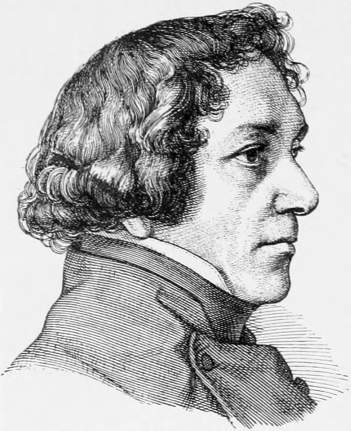
PHILIP VEIT.
It shows above all much self-understanding that all these masters in their later years restricted themselves exclusively to design, which better expressed their character. In compositions and sketches of this kind, which were only drawn, and were thus untrammelled by the fruitless struggle with the difficulties of the technique of painting and a complete lack of the notion of colour, they moved more freely and lightly. In their frescoes and oil-paintings, partly through insufficient technique, partly through their all too servile imitation of foreign ideals, they went astray. As draughtsmen, they had more courage to be themselves, and while in the completer paintings many a fine trait, many an intimate reflection of the soul was lost, or through the obduracy of the material did not attain a right expression, here their spiritual and emotional qualities can be better valued.
Joseph Führich, one of the most staunchly convinced champions of these reactionary tendencies, has become, entirely owing to his extensive activity as a draughtsman, somewhat more familiar to our modern knowledge than most of his contemporaries. He had begun as a draughtsman. As a student of the Prague Academy he was an enthusiast for Schlegel, Novalis, and Tieck; and even before his journey to Rome he had etched fifteen plates for Tieck’s Genoveva. It was Dürer who exercised the deciding influence upon his further development. He had been led to him through Wackenroder, and had copied his “Marienleben” in 1821. “Here I saw,” he says in his Autobiography, “a form before me which stood in trenchant opposition to that of the Classicists, who are anxious to palm off as beauty their smoothness and pomposity borrowed from the misunderstood antique, and their affected delicacy as grace. In contrast with that absence of character which prevailing academic art mistakes for beauty I saw here a keen and mighty characterisation which dominated the figures through and through, making them, as it were, into old acquaintances.” The strong and godly German middle age took then in Führich’s heart the same place which the Italian Quattrocento had filled in Overbeck’s range of thought. And this old-German tendency was only temporarily interrupted by his sojourn in Rome. After he came to Rome in 1826 he became a Nazarene, and was accustomed there to look back at the tendencies of his youth as an error; and both at Prague, where he returned in 1829, after collaborating at the frescoes in the Villa Massini, and at Vienna, where from 1841 he held the post of professor in the Academy, he found rich opportunity for putting into practice his ecclesiastical and orthodox views of art.
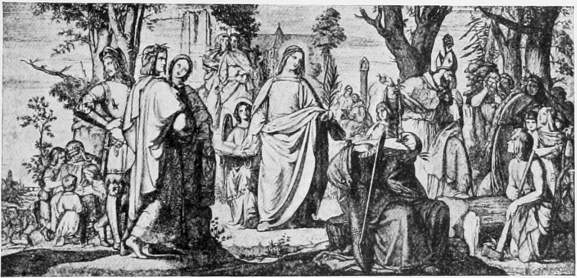
VEIT. THE ARTS INTRODUCED INTO GERMANY BY CHRISTIANITY.
His frescoes in the Johannis-und-Altleschenfelder Church in Vienna are, perhaps, more harmonious in colour, but no more independent in form, than the works of the others. In his old age he returned once more to the impressions of his youth, and so found himself again.
As a boy, in his little native village of Kratzau, in Bohemia, he had tended the cows in summer time and had acquired a certain sincere knowledge of nature and shepherd-life. He had to thank Dürer for his preference for the idyllic and patriarchal family scenes in Sacred History, and these tendencies found pleasing expression in pictures like “Jacob and Rachel,” or “The Passage of Mary across the Mountains.” No matter that the figures in “Jacob and Rachel” are taken out of the early pictures of Pinturicchio and Raphael, they are still interwoven, with their background of landscape, into an idyll of great naïveté and charm. More especially, however, did the qualities which he owed to Dürer acquire value—a sturdy characterisation, a naïve art in telling the story, and a great wealth of fresh traits, straight from nature—in the serial compositions of his old age. There is no sentimental vagueness, nothing academical. Führich had a keen eye for what was intimate, familiar; a tender sense of the individualities of landscape in woodland and meadow, of the charm of everyday life as well as of the animal world; and though an idealist, he knew how to assimilate ingeniously what he had observed with a certain realistic fulness. The old story of Boaz and Ruth grew beneath his hands into a delicious idyll of country life. From the story of the Prodigal Son he has extracted with sensitiveness the purely human kernel, and as late as the winter of 1870-71, at the age of seventy-one, he illustrated the legend of St. Gwendolen, in which he depicted with tender reverence the escape of a human soul, withdrawn from the world and resigned to God’s will, into Nature and her peace.
Edward Steinle, who went from Rome to Vienna in 1833, and settled in Frankfort in 1838, is called, not very appropriately, by his biographer, Constantine Wuzbach, “a Madonna painter of our time.” His name deserves to come down to posterity rather for what he created outside the essential characteristics of his art. In his frescoes in the minster at Aachen, in the choir of the cathedrals of Strasburg and Cologne, he stood firm on the standpoint of the Nazarenes; which is as much as to say they contained nothing novel in the history of art. In his fairy pictures, however, imagination broke through the narrow confines of dogma, and entwined itself in creative enjoyment round the vague figures of fable. His “Loreley,” in the Schack Gallery, as she looks down, a Medusa-like destroyer, from the tall cliff; his watchman who looks dreamily into space over the houses of the old town; his violin player on his tower who plays, forgetful of the world,—these have something musical, poetical, that freshness of sentiment and unsought naïveté which as an inheritance of his Viennese home was also peculiar in such a high degree to Schwind.
The Romantic aspiration is revealed in Steinle, even, in a certain “yearning after colour.” There lives in his works a refined feeling for colour that, especially in his water-colours, rarely forsakes him. Take, for instance, the fresh, tinted pen-drawings, engraved by Schaffer, in which he displayed with the naïveté of Memlinc the life of St. Euphrosyne; the five aquarelles of Grimm’s “Snow-White and Rose-Red”; or his illustrations to Brentano’s poems, such as the Chronicle of the Wandering Student, and the Fairy Tale of the Rhine and Radlauf the Miller, in which he developed a delight in the world and an idea of landscape that in the ascetic Nazarene excite astonishment.
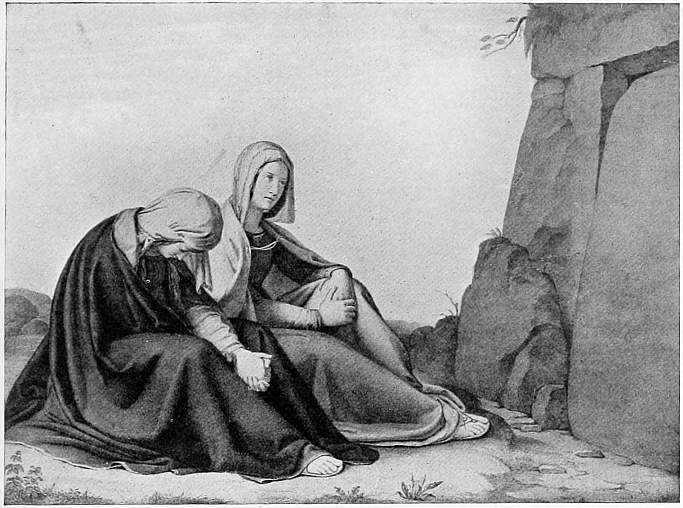
VEIT. THE TWO MARYS AT THE SEPULCHRE.
Julius Schnorr von Carolsfeld went, after the completion of the Ariosto Room of the Villa Massini, first to Vienna, then in 1827 to Munich, in order to paint the Nibelungen in the halls of the royal residence of that time, and in the imperial halls of the state palace the history of Charlemagne, Frederick Barbarossa, and Rudolf of Hapsburg. He also, however, created his best work at the close of his life in Dresden,—the forcible woodcuts of his Picture Bible, which narrated the world’s sacred history in strong and vigorous strokes.
Strangest to the present-day taste have become the drawings of Cornelius. His plates to Goethe’s Faust have, indeed, a certain austere strength of conception, which he learnt from Dürer; but also faults of drawing, exaggerations, crudities, and errors in perspective, which he did not find in Dürer.
In his second work, the Nibelungen cycle, an intentional old-German angularity, with an unintentional modern clumsiness, has effected a mésalliance even less attractive.
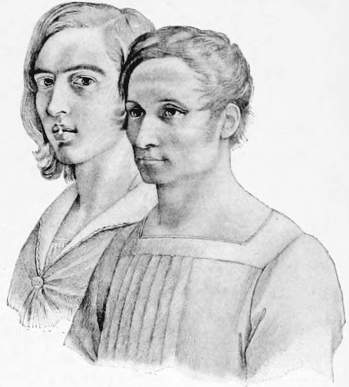
OVERBECK. PORTRAIT OF HIMSELF AND CORNELIUS.

CHAPTER VI
THE ART OF MUNICH UNDER KING LUDWIG I
More than seventeen hundred years ago there reigned a Roman emperor who loved art passionately. He looked upon it from an intellectual altitude which few have reached, and he valued it as the monumental consummation of Græco-Roman culture. Standing upon a plane of intellectual elevation, himself gifted with artistic intuition, he knew of no higher enjoyment for a ruler than the cultivation of the architectural and other forms of art. It was he who opened up to the energy of artists a field such as has never been offered to them before or since. He spent upon his works sums incalculable, so that his people grew restless under their emperor’s mania for building. His villa at Tivoli, which attained to the extent of a town, was in itself a copy of everything that he most loved and admired in the world. It united nearly all the renowned buildings of Athens in one masterly reproduction. And then with architecture came the other arts. The most magnificent collections of sculpture were formed, for none had better opportunities of acquiring the antique masterpieces of the Greek towns. Numberless frescoes, scenes from those cities and regions which had most impressed him on his travels, adorned the walls.
And yet subsequent generations have viewed with unconcern this halcyon period in the history of art. Though his contemporaries fancied that the splendour of the Greek sun was still radiating over them, it was but a borrowed lustre, which never went beyond the reproduction or copying of classic examples. Whatever Greek temples the emperor might build and decorate, he failed to summon into being a Phidias or a Polygnotes to revive for him the forms of the antique. The names of the artists who worked for him are forgotten. They had no originality; they copied the types of the Grecian and Egyptian periods, and their art was but a repetition of old ideals, without character of age or place. The fifteen colossal columns of his Olympieion that are still standing impress one as foreign to Athens, and would seem more in place at Baalbeck or Palmyra than in this city of the Muses. Epictetus would have smiled at the emperor diverting himself with an album of the wonders of the world, as a piece of sentimentality. The age of Hadrian produced thousands of buildings, statues, and pictures, but no original works.
Will a different judgment be pronounced in the lapse of time upon the artistic creations of King Ludwig I? Ludwig also—his biography reads like that of Hadrian—was an enthusiastic admirer of art. After the Peace of Vienna, when the political aspirations of Germany had been frustrated, he alone among the numerous German princes of the old alliance fostered homeless art, and thus fulfilled a noble mission. The king’s splendid enthusiasm for the ideal significance of art, which he hoped would lead the German people, then seeking to work out its individuality, from out of its Philistine narrow-mindedness to nobler and greater things—this enthusiasm will redound to his enduring honour. Schiller’s idea of educating humanity by æsthetic means had in him grown into a living and powerful sentiment.
All that it was possible to accomplish in the cause of art, on the basis of existing development, his endeavours have fully realised. In the course of twenty-three years he spent more than £3,000,000 from his privy purse, and made Munich what it is, the principal art centre of Germany; changed it from a Bœotia into an Athens; founded its art collections, and erected the buildings which give the town its character. Then he offered those new walls to the painter Cornelius, and commanded him to cover them. “You are my field-marshal, do you provide generals of division.” In 1814 Cornelius had written to Bartholdy: “The most powerful and unfailing means to restore German art and bring it into harmony with this great period and the spirit of the nation would be a revival of fresco-painting as it existed in Italy from the days of the great Giotto to those of the divine Raphael.” And through this royal command the dream was realised beyond all expectation. No such lively artistic animation had been witnessed since the great periods of Italian art; an animation which does not cut the worst figure in German history in those sad times of political stagnation and reaction. But that there was a living soul of art in those days posterity will no more acknowledge than it does in the case of the age of Hadrian.
“Wie bei Bartholdy als Kind, so in Massimis Villa als Jüngling Teutshes Fresco wir sehn, aber in München als Mann,”
sang King Ludwig. Now, after two generations, it can be seen that fresco-painting at Munich from 1820 to 1840 produced less original conceptions of the German art of the nineteenth than weak reflections of the Italian art of the sixteenth century.
Various favourable circumstances combined at that time to cause Cornelius to be specially looked upon by his contemporaries as an incomparable master. Since Tiepoli, German monumental art had remained dormant. The frescoes at Munich were the first attempts made to revive it. And it seemed as though with Cornelius, German art had at once risen to the dizzy heights to which Italian art had been led by Michael Angelo. The lookers-on believed in Buonarotti’s resurrection. As in the Sistine “Last Judgment,” the movement of his heroic figures appeared plastic and pathetic, and his types, not excepting the women, gave that impression of the terrible, which none but Signorelli and Michael Angelo had attained before him. His advent, it was said, might almost make one believe in a kind of metempsychosis; as though the spirit of the great Florentine master, that giant of the Renaissance, had been restored to humanity. At that very period the Italian art of the Cinquecento enjoyed the exclusive favour of the German scholars. It alone was worthy of imitation; in it the æsthetic philosophers sought for rules and laws to govern the development of art. And as they thought that all the qualities of this artistic method were to be found in the works of Cornelius, it was only logical to arrive at the conclusion which the Crown Prince Ludwig summed up in the following words: “There has been no painter like Cornelius since the Cinquecento.”
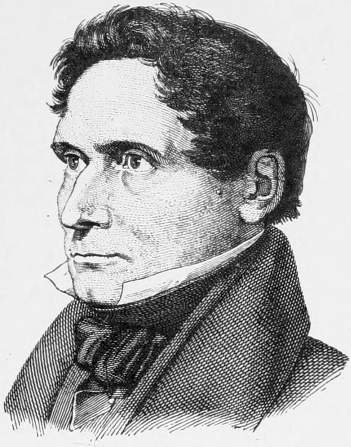
PETER CORNELIUS.
At the same time the intellectual character of his work harmonised with the wishes of a period in which the leaders of German thought tried to forget the dreary dulness of life by plunging into the most profound speculations. “What does it matter,” writes Hallman, “if we lack all joyous, independent national feeling? What though we do not even try to resuscitate this feeling with wars and battles? We strive after something higher! The world is beginning to respect German intellect and learning. We believe that in this we are in advance of other nations, and we seek a mode of expression, we want to give a form to that lofty thought through our art, in order that we may bequeath to posterity an image of our fortunate condition.... Therefore it is a remarkable sign of the times that painting strives to make the weighty output of intellectual thought a common treasure of all who are neither able nor disposed to follow speculation to its dizzy heights, nor erudition to its lowest depths; that painters try to transform the results of those investigations into fresh and ever lively conceptions—the element of art.”
To accomplish this none was better fitted than Cornelius. What a weight of thought and learning his works display!
In the Pinakothek, Cornelius’ main idea was to paint the life and work of Nature as illuminated by the figures of the Greek gods. For the series of paintings in the Hall of the Gods, Hesiod’s Theogony offered a basis upon which to demonstrate the idea of the triumph of the creative mind in heaven and upon earth. In the second room, human passion, power, and tyranny were illustrated in scenes of Greek heroic life from the Iliad. The frescoes in the Ludwigskirche were to follow the Christian apocalypse as a concatenation, and to depict it in symbolic treatment from the Creation to the Last Judgment. The frescoes for the Campo Santo at Berlin were meant to represent “the universal and most exalted fortunes of humanity, the manifestation of divine grace towards the sins of mankind, the redemption from sin, perdition, and death, the triumph of life and eternity.” Each of these paintings is a treatise. Each fresco bears a definite relation to the other; deep philosophic speculations weave their threads from one to the other. Or else the painter revels in a suite of compositions which trace a network of intellectual combinations from one picture to the other. As he himself expressed it, he delivered his diploma lecture through his paintings.
And this painted erudition harmonised with the requirements of those times of dominating intellectual tendencies. The scholars saw in Cornelius the poet, the doctor-in-philosophy; held that the principal value of the work of art lay in its intellectual contents, and felt that their loftiest mission was to express these contents still more correctly than the painter himself. The idea, they said, was the alpha and omega of the painter’s art, and must be accepted at its full value, even when represented in the most shadowy external form.
These opinions have now vanished entirely. A more extended intercourse with the old masters and with the art of other countries has gradually cured the Germans too of that mental hypertrophy from which they suffered in their view of art—a complaint whose characteristic symptom was the entire lack of sensuousness, of that sensibility to beauty of form and external charm which always has been and always must be the predominating mood of a society in which art is to flourish. They have gradually reached the point at which one interests one’s self in a picture for the sake of the painting of it, looks first at the picture, and only then asks what the painter’s idea may have been, or what the spectator is to gather from it. No poem will find favour which offers acceptable thoughts in badly worded, halting, unmelodious verse; nor do the loftiest thoughts in themselves suffice to make a work of art. Profundity of thought is a thing that has little to do with pure art; and the subject alone, however world-stirring the ideas in it may be, never makes a thing artistic. We have learnt to find the most intense enjoyment in the mere contemplation of Titian’s “Earthly and Heavenly Love,” although we may not yet know what this picture is really meant to convey. And we know none the less that what renders Raphael’s “School of Athens” immortal is not its catalogue of ideas, which has been drawn up by an anonymous pedant, but the master’s artistic power, the intensity with which he expresses what was barely showing bud in the material, the self-reliant strength and sureness with which the form and colour have succeeded in outlining and creating every figure and every movement in the picture.
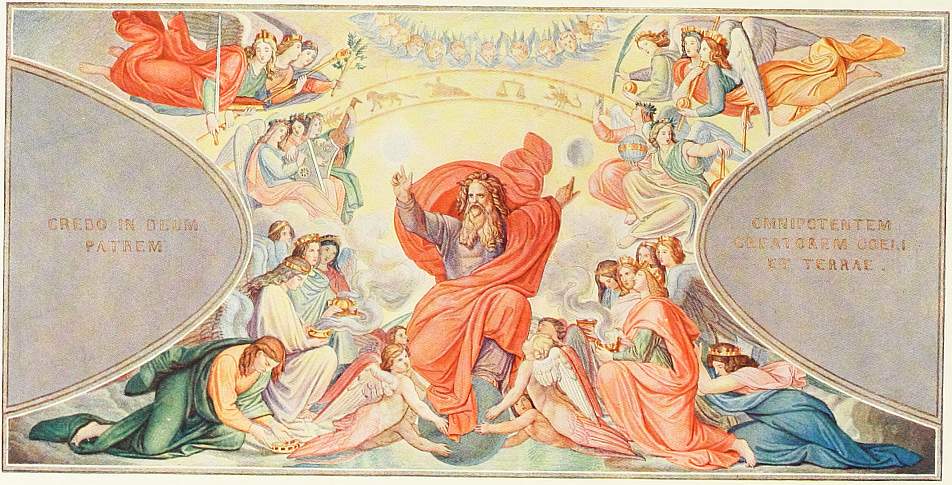
PETER CORNELIUS ‘LET THERE BE LIGHT’
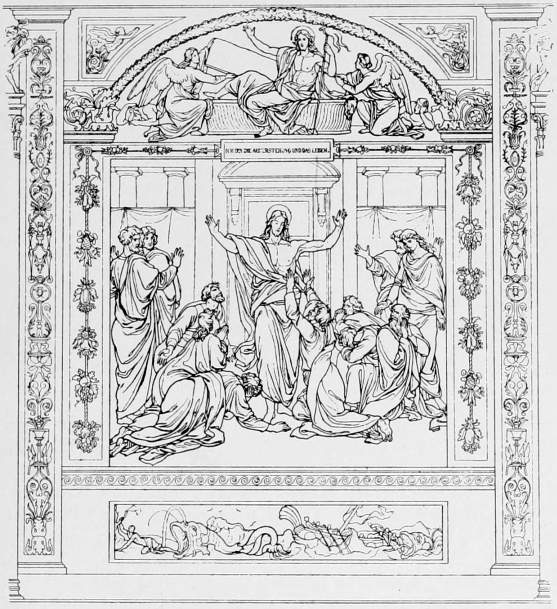
CORNELIUS. FROM THE FRESCOES IN THE FRIEDHOFSHALLE, BERLIN.
No less has the comparative study of art gradually refined people’s sensibility to originality. We are no longer compelled to place an artist on the same level with a master of ancient art because of the outer resemblance of their work. We have progressed so far as to respect in art none but original genius, and to look upon imitation as a testimonium paupertatis though Praxiteles or Michael Angelo be the model. In this we find the explanation of the low esteem in which some of the old masters are now held. The contemporaries of Mabuse and Marten Heemskerk thought that in these painters they had found again the great primeval, Titanic nature of Michael Angelo, his vast motives and majestic forms. To-day we say of them, and with justice, that they produced nothing better than caricatures of Michael Angelo, that they expressed themselves in shallow phrases, that their religious pictures are cold and inflated, and that their mythological presentations with naked figures impress us as bombastic and repellent. Houbraken, in his biography of Gérard de Lairesse, wrote: “A whole book could be filled with the description of his innumerable pictures and panels, ceilings and frescoes.” To-day we dismiss this unattractive mannerist in a few lines. What his contemporaries described as his Michaelangelesque and majestic fierceness appears to us, looking back, as a mere pale imitation.
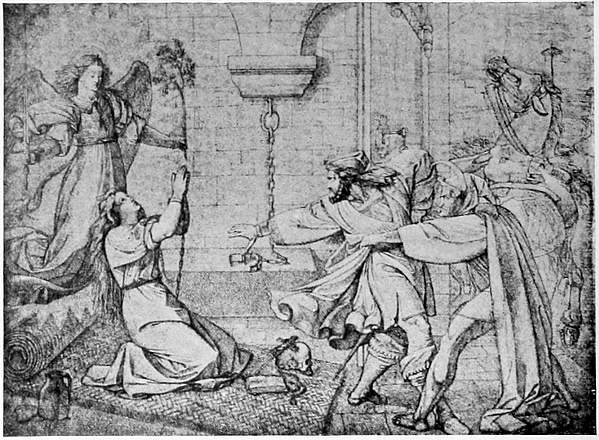
CORNELIUS. MARGUERITE IN PRISON.
Measure Cornelius by the same rule, and the result is no less melancholy. Merciless history paused for a moment to consider whether it ever saw his equal, and then passed on to the order of the day, as it did with his predecessors. To us he is no longer the original genius that he was to his contemporaries, but an imitator. The retrospective history of art marks a new epoch with him, Heinrich Hess, and Schnorr: the advance from the paths of the early Italians, trodden by the Nazarenes, to this link with the golden age of the Cinquecento. The works of Cornelius are mighty shadows cast into our days by the gigantic figures of Michael Angelo. But only shadows! There is no blood in them. A direct line leads from Michael Angelo to Millet; but I doubt whether the master would delight in Cornelius, who has only used him as a gradus ad Parnassum. The works of Cornelius are the products of a civilised yet artistically poor period. The idealism of Michael Angelo had raised itself upon the naturalistic shoulders of Donatello and Ghirlandaio; this new Cornelian idealism sprang into being full-grown from reminiscences, and was therefore from the outset without backbone. It is the fruit of a decadence, not the mature product of a full-blown art, which has taken centuries to grow and ripen. In Michael Angelo the aspirations of Italian art, from Giotto onward, attained their zenith. Cornelius, standing solitary in an inartistic period that had lost every tradition and all technical method, believed in the possibility of rising to the same level by making the forms borrowed from Michael Angelo convey scraps of modern knowledge. In doing this he could not but confirm the experience, thus described by Goethe in his Theory of Colour: “Even the most perfect models are delusive, by causing us to pass over necessary decrees of culture, and thus generally carrying us beyond the goal into a domain of boundless error.”
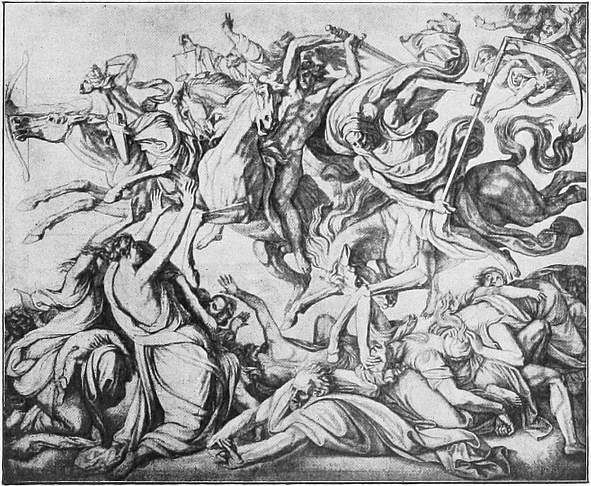
CORNELIUS. THE APOCALYPTIC HOST.
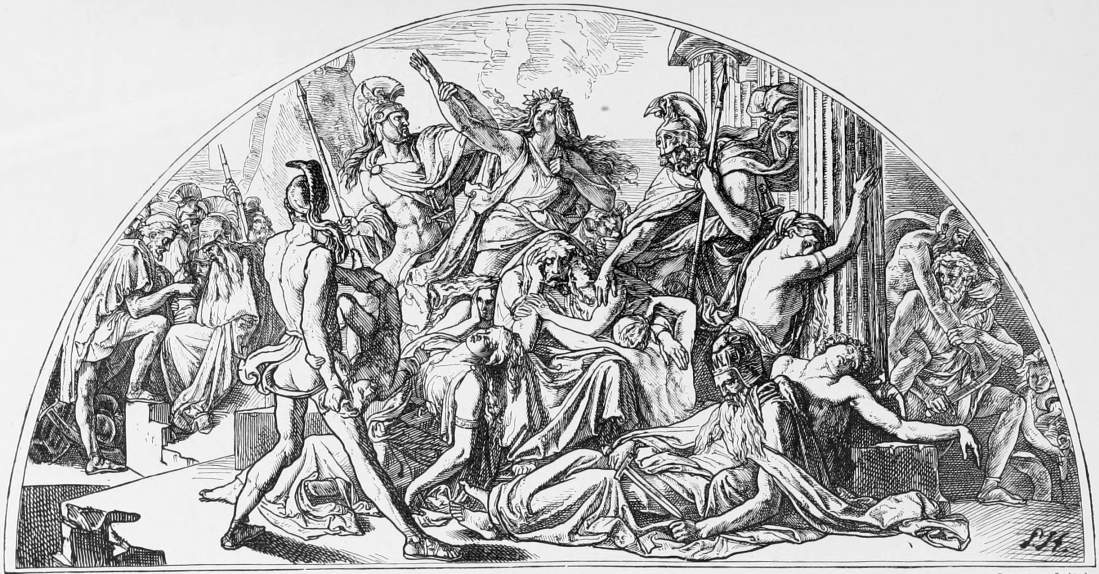
At the same time that Heinrich Hess was carrying on his calligraphic exercises after Raphael and Andrea del Sarto in the Basilika at Munich, Cornelius was making his schoolboy sketches after Michael Angelo. What is great in his master is empty pose in him; what is furia in the former is a laboured imitation in the latter. While the terrific Florentine Master found within himself the expression of his superhuman figures, his learned follower copies attitudes, gestures, groups—familiar to anyone who has been to Italy and passed a few hours in the Sistine Chapel. One seems to hear the old Florentine’s great voice toned down through the telephone, and irritating us with false pathos at moments when pathos is quite superfluous. All the faces are distorted with grimaces, heads of hair are puffed up as though with serpents, garments fly about; people shout instead of speaking, open their mouths wide as though they were giving the word of command to an army, stretch out their arms as though they would embrace the world. A mother bearing a child in her arms squeezes it to death. A cook roasting a leg of mutton bastes it with a Herculean gesture, and a butler emptying a leather bottle has the air of a river-god meditating a flood. In order that his human beings may look vigorous and heroic, he makes them walk in seven-league boots, dislocate their limbs, expand the gigantic measurement of the body far beyond the human. Every head shows a different colouring: one red as sealing-wax, another rose-pink, a third caput mortuum. Added to this, the academic drapery arrangements, those florid garments with their rolling, writhing folds, for which there is no real justification, and which have no use but that of ornament. “Ah,” says Goethe, in one of his letters, “how true it is that nothing is remarkable but what is natural: nothing grand but what is natural: nothing beautiful, nothing, etc., etc., but what is natural.” Michael Angelo is not at all easy to understand; and Cornelius’ study of him resulted in the very same mannerism into which the Dutchmen had fallen three hundred years earlier,—the only difference being that he surpassed them in erudition. But although this quality would no doubt have greatly helped him had he written books, we cannot take it into account in discussing his artistic merits, any more than we can judge Gérard de Lairesse by his literary achievements. Nay, more, as he had elected to confine himself to painting, his erudition became a curse to him, bringing him to disregard beauty of form in a manner as yet unknown in the history of art. Not only was he filled with ardour for the loftier thoughts, without allowing any other forms for their presentation but those which were mere reminiscences of former art periods—he did not even give himself leisure thoroughly to assimilate the forms borrowed from Michael Angelo, and to animate them with fresh life. Hence the fact that, as an artist, he remains greatly below the level of the Dutch copyists, in whose work there is at least no faulty drawing and tasteless colouring to be found. He asked for walls, not as panels to paint on, but as tablets on which to inscribe his thoughts; felt exclusively as a poet, a man of learning, brooding ideas. Engrossed in developing these ideas, he valued form and colour no more than an author would the embellishing of his manuscript with flowing letters and an artistic arrangement of inks. It is only by this means that we can explain the unjustifiable carelessness with which he surrendered his cartoons to his pupils, and allowed them a free hand in the carrying them out, or account for the evanescent colouring in the Glyptothek and in the Ludwigskirche,—a colouring which was even at that time far below the general level, and which could only be excused in the case of a self-trained and quite untutored school.
Seemann, Leipzig.
CORNELIUS. THE FALL OF TROY.
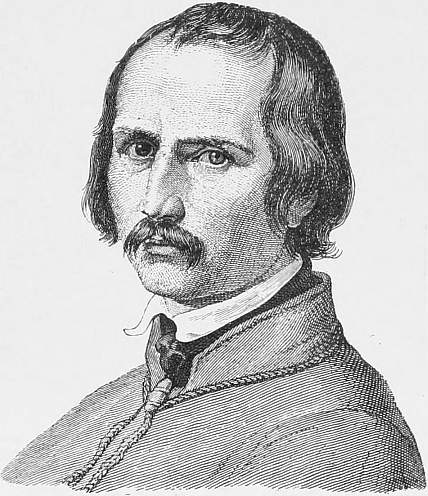
WILHELM KAULBACH.
A man of this kind, who had nothing to teach that was worth the learning, and who excelled only in intellectual qualities which could not be imparted to others, must needs prove the most dangerous academy-principal Germany has had since she first boasted an academy. So much the more as his pupils readily submitted to the personal fascination of this earnest little man with his black clothes, his pompous appearance, his flashing eagle eye, which made one believe that, Dante-like, he had looked upon heaven and hell. “As there are men born to command an army, so Cornelius was born to be the head of a school of painting,” said King Ludwig. We can scarcely help smiling at Schwind’s account of the trembling awe with which, upon his arrival from Vienna, he presented himself to the master. The red-haired stripling, in his outgrown clothes, timidly strolling round the rooms of the Glyptothek suddenly sees Cornelius himself, high on a scaffolding, in all his glory, in an effulgence such as surrounds the head of Phœbus Apollo. Accustomed to seeing young artists stoop before him, now stammering, now paling, now blushing, the demi-god descends to the level of the unknown mortal. “He is quite a little man, in a blue shirt, with a red belt. He looks very stern and distinguished, and his black, gleaming eyes impress you. He descended from his throne, changed his blue smock for an elegant frockcoat, drank a glass of water with an easy manner, and made my flesh thrill with a short explanation of what had been painted and what was still to be done, tucked a few writing books under his arm, and went upon his business to the academy.”
The reformation of the academy, instigated by him at Munich, demonstrated the one-sidedness of his point of view. He turned it into a school for fresco-painting. “A professorship in genre and landscape painting appears to me superfluous,” he wrote to the king in 1825; “true art knows no subdivision.” But as he himself had only partially mastered fresco painting, he did not even succeed in establishing a school of fresco painters. It was only one of designers of cartoons.
“Read the great poets: Homer, Shakespeare, Goethe; do not forget to include the Bible. The brush has become the ruin of our art. It has led from Nature to Mannerism.” By means of this teaching Cornelius infused all his own defects into his academy, which for that reason was doomed from the outset to an early decease. A war of extermination, often leading to the most burlesque scenes, was declared by the Cornelians against the Langerians, who were despised because they had retained a few of the technical acquirements of the peruke period. When Cornelius’s attention was drawn to the fact that in one of his cartoons he had given a Greek hero six fingers he answered with indifference: “Ay, and if he had had seven, how would it affect the general idea?”
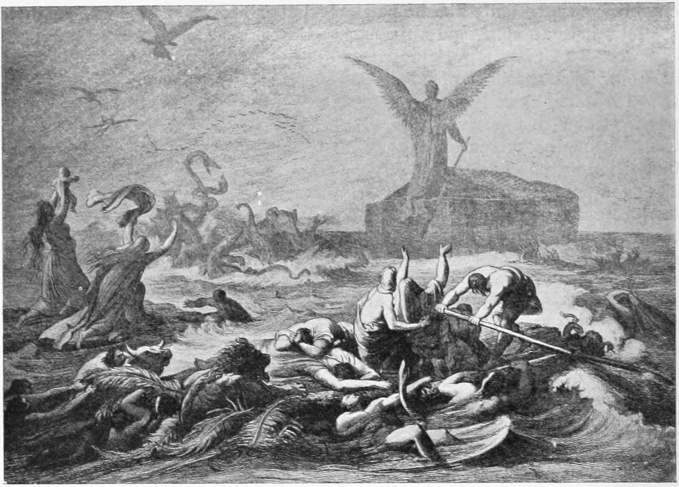
KAULBACH. THE DELUGE.
It was only natural, therefore, that his pupils should feel above using a model. It is said that at the time when they were turning Munich into an Athens, and the painters were covering the city walls with frescoes, Munich possessed but one model, and the poor fellow died of starvation. And then, how they hated colours! They were so difficult to manage! Who, pray, wanted to learn fresco painting by hard labour, and swallow the chalk-dust? It was much easier to copy their lord and master, whose name was on their lips, but not a spark of whose genius was in their heads, with every sort of mannerism. “When nature once produces a new birth she does so with a lavish hand. Talents, talents enough for centuries!” In these words Cornelius himself did honour to his pupils—to Carl Herrmann, Strähuber, Hermann Anschütz, Hiltensperger, and Lindenschmit the elder, the mention of whose names evokes a painful memory of the arcades in the palace garden at Munich.
What survives of Cornelius is only the man, the individual. Posterity will doubtless always honour him for the unflinching energy with which he upheld his ideal from youth to failing age; for his courage in propounding and defending what seemed right to him; for refraining from putting on velvet gloves with the multitude, but frankly showing them his nails. This high-mindedness of Cornelius, and his lofty conception of the aims of art, must always command our respect. All his works are the product of a serene, great, and noble soul. His is a physiognomy with a proud, vigorous profile, which expresses an intellectual tendency, and can never be forgotten. He was a man—as a painter, a curse to German art, but a self-conscious, aristocratic mind. As he himself said: “Art has its high-priests and also its hedge-priests”; and when at the end of his life he made his profession: “Never, under any circumstance of my life, have I lost my pious reverence for the divinity of art; never have I sinned against it,” we none of us refuse to accept his word.
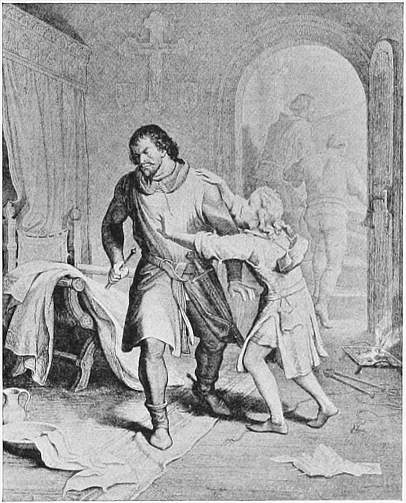
KAULBACH. PRINCE ARTHUR AND HUBERT.
This unfailing earnestness which suffuses Cornelius’s work raises him high above Wilhelm Kaulbach, and secures for him lasting fame, when that of Kaulbach shall have been buried with the last of the “cultured” patrons for whom he worked, and by whom he was placed on a pedestal. Look at both of them from a purely artistic point of view, comparing them with the old masters, and both of them sink equally into insignificance. But if we come to accept the problem of art criticism as a matter of psychology rather than of æsthetics, if we search for the relations between the work of art and the soul of its author, we cannot but look upon Kaulbach as by far the inferior. Cornelius endeavoured to raise the masses to his level, paid for his idealism with unpopularity, and was never understood. Kaulbach, the humble servant of the public, changed the Spartan iron of the art of Cornelius for the base coin of the art unions; to tickle the multitude, he clothed voluptuous sensuality in the stately garment of the earnest Muse, and was hailed with jubilation throughout his life. But the valise with which alone, according to the fairy-tale, one can enter upon the journey to immortality, was still lighter in his case. Idealistic painting, as professed by Cornelius, had skimmed all the cream from religious and mythological subjects; so Kaulbach tried to give something more actual in its stead. He found this in the philosophy of history, in the images of epochs in the history of the world which were then so much in vogue, and handed his public, eager for knowledge, a printed programme upon which he had catalogued the gigantic thoughts and even weightier references which the picture was said to contain. As the masses were awed by the severity of the Cornelian conception of forms, he softened it down with superficial calligraphic elegance: what was sturdy and angular in the former was by him changed into a coquettish effeminacy. This he effected by daubing his pictures, which were in no way colour conceptions, with insipid combinations of colour, and replaced with oleographs Cornelius’s illuminated monumental woodcuts. By these concessions to the picturesque he drove the axe into the tree which the designers of cartoons had planted. The part he plays is that of a man of compromise between Cornelius and Piloty; his frescoes are too sugary; his oil-paintings too faulty. It was he who buried the era of cartoons, although the obsequies were conducted with all pomp.
A spiritual battle, an aerial battle, the “Battle of the Huns,” is the first of his works. Beneath, a real historical event; above, the same reproduced in the spiritual world. The battle is over; the field is hidden beneath the corpses of the slain; but the spirits continue the combat in mid-air, and strive to turn the occasion to account for a display of nudity. Next came the “Destruction of Jerusalem,” crammed with ingenious references, and elucidated with long, printed commentaries. This programme-painting played its trump card on the staircase of the Berlin Museum, where a space of 240 feet by 28 feet is occupied by “the intellectual manifestations of the historical Weltgeist”; “the total evolution of culture with every people of every period in its principal historical phases”; those incidents “which, in the evolution of universal history, mark the important knots with which the closely entwined threads of the national dramas of the universe are bound together.” The “Battle of the Huns,” the “Destruction of Jerusalem,” were included in the series; and to them were added the “Tower of Babel,” the “Rise of Greece,” the “Crusades,” and the “Reformation.” The whole of Hegel’s philosophy was reproduced on the walls. But as the pictures are not new through any novelty or greatness of their conception, we need certainly not enter into the “astounding profundity” of their philosophy. The eye is struck with mere compositions, built up according to certain formulas, and tableaux vivants, put together with more or less cleverness, theatrical in effect and crude in colour.
Of his other large pictures, the “Naval Battle at Salamis” caused a special stir through its sinking harem. In his “Nero” he contrasted the orgies of the Romans of the decadence with the enthusiasm for death of the early Christians. Again, in his great cartoon in charcoal of “Peter Arbue,” he inflated to monumental dimensions a drawing suitable for a comic paper.
Kaulbach is not an artist to be taken seriously. Woltmann, who made the same observation twenty years ago, tried at least to vindicate the illustrator, and expressed his regret that a man who had the stuff in him of a German Hogarth should unfortunately have been caught in the toils of the Cornelian school. But this comparison does little justice to Hogarth. There is nothing in the illustrations of Kaulbach which many other artists could not have improved upon. In his “Reynard the Fox” he adapted, for the benefit of the German public, Grandville’s Scènes de la Vie privée et publique des Animaux, published in 1842. His illustrations for éditions de luxe (“The Women of Goethe,” etc.) marked the first steps of the road which ended in Thuman. And Thuman stands higher than Kaulbach. The faint, unaccented drawing, the oval “beauty” of heads, declamatory and expressionless, the academic touch are common to both of them. But only with Kaulbach do we find the penetrating perfume of the demi-monde, the voluptuous, satirical laughter which is not even stilled before Goethe, the pandering sensuality which cannot touch the purest and tenderest figures in German poetry without using them as a pretext to fling nudities to the public like bones to a dog. In his “Dance of Death” suite, Kaulbach turned into frivolity what Rethel had before expressed solemnly and earnestly. Like the two augurs, who could not meet without laughing, so at last the satirical designer began to laugh at his own monumental pictures. After completing in his series of mural paintings at the Berlin Museum his “Apotheosis of the Evolution of Human Culture,” he explained in his friezes that the whole was, after all, nothing but a dustbin and a lumber-room. When he was commissioned to depict a suite of paintings for the upper walls of the new Pinakothek at Munich, the artistic life of that town, as glorified by King Ludwig—a suite which the weather has since been kind enough to render almost invisible—he fulfilled his task by mocking at what he should have glorified.
“All die Meister Kunstbahnbrecher, wie die Herren selbst sich nennen, Wahrlich Widderköpfe sind sie, Mauern damit einzurennen. Mit dem Loche in der Mauer ist’s noch lange nicht geschehen, Da muss erst der Held erscheinen, siegreich dadurch einzugehen. Gegen jenes Ungeheuer ziehen sie zu Feld mit Phrasen, Wie die sieben Schwaben einstmals ritterlich bekämpft den Hasen. Voran zieht der edle Ritter Schnorr, der Künste Don Quixote, Seine Rosinante setzt er, statt des Pegasus in Trotte; Heiliger Hess, sein Sancho Pansa, Du nicht liebst das offene Streiten, Und du lässt dich sachte, sachte, ’rab von Deinem Esel gleiten. Was ist denn so grosses Neues in der Neuen Kunst geschehen? Nichts, als was sie nicht der aften, längst vergangnen abgesehen. Wände ich auch Lorbeerkränze all um diese Alltagsfratzen, Würden sie sie doch nur zieren zu bedecken hohle Glatzen.”
This is the commentary written by Kaulbach himself; and Théophile Gautier called the suite un carnaval au soleil. “The king in his youth spent millions in order to elevate art,” says Schwind; “and now in his old age he pays another thousand pounds in order to be laughed at for it.” Heine’s loud, scornful laughter resounds over the grave of romantic literature; and so the “monumental period of German art” ends in self-derision.
Moreover, as the mural paintings of the new Pinakothek, like the frescoes in the Arcades and most of the other monumental products of the period, are falling into ruin, and only show traces of their past beauty in a few faint spots of colour not yet entirely effaced, it is quite clear that it was an inherent fallacy of Cornelius to expect a renovation of national German art from fresco painting. The Venetians of the sixteenth century well knew why they did not take up fresco painting. Monumental painting, as aimed at by Cornelius, must remain an imported plant that cannot possibly thrive in a northern climate; and oil-painting, since the Van Eycks the medium and basis of art-culture among the Teutonic races, took its revenge upon his one-sidedness and his Michaelangelesque disdain, in the fact that at Munich it had to be learnt again right from the beginning.
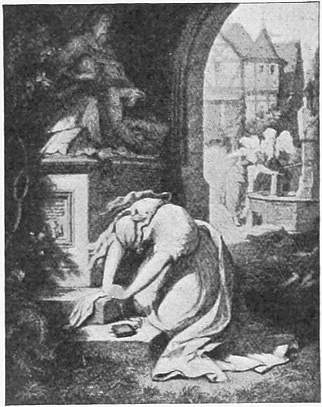
KAULBACH. MARGUERITE.
CHAPTER VII
THE DÜSSELDORFERS
On the Rhine there existed a school of painting instead of a school of drawing, a fact which at that time placed Düsseldorf next in importance to Munich. Wilhelm Schadow, its first director, was lacking in any personal distinction as an artist, but he had received from his great father a tendency towards perfection of technique, which brought him and his school into direct opposition with the purely philosophical painters of the severe Cornelian tradition, and which has even in our days been able to exercise an authoritative influence. In Rome he was the only one of the Nazarenes amenable to the French influence, while the others nervously held aloof from the members of the French Academy. And this formal bent of his talent later gave him the qualifications of a sound teacher. Immediately upon his arrival at Düsseldorf, in November 1826, he was escorted by a stately throng of students: Carl Friedrich Lessing, Julius Hübner, Theodor Hildebrandt, Carl Sohn, H. Mücke, and Christian Koehler, who were afterwards joined by Eduard Bendemann, Ernest Deger, and others. These became the mainstay of the celebrated Old Düsseldorf School, which was soon supported by the jubilant enthusiasm of its contemporaries. At the Berlin exhibitions the new school of painting passed from one triumph to the other. Young men fresh from school suddenly made names that were honoured throughout Germany, by reason of the remarkable manner in which their works succeeded in expressing the sentimental romanticism of the time.
The Wars of Liberty of 1813, which had caused a gust of joyous enthusiasm to penetrate even into the peaceful seclusion of the Nazarenes, were not, like the wars of 1870, the outcome of careful calculation, but the result of a sudden burst of ardour, and the disillusion had now followed upon the enthusiasm. In 1810, with the French bayonets gleaming outside the windows, and the French kettledrums drowning the sound of his voice, Fichte delivered at the Berlin University his famous speeches which sounded the réveillé for Germany. At the same time Kleist wrote his Hermannschlacht: Napoleon was to be treated as Hermann had treated Varus. “Was blasen die Trompeten, Husaren heraus,” pealed through the air; the song of “Got, der Eisen wachsen liess” rose heavenwards in brazen accords. And not long after, the same lions who had beaten the Corsican at Leipzig, and had with Arndt conceived the idea of a great, united fatherland, had once more become the same easy-going people, drinking their beer and smoking their pipes in their little duodecimo principalities as of old. Those dreary times, which saw no prospect of relief in their own days, must needs nourish a devotion to the past. That haughty antiquity, which had been possessed of the ideal to which the present had not been able to attain, became the object of a fanatical adoration. Men lost themselves in the old storehouses of faded German reminiscences, and fled for inspiration to the times of a consolidated German Empire. This return to the ruins of the past was a protest against the grey, colourless present. The patriotic frenzy of the poets of freedom changed into enthusiasm for the vanished glories of mediæval Germany. They remembered with longing and yearning the days when the robber-knights ruled town and country from their strongholds. Schenkendorff sang hymns inspired by the old cathedrals, rummaged with holy horror among the skeletons of knights and heroes in the chapel, and wrote a poem in memory of the thousandth anniversary of the death of Charlemagne; Arndt, the bard of the wars of freedom, violently attacked the “industrialism” of the time, declaiming against steam and machinery; Zacharias Werner composed his poem, “Das Feldgeschrei sei: alte Zeit wird neu.”
This revival of romanticism opened up a wide field to science and poetry. The apotheosis of the old imperial times was made manifest amid fairy-like glamour. Poetry grasped the pilgrim’s staff, or rode with beauteous dames on milk-white palfreys through forest and glade. Enchanted genii, elves, fairies, and goblins were encountered on the road. Nowhere is there so sweet a scent of blossoms, so innocent a sound of children’s merriment, as in Tieck’s delightful and dainty fairy-tales, or in the works of Clemens Brentano, those precious stories of Father Rhine, of the water-nymphs and the crystal castles at the bottom of the green current, pictures full of charming wilfulness, dreamily winsome, like summer evenings on the Rhine. Uhland sang, as once had sung the knightly poets with the golden harps—
“Von Gottesminne, von kühner Helden Muth, Von lindem liebesinne, von süsser Maiengluth.”
To this day we seem to peep between the weather-beaten castles, standing on their grey rocks along the Rhine Valley, into the realm of romance as into an enigma propounded by mountain and dale. Rhine and romance!
No spot in Germany was better fitted to become the cradle of a romantic art than Düsseldorf, the peaceful town on the legend-haunted banks of the green river. In the fifteenth century, in addition to the school of Florence, where flowed a rich current of political and human life, where great buildings, monuments, and frescoes kept architects and sculptors and painters uniformly busied, there existed in the remote Umbrian valleys, in the land of miracles and visions, that school of painting in oils which saw its only eternal ideal in the deep eyes and soft aspect of the Madonna, and made the visionary aspirations of the soul, emotions, and sentiment the exclusive subject of their pictures. In the same manner, in the nineteenth century, we find in contrast with the Munich school, with its numerous architectural products, its massive statuary, and the epic-dramatic fresco painting of Cornelius—“wedding the German to the Greek, and Faust to Helen”—that lyrico-sentimental Düsseldorf school of painting which embraced Madonnas and prophets, knights and robbers, gipsies and monks, water-nymphs and nuns with the same languishing tenderness. In matter and technique it completes the art of Cornelius and the Nazarenes; that of the Munich master by its encouragement of oil-painting; that of the Nazarenes by the stress which it lays upon the more worldly side of mediæval life, upon chivalry, and in a less degree upon that other pillar of mediævalism the Church. The Nazarenes are archæological and ascetic; the Düsseldorf school is insipid in a modern way, feeble, colourless, and sentimental.
Count Raczynski and Friedrich von Uechtritz have given us interesting descriptions of life at Düsseldorf at that time, and their story reads like a chapter of Tacitus’ Germania. “Grand dieu! Bons et affectueux allemands!” exclaimed a Parisian critic of the Count’s book in sad emotion, and held up this virtuous German life, as an example worthy of imitation, to his compatriots, the decadents of fashionable artistic Paris, fallen into modern luxury. Undisturbed by the hum of a big city, and without any communication with its surroundings, the Düsseldorf colony of artists lived its life of seclusion. The painters saw none but painters. They herded together in the studios, and the sole recreation in the intervals of their work was a visit to another studio. The whole of the day was devoted to painting; when the picture was complete it went to the art union; and the hours of tediousness were overcome with the assistance of a little intrigue. Hildebrandt possessed the nucleus of a collection of beetles. Lessing, the hunter, collected pipes and antlers, and only felt himself at home in the little room which he occupied with Sohn when it assumed the appearance of a gamekeeper’s cottage. Convinced that politics were the ruin of character, they allowed no questions of the day to interfere with the calmness of their artistic life. Few of them ever read a newspaper. In the year of revolution, 1830, their sole interest in the events around them was concentrated in the fear that a war might disturb their idyllic life. The end of the day’s work saw them in summer-time bent on a pilgrimage to the Stockkämpchen, to refresh themselves with a cup of buttermilk, to play at bowls, or to enjoy a race among the cabbage patches of the garden. In winter they made a point of meeting at seven o’clock every Saturday night at the inn for a literary reading. Each taking his part they recited the dramas of Tieck, of Calderon, and Lopez; or Uechtritz read extracts from German history, the Crusades, the period of the emperors, the riots of the Hussites. Every Sunday night there met at Schadow’s a very distinguished intellectual circle, consisting of Judge Immermann (the reformer of the stage at Düsseldorf), Felix Mendelssohn the composer, Kortum, author of the Jobsiade, and Assessor von Uechtritz, with their ladies. But the great gala-days were the theatrical performances which took place twice a week. Under the leadership of Immermann the theatre had become the place whence the young painters gathered their liveliest suggestions. Some of them went even so far as to take part in amateur performances, conducted by Immermann, and given in Schadow’s house, under the auspices of the whole of the distinguished society. And thus the pictures of this school were not conceived under the influence of life, but of the theatre. The Düsseldorf artists were youths whose productions were not rooted in life, but in reading and culture; youths who always moved in good society, and who had passed through the great ordeals of life, but only on “the boards representing the universe.”
Theodor Hildebrandt became the Shakespeare of Düsseldorf. The translation of the works of the English poet by Schlegel had been published some time earlier, and Immermann, in Düsseldorf, had been the first to offer Shakespeare a home on the German stage. The performances of his tragedies were regarded as red-letter days. During the three years of Immermann’s leadership (1834-37), Hamlet, Macbeth, King John, King Lear, The Merchant of Venice, Romeo and Juliet, Othello, and Julius Cæsar were performed on fifteen occasions in all.1 To give the titles of these plays is at once to characterise the subject-matter of Hildebrandt’s paintings. He very often had a hand in the staging of the plays, and is said to have shown a remarkable histrionic talent in the performances at Schadow’s. He rarely went to other poets for his inspiration, as in his “Pictures from Faust” and his “Beware of the Water Nymph,” where he honoured Goethe, and in his “Brigands,” where he may have been inspired by one of the many variations on Rinaldo Rinaldini that flooded the market at the time, or perhaps also by Byron, whose influence was very marked on the Düsseldorf school.
Goethe’s Frauengestalten, more especially the Leonoras, were reproduced in oils by old father Sohn. Eduard Steinbruck painted Genevièves, Red Riding Hoods, Elves, and Undines, after Tieck and Fouqué; H. Stilke’s “Pictures from the Crusades” introduced Walter Scott to the German public. Uhland’s first ballads had brought into fashion the damsels who from the ramparts of their castles wave a sad farewell to the lonely shepherds; the ancestral tombs, in which the last knight of his race takes his everlasting rest; the lists, where melancholy heroes stab themselves. His Love-song of the Shepherd to the Shepherdess—
“Und halt ich dich in den Armen Auf freien Bergeshöhn, Wir sehn in die weiten Lande Und werden doch nicht gesehn,”
gave Bendemann the motive for his picture of the same name. Young Lessing had to thank Uhland for the subject of his first success, “The Sorrowing Royal Pair,” which at one bound made his name one of the most honoured in German art.
“Wohl sah ich die Eltern beide Ohne der Kronen Licht Im schwarzen Trauerkleide, Die Jungfrau sah ich nicht.”
After Bürger he painted a Leonora—of course in so-called mediæval costume, in order “to avoid the unpicturesque attire in fashion during the Seven Years’ War”; and at the same time as Hildebrandt, “A Mourning Brigand,” who, in the full light of the evening sun, sits brooding on a rock over the depravity of the world. That all of them were frantically enthusiastic for the Hohenstaufens is due to the publication of Von Rainer’s History in 1823, which took a greater hold of the public than did Schiller’s History of the Thirty Years’ War, and inspired numerous dramas.
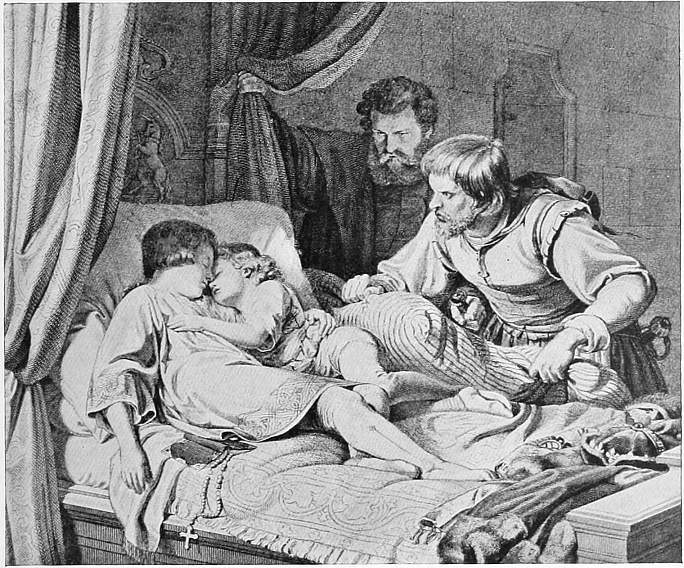
HILDEBRANDT. THE SONS OF EDWARD.
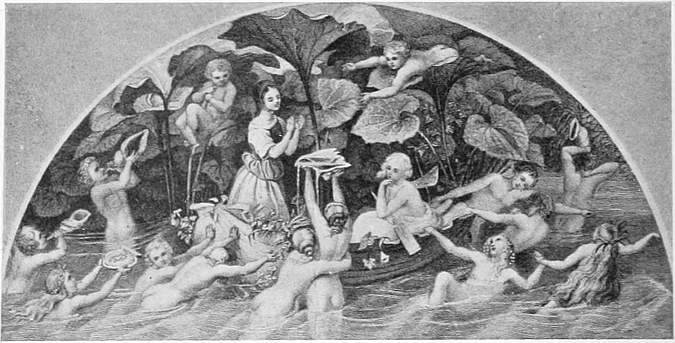
STEINBRUCK. ELVES.
Even the idyllic and touching scenes from the Old Testament and the Hebrew elegies are easily traced back to theatrical inspirations. With the exception of the frescoes of the Casa Bartholdy, the subjects of which were selected with an eye to the religious belief of their purchaser, the Nazarenes found all the subject-matter they wanted in the New Testament. The Passion of Our Lord was unable to inspire the Düsseldorf school. As compared to the few Christian paintings by W. Schadow, and the dreamy Madonnas of Deger, Ittenbach, and little Perugino Mintrop, we find a far greater number of scenes from the Old Testament, which at the time gave birth to numerous dramas. Hübner, always inclined to idyllic and melancholy scenes, painted Ruth and Boaz, his first great picture, which established his reputation. After Klingemann had utilised the whole life of Moses by turning it into a theatrically effective sequence, Christian Koehler scored a success with his “Moses hidden in the Bulrushes” and his “Finding of Moses,” and then, incited by Raupach’s “Semiramis,” abandoned his biblical heroines for Oriental ones. Theodor Hildebrandt took Tieck’s “Judith” as an inspiration for his picture of this Jewish heroine. Kehren’s “Joseph reveals Himself to his Brethren” was begun after the opera Joseph in Egypt had been performed at Düsseldorf. Bendemann, in 1832, played his trump card with his “Lament of the Jews,” now in the Cologne Museum, after Byron had made his propaganda, suggested by the sad lives of the children of Israel, and Friedrich von Uechtritz had caused his drama, The Babylonians in Jerusalem, to be performed, ending as it does with the sending of the Jews into captivity in Babylon—
“Wein’ über die die weinen fern in Babel, Ihr Tempel brach, ihr Land ward, ach! zur Fabel! Wein’! es erstart der heil ’gen Harfe Ton, Im Haus Jehovas haust der Spötter Hohn.”
And his oil-paintings of a later date, “Jeremiah on the Ruins of Jerusalem” (1834), now in the German Emperor’s collection, and the “Sending of the Jews into Captivity in Babylon” (1872), in the Berlin National Gallery, were variations on the same theme.
The productions of the Düsseldorf school were thus in perfect harmony with the programme issued by Püttmann in his book. Pictorial representations may be taken from two ranges, History or Poetry; the painter may choose an historical fact as a subject for representation, or reproduce in visible form the rhythmically shaped fancy of a stranger. History shows him figures full of expression, and even a less powerful artist will find it possible to make a true copy of them. If the painter works from poems his representations are sure to meet with approval, as they render the beautiful and the attractive in visible shape. “But the greatest success lies in store for those works which depict in harmony with the mood of the times historical or poetical performances which express human suffering in its various stages, from homely and everyday griefs to the silent sorrow of irretrievable catastrophe.”
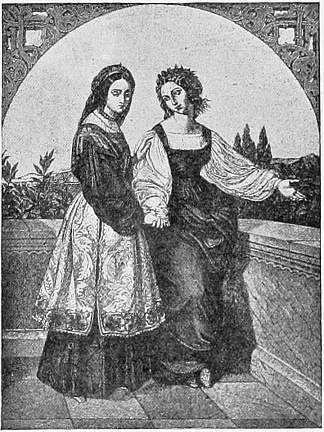
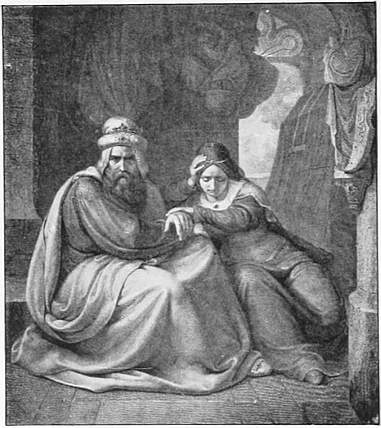
SOHN. THE TWO LEONORAS. LESSING. THE SORROWING ROYAL PAIR.
Thus the scale of sorrow from sad melancholy to painful suffering became the speciality of the Düsseldorf school. At the foot of the scale we find the pictures which “represent the common, yet keen sorrow of parents at the death or the sad future of their children.” Lessing’s “Royal Pair” mourn the death of their daughter; Hagar grieves because she is forced to abandon her son Ishmael in the desert; Genoveva, because the roe is so long in coming to the rescue. The mortal grief of love is represented by Lessing’s “Leonora”; grief of love at separation by Sohn’s and Hildebrandt’s pictures of “Romeo and Juliet.” Even the murderers of the “Sons of Edward” mourn at their crime when they see the children—
“Girdling one another Within their innocent alabaster arms: Their lips were four red roses on a stalk, Which in their summer beauty kissed each other.”
Job grieves at the downfall of his house; Hübner’s “Ruth,” because her weeping mother-in-law entreats her to depart; Stilke’s “Pilgrim in the Desert,” because his horse has died of thirst; Plüddeman’s “Columbus,” because he knows himself to be unworthy of the grace of God which enabled him to discover America; Kiederich’s “Charles V”, because he has retired too early to his monastery, and is plagued by the ticking of his watch. The Hohenstaufens, of course, appealed more to the pity of the public: the misfortunes of the beautiful Enzin, of Manfred and Conrad, gave birth to a sentiment of profoundest sadness. Even brigands mourn at the depravity of the world. The age had come to despise its own Philistine situation so deeply that it looked up to the brigands, the adversaries of civil order, as to representatives of justice. All depravity, it was said, originated with the public functionaries, and to the noble brigands was allotted the task of revolutionising existing things. Their ally in this was to be the poacher. At a time when a revision of the game-laws was the sole timid wish the people ventured to lay before its princes, it was only logical that the poacher should be looked upon as the victim of injustice, as the rescuer of the small man from the claws of feudal despotism. The numerous pictures that glorify him, as he falls weltering in his blood beneath the guns of the gamekeepers, make pendants to Raupach’s “Smugglers,” and to the rest of the highly esteemed literature which turned the life of the poacher into sentimental dramas or novels.
Fortunately we, in our days, find great difficulty in entering into the spirit which gave birth to these productions. A world lies between it and the present, just as between the Germany of to-day and the Germany of 1830. Men of the younger generation, who were still at school when Bismarck spoke his word of blood and iron, can hardly understand how this modern, realistic Germany can have been, two generations ago, a sentimental Germany. Now the significance of the Düsseldorf school in the history of civilisation lies in the fact that they are the real representatives of that age of sentimentality. A generation that melted away in tearful dreamings must needs enthusiastically recognise its own flesh and blood in those knights and damsels, squires and pages, monks and nuns, who, infinitely amorous or infinitely religious, were all infinitely sentimental; and things that now only evoke a smile or a shrug must needs have moved them to tears. Look where you will, you meet the same world. It hung on the walls, it displayed itself in engravings, lithographs, and coloured prints; if one lay down for a siesta, one found a lovelorn knight and damsel or a praying nun stitched on the cushion; if one put one’s foot on a carpet, one trod upon noble hunting-dames on horseback, falcon on wrist; one carried them in one’s pockets on cigar-cases and handkerchiefs; the traveller and the cheap tripper took them abroad on their knapsacks.
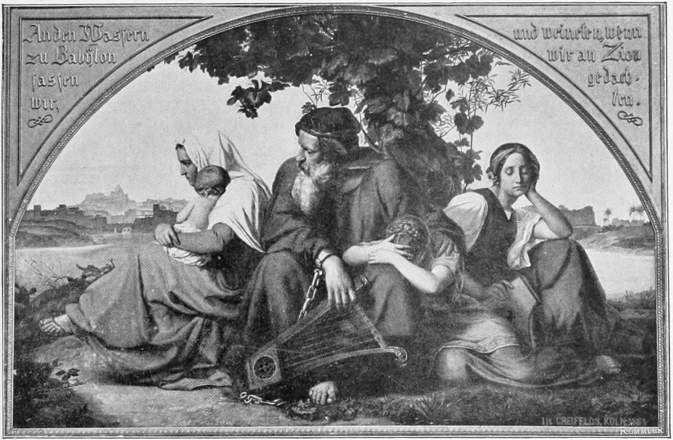
Seemann, Leipzig.
BENDEMANN. THE LAMENT OF THE JEWS.
Technically, the pictures of this school were not without their merits. “The greatness of Michael Angelo” may not have been Bendemann’s, and Sohn’s carnations are far removed from “the melting colouring of Titian.” But as opposed to the one-sidedness to which fresco painting at Munich was given up, the encouragement of oil-painting at Düsseldorf must be looked upon as praiseworthy. These painters were the first in Germany to try again to learn how to paint in oils. The extreme artistic clumsiness that had reigned under Cornelius was followed by a period in which, under Schadow, earnest studies and serious work were devoted to an effort again to master a technical medium. Their friendly emulation led to surprising progress, which assured to the Düsseldorf school a technical superiority over all the other German schools of the period.
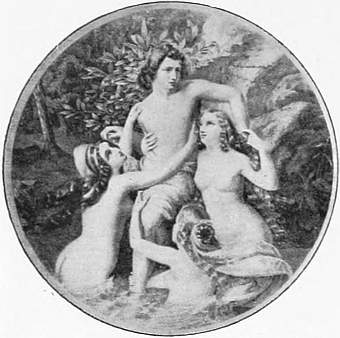
SOHN. THE RAPE OF HYLAS.
If, nevertheless, their pictures have not maintained their position as vital works of art, it is due to the fact that they were produced under the pressure of that mechanical idealism which makes all their productions so utterly unattractive to us. The ideal “line of beauty” has turned the figures into bloodless shadows and washed-out theatrical forms. As philosophy was to Cornelius, so to the Düsseldorfers was poetry their Noah’s Ark. The interest aroused by the poet was their ally; the breath of the wind that set their boat afloat; the general poetical tendency made up for the deficiency in artistic interest. Had it not been for the support of the poets, their sugary, insipid figures would have from the beginning been unable to hold their own. For after having been retouched by “Idealism,” nothing vital remained in those romantic kings, fantastic knights, Jews, and stage princesses; nothing particular and characteristic in their generalisation, nothing generally human. With them a king is always an heroic prince in black harness, a woolly beard, and a scarlet cloak. A queen is represented as proud and dark, or tender and fair-haired. In the much-beloved “couples” from poems, characterisation goes no further than general contrasts: the brunette in red attire with white sleeves; the tender blonde with the complementary garment of pale violet; the one with luxurious embonpoint, the other languidly slender—men brown, women white, youths rosy. Knights wear silvery helmets with or without plumes; now with open, now with shut visor; sometimes they sit on poetic palfreys, now of slender, now of sturdy build. The only impressions they are subject to may be interpreted with the assistance of the plaster bust: honour, fidelity, love. And as sentiment and heroism are national virtues of the Germans, they are bound to show sentimental expression whilst killing their adversaries. Even the brigands are generalised lay figures. The Düsseldorf ideal of beauty aimed at a certain tender, vaguely graceful swing of outline that anxiously avoided all manly and strong, energetic and characteristic expression, all that could remind one of nature. They rejected Leonardo da Vinci’s advice, to tug at the nipple of Mother Nature, but looked upon her merely as their aunt; and for this, despised Nature took her revenge by making their figures shapeless and phantom-like. And as their “dread of painted stupidities” did not once bring them to make bold mistakes, we can neither praise nor censure their pictures, cannot enjoy them or take offence at them, but look at them sine ira et studio, with a lukewarm feeling of utter indifference.
1 As is still the case in most of the German theatres, the programme changed every night. Two or three consecutive performances of one play remain a rarity.
CHAPTER VIII
THE LEGACY OF GERMAN ROMANTICISM
It was reserved for two younger men to reach the aim that hovered in the far distance before Cornelius and the Düsseldorfians. And, by one of fortune’s remarkable freaks, the greatest German monumental painter of the nineteenth century came from the Düsseldorf, the greatest Romanticist from the Munich school.
Alfred Rethel was twenty-four years old when he received the commission to paint the frescoes in the Kaisersaal at Aachen, and had previously worked in the Düsseldorf Academy, and then with Veit at Frankfort. But the pictures are suggestive neither of his Düsseldorfian nor of his Nazarene training. The deeds of Charlemagne, the ancestor of the German Imperial dynasties, are nobly, and, at the same time, vigorously embodied in them. Rethel had studied the harsh strength of his Albrecht Dürer, but only as a kindred spirit studies his kin. Neither Cornelius nor Schnorr has depicted the old German heroic might and the vanished imperial grandeur, the great past, the iron Middle Ages, with such notable traits. How plain in his heroic greatness stands the mighty conqueror of the Saxons by the overthrown pagan idols; how simply and majestically does he march into conquered Pavia. What an inexorable and irresistible warrior he seems, as he rages amongst the Moors who flock round the cars of their idols; and with what grave phantom dignity does he gaze in death upon the young Emperor Otto, who has forced his way into his vault, and kneels trembling before the lifeless frame of his great forefather. There is no vestige of pose, nothing superfluous; everywhere simplicity, compression, lucidity. Only what is necessary is inscribed here, in the lapidary style. No meaningless phrase interrupts his narrative; the inner meaning is never sacrificed to any external beauty of line; his forms like his thoughts are severe and precise. He draws with a sure hand in crisp lines, like a writer who aims at the utmost brevity and so lays especial emphasis on his sentences and words. The self-revelation in these pictures is admirable—the illuminating clearness with which they tell what they have to say without the aid of any commentator, the directness with which they present in an artistic aspect the substance to be given. And with this substance the painting corresponds.
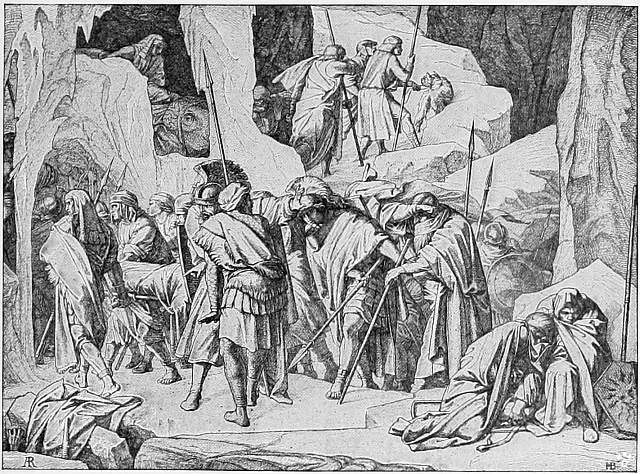
It is to be deplored that Rethel himself could carry out in colour only four of his designs, and that the completion of the rest was entrusted to the painter Kehren, who spoilt by his effort after charm of colour the collective impression of the series. The pictures painted by Rethel himself are, in the simplicity of their colouring, in remarkable accordance with the powerful style of his drawing. Rethel’s painting has something stern and grey, bare and sombre. He belongs to the stylists whose implement is rather charcoal than the brush; but he had, although no colourist, a free command of colour, and never committed any fault of taste, but with a remarkably sure instinct used colour in the mass, simply, but yet with significant effect. He might have been the man to create a monumental German art. A tragic destiny! Heinrich von Kleist, the greatest German poet of the post-classical age, who was chosen for so high a vocation, the creation of a new dramatic style, shot himself; and the giant, Alfred Rethel, was to end in madness. Barely forty years old was he when he walked by the warder’s side in the courtyard at Düsseldorf, picking up flint-stones, a poor, simple madman. Only two series of designs ensure, apart from the frescoes at Aix, the immortality of his name: “Hannibal’s Passage over the Alps,” and the “Dance of Death.” As a draughtsman, just as a painter of frescoes, he is the same Titan, sounds the same stern, manly note.
Here the heroic hosts of the Carthaginians stand anxious, yet resolved, at the foot of the grim Alpine pass; steep, beetling cliffs, precipice, ice and snow, tower before them. Now the climb begins, and the struggle with the fierce, barbaric folk of the mountains, who swing themselves on leaping-pole like wild animals over the gaping crevices in the ice. Yonder are men, horses, an elephant, hurled into the abyss; some have spitted themselves on jagged branches of trees in their fall, others twine themselves together in horrible coils; at last the most advanced have reached the heights, and the heroic figure of the commander points out proudly to them, as they breathe once more, the plains of Italy.
Over his second work there broods the shadow of that mental darkness which was to surround him. When, in the year 1848, the political storm burst over the soil of Europe, Rethel’s fantasy reaped a rich harvest. He drew his “Dance of Death,” represented Death the Leveller, who drives poor fools behind the barricades. The ghostly and spectral, that horror of death that breaks in upon us in the midst of life, had been the propensity of German art since Dürer and Holbein. Like them, Rethel loved the world of the diabolical, and similarly chose for his embodiment of it the sturdy, simple contours of the old German wood engravings. Death as the hero of revolution makes a commencement. There he rides as the town-executioner, a cigar between his lips, his scythe in his hand. He sits shambling in the saddle, his smock and tall boots dangle on his bony figure. Dressed like a charlatan, he excites the people before the tavern against the rulers, that he may earn his harvest at the barricade. He himself stands firm and proud, like a general on the field of battle, the flag in his hand, and the bullets of the soldiers whistling harmlessly through his bony ribs. But the artisans who follow him are not invulnerable as he is; the grape-shot sweeps them down off the barricade. The contest is over; triumphant, with a wreath of bay round his skull, mocking venom in his glance, Death rides with his banner unfurled across the barricade, where the dying writhe in their gaunt death-struggle, and children bewail their fallen fathers. The plate, “Death as the Assassin,” takes up the story of the outbreak of cholera at a masked ball in Paris. In terrified haste the dancers and musicians leave the hall. Only one mummy-like spectre, the Cholera himself, a shape of horror, keeps his ground, as though turned to stone, and holds the triumphant scourge like a sceptre in his bony hand. Death, in a domino, with two bones for a fiddle, plays a call to the dance; and beneath the awful sounds of his tune the people, stretched on the ground, in sick convulsions, grinning with distorted features, behind their jesters’ masks, twist and turn.
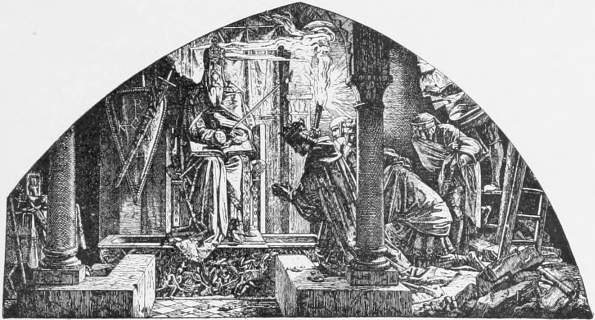
RETHEL. THE EMPEROR OTTO AT THE TOMB OF CHARLEMAGNE.
There is something of Th. A. Hofmann’s wild fantasy of the ague-fit in this picture,—something morbid, satanic, that suggests Félicien Rops; yet, at the same time, something so pithy and virile, and in form so compressed, well-balanced, and correct, that it brings the old Germans, too, to our recollection. And the reconciliation with which the series ends is pathetic. In the high steeple, lit by the rays of the setting sun, the grey old bellringer, his worn hands clasped in prayer, has fallen quietly asleep in his armchair. A calm peace rests upon his good, old, devout countenance. The thin hands, with their marks and furrows, tell a long tale of hard work, sorrow, and longing for rest. And the weary veteran has made a pilgrimage for the health of his poor soul, as prove the pilgrim’s hat and staff by the wall; and now Death has really come, the well-known presence indeed, but this time with no grin of mockery, rather in profound pity. In his ingenious manner of giving an expression of mockery, cold indifference, or compassion to the head of the skeleton, Rethel stands on a level with Holbein. To the old ringer, Death, who before had grinned so diabolically, is a gentle and trusted friend. Quietly and pensively he performs the task that the old man has done so often when he attended the departure of some pilgrim of earth with the solemn notes of his bell. Rethel himself had still to drag through many years in an obscure night of the spirit before for him, too, Death, as the friend, rang the knell.
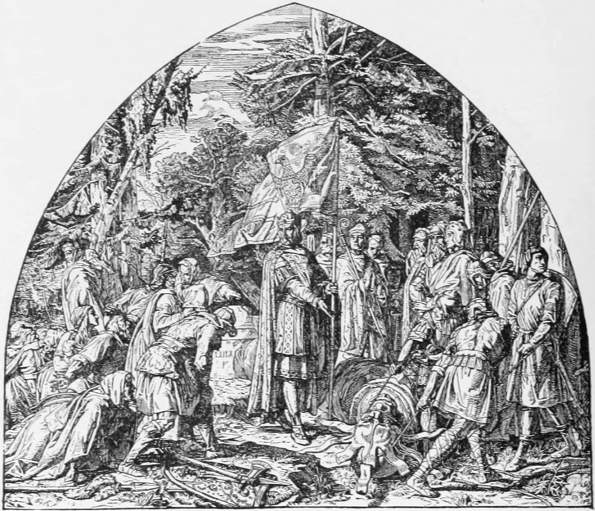
RETHEL. THE DESTRUCTION OF THE PAGAN IDOLS.
And now for him who was the most admirable of them all, Lady Adventure’s true knight.
“Master Schwind, you are a genius and a Romanticist.” This stereotyped compliment was paid by King Ludwig to the painter on each occasion that, without buying anything of him, he visited his studio. And with equal regularity Schwind, when he had sat down again at his easel, after the royal visit, to smoke his pipe, is said to have muttered something extremely disloyal. In this trait the whole Schwind is already revealed,—free from all ambition, every inch an artist.
W. H. Riehl has described a series of such episodes, which one must know in order to understand Schwind, that highly gifted child of nature, who separates himself from the group of philosophical, “meditative” artists of his age, both as an individual and as an audacious, original genius of effervescent wit.
Seemann, Leipzig.
RETHEL. HANNIBAL’S PASSAGE OVER THE ALPS.
When an æsthetic once hailed him as “the creator of an original, German kind of ideal, romantic art,” Schwind repeated very slowly, weighing each word: “’An original, German kind of ideal, romantic art.’ My dear sir, to me there are only two kinds of pictures, the sold and the unsold; and to me the sold are always the best. Those are my entire æsthetics.” Or a noble amateur comes to him with the request that he would take him just for a few days into his school, and instruct him especially in his masterly art of drawing in pencil. Whereupon Schwind: “It does not require a day for that, my dear Baron; I can tell you in three minutes how I do it, I can give you all the desired information at once. Here lies my paper,—kindly remark it, I buy it of Bullinger, 6 Residenz Strasse; these are my pencils, A. W. Faber’s, I get them from Andreas Kaut, 10 Kaufinger Strasse; from the same firm I have this indiarubber too, but I very seldom use it, so that I use this penknife all the more, to sharpen the pencils; it’s from Tresch, 10 Dienersgasse, and very good value. Now, I have all these things lying together on the table, and a few thoughts in my head as well; then I sit down here and begin to draw. And now you know all that I can tell you.” Again he asks “to be decorated with an order,” because he “is ashamed to mix in such a naked condition with his bestarred confrères,” and after the bestowal of the desired decoration he says: “I wore it only once, at the last New Year’s levée, but I vowed at the same time that six horses should not drag me there again. Before, there was at any rate a beautiful queen there, and then the court ladies laughed at one; but amongst men only, the stupidity of it is not to be endured.” When he grumbles over commissions which have been given to others, and adds good-temperedly, “Indeed, I’m an envious fellow”; when he paints the most delicate pictures and then growls, “What am I to do with the things, if nobody buys them?” when he indulges in outbursts of wrath, and a minute later has forgotten again the abusive words which the others spitefully bring up against him years afterwards,—then here, too, his happy humour forces its way everywhere, that divine naïveté which forms the soul of his and of all true art.
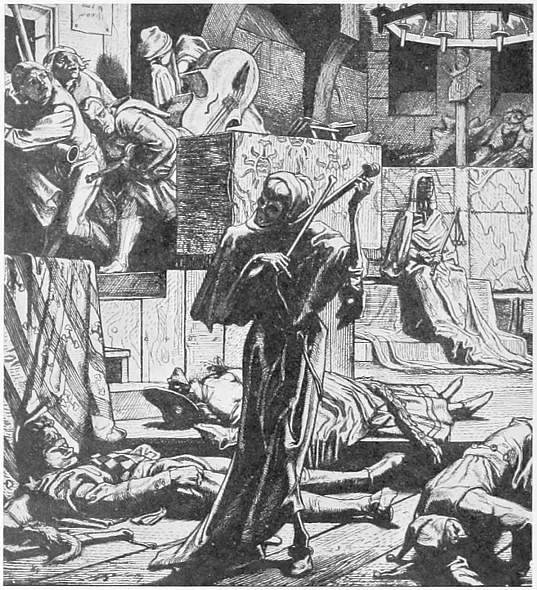
RETHEL. DEATH AT THE MASKED BALL.
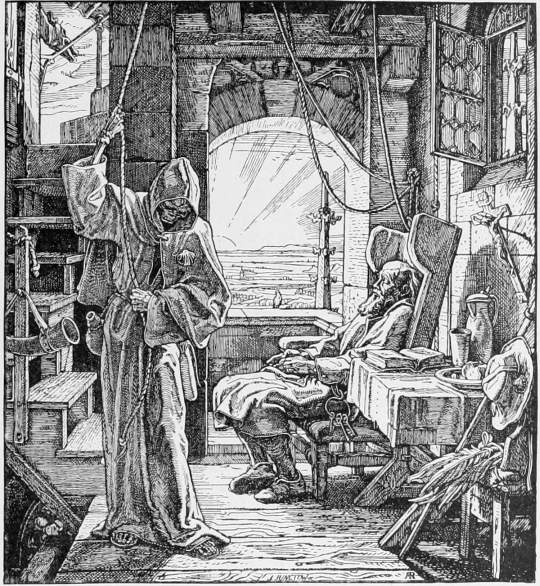
Seemann, Leipzig.
RETHEL. DEATH THE FRIEND OF MAN.
Schwind remains a personality by himself—the last of the Romanticists, and one of the most amiable manifestations in German art. He was free from the malady of that sham Romanticism which sought the salvation of art in the resurrection of the Middle Ages, misunderstood, and grasped sentimentally, and as it were by stencil. He was spiritually permeated by that which had given Romanticism the capacity to exist: the sense of that forgotten and imperishable world of beauty which it has again discovered. The others sought for the “blue flower,” Schwind found it; resuscitated in all its faëry beauty that “fair night of enchantment which holds the mind captive.” He incorporated the romantic idea in painting as Weber did in music, and his works, like the Freischütz, will live for ever. Many a man listened to him holding forth upon water-nymphs, gnomes, and tricksy kobolds, as of beings of whose existence he appeared to have no doubt whatever. On one occasion, while out walking near Eisenach in the Annathal, a friend laughingly observed to him that the landscape really looked as if gnomes had made the pathway and had had their dwellings there. “Don’t you believe it was so? I believe it,” answered Schwind in all seriousness. He lived in the world of legend and fairy-tale. If ever a fairy stood beside the cradle of a mortal man, assuredly there was one standing by Schwind’s; and all his life long he believed in her and raved about her. Born in the land where Neidhart of Neuenthal had sung and the Parson of the Kahlenberg had dwelt, to his eyes Germany was overshadowed with ancient Teutonic oaks: for him, elves hovered about watersprings and streams, their white robes trailing behind them through the dewy grass; a race of gnomes held their habitation on the mountain heights, and water-nymphs bathed in every pool. In him part of the Middle Ages came back to life, not in livid, corpse-like pallor, but fanned by the revivifying breath of the present day.
For that is what is noteworthy about Schwind; he is a Romanticist, yet at the same time a genuine, modern child of Vienna. There are three things in each of which Vienna stands supreme: hers are the fairest women, the sweetest songs, and the most beautiful waltzes. The atmosphere of Vienna sends forth a soft and sensual breath which encircles us as though with women’s arms; songs and dances slumber in the air, waiting only for a call to be awakened. Vienna is a place for enjoyment rather than for work, for pensive dreaming rather than for sober wakefulness of mind. Moritz Schwind was a child of this city of beautiful women, songs, and dances, as may be observed in the feminine nature of his art, in its melody and rhythm: in music, indeed, it had its source. In song-singing, bell-ringing Vienna it was difficult for him to guess in what direction his talents lay; but all his life long he kept an open eye for the charms of beautiful womanhood. No artist of that time has created lovelier forms of women, beings with so great a charm of maidenly freshness and modest grace. Instead of the goddesses, heroines, and nun-like female saints, whose appearance dated from the Italy of the Cinquecento, Schwind depicted modern feminine charm. The group of ladies in “Ritter Kurt” is, even to the movement of their gloved fingers, graceful in the modern sense. He was a painter of love—a breath of Walter von der Vogelweide’s ideal perfection of womanhood pervades his pictures.
“Durchsüsset und geblümet sind die reinen Frauen, Es ward nie nichts so Wonnigliches anzuschauen, In Lüften, auf Erden, noch in allen grünen Auen.”
Schwind, too, painted frescoes, and in them he is very unequal. All his life long he complained of the lack of important commissions; it was fortunate for him that he did not get more of them. Such a painter as he can execute no orders but his own,—just as good poems do not come to order. A long list of wall paintings—the Tieck room and the figure-frieze in the Habsburg Hall of the new palace at Munich, the frescoes in the Kunsthall and in the Hall of Assembly of the Upper House at Karlsruhe, those in the Castle of Hohenschwangau, even the theatre pieces in the loggia and in the foyer of the Vienna Opera House—could be easily struck out of Schwind’s work, without detriment to his reputation. Only when the subject permitted him to strike a simple note of fairy music was he charming even in his wall-paintings, and therefore those which depict scenes from the life of St. Elizabeth in the Wartburg are rightly the most celebrated. Like Rethel in the field of the heroic, so Schwind in that of romantic legend reached the goal which the former kept before his eyes, for the revivifying of the time when there was an enthusiasm for fresco painting. His paintings are poor in colour, motley, magic-lantern views in the style of the heraldically treated figures seen in the frescoes and stained glass of the Romanesque and early Gothic Middle Ages, and yet in every line as delightful as the man himself. Nowhere do we find glaring contrasts, nowhere any violent agitation in the expression of the faces. It is by the avoidance of all landscape accessories, and by a hardly noticeable change in the simple plant-ornamentation in the background, that the events represented are made to lose touch with actual reality. In the first picture, bright-hued birds flit here and there among the rose-branches forming the decorative work; in that which treats of St. Elizabeth’s expulsion, the Wartburg rises in the background, while little singing angels are perched upon the boughs of the bare winter-stripped trees that overlook the miserable cell in which St. Elizabeth dies. A touch of the true-heartedness of the ancient Teuton, a breath of peacefulness, permeates Schwind’s Wartburg pictures like the waft of an angel’s wings.
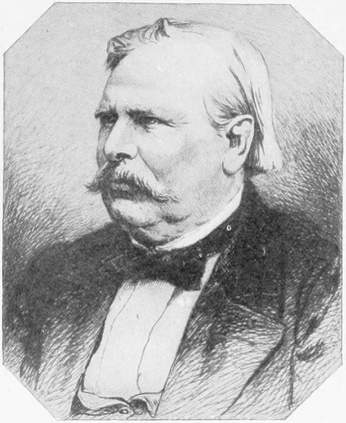
MORITZ SCHWIND. Graphische Künste.
Schwind, like Rethel, is numbered among the few artists of that period who were able to preserve their absolute simplicity against the great painters of Italy. “I went into the Sistine Chapel,” he says of his journey to Rome, “gazed upon Michael Angelo’s work, and sauntered back home to work at my ‘Ritter Kurt.’ I take the greatest possible pleasure in my present picture, although the subject is absolutely crazy. I love to paint trees and rocks and old walls, and I have put plenty of them into it, besides a fellow on horseback and in full armour. What does it matter? One must work according to one’s natural capacity. Even at the time when I was studying at Munich I came to the conclusion that that of which the mind of itself takes hold, and that which takes hold of it, is the one only right thing for every man who has a vocation. Art consists of this unconscious taking hold and being taken hold of. Deus in nobis. And therefore the young artist will do well to be careful in visiting the museums. You go to the galleries where the works of the great masters are to be seen. There you see, all at once and all together in confusion, works of every school and of every era. It is extremely likely that you are overwhelmed by the mass, and beauties of every kind, belonging to tendencies and epochs altogether diverse, shake the ground under your budding vocation, and like fifty various climates influencing a single plant, arrest a growth which is possible only in one, and that a favourable one. The imitation of the Italians in especial can as a rule have only the effect of estranging us from our own individuality, a fact which was once again fully borne in upon me when I saw Overbeck’s new altar-piece in the Cathedral of Cologne. It may sound severe and uncalled-for from me, but every man who has forgotten his mother-tongue is tottering on his feet. The imitation of foreigners is the dangerous blind alley into which our art has betaken itself. When I exhibited ‘Ritter Kurt’ people said, ‘It is Old German,’ and forthwith it stood condemned, as if that were a disgrace, and as if one should not rather have saluted the fact with joy, as the right thing for us Germans. The art of painting which I follow is the German, and glass-painting must be taken as its foundation.”
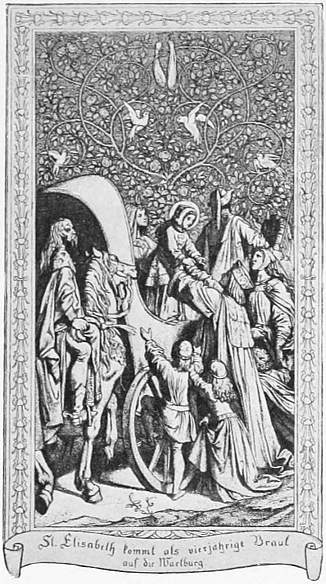
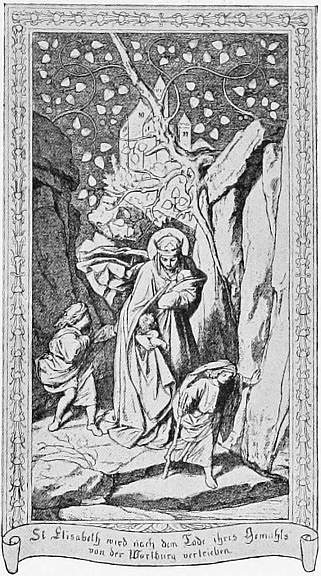
SCHWIND. FROM THE WARTBURG FRESCOES. SCHWIND. FROM THE WARTBURG FRESCOES.
In Schwind one might imagine an old German master of the race of Albrecht Altdorfer come to life again. In the small, simple pictures of landscape and fairy-tale, which Count Schack has collected in his private gallery for the quiet and devout enjoyment of thousands, he has given us his best work as a painter.
Yet even his pictures have the failings of his time. Compared with Dürer, he seems like a gifted amateur; there are manifold empty, dead spaces to be observed among his figures; their action is at times misconceived and puppet-like; and his sense of colour was always limited. One may be permitted to look forward to some master, at the head of a coming epoch in art, who shall combine with Schwind’s German fairy imagination the sensuous, dashing colour-elf that possessed Bœcklin. There might a school of art arise, to follow for the future the path which Franz Stuck has struck out. As to technique, Schwind was a child of the cartoon era; as regards tenderness of feeling, he is a modern. It is difficult to persuade a non-German of Schwind’s greatness, in presence of the pictures; but when they are reduced to black-and-white they appeal to every one. The heliogravure enables one to imagine what the original does not show; it incites the soul to further poetic creation, it announces what Schwind would be were he alive to-day. An elfland kingdom of enchantment, full of genuine poetry and beauty, opens out before us; a fairy garden, where the “blue flower” pours forth the whole of its sense-benumbing perfume. Count von Gleichen; the boy’s miraculous horn; the mountain spirit Rübezahl, wandering along through the wild mountain forest; the hermits; the elves’ dance; the erlking; the knight and the water nymph,—they are flooded with all the enchantment of Romanticism, they possess deep feeling without mawkishness, the old-German note of fairy legend and Hans Memlinc’s childlike simplicity, yet at the same time the life of the present day, full of feeling and rich in delicate shades. How strong and brave are the men; how tender, noble, and charming the women! What a modest, maidenly art it is! just as its master was an innocent, harmless, and joyous being.
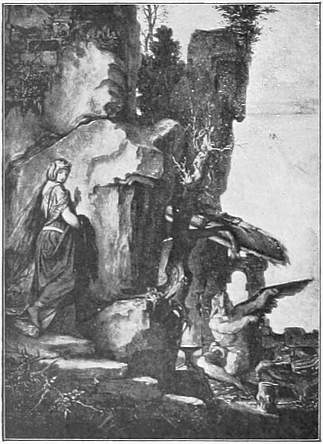
SCHWIND. WIELAND THE SMITH.
His works, in comparison with those of his contemporaries, who were devising systems by means of which art should be brought back to the classical, bear the stamp of naïve creations in which no hypocrisy, no decorative nothingness finds expression. As against the erudite treatises of the Cornelius school, they preached for the first time the doctrine, that in works of art what is important is not the quantity of learning displayed therein, but the quality of the feeling exhibited. With all their inequalities, all their incorrectness, all their weak points, they are inspired, sung, dreamed, and not put together in cold blood according to recipes: in them is the pulsation of a human heart, a tender human heart full of delicate feeling. This it is which constitutes his magical attraction to-day, which makes him the firm bond of connection between the moderns. He was no imitator, no soulless calligraphist performing laborious school exercises after the manner of the old masters; he spoke the language of his time.
He was one of the first who at that time laid aside the prejudice against modern costume, and in his “Symphony” turned to artistic account, in one fantastic whole, even Franz Lachner’s frockcoat and Fräulein Hetzenecker’s modern society toilette. “If you may paint a man hidden in an iron stove—what is called a knight in armour—you may still more permissibly paint a man in a frockcoat. In general, one can paint what one will, provided always that one wills what one can.” And it was only by means of this present-day temper that Romanticism could find so full-toned an expression in his works. Only because he was truly a citizen of the present day and felt its blood beating in his veins, could he feel the congenial elements of the past. To him the old-time legends were no antiquarian, erudite, pedantic lumber; they were a part of himself, and he interpreted them in more childlike simplicity of manner and with more delicate feeling than any artist of former times, because he observed them with the eye of the present age, with an eye made keen with longing. Just as in his “Wedding Journey” he raised all reality into the poetry of purest romance, so is his Romanticism saturated with a sense of reality charged with memories of home. Out of his fairy-tale pictures is breathed a charming fragrance of the long-vanished days of earth’s first springtide, and yet for that very reason a breath of the most modern Décadence. He is distinguished from Marées and Burne-Jones, from Puvis de Chavannes and Gustave Moreau, by a very unmodern attribute—he is bursting with health. He is still naïvely childlike, free from that elegiac melancholy, that temper of weary resignation, which the end of the nineteenth century first brought into the world.
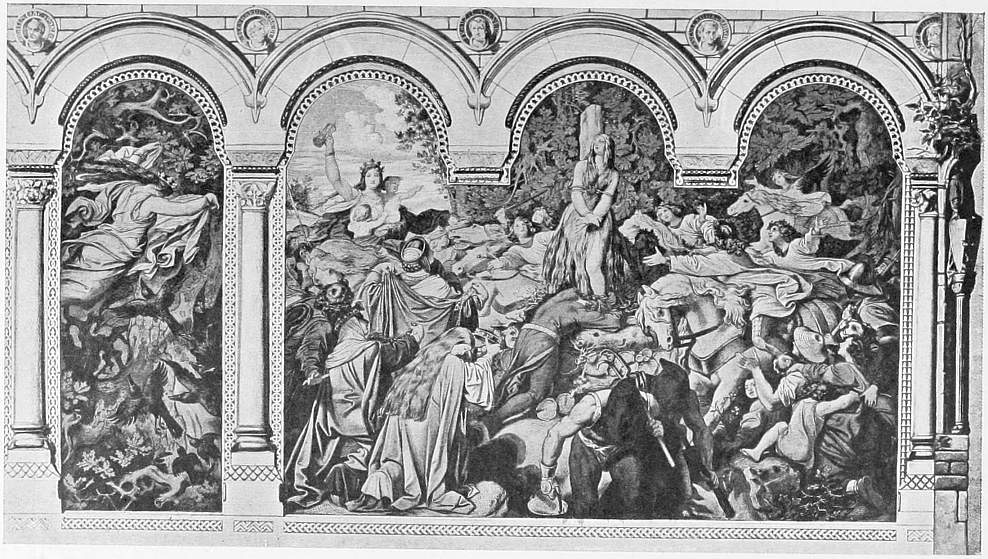
Neft, Helio.
SCHWIND. FROM THE STORY OF THE SEVEN RAVENS.
Yet Schwind was one of the first to feel and give expression to that modern sense of longing desire which turns back from a nervous, colourless age, from the prosiness of everyday life, towards a vanished Saturnian era, when man still lived at peace and undisturbed in happy union with nature. For even this proclaims him our contemporary, that the temper of his pictures develops itself from the landscape. A landscape painter through and through—almost in Bœcklin’s sense, who transformed the temper of Nature into the contemplation of living beings—he spoke of the rest and peace of German forests, of that hour of summer’s night when no wind blows, no leaflet moves, when to the solitary wanderer in the woods the mists rising from the meadows are transformed into white veils of the elves, and the gold-rimmed waves of the sea into the yellow hair of mermaids frolicking in the moonlight to the magic notes of their golden harps. He felt and loved his landscapes rather than studied them, yet they are saturated with an entirely modern sentiment for Nature. No German, at that time, had caught and understood the interweaving of the forest boughs with such intimate familiarity. The fresh sunshine of the morning breaks through the light green of the young beeches, and leaps from bough to bough, transforming the glittering dewdrops into diamonds, and the beetle, creeping comfortably over the soft moss, into gold and precious stones. “Da gehet leise nach seiner Weise der liebe Herrgott durch den Wald” (“The dear God holy, He passeth slowly, as His wont is, through the wood”). With a few boldly drawn lines and light colours we are transported into the midst of the forest world, and all around us opening buds and verdurous green, sweet scents, and the murmur of leaves. “When one has set one’s love and joy on a beautiful tree so fully,” he said to Ludwig Richter, “one depicts all one’s love and joy with it, and then the tree looks quite different from an ass’s fine daub of what he thinks it should be.”