Front matter (continued 5)
Reading edition
Albert, Helio.
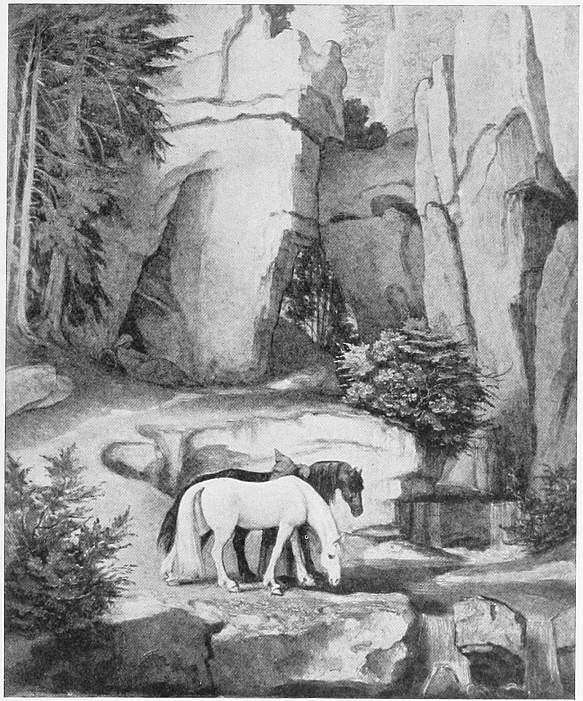
SCHWIND. A HERMIT LEADING HORSES TO A POOL.
Only so intimate a connection with Nature could enable Schwind to imagine landscapes, which in their virginal old-world mood form at once the echo of the figures and of their actions. These green meadows and flower-besprent hills, these gloomy wooded slopes, these smooth valleys through which glittering waters glide murmuring along, are fit and suitable dwelling-places for the delicate fabulous beings of the flower-entwined old fairy legends. Schwind lived with Nature. He gave the name of Tanneck (Fir-tree Corner) to the little country house which he built for himself on the Starnberger See, and the fresh scent of pinewood, the rustling sound of German forests, pour forth from his pictures. Like young Siegfried, he understood the language of birds, and went eavesdropping to hear what the pine trees whispered to one another.
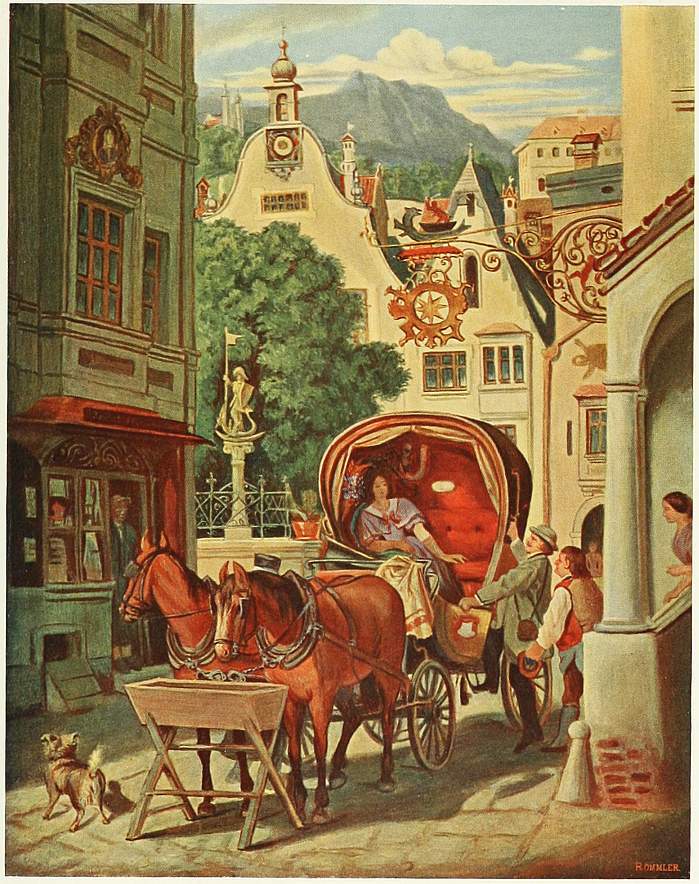
SCHWIND. THE WEDDING JOURNEY.
Still freer, more spontaneous, and lighter than in his oil paintings was his touch in his water-colours, in which the colour is only breathed over the forms like a delicate vapour; and quite especially in his illustrations—so far as the word may be employed with respect to him, for he never illustrated, he gave shape to his own thoughts, and that only which moved his innermost being he brought fully formed before one’s eye. The Bilderbogen and the Fliegende Blätter of Munich obtained from him witty and humorous inventions, such as “The Almond Tree,” “Puss in Boots,” “The Peasant and the Donkey,” “Herr Winter,” and “The Acrobat Games.” His fairest legacy consists of three cyclic works: “Cinderella,” “The Seven Ravens,” and “The Beautiful Melusina”; wherein he glorified with praise the beauty and fidelity of women, and their capacity for self-sacrifice. “Cinderella,” which appeared in 1855, at the Munich Exhibition, is a fairy-tale, than which poet has seldom, indeed, narrated a chaster, tenderer, or more fragrant. In 1858 followed the touching story of the good sister who releases her brothers by dint of unspeakable suffering and endurance, to-day the priceless pearl among the gems of the Weimar collection. For twenty years, as he said, the work had been in his thoughts. So far back as in 1844 he wrote to Genelli: “I believe that it will give something which may please people who have a sense for love and faithfulness, and for a touch of the power of enchantment.” When an acquaintance of his gazed upon it with dismay, and ingenuously asked for whom the thing was intended, and whither it was to go, Schwind turned his penetrating, flashing little eyes upon him, and then said: “Do you know, I painted that for myself; it is the dream of my life; no one shall buy it; some day I shall give it to a friend.” It is an imperishable work, full of grace, modesty, and charm.
Schwind takes the story up at the fateful moment when the lonely maiden, who is determined to release her enchanted brothers by assiduous spinning and constant silence, is discovered by a hunting party. There, amid the enchantment of the forest solitude, she sits in the hollow of a tree and spins away at the seven shirts, to free her seven brothers. Thus the king’s son catches sight of her. The fire of love kindles in his eyes. In one long kiss the maiden gives herself to him. The wedding takes place, and like another St. Elizabeth she is seen standing, soon afterwards, distributing alms to starving beggars. Yet, meanwhile, she has fallen under suspicion owing to her continuous silence; even her husband becomes distrustful, because in the quiet of night he has observed that she is not resting by his side, but is quietly up and spinning. And the catastrophe comes when the silent queen gives birth to twins, who, to the horror of all around, fly off in the form of ravens. Tranquil and affectionate, the young mother awaits her fate. Then follow the sentence of the Vehm-tribunal, the pathetic parting from her husband, the preparation for death. There is only one hour more to pass by before the seven years are over and the spellbound brothers set free. The good fairy appears in the air, hour-glass in hand, and brings solace to the hard-pressed heroine. The beggars, too, whose benefactress she had been, bring help, and hold the gate of the dungeon in force. So the time runs out, the spell is broken, and the brothers hasten, on milk-white horses, to save their sister from the stake. In Schwind’s marvellous drawings the story passes quickly on, stroke by stroke, deeply moving and soul-stirring in its dramatic force.
The “Beautiful Melusina” was the kiss of the water-nymph, with which Romanticism led her faithful knight to his death, only to disappear together with him out of German art. “The winter has dealt me a sore blow; I shall never be able to do anything more.” Carl Maria von Weber and Uhland had already gone before; Schwind was lying on his sick-bed when the German victories created a German fatherland. He learned, however, all the long series of glorious tidings that came from the field of war, saw the tumultuous joy and the dazzling sea of fire which surged through Munich in January 1871, and heard the joyful news that Germany was at last united. Then he had a glass of champagne poured out for him, and drank it to the new empire and the future of the nation.
In the middle of a wood of lofty beeches in Bernrieder Park, on the Starnberger See, there stands a small rotunda, within is a prattling fountain, right round the walls runs a frieze, depicting the legend of the “Beautiful Melusina.” It is Schwind’s monument. With him German Romanticism perished; reality itself had now become so marvellous. When, in 1850, Hübner had to paint a figure of Germania for a page in King Ludwig’s album, he depicted a queenly woman, prone on the ground, with her face in the dust, amidst a desolate landscape and under a cloudy sky. The crown has fallen from her head and a skull lies by her side, while on the frame are inscribed these words from the Book of Lamentations: “Mine eye runneth down with rivers of water for the destruction of the daughter of my people; the crown of our head is fallen.” When Schwind died, Germany had re-arisen. In the very year of his death, Lenbach painted his first Bismarck pictures: in Bismarck was embodied that power by means of which the dream of a nation was fulfilled.
Albert, Helio.
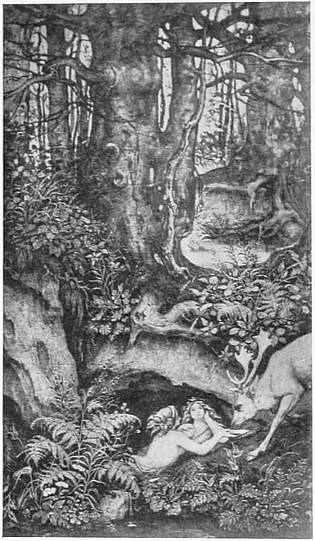
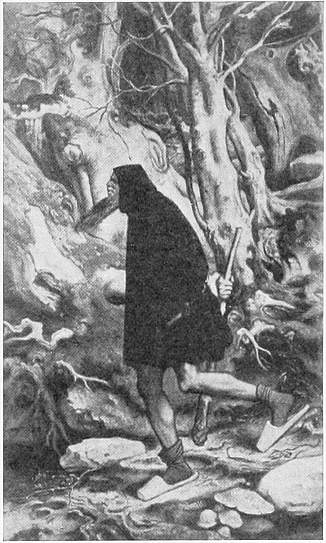
SCHWIND. NYMPHS AND STAG. SCHWIND. RUBEZAHL.
Thus Schwind’s works are not only the sign of a completed period in German history, but also at the same time both the climax and the conclusion of an art-epoch. Schwind had lived through the entire revolution which German painting had at that time undergone. At his death the sound of the hunting horns of Romanticism had died away. He had lived long enough to have the opportunity of criticising neatly, as follows, the dry, unpoetical school of historical painting then making its appearance, as if introduced by gaudily costumed models, a school which made its first hit with Lessing’s “Ezzelino”: “I will explain the picture to you. Ezzelino is seated in his dungeon, and two monks are attempting to convert him. One of them recognises that all pains are thrown away upon the old sinner, and takes himself off, regretfully desisting from all further endeavour; the other still has hopes, and continues his exhortations. But Ezzelino only keeps his angry gaze fixed before him, muttering, ‘Leave me alone! Don’t you see that I am—posing as a model!’” He had had occasion to write to his friend Bauernfeld: “I have seen so many schools of so-called painting in my time that it is an absolute horror to me”; he had asked Piloty: “What calamity are you preparing for us now?” and had thought it his duty to address to one of the younger painters the question: “Are we then an academy of the Fine or of the Ugly Arts?” “A man like me, with his ideas, walks like a ghost amid the battle of the virtuosi, in which the whole life of art has gone astray,” he used sadly to say. His last wonderful works stand alone in a time which was dazzled by the flash of arms characterising the Franco-Belgian school of art. It was not till much later that Hans Thoma took up the threads which connect the work of Schwind with the present epoch. When he died he was a solitary, isolated man taking leave of a generation in which he had no part. The period of historical painting which followed him produced no single work distinguished by Schwind’s sense of fragrant legendary poetry. The charming forest fairy who had appeared to him showed herself to no other; like the betrayed Melusina, she had returned to rest again, solitary, in her fountain home. Fantasy, tender soul that she is, had taken wings, whither none can tell. “That is why nobody has a single idea,” as Schwind said in his drastic way. The Muse of Schwind, the last Romanticist, was a chaste, pensive, soulful maiden; while that of Piloty, the first colourist, was a noisy, bloodthirsty Megæra. Yet one can have no doubt as to the necessity of this evolutionary change.
Schwind himself is among the masters “who have been, and are, and shall be.” He was different from all that was arising around him; he embodied the spirit of the future, and exercises over the art of the present day so great an influence that where two or three painters are gathered together in the name of the beautiful, he has his place in the midst of them, and is present, invisible, at every exhibition. But he exercises this influence only spiritually. Young artists study him as if he were a primitive master. Enraptured, they find in him all those qualities for which there is to-day so ardent a longing—innocent purity and touching simplicity, a mystic, romantic submersion in waves of old-time feeling and a charming youthful fervour. They do not study him in order to paint like him.
“Our heads are full of poetry, but we cannot give it expression,” are the words with which Cornelius himself characterised this period. Germany had original geniuses indeed, but no fully matured school to compare with the French; as yet the Germans did not know how to paint. Up to this time the course of painting in Germany had been a bold but imprudent flight through the air; in its Kaulbach-like cloud-heights it had melted away to a shadow, only to fall again, somewhat roughly, to the ground. It died of an incurable disease—idealism. The painters of that time, one and all, had never become real artists; strictly speaking, they had always remained amateurs. He alone is a great artist in whom the will and the performance, the substance and the form, are in complete accordance. Painters who never knew exactly what is meant by painting, artists whose most noticeable characteristic was that they had no art-capacity, were only possible in the first half of the nineteenth century in Germany, where for that very reason they were admired and praised.
What now began was a necessary making good what had been so long neglected. For craftsmanship is the necessary presupposition of all art, which can no longer suffer any one to be called a master who has not learnt his business. In the atmosphere of incense which surrounded Cornelius in Munich, the dogma that salvation was to be found in German art alone, and that the German nation was the chosen people of art, had reached a height of self-adoration which came near to megalomania. In the proud enthusiasm of those times, great in their aims as in their errors, the Germans had as false an opinion as possible of the art of foreign countries.
In the very years when the first railways were ousting the old mail-coaches the mutual interchange of endeavour and ability between the various nations was slower and scantier than ever before. How German artists had wandered abroad in the fifteenth and sixteenth centuries, in that great age when Dürer crossed the Alps on Pirkheymer’s pony, and when Holbein obtained from Erasmus letters of introduction for England! With what joy Dürer, in his letters and in his journal, gives an account of the recognition accorded him in artistic circles in Italy and the Dutch cities! Nearly all the German painters had, in the course of their long wanderings, made acquaintance with either the Netherlands or Italy. They knew exactly what was going on in the world around them. Dürer and Raphael used to send drawings to each other, “so as to know each other’s handwriting.” It was only in the first half of the nineteenth century that the Germans, once proud in the consciousness of possessing the finest comprehension of, and the greatest receptivity for, foreign intellectual wares, lived apart in timid isolation. Into the suburban still-life of the German schools of art not a sound made its way of what was taking place elsewhere. Only thus was it possible for the Germans to imagine that among all modern nations they alone had a vocation for Art. No one had the least idea that in England, the land of machines and beefsteaks, there were men who painted; and people went so far as to proclaim piety, morality, thoroughness, accurate draughtsmanship, and diligent execution the monopoly of German art; and superficiality, frivolity, and “empty straining after effect” the ineradicable national failing of that of France.
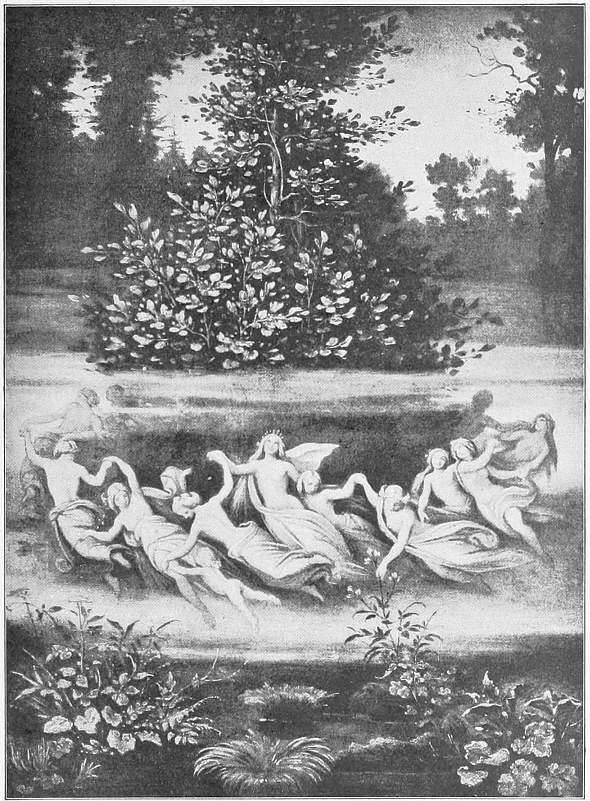
SCHWIND. THE FAIRIES’ SONG.
With some such ideas in their heads the majority of the German painters, in the autumn of 1843, found themselves confronted by Gallait’s “Abdication of Charles V” and Bièfve’s “Agreement of the Dutch Nobility”; two Belgian pictures which at that time were going the round of the exhibitions in all the larger towns of Germany. And it was not long before the belief in the old gods, which had for thirty years held sway in the city of King Ludwig, was completely undermined by the younger generation. “Even for the great gods, day comes to an end. Night of annihilation, descend with the dusk!” Diogenes expelled from his philosophic tub could not have felt more uncomfortable than the German painters in presence of the Belgian pictures. As till then the incapacity to paint had been belauded as one of the strongest possible proofs of the higher artistic nature and of genuine greatness, so now it was perceived that nevertheless, on the banks of the Scheldt and of the Seine, a much greater school of painting was in full bloom, and producing splendid fruit.

CHAPTER IX
THE FORERUNNERS OF ROMANTICISM IN FRANCE
In France the first decade of the century gave no premonition of the powerful development which was shortly to take place in French art. A legion of characterless pupils issuing from David’s studio wearied the world with their aimless works, and hurled their thunderbolts against all rising talent. The austere catalogue of the Salon was a pell-mell of Belisarii, Télémaques, Phædras, Electras, Brutuses, Psyches, and Endymions. Girodet and Guérin wearied themselves in putting on canvas the chief scenes in the classical tragedies at that time so frequently performed—Pygmalion and Galatea, the Death of Agamemnon, and the like—and painted portraits between times; Girodet’s dry and poor, Guérin’s solemnly vacant. The universal note was that of tedium.
François Gérard alone, the “King of Painters and Painter of Kings,” survives, at least in his portraits. Like David he is redeemed only by his portrait painting, and his successes in that direction eclipse even Mme. Vigée-Lebrun, the amiable, gifted, and graceful painter of Marie Antoinette’s days. At the outbreak of the Revolution she had left France. Everywhere extolled and welcomed with open arms, she painted Mme. de Staël in Switzerland, and at Naples Lady Hamilton, the famous beauty of the time of the Directory. But when, in 1810, she returned to Paris, she had been forgotten. The day on which Marie Antoinette picked up her brush for her, as Charles V had done for Titian, was to remain the happiest in her life. She belonged to the Ancien Régime, and although her death did not take place till 1842, at the age of eighty-seven, her work was already over in 1792. In her old age she busied herself in writing memoirs of the splendour of her youthful days, from the famous mythological dinner in the Rue de Cléry, where her husband appeared in the character of Pindar and recited his translation of Anacreon’s odes, to the triumphs which accompanied her journey round Europe.
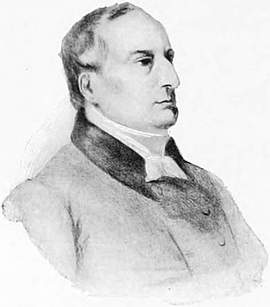
FRANÇOIS GÉRARD. L’Art.
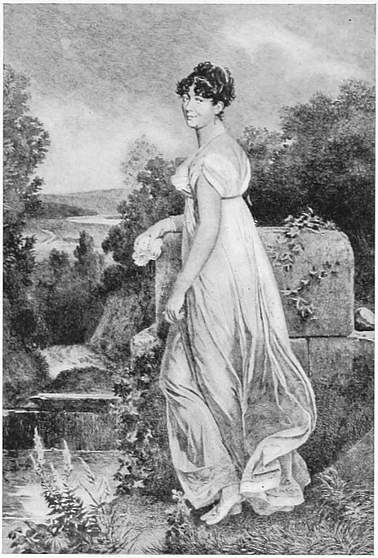
Gérard took the place which she had left vacant at her departure, and filled it well, especially in his youth. When, in the Exhibition of Portrait Painting held at Paris in 1885, there appeared the likeness of Mlle. Brongniart, from the collection of Baron Pichon, painted by Gérard in 1795, at the age of twenty-five, there was general astonishment at the familiar and intimate grasp of character it displayed. The portrait of this young girl standing in her white dress, so tranquil and without pose, has in the firmness of its draughtsmanship the austere charm and dignity of a Bronzino. And later none could give to the aristocracy of Europe a nobler or more natural bearing than did Gérard, who became their tried and trusted depicter: yet in his last days he descended into theatrical exaggeration. Endowed as he was with all the captivating qualities of a cultured man of the world, he had from the beginning avoided as the plague the revolutionary politics in which David was for some time engaged, and when at the instance of the elder master he was appointed a member of the Revolutionary Tribunal, he alleged illness in order to be absent from its sessions. He was a man of the salons, the born painter of the great world, his house the centre of a distinguished circle of society. Not a celebrity, not an emperor or king, but wished to be painted by Gérard. And just as he had been the chosen portrait painter of the Bonaparte family, so after the Restoration he was still the official favourite of the Court. Josephine took the fashionable painter under her high protection, Napoleon’s marshals defiled before him, and the aristocracy which returned with Louis XVIII vied with one another for his favour.
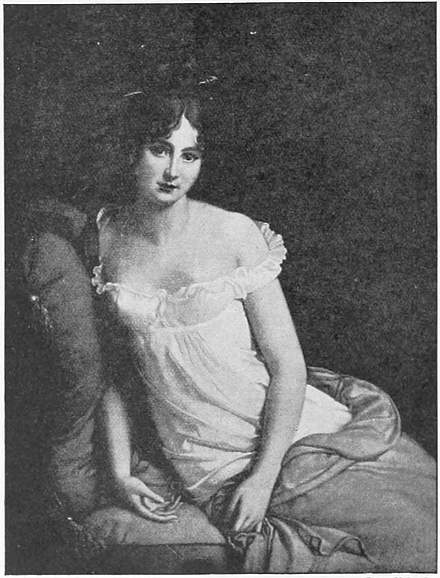
Gérard’s three hundred portraits are a continuous catalogue of all those who in the first quarter of the century played any part in France upon the political, military, or literary stage. A man of supple talent and fine tastes, he completely satisfied the desires of a society which, after the storm of the Revolution, opened its salons again and re-established its former hierarchy of rank. The portrait with rich background of upholstery, and the depicting of public ceremonies, were reintroduced by him into the field of art. The people whom he painted are no longer “citizens,” as with David, but princes, generals, princesses; and their surroundings allow of no doubt as to whether they are to be addressed as Sir, as Your Serene Highness, or as Your Excellency. No one knew how to flatter in so tactful a manner, particularly in portraits of ladies. It was to him, therefore, that Mme. Récamier had recourse when she was dissatisfied with David’s likeness of her. Gérard’s, which she destined for Prince Augustus of Prussia, one of her admirers, gave the “fair Juliette” the fullest satisfaction. In the former she was represented reposing on a couch, austere and without charm, like a tragic muse. Here she sits in a pleasant, lazy attitude upon a chair, in a transparent robe which fully displays her form; about her lips plays a half-melancholy, half-coquettish smile, and she, the great actress who had turned so many men’s heads, gazes with gentle child-eyes as innocently upon the world as though she believed the story about babies and the stork.
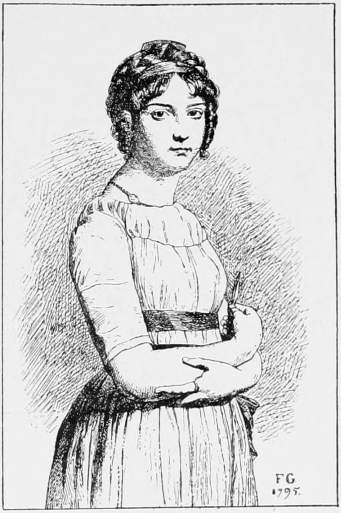
Gaz. des Beaux-Arts. Gaz. des Beaux-Arts.
GÉRARD. MADAME VISCONTI. GÉRARD. MLLE. BRONGNIART.
The background, too, that colonnade “leading nowhither,” is characteristic of the change in the manner of regarding things. The older schools of painting had, in the case of portraits, managed the treatment of the background in two different ways. The old Dutch and Germans—Jan van Eyck and Holbein—aimed at showing a man, not only portrayed with the subtlest fidelity to truth, but also in the surroundings in which he was usually or by preference to be found. The Italians renounced all representation of such scenes, and gave only a quiet, neutral tone to the background. Gorgeous decorative scenery was introduced by the court painter Van Dyck, and since the second half of the seventeenth century had continually risen in popular favour. Mignard, Lebrun, and Rigaud had brought into fashion, for portraits of princely personages, that stately pillared architecture, with broad velvet curtains swelling and descending in ample folds, which at that time was so remarkably in keeping with the whole cut of the costumes, with the enormous full-bodied wigs and the theatrical attitudinising of that epoch. For the likenesses of generals and warlike princes the favourite background was one which represented, by means of a number of small figures, entire battles, marches, sieges, and so forth. Both these methods, and, together with them, that of an ideal, lightly indicated park landscape, were put an end to by the Revolution, under the influence of which all extravagant pomp, not only in life, but even in portrait painting, was replaced by an ascetic sobriety. Gérard, the Court painter of the Bourbons, who on their return had “learnt nothing and forgotten nothing,” reintroduced the gorgeous pillar decoration, which still remained the authoritative style under Stieler and Winterhalter, and has only in the bourgeois era of to-day given way to the simple, neutral-toned background of the Italians.
David, by the way, never forgave Mme. Récamier for having preferred his pupil to himself. When, in 1805, after the completion of Gérard’s likeness of her, she approached David on the subject of finishing his, he answered drily: “Madame, artists have their caprices as well as women; now it is I who will not.”
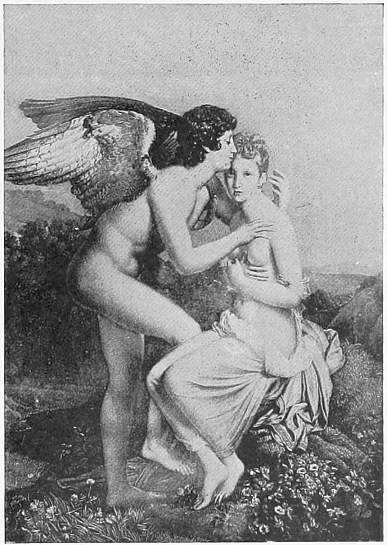
As an historical painter Gérard was an imitator of the mannerist Girodet. Paintings such as “Daphnis and Chloe,” or the famous “Psyche” receiving Cupid’s first kiss (1798), made indeed a great sensation among the ladies, who for some time afterwards painted their faces white, to resemble the gentle Psyche; but from the artistic point of view they do not rise above the ordinary level of the Classical school. As an historical painter he took much the same course as David; he began as a Revolutionist in 1795 with the usual “Belisarius,” and ended as a Royalist with a “Coronation of Charles X.”
The more stiff and sober the antique style of David became, the sooner a counter-current was likely to arise, and the change of taste showed itself first in the circumstance that, from 1810 on, a master came more and more to the front who, already old, had hitherto lived in obscurity, almost despised by his contemporaries. This was the amiable, sympathetic, charming, sweet, and great Prudhon, the lineal descendant of Correggio, a solitary painter, the gracefulness of whose art was at first unappreciated, but who, as the orthodox academicians began to be more and more tedious, exercised a correspondingly greater influence over the younger generation. He is the one refreshing oasis in the desert wilderness of the Classical school.
What a difference between him and David! When the elegant grace of Watteau fled from the French school, and the new Spartans dreamed of founding a Greek art, David was the hero of this buskined theatrical school of painting. He painted “The Horatii” and “Brutus,” and thought to bring ancient Rome back to life by copying the shapes of old Roman chairs and old Roman swords. That was the antique style of his first period. Later, having made the discovery that, compared with the Greeks, the Romans were semi-barbarians, he abandoned the Roman style, and thought to make a great stride forwards by copying Greek statues and carefully transferring them to his pictures. This “pure Grecian character” is represented in his “Rape of the Sabines.” Later again, he turned to the more ancient Greeks, and the result was the most academic of his pictures, his “Leonidas.” A mixture of dryness and declamatory pathos; diligence without imagination; able draughtsmanship and an absolute incapacity of drawing anything whatever without a model; careful arrangement without the slightest trace of that gift of the inner vision whereby the whole is brought complete and finished before the eye,—these exhaust the list of David’s qualities. By means of casting and copying he thought to come near to that art of the antique whose soul he dreamed of embracing, when he held but its skeleton in his hands.
Gaz. des Beaux-Arts. Cassell & Co.
GÉRARD. CUPID AND PSYCHE. GÉRARD. MADAME RÉCAMIER [DETAIL].
And meanwhile, away from the broad high-road, and almost unnoticed, was living that painter whom David contemptuously called “the Boucher of his time.” He it was who truly cherished the gods of Greece in his heart, under whose brush the dead statues began to breathe and to feel the blood flowing in their veins, as in the old days when the Renaissance dug them out of the ground. His appearance on the stage indicates the first protest against the rigid system pursued by the painter of the Horatii and of Brutus. Prudhon also believed in the antique, but he saw therein a grace which no Classicist had ever seen; he also contrasted the simplicity of the Grecian profile with the capricious, wrinkled forms of the rococo style; he too had spent his youth in Italy, but had not thought it criminal to study Leonardo and Correggio; he did not bind himself either to cold sculpture or to the delicate morbidezza of the Lombards as the only means of grace. He remained a Frenchman heart and soul, in that he inherited from Watteau’s age its womanly softness and elegance. In a cold, ascetic age he still believed in tenderness, gaiety, and laughter—he who as a man had but little reason to take delight in life.
Prudhon was ten years younger than David, and was born at Cluny, the tenth child of a poor stone cutter. He grew up in miserable circumstances, cherished only by a mother who devoted the whole of her love to this her youngest born, and to whom the child, a delicate pliant creature, clung with girl-like tenderness. His parents used often to send him out with the other poor children of the little town to gather faggots for the winter in the wood belonging to the neighbouring Benedictine monastery. There the handsome, sprightly boy with the large melancholy eyes attracted the notice of the priest, Père Besson, who made him a chorister and gave him some instruction. Here, in the old abbey of Cluny, surrounded by venerable statues carved in wood, by old pictures of saints and artistic miniatures, he recognised his vocation. An inner voice told him that he was to be a painter. And now his Latin exercise books began to fill with drawings, and he carved little images with his penknife out of wood, soap, or whatever came to his hand. He squeezed out the juice of flowers, made brushes of horsehair, and began to paint. He was inconsolable on finding that he could not hit off the colouring of the old church pictures. It was a revelation to him when one of the monks said to him one day: “My boy, you will never manage it so: these pictures are painted in oils”; and he straightway invented oil painting for himself. With the help of the instruction which he now received at Dijon from an able painter, Devosge, he made rapid progress.
Nevertheless a generation was yet to pass before he was really to become a painter. His marriage, on 17th February 1778, with the daughter of the notary of Cluny, became the torment of his life. A linen-weaver and three of his father-in-law’s clerks were present at the wedding. His wife was quarrelsome, their income small, and their family rapidly increasing. He betook himself to Paris to seek his fortune, with a letter of introduction to the engraver Wille. “Take pity on this youngster, who has been married for the last three years, and who, were he to come under some low fellow’s influence, might easily fall into the most terrible abyss”; so ran the letter, which a certain Baron Joursanvault had given him. He hired himself a room in the house of M. Fauconnier, the head of a firm engaged in the lace trade, who lived in the Rue du Bac with his wife and a pretty sister. The latter, Marie, was eighteen years of age, and, like Werther’s Lotte, was always surrounded by her brother’s children, whom she looked after like a little housewife. Prudhon, himself young, sensitive, and handsome, loved and was loved, and made her presents of small flattering portraits and pretty allegorical drawings, in which Cupid was represented scratching the initials M. F. (Marie Fauconnier) on the wall with his arrow. That he was married and several times a father she never knew, till one day Madame Prudhon arrived with the children. “And you never told me!” was her only word of reproach.
Gaz. des Beaux-Arts.
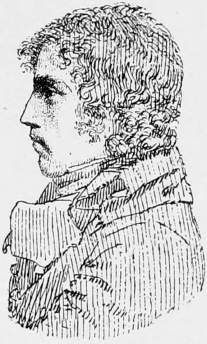
PIERRE PAUL PRUDHON. PORTRAIT OF HIMSELF.
Prudhon himself now went to Italy—a journey accompanied by serious difficulties. At Dijon he had competed for the Prix de Rome, and had been so simple as to make a sketch for one of his rivals. He owed it to the latter’s honesty that the scholarship nevertheless fell to himself. He started on his journey; but when he reached Marseilles, and was ready to embark, the vessel was unable to weigh anchor for several weeks, owing to stormy weather. And even on the voyage it became necessary to disembark again, so that months had elapsed before he arrived in Rome, penniless, and having embraced, according to classical custom, the land he had come to conquer; for he had fallen out of the carriage on the way. Fortunately his dearly bought sojourn in Italy did him no harm. He had indeed intended to draw only from the antique and after Raphael; but after the lapse of a very few weeks he found his ideal in Leonardo. Him he calls “his Master and Hero, the inimitable father and prince of all painters, in artistic power far surpassing Raphael!”
In a small sketch-book, half torn up, dating from this time, and still in existence, we have already the whole Prudhon. It contains copies of ancient statues, made laboriously and without pleasure in the work; then comes Correggio’s disarmed “Cupid,” a delicious little sketch, and with the same pencil that drew it he has written down the names of the pictures he purposes painting later on: “Love,” “Frivolity,” “Cupid and Psyche.” It is as it were the secret confession of his fantasy, a preliminary announcement of his future works. Here and there are found sketches hastily dashed off of beautiful female forms in the graceful attitude which had excited his admiration in the women of the “Aldobrandini Wedding.” But, above all, the young artist observed all that was around him. He lived in unceasing intercourse with the beautiful, and his soul was nurtured by the spirit of the works which surrounded him. He accumulated pictures, not in his sketch-book, but in himself; so much so that, when he was afterwards interrogated as to his Italian studies, his only answer was: “I did nothing but study life and admire the works of the masters.” He avoided association even with scholars who had taken the Prix de Rome. The elegant and graceful sculptor Canova was the only one with whom he permitted himself any intercourse.
Gaz. des Beaux-Arts.
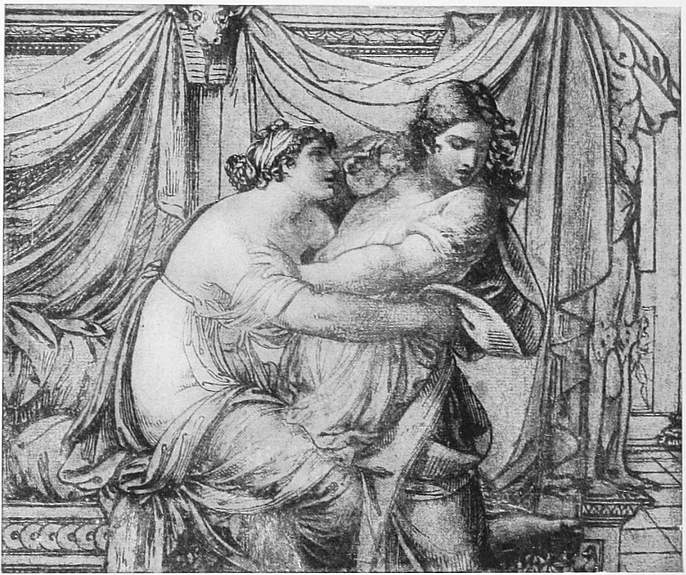
PRUDHON. JOSEPH AND POTIPHAR’S WIFE.
When his scholarship had run its course, at the end of November 1789, he found himself again in Paris, and the struggle against poverty began once more. Even while in Italy he had sent all his savings to his wife, who had straightway squandered them in drink with her brother, a sergeant in a cavalry regiment. At Paris he had to act as parlour-maid and nursery-maid. The faces of two more women rise up in his life like fleeting stars, and both of them died before his eyes. The first was the mysterious stranger who appeared one day in his studio and commissioned him to paint her portrait. She was young, scarcely twenty years of age, with great blue eyes, but her face was weary and wan as though from long sleepless nights. “Your portrait?” asked Prudhon, “with features so troubled and sad?” He set to work, silent and indifferent; but with every stroke of his brush he felt himself more mystically attracted to this young girl, evidently as unhappy and as persecuted by fate as himself. She promised to return on the morrow; but neither on that day nor on the next did she appear. One afternoon he was wandering dreamily along the street, thinking of the unknown fair one, when his eye almost mechanically caught sight of the guillotine, and he recognised in the unhappy victim at that very moment ending her days the mysterious visitor of his studio.
To keep the wolf from the door, Prudhon was obliged for some years to draw vignettes on letter-sheets for the Government offices, business cards for tradesmen, and even little pictures for bonbonnières. For this the representatives of high art held him in contempt. Greuze alone treated him amicably, and even he held out no hopes for his future. “You have a family and you have talent, young man; that is enough in these days to bring about one’s death by starvation. Look at my cuffs.” Then the old man would show him his torn shirt-sleeves—for even he could no longer find means of getting on in the new order of things. To his anxieties about the necessities of life were added dissensions with his wife. He became the prey of a continual melancholy; he was never seen to smile. Even when a separation had been effected his tormentor persecuted him still, until she was relegated to a madhouse. But now a change comes over the scene with the entrance of Constance Mayer.
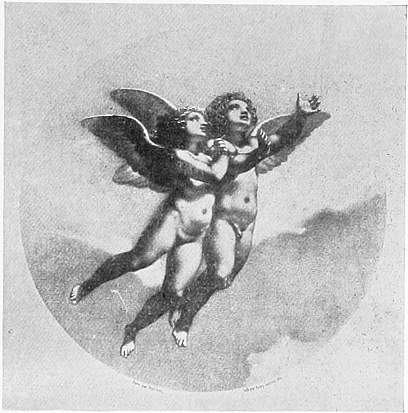
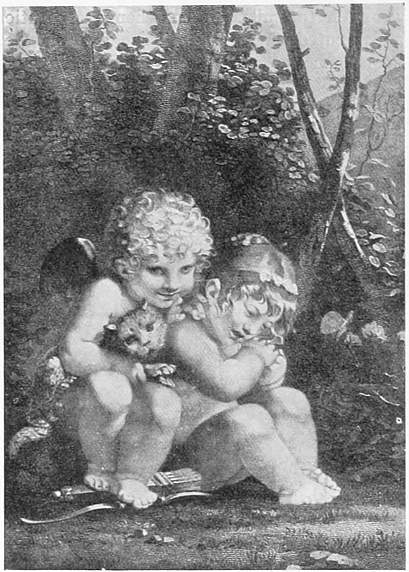
PRUDHON. STUDY DIRECTS THE FLIGHT OF GENIUS. PRUDHON. LE COUP DE PATTE DU CHAT.
This amiable young painter, his pupil, was the star that lighted up his old age. She was ugly. With her brown complexion, her broad flat nose, and her large mouth, she had at first sight the appearance of a mulatto. Yet to this large mouth belonged voluptuous lips ever ready to be kissed; above this broad nose there were two eyes shining like black diamonds, which by their changeful expression made this irregular, gamin’s face appear positively beautiful. She was seventeen years his junior, and he has painted her as often as Rembrandt painted his Saskia. He has immortalised the dainty upturned nose of his little gipsy, as he called her, in pictures, sketches, pastels, all of which have the same piquant charm, the same elegant grace, the same joyous and merry expression. In her he had found his type, as his namesake Rubens did in Hélène Fourment. Constance Mayer became the muse of his delicate, graceful work. And she too died before his eyes, having cut her throat with a razor.
The master and the pupil loved each other. As sentimental as she was passionate, as gay as she was piquant, nervous and witty, she possessed every quality that was likely to captivate him, as she chattered to him in her lively and original way, and flattered his pride as an artist. This love seemed to promise him rest and a bright ending for his days. He entered into it with the passion of a young man in love for the first time. Mlle. Mayer, after her father’s death, was dependent on no one. Her studio in the Sorbonne was separated from her master’s only by a blind wall. She was with him the entire day, worked at his side, was his housekeeper, and saw to the education of his daughter, to whom she was at once a mother and an elder sister; and Prudhon transferred to her all the tender love which as a child he had cherished for his mother. In his gratitude he wished to share his genius with his friend, and to make her famous like himself. It is pathetic to note in Mlle. Mayer’s studies with what patience and devotion he instructed her, how he strove to animate her with his own spirit, and to give her something of his own immortality. Even his own work was influenced by the new happiness. To the period of his connection with Constance belong his masterpieces, “Justice and Vengeance,” “The Rape of Psyche,” “Venus and Adonis,” and “The Swinging Zephyr.”
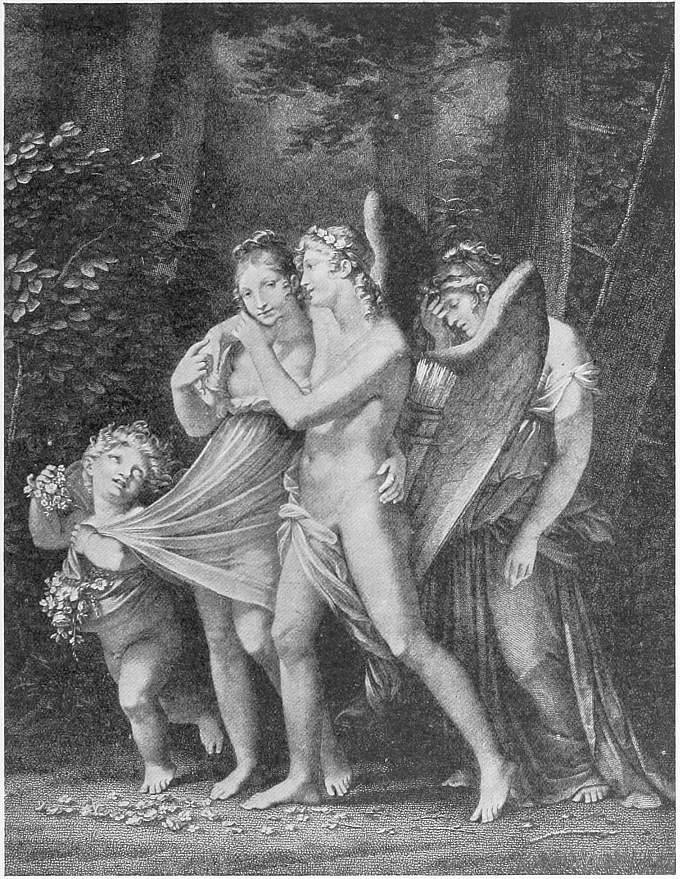
PRUDHON. CUPID AND PSYCHE.
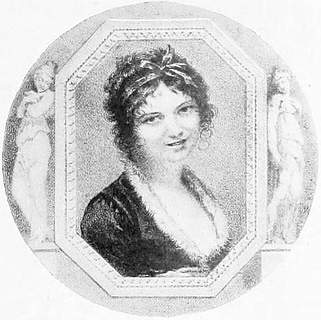
CONSTANCE MAYER.
These brought him at last even outward success. In 1808 the Emperor gave him the Cross of the Legion of Honour for his picture of “Justice and Vengeance,” and he became, if not the official, at least the familiar painter of the Court. The fine portrait of the Empress Josephine belongs to this period. When the new Empress Marie Louise wished to learn the art of painting, Prudhon, in 1811, became her drawing master; and when on the birth of the King of Rome the city of Paris presented to the Emperor the furniture for a room, he was commissioned to provide the artistic decoration. Criticism began to bow its head when his name was mentioned; and the younger generation of painters soon discovered in him, once so contemptuously reviled, the founder of a new religion, the want of which had long been felt. He began to make money. Constance Mayer seemed to bring him luck: her death affected him all the more deeply.
By nature nervous and highly strung, jealous and keenly conscious of her equivocal position, she could not make up her mind, when the painters were ordered to move their studios from the Sorbonne, either to leave Prudhon or openly to live with him. On the morning of 26th March 1821 she left her model, the little Sophie, alone, after giving her a ring. Soon afterwards a heavy fall was heard, and she was found lying on the ground in a pool of blood. Prudhon lingered on for two years more, two long years spent as it were in exile. Solitary, tortured by remorse of conscience, and with continual thoughts of suicide, he lived on only for his recollections of her, in tender converse with the memorials she had left, insensible to the renown which began gradually to gather round his name. The completion of the “Unfortunate Family,” which Constance had left unfinished on her easel, was his last tête-à-tête with her, his last farewell. He left his studio only to visit her grave in Père-Lachaise, or to wander alone along the outer boulevards. An “Ascension of the Virgin” and a “Christ on the Cross” were the last works of the once joyous painter of ancient mythology: the Mater Dolorosa and the Crucified—symbols of his own torments. Death at length took compassion upon him. On the 16th of February 1823 France lost Prudhon.
His art was the pure expression of his spiritual life. His life was swayed by women, and something feminine breathes through all his pictures. In them there speaks a man full of soul, originally of a joyous nature, who has gone through experiences which prevented him ever being joyous again. He has inherited from the rococo style its graces and its little Cupids, but has also already tasted of all the melancholy of the new age. With his smiles there is mingled a secret sadness. He has learnt that life is not an unending banquet and a perpetual pleasure; he has seen how tragic a morrow follows upon the voyage to the Isle of Cythera. The bloom has faded from his pale cheeks, his brow is furrowed—he has seen the guillotine. He, the last rococo painter and the first Romanticist, would have been truly the man to effect the transition from the eighteenth to the nineteenth century by a path more natural than that followed by David.
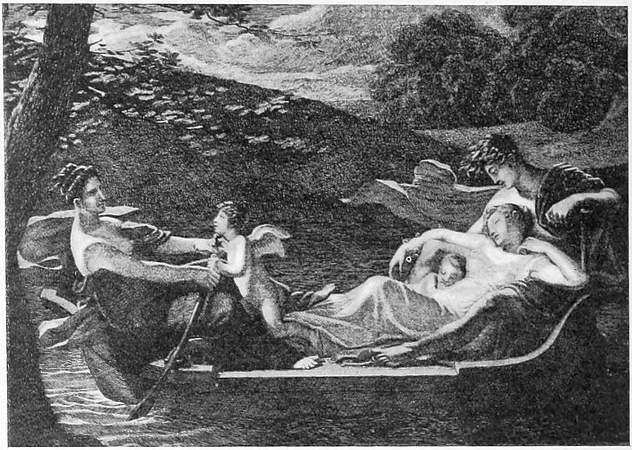
Gaz. des Beaux-Arts.
CONSTANCE MAYER. THE DREAM OF HAPPINESS.
Even his fugitive sketches, thrown off in the days of his poverty, have a quite peculiar charm and a thoroughly individual sentiment. There are vignettes of his for letter-sheets, done for the Government offices, which in a few pencil touches contain more manly elegance and poetry than do David’s most pretentious compositions with all their borrowed Classicism. Prudhon was the only painter who at that time produced anything of conspicuous merit in the art of ornament. Even drawings such as “Minerva uniting Law and Liberty,” which from their titles would lead one to expect nothing more than frozen allegories, are imbued, not with David’s coldness, but with Correggio’s charm. French grace and elegance are united, without constraint, to the beauty of line found in ancient cameos. He it was who first felt again the living poetry of that old mythology, which had become a mere collection of dry names. He is commissioned to draw a card of invitation for a ball, and he sends a tender hymn on music and dancing. In extravagant profusion he scatters forth, no matter where, poetic invention and grace such as David in his most strenuous efforts sought for in vain. It was during this time that Prudhon became the admirable draughtsman to whom the French school have awarded a place among their greatest masters. These drawings and illustrations were the necessary preparation for the great works which brought him to the front at the beginning of the century.
Even his first picture, painted in 1799—to-day half-destroyed—“Wisdom bringing Truth upon the earth, at whose approach Darkness vanishes,” must, to judge from early descriptions, have been marked by a seductive and delicate grace. And the celebrated work of 1808, “Justice and Vengeance pursuing Crime,” belongs certainly, so far as colouring is concerned, rather to the Romantic than to the Classical era. For during the latter, one faculty especially had been lost, and that was the art of painting flesh. Prudhon, by deep study of Leonardo and Correggio, masters at that time completely out of fashion, won back this capacity for the French school. In wild and desolate scenery, above which the moon, emerging from behind heavy clouds, shines with a ghostly light upon the bare rocks, the murderer is leaving the body of his victim. He strides forth with hasty steps, purse and dagger in hand, glancing back with a shudder at the naked corpse of a young man which has fallen upon a ledge of rock, lying there stiff and with outstretched arms. Above, like shapes in the clouds, the avenging goddesses are already sweeping downwards upon him. Justice pursues the fugitive with threatening, wrathful glance; while Vengeance, lighting the way with her torch, stretches out her hand to grasp the guilty one. In that epoch this picture stands alone for the imposing characterisation of the persons, for its powerful pictorial execution, and the stern and grandiose landscape which serves as setting to the awful scene.
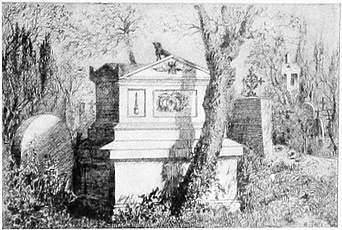
THE TOMB OF PRUDHON AND CONSTANCE MAYER AT PÈRE-LACHAISE.
In general, Prudhon was not a tragic painter; his preference was for the more joyous, light and dreamy, delicately veiled myths of the ancients. His misfortunes taught him to flee from reality, and on the wings of Art he saved himself, in the realm of legendary love and visionary happiness. So we see Psyche borne aloft by Zephyr through the twilight to the nuptial abode of Eros. A soft light falls upon her snowy body; her head has fallen upon her shoulder, and one arm, bent backwards, enframes her face. Silent like a cloud, the group moves onward—a sweet-scented apparition from fairyland. Now, enraptured genii visit the slumbering Fair One in forest-shadows, under the shimmering moon; now she is stealing secretly down to bathe in a tranquil lake, and gazes with astonishment upon her own likeness in the gloomy mirror. Here Venus, drawing deep breaths of secret bliss, is seated, full of longing love, by the side of Adonis. Who else, at that time, could draw nude figures of such faultless beauty, so slender and pure, with lines so supple and yet so firm, and enveloped in so full and soft a light? Or again, he paints Zephyr swinging roguishly by the side of a stream. A gentle breeze plays through his locks, and the cool darkness of the wood breathes through all things round.
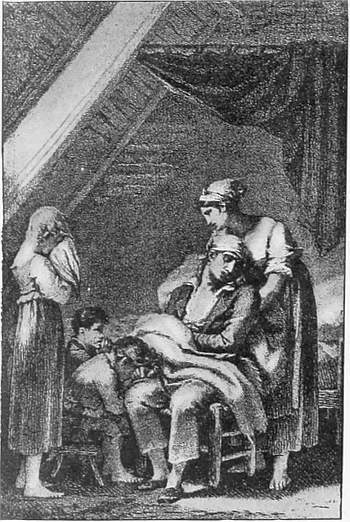
Gaz. des Beaux-Arts.
PRUDHON. THE UNFORTUNATE FAMILY.
Prudhon’s work is never a laborious patchwork of fragments of antique forms picked up here and there, never the insipid product of the reason working in accordance with recipes long handed down; it is thoroughly intuitive. Never keeping too closely to his model, he gave to his creations the movement and the divine breath of life. In his hands with dreamlike fidelity the Antique rose up again renewed, new in the sense of his own completely modern sentiment, and in that of those great masters of the Renaissance who had wakened it to life three hundred years before. For Prudhon, as is shown by his landscape backgrounds, is altogether Jean Jacques Rousseau’s contemporary, the child of that epoch in which Nature revealed itself anew; and, as is proved by his figures, he is a congenial spirit to Antonio da Allegri and Vinci. In fresh recollection of Correggio, he loves a soft exuberance of flesh and a delicate semi-obscurity; in enthusiastic reverence for Leonardo, those heads of women, with deep, sensuously veiled eyes, and that mysterious delicate smile playing dreamily round the wanton mouth. Only, the enchanting sweetness of the Florentine and the delicious ecstasy of the Lombard are toned down by a gentle melancholy which is entirely modern. The Psyche borne up to heaven by Zephyr changes in the end, when purified and refined, into the soul itself, which, in the form of the Madonna, ascends into heaven, transfigured with longing desire; and Venus, the goddess of love, is transformed into Love immortal, “Who, stretched upon the Cross, yet reacheth out His hand to thee.”
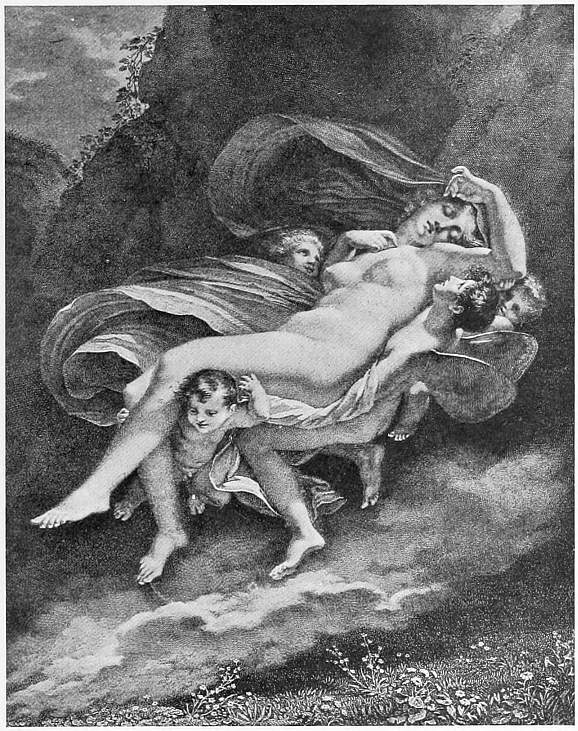
PRUDHON. THE RAPE OF PSYCHE.
This man, with his soft tenderness and fine feeling for the eternal feminine, was as though fashioned by Nature to be the painter of women of his time. If David was the chief depicter of male faces bearing a strong impress of character, delicate, refined, womanly natures found their best interpreter in Prudhon. His heads of women charm one by the mysterious language of their eyes, by their familiar smile, and by their dreamy melancholy. No one knew better how to catch the fleeting expression in its most delicate shades, how to grasp the very mood of the moment. How piquant is his smiling Antoinette Leroux with her dress à la Charlotte Corday, her coquettish extravagant hat, and all the amusing “chic” of her toilette! Madame Copia, the wife of the engraver, with her delicately veiled eyes, has become in Prudhon’s hands the very essence of a beautiful soul. A languishing weariness, a remarkable mingling of Creole grace and gentle melancholy, breathes over the portrait of the Empress Josephine. She is represented seated on a grassy bank in a dignified yet negligent attitude, her head slightly bent, her gaze wandering afar with a look of uncertain inquiry, as though she had some faint presentiment of her coming misfortune; and the dreamy twilight-shadows of a mysterious landscape are gathering around her.
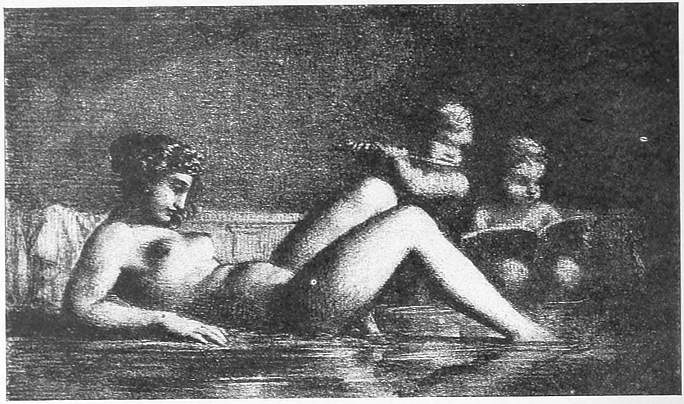
PRUDHON. LE MIDI.
Coming after a period of colour asceticism, Prudhon was the first to show a fine feeling for colour. Even during the revolutionary era he protested in the name of the graceful against David’s formal stiffness. He sought to demonstrate that human beings do not in truth differ very widely to-day from those in whom Leonardo and Correggio delighted, that they are fashioned out of delicate flesh and blood, not out of marble and stone. Standing beside David, he appealed to the art of colour. But as with André Chénier, a spirit congenial to his, it was long before he attained success. His modesty and his rustic character could effect nothing against the dictatorial power of David, on whom had been showered every dignity that Art could offer. People continued to ridicule poor Prudhon, who worked only after his own fantasy, who had fashioned for himself in chiaroscuro a poetic language of his own, till the question was raised again from another side, and this time by a young man who came directly out of David’s studio.
Antoine Jean Gros was one of David’s pupils, and stood out among his fellows as the one most submissively devoted to his master; yet it was he who, without wishing it or knowing of it, was preparing the way for the overthrow of David’s school. He was born 17th March 1771, at Paris, where his father was a miniature painter. His vocation was determined in the studio of Mme. Vigée-Lebrun, who was a friend of his parents. In the Salon of 1785, which contained David’s “Andromache beside the Body of Hector,” he chose his instructor. He was then the handsome youth of fifteen represented in his portrait of himself at Versailles, with delicate features, full of feeling, on which lies an amiable, gentle cast of sentimentality. Two large, dark-brown eyes look out upon the world astonished and inquiring, dark hair surrounds the quiet, fresh face, and over it is cocked a broad-brimmed felt hat. In this picture we see a fine-strung, sensitive nature, a soul which would be plunged by bitter experiences into depths of despair, in proportion as success would raise it to heights of ecstasy. In 1792 he competed unsuccessfully for the Prix de Rome, and this failure was the making of him.
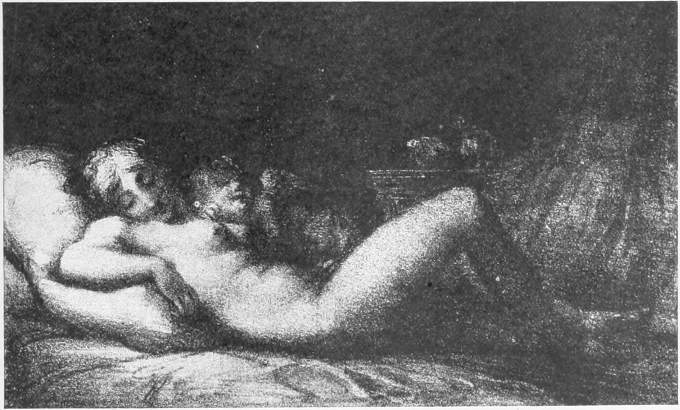
PRUDHON. LA NUIT.
He went to Italy on his own account, and was an eye-witness of the war which Napoleon was there waging. There he beheld scenes in which archæology had no part. For when Augereau’s foot-soldiers carried the bridge of Arcola by assault, they had little thought of imitating an antique bas-relief. Gros observed armies on the march, and saw their triumphant entry into festally decorated cities. He learnt his lesson on the field of battle, and on his return placed on record what he had himself gone through. In Italy he caught the poetry of modern life, and at the same time was enabled as a painter to supplement David’s lectures with the teaching of another surpassing master. It was in Genoa that he became acquainted with Rubens. As Prudhon’s originality consisted in the fact that he was the first of that period again to stand dreaming before Leonardo and Correggio, so did Gros’ lie in this, that he studied Rubens at a time when the Antwerp master was also completely out of fashion. His instinct as a painter had at the very commencement guided him to Rubens’ “St. Ignatius,” which in his letters he described as a “sublime and magnificent work.” When he was subsequently appointed a member of the Commission charged with the transference of works of art to Paris, he had abundant opportunities of admiring critically the works of the sixteenth and seventeenth century masters. The two impressions thus received had a decisive effect upon his life. Gros became the great colourist of the Classical school, the singer of the Napoleonic epos. Compared with David’s marmoreal Græco-Romans, Gros’ figures seem to belong to another world; his pictures speak, both in purport and in technique, a language which must more than once have astonished his master.
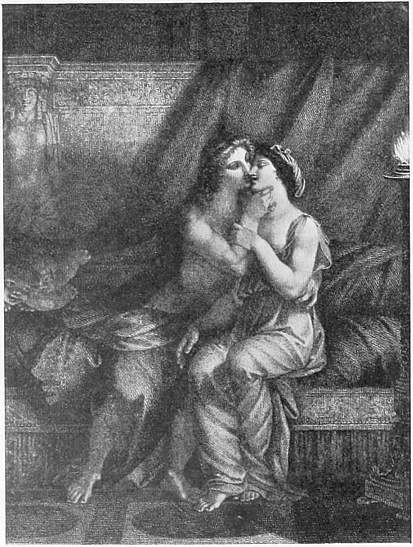
PRUDHON. L’ENJOUIR.
He was fortunate enough to be presented to Josephine Beauharnais, and through her to Bonaparte, in the Casa Serbelloni at Milan; and Gros, whose earnest desire it was to paint the great commander, was appointed a lieutenant on his staff. He had occasion, in the three days’ battle of Arcola, to admire the Dictator’s impetuous heroism; and he made a sketch of the General storming the bridge of Arcola at the head of his troops, ensign in hand. It pleased Napoleon, who saw in it something of the dæmonic power of the future conqueror of the world; and when the picture was exhibited in Paris in 1801 it met there also with the most striking success. The greater warmth of colour, the broader sweep of the brush, and the life-like movement of the figures seemed, in comparison with David’s monotonous manner, to be far-reaching innovations.
With his “Napoleon on the Bridge of Arcola” Gros had found his peculiar talent. What his teacher had accomplished as painter to the Convention, Gros carried to a conclusion in that span of time during which Napoleon lived in the minds of his people as a hero. He too made an occasional excursion into the domain of Greek mythology, but he did not feel at home there. His field was that living history which the generals and soldiers of France were making. He won for contemporary military life its citizenship in art. David, wishing to remain true to “history” and to “style,” had depicted contemporary events with reluctance. What Gérard and Girodet had produced was interesting as a protest on the part of reality against classical convention, but on the whole it was unsatisfying and wearisome. Gros, the famous painter of the “Plague of Jaffa” and of the “Battle of Eylau,” was the first to attain to high renown in this field.
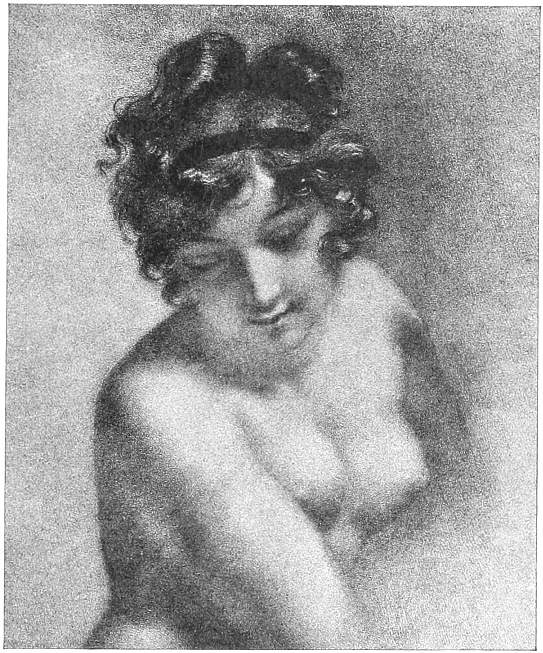
PRUDHON. MARGUERITE.
These are two powerful and genuine pictures, two pre-eminent works which will endure. Gros stands far above David and all his rivals in his power of perception. The elder painter is now out of date, while Gros remains ever fresh, because he painted under the impulse given by real events, and not under the ban of empty theories. A realist through and through, he did not shrink from representing the horrible, which antique art preferred to avoid. In an epoch when Rome and Greece were the only sources of inspiration he had the courage to paint a hospital, with its sick, its dying, and its dead. When in the Egypto-Syrian campaign the plague broke out after the storming of Jaffa, Napoleon, accompanied by a few of his officers, undertook, on 7th March 1799, to visit the victims of the pestilence. This act deserved to be celebrated in a commemorative picture. Gros took it in hand, and represented Napoleon, in the character of consoler, amid the agonising torments of the dying; deviating from historical accuracy only so far as to transfer the scene from the wretched wards of the lazaretto to the courtyard of a pillared mosque. In the shadows of the airy halls sick and wounded men twist and writhe, stare before them in despair, rear themselves up half-naked in mortal pain, or turn to gaze upon the Commander-in-Chief, a splendid apparition full of youthful power, who is tranquilly feeling the plague boils of one of their comrades. Here and there Orientals move in picturesque costumes, distributing the food which negro lads are bringing in. And beyond, over the battlements of the Moorish arcades, one sees the town with its fortifications, its flat roofs and slender minarets, over which flutter the victorious banners of the French. On one side lies the distant, glittering blue sea, and over all stretches the clear, glowing southern sky.
Like a new gospel, like the first gust of wind preceding the storm of Romanticism, this picture standing in the Louvre, surrounded by its stiff Classical contemporaries, excites a sensation of pleasure.
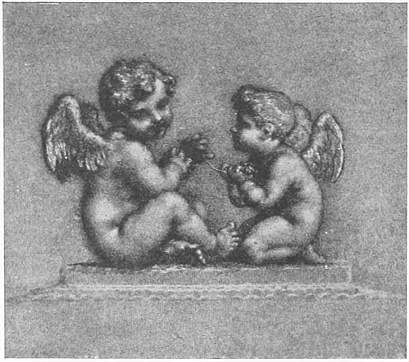
PRUDHON. LES PETITS DÉVIDEURS.
Gros’ heroes know, as David’s do, that they are important, and show it perhaps too much, but at least they act. The painter felt what he was painting, and an impulse of human love, an heroic and yet human life, permeates the picture. Moreover, Gros did not content himself with the scanty palette and the miserable cartoon-draughtsmanship of his contemporaries. This treatment of the nude, these despairing heads of dying men, show none of the stony lifelessness of the Classical school; this Moorish courtyard has no resemblance to the tragedy peristyle so habitually employed up to that time; this Bonaparte laying his hand upon the dying man’s sores is no Greek or Roman hero. The sick men whose feverish eyes gaze upon him as on the star of hope, the negroes going up and down with viands, are no mere supernumeraries; the sea lying in sunshine beyond, full of bustling sails, and the harbour gaily decked with many-coloured flags, point in their joyous splendour of colouring to the dawn of a new era. The young artists were not mistaken when, in the Salon of 1804, they fastened a sprig of laurel to the frame of the picture. The State bought it for sixteen thousand francs. A banquet at which Vien and David presided was given in honour of the painter. Girodet read a poem, of which the conclusion ran as follows—
“Et toi, sage Vien, toi, David, maître illustre, Jouissez de vos succès; dans son sixième lustre, Votre élève, déjà de toutes parts cité, Auprès de vous vivra dans la postérité.”
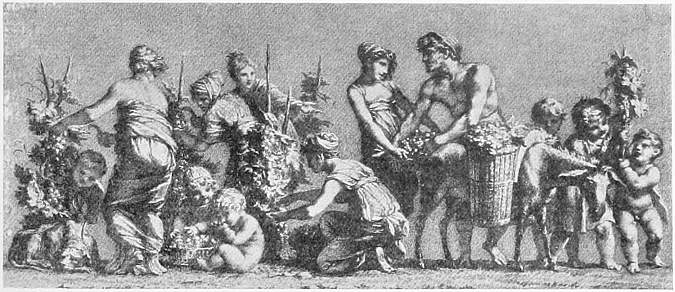
PRUDHON. THE VINTAGE.
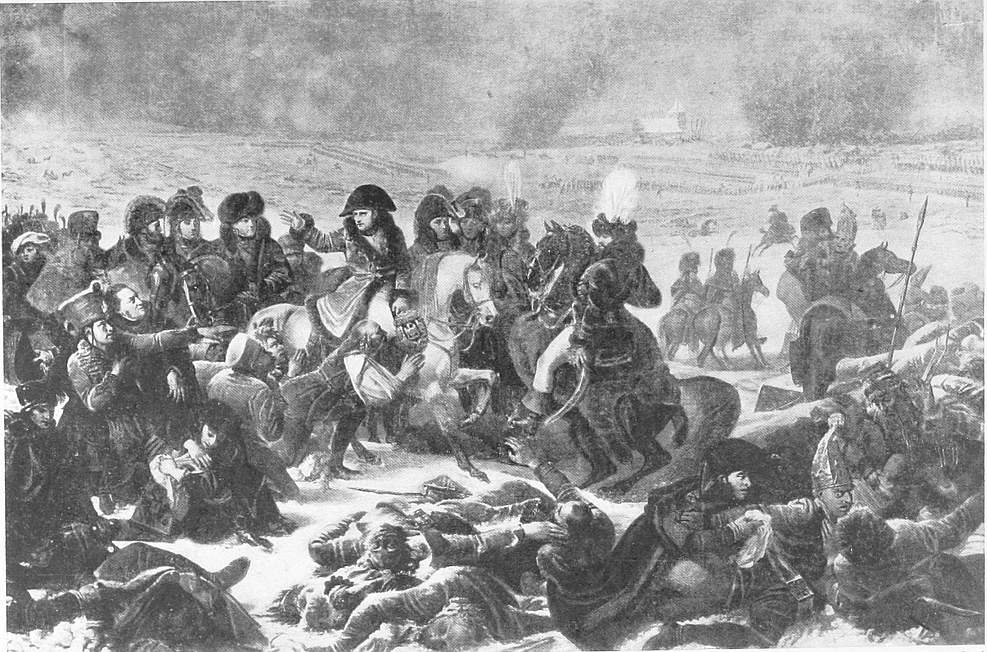
In his “Battle of Eylau,” exhibited in 1808, Gros has given us a companion picture to the “Plague of Jaffa”: in one a visit to a hospital, in the other the inspection of a field of battle after the fight is over. The dismal grey hue of winter rests upon the white sheet of snow stretching desolately away to the horizon, only interrupted here and there by hillocks beneath which annihilated regiments sleep their last sleep. In the foreground lie dead bodies heaped together, and moaning wounded men; and in the midst of this horror of mangled limbs and corrupting flesh he, the Conqueror, the Master, the Emperor, comes to a halt, pale, his eyes turned towards the cities burning on the horizon, in his grey overcoat and small cocked hat, at the head of his staff, indifferent, inexorable, merciless as Fate. “Ah! si les rois pouvaient contempler ce spectacle, ils scraient moins avides de conquêtes.” The classical posturing which still lingered, a disturbing element, in the Plague picture, has been put aside completely. The conventional horse from the frieze of the Parthenon, which David alone knew, has given way to the accurately observed animal, and the colouring too, in its sad harmony, has fully recovered its ancient right of giving character to the picture. It was, beyond all controversy, the chief work in the Salon of 1808, rich in remarkable pictures; neither Gérard’s “Battle of Austerlitz,” nor Girodet’s “Atala,” nor David’s Coronation piece endangered Gros’ right to the first place.
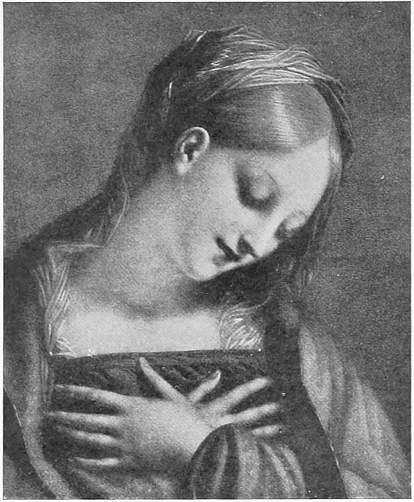
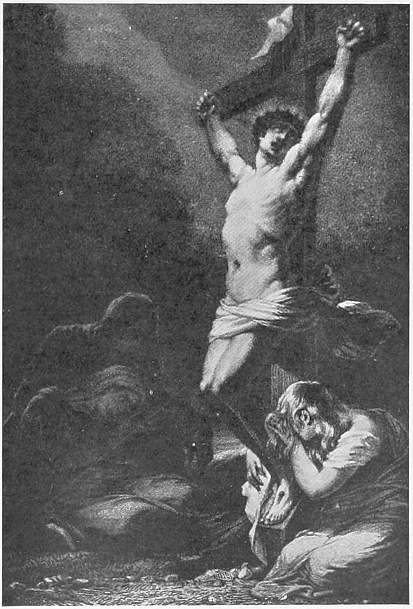
PRUDHON. THE VIRGIN. PRUDHON. CHRIST CRUCIFIED.
“Napoleon before the Pyramids,” at the moment when he cries, “Soldiers, from the summit of those monuments forty centuries contemplate your actions,” constitutes, in 1810, the coping-stone of the cycle. Gros alone at that time understood the epic grandeur of war. He became, also, the portrait painter of the great men from whom its events proceeded. His picture of General Masséna, with its meditative, slily tenacious expression, is the genuine portrait of a warrior; and how well is heroic, simple daring depicted in the likeness of General Lasalle, without the commonplace device of a mantle puffed out by the wind! His portrait of General Fournier Sarlovèse, at Versailles, has a freshness of colouring, the secret of which no one else possessed in those days except the two Englishmen, Lawrence and Raeburn. Gros was far in advance of his age. A painter of movement rather than of psychological analysis, he brought out character by means of general effect, and gave the essentials in a masterly way. His portraits, just as much as his historical pictures, have a stormy exposition. In David all is calculation; in Gros, fire. Almost alone among his contemporaries, he had studied Rubens, and like him gave colour the place due to it. At times there is in his pictures a natural flesh-colour and an animation which make this warm-hearted man, who has not been sufficiently appreciated, a genuine forerunner of the moderns. Surrounded as he was by orthodox Classicists, he cried in a loud voice what Prudhon had already ventured to say more timidly: “Man is not a statue—not made of marble, but of flesh and bone.”
But as with Prudhon, so with Gros. This man, of exaggerated nervousness, was lacking in that capacity for persistence which belongs to a strong will conscious of its aim; he lacked confidence in himself and in the initiative he had taken. So long as the great figure of Napoleon kept his head above water he was an artist; but when his hero was taken from him he sank. The Empire had made Gros great, its fall killed him. The incubus of David’s antique manner began once more to press upon him, and when David after his banishment (in 1816) committed to him the management of his studio in Paris, Gros undertook the office with pious eagerness, on nothing more anxiously intent than as a teacher once more to impose the fetters of the antique upon that Art which he had set free by his own works. “It is not I who am speaking to you,” he would say to the pupils, “but David, David, always David.” The latter had blamed him for having taken the trouble to paint the battles of the Empire, “worthless occasional pieces,” instead of venturing upon those of Alexander the Great, and thus producing genuine “historical works.” “Posterity requires of you good pictures out of ancient history. Who, she will cry, was better fitted to paint Themistocles? Quick, my friend! turn to your Plutarch.” To depict contemporary life, which lies open before our eyes, was, he held, merely the business of minor artists, unworthy the brush of an “historical painter.” And Gros, who reverenced his master, was so weak as to listen to his advice: he believed in him rather than in his own genius, in the strength of others rather than his own. He searched his Plutarch, and painted nothing more without a previous side-glance towards Brussels; introduced allegory into his “Battle of the Pyramids”; composed in homage to David a “Death of Sappho”; and painted the cupola of the Pantheon with stiff frescoes; while between times, when he looked Nature in the face, he was now and then producing veritable masterpieces.
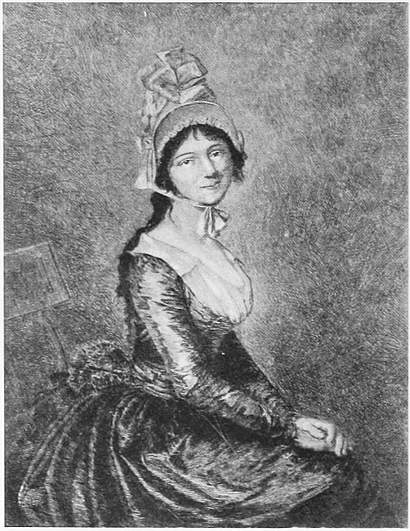
Gaz. des Beaux-Arts.
PRUDHON. MADAME COPIA.
His “Flight of Louis XVIII” in the Museum at Versailles, shows him once more at his former height. It is “one of the finest of modern works,” as Delacroix called it in 1848, in an essay contributed to the Revue des Deux Mondes; at once familiar and serious. Napoleon had left Elba, marched on Paris, and had reached Fontainebleau, when, in the night of the 19th-20th March 1815, Louis XVIII determined to evacuate the Tuileries with all speed. Accompanied by a few faithful followers and by the officers of his personal service, he abandons his palace and takes leave of the National Guards. There is something pathetic in this sexagenarian with his erudite Bourbon profile, immortalised in the large five-franc pieces of his reign, with his protruding stomach and small thick legs, looking like a dropsical patient going to hospital. His bearing is most unkingly. Gros has boldly depicted the scene, even to the pathological appearance of the king, just as he saw it, forgetting all that he knew of antique art. He had himself seen the staircase, the murmuring crowd, the lackeys hurrying by, lantern in hand, at their wits’ end, and the fat, gouty king, who in his terror has forgotten all kingly dignity.
That was an historical picture, and yet as he painted it he reproached himself anew for having forsaken the “real art of historical painting.” At the funeral of Girodet in 1824 the members of the Institute talked of their “irreparable loss,” and of the necessity of finding a new leader for the school who should avert with a strong hand that destruction which hot-headed young men threatened to bring upon it. “You, Gros,” observed one of them, “should be the man for the place.” And Gros answered, in absolute despair; “Why, I have not only no authority as leader of a school, but, over and above that, I have to accuse myself of giving the first bad example of defection from real art.” The more he thought of David, the more he turned his back upon the world of real life. With his large and wearisome picture of “Hercules causing Diomedes to be devoured by his own Horses” (1835) he sealed his own fate. Conventionality had conquered nature.
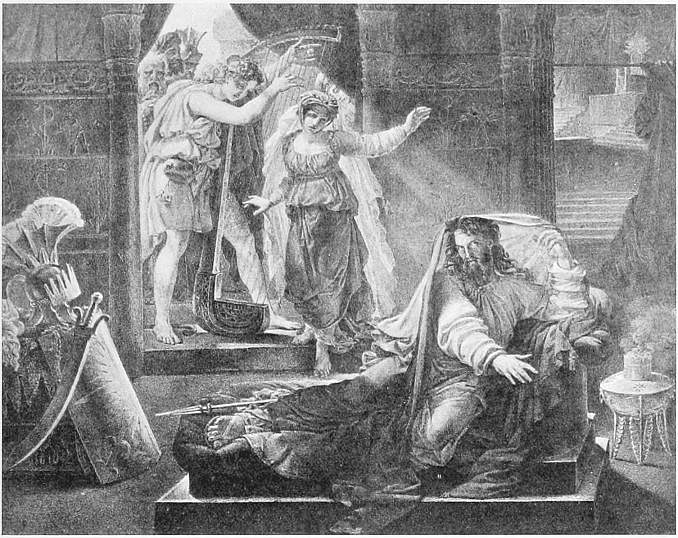
GROS. SAUL.
The painters overwhelmed him with ridicule, and a shrill shout of derision rose from all the critics. Already, for some time past, a few writers had risen to protest against the Classical school. They spoke with fiery eloquence of the rights of humanity, the benefits of liberty, the independence of thought, the true principles of the Revolution, and found numerous readers. They fought against rigid laws in the intellectual as well as the social sphere; they pointed out that there were other worlds besides that of antiquity, and that even the latter was not peopled exclusively by cold statues; they delighted in describing the great and beautiful scenes of Nature, and opened out once more a new and broad horizon to art and poetry. The Spring was awakening; Gros felt that he had outlived himself. Arming himself against the voices of the new era with the fatal heroism of the deaf, he became the martyr of Classicism in French art. He was a Classic by education, a Romantic by temperament; a man who took his greatest pride in giving the lie as a teacher to the work he had accomplished as an artist, and this discordance was his ruin.
On the 25th of June 1835, being sixty-four years of age, he took up his hat and stick, left his house without a word to any one, and laid himself face-downwards in a tributary of the Seine near Meudon. It was a shallow place, scarce three feet deep, which a child could easily have waded through. It was not till next day, when he had been dead for twenty-four hours, that he was discovered by two sailors walking home along the bank. One of them struck his foot against a black silk hat. In it there was a white cravat marked with the initial G., carefully folded, and upon it a short note to his wife. On a torn visiting-card could still be read the name, Baron Gros. A little farther on they saw the corpse, and as they were afraid to touch a drowned man, they drew lots with straws to decide which of them should pull him out. “I feel it within me, it is a misfortune for me to be alone. One begins to be disgusted with one’s self, and then all is over,” he had once in his youth written to his mother with gloomy foreboding. Such was the end of a master every fibre of whose being was in revolt against Classicism, and who had so great a love for colour, truth, and life.
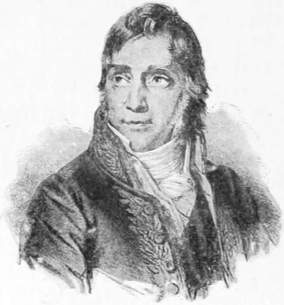
L’Art.
ANTOINE JEAN, BARON GROS.
More important events were yet to take place before the signal of deliverance could be expected. It was the young men who had grown up amid the desolate associations of the Restoration who were to lead to victory the new movement of which Prudhon and Gros had been the forerunners. The dictatorship over art of that Classical school which had been taken over from the seventeenth century was limited to a single generation—from the birththroes of the Revolution to the fall of the Napoleonic Empire. For although many of David’s pupils survived until the middle of the century, yet they were merely academic big-wigs, who, compared with the young men of genius who were storming their positions, represent that mediocrity which had indeed attained to external honours, but had remained stationary, fast bound to antiquated rules. The future belonged to the young, to a youth which from the standpoint of our own days seems even younger than youth commonly is, richer, fresher, more glowing and fiery—the Generation of 1830, the “vaillants de dix-huit cent trente,” as Théophile Gautier called them in one of his poems.
Photo, Levi.
GROS. THE BATTLE OF EYLAU.
CHAPTER X
THE GENERATION OF 1830
During the years which elapsed between 1820 and 1848 France produced a great and admirable school of art. After the convulsions of the Revolution and the wars of the Empire, that generation had arisen, daring and eager for action, which de Musset describes in his Confessions d’un Enfan du Siècle. And these young men, born between the thunders of one battle and another, who had grown up in the midst of greatness and glory, had to experience, as they ripened into manhood, the ignominy of Charles X’s reign, the period of clerical reaction. They saw monasteries re-erected, laws of mediæval severity made against blasphemy and the desecration of churches and saints’ days, and the doctrine of the divine origin of the monarchy proclaimed anew. “And when young men spoke of glory,” says de Musset, “the answer was, ‘Become priests!’ And when they spoke of honour, the answer was, ‘Become priests!’ And when they spoke of hope, of love, of strength and life, ever the same answer, ‘Become priests!’” The only result of this pressure was to intensify all the more the impulse towards freedom. The political and intellectual reaction could only have the effect of impelling the poetic and artistic emotions of young and unquiet spirits into opposition, on principle, to all that was established, into a fiery contempt for public opinion, into the apotheosis of unrestrained passion and unfettered genius. The French Romanticists were anti-Philistines who regarded the word “bourgeois” as an insult. For them Art was the one supreme consideration; it was to them a light and a flame, and its beauty and daring the only things worth living for. For those who put forward such demands as these, the “eunuchism of the Classical”—an expression of George Sand’s—could never suffice. They dreamed of an art of painting which should find its expression in blood, purple, light, movement, and boldness; they held in sovereign contempt the correct, pedantic, colourless tendency of their elders. An inner flame should glow through and liberate the forms, absorb the lines and contours, and mould the picture into a symphony of colour. What was desired and sought for, in poetry and in music, in plastic art and in painting, was colour and passion: colour so energetic, that drawing was, as it were, consumed by it; passion so vehement, that lyrical poetry and the drama were in danger of becoming feverish and convulsive. A movement which reminds one of the Renaissance took possession of all minds. It was as though there were something intoxicating in the very air that one breathed. On a political background of grey upon grey, consisting of the cowls of the Jesuits of the Restoration, there arose a flaming, refulgent, blustering literature and art, scintillating with sparks and bright hues, full of the adoration of passion and of fervid colour. Romanticism is Protestantism in literature and art—such is Vitet’s definition of the movement.
Literature, which, adapting itself to the politics of the government, had begun in Chateaubriand with an enthusiastic fervour for Catholicism, Monarchy, and Mediævalism, had in the twenties become revolutionary; and the description of its battles is one of the most glowing chapters in George Brandes’ classic work. There was a revolt against the pseudo-antique, against the stiff handling of the Alexandrine metre, against the yoke of tradition. Then arose that mighty race of Romantic poets who proclaimed with Byronic fire the gospel of nature and passion. De Musset, the famous child of the century, the idol of the young generation, the poet with the burning heart, who rushed through life with such eagerness and haste that at the age of forty he broke down altogether, worn out like a man of seventy, deliberately wrote bad rhymes in his first poems, for the purpose of thoroughly infuriating the Classicists. So, too, he wrote his dramas, in which love is glorified as a serious and terrible power with which one may not trifle, as the fire with which one must not play, as the electric spark that kills. So George Sand, the female Titan of Romanticism, published her novels, with their subversive tendencies and their sparkling animation of narrative. Between these two rises the keen bronze-like profile of Prosper Mérimée, who prefers to describe the life of gypsies and robbers, and to depict the most violent and desperate characters in history. Finally, Victor Hugo, the great chieftain of the Romantic school, the Paganini of literature, unrivalled in imposing grandeur, in masterly treatment of language, and in petty vanity, found submissive multitudes to listen to him when he rose in fierce and fiery insurrection against the rigid laws of the bloodless Classical style, and substituted for the actionless and ill-contrived declamatory tragedies of his time his own romantic dramas, breathing passion and full of diversified movement.
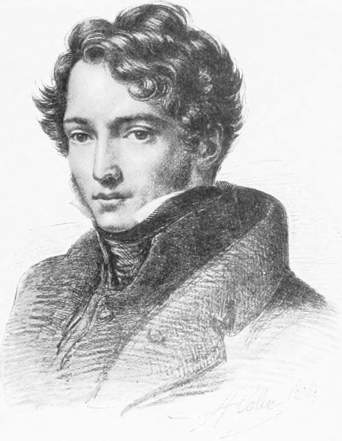
THÉODORE GÉRICAULT.
The conflict was deadly. The young generation hailed with applause the new Messiah of letters, and grew intoxicated with the harmony of Hugo’s phrases, which sounded so much fuller and fierier than the measured speech of Corneille and Racine. The Théâtre Français, recently benumbed as with the quiet of the grave, became all at once a tumultuous battlefield. There they sat, when Hugo’s Cromwell and Hernani were produced on the stage, correct, well dressed, gloved, close shaven, with their neat ties and shirt collars, the representatives of the old generation, whose blameless conduct had raised them to office and place. And in contrast to them, in the pit were crowded together the young men, the “Jeune France,” as Théophile Gautier described them, one with his waving hair like a lion’s mane, another with his Rubens hat and Spanish mantle, another in his vest of bright red satin. Their common uniform was the red waistcoat introduced by Théophile Gautier—not the red chosen for their symbol by the men of the Revolution, but the scarlet-red which represented the hatred felt by these enthusiastic young men for all that was grey and dull, and their preference for all that is luminous and magnificently coloured in life. They held that the contemplation of a beautiful piece of red cloth was an artistic pleasure. A similar change took place at the same time in ladies’ toilettes. As the Revolution had in ladies’ costumes rejected all colour in favour of the Grecian white, so now dresses once more assumed vivid, and especially deep red hues; deep red ribbons adorned the hat and encircled the waist.
Deep red—that was the colour of the Romantic school; the flourishing of trumpets and the blare of brass its note. Flashes of passion and ferocity, rivers of sulphur, showers of fire, glowing deserts, decaying corpses in horrible phosphorescence, seas at night-time in which ships are sinking, landscapes over which roaring War shakes his brand, and where maddened nations fall furiously upon one another—such are the subjects, resonant with shout of battle and song of victory, which held sway over French Romanticism. At the very time when at Düsseldorf the young artists of Germany were painting with the milk of pious feeling their lachrymose, susceptible, sentimental pictures, utterly tame and respectable; when the Nazarene school were holding their post-mortem on the livid corpse of old Italian art, and seeking to galvanise it, and with it the Christian piety of the Middle Ages, into life again; at that very time there arose in France a young generation boiling over with fervour, who had for their rallying cry Nature and Truth, but demanded at the same time, and before all else, contrast, pictorial antithesis, and passion at once lofty and of tiger-like ferocity. In those very years, when in Germany, the cartoon style of Carstens having died away, progress was limited to a timid and unsuccessful pursuit of that revelry of colour which marked the Quattrocentisti, the French took at once, as with the seven-leagued boots of the fairy-tale, the great stride onward towards the Flemings.
Through Napoleon, France had grown richer, not only in glory, but in art treasures, gathered together from all countries into Paris, as trophies of the victorious general. The abundant collections thus accumulated brought to bear upon that generation the quickening influence of the best that had been done in the art of painting. Nowhere could one study either the Venetian colourists or Rubens to greater advantage than in the Louvre, and it was by virtue of this unrestrained intercourse with the masters who represent the most perfect blossom of colouring that the Byronic spirits of 1830 succeeded in giving full expression to the glowing full-coloured life of things which hovered before their heated imagination. It is unnecessary to say that this was accompanied by a great widening of the range of subjects treated. The Romantic school showed that there were other heroes in history and poetry besides the Greeks and Romans. They painted everything, if only it possessed colour and character, flame, passion, and exotic perfume. Romanticism was the protest of painting against the plastic in art, the protest of liberty against the academic teaching of the Classical school, the revolution of movement against stiffness.
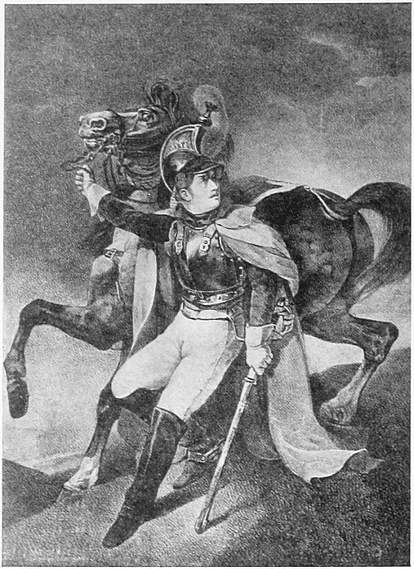
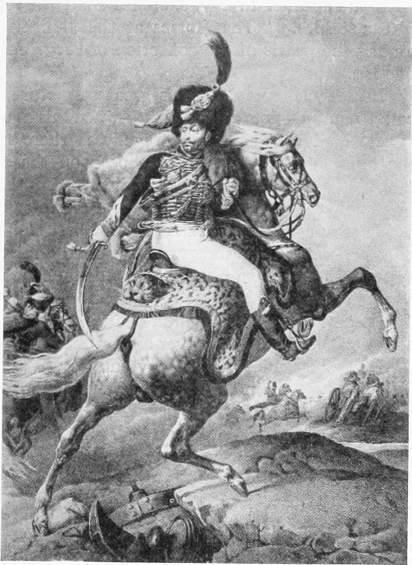
GÉRICAULT. THE WOUNDED CUIRASSIER. GÉRICAULT. CHASSEUR.
It was in the studio of Guérin, the tame and timid Classicist, that the young assailants grew up, “the daubers of 1830,” who called the Apollo Belvidere a shabby yellow turnip, and who spoke of Racine and Raphael as of street arabs. They were tired of copying profiles of Antinous. The contemplation of a picture by Girodet was wearisome to them. It was Théodore Géricault, a hot, hasty passionate nature, of Beethoven-like unruliness and of heaven-storming boldness, who spoke the word of deliverance.
He was a Norman, sturdily built and serious in manner. Even while he was studying in Guérin’s studio he had already grasped some of the ideas which Gros had in his mind, and, although not his pupil, Géricault may be said to have continued his work, or at least would have been able to do so had he lived longer. Like him, he had from his youth up contemplated, full of wonder, the rolling sea and the thunder-laden skies; like him, he had a predilection for fine horses; and, being of a somewhat melancholy disposition, he preferred to treat of the darker aspects of life. His aspiration was to paint the surging sea, proud steeds rushing past at a gallop, suffering and striving humanity, great deeds, pathos and frenzy in every form. His first works were splendid horsemen, whose every muscle twitches with nervous movement. During his short stay in Charles Vernet’s studio he had already taken an interest in cavalry, and begun the studies of such subjects, which he continued to the day of his death. Afterwards, while he was working under Guérin and before his visit to Italy in 1817, he often went to the Louvre, copied pictures and studied Rubens, to the great annoyance of his teacher, who with horror beheld him entering upon so perilous a path.
Here again he followed in the steps of Gros, whose portrait of General Fournier Sarlovése was hung in the Salon of 1812 close by Géricault’s “Mounted Officer.” This picture, a portrait of M. Dieudonné, an officer in the Chasseurs d’Afrique, crossing the battlefield sword in hand on a rearing horse, was the first work exhibited by Géricault, then twenty-one years of age. It was an event. Gros found himself supported, if not surpassed, by a beginner who had his own enthusiasm for colour and movement, for profiles broadly and boldly delineated. In 1814 followed the “Wounded Cuirassier,” staggering across the field of battle and dragging his horse behind him. These were no longer warriors seated on classical steeds foaming with rage, but real soldiers in whom there was nothing of the Greek statue. Then Géricault went to Italy, but in this case also it was not to pursue archæological studies in the museums, but to see the race of the barberi during carnival. To this time belong those studies of horses, for the possession of which collectors vie with one another to-day, sketches made in the open air, out in the street or in the stables. “The Horses at the Manger” and “Horses fighting” were among the pearls of the collection of French drawings in the Paris Exhibition of 1889.
In 1819 he completed his greatest picture, that which most people alone call to mind—not quite fairly—when his name is mentioned—“The Raft of the Medusa.” What a tragedy is there represented! For twelve days the unfortunate wretches have been on the deep, starving, in utter despair and ready to lift their hands against each other. They were a hundred and fifty, now they are but fifteen. One old man holds upon his knees the corpse of his son; another tears his hair out, left alone in life after seeing all his dear ones perish. In the foreground lie dead bodies which the waves have not yet swept away. But far away in the distance a sail appears. One points it out to another: yes, it is a sail! A mariner and a negro mount upon an empty barrel and wave their handkerchiefs in the air. Will they be seen? The anxiety is terrible. And ever higher and higher the grey waves roll on.
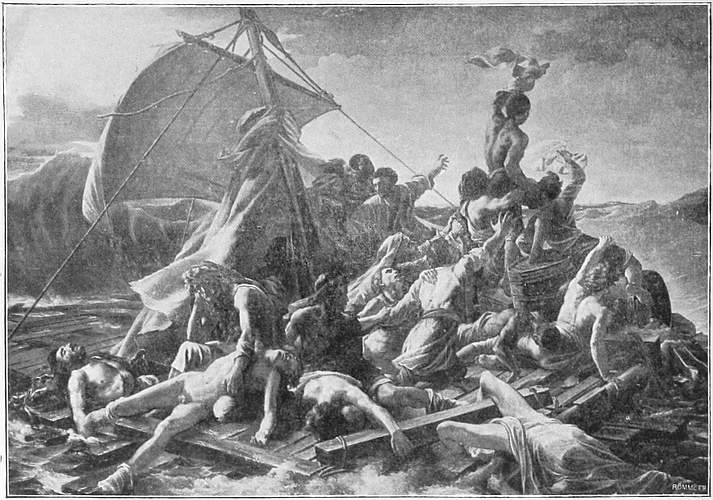
Seemann, Leipzig.
GÉRICAULT. THE RAFT OF THE MEDUSA.
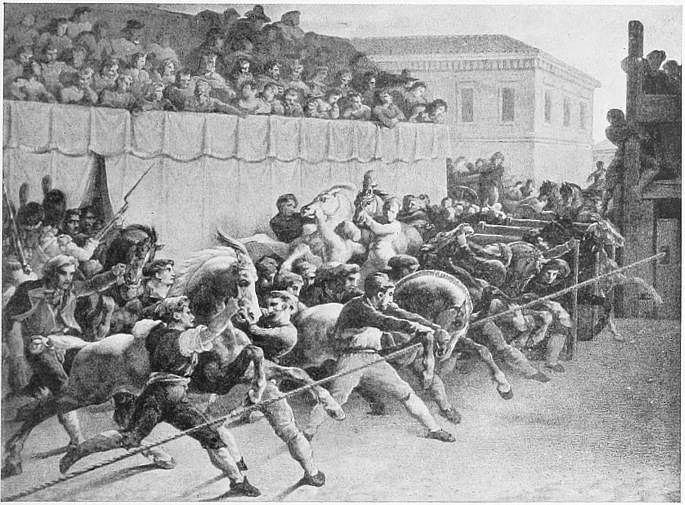
GÉRICAULT. THE START.
How must such a scene have impressed a generation which for long years had seen nothing in the Salon but dry mythology and painted statues! Géricault was the first to free himself from the tyranny of the plaster-of-Paris bust, and once again to put passion and truth to nature in the place of cold marble. Just as he commissioned the ship’s carpenter who had constructed the raft and was one of the saved to make him a model of it, so also he moved into a studio close to the hospital, for the purpose of studying the sick and dying, of sketching dead bodies and single limbs. It must be admitted that one would wish for a yet firmer grasp of the subject. In form, Géricault still belongs to the school of David. A good deal of Classicism shows itself in the fact that he thought it necessary to depict the majority of the figures naked, in order to avoid “unpictorial” costumes. There is still something academic in the figures, which do not seem to be sufficiently weakened by privation, disease, and the struggle with death; but what man can free himself at one stroke from the influence of his time and environment? Even in the colouring there lingers some touch of the Classical school. It offends no one, a fact to be insisted on in comparing him with the Nazarenes; but as yet it plays no part in expressing the meaning of the picture. From the distance, indeed, whence the rescuing ship is drawing near, a bright light shines forth upon a scene otherwise depicted in dull brown. Save for this, the intention of the picture is not expressed by means of colour, and it even shows some retrogression as compared with Géricault’s earlier works. He had begun with Rubens, yet these studies in colouring did not last. In the “Wounded Cuirassier” of 1814 dark tones took the place of the former cheerfulness, and so in the “Raft of the Medusa” he imagined the tragedy could be represented only in sombre hues. He spread over the whole scene a monotonous unpleasant brown shade, and in his endeavour to lay all weight upon human emotion he went so far as almost to suppress the sea, which nevertheless played the chief part in the drama, and whose deep blue would have afforded a splendid contrast. Discoveries are not to be made all at once, but only when their hour is come.
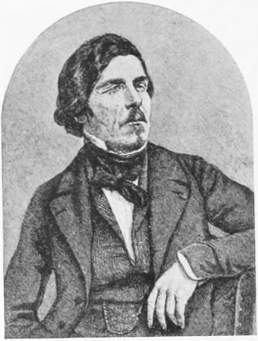
Seemann, Leipzig.
EUGÈNE DELACROIX.
The next step in French art was to be that of reinstating the significance of colour in the full rights conquered for it by Titian, so that it should no longer be merely a tasteful tinting of the figures, but should become truly that which gives its temper to the picture. It was not reserved for Géricault to effect this. A trip to London, which he made in 1820, in company with his friend Charlet, was the last event of his life. There the sportsman awoke in him once more, and he painted the “Race for the Derby at Epsom.” Soon after his return he was thrown from his horse while riding, but lingered on for two years longer, suffering from a spinal complaint. With a few more years in which to develop he should have been one of the great masters of France, but he died when scarcely in his thirty-second year.
Yet he lived long enough to observe, in the Salon of 1822, the début of one of his comrades from Guérin’s studio. A greater than himself, to whom with dying voice he had given a few words of advice, arose as the intellectual heir of the young painter so prematurely carried off, and carried to its issue the struggle which he had begun. It was on 26th April 1799, at midday, that the first genuine painter’s eye of the century saw the light, at Charenton Saint-Maurice. Géricault had made a beginning, but it was the impetuous, powerful genius of Eugène Delacroix which entered in and completed his work. What Gros had dimly perceived, but had not dared to express, what Géricault had barely had time with a courageous hand to point out, a hand too soon stiffened in death—the modern poetry of colour, of fever, and of quivering emotion—it was reserved for Delacroix to write.
“That child will grow up to be a famous man; his life will be extremely laborious, but also extremely agitated, and always exposed to opposition.” Thus had a madman prophesied of the boy one day when he and his nurse were taking a walk near the lunatic asylum at Charenton. And he was right.
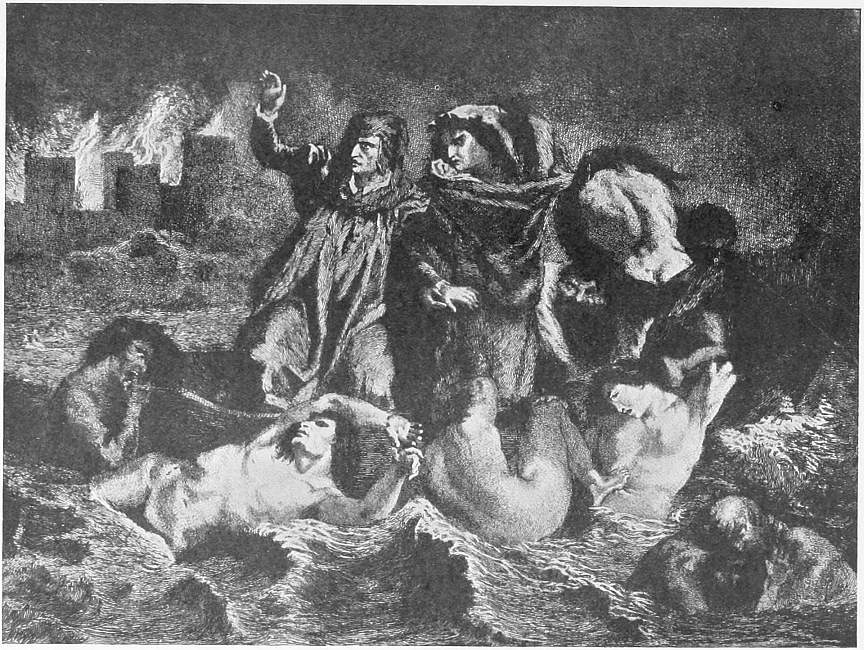
L’Art.
DELACROIX. DANTE’S BARK.
Delacroix was another of the pupils who had grown up in Guérin’s studio, but he became the latter’s antipode. Even in his student years he took counsel, not of the antique, but of Rubens and Veronese; and when Géricault was painting his “Raft of the Medusa,” Delacroix belonged to the little band of enthusiastic admirers which gathered round the young master. He served as model for the half-submerged man to the left in the foreground of that picture. After busying himself at first almost entirely with caricatures, and studies of horses, and with Madonnas in the Classical style, he exhibited in 1822 his “Dante’s Bark,” in a pictorial sense the first characteristic picture of the century. One is inclined even to-day to repeat David’s exclamation when he caught sight of the work, the first great epoch-making life-utterance of the revolutionary Romanticists: “D’où vient-il? Je ne connais pas cette touche-la.” There were thoughts in it which had not been conceived and expressed in the same manner since the time of Tintoretto. Dante and Virgil, ferried by Phlegyas over Acheron, are passing among the souls of the damned, who grasp hold of the boat with the energy of despair. A theme taken from a mediæval author; an antique figure, that of Virgil, but seen through the prism of modern poetry. While the Florentine, stiff with horror, gazes upon the swimming figures which cling to the boat with teeth and nails, Virgil, tranquil and serious, turns on them a face which the emotions of life can no longer affect.
The work obtained a decisive success. A carpenter in Delacroix’s house had made for the young painter an inartistic frame of four boards. When he went to the exhibition and looked for his picture in the side-rooms he could not find it. The frame had fallen to pieces during removal, but the picture had been hung in an honourable place in the Louvre, in a rich frame ordered for it by Baron Gros. “You must learn drawing, my young friend, and then you will become a second Rubens,” was the salute which this remarkable man, whose theory ever gave the lie to his practice, gave the young master. Naturally Delacroix would not now have been admitted into the school of David, or would have been placed there in the lowest rank—with Rubens and a few other immortals, who drew no better than he did. He was absolutely opposed to all the exact, regular, well-balanced, colourless traditions which held sway in David’s school with their pedantic erudition and bourgeois discretion. The principle of the Classicists was the Greek type of beauty, and the translation of sculpture into painting. In Delacroix’s picture there was no longer anything of that sort. Géricault had already broken away from the academic stencilling of form, and had substituted natural expression, life, and emotion for conventional types; Delacroix now set aside the sullen colouring of the Classical school, and its painted statues made way for the colour-symphonies of the Venetians.
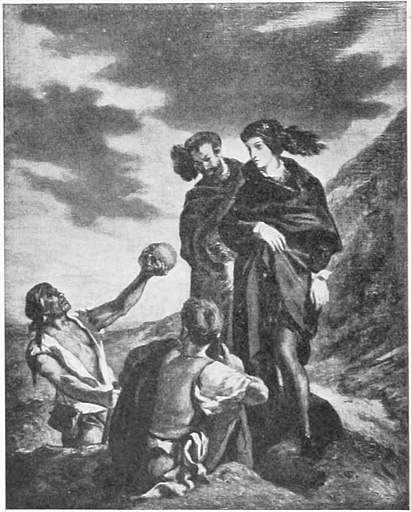
Baschet.
DELACROIX. HAMLET AND THE GRAVE-DIGGERS.
These reforming qualities found in his second work, a few years later, a much fuller expression than in the “Dante’s Bark.” At that time the Greeks, that heroic nation, struggling and dying for its religion and independence, had excited everywhere the deepest sympathy and enthusiasm. Delacroix was the very man to be inspired by such a theme. From the agitation caused by the martyrdom of Greece, and from his taste for Byron’s poetry, resulted in 1824 the celebrated “Massacre of Chios,” on which he was already employed in 1821, before the completion of his “Dante’s Bark,” and in which his power of expression as well as of colour was carried much further than in the earlier picture. In the “Dante’s Bark” there were still, both in form and colour, reminiscences of the great Florentine masters; as, for instance, in the female figure in the foreground, which is almost an exact reproduction of Michael Angelo’s “Night.” The event depicted was comparatively quiet and tranquil, and the well-balanced composition would have done honour to the most rigorous follower of David. The only novelty lay in the treatment of colour, and in the substitution of the individual and characteristic for the typical and ideal. But undoubtedly it was now possible not only to produce in colour more powerful chords, but also in expression to strike notes more dramatic, for the academic plaster-of-Paris heads of the David school had depicted human emotion only in icy immobility. Delacroix had put all these possibilities into the new picture. The pyramidal configuration has resolved itself into an unconstrained grouping of figures. Here we have for the first time the artistic spirit intoxicated with colour, the “Orlando Furioso of colourists,” the pupil of Rubens, Delacroix. An entire world of deep feeling and of painfully passionate poetry, an entire world of tones, which the master under whose eyes he painted his “Dante” could not have conceived, lies enclosed within the frame of this picture. The figures, sitting, kneeling, partly reclining, with their half-starved bodies and their gloomy, brooding, hopeless faces; the desperate struggle between the conquerors and their victims in the far distance; the contrast between this scene of horror and the luminous splendour of the atmosphere, and the wealth of colour in the whole, made and still make this fine painting one of the most impressive pictures in the Louvre. It is a work which flames in glow of colour more than any that had appeared in France since the days of Rubens. The English had been his teachers. “It is here only that colour and effect are understood and felt,” Géricault had previously written from London. Delacroix’s work had already been sent off to the Salon when Constable’s first pictures were just arriving there, and the impression which they made upon him was so powerful that, at the very last moment, and in the Louvre itself, he gave his picture a brighter and more luminous colouring.
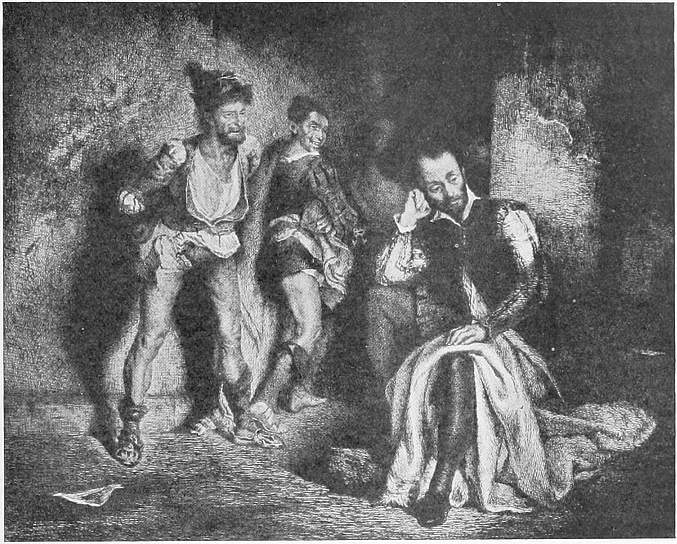
L’Art.
DELACROIX. TASSO IN THE MAD-HOUSE.
And indeed it was not till now that the Classicists perceived how great an opponent had arisen against them. Not only did the aged Gros call the “Massacre of Chios” “le massacre de la peinture,” but all the critics talked about barbarism, and prophesied that on this path French painting would hasten to its destruction. The prize of the Salon was awarded, not to the “Massacre,” but to Sigalon’s “Locusta,” an unimportant work of compromise, though very clever and well studied in draughtsmanship. It was said that Delacroix’s picture was lacking in symmetrical arrangement, that he showed too great a contempt for the beautiful, that indeed he appeared systematically to prefer the ugly—that is to say, he was blamed for the very qualities wherein lay his importance as a reformer. Accustomed as they had been for many years to an art in which intellect, correctness, and moderation held sway, not one of the critics was in a position to perceive all at once the value of this fiery spirit. Delécluze, the indefatigable defender of the sacred dogmas of the Classical school, characterised “dramatic expression and composition marked by action” as the reef whereon the grand style of painting must inevitably be wrecked. The modern schools of art, he taught as late as 1824, exist, flourish, and have their being only by the utilisation of what we can learn from the Greeks. Even acknowledging the progress in colour which the work showed, it nevertheless belonged, he said, to an inferior genus, and all its excellences in colouring could not outweigh the ugliness of its form.
Therewith began the battles of the Romantic school, and all the daring of Théophile Gautier, Thiers, Victor Hugo, Sainte-Beuve, Baudelaire, Bürger-Thoré, Gustave Planche, Paul Mantz, and others had to be called upon in order to storm the heights held by the batteries of the Classical critics. Count Forbin gave proof of no less courage when he bought the picture, torn to shreds as it was by hostile criticism, for the State, at the price of six thousand francs. This enabled Delacroix to visit England. He spent the time from spring to autumn of 1825 in London, where he consorted amicably with all the artists of the day. And he took an interest not only in English art, but also in literature and the drama. His preference for Shakespeare, Byron, and Walter Scott, who were already his favourite poets, found new sustenance. An English opera made him acquainted with Goethe’s Faust; and henceforth these poets entered into the foreground of his works. A picture of “Tasso” (the poet in a cell of the madhouse, through the window of which two grinning lunatics look in upon him) in 1826, the “Execution of the Doge Marino Faliero” and the “Death of Sardanapalus,” both after Byron, in 1827, and “Faust in his Study” in 1828, followed the “Massacre”—all of them obviously the works of a painter who loved bright, glowing colour, had studied Rubens and had recently returned from England. In 1828 was published, in seventeen plates, his cycle of illustrations to Faust, to accompany a translation of the poem into French; and this was followed by a number of lithographs on Shakespearian subjects.