Front matter (continued 7)
Reading edition
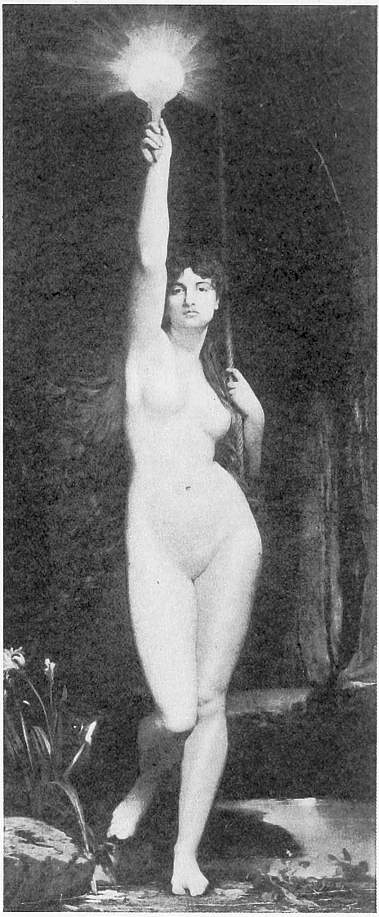
LEFÉBURE. TRUTH.
(By permission of Messrs. Goupil, the owners of the copyright.)
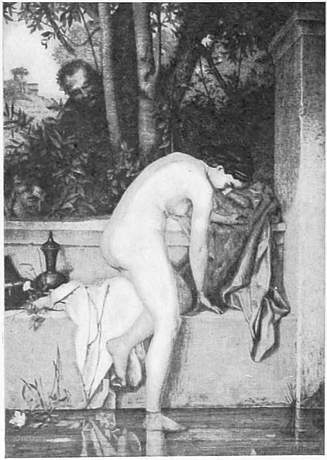
L’Art.
HENNER. SUSANNA AND THE ELDERS.
William Bouguereau, who industriously learnt all that can be assimilated by a man destitute of artistic feeling but possessing a cultured taste, reveals even more clearly, in his feeble mawkishness, the fatal decline of the old schools of convention. He has been compared to Octave Feuillet, who also never extricated himself from the scented atmosphere of distinguished society; but the comparison is unjust to Feuillet. Bouguereau is in his Madonna-painting a perfumed Ary Scheffer, in his Venus-pictures a greater Hamon; and in his perfectly finished and faultless stencilling style of beauty he became from year to year more and more insupportable. His art is a kind of painting on porcelain on a large scale, and he gives to his Madonnas and his nymphs the same smooth rosy tints, the same unreal universalised forms, until at last they become a juste-milieu between Raphael’s “Galatea” and the wax models one sees in hairdressers’ shops. Only in one sense can his religious painting be called modern; it is an elegant lie, like the whole of the Second Empire.
Close by Bouguereau’s “Venus” in the Luxembourg hangs the well-known colossal figure of a beautiful nude woman with unnaturally over-developed thighs, which by the shining mirror in its uplifted right hand proclaims itself to be “Truth.” Jules Lefébure, the painter of this picture, is also completely a slave to tradition; he came from Cogniet’s studio, and won the Prix de Rome in 1861. But he at least possesses more taste, elegance, and character; his painting of the nude is more distinguished, truer, and more powerful. He is in the broader sense of the word a worshipper of nature, and was so in his youth especially. His “Sleeping Girl” of 1865 and his “Femme couchée” of 1868 are smooth and honest studies from the nude, of delicate, sure draughtsmanship, and have therefore not become antiquated even to-day. Unfortunately he did not find this masculine accent again, when at a later time he grouped ideal figures together to make pictures of them. His “Diana surprised” of 1879 was a very clever composition of well-ordered lines, possessing even fine details, especially one or two charming heads, but as a whole it is lifeless and uninteresting. Like Bouguereau, he lacks power, and, notwithstanding his distinction and his capacity for arrangement, he is not painter enough to be truthfully entitled a “painter of the nude.”
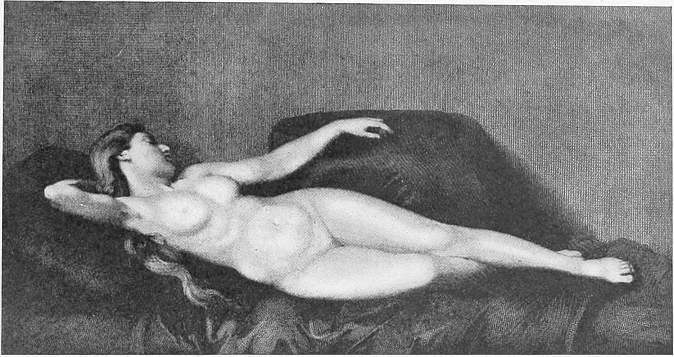
Gaz. des Beaux-Arts.
HENNER. THE SLEEPER.
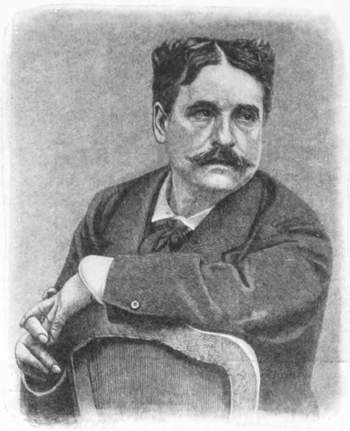
PAUL BAUDRY.
In general, French art, however willingly it took to this sphere during the period we are considering, is rich indeed in well-drawn documents, but poor in works which, considered as painting, can bear the most distant comparison with Fragonard and Boucher. The Revolution had put an end to the joyous flesh-painting of French art. At the close of the eighteenth and the beginning of the nineteenth century the painter of tender and life-like flesh-colour was not the reformer David, but the despised Prudhon. The former found his ideal in statues, and turned flesh to stone. The latter, a direct descendant of Correggio, gave expression to life with a tender mellowness. Ingres was again, like David, a very mediocre flesh-painter, and the Romanticists entered this sphere but seldom. Delacroix indeed has in his “Massacre” a couple of excellent touches, but they are isolated phenomena in his work. After 1850 the approved system was to give nude female figures the appearance of being made of terra-cotta, biscuit, or ivory. The forgotten art of painting velvety, soft flesh, and of making it vibrate in light, had to be learned over again, and to this meritorious task Henner devoted himself—the modern Correggio from Alsace, who stands to Cabanel in the same relation as Prudhon to David. Even Henner in his later days has become very much a mannerist, and has done some very bad work. To-day he prefers a heavy, pasty, buttery style of painting, with faces which look as if they had been pickled in oil, and have an unreal expression; his contrasts of light and shade, once so delicate, have become raw and forced. Yet beside Cabanel he still appears the true poet of female flesh-painting, the dreamy graceful depicter of refined sensuality. Prudhon’s delicate ideal and his language of vibrating tenderness are revived in Henner. His “Nymph resting” in the Luxembourg has the same soft morbidezza, the same delightful mystery, in which Prudhon before him had enveloped the sweetness of smiling faces and the beauty of female forms. He too chose the Lombards as his guides. After winning the Prix de Rome in 1858, he sent to the Salon of 1865 a “Susanna,” which already shows his ability as a flesh-painter and his relationship to Correggio. And a Lombard he has remained all his life. One could with difficulty find a more delicate and smooth study of the nude than his “Biblis” of 1867.
Since that time another tendency highly characteristic of Henner has shown itself in his work. In his endeavour to render the tint and tender softness of flesh as delicately as possible, he sought at the same time for light which should intensify the clear tone of the nude body. These he found in that time of evening, which one might call Henner’s hour, when the landscape, overshadowed by the twilight, gradually loses colour, and only a small blue space in the sky or a silent forest-lake still for a moment preserves the reflection of vanishing daylight. In this tranquil harmony of nature after sunset, the white pallor of the human body seems to have absorbed all the daylight and to be giving it forth again, while the surrounding landscape is already merging into colourless shadow. This is Henner’s “second manner,” and he raised it into a system. Every year since then there has appeared in the Salon one of those pale nymphs, standing out so mistily against the dark green of an evening landscape, or one of those Virgilian eclogues, in which the gloaming rests caressingly upon nude white bodies. And by this method of painting flesh and of throwing light upon it, Henner has won for himself an important place in modern art.
Paul Baudry, the powerful decorator of the Grand Opera House at Paris, marks the close of this tendency. In his work the endeavours of all those talented artists who sought to found a new school of “ideal painting” upon the basis of the study of the Italian Classicists came to a crowning height; and at the same time Baudry took a further step onward, in that he vivified the classical scheme with a yet more marked cast of “modernity.”
His first picture, on the murder of Marat, was feeble. What David had executed smoothly and forcibly in his dead “Marat,” Baudry spoiled in his “Charlotte Corday.” The bath, the night-table with the inkstand on it, the map on the wall, and all the fittings of the room, are painted with the greatest finish, but the young heroine in her petrified idealism has no more life in her than there is in the furniture.
His “Pearl and Wave,” which is hung in the Luxembourg close to Cabanel’s and Bouguereau’s “Birth of Venus,” gave proof of progress. A deep-blue wave, towering on high and crowned with foam, has washed a charming woman ashore like a costly pearl. She seems to have just awakened out of slumber, and her roguish, moistly gleaming eyes are smiling. Saucily she leans forward her fair-haired head under her bended arms, and stretches out in easy motion her youthfully slender yet fully proportioned body. Bouguereau’s and even Cabanel’s female beauties are waxen and spoiled by retouching, but Baudry’s Cypris is a living being, and preserves some of the individual charm of the model.
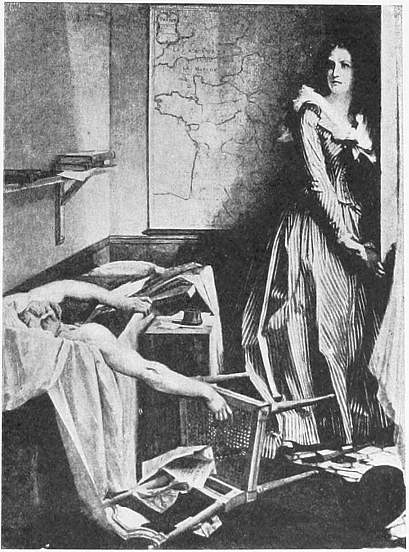
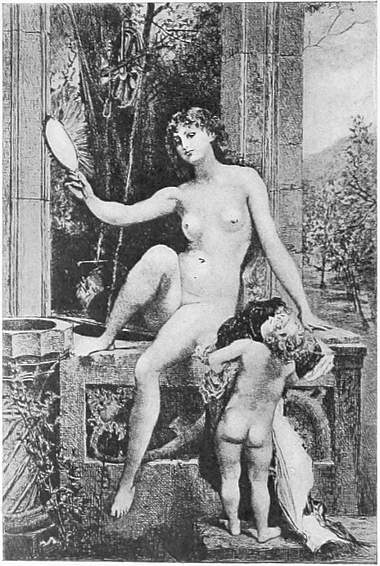
Baschet. Gaz. des Beaux-Arts.
BAUDRY. CHARLOTTE CORDAY. BAUDRY. TRUTH.
It is this breath of realism which gives their attractiveness to Baudry’s pictures in the Paris Opera House. He cannot indeed be ranked as a truly great master of decorative painting, as the Fragonard of the nineteenth century; he was too eclectic. The five years, from 1851 to 1856, which as winner of the Prix de Rome he spent in the Villa Medici, were the happiest of his life. He saw in the Italian galleries neither Holbein nor Velasquez, neither Rembrandt nor Botticelli nor Caravaggio. He saw nothing and revered nothing save the pure tradition of the Cinquecento, which was to him the Alpha and Omega of art. He dreamed of great decorative works which should place him on an equality with those old masters. It was therefore joyful news to him when, at the suggestion of his old comrade Charles Garnier, he was commissioned to adorn the Opera House. Baudry was then thirty-five years old, in possession of his full powers, and yet he thought it necessary to go back to Italy to interrogate the masters of the Renaissance anew. For a full year he worked ten hours daily in the Sistine Chapel. As soon as he knew Michael Angelo by heart, he betook himself to England to copy Raphael’s cartoons, and then in 1870 for the third time to Italy, before he felt himself capable of covering the five hundred square metres of canvas. The task took him four years, and when it was exhibited at the Palais des Beaux-Arts in 1874, prior to being placed in its final resting-place, there was general astonishment at a single man’s power to produce so much and such great work.
To-day his praise cannot be sounded so high. The place to which he aspired, by the side of the great masters of the Renaissance, will not fall to Baudry’s lot; he is hardly to be reckoned even among the great French masters of the nineteenth century. To rise even so far he lacked the first and most essential gift—originality. He was a model pupil in his youth, and a pupil he remained all his life. He always saw nature through the medium of art, and never had the courage to take a fresh breath and plunge into its fountain of youth. Between him and reality there was ever the prism of the old pictures that he loved; brush in hand, he devoted himself, turn by turn, and with equal enthusiasm, to Michael Angelo, Titian, Correggio, Bronzino, and even Ingres. As soon as he returned from Italy for the first time, as holder of the Prix de Rome, he exhibited several pictures which were altogether Titian in colouring, altogether Raphael in style. Each of them, even the most important, calls some other painting to one’s mind. His “Fortune and the Child” is a variation upon Titian’s “Divine and Earthly Love”; his “Death of a Vestal Virgin” a reminiscence of the “Death of Peter Martyr”; his “Warrior” in the Opera House is the painted double of Rude’s “Marseillaise.” How many gestures, attitudes, and figures could, by a close analysis, be shown to be borrowed in turn from Veronese, Andrea del Sarto, Correggio, or Raphael! His works are a synthesis of the favourite forms of the Cinquecento; they are the testament of the Cinquecento masters. He was a Parisian Primaticcio, a posthumous member of the old school of Fontainebleau. In him was embodied the last smile of the Renaissance, the results of which he assimilated and reduced to formulæ. He lacked creative imagination, and his pictures are wanting in individual character. The nervous movement and sinewy stretchings of his young men’s bodies would never have been painted but for Donatello’s “David.” Of his women, the powerful and muscular are descended from Michael Angelo’s “Eve,” the more slender and elegant come down from Rosso. His palette, with its blue and white tints, is bright and flowery, but it is no less artificial than his composition.
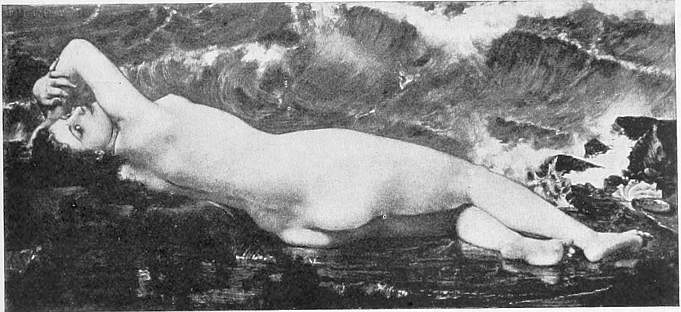
Baschet.
BAUDRY. THE PEARL AND THE WAVE.
(By permission of Mr. W. H. Stewart, the owner of the picture.)
Nevertheless, it would be unjust to speak of Baudry’s work as merely faded Classicism, or as Michael Angelo and water. He was not merely a pupil of the Italians; he contributed something Parisian of his own, something pretty, mannered, refined, graceful, seductive, and smiling, and felt himself independent enough to give to his conventional figures this sprightly addition of genuinely modern nervosity. The birth-certificates of his young men were drawn up in Florence, those of his young women in Rome, three hundred and fifty years ago; yet there is in the latter something of the Parisienne, in the former something of the modern dandies who know the fevered life of the Boulevards. In his delightful art there is French wit, there is a touch of the piquant, of the feminine, of the ambiguous, which almost amounts to indecency. One can still recognise the charming model in the figures of his dancers and Muses; you can see that Music’s or Poetry’s waist was laced up in a close-fitting corset before she sat for the picture. One may meet these women at any moment, trailing their dresses along the sidewalks of the Boulevards, or riding negligently in their carriages back from the Bois de Boulogne. And still more modern than the wasp-like form of the body is the character of the face and the smile on the lips. Thus Baudry has given a new shade to the manner in which one can obtain inspiration from the old masters. To all that he borrowed he added a personal and charming note. He possesses an elegance and grace which are neither Correggio’s, nor Raphael’s, nor Veronese’s, but French and Parisian. His Muses and Cupids, his “Comedy” and his “Judgment of Paris,” are documents of the French spirit in the nineteenth century, and—together with a few small and fine portraits on a green or blue background à la Clouet, among which that of his friend About takes the first rank—they will always assure him an important place in the history of French art.
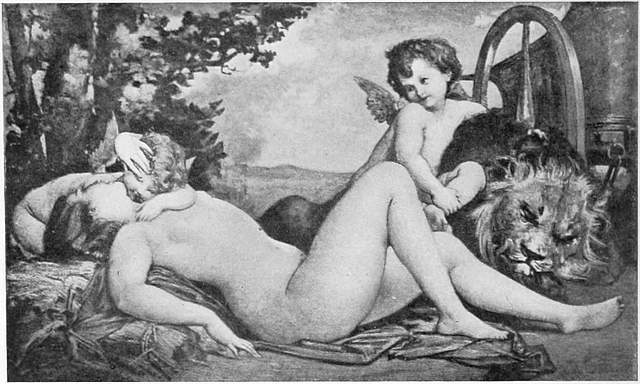
Gaz. des Beaux-Arts.
BAUDRY. CYBELE.
(By permission of the Marquise Arconati-Visconti, the owner of the picture.)
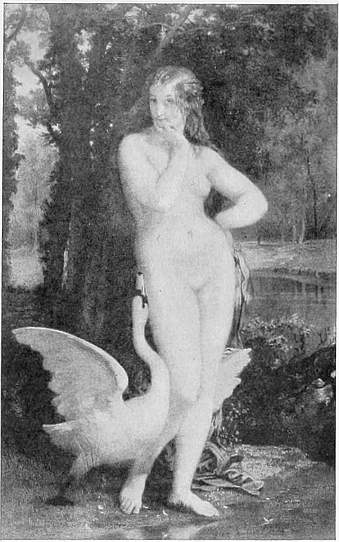
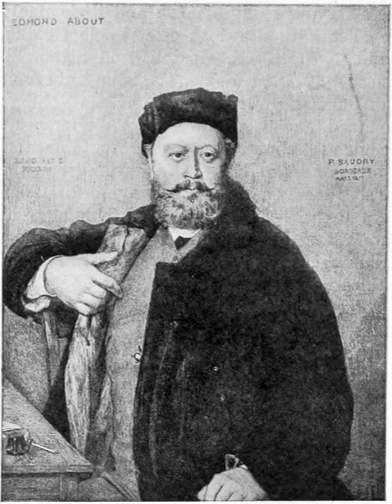
Gaz. des Beaux-Arts.
BAUDRY. LEDA. BAUDRY. EDMOND ABOUT.
Another artist who worked with Baudry at the decoration of the Grand Opera House was Élie Delaunay, who painted in a hall leading out of the foyer three large pictures on the myths of Apollo, Orpheus, and Amphion, and was at that time less appreciated than he deserved. Delaunay was born in the same year as Baudry, and, like him, was a Breton. In their genius also they are very similar. He shared in Baudry’s admiration of the masters of the Renaissance, but his worship was less for the Cinquecento than the fourteenth century. It was in Flandrin’s studio that he prepared himself for his entry into the École des Beaux Arts. His first picture, in 1849, “Christ healing a Leper,” was, with respect to its Roman manner of conceiving form and its bronze-like firm draughtsmanship, still entirely in the style of Ingres. It was not till he went to Italy in 1856, as winner of the Prix de Rome, that he turned from the works of the Roman school to those of the early Renaissance masters, to whom he was attracted by their rigorous study of form and their manly severity. His sketch books were filled with drawings after Paolo Uccello, Filippo Lippi, Pollajualo, Ghirlandajo, Botticelli, Gozzoli, and Signorelli. It was just at this time that French sculpture was making its significant revolt against the antique and in favour of Donatello, Verrocchio, and Della Robbia; that the Prix de Florence was founded, and that Paul Dubois’ “Florentine Singer” appeared. Delaunay became as a pupil of the Quattrocento masters one of the greatest draughtsmen of the century, a healthy Naturalist in the sense in which the Primitives were so, with a concise and firm power of design which only Ingres amongst modern French painters shares with him. The bodies of his nude male figures are strained in nerve and muscle like those of Donatello; they have the essential elegance and powerful rhythm of Dubois’ statues. Even the two pictures which he sent from Italy to the Salon, “The Nymph Hesperia fleeing from the Pursuit of Æsacus,” and the “Lesson on the Flute” in the Museum at Nantes, were works of great taste and sincerity, studied with respectful and patient devotion to nature, without striving after sentimental effect and without conventional reminiscences. When in 1861 he returned from Rome, he completed the frescoes in the church of St. Nicholas in Nantes, which, in their strict severity, remind one of Signorelli’s Cycle at Orvieto. In 1865 appeared in the Salon his “Plague at Rome,” which afterwards passed into the Luxembourg, and which is not devoid of tragic accent. In that collection hangs also his “Diana” of 1872, a proud nude figure drawn with firm and manly lines, and full of grave dignity, after the manner of Feuerbach. At the same time as his “Diana” he exhibited his portrait of a Mlle. Lechat, seated like one of Botticelli’s Madonnas in front of a trellis of roses—in the style of the old masters, and yet modern, naturalistic, and in excellent taste. Thenceforth he took his place among the first portrait painters of his time. There is an inexorable love of truth, a something bronze-like and stony in his pictures, finished as they are with the firm impress of medals. Instances of this may be found in his fine portrait of Mme. Toulmouche, whom he has represented in a white summer costume, with black gloves, seated in the midst of cheerful landscape; and also in several male heads drawn with that firmness of modelling which Bronzino in his best days alone possessed. After the completion of the Opera paintings he finished, in 1876, twelve decorative pictures for the great hall of the Council of State in the Palais Royal. His last works, which remained unfinished, were designs for the Pantheon—scenes from the life of St. Geneviève—in which he followed in the footsteps of the great fresco colourists of Upper Italy, Gaudenzio Ferrari and Pordenone. Élie Delaunay was no original genius, and as a pupil of the painters of the Quattrocento has not enriched the history of art in any way, but he stands forth, in a time which cared for nothing but external effect, as a very loyal, serious, and honest artist, whose works all bear the stamp of a healthy, manly spirit.
Though in the works of these masters the Classicism of Ingres passes away, in part enfeebled and in part imbued with modern elements and vivified by a more direct study of nature, yet on the whole Paul Delaroche dominates this period also. Historical painting takes the highest places in the Salon, and shows itself altered only in this respect, that, instead of Delaroche’s tameness of style, we have sensational subjects, arguments which revel in scenes of horror and display of corpses. Literature had already entered upon this path. Even Mérimée in his last novel, Lokis, was clearly the forerunner of that tendency in taste which Taine characterised by the words, “Depuis dix ans une nuance de brutalité complète l’élégance.” Flaubert himself, in his Salambo, was to some extent carried away by the stream. Consider, for instance, the descriptions of Gisko crawling, a maimed, shapeless stump, out of the ditch into Matho’s tent, and of how his head is sawn off; of the tortures inflicted by the Carthaginian people upon the captured Matho; or of how the mercenaries are starved to death in the rocky valley where they were imprisoned. Vying with this tendency of literature, painting attained in its chosen themes an over-excitation which reached the limits of the possible. While Delaroche had only in a very timid manner led the way to the tragedies of history, the younger artists hunted up all the most horrible deeds of blood to be found in the great Book of Martyrs of the story of man, and elaborated them on gigantic canvases. It would be quite impossible to draw up a catalogue of all the murders at that time perpetrated by French art. They might be arranged under various headings, as biblical, historical, political murders; murders in connection with robbery, and murders arising out of revenge; with subdivisions corresponding to the means employed, as poison, the dagger, the halter, broadsword and rapier, the bowstring, strangling, burning, etc. This was the time when, on account of this dominance of the “Genre féroce,” the public used to call the Salon the Morgue.
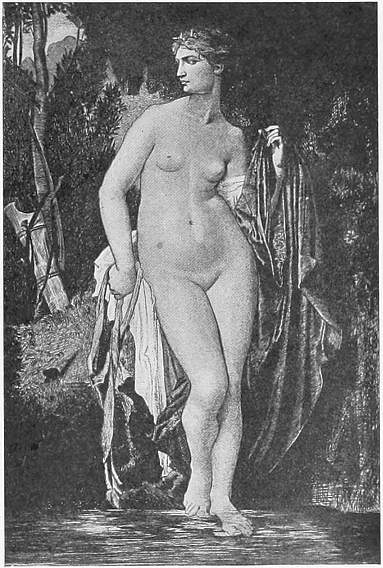
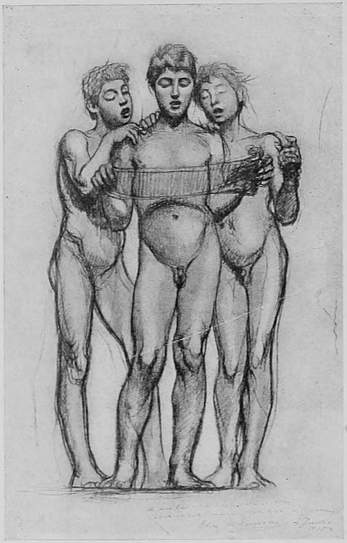
Gaz. des Beaux-Arts. Gaz. des Beaux-Arts.
DELAUNAY. DIANA. DELAUNAY. BOYS SINGING.
Toudouze painted the “Fall of Sodom” with a dozen copper-coloured Abyssinians, larger than life, rolling on the ground in convulsions, while Lot’s wife, dying and half-consumed by fire, gnashes her teeth as she raises the corpse of her child over her head. In a picture of George Becker’s were represented the corpses of King Saul’s sons, delivered over by David to the Gibeonites, hanging alongside of each other in a dark forest scene on a cross-shaped framework, like butcher’s meat from the shambles. Their mother stands beneath the scaffold, swinging a knotted club to protect the corpses from an antediluvian vulture. In a painting by Bréhan, Cyaxares, King of the Medes, gives a banquet, and by way of dessert has his guests the Scythian leaders massacred by his mercenaries. In one by Matthieu, Heliogabalus has hit upon a yet happier idea, for at the conclusion of the meal he sets half-starved lions and tigers upon his guests. Aimé Morot depicted in a large picture “The Wives of the Ambrones” in the battle of Aquæ Sextiæ. They are hurling themselves like a horde of furies upon the Roman horsemen who are attacking the camp. Half-naked, or entirely so, with their hair flowing behind them, they throw themselves upon the Romans, catch hold of the swords by the blade, tear their eyes out, and are trampled beneath the horses’ hoofs. Especially popular were the voluptuous and cruel wild beasts from the menagerie of the Cæsars. Nero in particular suited the atmosphere of the period; his ghost haunted the novel, the stage, sculpture, and painting, and there seemed to be a general agreement to immortalise him and the morally monstrous personality of Locusta. In a picture by Sylvestre he is represented with florid cheeks, glowing with fat, and gloating over the mortal agony of a slave lying on the ground, upon whom Locusta has tested the poison intended for Britannicus. Aublet varied the same theme by making a negro lad the victim, while several corpses of negroes lying in the background suggest that the Emperor was not quite satisfied with Locusta’s first experiments. Round Nero, the more entirely to fill his magnificent Golden House, the charming shades of his congenial comrades in crime weave their flitting dances. Pelez depicted the strangling of the Emperor Commodus by the gladiator to whom the Empress had entrusted the task, and painted with tender interest the marks caused by suffusion of blood which the athlete’s hand had left upon the unhappy prince’s neck. A very familiar figure is that of Seneca, with distorted features, uttering his last words of wisdom while the blood pours from his opened veins. After the madness of the Cæsars comes the atrocious history of the Merovingian kings. Luminais, the painter of Gauls and barbarians, represented in his large picture “Les Énervés de Jumièges” the sons of King Clovis II, who, after the muscles of their knees have been destroyed by fire, are set helplessly adrift in a boat on the Seine. Then followed torture scenes from the time of the Inquisition, and saints burning at the stake. The conception which this post-Romantic generation had of the East was of cruelty and voluptuousness mixed, a thing pieced together out of white bodies, purple streams of blood, and brown backgrounds. Here, the favourite Sultana contemplates the severed head of her rival, which stares at her out of its glassy eyes; there, eunuchs are making ready to strangle a woman condemned to death. In works such as these the genius, powerful in composition, of Benjamin Constant, celebrates its triumphs.
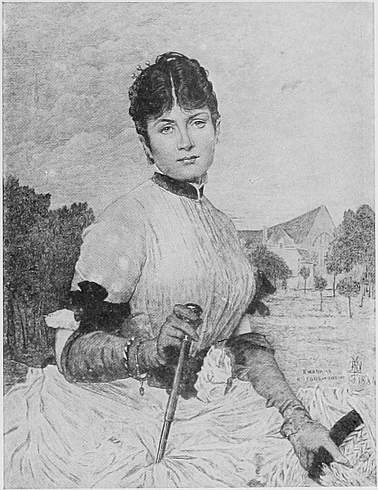
Gaz. des Beaux-Arts.
DELAUNAY. MADAME TOULMOUCHE.
Yet, notwithstanding all the means of allurement furnished by such themes, these paintings almost invariably fail to produce the anticipated effect. Not that it is the brutality of the subjects that makes them unpleasant. Art in all times has busied itself with the horrible. How voluptuously does Dante depict the horrors of Hell! What imagination was ever peopled with figures more dreadful than those conceived by Shakespeare? Cruelty and death have a poetry of their own: why should Art prudishly abstain from depicting them? Only, if the result is to be a good picture, the subject must be in strict congruity with the talent employed upon it, and in the majority of these works this conformity is lacking. The subjects alone had become more savage and brutal. In the manner of treatment there is none of the wild effect which the Neapolitans of the seventeenth century gave to their scenes of martyrdom. Spirits truly wild, like Delacroix and Caravaggio, are not to be met with every day. The painters who launched out upon these bloodthirsty themes took absolutely no inward “enjoyment in tragical subjects,” but simply painted them as if after precepts learned at school. And as they were also deficient in that knowledge of nature which is acquired only by direct study of life, not one of them was in a position to give to his historical scenes that naturalistic weight which alone gives to such themes a character of convincing probability. True, these pictures compel respect on account of their unusual ability. These naked bodies, twisting themselves in the most varying postures of pain, give proof by their correct draughtsmanship of the most painstaking anatomical studies, yet after all they are nothing more than inverted Laocoöns. The Classical spirit haunts them still, and a discordant effect is produced when subjects so full of wild passion are tranquilly depicted according to cold conventional rules. Over all these figures and scenes, even the most horrible, lies the veil of a Classical embellishment, which deprives them altogether of that directness which lays hold on the imagination. The pictures are good studies of costume, and make an admirable impression by their resplendent glow of colour; they are show-pieces, brilliant stage effects, as happily conceived as any of Sardou’s. But the recipe for their production is still that of the school of Delaroche: avoidance of all extremes, generalised forms, careful composition, crude lukewarmness, or the affectation of daring. Scarce one of these painters has given to his wild subject an equal wildness of treatment; not one has raised himself from the paltry level of Delaroche to the artistic height of Delacroix.
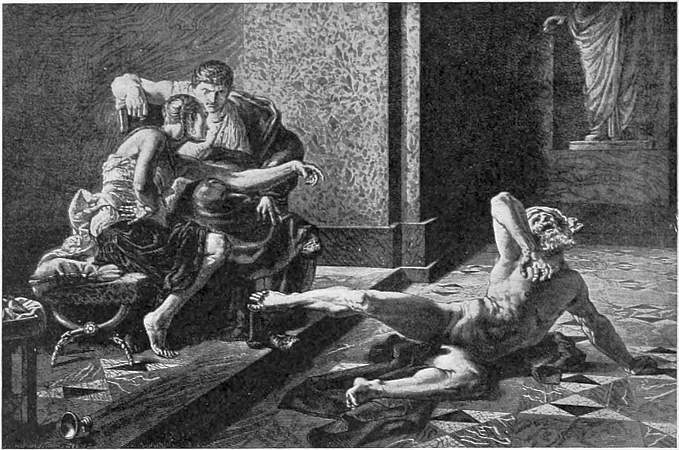
L’Art.
SYLVESTRE. LOCUSTA TESTING IN NERO’S PRESENCE POISON PREPARED FOR BRITANNICUS.
Laurens alone, surnamed by his comrades “the Benedictine,” because his predilection was for forgotten themes from ecclesiastical history, constitutes in a certain sense an exception to the rule. He too belongs to the group of historical painters whose theory is that a picture should represent an historical fact with absolute accuracy. But he is more masculine than Delaroche. His personages are truer to nature, or, if one will, less banal; the general effect is warmer and fuller of life; he has a greater power of attracting attention. There is nothing great in his work, but there is no cold pedantry: the art of combination is more adroit, so that one is less aware of calculation, and may sometimes observe a grim earnestness. He really loves the terrible, while the others merely made use of it for the manufacture of what are nothing more than tableaux. To the Inquisition especially he was indebted for notable successes, and at times he was able to depict its dark scenes of horror in a very subtle manner. When he heaps up, in front of a church, corpses to which the priests have refused burial; when he disinters popes in order to place them in the dock before their accusers; when he opens coffins to reveal the decomposed features of some erstwhile beauty, he sets even blunted nerves on the stretch; and as he has therein attained the goal he had proposed to himself, his art is not without its justification.
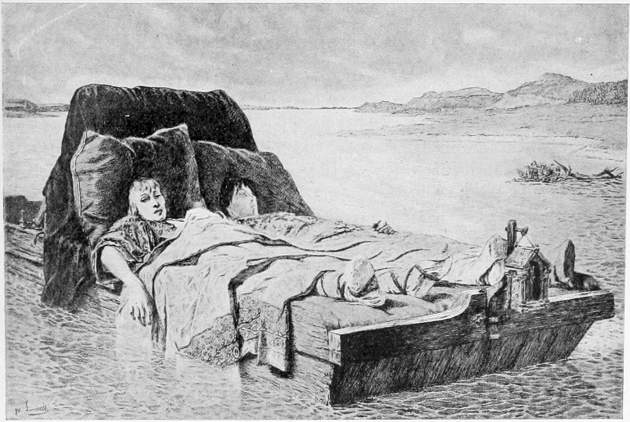
L’Art.
LUMINAIS. LES ÉNERVÉS DE JUMIÈGES.
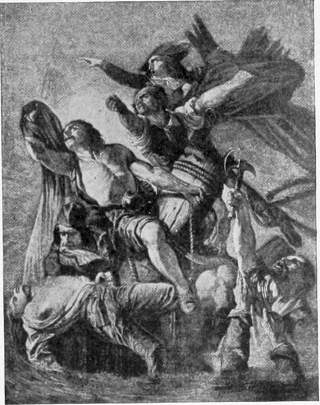
Among the younger generation, Rochegrosse, an artist of daring genius, appeared for a while to have taken to such themes by free choice, and not solely through the traditions of the studio. One seemed to observe in his works a truly emotional temperament flaming behind the trammels of conventionality, and was almost inclined to rank him among the spirits of storm and stress who trace their descent from Delacroix. After his first picture, in which “Vitellius” is represented dragged through the streets of Rome and ill treated by the populace, he achieved success with a scene taken from the destruction of Troy. Here “Andromache,” raging with impotent anguish, is struggling against a number of Greeks who have snatched her child from her arms to throw it down from the ramparts. This brutal strife is depicted with the highest naturalistic power. Neither the heroine nor the warriors belong to the ideal figures of the style of compromise. Andromache is of a fulness of form almost approaching corpulence, and the Greeks remind one of Indians on the warpath. Mangled corpses complete the picture, and on the bare wall to the left, over the stairs, hang dead bodies abandoned to corruption and the birds of prey. In his third picture he took for his theme the horrors of the barbarous and ferocious Peasants’ War in the fourteenth century, as Mérimée had described them in his book entitled La Jacquerie; and his work is all the more effective as there lurks in the subject a certain grim modern touch which reminds one of the Social Democracy, of the insurrection of the Commune, of something which might happen even to-day. The insurgents break into the hall, where the ladies of the castle have taken refuge with their children. One alone stands erect, the grandmother in her nun-like widow’s dress, and stretches her arms behind her with a gesture of energy, as if to shield the younger ones at her back. The foremost intruder ironically takes off his cap. Another lifts up on his pike the fair-haired, bleeding head of the lord of the castle; a third has similarly transfixed his reeking heart. Others are pressing in from without, breaking the window panes with their weapons, which are yet dripping with blood. Beneath frightful figures are seen, the most horrible that of a woman standing on the window-sill, her hands propped upon her knees, gazing with insane laughter upon the mortal terror of the aristocratic ladies.
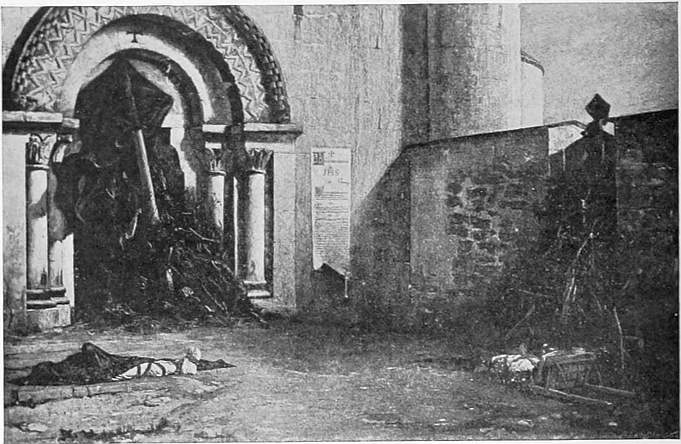
Baschet.
LAURENS. THE INTERDICT.
In his subsequent pictures Rochegrosse did not go so far afield. His “Murder of Julius Cæsar” was a work of art in white upon white, full of crude imagination, with white walls, white reflections of light, white togas, and dark red blotches of blood. His grass-eating “Nebuchadnezzar” proved that from the sublime to the ridiculous there is often only a step. Between times he painted archæological trifles for ladies of literary culture, such as the “Battle of the Sparrows” of 1890; but in his great “Fall of Babylon” he has proved once more what he can do. No doubt it is not a fine work: it is a mere decorative piece, but an astonishingly spirited performance. The scene is the palace of the Babylonian kings, the decorative construction of which the recovered monuments and the recent scientific investigations had rendered it possible to reproduce. Rochegrosse consulted with the zeal of an archæologist all the treasures of the Louvre and the British Museum,—Assyrian friezes, ornaments, and costumes,—and then set forth in these surroundings the famous banquet at which the Prophet Daniel explained the words “Mene, Tekel, Peres.” The day begins to break; in the distance the army of the Medes advancing to attack the palace has burst open the gate; Belshazzar leaves the table in terror, and takes to his weapons; the naked women, still intoxicated, stretch their limbs, or remain lazily indifferent lying on the ground; around is a dazzling confusion of mosaics, of polychrome architecture, of fantastic images of animals, of glittering tapestries shot with many hues and pleasing to the eye; of flowers, vases, fruits, pastry, and nude bodies of women. The grey light of morning strives to overcome that of the half-extinguished lamps, and rests with leaden weight upon the gigantic still-life below.
Gaz. des Beaux-Arts. L’Art.
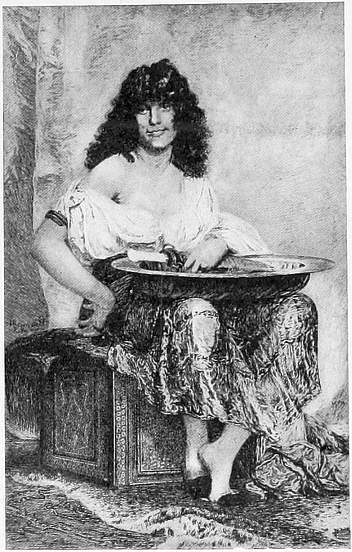
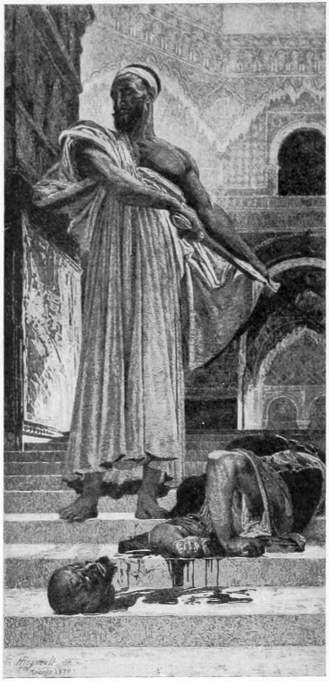
REGNAULT. SALOME. REGNAULT. THE MOORISH HEADSMAN.
(By permission of M. Georges Petit, the owner of the copyright.)
If some portion of Delacroix’s wild genius appears to have descended upon Rochegrosse, yet was Henri Regnault, as a colourist, the greatest of Delacroix’s heirs—even allowing for the exaggerated renown which came to him in France, from the fact that he was the last to fall in the war of 1870. His portrait of “General Prim” of 1869, which, rejected by the sitter, came eventually to the Louvre, is somewhat reminiscent of Velasquez and Delacroix, but is nevertheless, with those of Géricault, amongst the finest equestrian portraits of the century. In his “Salome” he has depicted a black-haired girl with twitching feet, resting upon a stool after her dance, and contemplating with the cruelty of a tigress the platter which she holds ready for the head of John the Baptist, while her glowing red mouth with its dazzling teeth smiles like that of an innocent child. In her he has embodied with infernal subtlety the demon of voluptuous wantonness, and has composed a symphony in yellow of seductive and dazzling charm. She is attired in transparent gold-inwoven robes, which have a caressing congruity with the resplendent texture of the background.
His “Moorish Headsman” is a symphony in red. In his pale rose-red garb the tall Moor stands in majestic dignity, wipes a few drops of blood from the blade of his sword, and glances with careless indifference—a type of the dreamy cruelty of Oriental fatalism—without anger and without pity, without hatred and without satisfaction, upon the severed head with its distorted eyes, which, rolling down a couple of steps, has stained the white marble with purple patches of blood. “I will cause the genuine Moors to rise again, at once rich and great, terrible and voluptuous,”—so the voice of Delacroix speaks out of this picture by Regnault. His paintings, like those of his master, have the effect of splendid Oriental costumes; they are shot with every hue, they lighten and glisten, they are inwoven with magnificent arabesques of gold and silver, with sparkling embroideries and precious stones. The “Orlando Furioso” of art lives once more in these fascinating harmonies, in the power, splendour, and lustre of the colouring. Just as Baudry at the close of the Classical period produced in his paintings for the Opera House the noblest work after the idealist formulæ, so Regnault in his “Salome” and his “Prim” has completed the last defiant works of the formulæ of Romanticism.
We have thought it advisable to follow this development of the art of painting down to its close, just as in treating of the older periods we have proceeded, not upon chronological principles, but upon those of historical style. Now that the old art has been followed to the grave, it will be all the easier, later on, to perceive clearly how the new arose slowly out of its invisible depths. And as France since 1830 has become the high school of art for other nations, those paths have at the same time been indicated along which the art of painting was proceeding during these years in other countries.
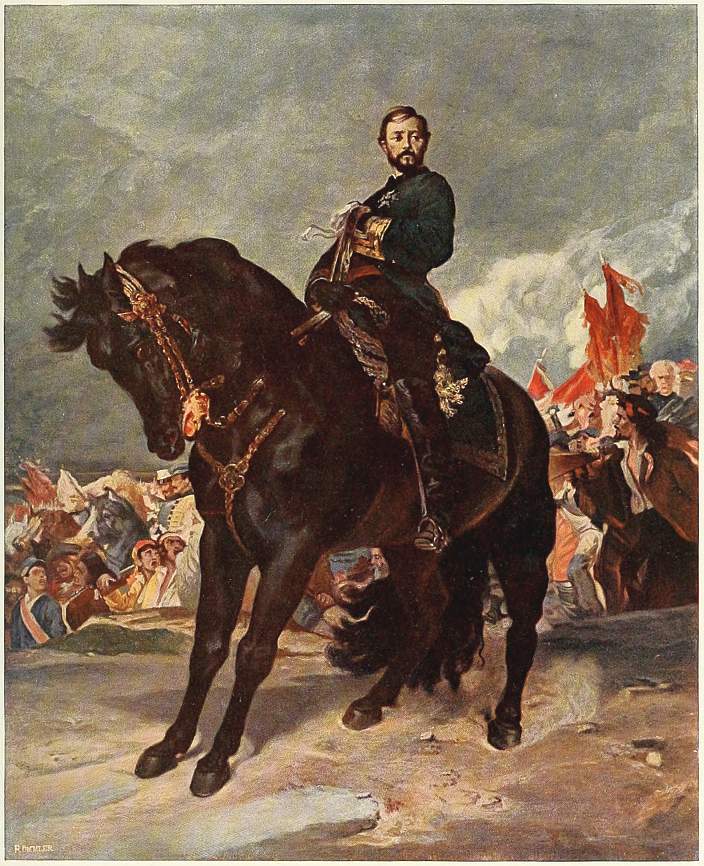
HENRI REGNAULT. GENERAL PRÍM.

CHAPTER XIII
THE HISTORICAL SCHOOL OF PAINTING IN BELGIUM
Belgian art had gone through the same history as French art since David. When the French patriarch came to Brussels to pass the remainder of his days there in honour, he found the ground already well prepared. The Classicists had long since made their way into art, and the old Flemish tradition was dying out. Lens and Herreyns are the last colourists in the sense of the good old time, but they are associated with the good old time only through the qualities of their colouring. As a degenerate descendant of Van Dyck, Lens painted with a feeble brush sweet, insipid, sugary work for boudoirs and prie-dieu chairs; and had lost his feeling for nature to such a degree that he gave the aged the same flesh tint as children, and men the full breasts of hermaphrodites. Herreyns, appointed director of the Antwerp Academy in 1800, was more masculine; and although likewise conventional and wanting in individuality, he was none the less a painter of breadth and boldness. He was most enraptured with a model with a copper-coloured skin and knotted muscles, or with pretty and ruddy children, and fat nurses with swelling breasts. This bold worker embodied in his own person the art of a great epoch, but did nothing to renew it. These painters, indeed, only mixed for a new hash the crumbs fallen from the table at which giants had once sat. They looked backwards instead of around them, and lighted their modest little lamp at the sun of Rubens. France was the only country where art followed the great changes of culture in the age. Hence Flemish painting had been crossed with French elements long before David’s arrival. And Paris was for the artists of 1800 what Italy had been for those of 1600. They made their pilgrimage in troops to the studio of Suvée, who had originally come from Bruges, but had lived since 1771 on the Seine. There, and there only, recipes for the composition of great figure pictures were to be obtained. And thus art completed what the Empire had in a political sense begun. The artistic barriers fell as the geographical ones had done before, and the Belgian painters went back to Brussels, Antwerp, Ghent, and Bruges as men annexed by France.
David on his arrival needed only to shake the tree and the fruit fell ripe into his lap. He entered Flanders like a conqueror, and left the signs of ravage behind him on his triumphal progress. In Brussels a court gathered round him as round a banished king, and a gold medal was struck in memory of his arrival. He took Flemish art in his powerful hands and crushed it. For, needless to say, he saw nothing but barbarism in the genius of Rubens, and inoculated Flemish artists with a genuine horror of their great prince of painters. He continued to teach in Brussels what he had preached in Paris, and became the father-in-law of a deadly tiresome Franco-Belgian school, to which belonged a succession of correct painters; men such as Duvivier, Ducq, Paelinck, Odevaere, and others. For the aboriginal, sturdy, energetic, and carnal Flemish art was prescribed the mathematical regularity of the antique canon. The old Flemish joyousness of colour passed into a consumptive cacophony. And then was repeated in Belgium the tragedy which Classicism had played in France. Everything became a pretext for draperies, stiff poses, sculptural groupings, and plaster heads. Phædra and Theseus, Hector and Andromache, Paris and Helen, were, as in Paris, the most popular subjects. And so great a confusion reigned, that a sculptor from whom a wolf was ordered included the history of Romulus and Remus gratuitously.
The only one whose works are still partially enjoyable is Navez. He was, like Ingres in France, the last prop of this art, chiselled, as it were, out of stone; and even after the fall of Classicism he remained in esteem, because, like Ingres, he knew how to steer a prudent course between David, the Italians, and a certain independent study of nature. A touch of realism was mingled with his mania for the Greeks; only to a limited extent did he correct “ugly” nature; he would have ventured to represent Socrates with his negro nose and Thersites with his hump, and, again, like Ingres he has left behind him enduring performances as a portrait painter. His correct, cold, and discreet talent grew warm at the touch of human personality, and his drawings, in particular, prove that he had warmth of feeling as an artist. As his biographer tells us, he seldom laid down the sketch-book in which he fixed his impressions as he talked. Every page was filled with sketches of a group, a figure, or a gesture seen in the street and rapidly dashed off, “as realistically as even Courbet could desire.” And these he transferred, when he painted in the “noble style.”
As Navez had importance as an artist, so had Matthias van Bree—Herreyns’ successor in the directorate of the Antwerp Academy—importance as a teacher. He worked in Belgium, like Gros in Paris, only in another way. While Gros as an artist was the forerunner of Romanticism, and as a teacher an orthodox Classicist, Van Bree is tedious as an artist, but as a teacher he fanned in the young generation a glowing love for old Flemish art. No one spoke of Rubens, Van Dyck, and the great art of the seventeenth century with so much warmth and understanding; and whilst with the charcoal in his hand he composed buckram cartoons, he dreamt of a youth who should arise to renew the old Flemish tradition.
Before long this young man had grown up. He had seen the artistic treasures of Antwerp and Paris. Here Rubens had delighted his eyes, and there Paul Veronese. As he admired both in the Louvre, he heard behind him the voice of the young Romanticists who, like him, had an enthusiasm for colour and movement, and blasphemed the stiff, colourless old David. Gustav Wappers, also, had paid toll to Classicism, and painted in 1823 a “Regulus” after the well-known recipe. All the greater was the astonishment when, in 1830, he came forward with his “Burgomaster van der Werff”: “Burgomaster van der Werff of Leyden, at the siege of the town in 1576, offers his own body as food to the famished citizens.” The very subject could not fail to create enthusiasm in the great body of the people, excited as they were by ideas of liberty: the brilliant method of presentation did this no less. What the old Van Bree looked for, the return to the splendour of colour and sensuous fulness of life of the old masters, was achieved in this picture. In the same year, when Belgium had won her nationality and independence once more, a painter also ventured to break away from the French formulæ of Classicism, and to treat a national theme in the manner of those painters who in former centuries had been the glory of Flanders. Wappers was greeted as a national hero; his part it was to bring to an issue with the brush that good fight which others had fought with the musket and sabre. His picture was a sign of the delivery of Flemish art from the French house of bondage. Whilst older men were horrified, as the followers of the school of Delaroche were afterwards horrified at the “Stone-breakers” of Courbet, the younger generation looked up to Wappers as a Messiah. Everything in the Brussels Salon faded before the freshness of the new work; a springtide in painting seemed to be at hand, and the wintry rigidity of Classicism was warmed by a burst of sunshine, the old gods trembled and felt their Olympus quake. Gustav Wappers was held to be the leader of a new Renaissance. In him the great era of the seventeenth century was to be continued. The iridescence of silken stuffs, the whole colour and festal joyousness of the old masters, were found once more. As in France there rose the shout, “An Ingres, a Delacroix!” so there resounded in Belgium the battle-cry, “A Navez, a Wappers!” The picture was bought by King William II of Holland, and in 1832 Wappers was made Professor of the Antwerp Academy.
Bruyllant, Brussels.
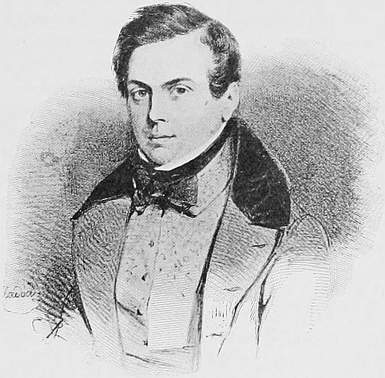
GUSTAV WAPPERS.
The Exhibition of 1834 confirmed him in his new position as head of a school. This was a genuine triumph, which he gained by his “Episode in the Belgian Revolution of 1830.” A scene out of the blood-stained days of the street fights in Brussels—that glorious final chapter of the struggle of the Belgian people for freedom from the French yoke—was nothing less than an event in which every one had recently taken part. At a period when so few realised how closely the great masters of the past were bound to their own time and imbibed from it their strength and nourishment, this new painter, in defiance of all theories, had drawn boldly from life. This picture was regarded as “a hymn of jubilation for what was attained and a threnody for the sacrifice it had cost.” And the neighbourhood of the church, where he had laid the action, stamped it almost as the votive picture of the Belgian people for its dead. On the right an artisan standing aloft upon a newly thrown up earthwork is reading to his attentive comrades the rejected proclamation of the Prince of Orange. On the left a reinforcement is coming up. In the foreground boys are tearing up the pavement or beating the drum; and here and there are enacted various tragical family scenes. Here a young wife with a child on her arm clings with all the strength of despair to her husband, who resists her and finally tears himself from her grasp and hurries to the barricade—the cry of love is drowned amid the clash of arms. There, supported on the knee of his grey-headed father, rests a handsome young fellow with closing eyes and the death-wound in his heart. It seems as though the Horatian dulce et decorum est might be said to wander over his features and to glorify them. For patriotism as well as for mere sentiment, here are noble scenes enough and to spare. Not only all Brussels, but all Belgium, made a pilgrimage to Wappers’ creation. Every mother beheld her lost son in the youth in the foreground whose life has been sacrificed; every artisan’s wife sought her husband, her brother, or her father amongst the figures of the fighting-men on the barricades. All the newspapers were full of praise, and a subscription was set on foot to strike a medal in commemoration of the picture. If, up to this time, Wappers had been merely praised as the renewer of Belgian art, he was now placed alongside of the greatest masters. Thiers induced him to exhibit in Paris the much discussed work, the fame of which had passed beyond the boundaries of Belgium. The “Episode” made a triumphal tour of all the great towns of Europe before it found its home in the Musée Moderne; and Wappers’ fame abroad increased yet more his celebrity in Flanders. Thanks to him, the neighbouring nations began to interest themselves in the Belgian school. All were united in admiration of “the mighty conception and the harmonious scheme of colour.” The German Morgenblatt published a study of him in 1836. Wappers counted as the leading painter of his country.
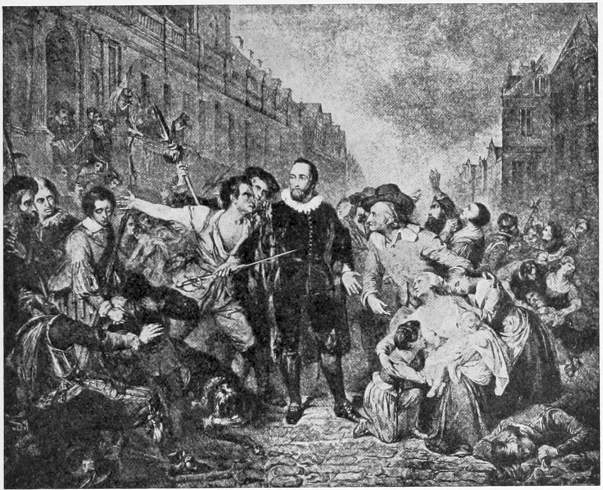
Bruyllant, Brussels.
WAPPERS. THE SACRIFICE OF BURGOMASTER VAN DER WERFF AT THE SIEGE OF LEYDEN.
Yet the same year brought him his first rivals. His entry on the stage had given strength to a group of young painters belonging to the same courageous movement, and the Brussels Salon of 1836 concentrated their efforts. Nicaise de Keyzer made his appearance in heavy armour. As early as 1834 he had come forward with a great picture, a Crucifixion, in which he desired to compete with Rubens, as it seemed, in the latter’s most special province. Yet the work merely testified to its author’s excellent memory: the majority of the heads, gestures, and draperies had been made use of in old pictures in precisely the same fashion. Consciously or not, he had copied fragments direct, and welded them together in a new composition. If, in spite of this, the name of de Keyzer already flew from mouth to mouth, he owed it to the nimbus of romance which irradiated his person. The story went that an Antwerp lady on one of her walks had seen a young man drawing in the sand, while his flock was at pasture not far off. She stepped up and offered him a pencil, and he, a new Cimabue, began forthwith to sketch a picture of the Madonna. The drawing was so beautiful (so the tale ran) that the lady would have held it a sin to allow the genius to end his days as a shepherd. He came to town, received instruction, and learned to paint. A little idyll illuminated by the amiability of a lady was quite enough to prepare a friendly reception for De Keyzer. And since he, like a tractable, modest young man, hearkened attentively to criticism, he satisfied all desires when, in 1836, he came forward with his “Battle of the Spurs at Courtrai, 1302.” In its quiet elegance the work answered to the peaceful mood which prevailed once more after the days of revolt and political insurrection. He was given special credit for clearness of composition and antiquarian exactness. De Keyzer had chosen the moment when the Count of Artois was expiring on the knees of a Flemish soldier; another Fleming had his arm raised to protect his general from the approaching French. For the rest, there is a lull in the fight, though the battlefield in the background is indicated with the minuteness of an historian: none of those carnages of blood and smoke of which the world was grown once more weary, but a correct, well-disciplined battle, a skilful composition of fine gestures, helmets, cuirasses, and halberts. Even the Count’s spur, says Alvin, is drawn after the original, the only remaining spur out of seven hundred which lay scattered on the field after the day of Courtrai.
In the same year Henri Decaisne completed his “Belges Illustres.” The famous past was supposed to give its blessing to the great present. The artist, who in Paris had painted portraits with success, had been esteemed there by Lamartine, and celebrated by Alfred de Musset in a brilliant article in the Revue des Deux Mondes, now gratified a long cherished desire of the Belgian national pride when he united the heroes of the land in an ideal gathering.
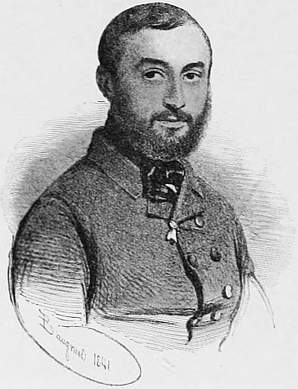
Soon afterwards Gallait and Bièfve trod the stage of Belgian painting. In point of size their pictures surpassed all that that age, accustomed as it was to vast canvases, had yet witnessed. “The Abdication of Charles V” measured twenty feet; it was hung in the Salon Carré of the Louvre above Paul Veronese’s “Marriage at Cana.” An entire court of great ladies and gentlemen, clad in velvet and brocade, move in the gorgeous hall of state of a king’s castle. The solemn moment is represented when Charles V, erect and dominating the entire assembly, cedes the government of his possessions to Philip: and here is a mine of profound criticism of the philosophy of history. This old man, with one foot in the grave, whose forceful head still bears, like a Caryatid, the heavy burden of empire, embodies the splendour, fame, and might of bygone days. Faltering, he steps down from the throne, as though hesitating at the last moment whether he should appoint as his successor this son whom he both loves and fears; and, lifting to heaven his tired, sunken eyes, he commends unto God the future of the realm. Philip, the only one in the assembly entirely clothed in black, who receives the gift of dominion with an icy coldness, is transformed by the able exegesis of the critics into the satanic demon conjuring up the powers of hell. The picture even gives a glimpse into the future. For as he speaks Charles leans his left hand upon the shoulder of another young man, William of Orange. This indicates that soon the nation will wrest their independence from the double-tongued Jesuitical policy of Philip. To the left of this central group, robed in velvet and silk, stand the ladies around Margaret, the sister of the Emperor; she, in the garb of a nun, sits in her chair as in a prie-dieu. To the right, near the throne, are pages and priests, and amidst them Egmont and Horn, standing aloof and silent, look upon the scene. “The Abdication” had a grand success. It confirmed the hopes which had been set on Gallait ever since the completion of his “Tasso,” and it was proudly ranked amongst those works which did special honour to the young nation. Wappers saw himself eclipsed, and Louis Gallait took the lead.
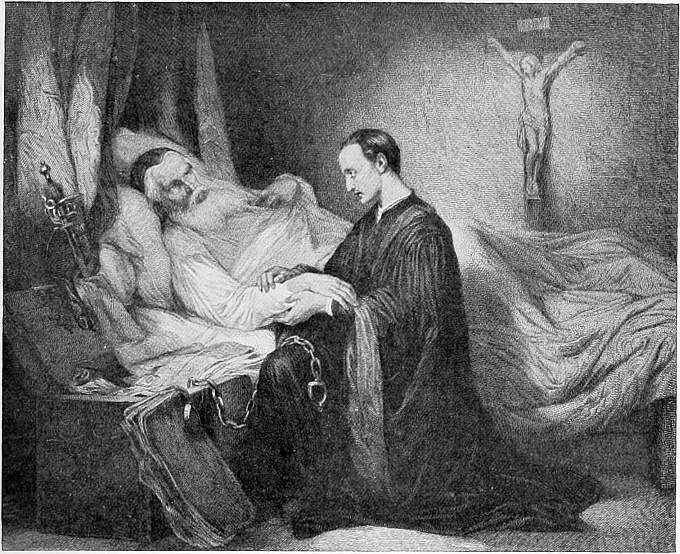
WAPPERS. THE DEATH OF COLUMBUS.
Edouard de Bièfve’s “Treaty of the Nobles” formed the historical supplement to this work; after the triumph of the kingdom came the triumph of the people. The picture represents the signing of the defensive league, against the Inquisition and other breaches of privilege, which the nobility of the Netherlands entered into in 1566, in the Castle of Cuylenburg, near Brussels; it was hailed by the Berliner Staatszeitung as “a landmark in the chronicle of historical painting.”
This heroic era of Belgian painting was brought to a close in 1848 by Ernest Slingeneyer, who, as early as 1842, obtained a brilliant success with his “Sinking of the French Battleship Le Vengeur.” His “Battle of Lepanto” was the last great historical picture, and the entire vocabulary of admiration known to art criticism was showered upon it by the Brussels press.
Even a new period of religious painting seemed about to dawn. German art, up to that time little regarded in Belgium, had since the fifties been discussed with considerable detail in the journals, and such names as Overbeck, W. Schadow, Veit, Cornelius, and Kaulbach had speedily acquired a favourable reputation. An exhibition of German cartoons instituted in Brussels in 1862 served—strangely enough—to sustain this high appreciation. The young nation believed that it could not afford to lag behind France and Germany, and commissioned two Antwerp painters, Guffens and Swerts, who had early made themselves familiar with the technique of fresco, to found a Belgian school of monumental painting. To this end they entered into a correspondence with the German artists, and, after long studies in Italy and Germany, adorned with frescoes the Church of Notre Dame in St. Nicolas in East Flanders, St. George’s Church in Antwerp, the town halls of Courtrai and Ypres, a few churches in England, and the Cathedral of Prague; and on these frescoes Herman Riegel, in 1883, published a book in two volumes.
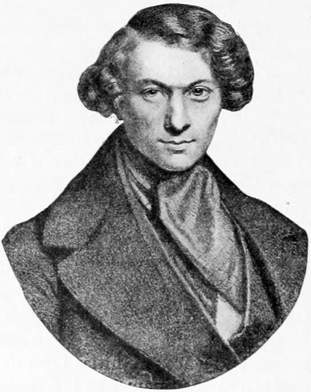
Bruyllant, Brussels.
DE KEYZER.
At the present day this religious fresco painting, which handed on the doctrine of the German Nazarenes—the doctrine that nothing remained to the nineteenth-century artist except to imitate the old Italians as well as he could—can no longer command such exhaustive disquisition. And not it alone: the whole “Belgian artistic revival of 1830” appears in a somewhat dubious light. After the disconsolate wilderness of Classicism this period marked an advance. Every Salon brought some new name to light. The State had contributed a big budget for art, and extended its protecting hand over the “great painting” which was the glory of the young nation. What could not be got into the Musée Moderne, founded in 1845, was divided amongst the churches and provincial museums. The number of painters and exhibitions increased very noticeably. Beside the great triennial exhibitions in Brussels, Antwerp, and Ghent, there were others in the smaller towns, such as Mons and Mechlin. The Belgian painters of 1830 appear, no doubt, as great men, when one considers to what a depth art had sunk before their advent. Wappers especially widened the horizon, by breaking the formula of Classicism and renewing the tradition of the brilliant colourists of the seventeenth century. De Bièfve, De Keyzer, Slingeneyer, severally contributed to the Belgian Renaissance. The old Flemish race knew itself once more in this fond quest of beautiful and radiant colouring. The historical painting had even a certain actual interest. Standing so near to the glorious September days when the country won its independence, the painters wished to draw a parallel between the glorious present and the great past, and to waken patriotic memories by the apotheosis of popular heroes. And yet the Musée Moderne of Brussels is not one of those collections in which one willingly lingers. The works in the old museum, hard by, have remained fresh and living and in touch with us; those in the new gallery seem to be divided from us by centuries. For the mischief with pictures which do not remain for ever young is precisely this—they grow old so very soon. Posterity speaks the language of cold criticism; and those powers must be great which are even favoured with a verdict. The luxuriant wreaths of laurel which fall upon the living are no guarantee of enduring fame, while in the crowns awarded after death every leaf is numbered. In how few of these once lauded works there dwells the power to speak in an intelligible language to a generation which tests them, not for their patriotism, but for their intrinsic art. The Belgian school of 1830 has left behind it the trace of respectable industry, but a supreme work is what it has not brought forth.
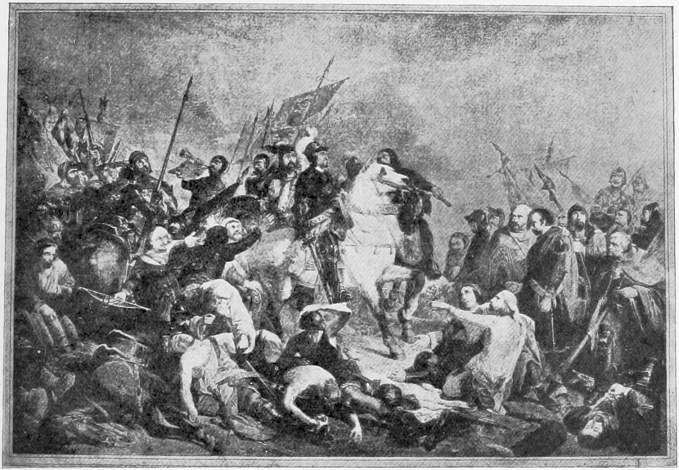
Bruyllant, Brussels.
DE KEYZER. THE BATTLE OF WOERINGEN.
How hard it is to see anything epoch-making in Wappers’ “Van der Werff.” How theatrically the figures are posturing, how improbable is the composition, and what an unwholesome dose of sentimentality is to be found in that burgomaster, who is offering himself as a prey to the multitude! The heads are those of troubadours. And these jerkins brought fresh out of the wardrobe, these neatly ironed white ruffles, all this rich velvet and glittering pomp, how little it resembles the torn rags of a half-starved people after a nine months’ siege! His revolutionary picture of 1834 is an unfortunate transposition into a sentimental key of the “Freedom on the Barricades” by Delacroix. Here also are play-actors rather than men and women of the people. This old man who is kissing the banner, the wife who winds her arms about her husband as Venus does about Tannhäuser, the pale girl who has fallen in a faint, the warrior who, with his eyes turned up to Heaven, is breaking his sword—these are figures out of a melodrama, not revolutionaries storming the barricades, nor famishing artisans fighting for their very existence. And the thin, spick-and-span colouring is in just as striking a contrast with the forceful action of the scene. An idyll could not be carried out with more prettiness of manner than is this picture which represents the rising of a people. The artisans are as white as alabaster. A light rouge rests upon the cheeks of the women, as when Boucher paints the faltering of virtue. And afterwards Wappers’ course went further and further down hill. Only in these two early works, in which he responded to a political movement by an artistic endeavour, does he seem, in a certain sense, individual and powerful. All the others are stereotyped productions which, having nothing to do with the Belgian national movement, have all the more to do with the Parisian École du bon sens. Even his “Christ in the Grave,” painted in 1833, and now in St. Michael’s Church at Louvain, with its artificial grace and pietistical sentimentality, might have been painted by Ary Scheffer. The pathetic scenes from English and French history of the sixteenth and seventeenth centuries which followed this merely reflect that painting of historical anecdote which was invented by Delaroche. Agnes Sorel and Charles VII, Abelard and Eloise, Charles I taking leave of his children, Anne Bullen’s parting from Elizabeth, Peter the Great presenting to his ministers the model of a Dutch ship, Columbus in prison, Boccaccio reading the Decameron to Joanna of Naples, the brothers De Witt before their execution, André Chénier in the prison of Saint-Lazare, Louis XVII at Simon the shoe-maker’s, the poet Camoens as a beggar, Charles I going to the scaffold—all are subjects treated by others before him in France, and neither in their conception nor their technique have they anything original. In the last-mentioned picture, exhibited in Antwerp in 1870, he attained the limit of sugary affectation: a young girl has sunk on her knees, and, with dreamily uplifted eyes, offers to the Stuart King who is going to his death—a rose! Wappers is merely a reflex of French Romanticism, although he cannot be brought into direct comparison with any Parisian master. The passion of Delacroix stirred him but little: nothing points to a relationship between him and that great spirit. One is rather reminded of Alfred Johannot, whom he resembles in his entire gamut of emotion as in his treatment and selection of subjects. In both may be found elegance of line, Byronic emphasis, histrionic gestures, and the same stage properties borrowed from the theatre; never the genuine movement of feeling, only empty and distorted grimaces.
Of the others who appeared with him the same may be said. All Belgian matadors of the forties and fifties came to grief, and are interesting in the history of art only as symptomatic phenomena, as members of that school of Delaroche which encompassed the world. They abandoned the antique marble, the chlamys, and the leaden forms of the Classicists, to set in their place a motley picture of the Middle Ages, made up of cuirasses, mail-shirts, fleshings, and velvet and silken doublets. One convention followed the other, and pedantic dryness was replaced by melancholy sentimentalism. As skilled practitioners they understood the sleights of their art, but never rose to individual creation. Amongst many painters there was not a single artist.
As regards De Keyzer, it seems as if throughout his whole life he had wished to remain true to the memory of his benefactress: a simpering feminine trait runs with enervating sweetness through all his works, even through that “Battle of the Spurs” which founded his reputation. According to old writers, the athletic bodies of the Flemings were the terror of the French chivalry at Courtrai. De Keyzer has made of them mere plaster figures, and the pale, meagre colouring is in keeping with the languid conception. In the battles of Woeringen, of Senef, and Nieuwpoort, which followed on this picture, and were executed for the Belgian and Dutch Government, he succeeded still less in overcoming his affectation; and he first found the fitting province for his mild and correct talent when in later years he began to render little anecdotes of the Emperor Maximilian or Justus Lipsius out of the studio of Rubens or Memlinc. For these there was need of little but a certain superficial play of colour and an elegant painting of textures.
Bruyllant, Brussels. Bruyllant, Brussels.
SLINGENEYER. THE AVENGER. LOUIS GALLAIT.
Ernest Slingeneyer is stronger and more masculine. Yet what an unrefreshing chaos of blue, red, saffron, and citron-yellow is that “Sea-fight at Lepanto”! Slingeneyer felt that the chiaroscuro with which Wappers saturated his “Episode” was not in keeping with this action under open sky. But rightly as he felt this, he had not the strength to solve the problem of open-air painting. What a barbaric effect these red, brown, and yellow bodies make in their motley theatrical pomp! How the composition of the picture savours of apotheosis! As for his later work, his thirteen gigantic pictures, “gloires de la Belgique,” in the great hall of the Brussels Academy, like De Keyzer’s mural paintings above the staircase of the Antwerp Museum, they would never have been painted had they not had Delaroche’s hemicycle as their forerunner.
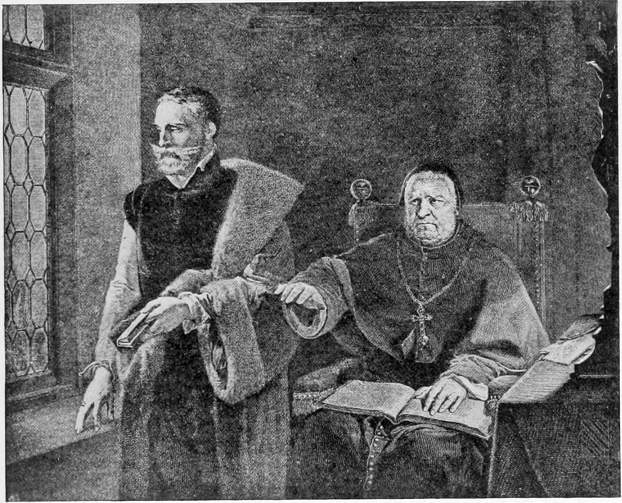
And Gallait’s “Abdication of Charles V”—one fails to understand how it was possible that so much able disquisition was suggested by this picture. How slight a smattering of the erudition of a stage manager is necessary for the representation of such a scene: the throne on one side; before it the lords and gentlemen in a semicircle, to the left front the ladies to make a fine effect for the eye, and in the background balconies with curious spectators, to widen out the spectacle. It is all pure theatre; an icy ceremony with prettily got up supernumeraries. All the heads have the discreditable appearance of family portraits painted after death, and then washed over with a faint conventional tinge of red. The whole thing is like a huge piece of still-life, which an adroit painter has put together out of a mixture of heads, gold, jewels, mantles, and perukes. Delaroche seems to have contributed the composition, Devéria the sumptuous costumery; and as for the colouring, Isabey, with his sunbeams shimmering in gold and silver, may not improbably have had something to do with that. What was spontaneous in Wappers is replaced in Gallait by cold calculation. Once and once only did this correct and frigid painter give evidence of a certain dramatic vein; it was when in 1851 he painted “The Brussels Guild of Marksmen paying the Last Honours to Egmont and Horn.” With a brutal audacity the decapitated heads are set to their bodies. Bloodless and livid, with clotted and tangled beards, they both really look as if they had been studied direct from nature. But the rest of the picture, the surrounding of theatrical attractions, parade costumes, and false pathos, is all the less in keeping with this study of death. How Zurbaran or Caravaggio would have treated the theme! They would have veiled the unessential figures in darkness, and irradiated the heads only with a trenchant light. What Gallait has made of it is the final tableau of an opera of costume. The two sergeants of Alva who are on guard, and the men who are showing their reverence, tread the stage like bad actors, scrupulously arrayed and making pathetic gestures. Their action has been studied from drawing-school copies; no genuine cry of passion ever breaks through. Heads, hands, and outlines have all a sickly idealism; a studious and sedulously polished manner of painting has ruined the intrinsic spirit of the work as a whole. Théophile Gautier was right when he wrote of Gallait: “Tout le talent qu’on peut acquérir avec du travail, du goût, du jugememt, et de la volonté, M. Gallait le possède.” Gallait’s “Last Obsequies,” hung in that same Salon of 1850 which contained Courbet’s “Stone-breakers,” and the words of recognition accorded to it, were the last obsequies given to the parting genius of historical painting. A few years went by, and Gallait’s fame died away. After 1851 he painted fourteen other great historical pictures (“Egmont’s Last Moments,” “Johanna the Mad by the Corpse of her Husband,” “Alva at the Window during the Execution of the two Counts,” etc.), and, occasionally, sentimental genre pictures, such as “The Oblivion of Sorrow” in the Berlin National Gallery; in this a small boy is playing the fiddle for the consolation of his sister, who had sunk upon the high-road exhausted by hunger. He also painted many portraits. But nothing gave him a niche in the memory of his contemporaries. “The Pest at Tournai,” painted in 1882, was a work extremely creditable to his old age; it was nevertheless a picture which appeared to another generation merely as a phantom; and when, on 20th November 1887, the announcement of his death passed through the land, it came unexpectedly, like that of a person already believed to have been long dead.
Bruyllant, Brussels.
GALLAIT. EGMONT’S LAST MOMENTS.
Bruyllant, Brussels.
EDOUARD BIÈFVE.
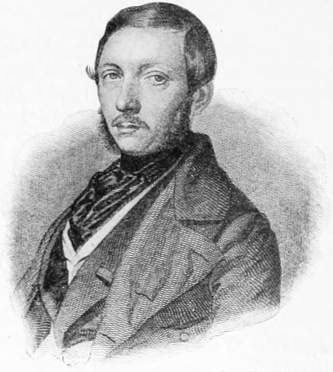
Finally, Edouard de Bièfve, who in 1842 shared Gallait’s triumph in Germany, and was afterwards named in the same breath with him, is the man who marks the complete corruption of this tendency. If the sturdy Wappers, the emasculate De Keyzer, and the eclectic Gallait tricked out their pathetic heroes with noble heads like that of the Antinous, and offered their contemporaries an adroit theatrical art, a parade, and a hollow pathos, the incapable Bièfve never got beyond the painting of tableaux vivants laboriously presented. Terrible and of Shakespearian impressiveness is the scene in which the half-famished Ugolino hurls himself upon his son in an appalling ecstasy of frenzy, a curse against God and man upon his lips. Upon the canvas, six metres wide, which Bièfve in 1836 devoted to this theme, there is represented an old gentleman, who, though certainly a little pale, contrives to maintain in perfection the punctilious bearing of a cavalier, and in the midst of his fasting cure has picturesquely draped round his shoulders an ermine mantle, as if he had been asked out to dinner. Before him stands a young man, possessing that graceful outline beloved of Paul Delaroche. Devéria, Ary Scheffer, and Johannot were better painters of such monumental illustrations of the classics. As yet the shivering art of Belgium had learnt only to warm itself at the Parisian fireside. Even Bièfve’s “League of the Nobles of the Netherlands,” despite its national subject-matter, was no more than a lucky hit, which he owed to his long residence in Paris. And how tiresomely is the scene played out! One would wish to catch the mutterings of insurrection from these men who personify the Belgian people; but Bièfve’s picture is restful and dignified. Egmont and Horn, the lions of the occasion, are conducting themselves like honest citizens who are bored at a party. Seated in his chair, the handsome Egmont thinks merely of showing his fine profile to the ladies in the gallery, and Horn, who steps towards the table to make his signature, does it with the elegance of a lover inscribing verses in a young lady’s album. Three brothers with clasped hands swear the well-known oath to die together.
It is a little irony in the history of art that in 1842 these two same pictures set all Germany in tumult, and diverted the whole stream of painting into a new course. But how was it possible that the German painters stood before them as if struck by lightning? It must be remembered that for a whole generation Germany had seen nothing but coloured cartoons, and that the enthusiasm for Franco-Belgian art had been so prepared that the least touch was enough to set it in flames.
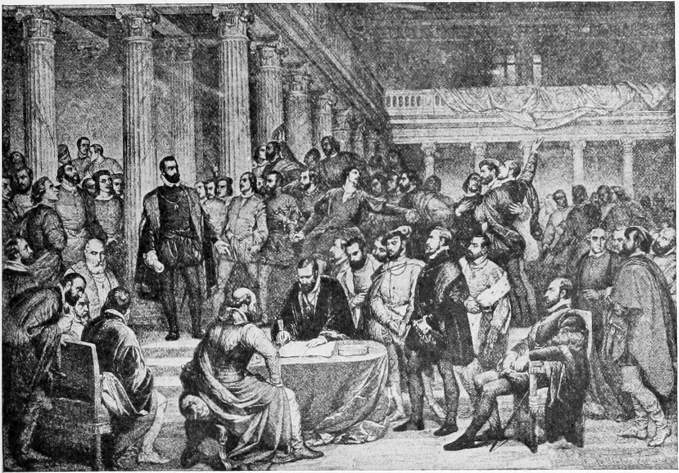
Bruyllant, Brussels.
BIÈFVE. THE LEAGUE OF THE NOBLES OF THE NETHERLANDS.
Since the wars of liberation Germany had been very reserved in her attitude towards the French. Until the year 1842 original works of the French and Belgian school had never been hung in any German exhibition. But in spite of this, a high, even enthusiastic, appreciation of French and Belgian painting was being spread, especially amongst the younger generation. Even in engravings and lithographs after French pictures it was believed that qualities of colour were discoverable which were wanting in German painting. Heine and other authors, who had wandered to Paris, “the lofty tower of Freedom,” to escape from the depressing condition of German affairs, had done what in them lay for the dissemination of this cult. The rising generation of the forties had been driven by Heine’s notices of the Salon into an almost hostile attitude towards the dominant art schools of Germany, the schools of Düsseldorf and Munich. The stylists on the Isar and the sentimental elegiac painters on the Rhine met with the same antipathy from the younger generation. The appearance of the two Belgian historical pictures, which were really nothing more than offshoots of the great French school, gave nourishment of doubled strength to this tendency to seek salvation in Paris. The German painters were startled out of contentment with their beloved cartoons, and to many a man it seemed as if the scales had fallen from his eyes. They perceived what an admirable thing it is that a painter should be able to paint. What they could have learnt long before from any good old picture, and in their turbulent enthusiasm for ideas had not learnt, was made suddenly clear to them by these new paintings. They came to the conclusion that it was impossible for God Almighty to have poured light and colour over the objective world with the intention that painters should transform it into a world of shadowless contours. They recognised that the style of cartoon work had led away from all painting, and that it was therefore necessary to do honour once more to the despised handiwork and technique of art, as the fundamental condition of its well-being. However much the æsthetic party might warn them not to renounce “the Reformation of painting, which had been begun and perfected forty years before,” and not “with modern technique to sink back into the pre-Cornelian, ornamental model painting,” the demand for colour, which had been so long neglected, asserted its rights more and more loudly. King Ludwig’s saying was repeated as though it were a new revelation: “The painter must be able to paint.” Colour was the battle-cry of the day, the battle-cry of youth, to whom the world belongs. In place of the ideal of contour came the ideal of hue and pigment. Cartoons, in the sense of the old cartoon school, no one would draw any longer. To paint pictures, finished pictures, was the tendency of the day. And since painting is to be learnt from the living only, and such as could paint lived in Germany no longer, they packed their trunks, and set out to learn from the “go-ahead neighbour.” As Rome had been hitherto, so was Paris now, the high school of German art. “To Paris!” and “Painting!” were the cries throughout all Germany.
CHAPTER XIV
THE REVOLUTION OF THE GERMAN COLOURISTS
From 1842 dates the pilgrimage of the German artists to Paris, Antwerp, and Brussels. In Delaroche, Cogniet, and Couture, in Wappers and Gallait, they believed they could discover the secrets of art which were hidden from German teachers. The history of art can scarcely offer another example of such a sudden overthrow of dogmas hitherto dominant by dogmas directly opposed to them. During the first half of the century the painters of Germany were pious men, humorous, witty, and intelligent men; they had a sharply cut profile, and so enchained the multitude by their human qualities that nobody remarked how little they understood of their craft, or that they were too superior to learn to draw correctly, held colour unchaste, and made virtues of all their failings. The next generation was condemned to learn painting during the whole of its natural life. The former were “problematic natures”: beings who united with a Titanic force of will an actual achievement which is hardly worth mentioning; who regarded the mere handicraft of art as beneath their dignity; who, in their revelations to mankind, were resolved to burden their spirit as little as possible with any sensuous expression of their genius, and, above all, meant not to degrade themselves by the manual labour of learning to paint, and thereby wasting their valuable time. The latter were not ashamed of painting. By devoting themselves with vehemence to the colouring and technique of oil-painting, they accomplished the necessary revolution against the abstract idealism of the school of Cornelius. In their opulence of ideas the draughtsmen of cartoons had made a notch in the history of art by casting the technical tradition overboard. To have reinstated this as far as they could, with the aid of the French, is the peculiar merit of the generation of 1850. “Règle générale: si vous rencontrez un bon peintre allemamd, vous pouvez le complimenter en français.” So runs the motto—not complimentary to Germany, but quite unassailable—which Edmond About prefixed to his notices on the Paris Universal Exhibition of 1855.
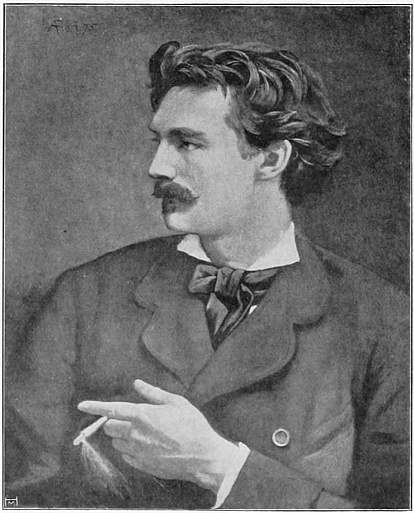
Hanfstängl.
ANSELM FEUERBACH. PORTRAIT OF HIMSELF.
Anselm Feuerbach was the first distinguished German artist who made the journey to Paris with a proper knowledge of the necessity of this step. In Germany he was the greatest representative of that Classicism of which the principal master in France was Ingres, and the continuator Thomas Couture. And he succeeded in accomplishing that which the German Classicists of the beginning of the century strove after in vain. Whilst they contented themselves with suggestions and an indeterminate symbolisation of poetical ideas after the Greek writers, German Classicism achieved in Feuerbach’s “Symposium of Plato” a great, noble, and faultless work, which will live. He moved upon classic ground more naturally and freely and with more of the Hellenic spirit than even the French. For the classic genius was begotten in him, and not inoculated from without. In the Vermächtniss the son calls his father’s book the prophetic seal of his own original being. He inherited the classic spirit from the enthusiastic scholar, the subtile author of the Vatican Apollo, to whom the genius of Greece had so fully and completely revealed itself.
A remarkable nature: philologer and dreamer, German and Greek, one who rejoiced in beauty and in the life of the senses, and whose proud muse strayed through life solitary and with leaden weights upon her feet,—such was Anselm Feuerbach, and by that division of his being he was ruined. Equipped with a superior education, an appearance of singular nobility, and with proud family traditions, he emerged like a shining meteor in Düsseldorf, when he began his career at the age of sixteen, brilliant, precocious, and already a favourite amongst women. This was in 1845. He ran through all the schools in Germany, Belgium, and France. In regard to the living, he believed himself to be indebted to the French alone, and eagerly claimed the merit of having been the first to seek them out. But it was in Italy that he had passed through his novitiate as an artist. A glorious hour it must have been when Feuerbach, full-blooded and dedicated to the worship of beauty, entered Venice in 1855, in company with that cheerful and convivial poet Victor Scheffel. In the town of the lagoons, whither he had come on a commission from the Court of Karlsruhe to copy the Assumption of Titian, Feuerbach made the second determining step of his life. The third he made when his stipendium was withdrawn, and, full of youthful confidence in his luck and his good star, he undertook his journey to Rome.
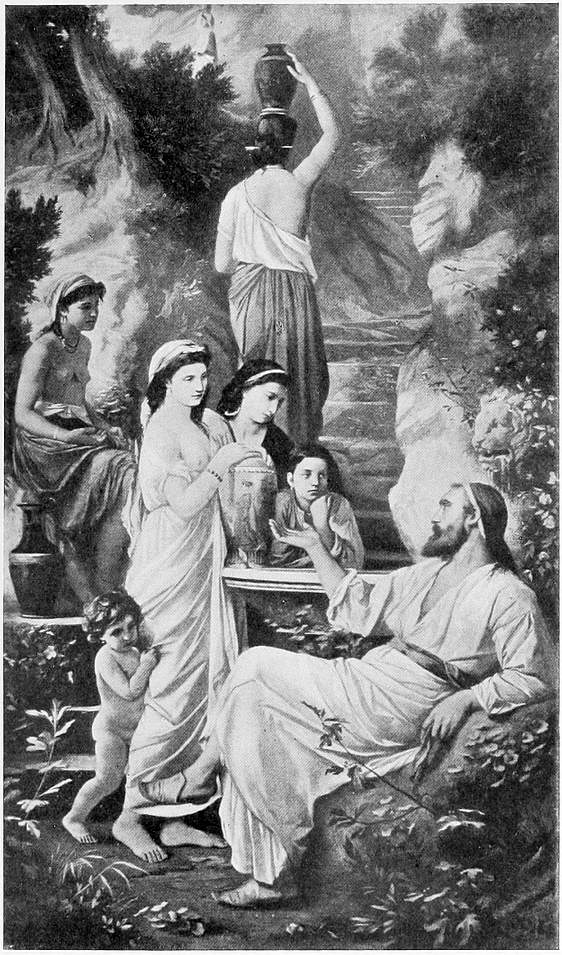
Albert, Munich.
FEUERBACH. HAFIZ AT THE WELL.
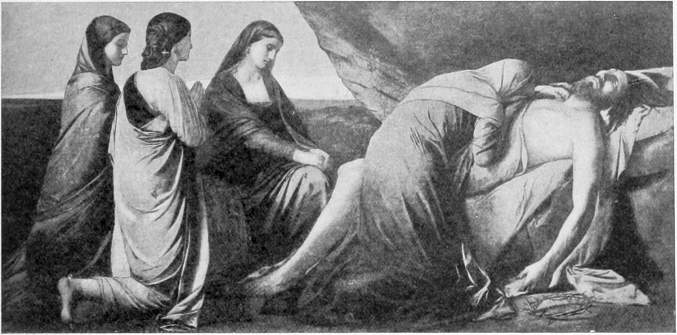
Albert, Munich.
FEUERBACH. PIETA.
He was handsome, small, and refined, and rather pale and spare—of that delicacy which in highly bred families is found in the last heirs with whom the race dies out—and he had dark locks which clustered wildly round his head. The moulding of his features was feminine, and his complexion southern; his eyes, shadowed by long lashes, were brown, sometimes fiery, sometimes sad and earnest, and his glance was swift. He loved to sing Italian songs to the guitar in his fine, deep voice, and Boecklin and Reinhold Begas would join in.
The impressions he received in Italy were formative of his life. For he learnt to understand the divine simplicity and noble dignity of antique art better than Couture was capable of understanding them; and he achieved a simple amplitude to which the French Classicism had never risen.
From his first works, to which the Düsseldorf egg-shell is still sticking, down to the “Symposium of Plato”—what a route it is, and through what phases he passes. “Hafiz at the Well,” surrounded by voluptuous, half-naked girls, painted at Paris in 1852, was his first eminent achievement. In subject it is a late fruit from Daumer’s study of Hafiz: as a work of art it is one of the most genuine products of the school of Couture. No other German artist has surrendered himself so entirely to the French. With a large brush, never losing sight of the complete effect, Feuerbach has painted his canvas, almost for the sake of showing that he has assimilated everything that was to be learnt in Paris. The same influence preponderates in the “Death of Pietro Aretino,” done in 1854. But, side by side with the Parisian master, the later Venetians have an unmistakable share in this work. The capacity to grasp things in a monumental largeness is already announced. Evidently Feuerbach has studied Paul Veronese, and realised how high he stands above the French painters. At the same time he has examined the other Venetians for their technique, and discovered something which has appealed to him in Bordone’s colouring. But “Dante walking with high-born Ladies of Ravenna,” finished at Rome in 1857, was the ripest fruit of his Venetian impressions. In sunny warmth of colour, fine golden tone, and quiet simplicity of pictorial treatment, no modern has come so near to Palma and Bordone. And in “Dante’s Death,” of 1858, there predominates a still greater depth and golden glow, a grave and devout beauty.
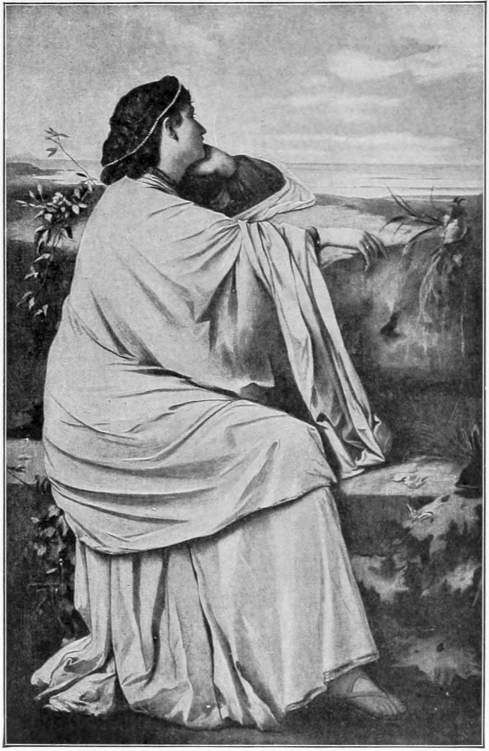
Seemann, Leipzig.
FEUERBACH. IPHIGENIA.
In the following works, however, Feuerbach, with a conscious purpose, denies himself the quality to which the Dante pictures owe a principal part of their powerful effect: the mild glow, the sunny beaming of colour. He confines himself to a cool scheme of tone, reduced to grey, almost to the point of colourlessness; to a glimmer of leaden blue, a moonlight pallor. At the same time he has concentrated the whole life of his figures in their inward being, whilst every movement has been taken from their limbs. Even the expression of spiritual emotion in the eyes and features has been subdued in the extreme. The “Pietà,” both the “Iphigenias,” and the “Symposium of Plato” are the world-renowned proofs of the height of classic inspiration which he touched in Italy. Measure, nobility, unsought and perfected loftiness characterise the “Pietà,” that mother of the Saviour who bows herself in silent agony over the body of her Divine Son, and those three kneeling women, whose silent grief is of such thrilling power, precisely because of its emotionlessness. For “Iphigenia” Feuerbach has given of his best. She is in both examples—the first of 1862, the second of 1871—a figure sublime beyond human measure, grand like the figure of the Greek tragedy. But the “Symposium of Plato” will always assert its high value as one of the finest pictorial creations of an imagination nourished on the great art of the ancients, and filled brimful with the splendour of the antique world. There is nothing in it superfluous, nothing accidental. The noblest simplicity of speech, a Greek rhythm in all gradations, the beautiful lines of bas-relief, decisive colour and stringent form—that is the groundwork of Feuerbach’s art. And through it there speaks a spirit preoccupied with greatness and heroism. Thus he created his “Medea” in the Munich Pinakothek, that picture of magnificent, sombre melancholy that affects one like a monologue from a Sophoclean tragedy. Thus he painted his “Battle of the Amazons,” one of the few “nude” pictures of the century which possesses the perfectly unconcerned and unsexual nudity of the antique. Italy had set him free from all the insincere and calculated methods which had deformed French art since Delaroche; it had set him free from all theatrical sentiment, by which he had accustomed himself to understand everything that was forced in costume, pigment, pose and movement, light and scenery. In the place of the ordinary treatment from the model, with its set gestures and grimaces, he gave an expression of form which was great, simple, and plastic. His study seems to have been an incessant exercise of the eye, to see and to hold fast to the essential, to the great lines of nature as of the human body.
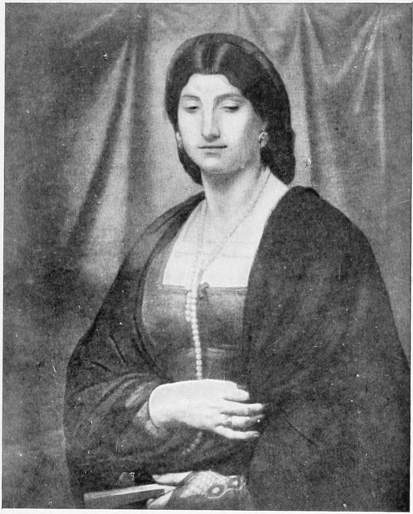
Albert, Munich.
FEUERBACH. PORTRAIT OF A ROMAN LADY.
In the full possession of these powers, which he acquired amid the elementary simplicity and heroic majesty of Roman landscape by constant intercourse with the great painters of the past, he determined in the summer of 1873 to accept an invitation from the Vienna Academy. His friends rejoiced. At last this worker, who had been abandoned in a foreign land, seemed to have found in his native country a place which offered him a new life. He was but little more than forty: yet all was so soon to be over. From Rome he came to the restless capital which had just lived through the birththroes of a new epoch; from the side of Michael Angelo to the side of Makart! The sketches for a series on the wars of the Titans, which he began after his arrival, promised the greatest things. They display a sureness and majesty which find no parallel in the German art of those years. But they were destined never to be completed.
Feeling himself, like Antæus, strong only on Roman soil, he lost his power in Vienna. Reserved, innately delicate, a mystical, ideal nature like that of Faust, and one which only with reluctance permitted to a stranger a glimpse of its inner being; in his life, as in his art, high-bred and simple, hating both as painter and as man everything overstrained or sentimental; in his judgment harsh, severe, and uncompromising, lonely and proud, he was but little adapted to make friends for himself. The indifference with which his study for the “Fall of the Titans” was received in the Vienna Exhibition wounded him mortally. Vienna, which is so much disposed to laughter, laughed. Criticism was rough and unfavourable. He left Vienna and went to Venice. The tragical fate of a party of voyagers, drowned as they were playing and singing together on a night journey to the Lido, gave him the motive for his last picture, “The Concert,” which was found unfinished after his death, and came into the possession of the Berlin National Gallery. On 4th January 1882 he died, alone in a Venetian hotel.
“Hier ruht Anselm Feuerbach, Der im Leben manches malte, Fern vom Vaterlande, ach, Das ihn immer schlecht bezahlte.”
So runs the epitaph which he made for himself. And posterity might alter it into—
“Hier ruht ein deutscher Maler, Bekannt im deutschen Land; Nennt man die besten Namen, Wird auch der seine genannt.”
However, one must not go too far. In familiar conversation Feuerbach once said of himself that when the history of art in the nineteenth century came to be written, mention would be made of him as of a meteor. So isolated, and so much out of connection with the artistic striving of his contemporaries, did he believe himself to be, that he held himself justified in saying: “Believe me, after fifty years my pictures will possess tongues, and tell the world what I was and what I meant.” In truth, he owes his resurrection less to his pictures than to the Vermächtniss. A book has opened the eyes of Germany to Feuerbach’s greatness, and since that time the worship of Feuerbach has gone almost into extremes. Throughout his lifetime—like almost every great artist who has died before old age—he was handled by the Press without much comprehension. The critics blamed his grey tones, the connoisseurs complained of his unpatriotic subjects or missed the presence of anecdote. His admirers were the refined, quiet people who do not praise at the top of their voices. He never met with recognition, and that poisoned his life. It is generous of posterity to make up for the want of contemporary appreciation. But when he is set up as a pioneer, whose work pointed out the art of the future, the judgment becomes one which a later posterity will subscribe to only with hesitation.
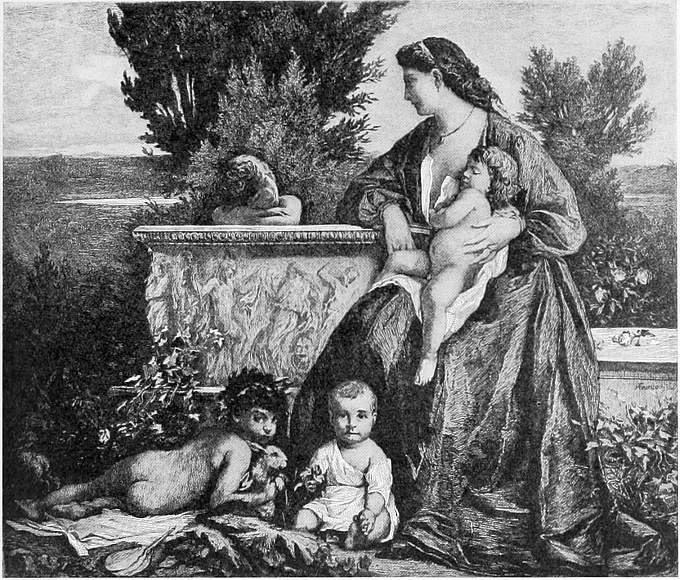
FEUERBACH. MOTHER’S JOY.
Feuerbach presents a problem for psychological rather than artistic analysis. Whoever has read the Vermächtniss feels the personal element in these works, sees in them the confessions of a proud, unsatisfied, and suffering soul, and in their author no son of the Renaissance born out of due season, but a modern who has been agitated through and through by the décadent fever. In his book Feuerbach appears as one of the first who felt to his inmost fibre all the intellectual and spiritual contradictions which are bred by the nineteenth century, and who cherished them even with a sort of tenderness, as contributing to a high and more subtilised condition of soul. He was one of the first who, in the same way as Bourget and Verlaine, studied moral pathology under the microscope, and who, with a tired soul and worn-out feelings, sought for the last refinement of simplicity. And this weary resignations seems also to speak from his pictures. Not one of the old painters has this modern melancholy, this air of dejection which hovers over his works. Even the ladies round Dante are filled with that sadness which comes over youth on the evenings of sultry summer days, when it is struck by a presentiment of the transitoriness of earthly things. It is as if these figures would all some day or other vanish into the cloister, or, like Iphigenia, sit lonely upon the shore of a sea, whither no ship should ever come to release them. And it is certainly not by chance that Iphigenia had such a hold upon the artist; he repeatedly set himself to render her figure afresh, and, later, Medea steps beside her as the impersonation of the still more intense sense of desertion which filled the artist’s spirit. The woman of Colchis, who sits shivering on the shore of the sea, chilled through and through by the consciousness of her abandonment; the daughter of Agamemnon, who in spirit is seeking the land of the Greeks, with the boundless sea spreading wide and grey before her, like her own yearning,—both are images of the lonely Feuerbach, who, like Hölderlin, the Werther of Greece, flies to a dreamy Hellas as to a happy shore, to find peace for his sick spirit. His “Symposium of Plato” has not that exuberant sensuousness, that mixture of esprit and voluptuousness, of temperance and intemperance, which marks the Athenian life under Pericles; nor has it the Olympian blitheness with which Raphael would have executed the subject. A breath of monkish asceticism is over every joy, subduing it. These Greeks have tasted of the pains which Christianity brought into the world. Or take his “Judgment of Paris” in Hamburg. Nude women life-size, Loves, southern landscape, gay raiment, golden vessels, brilliant ornament, beauty—those are the elements of the picture; and how little have such words the power to render the impression! But Feuerbach’s three goddesses have an uneasiness, as if each one of them knew beforehand that she would not receive the apple; Paris is sitting just as cheerlessly there. And by borrowing his loves from Boucher, Feuerbach has shown the more sharply the opposition between the Hellenic legend which he interprets and the funereal mien with which he does it. The blitheness of the antique spirit is tempered by the sadness of the modern mind. He tells these old myths as never a Greek and never a master of the Renaissance would have told them. Olympus is filled with mist, with the colouring of the North, with the melancholy of a later and more neurotic age, the moods of which are for that very reason more rich in nuances—an age which is at once graver and more disturbed by problems than was the old Hellas. Feuerbach’s pictures are octaves in the language of Tasso, but of a repining lyrical mood which Tasso would not have given them. The brightest sunshine laughed over the Greece of the Renaissance; over that of Feuerbach there rests a rainy, overcast November mood. Even works of his like the “Children on the Sea-shore” and the “Idyll” reveal a pained and suffering conception of nature, that tender and subdued spirit that Burne-Jones has; it is as if these blossoms of humanity were there to waste away in buds that never come to fruition, as if it were no longer possible to breathe into creation the true joyousness of youth. Even the five girls, making music out of doors, in the picture “In Spring,” look like young widows, putting the whole tenderness of their souls into elegiac complaints for their lost husbands.
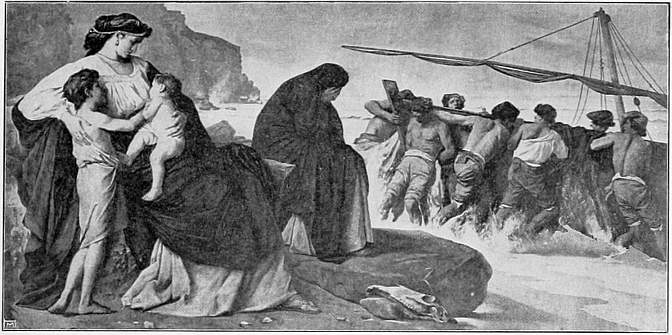
Hanfstängl.
FEUERBACH. MEDEA.
To this resigned and mournful expression must be added the uncomfortable motionlessness of his figures. They do not speak, and do not laugh, and do not cry; they know no passions and sorrows which express themselves by the straining of the limbs. Everything bears the impress of sublime peace, of that same peace by which the works of Gustave Moreau, Puvis de Chavannes, and Burne-Jones are to be distinguished from the ecstatic and sentimental tirades of the Romanticists. In Feuerbach’s works this is the stamp of his own nature. The antique beauty becomes shrouded in a mysterious veil; and life is illuminated as by a mournful light, which rests over bygone worlds. What heart-rending keenness is often in the effect of the melancholy tinge of these subdued bluish tones! That colour is the genuine expression of the temperament reveals itself clearly enough in Feuerbach. When he began his career, his head full of ideals and his heart full of hopes, his pictures exulted in a Venetian splendour, in full and luxuriant golden harmonies; as “joy after joy was shipwrecked in the stream of time” they became leaden, sullen, and corpse-like. As Frans Hals in his last days, when his fellow-creatures allowed him only the bare necessities of life, accorded to the figures in his pictures only so much colour as would give them the appearance of living human beings; as Rembrandt’s magical golden tone changed in the sad days of his bankruptcy into a sullen, monotonous brown, so a deep sadness broods over the pictures of Feuerbach,—something that savours of memory and remorse, the mournful atmosphere and dark mood of evening which the bat loves. Even as a colourist he has the melancholy lassitude of the end of the century.
That is what distinguishes him from his contemporaries. The other idealists of those years painted their pictures without hesitation and with the facility of a professor of calligraphy; they remembered, arranged their reminiscences, and rubbed their hands with self-complacency when they came near their model. They did not yet feel the throb of the nineteenth century, and impersonality was their note. Feuerbach, the neurotic brooder, was a personality. After a long mortification, the human spirit, the living, suffering, human spirit, celebrated its renaissance in his works. Under its influence the jejune painting of prettiness practised by others was changed to modern pessimism and sorrowful resignation. The more he gave way to these moods the more modern he became, the more he was Feuerbach and the further he departed from the works of art which were regarded by his contemporaries and himself as eternal exemplars. He has been reproached with oddities and strange eccentricities. The critics reminded him how far he departed from the lines of his models; indignantly they asked him why he, the pale, delicate, sick, neurotic, and overstrained man, the uncertain, faltering, and tortured spirit, did not paint like the blithe, improvising Raphael, like the jubilant and convivial Veronese, like the sensuous, exuberant Rubens. And Feuerbach himself becomes perplexed. Like Gros in France, he is conscious both of his strength and his weakness. He does not stand sovereign above the old painters, like Boecklin and those other idealists of the present. He runs through life in ever fresh astonishment at the novelty which is revealed to him in the works of earlier centuries. The nerves of this latter day vibrate, the blood of the nineteenth century throbs in him—yet he has the wish to imitate. The history of every one of his works is a fight, a desperate struggle, between the individuality of the artist, his own inward feeling, and the “absolute Beauty” which hovered beyond him cold and unpliable.