Front matter (continued 8)
Reading edition
In his first drawings he begins boldly; one knows his hand and says: “Only Feuerbach can have done that.” And then one is able to trace, step by step, and from sketch to sketch, what pains he takes that the finished picture may be as little of a Feuerbach as possible. The personal and individual element in the drawings is lost, what is Feuerbachian in the composition, the personal contribution of the artist, is effaced, and finally there is produced in the picture the marvellous look of having been painted by a genuine old Venetian as a ghost. And Feuerbach felt the dissonance. He feels that he fully expresses himself no more, and also that he does not reach the level of the old masters. He adds borrowed, conventional figure, like the Boucher Cupids in the “Judgment of Paris”—figures against which every fibre of his being revolts—just to arrive at an outward resemblance to the old pictures, an impression of exultation and joyousness and the spirit of the Renaissance. And when he stands opposite his work he seems to himself like a gravedigger in a harlequin’s jacket. He scrutinises himself in despair, and one day comes to feel that his power of production is exhausted. Splendid and unapproachable, from the walls of the galleries, the art of the classic masters stares him in the face; and he enters into a dramatic life-and-death struggle with it. He will not be Feuerbach, and cannot become a Classic. The curtain falls and the tragedy is over. Such destinies have been before in the world, no doubt; but in our time they have multiplied, and seem so much the sadder because they never come to the average man, but only to great and peculiarly gifted natures.
Albert, Munich.
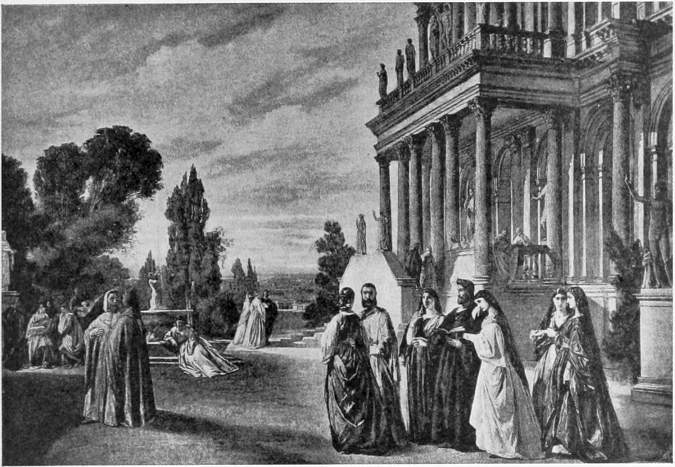
FEUERBACH. DANTE WALKING WITH HIGH-BORN LADIES OF RAVENNA.
These matters—a silent historical sermon—one reads, with the help of the Vermächtniss, out of Feuerbach’s works. There “his pictures possess tongues”; there comes out of them a sound like the cry of a human heart; the whole tragedy of his career becomes present—what he succeeded in doing and what remained unapproachable. Yet later generations, which will judge him no longer psychologically, but only as an artist, generations with which he no longer stands in touch through his ethical greatness, will they also feel this in the presence of his finished pictures? To them will he be pioneer or imitator, forerunner or continuator? Will he take his place by Boecklin and Watts, or by Couture and Ingres? It is perhaps a happy chance that in the history of art one sometimes stumbles upon personalities that mock at all chemical analysis. Feuerbach, at any rate, is a great figure in the German art of these years. His is a high-bred, aristocratic art, free from any illustrative undertone, and from loud and motley colour. It is true that his figures also pose, but never clumsily or without expression, never theatrically. At a time when declamation was universal he did not declaim, at least he never did so with a forced pathos; and it is principally this which gives him a very high and special place amongst the German painters of the transitional period. He is always simple, grave, majestic. Everything that he does has style, and that makes him so peculiar in an art which is so often petty.
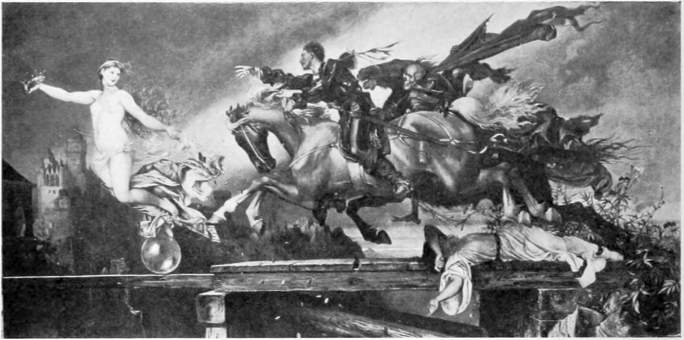
HENNEBERG. THE RACE FOR FORTUNE.
(By permission of the Berlin Photographic Co., the owners of the copyright.)
But a different judgment is formed when one compares him with the French and the old masters. A meteor Feuerbach was not; for he stood on the ground of the Couture school, and raised himself later to yet greater simplicity, going back to purer sources, to the Venetians and the Romans. He is more austere and manly than Couture, but he is, as he stands in his finished pictures, a Roman of the Cinquecento, who has been in Venice; not an original genius of the nineteenth century, like Boecklin. Boecklin paints the antique figures in their eternal fulness and youth; but he is quite modern in sentiment and in his highly developed technique. Feuerbach in regard to technique stands now on French soil, now on Venetian or Roman; and in his sentiment he is an imitator of the Cinquecentists, or, if you will, a phenomenon of atavism. His writings and drawings show him concerned with the present, his paintings with the past. The modern temperament, artistically restrained, breaks out no more, the nerves have no rôle, no human sound is forced from his figures. He learnt through the spectacles of the great old masters to look away from everything petty in life, but he never laid those spectacles down. This modern man, who was so neurotic as a writer, sought as a painter, for the sake of the ideal, to have no nerves at all. Before many of his pictures one wishes for a fire; they make an effect so cold that one shivers. The quality in them which calls for boundless admiration is his splendid artistic earnestness. There speaks out of them a sacred peace. Yet, when he is set up as a pioneer, it must never be forgotten that he is not self-sufficient as, shall we say, Millet, but has attained his majesty of conception only in the leading-strings of masterpieces of a great period, and precisely in the leading-strings of those masterpieces from the numbing influence of which modern art was forced to set itself free, before it could come to the consciousness of itself.
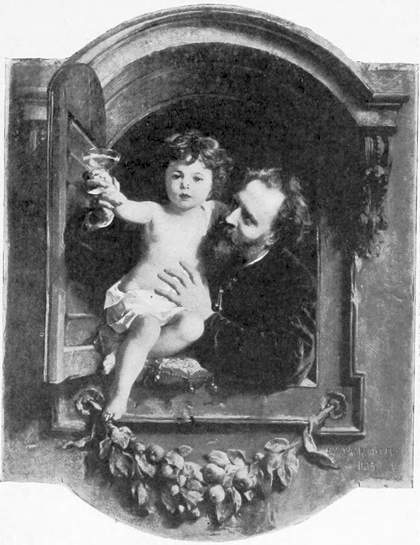
GUSTAV RICHTER. PORTRAIT OF HIMSELF.
Together with Feuerbach—and having, like him, previously received enlightenment as to colouring at the Antwerp Academy—Victor Müller, of Frankfort, had gone to Couture in 1849. He resided until 1858 on the banks of the Seine, and was especially influenced by Delacroix, and perhaps also a little affected by Courbet. At least his “Wood Nymph”—a voluptuous woman lying in a wood—which first made him known in Germany in 1863, seems but little removed from the healthy realism and exuberant vigour of the master of Ornans. Otherwise, like Delacroix, he has occupied himself almost exclusively with Shakespeare. “Hamlet at the Grave of Yorick,” “Ophelia,” “Romeo and Juliet,” “Hero and Leander,” were pictures of a deep, sonorous glow of colour; the characters in them were seized with great intellectual concentration, and the surrounding landscape filled with that sombre poetry of nature which in the hands of Delacroix so mystically heightens the impression of human tragedies. Victor Müller was of a bold, uncompromising talent, full of southern glow and wild Romanticism; a powerful, forcible realist, who never sought the empty, sentimental, ideal beauty known to his age. In a period dominated almost from end to end by a jejune and rounded beauty, he gives pleasure by a healthy, refreshing “ugliness.” All the heads in his pictures were painted after nature with a religious devoutness; painted by a man who openly loved the youthful works of Riberas and Caravaggio. And just as surprising is the power of expression, the deep and earnest sentiment, which he attained in gestures and physiognomy. While Makart, in his balcony scene from Romeo and Juliet, never got away from a hollow, theatrical affectation, Müller’s picture glows throughout with a sensuous passion that saps the blood. A new Delacroix seemed to have been born; an extraordinary talent seemed to be rising above the horizon of our art, but Germany had to follow to the grave her greatest offshoot of Romanticism before he had spoken a decisive word, just as she lost Rethel, the greatest son of the cartoon era, in the flower of his age.
Of the others who made the pilgrimage to Paris with Feuerbach and Müller, not one has a similar importance as an artist. Their merit was that they made themselves comparatively able masters of technique, and taught the new gospel when they returned to Germany. To their superiority in technique and colour, given them by a sound French schooling, they owed their brilliant success in the fifties. They were, at the time, the best German painters, and great at a time when ability was novel and infrequent. As soon as it became customary and commonplace, there remained little to raise them above the average.
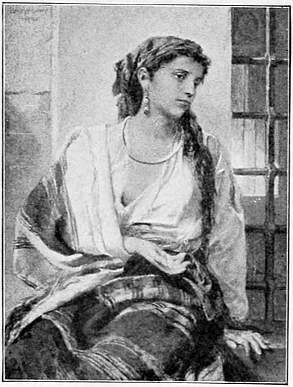
RICHTER. A GIPSY.
That is true of the entire Berlin school of the fifties and sixties. The most independent of the many artists who journeyed from the Spree to the Seine is, probably, Rudolf Henneberg, who died young. His technique he owed to Couture, in whose studio he worked from 1851, and his subject-matter to the German classical authors. Born a Brunswicker, he felt himself specially attracted by his countryman Bürger, and became a Northern ballad painter with French technique. Movement, animation, wildness, and a certain romantic eeriness, proper to the Northern ballad—these are Henneberg’s prominent features, as they are Bürger’s. His pictures have a bold caprice and a peculiarly powerful and sombre poetry. The hunting party storm past irresistibly, like a whirlwind, in his “Wild Hunt,” the illustration to Bürger’s ballad, which in 1856 won him the gold medal in Paris.
“Und hinterher bei Knall and Klang Der Tross mit Hund und Ross und Mann.”
A Düsseldorfian Romanticism, from the Wolf’s Glen, is united to Couture’s nobleness of colouring in his “Criminal from Lost Honour,” of 1860. And a part—even if only a small one—of the spirit which created Dürer’s “The Knight, Death, and the Devil” lives in his masterpiece “The Race for Fortune,” a picture breathed on by the spirit of sombre, mediæval Romanticism, which made his name the most honoured in the Exhibition of 1868.
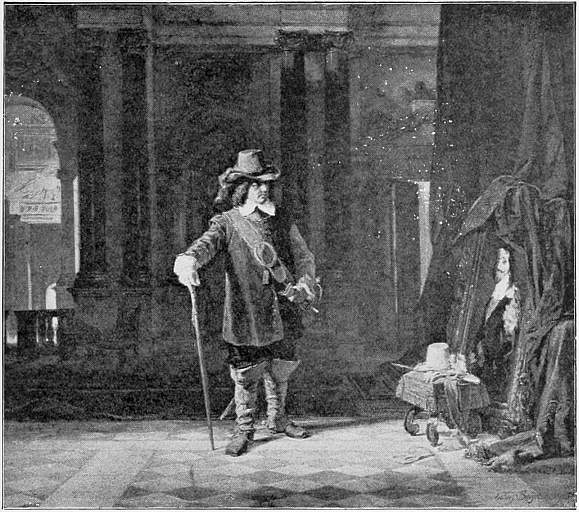
SCHRADER. CROMWELL AT WHITEHALL.
The negation of power, an almost feminine painter of no distinctive character, a new edition of Winterhalter, was Gustav Richter. His popularity is connected with the fisher-boys and odalisques, the reproduction of which every sempstress at one time used to wear on her brooch, while in printed colours they added splendour to all the bonbon and handkerchief boxes. The accomplished workmanship and sparkling treatment of material which he acquired in Paris made him in 1860, after Eduard Magnus had made his exit, the most famous painter of feminine beauty. A pleasure-loving man of the world, elegant in appearance, fame, honour, and distinction were showered upon him, and he became the shining spoilt darling of society, the central point of an extensive and animated convivial intercourse. His works were carried out in a style which, at that time, had not been learnt in Berlin, and had an air of Court life which was held to be exceedingly fashionable. It was later that the banal emptiness and insipid taste of his toilette portraits first became obvious, and that their everlastingly sweet and doll-like smirk, and their kind and winning eyes, always the same, began to grow tiresome. In all his life-size chromolithographs there is a distinction of build and appearance, which in the originals was perhaps to have been desired, although the originals unquestionably looked like something that was more human and individual. In riper years, after the happiness of family life had been given him, he executed works which assure his name a certain endurance; this he did in some of his family portraits,—for instance, in those of his boys and his wife. To this last period belongs the ideal portrait of the Baroness Ziegler as Queen Louisa, which became such a popular picture in Prussia. But Richter’s “great” compositions, which once charmed the visitors at exhibitions, are now forgotten. In “Jairus’s Daughter”—admired in 1856 as a fine performance in colouring—what strikes one now that its colouring has long been surpassed is the inadequacy and theatricality of its characterisation, the outward show, and the banality of this handsome young man who performs his miracle with a declamatory pose. The “Building of the Pyramids,” painted for the Maximilianeum in Munich, with its swarming crowd of dark-coloured people, and the royal pair come to inspect with an endless train, is a gigantic ethnographical picture-sheet, which did not repay the expenditure of twelve long years of work.
In Paris Otto Knille learnt to approach huge canvas and wall spaces with fearlessness, and by executing the many monumental commissions which fell to his share in Prussia, he put this French talent to usury in a manner which was as blameless as it was uninteresting. Some good paintings by Julius Schrader, such as the historical pictures with which his fame is associated, have remained fresh for a longer period. The “Death of Leonardo da Vinci,” as well as the “Surrender of Calais to Edward III,” “Wallenstein and Seni at their Astrological Studies,” “The Dying Milton,” and “Charles I parting from his Children,” are only a collection of what the Parisian studios had transmitted to him. Delaroche and the illustrative and theatrical painting of history, having gone the rounds in Belgium, in the next decade demanded their sacrifice in Germany.
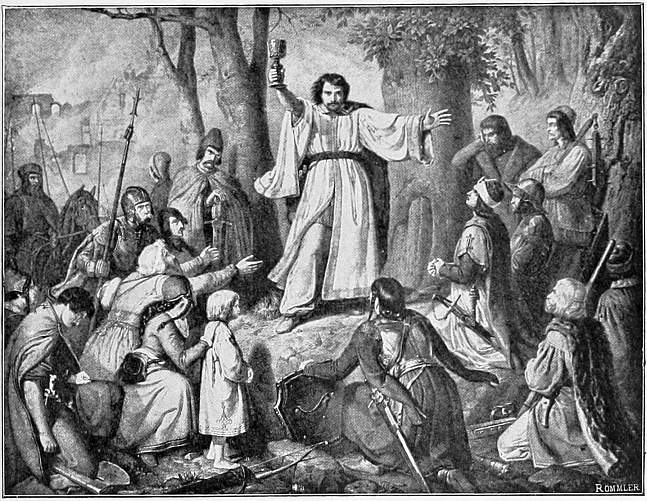
Seemann, Leipzig.
LESSING. THE HUSSITE SERMON.
Here also similar political and literary conditions were prescribed. A backward people, uncontent with itself, pined for deeds and glory. Through the presentment of the great dramas of the past the spirit of the present was to be quickened, as a relaxed body by massage. Here also the knowledge of history levelled the ground for painting, as it did in France. While, in the imagination of the Romanticists, different ages melted dreamily into each other, and the Hohenstauffen period, because of its tender melancholy character, gave the keynote for all German history, the scientific writing of history had, since the thirties, entered as a power into literature. Schlosser began his Universal-historische Uebersicht der Geschichte der alten Welt, which swelled to nine volumes, and represented with a completeness hitherto unapproached the civilisation of antiquity. His history of the eighteenth century was a still greater departure, for, after the example of Voltaire, he included manners, science, and literature in his account of political events. On the uncompromising subjectivity of Schlosser followed the scientific objectivity of Ranke, who, a master of the criticism of sources, delineated with delicate, silver-point portraits the Papacy after the Reformation, the French Court, the policy of the princes of the age of the Reformation, Cromwell, and the heroes of the rising power of Prussia. Luden, Giesebrecht, Leo, Hurter, Dahlmann, Gervinus, and many others began their great labours. German painting, like French, sought to take advantage of the results of these scientific investigations; and Schnaase was the first who, in the Kunstblatt in 1834, described historical painting as the pressing demand of the age, and the cultivation of the historical sense in such a disconsolate epoch as a “truly religious necessity.” Soon afterwards Vischer began to preach historical painting as a new gospel. History, he says, is the revelation of God. His Being is revealed in it as much as in the sacred writings of religion. Historical painting is therefore the completion and full exemplification of those principles which, five centuries back, in Giotto, led to the movement of the new Christian painting. It is called forth by the development of all forms of life and knowledge, and is the last and highest step which sacred painting is able to reach: it is the final completion of sacred painting itself. “Who represents the Holy Ghost with more dignity? He who paints Him as a dove upon a sheaf of sunbeams, or he who places before me a great and lofty man, a Luther or a Huss in the flame of divine enthusiasm?”
Something of the sort had been in the mind of Strauss when he advocated the worship of genius as a substitute for religion. The infidel idealistic painting and satire had been followed by a religious art which evaporated in Nazareanism; pure history in boots and spurs was next preached as a religion. “We stand,” says Hotho in his history of German and Netherlandish painting, “with our knowledge, culture, and insight, on a summit from which we overlook the whole past. The Orient, Greece and Rome, the Middle Ages, the Reformation, and modern times, with their religion, literature, and art, their deeds and their life, spread like a universal panorama before us; and it is one that we must grasp with a universal feeling for the distinctiveness of every people, of every epoch, and of every character. In this fashion to bury one’s self in the past, to get at the most essential meaning of its life by knowledge, to awaken what is dead, and by art to renew what is vanished, and thus to elevate the present to the level of the still living, kindred Mnemosyne of the past, such is the vivifying work of our time; and to that work its best powers must be devoted.”
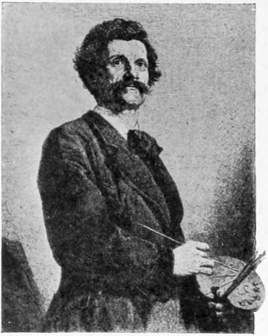
CARL PILOTY.
The first who worked with these principles in Germany was Lessing. He was a great landscape painter, and a clever and amiable man, whose house in Karlsruhe was for many years a meeting-place for the polite world, and every beginner, every young man of talent, visited it to seek protection. During the winter of 1832-33 Menzel’s Geschichte der Deutschen fell into his hands. In it he read the story of Huss and the Hussites, and with “The Hussite Sermon” he soon afterwards began the sequence of pictures which had as their theme the battle between Church and State, the struggle of the Popes with the Emperors, the conflict between binding tradition and free personal conviction—a sequence to be viewed in connection with the opposition between authority and freedom which had actually arisen through Strauss’ Life of Jesus. “Huss before the Council,” “Huss on his Way to the Stake,” “The Burning of the Papal Ban,” were found on their appearance exceedingly seasonable by the orthodox, Protestant side. For people were determined to see in them, at one time, the protests of a Protestant against the Catholic art tendencies of the Nazarenes, at another, biting epigrams on the Catholic and pietistic bias, ruling in Prussia under Friedrich Wilhelm IV. They are of historical interest in so far as Lessing, before the period of French influence, anticipated in them the path on which the German historical painting—whose centre through Piloty came to be Munich—moved in the following years.
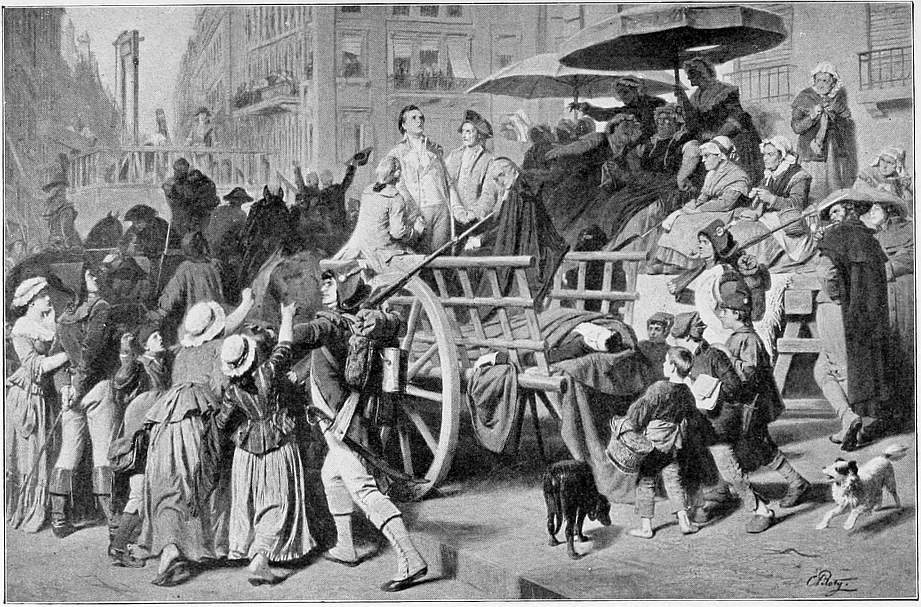
PILOTY. GIRONDISTS ON THE ROAD TO THE GUILLOTINE.
(By permission of the Berlin Photographic Co., owners of the copyright.)
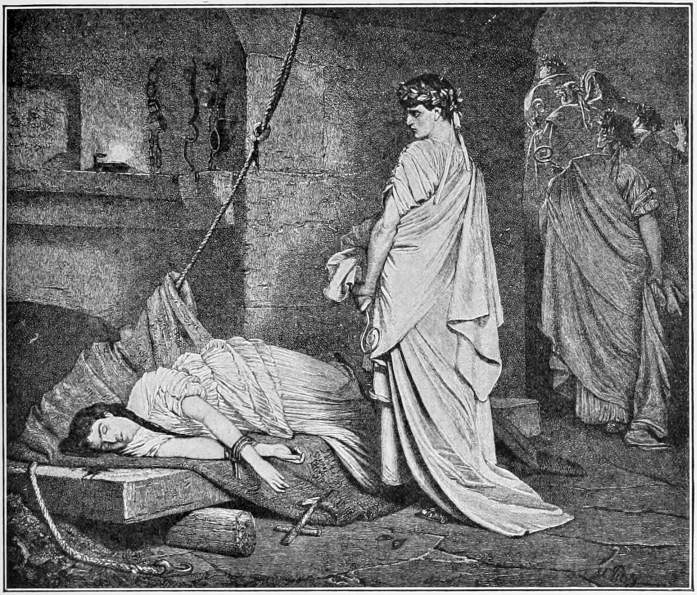
Seemann, Leipzig.
PILOTY. UNDER THE ARENA.
Piloty’s glory is to have planted the banner of colour on the citadel of the idealistic cartoon drawers. True, it was only the discarded fleshings of Delaroche; but since he possessed, side by side with a solid ability, pedagogic capacities of the first rank, and thus brought to German art, in his own person, all the qualities which it had wanted during half a century, his appearance was none the less most important in its consequences. Even to-day, beside Kaulbach’s “Jerusalem” and Schnorr’s “Deluge” in the new Pinakothek, his “Seni” is indicative of the beginning of a new period. Before him the most celebrated men of the Munich school made a boast of not being able to paint, and looked down upon the “colourers” with a contemptuous shrug; so here everything was attained which the young generation had admired in Gallait and Bièfve. This astounding revelation of colour was in 1855 praised in Germany as something unheard of and absolutely perfect. There was no more of the petty, motley, bodyless painting which had hitherto been dominant. The manner in which the grey of morning falls upon the murdered man in the eerie chamber, the way the clothes and the silken curtains glimmer, were things which enchanted artists, whilst the lay public philosophised with the thoughtful Seni over the greatness of heroes and the destiny of the world. At one bound Piloty took rank as the first German “painter”; he was the future, and he became the leader to whom young Munich looked up with wonder. Before him no one had known how to paint a head, a hand, or a boot in such a way. No one could do so much, and by virtue of this technical strength he founded such a school as Munich had never yet seen. The consequence of his advent was that the town could soon boast of many painters who thoroughly understood their business. What an academical professor can give his pupils (thorough groundwork in drawing and colour), that the young generation received from Piloty, who at his death might have said with more right than Cornelius: “We have left a better art than we found.” He who discovered and guided so many men of talent, left behind him when he died a well-drilled generation of painters; and far beyond the boundaries of Munich they assure him the honourable title of a preceptor of Germany. The Munich movement does not offer the example of passionate and embittered battles, like those which the Parisian Romanticists maintained against the Classicists of the school of David. The guard did not die, but surrendered, and retired into an otium cum dignitate. Without a contest the ground was left to the new generation, which was united by no bond of tradition with that which had just been driven from the field; it was left to an unphilosophic, unpoetic generation, whose only endeavour was to bind together the threads of technical art which had been torn by unalterable circumstances.
This revolution was accomplished with almost unnatural swiftness. In the lifetime of Cornelius himself the Franco-Belgian dogma of colour reached its end and summit in Makart, with whom colour is an elementary power, overflowing and levelling everything with the might of absolutism. In the same year that Cornelius died “The Pest in Florence” made its tour through the world. Already Schwind and Steinle, those two children of Vienna, had separated themselves from the thoughtful stringency of form and plastic clearness of their German comrades, by a certain coloured and lyrically musical element in their work. And now also it was an Austrian who again habituated the colour-blind eyes of the Germans to the splendour of pigment. Michael Angelo’s expression of form, as it had been imitated by Cornelius, was opposed by the colour-symphonies of the Venetians: drapery and jewels, brocade and velvet, and the voluptuous forms of women.
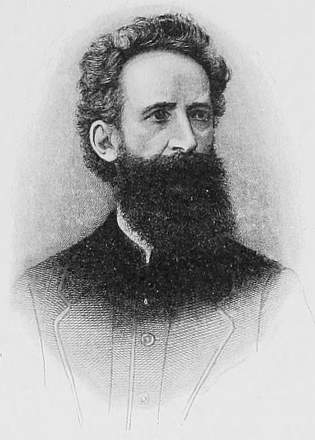
HANS MAKART.
Hans Makart was a genius most picturesque in his mode of life. Whether this life was enacted in his studio, fitted up like a ballroom, in the Ring-Strasse, converted into a stage, or upon his canvas, everything was transformed for him into decoration gleaming with colour. And through this delight in colour the most important impulses were given in the most diverse provinces of life. Against the dowdy lack of taste and the harsh gaiety of ladies’ fashions in that era he set his distinguished costume pictures, carried out in iridescent satin tones; and the enterprising modistes translated them into fact. The Makart hat, the Makart roses, the Makart bouquet—very old-fashioned, no doubt, at the present time—were disseminated over the world. Under the influence of Makart the whole province of the more artistic trades was regarded from a pictorial point of view. Oriental carpets, heavy silken stuffs, Japanese vases, weapons and inlaid furniture, became henceforth the principal elements of decoration. The fashionable world surrounded itself with brilliant colours; papers were supplemented by portières and Gobelins, ceilings were painted, and gay umbrellas stood in the fireplace. The bald, honest city-alderman style gave way, and a bright triumph of colour took its place. In the studio of the master were the finest blossoms of all epochs of art; richly ornamented German chests of the Renaissance stood near Chinese idols and Greek terra-cotta, Smyrna carpets and Gobelins, and old Italian and Netherlandish pictures were mingled with antique and mediæval weapons. And amid this rich still-life of splendid vessels, weapons, sculpture, and costly stuffs and costumes, which crowded all the walls and corners, there rose to the surface as further pieces of decoration a velvet coat, a pair of riding breeches, and a smart pair of Wallenstein boots. Their wearer was a little man with a black beard, two piercing dark eyes, and one of those splendid broad-browed heads which are universally accepted as the sign of genius.
Makart’s pictures are similar studies of still-life out of which human figures rise to the surface. One hears the rustle of silk and satin, and the crackle of costly robes of brocade; one sees velvet door-hangings droop in heavy folds, but the figures which have their being in the midst are merely bodies and not souls, flesh and no bones, colour and no drawing. Sometimes he draws better and sometimes worse, but never well. And therefore he seems unspeakably small by the side of the old Venetians, who in such representation combined a highly developed knowledge of form with luxuriant brilliancy of colour. But even his colour, that flaunting, piquant, bituminous painting derived from Delaroche, which once threw all Germany into ecstasies, no longer awakes any cordial enthusiasm; and the fault is only partially due to the rapid decay, the sadly dilapidated appearance of his pictures. There is not much more remaining of them than of that shining festal procession which for a forenoon set the streets of Vienna in uproar. Tone and colouring have not become finer and more mellow with the years, as in old Gobelins, but ever more spotty and dead. And even if they had remained fresh, would they yet appeal to the present generation, so much more discriminating in their appreciation of colour?
Makart, so much lauded as a painter of flesh, was never really able to paint flesh at all. His feminine flesh tints are often bloodlessly white, and often tinged by an unpleasant, sugary rose hue. The fresh fragrance of life is not to be found in his figures, for they have been begotten, not by contact with nature, but by commerce with old pictures. He was often reproached with immorality by the prudish critics of earlier years; Heaven knows how stagnant and stereotyped this nudity seems in the present day, and how tame this sensuousness, even when one’s thoughts do not happen to have been raised to the great, carnal, and divine sensuousness of Rubens. Like Robert Hamerling, allied to him by his intoxication in colour, Makart had a great momentary success; but, like the former, the brilliancy of his work has swiftly paled, and it is now seen how poor and sickly was the theme hidden behind the lavish instrumentation. Because a correct and solid anatomy was wanting to his creations from their birth upwards, they can live no longer now that their blooming flesh is withered. In fact, Makart’s painting was a weakly and superficial art. He had a sense for nothing but what was external. It is said that in Chile there are huge and splendid façades on which are written Museo Nacional, Theatro Nacional, and there is nothing behind. And so for Makart the world was a house with a splendid façade glowing with colour, but without dwelling-rooms in which the sorrow and joy of humanity make their abode. His men do not think and do not live; they are only lay figures for splendid garments, or materially circumscribed spaces of rosy flesh colour; they make a stuffed, brainless, animal effect. All his women heave up their eyes in the same meaningless fashion, and have a vapid, doll-like trait about their white teeth, laid bare as if for the dentist. It makes no difference whether they are meant to be portraits or merely embody a feminine plastic lyricism. It was not wise of Makart to paint a portrait. He might drape his original after Palma Vecchio, after Rubens or Rembrandt, as Semiramis or a Japanese; his intellectual incapacity remained always the same; the poetry of the psychical nature evaporated from his art.
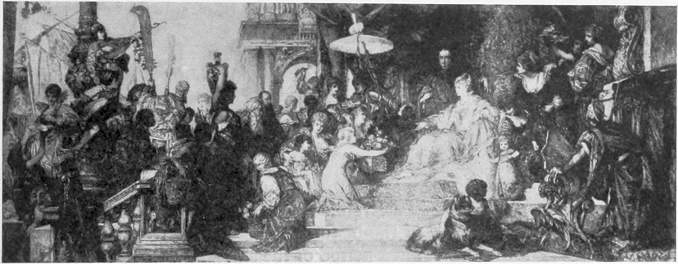
MAKART. THE ESPOUSALS OF CATTERINA CORNARO.
But all that cannot alter the fact that Makart takes a very high place amongst his contemporaries, in that epoch dominated by the historical painting, and not yet arrived at an original conception of nature. Poussin said of Raphael: if you compare him with the moderns he is an eagle, but if you place him by the Greeks he is a sparrow. So when one thinks of Veronese or Rubens, one finds on Makart the feathers of a sparrow, but amongst his contemporaries in Germany he seems like an eagle. While all those from whom he derived, those Pilotys, Gallaits, and Delaroches, were no more than skilled historians in painting, Makart, though much tamer and smaller, has a relationship with Delacroix in his sovereign artistry. That joy in the purely pictorial which expressed itself in the festal procession in the Ring-Strasse and in the furnishing of his studio was, moreover, the ground-principle of his art. With the naïveté of the old masters he has boldly set himself above all historical truth; with absolute want of respect for books of history he has committed anachronisms at which any critic would be irritated. Revelling in splendid revelations of colour, all that he concerned himself about was that his costumed figures should render a fine harmony of hues. So exclusively was his eye organised for colour that every picture was first conceived by him on the palette as a luxuriant mass of colour, and he invented afterwards the theme which was proper for it. If Delaroche transformed painting into the flat, sober, and scientifically pedantic illustration of history, Makart gave it again a bright and splendid play of colour. The Nazarenes were philosophers and theosophers, the Romanticists revelled in lyrical sentiment. Kaulbach was a philosophic historical student of the Hegelian school, Piloty a prosaic and declamatory professor of history, Makart was the first German painter of the century. His personages weary themselves out in the enjoyment of their own dazzling outward personality. Free as the ancients with their gods and legends, he pours forth his Cupids, beautiful women, genii, Bacchantes, and historical figures, and at the same time draws into his kingdom of art all nature with its variety of plants, flowers, and fruits, all civilisation with its fulness of splendid vessels and jewels, of shining stuffs, emblems, weapons, and masks. All that he created breathes the naïve, sensuous satisfaction of the genuine painter.
“The Pest in Florence” undoubtedly had its origin in Boccaccio’s description of the great epidemic which visited the town on the Arno; but the picture is a free fantasy of sensuous enjoyment and naked flesh, a colour symposium in which there really lives an atom of the flaming vital energy of Rubens.
Take “The Espousals of Catterina Cornaro,” that gay procession of representatives from Cyprus and Venice, of dignified men, of procurators of St. Mark, of women in foreign garb, of bright colour, who crowd round their young mistress, the queen of the feast, rejoicing amid the splendid architecture of the piazza. To the anger of the historian, he removes the scene from the fifteenth century to the blossoming period of the sixteenth, when the creations of Sansovino, Titian, and Veronese adorned the Queen of the Adriatic. “The Entry of Charles V into Antwerp” derived only its external impulse from Dürer’s Diary. The picture with the naked girls strewing flowers might almost as well represent the triumphal entry of Alexander into Babylon. In the magic land by the Nile it is not the history of civilisation and ethnography that attracts him, nor the monumental world of the pyramids and the temples of the gods, but the sensuous glow of southern nature and the still-life and artistic accessories out of which the beautiful serpent Cleopatra is seen to rise. Female bodies, animals, and fruits, set in the midst of rich, luxuriant landscapes, painted with oil and bitumen, such are the elements of which his pictures of the old world of legend—the hunt of the Amazons and of Diana—are composed.
With these capacities Makart was scenical painter par excellence. His Abundantia pictures in the Munich Pinakothek and the ceiling-pieces of the Palais Tumba in Vienna are among his best creations. There lives in them something of the Olympian blitheness of the ancients, of that easy joyousness which since Tiepolo seemed to have been buried in melancholy reflection and constrained brooding. They fulfil their purpose, as an invitation to the enjoyment of life, precisely because they carry no intrinsic thought to burden the sensuous display. Moreover, the unctuous and gorgeous colouring, with the animated contrasts of warm brown and light blue, mediated by the deep, glowing Makart red, corresponds to the mood they have been designed to awaken—one which called forth the joy of life, luxuriant, full-blooded, and foaming over. The great, fiery red flower, which sprouts out of the ground at the feet of the nymph in “Spring,” was the last thing touched by Makart’s brush, the last flare of the marvellous colour-demon by which he was possessed.
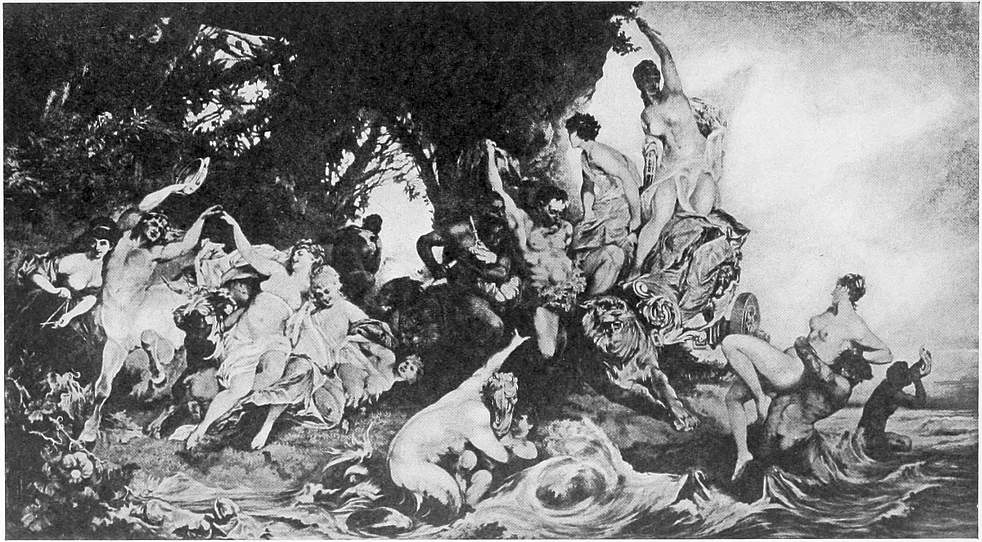
MAKART. THE FEAST OF BACCHUS.
Was possessed! For Makart’s whole artistic endeavour had something unconscious. One might say in a variant reading from Lessing: “If Makart had been born without a brain he would nevertheless have been a great painter.” It is as if one who lies buried in Antwerp had once more felt the instinct of production, and let himself down into the great head of the little Salzburger; and the head, being a somewhat imperfect medium, only stammered out the intentions of the sublime master. There is something remarkable in the career of this son of the poor servant, on whom fortune showered with full hands all it had to offer a child of the nineteenth century, and who in the midst of his splendour in Vienna remained always the same harmless child of nature that he had been in Munich, when, after receiving his first hundred florins, he drove in a cab the two steps from Oberpollinger to the Academy.
One must take him as he is—a product of nature. Makart was a scene painter, and that not in his scenical pictures only; but he was an inspired scene painter, of an enviable facility, who poured forth in play what others fabricate with pains. His merit it is to have announced to the Germans afresh, in an overwhelming style, that revelation of colour which had been forgotten since the Venetians and Rubens. He has not advanced the history of art, as such. What he gave had been given better before. But the history of German art in the nineteenth century has to honour in him the most perfect representative of the period in which colour-blindness was succeeded by exuberance of colour, and the cartoon style by the delight in painting.
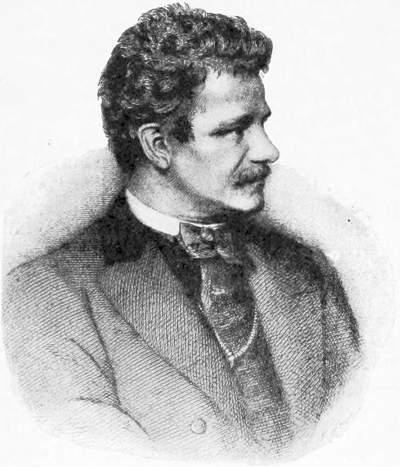
GABRIEL MAX.
Graphische Kunst.
Beside Makart, the child of nature, Gabriel Max’s seems a calculating, tormented, unhealthy talent. In the manner in which Makart did his work there lay a certain elementary, logical necessity; in Max there is a great deal of speculation and over-refinement. Makart’s home was the town on the lagoons. Max is by education and temperament a disciple of Piloty—that is to say, a painter of disasters; by birth he was a Bohemian. And that resulted in his case in a very interesting mixture. When he exhibited his first pictures it was as if one heard a refined music after the tom-tom of Piloty. In his “Martyr on the Cross,” which appeared in the spring of 1867 in the Munich Kunstverein, he first struck that bitter-sweet, half-torturing, half-ensnaring tone in which he afterwards continued to sound. It is dawn; a soft grey light rests, beaming mildly, over the lonely Campagna. Here stands a cross on which a girl-martyr has ended her struggles. A young Roman coming home from a feast is so thrilled by the heavenly peace in the expression of the unhappy girl’s face that he lays a crown of roses at the foot of the cross, and becomes a convert to the faith for which she has suffered. The mysterious mortuary sentiment in the subject is strengthened by the almost ghostly pallor of the colouring. Everything was harmonised in white, except that one dark lock, falling across the pale forehead with great boldness, sounded like a shrill dissonance in the soft harmony, like a wild scream; it had come there apparently quite by chance, but was nevertheless calculated to a hair’s breadth. The terribly touching vision of the martyr aroused in every visitor to the Kunstverein a shudder of delight. It was even a fine variation, and one which invited pity, that the victim should not have been a hero, as in conventional catastrophes, but a soft and sweet girl, made for love and never for the cross. And it was the more absorbing, too, because it was impossible to say whether the young Roman was looking up to the beautiful woman with the desecrating sensuality of a décadent or with the fervid ecstasy of a convert. The same horrified fascination was wakened again and again in the presence of the later pictures of the painter. Almost every one contained a scene of martyrdom, in which the tormented and sinking heroine was a helpless child or a weak and defenceless woman. The passion for tragic subjects brought into full swing by the historical painters was directed in Max against the purest and tenderest, the most chaste and the most lovely. The type was always the same, with its Bohemian nose and one eye larger than the other, by which was attained a curiously visionary or hysterically enthusiastic expression. And the pictorial treatment corresponded to it: there was always a flesh-tint of poignant mortal pallor, a white clinging drapery, a black veil, a light grey background, all harmonised in one very delicate chord.
Goethe’s Gretchen made the beginning. In the Zwinger she lifted up her eyes in frightened anguish to the countenance of the Madonna. She sat in her cell, her face altered by madness and lit up with a wild laughter, and in a reverie passed her hand through Faust’s locks. Or as a phantom she wandered in the Walpurgis night, in her long, flowing shroud, with a blood-red stripe round her throat. This picture, exhibited with electric light, was especially effective. Max had brought into the earnest corpse-like eyes an expression that was terribly demoniacal, and had been attained to the same degree by no earlier illustrator of Faust. A raven, pecking at the lost ring, was her ghostly escort.
Max showed great invention in hitting upon such things. Bürger’s Pfarrertochter von Taubenhain gave him the material for his “Child-murderess”—a young girl who, by the bank of a lonely pool, overgrown with reeds, stabs her child to the heart with a needle, and in a sudden rush of maternal love presses a kiss on the stiff little body before committing it to the water. Here the sombre, disconsolate character of the landscape accorded finely with the action, and the pale body of the child made an exceedingly bright, pungent spot of colour on the dark-green rushes. “The Lion’s Bride” illustrated Chamisso’s ballad of the jealous lion who killed his mistress before her wedding, because he would not give her over to another. Majestically he lies behind her, with one paw on the arm of the slain, and the other struck into her thigh. The stones of the floor are reddened with her blood. But far more frequently than blood Max employed the tints of corruption, the true nature morte. In its colour-values and subtle shades the dead human body, just at the point where corruption begins, was better suited to the painter’s pallid scale of colour than the light and brutally effective red of freshly poured-out blood. Among these paintings of mortification must be reckoned “Ahasuerus by the Body of a Child” and “The Anatomist”; the latter meditatively regards at the dissecting-table the corpse, covered with white linen, of a young girl who has committed suicide. In his “Raising of Jairus’s Daughter” the effect of mortification was most cleverly heightened by a small detail, which made an extraordinary impression: this was a fly on the naked arm of the girl, put there to remind the spectator of the unconsciousness of the body.
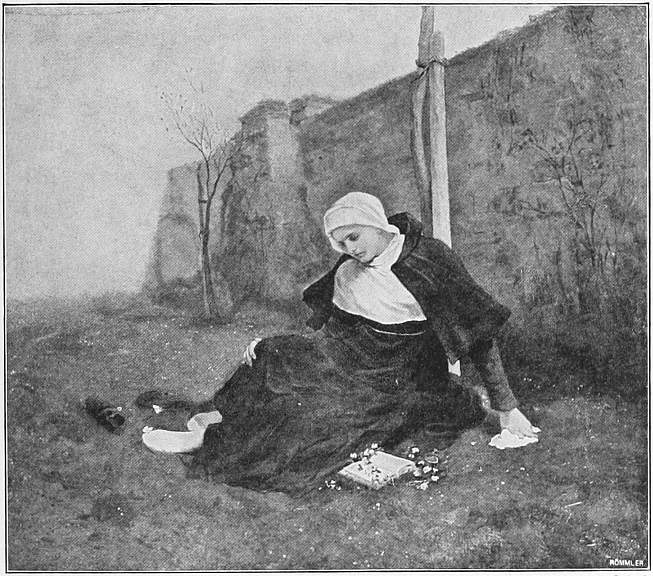
Seemann, Leipzig.
MAX. A NUN IN THE CLOISTER GARDEN.
The secrets of death are always certain of their effect on the nerves; but by means of the broken hearts of women, with annihilated hopes and agonised hysterical sufferings, he succeeded again in calling forth a bitter-sweet sympathy. “Mary Magdalene” and “The Maid of Orleans” were the masterpieces of this group. The underlying idea of the picture “Light” is that a blind young Christian girl, at the portal of the Roman catacombs, offers lamps to the entering Christians for the illumination of their dark way. The blind woman as the giver of light! Even in his youth, with cruel irony, he had had sung by a blind quartet the song, “Du hast die schönsten Augen.” A touch of Delaroche is in the other young martyr, who, between the bloodthirsty beasts of the Roman circus, looks up amazed to the rows of spectators, from the midst of which a young Roman has flung her a rose as a last greeting. In the next moment she will be lying on the earth torn to shreds by the beasts.
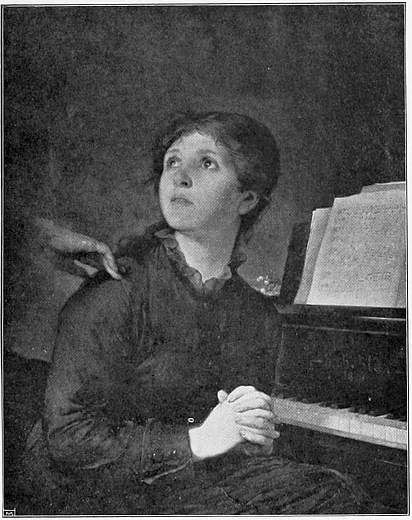
As he succeeded here in giving a presentiment of the horrible, so in another group of pictures Max attained a yet more demoniacal charm by the ghostly. He had early made himself familiar with Schopenhauer and Buddha and the Indian fakirs; the mystical and spiritualistic movement had just at that time been set going by the writings of Carl Du Prels. Justinus Kerner and the prophetess of Prevorst were the order of the day. Max became the painter of hypnotism and spiritualism. “The Spirit’s Greeting” made a special sensation: the young girl at the piano, in this picture, is interrupted in her playing by the touch of a materialised ghostly hand, which stretches towards her from a soft cloudy mist. The mixture of horror, joy, devotion, and ecstasy in the face of the young player was very effective. In order to render effects of the kind he made extensive studies from the hypnotised model, and in this way he sometimes reached an extraordinary intensity of expression. He took a decided position with regard to another question which at the time was very acute—vivisection. This he did in the picture of the man of science from whom an allegorical female figure, “The Genius of Pity,” takes away a little dog doomed to be dissected, showing by a pair of scales that the human heart has more weight than the human understanding.
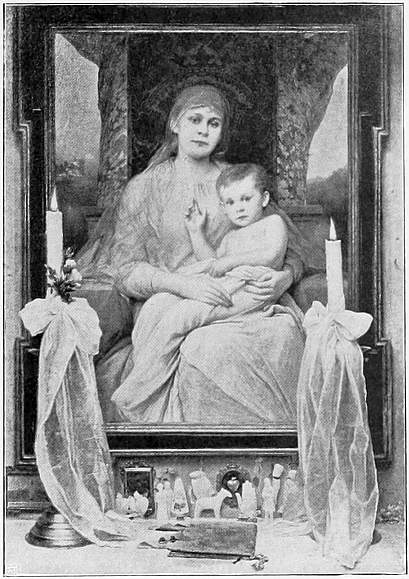
All this goes to show that Max is the opposite of artless. He knows how to calculate an effect on the nerves with extreme subtlety, and most skilfully at times to give his pictures the attraction of the freshly printed newspaper. He appeals to compassion rather than imagination. He would set the heart beating violently. He triumphs generally by his subjects, and his effects are much purer in those few works in which he renounces the piquant adjunct of the demoniacal, the tragical, and the mystical, and becomes merely a painter. Amongst those works is to be reckoned that beautiful “Madonna” on the altar, painted in 1886, and so tenderly illustrating the verses of Heine—
“Und wer eine Wachshand opfert, Dem heilt an der Hand die Wund, Und wer ein Wachsherz opfert, Dem wird das Herz gesund.”
And so too does that charming “Spring Tale” of 1873, which breathes only of gaiety, happiness, and peace; a young girl sits under the blossoming bushes, and listens enraptured to the warbling of a nightingale.
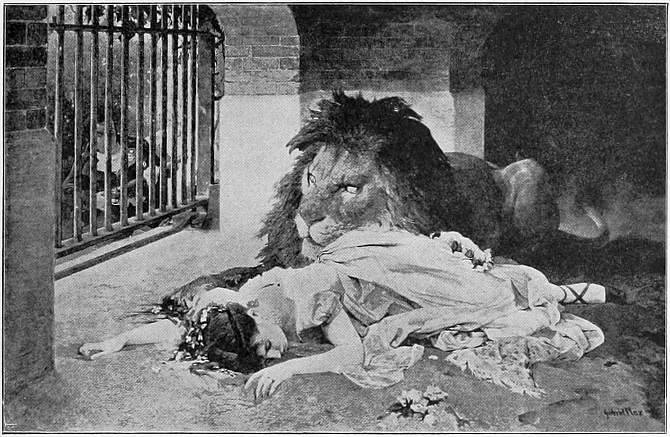
Hanfstängl.
MAX. THE LION’S BRIDE.
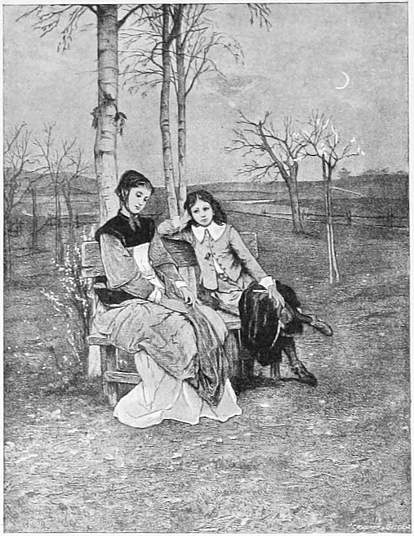
Those pictures, the “mood” of which grows out of the landscape around—“The Nun in the Cloister Garden,” “Adagio,” “The Spring Tale,” and “Autumn Dance”—give Max a very high and peculiar place in the work of his period. He appears in them as a tender poet who expresses his emotions through a pictorial medium; as an adorer of nature of a soft melancholy and subtle delicacy, which are to be found in like manner only in the works of the Englishmen Frederick Walker, George Mason, and George H. Boughton. Nature sings a hymn to the soul of the painter, and through his figures it is breathed forth in low, vibrating cadences. A tender landscape of earliest spring gave the ground-tone to his charming picture “Adagio.” Young trees with trembling stems raise their slender crowns into the pale blue sky flecked with clouds. As yet the branches are almost naked; only here and there appears the embroidery of fresh yellowish green. And in this soft, tender nature which shyly reveals itself as with a slight shudder after its long winter sleep, there are seated two beings: a boy and his young mother—she looks almost a child—dreamily meditating. Their eyes look strangely into vacancy, as though their thoughts are wandering. Nature works on them, and a melancholy Warte nur balde runs through their souls. A spring landscape of blissful gaiety, where nightingales warble, butterflies sip at the flowers, and sunbeams play coquettishly round the budding rosebushes, is the Setting of the “Spring Tale.” Everything laughs and rejoices, shines and scents the air in the early sunlight. Pearls of dew sparkle on the meadows, gnats hum and leaves murmur. She thinks of him. All the joy of a first love-dream sets her heart quivering with a delicious tremor. In her heart as in nature it is spring. Yet even as a landscape painter Max generally has that tender, suffering trait which runs through his creative work elsewhere. Twilight, autumn, pale sky and dead leaves have made the deepest impression on his spirit. Thin, half-stunted trees, in the leaves of which the evening wind is playing, grow upon an undulating, poverty-stricken soil. The landscape spreads around with a kind of lyrical melancholy: a region which gives no exuberant assurance of being beautiful, but which, in its poverty, attunes the mind to melancholy; a region, however, which knows not of storms and loneliness, but is the peaceful dwelling of quiet and resigned men. These beings belong to no age; their costume is not modern, but neither is it taken from any earlier period. They do not act and they tell no story; they dream their time away meditatively and gravely. Max has divested them of everything fleshly and vulgar, so that only a shadow of them remains, a soul that vibrates in exquisite, dying, elusive chords. “The Autumn Dance” is such an unearthly picture, and one of indefinable magic. Children and women are dancing, yet one feels them to be religious dreamers whom a melancholy world-weariness and a yearning after the mystical have drawn together to this secret and sequestered corner of the earth. The pale, transparent air, the tender tints of the dresses, delicate as fading flowers, the flesh tint giving the figures something ghostly and ethereal—it all strikes a note at once blythe and sentimental, happy and sad. “The Nun in the Cloister Garden” is in point of landscape one of his finest productions. In the cloister garden, despite the budding spring, there reigns a disconsolate dreariness. On the thin grass sits a young nun, who follows dreamily the gay fluttering of two butterflies, which flit around at her feet. A black dress, harshly and abruptly crossed by a white cape, envelops the youthfully delicate form. The dying sapling on which she is leaning bends helplessly against the stubborn paling to which it is fastened with iron clamps. The weather-stained wall stretches along in a dreary monotonous grey. An old sundial relentlessly indicates the slow dragging hours. But the deep blue heaven, in which a pair of larks poise exulting, looks in across the wall, from which a scrubby growth climbs shivering in the breeze.
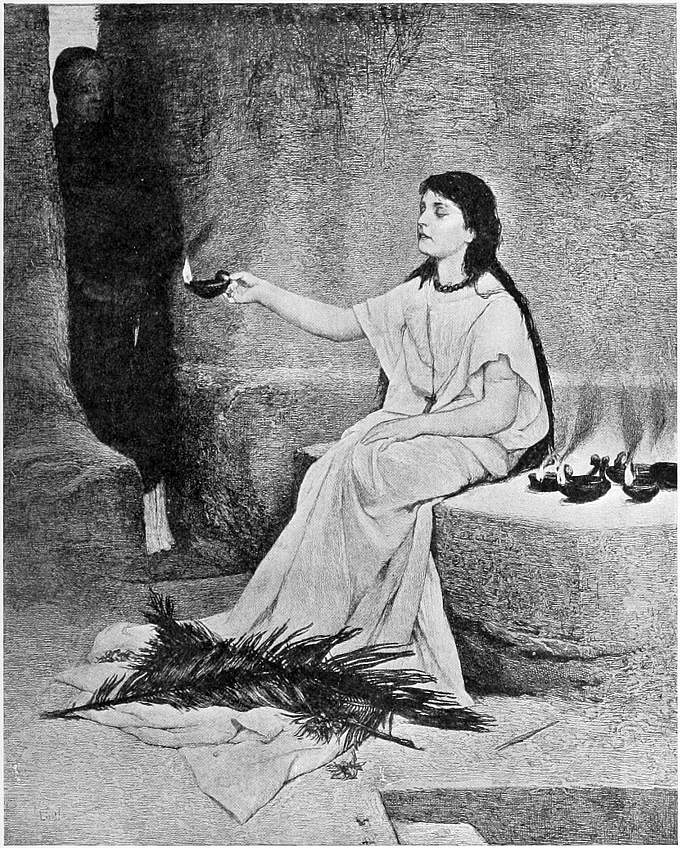
Graphische Kunst.
MAX. LIGHT.
In such pictures, too, Max has a morbid inclination to a mystical delicacy of sentiment. He gives what is real an exquisite subtlety which transplants it into the world of dreams, and his tender sense of pain perhaps appeals only to spirits of an æsthetic temper. He is the antithesis of robust health; and yet there lies in the excess of nervous sensibility—in the pathological trait in his art—precisely the quality which inspires the characteristic delicacy of his earlier works. Here is no pupil of Piloty, but our contemporary. In their anæmic colour his pictures have the effect of a song of high, fine-drawn, and tremulous violin tones, at once dulcet and painful. With their refinement and polish, their subtle taste and intimate emotion, so wonderfully mingled, they reach the music of painting. They paint the invisible, they revel in dreams. In a period which played only fortissimo, and was at pains to drum on all the senses at once with a distorting passion, Max was, next to Feuerbach, the first who prescribed for his compositions dolce, adagio, and mezza voce; who sought for the refined, subdued emotions in place of the emotions fortes.
Hanfstängl. Gräphische Kunst.
MAX. THE SPIRIT’S GREETING. MAX. ADAGIO.
These pictures, the more subdued the better, make him the forerunner of the most modern artists, and assure his name immortality much more certainly than the great figure resting on an historical or literary basis. Their delicate black, green, and white simplicity has a nobleness of colouring which stands quite alone in the German painting of the century, and this, together with their refined musical sentiment, is probably to be set rather to the account of his Bohemian blood than of his Munich training. And whilst in the heads of his figures elsewhere a certain monotonous vacuity disturbs one’s pleasure, he appears here as a psychic painter of the highest mark; one who analysed with the most subtle delicacy all the fleeting nuances—so hard to catch—of melancholy, silent resignation, yearning, and hopelessness. Only the figures of the English new pre-Raphaelites have the same sad-looking, dove-like eyes, the same spiritual lips, tremulous as though from weeping. There must have been a divine moment in his existence when he first filled the loveliest form with the expression of the holiest suffering, the sweetest reverie, the deepest devotion, and the most rapt ecstasy. And if later, when people could not weary of this expression, he took to producing it without real feeling and by purely stereotyped means, that is, at any rate, a weakness of temperament which he shares with others.
Gabriel Max is an individuality, not of the first rank indeed, but he is one; and there are not many painters of the nineteenth century of whom that can be said. He has often underlined too heavily, printed too much in italics, and done more homage to crude than to fine taste. But he has, in advance of his contemporaries, in whose works the good was so seldom new, the priceless virtue that he always gave something new, if not something good. His art was without ancestry, an entirely personal art; something which no one had before Max, and which after him few will produce again. A province which had not yet been trodden, the province of the enigmatic and ghostly, was opened up by him; he set foot in it because he is a philosophic brooder, fascinated by the magic of the uncanny. His studio is like a chapel in which a mysterious service for the dead is being held, or the chamber of an anatomist, rather than the workroom of a painter. The investigation of dead birds occupied him after his Prague days just as much as the sounding of the life of the human spirit. He lived at the time with his parents in an old, ghostly house, and roamed about a great deal in the picture gallery of the Strahow foundation; and here in lonely nights and mysterious picture-rooms there arose that grave and sombre spirit which runs through his work. As a child at the death of his father he had his first “vision.” His earliest picture, which he finished while at the Prague Academy, and sold afterwards to the Art Union there for ninety florins, showed that he had begun to move on his later course: “Richard the Lion-heart steps to the Corpse of his Father and it bleeds.” He was thus inwardly ripe when, in 1863, he came to Piloty in Munich, and, equipped with the technique of the latter, refined in so delicate a manner on the traditional painting of disasters. And if a conscious design on the nerves of the multitude frequently entered into his work, it was, as a rule, veiled by captivating beauty and excellence of painting. His older good pictures fascinate the most jaded eye by their remarkably tender sentiment, and the mystical spirituality of his soft and lovely girlish heads has been reached by few in his century. He is at the same time a colourist of complete individuality, who made pigments the subtilised and ductile means of expression for his visionary moods of soul. He has brought into the world a numerous stock of works prepared for the market; and he has not disdained to paint glorified wonders of the fair, like the Christ’s head upon the handkerchief of Veronica, whose eyes seem to be closed by their lids and are looking out at the same time wide open. But much as he sinned, he always remained an artist. A curious, interesting, characteristic mind, one of the few who ventured even forty years ago to give themselves out as children of their time, in the firmament of German, and indeed of European art, he appears as a star shining by its own and not by borrowed light, as one whose incommensurable magnitude it is that his talent cannot be compared with any other. That is what gives him his artistic importance.
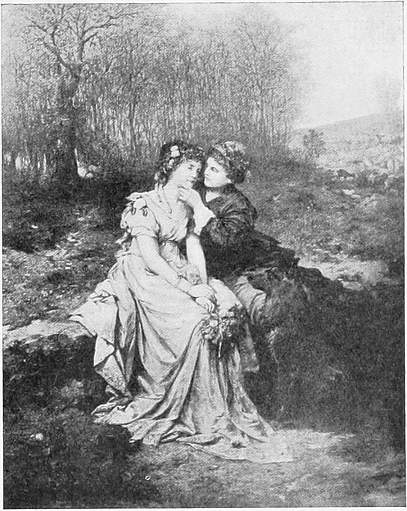
MAX. A WINTER’S TALE.
All the less room can be claimed by the many who, likewise following in their subject-matter the lines of Piloty, get no further than the traditional catastrophe. Not Munich only, but all Germany, lay for more than a decade after the middle of the century under the shadow of historical painting, which here, as in other countries, came as the logical product of an unhappy time, dissatisfied with its own existence when Germany was merely a geographical expression, and in the pitiable misery of that age of state-confederations, dreamt of a better future at singing contests, athletic tournaments, and rifle meetings. The more poverty-stricken the time was in real action, the more vehement was the desire to read of action in books or to see it on canvas; and in this respect historical painting rendered at that time important political services, which are to be acknowledged with gratitude; just as the historical drama, the historical ballad and the historical novel were, all and several, means for the expression of the deep-seated longing of a backward people for political labours, for deeds and for fame.
But the artistic yield was not greater than elsewhere.
When the learned in the thirties laid it down in doctrinaire fashion that, with the destruction of religious fervour begun by science, the old traditionary sacred painting would fall away of itself and the painting of profane history take its place, they overlooked from the very beginning the fact that, so long as the much discussed worship of genius had not actually become a reality the painting of history had to fight against insuperable obstacles. What constitutes the prime condition of all art—that its contents must be some fact vivid in consciousness—should, at any rate, determine its limitations, and ought to have confined the historical picture to the nearest universally known subjects. And what happened was just the contrary.
When Delaroche had skimmed the cream, his successors were forced to search in the great martyr book of history for events which were more and more unknown and indifferent. Piloty took from ancient history “The Death of Alexander the Great,” “The Death of Cæsar,” “Nero at the Burning of Rome,” and “The Triumphal Progress of Germanicus”; and from mediæval history, “Galileo in his Prison observing the Periodic Return of a Solar Ray,” and “Columbus sighting Land”; from the history of the Thirty Years’ War, “The Foundation of the Catholic League by Duke Maximilian of Bavaria,” “Seni before the Body of Wallenstein” (the morning before the battle at the White Mountain, Seni has come to carry away Wallenstein’s body), “Wallenstein on the way to Eger,” and “The News of the Battle at the White Mountain”; from English history, “The Death Sentence of Mary Stuart”; and from French history, “The Girondists on their Way to the Scaffold.”
After these pictures were painted and had had their success the turn came, in the years immediately following, for subjects growing steadily more and more dreary. And as Goethe held the historical to be “the most ungrateful and dangerous field,” so it now appeared as though laurels were to be gathered there only. From the political dismemberment of the present, German artists were glad to seek refuge as far back as possible in the past, and they flung themselves on the new province with such fiery zeal that, after a few decades, there was a really appalling number of historical pictures, illustrating every page of Schlosser’s great history of the world. Max Adamo painted “The Netherlandish Nobles before the Tribunal of Alva,” “The Fall of Robespierre in the National Convention,” “The Prince of Orange’s Last Conversation with Egmont,” “Charles I meeting Cromwell at Childerley,” “The Dissolution of the Long Parliament,” and “Charles I receiving the Visit of his Children at Maidenhead”; Julius Benczur: “The Departure of Ladislaus Hunyadi,” and “The Baptism of Vajk,” afterwards King Stephen the Holy of Hungary; Josef Fluggen: “The Flight of the Landgravine Elizabeth,” “Milton dictating Paradise Lost,” and “The Landgravine Margarethe taking leave of her Children”; by Carl Gustav Hellquist there were “The Death of the wounded Sten Sture after the Battle of Bogesund in the Mälarsee,” “The Embarkment of the Body of Gustavus Adolphus,” and the forced contribution of “Wisby and Huss going to the Stake.” Ernst Hildebrand had the Electress of Brandenburg secretly taking the sacrament in both kinds, and Tullia driving over the corpse of her father; Frank Kirchbach displayed “Duke Christopher the Warrior”; Ludwig von Langenmantel: “The Arrest of the French Chemist Lavoisier under the Reign of Terror,” and “Savonarola’s Sermon against the Luxury of the Florentines”; Emanuel Leutze: a “Columbus before the Council of Salamanca,” “Raleigh’s Departure,” “Cromwell’s Visit to Milton,” “The Battle of Monmouth,” and “The Last Festival of Charles I”; Alexander Liezenmayer: “The Coronation of Charles Durazzo in Stuhlweissenburg,” and “The Canonisation of the Landgravine Elizabeth of Thüringen”; Wilhelm Lindenschmit: “Duke Alva at the Countess of Rudolstadt’s,” “Francis I at Pavia,” “The Death of Franz Von Sickingen,” “Knox and the Scottish Image-breakers,” “The Assassination of William of Orange,” “Walter Raleigh visited in his Cell by his Family,” “Luther before Cardinal Cajetan,” “Anne Boleyn giving her Child Elizabeth to the care of Matthew Parker,” and “The Entrance of Alaric into Rome”; Alexander Wagner: “The Departure of Isabella Zapolya from Siebenbürgen,” “The Entry into Aschaffenburg of Gustavus Adolphus,” “The Wedding of Otto of Bavaria,” “The Death of Titus Dugowich,” “Matthias Corvinus with his Hunting Train,” and many more of the same description.
Hanfstängl.
MAX. MADONNA.
Was it at all possible to make works of art out of such material? Perhaps it was. The real artist can do anything. What he touches becomes gold, for he has the hand of Midas. But just as certain it is that the “historical painting,” carried on by a joint-stock company, almost never got any further than stage pathos, tailoring, and glittering splendour of material. Like many another thing which the nineteenth century brought to birth, it was an artistic error, which countless persons paid for by the waste of their lives. The older art knew nothing of such a reconstruction of the past. If historical subjects were painted, the artists were almost throughout contemporaries of the subject that was to be treated; seldom did the materials belong to an epoch already past. But in both cases the work was done by immediate intuition, since even in the treatment of matters long gone by the painters never dreamed of painting them in the spirit of past times. They might depict Jews, or Greeks, or Romans, but they always represented their own countrymen in the surroundings and costume of their own time. The scientific nineteenth century made the first demand for historical accuracy. In dress and furniture this could be attained with the assistance of a cabinet of engravings and a work on costume. Whoever went to work in a very scientific spirit could even borrow from a museum the genuine costumes of Egmont and Wallenstein. But it was all the harder artistically to quicken into life the men themselves who had felt, lived, and suffered in the past. The painter could not proceed otherwise than by draping a modern, professional model, having consulted portraits, drawings, or busts, and having sought the aid of a peruke and false beard. An entirely realistic reproduction of this masquerade, however, made only too evident the contrast between the splendid old garment and the member of the proletariat who was dressed up in it. For, granted that men of the present have much in common with those of the past, every period has none the less its own type, even its own gestures, which no costume can make one forget. And speaking merely of general humanity, there is no question that a statesman at all times looked different from a professional model. In a very bad suit of clothes, but in one which, at any rate, fitted him, and in which he was able to behave himself naturally, the poor fellow came to the studio, to feel, for a few hours, in satin hose and a velvet doublet, like a carnival figure. Who was to give him the easy knightly bearing to play his part suitably to the occasion? It was not possible in this way ever to attain the naturalness and fulness of life of the old painters. In Terborg’s “Peace of Westphalia” everything is genuine and true and simple; here wig and woollen beard have got the upper hand. And if the painter proceeded not as a theatrical tailor, but as an historian of civilisation, the result was an archaic dryness. For then he was merely thrown back on the great masters of those periods in which the action took place, and, while he enlarged and coloured old busts or engraved portraits, his art was only second-hand.
And so the only way out of the difficulty was to use the model, but to idealise him by generalising and sinking the individual in the universally human, noble, and heroic. In this way the remarkable family likeness of all these heads becomes comprehensible, and it is still further heightened by that preference for a monotonous type of beauty which, from the period of Classicism, entered, as it were, into the blood of these painters. The human physiognomy, in reality so various, had then only one mask for the many characters which life creates. There was a fear of “ugliness,” as if it were a spot of dirt, and the personages portrayed received, one and all, an icy trait of “the Beautiful.” The various Egmonts, Wallensteins, and Charles the Firsts of Gallait and Bièfve, Delaroche, and Piloty have not the blood of human beings, they have not the scars which are made by fate, but are all alike in their Byronic turn of the head. One knows the so-called character-heads—Luther gazing upwards with the look of one strong in faith, Columbus discovering America, and Milton in whose head are seething all the thoughts which dying men are wont to have in their last moments,—one knows them as thoroughly by heart as one knows all the opened folios and overturned settles, the picturesquely draped tapestry reserved for tragic funereal service, and that little box, covered with brass and catching the flashing lights, which constitutes in Belgium, France, and Germany the iron casket of all historical pieces. In the place of the inward Shakespearian truth of the figures, peculiar to the old masters, is the outward truth of costume; and the historical “property man,” whose highest aim is to “dress” the great moments of universal history in the prescribed manner, has stepped into the place of the artist. In the works of the old masters the historical figures stand out with sincerity as characters of flesh and blood, despite the want of “local colour,” whilst in the moderns the costumes certainly are correct, but the figures are so much the less credible and vital. “Beautiful may be the folds of the garment, but more beautiful must be that which they contain.”
Clothes do not make people, and costumes heighten no passions. Thus difficulties were heaped on difficulties, when impassioned situations and moments of dramatic intensity were to be painted. Whoever has reached that height of artistic power where the artist may with impunity put his model out of his head—like Delacroix, grand, volcanic, stormy, and excited to a fever heat by his inspiration,—that man will be capable of giving the effect of truth to such scenes, and of running through the whole gamut of emotion with a crushing power of conviction. But the joint-stock historical painter had to get his models to pull faces, and then no less laboriously to render with his oils those grimaces so laboriously produced. Hence the monotonous and petrified histrionic ecstasy of these pictures, the noble indignation put on for show, and that distressing gesticulation. As the actor gives emphasis to his words far more by gestures than is the case in ordinary life, so here also the artificially impassioned air of the heads was conventionally interpreted by corresponding motions of the arms. And thus the closing tableau was made ready: the dancers lay their hands on their hearts with tender and deep feeling; the tenor heroes sing that they are prepared to die; the tyrants let their deep basses vibrate, and the orchestra rages, to close with a shattering chord at the moment when the hero sets his foot upon the chest of the traitor; then come the Bengal lights, and then the curtain falls. What a spectacle!—but, alas, a spectacle and nothing more. All the emotions are artificial; they are opera emotions: the painters are only clever fellows, manufacturers of librettos and gay canvas; they show a great deal of knowledge and dexterity, but they have only a head and no heart. Stage requisites and professional models can never take the place of the free, creative force of imagination.
And if German pictures of this sort have an effect almost more insincere and theatrical than the French, the reason probably is that gesture—that external aid to the expression of feeling—is always more natural to the Latin than the Teutonic races, and has therefore, of itself, an effect of affectation in every German picture. We know that Bismarck, the Teuton incarnate, even in the most excited of parliamentary speeches, never made any other movement than to rap nervously with his pencil. “The German only becomes impassioned when he lies.” The most genuine masters of German blood have felt that right well, and they have been honest enough to say it out. A pervading trait of old German art is simplicity, the avoidance of everything impassioned even in the grandest conception, such as Dürer has. If in Leonardo’s “Last Supper” terror, indignation, curiosity, and sorrow are reflected by twelve heads and twenty-four hands in movements of agitation which are always new, in Dürer’s woodcut all the limbs and senses of the disciples are paralysed at the sorrowful revelation of the Saviour; it seemed to them desecration to break the solemn, oppressive stillness by noisy utterances of opinion and hasty gestures. And the same thing is to be remarked in every similar picture of Rembrandt’s; here too are only quiet and subdued movements, delicate suggestions and silence. The effect is great and sublime, the features of the Saviour earnest and expressive, but His mien is without any ecstatic emphasis such as a painter of Romance blood would have given Him. Only in the nineteenth century—partly through imitation of the Italians in Cornelius and Kaulbach, and then through imitation of the French in Piloty and his disciples—has this impassionedness, so opposed to German nature, entered into German art; and it has borrowed from the opera the distortions by which it has expressed the agitations of the spirit. No one works with impunity against the grain of his temperament. Exaggerated and violent movements, “ostentatious gestures of false dignity,” have replaced the natural expressions of life.
Less pose, parade, and theatricality, more ease, truth, and quietude; less insipid, generalised “beauty,” more forcible, characteristic “ugliness”: if art was not to be drowned in a surge of phrases, this was the path to be taken; and the transition was accomplished in “the historical picture of manners.”

CHAPTER XV
THE VICTORY OVER PSEUDO-IDEALISM
Immediately upon the epoch-making labours of the historians followed the first romances that were archæological and dealt with the history of civilisation; and hand in hand with these literary productions there was developed—by the side of historical painting proper, in France, Belgium, and Germany—a tendency to represent the life of the past, not in its grand dramatic action, but in its familiar concerns. In the one case there was history in its state uniform, in the other history in undress. And while the former class of painters saw the past only in a condition of unrest and violent movement, the latter began to enter into the details of daily life, and to represent it as it flowed by in times of peace. Those who had the romantic bias turned to the old artistic crafts. As yet that bias consisted only in an enthusiasm for the tasteful civilisation of a bygone age, with its polished charm of luxurious household appointments and pleasing costume. Rooms were filled with Gobelins and rich stuffs, handsome furniture and old pictures. By the rapid sale of their productions painters were placed in a position to acquire for themselves at the second-hand dealers all the beautiful things they painted. They placed their dressed-up models in front of their tapestries, and between their cabinets and tables. Stress was laid on historical accuracy in the representation of the usages and costumes of the past, not on dramatic action, and in this respect the historical picture of manners, as opposed to historical painting, marked an advance towards intimacy of feeling. The latter still worked from the abstract. The painter read a book and looked out for telling passages. He idealised models, to lend his picture the character of “great art.” It was always the illustration of underlying ideas.
In this new kind of picture, on the contrary, the conception of a work of art was given, by the perfected representation of any part of the visible world, were it only the corner of a studio elaborately and artificially arranged. The historical picture of manners no longer depicted “the meeting of hostile forces,” but either the heroes of history or the nameless men of the past in their daily act and deed, and so accustomed the public gradually to interest themselves in people who did not act with histrionic passion, but conducted themselves quietly and soberly like men of the present time. The place of the dramatic was taken by those phases of life which are pleasant and smooth. At the same time there was no need to be thrown back on conventional idealisation, and it was possible to bring people dressed up for the occasion directly into the picture, just as they sat there, since the contrast between the professional model and the old-fashioned dress made itself less felt on this smaller scale of art. Thus was achieved the transition from the heroic historical art of the first half of the nineteenth century to that familiar and more human art of the second half, which no longer fled for help to the past, but sought a simpler ideal in reality.
First of all in France, from the side of the solemnly earnest group of Academicians, there stepped forward certain artists who moved in the old world quite at their ease, and began to paint simple little pictures from the daily life of antiquity, instead of the great ostentatious canvases of David and Ingres. In literature their parallels are Ponsard and Augier, who in their comedies brought antique life upon the stage, the one in Horace et Lydie, the other in La Ciguë and Le Joueur de Flûte.
Charles Gleyre approached nearest to the strict academical style of Ingres. Not even by a tour in the East did he allow himself to be led away from the Classical manner, and as head of a great and leading studio he recognised it as the task of his life to hand on to the present generation the traditions of the school of Ingres. Gleyre was a man of sound culture, who during a sojourn in Italy which lasted for years, had examined Etruscan vases and Greek statues with unintermittent zeal, studied the Italian classics, and copied all Raphael. Having come back to Paris, he never drew a line without having first assured himself how Raphael would have proceeded in the given case. And this striving after purity of form has robbed his works (“Nymph Echo,” “Hercules at the Feet of Omphale,” and the like) almost entirely of ease, freshness, and naturalness. Gleyre became, like Ary Scheffer, a victim to style. He had in him—his “Evening” of 1843 is sufficient to show it—a tender, dreamy, and contemplative spirit. The feelings to which he wished to give expression were his own, and the more fragrant, romantic, and vaporously indistinct they were, the more did they suffer from the stiff academical line in which he so mercilessly bound them. Only in his “Orpheus torn by the Bacchantes” has he raised himself to a certain neo-Greek elegance.
Louis Hamon stands at the end of this path, which led gradually from the strictness of form characteristic of the idealism of Ingres to incidents thought out in perfectly modern fashion and laid in a primitive era only because of the advantages of costume offered by the antique. The grace of his pictures is modern; their Classicism is a disguise. To robust natures his art can make but little appeal. He has deprived nature of her strength and marrow, and painting of its peculiar qualities, transforming them into a coloured dream, a tinted mist. In Hamon’s modelling there is an uncertainty, in his colour a sickly weakness and meagre effeminacy, which give to his figures and landscapes the appearance of being dissolved in vapour. Everything firm is taken from them; the stones look like wadding, the plants like soap, the figures like china dolls which would fly into the air at the least gust of wind. Nevertheless there are times when his confectionery has a sympathetic grace. What distinguishes him is something simple, pure, youthful, fresh, and childlike. His colour is lighter and more delicate than Gleyre’s. None but blended colours such as light blue and light yellow mingle in the harmony of white tones. The severe antique style has been given a pretty rococo turn: his Greek girls, women, and children are like figures of Sèvres porcelain; the scenes in which he groups them are pleasing,—sports of fancy brought forward in a Grecian garb, of an affected sensuousness and a coquettish grace. His prettiest picture was probably “My Sister’s not at Home”—Greece seen through a gauze transparency in the theatre.
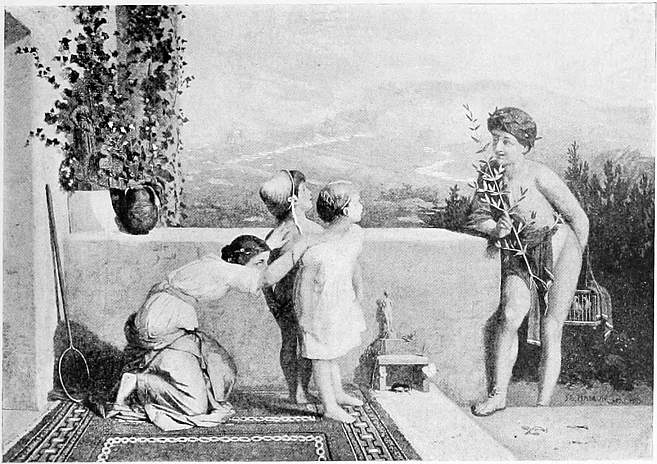
Gaz des Beaux-Arts.
HAMON. MY SISTER’S NOT AT HOME.
(By permission of Messrs. Boussod, Valadon & Co., the owners of the copyright.)
Léon Gérôme has also a taste for borrowing his subjects from the antique; being a pupil of Delaroche, however, he has treated not mythological but historical episodes of antiquity. His “Cock-fight,” “Phryne before the Areopagus,” “The Augurs,” “The Gladiators,” “Alcibiades at the House of Aspasia,” and “The Death of Cæsar,” together with pictures from Egypt, are his most characteristic works: Ingres and Delaroche upon a smaller scale. He shares with the one his learnedly pedantic composition, and with the other his taste for anecdote. It may be remarked that in these same years Emile Augier was active in literature, but that Augier, living in the same epoch of modern life, is far more powerful and animated in his Classical pieces. Gérôme’s art is an intelligent, frigid, calculating art. In execution he does not rise above a petty study of form and an academic discipline. His drawing is accurate, and he has even succeeded in giving his figures a certain natural truth which is in advance of the generalisation of the classic ideal; yet from first to last he is wanting in every quality as a painter. His pictures of the East are hard landscapes, in which men or animals, harder still—unfortunate, eternally petrified beings—stand out abruptly. He draws and stipples, he works like an engraver in line, and goes over what he has painted again and again with a fine and feeble brush. He has an eye for form, but the effect of light upon the body escapes him. His pictures therefore give the impression of china, and his colour is hard and dead. What distinguishes him is a watchful observation, a chilling correctness, enclosing everything in characterless outlines. And this marble coldness remained with him later when, moving with the development of historical painting, he gradually took to working on more tragical subjects. Even the most violent subjects are depicted with a dainty grace, and with a smile he serves up decapitated heads, prepared with a painting à la maitre d’hôtel, upon a gold-rimmed porcelain plate as smooth as glass.
Another painter of archæological genre is Gustave Boulanger, who after extensive studies in Pompeii gave a vogue to those antique interiors and scenes of Pompeian street life now associated with the name of Alma-Tadema.
Direct descendants of Delaroche and Robert Fleury were those who threw themselves enthusiastically into treating the physiognomy of the sixteenth and seventeenth centuries, and devoted the most ardent study to the weapons, costumes, and furniture of those epochs. They never wearied in representing François I and Henri IV in the most varied situations of life, nor in searching the biographies of great artists and scholars for episodes worth painting. Especially popular subjects were those of celebrated painters at their meeting with contemporaries of high station: Raphael and Michael Angelo coming across each other in the Vatican, Murillo as a boy, the young Ribera found drawing in the street by a Cardinal, Bellini in his studio amid all manner of precious objects, Charles V and Titian, Michael Angelo tending his servant, and others of the same kind. The number of painters who were active in this province is as great as the number of anecdotes which are told of distinguished men. They spread themselves over various countries, like the swarms of insects hatched on a summer’s day amid luxuriant vegetation, and thereby they render the task of selection more difficult to the historian. In France there worked Alexander Hesse, Camille Roqueplan, and Charles Comte; in Belgium, Alexander Markelbach and Florent Willems. Markelbach, a pupil of Wappers, in addition to episodes from English history, specially devoted himself to painting the shooting festivals of the old Netherlandish city guards, in which enterprise the Doelen pieces of Frans Hals did him excellent service in the matter of costume. Florent Willems, who, as a restorer, saturated himself with the manner of the old masters, was particularly popular on account of the smooth finish he gave to his modish ladies, cavaliers, soldiers, painters, soubrettes, and patrician matrons of the sixteenth and seventeenth centuries. All the richly coloured satin, brocade, and velvet costumes of these personages, together with the tapestry, the curtains, and the furniture of their dwellings, he had the secret of reproducing in such a fashion that he was long esteemed a modern Terborg. Amongst the Germans, L. von Hagn was the most delicate of these artists, and the graceful comedies of real life which he painted, transplanting them into the Italian Renaissance or the French rococo period, have often great distinction of colouring. Gustav Spangenberg, after the lucky but isolated success he had made with “The Track of Death,” devoted himself to the Reformation period; and Carl Becker to the Venetian Renaissance, from which he occasionally made an excursion into the German. These and many others could be discussed with more particularity if their pictures, smooth as coloured prints, and neatly finished in their own paltry way, were not so much below the standard of galleries. For them also the incident to be represented, with the personages concerned in it, was the principal matter, and not pure painting. These fetters upon true art were first shaken off by the hands of the following painters.
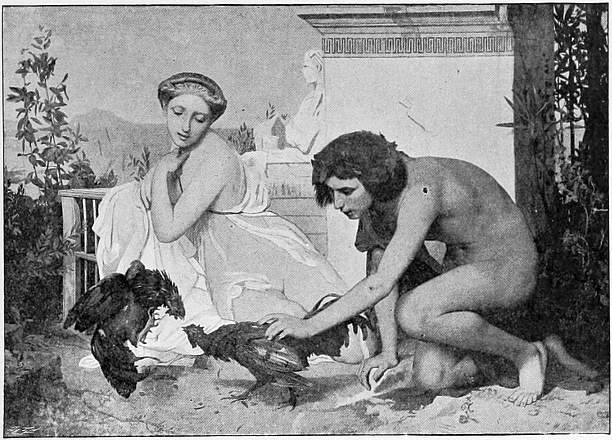
Cassell & Co.
GÉRÔME. THE COCK-FIGHT.
Of the generation of the eminent Flemish artists of 1830 Hendrik Leys is the one whose fame has been most enduring. Born in Antwerp on 18th February 1815, at first destined for the priesthood, and then in 1829 admitted to the studio of Ferdinand de Braekeleers, he had made his début in the beginning of the thirties with a pair of historical pictures. These indeed revealed little of the power which he evinced later, but they furnished some indication of what he was aiming at. Here were none of the skirmishes—so popular at the time—in which blood flows as from the pipes of a fountain; the combatants fought with decorum and moderation, and less from conviction than to justify the helmets and cuirasses which had been fetched from the wardrobe. In both of them, on the other hand, the background—a mediæval town with tortuous alleys, lanterns, and picturesque taverns—was most lovingly treated. Here was revealed a thoroughly German delight in minute detail. Instead of subordinating the accessories as others did, with the object of throwing the principal personages into relief, Leys represented an entire corner of the world at once, giving full distinctness to the smallest things, down to the implements of daily life, the grasses and flowers of the landscape, and the variegated corner-stones of the old house-fronts, whose picturesque porches and lattices bulge into the crooked lanes. His next picture, “The Massacre of the Löwen Magistrates,” was a still further departure from precedent, since—quite in Callot’s manner—it mingled with the principal drama a mass of grotesque episodes. The born genre painter was announced by these traits; and not less striking was the form of the art, which was a thorough departure from the manner of the “painters of the grand style.”
The resuscitation of a national art, which had been the life-long aim of Gustav Wappers, who was twelve years his senior, was what Leys also set up as the goal of his artistic endeavours. But their ways divided. Wappers was principally inspired by Rubens, while Leys attached himself at first to the Dutch painters. A visit made to Amsterdam in 1839 had helped him to an understanding of Rembrandt and Pieter de Hoogh. He followed them when, in 1845, he painted his “Wedding in the Seventeenth Century”—a rich display of gleaming hangings, golden plate, and red-plush furniture, amid which move handsomely dressed people, wedding guests, and violin players. The effort to approach Pieter de Hoogh or Jan van der Meer is apparent in the management of light; the treatment of drapery reminds one of Mieris and Metsu. Another pair of anecdotic pictures from the seventeenth century allow one to follow the progress by which Leys, under the influence of Dutch models, gradually developed that power and mastery of colouring, that completeness of pictorial effect, and that soft treatment of subdued light which were justly admired in his first works. In particular, certain works founded on the legends of painters and monarchs—Rubens, Rembrandt, or Frans Floris visited in their studio by some personage of high station—made him the lion of the Paris Salon. In 1852 he stood at the summit of his fame; he was recognised as one of the first of painters, both in Belgium and in other countries, and was everywhere loaded with honours. Then he cast his slough and entered on his “second manner.”
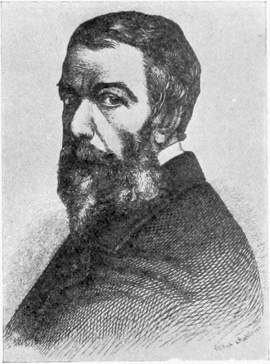
Seemann, Leipzig.
HENDRIK LEYS.
After he had followed Rembrandt for more than a decade he turned from him to cast himself suddenly into the arms of the German masters of the sixteenth century, and, according to his own saying, “from that time forward to become an artist.” During a tour through Germany, in 1852, he had become familiar with Dürer and Cranach; in Dresden, Wittenberg, and Eisenach there hovered round him the great figures of the Reformation period. Half-effaced memories of his countrymen, the brothers Van Eyck and Quentin Matsys, became once more fresh, and drove him decisively forward on his new course. “The Festival at Otto Venius’s” and “Erasmus in his Study” were the first steps in this direction, and when soon afterwards he came forward with his costume pictures, “Luther as a Chorister in Eisenach” and “Luther in his Household at Wittenberg,” every one was enraptured with the exquisite truthfulness of his portrayal of archaic life. At the World’s Exhibition of 1855 he had another magnificent success with three pictures executed in old German style. These were “The Mass in Honour of the Antwerp Burgomaster Barthel de Haze,” “The Walk before the Gate,” and “New Year’s Day in Flanders.” His return from Paris, where he was the only foreigner except Cornelius who had received the great gold medal, took the form of a triumphal progress in Antwerp, where he was greeted with illuminations, torchlight processions, and laurel wreaths made in gold. He was held to be the most eminent master since Quentin Matsys, the Jan van Eyck of the nineteenth century. In the Brussels Salon he appeared as a prince of art, before whom criticism made obeisance, and for whose pictures special shrines were erected. He was striking, not merely as an artist, but as a man: his stately figure was known to every one in Antwerp, and was pointed out to strangers as one of the sights of the place. In 1867, when he again received the medal in Paris, the Antwerp Cercle Artistique had a medal struck to commemorate an event of such importance in Belgian art. His decease, on 25th August 1869, threw the whole town into mourning; the windows in the town hall, where he had painted his last pictures, were hung with black, and the announcement of his death pasted up on great placards at the street corners. “Leys is ons” ran the phrase in the speech made by the burgomaster over his open grave. To-day his statue stands on the Boulevard Leys, and his house is noted down in Baedecker, like those of Matsys and Floris, Rubens and Jordaens.
Leys was thus a favourite child of fortune. Enthusiastic applause showered him with fame and laurels. But it is natural that posterity should find a good deal to cancel in these titles of honour.
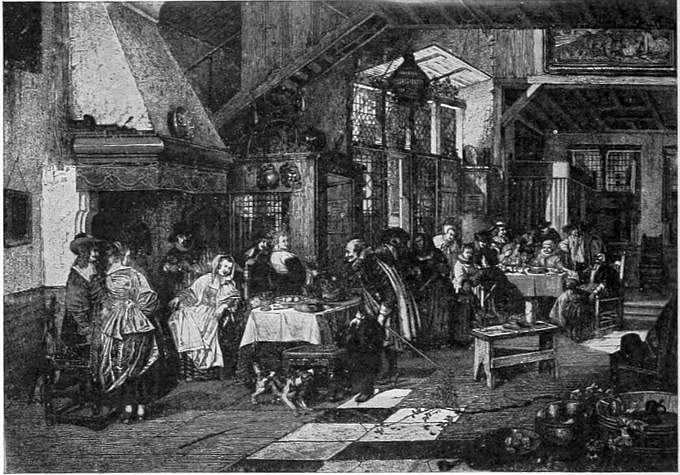
Seemann, Leipzig.
LEYS. A FAMILY FESTIVAL.
Through Leys the history of art was not enriched with anything new. His delicate art—severe in outline—which goes back directly to the peculiar manner of the fifteenth century, is in itself not without merit. But how much of it belongs to the nineteenth century? To what extent has the painter stood independent and on his own peculiar ground? He could draw a Van Eyck which might be taken for an original. He seems like an old master gone astray by chance amongst the moderns. His knowledge of the sixteenth century is marvellous. In fact, he was a visionary who saw the past as clearly as though he had lived in the midst of it. The men he paints are his contemporaries. He has drawn them from life in the year of grace 1493, and they make no gesture nor grimace which might not be four hundred years old. Yet that means that he was not an original genius, but merely one who gave an adroit reproduction of a formula already in existence. And much as he affected to be the contemporary of Lucas Cranach and Quentin Matsys, he had not their simplicity: where they painted life he painted the shadow of their realism. Surrounded by old pictures, breviaries, and missals, he contented himself with copying the still forms of Gothic miniatures instead of living nature. He went so deeply into the pictures of the Antwerp town hall that he followed the old masters in their very errors of perspective; and though even the most childish confusion between foreground and background does not disturb one’s pleasure in them, because they knew no better, it is an affectation in him, with his modern knowledge, intentionally to make the same mistakes. Instead of being an imitator of nature, he is an imitator of their imitation—a gourmet in pictorial archaism.
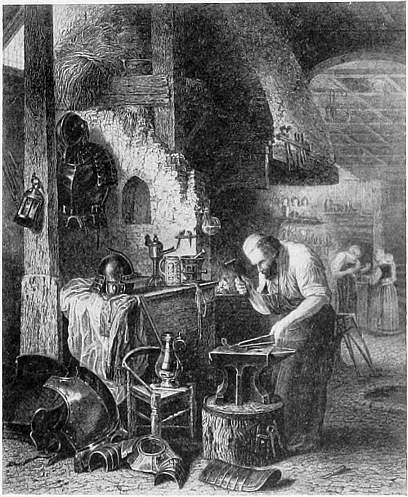
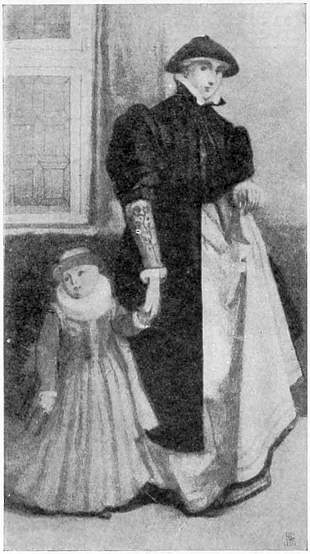
LEYS. THE ARMOURER. LEYS. MOTHER AND CHILD.
Yet it was exactly this uncompromising archaism which was of importance for his time, and amongst his contemporaries it gives him significance as a reformer. He is the only one amongst them who really represents the Flemish race. Wappers was merely a Fleming from Paris, who shook off the yoke of the Greeks to bear that of the French. Delaroche lived again in Louis Gallait, the pupil of David. Their works had the sentiment of French tragedies, and an artificial neatness which completely departed from the truth of nature; the figures were combed and washed and brushed and polished, the gestures were histrionic, the colours toned in a stereotyped fashion to effect a pleasing ensemble. Leys endeavoured to be true. In his pictures he had no wish to express ideas, but merely to bring back a fragment of “the good old time” in all its brightness of life and colour. And whilst as a colourist he was bent upon avoiding uniformity of tone and giving everything its natural character, as a draughtsman, too, he set up, in opposition to the more patrician fluency of others, the citizen-like angularity of an art uninfluenced by the Cinquecento. As in Cranach, Dürer, and Holbein, one finds in his pictures profiles that are vividly true; harsh and often unwieldy heads, wrinkled faces, and heavy, massive shoulders resting on stunted bodies. The human form, with fat stomach and great horny hands, seems almost deformed. Everything which the struggle for existence has made of the image of God is expressed in the works of Leys for the first time since David. Even his “Massacre of the Löwen Magistrates” showed sharp, naturalistic physiognomies in the midst of its confused composition, and his “Barthel de Haze,” fifteen years after, fully exemplified this striving after characteristic and truthful expression. None of his contemporaries has shown himself more cool and indifferent to conventional and graceful profile and “beauty” in the drawing of heads. Hatred of the academic model made Leys bring art back to its sources. The hideousness, so often childish, in primitive pictures was dearer to him than all Raphael. By this emphasising of the characteristic in attitude and the expression of the face he shows himself, although he painted historical subjects, the very antipode of the painter of the historical school, and, at the same time, one of those who effected the transition which led to the modern style. In setting up quaintness and far-fetched archaism against the mannerism of the idealists, Leys accustomed the eye again to recognise that there was something truer than nobility of line and aristocratic pose; and, as he appealed to the old masters as accomplices, it was impossible for æsthetic criticism to be offended.
In France the transition from the absolutely beautiful to the characteristic, from types to individuals, was brought about from various sides. On the one side Romanticism had opposed to the antique style that of the Flemish painters. On the other side, within Classicism itself, there had been a change from the antique and the Cinquecento to the early Italian renaissance. A new world was opened to sculpture by the “Florentine Singer” of Paul Dubois. The more artists buried themselves in the study of those early pioneers of realism, Donatello, Verrochio, della Robbia, and the other masters of the Quatrocento, the more they found themselves fascinated by the sparkling animation of these creations, and sought to transfer it freely into their own work. The fifteenth century, with the energetic force of its figures, its close grasp of nature, and its pithy characterisation, which did not even shrink from ugliness, induced painters to go back more than they had formerly done to the sources of real life and to bring something of its directness into their creations. Élie Delaunay began to look on nature with an eye less bent on making abstractions and regarding all things from the standpoint of style; he began to apprehend more clearly her individual peculiarities and to reproduce them more truly than had been done by the frigid school which cast everything into the mould of Classicism. But Ernest Meissonier went a step further when by his rococo pictures he set the Dutch tradition on a level with the Flemish and Early Italian as a formative influence.
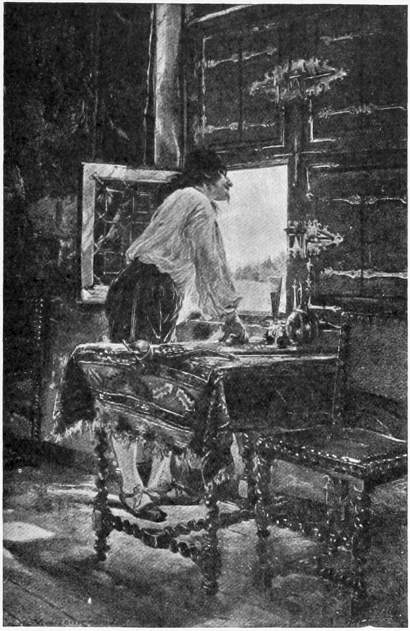
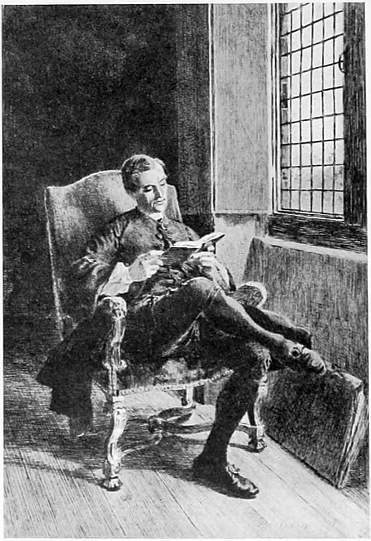
Baschet. Gaz. des Beaux-Arts.
MEISSONIER. THE MAN AT THE WINDOW. MEISSONIER. A MAN READING.
A picture must either be very big or very small if it is to attract attention amid the bustle of exhibitions. This was probably the consideration which led Meissonier to his peculiar class of subjects, and induced him to come forward with minute Netherlandish cabinet-pieces at the time when the Romanticists were issuing their huge manifestoes. He came of a family of petty tradespeople, and in his youth he is said to have taken over his father’s business, a trade in colonial produce. Every morning at eight o’clock punctual he was at the shop desk, and kept the books and copied business letters, and in this way accustomed himself to that painstaking and uniform carefulness which was characteristic of him to the end of his life. His teacher, Cogniet, was without influence on him. Even in his youth, when there went forth the battle-cry of “A Guelf, a Ghibelline! A Delacroix, an Ingres!” Meissonier sat quietly in the Louvre and copied Jan van Eyck’s Madonna from Autun. And a Netherlandish “little master” did he remain all his days. He first earned his bread as an illustrator, but after 1834 he began to exhibit all manner of pieces from the time of Louis XIV and Louis XV—the “Bourgeois hollandais rendant Visite au Bourgmestre” of 1834, the “Chess Players of Holbein’s Time,” 1835, the “Monk at the Sickbed,” 1838, the “English Doctor” and the “Man Reading,” 1840. The Salon of 1841 was for him what that of 1824 had been for Delacroix and Ingres, and that of 1831 for Delaroche: the cradle of his fame. “The Chess Party” (17 cm. high and 11 cm. broad) was the most celebrated picture of the exhibition. The great Netherlandish “little masters” of the seventeenth century, till then scarcely known and little appreciated, were brought out for comparison. “Has Terborg or Mieris or Meissonier done the greater work?” was the question. People marvelled at the sharpness of this short-sighted eye which had a perception for the smallest details. “Good heavens! look at the way that’s been done,” said the Philistine, taking a magnifying glass; and felt himself a connoisseur if the curator at his elbow called out, “Not too near!” Even his first pictures had an accuracy and finish which defies description. It seemed as if a most admirable Netherlandish painter in miniature scale had arisen. The execution of his design in colours was as slow, careful, and laborious as were his preparatory studies for costume: every touch was altered and altered again; many a picture which was almost ready was thrown aside, scraped out, and completely recast. Not hot-headed enthusiasts, but “connoisseurs,” has Meissonier conquered in this fashion. Those readers, philosophers, card-players, drinkers, smokers, flute-players and violin-players, engravers, painters and amateurs, horsemen and farm-servants, brawlers and bravoes, from the seventeenth and eighteenth centuries, which he painted year after year, were soon the most coveted pictures in every superior private collection. In 1884 he was able to celebrate his jubilee as an artist with an exhibition of one hundred and fifty pictures of the kind. And as they would have gone dirt cheap if they had been bought for their weight in gold, the public accustomed itself to buy them for their weight in thousand-franc notes.