DR. GEORG SCHWEINFURTH.
Ellen E. (Ellen Elizabeth) Frewer translation
TRANSLATED BY ELLEN E. FREWER. WITH AN INTRODUCTION BY WINWOOD READE.
IN TWO VOLUMES. Vol. I.
WITH MAPS AND WOODCUT ILLUSTRATIONS.
LONDON: SAMPSON LOW, MARSTON, LOW, AND SEARLE. CROWN BUILDINGS, 188, FLEET STREET. 1873. All rights reserved.
LONDON: PRINTED BY WILLIAM CLOWES AND SONS. STAMFORD STREET AND CHARING CROSS.
INTRODUCTION.

Above Assouan, the terminus of tourists is the Nubian Desert, a yellow arm of the Sahara, thrust between Central Africa and Egypt. When this desert is crossed, you come to the ancient Ethiopia, which consists of lowlands watered by the Nile, while a little to the left is Abyssinia, the Switzerland of Africa. The White Nile, which comes from the Equator, is hereabouts joined by the Blue Nile, or Black Nile, from the Abyssinian Wells; and near their confluence is the town, Khartoom. In the glorious days of the Pharaohs Ethiopia was colonised by Egypt, and there was a famous city, Meroe by name, possessing pyramids and temples. In the days of Egyptian decline Ethiopia became independent, conquered the mother country for a time, and was never entered by the armies of the Persians. The Ptolemies who afterwards reigned at Alexandria did conquer Ethiopia, even to its Highlands, carrying their arms, as they boasted, where the Pharaohs themselves had never been; but the Romans did not occupy the country; they followed the advice of Augustus,[1] and the Nubian Desert was made their frontier.
In the same manner the Arabs under the caliphs did not attempt the conquest of Ethiopia, and it was perhaps owing to Buonaparte that Turkish Egypt advanced so far to the south.
The French expedition has always been stigmatised as a fruitless crime. But by the French the power of the Mamelukes was broken; by the French was displayed on Egyptian soil the superior genius of Europe, and thence may be derived a movement similar to that which in the days of the Pharaohs was produced by the Phil-Hellenes, or kings who were “lovers of the Greeks.” Mehemet Ali organised an army in the European manner, and crossing the Nubian Desert, conquered the lowlands of Ethiopia or Soudan. At the same time he commenced the civilisation of Cairo. These two great projects, culture in the capital, and conquest in Soudan, have been carried out of late years with marvellous intelligence and energy by the reigning Khedive. To understand what has been accomplished, let us compare the Egypt and Ethiopia of the present with the past.
In the past, a European traveller who visited Egypt incurred contumely and considerable risk. He was not allowed to ride on a horse; he was called “dog” by the pious who passed him in the streets, and pelted by the playful gamin; the dogs barked at him; the women turned their eyes away as if they had seen an unclean thing. But now Cairo, like Rome and Florence, lives upon tourists, who, if they are not beloved, are welcome; the city is lighted by gas: it has public gardens in which a native military band performs every afternoon; an excellent theatre, for which Verdi composed Aïda; new houses in the Parisian style are springing up by streets, and are let out at high rents as soon as they are finished. No gentleman wears a turban; and few any longer affect to despise the blessings of a good education.
Let us now pass on to the south. In the olden time the Nubian Desert was infested by roving bandit-tribes. Since the days of Mehemet Ali they have earned an honest livelihood by letting out their camels: and soon they will become navvies, railway porters, &c. Already there is telegraphic communication between Cairo and Khartoom, and a railway is about to be commenced. As for the Soudan, it was formerly divided among a number of barbarous chiefs almost incessantly at war. It is now conquered and at peace, and trade is seldom disturbed. Civilised opinion, all-powerful at Cairo, penetrates into the remotest recesses of this new African empire; the traffic in slaves is abolished, and those who perpetrated their crimes in the dark depths of the continent have lately been reached by the arm of the law.
It is my purpose in making these remarks to show what facilities for geographical research are afforded by the power and good will of Egypt. In former times the explorer began at the Nubian Desert or the Red Sea; he might be plundered of all that he possessed before he entered negro Africa at all. Supposing he arrived safely in Sennaar, he was at once exposed to those vexatious extortions and delays which so frequently robbed him of his money and his health before he had opened new ground. As it is, a firmam from the Viceroy obtains him men and boats from the governor of Khartoom, and therefore his point of departure is shifted many degrees to the south. He is now able to penetrate into the heart of Africa before he encounters an independent chief. The area of the firmam is immense, but beyond that area the dangers and difficulties of travel are perhaps increased by the aggressive policy of Egypt. The princes of Darfoor and Waday have a constant dread of annexation, and a European traveller, if he entered those countries, would find it difficult to obtain his congé. The west forest region which lies south of Darfoor and Waday, and also along the main stream of the Nile, has always been a slave-hunting ground; annual raids are made from Darfoor and Waday, the hunters taking out licences from their kings,[2] and the Egyptian company of bandits, whom Sir Samuel Baker recently dispersed, hunted the land south of Grondokoro. These wars unsettled the country and rendered it difficult for travel. The slave-hunters intrigued against the European, fearing that he would expose them to the government at Cairo; and the slave-hunted had learnt to regard all white men as their foes and oppressors. Thus it has happened that out of a host of men who have attempted to penetrate Africa from north to south only two have achieved success. The first and foremost of these is Sir Samuel Baker; the second is Dr. G. A. Schweinfurth, the author of this work.
He was born at Riga in December 1836, and was the son of a merchant. He studied at Heidelberg and Berlin, where he took his degree as Doctor of Philosophy, and devoted himself from his boyhood to the science of botany. At his first school one of the masters was a son of a missionary in South Africa; he used often to describe the wonders of that country, and perhaps it was in this manner that his mind was turned towards that country which afterwards created his career. But the proximate cause was a collection of plants placed in his hands to arrange and describe. In 1860, the young Freiherr von Barnim, accompanied by Dr. Hartmann, had made a journey in the region of the Nile, where he had fallen a victim to the climate. His collections were brought home, and as Schweinfurth day after day studied these dry corpses, a yearning came upon him to go to the land where he might behold them in all their bloom and their beauty, and where he might discover new species—those golden joys for the explorer. In 1863, he left Berlin for Egypt, and having botanised in the Delta of the Nile, travelled along the shores of the Red Sea, skirted the Highlands of Abyssinia, passed on to Khartoom, and finally, his purse being empty, returned to Europe, after an absence of two years and a half, with a splendid collection of plants. But soon he languished for Africa again, and submitted to the Royal Academy of Science a plan for the botanical exploration of the equatorial districts lying west of the Nile. His proposals were at once accepted; he received a grant of money from the Humboldt Institution, and, in 1868, he landed in Egypt. During three years he was absent in the heart of Africa, and, even before he had returned, his name had already become famous in Europe and America. Travelling, not in the footsteps of Baker, but in a westerly direction, he reached the neighbourhood of Baker’s lake, passing through the country of the Niam-Niam, and visiting the unknown kingdom of Monbuttoo. As an explorer, he stands in the highest rank, and merits to be classed with Mungo Park, Denham and Clapperton, Livingstone, Burton, Speke and Grant, Barth and Rohlfs. He can also claim two qualifications which no African traveller has hitherto possessed. He is a scientific botanist, and also an accomplished draughtsman. Park had some knowledge of botany, and Grant made an excellent collection, but both must be regarded as merely amateurs. In other works of African travel the explorer has given rude sketches to some professional artist, and thus the picture has been made; but Schweinfurth’s sketches were finished works of art. In a geographical sense, this work is of importance as a contribution to the problem of the Nile; and ethnologically it sets at rest a point which has long been under dispute, viz., the existence of a dwarf race in Central Africa. These Pygmies are mentioned by the classical writers; much has been said about them by modern travellers on the Nile; Krapf saw one on the Eastern Coast; the old voyagers allude to their existence in the kingdom of the Congo, and Du Chaillu met them in Ashango Land. Yet still much mystery remained which, thanks to Schweinfurth, is now at an end. That such a race exists is now placed beyond a doubt; and it is probable that these dwarfs are no other than the Bushmen of South Africa, who are not confined, as was formerly supposed, to that corner of the continent, but also inhabit various remote recesses of Africa, and were probably the original natives of the country.
Winwood Reade.
FOOTNOTES:
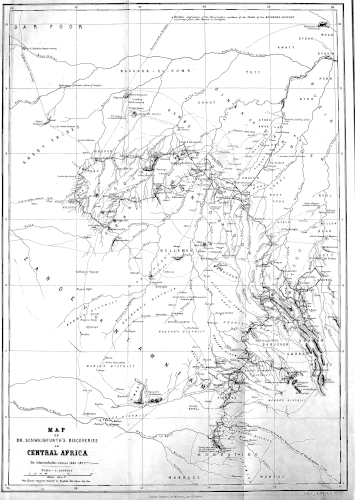
MAP OF DR. SCHWEINFURTH’S DISCOVERIES in CENTRAL AFRICA
CONTENTS.
CHAPTER I.
My former journey—Inducements to a second—Plan and object—Custom-house difficulties at Suez—Scenes in the Governor’s divan—Environs of Suez—Sulphur mine of Gimsah—Recluse life of the officials—An unenticing coast—The roadstead of Djidda—The bride of the fish—Voyage across the Red Sea—Salt works of Roway—Appearance of the shore—Charm of the moonlight nights—Importance of Suakin—First night-camp in the mountains—New species of Dracæna—Numerous succulents among the flora—The valley of Singat —Idyllic abode of the Governor—Mountains of Erkoweet—The olive-tree wild—Gardens of the desert—Characteristics of the town Bedouins—Equipment for the desert—Old fanatic from Kano—Injury and oppression—The Bedouin camp O-Mareg—Brown coating of the rocks—Goats and sheep of the Bedouins—Plant with my own name—Contest with the camel-drivers—Ugliness of the women—A monument of nature—Arrival at the Nile—Tent in peril—A wedding—The ninety-nine islands and the Sablook-straits—Pitiable condition of the country—Arrival at Khartoom Page 1
CHAPTER II.
Kind reception in Khartoom—Dyafer Pasha, the Governor-General—Contract with Ghattas—Herr W. Duisberg—Ivory trade at Khartoom—Khartoom possessions in the negro countries—Departure from Khartoom—Manning of the boat—Construction of the Khartoom boats—First night on the White Nile—Character of the landscape—Washing away of the east bank—Fertility of the country on the west—Acacia forests—Herds of the Hassanieh—Numerous hippopotamuses—Geese and ducks—Beginning of the wilderness—The Ambatch-wood—First day of ill-luck—Running over a wild buffalo—Baggara Arabs—Brethren in the faith—The mountain Nyemati—Evening gossip about pygmies—Native Egyptian cultivated plants—Buffalos alarming the Baggara—Mohammed Kher, the robber chief—Impressions on the first sight of savages—Boat attacked by bees—Frightful agony—Gadflies—Giant snails—A man carries three canoes—Repair of the sail-yard—Fashoda the most southern military station—Fifteen Shillooks at a shot—Gay temperament of the people—Gun accidents—African giant snakes 43
CHAPTER III.
Camp of the Mudir—A negro king—Campaigns—Future of the country—A wise judge—The shrieking priest—Gum-arabic—The melodious tree—Mohammed Aboo-Sammat—Boats on the flight—Treachery of the Shillooks—General market—Excuse for plunder—First papyrus—Cæsar among the pirates—Useless attempts to proceed—A world of grass—Hippopotamuses in a fright—The last obstacle—Depreciation of the Gazelle stream—Bon-mot of the Viceroy—Ghattas’s namesake—The slipper-shape—Description of the Nueir—Analogy between man and beast—Cactus-type of Euphorbiæ—The Bahr-el-Arab a mainstream—Vallisneria meadows—Arrival in Port Rek—True nature of the Gazelle—Discovery of the Meshera—Deadly climate and its victims—Le Saint—Features of the scenery—The old queen and her prince consort—Royal gifts—Fishes and birds 84
CHAPTER IV.
Start for the interior—Flags of the Khartoomers—Comfortable travelling with bearers—The African elephant—Parting from Shol and Kurdyook—Disgusting wells in the district of the Lao—Wide sandflats—Village of Take—Fatal accident—Arabian protocol—Halt in the village of Kudy—Description of the Dinka—Peculiarities of the race—Dyeing of the hair—Nudity—“The Turkish lady”—Iron age—Weapons of the Dinka—“People of the stick”—Weapons of defence—Domestic cleanliness—Cuisine—Entertainment of the ladies—Snakes—Tobacco-smoking—Construction of the huts—Dinka sheep, goats, and dogs—Reverence for cattle—Degeneration of cows—Intestinal worms—Deficiency of milk—Large murahs—Capabilities of the Dinka—Warlike spirit—Treatment of enemies—Instance of parental affection—Forest district of the Al-Waj—Arrival at Ghattas’s chief Seriba 137
CHAPTER V.
Reception at the Seriba—Population—Fertility—Salubrity—Management—Poor prospects of the ivory trade—Failure of European firms in Khartoom—Idrees, the chief agent—Domestic arrangements—Beauties of spring—The daughter Seriba Geer—Bit of primeval forest—Giraffe-hunt—Bamboo jungle—Negro festival and music—Trip to the Dyoor and to Wow—Desertion of bearers—Good entertainment—Marquis Antinori and Vayssière—Old servant of Petherick’s—Hornblend—Height of the water of the Dyoor—Apostrophe to the river—A model Seriba—First acquaintance with Niam-niam—Trader from Tunis—The Wow River—Seriba Agahd in Wow—Edible fruits of the country—Wild buffaloes—Instability of dwellings—Caama and Leucotis antelopes—Numerous butterflies—Bear-baboons—Pharaoh palms—Daily life of the Dyoor—Their race—Iron-smelting—Formation of huts—Idyll of village life—Hunting with snares—Women’s work—Graves—Care of young and old 172
CHAPTER VI.
Laying out a garden à l’Européenne—Hunting adventure with a bastard Gems-bok—Death of Arslan—Physiognomy of the vegetation—Character of the soil—Geography of plants—Destruction of a Seriba by natives—Seriba law—Cattle-raids on the Dinka—Tour round Ghattas’s Seribas—Geography at Geer—Fish of the Tondy—Fear of ghosts in Kulongo—Caves of Gubbehee—Central African jackal—Bamboos in blossom—Triumph of Nature over her traducers—Joint-stock distillery in Gurfala—Nubian love of drink—Petherick’s Mundo—Unsuccessful chase in the long grass—Two bush-antelopes—Cultivated plants of the district—Cereals—Large growth of sorghum—Leguminous fruits—Oily fruits—Tubers—Vegetables—Tobacco—Smoking in Africa 213
CHAPTER VII.
The Bongo: Area, boundaries, and population of Bongoland—Subjection of the Bongo to the Khartoomers—Decrease of population by slave-trading—Red tinge of the skin—Width of the skull—Small growth of hair—No aridity in climate—Wild tubers as food—Races of goats and dogs—Hunting-weapons—Villages and huts—Smelting furnaces—Money of the Bongo—Weapons for display—Wood-carving— Penates of the Bongo—Musical instruments—Character of Bongo music—Corpulence of the women—Hottentot Venus—Mutilation of the teeth—Disfigurement of the lips—Arrow-poisoning—National games—Marriage premiums—Natural morality—Disposing of the dead—Memorial erections—Mistrust of spirits—Loma, good and ill-luck—Fear of ghosts—Belief in witches—Peculiarities of language—Unity of the people of Central Africa—Extermination of the race Page 256
CHAPTER VIII.
Calamities by fire—Deliverance and escape—Six women-slaves burnt—Barterings—Domestication of wild-cats—Plague of cockroaches—Pillen wasps—Agamæ and chameleons—Fever—Meteorology—Solar phenomenon—A festal reception with an unfortunate result—Disturbance of rest at night—Murmuring of prayers—Jewish school—Orgies and drum-beating—Casting out devils—Resolve to follow Aboo-Sammat—Start towards the south—Passage of the Tondy—Character of the forest—The water-bock—Scenery by night—Shereefee’s attack—Seriba Duggoo—Consequences of the steppe-burning—Seriba Dagguddoo—Burnt human bones and charred huts—Tropics in winter—Two kinds of ant-hills—Arrival in Sabby—Nocturnal festivities of the Bongo—Desolation of the country—Goat-suckers—Abundance of game—The zebra-ichneumon—The spectral mantis—Lions—Wonderful chase after hartebeests—Snake and antelope at a shot 315
CHAPTER IX.
Tour through the Mittoo country—Early morning in the wilderness —Soldier carried away by a lion—Dokkuttoo—Fishing in the Roah—Feeding a slave caravan—Ngahma—Dimindo, the hunter’s Seriba—Wounds from the grass—Dangadduloo—Entertainment in the Seribas—The river Rohl—Reception at Awoory—Footsore—Trial of patience—People of the district—Poncet’s Seriba Mvolo—Mercantile prospects for the Egyptian Government—Fantastic character of landscape—Structure of pile-work—Rock-rabbits—Rock-rabbits’ feet—Nile cataract in miniature—The Tinnea æthiopica—Seriba Karo on the Wohko—Reggo and its breed of dogs—Kurraggera—Aboo Sammat’s festivities—A speech of the Kenoosian—Aboo Sammat and the subjugated chiefs—Deragoh and its mountains—Kuddoo on the Roah—Fear of lions in the forest of Geegyee—Return to Sabby—The Mittoo people—Inferiority of race—Disfiguration of the lips by Mittoo women—Fetters of fashion—Love of music 365
CHAPTER X.
Preparations for Niam-niam campaign—Generosity of Aboo Sammat—Organisation of the caravan—Ceremonies at starting—Banner of Islam—Travelling costume—Terminalia forest—Hartebeest chase—Ahmed the Liar—Prospect from Mbala Ngeea—Bivouac on the Lehssy—Camp noises at night—Story of cannibalism—Ahmed’s fate—The Ibba—First meeting with Niam-niam—Growth of the popukky-grass—Elephant-hunting among the Niam-niam—Surprise at the white man—Visit to Nganye—A chieftain’s household—Entertainment by Nganye—Gumba—Colocasia—A Niam-niam minstrel—Beauty of the Zowa-trees—Encephalartus on the hill of Gumango—Cultivated districts on the Rye—Condition of hamlets and farms—Devastation of Bendo’s district—Contest with the soldiers—Escape from a bullet—Identity of the Sway and the Dyoor—The law of drainage—Passage of the Manzilly—First primeval forest—Frontier wildernesses—Organisation in the geography of plants—Importance of guinea-fowl to the traveller—Feeding the bearers—National diet 415
CHAPTER XI.
Aboo Sammat’s territory—Jungle on the brooks—Discovery of wild pepper—Giant trees—Modesty of the Niam-niam women—Fresh danger from a bullet—A Bongo poisoned by manioc—Liberal treatment of bearers—Nduppo’s disagreement with Wando—Savage admiration of Europeans—The skin-trade—Wando’s braggings and threatenings—Formation of columns for war—Natives as soldiers—Difficulties of river-fording—Difference of level of soil on the watersheds—Mohammed’s prelude to drinking beer—Division of forces—Primeval forest on the Lindukoo—Rikkete’s jealousy—Varieties of genets—Mohammed’s réveil—Morning toilet of the Niam-niam—Waterfall on the Lindukoo—Magic roots—Watershed of the Nile district—Simple geological formation of Central Africa—The chimpanzee and pandanus found only beyond the watershed—Confusion in crossing the brook—Africa’s revenge on the white man—Venturesome interview of Mohammed with Wando—Value of ivory and copper—Definition of a “gallery-wood”—Duality of vegetation—Wando visits my tent—Wando’s nonchalance—A specimen of native cookery—Six Nubians murdered by Niam-niam—The leaf-eater and grass-man 465
CHAPTER XII.
Poultry-market—Votive pillars and hunting-trophies—Indirect evidence of cannibalism—The chimpanzee in Central Africa— Presents of chimpanzee skulls—New style of huts—The A-Banga—Cultivation of manioc in Central Africa—The Treculia—Cam-wood and muscat nuts—Conflict with natives—Shooting-match and sham fight—Magic lucifers—Mutual interchange of blood—Botanical excursion interrupted—Gyabir wounded—Modes of expressing pain—Female slaves captured—Giant lichens—Tree-termites—Monbuttoo frontier—Reception by Nembey—Northern limit of the oil-palm—Imaginary alarm—Unexpected arrival of Khartoomers—Visit of Bongwa and his wife—Cattle of the Maogoo—Cultivation of the sugar-cane—Interview with Izingerria—Arrival at the Welle—Condition of the Welle—Relations of the stream—Crossing the river—Monbuttoo canoes—New impressions of the heart of Africa—Arrival at Munza’s residence 515
LIST OF ILLUSTRATIONS.
(ENGRAVED BY J. D. COOPER.)
PAGE
Ombet—Dragon trees to face 22
The Lassav (Capparis galeata) 23
A Bishareen Sheep 34
Aboo-Odfa 37
Ambatch Canoe 77
View of Fashoda 80
Prickles of Acacia fistula 98
In full flight before the Shillook canoes to face 100
The vessels in the grass-barrier to face 106
Balæniceps Rex 116
The Meshera 128
The old Shol 133
View on the Meshera (Port Rek) to face 136
Profiles of the Dinka 149
A Dinka Dandy 151
Dinka Instruments for parrying club blows 155
Dinka village to face 159
Sectional View, showing construction of Dinka Hut 160
Dinka Bull 161
Dinka Sheep 162
Dinka Goat 163
“Kyatt” Worm 166
Dinka cattle-park to face 166
The chief settlement of Kurshook Ali. A majestic Khaya-tree to face 188
Central African Hartebeest 195
Leucotis Antelope (male) 196
Leucotis Antelope (female) 197
Brass Ornaments of the Dyoor 202
Portrait of a Dyoor 203
Portrait of a Dyoor 204
Spear Head 205
Dyoor Spade ib.
Dyoor Smelting-furnace 207
Dyoor village in winter to face 209
Central African Bastard Gemsbok (Antilope leucophæa) 217
Kosaria palmata 220
The Kilnoky 231
Young Polypterus 232
The Madoqua 244
The Deloo 245
Central African Yam 251
The Nyitti ib.
Calyx of the Hibiscus Sabdarifa 253
Bongo Goat 270
Short-bodied Goat of the Bongo 271
Vertical Section of Smelting-oven 278
Iron Money 279
Bongo Lances 280
Pincers used by the Bongo women for plucking out their eyelashes 281
Knife of the Bongo women ib.
The Dangabor and a single ring 282
Bongo stool 283
Yanga’s grave 285
Bongo 293
Bongo woman 295
Phenomenon on the 17th of May, 1869 (coloured plate) to face 326
The Depression of the Tondy to face 336
The Central African Waterbock (Antilope ellipsipryma) 339
Mushroom-shaped white-ant hills 349
View in the district of Mvolo to face 384
Poncet’s Seriba in Mvolo to face ib.
Goggo, a Mittoo-Madi Chief 394
Goat of the Bongo, Mittoo, Momvoo, and Babuckur 405
Lory, a Mittoo Woman 407
Wengo, a Mittoo Woman 408
Loobah Woman 409
Cone of quartz worn in the lip ib.
Apron worn by the Madi 410
Ngahma, a Mittoo Chief 411
Mittoo Lyre 413
Niam-niam in full dress 439
Coiffure of the Niam-niam 440
A Niam-niam Minstrel to face 445
A Niam-niam Girl 472
Niam-niam hamlet on the Diamvonoo to face 517
An A-Banga 524
Platycerium Elephantotis, Schweinf. 538
Bongwa’s Wife 544
Entry to Izingerria’s Mbanga to face 546
Large Map of Dr. Schweinfurth’s Discoveries in Central Africa to follow viii
ERRATA.
Vol. I., page 32, line 10 from bottom, for “prevaence,” read “prevalence.”
” ” 50, line 16 from top, for “pew,” read “pen.”
” ” 140, line 6 from bottom, for “Kigelia,” read “Kigeliæ.”
” ” 419, line 6 from bottom, for “Shaba,” read “Sheyba.”