Chapter XI
Ellen E. (Ellen Elizabeth) Frewer translation
Aboo Sammat’s territory. Jungle on the brooks. Discovery of wild pepper. Giant trees. Modesty of the Niam-niam women. Fresh danger from a bullet. A Bongo poisoned by manioc. Liberal treatment of bearers. Nduppo’s disagreement with Wando. Savage admiration of Europeans. The skin-trade. Wando’s braggings and threatenings. Formation of columns for war. Natives as soldiers. Difficulties of river-fording. Difference of level of soil on the watersheds. Mohammed’s prelude to drinking beer. Division of forces. Primeval forest on the Lindukoo. Rikkete’s jealousy. Varieties of genets. Mohammed’s réveille. Morning toilet of the Niam-niam. Waterfall on the Lindukoo. Magic roots. Watershed of the Nile district. Simple geological formation of Central Africa. The chimpanzee and pandanus found only beyond the watershed. Confusion in crossing the brook. Africa’s revenge on the white man. Venturesome interview of Mohammed with Wando. Value of ivory and copper. Definition of a “gallery-wood.” Duality of vegetation. Wando visits my tent. Wando’s nonchalance. A specimen of native cookery. Six Nubians murdered by Niam-niam. The leaf-eater and grass-man.
One of the native chieftains, as I have already mentioned, had exhibited so much hostility, and had been so great an obstacle to Mohammed Aboo Sammat’s ivory trade in Wando’s district, that Mohammed had proceeded to violence and had wrested away his territory. This chieftain was now dead, and Mohammed in his place had appointed a native spearman of royal blood. Mohammed had a considerable number of these spearmen, natives of the Niam-niam country, who were brought into his Seribas, and having been initiated into the use of fire-arms, formed one of the main supports of his authority. Backed by the continual presence of some forty or fifty armed Nubians, Surroor (for such was the name of the new vicegerent) held sway over a populous area of 700 square miles. According to the joint estimate made by Mohammed and Surroor, the number of men in the territory capable of bearing arms was not less than 40,000. I believe, however, that half this number would be nearer the mark; for when I test my impressions by comparing them with the results of my careful investigations in Bongo-land, I cannot but think that the entire population of the Niam-niam country, with its wide tracts of wilderness utterly uninhabited, hardly averages 65 to the square mile.
Since here amongst the bearers there is no institution of statute labour, and the number of villages and huts could only be arrived at by careful scrutiny of an entire district, the only means open to me for estimating the amount of population was by taking what reckoning I could of the people who assembled on either side of our route as we passed along. These may be divided into three classes: first, those who had come from mere curiosity; secondly, those who had been ordered to settle in a district to contribute towards the general means of subsistence; and, thirdly, the fighting-force that was displayed in various places during time of war, and which most probably represented the large majority of the men who were capable of bearing arms.
The strongholds in this district consist of one large Seriba and three smaller palisaded enclosures. In these subsidiary settlements discipline is maintained by native overseers with a small detachment of armed men.
The personal relation of the Niam-niam towards their rulers was far less servile than what I had observed among the Bongo and Mittoo. The duties imposed were mainly the same. They were bound to assemble promptly at any signal either for war or for hunting, to provide an adequate support for whatever soldiers and bearers might be brought into the country; to furnish wood and straw for building purposes, and to perform various incidental labours. The Niam-niam, however, are not employed as bearers upon the expeditions, and upon the whole are less oppressed and are treated with more consideration than the Bongo. At present they can hardly comprehend their state of subjection, and this indefinite feeling is fostered at first by leniency on the part of the oppressors, that they may smooth the way for severer measures in the future.
The power of any native chiefs among such a people of unsettled habits and unpliant temper as the Niam-niam—a people delighting in the chase—is necessarily at present very limited; it cannot extend any further at all than to accomplish the disposal of whatever men may be capable of bearing arms either for the purpose of warfare or of hunting. The official emoluments of these chiefs are derived partly from an allowance made upon all the ivory that is secured, which is always paid without being contested, and partly from their having a right to half of all the elephant meat; but for their ordinary subsistence they have to turn their attention to the cultivation of the fields; and for this purpose they endeavour to increase their home establishments by the acquisition of as many wives and women-slaves as their resources will allow.
ABOO SAMMAT’S SERIBA.
I remained at this place from the 10th to the 26th of February. The Seriba was in lat. 4° 50´ N., and was 87 miles south—almost due south—of Sabby. It was situated in the angle formed by the confluence of two streams, the Nabambisso and the Boddo, which were overhung by lofty trees, and in some places were enclosed by dense thickets. Close at hand was the “mbanga” of Surroor.
I spent the daytime in an assiduous investigation of the neighbouring woods. My collection increased considerably, and the paper packets prepared for the reception of my treasures were rapidly filled up. The crowds of natives who came from far and near to gaze upon me afforded me an acceptable opportunity of filling up some pages in my album. My two Niam-niam interpreters (called in Arabic Gyabir and Amber) felt at home upon their native soil, and accompanied me everywhere, making my intercourse with the natives perfectly easy. I was able to roam about at will in the adjacent jungles, as the environs were as safe as those of Ghattas’ Seriba in the Dyoor; and, altogether, I was soon as comfortable as I could desire in this remote land.
The scenery was lovely; the two streams never failed throughout the year to be well supplied with water, and flowed through deep glades where the lofty trees were wreathed and festooned with creepers in clustered grace that would have been an ornament to any palm-house. In the part where the supply of water was diverted to the residences the woods had been considerably thinned. The wild date-palm (Phœnix spinosa), which may be considered as the original of the species cultivated throughout the desert region from Senegambia to the Indus, grows here as a low shrub, and together with the calamus forms an impenetrable hedge along the banks of the stream. The double barbs of the calamus cling tenaciously to the skin and clothes, reminding one of the prickly acacia to which the Boers, or Dutch colonists in South Africa, have given the name of “wag-a-bitjen,” i. e. wait-a-bit.
A new characteristic of the flora appears here in the Amomum, which I found in tall masses on the damp soil near the bed of the stream, and even in the water itself. I saw five different species, with white, yellow, and crimson flowers. The fruit of all the kinds is bright red, and contains a soft pulp which has a flavour like citron, and which envelopes the aromatic seeds known as grains of paradise. The water of the streams runs clear as crystal, and the traveller may at any time allay his thirst by a cooling draught. Here and there the sun’s rays force their way through the interlacing creepers which hang in festoons between stem and stem, and in the twilight the foliage gleams almost like burnished metal. The Ashantee pepper (Cubeba Clusii) clothes the trunks with a close network which is thickly covered with bright red berries that grow in clusters as long as one’s finger. After the fruit has been dried it makes a very good substitute for black pepper, which it very much resembles in flavour. I was the first to draw the attention of the Nubians to the plant, for, although they had travelled much in the Niam-niam lands, they had no idea that these berries had the properties of pepper, and seemed highly gratified at the discovery. The Niam-niam take the pepper only as a medicine; for seasoning their dishes they are accustomed to use the Malaghetta pepper (Habzelia), of which we shall have to speak on a later page. The Ashantee-pepper is one of the most common and yet at the same time one of the most striking of the characteristics of the primeval forests of the district; it forms the finest adornment of the giant trees, and covers the venerable stems of these princes of the vegetable kingdom with a vesture of royal purple.
KOKKOROKOO.
One amongst the most imposing forms of vegetation is found in a Sterculia of the Cola tribe, called “kokkorokoo.” This tree grows to a height of 80 or 90 feet; the stem gradually tapers upwards to a point, whilst at the base it is suddenly expanded to so great a bulk that it would require eight or ten men to encircle it; thence it rises in a mass of narrow arms, corresponding to the direction of the roots, shooting upwards for many feet, like a series of planks joined together edge to edge. The leaves are heart-shaped and form a light and airy foliage, but this commences at such a height above the ground that I was for some time in doubt about the true form of the tree. At length I discovered a shoot bursting from a root that enabled me to realise a proper idea of the plant. It is no uncommon thing in these primeval forests for the botanist thus to see the object of his desire at a height so far above his head that he is unable to attain so much as a single leaf.
It was upon the Boddo that I found the first specimens of Anthocleista. The flora of the Niam-niam countries contains several species of this genus of the Loganiaceæ, which is remarkable for the immense size and small number of its leaves that grow all together at the crown of a single stem running up without a branch. Let any one imagine a tobacco plant magnified to ten times its natural size and placed upon the top of a stem some twenty feet high, and he will then have some idea of this plant with its circling labyrinth of leaves. In any drawing of a landscape the Anthocleista defies every rule of perspective. The equatorial zone alone can boast of plants so unique in character as these, which may be considered as samples of the unexplored splendour of the primeval forests of Brazil.
After every ramble I turned my steps to Surroor’s mbanga, and my visits there were always enjoyable, because I ever found something fresh that sensibly enlarged my knowledge of the country. There was invariably a large assemblage of natives about the vicegerent’s court, and among them a considerable number of women; for Surroor, besides his thronging harem, kept a great many female slaves in attendance upon himself and his wives. As a guest of Mohammed’s I was always treated here with the utmost respect. The most elaborate benches and stools were brought out for me to sit on, and Surroor’s store of these exemplars of native art was inexhaustible. The choicest delicacies of the country were outspread before me, but these were to me as prohibited as shewbread. I always made a rule of eating alone, and consequently felt constrained to leave the dainties to my interpreters and Nubian servants.
Yes; I took my meals alone. A solitary European, as he proceeds farther and farther from his home, may see his old associations shrink to a minimum; but so much the more, with pertinacious conservatism, will he cling to the surviving remnants of his own superiority. Nothing can ever divest him of the thought as to how he may maintain the prerogative, which he takes for granted, that he is a being of some higher order. Many a misanthrope, in his disgust at the shady side of our modern culture, may imagine that to a traveller, in his intercourse with the children of Nature, the thousand necessities of daily life must seem but trifles vain and empty, to be dispensed with without a sigh. Such an one may fancy that the bonds which fasten him to the world of civilisation are weak and all waiting to be rent asunder as soon as Nature is left to assert her unfettered rights; but from experience I can assure him that the truth is very different. With the fear of degenerating ever before his eyes, the wanderer from the realms of civilisation will surely fix his gaze almost with devotion on the few objects of our Western culture that remain to him, which (however trivial they are in themselves) become to him symbols little less than sacred. Tables and chairs, knives and forks, bedding, and even pocket-handkerchiefs, will assume an importance that could never have been anticipated, and it is hardly too much to aver that they will rise to a share in his affections.
NIAM-NIAM WOMEN.
The social position of the Niam-niam women differs materially from what is found amongst other heathen negroes in Africa. The Bongo and Mittoo women are on the same familiar terms with the foreigner as the men, and the Monbuttoo ladies are as forward, inquisitive and prying as can be imagined; but the women of the Niam-niam treat every stranger with marked reserve. Whenever I met any women coming along a narrow pathway in the woods or on the steppes, I noticed that they always made a wide circuit to avoid me, and returned into the path further on; and many a time I saw them waiting at a distance with averted face, until I had passed by. This reserve may have originated from one of two opposite reasons. It may on the one hand have sprung from the more servile position of the Niam-niam women themselves; or, on the other, it may have been necessitated by the jealous temperament of their husbands. It is one of the fine traits in the Niam-niam that they display an affection for their wives which is unparalleled among natives of so low a grade, and of whom it might be expected that they would have been brutalised by their hunting and warlike pursuits. A husband will spare no sacrifice to redeem an imprisoned wife, and the Nubians, being acquainted with this, turn it to profitable account in the ivory trade. They are quite aware that whoever possesses a female hostage can obtain almost any compensation from a Niam-niam.
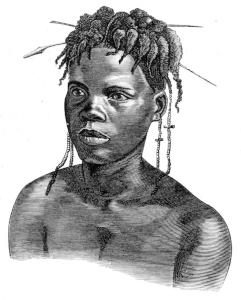
A Niam-niam Girl.
SURROOR.
My exceptional position made it easy for me to procure an order from Surroor that some of his wives should sit for their portraits. This was an unusually favourable opportunity, and the ladies with their plaited tresses, allowed me to make many additions to my portfolio and to my list of measurements. In this place I measured about fifty different people, taking no less than forty measurements of each. This of course was the work of time, but my trouble was all in vain, for all my notes, with many others, were destroyed in the fire, of which the record will have to be made, on the 2nd of December. Altogether I had carefully registered the measurements of more than 200 individuals belonging to various nations.
During the time that Surroor had acted in the capacity of Mohammed’s spearman, he had learnt to speak Arabic fluently, and was therefore able to give me considerable information on many points. I asked many local questions, since the unravelling of the confused hydrographical network in this part of the country was an object which I could never permit to be absent from my thoughts. I was not long however, in discovering that these Zandey (Niam-niam), although possessing such uniformity in speech and customs, had no more knowledge of the remote parts of their country than the majority of the other natives of Central Africa. I may mention, as an instance of this, that no one in this district knew so much as the name of Mofio, whose territory indeed was 300 miles distant, but whose reputation, as one of the chief Niam-niam princes, might have been presumed to be widespread.
Another occasion very shortly afterwards had the effect of impressing the people about me with a very lofty notion of the good genius which presided over my fortune, and protected me from injury. A traveller who has learnt experience will understand the desirableness of turning the progress of events to the advantage of his personal reputation. As I was about to take my seat of honour at Surroor’s side on a Monbuttoo bench, my life for the third time was imperilled by a bullet fired from the neighbouring Seriba. The descending ball passed close to my left, and within a few inches of my forehead; glancing off the palm-sticks which were attached to my seat, it dashed through the roof of an adjacent hut. However much I may have been alarmed, I succeeded entirely in disguising my terror. The Nubians do not possess any wad-hooks for extracting either cartridges or bullets; their guns consequently have to be discharged in order to keep them clean and in proper condition. It may therefore be imagined that in the vicinity of a Nubian camp there is a perpetual whirring and whizzing in the air from the incidental firing of these stray shots.
Hunting in this place, as far as we were concerned, was not to be thought of, as the region was far too thickly populated, and the Niam-niam themselves are such devoted huntsmen that they leave nothing for the stranger beyond the few francolins and guinea-fowl which may escape their snares.
During our sojourn, Mohammed Aboo Sammat, with his faithful black body-guard of true Zandey, had arrived from the Mittoo country. The entire united forces then prepared to advance to the south, Ghattas’s agent and plenipotentiary not considering that a division could be ventured upon until we had gained sufficient assurance of the peaceful intentions of Wando, whose territory we should have to cross upon our route. Any apprehensions of hostility, however, were soon allayed, and for a time all went well.
By the 25th of February all the preparations for marching were complete, and, reckoning all Aboo Sammat’s and Ghattas’s people, we were a body of little short of 1000 strong. Our marching column was not much less than four miles in length, so that it happened more than once, after a short day’s march, that those in front were erecting their huts with leaves and grass before those in the rear had lost sight of the smoke of the encampment of the previous night.
Just before starting Mohammed had sent some of his dependents back to Sabby, and I took the opportunity of remitting by them the botanical collection which I had made. Amongst other plants were two specimens of the remarkable Cycadea, which after all the vicissitudes of travel arrived in Europe in a state of vitality.
Only a small portion of my reserve of cattle was now remaining, and the maintenance of the men in the Seriba had quite exhausted the stores; to Mohammed’s great annoyance, even the sorghum-seed, which was to have been conveyed to Munza, king of the Monbuttoo, as a curiosity, had been consumed as material of diet, and thus the heart of Africa had been deprived of one advance in culture.
We proceeded, first of all, two leagues in a westerly direction, and after crossing the Nabambisso and two smaller streams, we made our necessary halt. It was on the western boundary of the cultivated district subject to Aboo Sammat, and before we could venture to quit it, an adequate relay of provisions had to be procured from the neighbourhood.
FEEDING THE BEARERS.
The feeding of the bearers was an animated scene, enlivened as it was by the concourse of some hundreds of the Niam-niam people. The provision for the most part consisted of great lumps of pappy dough piled upon broad leaves, and served with strong-smelling sauces which were brought in pots, bowls, calabashes, and vessels of every variety. Drawn up on one side, in groups arranged according to the order of their arrival, stood the bearers, whilst the Niam-niam in throngs took their position on the other, and many an eager glance was thrown upon the preparations for the general repast. I took my sketch-book in my hand, and wandering through the ranks preserved my observations of the diversified tattooing which everywhere arrested the eye.
To judge from the representations which have been given us by Du Chaillu, Griffon, and other travellers, I should say that in external appearance the Niam-niam very much resemble the people of the Fan on the Gaboon. The two races adopt a similar fashion of dressing their hair; both alike have the reputation of being cannibals; and from all accounts their domestic arrangements are not very different.
Almost immediately after starting on the following morning we crossed the Nabambisso, and our course subsequently lay across a group of low mounds of gneiss covered with an interesting vegetation. Here grew in great abundance the Selaginella rupestris, clothing the bare rock with a graceful carpet of verdure; and here, too, for the first time since leaving the Red Sea, I was greeted with the sight of the Abyssinian aloe with its fiery barb. This plant belongs to the flora of the loftiest mountains; but although the elevation of the country was scarcely more than 2500 feet, yet it was sufficiently high to permit the plant to thrive; in Nubia, too, it flourishes at an altitude hardly higher than that in which it is conspicuous here. After surmounting the gneiss rocks we crossed the Nabambisso for the second time, and marching onwards in a southerly direction we reached a wide depression, called Yabongo, enclosed by dense bushes like the “Luche” in the Mark of Brandenburg, or perhaps still more like a meadow-pool in the sense of the “nyalnyam” of Bornoo. On the edge of the water many wild Phœnix of both sexes were flourishing with greater magnificence than any I had yet seen, their stems running to the height of some twenty feet. For a distance now there were no watercourses above ground to be seen, and shortly afterwards we entered upon another valley which was distinguished by the name of Yabo. The interval between the two hollows was filled by woodlands, graceful as parks, and adorned by many a large-leaved fig-tree bearing a multitude of figs much larger than those we ever grow.
CONSIDERATION FOR BEARERS.
While we were here, one of the Bongo bearers died from the effects of eating manioc before it had been prepared and divested of its poisonous parts. For twenty-four hours before his death he had lain in a state of coma, and a strong emetic had been entirely without effect. In the Niam-niam countries the manioc roots are of the same uncertain quality as those of South America, and the Bongo being unfamiliar with the differences, often do themselves serious injury on their expeditions by partaking of them indiscrimately.
Not long afterwards another of the Bongo people was carried off by a lion from the side of a bivouac fire; and these two were the only deaths that occurred in the course of the two months that Mohammed’s caravan was on its outward way. Probably much was due to the salubrity of the air, which contributed to make the men superior to the drawback of unwholesome food, and to all the exertions, fatigues, and deprivations to which they had to submit; but beyond a doubt the fact spoke volumes for the considerate treatment that the bearers received from Mohammed. He spared his people most studiously, and often rated the soldiers very severely whenever they were impatient or harsh with the bearers; he personally superintended the distribution of all the corn, and in his anger I have heard him revile the troops, telling them that they were good-for-nothing rascals who only knew how to go to sleep, and how to bully the bearers.
Towards noon on the 27th of March we reached the Uzze, a small river running almost parallel with the Sway, and of about the same dimensions as the Hoo, only having a much slower current. The river-bed was twenty-five feet wide, but at this period there was not more than a two-foot depth of water. The stream flowed along an open plain, unrelieved by trees, but animated by many herds of buffaloes, which we did not now stay to chase, but which afforded us excellent sport upon our way back. About two miles to the south of the Uzze we crossed the Yubbo, the two rivers here being quite close together, although they diverge again to a distance of several leagues towards the west before they ultimately unite and join the Sway.
The Yubbo at this time was fifty feet wide, and like the Uzze was only two feet deep; it meandered along a low steppe which was obviously subjected to inundation, a fact that testified to the importance of the river in the rainy season. Estimated merely with reference to the length of its course, the Yubbo might compete with the Sway for the honour of being chief among the original stream-sources which make up the Dyoor, but the comparison of the volume of water which the separate rivers contain demonstrates that it really performs a very subsidiary part. Another argument that very pointedly tends to prove that the Sway is really the main source rests upon the fact that the natives distinguish it, at its earliest risings, in the defiles of the Baginze, by the same name that the Dyoor itself bears among the Niam-niam in what were formerly the states of Tombo. The development of the Sway, from the aggregated confluence of a number of smaller streams, is as characteristic an example of “river-sources” as the records of geographical science can furnish.
After crossing the deep hollow of the bed of the Yubbo, we met some messengers who had been despatched by Nduppo, Wando’s brother, to bid us welcome. Nduppo was chief of a district subject to his brother, with whom, however, he was by no means on good terms. From Nduppo himself, of course, we had no hostilities to fear, as nothing could be of more importance to him than to preserve his friendly relations with Mohammed. As we arrived at his mbanga some hours before night, I had time to make a short visit to a deep ravine at no great distance, that was watered by a streamlet called the Nakofoh, which was almost hidden by the dense groves upon its bank.
Our camp had meanwhile been improvised, a number of grass huts having been speedily erected because of the threatening aspect of the sky; towards evening for some days past there had been the appearance as if a storm were rising, but rain had only fallen twice since the beginning of the month, and even now the clouds were broken. On reaching the encampment I found Nduppo himself in company with Mohammed. I joined them, at once, being as anxious as anyone to get what intelligence I could about Wando and his intentions. It transpired that the feud between Nduppo and his brother had become so violent in rancour that Nduppo avowed that he lived in constant terror of being attacked and murdered by Wando’s soldiers, and this cruel destiny which he foreboded did actually befall him a very few days after our departure. For ourselves, the following day would decide whether we were to have peace or war.
Our next move was to the quarters of Rikkete, another brother of Wando’s, and who, holding the office of behnky, had remained faithful in his allegiance, and was consequently in avowed hostility to Nduppo. The three brothers were part of the numerous family of Bazimbey, whose extensive dominions, a few years previously, had been divided into six small principalities, a heritage which was a perpetual apple of discord amongst his sons. Bazimbey was one of the six sons of Yapahti, who still retain their rule over nearly all the eastern countries of the Niam-niam.
ADMIRING THE WHITE MAN.
My personal appearance aroused the most vivid interest on the part of Nduppo and his suite. Their curiosity seemed insatiable, and they never wearied in their inquiries as to my origin. Theirs were the first exclamations of a kind which more or less frequently continued to be made throughout the rest of my journey. To their mind the mystery was as to where I could have come from; my hair was the greatest of enigmas to them; it gave me a supernatural look, and accordingly they asked whether I had been dropped from the clouds or was a visitor from the moon, and could not believe that anything like me had been seen before.
And with regard to this appearance of mine, I may mention that amongst these people of the far interior it hardly seemed to be the colour of my skin that principally excited their astonishment, for even in the remotest regions of Central Africa, tribes that have no conception of an ocean are aware of the existence of white men; but it was invariably my long straight hair that caused their chief surprise, my own purpose in letting my hair grow to an unusual length being that I might be identified at once amid all the countless shades of complexion that were found amongst the Nubians. I enquired whether they had not seen the traveller Piaggia, that white man who but a few years ago had been staying in their parts with king Tombo; but they replied that although they had heard about him, they had never seen him. In my way, therefore, I was quite unique, and truly a desideratum in their ethnographical experience.
Nduppo communicated to us many particulars about his brothers, and about the warfare that was carried on between them, and informed us likewise of the death of Bazimbey’s brother Tombo, who had entertained Piaggia with so much hospitality. Tombo’s kingdom, it appeared, had likewise been cut up into a number of smaller states which still retained all their national hostility to the intruders from Khartoom. The residence at which Bazimbey had lived, during his sovereignty, was pointed out to me, at a distance which, I should presume, was about 25 miles. It was explained to me that a messenger, if he were strong and could walk well, could accomplish the journey in a day, but, it was added that he must not halt on the way, and that he would have to get on apace like a Niam-niam, and not to dawdle like a Bongo bearer carrying his load.
ABUNDANCE OF SKINS.
Throughout the whole of the territory that was subject to Wando, the clothing of all the people consisted of skins, as the fig-tree, of which the bark is so generally used in the south, does not thrive here at all well. For all those who require it, the bark has to be imported from the country of the Monbuttoo, and is consequently an article of luxury. Skins can ordinarily be obtained at a price which seemed to me ridiculously small. For the purpose of getting a few trifling additions which were necessary for my cuisine I was in the habit of breaking up some of my larger copper rings into little bits, and I was very pleased to find how far these copper fragments would go in making purchases of skins of various kinds. In this way I bought a fine otter skin (probably Lutra inunguis, Cuv.) for about threepence, genet skins for about a penny apiece, and those of the Colobus quereza for a very little more. Very plentiful and consequently equally cheap were the skins of civets, Herpestes fasciatus, Felis maniculata, F. caracal and F. serval. The skins of the smaller kinds of antelopes, too, were very frequently offered for sale, especially those of the beautiful Antilope scripta (the harness bush-bock of South Africa) and of A. grimmia, A. madoqua, and the long-haired water-bock (A. difassa). It is very strange how, notwithstanding this extraordinary abundance and cheapness of skins, traffic in them, as an article of commerce, is entirely unknown in Khartoom, where the dealers seem to have no suspicion of the large demand there undoubtedly would be. Leopard skins, it may be added, were comparatively rare, and were only used by royal personages to line their shields, or according to their own special prerogative, to encircle their heads. Nduppo wore a serval-skin, of which the ends drooped in graceful folds over his neck and shoulders, whilst great pins, headed with pieces cut from the tail of the Sciurus leucumbrinus, held it firmly fastened to his luxuriant hair.
Aboo Sammat was known amongst the Niam-niam by the name of “Mbahly” or “the little one,” a designation given him long ago by the people, on account of the youthful age at which he had entered their country. Nduppo informed us that Wando had declared, with what was tantamount to an oath, that Mbahly should not this time escape, but that he and all his crew should be annihilated: he, moreover told us that the threats had extended to myself. Wando, he said, avowed that he did not want any presents, and that all the beads in the world were nothing to him; if any offerings were sent he would trample them in the grass; if any stuffs were given him he would rip them into shreds; plenty of copper he had already, and for that matter, plenty of ivory too, but he did not intend to part with any of it.
For a long time it perplexed me to discover the reason of Wando’s animosity. Only two years previously he and Mohammed had been on the most friendly terms. Mohammed had visited him at his home, and the two had entered into the closest alliance, which had been sealed by Mohammed marrying his daughter, who as I have already mentioned, was now one of the first ladies in the harem of Boiko. But, meanwhile, Mohammed had been in Khartoom, and during his absence he had entrusted the charge of his expeditions to his brother, who had fallen out with Wando. Mutual recriminations led to mutual plunder, and Wando was now in a rage that could not easily be suppressed.
Nduppo led us to understand that in the course of our next march we should receive definite tidings of Wando’s intentions. If an attack were resolved upon, his whole force would be assembled and we should be prevented from going on to Rikkete; but if, on the other hand, we were permitted to reach Rikkete unmolested we might then be sure that there would be a temporary peace. And this in reality we found to be the case. As we were approaching Rikkete we were met by Wando’s envoys bringing the accustomed conciliatory flasks of beer. Various circumstances might have weighed with the chieftain to induce him to postpone his outbreak. It is possible that he considered that while Aboo Sammat’s and Ghattas’s companies were united and could muster 300 guns, the time was not arrived for an attack; he also reckoned, with true African craftiness, that it would be more advantageous to himself to fall upon us on our way back from the Monbuttoo. He imagined, moreover, that all our valuables which he now so contemptuously rejected would fall into his hands without the necessity of any ivory traffic at all, and that our stores (as being an unnecessary burden to be carried to the Monbuttoo and back) would be deposited in his charge until our return; and in addition to all this, it is not unlikely that he counted with some certainty upon receiving plenty of presents from the liberal Kenoosian.
PRECAUTIONS.
In order to be ready in a moment for any emergency, our caravan for the first time, on the 28th of February, set out on its journey with its disposition arranged according to the rules of Nubian warfare. The entire body being drawn out in columns, the whole of the armed force was divided into three companies, each headed by its own banner. In front of all marched the first division of the troops, followed by the bearers with the linen goods, the bars of copper, and the store of beads; in the middle of the train was the second division, which had charge of the bulk of the ammunition, chests of cartridges and boxes of powder and caps; then followed the women and female slaves, whilst the third division brought up the rear. For the general security it was ordered that no straggler should be permitted to lag behind or to go farther back than the standard-bearer at the head of the third division. From the nature of the path all were obliged to march in single file, and thus our train, although as compact as possible, swelled out to an enormous length. Independently of the main body, a troop of native soldiers, composed of Bongo and Niam-niam slaves, that had been armed and well trained by Aboo Sammat, was now detached to reconnoitre the thickets in front and on either hand, and to make sure that the advance was safe. As a general rule, these blacks made much more effective soldiers than the Nubians, and upon them fell the heaviest of all the work of war. Their employment of hunting, which is a pursuit much too laborious for their oppressors, makes them far more expert and practised shots, and besides this, they are heartier in their work and fear neither wind nor weather.
Whilst all the Nubians who carry guns are dignified by the high-sounding title of “Assaker” (soldiers), the natives who may be enlisted are called in the common jargon of the Soudan Arabic, either “Narakeek,” “Farookh” or “Bazingir.” The precise etymology of these various designations I could never ascertain. There are, however, some words which occur so frequently in the conversation of the Khartoomers that they become indispensable for fully describing the details of service in the countries of the Upper Nile. The “Narakeek,” for instance, would appear to be the only men who are trusted with the heavier guns, of which a considerable number, originally intended, no doubt, for elephant-hunting, are now found in the companies of the Khartoomers, and form what might be called their artillery. Mohammed Aboo Sammat had twenty of these guns, of which I ascertained that the majority were manufactured by Roos of Stuttgard. They are not loaded either with conical shot or with explosive bullets, but merely with a handful of heavy deer-shot; their action is very effective, and their first discharge amongst a party of savages rarely fails to send them scampering off at full speed.
It was in crossing the beds of the brooks and in getting through the thickets that bounded them that the greatest precautions were requisite. All our long experience had made us quite aware how easily a caravan may be thrown out of marching order and put into the greatest confusion by the mere irregularity of the soil, and under such circumstances every attempt at defence must be unavailing: bullets might do some service when deliberately aimed at an open foe, but would be utterly useless when fired at random from amidst a labyrinth of trees or in the obscurity of a thicket.
CAMP-LIFE.
Between three and four hours were occupied in reaching Rikkete’s mbanga. Half-way on our road, after crossing three smaller streams, we came to a larger one, which, like the others flowing to the south and to the east, passed near the hamlets which lay contiguous to Nduppo’s frontier. Here we halted for our morning meal. The bearers ransacked acre after acre for the sweet-potatoes which were in cultivation in this district, where also, for the first time in our descent from the north, we found manioc plantations of any magnitude. Only in deference to an express order that the poultry which was running about the forsaken huts should be respected as the property of others, did the people abstain from catching the hens and chickens that were within their reach, but it was an act of self-denial, and they were compelled to content themselves with plantains cooked in ashes. Altogether it was a motley picture of African camp-life: the ravaged lands, the chattels of the fugitives scattered all around, the variety of platters, the corn-bins, the wooden mortars, the stools, the mats, and the baskets, all tumbled about at the pleasure of the intruders, conspired to make a spectacle of confusion so utter and so hopeless that, the only relief was in resignation.
Beyond the stream our path turned directly to the south; hitherto its direction, though winding, had been mainly west. The continual fluctuations in the level of the land made me suspect that we were really approaching that watershed of the Nile for which I had been looking with such eager and impatient expectation. The ground, that had been sloping down towards the west all the way to Nduppo’s mbanga, we now found sloping down towards the east, so that the streams that proceeded from this district to meet the Yubbo for a while flowed in a direction exactly opposite to that of the stream they were about to join. A comparatively important stream, the Lindukoo, at a little distance received all these other streams into its channel and was the last water connected with the system of the Nile that we had to cross. Over steepish hills, along defiles of slippery clay and through clefts and ravines which the rain-torrents had capriciously hollowed out, our road led us onward to Rikkete. Contrary to our expectations we were received amidst the mingled noise of drum and trumpet, whilst a deputy from the chieftain stood in front of his huts to bid us welcome.
We encamped upon some ground that was still fallow, for the few showers that had fallen were only the forerunners of the settled rain which lasts from May till October, and had had little effect upon the soil, so that the sowing of the crops had not yet commenced. Our camp was close to some groups of huts that were inhabited by Rikkete’s wives and retinue; and behind it, under the shadow of imposing banks, flowed a brook called the Atazilly.
Mohammed entered into very amicable relations with Rikkete, and not only obtained some valuable tusks from him by way of traffic, but secured an ample supply of provisions for the immediate use of the caravan. Towards evening some messengers arrived from Wando, confirming his friendly intentions and bringing, as peaceful pledges, an offering of flasks of eleusine-beer. At night we were in company with Rikkete, and Riharn my cook, who had but few opportunities of displaying that skill in the culinary art which he prided himself upon learning in the large hotel at Cairo, prepared some farinaceous dish in the European style with which I entertained the Niam-niam magnate. The article that seemed to puzzle the people most was our sugar; they could not comprehend how it should have all the appearance of stone and yet melted in the mouth, tasting like the juice of their native sugar-cane, which was cultivated among them, although not to any great extent.
Before tasting the proffered beer, Mohammed insisted upon Wando’s emissaries emptying one gourd-shell after another for their own enjoyment, a proceeding which had the effect of considerably elevating the spirits of the party. The Nubian soldiers, pleased at the pacific turn that matters had taken, passed the night in chanting their carols, accompanied by the strains of the tarabuka; and the Bongo and Mittoo revelled and danced for many hours in their own fashion to the sound of their kettle-drums and horns.
DIVISION OF THE FORCE.
There seemed now to remain no further obstacle in the way of the separation of the two companies; and, in order to complete the preliminary arrangements for the division, it was decided that we must remain for a whole day with Rikkete, a determination which was hailed by myself with much satisfaction. Ghattas’s corps was to be accompanied by a detachment of one hundred of Aboo Sammat’s soldiers, and to take its departure for what formerly had been Keefa’s territories in the west and south-west, where they hoped to transact a remunerative business, because, in consequence of the absconding of the natives, the main company of Ghattas had been left destitute of any bearers. After the reduction, an armed force of 175 was left for our protection as we proceeded on the remainder of our way to the Monbuttoo.
Early on the following morning I paid Rikkete a visit at his residence in the village, and made him what I considered a handsome present of beads of a pattern superior to what had ever before been seen in this part of Africa. I, however, received no present in return, but on the contrary had to pay for the simplest things with which I was supplied, whether they were sweet-potatoes, colocasiæ, or poultry. The Niam-niam are an acquisitive people, and never lose an opportunity to increase their store of copper, attaching comparatively little importance to any other wealth. Once when I was complaining that in spite of my liberality I could not obtain the most trifling articles for cooking without giving a full price for them, I was met by the true African answer that if they took the trouble to bring me their commodities I must expect to pay for them.
My visit to Rikkete over, I could not resist spending the day of our halt in an excursion. Accordingly, having enlisted the services of some natives as guides, I started off with all my people, who had to carry my heterogeneous appliances, which consisted of guns, portfolios, boxes large and small, cases, ropes, trowels, stock-shears and hoes. Crossing the Atazilly, and wading by the side of the stream through the swamps which were crowded with jungles of amomum as high as myself, and adorned with the rosy blossoms of the Melastomaceæ, I proceeded for three-quarters of a league across the steppe until I reached the stream to which I have referred already, called the Lindukoo or the Undukoo.
Here there opened to my view one of the most magnificent prospects that forest scenery could afford; the gigantic measure of some of the trees was altogether surprising, but yet, on account their various heights, their foliage lay as it were in strata, and the denseness of the ramification wove the branches into a chaos as picturesque as it was inextricable. A merry world of apes was gambolling on the topmost boughs; two of the larger species of monkeys (Cercopithecus) were also represented, as well as members of the Galago family, which are half-blinded by the glare of daylight. The Colobi, too, with their long silvery hair, were conspicuous as they flitted across the dark gaps that were left in the lower branches, or as they scampered along the more horizontal arms of the trees above. Numerous, however, as they were, I had no chance of securing a single specimen, as my shot, when aimed to an altitude of seventy or eighty feet, was spent in vain. The guinea-fowl, as ever, afforded prolific sport, their large grey bodies standing out distinctly against the fresh verdure; but we lost a great many that were hit, in consequence of their falling into the midst of impenetrable masses of shrubs. Accompanied as I was by only a small number of armed men, I could not be otherwise than sensible how completely, if they chose, I was in the power of the natives. I was encouraged, however, to believe that the engagement made was perfectly reliable, as, except under that conviction, consent would never have been given for the armed forces to divide.
My Niam-niam guides rendered me the greatest service; not only did they enter very heartily into my pursuits, climbing up the lofty trees without hesitation to reach the produce of the topmost boughs, but they made me acquainted with the native names of all the plants, and brought me specimens for my close inspection of what otherwise I could merely see at a distance, and in the confusion of promiscuous foliage.
Though the hollow gorge of the river sank for some eighty feet, there were trees at the bottom whose crests were level with the land above. The protruding roots amid the landslips, just as in our own mountain hollows, served as steps; and all along, abundant as in Alpine clefts, there sprung up many a variety of graceful ferns.
RIKKETE’S WIVES.
I proceeded north-west for a considerable distance up the stream, and having laboriously crossed and recrossed the swampy bed of the valley, I returned in the evening to my quarters with my portfolios enriched beyond my most sanguine expectations. Before night, I repeated my visit to Rikkete’s residence, and found his wives sitting on the open area before the huts, and employed in their several domestic ways. My intrusion appeared to give the ladies great uneasiness, and the interpreters themselves put on a grave look of concern and were ominously silent. I was just about to transfer the scene to my sketch-book when Rikkete suddenly appeared. He reproached me vigorously, insisted upon knowing what business I had amongst his wives, and demanded how I presumed to go to his huts without his knowledge or permission. These Niam-niam wives for their part were very passive, and as quiet and reserved as though they had been brought up amidst the refinements of a Turkish harem. Rikkete, too, was soon appeased. He was a true son of the desert; but his general demeanour, the reserve of his bearing, and the moderation of his tone, were worthy of him as a man of royal blood who, conscious of his superiority, could, when he pleased, converse with the most perfect self-possession.
In my subsequent transactions with the natives, I was again offered a great number of skins; this time skins of genets, which were represented in several varieties. I discriminated them into three sorts, according to the number of the stripes made by the spots that ran along the body. The general colour appeared to change with the creatures’ age. The ground colour varied from a light ash-grey to a deep yellowish brown, while the spots ranged from the colour of coffee to a perfect black. In consequence of these diversities zoologists have very probably been misled, and have been all in error when they have described the Viverra genetta as being of several species.
In the glimmer of dawn we were aroused by the accustomed signals. Two of the Bongo in Mohammed’s service had learnt at Khartoom how to blow their trumpets and beat their drums for this important function, and they sounded the Turkish réveil admirably, giving it the full roll and proper compass. In particular, Inglery the trumpeter was superb in his execution, and the astonished woods could not too often re-echo back his clanging notes. The Niam-niam were quite delighted with the strain, and frequently could be detected humming the melody to themselves. Wando and Munza alike were never weary of urging the request that Aboo Sammat would either make them a present of his trumpeter, or allow them to purchase him at any price he might elect to name; but Inglery was the joy and pride of Mohammed, and in his way was quite unique throughout the district of the Upper Nile as far as the banner of Islam had been borne.
NIAM-NIAM DIGNITY.
Our caravan was accompanied by a large number of guides and natives who were eager to show the way, as a stiff day’s march was before us, and a passage over several difficult water-courses had to be accomplished. The morning toilette of the Niam-niam guides was singular enough. In order to protect themselves against the chilly damp of the early dew as they marched along the narrow pathways of the steppes, they covered the entire front of their body with some large skins, which made them look as if they wore coopers’ aprons. For this purpose there is no skin that looks more picturesque than that of the bush-bock, with its rows of white spots and stripes upon a yellow ochre ground. The bearing of the Niam-niam is always chivalrous as becomes a people devoted to war and to the chase, exhibiting a very strong contrast to the unpolished nonchalance of the Bongo, the Mittoo, and even of the finicking Arabians. The Niam-niam might be introduced straight upon the stage, and would be faultless in the symmetry with which they would go through their poses.
Our way took a turn beyond the Atazilly across the same steppe over which we had passed yesterday. After an hour we arrived again at the Lindukoo, which here forms a considerable cataract of some thirty feet deep, falling over the worn and polished gneiss. A thick bank-wood shaded the rocks, which were charmingly adorned with the rarest ferns, and a regular jungle of tangled foliage canopied the depth beneath which the rosy blooming ginger-bushes grew as tall as a man and scented the air with their fine aroma. Just for half-an-hour we halted upon the high and dry levels that we found, and regaled ourselves with refreshment from our store of provisions.
An early rest like this was quite common with us, for in the confusion of our starting at the dawn of day there was seldom any leisure at all to think of breakfast. Our leader, neither proud nor upstart, but like all Nubians, whose finest quality is their sense of equity and brotherhood, munched away amidst a circle of his more intimate associates, to which my Khartoom attendants were admitted, at some cold fowl seasoned with pimento, which was the choicest morsel that the country could supply. With the flowery yams, the sweet-potatoes, and the colocasiæ, which appeared such an invaluable boon to the country, the Nubians could do nothing, so unaccustomed were they in their native place to vegetables of any sort: what they missed most was plenty of their flat cake of kissere; quite voluntarily they renounced all meat. They carried with them a supply of the capsules of the Hibiscus esculentus, dried before they were ripe, and by the aid of the indispensable red pepper and some fat or oily substance, they manufactured a slimy sauce in which they soused their kissere. They were epicures enough to carry with them in a horn their own “duggoo,” which is a kind of pot-pourri composed of every condiment they can procure, being a combination of salt, pimento, fœnum græcum, basilicum, coriander, mustard, dill, and a variety of other ingredients of the kind.
But now for a time the days of kissere and sorghum-pap were over. Now for awhile they had to put up with eleusine, that tiny, scaly, black and bitter grain of which Speke declares that it is sown, because the spades, which do such an amount of mischief to other seeds, leave this uninjured—the same Eleusine coracana (called teleboon in Arabic and raggi in the West Indies) which on account of its extreme bitterness was condemned by Baker as being putrid and unfit to eat. Leaving it for the people who seemed to enjoy it well enough, he made the remark that “the lion dies of hunger where the ass grows fat.”
There was a general belief in magic. One day, my servant, Mohammed Ameen, would get it into his head that I had found a plant from which I could extract gold; on the next day it would be some wonderful skull that I had found, and from which I knew how to extract the subtlest poison; the day after and I had the luck to kill an antelope because I was in possession of some marvellous root. With plain matter-of-fact these good people cannot get on at all: that every herb must have some medicinal properties and use would appear never to have entered the minds of any but Europeans. “Knowest thou the herb that gives perpetual youth?” is the question that the Oriental asks; and mysterious secrets are yet to be unfolded to the African.
FATALISM.
No one clings more than a Niam-niam to the superstition that the possession of certain charmed roots contributes to the success of the chase, so that the best shots, when they have killed an unusual number either of antelopes or buffaloes are usually credited with having such roots in their keeping. The fatalism, which is exhibited just as decidedly by Mohammedans as by heathens, is such that it does not attach the least importance to the skill with which an arrow or bullet is aimed. This is a reason why the Khartoomers are never practised in the art of shooting; they do not doubt but that whatever is designed for the unbeliever is sure to hit its mark.
The direction which the river Lindukoo was taking appeared to me to be exactly the reverse of that in which flowed the current of the Yubbo; and, in spite of the positiveness on the part of the guides, all their statements left my mind unconvinced, and in a state of considerable perplexity. But two months later when I had again to cross the river some distance further to the East, my presentiment was thoroughly confirmed. The formation of the land just here is very uneven and irregular; quite in contrast to what it was observed to be both previously and subsequently upon our progress. With the Lindukoo, then, I was bidding farewell to the district of the Nile. Many as there had been before who had undertaken to explore the mighty river to its fountain-head, here was I, the first European coming from the north who yet had ever traversed.
The Watershed of the Nile.
Upon this memorable day in my life, I confess I had no real knowledge of the significance of the soil upon which my steps were tarrying, for as yet I could know nothing of the configuration of the country before us. The revelation of the truth about this watershed only became apparent to me after I had gathered and weighed the testimony of the Niam-niam, which sufficiently demonstrated that the next river, the Mbrwole, belongs to the system of the Welle. This river now was an enigma to me, and to unravel the hydrographical perplexities which surrounded it, continued throughout my journey to puzzle my brain; certainly I was satisfied it could never be brought into unison with any of the tributaries of the Sway. A little patience, and the problem was solved.
With the exception of the high ridge on the north of the River Lehssy which the Niam-niam call Mbala Ngeea, there was nowhere, along the entire line from the Gazelle to the Welle, any wide difference observable in the conformation of the land. But southwards from the Lindukoo, it was all uphill and downhill, and through defiles, hill-caps rising and falling on either side, high enough to be prominent over the undulations that were around them. These undulations were everywhere of that red hue which rendered it all but certain that they were only elevations of that crust of recent swamp-ore which is so widely diffused in Central Africa. The higher eminences that rose above were of a far earlier formation, being projections of gneiss, the weather-worn remnants of some primeval mountain ranges, gnawed by the tooth of time, and crumbled down from jagged peaks to smooth and rounded caps. Subsequently, on my return at the end of April, I pushed my way beyond these elevations of the gneiss, and penetrated farther east, into the narrower limits of the watershed.
MUTABILITY OF RIVER CHANNELS.
This uniformity in geological formation of a district so immense, as far as it is known, is certainly very remarkable. The source of the Dyoor is the only exception, and presents some variety in stratification. Everything points to the fact that since the era of the formation of the swamp-ore (spreading as it does from the banks of the Dyoor to the Coanza, and from Mozambique to the Niger) there has been no alteration in the surface condition of the land except what has occurred by reason of the water-courses finding new directions for themselves along the loose and yielding deposit. And even when the elevations are taken into account which have caused whole chains of hills to arise, such for instance as those which encircle the basin of the Tondy, still I am inclined to believe that there too the existence of the valleys and depressions is to be explained by no other hypothesis than the perpetual mutability of the channels by which the streams have forced their way.
Followed in our course from the Lindukoo by a side stream which discharged itself by a waterfall, we arrived at the regular watershed, which, judging by my aneroid, which had not varied for four years, I should estimate at 3000 feet high. Passing onwards we came to a brook called the Naporruporroo which rippled through a gorge some seventy feet deep. The stem of a great tree had been thrown across the chasm, and by means of this we were enabled to pass over without being under the necessity of making a descent. As we proceeded, the peaks of the trees which grew beneath were some way below the level of our feet. After a while, we had first to cross another, and then another of these streams which at no great distance united themselves in one common channel.
The stream I have just mentioned was at the bottom of a valley some eighty feet deep, and as its banks were almost perpendicular the bearers had to make the most strenuous exertions to ascend. They had to help each other up, and the baggage therefore had to be passed on from one to another of the men, and then to be laid down awhile that they might have their hands at liberty to help them as they climbed. To accomplish this difficult passage at all with four-footed beasts of burden it would have been requisite to make a very long and arduous détour. The detention, however, to which the difficulty subjected the caravan was not in any way a loss to me; it gave me time to stay and gather up what I would of the botanical treasures of the place, which in luxuriance seemed to me to surpass all that as yet I had seen. The valley was so deep that no ray of sunshine by any possibility could enter it. The pathway was barely a foot wide and wound itself through a mass of waving foliage. There was a kind of Brillantaisia with large violet blossoms that I found close by the way; and I stayed to arrange in my portfolio, for future investigation, some of its leaves, waiting while our lengthy procession passed along. Squeezed up in a labyrinth of boughs and creepers, and wreathed about with leaves, I sat as though I were in a nest. These opportunities were several times repeated, in which I found I could get half an hour at my disposal, and could botanize without disturbance; then as soon as the caravan had defiled past I took advantage of the first open ground to regain my position near the front.
So numerous were the hindrances and so great the obstacles which arose from the ground conformation of the watershed that our progress was necessarily slow.
About four miles from Lindukoo we reached the Mbrwole, which the Nubians without further description simply call “Wando’s River.” It was here bordered by wood, and had a breadth of about eighty feet, though its depth did not exceed two feet, the flow of the stream being what might be described as torpid. Aboo Sammat’s people gave us all the particulars of the year’s luck in hunting, and dwelt much upon the circumstance of a chimpanzee having been killed, an event which was evidently very unusual. The woods that composed the “galleries” were dense and manifestly adapted to be a resort of these creatures. The fact was of considerable interest as relating to the watershed, because in none of the more northerly woods had I ever been able to acquire any evidence at all that the chimpanzee had been known to exist. It was remarkable that the first trace I found of this race of animals was upon my reaching the first river that was unattached to the system of the Nile. It may be said of the district of Wando, where bank vegetation is most luxuriant and where the drainage is like a complication of veins squeezed from an overcharged sponge, that it is the region which, more than any other, is conspicuous for the abundance of the chimpanzee, which here represents the breed of the West African Troglodytes niger.
ANONACEÆ.
Countless in diversity as were the trees and shrubs, the Anonaceæ, by mere reason of their numbers, must take a very prominent place in the catalogue. A family of plants is this of which, so long as the flora of tropical Africa was unexplored, it was presumed that America was the chief, if not the exclusive habitat. But since our knowledge has been enlarged, and especially since my own investigations in the Niam-niam lands, it has become clear almost beyond a question that Africa is at least as prodigal in the Anonaceæ that it yields as all the tropical districts of America.
Again for two hours we made a pause. The Nubians enjoyed a bright cool bath, the long column of bearers still toiling onwards with their loads. The opportunity to myself was as acceptable as ever, and I continued to secure a new abundance of botanical treasure. By way of variety, intelligence was brought us that a gun had gone off through negligence, and that the ball had rent a hole in the apron of one of the soldiers. Of course there was a great outcry and no end of gesticulating. The culprit took with the most passive resignation the lashing that was assigned him, and then all was forgotten, and something fresh had to be awaited to stir up a new excitement. The people are fatalists of the purest water, and no amount of experience can make them prudent.
Farther on, a march through a flat and open steppe led us after a few miles to a deep glen so thick with wood that it occupied us at least half an hour in crossing. Its bottom was a wide marshy streak over which there was no movement of the water, that seemed to be entirely stagnant. A new type of vegetation revealed itself, one never observed in the Nile lands by any previous traveller. This consisted of the thickets of Pandanus, which were to my mind an evidence of our having entered upon a new river-district altogether, the plant being an undoubted representative of the flora of the western coast.
And now we had to make our first experience of the various artifices by which the transit over these marshes has to be accomplished; not only would it be impossible for a carriage of any description or for any one on horseback to go over, but even when the baggage was conveyed by hand there was the serious risk of anyone seeing all that he most cared for, his clothes and his journals, tumbling from the bearers’ heads and sinking in the filthy slime. Mouldering trunks of trees there might be, but to place the foot upon these was to find them roll like a wave in the waters; others would be too smooth and slippery to allow a step to be trusted to their treacherous support; and then the deep continual holes would either be filled by water or covered with a floating vegetation which betrayed the unwary footsteps into trouble, so that there was no alternative for the bearers but to jump from mound to mound and keep their balance as best they might: to no purpose would they try to grasp at some support; the prickly leaves of the Pandanus, notched and jagged on the edges as a saw, made them glad to withdraw their tortured hand.
CROSSING THE MARSHES.
For miles far away the deserts re-echoed back the shouts of the bearers as they splashed through the waters; and the air around reverberated with the outcry, with the mingled laughing and swearing of the Nubians, and with the fluster of the women slaves as they jostled each other in carrying their dishes, gourd-flasks, and calabashes, through the prickly hedges. Every now and then would arise a general shriek, half in merriment, half in fright, from a hundred lungs, betokening that some unlucky slave had plumped down into a muddy hole, and that all her cooking utensils had come tumbling after. I could not help being on continual tenterhooks as to the fate which would befal my own baggage, particularly my herbarium, which although it was packed up most cautiously in india-rubber, yet required to be handled very gently. My Bongo bearers, however, were picked men, and did their work well. They waded on and never once had any misadventure, so that it resulted that everything, without exception, that I had gathered in these remote districts of Central Africa, was spared alike from loss or damage.
Dressing and undressing on these occasions was tiresome enough, but it was not the whole of the inconvenience. When the task of getting across had been accomplished, there still remained the business of purification; and no easy matter was it to get free from the black mud and slime that adhered tenaciously to the skin. It almost seemed as if Africa herself had been roused to spitefulness, and was exhibiting her wrath against the intruder who presumed to meddle with her secrets. With a malicious glee she appeared to be exulting that she was able to render the white man, at least for the time, as black as any of her own children; nor was she content till she had sent a plague of mud-leeches to add to his discomfort. Naked and shivering she let him stand even in the mist and rain of a chilly dawn; and no help for him till some friendly hand should guide him to a pool where the water still was undefiled, and he could get a wash. And then what a scraping! How ruefully too would his eye fall upon the ugly blood-suckers which clung about his legs! To make these relax their hold, recourse must be had to the powder-flask; and, after all, the clothes would be saturated with the blood that had been shed in vain. As for the things that had been splashed and wetted in the turmoil of the passage, they were laid out either upon a cluster of trampled fern-leaves or upon any little spot that seemed to give them a chance of drying.
The sun was already declining, and we had still three of these bogs to pass over, each with its running stream that would delay us for half an hour or more. Of these three, the second was the largest, and was known by the name of Mbangoh. Notwithstanding the vexation and harassment, to which I was unaccustomed, I found many an opportunity of gathering shrubs and plants of interest from the promiscuous vegetation amidst which we made our way.
The shades of night had gathered, when, after passing the last of the rivulets, we arrived at some farms in a cultivated spot. There was indication of rain, and a great deal of commotion ensued in taking precaution against it; luckily, however, we escaped with only a few heavy drops, and having been relieved from anxiety by a general clearing of the weather, we enjoyed the good night’s rest which our hard day’s toil had earned.
In order that we might arrive at Wando’s residence in good time on the following day, we made our start punctually at sunrise. After we had marched for half a league over open steppe, and had effected our passage over the Dyagbe, the signal was sounded for the morning halt.
ABOO SAMMAT’S INTERVIEW WITH WANDO.
Mohammed here expressed his intention of having a preliminary conference with Wando before we definitively pitched our camp, and borrowing my revolver, as he had done before, he set out with the utmost composure, attended solely by his black body-guard, the Farookh. At the head of these he hurried away at a pace so fast that the lads who carried his arms could scarcely keep up with him. It is characteristic of the Nubians that whenever they have important transactions on hand they always move with extreme rapidity.
Within an hour Mohammed returned, perfectly content with his interview, and proceeded at once to conduct the caravan to the station allotted to it, close to the banks of the Dyagbe, and just about the distance of an arrowshot from the wall of foliage which formed the confine of the primeval forest. Taking their hatchets, the bearers entered the thickets and hewed down long stakes, with which they set to work to construct some huts, my own people meanwhile busying themselves by providing some posts and props which I required equally for the protection of my baggage from the dampness of the ground and for placing it out of the reach of white ants. I had brought some deal boards with me from Khartoom, and by putting these upon the props a convenient arrangement was made for storing in the narrowest compass a good deal of baggage. Space in my tent was necessarily very limited.
Every hand was set to work, and in a very short time a number of pretty little huts were erected with no other material than the fresh grass; and when the baggage had all been properly secured there commenced a brisk and very amicable commerce with the natives. Fine elephant-tusks were brought for sale, and found no lack of ready purchasers. Presents of cloth and beads were freely distributed, for the double purpose of putting the people into a good mood and of inducing them to disclose new resources for procuring ivory. Wando himself appeared arrayed in a large shirt of figured calico, made with long sleeves, which he wore (in the same way as all the other native chieftains) solely out of compliment to the donor. As soon as the visitors withdrew he deemed it an attire below his dignity, and could not condescend to trick himself out in a dress which ordinarily was reserved as a kind of curiosity for his wardrobe.
The cannibal prince, of whom for some days we had been in such dread, looked a harmless mortal enough as he strolled through the camp arm-in-arm with Mohammed’s officers; no doubt they had enjoyed a mutual drink to each other’s health.
The kind of beads which the Niam-niam prefer wearing, when they can procure them, is that which is known in Khartoom commerce as “mandyoor,” consisting of a long polyhedral prism, about as large as a bean and blue as lapis lazuli. Hardly any other kind retains any value at all. Cowries are still used as a decoration on the national costume, but the demand for them is not great, and for ten years past they have not formed at all an important item in the Khartoom traffic. Fashion extends its sway even as far as these remote wildernesses, which have their own special demand for “novelties.”
As medium of exchange, nothing here was of any value except copper and iron, which never failed to be accepted in payment. English copper, which the Khartoomers take with them in long bars about three-quarters of an inch thick, is most in repute; but not unfrequently they make use of the lumps of copper which they obtain from the mines to the south of Darfoor. With any other resources for obtaining copper the inhabitants of the country through which I travelled appear to be hardly acquainted, though possibly the Congo region might, in former times, have found an outlet for its store in this direction. To provide suitable small change for their minor purchases, the expeditions to the Niam-niam always include among their bearers a certain number of smiths, who from the larger bars and ingots fabricate rings of all sizes, from the circlet to go round the arm down to the ring just large enough to fit the finger. These rings are made from quadrangular bars, the ends of which are subsequently reduced to taper points. It may be added, by way of example, that for a finger ring a Niam-niam would give a chicken, although the copper material itself was not worth three farthings.
COST OF IVORY.
Here, at its fountain-head, ivory, as might naturally be expected, may be obtained in barter at a very trifling cost. On the coast of Guinea it is necessary to part with a whole host of commodities, guns, cloth, knives, looking-glasses, and what not, for a single tusk of an elephant; but a Niam-niam is contented if he can get half a bar of copper, which would not be worth more than four or five dollars. Not only, however, would there be some additional presents of cloth or beads, but the weight and transport would have to be taken into account. The prime cost here would probably be scarcely five per cent. of the value of the ivory, which fluctuating, of course, according to quality, generally, on an average, in Europe realises two or three dollars a pound; whilst on the other hand, the same purchase could not be made at the harbours upon the western coasts for much less than 80 per cent. of the gross value. Through the immense outlay which is entailed upon the Khartoom merchants by the support of so many soldiers, and, in fact, from the precarious results of the expeditions, the ultimate profit is really so moderate and it is gained at so much risk, that the ivory trade on the whole is not flourishing. But how matters could practically be mended, or how the expenses of proceeding in the lands of the Upper Nile could be diminished, I confess I have no scheme to propose. The lands are not only so remote from the coast, but they are so far away even from the navigable rivers, that they can never play an important part in the traffic of the world; nor can the railway which it is in contemplation to construct between Khartoom and Egypt introduce any material change into the existing condition of things.
So full of bustle was our camp life that it was not till nightfall that I had an opportunity of inquiring from Mohammed what had transpired during his interview with Wando. I now learnt that the revolver he had borrowed had done him a good turn. He had hurried on in front of his escort, and had gone boldly to the chieftain to reprimand him for his equivocal behaviour; but he had no sooner entered the hut than he was encircled by a troop of Wando’s satellites, who levelled their lances at him in a most threatening attitude. He felt himself a prisoner, but, undismayed, he cried out that his life should cost them a thousand lives, and, snapping the revolver, he dared them to touch him at their peril. The intimidated Niam-niam at once assumed a milder tone, and, thanks, as Mohammed said, to his temerity, everything turned out well.
We remained in Wando’s camp from the 2nd to the 6th of March. The wood at Dyagbe was most luxuriant, and every day it unlocked to me new and untold treasures, which were a permanent delight. Here, too, was unfolded before my gaze the full glory of what we shall in future understand as “a gallery.”
My predecessor, the Italian Piaggia, whose meagre description of the Niam-niam lands betrays, in spite of all, an acute power of observation, has designated these tracts of bank vegetation as “galleries.” The expression seems to me so appropriate and significant that I cannot help wishing it might be generally adopted. I will endeavour briefly to state in what the peculiarities of these “galleries” consist.
In a way that answers precisely to the description which Dr. Livingstone in his last accounts has given of the country to the west of Lake Tanganyika, and which is not adequately accounted for either by the geological aspect of the region or by any presumed excess of rain, there is sometimes found a numerical aggregate of springs which is beyond precedent. These springs result in a perpetual waterflow, which in the north would all be swallowed up by the thirsty soil of low and open plains, but which here in the Niam-niam country is all restrained within deep-cut channels that form, as it were, walls to confine the rippling stream. The whole country, which is nowhere less than 2000 feet above the level of the sea, is like an over-full sponge. The consequence of this is, that many plants which in the north disappear as soon as the fall of the waters deprives them of their moisture, are here found flourishing all the year round; so that all the vales and chinks through which the water makes its way are permanently adorned with a tropical luxuriance. The variety of trees and the manifold developments of the undergrowth conspire to present a spectacle charming as any that could be seen upon the coast of Guinea or in the countries which are watered by the lower Niger. But, notwithstanding all this, the vegetation altogether retains its own specific character up in the higher tracts between stream and stream, and corresponds to what we have been familiar with ever since we put our foot upon the red soil of Bongoland, being a park-like wood, of which the most conspicuous feature is the magnitude of the leaves.
DUALISM OF VEGETATION.
I have previously had occasion to mention how a dualism of the same kind marked the vegetation of the whole country south of the Hoo, where the formation of the land first changed from the monotonous alternations between low grass flats and undulated wood-terraces. It would almost seem as if the reason for the altered law which presides over the water-courses is to be sought in the increasing elevation of the soil, and in the opening of the lower plain of the swamp-ore, which, being furrowed up with a multitude of channels, allows the unfailing supply of all the numerous springs to flow away.
Trees with immense stems, and of a height surpassing all that we had elsewhere seen (not even excepting the palms of Egypt), here stood in masses which seemed unbounded except where at intervals some less towering forms rose gradually higher and higher beneath their shade. In the innermost recesses of these woods one would come upon an avenue like the colonnade of an Egyptian temple, veiled in the leafy shade of a triple roof above. Seen from without, they had all the appearance of impenetrable forests, but, traversed within, they opened into aisles and corridors which were musical with many a murmuring fount.
Hardly anywhere was the height of these woods less than 70 feet, and on an average it was much nearer 100; yet, viewed from without, they very often failed to present anything of that imposing sight which was always so captivating when taken from the brinks of the brooks within. In some places the sinking of the ground along which the gallery-tunnels ran would be so great that not half the wood revealed itself at all to the contiguous steppes, while in that wood (out of sight as it was) many a “gallery” might still exist.
Most of those gigantic trees, the size of the stems of which exceed any of our own venerable monarchs of the woods, belong to the class either of the Sterculiæ or the Boswelliæ, to which perhaps may be added that of the Cæsalpiniæ; the numerous Fig-trees, the Artocarpeæ, the Euphorbiaceæ, and the endless varieties of the Rubiaceæ, must be entirely excluded from that category, and few representatives of this grade belong to the region of the underwood. Amongst the plants of second and third rank there were many of the large-leaved varieties, and the figs again, as well as the Papilionaceæ and especially the Rubiaceæ had an important place to fill. There was no lack of thorny shrubberies; and the Oncoba, the Phyllanthus, the Celastrus, and the Acacia ataxacantha, cluster after cluster, were met with in abundance. Thick creepers climbed from bough to bough, the Modecca being the most prominent of all; but the Cissus with its purple leaf, the Coccinea, the prickly Smilax, the Helmiæ, and the Dioscoreæ all had their part to play. Made up of these, the whole underwood spread out its ample ramifications, its green twilight made more complete by the thickness of the substance of the leaves themselves.
FERNS.
Down upon the very ground, again, there were masses, all but impenetrable, of plants of many and many a variety which contributed to fill up every gap that was left in this mazy labyrinth of foliage. First of all there were the extensive jungles of the Amoma and the Costus rising full fifteen feet high, and of which the rigid stems (like the haulms of the towering grass) either bar out the progress of a traveller altogether or admit him, if he venture to force his way among them, only to fall into the sloughs of muddy slime from which they grow. And then there was the marvellous world of ferns destitute indeed of stems, but running in their foliage to some twelve feet high. Boundless in the variety of the feathery articulations of their fronds, some of them seemed to perform the graceful part of throwing a veil over the treasures of the wood; and others lent a charming contrast to the general uniformity of the leafy scene. High above these there worked themselves the large slim-stemmed Rubiaceæ (Coffeæ), which by regularity of growth and symmetry of leaf appeared to imitate, and in a measure to supply the absence of, the arboraceous ferns. Of all other ferns the most singular that I observed was that which I call the elephant’s ear. This I found up in trees at a height of more than 50 feet, in association with the Angræca and the long grey barb of the hanging Usneæ.
Whenever the stems of the trees failed to be thickly overgrown by some of these different ferns, they were rarely wanting in garlands of the crimson-berried pepper which twined themselves around. Far as the eye could reach it rested solely upon green which did not admit a gap. The narrow paths that wound themselves partly through and partly around the growing thickets were formed by steps consisting of bare and protruding roots which retained the light loose soil together. Mouldering stems, thickly clad with moss, obstructed the passage at well-nigh every turn. The air was no longer that of the sunny steppe, nor that of the shady grove; it was stifling as the atmosphere of a palm-house; its temperature might vary from 70° to 80° Fahr., but it was so overloaded with an oppressive moisture exhaled by the rank foliage that the traveller could not feel otherwise than relieved to escape.
To the European lover of his garden everything at first might seem to be as artistic in its grouping as it was abundant in its luxuriance; but the screaming outcry of the birds in the branches above, the annoying activity of the insect world, and beyond all, the amazing swarms of minute ants which come showering down from every twig upon anyone who intrudes upon their haunts, detract very considerably from the enjoyment of this prodigality of nature. Yet for those who could persevere there was much to compensate in the general solemnity of the scene, for the sound of the rustling of the foliage above could scarcely penetrate the weird shades below. Butterflies gay and busy in countless swarms, with their gleaming yellow wings, gave animation to the repose of the eternal green, and made up for any deficiency of radiant bloom.
Our encampment was but comparatively a few steps away from this unbounded storehouse of creative wealth, so that with the greatest convenience I could prepare within my tent for all my explorations. That dual character of the vegetation to which I have referred offers a great advantage to the botanist in this teeming district. In the damp atmosphere of the western coasts the drying of plants is hardly ever capable of being accomplished without exposing them for a time before a fire, an operation which has generally the effect of inducing a blackness over the specimens which necessarily very materially increases the difficulty of their being scientifically examined when they reach their destination in Europe; but here, except upon a thoroughly wet day, the plants will all dry just as readily as they would in a country where water is the reverse of abundant. When plants have been gathered and dried in the hot steamy atmosphere of Guinea, and corresponding plants have been gathered and dried as they are found in Nubia, the comparison of the two may assist in establishing what relations exist between the bank wood and the steppes of the different countries.
WANDO.
I had already made the acquaintance of Wando’s sons, but hardly expected the honour that Wando himself paid me by visiting me in my tent. A troop of armed men composed his retinue and arranged themselves in a circle round the tent, whilst, with all deference, I made my illustrious guest the offer of my own seat which I had brought with me from the Gazelle. Wando was somewhat below a medium height, but he could show a large development of muscle, and no insignificant amount of fat. His features were of so marked and well-defined a character, that in their way they might be pronounced good, the head itself being almost perfectly round. Nothing took me more by surprise at Wando’s entrance than the perfect self-possession, which might almost be called nonchalance, with which he took the proffered seat. Savage as he was, his composure and native dignity were those of which no European when receiving homage would need to be ashamed. Crossing his arms upon his breast, he reclined one leg upon the other, and began to throw the centre of gravity of his bulky frame so far behind the perpendicular that I was in momentary fear lest the back of my chair which creaked audibly at every movement of the Niam-niam potentate, should be faithless to its trust. It seemed to sigh beneath its burden. Wando reminded me in more than one respect of the portly king of Ovampo, on whom Galton with some trouble forced the crown that had been brought from the theatre. With the merest apology of a piece of skin to cover him, he sat in all but absolute nakedness, revealing the exuberance of fat which clothed his every limb.
It was commonly said of Wando that he was the avowed enemy of all cannibalism. I was informed in various quarters that people from the neighbouring districts had come to him when they found themselves growing too fat, and had declared that they did not consider their lives were safe on account of the men-eaters by whom they were surrounded. But the sentiments of the chieftain did not appear to exercise much influence upon the majority of his subjects, as we only too soon became aware as we advanced farther to the south.
This visit of Wando’s gave me an opportunity of which I did not omit to avail myself of entering my indignant protest against the want of hospitality with which on his part we had been received. I recounted to him by way of contrast the many acts of liberality which had been shown us by the Nubians in general, assuring him that my dogs had received more care from them than I, their master, had received from him, king though he was; to supply my dogs with meat, goats had been killed, and for myself bullocks had never been spared. Wando remonstrated, saying that he had neither one nor the other; but I made him understand that he had plenty of poultry, certainly enough, and more than enough, for me and my people. Finally, I proceeded to let him know what I thought of his hostile demonstration before our arrival; and while I spoke I dashed my fist upon the camp-table which stood before us, till the plates and drinking vessels clattered and jingled again. My personal attendants, however, Mohammed Ameen and Petherick’s old servant, the travelled and experienced Riharn, knew better, after all, than I did, how to take Wando to task. Pointing to me, they made him comprehend that he was threatened with a most certain and speedy judgment if he suffered a Frank to come to the most trifling harm. They charged him not to forget that it was a Frank he was dealing with, and that it was quite within the power of a Frank to make the earth to yawn and from every rent to give out flames that should consume his land. And as they spoke, the interpreters explained all, word for word, to his excited understanding. Intimidated to that degree of which none but a negro is capable, and only eager to avert a miserable fate, he hurried back to fulfil his promise of sending provisions without stint or delay.
A TEMPTING DISH.
Almost immediately afterwards a number of his people came teeming in, bringing not only some lean and half-fed poultry, but a lot of great black earthen pots which they laid down as offerings from their master at the opening of my tent. A revolting smell of burning oil, black soap, and putrid fish rose and stunk in the nostrils of all who were curious enough to investigate, even from a distance, the contents of the reeking jars; to those who were so venturesome as actually to peer into the vessels, there was revealed a dark-coloured stew of threads and fibres, like loosened tow floating between leather shavings and old whip-thongs. Truly it was the production of a savage, and I may say of an indigenous, cookery, such as our progenitors in their primeval forests might have prepared for themselves out of roast rhinoceros or mammoth-foot. There seemed a rebound in the lapse of time. As matter of fact, the caldrons were full of a burnt smoky ragoût made from the entrails of an elephant some two hundred years old, very tough and exceedingly rank. This wonderful example of nature’s earliest promptings was handed first to me by the Bongo bearers, whom I at once begged to accept for themselves the dainty dish of the savages; but even the Nubians, not at all too fastidious generally in anything which their religion permits them to eat, rejected the mess with the greatest disdain.