Chapter VII
Ellen E. (Ellen Elizabeth) Frewer translation
The Bongo: Area, boundaries, and population of Bongoland. Subjection of the Bongo to the Khartoomers. Decrease of population by slave-trading. Red tinge of the skin. Width of the skull. Small growth of hair. No aridity in climate. Wild tubers as food. Races of goats and dogs. Hunting-weapons. Villages and huts. Smelting furnaces. Money of the Bongo. Weapons for display. Wood-carving. Penates of the Bongo. Musical instruments. Character of Bongo music. Corpulence of the women. Hottentot Venus. Mutilation of the teeth. Disfigurement of the lips. Arrow-poisoning. National games. Marriage premiums. Natural morality. Disposing of the dead. Memorial erections. Mistrust of spirits. Loma, good and ill-luck. Fear of ghosts. Belief in witches. Peculiarities of language. Unity of the people of Central Africa. Extermination of the race.
I purpose in this chapter to describe a people which, though visibly on the decline, may still by its peculiarity and striking independence in nationality, language, and customs, be selected from amid the circle of its neighbours as a genuine type of African life. Belonging to the past as much as to the present, without constitution, history, or definite traditions, it is passing away, like deeds forgotten in the lapse of time, and is becoming as a drop in the vast sea of the Central African races. But just as a biographer, by depicting the passions, failings, and virtues of a few individuals, may exhibit a representation of an entire epoch in history, so we may turn with interest to scenes which have been enacted in this limited district of the great and mysterious continent, sure of finding much edifying matter in the course of our investigations. Like the rain-drop which feeds the flowing river and goes its way to replenish the mighty ocean, every separate people, however small, has its share in the changes which supervene in the progress of nations; there is not one which is without an abstract bearing on the condition of primitive Africa, and which may not aid us in an intelligent survey of any perspective that may be opened into its still dark interior.
To the antiquary, within whose province the description may lie in a degree, the material that is offered must be in a measure attractive. A people, as long as they are on the lowest step of their development, are far better characterised by their industrial products than they are either by their habits, which may be purely local, or by their own representations, which (rendered in their rude and unformed language) are often incorrectly interpreted by ourselves. If we possessed more of these tokens, we should be in a position to comprehend better than we do the primitive condition of many a nation that has now reached a high degree of culture.
COUNTRY OF THE BONGO.
Of all the natives with whom I had intercourse in my wanderings, the majority of those who acted as my bearers, and amongst whom I most frequently sojourned, were the Bongo. It was in their territory that I spent the greater part of my time in the interior; and thus it happened that I became intimate with many particulars of their life, was initiated into all their habits, and even to a certain extent mastered their dialect.[28]
The present country of the Bongo lies between lat. 6° and 8° N. on the south-western boundary of the depression of the Bahr-el-Ghazal basin, and on the lowest of the terraces where the southern slopes appear to make a transition from the elevated ferruginous crust to the unfathomed alluvial flats which are traversed by all the affluents of the river. In the extent of its area the land covers about the same surface as Belgium, but with regard to population, it might be more aptly compared to the plains of Siberia or the northern parts of Norway and Sweden; it is a deserted wilderness, averaging only 11 or 12 people to the square mile. The country extends from the Roah to the Pango, and embraces the middle course of nearly all the affluents of the Gazelle; it is 175 miles long by 50 miles broad, but towards the north-west the breadth diminishes to about 40 miles. On the north it is only divided by the small Dyoor country from that of the Dinka, which, however, it directly joins upon the north-east. The south-east boundary is the Mittoo territory on the Roah; and that on the west is the country of the Golo and Sehre on the Pango. The eastern branch of the extensive Niam-niam lands joins the Bongo on the south; whilst, wedged between and straitly pressed, the Bellanda and the Babuckur have their settlements.
When, eighteen years ago, the Khartoomers first set foot in Bongoland, they found the entire country divided into a number of independent districts, all in the usual anarchy of petty African communities; there was nothing anywhere like an organised commonwealth such as may be found amongst the Dinka, where entire districts unite and form an imposing warlike tribe. Every village simply had its chief, who, in virtue of superior wealth, exercised a certain authority over the rest of the inhabitants, and who, in some cases, had an additional prestige from his skill in the art of magic. The Nubians, consequently, never had to contend against the unanimous hostility of a powerful or well-disciplined people, and only in a few isolated places had to encounter much resolute opposition. Their soldiers, not merely by the tenor of their religion, conceived themselves justified in perpetrating every sort of outrage upon heathen unbelievers, but they were taught to consider their acts of violence as meritorious in the sight of God: it was, therefore, an easy matter for them to fall upon the weak authorities of the country, and in the space of a few years to apportion the entire territory amongst the few ivory merchants in Khartoom, whose spirit of enterprise, suddenly kindled by the exaggerated reports of the profits secured on the Upper Nile by Europeans, the first explorers, had developed itself into a remarkable activity.
VASSALAGE.
The natives were without difficulty reduced to a condition of vassalage, and, in order that they might be under the close supervision and at the service of their oppressors, they were compelled to quit their homes, and to reside near the Seribas that were established in various parts of the land. By the application of this sort of feudal system, the trading companies brought about the realisation of their project for a permanent occupation of the country. Shut in by the Niam-niam on the south and by the Dinka on the north, Bongoland offered a twofold advantage for the establishment of headquarters for the expeditions: in the first place, it was in close proximity to the Mesheras, or landing-places; and, secondly, by its advanced position towards the interior, it afforded most ample opportunities for setting in operation the contemplated excursions to the prolific ivory districts of the south. The Dinka, hostile and intractable from the first, had never given the intruders the smallest chance of settling amongst them; while the Bongo, docile and yielding, and addicted almost exclusively to agriculture, had, on the other hand, contributed in no slight measure to maintain the Seribas. If ever, now and again, they had been roused to offer anything like a warlike opposition, they had only too soon succumbed to the motto of the conquerors, “Divide, et impera.”
The Dyoor, the Golo, the Mittoo, and other smaller tribes, shared the fate of the Bongo, and in the short space of ten years a series of more than eighty Seribas had arisen between the Rohl and the Beery. Scarcely half the population escaped slavery, and that only by emigrating; a portion took refuge amongst the Dinka on the north, and others withdrew southwards to the Niam-niam frontiers, where the isolated mountains enabled them to hold out for a while. The Khartoomers, however, were not long in pursuing them, and gradually displaced them even from this position.
During the early years of their occupation, the Nubians beyond a question treated the country most shamefully; there are traces still existing which demonstrate that large villages and extensive plots of cultivated land formerly occupied the scene where now all is desolation. Boys and girls were carried off by thousands as slaves to distant lands; and the Nubians, like the parvenu who looks upon his newly-acquired wealth as inexhaustible, regarded the territory as being permanently productive; they revelled like monkeys in the durra-fields of Taka and Gedaref. In course of time they came to know that the enduring value of the possessions which they had gained depended mainly on the physical force at their disposal; they began to understand how they must look to the hands of the natives for the cultivation of their corn, and to their legs for the transport of their merchandise. Meanwhile, altogether, the population must have diminished by at least two-thirds. According to a careful estimate that I made of the numbers of huts in the villages around the Seribas and the numbers of bearers levied in the several districts, I found that the population could not at most be reckoned at more than 100,000, scattered over an area of nearly 9000 square miles.
On first landing from the rivers, the Khartoomers opened up an intercourse with the Dinka, who did not refuse to furnish them with bearers and interpreters for their further progress into the interior, and it was from them that they learnt the names of the different tribes. In Central Africa every nation has a different designation for its neighbours than that by which they are known among themselves; and it is the same with the rivers, which have as many names as the nations through whose territory they flow. In this way the Nubians have adopted the Dinka appellations of Dyoor for Lwoh, Niam-niam for Zandey, and Dohr for Bongo. This last people always style themselves Bongo, and the Khartoomers, since they have made their headquarters in their territory, have discarded the Dinka name of Dohr, and now always use the native term Bongo. According to the Arabic form of expression, the plural of Dohr is Derahn, and of Niam-niam it is Niamahniam.
COMPLEXION OF THE BONGO.
The complexion of the Bongo in colour is not dissimilar to the red-brown soil upon which they reside; the Dinka, on the other hand, are black as their own native alluvium. The circumstance is suggestive of Darwin’s theory of “protective resemblance” among animals; and although in this instance it may be purely accidental, yet it appears to be worthy of notice. Any traveller who has followed the course of the main sources of the White Nile into the heathen negro countries, and who has hitherto made acquaintance only with Shillooks, Nueir, and Dinka, will, on coming amongst the Bongo, at once recognise the commencement of a new series of races extending far onwards to the south. As trees and plants are the children of the soil from which they spring, so here does the human species appear to adapt itself in external aspect to the red ferruginous rock which prevails around. The jet-black Shillooks, Nueir, and Dinka, natives of the dark alluvial flats, stand out in marked distinction to the dwellers upon the iron-red rocks, who (notwithstanding their diversity in dialect, in habit, or in mode of life) present the characteristics of a connected whole. Of this series the tribes which must be accounted the most important are the Bongo, the Mittoo, the Niam-niam, and the Kredy, all of which are equally remarkable for their entire indifference to cattle-breeding. The whole of these, especially the women, are distinguished for the reddish hue of their skin, which in many cases is almost copper-coloured. It cannot be denied that this red-brown complexion is never entirely wanting, even amongst the darkest skins that are found in the lowlands; but the difference between their complexion and what is ordinarily observed among the Bongo is only to be illustrated by the contrast in colour between a camellia leaf in its natural condition and after its epidermis has been removed.
Although amongst every race the tint of the complexion is sure to deviate into considerable varieties of shade, yet, from a broad estimate, it may be asserted that the general tint remains unaltered, and that what may be denominated the “ground tint” constitutes a distinctive mark separating between race and race. Gustav Fritsch, in his work upon the people of Southern Africa, has bestowed great attention upon this subject, and by means of an ingenious table, arranged according to the intensity of various shades of colour, has very perspicuously explained the characteristics of the Kaffirs, Hottentots, and Bochjesmen. As matter of fact, among the Bongo may be seen individuals with their skin as black as ebony; but yet this does not prevent the true ground tint of their complexions being something essentially distinct from any example that could occur among the true Ethiopians, whether these might be light or dark. The evidence of the distinction of which I speak, I have no doubt is altogether very conclusive; and I have had many opportunities of testing its reality in my observations at the various Seribas, where half-castes are very numerous, being the offspring of Nubians (including Bedouins in that category) and Bongo.
In taking a coloured likeness of a Bongo it is necessary to use the deep red pigment known as Pompeian red very freely. I was once in the studio of an artist at Rome who was painting in oil the likeness of a Bongo whom I had brought to Europe. I could not help observing that he made the ground-tint of the flesh quite of a liver colour (hepatic) hue, whilst when he was portraying natives, either of Dongola or of Berber, or even when he was depicting the true Arabs, although their skins were equally dark, he did not make use of red at all, but employed a kind of yellow for the basis of the shades to follow. His proceeding appeared to me an involuntary attestation to the distinction which really exists.
STATURE OF THE BONGO.
Like the Niam-niam, Mittoo, and Kredy, the Bongo rarely exceed a medium height. They differ, however, in several respects from the Dinka and other people of the lowland plains. Their prominent characteristics appeared to me to consist in a more compact form of limb, a sharper development of muscle, a wider formation of the skull, and generally a preponderating mass in the upper part of the body. Of 83 men that I measured I did not find one who had attained a height of 6 ft. 1 in., whilst the average height did not appear to me to be more than 5 ft. 7 in. Dinka and Bongo alike afforded very striking samples of the two great series of races which they severally represented, and each displayed the principal characteristics of their particular race in their stature, their complexion, and their form of skull. I cannot recall a single instance among the Bongo where the skull was of the long but narrow shape that is all but universal among the Dinka. Of many of these Bongo that I measured, I should pronounce that they would require to be classified as hardly removed from the lowest grade of the Brachycephaly. They appear themselves to be aware of this characteristic. I remember a discussion that once arose about a little boy, too young to speak, as to whether he was a Dinka or a Bongo. One of the interpreters, after minute examination of the proportions of the child’s head, came to an immediate, but decided, opinion that the boy was a Bongo, and in answer to my inquiry as to the grounds on which he so confidently based his decision, he explained that he judged from the fact that the head was broad; he went on, moreover, accompanying his words by corresponding gestures, to say that the Bongo women, as soon as an infant is born, press its head downwards, but the Dinka mothers, on the contrary, compress the heads of their babies from the sides. Now, although it is hardly credible that this manipulation on the part of the mothers would have any permanent influence on the conformation of the skulls of an entire nation, yet we may accept the statement as a significant proof of the high estimation in which the natives hold this attribute and token of their race. It has been proved by experience that in the most diverse nations of the earth, mothers will always be ready to use external means to promote as far as they can any signs of nationality in their offspring, ignorant of the certainty that these signs would of themselves, without assistance, be manifested eventually. In order to effect an actual alteration in the shape of the skull, such as may be observed amongst the Mongolian and American Indian tribes, it is necessary to employ continuous and forcible pressure, and to bind the head with straps and bandages from the earliest infancy.
The hair of the Bongo offers no peculiarity, either with regard to its culture or its growth, that can be deemed of any special interest; it is short and curly; moreover, it is of that woolly nature at which, in default of anything better, the theorist who propounds the doctrine of the independent and yet of the mutual connection of the heathen races eagerly clutches. Corresponding to the numerous gradations in complexion and formation of the skull are the varieties in growth of the hair which are exhibited. Hair which is thick and frizzly is common amongst every race that has hitherto been discovered on African soil, and although there are a few unimportant exceptions among the Arab tribes (the Sheigieh) who have settled in Nubia, and notwithstanding that the hair of the Ethiopians, as well as that of the North African people may be termed curly more appropriately than woolly, yet straight hair is nowhere to be found. The real distinctions, therefore, in the growth of the hair in the nations of Central Africa consist in the colour and length, which vary considerably in the different races; beards predominate with some, whilst with others they fail entirely. In common with most other people of the red soil, the Bongo have hair which is perfectly black, but in its length it is very different from that of the Niam-niam. On the Niam-niam frontiers the Bongo have often tried to imitate their neighbours by twisting and plaiting their hair, but their attempts have been always a failure. Whiskers, beards, and moustaches are cultivated in very rare cases, but the hair never grows to a length much exceeding half-an-inch.
SUPPLY OF WATER.
Bongoland is traversed from south to north by five important tributaries of the Gazelle. With these are associated a number of smaller rivulets which are not permanent streams; nevertheless, from the pools which remain in their beds throughout the dry season, they furnish a sufficient supply of moisture to maintain the vegetation of the country. Water for drinking never fails, although from November to the end of March a fall of rain is quite exceptional. In cases of necessity water can always be procured without much time or trouble from those pools which survive the periodical water-courses in the marshes. Dearth as a consequence of prolonged drought appears to be a condition quite unknown; certainly it has not occurred for the last ten years. The crops are far more frequently injured by superabundant moisture than by drought, and the continuance of wide inundations has been followed by famine. Everything seems to suggest the thought how easily rice might be cultivated in the country.
The Bongo are essentially an agricultural people. With the exception of some occasional hunting and some intermittent periods devoted to fishing, they depend entirely upon the produce of the soil for their subsistence. Their cultivated plants have already been noticed in a previous chapter. To agriculture men and women alike apply themselves, devoting their greatest attention to the culture of their sorghum. The amount of labour they bestow upon this cereal is very large. The seed is lavishly broadcast into trenches which have been carefully prepared for its reception, and when it has germinated and made its appearance above the ground, two or three weeks are spent in thinning the shoots and in transplanting them away from the spots where they are too thick; a system which experience has shown can very advantageously be applied to maize. Very few vegetables are cultivated, but for these the people find a variety of substitutes in the wild plants and tubers which abound. Everywhere throughout the tropics the Gynandropsis, the Corchorus, and the Gieseckia grow close upon the confines of the abodes of men, and the leaves of these, like the leaves of the gourd, are frequently used as an ingredient in soup. The fleshy leaves of the Talinum roseum are served up in the same way as our spinach; and the tough foliage of the Tirna-tree (Pterocarpus), as it becomes soft in the process of boiling, is employed as a vegetable, and is really sweet and tender. The fruit of the Hymenocardia, not unlike that of the maple, has an acid flavour far from unpleasant, and serves a similar purpose.
FUNGUSES.
During the rainy season the country is very prolific in many varieties of funguses. The Bongo have a great fancy for them; they keep them till they are on the verge of decay, and then dry and pound them. They use them for the purpose of flavouring their sauces, which in consequence are enriched by a haut goût, which without depreciation may perhaps be compared to rotten fish. Throughout the country I never saw any funguses but what were perfectly edible, and some of them I must confess were very palatable. The natives call them all “Kahoo,” while to the larger species they give the special name of “hegba-mboddoh,” which is synonymous with the Low German “poggen staul,” or with the English “toad-stool.” “Hegba” is the name which the Bongo give to their little carved stools, and “mboddoh” is the generic term for all frogs and toads, and the proper designation for the Bufo pandarinus in particular. This “hegba-mboddoh,” which has thus suggested the same idea in very remote parts of the world, is here a gigantic Polyporus; not unfrequently specimens may be found of it which grow to a height of nine inches, are a foot in diameter and weigh nearly fifty pounds. In form, size, and colour they are not unlike the grey clay edifices of the Termes mordax, of which I shall have occasion to speak hereafter. The funguses which are most common, and which moreover are the most preferred, are the different species of Coprinus, Marasmius, Rhodosporus, and the tough but aromatic Lentinus.
I have already mentioned the great abundance of edible, if not always palatable, fruit which is produced by the common trees of the country. In clearing the woods for their tillage the Bongo are always careful to leave as many of these trees as they can, and by thus sparing them they preserve many a noble ornament to their fields, which would otherwise be as monotonous as they are flat. The Butter-tree and the Parkia are very carefully in this way saved from destruction, and form a striking feature in many of their landscapes. It is a remarkable peculiarity of the flora of this region that all the species which are not essentially shrubby or arborescent strive for a perennial existence; and, as evidence of this, it may be observed that the roots and portions of the stem beneath the soil either develop into bulbs and tubers, or exhibit a determination to become woody. Annuals occupy a very insignificant place, and all vegetation seems to be provided with a means of withstanding the annual steppe-burning, and of preserving the germs of life until the next period of vitality recurs. When their corn provision is exhausted, or when there is a failure in the harvest, then do the Bongo find a welcome resource in these tubers; they subsist upon them for days in succession, and find in them the staple of their nourishment whenever they go upon their marches in the wilderness.
Quite incredible is it what the Bongo are able to digest. Most of the bulbs and tubers are so extremely bitter that it is not until they have been thoroughly steeped in boiling water or have had their pungent matter mollified by being roasted at a fire, that they can be eaten at all; they are gall to the taste. Amongst these bitter bulbs there are two which may claim a special notice; these are the Mandibo and the Moddobehee. The Mandibo is a species of Coccinea, which is nearly everywhere very abundant; the Moddobehee (dog’s gum) is one of the Eureiandræ; they are both Cucurbitaceæ, and both contain poisonous matter. Impregnated with the like bitterness are the rape-like roots of the Asclepiadeæ, the huge tubers of the Entada Wahlbergii, and of the Pachyrrhizus; so also are the various kinds of Vernoniæ and Flemingiæ, which are dug up from a foot below the surface of the soil.
The natives can make but little use of the plants which grow from any of these numerous tubers. The diminutive Drimia lifts its pretty red blossoms about a couple of inches above the rocky ground, and is a bulbous plant which becomes edible after a prolonged boiling.
Whenever a halt is made upon the marches across the wilderness, the bearers, as soon as they are liberated from their burdens, set very vigorously to work and grub up all sorts of roots from the nearest thickets. I can myself vouch for a fact, which might fairly be deemed incredible, that thirty Bongo who accompanied me on my return to Sabby, at a time when I had scarcely enough to keep me from starvation, subsisted for six consecutive days entirely on these roots, and although we were hurrying on by forced marches, they lost neither their strength nor their spirits. Their constitution was radically sound, and they seemed formed to defy the treatment of their inhospitable home.
Already it has been mentioned that there is an entire deficiency of common salt throughout the district of the Gazelle. The alkali that is everywhere its substitute is obtained by soaking the ashes of the burnt wood of the Grewia mollis, a shrub common throughout Bongoland, and which is notoriously useful in another way by the quantity of bast which it produces.
SMOKING AMONG THE BONGO.
Tobacco is indispensable to the Bongo, and is universally cultivated. The species known as Mashirr (Nicotiana rustica) is very pungent; its small thick leaves are pounded in a mortar, and are subsequently pressed and dried in moulds. From the cakes thus formed, the natives break off fragments as they require them, grind them into powder by means of stones, and smoke the preparation in long pipes that have very pretty clay bowls. They are addicted to smoking quite as inveterately as many of the nations that live in the polar regions, and are not content until they are utterly stupefied by its effects. I had a circumstance brought under my notice which exhibited to me the extreme to which they can carry their abuse of the narcotic: upon one of our marches a Bongo man had indulged to such excess, and had inhaled the pungent fume so long, that he fell senseless into a campfire, and was taken up so severely burnt that he had to be carried by his comrades on a litter for the remainder of the journey.
The Bongo fashion of smoking is even more disgusting than that which has been already described as prevalent amongst the Dinka. In the same manner as with them, the pipe is passed from hand to hand, but the lump of bast that intercepts the pungent oil is not placed in the receptacle of the stem, but is put in the mouth of the smoker, and together with the pipe is passed from one person to another. The habit of chewing tobacco is adopted as much by the Bongo as by the Mohammedan inhabitants of Nubia; but the custom is so universal that there would seem to be ample justification for the belief that it is indigenous rather than what has been acquired from foreigners. The practice in which the Bongo indulges of placing his tobacco quid behind his ear is very repulsive.
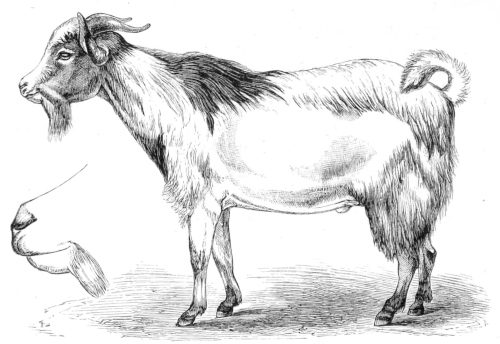
Bongo Goat.
BONGO GOATS.
It is to their indifference to cattle-breeding, like what is practised so extensively by the Dinka, that the Bongo owe their comparatively peaceful relations with the so-called “Turks.” It is to the same cause that the latter are indebted for the sluggish measure of opposition shown them by their vassals. The domestic animals of the Bongo are poultry, dogs, and goats; sheep being almost as rare as cattle. The goats are unlike those of the Dinka, but are of a breed quite common throughout these regions of Central Africa. Not only did I see them amongst the Mittoo and Madi, but likewise among the Babuckur, and even in the country of the Monbuttoo, whither they had been brought by the equatorial nations whom the Monbuttoo simply style the “Momvoo.” These goats, like the Dinka sheep, are distinguished by a hairy appendage from the breast and shoulders, and by a short stiff mane, which runs right along the ridge of the back to the small erect tail. The frontal is round, and projects considerably beyond the base of the nasal bone, and the horns are very strong and but slightly curved. The ordinary colour of these pretty animals is a light fawn or chamois-brown, the mane being very dark. I occasionally found the Bongo in possession of another breed which I met with nowhere else, and which is probably merely a cross with the Dinka goat. It has a remarkably short and plump body, and is generally of a pepper-and-salt colour. The coat is somewhat longer and more shaggy than that of the other breed, and besides the mane-like appendage in front the hind quarters are also covered with long rough hair.
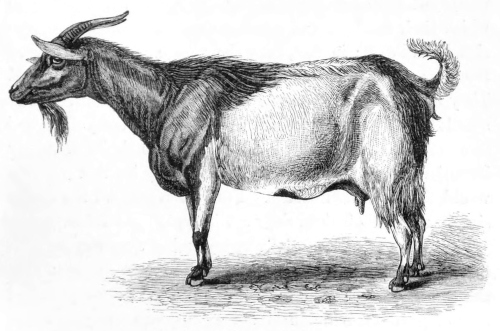
Short-bodied Goat of the Bongo.
The Bongo dogs, with regard to size, are between the small Niam-niam race and the Dinka breed, which corresponds more nearly to the common pariah of Egypt. On account of the indiscriminate crossing of the races, a dog of pure Bongo breed is somewhat rare; its chief characteristics are a reddish tan colour, short erect ears, and a bushy tail like a fox’s brush. Their greatest peculiarity appeared to me to be the bristling of their hair, which at every provocation stands up along the back and neck like that of an angry cat. The bushiness of the tail distinguishes the breed from the smooth-tailed Dinka dog, and from that of the Niam-niam, of which the tails are as curly as pigtails.
Although the Bongo are not over choice in their food, they persistently abstain from eating dog’s flesh, a practice to which their southern and south-eastern neighbours are notoriously addicted; in fact, they show as much abhorrence at the idea as they would at devouring human flesh itself. They have a curious superstition about dead dogs. I was about to bury one of my dogs that had recently died, and some of the men came and implored me to desist from my intention, since the result would assuredly be that no rain would fall upon their seeds. For this reason all the Bongo simply throw their dead dogs out into the open fields.
At some seasons, especially at the end of the rainy months, fishing and hunting offer productive sources for obtaining the means of subsistence. Hunting is sometimes practised by independent individuals going out separately; but at other times it takes the form of an extensive battue, in which the men belonging to a whole district will combine to take a share. Occasionally, too, a rich booty is obtained from the trenches and snares. Nets are used in all the battues for game, and the Bongo devote as much attention to the construction of these nets as they do to the weaving of their fish-snares and basket-pots. Their fishery is principally limited to the winter months.
HUNTING-SNARES.
Elephant-hunting has for the last twelve years been among the things of the past. It is only the oldest of the men—and here the number of the men that are really old is very small—who appear to have any distinct recollection of it at all. The huge lance-heads, which are now only weapons of luxury in the possession of the wealthy, or upon some rare occasions used for buffalo-hunting, are the sole memorials of the abundance of ivory of which Petherick, as an eye-witness, has given so striking a description. The snares by which the Bongo succeed in catching the smaller kinds of game generally consist of the stem of a tree balanced horizontally by means of ropes.[29] A spot which the game is known to haunt is selected for the erection of these snares; a hedge, or some sort of enclosure, is set up on each side of the tree so that the game may be obliged to run underneath: it is arranged so that the animals as they pass tread upon a kind of noose or slip-knot which slackens the ropes by which the tree is suspended, and the falling weight crushes and kills the game below. The numbers of snares of this description which are found in the bush-thickets is a sufficient proof of their efficacy. The smaller species of antelopes, ichneumons, civets, genets, wild cats, servals, and caracals, are all in turn caught by this stratagem.
Hunting on a minor scale is a very favourite recreation, and the children find a daily amusement in catching rats and field-mice. They weave baskets in the form of long tubes, which they lay flat upon the ground in the immediate neighbourhood of the mouse-holes; they then commence a regular battue, when the scared mice, scampering back to regain their homes, run through the stubble, and often rush into the open traps, where, like fish in a weir-basket, they are easily secured. In this way the Bongo boys catch considerable quantities of meriones, Mus gentilis, and M. barbarus, which they tie together by their tails in clusters of about a dozen, and barter them to each other as dainty morsels. “These are our cows,” they would shout to me with great glee whenever I met them returning after their sport had been successful. Another use which is made of the mice which are captured by this simple artifice is to employ them for a bait for securing what they esteem the especial delicacy of roast cat. On the narrow paths which traverse the steppes like rifts in the long grass, they construct diminutive huts out of some twisted reeds; by placing the mice inside these they are very often able to entice the cats into a snare.
With the exception of human flesh and the flesh of dogs, the Bongo seem to consider all animal substance fit for eating, in whatever condition it may be found. The putrefying remnant of a lion’s feast, which lies in the obscurity of a forest and is only revealed by the kites and vultures circling in the air above, is to them a welcome discovery. That meat is “high” is a guarantee for its being tender, and they deem it in that condition not only more strengthening than when it is fresh, but likewise more easy of digestion. There is, however, no accounting for taste, certainly not with the Bongo, who do not recoil from the most revolting of food. Whenever my cattle were slaughtered, I always saw my bearers eagerly contending for the half-digested contents of the stomach, like the Esquimaux, whose only ideas of vegetables appears to be what they obtain from the contents of the paunches of their reindeers; and I have seen the Bongo calmly strip off the disgusting amphistoma-worms which literally line the stomachs of all the cattle of this region, and put them into their mouths by handfuls. After that, it was not a matter of surprise to me to find that the Bongo reckons as game everything that creeps or crawls, from rats and mice to snakes, and that he is not particular what he eats, from the carrion vulture to the mangy hyæna, or from the fat earth-scorpions (Heterometrus palmatus) to the caterpillars of the winged termites with their oily beetle-bodies.
Having thus dilated with more minuteness than elsewhere upon the external features of Bongo life, such as their agriculture, hunting, and fishing, I may proceed to call attention to those arts by which, even in this low grade of development, man seeks to ameliorate and embellish his existence.
BONGO DWELLINGS.
First of all, the dwelling-place may demand our notice, that which binds every man more or less to the soil which affords him his subsistence—that family nucleus, from which the wide-branching tree of human society has derived its origin.
In the period when the Khartoomers first made their way into the country, the Bongo, quite unlike the other tribes, inhabited extensive villages, which, similar to the present Seribas, were encompassed by a palisade. Neither towns nor villages are now to be seen, and the districts which are occupied at all are only marked by scattered enclosures and little gatherings of huts, as in the country of the Dinka and the Niam-niam. Very rarely are more than five or six families resident in the same locality, so that it is almost an exaggeration to speak of their being villages in any sense. The communities in past times seem to have had a preference for gathering round some great tamarind, ficus, or butter-tree, which often still survives and constitutes the only relic of habitations which have long fallen to decay; and even to the present time the Bongo appear to retain this partiality, and more often than not they may be found beneath the natural shade of a spreading roof of foliage, enjoying the light and space which are prohibited to their cramped and narrow dwellings. The ground for a considerable circuit about the huts is all well cleared and levelled, its surface being the general scene of labour on which all the women perform their ordinary domestic duties. The corn is there thrashed and winnowed; there it is brayed in the wooden mortars or pounded by the mill; there are the leaves of the tobacco plant laid out to dry; there stand the baskets with the loads of mushrooms or supply of fruit; and there may be seen the accumulated store of nutritious roots. Dogs and poultry alike seem to revel in security under the majestic covering, while the little children at their play complete the idyllic picture of life in Central Africa.[30]
Upon the erection of their dwellings there is no people in the Gazelle district who bestow so much pains as the Bongo. Although they invariably adopt the conical shape, they allow themselves considerable diversity in the forms they use. The general plan of their architecture has already been sketched. The materials they employ are upright tree-stems, plaited faggots, canes of the bamboo, clay from the mushroom-shaped white-ant hills, and tough grass and the bast of the Grewia.
The diameter of the dwellings rarely exceeds twenty-feet, the height generally being about the same. The entrance consists of a hole so small that it is necessary to creep through in order to get inside; and the door consists of a hurdle swung upon two posts so as to be pushed backwards and forwards at pleasure. The clay floor in the interior is always perfectly level; it is made secure against damp as well as against the entrance of white ants by having been flattened down by the women trampling upon broad strips of bark laid upon it. The common sleeping-place of the parents and smaller children is on the floor. The bedding generally consists only of skins, the Bongo having little care for mats. For the pillow of the family they ordinarily use a branch of a tree smoothed by being stripped of its bark.
In every dwelling-place is found a conical receptacle for corn, named the “gallotoh,” which is elevated on piles, varying in height, so as to protect the provision from the damp of the soil or from the ravages of rats or white ants. Magazines of this kind for the reserve of corn are in general use throughout Africa, from the Rumboo of Damerghoo in the Central Soudan, right into the country of the Kaffirs and Bechuanas.
All the dwellings of the Bongo, whether large or small, are marked by one characteristic, which might almost be represented as a national feature. The peak of their huts is always furnished with a circular pad of straw, very carefully made, which serves as a seat, and from which it is possible to take a survey of the country, covered with its tall growth of corn. The name of “gony” is given to this elevation, which is surrounded by six or eight curved bits of wood projecting as though the roof were furnished with horns. It is peculiar to the huts of the Bongo.
ABUNDANCE OF IRON.
Iron is found in such quantities throughout the region that naturally the inhabitants devote much of their attention to its manipulation; its very abundance apparently secures them an advantage over the Dinka. Although, according to our conceptions they would be described as utterly deficient in tools and apparatus, still they produce some very wonderful results, even surpassing the Dyoor in skill. With their rude bellows and a hammer which, more commonly than not, is merely a round ball of pebble-stone (though occasionally it may be a little pyramid of iron without a handle) upon an anvil of gneiss or granite, with an ordinary little chisel and a pair of tongs consisting of a mere split piece of green wood, they contrive to fabricate articles which would bear comparison with the productions of an English smith.[31]
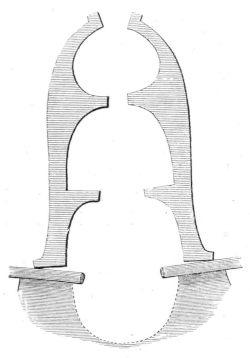
The season when opportunity is found for putting the iron-works in motion is after the harvest has been housed and the rains are over. Already, in a previous chapter,[32] iron-work, as produced by the Dyoor, has been noticed, but the Bongo have a system considerably more advanced, which appears worthy of a brief description. Their smelting apparatus is an erection of clay, generally about five feet in height, containing in its interior three distinct compartments.[33] These are all of the same size, that in the middle being filled with alternate layers of fuel and ore. This centre chamber is separated from the lower by means of a kind of frame resting on a circular projection; and it is divided from the chamber above by a narrow neck of communication. The highest and lowest of the divisions are used for fuel only. Round the base of the inferior chamber there are four holes, into which the “tewels” or pokers are introduced, and to which bellows are applied to increase the intensity of the combustion; there is a fifth hole, which can be stopped with clay as often as may be desired, and which serves to allow the metal to be raked out after it has trickled down into the cavity below the frame.
The most important of the iron productions are designed for the trade that the Bongo carry on with the tribes that dwell in the north, and which some time since was very active. The raw iron is exhibited in three separate shapes: one is named “mahee,” being spear-heads of one or two feet long, corresponding exactly with what has been mentioned as common with the Dyoor; the second is known as “loggoh kullutty,” and is simply a lot of black, ill-formed spades; the third is called distinctively “loggoh,” consisting of regular spades, which, under the market appellation of “melot,” have a wide sale everywhere along the course of the Upper Nile.
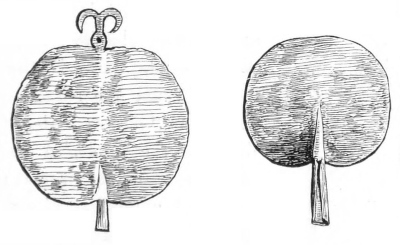
Iron money. Loggoh Kullutty. Loggoh melot.
BONGO MONEY.
The “loggoh kullutty” is the circulating medium of the Bongo, the only equivalent which Central Africa possesses for money of any description; but, rough-shaped as it is, it seems really to answer in its way the purpose of regular coin. According to Major Denham, who visited the Central Soudan in 1824, there were at that time some iron pieces which were circulated as currency in Loggon on the Lower Shary, answering to what is now in use among the Bongo; but at the period of Barth’s visit all traces of their use had long disappeared. The “loggoh kullutty” is formed in flat circles, varying in diameter from 10 to 12 inches. On one edge there is a short handle; on the opposite there is attached a projecting limb, something in the form of an anchor. In this shape the metal is stored up in the treasures of the rich, and up to the present time it serves as well as the lance-heads and spades for cash and for exchanges, being available not only for purchases, but for the marriage portions which every suitor is pledged to assign. The axe of the Bongo consists of a flat, cumbrous wedge of iron, into the thick end of which is inserted a knobbed handle; it is an instrument differing in no particular from what may be seen throughout Central Africa.
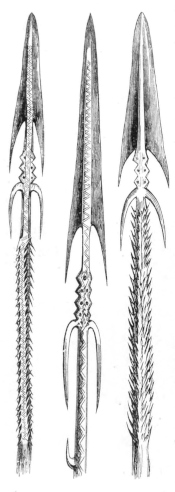
Bongo lances.
Besides these rough exhibitions of their craft, the Bongo produce arms, tools, and ornaments of admirable quality, and, at the instance of the controllers of the Seribas, have manufactured chains and manacles for the slave-traffic. Very elegant, it might almost be said artistic, is the work displayed on the points of their arrows and lances. The keen and (to use a botanical expression) the “awny” barbs and edges of these instruments, to any one who is aware of the simple means of production in their reach, must be quite an enigma. The lances are readily recognised by their shapes, and may be classified in a threefold way. First, there is the common lancet-formed spear-head, which is known as “mahee;” then, secondly, there is the “golo,” a hastate sort of spear, with long iron barbs below the point extending along the stem to which the wooden stock is attached; whilst the third description is called “makrigga,” and consists of a spike, the stem of which is covered with a number of teeth symmetrically arranged along it, sometimes upwards and sometimes downwards. This makrigga is often merely an article of show, and the technical skill of the smith is concentrated upon its design. The name of makrigga is appropriated to it from the Randia dumetorum,[34] a prickly shrub, which is quite common in the district: seeming to indicate that the pattern is derived from an object in nature, it affords a fresh illustration of the view, that all human arts are only imitations of what may be observed in the free fields of a wide creation.
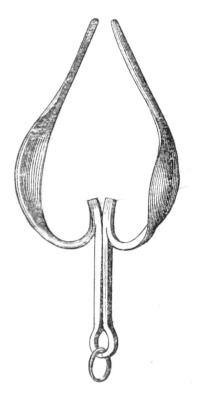
Pincers used by the Bongo women for plucking out their eyelashes.
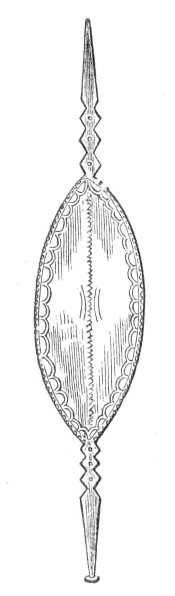
Knife of the Bongo women.
BONGO ORNAMENTS.
Equal care is bestowed upon the production of the iron and copper ornaments which are worn and the cutlery which is used by the women. For the purpose of plucking out their eyebrows and eyelashes, they employ a pair of little pincers called “peenoh,” of which an illustration is here introduced. Quite peculiar to the Bongo women are their “tibbah,” or elongated oval knives, with handles at either end, which are sharpened on both edges, and which are often very elaborate in their workmanship. These knives are in constant use for all domestic purposes, being of especial service in peeling their tubers and in slicing their gourds and cucumbers. The rings, the bells, the clasps, the buttons, whatever they affix to their projecting lips or attach to the rims of their ears, the lancet-shaped hair-pins, which appear indispensable to the decoration of the crown of their head and to the parting of their locks, all are fabricated to supply the demands of the Bongo women’s toilet.
The decoration of which the men are proudest is the “dangabor,” which simply means “rings one above another.” The Dinka and the Dyoor both have an ornament very similar to this, composed of accumulated rings, which cover the arm below the elbow; but the Bongo finish off their article with much more elaborate work. Each separate ring is furnished with a boss of a height and strength to correspond with the ring next to it, the rings themselves being forged so as to become gradually larger in proportion as they are farther from the wrist. The arm is thus covered with what may be described as a sleeve of mail, each ring of which can be turned round or displaced at pleasure.
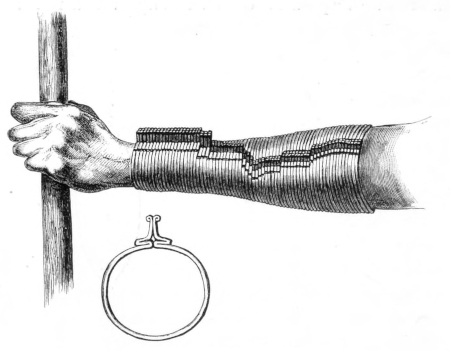
The Dangabor and a single ring.
WOODEN UTENSILS OF THE BONGO.
Hardly inferior to the skill of the Bongo in the working of iron is their dexterity in wood-carving. Perhaps the most striking specimens of their art in this way may be noticed in the little low four-legged seats or stools which are found in every household, and are called “hegba.” These are invariably made from a single block, the wood chosen for the purpose being that of the Göll-tree (Prosopis lanceolata, Benth.), which is of a chestnut brown, and after use acquires an excellent polish; they are used only by the women, who are continually to be seen sitting on them in front of their huts, but they are altogether avoided by the men, who regard every raised seat as an effeminate luxury.
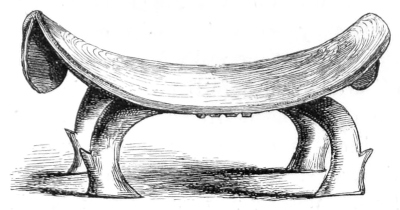
Bongo stool.
Other articles of their fabric in wood are the pestles, the troughs for oil-pressing, the flails for threshing corn, and, most remarkable of all, the goblet-shaped mortars in which the corn is bruised before it is ground into flour upon the grinding-stones. Very graceful in shape are these mortars, not unlike a drinking-goblet with a cut stem; they are not sunk below the ground, as is ordinarily the case with those of the Dinka and Dyoor, but they can be removed whenever it is requisite from place to place. Their height is about thirty inches. Mortars of very similar design were noticed by Barth amongst the Musgoo, and they are also used by the Ovambo, the Makololo, and other negro nations. They are worked by two women at once, who alternately pound away with heavy pestles in a regular African fashion, which has been long immortalised by the pictorial representations of ancient Egypt. Very cleverly, too, do the Bongo cut spoons of very choice design out of horn, of the same shape as may be found in nearly every market in Europe.
Consequent upon the oppression to which the Bongo have now for years been subject, and the remorseless appropriation of all their energies by the intruders, very many of the primitive habits of the people were disappearing; and at the time of my visit my attention was rather arrested by what were memorials of a bygone and happier condition of things, than by anything that was really done under my eyes. Just as in the Central Soudan, in Borneo, and in the Tsad countries, so here also the destructive power of Islamism has manifested itself by obliterating, in comparatively a brief space of time, all signs of activity and all traces of progress of any kind. Wherever it prevails, it annihilates the chief distinctions of race, it effaces the best vestiges of the past, and extends, as it were, a new desert upon the face of the land which it overruns. Those who have been eye-witnesses of the state of things when the intruders first broke in upon the country, gave me still further details of what had been the special industries of the people.
In the villages there are found very frequently whole rows of figures carved out of wood and arranged either at the entrances of the palisaded enclosures, forming, as it were, a decoration for the gateway, or set up besides the huts of the “Nyare” (chiefs), as memorials, to immortalise the renown of some departed character. In Moody, a district towards the west, I came across the remains (still in a perfect state of preservation) of an erection of this sort, which had been reared above the grave of the Bongo chieftain Yanga. Large as life, the rough-hewn figures represented the chief followed in procession by his wives and children, apparently issuing from the tomb. The curious conception of the separate individuals, and the singular mode in which they were rendered by the artist, awakened my keenest interest. The illustration which is subjoined may be accepted as a faithful representation of the first rude efforts of savages in the arts of sculpture.
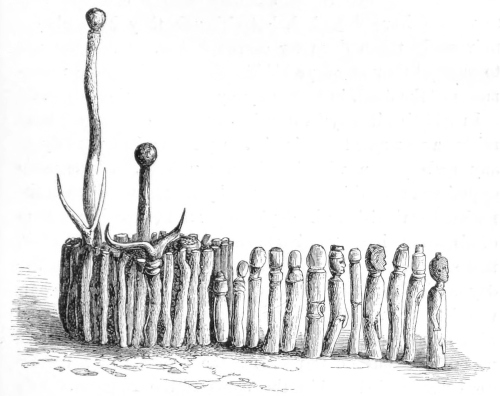
Yanga’s grave.
BONGO GRAVES.
Plastic representations of men are known generally by the name of “Moiogohgyee:” when I first saw them, I was under the impression that they must be idols, similar to what the Fetish-worship has introduced into the western coasts, but I soon satisfied myself of my misconception in this respect. The true design of these wooden figures is simply to be a memorial of some one who has departed this life: this is proved by the term “Moiagoh Komarah,” i.e., the figure of the wife, which is applied to an image raised by a surviving husband to the pious memory of his departed wife, and which is set up in the hut as a species of Penates. However rude these attempts must be pronounced, they nevertheless reveal a kind of artistic power certainly far from contemptible; at any rate, the very labour bestowed upon them indicates the appreciation which the artist entertained for his work. The Bongo, for their own part, regard their wooden images as incomparably superb, and persuade themselves that the likenesses of those who are represented are perfect. To complete the illusion, they very often deck the figure with bead-necklaces and rings and affix some hair over the appropriate parts of the body. Travellers in Central Africa have narrated that they have seen figures of wood corresponding to what I have described, but although they have almost universally taken them for carved deities, I would venture to suggest that in all probability they are elsewhere monuments of the dead, in the same way as among the Bongo.
In addition it may be mentioned that a custom exists of raising a monument of this kind to preserve the memory of any male person who has been murdered. I was made acquainted with this circumstance by the mouth of one of the national authorities, who depicted to me the peculiar custom of his fathers in a narrative to the following effect. He said that murder and manslaughter used to be the order of the day at all their festivals and drinking-bouts; when the harvest had been abundant and the granaries were well-stored with corn, there used to be no bounds to their licentiousness; there was no respect for the Nyare, and his words were disregarded amidst the blows of the Nogarra. Now the “Turks” would punish a murderer by carrying off his wife and children, and compel him to pay a heavy fine in iron and make some compensation to the relatives: but formerly the friends would take the law into their own hands, and proceed to exact personal punishment, though they had to set to work very warily if they would keep themselves out of difficulty. When anyone discovered that either his friend, or it might be his brother, or perhaps his wife, had been killed, and the criminal could not be detected, it was no unknown device to prepare beforehand an image carefully representing the murdered person, and very often the likeness would be singularly perfect. He would then invite all the men to a feast, at which the spirituous “legyee” would be freely circulated; and then, when the excitement was at its height, in the very midst of the singing and dancing, he would unexpectedly introduce the figure that had been prepared. The apparition would be sure to work its effect; the culprit would not fail to be betrayed, as he cowed and exhibited his wish to slink away. Having thus detected the offender, the injured party could deal with him as he pleased.
BONGO MUSIC.
The Bongo, in their way, are enthusiastic lovers of music; and although their instruments are of a very primitive description, and they are unacquainted even with the pretty little guitar of the Niam-niam, which is constructed on perfectly correct acoustic principles, yet they may be seen at any hour of the day strumming away and chanting to their own performances. The youngsters, down to the small boys, are all musicians. Without much trouble, and with the most meagre materials, they contrive to make little flutes; they are accustomed also to construct a monochord, which in its design reminds one of the instrument which (known as the “gubo” of the Zulus) is common throughout the tribes of Southern Africa. This consists of a bow of bamboo, with the string tightly strained across it, and this is struck by a slender slip of split bamboo. The sounding board is not, however, made of a calabash attached to the ground, but the mouth of the player himself performs that office, one end of the instrument being held to the lips with one hand, while the string is managed with the other. Performers may often be seen sitting for an hour together with an instrument of this sort: they stick one end of the bow into the ground, and fasten the string over a cavity covered with bark, which opens into an aperture for the escape of the sound. They pass one hand from one part of the bow to the other, and with the other they play upon the string with the bamboo twig, and produce a considerable variety of buzzing and humming airs which are really rather pretty. This is quite a common pastime with the lads who are put in charge of the goats. I have seen them apply themselves very earnestly and with obvious interest to their musical practice, and the ingenious use to which they apply the simplest means for obtaining harmonious tones testifies to their penetration into the secrets of the theory of sound.
As appeals, however, to the sense of sound, the great festivals of the Bongo abound with measures much more thrilling than any of these minor performances. On those occasions the orchestral results might perhaps be fairly characterised as cat’s music run wild. Unwearied thumping of drums, the bellowings of gigantic trumpets, for the manufacture of which great stems of trees come into requisition, interchanged by fits and starts with the shriller blasts of some smaller horns, make up the burden of the unearthly hubbub which re-echoes miles away along the desert. Meanwhile, women and children by the hundred fill gourd-flasks with little stones, and rattle them as if they were churning butter: or again, at other times, they will get some sticks or dry faggots and strike them together with the greatest energy. The huge wooden tubes which may be styled the trumpets of the Bongo are by the natives themselves called “manyinyee;” they vary from four to five feet in length, being closed at the extremity, and ornamented with carved work representing a man’s head, which not unfrequently is adorned with a couple of horns. The other end of the stem is open, and in an upper compartment towards the figure of the head is the orifice into which the performer blows with all his might. There is another form of manyinyee which is made like a huge wine-bottle; in order to play upon it, the musician takes it between his knees like a violoncello, and when the build of the instrument is too cumbrous, he has to bend over it as it lies upon the ground.
Little difference can be noticed between the kettle-drums of the Bongo and those of most other North African negroes. A section is cut from the thick stem of a tree, the preference being given to a tamarind when it can be procured; this is hollowed out into a cylinder, one end being larger than the other. The ends are then covered with two pieces of goat-skin stripped of the hair, which are tightly strained and laced together with thongs. At the nightly orgies a fire is invariably kept burning to dry the skin and to tighten it when it has happened to become relaxed by the heavy dews.
A great number of signal-horns may be seen made from the horns of different antelopes; these are called “mangoal,” and have three holes like small flutes, and in tone are not unlike fifes. There is one long and narrow pipe cut by the Bongo out of wood which they call a “mburrah,” and which has a widened air-chamber close to the mouth-piece, very similar to the ivory signal-horns which are so frequently to be seen in all the negro countries.
BONGO SINGING.
Difficult were the task to give any adequate description of the singing of the Bongo. It must suffice to say that it consists of a babbling recitative, which at one time suggests the yelping of a dog and at another the lowing of a cow, whilst it is broken ever and again by the gabbling of a string of words which are huddled up one into another. The commencement of a measure will always be with a lively air, and every one, without distinction of age or sex, will begin yelling, screeching, and bellowing with all their strength; gradually the surging of the voices will tone down, the rapid time will moderate, and the song be hushed into a wailing, melancholy strain. Thus it sinks into a very dirge, such as might be chanted at the grave, and be interpreted as representative of a leaden and a frowning sky, when all at once, without note of warning, there bursts forth the whole fury of the negro throats; shrill and thrilling is the outcry, and the contrast is as vivid as sunshine in the midst of rain.
Often as I was present at these festivities I never could prevent my ideas from associating Bongo music with the instinct of imitation, which belongs to men universally. The orgies always gave me the impression of having no other object than to surpass in violence the fury of the elements. Adequately to represent the rage of a hurricane in the tropics any single instrument of course must be weak, poor, and powerless, consequently they hammer at numbers of their gigantic drums with powerful blows of their heavy clubs. If they would rival the bursting of a storm, the roaring of the wind, or the splashing of the rain, they summon a chorus of their stoutest lungs; whilst to depict the bellowings of terrified wild beasts, they resort to their longest horns; and to imitate the songs of birds, they bring together all their flutes and fifes. Most characteristic of all, perchance, is the deep and rolling bass of the huge “manyinyee,” as descriptive of the rumbling thunder. The penetrating shower may drive rattling and crackling among the twigs, and amid the parched foliage of the woods, and this is imitated by the united energies of women and children, as they rattle the stones in their gourd-flasks, and clash together their bits of wood.
It remains still to notice some examples of the various handicrafts which are practised by this people. Compared with other nations, the Bongo are remarkable for the attention they give to basket-work. They make (very much after the fashion of a coffee-bag) a strainer to filter and clarify their “legyee,” which is a drink something like ale fermented from sorghum. Baskets are roughly yet substantially made by twining together the stems of the bamboo. As their first efforts in this line, the natives are accustomed to make the circular envelopes in which they pack their corn for exportation. They take the coriaceous leaves of the Combreta and Terminaliæ, and by inserting the petiole of one leaf into the laminæ of two others, they form strips of leaves which in a few minutes are made into a kind of basket, equally strong and flexible, which answers its purpose admirably.
Woven matting is very rarely found in use. The walls of every hut are made of basket-work, as are the beehives, which are more often than not under the shadow of some adjacent butter-tree. Generally these hives are long cylinders, which midway have an opening about six inches square. The yield of honey, wild or half-wild, is very large, and of fine quality: the bees belong to the European species. The aroma of the Gardenia flowers is retained to a very palpable degree, but wherever the Candelabra-euphorbia happens to be abundant, the honey partakes of the drastic properties of its poisonous milk, and has been the cause of the natives being reproached with the intention of poisoning the Nubians.
BONGO FISHING.
In consequence of the people being so much engrossed at certain periods of the year by their hunting and fishing, the manufacture of fish-nets, creels, and snares, makes an important item in their industrial pursuits. For the most part all the twist, the bird-snares, and the fishing-lines are made from the fibres of bast, which are so plentiful in the cultivated Crotalaria and the Hibiscus. For inferior purposes the common lime-like bast of the Grewia mollis is made to suffice. The Sanseviera guineensis is not less abundant, but the bast which it yields, although very fine, is not very enduring. It is generally very black through having been left to lie upon the dark soil of the marshes, and is only used for making a kind of kilt like a horse’s tail, which the women wear behind from a girdle about their waist. Cotton-shrubs are planted only by the Dinka, who make their fishing-lines of the material which is thus provided.
The manufacture of the pottery all falls to the care of the women, who do not shrink from the most difficult tasks, and, without the help of any turning-wheel, succeed in producing the most artistic specimens. The larger water-bottles are sometimes not less than a yard in diameter. The clay water-pots are ordinarily of a broad oval shape, adapted for being carried on the head with the narrow end resting on a kind of porter’s knot, which is made either of leaves or plaited straw. Handles are uniformly wanting: for, whatever may be the purpose to which the vessels are applied, whether for holding water or oil, for boiling or for baking, the material of which they are made contains so large a quantity of mica (which the natives do not understand how to get rid of), that it is very brittle, and the imperfect baking in the open air contributes to this brittleness. To compensate for the lack of handles by which the vessels might be lifted, their whole outer surface is made rather rough by being ornamented by a number of triangles and zigzag lines, which form all manner of concentric and spiral patterns. The gourd-platters and bottles are generally decorated with different dark rows of triangles. A large amount of labour is expended upon the manufacture of clay bowls for pipes, which are often really elaborate, and have generally quite a European character; very often their design consists of a human head, and these are so treasured as works of art, that their possessors cannot be induced to part with them at any price.
The preparation of skins for leather aprons and similar purposes has hitherto been limited amongst the Bongo, as probably amongst all the heathen negroes, to the simplest mechanical process of kneading and fulling by means of ashes and dung, which is followed up by a liberal application of fat and oil till a sufficient degree of softness and pliancy is attained. Recently from the Nubians the use of tan has become generally known, and it may not unreasonably be conjectured that the method of using it will gradually extend from the north of Africa towards the south, in the same way as it has spread upwards from the Cape. Previous to their contact with Europeans, none of the southern people of Africa had discovered the use of tan, although the skins of their animals were a very important item in their economy. In Bongoland at present the bark of the Gere (Hymenocardia Heudelotii) is what is most frequently employed, and the red tan it yields is found to be very effectual.
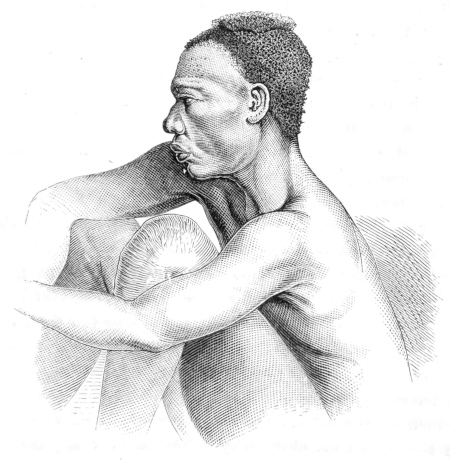
Bongo.
BONGO PHYSIOGNOMY.
We have now to notice the apparel and general external aspect of the people, which is as important in its way as the outline of any natural object, such as the growth and foliage of trees. In default of proper clothing, various disfigurements of person play an important part, and the savage is voluntarily even more of a slave to fashion than any of the most refined children of civilization. Here, as in every other quarter of the globe, the male sex desires to be externally distinguished from the female, and they differ widely in their habits in this respect. There is, however, one ugly custom which is common to both sexes throughout the basin of the Gazelle, which consists in snapping off the incisors of the lower jaw, an operation which is performed as soon as the milk teeth have been thoroughly replaced by the permanent. Upon the south borders of the country, near the Niam-niam, this custom ceases to be exactly followed, and there it is the habit, as with the Niam-niam themselves, instead of breaking them off, to file some of the teeth, and indeed sometimes all of them, into sharp points. Occasionally the natives file off the sides of the upper teeth as well as clip off the lower; nor is it an uncommon thing for gaps to be opened at the points of contact of the central upper teeth, whilst every now and then individual cases occur where interstices have been made in the sides of all the four front teeth large enough to admit a good-sized toothpick. Circumcision is unknown throughout the entire river-district.
The men do not go about in a condition so naked as either the Dyoor, the Shillooks, or the Dinka, but they wear an apron of some sort of skin, and recently have adopted a strip of stuff, which they fasten to the girdle that is never missing, allowing the ends to hang over before and behind. All the sons of the red soil, as the Bongo, the Mittoo, the Niam-niam, and the Kredy, are called “women” by the Dinka, because amongst them the females only are protected by any covering of this description. The Bongo women on the other hand, and especially those who reside on the highlands, obstinately refuse to wear any covering whatever either of skin or stuff, but merely replenish their wardrobe every morning by a visit to the woods; they are, therefore, in respect of modesty, less particular than the women of the Dinka; a supple bough with plenty of leaves, more often than not a bough of the Combretum, and perhaps a bunch of fine grass, fastened to the girdle, is all they consider necessary. Now and then a tail, like a black horsetail, composed of the bast of the Sanseviera, is appended to the back of the girdle in a way that has already been mentioned. The rest of the body is allowed by both sexes to be entirely unclad, and no addition to the costume is ever seen, except we should reckon the feathered head-gear, which is exhibited on the occasion of a feast or a ball.
As a rule the hair of both men and women is kept quite short, and not unfrequently is very closely shorn, the principal exception being found in the south, where the habits of the Niam-niam have extended their influence into the Bongo territory, and both men and women wear tufts and braids of a length approximating to that of their neighbours.
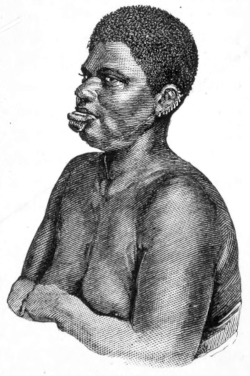
Bongo Woman.
BONGO WOMEN.
It may possibly be imagined that the extremely primitive covering of the Bongo women irradiates them with something of the charm of Paradise; but a very limited experience will soon dispel the rapture of any illusion of the kind. All full-grown women attain such an astounding girth of body, and acquire such a cumbrous superabundance of flesh, that it is quite impossible to look at them without observing their disproportion to the men. Their thighs are very often as large as a man’s chest, and their measurement across the hips can hardly fail to recall the picture in Cuvier’s Atlas of the now famous “Hottentot Venus.” Shapes developed to this magnitude are no longer the exclusive privilege of the Hottentots; day after day I saw them among the Bongo, and they may well demand to be technically described as “Steatopyga.” In certain attitudes, as for instance when they are carrying their heavy water-jars upon their heads, they seem to assume the shape of an inverted S. To their singular appearance the long switch tail of bast very much contributes, and altogether the profile of a fat Bongo woman is not unlike that of a dancing baboon. I can vouch for it that women who weigh twenty stone are far from scarce.
Very few are the people of Central Africa amongst whom the partiality for finery and ornaments is so strongly shown as with the Bongo. The women wear on their necks an accumulation of cords and beads, and not being fastidious like their neighbours, will put on without regard to shape or colour, whatever the market of Khartoom can provide. The men do not care much for this particular decoration, but prefer necklaces, on which they string some of those remarkable little fragments of wood which are so constantly found in every region of Africa. With the bits of wood hang fragments of roots, which are in form something like the mandrake, which, in Southern Europe, has been the subject of so strange a superstition. Alternating with the roots and wood are the talons of owls and eagles, the teeth of dogs, crocodiles, and jackals, little tortoise-shells, the claws of the earth-pig (Orycteropus), and in short any of those objects which we are accustomed to store in the cabinets which adorn our salons. They appear to supply the place of the extracts from the Koran which, wrapped in leather sheathes, the Nubians wear by dozens about their person; anything in the shape of an amulet being eagerly craved by every African.
BONGO DECORATION.
Not unfrequently the men deck themselves out in females’ ornaments. Many cover the rims of their ears with copper rings and crescents; others pierce the upper lip like the women, and insert either a round-headed copper nail or a copper plate, or, what is still more general, some rings or a bit of straw. The skin of the stomach above the waist is often pierced by the men, and the incision filled up with a bit of wood, or occasionally by a good-sized peg. On the wrist and upper part of the arm they wear iron rings of every pattern; some rings are cut out of elephant and buffalo hide, and look almost as though they were made of horn. The “dangabor,” an ornament composed of a series of iron rings, and worn on the lower portion of the arm, has been already described.
The Bongo women delight in distinguishing themselves by an adornment which to our notions is nothing less than a hideous mutilation. As soon as a woman is married the operation commences of extending her lower lip. This, at first only slightly bored, is widened by inserting into the orifice plugs of wood gradually increasing in size, until at length the entire feature is enlarged to five or six times its original proportions. The plugs are cylindrical in form, not less than an inch thick, and are exactly like the pegs of bone or wood worn by the women of Musgoo. By this means the lower lip is extended horizontally till it projects far beyond the upper, which is also bored and fitted with a copper plate or nail, and now and then by a little ring, and sometimes by a bit of straw about as thick as a lucifer-match. Nor do they leave the nose intact: similar bits of straw are inserted into the edges of the nostrils, and I have seen as many as three of these on either side. A very favourite ornament for the cartilage between the nostrils is a copper ring, just like those that are placed in the noses of buffaloes and other beasts of burden for the purpose of rendering them more tractable. The greatest coquettes among the ladies wear a clasp or cramp at the corners of the mouth, as though they wanted to contract the orifice, and literally to put a curb upon its capabilities. These subsidiary ornaments are not however found at all universally among the women, and it is rare to see them all at once upon a single individual: the plug in the lower lip of the married women is alone a sine quâ non, serving as it does for an artificial distinction of race. According to the custom of the people, there need only be a trifling projection of the skin so as to form a flap or a fold, to be at once the excuse for boring a hole. The ears are perforated more than any part, both the outer and the inner auricle being profusely pierced; the tip of the ear alone is frequently made to carry half-a-dozen little iron rings. There are women in the country whose bodies are pierced in some way or other in little short of a hundred different places.
The Bongo women limit their tattooing to the upper part of the arm. Zigzag or parallel lines, or rows of dots, often brought into relief by the production of proud flesh after the operation has been accomplished, are the three forms which in different combinations serve as marks of individual distinction. The men tattoo themselves differently, and some of them abstain from the operation altogether. At one time the lines run across the breast and stomach to one side of the body; at another they are limited to the top of the arm, whilst it is not at all unusual for the neck and shoulder-blades to be tattooed.
Besides the ornaments that I have mentioned, the toilet of a Bongo lady is incomplete without the masses of iron and copper rings which she is accustomed to wear on her wrists and arms, and more especially on her ankles. These rings clank like fetters as she walks, and even from a distance the two sexes can be distinguished by the character of the sound that accompanies their movements. That human patience should ever for the sake of fashion submit to a still greater martyrdom seems almost incredible, though hereafter we shall have sufficient proof when we delineate the habits of the Mittoo, the neighbours of the Bongo, that such is really the case.
In Bongoland, as in all the northern parts of the territory that I visited, copper of late years has attained a monetary value, and has become an accustomed medium of exchange. Glass beads are annually deteriorating in estimation, and have long ceased to be treasured up and buried in the earth like jewels or precious stones, being now used only to gratify female vanity. In former times, when the only intercourse that the Bongo held with the Mohammedan world was by occasional dealings with the Baggara Arabs, through the intervention of the Dembo, a Shillook tribe connected with the Dyoor, cowrie-shells were in great request, but these also have long since fallen out of the category of objects of value. Gold and silver are very rarely used as ornaments, even in the Mohammedan parts of the Eastern Soudan; it is therefore hardly a matter of surprise that to the Bongo, whose soil is singularly uniform in its geological productions, they should be all but unknown. The Bongo, moreover, have but little value for brass, differing greatly in this respect from their neighbours, the Dyoor.
BONGO WEAPONS.
Their weapons consist mainly of lances, bows and arrows, shields being very rarely used, and even then being appropriated from other neighbouring nations. Although the greater part of the population is at present quite unaccustomed to any warlike occupation, except when any of them chance to be employed in the raids upon the Dinka or in the Niam-niam campaigns, yet they still maintain a wonderful dexterity in the use of the bow and arrow, and we shall have occasion in another place to notice their performances in this respect. The large size of their weapons is remarkable; I saw many of their bows which were four feet in length, their arrows are rarely under three feet long, and on this account they are never made from the light reed-grass, but are cut out of solid wood. The forms of the arrow-heads also have a decided nationality stamped upon them. In the course of time I was easily able to determine at a glance the tribe to which any weapon belonged by certain characteristics, the details of which would now engross more time and space than are at our command. It may be mentioned that the Bongo, like the negroes above Fesoglu, on the Upper Blue Nile, imbue their arrows with the milky juice of one of the Euphorbiæ. This species, of which I now for the first time collected some specimens, has been erroneously represented by Tremaux in the atlas of his travels[35] as Euphorbia mamillaris, but it is in fact one of the many Cactus-euphorbiæ for which the flora of Tropical Africa, and especially that of the drier regions, is distinguished, and is entirely distinct from the South African species. It is a branching, straggling shrub, varying in height from five to eight feet, at one time growing in large masses in the light woods, and then failing altogether for the space of several days’ journey. Not only the larger branches, nearly two inches thick, but also the smaller boughs, are encrusted with a snowy white rind, covered with thick spiny protuberances, which stand singly under the eyes of the leaves. At the extremity of each bough is a bunch of fleshy succulent leaves, shaped like lances, and six inches in length. This species of Cactus-euphorbia (E. venefica) is termed by the Bongo “bolloh,” in contradistinction to “kakoh,” their name for the larger sort (E. candelabrum), which is common in the country, but of which the milky juice is far less dangerous than that of the “bolloh,” for if this be applied in a fresh condition to the skin, it results in a violent inflammation. It is, however, my opinion that this juice, as it is used by the Bongo, being spread in a hard mass over the barbs and heads of the arrows, can do very little harm to the wounded, as when it is once hard it is difficult to melt, and there cannot possibly be time for it to commingle with the blood after a wound has been made by an arrow.
BONGO GAMES.
We may now turn our attention to the Bongo games, which are as original and primitive as their music. One of these games, as forming excellent training for the chase, deserves some especial notice. A number of men are provided with pointed sticks made of hard wood, which they use as lances. They form a large ring, and another man who has a piece of soft wood attached to a long string, runs round and round within the circle. The others then endeavour with their pointed sticks to hit the mark whilst it is being carried rapidly round. As soon as it is struck it falls to the ground, and the successful marksman is greeted with a loud cheer. Another game requires no less calmness and dexterity. A piece of wood bent into a crescent has a short string attached to the middle; this wood is then hurled by the one end of it with such violence to the earth that it goes spinning like a boomerang through the air. The players stand face to face at a distance of about twenty feet apart, and the game consists in catching the wood by the string, a performance that requires no little skill, as there is considerable danger of receiving a sharp knock. Both games might, under some modifications, admit of being adopted into our rural sports.
Turning now to the national manners, customs, and ideas, I profess that they are subjects of which I must treat with considerable reserve, since my residence as a stranger for two years amongst these savages only gave me after all a very superficial insight into the mysteries of their inner life. Since, however, the accounts of eye-witnesses, who knew the land in its primitive condition, seem to accord with and to corroborate my own observations, as well as the information I obtained from the Bongo themselves, I am in a position to depose to some facts, of which I must leave the scientific analysis to those who are seeking to cultivate the untried soil of the psychology of nations.
Elsewhere, and among other nations with whom I became acquainted, the number of a man’s wives was dependent on the extent of his possessions, but amongst the Bongo it seemed to be limited to a maximum of three. Here, as in other parts of Africa, a wife cannot be obtained for nothing, even the very poorest must pay a purchase price to the father of the bride in the form of a number of plates of iron; unless a man could provide the premium, he could only get an old woman for a wife. The usual price paid for a young girl would be about ten plates of iron weighing two pounds each, and twenty lance tips. Divorces, when necessary, are regulated in the usual way, and the father is always compelled to make a restitution of at least a portion of the wedding-payment. If a man should send his wife back to her father, she is at liberty to marry again, and with her husband’s consent she may take her children with her; if, however, her husband retains the children, her father is bound to refund the entire wedding-gift that he received. This would be the case although ten years might have elapsed since the marriage. The barrenness of a woman is always an excuse for a divorce. In cases of adultery, the husband endeavours to kill the seducer, and the wife gets a sound flogging. Whoever has been circumcised according to the Mohammedan law, cannot hope to make a good match in Bongoland.
A Bongo woman, as a rule, will seldom be found to have less than five children: the usual number is six, and the maximum twelve. In childbirth she is supported with her arms on a horizontal beam, and is in that position delivered of the child; the navel-cord is cut very long with a knife, and always without a ligature. No festivities are observed on the occasion of a birth. The infants are carried on the mothers’ backs, sewn up in a bag of goat’s-hide, like a water-bottle. The children are kept at the breast until they have completed their second year, weaning being never thought of until they can be trusted to run about. In order to wean a child, the mother’s breast is smeared with some acrid matter, and the bruised leaves of some of the Capparidæ are mixed with water to a pulp, and have the effect of drying up the milk.
Among the Bongo and the neighbouring nations there is a custom, manifestly originating in a national morality, that forbids all children that are not at the breast to sleep in the same hut with their parents; the Bongo in this respect putting to shame many of those who would boast of their civilization. The elder children have a hut appropriated to themselves, but take their meals with the rest of the family. In addition to this custom there is the universal rule, as with ourselves, that no matrimonial alliance takes place until the youths are about eighteen and the girls about fifteen years of age.
BONGO EXEQUIES.
In the disposal of their dead, the customs of the Bongo are very remarkable. Immediately after life is extinct, the corpses are placed, like the Peruvian mummies, in what may be described as a crouching posture, with the knees forced up to the chin, and are then firmly bound round the head and legs. When the body has been thus compressed into the smallest possible compass, it is sewn into a sack made of skins, and placed in a deep grave. A shaft is sunk perpendicularly down for about four feet, and then a niche is hollowed to the side, so that the sack containing the corpse should not have to sustain any vertical pressure from the earth which is thrown in to fill up the grave. This form of interment is also prescribed in the law of Islam, which, in this and many other cases, has probably followed an African custom. The Bongo have a striking practice, for which, perhaps, some reason may be assigned, of burying men with the face turned to the north and women to the south. After the grave is filled in, a heap of stones is piled over the spot in a short cylindrical form, and this is supported by strong stakes, which are driven into the soil all round. On the middle of the pile is placed a pitcher, frequently the same from which the deceased was accustomed to drink his water. The graves are always close to the huts, their site being marked by a number of long forked branches, carved, by way of ornament, with numerous notches and incisions, and having their points sharpened like horns. Of these votive stakes I saw a number varying from one to five on each grave. The typical meaning belonging to these sticks has long since fallen into oblivion, and notwithstanding all my endeavours to become acquainted with the Bongo, and to initiate myself into their manners and customs, I could never discover a satisfactory explanation. The sticks reminded me of the old English finance-budgets in the time of William the Conqueror. In answer to my inquiries, the Khartoomers merely returned the same answer as they did to my predecessor, Heuglin; they persisted in saying that every notch denoted an enemy killed in battle by the deceased. The Bongo themselves, however, repeatedly declared that such was by no means the case, and quite repudiated the idea that they should ever think of thus perpetuating the bloodthirstiness of the dead. The neighbouring Mittoo and Madi adopt very much the same method of sepulture. The memorial-urns erected over the graves of the Musgoo remind the traveller of those of the Bongo. Whenever a burial takes place, all the neighbours are invited to attend, and are abundantly entertained with merissa. The entire company takes part in the formation of the grave, in the rearing of the memorial-urn, and in the erection of the votive stakes. When the ceremony is finished, they shoot at the stakes with arrows, which they leave sticking in the wood. I often noticed arrows that had been thus shot still adhering to the sticks.
The Bongo have not the remotest conception of immortality. They have no more idea of the transmigration of souls, or any doctrine of the kind, than they have of the existence of an ocean. I have tried various ways and means of solving the problem of their inner life, but always without success. Although the belief in immortality may be indigenous to Africa, I should question whether the ancient Egyptians did not in their religious development obey the promptings of the Asiatic East. At any rate, those statements are incorrect which would endeavour to explain the dull resignation displayed by the victims of human sacrifice in Dahomey by a theory of their belief in immortality. All religion, in our sense of the word religion, is quite unknown to the Bongo, and, beyond the term “loma,” which denotes equally luck and ill-luck, they have nothing in their language to signify any deity or spiritual being. “Loma” is likewise the term that they use for the Supreme Being, whom they hear invoked as “Allah” by their oppressors, and some of them make use of the expression, “loma-gobo,” i. e., the superior, to denote the God of the “Turks.” The almost incomprehensible prayers of the Mohammedans are called by the Bongo “malah,” which has evidently some connection with the word “Allah” that is generally repeated over and over again in all the devotions of the Nubians.
If any one is ill, his illness is attributed to “Loma,” but in the event of anybody losing a wager or a game, or returning from a hunting adventure without game, or coming back from war without booty, he is said to have had “no loma” (loma nya), in the sense of having no luck.
BONGO SUPERSTITION.
Quite amazing is the fear which exists among the Bongo about ghosts, whose abode is said to be in the shadowy darkness of the woods. Spirits, devils, and witches have the general appellation of “bitaboh;” wood-goblins being specially called “ronga.” Comprehended under the same term are all the bats (especially the Megaderma frons, which flutters about from tree to tree in broad daylight), as likewise are owls of every kind (Strix leucotis and Strix capensis being here the chief); and besides these the Ndorr (Galago senegalensis), a kind of pseudo-simia, with great red eyes and erect ears, which drags out a gloomy existence in the cavities of hollow trees. There are, too, prowling beasts of night, for which they entertain the utmost dread, regarding them with superstitious awe. To ward off the evil influences of these spirits, the Bongo are acquainted with no other means except the magical roots in which the professional sorcerers trade, in a similar way as the Mohammedan priests of the Soudan in their amulets and sentences from the Koran. Very seldom are any attempts made to expel the spirits by the means of exorcism, which is turned to great account by the Dinka magicians. The institution of the “Cogyoor” is here called “belomah,” but whenever it is necessary to have an invocation over a sick patient, they more often than not send for a professional wizard from the neighbouring Dinka.
Good spirits are quite unrecognised, and, according to the general negro idea, no benefit can ever come from a spirit at all. They affirm that the only thing they know about spirits is that they do mischief, and certain it is that they have no conception either of there being a Creator, or any kind and ruling power above. They assert that there is no other resource for obtaining communication with spirits, except by means of certain roots, which may be of service likewise in employing the powers of evil to inflict injury on others. To their knowledge of this magic may be attributed much of the influence which the native chiefs, independently of their authorised rule, exercise over the mass of the people in their districts. This may be witnessed among the Bary on the Bahr-el-Gebel, and a hundred other tribes, who yield the greatest deference to the controllers or captains of their communities. The practice of fetching down rain is never pretended to by the Bongo chiefs, and may be said to be absolutely unknown; but probably this may rise from the climate so rarely making it necessary to put their skill in this respect to the test.