Chapter X
Ellen E. (Ellen Elizabeth) Frewer translation
Preparations for Niam-niam campaign. Generosity of Aboo Sammat. Organisation of the caravan. Ceremonies at starting. Banner of Islam. Travelling costume. Terminalia forest. Hartebeest chase. Ahmed the Liar. Prospect from Mbala Ngeea. Bivouac on the Lehssy. Camp noises at night. Story of cannibalism. Ahmed’s fate. The Ibba. First meeting with Niam-niam. Growth of the popukky-grass. Elephant-hunting among the Niam-niam. Surprise at the white man. Visit to Nganye. A chieftain’s household. Entertainment by Nganye. Gumba. Colocasia. A Niam-niam minstrel. Beauty of the Zawa-trees. Encephalartus on the hill of Gumango. Cultivated districts on the Rye. Condition of hamlets and farms. Devastation of Bendo’s district. Contest with the soldiers. Escape from a bullet. Identity of the Sway and the Dyoor. The law of drainage. Passage of the Manzilly. First primeval forest. Frontier wildernesses. Organisation in the geography of plants. Importance of guinea-fowl to the traveller. Feeding the bearers. National diet.
Three months had thus elapsed in almost uninterrupted wanderings, but I found on my return to Sabby that I could spare only a short reprieve for recruiting. Previous to starting on the laborious expedition to the Niam-niam, to which under the guidance of my protector I had pledged myself, there remained only a fortnight. A score of packages had to be fastened up, many a trunk had to be arranged, clothes had to be provided, implements of many sorts to be secured, ammunition and arms to be put in readiness for the projected excursion into a hostile territory, where we proposed to pursue our way for six months to come. In addition to this provision for the future, I had to make good the arrears in my diary, to get through all my correspondence for the current year, and to provide for the remittance of my valuables to distant Europe. All this had to be accomplished in the space of fourteen days.
Nor could domestic demands afford to be overlooked. My household required a vigilant supervision. The mere labour of washing our clothes was considerable, although the accumulation of two months’ wear was by no means extensive. In order to perform the laundry work, it was necessary to send to the river, a league and a half distant, where the things could be rinsed out, dried, and bleached. On the evening before our departure for what we called “the world’s end,” my four-legged body-guard was suddenly enlarged by eight charming little pups of the splendid Shillook breed. Of my Nubian servants, Hussein was the oldest and the most experienced, and to him I entrusted the responsibility of conveying in safety the newly-born animals, together with my correspondence and all my collections, back to Ghattas’s Seriba in Dyoor-land, which I still deemed my head-quarters. The worthy fellow thus had the advantage of exchanging the prospect of a roving life among the Niam-nian for the friendly life of the Seriba, where, in the society of his countrymen, he might pass his time in playing upon the robaba, in mastering the intricacies of the game of mungala, or, while the gourd-shells of merissa went merrily round, in joining in the chorus, rendered with a fine nasal twang, of “Derderoah, derderoah el yum, derderoah, derdereh, ginyatohm.”
By the 29th of January, 1870, every preparation had been so far advanced that the bulk of the caravan was set in motion. Mohammed Aboo Sammat himself proposed to join the party in about a fortnight, as he was compelled to go into the Mittoo district to secure some additional bearers. My own retinue consisted of four Nubian servants, and three negroes who were engaged as interpreters, one of them being a Bongo, the other two genuine Niam-niam; besides these, there was a number of Bongo bearers, which at first was about thirty, but in the course of our progress was increased to forty. The whole of these were supplied to me at the sole expense of Mohammed, whose hospitality I had now been receiving for three months, and continued to enjoy to the end of our excursion; not only throughout the period of eight months did he entertain me and all my party whilst we were in his settlements, but he entered most readily into all my wishes, and whenever I desired to explore any outlying parts he would always lend me the protection of a portion of his armed force.
MOHAMMED ABOO SAMMAT.
Never before had any European traveller in Central Africa such advantageous conditions for pursuing his investigations; never hitherto in the heart of an unknown land had there been anything like the same number of bearers at his disposal, and that, too, in a region where the sole means of transport is on the heads of the natives. All the museums—particularly those which are appropriated to botany—which have been enriched in any way by my journeyings are indebted to Aboo Sammat for not a few of their novelties. Solely because I was supported by him did I succeed in pushing my way to the Upper Shary, more than 800 miles from Khartoom, thus opening fresh districts to geographical knowledge and establishing the existence of some enigmatical people.
Everything, moreover, that Mohammed did was suggested by his own free-will. No compulsion of government was put upon him, no inducements on my part were held out, and, what is more, no thought of compensation for his outlay on myself or my party ever entered his mind. The purest benevolence manifestly prompted him—the high virtue of hospitality in its noblest sense. Whoever is actuated by the spirit of adventure to penetrate into the heart of Africa, so as to make good his footing amongst four different peoples, is undoubtedly a man of energy; although he may not be spurred on by any scientific purpose, and may simply be gratifying a desire to visit lands that are strange and to enjoy sights that are rare, yet he must have succeeded in vanquishing the thoughts which suggest that there is no place like home, and which represent it as the merest folly to sacrifice domestic ease for the fatigues, troubles, and privations which are inseparable from the life of a wanderer.
Our caravan was joined on its way by a company of Ghattas’s from Dangadduloo, conducted by a stout Dinka, whose acquaintance I had already made at the Seriba where he resided. His party consisted of 500 bearers and 120 soldiers, and they contemplated, in conjunction with a part of Aboo Sammat’s people, undertaking an expedition into the ivory district of Keefa. That district was shut out from Ghattas’s by the fact of the road towards it being the property of Aboo Sammat: according to a convention entered into by the Nubians, a caravan of one company was not to traverse a region appropriated by another, unless an alliance for that purpose was made between the two. As the result of this compact, it had come to pass that no less than fifteen different roads, corresponding to the same number of different merchant houses in Khartoom, branched out towards the south and west from the localities of the Seribas into the remotest lands of the Niam-niam.
Wherever two of these roadways intersect, a serious collision between the parties concerned is almost certain to ensue. Any conductor of an expedition is sure to endeavour to get the monopoly of all the ivory into his own hands. The various native chieftains are prohibited from disposing of their produce to any other agent than himself—a demand which is enforced by violence—and rival companies are intimidated by threats of action for trespass; in fact, no pains are spared to assert a right as vigorously as possible.
MITTOO BEARERS.
An agreement had now been made according to which the leader of Ghattas’s caravan was to accompany Aboo Sammat’s expedition as far as his establishments in the Niam-niam lands, and afterwards was to be allowed the protection of a military detachment to proceed towards the west, Aboo Sammat himself having resolved to carry on his own main body in the direction of the south. The bearers of the Ghattas party from the east were all Mittoo, a tribe that is of much weaker frame and less capable of sustaining fatigue than the Bongo, so that by the time that they had reached Sabby, although it was only about four days’ march, they had already a considerable number of invalids. Aboo Sammat’s intention this year was to make his first experiment with the Mittoo from the territories he had recently gained, and to try to employ them as bearers in this enterprise among the Niam-niam. To be a bearer is a service which demands a kind of apprenticeship, and no one without practice is fitted for the continual strain and endurance which it requires. The representations, moreover, which had been made to these inexperienced Mittoo, both about the nature of the country they would have to traverse and the cannibal propensities of the people with whom they would be brought in contact, acted so powerfully upon them that it was only under compulsion that they could be made to enter upon the service at all. While, therefore, the Bongo bearers were to be relied upon, and looked forward blithely to any fatigues that might be before them, the Mittoo had to be scrupulously watched, and by night to be carefully secured within the bounds of the palisade to prevent their effecting an escape. On the very evening before we started from Sabby a number of them ventured upon a combination to revolt, and, in fact, got free into the open country. By the assistance of the Bongo they were captured after an hour’s hard chase, brought back into the Seriba, placed under closer guardianship, and for a punishment were made to wear all night the yoke of the “shaba,” which is ordinarily placed on the necks of slaves.
Swelling the numbers of our caravans there was a whole troop of women and female slaves, and a crowd of negro lads who followed the soldiers to carry their equipments. There was in addition a large herd of cattle which the Ghattas party had plundered from the Dinka, and which they drove with them to maintain themselves when they came to enter upon the desolation of the desert. Aboo Sammat, never rich in cattle, because he did not, in the same way as his neighbours, indulge in plundering the Dinka, had certainly made no superfluous provision for the needs of his people; but for myself there was an abundant supply of calves, sheep, and goats still remaining from the liberal presents that had been made me in Mvolo during my excursion to the Rohl. Whenever an animal was killed, I invariably shared the meat with the Nubians, and they were always ready to return the favour as often as they slaughtered any of their own. My people’s necessities were thus supplied, whilst personally I was continually provided by Aboo Sammat with the choicest morsels as long as there was any choice to be made. But where property fails, even Cæsar must forego his rights; and days of scarcity did arrive, when for my servants there was nothing, and for myself there was next to nothing, to be had.
It will readily be imagined that for a colony of nearly 800 people a start in single file was not effected in a moment: it was quite midday before I commenced any movement at all. Several days had to elapse, and no little patience had to be tried, before things fell into anything like regularity. Of all men in the world, perhaps the Nubians are the most disorderly. Method is altogether alien to their nature; they loathe it after the unshackled freedom they are accustomed to indulge; they have no idea of any advantages arising from mutual co-operation, and accordingly they look upon any approach to order only as a token of individual bondage.
MANAGING THE NUBIANS.
Amongst a body of men actuated by such sentiments, any thought of discipline, according to our ideas, is entirely out of the question. Only that master can at all hope to succeed in exercising any authority who understands how to get upon the weak side of their character. By this means he may perchance attain what he wants in a way which a Turk, even by the extremest severity, could never accomplish. He may prevail, for instance, by slipping in at the right time an allusion to brotherhood, or by an appeal to honour and to the value of one’s word; or he may invoke the religious sentiment by reminding the Nubian of his being a Mohammedan, “Thou art a Moslem;” or again, by holding out a bribe, such as a fresh slave or a good payment, he may reduce a cantankerous spirit to subjection; but whatever is done has to be effected craftily and with a good deal of insinuation and gentle coaxing. No one understood all these artifices better than Aboo Sammat, who was utterly regardless of all consequences and could behave like a perfect tyrant as soon as ever he had established a control. On account of my own position amongst the Nubians I had to renounce most of these little artifices, but, nevertheless, I had my own special resources. A piece of wit, brought to bear at the right place and at the right time, very seldom failed to be of essential service. Although a capacity for appreciating wit must in a way be considered local and limited in its compass, yet it hardly admits of dispute that there is no nation of the world entirely without its sense of humour. The botanist Fortune, who made his laborious investigations in China, has left it upon record that he only succeeded by mother-wit in gaining access to a people which had previously resisted every effort towards the least familiar intercourse with them. A faculty of bantering a little may be of considerable service to assist the progress of a traveller; and I may, perhaps, be allowed to relate what follows as an instance of the mode in which I attempted to proceed, and the example, perchance, may give a trifling hint to those who may be disposed to follow in my wake.
I will assume that there was going to be some contention or other between me and my people, as, for instance, that I had determined to go to some particular mountain, and they held it as utterly useless to go and camp in a desert while they had the chance of staying and enjoying their merissa among their friends. Very rarely in Egypt do people exchange a few words with one another without introducing the term “ya Sheikh” as a mode of allocution. Even a father talking to his son of a few years old will address him as “ya Sheikh.” In Nubia the habit is not quite so general, but is common enough to be familiar and to be entirely understood. Now, one of my people had once taken umbrage at the word being addressed to him, and in ill-tempered pique he had repudiated the term, saying “Don’t sheikh me; I am no sheikh.” I thought to myself that he should hear of this again; and hear of it again he did.
Some weeks elapsed, and by chance an occasion arose when we were discussing about a certain mountain, whether it were too far off or too high for us to ascend. One of my party was arguing and trying to satisfy the other, who was our cantankerous friend of old, and happened to begin one of his appeals to him by saying “ya Sheikh.” This was my chance; so I cried out, “O don’t sheikh him. Twice he has himself told me that he is no sheikh; he is a lout. If he were a sheikh, he would go with us to the mountain; but, because he is a lout, he likes to stay behind and sip his beer.” A general laugh of applause followed my little sally, and the joke was hailed with a round of derision against the captious booby. This trifling circumstance, perhaps, may illustrate the mode of dealing which appeared to answer best, and I hope needs no excuse for the length at which it is related.
Delay upon delay prevented our making a start, and Nubian-like we consumed the day in getting ready. When the caravan did issue from the Seriba, it proceeded, according to the usage of the country, under the conduct of a banner carried ahead. The armed force was portioned out in three divisions, each of which had its own flag. Aboo Sammat’s banner was like the Turks’; it had the crescent and the star upon a red ground: Ghattas, although he was a Christian, displayed the same symbol of Islam, only red upon a white ground. At the start, two captains, Ahmed and Badry, were put in charge. Of these I had already made the acquaintance of the latter, during my excursion to the Rohl. Aboo Sammat himself, as I have mentioned, had arranged, with the third corps, to join the caravan somewhat later.
BANNER OF ISLAM.
At the outset of any expedition, whether it be a movement to the river, a raid upon the cattle of the Dinka, or an excursion to the Niam-niam, it is deemed an indispensable preliminary that a sheep should be offered in sacrifice at the entrance of the Seriba. When this has been accomplished, the procession is prepared to start, and the standard-bearer lowers his flag over the victim, so that the border of it may just touch the blood, and afterwards there is the usual muttering of prayers. In truth, the banner of Islam is a banner of blood. Bloodthirsty are the verses which are inscribed upon its white texture; a very garland of cruel fanaticism and stern intolerance is woven in the sentences from the Koran which, in the name of the merciful God, declare war against all who deny the faith that there is one God and that Mohammed is his prophet, and which assert that his enemies shall perish from the face of the earth.
The sun was already in the zenith when we found our way to the arid steppes; the heat was scorching, but I enjoyed having my dogs about me, barking for joy at their liberation from the confinement of the Seriba. Very memorable to me is still that day on which I took this first decisive step towards the attainment of my cherished hopes. I thought of that moonlight night as I left Khartoom, when upon the glassy mirror of the White Nile I had kept my vigil of excited interest, and now here I was making a still more decisive movement and entering upon a still more important section of my enterprise. Now, there was nothing to obstruct me from penetrating to the heart of Africa far as my feet could carry me; now, as Mohammed said, I could advance to the “world’s end,” and he would convey me on till even I should acknowledge that we had gone far enough. But unfortunately my vision of hope was doomed to be dispelled. Just at the moment when curiosity was strained to its highest expectation, at the very time when scientific ardour was kindled to go on into the very depths of the mysterious interior, we were compelled to return. Had we only been enabled to prosecute our journey as far again towards the south, I do not entertain a doubt but that I should have been in a condition to solve the problem of the sources of those three great rivers of the west, the Benwe, the Ogowai, and the Congo.
Upon the first day’s march we only proceeded a few miles and camped out beside the little stream Tudyee, of which the deeply-hollowed bed was divided into two separate arms. In one of these arms a languid current was passing on, but in the other, which was perfectly dry, I took my repose for the remainder of the day, under the shade of a grateful shrubbery which overhung its recesses. The revelry of a camp life was not wanting; meat in abundance was boiled, roasted, and broiled, and the festivity extended far into the night. As is ever the case on the first encampment, the proximity to the settlements with their ample provisions enables it to assume the aspect of a picnic.
The most valuable portion of my luggage was conveyed in twelve small portmanteaus, carefully covered with hides: the remnant was carried in chests and baskets. The rolls of paper were wrapped in sheets of calico, which I had well soaked in fresh caoutchouc. I continued to experience the great comfort of having my baggage conveyed by hand, so that I had access at any stage of our progress to whatever I required. It was hardly necessary to keep anything under lock and key, for nothing could be stolen that would not at once betray the thief. Everything was therefore open, and consequently very little time comparatively was lost in preparing for the daily start. There was only one thing to be guarded against, and that was the propensity of the bearers to turn the packages upside down. It was necessary in this particular to be always jogging the memory of the Bongo, who would reply “mawah,” (I hear) and so everything would go safely along, over sloughs and brooks and marshes, and across the steppes reeking with dew, wherever the leader might desire.
TRAVELLING COSTUME.
Anxious to reach the village of the Bongo sheikh Ngoly, we made a prolonged march on the next day. Proceeding through the most southerly of the districts occupied by the Bongo, we kept still in the region that belonged to Aboo Sammat. An hour or more before sunrise, as is usual with these caravans, a general réveil was sounded by drums and trumpets, and a meal was made on the remains of the previous night’s feast, as no halt was to be allowed for breakfast. A collection of plants, however, has to be carefully handled, and while my people were strapping up the packages, and the bearers and soldiers were forming their line, I found a quiet half-hour to prepare myself a cup of tea, and to arrange all my little matters for travelling. For the European traveller no article of apparel is better adapted than an old-fashioned waistcoat, with as many pockets as possible, into which a watch, a compass, a note-book, a tinder-box with some matches, and other articles of continual use may be stowed. A coat of any sort, however light, becomes a burden upon a walking expedition; about the arms it always uncomfortably obstructs the perspiration. A strong felt hat with a broad brim is the best protection for the head; it is preferable to the Turkish cap, but on account of the intense power of the rays of the sun it cannot be worn immediately next the head. It cannot have anything below it better than the red fez, which never requires to be taken off; when rest is taken under the shade of some spreading tree, it is quite sufficient to remove merely the felt hat.
The march was through a pleasant park-like country, and after crossing a considerable number of fordable rivulets, we arrived about midday at the huts of Ngoly. At Ngoly, over a surface of about eight square miles, we found various groves of the Terminalia macroptera, having very much the look of a wood of European oaks. In these regions any continuance of a single species of tree or plant is very rare, and the bush-forests are generally remarkable for the great diversity of species which is found on a limited area. The Terminalia is to be classed amongst that small number of trees of which regular groves, in what we call forests, rise to the view. It grows, as may readily be observed, upon the gentle depressions of a soil sufficiently rich, but which is yet too dry for the formation of the tall grass of the steppes, being watered only by currents which are formed during the rains, and of which we crossed the remnants during the dry months of winter. Between lat. 5° and 3° N., in the longitude under which we were travelling, the equatorial zone of the continual rainfall decidedly suffers an interruption, and the zenith altitudes of the sun cannot be said to bear a due proportion to the largest annual fall of rain.
The forests of the Terminalia are remarkable for the general deficiency of undergrowth or bushwood which they exhibit, a circumstance that arises from the general inability of woody plants to endure so moist a soil. The large proportion of the trees and shrubs of the country thrive much better in the rocky regions of the ironstone, and if ever a grove establishes itself where the ground is wet, it soon gets as clear of undergrowth as though all had been taken away by the hand of man, and ere long it assumes quite a northern aspect.
VOLUNTEER HUNTSMEN.
The landscape in Africa presents to a large extent examples of trees which only cast off their foliage fitfully. In contrast to these, the Terminalia annually throws off all its leaves as soon as the rains are over, and throughout our winter months it is perfectly bare. It grows to a height of about thirty or forty feet, and by its deeply-scored black bark and the general character of its ramifications, it may be said to be not unlike the glutinous alder of the north.
I passed the afternoon in a charming wood chasing the hartebeests (Antilope caama) which were abundant everywhere over this attractive hunting-ground. Their leather-coloured coats stood out in glaring contrast to the dark tree-stems; but the lack of underwood left our extensive encampment so thoroughly exposed, that the animals took alarm betimes, and were difficult to reach. Accordingly after an hour’s fatigue, I had to content myself (as would happen again and again) with a number of guinea-fowl, which were a never-failing and never-palling contribution to our cuisine. On all my hunting excursions I invariably found myself accompanied by a regular troop of people who made the chase a matter of great difficulty, but who nevertheless considered their services indispensable. My own three negroes carried the portfolios for the plants, and my rifles; but from the bearers there was always a swarm of volunteers who came to act as pointers, prompted to their extra exertions, partly from a desire to get the lion’s share of what might fall, and partly from that irrepressible love of hunting which seemed indigenous to their very nature.
As a matter of botanical interest I observed the frequency with which the wild Phœnix occurs in the low district all around Ngoly. Most probably this is the parent-stock of the date-palm; the time in which its fruit is here ripe is the month of July.
Up betimes on the morning of our third day’s march, I took my place at the front of our caravan, close behind the standard-bearer, in the hope of getting near enough to secure a shot at some hartebeest that might be taken by surprise. In the woods the animals could be seen in numbers as great as on the previous evening; they skulked behind the black stems of the trees, keeping a vigilant look-out, but as soon as anyone attempted to leave the procession and approach them, off they were with a bound, and scampering away in a zigzag career, regained the wilderness.
For a full hour the way proceeded through the wood, and then we entered a low-lying steppe which brought us to the running water of the little river Teh or Tee. As we approached we saw a herd of buffaloes betake themselves to flight, and, snorting and brandishing their tails, dash into the stream; these brutes, however, are here as elsewhere quite easily surprised by an adept. Flowing rather rapidly, the Teh is between twenty and thirty feet in breadth, and passes along wooded banks which gave me my first introduction to the flora of the Niam-niam. The botanical treasures of this district, I may venture perhaps to call the “bank or gallery flora,” in contradistinction to that extensive class of vegetation which predominates over the wide steppes around. Large Scitamineæ contribute an essential feature, and there is an Oncoba which bears upon its leafless wood blossoms that are conspicuous for their numerous stamens. This Oncoba is here found in its most northerly abode, but its growth is wide-spread as far as Benguela.
Unfortunately there was little leisure for me to enjoy this attractive entrée to the flora of the land. We had to hurry on, and passed quickly into a region where the tall unburnt grass made the route indistinguishable to all but an expert, and where it was impossible to see more than a few paces in advance.
VALLEY OF THE MONGOLONGBOH.
By perseverance we reached a bare and extensive rocky plain developing itself into the depression of a valley along which the stream of the Mongolongboh cuts its winding path. The rock is all composed of red ironstone, very frequently of that coarse and large-grained quality which is technically known as roe-stone. These flats of red rock are common all through the districts south of the great alluvial territory of the Dinka which is watered by the Gazelle and its various tributaries. They are often, for leagues together, level as the surface of a table, scarcely ever revealing a rift, and very rarely worn away into hollows. When, however, any of these depressions are found, they are always sure to be full of most interesting specimens of a periodic vegetation.
Our next halting-place was elope by the water-side under the shade of some noble trees, in which a merry troop of monkeys were frisking. As we arrived before midday, I had an opportunity of taking a ramble in the neighbourhood. For some miles round, the region was entirely uninhabited, and the utmost desolation prevailed. None of the traces of any previous occupation could be seen—none, I mean, of the peculiar weeds which will survive where there has been any cultivation; everywhere there was only bushwood and steppe, except just in the spots where the stone flats were on the surface or where the ground rose into hills, enclosing the valley along which the Mongolongboh wound its course. There was a fine panorama of the vale from the top of the hills, and many a group of antelopes enlivened the general stillness of the scene. My attention was arrested by a plant which was new to me and characteristic of the region; this was the little Protea, which occasionally formed complete hedges, bearing a resemblance to the class of vegetation which is found in the south of Africa, but which is very rarely met with in any northern portion of the continent.
Ahmed, the temporary leader of our caravan, had made arrangements to start again immediately after noon, at the same time announcing that we could not expect to be able to reach any place supplied with water at which we could pass the next night. This statement was quite contrary to the declaration of those who knew the way, and on the following day was refuted. Ahmed, however, persisted in his opinion, and, in his own Nubian fashion, said that he was ready to be pronounced a liar by any one who could disprove the truth of what he said. Wranglings of this sort went on day after day, and occasioned me some disquietude and misgiving.
A gathering storm compelled us to put forth all our energies, by way of precaution, to protect the baggage. The dark clouds rolled towards us, and the encampment was all bustle and alarm. By good chance, however, the storm passed on over our heads, and we had only a few heavy drops of rain. Since the end of last November this was the first day on which any rain at all had fallen. As often as we were threatened with wet, and time did not permit us to erect our tent, I made my baggage as secure as I could, by piling wood and layers of stone upon it, and covering the whole with great sheets of waterproof twill.
Long before sunrise on the 1st of February we had quitted our encampment, hastening our movements through a fear, which was altogether groundless, of there being a deficiency of water. Encompassed by hills, we marched along rising ground, and by the time that the morning light had dawned, we found ourselves at an elevation of about 500 feet above the valley of the Mongolongboh, and with a prospect open before us towards the south, much more extensive than we had hitherto enjoyed. The ridges of hills ran from east to west, and the peaks right and left of the path by which we were proceeding were called by our leaders Mbala Ngeea. Looking to the south we could see a thickly-wooded vale several miles across, and beyond this were two terraces diverging towards the west, which were made conspicuous by the contrast in their colour. The dark blue ridges which were more remote in the S.S.W. were pointed out as the district of Nganye, and the residence of the first Niam-niam chief whom we should have to visit. Before us in the valley there was visible the low ground of the Lehssy, which, in the lower part of its course, is called Doggoroo by the Bongo; whilst only separated from the Lehssy by a range of little hills, there was still beyond the broad and fertile valley watered by the Upper Tondy, which here receives the name of the Ibba. Among the Bongo its name is simply Bah, i.e. the river, just as the local population of Baghirmi call the Shary, a further evidence of the relationship which exists between the people.
FOLIAGE OF KOBBO-TREES.
We now descended from the heights and arrived at the Mah, of which the flat bed caused a number of broad pools of water to obstruct our way. This was the water that gave the lie to Ahmed’s statement. Along undulating terraces we next reached a wood, which consisted for the most part of wide stretches of kobbo-trees (Humboldtia), which gave a light but welcome shadiness to our path. The height attained by these Cæsalpineæ is generally about forty feet. They are to be admired for their fine feathery foliage, and for the size of the seed-vessels which hang from the boughs. During the drought of the winter season, when the herbage was short, or had altogether perished through the burning of the steppes, they sent out young sprouts graceful as the main stem itself, which were a charming ornament to the woods. The colour of the tender leaves sported from a bright moss-green to the richest purple, each leaflet being not less than two feet long. The magnitude of the leaves gives a peculiar feature to the woods, which flourish freely on the upper terraces of the district, the steppes in the depressed vale around being marshy and quite destitute of trees.
Making a fresh ascent, we passed upon our left one of those insulated elevations of gneiss which are so frequent in these regions, and which, as they lie scattered and weather-beaten over the plain, have all the indication of being the remains of some upheaving of the hills above the general level of the ferruginous swamp-ore around. The shape which these islands of gneiss most generally assume is that of a spherically-arched mound, here about 200 feet in height; and of this I saw some thirty examples in different parts during the course of my wanderings. A group of stately hartebeests was parading upon the summit, and surveyed from the distance of half a league the progress of our caravan as it wound its way along the bushy paths. By midday we had reached the Lehssy, and camped upon a flat of gneiss which the waters at their height had washed. At the present season of the year the stream pursued its course beneath the soil, but it had left a considerable number of water-pools, some of them a hundred paces long, and from forty to fifty feet wide, which, overhung as they were by shading bushwood, abounded in fish, especially barbel. By means of small shot I was able to secure a good many of these; and in a country like this where an agricultural life necessitates a residence remote from the river-plains, and where fresh fish is with difficulty preserved on account of the heat, such a catch is invaluable; it is welcomed as a dainty, and makes a most desirable change in the wearisome routine of the daily diet.
The splendid Afzelia-trees which overshadowed the Lehssy gave an additional charm to this halting-place, which was abundantly supplied with water that was as bright as it was refreshing. The level surface of the gneiss answered the double purpose of couches on which to sleep and tables on which to eat. Upon the shadowy banks one of the Anonaceæ, the Hexalobus, grows extensively, exhibiting its long tufted flowers, and breathing forth its pungent vanilla-like aroma; the petals, in colour and appearance, resemble little fragments of tape-worm, and are quite unlike any other known plant.
Continually was the repose of night again broken by the incessant chattering or singing of the Nubians, who ever chose the night-time for their hilarity, and in consequence were all day long as sleepy and lazy as they could be. All at once, when everyone was asleep, they would start up, and as a freak fire a feu de joie, startling the nocturnal silence by the whistling of their balls. Even the negroes did not sleep around their fires undisturbed. Under cover of the night every one took care to look after his own individual needs, and to enjoy the morsels that he had contrived to gather in the day-time; and many a tit-bit carefully concealed from the eyes of others all the day, was secretly consumed by the hungry fellows in the dead of night.
AN EXHAUSTED BEARER.
On the following morning I was one of the hindmost of the caravan, and proceeded in the company of Ahmed, our guide, and a few stragglers. We had passed two or three watercourses, overhung with copse wood and now quite dry, when we came upon a Mittoo bearer, exhausted by his journey, lying by the wayside. He was a poor withered, consumptive creature, and seemed as if he were pretty near his last gasp. The other bearers had taken his burden from him, and, conscious that he could not carry it farther, had spoken a few cheering words and left him to his fate. By a fair day’s walking it was just possible he might regain his home, provided he could keep clear of the prowling lions on his way; but lions, it is known, have a remarkable scent for a poor lone and helpless man. Let a poor fellow be sick or wounded, and he incurs a double danger. Meanwhile, the people who were with me were all discussing the matter in their own way; they could not agree whether the poor wretch were really ill, or whether he was making pretence, and not a few of them declared that no sooner would he have the chance than he would be off homewards as nimbly as a hare. Ahmed at this point put in his word, and observed that a day’s journey farther in advance, the man would never have ventured upon being left behind by his company, for fear of finding his way to the caldrons of the Niam-niam. This observation of his immediately turned the conversation to the subject of the cannibalism of that people, of which I was far from being convinced.
I mentioned that Piaggia had resided a whole year among the Niam-niam without witnessing a single instance of the practice. Ahmed replied that Piaggia had only visited the district of Tombo, where the people were nothing like so bad as they were here in the east, and he asserted that I should only have to wait for a few days before proof strong enough would be opened to my eyes. He went so far as to declare, nay, he swore hard and fast, that he knew a case in which some bearers, who had died from fatigue on the way, had been buried, and that in the interval of his going and returning, their graves had been reopened. Naturally I objected to this statement, that only the day before he had branded himself as a liar, and that consequently his word deserved no confidence; he persisted, however, in his affirmation, and went on to argue that it was not possible that it was any beast that had disturbed the graves; stones had been removed to get at the corpses that they wanted. “Yes,” he added, “and I have myself seen them eat foul flesh,—vile, stinking, putrid flesh;” and as he spoke he made grimaces so horrid, that they had every sign of being the expression of a sincere abhorrence. Poor Ahmed! I can think I see him still upon those rocks, expressing his emotion by the gestures of his hands. I can even now hear the vehemence of his oaths. Poor Ahmed I as though he were to be the very first of victims to his own belief, within a few weeks he fell in a mêlée, his body could not be found on the scene of conflict, and where should it by any possibility have gone, except into the stomachs of the Niam-niam?
Farther onwards our progress was very much impeded by the high masses of dry grass which had escaped destruction when the steppes were burned. In the path, which is a mere narrow rift in the steppes, made by those in front forcing themselves through, grass-stems abound so hard and firm, that they are as unyielding as the stubble of a sorghum-field, and make a most disagreeable obstruction in the way. The chain of hills over which we had crossed the day before constitutes the present boundary between the hunting-grounds of the Bongo and the Niam-niam. Indications, however, are not wanting that until a few years ago, the country quite up to the base of the hills had been occupied by the Niam-niam; at present the first district of this people is reached at the farther bank of the Ibba. As we continued our march, we observed a number of half-burnt posts belonging to their huts, and every here and there amidst the grass, there were the remnants of the great wooden drums, which never fail in any village of this people.
A BATH IN THE IBBA.
At noon we arrived at the Ibba, as I have said the Upper Tondy here is named. About a hundred feet in breadth, but only three feet deep, it offers no difficulty in the way of being forded. The water was running from east to west at the rate of sixty feet a minute, and many blocks of gneiss were lying in the river-bed, which was bounded by gradually ascending banks. I found some deep water beneath a line of overhanging trees, and thoroughly enjoyed a refreshing bath; it was my mishap, however, to experience an inconvenience which occurred to me again more than once in the course of my travels. Half-an-hour I had to wait for my clothes, which had been carried off by the mistake of one of my servants, and taken to the caravan. In my position it was impossible to avoid the heat of the sun, and the skin of an European is too sensitive to endure without mischief a temperature which at the very least was 80° Fahr. in the shade, the ordinary heat of the district in a locality well shaded, but quite open to the influence of the wind.
Upon the southern side of the river were the first cultivated lands of the Niam-niam that we had yet seen, and which at that time were lying fallow. Shortly afterwards the ground suddenly rose for some hundred feet. The universal Sorghum is here the prevailing crop, but farther on it is in a very large degree replaced by Eleusine.
We next found ourselves upon the territory of a tolerably rich chieftain, named Nganye, who was on very friendly terms with Aboo Sammat. Meanwhile, for the first mile or two after we left the river, we observed that all the inhabitants vacated their abodes. The name of the superintendent of the district was Peneeo. In all regions like this, where the greater fear happened to be on the side of the natives, the same behaviour was repeated, and very often was accommodating to both parties. In these cases the people with their wives and children, their dogs and poultry, their guitars, their baskets, their pots and pans, and all their household articles, make off to the thickest parts of the steppes, which have been spared from the fire and reserved for elephant hunting; there they hide themselves in an obscurity which only the eye of a bird could penetrate. It will not rarely happen that they are betrayed simply by the cackling of their fowls.
Some of Mohammed’s soldiers, who had been sent on in front, returned and brought us tidings of welcome from Nganye, whose residence we hoped to reach on the following day. We found ourselves, however, already very comfortable, as Peneeo, the chief of the district, or Behnky,[44] had likewise, as Nganye’s representative, paid us his compliments; he had brought a supply of corn for the bearers, and a lot of poultry as a present to myself. In his retinue were a number of men, who, although they were not unlike the score of Niam-niam that I had seen at Sabby, yet here in their own home had an appearance singularly wild and warlike.
POPUKKY-GRASS.
With their black poodle crops of hair, and the eccentric tufts and pigtails on their heads, they afforded a spectacle which to me was infinitely novel and surprising. Amongst the hundreds of Bongo and Mittoo, with whom the Dinka were associated as drovers, these creatures stood out like beings of another world; here were genuine, unmistakeable Niam-niam, neither circumcised nor crop-headed, such as other travellers have seen either in Khartoom or in the Seribas; here they were, presenting all the features of wildness which the most vivid Oriental imagination could conceive; a people of a marked and most distinct nationality, and that in Africa and amongst Africans is saying much.
Pursuing our route on the following day, we passed along a country that was very undulated, and led through many deeply cut defiles which ran down to the river. For three leagues we kept making a stiff ascent over fallow land, until we arrived at the settlement of Nganye. In consequence of the early rains and that which had fallen in the previous night, the ground had become quite soft, and a multitude of those plants which put forth their blossoms before their leaves had sprouted up. Grass so strong and so thick I have never elsewhere seen, as what I saw in this region. Subsequently I penetrated much farther on, and saw the high grass of the southern districts in the height of the rainy season, but on returning in the month of June, I could not suppress my astonishment at the enormous growth which here the grass attained. The dry stalks, in their height and thickness like reeds on a river-bank, are intentionally protected by the natives from destruction when the steppes are burned: and whenever there seems a chance of driving up a herd of elephants, the steppe-burning is only partial, and done in patches. The strongest of these permanent grasses is a species of panicum which the Niam-niam call “popukky.” The haulm of this attains a height of fifteen feet, and becomes almost as hard as wood, and as thick as a man’s finger. Cut crosswise its section is not circular, but a compressed oval, its colour being a bright golden yellow. At its lower end it is not hollow like a reed, but quite compact in substance, and if I wanted to make pipe-stems of it, I was obliged first of all to bore right through its length. Of this popukky the Niam-niam construct some very serviceable doors for their huts, and some mats, which they lay upon the ground and use for beds.
Whenever masses of grass of this nature are set on fire, the elephants have no possible escape from certain death. The destruction is carried on by wholesale. Thousands of huntsmen and drivers are gathered together from far and wide by means of signals sounded on the huge wooden drums. Everyone who is capable of bearing arms at all is converted into a huntsman, just as everyone becomes a soldier when the national need demands. No resource for escape is left to the poor brutes. Driven by the flames into masses, they huddle together young and old, they cover their bodies with grass, on which they pump water from their trunks as long as they can, but all in vain. They are ultimately either suffocated by the clouds of smoke, or overpowered by the heat, or are so miserably burnt that at last and ere long they succumb to the cruel fate that has been designed for them by ungrateful man. The coup de grâce may now and then be given them by the blow of some ready lance, but too often, as may be seen from the tusks that are bought, the miserable beasts must have perished in the agonies of a death by fire. A war of annihilation is this, in which neither young nor old, neither the female nor the male, is spared, and in its indiscriminate slaughter it compels us sorrowfully to ask and answer the question “Cui bono?” No other reply seems possible but what is given by the handles of our walking-sticks, our billiard balls, our pianoforte keys, our combs and our fans, and other unimportant articles of this kind. No wonder, therefore, if this noble creature, whose services might be so invaluable to man, should even, perhaps some time during our own generation, be permitted to rank in the category of the things that have been, and to be as extinct as the ure-ox, the sea-cow, or the dodo.
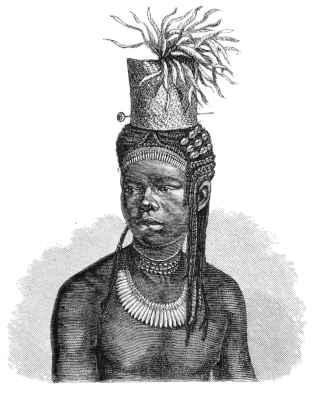
Niam-niam in full dress.
ARRIVAL AT A MBANGA.
Fatiguing enough we found our progress through the towering grass. The path was narrow, and it was very necessary to plant one’s foot firmly upon the stalks to avoid stumbling on the way. At length towards noon we arrived at the head-quarters of the chieftain, a residence which, in the language of the country, is called his “mbanga.”
I found myself at once encircled by the natives, who came streaming in to see for themselves the white man of whom already they had heard so much. It was my own first opportunity of seeing the Niam-niam in the reality of their natural life. As became a people with whom hunting is a prominent feature in their pursuits, they were girded with skins. High upon their extensively-dressed hair they wore straw-hats covered with feathers and cowries, and fastened on by means of long bodkins of iron or copper. Their chocolate-coloured skin was painted in stripes, like those of the tiger, with the juice of the Blippo (Gardenia malleifera).
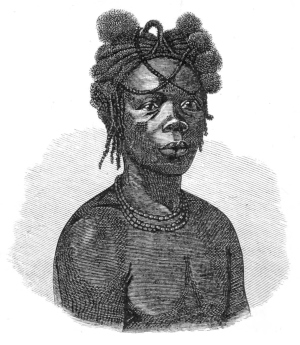
Coiffure of the Niam-niam.
COURT OF A NIAM-NIAM POTENTATE.
Whilst I was reposing beneath an awning that had been put up as a shelter from the sun, the natives bestowed upon me such a prolonged and decided stare that I had ample opportunity for transferring a few of their portraits to my sketch-book.[45] In the early evening I paid my respects to Nganye, the resident prince. His abode consisted of a collection of huts, some larger than others, which he had assigned to his body-guard, and to the wives and children of his closest associates. The mbanga of a prince may be known at once by the numerous shields that are hung upon the trees and posts in its vicinity, and by the troop of picked men, fully equipped, who act as sentinels, and are at hand night and day to perform any requisite service. Military expeditions, surprises, conspiracies for murder, are here the order of the day, but frequently other and better employments will arise to engage them—as, for instance, when the discovery is announced that a herd of elephants is in the neighbourhood. Then the signals must be sounded, and everyone without delay must be summoned, the occurrence being recognised as of national importance, for there is the chance of securing many hundredweights of ivory, and perchance ten times the weight of meat.
The shields are woven in pretty patterns of intermingled black and white, and are lined with royal leopard-skins. They are fastened by means of an iron knob on the inner side to the “trumbash” (an iron missile with three large projections), and altogether form really a striking sight.
Very modest in its pretensions was the court of this negro prince, and it had little to distinguish it from the huts of the ordinary mortals who had their homes around. The huts were circular, and had conical roofs which were unusually high and pointed, and were probably constructed to throw off the rain outside, as well as to allow for the dispersion of the smoke which was caused by the fire below. Surrounded by a dozen women, who with some household slaves superintended the tillage of the royal domain, Nganye had every appearance of enjoying a peaceful—nay, it may be said, an idyllic—existence.
I found him perfectly naked except for a little apron that he wore. He was sitting on a Monbuttoo stool, quite unarmed, and with no insignia whatever of his rank. There were, indeed, some twenty or thirty natives who were armed and kept guard in the outer court, but apart from this any pretension to state was entirely wanting. By means of my two interpreters I contrived to keep up a long conversation which I found interesting enough. I was made acquainted without reserve with all the details of Nganye’s family, and with all the particulars of his home administration. It was much that I came to him as a friend of Aboo Sammat’s. Aboo Sammat was to him a friendly neighbour, who brought to him as his chief an annual contribution of copper, beads, and stuffs; and the prince in return stored up for Aboo Sammat’s purchase all the ivory which the year’s exertions had secured. As regarded my own native land he did not exhibit the remotest curiosity; concerning the design and object of my journey no particle of interest betrayed itself in anything that he said nor in any question that he asked; and a similar remark may be made with respect to all the chieftains with whom I happened to be brought in contact. As everywhere else in Africa, a welcome is here given by reaching out the right hand; the middle fingers are joined and jerked together until they snap and crack again.
Whilst the cannibal magnate and myself were thus in solemn conference, and were ever regarding one another with that reverence which befits the representatives of noble communities, my retinue was being entertained with roast buffalo meat served up in pretty carved dishes. There was nothing palatable that could have been placed before me, and although Nganye, as subsequently Wando and Munza, accepted food from me, I never did from them. It is extremely unusual for Nubians and natives to take any meals in common, not so much from any religious scruple, but simply because it has never been the custom. In front of me, however, was placed a great clay vessel with four necks full of Niam-niam beer brewed from eleusine, which my Nubians enjoyed thoroughly as being stronger than anything they can get in their own country.
I presented Nganye with a great many necklaces of garnet-beads of the kind which had been prepared for the East Indian market. My own collection included no sorts except those which were quite novel in this country, having been provided not at all for the purpose of merchandise, but with the express object of making presents. Out of compliment to me, Nganye always wore my gifts as long as we remained in his locality, but, in the same way as other chieftains, he at other times systematically abstained from adorning himself with any foreign trinkets.
EFFECT OF RAIN.
On the night of the 3rd of February some rain again fell, but it was not heavy enough to penetrate the grass coverings that we had improvised for our baggage. This was the third occasion on which we had now had rain, and although the fall had been very insignificant, in fact scarcely a quarter of an inch, yet the effect was so great as to be almost magical. Its influence alike upon the thirsty earth and withered steppes was very wondrous, and the sprouting stalks of grass bore ample witness to the invigoration that it brought.
A broad valley, alternately steppe and cultivated land, spread itself out around the residence of Nganye, and through its midst there wound a watercourse which now was dry. Over this we made our way; and mounting the opposite acclivity, proceeded one league onwards to the west, thus for the time reversing our previous progress. Black and barren were the burnt steppes at this season, when the elephant-hunting was all over, and they were unrelieved as yet by any vegetation. Literally our feet trod upon the embers of the burnt grass, very much to the detriment of my own white costume, and involving a large consumption of my soap that had been so laboriously procured from oil of sesame, burnt wood, and oyster-shells. Around the base of the charred bushes there were little lines of green where the young sprouting herbage broke through the earth, and now and then some opening blossom would give an unexpected beauty to the scene. It almost seemed as if these early-blooming children of Flora had been waiting for a few drops of the rain that they might escape from the womb with the remnant of the sap which it had yet to give. Upon the general gloomy aspect of the landscape these rare scattered blooms of course could make no impression; it was needful to seek for them, and bend low to find them; they were modest as the violet which seems to hide itself by the wayside, and yet has charm enough to detain the passer-by.
A charming walk of two leagues and a half brought us to a subsidiary holding of Nganye’s, named after its superintendent Gumba. The villages of the district were abundant in corn, and afforded too welcome a chance for the hungry bearers to resist making there their halting-place; the prospect, moreover, of brimming beer-flasks had its wonted attraction with the Nubians. The goal was full in view; a little ridge of hills beckoned hospitably from afar, and immediately beyond were the broad acres of cultivated land which belonged, to Gumba.
A region was this which rarely failed to supply charming halting-places, and we could take our noontide rest in shady yet breezy positions beneath the spreading trees. The tamarind, however, which hitherto had thrown over us its pleasant canopy during our way along the lonely desert, now failed entirely, and I saw it again no further to the south; so also Mungo Park’s butter-tree, which had been so prominent a feature upon the red soil of the Bongo and the Dyoor, now disappeared completely from the scene; but on the other hand there were here displayed as much as in the northern latitudes the Parkia, the Afzelia, the Vitex, the fig, and the Khaya, whilst with these there were intermingled many new and striking forms of incomparable beauty.
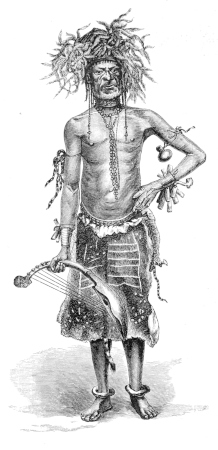
A NIAM-NIAM MINSTREL.
COLOCASIÆ.
The country hereabout was tolerably secure, the Niam-niam being desirous to secure Aboo Sammat’s friendship in order to ward off any mischief that might arise from the dangerous neighbourhood of Sabby. I considered it sufficiently safe to venture upon a little tour, attended only by my two Niam-niam servants. Directing my steps to the hill, I found that it was only like a hundred others, a pile of brown roe-stone, and apart from the open panorama it afforded, it possessed no interest at all. All along I gathered weeds and plants in ever-fresh variety.
Making at length our halt at a hamlet, my two companions drew my attention to a valuable production of their land. Underneath one of the granaries, which was supported in the usual way upon posts, was a great pile of firmly-pressed clay. On this an old woman was hammering with the pestle belonging to her mortar, and having knocked a hole, she drew out some tubers of a kind that I did not recognise. I afterwards found that it was the Colocasia, which is cultivated very freely throughout the Niam-niam country, and which when boiled makes a very excellent vegetable. The thick covering of clay is put over them not only to keep them moist in the dry season, but also to defend them from the ravages of rats, worms, and white ants. Whenever any of the tubers are required it is only needful to knock a hole through the clay, which can be plastered up again with a few handfuls of fresh mud. The same plan is also adopted in the rainy season to protect the crops from damp and rot; thus clay, everywhere abundant, is an universal antidote to the violence of nature.
As the darkness came on, our camp was enlivened by the appearance of the grotesque figure of a singer, who came with a huge bunch of feathers in his hat, and these, as he wagged his head to the time of his music, became all entangled with the braids of his hair. Altogether the head was like the head of Medusa. These “minne-singers” among the Niam-niam are known as “nzangah.” They are as sparing of their voices as a worn-out prima donna; except for those close by, it is impossible to hear what they are singing. Their instrument is the local guitar, the thin jingling of which accords perfectly well with the nasal humming of the minstrel’s recitative. The occupation of these nzangah, however, notwithstanding the general love of the people for music, would not appear to be held in very high esteem, as the same designation is applied to those unfortunate women, friendless and fallen, who are never absent from any community. Quite contrary to the practice of the neighbouring tribes, they have nothing to do with boisterous music, and only use their drums and horns for the purpose of signals. The minstrelsy of the Niam-niam may be said to have the character of a lover’s whisper.
Starting again and proceeding to the south, after an agreeable walk of about three hours, we arrived at the quarters of Bendo, a brother of Nganye, who had set him in charge of one of his best and most populous districts. The homesteads were all scattered over a wide and well-cultivated area, which extended with a northerly aspect along the declivity of an elevation of gneiss that rose to an altitude of about 200 feet. This hill was named Gumango; before we reached it we had to cross a considerable stream called the Rye, which throughout the year is always flowing. Uninfluenced hitherto by the rain, its breadth was now about forty feet, and its depth was sufficient to allow us to enjoy a pleasant bath at a spot where it ran beneath the shelter of some thick Psychotriæ. Tall popukky grass covered the banks, amidst which the splendid Nathalia, with its blossoms fine as those of a horse-chestnut, rose in all its beauty. The whole region, on either side the stream, was well cultivated, and look whichever way we would, we saw groups of farmsteads, although villages, in our sense of the term, did not exist.
Each family resides close to, if not actually upon, the land it cultivates. The insecurity of property is everywhere so great, that rather than relinquish their incessant watch over their crops, the people submit to many inconveniences and live far away from watercourses, put up with short supply of firewood, and brave the ravages of the white ants. Hostility, in this land, does not simply mean plunder and escape; the enemy is vengeful, and if he can carry nothing off, will damage all he finds, and destroy the rising crops.
The Rye empties itself into the river Sway, as the Dyoor is termed by the Niam-niam, although by the Bongo and Dyoor it is called the Geddy. Close to the rising eminence of Gumango, the Rye upon its left shore receives a considerable stream flowing from the marshy plains, along the banks of which are scattered numerous farmsteads surrounded by plantains. This was the first time I had seen the Musa sapientium in any quantities; just beyond the Nile district in the Monbuttoo country it becomes the very staple of the people’s food. The cultivation of the plantain seems to be a speciality of all the equatorial regions of Africa, from Uganda on Lake Ukerewe right away to the western lands on the Gaboon and Ogowai.
GROVE OF ZAWA-TREES.
Our encampment had been made to the north-east of Gumango in a great grove of Zawa trees (Lophira alata). Of this tree very few detached specimens are met with. It belongs to a class which flourishes beyond the range of the woods of the river banks, and will grow on a tolerably dry soil. Very noble is it in its growth, and so fine, that Colonel Grant has pronounced it to be the fairest memorial of his famous tour. Its bark is jet black, and it has a cylindrical crown of narrow quivering leaves, which vary in length from a foot to a foot and a half, whilst their breadth is rarely a couple of inches. Whilst it is young the colour of the foliage is purple, which subsequently changes to a deep sap-green. Every leaf is of a leathery texture, deeply wrinkled, and its surface smooth as if it were varnished. The blossoms repose in thick masses upon the extremities of the boughs; in colour they resemble those of the tea-tree, and emit a fragrant odour sweet as roses. It is one of the most serviceable productions of the country, as its fruit, which is about as large as a hazel-nut, yields a prolific supply of oil, of which the quality is singularly pure, while it is neither rank in smell nor coarse in taste. For my own part I much prefer the oil that is thus obtained to either that of the oil-palm, or of the butter-tree.
All the morning I pursued my botanising on the river Rye, and all the afternoon upon the sides and summits of Gumango. The arched surface of the rising mound of gneiss, stretching out without a rift, was the habitat of several very interesting ferns. Here I found the first specimen of Encephalartus which had ever been discovered in the northern latitudes of Africa. The joy of this surprise was no transient thing; but as often as the eye of the collector glances over the treasures he has brought from afar, it surveys a permanent memorial of his successful tour. The Ensete or wild Musa of Africa, which the Niam-niam call the “Boggumboly” (or little plantain) grows likewise in great abundance upon this interesting hill.
As surveyed from the summit of Gumango, the country, with the variegated colours of its cultivated enclosures, exhibited a thoroughly European aspect. Ploughed fields are nowhere to be seen, but the labour is limited to clearing out the weeds, and loosening the surface of the mould to receive the fine-grained eleusine, which no doubt requires more care than sorghum, which latter is sown broadcast.
All the farmsteads at this time had been deserted by their occupants, who had gone away and abandoned their well-stored granaries. Compared to the number of residences the store of provisions was very great, especially when the advanced season of the year is taken into account, for April was the month in which the new seeds should be planted out. One with another the huts had three granaries each, two of which were full of eleusine in its original condition, the remaining one being devoted to the same grain after it had been malted.
Everything testified to the fruitfulness of the soil. Sweet-potatoes, yams, and colocasiæ were piled up in heaps, and our hungry Bongo and Mittoo fell upon them as though they had entered a hostile country. The receptacles for corn, being circular erections of clay, supported on posts, and furnished with a covering which lifted up and down like a lid, were soon emptied, and the immediate neighbourhood of our quarters was like a scene of rapine and plunder.
NIAM-NIAM HUTS.
The arrangements of the Niam-niam huts are much the same throughout the land. Two, or at most three, families reside close together. Generally from eight to twelve huts are clustered round one common open space, which is kept perfectly clean, and in the centre of which is reared a post upon which the trophies of the chase are hung. Skulls of the rarest kind, splendid horns of antelopes and buffaloes, are attached to this standard, and, it must be added, skulls of men and withered hands and feet! Close in the rear of the huts, upon the level ground, were the magazines for corn; behind these would be seen a circle of Rokko fig-trees, which are only found in cultivated spots, and the bark of which is prized, far more than the handsomest of skins, as a material to make into clothing. Further in the background might be noticed a perfect enclosure of paradise figs; then in wider circumference the plantations of manioc and maize; and, lastly, the outlying fields of eleusine extending to the compound next beyond. I sketched several of the huts, which are embellished externally with black and white decorations. Several of the dwellings had roofs which rose upwards in two points; long poles projected from the peaks alike of huts and of granaries, and on these were strung rows of great land-snails (Achatina).
After some time we found Bendo himself arrayed in an apron of red flannel which had been given him by Mohammed. He looked very much disconcerted at seeing his property laid under such heavy contribution, but he was utterly helpless to arrest the havoc. The promise was given that Mohammed, when he arrived, would compensate him for all his loss by ample presents of copper rings and other gifts; and, as matter of fact, we found Bendo, at the time of our return, perfectly satisfied in his old quarters, and ready to show many proofs of the friendly interest with which he regarded me.
Besides Bendo and Gumba, Nganye had four brothers,—Imma, Mango, Nyongalia, and Mbeli,—who acted as his deputies, and had the charge of various districts. Intimidated by his alliance with Aboo Sammat, they were subservient to him with the obedience of vassals. There was, however, a seventh brother, Mbagahli, known by his Arabic name of Surroor, who was the direct subordinate of Aboo Sammat, and had been established in command of the wide country vanquished by him, which was bounded by the territories of Nganye, Wando, and Mbeeoh. Nganye had only two sons recognised as legitimate, Imbolutiddoo and Mattindoo, the former of which was destined to be the heir of his dignity. Nganye’s father was Moonuba, one of the six sons of Yapahti, who must not be confused with another prince of the same name whose territories lay to the south of Dar Ferteet.
On the 6th of February our march was maintained for a distance of six leagues until we arrived at the Sway. Whilst marching in single file it was very difficult to hold any communication with those who were before me or behind. Thus for a great part of the way I kept up no conversation at all, and had to obtain all my information about the country at the places where we halted, and where from the examination of several people I could learn the truth; going always upon the principle that in Africa what two witnesses state has some degree of probability, but when three agree, there is a moral certainty. As we proceeded, my attention was sufficiently occupied by observing the plants on both sides of our road, and every now and then I counted our steps in order to ascertain our rate of marching, the people, meanwhile, giving me the credit for muttering my prayers.
NEUTRALITY.
For the first and last time during our whole journey, I had a sharp contention with Aboo Sammat’s soldiers. Their conduct to the natives excited my indignation more and more every day, and an incident now occurred that thoroughly passed my powers of endurance. I could not without remonstrance allow one of the Nubians to maltreat the bearer that had been consigned to him by Bendo, and to strike him till his face was covered with blood, merely because he had broken a common calabash. But however much my sympathy with the negroes might make me a favourite with them, it could only be exhibited at the cost of a sacrifice of friendship with the Nubians, who were so indispensable for my comfort and necessities. I got the reputation of being a partisan and defender of the blacks, and more than once I was bitterly reproached because, as it was said, I reckoned the word of one negro of more account than that of ten Mussulmans. Under all similar circumstances, I learnt as far as I could to keep myself neutral, and thus happily I avoided much friction with either party. But it should be mentioned that I was never a witness of that abandoned cruelty and systematic inhumanity which the accounts of previous travellers in the lands of the Upper Nile might lead us to expect. A traveller to be just will take into consideration all the circumstances of the case and all the ameliorating particulars which may be alleged; but in the majority of these narratives, which make the hair almost stand on end, the judgment that is passed is not unfrequently warped and exaggerated. There is no justification for the pride with which we civilised people boast of our humanity. We have only to reflect upon the horrors that follow in the train of our wars, and if we could enfranchise ourselves from prejudice we should be compelled to allow that we are worse barbarians than all the Nubians—nay, that we are murderers by deliberate intention, and destroyers of the happiness of the homes of thousands.
As ill-luck would have it, on this same day a bullet came whistling by close to my ear. Once before, during my stay at Fashoda, on the White Nile, as the reader may recollect, I had been in peril of my life through the excessive carelessness of the Nubian soldiers in handling their arms; and not only was the danger renewed now, but a few days later it was repeated for the third time. On this occasion a group had camped out on the side of the road as I was defiling past in the caravan. One of the men had his comrade’s gun in his hand, and was apparently examining it, when, as I was within a few paces of him, it went off. All that I heard was the cry of alarm on the part of the man that he wished he had known the gun was loaded; my own people flocked around me in consternation, but I passed on without turning my head, as though I had heard nothing. After the events of the day my mode of proceeding was designed to make an impression on the people, and succeeded in winning the hearts of all, especially as I never passed a single remark upon the whole transaction. The result was that everyone looked upon me as protected by a good star, and that every attempt upon my life would be utterly unavailing.
Our further progress led us, for two leagues from the residence of Bendo, along cultivated lands which were covered with farmsteads. On either hand, and apparently united with Gumango, stretched out ranges of granite hills to the south and south-east. One hill in particular lay to the left of our way, which was very long, but not higher than Gumango. The three succeeding leagues were all down-hill across a desert, and we had to pass some marshy courses, and several of what for want of a better name may be called “meadow-waters,” which at this season of the year were quite dry. These localities in Kanori, the dialect of Bornoo, are called “nyalyam.” Barth mentions them as one of the most characteristic features of Central Africa, between the Shary and the Benwe.[46] The prevailing character of the landscape was that of a steppe lowland, broken now and then by park-like woods.
THE SWAY.
The southern limit of Nganye’s territory is reached at the river Sway, which flows through the desert land which bounds alike his territories and Aboo Sammat’s. Just one league before we arrived at the river we passed the hamlets of Marra, who was a “behnky” of Nganye’s. The Sway is the upper Dyoor, and according to the uniform representations of the Niam-niam, it is considered as the main stream. I came across its source at the mountain of Baginze, where, although it is but a little brook, it is called by the same name. The proofs that I can adduce for the identity of the Dyoor and Sway are conclusive enough to establish it for a certainty, and they appear worthy of some special notice here, since they may serve to throw some light upon the question of the independence of the Welle, as a system distinct from that of the Nile basin.
1. There is no doubt that the length of the river’s course between the two points where I crossed it, the one in Marra’s district and the other in Bongo-land, near Manganya, amounts to 145 miles; but the positions, which I accurately determined, of the south Bongo Seribas, belonging to Ghattas and Kurshook Ali, and the assertion of these two men that the Dyoor flows due north from a distance of at least 70 miles above the fording-place near Manganya, virtually reduce the portion of the course that I did not explore to one-half.
2. At Marra, the Sway was already a stream with a volume of water sufficient to have an important share in the formation of the Dyoor.
3. All the Niam-niam that were questioned by me in Kurkur and Dangah, and who came from parts of their native land adjacent to these places, plainly and uniformly called the Dyoor by the name of the Sway; and without ever having been to Marra they were quite aware that the river came from the parts intermediate between the lands of Nganye and Wando.
4. Upon the road which the roving ivory companies of Mundo take over what was formerly Tombo’s territory, the Sway is crossed near Fomboa, at a place that corresponds to the curve which the river describes in my map.
5. The most important river flowing towards the north and east that must be crossed by expeditions proceeding southwards from Dem Bekeer in Dar Ferteet, is the Nomatilla or Nomatina, which according to all accounts is identical with the upper course of the Wow or Nyenahm, and is at all events the largest tributary of the Dyoor. From Solongoh’s residence, past which it flows, the Nubians have followed the course of the Nomatilla right down into the lands of the Bongo and Dyoor. There are no other important tributaries that the Dyoor can possibly receive upon the left; the Sway must, therefore, necessarily be the whole and entire upper course of the Dyoor.
To myself it was a great satisfaction thus to have placed beyond a doubt the origin of at least one of the principal source streams of the region of the upper Nile; and thus definitely to have assigned its geographical position to Mount Baginze.
HYDROGRAPHY OF THE SWAY.
The Sway flows past Marra along a level steppe, which on account of the rapid flow and deep channel of the river can only rarely, and that at the time of the rainfall, be under water. At this time the banks were perpendicular, rising to a height of some 18 or 20 feet, and being cut through layers of alluvial soil very much reminded one of the Nile “guefs.” The distance between bank and bank was 40 feet, but the actual river was now about 25 feet wide. Its depth was about 4 feet, and it was flowing at the rate of 120 feet a minute. The volume of water which passed was thus 200 cubic feet in a second, whilst the Dyoor, before its union with the Wow, at the dry season in the end of December, did not roll onward a volume of more than 1176 cubic feet. In the middle of June again the Sway had a volume of 1650 cubic feet to the second; whilst the Dyoor in the rainy season, at the point I have just mentioned, exhibited a volume of 8800 to 14,800 cubic feet.
This apparent discrepancy between the proportions of water of the two rivers at the opposite seasons of the year, is nevertheless quite in accordance with physical laws, and is consequently adapted to the purposes of demonstration. The drainage of the land outwards from its springs takes place in definite channels. These channels are represented by the great rivers which take their rise in the highest districts. The rain, uniformly spread throughout the country, makes its escape to its destination by the courses which are periodically opened in the smaller streams which become tributary to the larger. Compared, therefore, to what they are in the winter, the great rivers are not during the rainy season proportionately increased to the same extent as the smaller.
All the tributaries of the Dyoor (even to the great Wow, to which the Dyoor owes at least one-third of its volume), as far as they are known to me, have in winter the most trifling significance. Upon the right are the Rye, the Lako, and the Lengbe; on the left the Hoo, the Yubbo, and the Bikky. Any small addition which the little affluents might be able to yield in the winter is all lost by infiltration and by evaporation, so that their entire and united efficiency is so unimportant as to be of no account whatever.
The sun had not risen on the 7th of February when we started on our passage over the river. A bath, no doubt, after the heat and fatigue of the previous day was very refreshing, but on this occasion it was involuntary; and as we waded up to our necks in water I was conscious of sacrificing the cosy warmth which a preparatory cup of tea had given my stomach to the cause of science.
Through a charming bush forest, which, though destitute of large trees, was most imposing in the luxuriance and size of its foliage, our long column continued its march. These bush woods, remarkable for the large dimensions of their leaves, predominate everywhere throughout the countries of the Bongo and of the Niam-niam; they contain little of the nature of the steppes, except in parts where there is space left for the grass to spring up in abundance. Districts destitute of trees could not anywhere be found except upon the rocky flats or amidst the damp and marshy lowlands. The outspread of green was so universal, that, camp where we would, we were like the eggs in a bowl of salad. Let arable land lie but a couple of years in fallow, and it will break out into a young but dense plantation; the roots of the shrubs that have been cut down send up new shoots, and the whole is soon again a mass of verdure. It should nevertheless be mentioned that every tree that is either fine in itself or useful in its product is always spared and allowed to stand. The charm of the landscape at this early season of the year is very fascinating, and beyond a question April and May are months full of delight in Africa.
Before noon we had reached the little river Hoo, which after flowing as far as the eye could reach through continued steppes, at a spot a few leagues further down unites itself to the Sway. At this period it was a mere brook rather than a river, with a level sandy bed varying from 35 to 20 feet in breadth; it had but a languid flow and seldom was above 2 feet in depth. The banks are very low, and the rainfall consequently soon makes it overflow its limits and swamp the adjacent steppes as far as the very limits of the woods. The plants which flourish on its borders, trees and shrubs alike, clearly reveal that for months together they have been under water.
BUFFALOES AND ELEPHANTS.
We took an hour’s rest, which was spent in making a cup of tea and in disposing of a kala-bok (Antilope leucotis) which I had shot upon our way as a herd had crossed our path. A fine landscape was open before us to the east, and upon the outspread plain were herds of buffaloes of which the movements afforded us some entertainment. They went to and fro in groups of several hundreds along the ground that was furrowed by their tracks, and over land which in the dry season alone was rugged and uneven. Whenever we crossed any extensive river-plains we always fell in with herds of buffaloes; but we observed that vestiges of elephants were comparatively very rare, although the indications were not wanting that even quite recently some had been upon the scene. But to these sagacious creatures a trodden path is a thing to be eschewed, and they prefer to pursue their long marches under the obscurity of night. If any one would prosecute elephant-hunting to advantage, he must, as a matter of course, renounce every other aim whatever.
From the flats where the Hoo lay low, we proceeded through an undulating rocky bush-wood to an adjacent brook called the Atoborroo. Sunk in a deep chasm 80 feet deep it was hardly perceptible from above, and streamed on over-massed by the densest marsh foliage. The vegetation of the woods offered me a fresh feast of plants that I had never before seen, and I enjoyed an especial pleasure in the discovery of thickets of a species of ginger-plant, which filled the valley all around with the most delicious aromatic perfume, and grew quite down to the edge of the water.
Damp and foggy was the following morning as our caravan moved on its way. We had proceeded but a short distance when our advanced party came to a standstill. This was a symptom that a brook or river of some sort had obstructed further progress. These continual delays and interruptions contributed somewhat to the difficulty of keeping a systematic record of my wayfaring experiences. Through the tall grass and high bushes I endeavoured to push my way to the head of the line, but I could only succeed in arriving in time to see the first company follow their banner over the Manzilly. Along a ravine deeply overhung by the broad branching foliage of the fig-trees, the stream rushed on to the north-east, a direction precisely the reverse of what was followed by the Hoo, which ultimately received the waters of all the minor streams which came from the western heights. At every time of the year these water-courses are all very rapid, and generally speaking they run over gravel beds in distinction from the marshy mould of the more sluggish streams. In these cases the tedious process of undressing is limited to merely taking off one’s socks and boots, and this is a considerable saving of time.
Shortly after this we came to a small, albeit a very small piece of primeval forest, containing giant fig-trees, commonly called gum-trees, and indeed of a species not unlike the Ficus elastica. As a forerunner of greater surprises still to come, there rose before my view the first thicket of the calamus (the rotang or Spanish reed), which deserves a foremost place in every description of the woods that line the river-banks in the Niam-niam lands. It was a “gallery” or avenue in miniature, such as I should find on a larger scale along the side of nearly all the smaller streams to the south. This conception, so necessary to an adequate topographical representation of the land, will be discussed in a somewhat later page.
After a while we reached a second brook beside the farmsteads of Kulenjo, which are the first settlements of the Niam-niam subject to the immediate control of Aboo Sammat. The possessions of each separate Niam-niam are parted from each other, just in the same way as the territories of the different tribes, by desolate intervals void of any residents whatever, nominally for the purpose of security, so that the inhabitants may by placing out a watch easily guard against any sudden attack. When there is mutual distrust, or in times of open war, watches are of little service in signalling danger, for then every Niam-niam, as a true hunter, passes his whole time in watching and lying in wait.
TROPICAL FOREST.
During the entire day I occupied myself among the magnificent thickets on the stream near Kulenjo, the vegetation, so different from what I had seen in other parts of the Nile district, and of which I had had only a foretaste on the Atazilly, being here revealed in its full splendour. The flora embraces the majority of the plants of the western coasts of tropical Africa that are known on the Gaboon, the Niger, and the Gambia, and overstepping the watershed dividing the Nile districts from the basin of the Tsad, opens to the traveller from the north the unexpected glory of the wildernesses of Central Africa. Though all was but a faint reflection of the rich luxuriance of the primeval forests of Brazil, yet, in contrast to what had gone before, it could not fail to be very charming. Throughout the twenty-six degrees of latitude over which I travelled, the progress of vegetation, according to the geographical zone and the meteorological condition of the successive lands, was organised with wonderful simplicity. For the first 800 miles stretched the dreary desert, giving place to wide steppes, void of trees, but ever covered with grass; next came the delightful region of the bush forests, where the vegetation, divested of the obnoxious thorns of the desert, recalled the soft foliage of his native land to the mind of the traveller, who lastly entered upon what he might correctly call the true primeval forest, which carried him back to the memories of his youth when he yielded his fancy to the fascinations of ‘Robinson Crusoe’ or of ‘Paul and Virginia.’ An identical change gradually supervening in the character of vegetation is perceptible in a contrary direction in the southern half of the continent; and travellers proceeding from the Cape northwards to the Equator have rarely failed to draw attention to the fact.
Nature everywhere proceeds upon the principle of levelling what is opposite and balancing what is extreme: she would seem to abhor the sharply-defined boundaries in which man delights so much, and in accordance with this law she here presents to the eye of the inquirer a transition that is very gradual, so that the limits of her districts overlap one another like the fingers of folded hands. Even in lat. 7° N. small isolated tracts of bank-forest, bearing, however, the characteristic types of the “gallery” flora, are scattered like enclaves among the bush-forests of the distant north. The forests at Okale, at Yagla, and the locality called “Genana,” are examples which I have already mentioned.
Nowhere did the guinea-fowl afford better sport than along the stream at Kulenjo; about noon their grey plumage could be seen in the shade of the foliage as they perched aloft in the trees at the edge of the wood, where they could be brought down one after another with the greatest ease. The keen vision of the Niam-niam did me good service in spying out the birds from a distance, for the waving green around me made me almost blind. The early morning likewise is not an unfavourable time for getting at guinea-fowl; they begin their flight very shortly after sunrise, but even then they are too much occupied in securing their food to heed the approach of any tolerably cautious sportsman.
FEEDING THE BEARERS.
The reader may perchance wonder at my frequent mention of these guinea-fowl, and I would therefore be allowed to explain that the traveller in Africa would be quite at a loss without them, as, with rare exceptions, they form the main commodity of his daily cuisine. In the course of five years I daresay I brought down as many as a thousand of these birds, generally two at a time. By using the lightest shot that can be obtained, and aiming high, failure is quite exceptional, as the smallest grain that hits the long neck is sure to bring down the game. With dogs, even when untrained, securing the birds is a still more easy matter. The guinea-fowl cannot fly far at a time, and therefore when they perceive the dogs in the long grass, they seem to realise their inability to escape, and take refuge on the nearest bough. Often while my dogs have surrounded a tree, I have brought down from a distance of thirty or forty feet one guinea-fowl after another, without a single bird having ventured to leave its hiding-place.
In marching for three days across an open wilderness, the caravan had to be provided by Kulenjo with their ordinary meals, and it was no easy matter in a region so scantily populated to find the necessary food for a thousand hungry mouths. The feeding took place in the evening, and before sunrise in the morning. The whole party of bearers were divided into groups, to which the food was distributed by the different “nyare,” or local Bongo overseers, who generally accompany the leaders of these longer expeditions. Handfuls of corn, measured out just as though they were portions for camels or asses, and lumps of bread composed of coarsely-ground impure Teleboon-corn (eleusine), boiled to a pulp, formed the wretched allotment and composed the substance of a meal such as we should hesitate at giving even to our cattle. Frequently in the wilderness they are reduced to the necessity of cooking and eating their corn unground. In comparison with this vile and wretched provision, linseed-cake and bran would be accepted by the Bongo and Mittoo bearers as choice delicacies. The natives bring them their pulpy bread in baskets, and by counting the great lumps of dough, which were packed in green leaves, it was possible, with some approximation to truth, to estimate the number of families appointed to take their share in providing the supplies.