Chapter III
Ellen E. (Ellen Elizabeth) Frewer translation
Camp of the Mudir. A negro king. Campaigns. Future of the country. A wise judge. The shrieking priest. Gum-arabic. The melodious tree. Mohammed Aboo-Sammat. Boats on the flight. Treachery of the Shillooks. General market. Excuse for plunder. First papyrus. Cæsar among the pirates. Useless attempts to proceed. A world of grass. Hippopotamuses in a fright. The last obstacle. Depreciation of the Gazelle stream. Bon-mot of the Viceroy. Ghattas’ namesake. The slipper-shape. Description of the Nueir. Analogy between man and beast. Cactus-type of Euphorbiæ. The Bahr-el-Arab a mainstream. Vallisneria meadows. Arrival in Port Rek. True nature of the Gazelle. Discovery of the Meshera. Deadly climate and its victims. Le Saint. Features of the scenery. The old queen and her prince consort. Royal gifts. Fishes and birds.
I remained nine days in Fashoda, a residence to which the non-arrival of the boats bound for the Gazelle River compelled us, because our force was not sufficiently numerous to overcome by ourselves the obstacles which the “Sett,” or grass-barrier, would present, and also inadequate for protection against an attack, which was not improbable, from the hitherto unsubdued residents.
A wider ramble, in which I inspected several Shillook villages, led me farther into the country, and gave me some conception of its thronging population. The Turkish officer, who welcomed me like a countryman because I was European, attended me, followed by a number of soldiers, all of us being mounted. Although throughout this tour, I was not offered even a bowl of fresh milk, and saw little beyond what had already come under my observation, viz., grey and rusty-red beings, innumerable conical huts, and countless herds of cattle; yet I could not be otherwise than impressed by various details which appeared characteristic of this people, now incorporated as Egyptian subjects, and which I shall proceed to relate.
SHILLOOK STATISTICS.
The Shillook tribe inhabits the entire left bank of the White Nile, occupying a territory about 200 miles long and about ten miles wide, and which extends right to the mouth of the Gazelle River. Hemmed in by the Baggara on the west, it is prevented by the river from extending itself farther eastward, and only the lower course of the Sobat has any of the Shillooks for its denizens. Their subjection to Egyptian government, which was completed in 1871, has caused a census to be taken of all the villages on the left bank of the Nile, which resulted in an estimate of about 3000. Taking the character of the villages into account this would give a total of above a million souls for this portion of the Shillooks alone. Now the Shillook land, which lies upon the White Nile, has an extent of hardly less than 2000 square miles, and when the number of heads upon this is compared with those in the populous districts of Europe we are justified in reckoning from 600 to 625 to a square mile; a result altogether similar is arrived at from a reckoning based on the estimate of there being 3000 villages, each village having huts varying in number from 45 to 200, and each hut averaging 4 or 5 occupants; this would give a total of about 1,200,000. This, in fact, is an estimate corresponding entirely with what the Mudir of Fashoda, who was conversant with the details of all state affairs, had already communicated to me in 1869.
No known part of Africa, scarcely even the narrow valley of the Nile in Egypt, has a density of population so great; but a similar condition of circumstances, so favourable to the support of a teeming population, is perhaps without a parallel in the world. Everything which contributes to the exuberance of life here finds a concentrated field—agriculture, pasturage, fishing, and the chase. Agriculture is rendered easy by the natural fertility of the soil, by the recurrence of the rainy seasons, by irrigation effected by the rising of the river, assisted by numerous canals, and by an atmosphere ordinarily so overclouded as to moderate the radiance of the sun, and to retain throughout the year perpetual moisture. Of fishing there is plenty. There are crocodiles and hippopotamuses in abundance. Across the river there is a free and open chase over wildernesses which would advantageously be built upon, but for the hostility of the neighbouring Dinka. The pasture lands are on the same side of the river as the dwellings; they are just beyond the limits of the cultivated plots; occasionally they are subject to winter drought, and at times liable to incursions from the Baggara; but altogether they are invaluable as supplying daily resorts for the cattle.
Still further proof of the superabundance of population of the Shillooks is manifest from the emigration which goes forward in a south-westerly direction, where considerable numbers of them, the Dembo and Dyoor, have settled on the border-lands between the Bongo and Dinka. Of these, however, I will speak hereafter; I will only pause now to remark how, in vivid contrast to the monotonous uniformity of nature which ordinarily asserts itself throughout vast tracts of Central Africa, there are even exhibited diversities of human development, differences of dialect, and peculiarities of bodily conformation. In the Shillook territory there are probably no less than 600 residents to the square mile, whilst in Bongo-land, within 180 miles to the south-west, there would be found hardly a dozen occupants on an equal area. Again, between lat. 5° and 1° N., within a range of not more than 300 miles, are to be found examples of the largest and of the smallest races of mankind—the Bari and the Akkah, of which the former might rival the Patagonians in stature, the latter being scarcely taller than Esquimaux, and considerably below a medium height.
SHILLOOK VILLAGES.
It should be appended to what has been said about the villages, that the entire west bank of the Nile, as far as the confines of the district reach, assumes the appearance of one single village, of which the sections are separated by intervals varying from 300 to 1000 paces. These clusters of huts are built with surprising regularity, and are so closely crowded together that they cannot fail to suggest the comparison with a thick mass of fungus or mushrooms. Every village has its overseer, whilst the overseers of fifty or seventy, or sometimes of 100 villages, are subject to a superintendent, who has the control of what may be called a “district,” and of such districts there are well nigh a hundred, each of them distinguished by its particular name. One of the descendants of the ancient kings had been reduced to entire subjection under the Government; another at the period of my first visit was still resisting to the utmost.
In the centre of each village there is a circular space where, evening after evening, the inhabitants congregate, and, either stretched upon hides or squatting down on mats of ambatch, inhale the vapour from burning heaps of cow-dung to keep off the flies, or from pipes with enormous clay bowls smoke the tobacco of the country.
In these spaces there is frequently erected the great stem of a tree, on which according to common African usage kettledrums are hung and used for the purpose of warning the inhabitants of any impending danger, and of communicating intelligence to the neighbourhood. Most of the negro tribes are distinguished by the form of their huts. The huts of the Shillooks are built with higher walls than those of the Dinka, and, as an ordinary rule, are of smaller circumference; the conical roofs do not rise to a peak, but are rather in the shape of flattened domes, and in this way it is that they acquire the singular resemblance to mushrooms of which I have spoken. The villages are not enclosed externally, but are bounded by fences made of straw-mats running between the closely-crammed houses, and which serve for shelter to the cattle of individual householders. Great grazing-plots, such as the larger villages combine to provide for the benefit of the community, and exist amongst the Dinka, cannot be secured for the Shillooks, because they are comparatively limited for space.
Now although these savages are altogether unacquainted with the refined cosmetics of Europe, they make use of cosmetics of their own; viz., a coating of ashes for protection against insects. When the ashes are prepared from wood they render the body perfectly grey, and hereby are known the poor; when the ashes are obtained from cow-dung they give a rusty-red tint, the hue of red devils, and hereby can be recognised the landowners. Ashes, dung, and the urine of cows are the indispensable requisites of the toilet. The item last named affects the nose of the stranger rather unpleasantly when he makes use of any of their milk-vessels, as, according to a regular African habit, they are washed with it, probably to compensate for a lack of salt.
The external appearance of the Shillooks, therefore, is by no means agreeable, but rather offensive to the beholder, who will hardly fail to notice amongst all the negro people who dwell in the plains of the Upper Nile a singular want of the lower incisor teeth, which in early life are always broken off. Their physiognomy hardly offers that decided negro type which their swarthy complexion would lead one to expect. To judge by the shape of the skull, this people belongs to the less degraded races of Central Africa, which are distinguished from other negro stocks by a smaller breadth of jaw and by a less decided narrowness of head. A comparison which I made with the skulls which I had collected and some which were taken from ancient Egyptian graves, and with the heads of living fellahs, established the fact of a remarkable resemblance. According to Professor R. Hartmann of Berlin, the similarity between the heads of ancient Egyptians and the Shillooks rests on the projection of the nasal bones; to have these so deeply set as to appear compressed by the forehead, would seem to be discordant with the general type of negro races. Without pronouncing any decided opinion as to the actual relationship of the Egyptian to the Shillook, that eminent savant thinks that he at least discerns a fresh proof of an unquestionable African origin of the latter.
SHILLOOK MEN.
Entirely bare of clothing, the bodies of the men would not of themselves be ungraceful, but through the perpetual plastering over with ashes, they assume a thoroughly diabolical aspect. The movements of their lean bony limbs are so languid, and their repose so perfect, as not rarely to give the Shillooks the resemblance of mummies; and whoever comes as a novice amongst them can hardly resist the impression that in gazing at these ash-grey forms he is looking upon mouldering corpses rather than upon living beings.
The stature of the Shillook is very moderate, and, as a general rule, is short compared with that of the lank, and long-legged Dinka.
Like most of the naked and half-naked Africans they devote the greatest attention to the arrangement of their hair; on every other portion of the body all growth of hair is stopped by its being all carefully plucked out at the very first appearance. As has been already observed, amongst the men the repeated application of clay, gum, or dung, so effectually clots the hair together that it retains as it were voluntarily the desired form; at one time like a comb, at another like a helmet, or, it may be, like a fan. Many of the Shillook men present in this respect a great variety. A good many wear transversely across the skull a comb as broad as a man’s hand, which, like a nimbus of tin, stretches from ear to ear, and terminates behind in two drooping circular lappets. Occasionally there are heads for which one comb does not suffice, and on these several combs, parallel to one another at small intervals are arranged in lines. There is a third form, far from uncommon, than which nothing can be more grotesque. It may be compared to the crest of a guinea fowl, of which it is an obvious imitation; just as among ourselves many a way of dressing the hair would seem to be designed by taking some animal form for a model.
Every now and then, however, one meets with heads of which the hair is closely cropped. However it may have happened, whether from illness or from some misadventure in dressing the hair, or perhaps from a fall of which the consequence has been an accident to the ponderous head-gear, I hardly know how, but something always seems wanting to such heads. In such cases there is frequently seen a comical-looking bandage fixed over the brow, forming a shade for the eyes, and which is made of a giraffe’s foxy-red mane clipped short. This has been elsewhere observed, and is not unknown amongst the Kaffirs of South Africa. Thus much for the men.
As far as regards the women—I saw none except those whose short-cropped hair appeared stippled over with fresh-sprouting woolly locks, and resembled the skin of a new-born lamb, like the “Astrachan” of commerce. The women do not go entirely naked, but wear an apron of calf-skin, which is bound round their loins, and reaches to their knees.
Just like the Dinka, whose external habits, apart from their hair-combs, they would appear almost entirely to follow, every man amongst them ordinarily carries a club-shaped crutch, nearly three feet in length, with a heavy round knob at its upper end, but which tapers down to a point at the other extremity, so that it resembles a gigantic nail. Their only arms are their long spiked lances, of which (to judge from the equivalents taken in exchange) one is valued at a Maria Theresa dollar. Bows and arrows are just as unknown amongst them as amongst the neighbouring Dinka, whilst, on the contrary, amongst the Nueir they are the chief weapons.
SHILLOOK ANIMALS.
The domestic animals which the Shillooks breed are oxen, sheep, and goats, the same kinds as hereafter we shall find amongst the Dinka; besides these, they keep poultry and dogs; other animals are scarce, and probably could not endure the climate. Throughout the country dogs abound, in shape like greyhounds, but in size hardly equal to our pointers. They are almost always of a foxy-red colour, with a black muzzle, much elongated; they are short-haired and sleek, and have long tails, smooth as those of rats; their ears are tolerably long, the upper portion being flabby and ragged, and therefore drooping forward. Almost beyond example in their activity in leaping and running, so fleet are they that with the greatest ease they outrun the gazelle, and are everywhere of service in the chase; over the earth-walls ten feet high, and over ant-hills, they bound with the celerity of cats, and can jump three or four times the length of their own slim bodies. I kept a number of genuine Shillook dogs, which subsequently did very well in the farther interior, and increased considerably. Like all dogs of the Nile district, from the Egyptian pariah to the village cur of the Soudan, this breed is always found to be deficient in the dew-claws of the hind foot, which always exist in our European dogs. As a general rule, it may be said that the Shillook dog differs little from the races of the Bedouins of Kordofan and of Sennaar.
The only conception which the Shillook entertain of a higher existence is limited to their reverence for a certain hero, who is called the Father of their race, and who is supposed to have conducted them to the land which they at present occupy. In case of famine, or in order that they may have rain, or that they may reap a good harvest, they call upon him by name. They imagine of the dead that they are lingering amongst the living and still attend them. It is with them as with other uncultivated children of nature, that old traditions and veneration of ancestors supply the place of religious legends or ethic system.
Late in the evening of the 1st of February we left Fashoda, and proceeded, without using the sail, for the greatest part of the night along the left bank. At daybreak we arrived at the Egyptian camp. We were received with singing, shouting, and the braying of trumpets. I was conducted by the Governor to his tent, and whilst, hour after hour, we smoked our pipes in company, I related to him the most recent events in the political world. After talking to him about the sources of the Nile, and the campaign of the English in Abyssinia, I told him of the events of the “Seven Days’ War,” in return for which I was presented with a fine bullock and several sheep and goats. The encampment, as I found, consisted of some huts erected with straw in a very off-hand way, the irregular forms of which contrasted very disadvantageously with the symmetrical regularity which is so conspicuous in the dwellings of the Shillooks. Military tents and awnings of sedge completed the equipment of the camp. An ordinary thorn hedge with two loopholes, in which a cannon was always placed, protected the spot, which was close to the left bank of the river. In the Mudir’s verandah I also made acquaintance with the Shillook chief, to whom I before alluded, who had entirely surrendered to the Egyptian Government, and was now, as the Governor expressed himself, “coming to his senses.” There was no external indication whatever of his rank, except a miserable rag which hung about his loins, or the common sandals which he wore, might be considered such. His short-cropped hair had no covering; his neck had a row of beads, such as the heads of families are accustomed to wear, worth about a couple of groschen; and this was all the decoration he displayed. He retained now but a shadow of his former power; his better days were gone, days in which, attended by a council of ancestral state, he had swayed the sceptre of patriarchal dignity. Of all the negro races which occupy the entire district of the Nile, the Shillooks used to uphold the most perfectly regulated government, and to appreciate them thoroughly it is necessary to refer back to the earliest registries, which those who accompanied the expedition of Mehemet Ali left on record. But now this condition is all changed, and everything has disappeared which gave this independent and primitive people their most striking characteristics.
SHILLOOK SUBMISSION.
In the immediate proximity of the camp all was generally at peace; the Shillooks apparently submitted tamely enough to a Government which did not exercise any very tyrannical power, and which contented itself with demanding a supply of bullocks and a stated levy of provisions to maintain the troops. Notwithstanding this usual semblance of concord, the Governor was notoriously on terms of open enmity and feud with the Shillooks in the south. Kashgar, another descendant of the ancient reigning family, still maintained himself as an uncontrolled sovereign, and was able to render that part of the river extremely unsafe for navigation. Ever and again the Governor with his force, never more than 600 strong, was undertaking expeditions against them; but, as he himself told me, they never came to an actual engagement. Although the blacks, he said, might muster 20,000 or 30,000 strong, the second cannon shot was quite enough to make them scamper off, and leave their flocks and herds in the lurch; upon these the mounted Baggara, in the service of the Government, descended and made them an easy spoil. This nomadic race, from time immemorial, has ever, as I have already mentioned, been addicted to the plunder of cattle, and has always exhibited a preference for that occupation.
In another respect the situation of the Government here is far from easy. Not only are the Shillooks at heart at enmity to it, but it excites the hostility of the trading companies who ascend the river. Nothing indicates the circumstances better than the expression of a member of one of these companies. “The Mudir,” he said, “doesn’t like to attack the Shillooks; he takes care of them, and only wants a few of their bullocks; but we—we should just like to annihilate them, devil’s brood as they are.” In fact, as the Mudir said to me, he only wanted the best of the Shillooks; the Shillooks know well enough that their “best” is their cattle, and this they are not really resigned passively to surrender, and so they go on and continue to be defiant, till they feel the grenades and rockets scorching their skins. For the future fortune of this favoured country I cannot anticipate much that is good. Whilst the Viceroy refuses to appoint Europeans as governors, like Munzinger in Massowa, his officers must fail in those qualifications which would be adequate for the successful administration of a newly-acquired negro territory. The visible retrogression of the Egyptian Soudan with respect to cultivation, confirms this unfavourable foreboding. Ismail Pasha centres all his hope upon the stimulating influence of a railway which shall connect Egypt with Khartoom, and very likely he may witness commerce enlarged to an unsuspected magnitude; one thing, however, there is which he cannot prevent, and that is the depopulation of the Shillook lands. Since they remain closed to European civilisation, and since the husbandmen in Egypt are sufficiently engrossed in acquiring fresh soil for their own tillage at home, there is no prospect whatever for any advantage to these lands, except it can be found in a large immigration of labourers from Asia.
JUDICIAL VERDICT.
The Governor was a remarkably intelligent Kurd, and great was my regret that I could not spare a longer time to listen to the interesting information that he gave me about the habits of the Shillooks, which he knew accurately from many years’ experience. I accepted all that he said with the greater confidence, because it had seldom occurred to me to meet a Turkish officer, who could fluently speak the dialect of the country. He was continually being called upon to adjust the disputes of the natives, who appealed to his judgment, even in their most private concerns. One young girl there was who, abashed and dejected, had been crouching in a corner, and then ventured to present herself before him as adjudicator. With her speech half-choked by emotion, she besought him to interpose his authority to set aside the obstacles which her parents threw in the way of her completing her marriage engagement with a young Shillook, whose name was Yōd. The hindrance to the wedding was simply the fact that the young man possessed no cattle. The Mudir inquired whether Yōd was not the owner of some cows. Her reply was, “No; Yōd has no cows; but Yōd wants me, and I want Yōd.” Although she urged her point over and over again, and pressed the Mudir to pronounce in her favour, because his judgment would constrain her parents, the Mudir did not yield. The girl kept saying “we must,” and “we will;” the judge could speak only of bullocks. There seemed to be no settling the matter, when he said, “You must go and wait: wait till Yōd has bullocks enough to satisfy your parents.” This was not a very comforting decision, but it showed me plainly how that it was ever his rule to recognise the customs of the country.
In order to attend to my European correspondence, which had fallen somewhat into arrears during my voyage, I prolonged my stay for three days. Pine forests of gum-acacias encompassed the spot as far as the extensive Shillook villages allowed them space, whilst the opposite shore presented an unreclaimed desert. At this season, when the waters had nearly reached their lowest level, the banks of the river were everywhere enlivened by numerous kinds of water-fowl. Ducks and geese did not preponderate, as in the northern districts, but the bird most frequently seen was the crowned crane. Thousands of these in swarms were to be seen upon the level banks, nor was there much difficulty in getting at them. Protected by the tall grasses on the slopes of the bank, one had but to discharge a load of good-sized shot, and the destruction was marvellous. Besides the black and rose-coloured storks there is occasionally found the common stork, familiar to us at home; deeper onwards in the interior I have always looked for this in vain. In every region throughout Africa there exists the rapacious hawk, whilst the graceful grey falcon is not at all uncommon. The most remarkable bird of prey, however, is the large whitey-brown eagle (Haliaëtos vocifer), which, sitting apart on trees and shrubs in the proximity of the waters, startles the passer-by by its peculiar shriek.
The noise of this bird is very singular, and is unlike any other known note of the feathered race; its cry ever comes unexpectedly, and is prolonged on the waters. Sometimes it makes one think that it must be the cry of frightened women which alarms him; or sometimes it appears as if a lot of shouting boys were rushing from their hiding-place. The illusion is so perfect, that, for my part, I never failed to hurry off in the direction of the sound, whenever I chanced to hear it. The peculiar cry of the bird is so characteristic, that the inhabitants of the Soudan have given it the expressive name of Faki, the shrieking priest.
Of birds which attach themselves to inhabited parts, the white-breasted Abyssinian raven is most abundant; the trees around Fashoda are full of them. This species dwells in pairs, which are continually hacking away at the tree stems, the raven not unfrequently coming to associate with them. The Rahama, consecrated (as an emblem of parental affection) amongst the ancient Egyptians and Hebrews, collects in considerable numbers in Khartoom, where it does duty as a scavenger; but although it is ever to be found in the towns of Egypt and Nubia, it is never met with here; it shuns the wilderness, and only feels at home in civilised places. In this district its place is supplied by the little carrion vulture (Neophron pileatus), which the people of the Soudan call “Nisr,” although this is only the ordinary Arabian appellation of an eagle. The heaths, broken as they frequently are by low shrubs, notwithstanding the nearness of so many dwellings, afford a suitable resort for whole coveys of guinea-fowls. The herbage on the steppe itself appears for miles together to be covered with the Bamia (Hibiscus esculentus), a species of marsh-mallow, the seed-pods of which form a favourite vegetable amongst the Nubians. By the White Nile it grows perfectly wild, whilst in the north it requires to be cultivated.
ACACIA-GROVES.
The acacia-groves produce gum in such unlimited quantities that, in the interests of commerce, they are specially worthy of regard. In the winter time, with the greatest ease in the course of a day a hundredweight of this valuable article could be collected by one man. Not once, however, did I see anyone gathering the gum, although the merchants of Khartoom are never in a position to supply sufficient to meet the demands of Europe. The descriptions of gum, which are hence brought to the Khartoom market, are those known as Sennaari and Talha, and are, in truth, only of a mediocre quality. Yet they do possess a certain marketable value, and through their abundance could be made to render a very large profit. The acacia-groves extend over an area a hundred miles square, and stretch along the right bank of the stream. The kind which is most conspicuous is the A. fistula, and which is as rich as any other variety in gummy secretions. I choose this definition of it from its Arabian appellation “soffar,” which signifies a flute or pipe. From the larvæ of insects which have worked a way to the inside, their ivory-white shoots are often distorted in form and swollen out at their base with globular bladders measuring about an inch in diameter. After the mysterious insect has unaccountably managed to glide out of its circular hole, this thorn-like shoot becomes a sort of musical instrument, upon which the wind as it plays produces the regular sound of a flute; on this account, the natives of the Soudan have named it the whistling-tree. It yields a portion of the gum known on the exchange as gum of Gedaref. It is often found in lumps as large as the fist; it is rarely colourless, and more frequently than otherwise tinged with the hue of amber.
Very striking is the sight afforded by the wood of acacias in the months of winter; the boughs, bare of leaves and white as chalk, stretch out like ghosts; they are covered with the empty pods, which cluster everywhere like flakes of snow; whilst the voices of a thousand flutes give out their hollow dirge. Such is the forest of the Soffar.
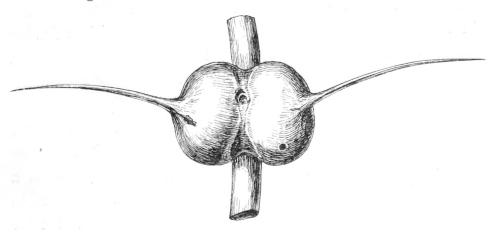
Prickles of Acacia.
The peculiarities which affect the growth of the acacia appear to be transmitted to a very remarkable extent. On a former journey I took some seeds to Cairo, which already had produced some trees of a very considerable size. These trees exhibited the special appearances of the parents; below the prickles were the same excrescences and insect-borings; not only was this the case in the park of Esbekieh in Cairo, but it also occurred in several other situations, which left the problem to be solved, how was it that the insect survived in the seed, or how did it contrive to get to its tree in Cairo?
ABOO SAMMAT.
On the 5th of February we finally left the Egyptian encampment, and directed our course up the stream towards the region of the papyrus. After sailing all night we stopped just short of the mouth of the Sobat, on the right bank close to a forest. The progress of the coming days would lead us through an insecure territory; we wanted to make up our supply of wood, and knew that the hostility of the Shillooks would, in many places, render any attempt at landing on our part quite unadvisable. Of the boats which were bound for the Gazelle, only one had arrived. In order to render us assistance, the Mudir had charged the owner not to leave my party in the lurch. This circumstance had a very important effect upon my whole journey, as it was the means of introducing me to Mohammed Aboo Sammat, who was proprietor of the boat. This magnanimous Nubian was destined to exercise a very considerable influence on my undertaking, and, indeed, he contributed more to my success than all the satraps of the Soudan. During my land journey I had first made his acquaintance, and now he invited me to be his guest until he should have accompanied me to the remotest tribes, a proposal on his part which made my blood tingle in my veins. A native of Dar-Kenoos, in his way he was a little hero. Sword in hand he had vanquished various districts large enough to have formed small states in Europe. A merchant full of enterprise, he avoided no danger, and was sparing neither of trouble nor of sacrifice; in the words of the Horaz, “he explored the distant Indies, and compassed sea and land to escape poverty.” Yet all the while he had the keenest sympathy with learning, and could travel through the remotest countries at the bidding of science to see the wonders of the world.
Far as eye can see, the Sobat flows between level banks bounded by unlimited steppes; where it joins the Nile it is about half as broad as the main stream. For a considerable distance the cloudy milk-white waters, which indicate the mountain stream, can be distinguished as they roll into the deep azure of the White Nile. The Sobat water is, however, far preferable to the Nile water, which, after being strained as it were, through a filter of grass, emerges transparent in colour, but with a flat, earthy flavour, which is highly disagreeable to the palate. The effect of the commingling of the two streams can be distinctly traced as far as Fashoda, where the inhabitants fancy they enjoy some consequent sanitary advantage.
We kept quite close to the right bank of the uninhabited quarter, but on the same day we found ourselves in full flight before thousands of the native Shillooks, who, with their light canoes of ambatch, hastened to the bank, and in thick troops prepared to displace us. As fate would have it, just as we were within sight of the dreaded Shillooks, our sailyard broke, and we were compelled to seek the land. Soon rose the cry, “They are coming! they are coming!” for in fact we could see them dashing over the stream with incredible celerity, and crowding their canoes as thick as ants. Hardly had we regained our craft, and made some speedy preparations for defence against an attack, when the foremost of the Shillook men, equipped for war, carrying their tufted lances in their hands, showed themselves by the banks which only now we had quitted. Apparently they came to offer some negotiation with us in the way of traffic; but ours was the ancient policy, “Danaos timentes,” and we pushed on.
Although, including Aboo Saramat’s party, we numbered full eighty armed men, we could not help suspecting that as soon as the north-east breeze should drop, by whose aid we were going along the stream without a sail, the savages would take advantage of our bad situation and inadequate fighting force to make an attack upon us.
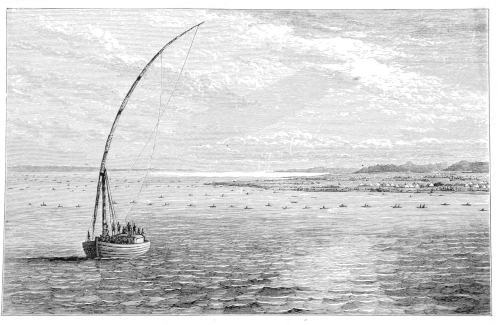
IN FULL FLIGHT BEFORE THE SHILLOOK CANOES.
A HASTY RETREAT.
This fear was not without reason; there were here, at a guess, at least 10,000 Shillooks on their legs and 3000 ambatch canoes in motion on the river. Accordingly we pushed up the stream, and had an opportunity, from a more secure neighbourhood, to observe the Shillooks more accurately. My telescope aided me in my investigation. I saw crowds of men violently gesticulating and contending; I saw women burdened with baskets loaded with poultry clapping their wings. After a while the Shillooks, disappointed, began to vacate the bank which we had left, and on the river could now be seen a redoubled movement of the canoes, whilst opposite fresh multitudes poured in, and gave to the whole scene the appearance of a general emigration of the people.
Within the last three years the boats had been permitted with reluctance, and only when several were together, to approach the shore at this part of the stream, for here it had happened in one single season that five vessels, the property of Khartoom merchants, as they were coming down the river laden with ivory, were treacherously attacked one after the other. The stratagem was employed of diverting the attention of the crews by an exhibition of attractive merchandise; while the Nubians were off their guard, at a given signal the Shillooks fell upon them and butchered them without exception. Gunpowder, rifles, and valuable ivory, all fell into their hands; the vessels they burnt. Ghattas himself, the merchant who owned the vessel by which I was travelling, suffered the loss of a costly cargo, while eighty men on that occasion met with a violent death. Only the Reis and one female slave escaped to Fashoda. Betimes they threw themselves into the water, and concealing their heads with some water weeds, floated on till the stream carried them out of the reach of harm.
On the following morning, after we had passed the mouth of the Giraffe river, we were joined by a flotilla of six boats. As we reckoned now nearly 350 armed men, we felt that we could venture without risk to enter upon commercial transactions with the Shillooks. The disturbed condition of the country had interfered to prevent them carrying about their merchandise as usual, and they now were collected in unusual numbers at the mart.
A mile away from the river-bank there were rows of dome-palms bounding a broad level, on which was exhibited all the liveliness of ordinary market-clatter. Busy and bustling, there were thousands congregated together; but the fear this time was not on our side. From far and near streamed in the natives; many brought baskets full of corn, eggs, butter, beans, and ostrich-feathers; others offered poultry, tied together in bunches, for sale: there was altogether the bustle of such a market as only the largest towns could display. The area was hemmed in by a guard of armed men, whose lances, like standing corn, glittered in the sun. The sense of security raised the spirits of the light-hearted sailors, and their merry Nubian songs rose cheerfully in the air. Two hours slipped quickly away, while the necessary purchases were being made, the medium of exchange being white or red glass beads. Soon afterwards a favourable breeze sprung up. Everything was still active in the market; fresh loads came teeming from the villages; the outcry and gesticulations of the market people were as excited as ever, when suddenly there boomed the signal to embark. The confusion, the noise, the hurry which ensued baffle all description; the Shillooks were in a panic, and, imagining that it must be all up with them, scampered off and jostled each other in every direction.
NUBIAN LOGIC.
The propitious wind did not, however, prevent our people from finding time to make a little détour into the country, where they had the luck to find some herdsmen who were trying to conceal a heifer amongst the grass. There was a report of a gun, and the beast was stretched upon the ground. A few minutes sufficed to quarter its carcase, and the hide and the pieces were conveyed on board. Half-a-dozen kids and some sheep were added to the stock, and so we proceeded on our way. In the eyes of the people such plundering is deemed to be perfectly legitimate for various reasons: first, because the Shillooks are heathen; secondly, because some years before they had burnt five Nubian vessels; thirdly and chiefly, because mutton and beef are very choice eating, particularly after having been limited for a time to durrapap. My tawny companions seemed to think that they knew a fourth palliation for their proceeding, which consisted in this, that none but themselves were capable of making a proper use of the goods of the blacks. In the districts of the Upper Nile, wherever the breeding of cattle is carried on, it is a custom of the negroes never to kill an animal, but only to consume those which die naturally; the reason obviously being, that they look upon the possession of living cattle as the main object of their existence. With them, steers do the duty of guineas and napoleons; the Nubians, therefore, jocosely affirm that they swallow the guineas, which in the keeping of the heathen are nothing better than so much dead capital.
We were not long in leaving the Shillook villages far behind. The inhabited region seemed to recede as our boat made its way along the water-course. The stream divided itself into a multitude of channels, which threaded their way amidst a maze of islands. The distant rows of acacias on either side were the only tokens to indicate the mainland. This was the day on which we first saw the papyrus. To me, botanist as I was, the event elevated the day to a festival. Here at a latitude of 9° 30´ N. are we now first able to salute this sire of immortal thought, which centuries ago was just as abundant in Egypt as at present it is on the threshold of the central deserts of Africa. I was quite lost in admiration at the variety of production of the surface of the water, to which the antique papyrus gave a noble finish. It strikes the gaze like the creation of another world, and seems to inspire a kind of reverence: although for days and weeks I was environed by the marvellous beauties which enrich the flora of the Nile, my eye was never weary of the vision of its graceful form.
The hindrances to our progress caused by the excessive vegetation began now to give us some anxiety. All day long we were bewildered not only by the multiplicity of channels, but by masses of grass, papyrus, and ambatch, which covered the whole stream like a carpet, and even when they opened gave merely the semblance of being passages. It is quite possible that the diversion of its course to the east, which, for sixty miles the Nile here takes, may check the progress of the stream, and be in a measure the cause of such a strange accumulation of water-plants. Certain it seems that neither any exceptional depth of water, such as may occur in particular years, nor yet any general overflow wider than usual, avails to exercise the slightest influence upon this exuberant vegetation. Were it a coating of ice it would split itself into fragments under the pressure of the stream, but here is a real web of tough tangle, which blockades the entire surface. Every here and there, indeed, the force of the water may open a kind of rift, but not corresponding at all with the deeper and true channel of the stream. Such a rift is not available for any passage of the boats. The strain of the tension, which goes on without intermission, has such an effect in altering the position of the weedy mass, that even the most experienced pilot is at a loss how to steer, consequently every voyage in winter is along a new course, and through a fresh labyrinth of tangle. But in July, when the floods are at their highest, navigation can be carried on along well nigh all the channels, since the currents are not so strong, and the vessels are able to proceed without detention to their destinations.
GRASS TANGLE.
Thick masses of little weeds float about the surface of the water, and by forming a soft pulp, contribute an effectual aid to bind together the masses of vegetation. Like a cement this conglomerate of weeds fills up all the clefts and chasms between the grass and ambatch islands, which are formed in the back-water where the position is sheltered from the winds and free from the influence of the current.
There are two plants, at a superficial glance hardly distinguishable, which perform the largest share in the formation of this compact web. One of them is the thin-membraned water-fern, the Azolla; the other (which is quite familiar to every visitor to the tank of the Victoria regia) being the Pistia, which can hardly fail to recall a head of lettuce. The sailors of the White Nile call it the “negro tobacco,” probably with reference to the dwarfed growth of the two kinds of tobacco in the negro lands. Besides these, our duck-weeds (Lemna) and Tussieua of various sorts intertwine themselves with the mass, and the different African representations of our commonest water-plants play a part by no means unimportant.
It is remarkable that in Egypt nearly all the species of water-plants which abound in the stream of the White Nile are wanting entirely; whilst, on the other hand, all the shore-shrubs, which had their native home in the neighbourhood of the Equator, pass over the intervening districts and there find a settlement. Even the conspicuous ambatch is, in Egypt, not known by name; and it is quite an event when any of the fragments of the papyrus find their way so far north. Every bit of wood which the river carries in its flood is collected by the inhabitants of the Nubian valley, and not a scrap escapes the keen look-out of the people, who are eager to compensate for their lack of firewood. At the season when the waters are at their height, the chase after floating wood is a daily occupation and a favourite engagement of the boys.
On the 8th of February began our actual conflict with this world of weeds. That entire day was spent in trying to force our boats along the temporary openings. The pilots were soon absolutely at a loss to determine by which channel they ought to proceed. On this account two vessels were detached from the flotilla to investigate the possibility of making a passage in a more northerly direction. Two hundred of our people, sailors and soldiers, were obliged to lug with ropes for hours together to pull through one boat after the other, while they walked along the edge of the floating mass, which would bear whole herds of oxen, as I subsequently had an opportunity of seeing.
Very singular was the spectacle of the vessels, as though they had grown in the place where they were, in the midst of this jungle of papyrus, fifteen feet high; whilst the bronzed, swarthy skins of the naked Nubians contrasted admirably with the bright green which was everywhere around. The shrieks and shouts with which they sought to cheer on their work could be heard miles away. The very hippopotamuses did not seem to like it; in their alarm they lifted their heads from the shallows in which they had stationed themselves for respiration, and snorted till the gurgling around was horrible. The sailors, concerned lest by their bulk these unwieldy creatures should injure the boats—not an unknown occurrence—gave vent to the full force of their lungs. This unearthly clamour was indeed the solitary means of defence at their command; in such a turmoil—men and boats in every direction—firing a shot was not to be thought of.
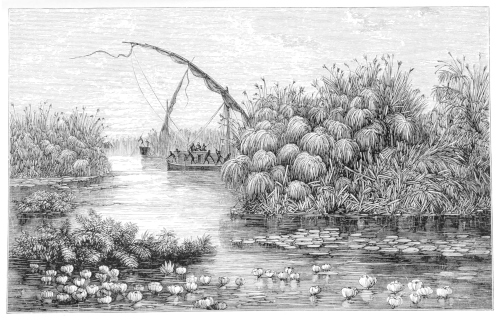
THE VESSELS IN THE GRASS-BARRIER.
EL SETT: THE GRASS-BARRIER.
This extraordinary grass-barrier had already been met with at the time of Miss Tinné’s expedition in 1863; here again in the summer of 1872 was it found, strong as ever, offering for months its serious impediments to navigation, and threatening to expose the crews to destitution, if their provisions should fail. The enterprising expedition of Sir Samuel Baker, in 1870-71, suffered repeated hindrances at this spot. An attempt was made to employ machinery to penetrate the mass, but steam-boats proved to be even less successful than the ordinary boats in making any headway. The conflict in these waters by means of wind and steam recalls what is not unfrequently seen in Egypt when a lot of men try to drag a donkey through the mud.
In this laborious fashion we had to toil on for several days. It was only by one of the side-arms of the blockaded mainstream that it was possible to reach the mouth of the Gazelle River. To this backwater the sailors give the name of “Maia Signora,” because the access to it is stated to have been discovered by the pilots who conducted Miss Tinné. Ever since the formation of the grass barrier (el Sett) there has been no approach to the river of Gondokoro, the Bahr-el-Gebel, except by a long side-arm called the Giraffe River, which is itself almost equally blocked up. Upon the whole we were more fortunate than our predecessors of previous years, because our journey chanced to fall during one of the periodical seasons when the growth of the ambatch is at a standstill. It happened therefore that of the three obstacles which (besides the current and the shallows) are generally to be expected, viz., grass, papyrus, and ambatch, one of the most important did not occur. The close of our first day’s exertion found us at night-fall on the southerly side of an island in mid-stream, whence we witnessed a spectacle striking in its way. Through an immense grove of acacias seventy feet high (A. verugera), which were remarkable for their resemblance to pine-trees, there gleamed, with the glare of day, the light of huge bonfires of faggots, which the Shillooks had kindled on the opposite bank, and which gave to the tall trees the effect of being truly gigantic.
Here on the 9th we tarried, and as it was the last woody district upon which we could reckon until we arrived at the mouth of the Bahr-el-Arab, we set to work to repair our broken sailyard. We were close now to the region of the Nueir: and on the steppes beyond the wood, we could see troops of them moving backwards and forwards; but they kept at a distance, and showed no disposition to open any negotiations with us. Footprints and various other indications leave no doubt but that this district is the playground of elephants, giraffes, wild buffaloes, and hyenas. Maraboo storks were abundant, and would often come tolerably close to the resorts of men, but as soon as they found themselves observed were careful to keep at a safe distance. During our progress along the river I brought down very many of these birds, and secured a quantity of their valuable feathers. These I sent to Europe, and at a bazaar for the benefit of the sick and wounded they realised a considerable sum. Maraboo feathers fetch higher prices than ostrich feathers, yet it is very remarkable that they are quite unknown in the commerce of Khartoom.
NUBIAN SONGS.
The temperature of the preceding days had been singularly fresh, and consequently the plague of flies, from which previous travellers had had to endure so much, did not at all molest us. We were, however, provided on board with all the appliances to protect ourselves from this nuisance, in case of need. Far into the night after these days of prolonged exertion resounded the songs of the Nubians, and the gourd-shells of merissa beer went round amid the native strains of Berber and Dongola. As I did not thoroughly understand the dialect of Dongola, I continually lost the exact purport of the words which were sung. One with the other the Nubians often use this dialect, although they just as frequently speak Arabic. Every now and then as they sung I made them tell me the sense of separate sentences; my listening to them seemed to delight them all, and I heard them saying behind my back, “Pity that the man is not a Mussulman, or at least a Turk, then what a capital fellow he would be!” To which another replied, “Turk, indeed! who ever heard of a Turk troubling himself about our songs? The Franks are worth a thousand of them!” The flattery took its effect upon me, and I was moved at once to deliver a regular homily to my people. Feeling like Cæsar among the pirates, I proceeded to say, “Did you ever hear, you rascals of cow-stealers, about those ancestors of yours, the Ethiopians of Meroë?” “Yes, indeed,” rejoined the Nubians, “for many and many a verse did our ancient poets compose about them, to celebrate their virtue; and they used to declare about the ruler of the gods (for at that time we believed in many gods) if he couldn’t be found in heaven it was because he was lingering amongst his darling Ethiopians on earth. But now, we have Allah, the great Allah; besides Allah we care for no other.”
“All very well;” I replied; “but where is the poet who can sing about his love to you, incorrigible thieves as you are? Just mind then what you are about for the future, and try to show that you are not unworthy of your great ancestors.”
The next day was again employed in unrelaxed endeavours to penetrate the grass-bound channels. The patches of papyrus became at once more frequent and more extensive, and here once again, after being long missed, is found the genuine Nile reed, the “shary” of the ancient Egyptians—the same as the soof of the Bible—which always grows on the shores of the mainland. Somewhat strangely the prevailing river-grass in the upper waters, the Vossia procera, is called in Arabic “Om-Soof,” the mother of wool. This appellation it derives from the peculiar hairy character of its leaf-sheaths. These have the disagreeable quality of covering the entire bodies of those who may be at work in the grass with a thick down of adhesive bristles. The sharpness of these and the scratches they inflict increase the irksomeness of the daily labour at the grass barrier. Still the great prairies amidst which the flood pursues its course afford an inexhaustible pasturage; cattle, sheep, and horses, all graze upon them, and no herbage is there that they prefer to the “Om-Soof.” At the close of the day, we again arrived in open water, and laid up for the night by the left bank, which presented a wide steppe entirely bare of trees.
Up with the sun, with sails hoisted with a moderate breeze in our favour, off we were on the following morning; short-lived, however, was our propitious start. Too soon the open water branched out into a labyrinth of channels, and the bewildered navigators lost all clue as to the actual direction of the stream. The projections of the green islets were always crowned with huge clumps of papyrus, which here grows in detached masses. It probably delights most in quiet waters, and so does not attain to the form of a high unbroken hedge, as on the upper banks of the Gazelle, for here, on account of the numerous stoppages, the stream flows through the narrow channels with extraordinary violence. The strength of the stream often makes towing impracticable, and the sailors often have considerable difficulty in sailing through it to the papyrus bushes, when they want to attach to their solid stems the ropes which are thrown out from their boats. This was the way in which we from sheer necessity sustained the resistance of the current. The depth of the channel was quite sufficient in itself to allow us to proceed, as our vessels drew only three feet of water; but the passage had become so contracted that at sunset we fastened ourselves to the papyrus-stems, quite despairing of ever being able to make further progress in this direction.
HIPPO- POTAMUSES.
It was one of those marvellous nights when the unwonted associations of a foreign clime seem to leave an indelible impression on the memory of the traveller. Here were the dazzling sparks of the glow-worm, glaring upon us like a greeting from our far-off home, and in countless masses glittering upon the dewy stalks of the floating prairie. In the midst of these were fastened our boats, hemmed in as firmly as though they were enclosed by polar ice. Loud was the rushing of the stream as it forced a way along its contracted course; but louder still was the incessant splashing of the emerging hippopotamuses, which had been driven by the vessels, as it were, into a corner, and were at a loss, like ourselves, how to go on or to retreat. Until daybreak their disquietude continued, and it seemed as though their numbers kept increasing, till there was quite a crowd of them. Already during the afternoon they had afforded a singular sight: whilst about half of our men were wading in shallow water and straining at the ropes, they found that they had entirely enclosed no less than six hippopotamuses, whose huge flesh-coloured carcases, dappled with brown, rose above the surface of the water in a way but rarely seen. A cross-fire was opened upon them from several vessels, but I could not make any use of my elephant rifle, because about 200 of our men were towing upon my line of sight. The clumsy brutes snorted and bellowed, and rolled against each other in their endeavours to escape; their ponderous weight bore down the tangle of the water-growth, and the splashing was prodigious.
Four days had now been consumed in this strain and struggle; after a final and unavailing effort on the fifth day, there seemed no alternative but to go back and make trial of another and more northerly branch of this bewildering canal-system. We succeeded in our retrograde movement so far as to attain an open basin, and found that we had only the distance of about 200 feet to get over, in order that we might reach the spot whereat the various streams of the Upper Nile unite. This place on the maps is distinguished by the name of Lake No, but the sailors always call it Mogren-el-Bohoor, i.e., the mouth of the streams. The difficulties which met us here were apparently quite hopeless. Our boats were not only heavily laden with corn, but, formed of the heaviest wood, their build was unusually broad and massive. Yet heavy and unwieldy as they were there was no alternative than literally to drag them over the grass. By dint, however, of main force, before the day was out the task was accomplished. The grass mass itself was lifted and pushed in front, whilst the men turned their backs against the sides of the boats, and pressed them on from behind. I was the only passenger to remain on board, because being fearful of a chill which might result in fever, I could not venture into the water.
What the maps call Lake No is merely the expanded mouth of the meeting waters. The current flowing from the south from the Bahr-el-Gebel passes along its apparent shores, which are projecting masses of papyrus. In order to reach the Gazelle it is necessary to bend westwards along the gradually narrowing lake-basin. At no season of the year is this water otherwise than shallow; even at the time of our retrograde voyage, when the floods were highest, we stranded more than once. Floating islands of papyrus of considerable extent were visible every here and there, and broke the uniformity of the expanse.
The passage which leads to the Gazelle has the essential properties of running water, although the stream itself is in winter scarcely perceptible. The river, however, is surrounded by such a multiplicity of backwaters and waters remaining in old river-beds, that the united volume of such a number of streams as I saw emptying themselves into it, at various times, through some hundreds of miles, could not possibly find its exit through this single channel alone. Petherick, in 1863, at the period when the water-floods were as low as possible, estimated the volume of waters to be rolling on at the rate of 3042 cubic feet a second; but he must have referred simply to the navigable channel at the mouth, without intending to represent that the calculation referred to the entire mass of the waters.
It remains still a matter of dispute which of the two currents should be considered as the main stream. According to analogy, as the Sobat is related to the Blue Nile, so the Bahr-el-Gebel is to the Bahr-el-Abiad, just as the Blue Nile is to the Nile of Egypt.
THE GAZELLE.
One of the objects contemplated in my journey was to show the importance of the western affluents of the Nile which unite in the Gazelle; and I have given evidence that, one way and another, they traverse a region of not less than 150,000 square miles. When I mention that in 1863 Speke called the Gazelle “an unimportant branch,”[11] and moreover that Baker has spoken of its magnitude with great depreciation, in reply, I might allude to another interesting fact in geographical annals. Not only did Bruce, a hundred years ago, suppose that he had discovered the sources of the Nile in Abyssinia, just where a hundred years previously they had been marked upon the Portuguese maps; but he represented the Bahr-el-Abiad as an inconsiderable stream, which joined the stream of his discovery at Halfaya, Khartoom at that time being not in existence. But it is absolutely impossible that Bruce could have returned from Sennaar to Berber along the left bank of the Blue Nile, and could have crossed at its mouth from the very spot where Khartoom now stands, without being aware that close behind him there was rolling its waters a stream as broad again as the Blue Nile. The record of his travels does not contain one word about the White Nile. The plain truth is that the White Nile was overlooked and disparaged, because it would have thrown his Blue Nile in the shade.[12] Ismail Pasha was quite right in saying that every fresh African traveller had his own private sources of the Nile; but for my part I am not at all ashamed to confess that I have not found them.
The wind was favourable, and so long as the course maintained a north-westerly direction we made a rapid progress. The main channel gradually contracted, however, and deviated into many abrupt meanderings, which had to be traversed by pushing and driving with poles. Here, too, the apparent banks consisted of floating grass-tangle, though further off the pasturing herds of the Dinka showed the true position of the mainland, whilst the ridge of forest beyond indicated the limit to which the inundations had extended. North of the mouth of the Gazelle the boundaries of the Shillooks and the Dinka meet each other, and the intervening territory is inhabited by the Nueir.
A GHATTAS BIRD.
In some places amongst the grass-tangle I made an attempt to botanize, and out of the numerous holes I fished up a variety of most interesting plants. The Gazelle is specially noted for the beauty of its water-lilies (Nymphæa stellata and N. lotus). Blossoms of these, in every variety of hue—white, blue, and crimson—well-nigh everywhere adorn the surface of the water; rooted below they project their long stalks and leaves through the apertures, like fishes, in the winter, to catch the air through holes in the ice. Should any one make a grasp at a blossom and fail to make good his hold, it may happen that the entire plant will make an elastic rebound and disappear beneath the grass. During the afternoon our course was N.W. and W.N.W., which is the general direction of the Gazelle throughout its lower half. The stream became wider again, the banks continuing to be lined by an impenetrable grass jungle. Remarkable dark-coloured water-birds (Plotus melanogaster) are found in considerable numbers upon the shores, intent upon making prey of small fishes. They settle upon the bushes, and one may every now and then be seen to make a sudden dive into the water, bring up a little fish in its beak, and resume its previous perch. Amongst the people of Khartoom this bird is called the “Ghattas,” a name which invested it with a special interest to me as being the name of my temporary protector.
For some few days past, just before sunset, great masses of tiny green flies had made their appearance. Although these were in no respect injurious, yet the buzzing they made and the choking cough which was caused by their numbers were anything but agreeable. Shortly after dark they retreated, only to appear again in the early dawn. Much more pertinacious were the spotty-legged gnats, which now began to torment us when the nights were not cool enough to disperse them. Everybody on board had provided himself for protection with a sack made of calico in which he slept, the result of which was ordinarily a temperature of some 80° Fahr., about the same as a regular vapour-bath. These gnats did not buzz about with so loud a noise, but their sting was much more decided. They might not cause such a lasting itching as some of their northern kindred, but the knack they had of finding a way for their proboscis through the thickest cotton till it reached one’s skin, made it only possible to keep them off by means of mosquito-nets. But altogether I reckoned this visitation as hardly worth the notice of a traveller who had grown up amongst the gnats of the teeming marshes of the north.
The Bahr-el-Ghazal may in some respects be compared to the Havel as it flows between Potsdam and Brandenburg; the two rivers are not dissimilar in their excess of floating vegetation, composed of plants which, to a great extent, are identical in their generic character. Frequently the breadth is not more than enough for a single vessel, but the depth could not be fathomed by our longest poles, and so revealed what was the enormous volume of water concealed by the carpet of grass for two hundred paces on either hand. What ordinarily appears to be land assumes at high water the aspect of an extensive lake. The general uniformity of level prevents any extensive range of vision; but I had only to mount the roof of my cabin, and, by observing the distance between the woods that skirted the prospect, I could approximately estimate the width of the river-bed. Nowhere did it appear to me to extend, like the valley of the Egyptian Nile, to a breadth of eight miles; and certainly, without further evidence, I cannot agree with former travellers, who describe it as being a lake or marsh of which the boundaries are unlimited.
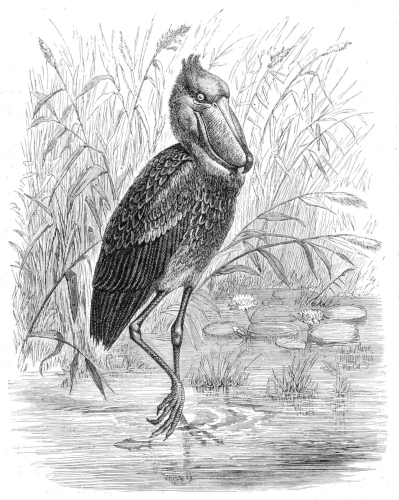
Balæniceps Rex.
BALÆNICEPS REX.
Neither crocodiles nor hippopotamuses are here to be observed. The absence of settled river-banks prohibits the Upper Nile from being the resort of the former; the deficiency of sand-banks would permit no life to the latter, which therefore make good their retreat to the narrower streams of the interior.
The second day of our voyage along the river brought us to the district tenanted by the Nueir. We found them peacefully pasturing their flocks and herds beside their huts, and betraying nothing like fear. They had been represented to me as an intelligent people; seeming to know what they had to expect or to dread, they were disposed for friendly intercourse with the Khartoom people, who, in their turn, were not inclined to commit any act of violence upon their territory. Two years and a half later, at the period of our return, all this was unfortunately changed, and landing was impossible.
Most of the Nueir villages lie on a spot where the Gazelle makes a bend from a north-east to a south-westerly direction. As we were making our way past the enclosures which lie on either side of the stream, my attention was arrested by the sight of a number of some of the most remarkable birds that are found in Africa. Strutting along the bank, they were employing their broad bills to grope in the slimy margins of the stream for fish. The bird was the Balæniceps Rex, a curiosity of the rarest kind, known amongst the sailors as the Abu-Markoob (or slipper-shape), a name derived from the peculiar form of its beak. It scientific name is due to the disproportionate magnitude of its head. Before 1850 no skins of this bird had been conveyed to Europe; and it appeared unaccountable to naturalists how a bird of such size, not less than four feet high, and of a shape so remarkable, should hitherto have remained unknown; they were not aware that its habitat is limited to a narrow range, which it does not quit. Except by the Gazelle and in the central district of the Bahr-el-Gebel, the Balæniceps has never been known to breed.
The first that appeared I was fortunate enough to hit with a rifle ball, which wounded it in its back, and brought it down: we measured its wings, and found them to be more than six feet across. Another was struck, but although it was pursued by an active party of Nubians, it effected an escape. As generally observed, the bird is solitary, and sits in retired spots; its broad beak reclines upon its crop, and it stands upon the low ground very much as it is represented in the accompanying illustration: it rarely occupies the ant-hills which every here and there rise some feet above the vegetation. The great head of the bird rises over the tall blades of grass and ever betrays its position. Its general structure would class it between a pelican and a heron, whilst its legs resemble those of a maraboo; it snaps with its beak, and can make a clattering noise like the stork. This Balæniceps would seem to furnish a proof that not everything in nature is perfectly adapted to its end, for when the birds are full grown, they never have their beaks symmetrical. The upper part does not correspond with the lower; the two members fall apart, and, like an old woman’s jaws, go all awry. The colour of their plumage in winter is a dingy light brown, their wings are black, and they seem to fly with difficulty, carrying their ungraceful heads upon their necks at full stretch, like a heron. They build in the rainy season, always close to the open water, forming their great nests of ambatch-stalks.
At the next groups of huts we made a stop, and did some bartering with the Nueir, who brought sheep and goats for exchange. Here, in the heart of the Nueir population, in a district called Nyeng, we fixed our quarters until the 16th. I made use of the time to spend the whole day in my ambatch-canoe, collecting the water-plants from the river.
THE NUEIR.
The Nueir are a warlike tribe, somewhat formidable to the Dinka. They occupy a territory by the mouths of the two tributaries of the White Nile, and are evidently hemmed in by hostile neighbours. In most of their habits they resemble alike the Shillooks and the Dinka, although in their dialect they differ from both. The pasturage of herds is their chief pursuit. The traveller who would depict their peculiarities must necessarily repeat much of what he has already recorded about the other tribes. With regard to apparel it will suffice to say that the men go absolutely naked, the women are modestly girded, and the girls wear an apron formed of a fringe of grass. Their hair is very frequently dyed of a tawny-red hue by being bound up for a fortnight in a compo of ashes and cow-dung; but occasionally it is cut quite short. Some of them weave cotton threads into a kind of peruke, which they stain with red ochre, and use for decoration where natural locks are not abundant. Their huts resemble those of the Dinka; always clean, the dwellings are surrounded by a trampled floor; the sleeping-place inside is formed of ashes of cow-dung, burnt perfectly white, and is warmer and better than any mosquito-net.
Nowhere in the world could a better illustration be afforded of the remarkable law of Nature which provides that similar conditions of existence should produce corresponding types amongst all ranks of animal creation. It does not admit of a doubt that men and beasts in many districts of which the natural features are in marked contrast to the surrounding parts do exhibit singular coincidences, and that they do display a certain agreement in their tendencies. The confirmation of this resemblance which is offered by the Shillooks, the Nueir, and the Dinka is very complete; these tribes, stationed on the low marshy flats which adjoin the river, are altogether different in habit to those which dwell among the crags and rocks of the interior. “They give the impression,” says my predecessor Heuglin, “that amongst men they hold very much the same place that flamingoes, as birds, hold with reference to the rest of the feathered race;” and he is right. The dwellers in these marsh-lands would probably have a web between their toes were it not compensated by the flatness of their feet and the unusual prolongation of the heel. Another remarkable similarity is the way in which, like the birds of the marshes, they are accustomed for an hour at a time to stand motionless on one leg, supporting the other above the knee. Their leisurely long stride over the rushes is only to be compared to that of a stork. Lean and lanky limbs, a long, thin neck on which rests a small and narrow head, give a finishing touch to the resemblance.
Leaving the last dwellings of the Nueir behind us, we arrived on the following day at the first wood which is to be observed on the banks of the Gazelle. Ant-hills of more than ten feet high are here scattered in every direction, and alone break the universal levelness of the plain. They are not unfrequently found in the heart of a thicket, because originally the stem of a tree served as the central axis of the earthy structure. Dead and withered though this had been, it sprouted out afresh from the roots, provided that these had been uninjured by the passages of the ants. Vestiges of the floods are traceable upon them, and show that the average difference between the highest and lowest level of the water is from three to four feet.
ALONG THE GAZELLE.
The river wends its way through charming wood-scenery, meandering amidst groves gay with the red bindweed (Ipomæa), amidst which now and then a tall tamarind uprears itself. Here I met with a fresh representative of the flora of Central Africa in the tree-like Euphorbia with its arms outspread like candelabras. This can be distinguished from the Euphorbia of the Abyssinian highlands, mentioned in Chapter I., by the involved confusion of its branches. Its eccentric shapes would seem to fill a place in Africa which in America is supplied by the order of the Cactaceæ; it also serves like the Mexican Cereus for the enclosure of estates, as slips taken from its branches readily take root in the ground. The sportsman could here reckon on a good bag, for the widow-ducks which swarmed upon the papyrus were brought down at every shot, and were serviceable for the table. Our people were all expert swimmers, and they continually fished out of the stream the birds which were struck, while their sport in no way ever hindered the progress of our craft.
The wind next day was not propitious, and the boats were obliged to stay beside a grass tangle by the bank. I made use of the detention to enjoy a little fishing for water-plants. The water-lilies surpassed all description, and would adorn any Victoria-house. Unfortunately I could not succeed in transferring to this region the queen of the waters. The Victoria regia seed, which I had brought for the purpose in pots, would never germinate; perhaps, although it was preserved in water, the heat of my cabin during my voyage was too great and destroyed its vitality. I can only boast of having naturalised in this district of Central Africa two plants as representatives of culture in Europe—the sun-flower and the tomato. The river, which is ordinarily about 300 feet wide, abounds in thick masses of potamogeton, trapa, and yellow ottelia. The seeds of this last plant much resemble the sesamum, growing like the seeds of the Nymphæa in a slimy gelatinous mass; they are collected by the natives, and, after being dried, are pounded down into a sort of meal, which the sailors of Khartoom assured me was a wholesome and excellent remedy for indigestion. It surprised me very much to learn that the eatableness of the water-nut (Trapa) was unknown to the Dinka, although it grew in such abundance on the river.
We landed, towards evening, close below the mouth of the Bahr-el-Arab in a forest of lofty trees, where the West African Stephegyne appears to find its extreme eastern limit. The wood of this species of Rubiaceæ is somewhat soft and light, but its branches make masts for the boats of a strength and straightness unequalled by any other growth in these countries, where wood adapted for erections of any sort is so notably scarce.
The Gazelle, at the place where the Bahr-el-Arab empties itself, has a width of about 1000 feet. This mouth is itself not much less, but just above the mouth the condition of the Gazelle is so different that it must be evident to every sailor that the Bahr-el-Arab plays a very important part in contributing to the entire system.
What the sailors mean by the Bahr-el-Ghazal is really only the channel as far as they navigate it; to them it is not a stream, in a hydrographical sense, such as either the Bahr-el-Arab or the Bahr-el-Dyoor. It is only at the mouth of the Bahr-el-Arab that there first appears a measurable current, and the fairway, which up to that point is not above 15 feet deep, is subsequently never less than twice that depth. After getting every information I could in the remotest west, I come to the conclusion that the Bahr-el-Arab is the main stream. Even at a distance of 300 miles above its mouth it is found throughout the year as a stream which cannot be forded, but must be crossed in boats, whilst the Bahr-el-Dyoor cannot be traced at all at so great a distance from its union with the Nile. The plains through which the Gazelle flows are too level to allow of any recognition at first sight of the true limits of the territory subject to its inundations. Any one, however, who is familiar with the character of the vegetation of the country, will easily detect symptoms from which he could form a tolerably correct opinion. Accordingly, on my return journey in 1871, I gathered ample evidence to satisfy myself that the Gazelle, associated as it is with the Bahr-el-Arab and the Bahr-el-Dyoor, is a river just as truly as either of the others. The fall of the water in the Gazelle is only produced by the torrent driven from the south and west, and may hardly admit of being estimated, since the entire difference measured between Khartoom and the Meshera (the termination of the navigable course) does not altogether amount to 100 feet.
STREAM OF THE GAZELLE.
An important change in the scenery of the shores supervenes upon a further progress. The lake-like surface of the water gives to the Bahr-el-Ghazal the semblance at first sight of being merely an extensive backwater. That just above the mouth of a stream so considerable as the Bahr-el-Arab there should be this abundance of water at the very time of the year when it is at its lowest ebb, is a circumstance which cannot fail to confirm the supposition which I entertained when I entered the Gazelle: I was certain that the narrow channel through which we travelled in the district of the Nueir could not possibly be the entire river; and there surely must exist to the north of the river other not inconsiderable arms, which are inaccessible on account of the denseness of the river grass.
Unhindered by any material obstacles, our course now lay between floating islands, which were partly adorned with variegated blossoms, and partly loaded with a luxuriant growth of splendid ferns. The poles sufficed to keep the boats from the floating vegetation, the masses of which were as unyielding as though they had been sheets of ice. It was evident by the motion of these masses, that the current, though it flowed languidly, had a continued progress towards the east. The river only varies in depth from about 8 to 14 feet. The bed presents the appearance of a meadow, in which little bright tortoises enjoy their pasture. This submerged sward is composed exclusively of the Ethiopian vallisneria, of which the female blossoms, affixed to spiral peduncles, rise from a fathom deep to the surface of the stream, their coiling stalks extending far and wide. Very wonderful is this plant in its sexual development; its northern sisters haunt the waters of the Po and of the Rhone, and have furnished a theme for the admiration of the poet.
Far away, on either side, beyond the flooded borders of the grassy river-bed could be discerned, at a distance of a league or two, large tracts of forest land; and between the river and the line of woods which stretched to the horizon there could be observed the cumbrous shapes of elephants going to and fro, and demonstrating that there at least the land was firm.
The channel, which we rapidly passed along under favourable breezes, became continually broader, and the nearer we approached the river source, the more the banks seemed to recede from each other. The sight of men, fishing out of canoes formed by a couple of hollow stems being fastened together, made us aware that we were approaching the dwellings of the Dinka, and soon after we came upon the enclosures for cattle surrounded by low thatch huts upon the left bank. Sailing on towards the south and south-east, we approximated to the limit of our voyage. A great cracking up in the air revealed to us that the sailyard had once more broken, so that it was only by main force, by pushing and pulling, that we managed to reach a large Dinka village, which lay on the west, almost at the extremity of the stream. Here was the cul-de-sac, to which the Dinka have given the name of the Kyt. We had quite recently passed the mouth of the Dyoor, which appears to separate into several streams; but if my attention had not been called to this circumstance by the Reis, I should certainly never have observed it, on account of the uniform features of that watery region. In our delight at having so quickly, and without misadventure, accomplished our passage up the Gazelle, we had a night of feasting and merry-making.
MESHERA ON THE GAZELLE.
The remainder of the journey was soon completed, and in the early morning hours of the 22nd of February we found ourselves at the Meshera, the landing-place of all who resort to the Gazelle. This place is marked in the maps as Port Rek, called so from the Rek, a section of the Dinka. These Rek people were the first allies among the natives that the new comers had acquired, and they had been accustomed to provide them with bearers long before the Khartoom merchants had established any settlements in the interior. Deducting the days on which we had not proceeded, our boats had taken thirty days in going from Khartoom to the Meshera. I had been anxious to make a good investigation of the river banks; otherwise the voyage might easily be accomplished in twenty days.
Above the mouth of the Dyoor, so difficult of access, the deep channel is continued for a space of sixteen miles, when it forms the cul-de-sac which I have mentioned: there is not the least current when the waters are all at their height; but in March and April there may at some places be observed a retrograde motion of the stream. It is manifestly an ancient bed of the Dyoor, or of some river which in the lapse of time has changed its course. It is not easy to explain it, but the stream seemed to me, as I think I could farther demonstrate, the navigable overflow of some inland liman, that is, the receptacle of a number of considerable rivulets meeting together, something like what the delta of the Canton river would be, if it could be levelled, filled up, and carried away inland. The uniform depth of the channel might seem to originate in some freak in the conformation of the ground, or of the masses of vegetation, which are irregularly scattered about; but really it is only an indication of a condition of things long passed away, when the mainstream flowed through better defined and more contracted borders.
Let us for a moment review the impressions we have gained. The volume of water brought by the Gazelle to swell the Nile is still an unsolved problem. In the contention as to which stream is entitled to rank as first-born among the children of the great river god, the Bahr-el-Ghazal has apparently a claim in every way as valid as the Bahr-el-Gebel. In truth, it would appear to stand in the same relation to the Bahr-el-Gebel as the White Nile does to the Blue. At the season when the waters are highest, the inundations of the Gazelle spread over a very wide territory; about March, the time of year when they are lowest, the river settles down, in its upper section, into a number of vast pools of nearly stagnant water, whilst its lower portion runs off into divers narrow and sluggish channels. These channels, overgrown as they look with massy vegetation, conceal beneath (either in their open depth, or mingled with the unfathomable abyss of mud) such volumes of water as defy our reckoning. The Gazelle then it is which gives to the White Nile a sufficient impetus to roll its waters onward; subsequently the Bahr-el-Gebel finds its way and contributes a more powerful element to the progress of the stream. It must all along be borne in mind that there are besides two other streams, the Dyoor and the Bahr-el-Arab, each of them more important than any tributary of the Bahr-el-Gebel; and these bring in their own influence. To estimate aright the true relation of all these various tributaries is ever opening up the old question in a new light.
THE KYT.
The ramifications above the mouth of the Bahr-el-Arab are very complicated, and must be very imperfectly traced on our present maps. The map issued by Lejean has many details, but must be accepted with caution, and requires us to remember that paper is patient of error as well as of truth. Whoever has traversed the lakes (so to call them) to the west of the Bahr-el-Arab, has, almost immediately beyond the mouth of the Dyoor, come upon the winding channel known as “the Kyt.” The shores of the Kyt are firm; there are detached groups of papyrus driven by the wind sometimes to its one bank, and sometimes to the other: its waters rise and fall, but have no other apparent motion; it widens at its extremity into a basin of papyrus, which was now open, but which in 1863 was entirely choked by ambatch. Heuglin, at that date, discerned, as he thought, in the dwindled and distorted stems a prognostication of an approaching disappearance of the ambatch; and from 1869 to 1871 there was no trace of it, Various openings are made by the water towards the west among the masses of papyrus, which enclose a labyrinth of little wooded islets.[13] One of these islands is the resting-place for the boats, and close at hand the voyagers establish their temporary camp. Being surrounded on every side by the water, all is secure from any hostile attack. The regular landing-place is on the southern shore of the basin, and thence commence the expeditions to the interior.
Such is the channel which, from the times of the earliest explorers, which appear to extend from the date of Nero’s centurions, mentioned by Seneca, up to the mercantile enterprises and voyages of discoveries of the last ten years, has always brought boats to that cul-de-sac, called by the Nubian sailors their Meshera. The first boat, which actually entered the Gazelle, was that of a Khartoom merchant, named Habeshy, in 1854; two years later followed Consul Petherick, the first to open mercantile transactions with the tribes resident in these remote regions.
At that time, when nothing was known either of the Dyoor or of the Bahr-el-Arab, it must have been no small surprise to the first explorers to see a stream so large suddenly end amongst a labyrinth of small islands, without any navigable affluent. Only by the help of a native pilot was such a discovery possible.
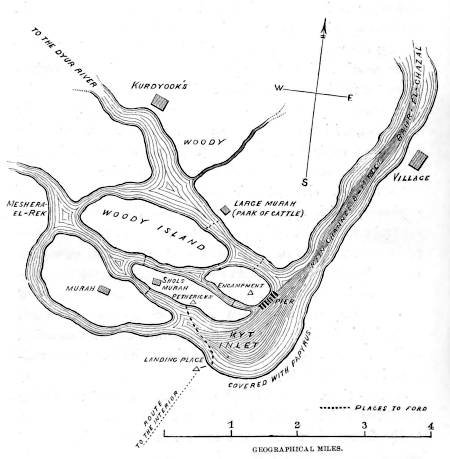
The Meshera.
MALARIOUS ATMOSPHERE.
I was compelled to linger out the remainder of February and the greater part of March in camp upon the little island, pending the arrival of the bearers who were to help me onwards to Ghattas’s Seriba. I was happy in escaping any ill effects such as might be dreaded from a protracted residence by this unhealthy river. I attributed my immunity in great measure to the precautionary use of quinine. Although by my daily occupations, botanising in swamps and continually wading amongst papyrus clumps, I had been more exposed to malaria than many others, I experienced no sickness. I swallowed every day, in three doses, eight or nine grains of quinine, enclosed for that purpose in gelatine capsules; this method is to be strongly recommended to every traveller, since the intense bitterness of the medicine taken in its undisguised form may excite a degree of nausea which, I can well believe, may contribute its part to a liability to fever. This treatment I continued, without its having any ill effect upon my constitution, until I could dispense with it in the purer air of the interior. I suppose, since this is not an universal experience, that the effects of the alkaloids may vary with different patients, and therefore it would be well for every one first to test the susceptibility of his individual constitution.
It is only too well known how many victims this treacherous climate has already claimed; it may without exaggeration be maintained, that half the travellers who have ventured into the swamps have succumbed to fever. The highest mortality was in the settlements of the Austrian mission in Gondokoro and St. Cross, now long since abandoned. Miss Tinné’s expedition of 1863 suffered the loss of five out of its nine European members, among them my unfortunate predecessor in the botanical investigation of this district, Dr. Steudner, who died suddenly quite at the beginning of the journey. Heuglin, too, lost the greater part of his valuable time in continual relapses of fever. The foundations of these miserable attacks had probably been laid in the miasma, of which the traveller had inhaled the poison during a protracted sojourn in the Meshera. The latest Job’s comfort, which had most unnerved me, had come just as I was embarking at Trieste. The French Geographical Society had, a few months previously, sent out Le Saint, a naval officer, on a voyage of discovery, having for its object the same district as myself, viz., the Niam-niam countries. His outward journey had been much lengthened by the grass obstruction in the Giraffe stream, and he died before he entered the country in which his more extended wanderings were designed to commence.
Before quitting the Meshera (the only landing-place for expeditions starting from the Gazelle) I will make a few observations on the natural character, scenery, and inhabitants of the region of this unique island world.
The Meshera had been reached by eighteen different boats belonging to Khartoom merchants, and these now lay, half-buried in mud and clay, firmly wedged in the jungle of papyrus. Every new comer could only by great exertions procure a fresh resting-place. For that purpose they proceeded in the following way: they backed their boat a little into the open water, and anchored; then a rope was fastened to a strong mass of papyrus-roots, which it towed with its loosened clods attached into open water, until the breeze carried over the entire floating mass to the opposite side of the basin. Thus was obtained one artificial Delos after another. The access to the bank is, however, still left blocked up by the compact border of papyrus thus conveyed across. By means of fire and hatchet avenues are then opened, and the long roots of papyrus are piled upon the elastic sward of its stubble until an available pathway is complete.
Most of the islands are adorned by graceful masses of bushes and by light groves of the larger trees, but the hatchet of strangers every year is altering this condition of things. In spite of all the uniformity of the tall papyrus bushes, and notwithstanding the burnt and dry appearance of the steppe-grasses, there is no lack, even in the mild winter of this little island-world, of the charms of scenery. The dark crowns of the evergreen tamarind stand out in sharp outline against the bare rugged branches of the acacias in their grey winter garb, between which the eccentric shapes of the candelabra-euphorbiæ, closely interlaced, bound the horizon in every direction, and form, as often as the eye wanders over the neighbouring islands, a fine gradation of endless shades of colour. This is especially noticeable in the early morning, when at sunrise a heavy mist hangs over the damp flats, and sometimes here, sometimes there, sets limits to the prospect, in a way that would lend enchantment to any scenery.
SECURITY IN THE MESHERA.
Protected by the endless ramifications of the marshes against any attacks of dangerous quadrupeds from the mainland, the sojourner here had only the most determined of all depredators to fear, namely, man himself. But even this fear was not really great. Nowhere on the face of the earth is a country more surrendered to robbery and lawlessness than this district of Africa; but still, as ever, one form of mischief balances another: man is a match for man; and so it results that the stranger may find repose and security here as much as elsewhere. The natives, who occupy the entire land in a wide circumference from the Meshera, form a portion of the great Dinka family, whose extreme outposts extend eastwards towards the Egyptian borders of Upper Sennaar, and whose tribes are counted by the hundred.
One of the most influential personages of the neighbouring race of the Lao was a woman, already advanced in years, of the name of Shol. She played an important part as a sort of chief in the Meshera, her riches, according to the old patriarchal fashion, consisting of cattle. As wealthy as cattle could make her, she would long since have been a prey to the Nubians, who carry on their ravages principally in those regions, if it had not chanced that the intruders needed her for a friend. They required a convenient and secure landing-place, and the paramount necessity of having this induced them to consider plunder as a secondary matter. They provided in this way, that single boats, even after all others had taken their departure, could safely remain in the Meshera throughout the rainy season without incurring any risk from the natives. The boatmen accordingly respect the bank of the river which is the resort of Shol’s herds; whilst Shol, on her part, uses all her influence to retain her tribe on friendly terms with the strangers. The smallest conflict might involve the entire loss of her property.
The old Shol did not delay, but the very first day came to my boat to visit me. On account of the colour of my skin, the Nubians had told her that I was a brother of the Sigñora (Miss Tinné). My pen fails in any attempt to depict her repulsiveness. Her naked negro skin was leathery, coarse, and wrinkled; her figure was tottering and knocked-kneed; she was utterly toothless; her meagre hair hung in greasy locks; round her loins she had a greasy slip of sheepskin, the border of which was tricked out with white beads and iron rings; on her wrists and ankles she had almost an arsenal of metal, links of iron, brass, and copper, strong enough to detain a prisoner in his cell; about her neck were hanging chains of iron, strips of leather, strings of wooden balls, and heaven knows what lumber more. Such was old Shol.