Chapter VIII
Ellen E. (Ellen Elizabeth) Frewer translation
Calamities by fire. Deliverance and escape. Six women-slaves burnt. Barterings. Domestication of wild-cats. Plague of cockroaches. Pillen-wasps. Agamæ and chameleons. Fever. Meteorology. Solar phenomenon. A festal reception with an unfortunate result. Disturbance of rest at night. Murmuring of prayers. Jewish school. Orgies and drum-beating. Casting out devils. Resolve to follow Aboo Sammat. Start towards the south. Passage of the Tondy. Character of the forest. The water-bock. Scenery by night. Shereefee’s attack. Seriba Duggoo. Consequences of the steppe-burning. Seriba Dagguddoo. Burnt human bones and charred huts. Tropics in winter. Two kinds of ant-hills. Arrival in Sabby. Nocturnal festivities of the Bongo. Desolation of the country. Goat-suckers. Abundance of game. The zebra-ichneumon. The spectral mantis. Lions. Wonderful chase after hartebeests. Snake and antelope at a shot.
So satisfactory was the condition of my health that it appeared to me entirely to confute the opinion entertained by Europeans that a prolonged residence in the tropics is destructive alike of physical and moral energy. For those probably who live in indolent repose, and who are surrounded by all the appliances of domestic comfort, who, so far from undertaking the trouble of a journey, have scarcely the activity to take a walk, there may be some ground for the presumption; and more particularly may this be the case in Mohammedan countries where slothfulness and laissez faire are as contagious as gaping is all the world over. But nothing of the kind is to be found for a traveller whose elasticity is kept at all on the stretch, and who is conscious of not having a minute to spare; the exercise of his faculties will keep them in vigour as full as though he were still on his native soil. For my own part, I could not help thinking of the contrast between the rainy season which I spent here and that which, in 1865, I had passed in Gallabat; now all was animated and cheerful; life seemed free from care; my health was unimpaired, and I enjoyed the most intimate converse with Nature; but then, on the contrary, it had been a perpetual struggle between getting well and getting ill, and I had never ceased to be haunted by the depressing influences of a weary spirit.
However happily my time in the Seriba glided on, still it was not altogether free from peril. An incident full of alarm occurred to me on the night of the 22nd of May. The rain was coming down in torrents, and about two hours after midnight a tremendous storm ensued. The thunderclaps rattling through the woods sounded like an avalanche, and coming rapidly one upon another, seemed to keep pace with the lightning which gleamed through the darkness of the night. Suddenly there was a shrieking of women’s voices, and at the same instant the blackness of night was changed to the light of day, as the blaze of a burning hut flared up aloft. The flaming structure was only separated from my own quarters by my single granary. Aroused by the outcry I sprang up; for to be caught asleep in an edifice constructed of straw and bamboo is to be enveloped in fire, and is almost certain death. The hazard was very imminent; in a very few minutes my hut must apparently be in flames; the work of demolition began at once; my powder was conveyed without delay to a place of safety; my chests and my herbarium were then secured; all the smaller articles of my furniture were thrown into great waterproof coverings and dragged out en masse. Perhaps about half of my property had thus been placed out of jeopardy when we observed that the wind bore the flames in a different direction, and fortunately the light framework of the burning roof gave way and it soon fell in; saturated as the straw was with the rain it put a check to the further spreading of the flames. Now was the time to draw our breath and look around; we could now give over our hurry and scurry, and examine the real condition of things. I stood almost petrified at the reflection how narrowly I had escaped coming to utter grief on this unlucky night; I thought how deplorable had been my lot if I had been reduced to a condition of nakedness and want in this inhospitable land; I became alive to the sense of shame with which I should have retraced my way back to Khartoom within a year, and with my task unfinished; I was dispirited; I knew not what might happen, and perhaps this fire was only a prelude to yet more bitter experience.
KILLED BY LIGHTNING.
The tokkul which had been burnt down was hardly five-and-twenty paces from my very bed. There, struck by lightning, six female slaves had met their simultaneous death; a seventh had been untouched by the electric fluid, and had contrived, half dead from burning, to effect an escape from the flaming pile. When a clearance was made on the next morning, after the ashes had been removed, the bodies of the ill-fated women were found completely charred, lying closely packed together just as they had gone to sleep in the hut around its centre support, which had been the conductor of the lightning. They formed a ghastly spectacle, at which even the native negroes could not suppress a shudder, whilst the recently imported Niam-niam slaves made no disguise of the relish with which they scented the odour of the burnt flesh, as they helped to clear away the débris. Scarcely any incident could befall a traveller more disquieting than this; it had haunted me in my dreams all through my sojourn in the Soudan; forebodings of it had stuck to my fancy, and now it appeared to be well-nigh on the very point of literal fulfilment.
One of the Nubian soldiers had, amongst the six victims of the conflagration, to bewail the loss of his sweetheart. To such a degree did this bereavement prey upon him that he entirely lost his reason, and so gave a considerable amount of trouble to the occupants of the Seriba. An instance of affection like this never came to my knowledge elsewhere in these districts.
As far as regards danger from fire, the settlement here was at a disadvantage when compared with various Seribas in which the huts are not crowded so closely together; but in other respects, such as the more complete security of the territory itself, the abundance of provisions, the rareness of mosquitoes, and the small number of white ants, this Seriba had recommendations which put every other in the shade. Very advantageous was the appearance at my door, morning after morning, of the neighbouring Dinka, who brought every variety of their productions for me to purchase. In this way I was kept amply provided not only with yams and earthnuts, the purest of oil and the finest of honey, but I was able readily to obtain all the corn I required for my retinue. Moreover, it happened not unfrequently that I had some natural production offered me of considerable rarity, and thus the edge of my botanical curiosity was kept continually sharpened. In the very depth of the rainy season by getting the eggs of some geese and bustards, and even of some ostriches, I managed to counterbalance the meagre produce of my poultry-breeding.
SPEKE AND BAKER’S TRAVELS.
Of these opportunities of seeing considerable numbers of the natives gathered round me, I made the best use I could to obtain the measurements of their bodies, an achievement on which I had set my mind with some degree of pertinacity. At the end of one year’s residence in the interior I had made a synopsis (under about forty heads) of the measurements of nearly two hundred individuals, but unfortunately very few of my memoranda are now forthcoming. During my intercourse with the natives I very often allowed what pictures I had to be exhibited, in order to satisfy their repeated inquiries. All they saw stirred up their unfeigned delight, and continually prompted them to ask in astonishment why they had not learnt the same things from the “Turks,” and to express their conviction that that must be a wonderful country where tools and guns were made. The indolent Nubians, too, would pay me visits most assiduously till I was absolutely weary of them. They would often make their appearance quite early and I could only disengage myself from them by letting them have my books and pictures about Africa to look through. The illustrations in ‘Le Tour du Monde,’ in Speke’s ‘Travels,’ and in Baker’s ‘Hunting Adventures,’ all alike furnished them with inexhaustible material for question and answer. They shouted their approbation aloud, and crowned their admiring estimate of any picture by crying out “bazyatoo” (the very facsimile), again and again. The name which Speke’s book acquired in the Seriba was ‘The History of King Kamrasi,’ while they called Baker’s work ‘The Book of the Elephant Hunter.’
In the beginning of September I was able to make a despatch to the river of my treasures I had collected, and to forward them by way of Khartoom to Europe. I had upwards of forty packages, and to put them together and make them secure was the business of a good many days. Particularly laborious was it to sew them all upon skins, and still more laborious, I do not doubt, to rip them up again when they reached their destination; for during their transit across the parching desert, the hides are not unfrequently so dried up that they become as hard as tin. For the protection of my packages and to prevent the botanical contents being invaded by insects or gnawed by rats, I had no difficulty in providing the caoutchouc substance of the Carpodinus, the “Mono” of the Bongo. This I obtained in a fresh condition, when it has the appearance of a well-set cream, and washed it lightly over the linen or the paper like a varnish. Not an insect found its way through this coating, and my packages all arrived thoroughly uninjured in spite of their being a twelvemonth on their way. Less adapted for the purpose I found both the milky sap of the fig and of the butter tree, because it is not so uniform in its character and does not admit of being spread so readily.
The produce of Ghattas’s Company was this year four hundred loads, being somewhere about 220 cwt., which would be worth in Khartoom nearly 4000l. In order to reach this amount, certainly not less than three hundred elephants had been destroyed, and probably considerably more.
Although the ants at this spot did not abound in the wholesale way in which they did in many other Seribas, there were nevertheless plenty of inconveniences in my quarters, and like every other traveller I had to get accustomed to them as soon as I could.
My want of space was a great difficulty. I was hardly at all better off in the hut where I ordinarily lived than in an old overcrowded lumber room. I had no cupboards and no small chests, and consequently I was compelled to be ever packing up and unpacking my thousand bits of property. The framework, of my own construction, which reached up into the circular roof did something to increase my accommodation, and I hung bags upon it containing my clothes and my linen, and a whole host of little things besides I stuck into the straw thatch above. Under such circumstances, no wonder that I had perpetual conflict with rats, crickets, and cock-roaches, and that they were a constant source of annoyance.
NOXIOUS VERMIN.
The only method which was really an effectual guarantee for the protection of any articles from being gnawed to bits was to hang them up; but whenever at nightfall I had any packages which could not be suspended there was one device of which I made use, and which was tolerably successful in keeping rats at a distance. One of the commonest animals hereabouts was the wild cat of the steppes (Felis maniculata). Although the natives do not breed them as domestic animals, yet they catch them separately when they are quite young and find no difficulty in reconciling them to a life about their huts and enclosures, where they grow up and wage their natural warfare against the rats. I procured several of these cats, which, after they had been kept tied up for several days, seemed to lose a considerable measure of their ferocity and to adapt themselves to an indoor existence so as to approach in many ways to the habits of the common cat. By night I attached them to my parcels, which were otherwise in jeopardy, and by this means I could go to bed without further fear of any depredations from the rats.
Quite helpless, however, did I appear with regard to the devastations of the crickets, which found their way through my stoutest chests, ate holes into all my bags, and actually fretted my very wearing-apparel and body-linen. Subsequently I received a supply of borax, and this turned out to be an adequate security against their mischief.
The encroachment of the wood-worms in the bamboos which composed my hut developed itself into a nuisance of a fresh sort. To myself it was a matter of great indifference whether the building collapsed sooner or later, but just at present it was a great annoyance to me that all day long there should be an unceasing shower of fine yellow dust, which accumulated on everything till it lay as thick as my finger, and almost exceeded the bounds of endurance.
Another noxious insect which was to be found in every hut was the Pillen-wasp (Eumenes tinctor). This was nearly two inches long, and had a habit of forming its nest in the straw right at the top of the circular roof. Associated with eight or ten others it made a huge cell, and flying in and out through the narrow doorway, which was the only avenue for light, it came into constant collision with my face. Its sting was attended by distracting agony far worse than the sting of any bee. Throughout the entire year I was baffled by these wasps, which were beautiful in colour, having wings of a fine violet blue. I made many attempts to destroy their ingeniously-constructed nest, and only succeeded after catching them in a butterfly-net and killing them one by one.
Throughout the tropics the harmless kinds of lizards may invariably be reckoned amongst the settlers in every house. Prettily marked skinks (Euprepes quinquelineatus and E. pleurostictus) enlivened my abode, whilst the graceful gecko (Hemidactylus verrucalutus) clambered up and down the walls just as frequently as in Egypt and in Nubia. But more numerous than all were the sociable agamæ (Agama colonorum), which kept nodding their heads, in a way that was extremely irritating to the Mohammedans, who fancied that it was the devil making fun of their prayers. I had previously repeatedly seen this species of the lizard in the overhanging rocky crags of the desert valleys on the Egyptian coast of the Red Sea; but here it appeared to lodge itself quite as freely in the huts as in the woods. The head of the male is of an orange-colour, and is easily detected from a considerable distance. Very ridiculous are their movements when any one approaches a tree upon which they are running up and down. They betake themselves to the farther side of the stem, and keep stopping at intervals, peeping out cunningly first from one branch and then from another, their large eyes beaming with a most knowing expression. Their favourite resort, however, in this district was the old woodwork of the palisades, and there they mustered in thousands.
I was very much surprised, at the beginning of the rainy season, at the large number of chameleons which at intervals clustered themselves upon the sprouting foliage. The common African sort grows to a very unusual size, and I saw several which could hardly be less than ten inches long. Scarcely less abundant is the smaller and slimmer species (C. lævigatus), which does not exhibit quite to the same extent the changes of its colour. Rolling its eyes in a very remarkable manner it answered the same purpose as the agama, with its nodding head, of getting up a joke against the Mohammedan fanatics. “What is a chameleon like?” I used to ask them, and not over delighted were they when they were told that the chameleon, with its one eye up and the other eye down, was a faki looking up to God in heaven, but at the same time keeping a sharp look-out upon the dollars of earth.
VALUE OF QUININE.
Thoroughly free, as I have said, from fever, during March and April, I persevered in taking my daily dose of ten grains or more of quinine; but as the heat diminished, and as the rainy season at its height was not so full of miasma, I gradually diminished, and in June and July entirely gave up my uniform administration of the tonic. But quinine still remained my sole medicine, my only resort in every contingency. If ever I got a chill, if ever I was wet through, or was troubled with any symptoms of indigestion, I lost no time in using it, knowing that for any traveller in a region such as this, any indisposition whatever is simply a doorway through which fever insidiously creeps and effects its dangerous lodgment. Any sudden giddiness in the head, or any spasm between the shoulders, or any failure in the functions of the limbs were all, I do not doubt, warnings of the ill-omened visitor, which I accepted in time to avert. Not only, as I have remarked, were fevers here quite common, but my own attendant, who had accompanied me from Alexandria, was prostrated some days by a very serious attack, and his condition of health was so much impaired that he had to be sent back on the next return of the boats. There were others, too, of my own people who had to endure attacks of less severity.
Expecting, as I had been, a much larger fall of rain, I could not be otherwise than much surprised at the meteorological facts which were actually exhibited. Although the rainfall extends over a longer period, the total average fall of water is less here than it is either in Gallabat or in Upper Sennaar, where the rain lasts only from the beginning of May to the beginning of October. There the rain, almost without exception, fell every night, and all night from sunset till daybreak; but here it was the result of experience that the rain ordinarily was to be expected between noon and night. All travelling consequently has to be accomplished before midday, and the journeyings are necessarily shorter than in the dry winter months. It may be taken as a rule that holds good very generally throughout the tropics that if the sun rises clear or becomes clear shortly after rising, there will pretty certainly be no rain for some four or five hours. In Gallabat it was considered rather a feat to walk during the rainy season from one house to another either in slippers or in Turkish shoes, but here, day after day, such protection for the soles of the feet was quite sufficient, even where the ground was not at all rocky.
CLIMATE AND TEMPERATURE.
European vegetables in Gallabat had generally been found to suffer from the excessive wet, and others had either run into weeds or in some way degenerated, but here, from May till August, we cultivated many sorts successfully, and made good use of the intervals which, sometimes for four or six days together, passed without any rain whatever. To confirm what I have said, I adduce the facts that in March 1869, in the centre of Bongoland (lat. 7° 20´ N.), the “Khareef” was opened by four little showers; in April there were seven considerable pourings; in May seven falls of rain, lasting several hours; in June ten, in July eleven, and in August twelve. These must not be reckoned as days of rain, for the truth is, an entire day of uninterrupted rain never once occurred. The rainfall only up to June was attended by tempests or thunderstorms, after which date the violence of them gradually and almost entirely abated. Heuglin in 1863 had made the same observation. At the end of July there ensued an entire change of temperature, and only in exceptionally hot afternoons did the heat ever again reach the extreme point which it had done previously; but even at its maximum it had never exceeded 95° Fahr. in the huts, whilst in the open air it was ordinarily 2° lower. I could now rejoice in a degree of heat scarcely above what is common in our northern zone, and seldom registered a temperature above 77° Fahr. in my own quarters. This fall in the thermometer is very beneficial and refreshing to the European, whose skin, exhausted by repeated perspiration, is very often distressed by a perpetual nettlerash.
The earliest rain which I observed this year fell while I was still at the Meshera on the 2nd of March; and the 16th of that month was the date on which the wind altered its course, and for the first time deviated from its long-prevailing north-easterly direction.
The uniformity of climate in equatorial Africa contributes very much to extend the range of particular species of plants. To this may be added the absence of those mountain systems which elsewhere, as in Asia, traverse the continent in all directions. Without let or hindrance the trade-winds exert their influence over the entire breadth of this region. Any interruption of the rainy season between the two zenith positions of the sun, which in Bongoland are some months apart, has never been authenticated. Although upon the north-west terraces of Abyssinia the rainy season might appear, through the influence of the mountains, to be obliterated or obscure, yet it could always be traced; but nevertheless the whole aggregate of circumstances which contribute to these precedents is not to be estimated during the transitory observations of one short sojourn.
Neither during the continuation of my wanderings towards the south did I find any indication which seemed to evidence that two rainy seasons had anywhere coalesced so as to become one continuous period of rain, which sufficed throughout the year to maintain an uninterrupted renewal of vegetation. Nowhere in the equatorial districts which I visited (not even in the territory of the Monbuttoo, of which the latitude is between 3° and 4° N.) did it appear that there ever failed a uniform period for foliage to develop itself. Apparent exceptions might be found where the condition of the soil is never otherwise than wet throughout the year; but even in this low latitude there is a dry season and a wet season, just as decided as in Nubia, twelve degrees further to the north.
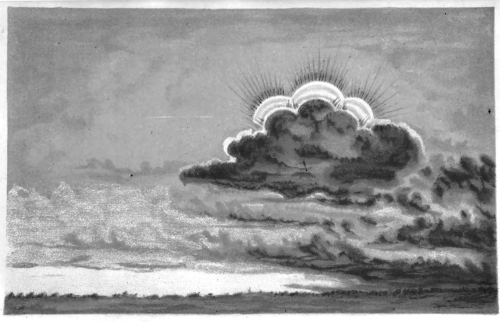
PHENOMENON ON THE 17ᵗʰ OF MAY 1869., HALF-PAST FIVE, P.M. LAT 7° 25.´N.
SOLAR PHENOMENON.
Between five and six o’clock on the afternoon of the 18th of May, while I was absorbed in my writing, I was suddenly startled by the outcry of a number of my people calling me to make haste out and witness the singular appearance which was arresting their attention on the south-west horizon. Great masses of clouds were covering the declining sun, whilst all below the heavy cumulus the heavens gleamed with the golden shimmer of a glorious sunset. Like a pile from the mighty Alps, stern and imposing, surrounded by dazzling glaciers and by many an avalanche, the central clouds of this great gathering massed themselves in ponderous layers which rolled majestically to the north. Starting out abruptly from the brilliant glare of the setting sun, these layers on their upper edge distinctly assumed the form of three vast swellings, while around the margin of each of these there gleamed the light of an unearthly glory; colours of the richest hue combined to give an effect as though each of the projecting accumulations were circled by a rainbow. Midway between the vanishing violet of the bow and the sombre ridge of cloud streamed a flood of light which repeated itself upon the superior margin of the wondrous spectrum. In three directions (issuing not directly as from the sun in the centre of the mass, but as though two parhelia besides contributed their power) there rose separately from each of the three tumescent rolls of cloud shadowy beams of light embracing the whole firmament above, whilst in addition to all this, there were secondary groups of beams diverging from the angles where the rainbow arches intersected. An appearance somewhat similar to these shadowed rays or streaks of alternate light and shade, resulting from the unequal masses of the floating clouds, has been recorded by Professor Tyndall as witnessed in Algiers. The colour of the rainbows on their edge nearest to the sun, and in consequence approximate to the clouds, was so remarkable that it could not fail to excite my attention. Altogether it was a spectacle not to be forgotten. The rainbow-like phenomenon had not the appearance of being an ordinary arch repeated thrice, but was one scallopped bow composed of three distinct but successive limbs: it continued for about five minutes, and allowed me ample time to make a sketch of its striking features.[36]
During September I found an opportunity to make a third excursion to the Tondy, and had the good fortune to make some valuable additions to my botanical store, but apart from this my days glided on without variety, and I have no episodes of interest to relate.
Fastened down as I was for the present to one spot, I had to limit my observations to its immediate neighbourhood, and accordingly with considerable perseverance and at the cost of some trouble, and, I may be permitted to add, of a good deal of soap, I went on taking the measurements of many of the natives, who I thought might render me service. There were hundreds of bearers, and after diligently reckoning them up and instituting comparisons based on written estimates and on a variety of portraits, I was able to satisfy myself as to the characteristic features of their nationality which they exhibit. I moreover devoted a considerable time to learn the dialects of the district, and found that the facility with which the different slaves had mastered Arabic in their intercourse with the Nubians was of great assistance to me in my endeavours.
Now and then there would occur incidents that were somewhat ludicrous. One day a visit from the superintendent of a distant Seriba was announced, and Idrees was all on the alert to give his colleague a fitting reception. The arrival was expected of Ali, the Vokil of Biselli, under whose guidance Miss Tinné had passed the most memorable year of her life. In readiness for the entrance of Ali into the Seriba, the whole armed force was drawn up in double line before the gate. Ali was not only Ali (“tall and strong”) by name, but he was in fact a head taller than any of his retinue. Full of state, with majestic mien, with the turban of the believer upon his head and the splendid hezam of Tarablus around his loins, he was just entering the military avenue when the soldiers fired their salute. The discharge was rendered, and they all mutually smothered each other in smoke. But the echoes of the salute were hardly silent, and wreaths of smoke still hovered in the air, when all of a sudden the solemnity was interrupted by the cry of “Russahs! russahs!” (bullets, bullets), and one of the soldiers rushed from the ranks, dashed down his musket, and seemed bereft of his senses. In truth, his vis-à-vis had forgotten to remove the charge from his rusty old gun, and the shots that had been designed for the geese in some neighbouring marsh had terribly punished the legs of his unfortunate comrade. The poor fellow applied to me for assistance, but I could not help him otherwise than by a kind word. I had not in my possession any instruments to extract the shot, and so I did the best I could to pacify by quoting mysterious texts, and by commending him to the mercy of Allah.
Rarely did a week elapse without the repetition of some such mischance as this. Perpetually in peril myself of being shot, I was ever being called upon to exercise my surgical skill either in bandaging fractures, or in extracting balls great or small; but as most frequently the shots found their way into the legs of the sufferers, in the legs most frequently I allowed them to remain.
PRAYERS OF THE PRIESTS.
Although my fatigue by day made repose by night very essential to me, my rest was sadly disturbed by the habits of my people. Quite intolerable at times was the eternal babbling of their prayers, which, beginning in the evening hours, were wearily prolonged, and nothing could accustom me to the clamour which they made. They seemed at times to drive me in my impatience well-nigh to distraction. Some priests had arrived from Darfoor, who surpassed all else in the clamour they raised. With a lot of gibberish utterly incomprehensible, through their antiquated pronunciation, to any of the Nubians, they proceeded to recite the verses of the Koran with the grinding monotony of a mill. My own people, however, devoted Mohammedans as they were, on these occasions took my part, and warned off the disturbers of my rest from the proximity of the hut. I cannot tell whether they were not such enthusiastic believers, or whether their animosity was excited by the bombastic erudition of the Foorians, but they set to work in earnest, and made a clearance as effectual as I had once seen accomplished by the officers of the liberal-tyrannical government of Muntass Bey in Suakin. That ruler, when I had last been residing in his town, had had the unparalleled audacity to send his Khavasses into the neighbouring mosque, and to threaten to make a free use of the kurbatch if the prayers at night were not promptly stopped. He sent a message to the effect that if the priests wanted to pray they need not shriek, for Allah could hear just as well without the outcry. The daring of such an intrusion had never been matched from the day of creation onwards.
Idrees, the superintendent of the Seriba, had eleven sons all nearly of the same age, a circumstance readily explained by his plurality of wives. For these youths, whom the children of other residents were allowed to join, he had instituted something like a regular Jewish school, and no one who has ever had the chance of witnessing the proceedings of such an institution can forget the sensation they left upon his ears. Four times in the course of the four-and-twenty hours, at intervals of four hours apart, does the chorus of voices in these Nubian schools break out in alternate humming, and buzzing, and shouting, occasionally varied by the didactic hammering of the master, by the switch of his rod, and the consequent screams of the youngsters, which were invariably followed by a louder and livelier articulation. There is one school time just before sunset and another very shortly after, so that every attempt at repose is certain to be thwarted. However, I could always endure this disturbance with much more equanimity than the humbug of the prayers; for, however erroneous, according to our ideas, might be the method of instruction in school, yet its object at least was laudable.
Occasions there were when nightly orgies were all the rage, and the idle pretext under which these were maintained was that the plague of flies permitted no rest. The Nubians, when they had made themselves tipsy with their detestable merissa, had the habit of finding an outlet for their hilarity in banging on the kettle-drums which hung at the entrance of the Seriba. To me this abominable noise was a very thorn in the flesh, and as the huge drums were very near my quarters, and had broken my sleep often enough, I took the liberty of sprinkling the parchment with a sufficient quantity of muriatic acid, so that the next time they were drummed they split across. Till some new kettle-drums were provided I could slumber in peace.
AN INCANTATION.
Another interruption to a quiet night occasionally arose from the native wizards, who practised the mystery of casting out devils. I told them that they must be very indifferent charmers if they were unable to expel the devils by day as well as by night; but they did not appear to see matters at all in that light. One occasion there was in which, out of pure compassion, I permitted the proceedings to go on, although the noise was so extreme that it would never have been tolerated in the daytime. The wife of the Dinka interpreter in the Seriba had been long suffering under some chronic disorder, and he had undertaken a long day’s journey to fetch a very celebrated conjuror or “Cogyoor” to treat her case. The incantation began in a strain which would try the very stoutest of nerves: the strength of the wizard’s lungs was astounding, and could have won a wager against a steam-trumpet. The virtue of the proceeding, however, centred upon this, and ventriloquism was called in to assist in producing a dialogue between himself and the devil which possessed the patient. I say the “devil,” because the Biblical expression has accustomed us to the phrase, but I disapprove of the translation, and would rather say the “demon.”
In the most penetrating tone, something like the cackling of frightened hens, only a thousand times louder, the sorcerer began the enchantment, which consisted of several acts. The first act lasted two hours without intermission, and unless it were heard it could never be imagined. I was assured that this introduction was quite indispensable—as a means of intimidating the devil and compelling him to reply, it could not by any means be omitted from the execution of the charm. The dialogue which followed between the wizard and the devil was carried on by the artifice of ventriloquism. The wizard made all kinds of inquiries as to the devil’s name, the period of his possession of the woman, his proceedings, and his whereabouts, and then went on to ask about his lineage, his kinsfolk, and acquaintances. When for an hour or more the wizard had interrogated him till he had got all the answers he wanted, he set to work to provide the real remedy. Hurrying away into the wood, he got some root or herb, which perchance in many cases contributes to a cure. It all vividly reminded me of the clap-trap which advertisers and quacks are accustomed to employ, and how it may happen that they get hold of some simple and long-known material, which, under some marvellous name, they impose as a novelty upon the public. Puffing is part of their trade, and without a good deal of noise their business will not thrive in Europe any more than in Africa.
JOINING ABOO SAMMAT.
The rainy season in due time came to its end. For seven months and a half I had now been quietly quartered in the Seriba of Ghattas; but a change was now impending, as I had resolved to quit my limited range and to attach my fortunes to the care of Aboo Sammat, whom I have already mentioned. Repeatedly he had invited me, at his own expense, to visit with him the Niam-niam lands, and I had determined to follow the advice of my people, who knew his character, and to accept his offer. I discovered that he had penetrated considerably further to the south than any other, and that he had more than once crossed that problematic stream of the Monbuttoo which was said to flow quite independently of the Nile system towards the west. The prospect of visiting the Niam-niam would be much more restricted if I were to remain attached to the expeditions of Ghattas’s Company, as they had hitherto been confined to those nearest and most northerly districts of that country of which the first knowledge in Europe had been circulated by Piaggia.
I could not be otherwise than aware of the questionableness of giving up my safe quarters, and exchanging my security for the uncertain issues of a wandering life in Central Africa, but irresistible was the inducement to enlarge my acquaintance with the country and to find a wider field for my investigations. The season of the year was, moreover, quite in favour of pushing farther on than I had previously contemplated. Full of expectation, therefore, I turned my hopes towards the south, in an eastern direction, towards that untraversed region between the Tondy and the Rohl, which already is just as truly subject to the Khartoomers as that in which I had been sojourning.
In my immediate neighbourhood I had tolerably well exhausted the treasures of the botanical world; after the rains were over there was a comparative barrenness in the productions of nature. I made, indeed, my daily excursions, but they reached only to places which I had previously inspected. A sense of irksomeness began to predominate, and every tree of any magnitude, every ant-hill had become so familiar that they had entirely lost the charm of novelty.
Aboo Sammat, in the most complimentary way, had made me a variety of presents: by special messengers he had conveyed to me animal and vegetable curiosities of many sorts. He once sent me the munificent offering of a flock of five-and-twenty sheep; and at my own desire, but at his cost, he furnished me with a young interpreter to teach me the dialect of the Niam-niam. In the middle of November, on his return from the Meshera, he would take our Seriba on his way, and I resolved to join him.
The people at Ghattas’s quarters endeavoured, but to no purpose, to dissuade me; they represented in very melancholy colours the misery to which I should inevitably be exposed in the desert life of Aboo Sammat’s district, which was every now and then threatened with starvation. There would be no lack of monuments of antiquity (“antigaht,” as they called them), or of hunting, or of wild beasts, but I must be prepared for perpetual hunger. Against all this, however true it might be, I consoled myself with the reflection that Aboo Sammat would certainly manage to keep me in food, and the difference of one more or less in number could not be very serious.
Another important reason which weighed with me was the saving of expense in the way of travelling. The mere cost of bearers for a journey through the Niam-niam lands would be some thousand dollars, which, according to contract, would go into the pocket of Ghattas: this would entirely be avoided if Aboo Sammat fulfilled his promise, and there was nothing to induce me to suppose that he was otherwise than a man of his word.
Nothing now seemed longer to detain me in the Dyoor or Bongo countries: accordingly, resolved to make a start, I packed up my goods without delay, and made the Governor acquainted with my intention. A regular commotion followed in the Seriba: the clerks and notaries produced the contract which had been signed at Khartoom, and attempted not only to demonstrate that Aboo Sammat had no right to receive me, but that Ghattas had the sole responsibility of my weal and woe, and must answer, at the peril of his head, for any misfortune that might befall me while I was under the tutelage of Aboo Sammat. The distorted character of their logic was manifest as soon as the evidence was shown that Ghattas was under obligations to me and not I to him.
PASSAGE OF THE TONDY.
After I had made all my arrangements to store the collections which had accumulated since my last despatch, I prepared to quit my bountiful quarters and to start by way of Koolongo over the desolation of the wilderness towards the south. The baggage which I found it necessary to take, I limited to thirty-six packages. The Nubian servants, three slaves, and the interpreter, composed my own retinue, but Aboo Sammat’s entire caravan, counting bearers and soldiers, consisted altogether of about 250 men. I myself joined the main body at Kulongo, where preparations had just been completed for the passage of the Tondy, which was then at high flood.
The regular progress began on the 17th of November. A march of an hour brought us to the low plain of the Tondy, where four Bongo bearers were ready for me with a kind of bedstead, on which I reclined at my ease as they conveyed me upon their shoulders above the many places which were marshy or choked with rushes, till they reached the ferry that Aboo Sammat had arranged. This ferry consisted of a great raft of straw upon which the packages were laid in separate lots, and to which most of the bearers clung while it was towed across by a number of swimmers who were accustomed to the stream. The Nubians floundered like fish in the strong current, and had some work to do in saving many a “colli,” which, in the unsteadiness of the passage, was thrown out of its equilibrium. The river, by its right bank, was running at the rate of 120 feet a minute and was about 200 feet across. Nearly exhausted as I was by the violence of the stream, when I approached the further side I was grasped hand and foot by a number of the swimmers, who brought me to land as if I had been a drowning man.
Beyond the river the land was less affected by any inundation, and after a few minutes we came to a steep rocky highland which bounded the way to the south. Rising to an elevation of little more than 200 feet, we had a fine open view of the depressed tract of land through which the Tondy meanders. Its windings were marked by reedy banks; the mid-day sun gleamed upon the mirror of various backwaters, and the distance revealed a series of wooded undulations. Tn a thin dark thread, the caravan wound itself at my feet along the green landscape, as I have endeavoured to depict it in the annexed illustration. The height on which we stood was graced by a beautiful grove, where I observed a fresh characteristic of the region, viz., the alder-like Vatica, a tree of no great size, but which now appeared in detached clumps. In the foreground of the picture are represented some of the most charming types of vegetation in the bushwood; on the left is the large-leaved blue-green Anona senegalensis; on the right, the Grewia mollis, a shrub with long twigs that supplies an abundance of bast and string wherever it grows. The little tree of the pine genus is the willow-leaved Boscia, which is a constant inhabitant of the Upper Nile district.
It was getting late in the day before we had assembled our whole troop upon the plateau. Very short, consequently, was our march before we halted for the night. The spot selected for the purpose had formerly been a small Seriba belonging to Ghattas; but in consequence of the Bongo who had settled there having all deserted, and of the difficulty of maintaining any intercourse with other Seribas during the rainy season, it had been abandoned. It was a district of utter desolation, far away from any other settlements.
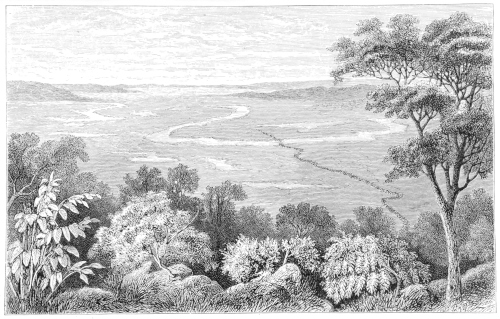
THE DEPRESSION OF THE TONDY.
DOGGOROO RIVER.
A brook, which in July and August becomes swollen to a considerable stream, flowed past our quarters for the night, and joined the Tondy at the distance of a few leagues. To this rivulet, which has its source in the Madi country, in lat. 5° 10´ N., the Bongo give the name of the Doggoroo, whilst it is known as the Lehssy in the districts which divide the territories of the Bongo from the Niam-niam. Up the stream we followed its course for two hours, keeping along the edge of a pleasant park-like country, till we arrived at some thickets, which we had to penetrate in order to reach the banks of the stream. Sluggish here was the water’s pace; its breadth was about thirty feet, and it was sufficiently shallow to be waded through, scarcely rising above our hips; on our return in the following year the passage involved us in considerable difficulty. Beyond the Doggoroo the ground made a gradual but decided rise, and for more than forty miles the ascent was continuous. It was the first elevation of the ground of any importance which I had yet seen anywhere south of the Gazelle; for here was a broad offshoot of the southern highlands, which, according to the statements of the natives, serve as a watershed for the coalescing streams of the Tondy and the Dyau (Roah).
After we had proceeded in a south-easterly direction till we had accomplished about a third of our journey to Sabby, the Seriba of Mohammed Aboo Sammat, we had at no great distance the territory of the Dinka upon our left. The adjacent clan is called the Goak, and a large number of the Bongo have taken refuge amongst them to escape the aggressions and stern oppression of the Nubians. The Dinka, for their part, impressed the strange intruders with such awe that, since Malzac (the well-known French adventurer, who for several years took up his quarters on the Rohl), no one has repeated the attempt to establish a settlement in their district. It is simply their wealth in cattle that is a temptation to occasional raids, which are studiously accomplished as far as possible without bloodshed. On the last stage between the Tondy and the Doggoroo we repeatedly came across the traces of elephants; but the trenches which had been designed to catch them had not as yet been a success. Elephants seem to prefer to make their way along the narrow paths which have been already trodden by the foot of man through the high grass, notwithstanding that they are not sufficiently broad to admit a quarter of their huge bodies.
After the rains are over and the steppe-burning accomplished, the landscape reminded me very much of the late autumn-time of our own latitudes. Many trees were entirely destitute of foliage; the ground beneath them being strewn with yellow leaves or covered with pale sere grass as far as the conflagration had spared it. One charming tree, a kind of Humboldtia, was conspicuous amidst the shadowy groves. It has seed-vessels a foot long, the seed itself being as large as a dollar, whilst its magnificent leaf is a beautiful ornament to the wood scenery wherever it abounds. The gay colours of the young shoots, sprouting directly from the root, crimson, purple, brown, or yellow, contribute in a large degree to this effective display. The foliage generally is so light that it was quite easy to penetrate into these woods, which constantly and agreeably relieved the barren aspect of the region.
THE WATERBOCK.
A considerable number of antelopes from various quarters had been killed by the hour in which we encamped for the night in a forest glade. These antelopes belonged to the Waterbocks (A. ellipsiprymna), of which the head is very remarkable, on account of the large excrescences which obtrude from the side of the nostrils, in the same way as in the wild buffalo. It has a fine sweeping pair of horns, which crown its brow. The hair of this species of Waterbock is extremely long and soft, and its skin is a very favourite decoration of the Niam-niam. There is but little difficulty in getting an aim at this animal, as its white haunches soon betray it amid the gloom of the forest, where it is more frequently found either quite solitary or in very small groups. I very much relished the tender flesh of the kids, although it was somewhat deficient in fat.
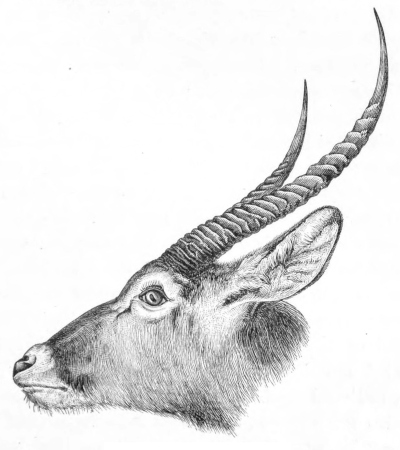
The Central African Waterbock. (Antilope ellipsiprymna.)
When morning dawned the only remnant of our supper was a pile of crushed bones; for neither skin nor gristle had been spared by the greedy negroes. The beast of prey disdains what a voracious man will devour; the beast rejects what is tough, and gnaws only about the soft and supple joints, whilst man in his gluttony roasts the very skin, splits the bones, and swallows the marrow. Splintered bones, therefore, here in the lines of traffic, just as they do in the caverns of antiquity, afford a distinctive evidence of the existence of men, whilst bones that have been gnawed only attest the presence of lions, hyænas, jackals, and the like.
Few there are who have not read of the glory of the southern heavens; rare is the traveller in the tropics who has not revelled in the splendid aspect of the great arch above when illumined by the shining of the moon. After a long hot march it may indeed happen that the traveller is far too weary and worn-out to be capable of appreciating the charm of any such beauties; in passive indifference, stretched upon his back, he turns a listless eye unconcerned upwards to the sky, till sleep overpowers him; and thus unconsciously he loses the highest of poetic ecstacies. Soon the heaven bedecks itself with countless numbers of fleecy clouds, which separate as flakes of melting ice, and stand apart: the deep black firmament fills up the intervals, and gives a richer lustre to the stars; then, circled by a rosy halo, rises the gentle moon, and casts her silver beams upon the latest straggler.
Meanwhile, far in the lonely wood, there has arisen, as it were, the tumult of a market; the gossip of the chatterers is interrupted now and then by the authoritative word of command of some superior officer, while many a camp-fire is kindled and illuminates the distant scene. To protect himself against the chilly air of night, each separate bearer takes what pains he can, using what ashes he can get for his covering. Wreaths of smoke hover over the encampment, a sense of burning oppresses the eyes and makes sleep all but impossible, and thus the attention is ever and again arrested by the moving orbs in the heavens above. To the traveller it well might seem as if the curtain of a theatre had been raised, and revealed a picture of the infernal world where hundreds of black devils were roasting at as many flames. Such were my nightly experiences as often as I journeyed with a large number of bearers.
SHEREEFEE.
About noon on the third day, after marching about sixteen leagues from Kulongo, we arrived at Duggoo, the chief Seriba of Shereefee, who maintained some small settlements in this remote wilderness. Notwithstanding the almost unlimited scope with regard to space, he was on the bitterest terms of hostility with Aboo Sammat, his neighbour in the south. A regular mediæval feud had broken out between them, the nominal cause of the quarrel being that one of Shereefee’s female slaves had been maltreated, and, having taken refuge with Aboo Sammat, had not been restored; but the interchange of cuffs and blows had been the actual ground of the discord. When two months previously Aboo Sammat was despatching his ivory-produce of the year, consisting of about 300 packages, to the Meshera, it was seized by the negroes as it was being conveyed across Shereefee’s district. These negroes attacked the defenceless bearers and massacred several of them; others they wounded with arrows and lances, till the whole caravan was overpowered, and every one throwing down his valuable burden made a precipitate flight. The Khartoom soldiers belonging to Aboo Sammat looked quietly on throughout the fray, for no attachment to their master would have induced them to fire a shot against any of their brethren.
Aboo Sammat, with all his property, was now in the desert, 150 miles away from the boats. To enter into action against Shereefee he hastened to the west, and induced a number of the controllers of Seribas to repair to the scene of violence, and to insist upon judgment being passed at Khartoom. But to accomplish this purpose he had to travel hundreds of miles in a few weeks, during the rains, and before his task was completed the proper time for shipment had elapsed, the high waters had abated, and all his goods had to remain at the Meshera to await another season, exposed all along to the too probable attacks of the hostile Dinka. Aboo Sammat, so far from taking the law into his own hands, had proceeded in the most legitimate way to demand compensation; but Shereefee, not satisfied with the wrong he had already perpetrated, spurred on his negroes to make repeated incursions upon his rival’s territory. Sometimes he endeavoured to entice Aboo Sammat’s Bongo people to desert, and sometimes sent his own to commit all manner of outrage and depredation. Many of the poor natives, the shuttlecocks of the fray, lost their lives in the contention; and I enriched my collection of skulls by some splendid specimens which I picked up on my way. “This was the spot,” said Aboo to me, “where the thieves made their attack. You have seen for yourself, and should speak up for me.”
Approaching the neighbourhood of the hostile Seriba we made a halt in the open country, about half a league away. To put a good face on the matter, and to make an impression upon Shereefee’s people, everybody put on their best clothes, and Aboo Sammat’s soldiers came out in all the gay colours of the fresh chintz which had just been acquired from the stores of the Meshera. The Turkish cut of these garments contributed in no small degree to the self-confidence of the men, and the Kenoosian could fairly pride himself upon having a troop who, not merely in externals, but in general discipline, were far superior to the disorderly bands which, in dirty rags, were quartered at the other Seribas. Every precaution was taken to guard against a sudden attack, and patrols were sent out to protect the flanks of our extended line. Ambushed in the thickets some armed Bongo were actually seen, but these outlying sentinels as soon as they observed there was a white man in the caravan, having heard of my presence in the country, abstained from any exhibition of hostility. Thus unmolested we drew close up to the Seriba, and Mohammed’s party bivouacked out in the open country. Meanwhile I was received in the most friendly manner by Shereefee’s brother, who was here in charge, and there was no disposition to act towards a Frank in any way that might involve difficulty at Khartoom. But I could not help thinking how narrowly all my baggage might be escaping attack, and what a hopeless attempt it might be to recover it.
DUGGOO.
The whole district, as I have mentioned, had been gradually rising in terraces all the way from the Tondy; and only just before we reached the Seriba, which was named Duggoo, after the superintendent of the place, had we marched continuously up-hill for half a league; no flowing water had hitherto been observed. On the south-west and south-east were visible the highlands in the distance, whilst in front of them were elevations of from 100 to 200 feet above the level of the adjacent vale. One of these elevations was very close to Duggoo in the north-east, whence from a bamboo jungle there streamed in the rainy season a brook which fell into the Dyan. The recesses and caverns in the red iron-stone reminded me of the great grotto at Kulongo, with its swarms of fluttering bats (Phyllorhinus caffra) and vast accumulation of guano.
The wide stretch of country between the Tondy and the Dyoor, extending some seventy miles, had but three years since been a populous district with many huts; now, however, it had only a few scattered habitations of the Bongo, which were grouped in the vicinity of either Aboo Sammat’s or Shereefee’s Seribas. Since the Bongo have been expelled by the Dinka, nothing but elephants and antelopes have found their pasture in those wild plains, which have once been cultivated. Occasionally the ruins of the burnt villages were still extant, rising above the rank grass. Nothing survived as direct evidence of the habitation of men; what scanty remnants of dwelling-places the first conflagration of the steppes had spared, either the ants or natural decay had soon destroyed. The only remaining vestiges of the occupation of the land are due to the richness of vegetation, and this has left its characteristic traces. I could specify some fifty or sixty plants which correspond so accurately with the weeds of other cultivated countries that they are significant tokens of a former presence of men. The preponderating Indian origin of all these plants is very observable, and a better acquaintance with the geographical facts connected with them would probably be as trustworthy an indication of the various migrations of an uncivilized people who have no history as either their dialect or their physical development.
Five leagues away from Duggoo we arrived at Dogguddoo, the second Seriba of Shereefee, where he was then resident. Many a slough and many a marsh had we to traverse on our progress, the result of the rain which had been falling for months. Midway we paused for a rest beside the relics of a great Bongo village, where stood the ruins of a large fence of the same description as is seen around the present Seribas. In the very centre of the village had stood, as is commonly found, an exceedingly fine fig-tree (F. lutea), and there were besides, a large number of tombs constructed of blocks of stone and ornamented with strangely-carved posts; at some little distance was a number of handmills that had been left behind, destined for some years to come to be a memorial of the past. The spot, named after the previous governor, was called Pogao. Shortly afterwards we arrived at a charming little brook, known as the Mattyoo, which, under the shadow of a pleasant copse-wood, went babbling over its red rocky bed, making little cascades and rapids as it streamed along.
In consequence of the repeated burnings of the steppes, well-nigh all vegetation was now blighted and impoverished: in particular the higher districts presented an appearance of wretched desolation. Repeatedly, in the winter landscape of the tropics, there are seen trees standing in full foliage in the very midst of their dismantled neighbours; and the loss of leaf would seem to be hardly so much an unconditional consequence of the time of year as a collateral effect of locality or condition of the soil.
After having for months together explored every thicket, and day after day penetrated into the high grass on the river-banks, I could not suppress my astonishmant at the absence of every description of snakes. The Khartoomers suggest an explanation of this circumstance which I am not disinclined to accept; they conjecture that in this stony region there is a deficiency of that rich black soil which splits like a glacier in the dry season, and makes riding in the North-Eastern Soudan a very dangerous proceeding; and, consequently, that there is neither a way for snakes to escape from the fires of the blazing steppes, nor any of those lurking-places which are indispensable for their resort.
STEPPE-BURNING.
Incalculable in its effect upon the vegetation of Central Africa must be the influence of the annual steppe-burning, which is favoured by the dryness of the seasons. The ordinary soil becomes replaced by charcoal and ashes, which the rain, when it returns, as well as the wind, sweeps right away into the valleys. The rock is, for the most part, a very friable and weather-worn ironstone, and upon this alone has everything that grows to make good its footing. The distinction, therefore, as might be imagined, is very marked between vegetation under such conditions, and vegetation as it displays itself by the banks of rivers, where the abundant grass resists the progress of the fire, and where, moreover, a rich mould is formed by the decay of withered leaves. But even more than the impregnation of the soil with alkalies, does the violence of flames act upon the configuration of plants in general. Trees with immense stems, taking fire at the parts where they are lifeless through age, will die entirely; and, where the grass is exceptionally heavy, the fresh after-growth will perish at the roots, or in other places will be either crippled or stunted. Hence arises the want of those richly-foliaged and erect-stemmed specimens which are the pride of our own forests; hence the scarcity of trees, which are either old or well developed; and hence, too, the abnormal irregularity of form which is witnessed at the base of so many a stem and at the projection of so many a shoot.
Flowing without intermission, all through the year, close by Dugguddoo, there is a brook which the Bongo have named the Tomburoo. Its water hurries on at the rate of 170 feet per minute, its depth hardly ever exceeds three feet, while its breadth varies from 20 feet to 50. Its banks, about four feet high, were bounded by land subject to inundations corresponding to the measurement of the stream. At a league’s distance to the east, the general elevation of the soil began afresh. The environs of the Seriba of Shereefee were only scantily cultivated, as the Nubians and the Bongo lived by preference on the produce of the plundering forages which they were accustomed to make amongst the adjacent Dinka tribes, the Ayell and the Faryahl, towards the north.
Exposing itself far and wide, there was the naked rock, the barrenness of which was only interrupted at intervals by a scanty covering of human bones! Carried off in groups, the captured slaves here succumbed to the overwrought exertions of their march. At times they died literally of starvation, as often there was no corn to be had in the barren land. The overland dealers in slaves make their purchases here at the most advantageous prices. In these eastern Seribas, as the result of the perpetual raids upon the Dinka, there is always a superabundance of the living black merchandise on hand, but very rarely is there an adequate supply of food for their maintenance. The traders proceed from Seriba to Seriba with their gangs, which they maintain on whatever provisions they can get on the way. Where destitution is an ordinary phase of things, it is self-evident that the traffickers, having no resources to support a lengthened journey, must, day after day, suffer considerable loss, and it is no unwonted thing for their gangs to melt away by a dozen at a time. Burnt bones of men and charred palisades of huts are too true an evidence of the halting-places of Mohammedanism, and, day by day, more and more was my imagination shocked by these horrid spectacles. In the very Seriba there was even awaiting me afresh the miserable sight, to which no force of habit could accustom me, of a number of helpless children, perfect little pictures of distress and wretchedness, either orphans or deserted by their mothers, and who dragged on a pitiable existence, half-starved, burnt by falling into the fire in their sleep, or covered with loathsome sores.
LAND-SNAILS.
Turning short off, almost at a right angle to our previous direction, our way beyond Duggoroo, after seven leagues, over a country well-wooded and rich in game, led us to the borders of Aboo Sammat’s territory. Once again the land began to rise, and appeared to be all but barren in water-courses of any kind. As we went along I picked up, in a state of perfect preservation, several of the bleached skulls of some of Aboo Sammat’s bearers, who, wounded in the murderous attack by Shereefee’s people, had never been able to regain their homes. In a bag, which one of my attendants constantly carried, I had a collection made of a number of the great land-snails which, after the termination of the rains, abounded in this region. The two kinds which appeared most common were Limnicolaria nilotica and L. flammea; of these, the former is rather more than four inches in length, the latter rather more than three. They invade the bushes and shrubs, and have a great partiality for the tender leaves of the numerous varieties of wild vine. They serve as food for a number of birds, the Centropus monachus, the cuckoo of the climate, in particular having a keen relish for them. Their shells are as thin as paper, a circumstance which, like the brittleness in the egg-shells of hens, testifies to the deficiency of chalk in the soil. I was in need of soap, and the chief object which I had in taking the trouble to collect these shells was to obtain what cretaceous matter I could, to enable me to make a supply, no other method of getting it occurring to my mind. At night we rested at a poor Seriba called Matwoly, where we were received in some dilapidated huts, as the place, together with all its Bongo adjuncts, for greater security against the attacks of Shereefee, was about to be abandoned.
The wearisome monotony of the woods, now generally stripped of their foliage, was enlivened by the fresh green of the Combretum, which here long anticipates every other tree in putting forth its tender buds. Gaily it stands apart from the uniform grey and brown of the surrounding forest, thrown into yet higher relief by the yellow of the mass of withered grass below, and showing itself brightly from the half-shaded gloom of the wood beyond.
Although I had now advanced an entire degree nearer to the Equator, being now in a latitude of 6° 20´ N., I still found that the landscape around had charms to offer which were not inferior to the winter beauties of the distant north. In the early morning I delighted to see the rimy dew that had fallen on the sprouting grass, and which frequently remained as late as nine o’clock; over the feathery Pennisetum and the Agrostideæ it fell like a white veil, and the bright drops sparkled like diamonds in the sunshine. The slender gossamer, moreover, which stretched itself over the deeps and shallows of the soil, and even over the footprints in the ground, appeared to operate as a conductor of the dew, which congealed till it was like a film of ice which crackles beneath the tread of a traveller in the autumn.
GREAT ANT-HILLS.
Distant four and a half leagues to the south lay Aboo Sammat’s head Seriba, known as Sabby, the name of its Bongo chief. Half-way upon our march we crossed a considerable stream, which was called the Koddy. As we forded its breadth of twenty feet, we found the water rising above our hips. Here again the candelabra-euphorbia seemed to be abundant, after having never been seen since I left the eastern bank of the river Dyoor. An essential feature of the district between the Dyoor and the Kohl is contributed by the small mushroom-shaped ant-hills which, found as they are in many a part of Tropical Africa, here cover the stony surface with their peculiar shapes. Formed exactly like the common mushroom, the separate erections of the Termes mordax are grouped in little colonies. The main difference between the tenements of these ants and those which construct conical domes as tall as a man, consists in this, that they have a definite altitude, which rarely exceeds thirty inches, and immediately that there is no further space they raise new turrets and form fresh colonies. The materials, too, of which this species of Termes constructs its edifice is neither grey nor of a ferruginous red, but is simply the alluvial clay of the place: it is so closely cemented together, that it defies the most violent kicking to displace it, and is hardly less solid than brickwork. The natives are very glad to employ it for the construction of their huts; they break it into fragments with their clubs, and moisten it till its substance yields. By the Bongo it is called Kiddillikoo.
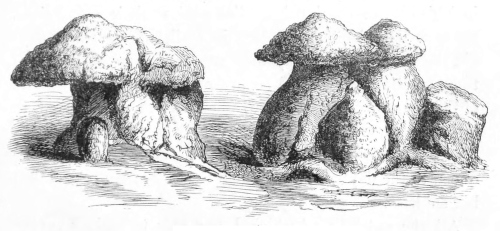
Mushroom-shaped white-ant hills.
The red ferruginous clay is the only material out of which the great ants (Termes bellicosus) construct their buildings. These are seldom found elsewhere than in a wood, where the pointed shapes are never seen. The neighbourhood of Sabby especially abounded in these monuments of animal labour, and not a few of them were fifteen feet in height. In altitude greater than in breadth, they reared themselves like a large cupola surrounded by countless pillars and projecting towers. At the first commencement of the building it embraces only some isolated domes, which gradually are combined into one single cluster, whilst the ramifications of the interior have entirely to be reconstructed. When we reflect that the dimensions of the bodies of these toiling ants (the female neuters) are not one thousandth part so great as the structure that they upheave, we cannot refrain from comparing their edifices with the most extensive cities which human hands have reared. During my previous journey, I had found several opportunities of investigating the secret habits of these wondrous creatures. The life of the traveller in Africa is one continual conflict against their aggressions. Once at the missionary station in Gallabat, for seven days did the people work away with crowbars to remove one of these erections, which had been accumulated in the middle of the courtyard, and which was not only an impediment in the way, but was a nuisance to the adjacent huts. At length they penetrated to the royal chamber, and dragged forth the queen to the daylight, from which she had carefully excluded her subjects.
All the ant-hills of which I was able to make a survey were constructed upon the double-chamber system, the maze of cells being divided apparently into two separate storeys. Adequately to describe the marvellous interior of one of these haunts of the community would require a volume of itself. No labyrinth of coral could be more intricate; its walls are curiously cemented together, its chambers are most carefully arranged and most amply stored with vegetable produce, and there are magazines which teem with cakes and loaves. A regular series of bridges conducts from place to place, and many a crossway traverses the pile. To detail the wonders of these erections would tax the patience of the reader, and the study of a life-time would not exhaust the marvellous perfection of the organization which they present.
ABOO SAMMAT’S HEAD SERIBA.
As might be conjectured, there is no want amongst these woods of ant-hills such as these, which have ceased to be occupied, and which consequently have been adopted as lurking-places by various kinds of animals that shun the light and lead a troglodite existence. Here skulks the aardvark or earth-pig (Orycteropus); here gropes the African armadillo (Manis); hither resort wild boars of many a breed; here may be tracked the porcupines, the honey-weasel, or ratel; here go the zebra-ichneumons and the rank civet-cats; whilst here, perchance, may be found what in this land is rare, an occasional hyæna.
Thus, after seven days’ journeying over a country all but uninhabited, on the 23rd of November I found myself at the head Seriba of my friend and protector, who received me with true Oriental hospitality. First of all, he had newly-erected for my use three pleasant huts, enclosed in their own fence; his thoughtfulness had gone so far that he had provided me with several chairs and tables; he had sent to a Seriba, eight days’ journey distant, to obtain some cows, that I might enjoy new milk every day; and, in short, he had taken the utmost pains to insure me the best and amplest provisions that the locality could supply. My attendants, too, who, together with their slaves, made up a party of thirteen, were entertained as freely as myself: everything contributed to keep them in good mood, and they were delighted jointly and severally to throw in their lot with mine.
The natives, when they saw not only their own superior, but the governors of other Seribas, treat me with such consideration, providing me with a palanquin for every brook, came to the conclusion that I was a magnate, and said to each other, “This white man is a lord over all the Turks”—Turks being the name by which the Nubians here wish to be known, although before a genuine Osmanli they would not have ventured to take such a title. As Aboo Sammat used jocosely to remark, they were accustomed at home to carry mud, but here they carried a gun instead. It was a matter of congratulation to myself that the people already had arrived at some apprehension of the superiority of an European. It set me at my ease to observe that I had nothing to fear as to being mistaken by the natives for one of the same stock as the Nubian menials. Equally advantageous to me was it that the same impression prevailed amongst the Niam-niam and the distant Monbuttoo, to whose territories I was approaching, and accordingly I entered upon my wanderings under what must be considered favourable auspices.
Situated in a depression between undulating hills which stretch from south-west to north-east, the settlement of Aboo Sammat was surrounded by numerous Bongo villages and fields. Here he centred an authority over his Bongo and Mittoo territories which stretched away for no less than sixty miles. The residence of Aboo himself was about a league away, where he kept his harem in retirement, his elder brother having the charge of the principal Seriba. After I had settled myself as conveniently as I could, I began afresh my accustomed rambles, so that, in the same way as I had done in Ghatta’s Seriba, I might familiarise myself with all the environs.
At this period, when vegetation was at a stand-still, the flora presented little novelty, and whatever I found corresponded very much with what I had already seen in the district between the Tondy and the Dyoor. The woody places around Sabby were generally somewhat thicker; there was neither the same expanse of low steppe-country, nor the same frequent interruption of woods by grassy plains. Corresponding to this density of growth of the forests there was a greater variety in the fauna.
ARRIVAL IN SABBY.
Meanwhile, amidst my investigations, I did not lose sight of my projected journey to the Niam-niam, and continually made what preparation I could. I criticised very diligently the muscles and measurements of the people, and very materially enlarged my vocabulary. Although I was only half-way towards the country of the Niam-niam, I found myself brought into connection with a considerably large number of them, and subsequently I was enabled in a degree to master their dialect. The report of the feud between Mohammed Aboo Sammat and Shereefee had extended to Mohammed’s outlying Seriba in the Niam-niam country, and had grown into a rumour that all his people had been exterminated by Shereefee’s agents. For the purpose of obtaining more reliable information the manager of the Seriba, ninety miles away, had sent ten young men to Sabby, and their strange appearance very much surprised me. Everything which I had hitherto seen of the people served to strengthen my conviction that they were marked off from the other population of Africa by a distinct nationality of their own. Even the Bongo seemed here to arouse my interest more than at Ghattas’s Seriba, where, on account of their longer period of subjection, they had gradually lost very many habits and peculiarities of their race. I spent accordingly a good deal of my leisure in making sketches of their dwellings and their furniture, and in my numerous excursions round the villages, I persisted in investigating everything, however immaterial it might seem, as though I were examining the vestiges of the prehistoric life of a palisaded colony.
The three slaves who accompanied me were now indispensable as interpreters. Apart from them I could have prevailed very little in overcoming the shyness and mistrust towards strangers which the natives continually exhibited: an exterior survey did not satisfy me, and I persevered till I gained admittance to the inside of several of the huts, so that I could institute a regular domestic investigation. Every corner was explored, and by this means many a strange implement was brought to light, and many an unexpected discovery revealed.
The granaries of the Bongo were now quite full, as the harvest was just over: all was consequently mirth and riot in the district, and many a night’s rest did I find disturbed by the noisy orgies which re-echoed from the shadowy woods. At full blast for hours together were the long wooden trumpets, the loud signal-horns, the huge trombones, and those immense drums for the construction of which the strongest timber has been selected from the forests. The powers of shrieking were put forth to the uttermost. Like the rolling of the breakers of an angry sea, the noise rose and fell: alternate screechings and howlings reached my ears, and hundreds of men and women seemed to be trying which could scream the loudest. Incapable of closing an eye for sleep while such infernal outcry was around, I went several times to inspect the frantic scene of merriment. Nights when the moon was bright were those most frequently selected for the boisterous revelry; the excuse alleged being that the mosquitoes would not let them rest, and therefore it was necessary to dance; but in truth, there was no nuisance of flies here worth consideration: I was not annoyed to anything like the same extent as upon my backward journey on the White Nile.
ORGIES OF THE NIGHT.
The following may be submitted as something like an ordinary programme of these soirées musicales. Slowly and mournfully some decrepit old man, or toothless old woman, begins with broken voice to babble out a doleful recitative; ere long first one and then another will put in an appearance from the surrounding huts, and point with the forefinger at the original performer, as if to say that this is all his fault, when suddenly, all together, they burst forth in universal chorus, taking up the measure, which they work into a wondrous fugue. At a given signal the voices rise in a piercing shriek, and then ensues a series of incredible contortions; they jump, they dance, and roll themselves about as though they had bodies of indian-rubber; they swing themselves as if they were propelled with the regularity of machines; it would almost seem as if their energy were inexhaustible, and as if they would blow their trumpets till their lungs gave way, and hammer at their drums till their fists were paralyzed. All at once everything is hushed; simultaneously they make a pause; but it is only to fetch their breath and recover their strength, and once more the tumult breaks out intense as ever. The license of their revelry is of so gross a character that the representation of one of my interpreters must needs be suppressed. It made a common market-woman droop her eyes and called up a blush even to a poor sapper’s cheek. Many of the people had iron rings about their ankles with balls attached, and these they rattled with such violence that their feet were bathed with blood.
Go where I might, I found nothing but lamentation over the impoverishment and desolation of the land, yet those who complained were themselves responsible for its comfortless aspect. Whilst, through the migration of the people, the country towards the north during the last three years had been changed into a wilderness, the Bongo, who clung to their homes and remained on their settlements, had not only lost their former wealth in sheep, goats, and poultry, but had even been too much driven to extremities to continue their cultivation of corn, and were sufferers from what was little short of famine. The Bongo asserted that in the first year that the Khartoomers committed their depredations amongst them, they were so terrified lest all their sheep, and goats, and poultry should be carried off, that, without delay, they had them all killed, cooked, and eaten. Eye-witnesses were not wanting who told me what had been the astonishing quantities of poultry that once had teamed in every village; but when there ceased to be any security for any one to retain what he had, of course there ceased to be any interest in making a store. If the harvest were prolific so that the granaries were full, the settlers would revel in indulgence as long as their resources held out; but for the greater portion of the year they had to depend upon the produce of the woods and upon the proceeds of the chase, which had often no better game to yield than cats, lizards, and field-rats. Not that there was any actual fear of starvation, because the supply of edible tubers and of wild fruits from the extensive woods was inexhaustible and not ill-adapted to a negro’s digestion, and because there was an abundance of the seed of wild grasses to be collected, which replaced the scarcity of corn.
In productiveness the land around Sabby was not inferior to the environs of Ghattas’s Seriba. The ears of sorghum here, as frequently as there, reached to a weight of six pounds; but at the same time the level tracts under cultivation were far less extensive, and in all the rocky places could only produce a smaller yield. The natives, however, never ventured to bring any of their grain to market, as I had been accustomed to see them: whatever anyone possessed, he cautiously kept out of the sight of the stranger. From all regular and systematic agriculture, the natives were as a rule debarred, because in the course of the year nearly every able-bodied man was compelled to go and do duty as a bearer, and consequently for months together was a stranger to his homestead, whilst he either plodded backwards and forwards to the Meshera, or was engaged upon the Niam-niam expeditions. Of copper, beads, and knick-knacks of every sort they managed to increase their store, but in agriculture they decidedly were retrograding. It was with them precisely as with their oppressors from afar: just as in Nubia, there was a destiny of evil being fulfilled upon the land, so here was the spectacle of a region degenerating from prosperity into neglect and woe.
GOAT-SUCKERS.
Repeatedly in the evening hours I watched the ghost-like fluttering of a long feathered goat-sucker of the species Cosmetornis Spekii Sclater, observed by Speke[37] in Uganda, and which was to be recognized by the astonishing elongation of the seventh and eighth wing-quills, the latter of which reaches over twenty inches in length. There was a second species of this genus, of which the male had the same kind of prolonged shaft-feathers expanded at the end and fluttering in the air like a peacock’s tail. This was the Macrodypterix longipennis, a remarkable bird which the Arabs call the “father of four wings,” because, as it chases the mice, it looks as though it had a couple of satellites in attendance. Both these make their earliest appearance about a quarter of an hour after sunset and as the twilight passes rapidly into thorough night; I had, therefore, only scanty opportunities of sending what were at best only stray shots to bring them down. For the purpose of catching insects they generally wheeled in circles at no great distance from the ground, but as the range of their flight was very circumscribed and its rapidity extremely great, it was somewhat difficult to get a good aim. However, as the practice was repeated daily, I succeeded in securing a considerable number of Speke’s interesting Cosmetornis. I should mention that while I had been in Ghattas’s Seriba, sport of this kind had very frequently been an evening recreation. The antipathy of this aëronaut of the dusky evening to the clear light of day, seemed very remarkable: it kept itself to the seclusion of the low bushwoods, and when roused up would disappear again at the first ray of light; often it would settle itself on the ground in a pile of leaves to which its own hue corresponded, and it might then almost be trodden upon before it could be stirred into flight.
During the incessant excursions which I kept making round Sabby I was able to discriminate not less than twelve distinct species of antelopes, of which I was successful in shooting several. Frequently met with here is the antelope (A. oreas) which is known as the Elend. During the rainy months it gathers in little groups of about half-a-dozen in the drier districts on the heights, but through the winter it is, like all its kindred, confined to the levels by the river-sides. Upon the steppes through which flow the brooklets in the proximity of Sabby the leucotis antelope is the most common of all game, and many is the herd I saw which might be reckoned at a hundred heads. Perhaps nowhere in the whole of North-east Africa would any one have the chance of seeing such numerous herds of antelopes collected together as travellers in the south are accustomed to depict. Assisted by a whole clan of Kaffirs, the Boers on the 24th of August, 1860, had a battue in Honour of the Duke of Edinburgh, of which the result was that between 20,000 and 30,000 antelopes are said to have been enclosed. Of the more circumscribed district of the Nile the parts that are most prolific in game are on the north-west declivity of the Abyssinian highlands, on the Tacazze or Seteet, in the province of Taka: there it is not an unknown circumstance for herds to be found which exceed a total of 400 head, but they do not correspond in the remotest degree with those which are depicted in the published engravings of the South African hunt. Still poorer in numbers of individuals are the antelopes in Central Africa proper, where the uniform diffusion of men encloses smaller wastes than those which can alone provide large lairs for game.
ZEBRA-ICHNEUMON: MUCUNA URENS.
Amongst the numerous smaller beasts of prey to which the regions that I visited gave harbourage, the zebra-ichneumon was to me one of the most interesting. I was very successful in securing living specimens of this widely-scattered species, and could not suppress my astonishment at the facility with which they were domesticated in my dwelling; if ever they get established in a house there is no getting rid of them. It is a saucy creature, and has neither fear to show nor submission to yield to the authority of man. It resembles the wild cat of the steppes in the ease with which it can be accustomed to a home life. I found it exceedingly troublesome on account of the pertinacious curiosity with which it peeped into all my cases and boxes, upset my pots, broke my bottles, with no apparent object but to investigate the contents. To accomplish its aim it made incessant use of its long, taper, snuffling snout as a lever. But the most vexatious art of which the animal was master was the skill it had in scenting out the spots where my hens were accustomed to lay their eggs, and of which it learnt the flavour before I had an opportunity of removing them to a place of safety. It is moreover a tricky little animal; by whisking and wagging its tail it assumes the appearance of fawning and wheedling, but as soon as anyone touches it, he gets a good bite on his finger. When hunted out and followed by dogs, it throws itself down on its back, kicks its legs about, and grins and gnashes with its teeth. To keep clear of being bitten the best way is to pounce upon it by its tail and to let it hang dangling in the air.
One morning there arrived at the Seriba from the far distant boundaries of the Bongo several wild-looking men, armed with bows and arrows. In order to satisfy myself of the effectiveness of their weapons, I set up a mark at a short distance, consisting of an earthen vessel, in front of which I placed a good thick pad of straw, and over all I threw a stout serge coat. Defying all the coverings, the arrow penetrated the coat, made its way through the straw and knocked a hole in the earthenware, which was nearly half-an-inch thick.
A plant there is here which is not very likely to be forgotten by anyone who has made many excursions into the woods: I mean the Mucuna urens. It is a sort of bean, of which the pods are enclosed in a thick rind and the leaves are covered with pungent bristles. These bristles are as brittle as fibres of glass and, broken off by the wind, are dispersed in all directions over the foliage in the forests. No one who explores the thickets can escape being punished by these tiny prickles. The natives, who are naked, go amongst them with the extremest caution. The stinging sensation they cause lasts about ten minutes, but it may be alleviated by washing.
There is a kind of Christ’s Thorn (Zizyphus Baclei) which every December yields an abundance of fruit, consisting of dry mealy berries, which have a very bitter taste. The colour of these is not unlike a chestnut; they are quite unfit for eating, but the Bongo prepare a powder from them which they throw upon the surface of their waters, and it has the effect of stupefying the fish.
In the parched steppe I repeatedly found a huge chafer belonging to the family of the Elateridæ, but unfortunately the specimens which I secured, together with my other collection of insect curiosities, were all destroyed by fire; and I have now no other reminiscences of them beyond the notes I took that they were of a bright brown colour and were but little short of two inches and a half in length.
Of the few larger shrubs which blow in the winter, an Echinops, with splendid purple blossoms as large as one’s hand, left a deep impression on my recollection. They start out of the grass in situations where the woods are not over-dense, and rise to the height of a man. For the sake of the security of what has been styled a “protective resemblance,” the mantis takes up its quarters amidst its boughs. Just as the leaf-frog secretes itself on the young and light green foliage, or the white ptarmigan resorts to the snowy downs of the frozen north, so does the mantis here take up its abode on the tree as purple as itself, and there endeavour to find a world in which it may conceal its singular shape. This part of Africa seemed to produce many species of this remarkable genus. Whenever I saw them I derived fresh confirmation for my belief that they try to adapt their places of resort to the specific colours of their bodies: the result of this is, that they often startle the plant-collector as if they were ghosts, and their strange shape is indeed somewhat suggestive of a harpy. At first sight the heads of the Echinops, on which they settle, look like malformations of the shrub itself, for the insect uncoils its arms, and like a suppliant lifts them to the sky. Every variety in colour seems to belong to the mantis; I have seen them red, yellow, green, and brown; the most remarkable of all was one of the colour of grass, which I found upon the peak of my hut in the Meshera, and which was of the surprising length of ten inches.
LIONS.
Around Sabby the general security was so complete that, quite at my ease and entirely unarmed, I might have ranged the woods if there had been a certain immunity from being attacked by lions; and against this I was compelled to be on my guard as I penetrated the depths of the wilderness to secure the novelties of vegetation, which could not fail to excite my curiosity. Although my vocation constrained me day after day to explore the recesses of the woods more thoroughly, and to make my way through places hitherto inaccessible, yet I never met with any untoward accident. At home I am quite aware that there are some who entertain the idea that every traveller in Central Africa is engaged in perpetual lion-fights, whilst, on the other hand, there are some who make the insinuating inquiry as to whether lions are ever really seen. In a degree both are right—both are in the avenue of truth. Lions are, in fact, universal, and may be met with anywhere; but their numbers are not absolutely large, but only proportioned to the princely rank they hold in the scale of animal creation. Their appearance is always a proof of the proximity of the larger kinds of game. Corresponding to the line in history, which tells that forty generations of Mamelooks tyrannized over the people of Egypt, might be registered the line in the records of the animal kingdom, which might run that forty lions found subsistence in the land.
It is not to be presumed that every hunting excursion in Africa is associated with adventure. Such is far from the fact, and it would be utterly wearisome for me to recount every frivolous incident of my ordinary hunt in quest of game for the table. Even in Africa a chase may be as insipid as coursing a hare in the environs of Paris. Shooting and hitting are two different things, as are also hitting and killing on the spot. So great is found to be the nervous resistance of the larger and stronger kinds of game in Africa that the sportsman must be prepared to lose at least 70 per cent. of all that he is able to wound; this will arise not merely from his being destitute of dogs to follow the scent, but from his continually finding himself baffled in pursuit by the world of grass and of marshes, through which he is obliged to make his way. When on the march, another obstacle to securing what is shot often arises from the fear of being left behind by the caravan, and the possibility of losing one’s way necessitates a despatch which is unfavourable to success.
WILD BOAR SHOT.
One afternoon the chase after a considerable troop of hartebeests led me deep into the wood. The cunning animals watched my movements very anxiously; by stopping repeatedly they enticed me continually further on into the gloom, and still eluded the chance of giving me a shot. Already had I penetrated so far into the forest that the rays of the sun were totally lost, and everything was wrapped in the obscurity of twilight; I was about to make my way over a depression in the ground, to get nearer to an elevation from which the antelopes were calmly surveying me, when I suddenly stumbled over some huge shapeless object, which seemed to me to be moving. Owing to the obscurity of the place I could not distinguish anything, but I found there was an ant-hill close by, of which I endeavoured to make some use; under the protection of this I made an attempt to get a few steps nearer to the enigmatical creature that lay before me; from behind the mound I cautiously made an investigation, and just at that instant the animal made a lurch, and revealed to me the snout of a huge wild boar, which seemed to cover the whole face like a mask, while a great pair of tusks projected from the bushy bristles of the enormous jaws; the stolid gaze of the brute made it clear that it was not conscious of my being near, but it seemed ready to take a spring upon the first intruder that should disturb it; I approached within the shortest possible distance, and then took aim, and lodged my bullet in the body of the beast. The spectacle that ensued was very singular. The unwieldy creature, contracted like an impaled fly, turned over on to its side, and then, with another contortion, on to its back, where it writhed about and jerked its legs in every direction. Whilst I was patiently abiding my time till the beast should expire, I was taken by surprise as I observed that the hartebeests were within pistol-shot of where I stood, as if they had been spell-bound by the incident which had interposed to rescue them from their pursuer. I was ready anew to take my aim at them. I had, however, only a single-barrelled gun, and no one in attendance to hand me a second. I was just on the point of loading, when, by one of those unlucky chances that will occur, I discovered that in my precipitation I had used all my bullets, and should only waste my labour in following up the pursuit. The wild boar, however, was mine, and I had it brought to my quarters the same evening. I went to bed without partaking of a supper from it, for whenever there is anything to do with the detestable flesh of a wart-hog, I am a regular Mohammedan. Accordingly, I had the greatest satisfaction in handing it over to the hungry negroes.