THE HEART LINE
Reading edition
Cover art
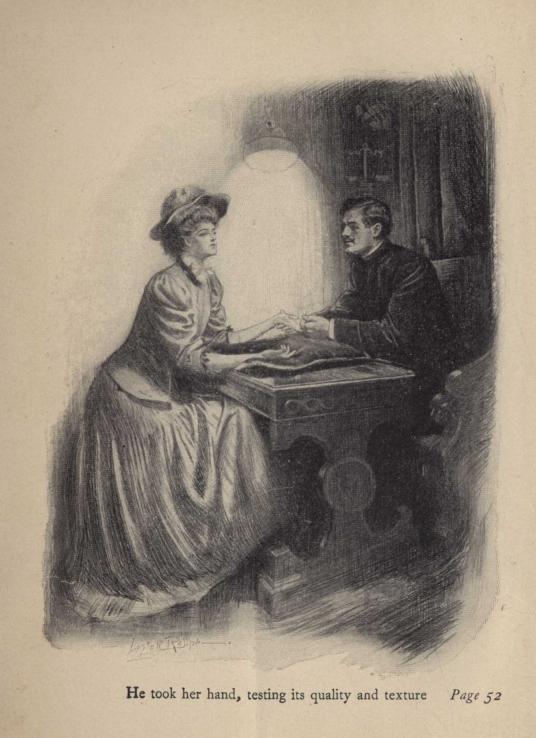
He took her hand, testing its quality and texture Page 52
THE HEART LINE
A DRAMA OF SAN FRANCISCO
By
GELETT BURGESS
Author of The White Cat, Vivette A Little Sister of Destiny, etc.
WITH ILLUSTRATIONS BY
LESTER RALPH
NEW YORK GROSSET & DUNLAP PUBLISHERS
COPYRIGHT 1907 THE BOBBS-MERRILL COMPANY
OCTOBER
TO MAYSIE WHO KNEW THE PEOPLE AND LOVED THE PLACE
IN MEMORY OF THE CITY THAT WAS
CONTENTS
CHAPTER
Prologue
I The Palmist and Fancy Gray II Tuition and Intuition III The Spider's Nest IV The Paysons V The Rise and Fall of Gay P. Summer VI Side Lights VII The Weaving of the Web VIII Illumination IX Coming On X A Look Into the Mirror XI The First Turning to the Left XII The First Turning to the Right XIII The Bloodsucker XIV The Fore-Honeymoon XV The Re-Entrant Angle XVI Tit for Tat XVII The Materializing Seance XVIII A Return to Instinct XIX Fancy Gray Accepts XX Masterson's Manoeuvers XXI The Sunrise
Epilogue
THE HEART LINE
PROLOGUE
In the year 1877 the Siskiyou House, originally a third-class hotel patronized chiefly by mining men, had fallen into such disrepute that it was scarcely more than a cheap tenement. Its office was now frankly a bar-room; beside it, a narrow hallway plunged into the shabby, shadowy interior; here a steep stairway rose. Above were disconsolate rooms known to the police of San Francisco as the occasional resort of counterfeiters, confidence workers and lesser knaves; to the neighborhood the Siskiyou Hotel had a local reputation as being the home of Madam Grant, who occupied two rooms on the second floor.
Her rooms were slovenly and squalid—almost barbarous in the extremity of their neglect. Upon the floor was a matted carpet of dirt and rubbish inches deep, piled higher at the corners, uneven with lumps of refuse, bizarre with scraps of paper, cloth and tangled strings.
In the rear room an unclean length of burlap was stretched across a string, half concealing a disordered, ramshackle cot, whose coverings were ragged, soiled and moth-eaten. A broken chair or two leaned crazily against the wall. The dusty windows looked point-blank upon the damp wall of an abutting wooden house. There had once been paper upon the walls; it was now torn, scratched and rubbed by grimy shoulders into a harlequin pattern of dun and greasy tones.
The front room, through the open rolling doors, was, if possible, in a still worse state of decay, and here wooden and paper boxes, tin cans, sacks of rags (doing service for cushions), a three-legged table and a smoked, rusty oil-stove, with its complement of unclean pots and dishes, showed the place, abominable as was its aspect, to be a human abode. A print or two, torn from some newspaper or magazine, was pinned to the wall in protest against the sordidness of the interior. The place gave forth a fetid and moldy smell. The air was damp, though the sun struggled in through cracked panes, half lighting the apartment.
There was, however, one piece of furniture, glossily, splendidly new, incongruously set amidst the disorder—an oak bookcase, its shelves well filled with volumes. Seated upon a cracker box in front of its open doors, this afternoon, a boy of eight years sat reading with rapt excitement the story of Gulliver's Travels.
He, too, seemed strangely set in that environment, for he was clean and sweet in person and dress. His hair was black and waving, his eyes deep blue, clear and shrewd. His cheeks were pink and gently dimpled, his mouth ample, firm and well-cut, over a square, deeply cleft chin. He was patently a handsome child, virile, graceful, determined in his pose. His natural charm was made more picturesque by a blue flannel suit, with white collar, cuffs and stockings. Oblivious to his extraordinary surroundings, he read on until he had finished the book.
He rose then, yawned and walked to the window in the front room to look out upon the street. Opposite was a row of low buildings—a stable, a Chinese laundry, two dreary rooming-houses and a saloon. The roof-line of the block, where the false wooden fronts, met the sky, held his gaze for a few moments. A horse-car lumbered lazily past, and his eyes fell to the cobble-paved thoroughfare and its passers-by. To the left, Market Street roared bustling a block away and the throngs swept up and down. To the right, a little passage starting from two saloons, one on each corner of the street, penetrated the slums. The warm, mellow California sunlight bathed the whole scene, picking out, here and there, high lights on window-glass that shot forth blinding sparks and flashes.
The boy yawned again, his hands in his pockets, then turned to the sooty oil stove and peered rather disgustedly amongst the frying-pans, tins and pasteboard boxes. There was nothing in the way of food to be found. He sniffed fastidiously at the corrupt odor of cooking, then knelt upon the floor and began a search, crawling gingerly on hands and knees. The ends of three matches projected slightly above the surface of the matted layers of rubbish. Here he scraped the dirt away with a case-knife and came upon a little paper-wrapped parcel which, opened, disclosed three bright twenty-five-cent pieces. He wrapped them up again, tucked them into the hole in the dirt and went on with his quest.
His next find, a foot or so from the base-board of the double doors, was a cache containing a pearl-handled pen-knife. He put it back. Here and there in the subsoil he came upon other treasure trove, each article carefully wrapped in paper or bits of rag—a jet ear-ring, a folded calendar, a silver chain, two watches, a dozen screw-eyes, several five-dollar gold pieces, a roll of corset laces. He returned them one by one as he found them, and smoothed the dirt over the place.
He had nearly exhausted the field in the front room, when he came upon a small paper bag containing a few macaroons. These he sat down to eat, first brushing off feathery bits of green mold. He discovered another bag containing peanuts. He chewed them slowly, throwing the shells upon the floor, his eyes wandering, his air abstracted.
Leading off the front room was a smaller one whose door was shut. He opened it now, and went in somewhat fearfully. Here was another cot drawn up in front of the window, and, upon nails driven in the wall, women's hats and dresses. Upon the inside of the door was pinned a stained, yellowing newspaper cut—the portrait of a man perhaps thirty years old, with mustache and side-whiskers and a wide flowing collar. Beneath it was printed the name, "Oliver Payson." The boy gazed at it curiously for some moments.
From this, he turned to a corner where stood an old trunk covered with cowhide whose hair was rubbed off in mangy spots. Corroded brass-headed nails held a rotting, pinked flap of red leather about the edge of the cover. On the top of the trunk, also in brass-headed nails, were the letters "F.G."
He stooped over and tried the lid. The trunk was locked. He lifted it, testing its weight, and found it too heavy to be budged. He rubbed the hair with his hand, played with the handles and fingered the lock longingly; then, after a last look, he left the room and closed the door.
He had gone back to the bookcase and taken down a volume of Montaigne's Essays, when he heard a knock on the door of the back room leading into the hallway. He unlocked the door, opened it a few inches and stood guarding the entrance.
A woman of middle age in a black bonnet, shawl and gown attempted to pass him. He stood stiffly in her way, regarding her harsh, sour visage, thin, cruel lips and pale, humid, bluish eyes. At his resolute defense her attitude weakened.
"Ain't Madam Grant to home?" she said.
"No, she is not. What do you want?"
"Oh, I just wanted to see her; you let me come in and wait a while—she'll be back soon, I s'pose?"
"She doesn't allow me to let anybody in when she's away," the boy protested.
"Oh, that's all right, Frankie; I'm a particular friend of hers. I'll just come in and make myself to home till she comes in. I'm all winded comin' up them steep stairs, and I've got to set down."
"I'm sorry," the boy said more politely, "but I mustn't let you in. I did let a lady in once, and Mamsy scolded me for it. The next day we missed a watch, too."
"My sakes! Does she keep her watches in the dirt on the floor, too?" the woman said, her eyes sparkling with curiosity. "You needn't worry about me, my dear; everybody knows me, and trusts me, too. Besides, my business is important and I've just got to see the Madam, sure."
"You may wait on the stairs, if you like, but you can't come in here. She says that the neighbors are altogether too curious." The remark was made deliberately, as if to aid his defense by its rudeness. But the woman's skin was tough.
"You're a pert one, you be!" she sniffed. "I'd like to know what you do here all day, anyway. You ought to be to school! We'll have to look after you, young man; they's societies that makes a business of seeing to children that's neglected like you, and takes 'em away where they can be taught an education and live decent."
The boy's face changed to dismay. The tears came into his eyes. "I don't want to go away, I want to live here, and I'm going to, too! Besides, I can read and write already, and I learn more things than you can learn at school. I'd just like to see them take me away!"
"What do you learn, now?" said the woman insinuatingly. "Do you learn how to tell fortunes? Can you tell mine, now? I'll give you a nickel if you will!"
"I don't want a nickel. I've got all the money I want!"
"Oh, you have, have you? How much have you got? Say, I hear the Madam's pretty well fixed. How much do you s'pose she's worth, now?"
"You can't work me that way."
She put forth a shaky hand to stroke his dark hair, and he warded her off. "Nor that way either!" he said, beginning to grow angry.
"Say, sonny, do you ever see the spirits here?" she began again.
"No, but I can smell 'em now," he replied.
She burst out into a cackle of laughter. "Say, that's pretty good! You're a likely little feller, you be. I didn't mean no harm, noways."
"You mean that you didn't mean any harm, don't you?" he asked soberly.
"No, I don't mean no harm, sure I don't! What d'you mean?"
"She says one shouldn't use double negatives."
"What's them, then?"
"I mean you don't use good English," said the boy.
"I don't talk English? What do I talk then—Dutch? What's the matter with you?"
"Oh, I'm just studying grammar, that's all. Now you see I don't need to go to school, the way you said. Mamsy teaches me every night."
"Oh, she does, does she? Well, well! I hear she has a fine education; some say she's went to college, even."
"Yes, she has. She went to a woman's college in the East, once."
"Then what's she living in this pigsty for, I'd like to know! It beats all, this room does. Let me come in for a moment and just look round a bit, will you? I won't touch nothing at all, sure."
The boy protested, and it might have come to a physical struggle had not footsteps been heard coming up the narrow stairway. The visitor peered over the railing of the balusters.
"That's her!" she whispered hoarsely.
A head, rising, looked between the balusters, like a wild animal gazing through the bars of its cage. It was the head of a woman of twenty-seven or eight, and though her face had a strange, wild expression, with staring eyes, she was, or had undoubtedly been, a lady. Her hair, prematurely gray, was parted in the center and brought down in waves over her ears. Her eyebrows, in vivid contrast, were black; and between them a single vertical line cleft her forehead. What might have been a rare beauty was now distorted into something fantastic and mysterious, though when at rare intervals she smiled, a veil seemed to be drawn aside and she became an engaging, familiar, warm-hearted woman. She was dressed in a brilliant red gown and dolman of mosaic cloth with a Tyrolean hat of the period. Such striking color was, thirty years ago, uncommon upon the streets, but, even had it been more usual, the severity of her costume with neither a bustle nor the elaborate ruffles and trimmings then in vogue, would have made her conspicuous.
She came up, with a white face, gasping for breath after her climb, one hand to her heart. For a moment she seemed unable to speak. Then suddenly and sharply she said:
"Francis, shut the door!"
The boy obeyed, coming out into the hall, with a hand still holding the knob.
"The lady wanted me to let her in, but I wouldn't do it, Mamsy," he said.
Madam Grant turned her eyes upon the apologetic, cringing figure, whose thin, skinny fingers plucked at her shawl.
"I just called neighborly like, thinkin' maybe you'd give me a settin', Madam Grant," she said.
Madam Grant had come nearer, now, and stood gazing at her visitor. The expression of scorn had faded from her face, her eyes glazed. She spoke slowly in a deliberate monotone.
"Your name is Margaret Riley."
The woman nodded. Her lips had fallen open, and her eyes were fixed in awe.
"Who are the three men I see beside you?" demanded Madam Grant.
"They was only two! I swear to God they was only two!"
"There is a little child, too."
"For the love of Heaven!" Mrs. Riley moaned. "Send 'em away, send 'em away, tell 'em to leave me be!"
Madam Grant's eyes brightened a little, and her color returned.
"Come in the room and I will see what I can do for you."
The three entered, Mrs. Riley, half terrified but curious, darting her eyes about the apartment, sniffing at the foul odor, her furtive glances returning ever to the mad woman. Francis went to the bookcase and resumed his reading without manifesting further interest in the visitor. Madam Grant seated herself upon a wooden box covered with sacking and untied the strings of her hat.
"What do you want to know?" she asked sharply.
"I got three tickets in the lottery, and I want to know which one to keep," Mrs. Riley ventured, somewhat shamefaced.
Madam Grant gave a fierce gesture, and the line between her brows grew deeper. "I'll answer such questions for nobody! That's the devil's work, not mine. How did your three husbands die, Margaret Riley?"
The woman held up her hands in protest. "Two, only two!" she cried; "and they died in their beds regular enough. God knows I wore my fingers out for 'em, too!"
"They died suddenly," Madam Grant replied impassively. "Who's the other one with the smooth face—the one who limps?"
Mrs. Riley coughed into her hands nervously. "It might be my brother."
"It is not your brother. You know who it is, Mrs. Riley; and he tells me that you must give back the papers."
"Oh, I'll give 'em back; I was always meanin' to give 'em back, God knows I was! I'll do it this week."
"In a week it will be too late."
"I'll do it to-morrow."
"You'll do it to-day, Mrs. Riley."
"I will, oh, I will!"
"Now, if you want a sitting, I'll give you one," Madam Grant continued. "That is, if I can get Weenie. I can't promise anything. She comes and she goes like the sun in spring."
"Never mind," said Mrs. Riley, rising abruptly. "I think I'll be going, after all." She started toward the door.
The clairvoyant's face had set again in a vacant, far-away expression and her voice fell to the same dead tone she had used before. She clutched her throat suddenly.
"He's in the water—he's drowning—he's passing out now—he's gone! You are responsible, you! you! You drove him to it with your false tongue and your crafty hands. But you'll regret it. You'll pay for it in misery and pain, Margaret Riley. Your old age will be miserable. You'll escape shame to suffer torment!"
Mrs. Riley's face, haggard and terrified, was working convulsively. Without taking her eyes from the medium, she ran into the front room and shook the boy's shoulder.
"Wake her up, Frankie, I don't want no more of this! Wake her up, dear, and let me go!"
Francis arose lazily and walked over to Madam Grant. He put his arm tenderly about her and whispered in her ear.
"Come back, Mamsy dear! Come back, Mamsy, I want you!" He began stroking her hands firmly.
Mrs. Riley, still gazing, fascinated, at the group, backed out of the room and closed the door. Her steps were heard stumbling down the stairs. Madam Grant's eyes quivered and opened slowly. She shuddered, then shook the blood back into her thin, white hands. Finally she looked up at Francis and smiled. "All right, dear!"
Her smile, however, lasted but for the few moments during which he caressed her; then the veil fell upon her countenance, and her eyes grew strange and hard. She gazed wildly here and there about the room.
"What's that in Boston?" she asked suddenly, the pitch of her voice sharply raised, as she pointed to the shells upon the rubbish of the floor.
"Only some peanuts I was eating, Mamsy," said the boy, guiltily watching her.
"Somebody has been in Toledo, somebody has been in New York! I can see the smoke of the trains!" Her eyes traveled around an invisible path, from mound to mound of dirt and scraps, noticing the slight displacements the boy had made in his quest for food. He watched her sharply, but without fear.
"Oh, the train didn't stop, Mamsy; they were express trains, you know."
"Don't tell me, don't tell me!"
She pointed with her slender forefinger here and there. "New Orleans is safe; New Orleans is always a safe, strait-laced old town; but the place isn't what it was! They've left the French quarter now to the Creoles, but I know a place on Royal Street where the gallery whispers—O God! that gallery with the magnolia trees—and the leper girl across the street in the end room!" Her voice had sunk to a harsh whisper; now it rose again. "Chicago—all right. I wouldn't care if it weren't. Baltimore—he never was in Baltimore. But what's the matter with Denver? Somebody's been to Denver!" She turned her gaze point-blank upon Francis.
He met it fairly.
"Oh, no, Mamsy, nobody ever goes to Denver, Mamsy dear!"
She knelt down and groped tentatively, sensitively, across the layer of dust that sloped toward the corner, by the bay-window. She turned, still on all-fours, to shake her finger at him, and say solemnly: "Don't ever go to Denver, Francis! Denver's a bad place, a very wicked place. They gamble in Denver, they gamble yellow money away." She arose, apparently either satisfied or diverted in her quest, to turn her back to the boy and look inside the bag she had been holding.
"Go outside, Francis!" she commanded, after fumbling with its contents.
He walked to the door and passed into the hall. Here he waited, listening listlessly, drumming softly upon the railing. The room was silent for a while; then he heard a muffled pounding, as of one stamping down the surface of the matted dirt. At last she called him and he went in again. Madam Grant's face was placid and kind.
She proceeded to occupy herself busily at the little oil stove, putting into the greasy frying-pan some chops which she had brought home with her. The spluttering and the pungent odor of the frying fat soon filled the two rooms. She cut a few slices from a loaf of stale bread, and set the meager repast forth upon the top of a wooden box.
"Come and have dinner, Francis!" she said, with a sweet look at him.
That the boy was far older than his years was evident by the way he watched her and took his cue from her, humoring her in her madder moments, restraining her in her moods of mystic exaltation, pathetically affectionate during her lucid intervals. She was in this last phase now, and from time to time, in the course of their meal, his hand stole to hers. Its pressure was softly returned.
"What have you read to-day?"
"I finished Gulliver."
"What did you think of it?"
"Why, somehow, it seemed just like it might be true."
"As if it might be true, Francis—what did I tell you?" Her tone grew severe, almost pedagogic. "You must be careful of your talk, my boy! Never forget; it is important. You'll never get on if you're careless and common. You will often be judged by your speech. What else did you read?"
"I tried Montaigne's Essays, but I couldn't understand much. It seemed so dull to me. But there's one, Whether the Governor of a Place Besieged Ought Himself to go out to Parley. I like that!"
Madam Grant laughed. "I'd like to have known Montaigne; he was a kind of old maid, but he was a modern, after all; common sense will do if you can't get humor."
"Where did you get all these books, Mamsy?"
Her face grew blank again; her eyes wandered. She recited in a sort of croon:
"Heard, have you? what? they have told you he never
repented his sin.
How do they know it? are they his mother? are you of
his kin?"
A frightened look came on the boy's face and his hand went to hers again.
"Mamsy, Mamsy!" he cried. "Come back, Mamsy! I want you!"
She turned to him as if she had never seen him before. "Oh!" she said, and drew aside. Then: "You mustn't ask questions, my boy."
"I won't, Mamsy."
"You're a good little boy and you came out of the dark," she pursued.
"Out of the dark?" he repeated, tempting her on. His curiosity was manifest.
"Don't you remember?"
"I'm not sure. They was a place—"
"There was a place," she corrected.
"There was a place where they beat me, and I ran away, and I found you, and you were good to me."
"No, it is you who have been good—I'm not good; I'm bad, Francis."
"I know you're good, Mamsy, because you teach me to do everything right, and I love you!"
With a quick impulse she clasped him to her, but even as she did so, her face changed again, this time with an expression of pain. She put her hand to her heart suddenly and moaned. He watched her in terror.
"Get the bottle!" she commanded huskily, dropping to the floor, to support herself on her elbow.
He ran to a little bath-room beside the closet, brought a bottle and spoon, poured out a dose of the medicine and put it to her lips. Finally she sat up, listening.
"Somebody's coming. She is coming! Come here, Francis! Quickly!"
Taking him by the hand, she led him to the closet in the back room, pushed him inside, closed the door and locked it.
It was dark in the closet, but he knew its contents as well as if he could see them. Upon a row of shelves were account-books and papers covered with dust. On nails in the wall his own small stock of clothes hung, and in a wooden box on the floor were his playthings—blocks, a wooden horse, several precious bits of twine and leather, a collection of spools and a toy globe. He sat down on this box patiently and waited.
Presently there came a knock at the hall door. Madam Grant opened it and some one entered. He heard his guardian's voice saying:
"Come in, Grace, here I am, such as I am, and here you are, such as you are." Then her voice changed, becoming tremulous and excited. "Ah, but she's beautiful! May I kiss her, Grace? Oh, what eyes! Her father's eyes, aren't they? Don't be afraid, Grace, let her come to me."
There was a reply in a soft voice which Francis could not make out, as they passed into the front room. He tried to peep through the keyhole, but as the key had been left in, he could see nothing. He sat down upon the box again to wait, playing with his toy globe. After a while he noticed a thin streak of light admitted by a crack in the panel of the door, and rose to see if he could see through it. At the height of his eye it was too narrow to show him anything in the room, but farther up it widened. He pulled down several account-books from the shelves and piled them upon the box. Standing tiptoe upon these, he found that he could get a clear though limited view of the bay-window.
Here a little girl sat quietly, vividly illuminated in the sunshine. She was scarcely more than four years of age and was dressed in a navy blue silk frock whose collar and pockets were elaborately trimmed with ruffles of white satin and bows of ribbon. She wore a white muslin cap decorated with ribbon, lace and rosebuds; white stockings showed above her high buttoned boots; her hair was a truant mass of fine-spun threads, curling, tawny yellow. Her face was round, her eyes extraordinarily wide apart under level, straight brows. What caught and held his attention, however, as he watched, was a velvety mole upon her left cheek, so placed as to be a piquant ornament rather than a disfigurement to her countenance. She sat listening, tightly holding a woolly lamb in her plump little arms. The two women were out of his range of vision.
The steady low sound of voices came to him, but he made no attempt to listen—his attention was riveted upon the figure of the little girl who was sharply focused, as in an opera-glass, directly in his field of view. Occasionally, as she was spoken to, she smiled, and her cheek dimpled; but she seemed to be looking at him, through the door. She scarcely moved her eyes, but kept them fixed in his direction, as if conscious of an invisible presence.
The women talked on. Occasionally Madam Grant's voice rose to a more excited note, and a few words came to him, betraying to his knowledge of her that her mood had been interrupted by her customary vagaries. At such times the little girl would withdraw her glance to gaze solemnly in Madam Grant's direction; she showed, however, no signs of alarm. It seemed, indeed, as if the little girl understood, even as he understood, the temporary aberration. Then her eyes would return to his, as if drawn back by his gaze.
So the scene lasted for a half-hour, during which time he caught no glimpse of the other visitor. At last a hand was outstretched and the little girl rose. Francis stepped down for a moment to rest himself from his strained position; when he had put his eye again to the crack she had passed out of his line of sight.
He was to catch a few words more, however, before the callers left.
"I'm glad you came to-day," Madam Grant said. "You were just in time."
"Why, are you going to leave here?"
"Yes, I'm going away."
"Felicia," the visitor said earnestly, "why won't you let us take care of you? This is no place for you—it is dreadful to think of you here! Now, while you are able to talk to me, do let me do something for you!"
"No; it's too late. Besides, there is Francis," said Madam Grant.
"Let Francis come, too. This is a terrible place for a child. Look at this room—look at the filth and disorder!"
Madam Grant's voice rose again. "Take her away, take her away!" she cried raucously. "She'll go to New York, she'll go to Toledo—I don't want her in Toledo meddling! She'll be in New Orleans the first thing you know; there she goes now! Take her away, take her away!"
The door closed. Francis heard the key turn in the lock. Then there was the jarring sound of a fall and finally all was still. He waited for some moments, then he called out:
"Mamsy, let me out! let me out!"
There was no reply.
"Mamsy!" he called out again. "Where are you? Come and let me out, please let me out!"
There was still no answer to his pleadings. In terror now, he pounded the panels, shook the handle of the door, and then began to cry. Climbing upon the box again, he caught sight of Madam Grant's skirt. She was lying prone upon the floor. As he wept on, she moved and began to crawl slowly toward him. At last her hand groped to the door and the key was turned in the lock. He burst out into her arms.
The blood was gone from her tense, anguished face; one hand clutched at her heart. She did not speak, but gasped horribly for breath. There was no need now for her to direct him. He poured out a dose of medicine and forced it between her lips. He gave her another spoonful; the drops trickled from her mouth and stained the front of her crimson gown. Then, with his assistance, she crept to his couch, pulled herself upon it and lay down, groaning. He sat on the floor beside her, stroking her hand.
For some time she was too weak to speak. Her black eyebrows were drawn down, the cleft between them was deep, like the gash of a knife. Her white hair fell about her head in disorder. She drew a ragged coverlid over her chest, as if suffering from the cold, though the sun shone in upon her as she lay and mercilessly illumined her desperate face. The spasm of agony abated, and after some minutes she breathed more freely. Then, with a sigh, her muscles relaxed and her voice came clear and calm.
"You must be a good boy, Francis," she began, "for I am going away. It's all over now with the worry and the puzzle and the pain. What will you do, I wonder? Oliver might help, perhaps. Oliver isn't so bad, down in his heart. He was fair enough. There's money enough. Francis, when I fall asleep, look in the trunk and hide the money, if you can—don't let them get it away from you! Wait till I'm asleep, though—the key is in my bag. What a fool I was! I might have known. There was my grandmother, she was mad, too. It may stop with me—oh, she was a dear little thing, though!"
"Who was the little girl, Mamsy?" Francis inquired, his curiosity overcoming his fear for her.
"Born with a veil, born with a veil! I was a seventh daughter, too—much good it did me! I could tell others—who could tell me? Bosh! it's all rubbish—we'll never know! fol-de-rol, Francis, it's all gammon—all but Weenie. Weenie knows. Yellow hair, too; it will grow gray soon enough!" Then, as if she had just heard his question she broke our querulously, "Where did you see her?"
"I looked through a crack in the door, Mamsy."
She pulled herself up in a frenzy of anger and shook her finger at him. "Oh, you did, did you? You snooping, sniping monkey! I'll tell you what you were looking at, you were watching the train to New York! You'll go to Toledo, will you? You won't find anything there. Go to New Orleans; there's plenty to find out in New Orleans! In Denver, too, and way stations, but be careful, be careful! I was born in Toledo." She sank back exhausted.
"Don't be worried, Mamsy," said Francis, attempting to calm her. "I won't never go to Toledo, Mamsy!"
"'Won't never'!" She glared at him. "What did I say about double negatives, boy? Two negatives make a positive, two pints make a quart, two fools make a quarrel, two quarrels make a fool. What language! I was at Vassar, too—I was secretary of my class! Oh, I want to see Victoria! She would understand, I'm sure! Oh, Francis!" Her voice dwindled away and her eyes closed.
For a moment she seemed to be asleep. Then a sudden convulsion frightened him. She spoke again without raising her lids.
"Why, there's mother! Come and kiss me, mother! Did Weenie send for you, mother? Oh, Weenie! Who's the old man? Father? I never saw father on this side, did I, Weenie? He passed out when I was very little, didn't he? So many people! Why, the room is full of them! Yes, I'm coming—"
The boy was tugging frantically at her hand, calling to her without ceasing, sobbing in his fright. He succeeded at last in bringing her out of her trance and she opened her eyes to stare at him. Her breath was coming harder. With a great effort she reached for the boy's head and pulled it nearer, gazing into his frightened eyes.
"Poor Francis!" she gasped. "You've been so good, dear—you've been my hope! Felicia Grant's hope! You have no name, dear; take that one, instead of mine—Francis Granthope—oh, this pain!"
"Shan't I get you the medicine?" he asked, sobbing.
"No, it's no use." She pushed him gently away. "I'm going—to sleep—now— Don't call me back, Francis; I want rest. Remember the trunk—good-by!"
She closed her eyes and rolled over on her side, turning her face away from him.
He waited half an hour in silence. Then he put his hands to her arms softly.
"Mamsy!" he said quietly but insistently. "Are you asleep, Mamsy?" There was no answer.
He arose and looked for her leather bag. He found it on the floor where she had fallen. Opening it, he found inside a heterogeneous collection—strings, hair-pins, peppermints, papers, a lock of hair in an envelope, a photograph, several gold pieces, and the key—he took it and tiptoed into the little side room with excited interest. He had never looked inside the trunk before and his eagerness made his hands tremble as he unlocked it.
On top was a tray filled with account-books and papers, letters, folded newspapers and a mahogany box. It was all he could do to lift it to get at what was beneath. He struggled with it until he had tilted it up and slid it down to the floor.
Below was a mass of white satin and lace. He lifted this piece by piece, disclosing a heavy wedding gown, silk-lined, wrapped in tissue paper, and many accessories of an elaborate trousseau—a half-dozen pairs of silk stockings, a pair of exquisite white satin slippers, a box of long white gloves, another of lace handkerchiefs, dozens of mysterious articles of lingerie, embroidered and lace-trimmed. In a lower corner was a little, white vellum, gold-clasped prayer-book.
Lastly he found a package securely wrapped in brown paper; opening this, he discovered six crisp, green packages of bank-notes. These he rewrapped and slid them inside his full blue blouse. Then he put everything back in order, replaced the tray and locked the trunk.
Finally he stole back to the form upon the couch. "Mamsy, are you awake?" he whispered.
There was no answer, and he shook her shoulder slightly. Then, as she made no reply, he leaned over and looked at her face. Her eyes were open, fearfully open, but they did not turn to his. They were set and glazed with film.
A horror came over him now, and he shook her with all his strength.
"Mamsy, Mamsy!" he cried. "Look at me, Mamsy! What's the matter?"
Still she did not look at him, or speak, or move. He noticed that she was not breathing, and his fear overcame him. He dropped her cold hand and ran screaming out into the hall.
CHAPTER I
THE PALMIST AND FANCY GRAY
Fancy Gray was the lady's name and the lady's hair was red. Both were characteristic of her daringly original character, for, as Fancy's name had once been Fanny, Fanny's hair had once been brown. Further indication of Miss Gray's disposition was to be found in her eyebrows, which were whimsically arched, and her mouth, which was scarlet-lipped and tightly held. Another detail of significance was her green silk stockings, rather artfully displayed to lend a harmony to her dark green cloth tailor-made suit, which fitted like a kid glove over Miss Gray's cunningly rounded little body. Her eyes were brown and bright; they were as quick as heliograph flashes, but could, when she willed, burn as softly as glowing coals of fire. Her face seemed freshly washed, her complexion was translucently clear, modified only by the violet shadows under her eyes and an imperceptible tint of fine down on her upper lip. Her hands, well beringed and well kept, were fully worth the admiration which, by her willingness to display them to advantage, she seemed to expect on their account.
In New York, a good guesser would have put her age at twenty-three; but, taking into account the precocious effect of the California climate, nineteen might be nearer the mark. She was, at all events, a finished product; there was no evidence of diffidence or gaucherie about Fancy Gray. She appeared to be very well satisfied with herself. If, as she evidently did, she considered herself beautiful, her claim would undoubtedly be acknowledged by most men who met her for the first time. On those more fastidious, she had but to smile and her mouth grew still more generous, showing a double line of white teeth, those in the lower jaw being set slightly zigzag, as if they were so pretty that it had been wished to put in as many as possible—her cheeks dimpled, her eyes half closed—and she triumphed over her critic. For there was something more dangerous than beauty in that smile; there was an elfin humor that captured and bewildered—there was warmth and welcome in it. It made one feel happy.
As she sat at her desk in the waiting-room she could look across the corner of Geary and Powell Streets to catch the errant eye of passing cable-car conductors, or gaze, in abstraction, at pedestrians crossing Union Square, or at the oriental towers of the Synagogue beyond. With the bait of a promising smile, she caught many an upward glance. Fancy Gray was not in the habit of hiding her charms, and she levied tribute to her beauty on all mankind. She gazed upon women, however, far less indulgently than upon men; never was there a more captious observer of her sex. A glance up and a glance down she gave; and the specimen was classified, appraised, appreciated, condemned, condoned or complimented. Not a pin missed her scrutiny, not a variation of the mode escaped her quest for revealing evidence. A woman could hardly pass from contact with Fancy's swift glance without being robbed, mentally, of everything worth while that she possessed in the matter of novelty in fashion or deportment. Fancy appropriated the ideas thus gained, and made use of them at the earliest opportunity. The waiting-room bore, upon the outside, the legend:
+------------------------------+ | | | FRANCIS GRANTHOPE, PALMIST | | | +------------------------------+
Inside, where Fancy sat daily from ten to four, the apartment was walled and carpeted in red. Upon the walls, painted wooden Chinese grotesque masks, grinning or scowling against the fire-cracker paper, hung, at intervals, from black stained woodwork. Between the two windows was a plaster column bearing the winged head of Hypnos; at the other end of the room was a row of casts of hands hanging on hooks against a black panel. The desk in the corner was Fancy's station, and here she murmured into the telephone, scribbled appointments in a blank-book, read The Second Wife, gazed out into the green square, or manicured her nails—according as the waiting-room chairs were empty, or occupied with men or with women. Whatever company she had, she was never careless of the light upon her or the condition of her tinted hair.
It was a cool, blustering afternoon in August. San Francisco was at its worst phase. The wind was high and harsh, harassing the city with its burden of dust. Over the mountains, on the Marin shore, a high fog hung, its advance guard scudding in through the Golden Gate, piling over the hills by the Twin Peaks and preparing its line of battle for a general assault upon the peninsula at nightfall. In the streets men and women clung to their hats savagely as they passed gusty corners, and coat collars were turned up against the raw air. Summer had, so far, spent its effort in four violently hot days, when the humid atmosphere made the temperature unbearable. Now the weather had flung back to an extreme as unpleasant; open fires were in order. There was one now burning in Granthope's reception-room, to which Fancy Gray made frequent excursions. She was there, making a picture of herself beside the hearth, having resolutely held her pose for some time in anticipation of his coming, when Francis Granthope arrived.
Tall, erect and able-bodied, with the physique of an athlete, and a strong, leonine head covered with crisp, waving, black hair, Francis Granthope had the complement of the actor's type of looks; but his alertness of carriage and his swift, searching glance distinguished him from the professional male beauty. Fine eyes of deep, rich blue, fine teeth often exposed in compelling smiles, a resolute mouth and a firm, deeply cleft chin he had; and all these attractions were set off by his precise dress—gloves, bell-tailed overcoat, sharply creased trousers, varnished boots and silk hat. A short mustache, curling upward slightly at the ends, and a small, triangular tuft of hair on his lower lip gave him a somewhat foreign aspect. He had an air, a manner, that kept up the illusion. Men would perhaps have distrusted him as too obviously handsome; women would talk about him as soon as he had left the room. Stage managers would have complimented his "presence"; children would have watched him, fascinated, reserving their judgment. He seemed to fill the room with electricity.
He sent a smile to Fancy, half of welcome, half of amusement at her picturesque posture, and, with cordial "Good morning!" in a mellow barytone, removed his overcoat and hat, putting them into a closet near the hall door. He reappeared in morning coat, white waistcoat and pin-checked trousers, with a red carnation in his buttonhole. He held his hands for a moment before the fire, then looked indulgently at his blithe assistant.
Now, one of Fancy's charms was a slender, pointed tongue. This she was wont to exhibit, on occasion, by sticking it out of her mouth coquettishly, and shaking it saucily in the direction of her nostrils—a joyous exploit which was vouchsafed only upon rare and intimate occasions. This, now, she did, tilting her head backward to give piquancy to the performance.
Granthope laughed, and went over to where she sat.
"You're a saucy bird, Fancy," he commented, leaning over her, both hands upon the desk. "Do you know I rather like you!"
Her face grew drolly sober; her whimsical eyebrows lifted.
"I don't know as I blame you," she replied. "You always did have good taste, though."
"I believe that I might go so far as to imprint a salute upon your chaste brow!"
"I accept!" said Fancy Gray.
He stooped over and kissed her. She was graciously resigned.
"Thank you, Frank," she said demurely. "Small contributions gratefully received." She tucked her head into the corner of his arm, and he looked down upon her kindly.
"Poor little Fancy!" he said softly.
"Have you missed me, Frank?"
"Horribly!"
"Don't laugh at me!"
"How can I help it, O toy queen?"
"Am I so awfully young?"
"You're pretty juvenile, Fancy, but you'll grow up, I think."
She was quite sober now. "Oh, there's an awful lot of time wasted in growing up," she said. Then she squirmed her head so that she could look upward at him. "You've been awfully good to me, Frank!" Her tone was wistful.
"You deserve more than you will ever get, I'm afraid," was his answer as he patted her hair.
"I think you do like me a little."
He shook his finger at her. "No fair falling in love!"
She laughed. "I believe you're afraid, Frank!"
"I don't know what I'd do without you, Fancy. We've been through a good deal together, first and last, haven't we?"
"Yes, we've had a good time. I'd like to do it all over again."
"Heavens, no!" he exclaimed. "I wouldn't! There's enough ahead. From what I've seen of life, things don't really begin to happen till you're thirty, at least. All this will seem like a dream."
"Sometimes I hope it will." Fancy was looking away, now. Her gaze returned to him after a moment of silence. "Don't you ever think of getting out of this, Frank? You're too good for these fakirs, really you are! Why, you could mix with millionaires, easy! And you've got a good start, now. They like you. You've got the style and the education and the 'know' for it."
He went back to the fireplace, standing there with his hands behind his back.
"Oh, this is amusing enough. What does it matter, anyway? There are as big fools and shams in society as there are in my business. Look at the women that come down here, and the things they tell me! Why, I know them a good deal better now than I should if I were on their calling-lists and took tea with them! But you are right, in a way. I suppose some day I must quit this and take to honest theft."
"Don't say that, Frank! I hate you when you're cynical."
"What else can I be, in my profession?"
"Oh, I do want you to quit, Frank, really I do, and yet, I hate to think of it. What should I do? I'd lose you sure! I could never make good with the swells. I'm only a drifter."
"Oh, you can't lose me, Fan; we've pulled together too long. You could make good all right. You've got a pose and a poise that some ladies would give their teeth for. I don't believe you've ever really been surprised in your life, have you?"
"I guess not." Fancy shook her head thoughtfully. "When I am surprised, it'll be a woman who'll do it. No man can, that's sure."
"No. I fancy you know all there is to know about men. I wish I did. You'll do, Fancy Gray!" He approached her and playfully chucked her under the chin. Then he looked at her gravely. "I wonder why you're willing to drudge along here with me, anyway. You could get a much better position easily—with your face—and brains."
"And figure. Don't forget that!" Fancy shook her finger at him.
"Yes." He looked her over approvingly.
"No woman ought to be blue with a figure like mine, ought she?"
He laughed. "I can't imagine your ever being blue, Fancy!"
Fancy opened her eyes very wide.
"There's a whole lot you don't know about women yet," she said sagely.
"That's likely."
"Am I to understand that I'm fired, then?" She tried to appear demure.
"Not yet. I'm only too afraid you'll resign. It's queer you don't get married. You must have had lots of chances. Why don't you, Fancy?"
"I never explain," said Fancy. "It only wastes time."
He went over to her again and very affectionately boxed her ears.
She freed herself, and turned her face up to him. "Frank," she said, "do you think I'm pretty?"
"You're too pretty—that's the trouble!" he answered, smiling, as at a familiar trait.
"No, but really—do you honestly think so?" Her face had again grown plaintive.
"Yes, Fancy. Far be it from me to flatter or cajole with the compliments of a five-dollar reading, but as between friends, and with my hand on my heart, I assert that you are beautiful."
"I don't mean that at all," said Fancy. "I want to be pretty. That's what men like—pretty girls. Beautiful women never get anywhere except into the divorce courts. Do say I'm pretty!"
"Fancy, you know I'm a connoisseur of women. You are actually and absolutely pretty."
"Well, that's a great relief, if I can only believe you. I have to hear it once a day, at least, to keep up my courage. Now that's settled, let's go to work."
He went back to the fireplace and yawned. "All right. What's doing to-day?"
"Full up, except from eleven to twelve."
"Who are they?"
Fancy jauntily flipped open the appointment book and ran her forefinger down the page.
"Ten o'clock, stranger, Fleurette Heller. Telephone appointment. Girl with a nice voice."
"Be sure and look at her," Granthope remarked; "I may want a tip."
"Ten-thirty, Mrs. Page."
Granthope smiled and Fancy smiled.
"Do you remember what I told her?"
Fancy looked puzzled. "What do you mean? About her husband?"
"No, not that. The last time she came I tried a psychological experiment with her. I told her that normally she was a quiet, restrained, modest, discreet woman, but that at times her emotional nature would get the better of her; that she couldn't help breaking out and would suddenly let go. I thought she was about due this week. There's been something doing and she wants to tell me about it to appease her conscience. Give them what they want, and anything goes!"
Fancy listened, frowning, the point of her pencil between her lips. "You don't need any of my tips on Mrs. Page," she said with sarcasm. "At eleven, Mr. Summer, whoever he is."
"I don't care, if he's got the price."
"It bores you to read for men, doesn't it, Frank? I wish you'd let me do it."
As she spoke, the telephone bell on the desk rang, and she took up the receiver, drooping her head coquettishly.
"Yes?" she said dreamily, her eyes on Granthope, who had lighted a cigarette.
"Yes, half-past eleven o'clock, if that would be convenient. What name, please? ... No, any name will do..... Miss Smith? All right—good-by."
She entered the appointment in her book, and then remarked decidedly, "She's pretty!"
"No objections; they're my specialty," Granthope replied; "only I doubt it."
"Never failed yet," said Fancy.
Granthope looked at his watch, then passed through a red anteroom to his studio beyond. Fancy began to draw little squares and circles and fuzzy heads of men with mustaches upon a sheet of paper. In a few moments the palmist returned, his morning coat replaced by a black velvet jacket tight-fitting and buttoned close.
"Oh, Fancy, take a few notes, please; you didn't get that last one yesterday, I believe."
She reached for a lacquered tin box, containing a card catalogue, withdrew a blank slip and dipped her pen in the ink. Then, as he stopped to think, she remarked:
"I don't see why you go to all this trouble, Frank. Nobody else does. You've a good enough memory, and I think it's silly. I feel as if I were a bookkeeper in a business house."
"One might as well be systematic," he returned. "There's no knowing when all this will come in handy. I don't intend to give five-dollar readings all my life. I'm going to develop this thing till it's a fine art. I've got to do something to dignify the trade. This doesn't use nearly all that's in me. I wish I had something to do that would take all my intellect—it's all too easy! I don't half try. But it's a living. God knows I don't care for the money—nor for fame either, for that matter. Fame's a gold brick; you always pay more for it than it's worth. I suppose it's the sheer love of the game. I have a scientific delight in doing my stunt better than it has ever been done before. Some play on fiddles, I play on women—and make 'em dance, too! Some love machinery, some study electricity—but the wireless, wheel-less mechanics of psychology for mine. Practical psychology with a human laboratory. Pour the acid of flattery, and human litmus turns red with delight. Try the alkali of disapproval, and it grows blue with disappointment. I give 'em a run for their money, too. I make life wonderful for poor fools who haven't the wit to do it for themselves. I peddle imagination, Fancy."
"You get good prices," Fancy said, smiling a bit sadly. "There are perquisites. There aren't many men who have the chances you do, Frank. Women are certainly crazy about you, and now that you're taken up by the smart set, I expect you will be spoiled pretty quick." She shook her head coquettishly and dropped her eyes.
He shrugged his shoulders. "I should think you would be almost ashamed of being a woman, Fan, sometimes," he said. "They are all alike, I believe."
Fancy bridled. Then she bit her lip. "You'll meet your match some day!"
"God, I hope so! It'll make things interesting. Nothing matters now. I haven't really wanted anything for years; and when you don't want anything, Fancy, the garlands are hung for you in every house."
"Did you ever have a conscience, Frank?"
"Not I. I shouldn't know what to do with it, if I had one. I don't see much difference between right and wrong. We give them what they want, as clergymen do. It may be true and it may be false. So may religion. There are a hundred different kinds—some of them teach that you ought to kill your grandmother when she gets to be fifty years old. Some teach clothing and some teach nakedness. Some preach chastity—and some the other thing. Who's going to tell what's right? My readings are scientific; my predictions may be true, for all I know. Some I help and some I harm, no doubt. But from all I can see, God Himself does that. Take that Bennett affair! He lost his money, but didn't he have a good taste of life? We'll never know the truth, anyway. Why not fool fools who think there's an answer to everything, and make 'em happy? Do you remember that first time we played for Harry Wing? I was new at it then. When I crawled through the panel and put on the robe, the tears were streaming down my face to think I was going to fool an old man into believing I was his dead son. What was the result? He was so happy that he gave me his gold watch to be dematerialized for identification. He got more solid satisfaction and comfort out of that trick than he had out of a year of sermons. I only wish I could fool myself as easily as I can fool others—then I could be happy myself."
"Why, aren't you happy, Frank?" Fancy asked, her eyes full of him. "I wish I could do something to make you happy—I'd do anything!"
"Oh, I'm not unhappy," he said lightly, neglecting her appeal. "I can't seem to suffer any more than I can really enjoy. I suppose I haven't any soul. I need ambition—inspiration. But we must get to work. Are you ready?"
Fancy nodded.
"August 5th," he dictated. "Mrs. Riley. Age sixty-five. Spatulate, extreme type. Wrist, B. Fingers, B, X, 5. Life 27. Head 18. Heart 4. Fate 12. 3 girdles. Venus B. Mars A. Thumb phalange over-developed. Right, ditto. Now:—married three times, arm broken in '94, one daughter, takes cocaine, interested in mines. Last husband knew General Custer and Lew Wallace. Accidentally drowned, 1877. Accused of murder and acquitted in 1878. Very poor.
"Don't forget to look up Lew Wallace, Fancy! Go down to the library to-night, will you?" he said, laying down his note-book.
"Where did you ever get that old dame?"
"Madam Spoll sent her here. She's easy, but no money in her. Still, I like to be thorough, even with charity cases; you never know what may come of them."
The telephone bell prevented Fancy's reply. She took up the receiver and said "Yes" in a languishing drawl.
"Yes. Number 15? .... Payson? Spell it .... Hold the line a minute." She turned to Granthope, her ear still to the receiver, her hand muffling the mouth-piece.
"Funny. Speak of angels—here's Madam Spoll now! She wants to know if you've got anything about Oliver Payson?"
"Payson?" he repeated. "Oliver Payson? No, I don't think so, have we?"
"I don't remember the name, but I'll run over the cards. Talk about method! I wish Madam Spoll had some! P., Packard, Page—no; no Payson here." She returned to the telephone. "No, we have nothing at all. Good-by." Then she hung up the receiver.
Granthope, meanwhile, had been walking up and down the room, frowning.
"It's queer—that name is somehow familiar; I've heard of it somewhere. Oliver Payson—Oliver Payson."
"Funny how you never can think of a thing when you want to," said Fancy, sharpening her pencil.
"I know something about Oliver Payson," Granthope insisted. "But it's no use, I can't get it. Perhaps it will come to me."
"You never know what you can do till you stop trying," Fancy offered sagely.
Granthope spoke abstractedly, gazing at the ceiling. "It's something about a picture, it seems to me."
He walked into his studio, still puzzling with blurred memories. Fancy took up The Second Wife.
At ten o'clock the door opened, and Fancy's hand flew to her back hair. A girl of perhaps twenty years with intense eyes entered timidly. Her hair was distracted by the wind and her color was high, increasing the charm of her pretty, earnest, finely freckled face. She wore a jacket a little too small for her, with frayed cuffs. Her shoes were badly worn; her hat was cheap, but effective.
"I called to see Mr. Granthope; I think I have an appointment at ten," she said.
"Miss Heller?" Fancy asked. The girl nodded. Fancy took inventory of the girl's points, looking her up and down before she replied, "All right; just be seated for a moment, please."
She walked to the studio and met Granthope coming out. They spoke in whispers.
"Let her down easy," Fancy suggested. "It's a love affair. She has a letter in her coat pocket, all folded up; you can see the wrinkles where it bulges out. Hat pin made of an army button, and she doesn't know enough to paint. Make her take off her coat and see if her right sleeve isn't soiled above where she usually wears a paper cuff to protect it. She is half frightened to death and she has been crying."
"All right," said Granthope. "I'll give her five dollars' worth of optimism."
Fancy put her hand in his softly. "Say, Frank, just charge this to me and be good to her, will you?"
"All right. If you like her, I'll do my best. She'll be smiling when she comes out, you see if she isn't."
As the girl went in for her reading, Mrs. Page walked into the reception-room, and nodded condescendingly. She was a dashing woman of thirty-five, full of the exuberance and flamboyant color of California. Her hair was jet black and glossy, massively coiled upon her head; her features were large, but regular and well formed; her figure somewhat voluptuous in its tightly fitting tailor suit of black. She was a vivid creature, with impellent animal life and temperament linked, apparently, to a rather silly, feminine brain. Her mouth was large, and in it white teeth shone. She was all shadows and flashes, high lights and depths of velvety black. From her ears, two spots of diamond radiance twinkled as she shook her head. When she drew off her gloves, with a manner, more twinkles illuminated her hands. Still others shone from the cut steel buckles of her shoes. She was somewhat overgrown, flavorless and gaudy, like California fruit, and her ways were kittenish. Her movements were all intense. When she looked at anything, she opened her eyes very wide; when she spoke she pursed her lips a bit too much. Altogether she seemed to have a superfluous ounce of blood in her veins that infused her with useless energy.
Fancy eyed her pragmatically, added her up, extracted her square root and greatest common divisor. The result she reached was evident only by the imperious way in which she invited her to be seated and the nonchalant manner in which, after that, she gazed out upon Geary Street.
Mrs. Page, however, would be loquacious.
"Shall I have to wait long?" she asked. "I have an engagement at eleven and I simply must see Mr. Granthope first! It's very important."
"I don't know," said Fancy coolly. "It depends upon whether he has an interesting sitter or not. Sometimes he's an hour, and sometimes he's only fifteen minutes." She spoke with a slightly stinging emphasis, examining, meanwhile, the spots on her own finger-nails.
"Oh," said Mrs. Page, and it was evident that the remark gave her an idea as to her own personal powers of attraction. "I thought Mr. Granthope treated all his patrons alike."
"Sometimes he does and sometimes he doesn't," was Fancy's cryptic retort. She watched the effect under drooped lashes.
The effect was to make Mrs. Page squirm uneasily, as if she didn't know whether she had been hit or not. She took refuge in the remark: "Well, I hope he will give me a good reading this time."
"It all depends on what's in your hand," Fancy followed her up, smiling amiably.
Mrs. Page minced and simpered: "Do you know, somehow I hate to have him look at my hand, after what he said before. He told me such dreadful things, I'm afraid he'll discover more."
"Why do you give him a chance, then?" said Fancy coldly.
"Oh, I hope he'll find something better, this time!"
"Weren't you satisfied with what he gave you?" Fancy asked. "I have found Mr. Granthope usually strikes it about right."
"Oh, of course, I'm satisfied," Mrs. Page admitted. "In fact, I trust him so implicitly that I have acted on his advice. But it's rather dreadful to know the truth, don't you think?"
Fancy nodded her head soberly. "Sometimes it is." She accented the adverb mischievously.
"Oh, I don't mean what you mean at all!"
"I know. You mean it's dreadful to have other people know the truth?"
"No; but I can't help my character, can I? It's not my fault if I have faults. It's all written in my palm and I can't alter it. Only, I mean it's awful to know exactly what's going to happen and not be able to prevent it."
"It's worse not to want to." Fancy waved her hand to some one in the street.
Mrs. Page withdrew from the conversation, routed, and devoted herself to a study of the Chinese masks, casting an occasional impatient glance into the anteroom. Fancy polished her rings with her handkerchief.
Granthope's voice was now heard, talking pleasantly with Fleurette, who was smiling, as he had promised. As she left, flushed and happy, Granthope greeted Mrs. Page, and escorted her, bubbling with talk, into the studio. The door closed upon a pervading odor of sandalwood, Mrs. Page's legacy to Fancy, who sniffed at it scornfully.
Many cable-cars had passed without Fancy's having recognized any one worth bowing to, before the next client appeared; but, at that visitor's entry, she became a different creature. Her eyes never really left him, although she seemed, as he waited, to be busy about many things.
He was a smart young man, a sort of a bank-clerk person, dressed neatly, with evidence of considerable premeditation. His hair was parted in the middle, his face was cleanly shaven. His sparkling, laughing eyes, devilishly audacious, his pink cheeks and his cool self-assured manner gave him an appearance of juvenile, immaculate freshness, which rendered an acquaintance with such a San Francisco girl as Fancy Gray, easy and agreeable. He laid his hat and stick against his hip jauntily, and asked:
"Could I get a reading from Mr. Granthope without waiting all day for it?" As he spoke he loosed a frivolous, engaging glance at her.
"He'll be out in just a moment," Fancy replied with more interest than she had heretofore shown. "Won't you sit down and wait, please?"
He withdrew his eyes long enough to gallop round the room with them, but they returned to her like horses making for a stable. He took a seat, pulled up his trousers over his knees, drew down his cuffs, felt the knot in his tie and smoothed his hair, all with the quick, accurate motion due to long habit. "Horrible weather," he volunteered debonairly.
"It's something fierce, isn't it?" said Fancy, opening and shutting drawers, searching for nothing. "It gets on my nerves. I wish we'd have one good warm day for a change."
"Been out to the beach lately?" he asked, eying her with undisguised approval. He breathed on the crown of his derby hat and then smelt of it.
"No," she replied. "I don't have much time to myself. I hate to go alone, anyway." Fancy looked aimlessly into the top drawer of her desk.
"That's too bad! But I shouldn't think you'd ever have to go alone. You don't look it."
"Really?" Fancy's tone was arch.
"That's right! I know some one who'd be willing to chase out there with you at the drop of the hat."
Fancy, appearing to feel that the acquaintance was making too rapid progress, said, "I don't care much for the beach; it's too crowded."
"That depends upon when you go. I've got a car out there where we could get lost easy enough. Then you can have a quiet little dinner at the Cliff House almost any night."
"Can you? I never tried it."
"It's time you did. Suppose you try it with me?"
Fancy opened her eyes very wide at him and let him have the full benefit of her stare. "Isn't this rather sudden? You're rushing it a little too fast, seems to me."
"Not for me. I'm sorry you can't keep up. You don't look slow."
Fancy turned to her engagement book.
"You must have known some pretty easy ones," she said sarcastically.
The snub did not silence him for long. He recrossed his legs, drummed on the brim of his hat, and began:
"Say, did you ever go to Carminetti's?"
"No, where is it?"
"Down on Davis Street. They have a pretty lively time there on Sunday nights. Everybody goes, you know—gay old crowd. They sing and everything. It's the only really Bohemian place in town now."
"I'm never hungry on Sundays," Fancy said coolly.
"Nor thirsty, either?"
"Sir?" she said in mock reproof, and then burst into a laugh.
"Say, you scared me all right, that time!"
"You don't look like you would be scared easy. I guess it's kind of hard to call you down."
He folded his arms and squared his shoulders. "I don't know," he said. "I don't seem to make much of a hit with you!"
"Oh, you may improve!"
"Upon acquaintance?"
"Perhaps. You're not in a hurry, are you?"
"That's what I am!" He went at her now with more vigor. "I say, would you mind telling me your name? Here's my card."
He rose, and, walking over to the desk, laid down a card upon which was printed, "Mr. Gay P. Summer." Fancy examined it deliberately. Then she looked up and said:
"My name is Miss Gray, if you must know. What are you going to do about it?"
"I'll show you!" he laughed, drawing nearer. What might possibly have happened (for things do happen in San Francisco) was interrupted by sounds predicting Mrs. Page's return.
"Say, Miss Gray, I'll ring you up later and make a date," he said under his breath. Then he turned to Mrs. Page and stared her out of the room with undisguised curiosity.
"You can see Mr. Granthope now," said Fancy, unruffled by the competition.
He made an airy gesture and followed the palmist into the anteroom.
Fancy grew listless and abstracted. After a while she went to the closet, examined herself in the glass on the door, adjusted the back of her belt, fluffed her hair over her ears and reseated herself. Then she took her book languidly and began to read.
There came a knock on the door.
"Come in," Fancy called out, arousing herself again. The new-comer was one who, though at least twenty-seven, was still graciously modeled with the lines of youth. Her head was poised with spirit on her neck, but, like a flower on its stem, ready to move with her varying moods, from languor to vivacity. Her hair was a light, tawny grayish-brown, almost yellow, undulant and fine as gossamer. In the pure oval of her face, under level, golden brows, her eyes were now questioning, now peremptory, but usually smoldering with dreams, hiding their color. Their customary quiescence, however, was contradicted by the responsiveness of her perfectly drawn mouth—a springing bow, like those of Du Maurier's most beautiful women. The upper lip, narrow, scarlet, so short that it seldom touched the lower, showed, beneath its lively curve, a row of well-cut teeth. With such charm and delicacy of person her small, flat ears and her proud, sensitive nostrils fell into lovely accord. She wore a veil, and was dressed in a concord of cool grays, modishly accented with black. Her movements were slow and graceful, as if she had never to hurry.
"I believe I have an appointment with Mr. Granthope for half-past eleven," she said in a smooth, low, rather monotonous voice.
"Miss Smith?" Fancy asked briskly, but with a more respectful manner than she had shown Mrs. Page.
The lady blushed an unnecessary pink, and blushed again to find herself blushing. She admitted the pseudonym with a nod.
"Take a seat, please," Fancy said. "Mr. Granthope will be ready for you in a few minutes." Then her eyes fluttered over the visitor's costume, rested for a second upon her long black gloves, darted to her little, patent-leather shoes, mounted to her black, picturesque hat, and sought here and there, but without success, for jewelry.
The lady took a seat in silence. She repaired the mischief the wind had done to her hair, raising her hand abstractedly, as she looked about the room. The Chinese masks did not entertain her long, but the head of Hypnos she appeared to recognize with interest. From that to Fancy, and from Fancy to the row of casts, her glance went, slowly, deliberately. Then she took a large bunch of violets from her corsage, and smelled them thoughtfully.
Fancy began to play with one of her bracelets, clasping and unclasping it. The lock caught in a bangle-chain, and, frowning, she bent to unfasten it. In an instant the lady noticed her dilemma, smiled frankly, and walked over to the desk, drawing off her long glove as she did so.
"Let me do it for you!" she said, and, taking Fancy's hand, she busied herself with the clasp.
Fancy watched her amusedly. The lady was so close that she could enjoy the odor of the violets and a fainter, more exquisite perfume that came from the diaphanous embroidered linen blouse, whose cost Fancy might have reckoned in terms of her week's salary. With careful, skilful movements the chain was unfastened, but the lady still held Fancy's hand in her own.
"Oh, what beautiful hands you have!" she exclaimed. "I never saw anything so lovely in my life! Let me see them both! I wonder if you know how pretty they are!"
She looked questioningly into Fancy's face and the twinkle in Fancy's eyes answered her.
"Oh, of course you do! Mr. Granthope must have told you! He has never seen a prettier pair, I'm sure!" She laid them carefully down, palms to the table, and smiled at Fancy.
"I see you've got the right idea about hands," said Fancy Gray archly. "That second finger's pretty good; did you notice it?"
Both laughed.
"I hope you don't think I'm rude," said the lady.
"You don't worry me a bit, so long as you can keep it up. I'm only afraid you're going to stop! But it seems to me you've got a pretty small pair of hands yourself! No wonder you noticed mine!" Fancy gazed at them, as if she were surprised to find any one who could compete with her own specialty.
For answer, Miss Smith, as she had called herself, drew her violets from her coat, kissed them and handed them to Fancy. Fancy played up; kissed them too, nodded, as if drinking a health, and tucked them safely away on her own breast. Then she treated Miss Smith to the by-play of her delicious dimples, as she said, "Come in as often as you like, especially when you have flowers!"
"Miss Smith's" face had become wonderfully alive, and she gazed at Fancy so frankly admiring that now Fancy had to drop her own eyes in embarrassment. At this moment Granthope's voice was heard as he came out of his studio with Gay P. Summer. A kind of shyness seemed to envelop the visitor and she drew back, her color mounting, her lids drooping.
"I'm all ready for you, Miss Smith," said Granthope, coming into the room and bowing suavely. "Come in, please."
Leaving Mr. Summer in conversational dalliance with Fancy Gray, the lady followed the palmist into his studio. As she walked, her graceful, long-limbed tread, with its easy swing, seemed almost leopard-like in its unconscious freedom, her head was carried somewhat forward, questing, her arms were slightly extended tentatively from her side, as if she almost expected to touch something she could not see.
CHAPTER II
TUITION AND INTUITION
It was a large room, unfurnished except for a couch in a recess of the wall and a table with two chairs drawn up under an electric-light bulb which hung from the ceiling. The walls were covered from floor to cornice by an arras of black velvet, falling in full, vertical folds, sequestering the apartment in soft gloom. Over the couch, this drapery was embroidered with the signs of the zodiac in a circle—all else was shadowy and mysterious.
The young woman walked into the place with her leisurely stride—her chin a little up-tilted, her eyes curious. In the center of the room she stopped and looked slowly and deliberately about her. The corners of her mouth lifted slightly with amusement, evidently at the obvious picturesqueness of the studio.
Granthope watched her keenly. With his eyes and ears full of Fancy Gray's ardent, dramatic youth, sparkling with the sophistication of the city, slangy, audacious, gay, this girl seemed almost unreal in her delicacy and exquisite virginity, a creature of dreams and faery, the personification of an ideal too fine and fragile for every-day. Her face showed caste in every line. He was a little afraid of her. Her bearing compelled not only respect, but, in a way, reverence—a tribute he seldom had felt inclined to pay to the mondaines who visited him.
His confidence, however, soon asserted itself. He had found that all women were alike—there were, as in chess, several openings to his game, but, once started, the strategy was simple.
"Well, how do you like my studio?"
"It's like dreams I've had," she said. "I like it. It's so simple."
"Most people think it too somber."
"It is somber; but that purple-black is wonderful in the way it takes the light. And it's all so different!"
"Yes, I flatter myself it is that. But I'm 'different' myself."
"Are you?" She turned her eyes steadfastly upon him for the first time, as if mentally appraising him, as he stood, six feet of virility, handsome, vivid and nonchalant. The color which had risen to her cheeks still remained.
"You are, too," he went on, examining her as deliberately.
She smiled faintly and took a seat by the table and removed her veil. Her face was now clearly illuminated, and Granthope's eyes, traveling from feature to feature in quest of significant details, fell upon her left cheek. His look was arrested at the sight of a brown velvety mole, a veritable beauty-spot, heightening the color of her skin. It was charming, making her face piquant and human. His hand went to his forehead thoughtfully.
At the sight of this mark upon her cheek, something troubled him. His mind, always alert to suggestive influences, registered the faintest impression of a thought at first too elusive to be called an idea. It was like the ultimate, dying ripple from some far-off shock to his consciousness. The impact died almost as it reached him—a flash, vaguely stimulating to his imagination, and then it was gone, its mysterious message uncomprehended.
She watched him a little impatiently, seeming to resent his scrutiny. Noticing this, he summoned his distracted attention and seated himself at the table. But, from time to time, now, his glance darted to her cheek surreptitiously, searching for the lost clue. He had learned the value of such subtle intuitions and would not give up his efforts to take advantage of this one.
She laid her bare hand upon the black velvet cushion beneath the light, saying, "I'm sorry that something has disturbed you." She looked at him, and then away.
"Why, nothing has disturbed me," he said. "Why should you think so?" Even as he pulled himself together for this denial her quick perception gave him another cause for wonder.
"I'm rather sensitive to other people's moods sometimes. That's one reason why I came. I didn't know but you might tell me something about it—how far to trust it, perhaps—though I came, I confess, more from curiosity."
Her air was still so detached that her conversational approaches seemed almost experimental. She spoke with pauses between her phrases, while her eyes, now showing full and clear gray, lit upon him only to rove off, returned and departed again, but never rapidly, as if she sought for her words here and there in the room, and brought them calmly back to him. She did not shun a direct gaze, but her look wandered as her thought wandered in its logical course, for the time seeming to forget his presence.
He took her hand and felt of it, testing its quality and texture, preparing himself for his speech. Her hand was long and slim, with scarcely a fiber more flesh upon the bones than was necessary to cover them admirably. He had no thought at first except to give his ordinary routine of reading, but his study of her showed her to be an exceptional character. She was beautiful, with the loveliness of an aristocratic and slightly bewildering spiritual type. Her hand in his was magnetic, delicious of contact, subtly alive even though not consciously responsive. Other women with more obvious charm had left him cold. She, aided by no suggestion of coquetry or complaisance, allured him. She awakened in him a desire not wholly physical, although he could not fail to regard her primarily in the sex relation that, so far, had been his chief interest in women. She, as a woman, answered, in some secret way, him, as a man. This was his first wave of feeling. Her hint amused him, true as her intuition had been; she had stumbled upon his embarrassment, no doubt, and had claimed prescience, a common enough form of feminine conceit. There he had a valuable suggestion as to the direction of her line of least resistance to his wiles.
Following upon this, as the first feeling of her unreality faded, upon contact, came the thought of her as a wealthy and credulous girl, who might minister to his ambitions. He was without real social aspirations, except in so far as his success in the fashionable world favored the game he was playing. Years of contact with credulity and hypocrisy had carried him, mentally, too far to value the lionizing and the hero-worship he had tasted from his smarter clients. But the patronage of such a fair and finished creature as this girl, especially if he could establish a more intimate relation, might secure the permanence of his position and his opportunities. He saw vistas of delight and satisfaction in such an acquaintance. He had had his fill of silly women whose favors were paid for in ministrations to their vanity. Such tribute, easy as it was for him with his facility, irked him. Here, perhaps, was one who might hold his interest by her fineness and her mentality, and by the very difficulty he might find in impressing her. There would be zest to the pursuit.
Beneath these waves of feeling, however, and beneath his active intelligence, there was an inchoate disturbance in some subconscious stratum of his mind. He felt it only as the slight mental perplexity the mole upon her cheek had caused; he had no time, now, to pursue that incipient idea. His impression of her as a desirable, pleasurable quarry incited him to devise the psychological method necessary for her capture. He knew to a hair, usually, what he could do with women; but now he was forced to gain time by a preamble in the conventional patter of the palmist's cult.
Her hand, it appeared, was of a mixed type, neither square nor conic, with long fingers, inclined to be psychic. He remarked the extraordinary sensitiveness denoted by their cushioned tips. Nails, healthy and oval; knuckles indicating a good sense of order in mental and physical life. She was, in short, of strong, vigorous mentality, well-balanced, artistic, generous, liberal; but (he referred to the Mount of Jupiter) with a tendency to be a looker-on rather than a sharer in the ordinary social pleasures of life. Saturn, developed more toward the finger, gave her a slightly melancholy temperament; Apollo showed a great appreciation of the beautiful in nature, with no little critical knowledge of art; Mercury was less developed, and implied a lack of humor; Venus betrayed a well-controlled but warm feeling; it was soft—she was, consequently, easily moved. Her thumb was wilful rather than logical, her fingers suggested respectively, pride, perception, self-respect, morbidity, love of the beautiful as distinguished from the ornamental, tact.
He had thrown himself into a pose so habitual as to become almost unconscious, though it was keyed to the theatrical pitch of his picturesque appearance and surroundings. The girl's expression showed, to his alert eye, a slight disappointment at the conventionality of his remarks. This spurred him to more originality and definiteness. He tossed his hair back with one hand in a quick gesture and turned to the lines in her palm, examining them first with a magnifying glass and then tracing them with an ivory stylus. Her eyes were fixed upon his, as if she were more interested in the manner than the matter of his task.
"You are the sort of person," he said, "who is, in a certain sense, egoistic. That is, after a criticism of any one, you would immediately ask yourself, 'Would I not have done the same thing, under the same circumstances?' You're stupendously frank—you'd own up to anything, any faults you thought you possessed; you'd even exaggerate a jestingly ignoble confession of motives because you hate hypocrisy so much in others. You are eminently fair and just, as you are generous. You have none of the ordinary feminine arts of coquetry. If you liked a man you would say so frankly."
It was typical of Granthope's enthusiasm for his game that he dared thus play it so boldly with his cards face up upon the table. His visitor began to show more interest; it was evident that she appreciated the ingeniousness of his phrasing. Her lip curved into a dainty smile. Her eyes gleamed slyly, then withdrew their fire.
He continued: "You are slow in action, but when the time comes, you can act swiftly without regard of the consequences. You are not prudish. You are willing to look upon anything that can be regarded as evidence as to the facts of life, even though you may not care to go into things purely for the sake of experience. You are faithful and loyal, but you are not of the type that believes 'the king can do no wrong'—you see your friends' faults and love them in spite of those faults, yet you are absolutely indifferent to most persons who make no special appeal. You are lazy, but physically, not mentally—there is no effort you will spare yourself to think things out and get to the final solution of a psychological or moral problem. You love modernness, complexity of living, the wonderful adjustments that money and culture effect, but not enough to endure the conventionality that sort of life demands. You are not particularly economical—you'd never go all over your town for a bargain or to 'pick up' antiques—you would prefer to go to a good shop and pay a fair price. You are fond of children—not of all children, however, only bright and interesting ones. You are fond of dress in a sensuous sort of way; that is, you like silk stockings, because they feel cool and smooth; silk skirts, because they fall gracefully and make a pleasant swish against your heels; furs, on account of the color and softness, but none of these merely because of their richness or splendor."
His face was intent, almost scowling, two vertical lines persisting between his brows; his mouth was fixed. His concentration seemed to hold no personal element; there was nothing to resent in the contact of his fingers or the absorption of his gaze. Suddenly, however, he looked up and smiled—he knew how to smile, did Granthope—and the relation between them became so personal and intimate that she involuntarily drew away her hand. He was instantly sensitive to this and by his attitude reassured her. Not, however, before she had blushed furiously, in spite of evident efforts to control herself.
His eyes glanced again at the mole on her cheek. Then, as if electrified by the sudden kindling and intensification of her personality, his subconscious mind finished its work without the aid of reason. As a bubble might separate itself from the bottom of the sea and ascend, quivering, to the surface, his memory unloosed its secret, and it rose, to break in his mind. The mole—he had seen it before—where? Like a tiny explosion the answer came—upon the cheek of the little girl who visited them that day, twenty-three years ago, at Madam Grant's—the day she died. It reached him with the certainty of truth. It did not even occur to him to doubt its verity. In a flash, he saw what sensational use he could make of the intelligence. Another idea followed it—an old trick—perhaps it would work again.
"Would you mind taking off that ring?" he asked.
She drew off a simple gold band set with three turquoises. He laid it upon the cushion, turning it between his fingers as he did so. In a single glance he had read the inscription engraved inside. His ruse was undetected; her eyes had roved about the room. He turned to her again.
"You are twenty-seven years old. You have a lover, or, rather, a man is making love to you. I do not advise you to marry him. You have traveled a good deal and will take another journey within a year. Something is happening in connection with a male relative that worries you. It will not be settled for some time. Are there any questions you would like to ask?"
"I think you have answered them already," she replied.
He leaned back, to shake his hands and pass them across his forehead, theatrically. Another bubble had broken in his consciousness. "Oliver Payson!"—the name came sharply to his inner ear like a voice in a telephone. Oliver Payson—he recalled now where he had seen the name—upon the newspaper cut pinned to the door of Madam Grant's bedroom. Like two drops of quicksilver combining, this thought fused with that suggested by the mole on the girl's cheek. "Clytie Payson"—this name came to him, springing unconjured to his mind. He determined to hazard a test of the inspiration. He simulated the typical symptoms of obsession, trembled, shuddered and writhed in the professional manner. Then he said:
"Would you like a clairvoyant reading? I think I might get something interesting, for I feel your magnetism very strongly."
She assented with an alacrity she had not shown before. Her eyes opened wider, she threw off her lassitude, awakening to a mild excitement.
"Let me take your hands again—both of them. This is something I don't often do, but I'll see what I can get."
He shut his eyes and spoke monotonously:
"I see a name—C, l, y—"
The girl's hands gave an involuntary convulsion.
"—t, i, e. Is that it? Clytie! Wait—I get the name—"
Beneath slightly trembling lids, a fine, sharp glance shot out at her and was withdrawn again. It was as if he had stolen something from her.
"Payson!"
The girl withdrew her hands suddenly; she drew in her breath swiftly, paling a little.
"That's my name, Clytie Payson! It's wonderful! Go on, please!"
She gave him her gracilent, dewy hands again, and he thrilled to their provocative spell. He took advantage of her distraction to enjoy them lightly. When he spoke there was no hesitation in his voice.
"I don't understand this! I don't know who these people are, or where they are, and it seems ridiculous to tell it. But there is a fearfully disordered room with the sun coming in through dirty, broken windows. The floor is covered with rubbish, there's no furniture but a few old boxes. I see two women and a little girl. They are in old-fashioned costumes."
Clytie's face was pale, now, and she watched him breathlessly.
"One of the women has white hair and vivid black eyebrows. She talks wildly sometimes; sometimes she's quite calm. The other woman is middle-aged and has a soft voice. The little girl is dressed in blue; she is sitting on a box listening. The crazy woman is kissing her."
He shook himself, shuddered and opened his eyes, to find Miss Payson gazing upon him, her hand to her heart.
"It's strange!" she said.
"It sounds nonsensical, I suppose," he said, "but that's just what I get. Can you make anything of it?"'
"It's all true!" said Clytie. "That very thing happened to me when I was a little girl—so long ago, that I had almost forgotten it."
"You remember it, then?"
"Yes, it all comes back to me—though I have wondered vaguely about it often enough. It was when I was four years old and I went with my mother to call on this strange, crazy woman—if she were crazy! I never knew. I never dared speak to father about it. He never knew that we went, I think. I had an idea that he wouldn't have liked it, had he known."
"And your mother?"
"She died—the same year, I think. We left San Francisco, father and I, soon after, and we lived abroad for several years. I didn't even remember the scene until long afterward, when something brought it up. Then it was like a dream or a vision."
"Do you know, Miss Payson, I feel that you have very strong mediumistic powers; I can feel your magnetism. I think that you might develop yourself so as to be able to use your psychic force."
She took it seriously.
"Yes, I think I do have a certain amount of capacity that way. I can never depend upon it, though, but my intuitions are very strong and occasionally rather strange things have happened to me."
It amused him to see how quickly she had fallen into the trap he had set for her. Experience had taught him it was a common enough assertion for women to make, and he was cynically incredulous. He was a little disappointed, too; as, in his opinion, it discounted her intelligence. Nevertheless, he found in it a way to manipulate her.
"Perhaps I might help you to develop it," he suggested, "although I'm not much of a clairvoyant myself; I claim only to be a scientific palmist."
"I think you are wonderful," Clytie asserted, giving him a glance of frank admiration. "This test alone would prove it. You see, having some slight power myself, I'm more ready to believe that others have it."
He waived her compliment with apparent modesty.
"Women are more apt to be gifted that way—it isn't often I attempt a psychic reading. What is written in the palm I can read; as a physician diagnoses a case from symptoms in the pulse and tongue and temperature, so I read a person's character from what I see in the hand. I have been particularly interested in yours, Miss Payson, and perhaps I have been able to give you more than usual. I hope I may have the opportunity of seeing you again; I'm quite sure I can help you, or put you in the way of assistance."
She arose and slowly drew on her gloves, her mind full of the revelation. He watched every motion with delight. Her brief mood of irradiation had given place to her customary languor, and her fragile loveliness, emphasizing the opposite to every one of his virile, ardent traits, allured him with the appeal of one extreme to another. Most of all, her mouth, wayward with its ravishing smile, enchanted him. It was controlled by no coquetry, he knew, and it moved him the more for that reason. Yet she seemed loath to go and moved slowly about the room. She stopped to point with a sweeping gesture at one side of the velvet-hung wall.
"It's rather too bad to hide the windows, isn't it?"
He smiled at her divination, doubtful of its origin.
"You have a very good sense of direction, haven't you?"
She appeared to notice his incredulity, but not to resent it.
"Indeed, I have very little," she said; then, giving him her hand with a quick impulse of cordiality, she smiled, nodded and turned to the anteroom.
He glanced at the table, saw her ring, and made a motion toward it. Then it occurred to him that it might be used as an excuse for seeing her again and he followed her out.
In the reception-room, Fancy was yawning; seeing them, she brought her hand quickly to her mouth and raised her eyebrows at Granthope. He made no sign in reply. Clytie walked up to her impulsively and held out her hand.