THE HEART LINE (continued 8)
Reading edition
Granthope shook his head sharply. "No, don't do that, please! I can't take anything, even as a loan, you know. I can't spend a cent I haven't honestly earned—I never shall again, if I have to starve, which I don't intend to do, either. You must know that."
"But from me—isn't that different?"
"Not even from you!"
"Of course you mustn't. I see. It's better not to, yet somehow I could have forgiven you if you had let me help a little at first. I don't exactly see how you're going to live. Why, it's awful, when you come to think of it, isn't it? It really is serious. What a goose I've been! I'm afraid I shall worry about you now. Well, you'll have to have lunch with me to-day, anyway. That's only fair, if I invite you."
"On the contrary, I'm going to invite you to share my humble meal."
"All right; let's be reckless then, if you must be proud and show off. It will be fun. I never economized in my life, but now I'm going to show you how. Hand over all your wealth, please."
She counted it out upon the desk, a five dollar piece, six silver dollars and two halves and a few nickels. "Now," she said, "how long can we make this last—a week?"
"I've lived for three weeks on that much, often, and paid for my room."
"Something's bound to happen within ten days, I'm sure. If you see nothing ahead at the end of a week, I'll put you on half-rations, and till then I'll allow you a dollar a day. Shall I keep it for you?"
He was delighted to have a treasurer.
"Now we'll take fifty cents and go to some nice dairy place and sit on a stool."
But, as he insisted upon a place where they could talk in quiet, they went, instead, to a shady little restaurant around the corner, and there they seriously discussed his prospects.
He did so whimsically. It was really absurd that he, in full health, six feet high and a hundred and seventy pounds in weight, at twenty-eight, could do nothing, so far as he knew, to support himself honestly. He had been a parasite upon the vanity of fools. After much casting about for ideas, she sent for an Examiner and began to search through the "Help Wanted; Male" column.
The Barber's College she rejected first, although he pointed out the advantageous fact that it offered "wages while learning." Canvassing for books or watches they both agreed was not interesting enough. Boot-black—he raised his eyebrows in consideration, she shook her head energetically; it was too conspicuous, with these open-air sidewalk stands. She turned up her nose, also, at the idea of his distributing circulars. The Marine Corps tempted him next—but no, she couldn't think of sparing him for three years, not to speak of a girl in every port. She asked him what a job-press feeder was; he didn't know, but he was sure he couldn't do it—it would be all he could do to feed himself. Profiler—if he could make as good a profile as Clytie's now, he might get that job. But it appeared to be something connected with a machine-shop. He looked at his white hands and smiled. Weavers, warpers and winders—equally mysterious and impossible. The rest of the wants were for mechanics and tradesmen. Clytie dropped the paper, disappointed.
He declined to let the matter disturb him, as yet. He had no fear of the future, and the present was too charming not to be enjoyed to the full.
"What I've always wanted to do," he said, "is to study medicine. If I could get money enough ahead to put myself through a medical school, I wouldn't mind beginning even at my age. I think I'm fitted for that, for I've cultivated my powers of observation and I know a good deal about human nature, and I've read everything I could lay my hands on. Some day I shall try that."
"Very well, Doctor Granthope, I shall make up my mind to being a doctor's wife, and being rung up at all hours, and being alone half the time."
"I wasn't aware that I had proposed yet," he answered jocosely.
"Why, people don't propose, now, do they? Not real people. What a Bromide you are!" she laughed joyously.
"I'll have to disprove that. Let's spend the rest of the afternoon out of doors and get acquainted! Then when I have a good chance I'll ask if you'll be my wife. Do you realize how little we know of one another? It's ridiculous. Why, you may have a middle name for all I know! You may eat sugar on canteloupe or vinegar on your oysters; you may be an extraordinary mimic; you may have escaped sudden death; you may have been engaged when you were seventeen; you may sulk; you may mispronounce my favorite words! How do I know but you like magenta and Germans and canary birds, and wear Jaegers; and object to profanity and nicknames, and say 'well-read' and read the Philistine!"
"Good Lord, deliver us! That's a devil's liturgy!" In denial of his categories she held him out her palm. "Oh, you should know me by that right hand! You're supposed to be a trained observer of symptoms and stigmata. You're the one who needs investigation! Do you realize what a risk I am running? Why, I haven't yet heard you speak to a dog, or answer a beggar, or seen you eat a banana, or watch a vaudeville show—and all four are necessary before I really know you."
She bent her head in mock humility and looked up at him from beneath her golden lashes. "You needn't be afraid, Francis; if you tell me what your rules are, I'll obey them. If you really want me to wear magenta, I shall be terribly fond of it, and I shall only think I've been stupid all my life to loathe it, and be so glad to learn. But I hope you don't!"
"If you'll allow me five cents for dessert," he said as seriously, "I'll order bananas, at the risk of losing you for ever."
They had begun now to revel in the piquancy of the situation. Their meetings had, up to this time, seemed fatal in their dramatic sequence, fraught with meaning, working steadily up to the climax in the studio. There had been few scenes between them, but those scenes had been cumulative in feeling. They had played their parts like actors in a play of destiny, a play whose plot had been closely knit and esthetically economical in incident and dialogue, each act developing logically the previous situation. Now that the tension was released, and the reaction had come after an histrionic catastrophe, each looked at the other with new eyes, seeking the living person under the tragic mask.
In this delightful pursuit they came upon such fantastic surprises, such rare coincidences, such lovely similarities of whim and taste and prejudice, and, above all, such a rare harmony in their points of view on life, that their talk was as exciting as if they had just met for the first time. The talk ran on, back and forth, lively with continual revelation. It came out, not in dominating trends of thought, or principled opinions, but in many charming lesser exemplifications of their mutual fastidiousness. She reached for a plate, and his hand was outstretched to give it to her at precisely the same instant—their fingers touched, and their eyes spoke in delighted surprise. He discovered that she, like himself, took no sugar in her coffee, and on that consanguinity of taste an imaginative structure arose, to be destroyed with equal delight when he found that she was resisting a temptation to use cream. She quoted spontaneously a line from Stevenson that, for no reason whatever, he had always loved: "For to my mind one thing is as good as another in this world, and a shoe of a horse will do." She knew his language, he fulfilled her test. Such were their tiny psychological romances at table.
They had reversed the usual order of progression in their friendship, or rather Fate had reversed it for them. Had they become betrothed in the ancient manner without previous knowledge of one another, their position could have been no more alluring and delicate, for, strangers physically and, to an extent, mentally, their intimacy of spirit was as certain and irrevocable as a blood relationship. They played with a series of little embarrassments.
To-day they had changed their characteristic parts; he was timid, as he had never been timid with women. She was bold, as she had never been bold with men. The primitive woman had come to life in her. They were, however, both of that caste which can notice, analyze and discuss the subtleties of such a condition while still enjoying it to the full. It delighted them to glean the nuances and overtones of that harmony. It was a new experience to Granthope to be with one who understood and was sensitive to the secondary and tertiary thrills of delight without having become hyper-refined out of vibration with the primal note of passion. That sharing of the wonderful first fruits with her, mentally as well as physically and spiritually, kept his appetite for her whetted to a keen edge. He could not get enough of her from sight or hearing, and each touch of her hand became a perilously exciting event, a little voyage of poetic adventure.
They were both learning swiftly the art of loving, but, though one goes far in the first sensational lessons, one can not go all the way, no matter how reckless is the attempt. Passion has to be adjusted to tenderness, and affection to experience, or there is discord. For her, perhaps, that love held more of faery, more freshness and delicious abandon, more mystery, for her nerves had never been dulled by contact; but for him there were newer and truer wonders as well. He had taken another degree in sentiment, and the initiation was as marvelous for him, an apprentice, as for her, a neophyte. And, in that sacred, secret lodge, when the time came, she would jump in a single intuitive moment to his level and surpass him.
Already she was tuned to the emotional pitch; she would notice every false move, every mistake in his devotion, as well as if she had been with him past-master in the rites of love. She could already teach him, and already she began to hold him back sensitively, to linger over every transient mood of feeling, every minor phase which women, in that stage between wooing and winning, so care to taste to the last sweet drop. Every reflex, every echo, she would bid him answer to, indefinitely prolonging, now that she was sure of him, the fineness of the reward of her moment, delaying the definite end. He had taught her the rapture of a caress—she would teach him the excitement of a smile, a tone, a gesture.
They lingered long at the table and then went forth into the sun. The cable-car carried them, still bantering, to the gate of the Presidio, and they set out rollicking across the golf-links. The open downs stretched in front of them in long, sweeping lines, like the ground swells of the sea, skirted to the north by groves of cypress and eucalyptus trees. Beyond, to the west, the ground grew sandy as it approached the ocean, and from that direction a sea-breeze sailed, salt and strong. Behind them was Lone Mountain, with its huge cross on top, and from there in a scattering quadrant a multitude of little houses, the outskirts of the city, skirmished towards the park. The turf was hard and smooth as a carpet, burned, here and there, in patches of black, but elsewhere of a pastel green, colored by the hardier weeds that had sustained the drought and fought their way through the matted, sunburned stalks of dry grass.
Dipping down through a wide, sandy hollow, tangled with fuzzy undergrowth, they climbed up again, making for a shoulder of the hill where the road curved sharply round the summit. They were alone in the world, now; no one was in sight, at least, and the glory of this free space of earth and air brought them as near to one another as if they had regained childhood. Clytie's hat was off, and her hair wantoned over her forehead and neck. She gave him her joyous laughter unrestrained, and he listened as to a song, and attempted by every wile he knew to provoke it again and again. If she had been high-priestess before, now she was pixie, and he was, at first, almost as afraid of her in this new guise. He explored a new world with her, as Adam did with Eve. As Adam did with Eve, he marveled at her.
It came to him, as they walked, that what had kept them apart, mentally, was an odd lack of humor. He saw how his whole life had been a pose towards himself as well as towards the world, repressing what now, the costume and custom gone, would come forth bubbling without care. He had kept a straight face so long! What mirth he had felt, in presence of his dupes, had been strained fine, escaping in the corner of a smile, while he fashioned his glib phrases. It had been a preacher's sobriety, the sedateness of priest-craft, aging him prematurely. She held him her hands now down the years, back to decent, cleanly fun. To his surprise he found that he could give full vent to it. He could laugh aloud, and need not study effects and poses; he need not impress her. His wit was clumsy; it even approached silliness, in its first runaway impulse, but he at least lost his self-consciousness. He followed her merriment, and they discovered nonsense together.
So, jollying, they tramped up to the road and came suddenly upon the sea, flaming, peacock blue, at the foot of the cliff which fell almost vertically at their feet. Across the dancing waves, from a coast like Norway's, Point Bonita arose, guarding the Golden Gate. At the end of a semicircular cove to their left a ragged cliff jutted into the channel; behind its promontory the hills rolled back.
She gave a cry of joy and happiness and sat down on the verge of the bluff to feast upon the view. He dropped beside her and took her hand. An automobile whirred past them and she did not flinch. There he underwent a revulsion of feeling.
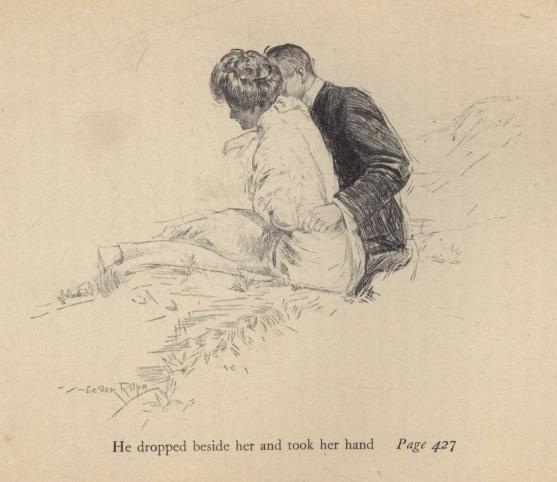
He dropped beside her and took her hand
"How can you love me?" he said bitterly. "What good am I? I have no capacity, no prospects, no purpose, even! I am a mere negative, and if I loved you I should free you from the incubus."
"Do you recall reading the palm of a girl whose lover in the Philippines refused to write to her?" she asked. "It happened about the time I first knew you, I think."
He nodded, watching a tug towing a bark out through the Gate, and she told him what she had heard of Fleurette's story that morning. It was no slight relief to him to think that he had helped some one, though his assistance had been based upon deceit.
"Don't you see?" she said. "Don't you understand how women love? It makes no difference how poor or how dishonored a man may be, if she loves him her happiness must be with him."
"Oh, a physical deformity is easy enough to forget. But how about a moral one? You'll be the wife of an outcast."
"If you refused to accept my love, if you left me, now, you would be inflicting a far greater pain than any gossip could ever give me."
"The mere problem of living appals me," he went on gloomily. "I would never think twice of it, if I were alone. But you know what a coward marriage makes of one."
She laughed in his face. "I'll be your first patient, Doctor Granthope, and I'll pay you well!"
"If there was some way of getting that money of Madam Grant's. I've never even thought of trying to claim it, but perhaps I might go up to Stockton and inquire about it. Of course, there's no fear of being accused of stealing it, now. But even if I had it, I don't know whether or not it would be right to use it myself."
"You might at least borrow it for a while, but for my own part I'm convinced that it's yours. There's no reason why the bank should have the use of it for nothing. I wish we could clear up that matter of Madam Grant."
They set out again, she with a buoyant tread, willowy and strong. It was not till her muscles relaxed that her characteristic, dreamy languor was apparent, and this trait was slowly disappearing under the influence of the new interest in her life. It was as if she had found, now, what she, in her former quiescent moods, had been watching and waiting for, and Granthope's presence stimulated her with energy. She was almost coquettish with him at times, now, the mood alternating with a noble frankness, the boldness of a gambler who has cast all hardily upon a single stroke. She was not afraid of being seen with him. She gave him herself in every word and glance. A casual observer could have read her fondness for him.
They went along the road, skirting the water, past the battery emplacements and disappearing guns, over a low hill toward the Fort. From this side the Bay opened to them, and beyond lay line on line of mountains, growing hazier in the distance, to the north and east. They had regained their spirits with this exercise, and talked again freely as boy and girl. He noticed with amusement and delight how she edged, unconsciously, nearer and nearer him. If he crossed the road, she came to him, without perceiving the regularity of it, as the armature comes to the magnet. She nearly forced him into the wall, or off the walk, in her unthinking pursuit of him, so strongly he attracted her. She blushed furiously when he spoke of it—it was so droll that he could not help mentioning it—but that comment did not cure her. She was over by his side, rubbing elbows as unaffectedly the next instant. How could she help it, when he kept his eyes on her as he did? she said. So, along the shore by the Life Saving Station, up to the parade ground and the barracks, then by a climb up the steep, narrow, tree-grown path to the corner gate of the reservation they sported.
That was the first of a series of outings they had together that week. The Golden Gate Park, Sutro's forest and the beach were each explored in turn, and while still within the limits of the city they tasted of country, mountain and shore, and let the days fly by. Clytie brought the luncheon, and they ate it, picnic fashion, under the blue sky. She kept strict account of his finances, and as his small capital dwindled they came back to his plans for the future. He met her, one day, with news.
"I think I shall have to go to work, after all," he said. "I've got a position."
She congratulated him, not without a shade of sorrow that their holidays were to end.
"It's too much like my old work to be very proud of, but it's a step up. It's founded on vanity, but this time I shall exploit my own instead of others'. I'm going on the stage. I've found my name is worth something."
She was a little disappointed and he was not surprised. "Oh, I'll soon become unbearable, I suppose. Most of the time I don't spend in front of the make-up glass looking at myself, I'll spend being looked at, trying to propitiate an audience. It's a school of egoism. But at least my pose will be honest. I saw the stage manager of the Alcazar, and I'm going to begin to rehearse next Monday."
He spoke banteringly, but she felt the truth of his jests. Still, it would provide for the present. It would make him more than ever notorious—but it was better than idleness.
The next day at ten o'clock she appeared at the studio to spend the day with him. It was Wednesday, and they were anxious to make the most of what time remained.
Except for his bed, table and bureau, his chamber was empty now, all his effects having been sold at auction. The sum received barely sufficed to pay off his debts. The studio, too, was bare, and placards hung outside both doors indicating that the premises were to let. The little office, however, was left as usual, except for the casts of hands, put away in the closet, and in this room they stayed by the open fire.
He was looking over his card catalogue as she entered. He had conceived the plan of writing a book on palmistry along new lines, in which he might embody his observations and theories. His aim was to attempt to correlate chirography, chiromancy, phrenology, physiognomy and all those sciences and pseudo-sciences which seek to interpret character through specialized individual characteristics, and to trace the evidences from one to another, showing how each element or indication would recur in every manifestation of a person's individuality, and how one symptom might be inferred and corroborated by another. It would take time and trouble, but he could spend his leisure upon it. The plan was tentative and hypothetical, but so suggestive that he was becoming interested in proving its verification. Clytie was enthusiastic about the book and desirous of helping him. He was becoming less afraid of her, and more sure of himself, after their days together, and he greeted her boldly enough, now. Yet there was still a fascinating novelty in his possession of her that made his familiarity seem like recklessness. Not for her, however. Once having given him her lips she could never refuse them again, nor could she longer think the action strange.
She took off her coat and hat, tucked in an errant curl or two over her ears and seated herself luxuriously in the arm-chair. As she had played with him, so now she worked with him, arranging his notes, dictating for him to write, or stopping to discuss the subject. She was too adorable in all this assumption of importance and seriousness for him not to interrupt her occupation more than once, for which diversion of her attention he was sent back promptly to his desk. The business kept them so employed for two hours, when she opened her package, brought forth their luncheon and brewed a pot of tea on the hearth.
"Francis," she said, after that was over, "do you know we are actually becoming acquainted? Isn't it too bad!"
"Don't you enjoy the process?"
"Decidedly I do. That's why I regret that it must soon be over."
"I doubt if we'll ever finish—if we do, it will be still more delightful to know you. And this process brings us toward that beautiful consummation."
"Yes, but this part is so pleasant. I hate to see it go. I want to roll it over on my tongue. Now, every word you say is a revelation and a surprise—a surprise that I have been anticipating all my life, if you'll pardon the bull. It's like unwrapping a mummy—I get excitedly nearer and nearer my ideal of you."
"But there's no satisfaction in opening doors if one can't go in."
"Ah, there's the immortal difference between a man and a woman! Most men want a marvel, patent and notorious. They want to come to the end of the rainbow and find the pot of gold; that's all, whether that means a kiss or a marriage. Women enjoy every step of the journey. Men think of nothing but fulfilment, women of achievement. Men care only for the black art of the Indian fakir who makes a grain of wheat grow to full maturity in a few minutes. Women appreciate the wonder of the natural development of that same little seed in the warm bosom of the earth, with its slow evolution of sprout and stalk and leaf and blossom—the glory of every step on the way!"
"But, can't you see that progress in affection needn't be a limited journey to a finite end, even the end of the flower, but, no matter how fast one travels, if one is really in love, the goal is always infinitely distant? There are enough things to be understood and enjoyed."
"Oh, I'm sure enough that I'll never get enough of you, and never know enough about you!"
"That's almost too true to be funny. You'll never know even who I am, I'm afraid. Think what a risk you run, my dear!"
"Oh, I know who you are well enough. You're the son of Casanova and Little Dorrit."
He grew reflective. "Isn't it strange," he said, "that you, with all your wonderful intuitions, shouldn't be able, somehow, to solve that riddle? Do you think I am Madam Grant's son? Sometimes that seems to be the inevitable conclusion."
"I can't quite think you are, Francis. Everything you have told me about her has brought her very near to me, somehow, and I feel as if I knew her, but you don't affect me in the same way. I think you're a changeling, myself! It is strange that I can't quite 'get' you now, though, not nearly as well as I used to. My power seems to have waned ever since—"
"Since what?"
"Since that first kiss! You see, I've exchanged that elusive power for something tangible." She put him away with a gesture. "No, not now! I want to be serious! And oh, here's what I found in my father's scrap-book. It seemed to have been cut from a very old paper. Somehow it seems to point to her. I want to know what you think about it."
She had copied it out and read it to him:
"Miss Felicia Gerard, who spoke immediately after Mrs. Woodhull's address, is one of that lady's most devoted adherents and helpers, having been connected with the cause for nearly a year. Although only twenty years of age, Miss Gerard has brought into action talents of no mean order. She was graduated at Vassar College, and is endowed both physically and mentally with the rarest and most lovable qualities. She was first presented to Mrs. Woodhull in Toledo, where the remarkable clairvoyant powers shared by the two women drew them naturally together. Miss Gerard is a regular contributor to Woodhull and Claflin's Weekly where her spirited articles have attracted wide notice and flattering praise."
"That must be Mamsy," he said.
"I'm sure of it. I shall ask my father as soon as I get the opportunity."
For the rest of the afternoon they talked as if they were never to meet again. Once or twice there came a knock, and the door was tried, but Granthope did not answer, and they were left alone in peace. She rose to go at six, and, as she was to be busy all the next day, the parting was long delayed. They were, indeed, getting rapidly acquainted.
CHAPTER XV
THE REËNTRANT ANGLE
Blanchard Cayley strolled into the Mercantile Library, one afternoon, and, nodding to the clerk at the desk, walked to an alcove in the corner of the main hall. He stopped at a shelf and sat down on a stool. He had done this several afternoons a week for years, going through the library as a business man takes account of stock, examining every book in order. Of some he read only the titles, glancing perhaps also at the date of the edition; of some he looked over the table of contents. Others he read, nibbling here and there. A few he took home. He had, by this time, almost exhausted the list. He read, not like a bookworm, with relish and zest, nor like a student desirous of a mastery of his subject; he read, as he did everything, even to his love-making, deliberately, accurately, with an elaborate scientific method that was, in its intricacy, something of a game, whose rules he alone knew. He had, indeed, specialized, taking up such subjects as jade, Japanese poetry, Esperanto, higher space, Bahiism, and devil-worship, and in such subjects he had what is termed "lore," but his main object was the conquest of the whole library in itself.
This afternoon he did not read long. Looking over the top of his book, as was his custom from time to time, to discover what women were present, he caught sight of Clytie Payson in the alcove containing the government reports. He replaced his volume and went over to her.
She was in high spirits, and welcomed him cordially, as if she had but just come from something interesting and stimulating; another man's smile seemed still to linger with her.
"Why, how d'you do, Blanchard?" she said. "I haven't seen you here for a long time. What has happened? Have you finished the library yet?"
"Oh, no, not quite. I've still a few more shelves to do, but I've been studying psychology on the side."
She looked at him with an indulgence that was new to him. "In petticoats, I presume, then?"
He shrugged his shoulders. "No, I've been studying a man," he said. "What are you doing?"
She overlooked the purport of his question and answered lightly, "Oh, only looking up some statistics for father. I've been coming here quite often, lately, but I'm almost finished, now. Is there anything in the world duller than a statistic? I always think of the man who went for information to a statistician at Washington and was asked, 'What d'you want to prove?'"
"How is your father getting on with the book?"
Clytie grew a little more serious. "Why, father's queer lately. I can't understand him at all. He's taken up with some spiritualists, and I'm rather worried about it."
"He's talked to me about them. But I should hardly think you'd be surprised at it. You're as much interested in palmistry as he is in the spooks, aren't you?"
Clytie flashed a glance at him. "Didn't you know that Mr. Granthope had given up palmistry?"
Cayley smiled and smoothed his pointed beard. "Oh, yes. I've heard considerable about it. Nobody seems to understand it but me. Very clever of him, I think."
"What d'you mean?" Clytie was instantly upon the defense.
"I like his system. It's subtle."
"His system?"
"Yes. You don't mean to say you still think he's sincere, do you?"
"I don't think it's necessary to discuss Mr. Granthope," said Clytie carelessly. "Of course I do believe he's sincere, or I wouldn't call myself a friend of his. He has given up a good paying business because he was sick of that way of earning a living."
"And also in order to make more money by quitting."
"How?"
"By marrying you."
She winced. "Blanchard," she said, "if you weren't an old friend, I couldn't forgive you that. But because you are, I can't permit you to think it."
"It was because we are old friends that I permitted myself to speak so plainly. You'll count it, I suppose, merely as jealousy. But I hate to see you taken in so easily."
Clytie looked up at him calmly, folding her hands in her lap. "Now, Blanchard, please tell me exactly what you mean, without any more insinuations."
"Why, Granthope has been for two months trying to marry you. He's after your money."
"Thank you for the implied compliment," she retorted dryly.
"Oh, well, you know perfectly well what I think of you, Cly. I was thinking of what I know of him, not what I know of you. He's made a deliberate attempt to get you, and this reform business is only a part of the game."
She smiled and turned away, as if she were so sure of Granthope that it was hardly worth her while even to defend him.
"It's not pleasant to say it," he went on; "but you spoke of being distrustful of these mediums your father knows, and my point is that Granthope's tarred with the same brush. He has worked with them and plotted with them."
She was as yet unruffled; the spell of her happiness was still upon her, and she answered mildly. "I can hardly blame you for thinking that, perhaps. I suppose I might myself, if I didn't know him so well. But I do happen to know something about his life, and I'm sure you're mistaken. He's told me a good deal, and I have my own intuitions besides."
Cayley was as serene. "Do your intuitions tell you, for instance, that he has a definite understanding with these mediums—in regard to you?"
"No, they do not!" she answered calmly, looking him fair in the face.
"It's true, nevertheless." Cayley, with sharp eyes, noted her flush. Her eyes were well schooled, but her quivering mouth betrayed her trouble.
She took up her book as if to dismiss the subject.
Cayley watched her with impassive eyes. "You may be his friend, as you say, but there are a lot of things about Granthope that you don't know yet."
"No doubt," she replied without looking up.
"And there are things which you ought to know."
She looked at him now, to say: "Do you fancy that you are helping your own chances any by attacking him?"
"Will it help his chances any if you find that he has given away particular facts that he's discovered about you and your father?"
She had begun to be aroused, now, and she showed fight. "I don't believe it!"
Still unperturbed, he went on in his mechanically precise way. "I've made it my business to find out about Granthope, Cly. It shouldn't surprise you—you know I'm in earnest about wanting you. I'm as earnest, too, in wanting to protect you. I don't propose to hold my tongue when I find that you're trusting in a man that's knifing you behind your back."
Her voice rang with pride and scorn as she rose, saying, "I don't care to discuss the matter further, Blanchard."
"Not when I say that I have seen notes in Granthope's own handwriting that were given to a medium as a part of a deliberate scheme? These notes were on definite things he had learned, I'm sure, from his conversations with you. Some of them are personal matters that I'm sure you wouldn't at all care to have made public. You could easily prove it if you saw them."
She had lost courage again, and hesitated, staring at him.
Then she said, freezing, "Let me see them, then. If you're determined to have a scene, you may as well follow the rules of melodrama."
"I can't show them, because this medium wouldn't let them out of his possession. But I can get him to let you see them, if you like."
"You say they are about things we—that I talked about?"
"Yes."
"Things—about—me?"
"Yes. I forget all of them. I had only a moment's glance."
For some moments she stood silent. Then she spoke swiftly. "I don't believe it. He couldn't do such a thing!"
"My dear Cly, you must remember that one's whole mental evolution is merely the history of the conflict between reason and instinct, and reason is bound to win in the end. That's the way we develop. The fact is, he could do it and did do it. He's a charlatan and he has used a charlatan's methods. I said he was clever. This giving up his studio was merely a kind of gambit. But he made a mistake when he tried to use a lot of cheap fakirs to help him out with you."
"Oh!" She clenched her fists. "Don't! I won't stand it!" Her head dropped as if she were weary. Her eyes burned.
"Oh, there's good in everybody, the copy-books say," he returned. "But the fact is, Cly, he isn't in your class, and never was. You should have seen that!"
She looked at him without seeing him, her eyes caught meaninglessly by the garnet in his tie, clinging to it, as if it were the only real thing in the world. Her lips parted, the color was leaving her cheeks, she looked as frail as a ghost. Suddenly she threw off her reverie, and placing her hand on his arm, said, "Let me see them—the notes—Blanchard. There must be some horrid mistake. I want to clear it up immediately."
"Very well, I'll take you now, if you like. It isn't far."
She followed him out of the library as if hypnotized. They spoke little on the way. Cayley tried his best to arouse her, but finally gave it up as impossible. He watched her, preserving his usual phlegmatic calm. She walked with head erect, her chin forward, with her long, graceful gait, beside him, but never seemed two human beings further apart in spirit.
Flora Flint opened the door to Vixley's flat. She acted quite as if she belonged there and invited them in cordially, with an up-and-down scrutiny of Clytie as they passed in. Then she disappeared down the long, tunnel-like hall. Cayley took Clytie into the office where, refusing a chair, she stood like a statue, her eyes fixed on the door.
Vixley entered, currying his beard with his long fingers. "Well, Mr. Cayley," he said, "what can we do for you? Like a sitting?"
"Professor, you recall telling me something about some memoranda Granthope gave you, don't you?"
"I been thinkin' about that, Mr. Cayley, and I don't know as I ought to have said anything. I'm rather inclined to regret it."
"You have said something, and I've brought this lady down to show the memoranda to her," said Cayley.
"H'm!" Vixley looked her over. "It ain't exactly customary to show things like that, you know."
"We've had all that out before. I'm here to see those cards."
Vixley drew up a rocking-chair for Clytie, and seated himself on the edge of the revolving chair in front of his desk, putting the tips of his long fingers together. "Francis Granthope is a bright young man," he said, "a very bright young man. Very painstaking, and very thorough. I won't say he ain't a leetle bit unscrupulous, however. A man who ain't got no psychic influence behind him has got to do some pretty good guessin'. Now you go to work and take me, with my control, Theodore Parker, and his band o' spirits, I don't need to bother much. I can get all I want out of the other plane. I ain't sayin' nothin' against Granthope, except maybe that he uses methods, sometimes, that ain't exactly legitimate, such as what I was tellin' you about."
"How did he happen to give you these notes?" Clytie asked.
"Why, I s'pose he expected me to give him an equivalent in return. I will say I have helped him out, at times, feelin' rather predisposed toward him, and him bein' a likely chap. But Lord, I don't need his help! And so I told him. In this case I didn't feel called upon to give away none of my client's affairs. Naturally he got a little huffy about it, and he's acted so that I'm inclined to resent it. I can't bear anything like ingratitude."
He opened his desk and took from a pigeonhole two cards. He handed them to Clytie.
"I was tellin' Mr. Cayley, here, I knew about Granthope and his methods. It'll show you what a poor business this palm-readin' reely is. Lord, they ain't nothin' in it at all! If anybody wants to know anything about the future the only way to do is to establish communications with the spirit-plane through the well-known and well-tried methods of spiritualism."
Clytie was not listening. Her eyes were upon the cards. She looked and looked, reading and re-reading, her face set in tense lines, the notes in Granthope's fine, closely written hand. There it was, as he had set it down:
Oliver Payson, b. Oct. 2nd, 1842. b. d. present from dau., bound copy of 'Montaigne' 1900. Tattoo mark anchor on right arm, near shoulder. Writing a book. Economics (?) Knew Mad. Grant (?) Wife visited Mad. G. x. v. p.
Clytie Payson. Engaged to Blanchard Cayley (?) Mole, left cheek. Ring with "Clytie" inside. Turquoises. Claims psychic power. Clairv. Goes to Merc. Lib. afternoons at 3. Buried doll under sun-dial in garden.
As she came to the last line she dropped the card from her fingers. She had become a woman of ice.
Vixley picked up the card and smiled, showing his yellow teeth. "Kind of a give-away, ain't it? I call his work lumpy."
"I hope you're convinced now," Cayley added.
She turned her head slowly, deliberately, to the Professor. "When did Mr. Granthope give you this card?"
"Oh, I dunno, exactly, he's gave me so much, one time or another. About two weeks ago, I should judge. Why?"
"I'm very much obliged to you." Her voice came as if from an immense distance. Then she nodded to Cayley, who rose.
"Nothin' more I could do, is they? Wouldn't you like to try a sittin', Miss?" Vixley asked with urbanity.
"Thank you, no." Clytie walked out slowly, without another look at him, like a somnambulist. Vixley hastened to escort her to the front door, and opened it.
Cayley gave him a look. It was returned. Vixley bowed. Clytie went out.
"Are you going over to North Beach?" Cayley inquired. "I'll walk up to the car with you."
"I'll go alone, I think."
"Oh, very well—but—"
"Good afternoon. You'll have to excuse me, Blanchard."
"All right. Good day."
She strode off, leaving him there.
She walked all the way home, and walked fast, her head held high, looking straight ahead of her. She took the steep hills with hardly a slackening of her speed, breasting the upward inclines energetically, leaning forward with grace. Up Nob Hill and down she went, along the saddle, up Russian Hill and over, without her customary pause to enjoy the glorious outlooks. Under her arm she still carried the book from the library which she had forgotten to put down when first Blanchard Cayley spoke to her. She held it automatically, apparently not knowing that it was there. With it she gripped her glove; her right hand was still bare, clenching her skirt.
She turned into her street at last, and climbed the wooden steps, into the garden. As she went up the path, her eyes lighted upon the sun-dial. She stopped and looked at it for a moment fixedly. Then into the house, up-stairs to her room, to throw herself upon the bed...
The wind had risen and blew gustily about the house. Her shutter banged at intervals. The noise kept up till she rose, opened the window and fastened back the blind, and went back to her bed. There she lay, staring, with her eyes wide open...
Her father did not come home that evening. At half-past seven she got up again, washed her face, arranged her hair, and went down-stairs to eat dinner alone. Afterward she stepped out into the garden. The wind billowed her skirts, fretted her hair into a swirl of tawny brown, cooled her cheeks. For an hour she walked up and down in the dark. The harbor was thick with mist. The siren on Lime Point sobbed across the Gate intermittently ...
Later, she went into the library and sat down with a book beside the fire. For a half-hour she did not turn a page, but remained quiescent, gazing at the flames...
At ten she went up to her workroom, lighted the gas, and took out her tools. For two hours she sewed leaves on her frame, working as if automatically. Her gaze was intent; one would have said that she was completely absorbed in her task. Slowly the sheets piled, one on another, each stitched to the back with deft strokes. Finally the whole volume was completed. She bound up the loose threads and put the book away. Then she heated her irons, got out her gold-leaf and spent an hour tooling a calf cover, pressing in roses and circles and stipples while her lips were sternly set. She arose, then, and looked out into the night...
She undressed at last and went to bed. Long after midnight there was a sound below of her father coming in. His footsteps went to and fro for a time, then they came up-stairs. His door was closed softly. There was no sound, now, but the ticking of her little clock, and, occasionally, the far-away echo of a steamer's whistle, and the dreary note of the siren. She tossed uneasily. The clock struck one, two, three, four. Then the wind began to sing round the corner of the house as the gale rose. The noise was soothingly monotonous, hypnotic, anesthetic...
At breakfast she was cool, serene, quiet, showing no traces of her emotion. She talked with her father, laughed with him, as usual, flying from one topic to another, never serious. As he got up to go, she remarked:
"Father, I think I'll go up to Sacramento to visit Mrs. Maxwell at Lonely a few days. I've put it off so long, and she's been after me again to come. She's up there all alone."
"All right, Cly. I saw her down-town, day before yesterday, and she told me she was going to ask you."
Clytie frowned. "You did? Why didn't you tell me?" She looked at him for a moment curiously. He seemed to wish to evade her question. Then she asked, with emphasis, "Did you ask her to invite me?"
Mr. Payson hesitated. "Why, I told her that you would probably accept—"
She bit her lip, still frowning. "I understand. On account of Mr. Granthope, I presume?"
"Well, I thought it would be just as well for you to take a little vacation."
Clytie said nothing. Mr. Payson lingered, ill at ease in the face of her implications. At last he looked at her over his spectacles and said petulantly: "I've been surprised at you, Cly, really. I have been considerably worried, as well. I'm afraid you've compromised yourself seriously by having been seen so much with Granthope. I haven't spoken of it, before, because I had already said all I could to you. You knew very well what my wishes were in the matter and it seems you've seen fit to disregard them."
Clytie still kept silent, listening to him calmly. He had worked himself up by his own words to an irascible pitch, but her non-resistance balked his temper, and it oozed away, as he continued.
"I hope this trip will give you a chance to think it well over, Cly, and I have no doubt that you'll come to see it as I do."
"Oh, I'll think it over," she replied listlessly.
Mr. Payson, having won his point in getting her out of town, shook his head without replying, and prepared to leave the room.
But Clytie continued. "At least, I am sure he was sincere in warning you against those mediums you are going to, father."
He turned to her, his irritability rekindled by her remark. "That's exactly what I most dislike about the man," he exclaimed. "If he hadn't attempted to prejudice me against them I might believe in his own change of heart, or whatever it was. But he went back on the very people with whom he's been associated for years. Isn't that suspicious?"
"Didn't he do that to save you from their tricks?" Her voice was low and evidently troubled; she seemed to be attempting to convince herself, rather than her father.
"I notice he didn't explain how they managed to give me my tests," Mr. Payson retorted, shaking his head emphatically. "He seemed to consider me the most simple and credulous person in the world. His statements, at least those he dared to make, were all general ones, and they implied that I was not old enough, or else, perhaps, too old to sift the evidence for myself. They were positively insulting. These mediums have given me proof enough to convince any one. They've told me things that couldn't possibly have been found out by any tricks. Take that about your giving me a copy of Montaigne for my birthday, for instance. How could they have found that out? You hadn't told any one about it, had you?"
"No," said Clytie faintly.
"There you are, then!" Mr. Payson wagged his head solemnly. "What did I tell you?"
"What else did they say?" Clytie asked anxiously.
"Plenty of things. Things I myself didn't know the truth about till I investigated. Things about my personal affairs, about my past life—oh, so much that I can't help feeling that there's something in this business that we don't understand. Oh!"—he paused for a moment, looking at her—"there was one thing I wanted to ask you about—I forgot to speak of it. It sounded like nonsense, at the time—you know that even spirits are sometimes frivolous and inconsequent—and there were so many other more important communications at the time that it slipped my mind. Vixley's control said something once about a doll that was buried underneath—"
"Oh, I forgot to ring up Mrs. Maxwell," Clytie interrupted, springing up. "I must tell her I'm coming. If I don't do it right away now I may not catch her—it takes so long to get a long distance connection."
She went up to him and putting her arms round his neck, kissed him. "Don't wait, father, if you're in a hurry. Good-by!"
She walked to the door.
"Well, then, I'll go along down-town," he said. "Be sure and write when you get up there."
She left him hurriedly and ran up-stairs.
At ten she was at the ferry, waiting for the boat which connected with the Sacramento train. There was a crowd going, coming and waiting in the long arcade outside. As she approached the ticket office a man was at the window. He was tall, dark-haired, distinguished. At sight of him, Clytie withdrew out of sight, and let him finish his business and leave. Then she approached, bought her ticket, and, watching sharply, dodging behind groups here and there, she succeeded in passing the ticket collector and losing herself in the assembly in the waiting-room without being observed. She wormed her way forward near the gate, and with the first rush of passengers, after the gate was raised, hurried on to the boat and went, immediately into the ladies' room.
On the other side she acted as cautiously. She remained till almost the last passenger had left the boat, then walked swiftly through the train-shed to her car. For an hour, as the train sped on, she scarcely looked to the right or the left.
The train slowed up at Stockton, and stopped. Clytie looked carelessly out of the window. Just as the train started again, Granthope appeared on the platform. He went up to a cab-driver and began talking. Clytie, flushing deeply, watched him so intensely that at last, as if attracted by some mental telepathy, he looked round and caught sight of her. His hat came off to her immediately. He gave a quick glance at the now rapidly moving train, as if intending to board it, then he gave it up as impossible. Clytie's eyes lost him, and she was carried on. It was a long time before the color faded from her cheeks.
CHAPTER XVI
TIT FOR TAT
Professor Vixley had prepared his campaign with Mr. Payson with the scientific delight of an engineer. His cunning was not too low to prevent his love of the sport for the sport's sake, and his elaborations and by-plays were undertaken with relish and enthusiasm. The pleasure was vastly heightened for him by the character of his dupe. Mr. Payson was a figure in the community, a man of weight and influence. He had an established position and an assured wealth. Heavy and slow, mentally, he had the dignified respectability that is usually associated with business success.
In the mental manipulation of such a personage Vixley felt a sense of power as enjoyable as the pecuniary reward. The dwarf, socially, led the giant.
He had his charge, by this time, well in hand. The old gentleman's ponderous mentality had been managed like an ocean steamship lying at the dock. One by one the lines of doubt and distrust and prejudice had been released. It was now time to fire his intellectual boilers. By means of their tricks, eavesdropping methods and clever guess-work, and with Cayley's help, they had fed him fuel for the imagination until now he was roused to a dynamic, enthusiastic belief in spiritualism, or that version of it which best suited their ends. Captain and pilot were aboard and in command. It remained but to ring up the engines, turn over the wheel and get under way for the voyage. Many another such argosy had been fitted out and had sailed forth from their brains, to return laden with treasure. There was hazard of collision or shipwreck, but the only obstacle now in view was Granthope, and Vixley felt sure that he could be blown out of the way with the explosion of a few scandals.
Mr. Payson's mind had an inertia which, once successfully overcome, was transformed to momentum. He was as credulous, as responsive, as influenced by the specious logic of the medium as if he had never been a skeptic. Vixley's next move was to realize financially on Payson's vanity and literary aspirations.
The ensuing series of communications from "Felicia," automatically transcribed by Vixley, developed the fact Mr. Payson's book would meet with disastrous competition from an unknown author who was working upon the same subject in Chicago. Such a publication would, in the eyes of any publisher, materially affect the value of a San Francisco book. Something must be done to prevent the rival work from being printed. The first step necessary, Vixley asserted, was to send a man to Chicago and investigate the case and report upon it. This preliminary reconnaissance cost a considerable sum. Payson did not see the emissary, for Vixley had warned him of the possibility of blackmail. "Felicia" now informed the sitter that the aid of the spirit world could be invoked to forestall the competing writer's efforts.
There was a band of spirits on the "third sphere," it seemed, who, though usually maleficent, could be placated. These "Diakkas" could, and possibly would, exert certain magnetic or psychic powers so as to prevent competition. It was difficult, however, to win over spirits so fantastic as these, even when one had established communication with them—itself an intricate and dangerous process. The only safe way, Mr. Payson was assured, was to create an atmosphere pleasing to them, one which absorbed antagonistic vibrations, and facilitated communication by intensifying the sitter's aura and rendering their acceptance of earthly conditions easy. And so forth, through an elaborate exposition.
The thing was accomplished by means of charging the room with the perfume of ambergris. Ambergris, however, was expensive. Mr. Payson had to pay fifty dollars an ounce for his; moreover, a fresh supply was necessary for each séance as the material quickly absorbed the deleterious psycho-physical elements of the atmosphere, and became inert to vibration. Professor Vixley divided this revenue with Madam Spoll, but he could not divide his pleasure in his artful fiction. Madam Spoll was only a woman; the artistic niceties of the harlequinade were lost on her.
This could not, however, go on for ever, nor were the two conspirators content to do business in so small a way. Both were convinced that the only chance for a large and permanent income lay in the production of Payson's and Felicia's child, and they set about the plan by which this should become remunerative.
Ringa was settled upon for the impersonation. He was simple, easily taught and led; he was willing. He would be as easily managed when the time came for a division of the profits of the enterprise. And so, one day, Madam Spoll waddled out to Turk Street to complete the negotiations.
Professor Vixley was bending over a small machine with horizontal arms in the form of a cross, decorated with mirrors, when she rang; before opening the door he covered the instrument with a black cloth and put it on his roll-top desk by the type-writer.
Madam Spoll came in smiling, unruffled as if her face had been freshly ironed out.
"I been walking lately, to reduce my flesh, but, Lord, I get such an appetite I eat more'n enough to balance," she panted, as she lowered herself carefully upon the quilted couch and crushed back into a sofa pillow, whereon was painted a fencing girl with a heart on her plastron. She loosened her beaded cape, and breathed heavily in relief.
"Well, I managed to get here, after all! What d'you think? Mrs. Riley has been to me for a private setting. Do you recall her, Vixley? She's that woman who was tried for murdering her husband some years back and was acquitted; or rather the jury was hung. Anyways, she wasn't. But I believe she done it. She's as nervous as a cat, and can't look you in the face to save her soul. It seems that she knew Madam Grant in the old days, and used to get readings off her. I don't know but we could use her, someway."
"Has she got any money?" said the slate-writer.
"She keeps a boarding-house, I believe. It wouldn't be much, but 'every little helps,' as the old lady said when she spit into the harbor. I might work her for five a week, I s'pose, but now I think of it, Masterson's doctoring her."
"Then they won't be much meat left on her bones!" Vixley grinned. "But I ain't botherin' with landladies till we finish with Payson. Did you see him yesterday?"
"I did, and he said he'd give a thousand dollars if we'd find the boy. I shouldn't wonder if he'd pay more if we work it right, not to speak of what we get from Ringa when he's fixed."
"Lord! A thousand dollars for Ringa! Wouldn't that make you seasick?" Vixley cackled, slapping his claw-like hand on his knee. "I say, Gertie, we ought to get a couple of good crockery teeth put in his jaw first, or the old man will want to return him for shop-worn. Ringa as Mr. Max Payson, Esquire! Gee whizz! I want to be there when the old gent falls on his neck and kills the fatted calf!"
"I've known a heap of worse boys than Max Ringa to have for a son," Madam Spoll said, a little irritated. "You go to work and wash him and dress him up in a Prince Albert and I don't know why he won't do as well as anybody."
"Oh, he'll do—he'll do elegant! He'll do Payson, anyways, and that's all we want."
"Oh, I'm going to teach him to jump through the hoop all right. He'll be doing the papa's darling act so natural you'll think he'd always slep' in a bed!" She chuckled now till she shook like a jelly-fish. "He's just crazy about it. Says he'll come down and take me to ride in his automobile car. Why, Payson will be good for all sorts of money if Ringa works him right. He ought to get an allowance of two or three hundred a month if the old man's got any proper feelings as a father."
"It's more'n likely he'll pay Ringa to stay away," Vixley remarked cynically. "I've seen these here fond parents before. I don't seem to see Ringa doin' society somehow. He'd be tryin' to blow the foam off his champagne and chewin' tobacco in the ball-room the first thing. But he'll do for a starter. If worse comes to worst we can hold the old man up to keep the story dark—and then there's the weeklies, they wouldn't mind gettin' hold of it."
"Say!" Madam Spoll suddenly exclaimed, "what's become of Fancy Gray, now that Frank has thrown her down?"
"Why, ain't you heard? She's took up with this fellow Cayley."
"No!" Madam Spoll's eyes were opened wide at the bit of gossip. "What's he up to with her, anyway?"
"Why, I expect he's trying to use her someway, so's to queer Frank's game with Miss Payson. Fancy knows all about Frank, if she can be induced to tell. If Cayley can show Frank up, he stands a better show to catch Miss Payson himself. At least, that's the way I figure it. I ain't got no idea that Cayley cares a rap for Fancy, but he's smooth, and as long as he can use her he'll keep her jollied along."
The Madam had been thinking hard. "Fancy ought to be pretty sore on Frank," she offered.
"I don't blame her. He's treated her bad."
"And there's no doubt about her being stuck on Cayley?"
"It certainly looks like it; she's with him all the time."
"Well, then, what's the matter with getting Cayley to work her so she can help us out with Payson? I believe we could use her good. She's a saucy chit, and she makes me tired with her fly-up-the-creek impudence; but all the same, she's clever, and if Cayley could only induce her to go into it, I can see lots of ways she could help."
Vixley thought over the matter for a few minutes in silence. "All right, Gertie, I'll speak to him about it. I guess he'll do it; he'll be afraid not to. We got him pretty well tied up, now."
"You can promise him that Felicia will recommend that he marries the girl. That'll be an inducement."
"I'm afraid the Payson girl has got something to say about that herself, from all I hear."
"Well, at any rate, we've queered Frank Granthope, and that's what Cayley wanted most."
"I guess so; at least, that's what I make out from what he says. He's pretty close-mouthed."
"Well, if he ain't close-mouthed about Payson, he can tend to his own affairs alone, for all I care. Has he gave you any more dope?"
"Has he! Why, he's been a-ringin' of me up every day, tippin' me off to everything the old man's up to!"
"You ain't let on anything about this child business to Cayley, have you?"
"D'you think I want to queer the whole game? Of course not. Why, Cayley would be scared that the daughter wouldn't get any of the money if he knew they was another heir. All the same, we got to be careful of Cayley, for he certainly has helped considerable. The old man wouldn't be where we got him now if Cayley hadn't shown up. What d'you think he told me this mornin'? Payson's been round to a lot of printers, gettin' estimates on the book, so's he can publish it hisself! Ain't that a gall? He never asked my advice about it! I'm going to give him a dig about that."
"Oh, well, let's get down to business, I ain't got any too much time," Madam Spoll interrupted. "About the materializing, now. We got to have a private séance, of course?"
Vixley rose, clasped his hands behind his back, and lifted himself up and down on his toes as he gazed at her. "I been a-thinkin' it over, Gert, and I come to the conclusion that it ain't best. Payson ain't prepared for it yet, and we got to go easy. He ain't actually convinced of physical mediumship yet, as it is. I think we better spring it on him at a public. Flora can pack the room with believers and cappers, and then, after Payson's seen a lot of other folks recognizin' spirits and gettin' messages, why, he'll be more inclined to swallow his test. I've made a study of him, and that's my opinion."
"Has Flora got plenty of help?"
"She wants one more girl to play spirit, for she's just lost a dandy she had—she was arrested for shopliftin', I believe. We can fix her up, though. There's your Miss French, for one."
"I don't trust her much, but she'll do on a pinch. But Perry we must have. It's better to use our own people. Who's Flora's cabinet control?"
"Little Starlight. Flora does her with a telescope rod. Oh, Flora's slick! She's a cracker jack of a ventriloquist—she's got at least six good voices!"
"How does she work, now? From the front seats?"
"No, mostly through the foldin' doors. As soon as the room is dark and the singin' has commenced she has the door rolled back the wrong way about a foot, and her players come in that way. They don't show against the black cloth, and they's no danger at all, for if anybody wants to examine the cabinet they ain't no panels nor nothing to be exposed. Flora's just got up a grand disappearance act, she tells me. She wears a white petticoat and her overskirt is lined with white. When she comes out of the cabinet her skirt is lifted up and wrapped round her head inside-out, as natural as life. Then she gradually lowers it and the whole form slowly disappears down to the ground like a snow-man meltin' in the sun. No, sir, you can't beat that girl, not in this town!"
"Vixley, I don't see no end to this graft. Why, after we've materialized we can etherealize, can't we?"
"Yes, and then we'll develop him till he don't know where he's at."
"And spirit-pictures, too. Felicia'll take a grand photograph!"
"You bet. I'm going to try them big cloth ones that you spray with prussiate o' potash. You can get blue, yeller, and brown fine. I been workin' on it already."
A ring at the front door-bell interrupted her colloquy. Vixley tiptoed to the window and peeped out; then he turned with a scowl.
"It's Doc Masterson. What the devil does he want, anyway?"
"No good, I'll bet," she replied.
"I got to let him in, I s'pose. It won't do to send him away, the old snake-in-the-grass. He's too smooth!"
"Oh, I ain't afraid of him. I wan't born yesterday," was her contemptuous reply.
"All the same, you be careful what you say to him, Gert," Vixley cautioned, as he went out into the hall.
He reappeared with the doctor. Madam Spoll smiled sweetly.
Doctor Masterson greeted her with a sour expression, and shook hands limply. He sat down deliberately, and, pulling out a soiled silk handkerchief, wiped his creased forehead and his bald pate. Then he cleaned his iron-bowed spectacles, blinking his red eyes as he breathed on the lenses.
Vixley, from the organ bench, watched him shrewdly, and offered him a cigar.
"No, thanks, I don't smoke," said the doctor peevishly.
"Since when?" Vixley asked in surprise.
"Since you give me that last 'Flor de Chinatown,' or whatever it was. When I want to smoke rag carpets again I'll try another." He showed his black teeth in a vicious grin.
Vixley tittered. "What's wrong, Doc? Looks like you had a grouch. Been takin' too much of Hasandoka's medicine lately? You didn't come round here to look a gift-horse in the mouth, did you?"
The doctor cleared his throat and pulled down his plaid waistcoat. "No, I didn't. But I didn't come round for to give you any hot air, neither! I'm glad I struck Madam Spoll here, for what I got to say may interest her, too."
"Spit it out and get rid of it, then," said Vixley; "don't mind us."
"The fact is," said Masterson, "you ain't neither of you treated me square. I fully expected to be in on this Payson game, from what you led me to believe, and you not only let me out with only a month's work, but you've shut me off from the main graft."
Madam Spoll fired up. "We never told you we was going to whack up with you, at all! Seems to me you got considerable nerve to try and butt in! Who's running this thing, anyway? You got all that's coming to you. We ain't never took him into partnership, Vixley, have we?"
"I ain't seen no contrack to that effect. You ain't got no call to complain, Doc; they ain't enough in it for three. Payson ain't loosened up enough for us to retire on it, yet."
Masterson's thin lips drew back like a hound's, to show his fangs. His Adam's apple rose and fell above his celluloid collar, as he swallowed his irritation. "Oh, very well," he said quickly. "Of course, if you want to freeze me out, you can. But I don't call it a square deal. I was the one what got him going, wan't I? Didn't I do my part all right? I understand you're going to materialize him and develop him, and the Lord knows what-all. I don't see why you can't find room for me, somewhere."
"You ought to be thankful for what you got out of it!" Madam Spoll exclaimed. "Lord, we didn't have to take you on at all! They's plenty of others we could have used. You're three hundred ahead of the game as it stands, and that's more than you've ever made in six months, before. Don't be a hog!"
"That's a nice thing for you to say," he sneered. "When I get up to two hundred pounds I'll begin to worry about that."
Vixley interfered craftily. "We'll think it over and let you know, Doc; we may be able to use you, perhaps, but we can't tell yet a while—not till we see how this thing turns out."
Madam Spoll broke in again, shaking her fat finger at him. "Don't you believe it, Masterson! Me and Vixley can work this thing alone, and you better keep your nose out of our business! If you come here looking for trouble, you can find it, fast enough!"
Vixley winked at her, but she was too angry to notice it. Masterson rose stiffly and faced her, his thumbs caught in the armholes of his plaid waistcoat. "All right," he said. "I ain't going to get down on to my knees to you. But the next time I'm asked for a good clairvoyant, it won't be you. I only ask what's fair, and I didn't come here for to be insulted."
"Oh, get on to yourself!" Vixley said, taking him by the arm. "Nobody ain't insulted you. You can't blame us if we want to do this our own way, can you?"
The doctor shrugged his shoulders and took a few steps toward the door. "You may think better of it when you talk it over," he hinted darkly. "You may see my side of it. Good afternoon, Madam Spoll, I won't take no more of your valuable time." He walked out.
"You was a fool, Gert," said Vixley, after the door slammed. "It won't do to let him get down on us. He knows too much."
"Pooh!" she flouted, bridling. "I ain't afraid of Masterson, nor anybody like him. He ain't got enough blood in his neck to do anything. He just came round here like a pan-handler to see if we wouldn't give him a poke-out. I'll see him further!"
"I ain't so sure," Vixley replied, rubbing his beard thoughtfully. "My rule is, don't make no enemies if you can help it. But of course we got to cut him out."
Madam Spoll subsided and changed the subject. "Have you got that developing machine yet?" she asked, her eyes, roving about the room.
He walked to the desk and carried the machine to the small table in front of her. Taking off the cloth he disclosed the revolving mirrors actuated by clockwork. It was much like the instrument first used by Braid in his experiments with mesmerism. He wound the spring and set the mirrors in motion. They whirled madly in their circle, casting flashes of light.
"That's the way it works—you just stare at it hard. I guess that will hold Payson a while. He's got the scientific bug enough to like this sort of thing."
Madam Spoll put her elbow on the table and rested her head on her hand, gazing, fascinated, at the flash of the revolving mirrors. As the machine began to whir, the canary in the cage by the window began warbling in an ecstasy of song. Vixley swore at the bird, and then, as it refused to stop, took down the cage and walked to the door with it.
"I guess that'll bring Felicia, all right, won't it?" he said as he went out of the room, leaving Madam Spoll transfixed, lulled and charmed by the flying mirrors.
He was gone longer than he intended; it was seven or eight minutes before he returned, whistling through his teeth. He turned into the front room and stopped in astonishment.
Madam Spoll was standing beside the machine, which had now run down. Her eyes stared blankly at the desk, one hand clutched her breast, the other was raised, as if to put something away from her. Her little low-crowned Derby hat had fallen partly off and hung on one side of her head. She stared, without speaking, her face set with an expression of terror.
"For Heaven's sake, Gert, what's the matter?" he cried.
She turned her eyes slowly toward him, shuddered, sighed, and her hands fell together. Then her face lighted up in a frenzy. "My God, Vixley, I got it! I got it! After all these years!"
"Got what, you crazy fool? The jimjams?"
"I got materializing—I got a spirit! She was right over there by the desk—a woman with white hair, it was, and she give me a message!"
"Rats!" Vixley was contemptuous. He took her hand and gave her a little shake. "Is that all? I guess you was hypnotized, Gert, that's all. That's what I got this jigger for, only I never thought you'd be one to go off half-cock like that!"
"Vixley," she said emphatically, "don't you be a fool! I see a spirit for the first time in my life, and you can't make me believe I didn't. And I know who it was, now. It was Felicia Grant, as I'm a sinner, and she came to warn me about Payson. Oh, you can laugh; I s'pose I would if I was you, but this was the real thing, sure!"
She reseated herself on the sofa and put her hands to her eyes. Vixley sat on the arm of the Morris chair and laughed loudly. "Well, well!" he exclaimed, "if that ain't a good one! Spirit, was it? Well, I guess if it'll work on Gertie Spoll it'll work on Payson, all right. Oh, Lord!"
She shook both hands wildly, almost hysterical with excitement, the tears flowing. "My God! We can't go on with Payson now. I don't dare to. I'm frightened."
"Oh, you just got an attack of nerves, that's all. You'll get over it and laugh at it. You keep still and cool off."
She wagged her head solemnly, unconscious of her hanging hat. "See here, Vixley, you know me! I'm too old a bird to be fooled with fakes—I've done too much of that myself. I've always claimed that I had clairvoyance, but I lied. I never got that nor clairaudience, no matter how I tried for it, and I've had to fake. I've had a gift o' guessing, perhaps, but that's all. But I swear to God, I got materializing just now. I've scoffed at it all my life, but I believe it now. I see her just as soon as you left, standing right over there by the desk, she was, and she turned to me and she says, 'If you persist you will come to harm. Take my advice and don't you do it!' and then she faded away. What d'you s'pose it means?"
"It means you need a drink," he said, and, walking to the desk, he took out a whisky bottle and poured out a stiff dose. "Them's the spirits that'll help you most. You put this down and see how you feel!"
She put it away with an impatient gesture. "Oh, you don't believe it," she cried, "but I see her just as plain as I see you this minute, and I heard her, too. What'll I do, Vixley? I can't give up my business, can I? I got to live."
"What's the matter with you? I don't see as they's anything to worry about, granted it was a spirit, which it wasn't one, o' course."
"She said, 'If you persist you will come to harm!' What else could that mean but Payson? Let's call it all off, before anything happens."
"Bosh! It ain't likely it meant Payson any more than it did anything else. Why, the thing is as simple as a rattle. Spirits be damned! You leave that to the suckers—with money."
Although his incredulity and sneers prevented her from actually withdrawing from the projected séance, she was by no means restored to calmness. She gave but a reluctant, distracted attention to his plans, and talked little herself. She went home oppressed by the sinister suggestions of her vision, muttering her dread for the future.
CHAPTER XVII
THE MATERIALIZING SÉANCE
FLORA FLINT'S Marvelous Spirit Messages and Grand Materializing Test Séance To-night. 50c. 5203 Van Ness Ave. Come, Skeptics.
Dougal pointed to this notice in the Call one night at Fulda's. There were six at table; he and Mabel and Elsie, Maxim, Starr and Benton.
Benton took up the paper, with a gleam in his eyes, as one who smelled the battle from afar. Starr was for going, most enthusiastically for it; he wanted another chance of seeing Benton in action. Maxim was always to be depended upon; he never refused to go with the others. Elsie smiled and did not commit herself to an opinion. She was a fatalist. If things went well, she smiled. If they went wrong, she was equally, perhaps even a little more, amused, and smiled as enigmatically. Mabel giggled hysterically; her eyes shone; she held up two fingers, the sign of acquiescence. No project was too mad for her to accept and welcome; the madder it was, the more enthusiastic she grew. In her the spirit of adventure still breathed. She was one to whom things always happened, for she never refused Fate's invitations. Fate, having invited her, usually saw her through the affair with gallantry. She always escaped unscathed, preserving all the freshness of her enthusiasm and ingenuousness. No one credited her with a history.
Their plan had been talked over and perfected for some time. Mindful of Fancy's warning, it had been decided to enter the place in two groups and find seats near together, being careful to hold no communication with each other.
Dougal was captain of the proposed exposure. He carried an electric torch and was to choose the proper moment for attack. When he flashed the light upon the spirit form and rushed forward to seize the actor, Maxim was to follow at his heels and help, while Starr and Benton "interfered" for him as in a foot-ball game. The girls were to take care of themselves and watch everything that went on so as to report the affair.
There was no adjournment to Champoreau's that night, for it was necessary to be at Flora Flint's early and attempt to get front seats. Half-past seven found them at the house on Van Ness Avenue, where they divided, Mabel going in with Dougal and Maxim, Elsie with Starr and Benton.
They went up a narrow staircase covered with yellow oil-cloth and encountered, at the top, a long, pale, tow-headed youth with two front teeth missing. He was slouching in the hall, by a little table, as if attempting to hide the tallness and awkwardness of his figure. Collecting the entrance fees without a word, he pointed to a door and the seats inside.
The room was square, and had two windows upon the street; it was lighted dimly from a chandelier in the center, and was crowded with chairs arranged on each side of a central aisle. There were already a score of visitors, and prominent in the second row was Mr. Payson, solemnly calm, impassive, his hands upon the top of his cane. Vixley sat in front and was conversing over the back of his chair with Lulu Ellis. Dougal and his companions found seats on the end of the fourth row; the others had to go farther back.
Hung about were the usual mottoes, worked in colored yarn on perforated cardboard, and, in addition, a notice warning visitors against disorder. It was evident that the materializing business was not unattended with risks. The air was stuffy and smelt of kerosene oil. A curtain of black cambric was stretched across one corner of the room, between the folding doors and the mantelpiece, opposite the windows. The hangings parted in the center, and were now draped up to each side, revealing the interior of the "cabinet."
Professor Vixley rose to announce that any one wishing to examine the cabinet might do so, but nobody seemed to think the investigation worth while. He then went on with an audible conversation with the plump Miss Ellis. He described, first, the wonderful willingness of Little Starlight, who was frequently sent by Flora with astral messages to her mother in Alaska. Lulu played up to him. She saw spirits in the room already—an old man was standing by the door, looking for some one. Another spirit was sitting down beside that young lady in green. Vixley regretted that he couldn't "get" materializing himself, though he had tried all his life. He had occasionally "got" clairvoyance, but it couldn't be depended upon. Clairaudience, of course, was easier. It could be developed in any one who had patience. With his revolving mirrors he could guarantee it in a month. He handed one of his business cards to a woman in black who seemed interested.
Flora Flint, pretty, dressed all in black, came in and joined the conversation. She complained of being tired and headachey, she had worked so hard that day. She stroked her forehead and rubbed her hands, but her eyes were busy with her audience.
She hoped that Stella wouldn't come to-night; Stella always "took it out of her." That was always the way with spirits who had lately "passed out," and who were not yet reconciled to their condition. Stella insisted upon coming back all the time to communicate with her mother—she was not only hindering her own "progression" but worrying her mother by so doing. Stella, moreover, had not yet learned the Laws of Being on the spirit-plane, and had not accustomed herself to the principles of control. Why, it was sometimes positive agony to be taken possession of by Stella. She came in with a bounce like, and it racked the medium all over; and she didn't know how to withdraw her force gradually and easily the way older spirits did. If Wampum, Flora's Indian control, weren't always ready to assist her it would be something terrible. Indians had special power over physical conditions. They were Children of Nature, nearer to earth conditions than others. They had more magnetism, and knew the secrets of natural medicine. Being simple creatures, they were more easily summoned from the spirit sphere—they hadn't "progressed" so far, and they were apt to be still actuated by the motives and desires of the flesh-plane. Oh, yes, they were often coarse and vulgar, but they meant well, indeed they did. Wampum was a great help.
As Flora Flint talked, her eyes ran over the room, looking carefully at her audience. Some she bowed to smilingly; on others her glance rested with more deliberation. She came back again and again to Dougal and Maxim, and to Starr and Benton, in the rear of the room. She whispered to Vixley, after this scrutiny, and he went out to hold a colloquy with Ringa in the hall. Soon after, Mr. Spoll came in and took a seat between the two groups of Pintos. He sat rigidly erect, his thin, bony face impassive, with only his wild eyes moving.
The Pintos listened with delight to Flora's jargon. Starr, placing his note-book under his hat, on his knees, made copious notes. Maxim was most impressed, almost persuaded by the seriousness of the dialogue. Mabel was all ready to believe at the first promise of a marvel. Elsie smiled, Benton yawned, Dougal hugged his electric torch fondly inside his coat.
Madam Spoll soon came in and seated herself between the two windows, under a box containing a lighted kerosene lamp. Her face, usually so complacent, was showing signs of perturbation. She was nervous, looking round every little while suddenly, running her fingers through her short cropped curly hair, throwing her head back as if she found it hard to breathe. She was without a hat, and wore, instead of her professional costume of silk and beads, a black cotton crape gown.
Shortly after eight o'clock, Flora took a chair in front of the cabinet. Vixley rose, fastened black shutters in front of the windows, closed the door, put out the gas and turned down the lamp in the box, shading it with a cloth curtain. The room was now so dark that one could scarcely distinguish anything, until, when eyes became somewhat accustomed to it, figures indistinct and shadowy could be vaguely recognized. Flora Flint spoke:
"I must ask you all to keep perfect silence, please. The spirits won't manifest themselves unless the conditions are favorable and the circle is in a receptive state. We can't do anything unless there's harmony, and if there's any antagonistic vibrations present there's no use attempting anything in the way of demonstration."
After this prologue, she began, accompanied by the faithful, the dreariest tune in the world:
"We are waiting, we are waiting, we are waiting, just now,
Just now we are waiting, we are waiting just now;
To receive you, to receive you, to receive you just now,
Just now to receive you, to receive you just now.
Show your faces, show your faces, show your faces, just now,
Just now show your faces, show your faces just now!
Come and bless us, come and bless us, come——"
The fourth stanza was here interrupted by three sharp knocks.
"Is that you, Starlight?" the medium asked. Two raps signified assent. "Are you happy, to-night?" Two more knocks.
"Starlight's always happy!" Vixley remarked aloud.
"Yes, she is a bright little thing," the medium assented. "She passed out when she was only twelve; they say she's very pretty. Are there any spirits with you, Starlight?"
Two more raps.
"Who's there—Wampum?"
Two raps were given with terrific force. Everybody laughed.
"Wampum's feeling pretty good, to-night," said Vixley.
"Anybody else?" Flora asked.
Yes, some one else.
"Who? Is it Mr. Torkins?"
Yes.
The voice of a little old dried-up lady on the front row was heard, saying, "Oh, that's Willie! I'm so glad he's come. Are you happy, Willie?"
Yes, Willie was happy. Had he seen Nelly? Yes, he had seen Nelly, and Nelly was also happy. And so, for a time, it went on, like an Ollendorf lesson.
Starlight was then asked if she could not control the medium, orally. She consented, and soon, in a chirping voice the medium twittered forth:
"Hello! Good evenin', folkses! Oh, I'se so glad to see you all, I is! Hello, Mis' Brickett, you's got a new bonnet, isn't you? It's awfully nice! Oh, I'se so happy. I got some candy, too. It's spirit candy; it's lots better'n yours." Here she laughed shrilly and the company snickered.
Mabel could scarcely hold herself in check and had to be pinched. Starlight resumed her artless prattle, with Vixley as interlocutor. The two exchanged homely badinage and pretended to flirt desperately. But she refused this time to sit upon his knee. Finally an old man asked if Walter were there.
"Well, I just guess!" said Starlight. "He's my beau, he is! He giv'd me this candy. Want some?" A chocolate drop flew into the middle of the room.
"That's real materialized candy!" Vixley explained. "We're liable to have a good séance, to-night!"
Starlight, after giving a few messages, announced that the spirits had consented to materialize, and requested the company to sing. Flora went into the cabinet, Madam Spoll turned the light still lower, and Vixley, stating that the medium would now go into a dead trance, took the chair in front of the cabinet. A doleful air was started by the believers on the front seats:
"I have a father in the spirit land,
I have a father in the spirit land,
My father calls me, I must go
To meet him in the spirit land!"
then,
"I have a mother in the spirit land,"
and so on, through the whole family, brother, sister and friend.
The darkness was now thick and velvety. The sitters could not see what they touched, and, gazing intently into the void, their eyes filled it with shifting colors and spots of light conjured up by the reflex action of the retina, as if their eyes were shut. As the song ended, there came an awed silence to add to the stifling darkness as they waited for the first manifestation from the cabinet.
Then the hush was broken by excited whispers, and a tall form, dimly luminous, was seen in the opening of the curtains.
"Why, here's the Professor!" said Vixley, shattering the solemnity, and making of this advent a friendly visitation. "Good evening, Professor, we're glad to see you. It's good to have you here again!"
A deep, slow voice replied, articulating its words painfully, "Good eve-ning, friends, I'm ver-y glad to be here to-night!" Every word was chopped into distinct syllables. The figure moved forward a little. It was a typical ghost, a vague, unearthly, draped figure, wavering, indistinct. The face melted into amorphous shadows. It glided here and there noiselessly.
The Professor was an affable celebrity, but somewhat verbose. He spoke to several of the company by name, and interspersed his greetings with jocular remarks to Little Starlight who was supposed to be flitting invisibly about the room. "She's a lit-tul darlink, ev-ery-bod-y loves lit-tul Star-light," he said, in answer to Vixley's comment.
He retreated silently to the cabinet, and the curtains closed upon him. Some one asked if they couldn't see the "Egyptian Hand" and Starlight's voice from the cabinet gave assent. Forthwith it appeared and made a hurried circle of the front part of the room, shedding a ghostly, phosphorescent glow, and, on its way, patting the heads of the faithful.
"Oh, I feel something so nice and soft!" cried Mrs. Brickett. "It's perfectly 'eavenly—right on top of my head—what is it?"
"That's hair!" Starlight called out.
The Professor bellowed from the cabinet, "Oh, ho, ho, ho! You must-unt mind lit-tul Star-light! She's so love-ly we don't mind her, do we?"
Vixley gave the cue for another song to cover the next entrance. This time it was My Bonnie Lies Over The Ocean, its special appositeness seeming to lie in the line, "Oh, bring back my Bonnie to me!"
Another shorter form appeared and stood wavering in front of the curtains, then, without a word, withdrew.
"That's Stella," said Vixley. "She's only come to get progression. She ain't very strong yet, so she can't stay but a minute, but we're always glad to see her and help her along all we can with our thought."
A woman, with a sob, rose to go forward.
"No, not to-night, Mrs. Seeley; the medium ain't strong enough!" said Vixley.
How he recognized these spectral visitors nobody asked. They looked just alike, except, perhaps, for height; all were wavering, white and mysterious, without distinguishable faces. At the entrance of another, like all the rest, Professor Vixley startled the company by saying, suavely and patronizingly:
"This is Mr. McKinley, friends. It's good to see you, Mr. McKinley. I'm glad you come. We're always glad to see you. Come again, come any time you feel like it." He explained, after the spirit vanished, that Mr. McKinley had had great difficulty in finding any medium sympathetic enough for him to control, and he wandered from circle to circle, hoping to establish communication with the earth-plane.
The next visitor was no less than Queen Victoria. "That's good!" said Vixley, "we're awful glad to see you, sure!" It now transpired that the spirits whispered their names to him in entering. His conversation became a bit dreary and monotonous and he failed to rise to his obvious opportunities.
A few forms, after this, came farther from the cabinet, and their friends were permitted to embrace them. These favored few sat on the front seats. Whispered dialogues took place—innocuous talk of troubles and happiness, perturbed commonplaces that, had they not been sometimes accompanied with genuine tears, would have been nothing but ridiculous. The spirits were all optimistic and willing to help. Their advice, usually, consisted of the statement that "conditions would soon be more favorable." At intervals the singers broke out into new songs, There's a Land that is Fairer than Day—Nearer, My God, to Thee!—and so on. The air became oppressively close. The audience began to whisper, cough and shuffle. Mabel, desirous of excitement, had nudged Dougal again and again, but he had muttered "Not yet!" at each hint.
The song Over There had just ended, and the hush of expectancy had fallen over the company when another form appeared and took a step towards Vixley.
"She says her name is Felicia," he announced. "Does anybody recognize her?"
"I do!" an unctuously mellow voice replied.
"She says she has a message for you," said Vixley, "but she don't want to give it out loud before all these people. Will you come up here?"
Mr. Payson made his way with difficulty, in the dark, past those on his row and came forward.
"You can touch her, if you want to; she's completely materialized. Very strong indeed for one outside Flora's band. She ain't got much vitality, though, and you mustn't tax her too much."
The old man reached forward and touched a cold hand.
"Is it you, Felicia?" he asked tremulously.
"Yes, dear!" was the answer, in a thick, hoarse whisper. "I'm glad to see you here. You must come often. I've tried so hard to get you. I want to help you."
"You have a message for me?"
She whispered, "Yes; it's about the child."
"What is it?" His voice was eager.
"I've found him."
"Oh, I'm so glad! I've longed so to find him and do what was right by him. You know, don't you?" All this was spoken so low that but few could make out the words.