THE HEART LINE (continued 2)
Reading edition
"I do hope I'll see you again, sometime," she said.
Fancy laughed. "I do, too. You're the only one who's ever really appreciated me. You make me almost wish I was a lady." By her tone, there was some old wound that bled.
"You're that, and better, I'm sure," Clytie answered softly; "you're yourself!"
She turned to leave. Granthope, who had watched the two women, amused, opened the door for her, received her long, steady glance, her quiet, low "Good morning," and bowed her out.
As soon as she had fairly left, he turned quickly to Fancy. "Where's Philip?"
"In the back room, I suppose." Fancy looked surprised.
"Go and get him, please; tell him to find out where this girl lives, and all he can about her."
"Say, Frank—" Fancy began, rising.
"Hurry, please! I don't want him to miss her. She's a good thing!"
"She's too good, Frank, that's just it!"
"That's why I want her. I don't catch one like that every day. Why, she's worth all the rest put together." He looked impatiently at her.
Fancy shrugged her shoulders and sailed airily out of the room.
Granthope stood for some time, his hands thrust into the pockets of his velvet coat, gazing abstractedly at the red wall of his reception-room. Then he took up the telephone and called for Madam Spoll's number.
He made himself known and then said, "I'll be round to-night before your séance. I want to talk something over."
CHAPTER III
THE SPIDER'S NEST
The architecture of San Francisco was, in early days, simple and unpretentious, befitting the modest aspirations of a trading and mining town. Builders accepted their constructive limitations and did their honest best. False fronts, indeed, there were, making one-story houses appear to be two stories high, but redwood made no attempts in those days to masquerade as marble or granite.
During the sixties, a few French architects imported a taste for classic art, and for a time, within demure limits, their exotic taste prevailed. The simple, flat, front wall of houses, now grown to three honest stories high, they embellished with dentil cornice, egg-and-dart moldings and chaste consoles; they added to the second story a little Greek portico with Corinthian columns accurately designed, led up to by a flight of wooden steps; the façade was broken by a single bay-window, ornamented with conventional severity. Block after block of such dwelling-houses were built. They had a sort of restful regularity, they broke no artistic hearts.
In later days, when San Francisco had begun to take its place in the world, a greater degree of sophistication ensued. Capitals of columns became more fanciful, ornament more grotesquely original, till ambitious turners and wood-carvers gave full play to their morbific imagination. Then was the day of scrolls and finials, bosses, rosettes, brackets, grille-work and comic balusters. Conical towers became the rage, wild windows, odd porches and decorations nailed on, regardless of design, made San Francisco's nightmare architecture the jest of tourists. Lastly, after an interregnum of Queen Anne vagaries, came the Renaissance and the Age of Stone, heralded by concrete imitations and plaster walls of bogus granite.
Madam Spoll's house was of that commonplace, anemically classic style which, after all, was then the least offensive type of residence. It was painted appropriately in lead color—for the house, with the rest of the block, seemed to have been cast in a mold—a tone which did its best to make Eddy Street prosaic. It had been long abandoned by fashion and was now hardly on speaking terms with respectability. It occupied a place in a row of boarding-houses, cheap millinery establishments and unpretentious domiciles. There was a dreary little unkempt yard in front, with a passage leading to an entrance under the front steps; above, the sign "Madam Spoll, Clairvoyant and Medium," was displayed on ground glass, and below, hanging on a nail against the wall, was a transparency. When the lamp was lighted inside this, one read the words: "Circle To-night. Admittance ten cents."
This Thursday the lamp was lighted. It was half-past seven o'clock.
Devotees had begun to arrive, and, entering by the lower door, they paid their dimes to Mr. Spoll, who stood beside the little table at the entrance, left their "tests"—envelopes, flowers, jewelry or what not—and passed into the audience-room.
This had once been a dining-room and its walls were covered with a figured paper, above which was a bright red border decorated with Japanese fans and parasols. A few gaudy paper lanterns hung from the ceiling, and here and there were hung framed mottoes: "There Is No Death"—"We Shall Meet Again"—"There Is a Land that is Fairer than Day." This room was filled with chairs set in rows, and would hold some forty or fifty persons. It was separated by an arch from a smaller room beyond, where, upon a platform, stood a table with an open Bible, an organ, two chairs and a folding screen.
Only the front seats were at present occupied, these by habitués of the place, all firm believers, a picturesque group showing at a glance the stigmata of eccentricity or mental aberration. For the most part they were women in black; they bowed to one another as they sat down, then waited in stolid patience for the séance to open. The others were pale, blue-eyed men with drooping mustaches and carefully parted hair, and a whiskered, bald-headed old gentleman or two who sat in silence. The room was dimly illuminated by side lights.
Farther down the hallway, opposite the foot of a flight of stairs leading upward to her living-rooms, was Madam Spoll's "study," and here she was, this evening, preparing for business.
This room was small and crowded with furniture. The marble mantel held an assortment of bisque bric-à-brac, sea-shells, paper knives and cheap curiosities. The walls were covered with photographs, a placque or two, fans and picture cards. A huge folding bed, foolishly imitating a mirrored sideboard, occupied one corner of the room. A couch covered with fancy cushions and tidies ran beside it. A table, heavily draped, a three-legged tea-stand, an easel with a satin sash bearing the portrait, photographically enlarged in crayon, of a bold, smirking, overdressed little girl, a ragged trunk and several plush-covered chairs were huddled, higgledy-piggledy, along the other side of the room.
Upon the couch Madam Spoll sat, spraying envelopes with alcohol from an atomizer on a small bamboo stand before her.
She was an enormous woman of masculine type, with short, briskly curling, iron-gray hair and a triple chin. Heavy eyebrows, heavy lips, heavy ears and cheeks had Madam Spoll, but her forehead was unlined with wrinkles; her expression was serene, and, when she smiled, engaging and conciliating. She was dressed in black satin with wing-like sleeves, the front of her waist being covered with a triangular decoration of bead-work.
Watching her with roving, black eyes was Professor Vixley, smoking a vile cigar. His face was sallow, of a predatory mold with a pointed, mangy beard, and sharp, yellow teeth. He wore a soft, striped flannel shirt with a flowing pink tie. From the sleeves of his shiny, cutaway coat, faded to a purplish hue, his thin, tanned, muscular hands showed like the claws of a vulture.
"You seem to be doin' a pretty good business," he remarked, dropping his ashes carelessly upon the floor.
"So-so," Madam Spoll answered. "If things go well we hope to get a new hall up on Post Street, but there ain't nothing in tests. Straight clairvoyance is the future of this business. Of course, we have to give cheap circles to draw the crowd, but it's a lot of bother and expense and it does tire me all out. Then there's always the trouble from the newspapers likely to come up."
"Pshaw! I wouldn't mind gettin' into the newspapers occasionally, it's good advertisin'. The more you're exposed the better you get along, I believe."
"'Lay low and set on your eggs' is my motto," said the Madam. "I don't like too much talk. I prefer to work in the dark—there's more money in it in the long run. I don't care if I only have a few customers; if they're good and easy I can make all I want."
"What do you bother with sealed messages for, Gert?" Professor Vixley asked.
"Oh, I got to fix a lot of skeptics to-night. I can usually open the ballots right on the table easy enough behind the flowers, but I want to read a few sealed messages besides. It may help along with Payson, too." She took up an envelope numbered "275." It was saturated with alcohol. She held it to the light, and squinting at the transparent paper, she read: "'When is Susie coming home?' Now, ain't that a fool question? I'll take a rise out of her, see if I don't! That's that woman who got into trouble in that poisoning case."
"Say, the alcohol trick's a pretty good stunt when you get a chance to use it! But I don't have time for it in my business."
"Yes, it's easy enough if you use good, grain alcohol, but I wish I had an egg-tester. They save a lot of time, and you can read through four or five thicknesses of paper with 'em. Spoll, he has plenty of chance to hold out the ballots and bring 'em in to me; his coming and going ain't noticed, because he has to fetch 'em up to the table, anyway. By the time I go on, all the smell's faded out. If it ain't, my handkerchief is so full of perfumery that you can't notice anything else. I'm going to fit up my table with one o' them glass plates with an electric flash-light underneath that I can turn on with a switch. You can read right through the envelope then. But I don't often consent to tests like that. It deteriorates your powers. And my regular customers are usually contented to send their ballots up open and glad of the chance to get an answer. They don't want to give the spirits no trouble! Lord, I wish I had the power I had when I begun." She smiled pleasantly at her companion.
"I see old Mrs. Purinton on the front row as I come in," Vixley observed, shifting his cigar labially from one corner of his mouth to the other.
"Say, there's a grafter for fair!" she exclaimed. "She's been coming here to the publics for two years and never once has she gave me a private setting. That's what I call close. She's as near as matches! And always the same old song—little Willie's croup or when's Henry going to write, and woozly rubbish like that. I got a good mind to hand her a dig. I could make a laughing-stock out of her, and scare her away easy. Folks do like a laugh at a public séance; you know that, Professor."
"Sure! It don't do no harm as long as you hit the right one."
"Oh, I ain't out for nothing but paper-sports and grafters. I know a good thing when I see it. I hope there'll be something doing worth while in this Payson business. He may show up to-night. Lulu claims she conned him good."
"I hope I'll have a slice off him," said Professor Vixley, his beady, black eyes shining. "We got to get up a new game for him before we pass him down the line."
"Oh, if anybody can I guess we can; there's more'n one way to kill a cat, besides a-kissing of it to death."
"Yes, smotherin' it in hot air, for instance!" Vixley grinned.
"They's one thing I wish," said Madam Spoll, "and that is that we had a regular blue-book like they have in the East. Why, they tell me there's six thousand names printed for Boston alone. If we had some way of getting a lead with this Payson it would be lots easier. But I expect the San Francisco mediums will get better organized some day and coöperate more shipshape."
Here Mr. Spoll entered, a tall, thin, bony, wild-eyed individual with a rolling pompadour of red hair, his face spattered with freckles. He walked on tiptoe, as if at a funeral, bowed to the Professor, coughed into his hand, and took up the letters Madam Spoll had been investigating, putting down some new ones.
"Oh, here's that 'S.F.B.' that Ringa told me about," she said, glancing at an envelope. "Is Ringa come in yet?"
"I ain't seen him; but it's early," said Spoll. "He'll show up all right. I'll send him right in."
"Is Mr. Perry in front?"
"You bet!" Spoll was still tiptoeing about the room on some mysterious errand. "Perry ain't likely to lose a chance to make a dollar, not him!"
"He's a good one!" Madam Spoll smiled at the Professor. "I don't hardly know what I'd do without him. I can always depend upon him to make good. He ain't too willing, and sometimes, I declare, he almost fools me, even. I've known him to stand up and denounce me something fierce, especially when there was newspaper men in the audience, and then just gradually calm down and admit everything I wanted him to. He looks the part, too. Why, I sent him round to Mrs. Stepson's circle one night, when she first come to town, and she was fooled good. I've seen him cry at a materializing séance so hard it would almost break your heart."
"Does he play spook?"
"No, he's best in the audience. He's a good capper, but I don't believe he could play spook—besides, he's getting too fleshy."
"Who else have you got regular?" asked Professor Vixley.
"Only two or three. I don't need so many touts as most. I pride myself on doing my own work without much help. Of course, you got to give a name sometimes when a fishing test won't work, and a friend in the audience helps. Miss French, she's pretty good, but she's tricky. I'm afraid of her. I was gave away once to the Chronicle and I lost a whole lot of business. Men are safer. Harry Debert is straight enough, but he's stupid. He's the too-willing kind, and you don't have a chance to get any effect.
"Say, Spoll," she added to her husband, "be sure and don't take no combs nor gloves! I ain't going to do no diagnosing in public—not for ten cents. Them that want it can pay for it and take a private setting."
"They're mostly flowers to-night," said Spoll as he crept out of the room.
"Lord, I do hate a flower test!" she groaned. "It's too hard work. Of course, they're apt to bring roses if their name's Rose, or lilies and daisies the same way, but you can't never be sure, and you have to fish. Lockets is what I like, lockets and ballots."
At this moment Mr. Ringa entered. He was a bleached, tow-headed youth, long and lanky, with mild gray eyes and a stubbly, straw-colored mustache. Two front teeth were missing from his upper jaw. His clothes seemed to have shrunk and tightened upon his frame. He bowed respectfully to Madam Spoll and Professor Vixley, who represented to him the top of the profession.
"Did you get that 'S.F.B.' letter, all right?" he asked.
"Yes, what about it?"
"She's easy!"
Vixley grinned. "If she's easy for you she must be a cinch for us!"
Ringa persevered. "Well, I got the dope, anyway. She's a Mrs. Brindon and she's worried about her husband—he's gone dotty on some fluzie up North. I read her hand last week. I told her they was trouble coming to her along of a dark woman—she's one of these beer-haired blondes—what I call a Würzburger blonde—then I showed it to her in the heart-streak. 'Go ahead and tell me how it will come out,' she says. I says: 'There's a peculiar condition in your hand that I ain't quite on to,' I says. She says: 'Why, can't you read it?' Says I: 'Madam, if I could read that well, I wouldn't be doing palms for no two bits a shot; I'd be where Granthope is, with a fly-away studio and crowding it at five plunks, per.' Then I says: 'Say, I hear Madam Spoll has great gifts in predicting at all affairs of the heart. I ain't never been to any of her circles, but why don't you shoot around next Thursday night and try her out?' 'What'll I do?' she says. Then I told her to write on a paper, 'Does he care more for Mae Phillips than he does for me, and how will it come out?' She done it and sealed it up into an envelope I give her."
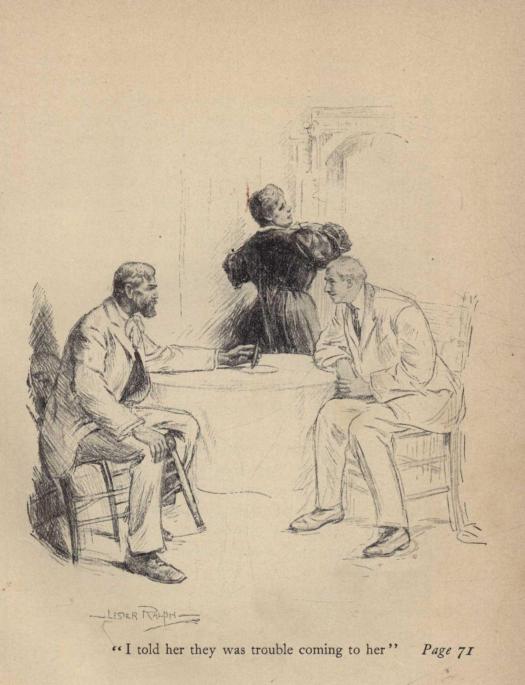
"I told her they was trouble coming to her"
"Good work!" said Madam Spoll. "I'll give you a rake-off if I land her. I've got her ballot right here. I won't need to open it."
"Ain't that job worth a dollar to you as it stands?" Ringa asked nervously. "I'll call it square and take my chances on the percentage."
"All right. It's a good sporting chance! Only I wish it was a man. Women are too close." Madam Spoll opened her purse and paid him.
As Ringa left, Vixley asked: "By the way, how about this fellow Payson? Do you think Lulu roped him?"
"I guess so. Lulu's done pretty well lately, and she's brought me considerable business. She ought to be here by this time."
"I should think she'd be able to handle him alone."
"Don't you go and tell her so! The thing for her to do is to get a manager, but I don't intend to queer my own game."
"What line is she workin' now? She's failed at about everything ever since she begun with cards."
"Oh, she's doing the 'Egyptian egg' reading. Wouldn't that freeze you? Lord, that was out of date twenty years go; but everything goes in San Francisco."
"Say, ain't this town the penultimate limit!" Vixley ejaculated, grinning. "Why, the dopes will stand in line all night for a chance to be trimmed, and send their money by express, prepaid, if you let 'em. Gert, sometimes I'm ashamed of myself for keepin' 'em waitin' so long! Talk about takin' a gumdrop away from a sick baby; that's hard labor to what we did for Bennett. What I want to know is, how do these damn fools ever get all the money we take away from 'em? It don't look like they had sense enough to cash a check."
"If I had one or two more decoys as good as Ringa and Lulu Ellis, I'd be fixed all right. I could stake out all the dopes in town. Say, Granthope could cut up a lot of easy cash if he'd agree to stand in. I tried to tap him about this here Payson, and he wouldn't give me a tip."
"Perhaps he didn't know anything. You can't loosen up when you're wide open, can you?"
"He generally knows all there is to know. The trouble is he's getting too high-toned. Since he fitted up his new studio and butted into society you can't get near him with nothing like a business proposition. I believe he thinks he's too good for this place and will go East. He's a nice boy, though. I ain't got nothing against him, only I wish he'd help us out. Hello, here's Lulu. Good evening, Lulu, how's Egyptian eggs to-day?"
Lulu Ellis was a dumpy, roly-poly, soft-eyed, soft-haired, pink-cheeked young woman, as innocent appearing a person as ever lived on her wits. Not that she had many of them, but a limited sagacity is enough to dupe victims as willing to be cajoled as those who appeal to the Egyptian egg for a sign of the future. Lulu's large, brown eyes were enough to distract one's attention from her rule-of-thumb methods. Her fat little hand was soft and white, her plump little body full of extravagant curves.
"Say, Mr. Payson has come!" she exclaimed immediately, with considerable excitement. "He's on the third row at the far end."
Madam Spoll became alert. "Did you see his test?"
"No, he was here when I come," Lulu replied.
"Go out and get Spoll." Madam Spoll spoke sharply. "We've got to fix this thing up right now."
Lulu returned to say: "There's such a crowd coming in he can't leave, but he says it was a gold watch with a seal fob."
"All right, so far," said the Madam. "Now, Lulu, are you sure of what you told me?"
Lulu's reply was interrupted by the entrance of Francis Granthope, in opera hat and Inverness cape, making a vivid contrast to the disreputable aspect of Professor Vixley. He greeted the three conspirators with his customary elegance.
"I'm sorry I had nothing about Payson when you rang me up, Madam Spoll, but just afterward his daughter came in for a reading. Queer, wasn't it?"
"God, that's a stroke of luck!" said Vixley eagerly. "I say, Frank, you can work her while we handle the old man, and we'll clean up a fortune. They say he's a millionaire." Vixley's little eyes gleamed.
"Let's hear what Lulu has to say, first," said Madam Spoll.
"Why, I didn't get much," Lulu confessed. "He said he dropped in by accident as he was passing by, to see what Egyptian egg astrology was. I got his name off of some letters he had in his overcoat pocket. I made him hang it on the hall hat-rack. I did all I could for him——"
"Did he get gay with you?" Professor Vixley interrupted. He had been overtly enjoying Lulu's plump charms with his rapacious eyes.
Granthope smiled; Lulu Ellis colored slightly.
"No, he didn't! I don't do none of that kind of work!"
"The more fool you!" Madam Spoll retorted. "He's an old man, ain't he?"
"Sixty," said Vixley, "I looked him up."
"Then he ought to be easy as chewing gum," said Madam Spoll.
Granthope lighted a cigarette and listened with a mildly cynical expression.
"He ain't that kind, though," Lulu insisted. "I ain't altogether a fool, after all. Why, he don't even go to church!"
Her three auditors laughed aloud, the Professor raucously, Madam Spoll with a bubbling chuckle, Granthope with scarcely more than an audible smile.
"That settles it, then. You're coming on, Lulu! What else do you know?" said Madam Spoll.
"Well, he has a daughter——"
"Yes, Granthope knows all about that," from the Madam.
"Her name is Clytie," said Granthope. "Twenty-seven."
"Is she a looker?" asked Vixley.
Granthope turned to him and gave him a patronizing glance. "You wouldn't think so, Professor. She's hardly your style. But she's good enough for me!" He languidly flipped the ash from his cigarette and took his pose again.
Lulu went on: "I think he had a love affair before he was married, but I couldn't quite get it. I didn't dare to fish very much. And that's about all I got."
"That's plenty, Lulu. You can go now. Here's a dollar for you and much obliged for passing him up."
"Oh, thank you," said Lulu. "I'm afraid it ain't worth that much. He gave me a dollar himself, though I don't charge but four bits, usually."
"Lord, what a fool!" said Vixley, watching her go out. "That girl won't ever get nowhere, she's too innocent. She knows no more about real life than a boiled egg."
"She's all right for me, though," Madam Spoll replied. "That's just the kind I need in my business. She fools 'em every time. They ain't nothing like a good blusher for a stool-pigeon, you take my word for it. Lulu's all right in her place." She turned to wash her hands at a bowl in the corner.
"Well," said Vixley, crossing his legs, "are you coming in with us, Frank?"
"It looks pretty good to me, so far. But it depends. What have you got about Payson, anyway?" Granthope's tone was languid.
Madam Spoll winked at Vixley, as she wiped her hands behind the palmist's back.
"Why," Vixley replied, "Payson's in wool and is director of a bank, besides. He's a square-head with a high forehead, and them are easy. Gertie, here, can get him into a private sittin', and when she does, you leave him to her—she'll find a way all right. She don't do no lumpy work, Gertie don't, you know that, all right! When she passes him along to me, I'll manage him like the way we worked Bennett with the real estate. I'd like another chance as good as him."
"You just wait," said Madam Spoll. "I got a hunch that this Payson is going to be pretty good pie; and we got a good strong combination, Frank, if you want to do your share."
"It's a pity Spoll ain't got some of Gertie's gumption," said Vixley, smiling with approval at his partner.
"Don't you make no mistake about Spoll—he's done some good work on Payson already." The Madam was adjusting her waist before the glass and coquetting with her hair. "The trouble with you, Vixley, is that you ain't got no executive ability—I'm going to organize this game myself. I can see a way to use Spoll and Ringa, and Flora, too. We want to go into this thing big. Payson's a keener bird than Bennett was, but they's more in him."
"So Spoll has begun, has he?" Granthope asked.
"Yes. He located the Paysons over on North Beach."
"I know that much already. The mother's dead. Mr. and Miss Payson have traveled abroad. What else do you know about her?"
"Why, it seems she's the sole heir. Good news for you, eh? High society, too—Flower Mission, Kitchen Garden, Friday Cotillions, Burlingame, everything. She could help you, Frank, if you got on the right side of her."
Here Mr. Spoll tiptoed in, bowed to Granthope, and said:
"Eight o'clock, Gertie."
Madam Spoll arose cumbrously, took a last peep in the mirror of the folding bed and turned into the hall, saying, "You take my advice, Frank. We depend upon you. See what you can do with the girl." She paused to bend a keen glance upon him. "What did you do with her, anyway?"
"Why, I did happen on something," he answered. "Do you remember Madam Grant, who used to live down on Fifth Street, twenty-odd years ago?"
Madam Spoll came back into the room eagerly.
"The crazy woman who lived so queer and yet had lots of money? Yes! She did clairvoyance, didn't she? I remember. She had a kid with her, too. Let's see—he ran away with the money, didn't he? And nobody ever knew what become of him. What about her?"
There was a duel of astute glances between them. Granthope had his own reasons for not wanting to say too much. He guarded his secret carefully, as he had guarded it from her for years.
"Miss Payson used to go down to see Madam Grant with her mother, when she was a little girl."
"No! did she, though? With her mother? That's queer! Hold on, Vixley. What did Lulu say about a love affair before Payson was married? Do you get that? Here's his wife visiting Madam Grant; you remember her, don't you? There's something in that I believe we got a good starter already."
Spoll appeared again, anxiously beckoning, and she went with him down the hall.
Vixley took up the scent. "Say, Frank," he asked, "how did you happen to get on to that, anyway? That was slick work."
Granthope turned to him and replied patronizingly, "Oh, I ought to know something about women by this time. I got her to talking."
Vixley frowned, intent in thought, stroking his scant, pointed beard and biting his mustache; then he slapped his knee with his claw-like hand. "Say, you got a grand chance there," he exclaimed. "See here, you can get in with the swells and be in a position to help out lots. It's the chance of a lifetime, and we'll make it worth your while."
"How?" Granthope inquired contemptuously.
"By a fair exchange of information. You put us wise, and we'll put you wise. I'll trust you to find ways of using what help we give you." He cackled.
"Yes—you can trust me. I think I might have some fun out of it. I don't mind helping you out, but all I need myself is a little imagination, some common-sense and a frock coat."
Vixley looked at him admiringly. "I wish't I had your chance, Frank; that's what I do. Say, you just light 'em and throw 'em away, don't you! I s'pose if I had your looks I could do it myself."
Granthope looked him over calmly. "There's no knowing what a bath and a manicure and a suit of clothes would do for you, Professor."
"You can't make brains out o' soap," retorted the medium.
"And you can't make money out of dirt.
"We'll see who has the money six months from now."
"It's a fair enough bargain. I take the girl, you take the money. I'm satisfied." Granthope arose and yawned. "Oh," he added, "did you know Payson had a partner named Riley? He was drowned in seventy-seven."
"That's funny. Queer how things come our way! Mrs. Riley is here in the front room with a test. She was tried for the murder of one of her husbands. Gert's goin' to shoot her up with it to-night. You better go in and see the fun. She'll give it to her good."
"I think I will," said the palmist.
He left Vixley plunged in thought, and walked out.
Turning into the audience-room he sat down on a chair in the rear. The place was almost filled. His eyes scanned the assembly carefully, roving from one spectator to another. On a side seat near him, a party of four, young girls and men, sat giggling and chewing gum. The rest of the company showed a placid vacancy of expression or lukewarm expectancy.
Madam Spoll at the organ and her husband with his violin, had, meanwhile, been playing a dreary piece of music, "to induce the proper conditions," as she had announced from the platform. They stopped, retarding a minor chord, and the medium went to the table and began to handle the tests, rearranging them, putting some aside, bringing others forward, in an abstracted manner. Then, looking up with a self-satisfied smile, she spoke:
"I want to say something to the new-comers and skeptics here to-night in explanation of these tests. Them who have thoroughly investigated the subject and are familiar with every phase of mediumship, understand, of course, that these objects are placed here merely to attract magnetism to the sitter and induce the proper conditions, so that your spirit friends will be able to communicate with you. This phase of mediumship is called psychometry, but if I'd stop to explain just what that means, I wouldn't have time to give any readings. Now, it won't be possible to get any messages unless you come here in the proper mood to receive them. You must send out your best thought and do all you can to assist, or else my guides won't be able to establish communication on the spirit plane. If you merely come here only to laugh and to make a scoff of the proceedings, I'll have to ask you to leave before I begin, for they's many here to-night who are honestly in search of the truth, seeking to communicate with the dear, loved ones beyond on the other side."
She passed her hand across her eyes, sighed, and fingered her chin nervously. She poked the articles on the table again.
"As I come on to this platform, I see an old man over there, in that direction, what you might call a middle-aged man, perhaps, of a medium height, and whiskers, like. I feel a condition of going on a journey, you might say, somewhere east of here, though maybe not very far, and I get the name John. The light goes over in your direction, lady, that one with the red hat. Yes, you. Would that be your father, possibly?"
The lady, straightening herself upon being thus addressed, said timidly, "I think perhaps you mean my uncle. His name was John."
"Maybe it is an uncle, though I get the influence of a father very strong, too. Has your father passed out?"
The lady in the red hat nodded.
"Then it is your father, do you see? Yes, I get an uncle, too, who wishes to communicate, only his influence ain't strong enough. That shows it ain't mind reading, as the newspaper folks say, don't it?" She smiled, as if she had made a point, and the audience appeared to be impressed.
"About this journey, now: maybe you ain't had no idea of traveling, but John says you will. I don't think it's liable to be very far, though. It'll be before the last of September or the first of October and John says it'll be successful. Do you understand what I mean?"
The lady, frightened at the terrible import of this question, did not speak.
"Did you send up an article?"
"It's that purse with the chain."
Madam Spoll fingered it and weighed it reflectively.
"I get a condition of what you might call inharmony. Seems to me like in your home something is worrying you and you ain't satisfied, you understand, with the way things are going and sometimes you feel as if, well, you just couldn't stand it!" Her smile, now, bathed her dupe with sympathy.
The lady nodded vigorously, with tightly shut lips.
"You kind of wonder if it does any good for you to go to all the trouble you do to sacrifice yourself and try to do your duty, when it ain't what you might call appreciated. And you're worried about money, too. Ain't that so?"
She received a ready assent. The woman's eyes were fixed upon her. Every one in the room watched the stripping naked of a soul.
"Well, John says that your father and him are helping you all they can on the spirit plane, and he thinks conditions will be more favorable and will take a turn for the better by the first of the year."
A question fluttered on the woman's lips, but before it had time to escape, Madam Spoll suddenly turned in the other direction.
"While I was talking to that lady," she said, "I felt an influence leading me to that corner over there by the clock, and I get the initials 'S.F.B.' Is there anybody of that name over there?"
A flashily dressed woman, with tinted yellow hair and rhinestone ear-rings, raised her hand.
"Those are my initials," she announced.
Madam Spoll grew impressive. "Your name is Brindon, ain't it?"
The woman gasped out a "Yes."
"Did I ever see you before?"
"No," said the blonde, "not to my knowledge, you didn't."
Madam Spoll made a comprehensive gesture with both hands, calling attention to the miracle. "You sent up a sealed ballot, didn't you?"
The woman nodded. She was obviously excited, looking as if she feared her skeleton was to be dragged forth from its closet; as indeed it was.
Madam Spoll took up the envelope with her delicate thumb and forefinger and displayed it to the audience.
"You see, it's still sealed," she announced, then, shutting her eyes, she continued: "My guides tell me that he's what you might call infatuated, but he'll come back to you and say he's sorry. Do you understand that?"
The woman was now painfully embarrassed and shrank into her seat. The medium, however, did not spare her. It was too good a chance for a dramatic sensation. She tore the envelope open and read its contents boldly: "Does he care more for Mae Phillips than he does for me?" It was a psychological moment. The old women stared at Mrs. Brindon with morbid delight. There was a little buzzing of whispers through the room. Then the audience prepared itself for the next sensation.
The medium picked up another envelope. "This is marked '275,'" she said, then she clutched her throat. "Oh," she cried, "I'm strangling! They's somebody here who passed out very sudden, like they was poisoned. It's terrible. I can't answer the question the party has written because there's an evil influence here, a wicked woman. She had three husbands and two of 'em died suspicious. Her name is Riley. Would that be you?" She pointed forcefully at a dried-up, old woman in a shawl, with bleared eyes and a veined nose.
There was no response.
"Was this question something about your daughter?" Madam Spoll asked.
The woman coughed and bowed, shrinking into herself.
"I guess you better go somewhere else for your readings," Madam Spoll declared cruelly. "Your aura don't seem to me to be very harmonious. I don't know what's the matter to-night," she went on, passing her hand across her forehead in apparent distress. "The conditions around me are something horrid." Her voice rose. "There's somebody in this very room here who has committed murder. I can't do a thing until I get that off my mind. My guides tell me who it is, and that they'll be satisfied if he'll acknowledge it and say he's sorry. Otherwise, this séance can't go on."
She stopped and glared about the hall. By this time she had worked her audience up to an intense excitement. Every one looked at his neighbor, wondering what was to come, but no one offered to confess to a crime. Madam Spoll raged up and down the platform in a frenzy. Then she stopped like an elephant at bay.
"I know who this person is. It's a man, and if he don't rise and acknowledge it, I shall point him out!"
No one stirred. On the fourth seat, a clean-shaven man of thirty-five, with sharp, aquiline features and wide-spread ears, sat, transfixed with horror, his two hands clenched. It was Mr. Perry, the cleverest actor in the medium's support.
She advanced toward him as if drawn by a secret power, stared into his eyes, and putting her hand upon his shoulder, said:
"Thou art the man!"
Mr. Perry wriggled out of her grasp. "See here," he cried, "you mind your own business, will you. You're a fake! You got no right to make a fool of me." His voice trembled, his face was a convincing mask of guilt arraigned.
The medium shook a warning finger at him. "You either acknowledge what I say is true, or you leave the hall! I can't go on with you here."
Mr. Spoll came in to stand beside her valiantly; spectators stood up to watch the drama. Mr. Perry's eyes were wild, his face distorted; suddenly he arose and rushed out of the room. Madam Spoll snapped her fingers two or three times, shook herself and went back to the platform. The murmurs died down and the séance was resumed.
Madam Spoll waited a while in silence, then she picked up a gold watch with a seal fob from the table. "I'm glad to feel a more peaceful influence," she said. "I'm directed toward this watch. I don't know who brought it up, for I was out of the room at the time, but I get the name 'Oliver.'" She looked up expectantly.
A gentleman arose from an end seat in the third row. He had a high domed head, partly bald, and a gray chin-beard with a shaven upper lip; under shaggy overhanging eyebrows, cold gray eyes looked through a pair of gold-rimmed spectacles. His air was benevolently judicial and bespoke culture and ease. He had, moreover, a well-marked presence, as of one used to being considered influential and prominent. A row of false teeth glittered when he opened his mouth.
"That's my name," he acknowledged in a deep, fluent voice that was heard all over the room, "and that is my watch."
Madam Spoll fixed him in the eye. "I'd like to know if I can't get your other name. My guides are very strong to-night." After a few moments of self-absorption, she smiled sweetly upon him. "I think I can get it clairaudiently. Would it be Pearson?"
"No, but that's pretty near it, though."
"It sounds like Pearson to me, Pearson. Payson, oh, yes, it's Payson, isn't it?"
"That's right," he said, and sat down.
"Did I ever see you before?"
"Not to my knowledge, Madam."
She looked triumphantly at her audience and smiled.
"If they's any skeptics here to-night, I hope they'll go away satisfied." A number of old ladies nodded emphatically. "Of course, newspaper men never come on a night like this, when my guides are strong. Funny what you see when you ain't got a gun, ain't it? The next time I'm half sick and tired out, they'll be plenty of them here to say I'm a fake, like our friend here who left so sudden, white as a sheet. Now, when I was directed to that watch, I was conscious of a spirit standing beside this gentleman," she pointed at him benevolently, "influencing me to take it up. It's a woman, and she must have been about thirty when she passed out, and remarkably handsome, too. She was sort of fair-complected, between dark and light. I get a feeling here in my throat and down here," she touched her breast, lightly, curving her arm gracefully inward, "as if she went out sudden, like, with heart disease. Do you know what I mean?"
Mr. Payson had bent forward now. "Yes," he said, "I think I do. Has she any message for me?"
"Yes, she has; but—well, you see, it ain't one I'd exactly care to give in public, and I don't think you'd want me to, either. If you come up after the séance is over, I'll see if I can get it for you. Or you might do still better to have a private setting and then I'll have time to tell you more. She brings me a condition of what you might call worry or anxiety, as if you had something on your mind."
She turned to a bunch of flowers, and, taking them up, smelled them thoughtfully, for a while. Mr. Payson settled back in his seat.
As the medium commenced again, Granthope arose with his faint, cynical smile and walked quietly out. He found Mr. Spoll at the table by the door.
"Well, I guess he's on the hook." The palmist buttoned his cape and lighted a cigarette.
"Trust Gertie for that," said Spoll; "she'll land him all right, see if she don't. Good night!"
Granthope turned up his collar and walked out into the street.
CHAPTER IV
THE PAYSONS
Mr. Oliver Payson lived on a half-deserted street on the northerly slope of Russian Hill, in a quarter of the town which, at one time, promised to become a favored, if not an aristocratic residential district. But the whim of fashion had fancied in succession Stockton Street, Rincon Hill, Van Ness Avenue, Nob Hill, and had now settled upon the Western Addition and the Presidio Heights. The old North Beach, with its wonderful water and mountain view, nearer the harbor and nearer the business part of the city, had long been neglected. The few old families, who in early days settled on this site, still remained; and, with the opening of new cable-car lines, found themselves, not only within a short distance of down-town, but at the same time almost as isolated as if they had dwelt in the country, for this part of the city is upon none of the main routes—few frequent the locality except upon some special errand.
One side of the street was still unbuilt upon; on the southern side stood three houses, each upon its fifty-vara lot, comfortably filling the short block. That occupied by the Paysons was an old frame structure of two stories, without attempt at ornamentation, except for its quaint, Tudoresque pointed windows and a machicolated wooden battlement round the flat roof. It stood on a gentle slope, surrounded by an old-fashioned garden, which was hedged in, on either side, by rows of cypress and eucalyptus trees, protecting it from the trade winds, which here blow unhampered across the water.
In front, a scene ever-changing in color as the atmospheric conditions changed, was ranged in a semi-circular pageant, the wild panorama of San Francisco Bay, from Point Bonita and Golden Gate in the west, past the Marin County shore with Sausalito twinkling under the long, beautiful profile of Mount Tamalpais, past Belvedere with its white villas, Alcatraz and Goat Island floating in the harbor, to the foot-hills behind Oakland and Berkeley, where, in the east, Mount Diablo's pointed peak shimmered in the blue distance.
In the second story of this house Clytie had a bookbinding room, where she spent most of her spare time. It was large, bare, sunny, impregnated with the odor of leather skins, clean and orderly. A sewing frame and a heavy press stood behind her bench and upon a table were neatly arranged the pages of a book upon which she was working. Carefully placed in workmanlike precision were her knives, shears, glue pot and gas heater and a case of stamping irons in pigeonholes.
She was, this afternoon, in a brown gingham pinafore, with her sleeves rolled up, seated before the table, her sensitive hands moving deftly at the most delicate operation connected with her craft. Upon a square of heavy plate glass, she laid a torn, ragged page, and, from several old fly leaves, selected one that matched it in color. She cut a piece of paper slightly larger than the missing portion, skived the edges, and pasted it over the hole or along the frayed margin. The work was absorbing and exacting to her eyes; to rest them, she went, from time to time, to the window and looked out upon the bay.
The water was gray-green streaked with a deeper blue. In the "north harbor" two barks lay at anchor in the stream and ferry-boats plied the fairway. In and out of the Gate there passed, at intervals, tugs with sailing ships bound out with lumber or in with nitrates, steamers to coast ports, or liners from overseas, rusty, weather-beaten tramps, strings of heavy-going barges, lusty little tugs, lumber schooners wallowing through the tide rip, Italian fishing smacks, lateen-rigged with russet sails, saucy launches, and, at last, the magnificent bulk of a white battleship sliding imperiously into the roadstead along the waterfront.
At four o'clock Clytie's mind seemed to wander from her occupation, and now, when she ceased and looked out of the window, her abstracted gaze was evidently not directed at what she saw. Her mental vision, rather, seemed alert. Her slender golden eyebrows drew closer together, her narrow, sharp nostrils dilated; her lips, half open, inhaled deep, unconscious breaths. The pupils of her eyes contracted like a cat's in the light. Then she shook herself, passed her hand over her forehead, shrugged her shoulders and resumed her work.
A little later this performance was repeated; this time, after her momentary preoccupation, she rose more briskly, put her tools away, laid her book carefully aside and took off her pinafore. After washing her hands she went into her own room on the same floor. She went down-stairs ten minutes after, in a fresh frock, her hair nicely arranged, radiating a faint perfume of violet water. She opened the front door and walked slowly down the path to the gate where the wall, though but waist-high on the garden side, stood high above the sidewalk. Here she waited, touching the balustrade delicately with her outstretched fingers, as if playing upon a piano. The breeze loosened the severity of her coiffure, which relaxed into slight touches of curling frivolity about her ears and neck. Her pink frock billowed out into flowing, statuesque folds as she stood, like a figurehead, gazing off at the mountains. Her mouth was set into a shape not quite a smile, a queer, tremulously subtle expression of suspense. She kept her eyes in the direction of Hyde Street.
It was not long before a man turned the corner and walked briskly toward her. He looked up at the first house on the block, searching for the number; then, as his eyes traveled along to the next gate, he caught sight of her. Instantly his soft felt hat swung off with a quick flourish and he sent her a pleased smile.
"Here I am, Mr. Granthope!" Clytie called down to him, and on the instant her face was suffused with pink. She had evidently expected him, but now she appeared as agitated as if his coming had surprised her.
He ran up the flight of wooden steps, his eyes holding hers all the way. His dark, handsome face glowed; he abounded with life and spirit as he stood before her, hand outstretched. In the other, he held a small leather-bound book.
"Good afternoon, Miss Payson!" he said heartily. He shook hands eagerly, his touch, even in that conventional greeting, consciously managed; the grasp was sensitive and he delayed its withdrawal a suggestive second, his dark eyes already at work upon hers. "How lucky I was to catch you out here!" he added, as he dropped her hand.
"Oh, I've been expecting you for some time," Clytie replied, retreating imperceptibly, as from an emotional attack, and turning away her eyes.
He noticed her susceptibility, and modified his manner slightly.
"Why! You couldn't possibly have known I was coming?"
"But I did! Does that surprise you? I told you I had intuitions, you know. You came to bring my ring, didn't you?"
"Yes, of course. You really have second-sight, then?" He looked at her as one might look at a fairy, in amusement mingled with admiration.
"Yes—haven't you?" She put it to him soberly.
"Haven't I already proved it?" His eyes, well-schooled, kept to hers boldly, seeking for the first sign of her incredulity. Into his manner he had tried to infuse a temperamental sympathy, establishing a personal relation.
She did not answer for a moment, gazing at him disconcertingly; then her eyes wandered, as she remarked: "You certainly proved something, I don't quite know what."
He laughed it off, saying: "Well, I've proved at least that I wanted to see you again, and made the most of this excuse."
"Yes, I'm glad I forgot the ring. I'm really very glad to see you, too—I half hoped I might. Won't you come up to my summer-house? It's not so windy there, and we can talk better."
He accepted, pleased at the invitation and the implied promise it held, and followed her up the path and off toward the line of trees. The place was now visited by belated sunshine which compensated for the sharp afternoon breeze. In the shelter of the cypress hedge the air was warm and fragrant. Here was an arbor built of withe crockery crates overgrown with climbing nasturtiums; it contained a seat looking eastward, towards Telegraph Hill. In front stood a sun-dial mounted on a terra cotta column, beneath a clump of small Lombardy poplars.
As she seated herself she pointed to it. "Did you know that this is a sort of cemetery? That sun-dial is really a gravestone. When I was a little girl I buried my doll underneath it. She had broken open, letting the sawdust all out, and I thought she must be dead. It may be there now, for all I know; I never dug her up."
He looked over at the shaft, saying, "A very pretty piece of symbolism. I suppose I have buried illusions, myself, somewhere."
She thought it over for a moment, and apparently was pleased. "I'd like to dig some of them up," she said at last, turning to him, with the slow movement of her head that was characteristic of her.
"Haven't you enough left?"
She started to reply, but evidently decided not to say what she had intended, and let it drop there, her thought passing in a puzzling smile as she looked away again.
He had laid his book beside him upon the bench, and, when her eyes came back, she took it up and looked at it. A glance inside showed it to be an old edition of Montaigne. She smiled, her eyes drifted to him with a hint of approval for his taste, then she turned her interest to the binding. As she fingered the leather, touching the tooled surfaces sensitively, her curiosity did not escape his sharp eyes, watching for anything that should be revelatory.
She explained: "I have a technical interest in bindings. I do some of that work myself. It's curious that I happened to be at work to-day on an old copy of Montaigne. I'm rebinding it for my father's birthday. You'd never think my hands were of any practical use, would you?"
He laughed. "Inconsistencies like that are what baffles one most, especially when one knows that most characters are inconsistent. But we professionals have to go by general rules. I should expect you to be an exception to all of them, though."
He watched her surreptitiously, noting her diminishing color, the evasion of her glance, and the air of self-consciousness with which she spoke, as they talked for a while of obvious things—the weather, the view, and the picturesque, old-fashioned garden. She had taken the ring and had put it upon her finger, keeping her eyes on its turquoises. Her whole demeanor ministered to his vanity, already pleased by her frank welcome. He was used enough to women's interest and admiration for him to expect it and play upon it, but this was of a shyer and more elusive sort; it seemed to hold something more seriously considered, it baffled him, even as he enjoyed its unction. Besides all this, too, there was a secret romantic charm in the fact that they had shared together that vivid experience of the past. He came back for another draught of flattery.
"It was odd that you expected me, wasn't it?" he said. "I can't help wondering about it."
She had her eyes upon the Sausalito boat, which was weaving a trailing web of foam past Alcatraz Island. At his words, she turned to him with the same slow seriousness as before and replied:
"I shouldn't think it would seem so remarkable to you, your own power is so much more wonderful."
"Perhaps so in that one case, but you know I don't, ordinarily, claim clairvoyance. It's only occasionally, as the other day with you, that I attempt it."
Her eyes awakened; she said earnestly, "Was I really able to bring that out in you?"
He caught at the hint. "Why, what else could it be but your magnetism? It was the more strange because I had never seen you before."
The glow faded, and she relaxed her nervous energy. "Ah, hadn't you? I wonder!"
"Why, had you ever seen me before that day?"
"I think so. At least you seem, somehow, familiar."
"When was it, and where, then?"
She seemed too puzzled to answer, or fatigued with following an intangible thread of thought. As she spoke, slowly, intensely, her hands made large, vague gestures, often pausing in mid air, as her voice paused, waiting for the proper word to come. "I don't know. It only seems as if I had been with you—or near you, or something—I don't know what. It's like a dream—or a story I can't quite recall, only—" she did not finish the sentence.
He wondered what her game could be. Fundamentally cynical, though he never permitted it to show in his manner, he distrusted her claims to prevision. There was, after all, nothing in Miss Payson's words that might not be accounted for by what he knew of the wiles of feminine psychology. His training had taught him how much a baseless hint, injected at the proper moment, could accomplish in the masquerade of emotions and the crafty warfare of the sexes. That he and she had been actors together in a past uncomprehended scene, he regarded as a mere coincidence of which he had already made good use; he refused to connect it with her suggestive remark, for he was sure that she must have been unaware of his presence in Madam Grant's room that day, so long ago. It seemed to him more likely that, woman-fashion, she had shot into the air and had brought down an unsuspected quarry. And yet, even as a coincidence, he could not quite dismiss the strangeness of it from his mind.
He was preparing to turn it to a sentimental advantage, when Clytie, who had relapsed into silence, suddenly aroused herself with one of those impulsive outbursts which were characteristic of her.
"There is something about it all that is stranger still, I think!"
Her golden brows had drawn together, separated by two vertical lines, as she gazed at him. Then with a little jet of fervor, she added:
"I'm afraid I know too much about you, Mr. Granthope! It's somewhat embarrassing, really. It doesn't seem quite fair, you know."
"I'm not quite sure that I understand."
"Oh, you know! You must know!"
He laughed. "Really, Miss Payson, it's very flattering, of course—"
"Oh, no, it's not in the least flattering."
"I wish you'd explain, then." He leaned back, folded his arms and waited indulgently. So long as he could keep the conversation personal, he was sure of being able to manage her, and further his own ends. It amused him.
She busied herself with a lace handkerchief as she continued, in a low voice, as if she were ridding herself of a disagreeable task, and always with the slow, monotonous turning of her questing eyes toward him, and away. "Of course I've heard many things about you—you're a good deal talked about, you know; but it's not that at all—it's an instinctive knowledge I have about you. I can't explain it. It's a queer special feeling—almost as if, in some way, I had the right to know. That's why I wanted to see you again—I hoped you'd come. I wanted to tell you."
"But all that certainly is flattering," he said. "I wouldn't be human if I weren't pleased to hear that you're interested, even if—"
She could not help breaking into smiles again, as she interrupted him.
"Oh, but I haven't told you yet."
"Please do, then!"
"It sounds so foolish when I say it—so priggish! But it's this: I don't at all approve of you. Why in the world should I care? I don't know. It isn't my business to reform you, if you need it." Now she had brought it out, she could not look at him.
Curiously enough, though he had been amused at her assumption of a circumstantial knowledge of him, this hinted comprehension of his character, of the duplicity of his life, if it were that, impressed him with the existence in her mind of some quality as rare and mysterious as electricity, a real psychic gift, perhaps. It gave him an instant's pause. Instinctively he feared a more definite arraignment. He began a little more seriously, now, to match his cleverness against her intuition; and, for the first defense, he employed a move of masculine coquetry.
"You have been thinking of me, then?"
"Yes," she replied simply, "I have thought about you a good deal since I was in your studio. But I suppose you're used to hearing things like that from women." She was apologetic, rather than sarcastic.
He shrugged his shoulders. He seemed to be able to make no way against her directness. "I've thought not a little of you, too, Miss Payson. You are wonderfully psychic and sensitive. I think you should develop your power—you might be able to do extraordinary things with it. I wish you'd let me help you. That is," he added humorously, "if I'm not too far gone in your disapproval."
"Oh, the disapproval—I call it that for want of a better word—isn't so important as the fact that I should feel it at all, don't you see? You remember that you told me I was the kind of a woman who, if she liked a man, would tell him so, freely. That is true. I would scorn to stoop to the immemorial feminine tricks. I do like you, and in spite of what I can't quite explain, too. I don't know why, either. It seems as if it's a part of that other feeling I've mentioned—that I've been with you, or near you, before."
He leaned forward to extort more of this delicious confession from her. "Do you mean spiritually, or merely physically near?"
"Oh, I don't mean an 'elective affinity' or anything so occult as that," she laughed. "Indeed, I don't quite know what I do mean—it's all so vague. I can't formulate it. It escapes me when I try. But I did know, for instance, quite definitely, that I'd see you again. I tell you about it only because I think that you, with your power in that way, may be able to understand it and explain it to me."
He thought he saw his chance, now, and instinctively he began to pose, letting his eyes deepen and burn on her. He nodded his head and said impressively:
"Yes. I have felt it, too, Miss Payson. It's wonderful to think that you should have recognized me and understood me so well. No one ever has before. We are related by some tie—I'm sure we've met before, somewhere, somehow—"
She jumped up and stood before him, her hands tightly held, her lips pressed together. For a moment, so, she looked hard at him; then what there had been of anger in her gaze softened to something like sadness or pity.
"That's what I meant!"
He misunderstood her remark and her attitude and went still farther astray from her meaning.
"You are not like any other woman I have ever known," he said, in the same soulful way.
"Why can't you be honest with me!" she broke out. She was astonishingly alive now; there was no trace of her former languor. He winced at realizing, suddenly, and too late, that he had made a false step.
"Why do you make me regret having been frank?" she went on, with a despairing throb in her voice. "You have almost succeeded in making me ashamed of myself, already. That is just what I disapprove of in you. Don't imagine that you can ever deceive me with such sentimentality. I shall always know when you're straightforward and simple. That's what I've been trying to make you understand—that I do know!"
She turned slowly away from him, almost hopelessly. For a moment she remained immobile, then before he had recovered his wits, she had modified the situation for him. Her eyes drifted back to his as she remarked thoughtfully:
"I am sure, too, that you could help me, if you would."
"How?" He tried to pull himself together.
"Merely by being honest with me."
He raised his eyebrows.
"Oh, I know that's a good deal to ask," she laughed.
"Of me?"
"Of any one."
"I'll try, Miss Payson," he said, not too seriously. "But you've frightened me. I don't dare think too hard about anything, you're such a witch."
She released him graciously and keyed down to an easier tone.
"You must forgive me if I've been too frank, Mr. Granthope, but this interview is almost like a first meeting, and you know how much one is apt to say in such a situation. Let's not continue the discussion—I'm embarrassed enough already. I know I shall regret what I've said. We'll talk of something pleasanter. Tell me about that pretty girl in your office."
"Oh!" he exclaimed, and his tone was as if he had said, "Aha!" He wondered if it were possible that, after all, it was only this which had moved her to speak.
Clytie frowned, but if she read his thought, she let it go unchallenged.
"She's an original little thing; I like her," she added.
"You do?" he said mischievously exaggerating his surprise.
"Yes, I do. Don't think I'm trying to patronize her, but she's a dear—and she's very pretty."
"Do you think so? I shall have to tell her that. She's pretty enough, at least, to have been on the stage. She was in vaudeville for a couple of years. I first got acquainted with her at the Orpheum. I've known her a long time. She's a great help and a great comfort to me, and a very clever girl."
"How long has she been your assistant?"
"Two years."
"And you haven't fallen in love with her yet?"
Granthope was relieved. He was sure now that she was, if not jealous, suspicious of his relations with Fancy. It was not the first time he had encountered such insinuations.
"Oh, not in the least," he said. "I can give you my word as to that. I don't think it ever occurred to me—though I'd do anything in the world for her."
"And I suppose you're as sure of her immunity?"
"Why, of course," said Granthope, and in his tone there was the ring of masculine assurance.
Clytie smiled and shook her head. "There are some things men never can know, no matter how clairvoyant they are," she said, looking away.
He did not follow this up, but arose to leave. "I'm afraid you have a very poor opinion of me, Miss Payson," he said, "but I do feel complimented by your frankness. Perhaps I shall merit it—who knows?" It was his turn to address the distance, and, in spite of his consciousness of an histrionic effect, his own words sounded curiously in his ears; they seemed premonitory. He shook himself free from her influence again. She had controlled the situation from the first word; he had only made a series of mistakes. It all confirmed his first estimate of her: that she was very well worth his while, but that her capture would be difficult.
Clytie, too, had arisen. Her mood had lightened, and her sense of humor had returned. "I hope I haven't been either tragic or absurd," she said, smiling. "I'm not always so serious, Mr. Granthope. The next time I meet you I'll probably be more conventional."
"Then I may see you again?"
"I doubt if you can help it."
"I shall certainly not try to!" Then he paused. "You mean—?"
"Yes!"
There was something delightful to him in this rapid transfer of wordless thought. It again established an intimacy between them. That she acknowledged such a relation by anticipating another meeting, an inevitable one, charmed him the more. He might win, after all, with such assistance from her. Her power of intuition aroused his curiosity—he longed to experiment with it. She was a new plaything which he had yet to learn to handle. Before, he had dominated her easily enough; he might do so again.
"Miss Payson," he said, "won't you come down to my studio again sometime? I'd like to make a more careful examination of your hand, and perhaps I can help you in developing your psychic sense."
"Oh, no, thank you. Really, I can't come again—I shall be pretty busy for a while—I have to go to the Mercantile Library every afternoon, looking up material for my father's book—and, after all, I got what I wanted."
"What did you want?"
"Partly to see you."
He bowed. "Curiosity?"
"Let's call it interest."
"You had no faith, then, in my palmistry?"
"Very little."
"Yet you acknowledge that I told you some things that were true?"
"Haven't I told you several things about yourself, too?"
"I'd like to hear more."
"Oh, I've said too much, already."
"Let's see. That I am more or less of a villain—"
"But a most interesting one!"
"That I have met you before—"
"Not perhaps 'met'—"
"That Fancy Gray is in love with me—"
"Oh, I didn't say that!"
"But you suspect it?"
"If I did, it was impertinent of me. It's none of my business."
"Well, you won't come again—you've quite satisfied your curiosity by seeing me?"
"Quite. I've confirmed all my suspicions."
"What were they?"
Clytie laughed. "Really, you're pushing me a little too hard, Mr. Granthope. I'd be glad to have you call here, sometime, if you care to. But my psychic powers are quite keen enough already. They rather frighten me. I want them only explained. As I say, it's embarrassing, sometimes. I hate to speak of what I feel—it's all so groundless and it sounds silly."
"You know more, then, than you mention?"
"Oh, much!"
"About me, for instance?"
"Yes. But it's vague and indefinite. It needn't worry you."
"Even though you disapprove?"
She laughed again. "You may take that as a compliment, if you like."
He nodded. "It is something that you care."
"I'm mainly curious to see what you'll do—"
"Oh, you're expecting something, then?"
"I'm watching to see. I confess I shall watch you. I said that you interested me—that's what I mean. You're going to—well, change."
As she stood between him and the light her soft hair showed as fine and crisp as spun glass. Her lips were sensitively curved with a flitting smile, her eyes were dreamy again. Everything about her bespoke a high spiritual caste, but, to Granthope, this only accented the desirability of her bodily self—it would make her the greater prize, unlike anything he had, so far, been able to win. He had an epicure's delight in feminine beauty, and he knew how its flavor should be finely tinctured by mind and soul; even beauty was not exciting without that, and of mere beauty he had his fill. Besides, she had unexpected reserves of emotion that he was continually tempted to arouse. But so far he had hopelessly misplayed his part, and he longed to prove his customary skill with women.
"Well," he said finally, offering his hand, "I hope I'll be able to satisfy you, sooner or later. I'll come, soon, for a report!"
"Oh, my mood may have changed, by that time."
He gave her the farewell amenities and went down the path to the gate. There he turned and saw her still watching him. He waved his hat and went down the steps, his mind restless with thoughts of her.
Clytie remained a while in the arbor. The fog had begun to come in now with a vanguard of light fleecy clouds riding high in the air, closing the bay in from all sides. The massive bank behind followed slowly, tinted with opal and rose from the setting sun. It settled down, shutting out her sight of the water, and its cohorts were soon scurrying past her on their charge overland from ocean to harbor. The siren at Point Bonita sighed dismally across the channel. It soon grew too cold to remain longer in the garden, and she went into the house shivering, lighted an open fire in the library and sat down.
For half an hour she sat there in silence, inert, listless, lost in thought, her eyes on the blurred landscape mystic with driving fog. The room grew darker, illuminated only by the fitful flashes of the fire. Her still, relaxed figure, fragile and delicate as an ivory carving, was alternately captured and hidden by the shadow and rescued and restored by the sudden gleam from the hearth. She had not moved when her father's step was heard in the hall. He came in, benignly sedate. His deep voice vibrated through the room.
"Well, Cly, dreaming again?"
She started at the sound and came out of her reverie to rise and greet him affectionately. He put down some books and a package of papers and lighted the chandelier, exchanging commonplaces with her—of her bookbinding work, which she confessed to have shirked; of the weather, with a little of old age's querulous complaint of rheumatic touches; of the black cat, which was their domestic fetish and (an immortally interesting topic to him) of the vileness and poisonous quality of San Francisco illuminating gas. His voice flowed on mellifluously with unctuous authority, as he seated himself in his arm-chair beneath the lamp, shook out his evening paper and rattled its flapping sheets.
Clytie evinced a mild interest in his remarks, smiled gently at his familiar vagaries, answering when replies should be forthcoming, in her low, even, monotonously pitched tones. She questioned him perfunctorily about the book he was writing, an absorbing avocation with him, warding off his usual disappointment at her lack of sympathy by involving herself in a conversational web of explanation regarding Foreign Trade Expansion, Reciprocal Profits and The Open Door in the Orient.
"There's not much use working on it at the office," he concluded. "I'm too liable to interruptions."
"Who interrupted you to-day?" she asked.
"Oh, there was a queer chap in this afternoon, an insurance solicitor; Wooley, his name was. I told him I didn't want an accident policy, but I happened to tell him about that time on the Oakland Mole, when I got caught between two trains in the Fourth of July crush—you remember? and he told me about all the narrow escapes he ever heard of, trying to get me to go into his company. Funny dog he was. He kept me laughing and talking with him for an hour. Then Blanchard came in. He says he's coming around to-night." He hesitated and scanned her intently through his gold-bowed glasses, under his bushy brows. "I hope you will treat him well, Cly."
Her face grew serious and her sensitive lips quivered, as she said:
"Why do you like Mr. Cayley so much, father?"
"Why, he's a very intelligent fellow, Cly; I don't know of another young man of his age who is really worth talking to. He knows things. He has a broad outlook and a serious mind. He's the kind of young man we need to take hold of political and commercial reform. I tell you, the country is going to the dogs for lack of men who are interested in anything outside of their own petty concerns. Why, he's the only one I know who really seems interested in oriental trade and all its development means to the Pacific slope. That's remarkable, considering he isn't himself connected with any commercial enterprise. I don't know what I'd do if I didn't have him to discuss my subject with. He seems to be genuinely interested in it. I wish you were as much so, Cly!"
Clytie turned away, smiling somewhat ironically, an uncommon expression for her engaging features.
"You know," she said slowly, "that I don't quite trust him."
"Why, you two have been friends long enough, you should know him better by this time. You're intimate enough with him."
"Oh, it's only a feeling I have. You know I have my intuitions—but what friendship there is has been of his seeking."
"He's all right, Cly," her father said dictatorially. "I haven't lived in the West for fifty years without knowing something of men. I do want you to learn to appreciate him. He's got a future before him and he is certainly fond of you. You know, if anything did come of it, I would—"
Clytie arose abruptly. "I think dinner's almost ready, father, and I'm hungry. Are you ready?"
She was imperious, holding her tawny head erect, her chin high, her hands clasped behind her back, the willowy suppleness of her body now grown rigid. Mr. Payson sighed resignedly, and allowed a moment's silence to speak for him; then, finding that his daughter's attitude continued to dominate the situation, he, too, arose, patted her cheek and shook his head. This pantomime coaxed forth a gracious smile from her. He took his manuscripts and left to go up to his room. Clytie remained at the window till he returned.
They had nearly finished their dinner, when, after a casual dialogue, she remarked, without looking at him:
"Father, do you remember anything about an old crazy woman who lived down south of Market Street somewhere, years ago—in a cheap hotel, I think it was?"
He started at her question and his voice, ordinarily so calm and so mellow, quavered slightly.
"What do you mean? Who was she?" he asked earnestly.
"That's what I want to know," Clytie said, stirring her coffee.
"What do you know about her?"
"Why—I went to see her once."
"You went to see her? When?"
"Then you did know her!"
Mr. Payson spoke cautiously, watching his daughter. "I have heard about her, yes, but I never knew you had been there. How in the world did that happen? It must have been a long time ago." He stared as if he could scarcely believe her assertion.
"Mother took me there once or twice. It's almost the first thing I remember."
"She did? She never told me! It's strange you have never mentioned it before."
"Perhaps I oughtn't to mention it now. I thought, somehow, that she wouldn't want me to tell you about it."
His tone now was disturbed, anxious, pitched in a higher key.
"Why shouldn't you speak of it? What difference could it possibly make? I remember that woman, yes. She was not old, though. Do you recall her well? You were very young then."
"I can almost see her now. She had white hair and black eyebrows, with a vertical line between them; she was pale, but with bright red lips. She wore a strange red gown. I think she must have been very beautiful at one time. Who was she, father?" Clytie sent a calm, level glance at him.
"Oh, she was a friend of your mother's. Your mother and I used to keep track of her and help her, that's all."
"Was she poor, then?"
"No, she wasn't. That was the queer part of it. She had considerable ability and actually carried on a real estate business, though she was pretty mad. She had lucid intervals, though, when she was as reasonable as any one."
"What became of her?"
"She died, I think, of heart disease. It must have been the same year your mother died, if I remember rightly."
"What was her name?"
Mr. Payson grew more nervous at this questioning, but he replied, "They called her Madam Grant, I believe. How did you happen to bring up the subject after all these years, Cly?"
It was her turn to be embarrassed. "Well—I've recalled that scene occasionally, and wondered about it—it has always been a mystery I couldn't explain, and I never dared talk about it. Of course, it's only one of those vivid early pictures of childhood, but it has always seemed very romantic."
"It was a strange situation," Mr. Payson replied. "She was a very unfortunate woman and I was sorry for her. I never would have permitted you to go, if I had known, of course, but perhaps your mother knew best." He dropped his chin upon his hand. "Yes, I'm glad you went, now. What impression did she make on you?"
"I only remember thinking how beautiful she must have been."
"Yes," Mr. Payson's voice was almost inaudible. He pushed his chair back, rose and went into the library. Clytie followed him.
"Are you going out to-night, father?"
"Yes, I've got some business to attend to."
"In the evening?" she raised her brows.
"Oh, I'm only looking up something—for my book." He turned away to avoid her gaze.
"Oh!" She sat down and took up a book without questioning him further. Soon after, the front doorbell rang and Mr. Cayley was shown in by the Chinese servant.
Blanchard Cayley was well known about town, for he had a place in many different coteries. By his birth he inherited a position in a select Southern set that had long monopolized social standing and looked scornfully down upon the upstart railroad aristocracy and that nouveau riche element which was prominent chiefly through the notoriety conferred by the newspapers. Blanchard Cayley's parts gained him the entrée, besides, to less conventional circles, where his wit and affability made him a favorite. He belonged to two of the best clubs, but his inclinations led him to dine usually at French or Italian restaurants, where good-fellowship and ability distinguished the company. He wrote a little and knew the best newspaper men and all the minor poets in town. He drew a little, and was familiar with all the artists. He accounted himself a musical critic and cultivated composers. He knew San Francisco like a rat, knew it as he knew the intricacies of French forms of verse, as well as he knew the architecture of music and the history of painting. He had long ceased his nocturnal meanderings "down the line" from the Hoffman Bar to Dunn's saloon, but he occasionally took a post-graduate course, of sorts, to see whether, for the nonce, the city was wide open or shut. He had discovered the Latin Quarter, now well established as a show-place for jaded pleasure-seekers, and had played bocce with the Italians in the cellars of saloons, before the game was heard of by Americans. He had found the marionette theater in its first week, traced every one of Stevenson's haunts before the Tusitala had died in Samoa, knew the writings of "Phoenix" almost by heart, and had devoured half the Mercantile Library. Tar Flat and the Barbary Coast he knew as well as the Mission and North Beach, and as for Chinatown, he had ransacked it for queer jars, jade and hand-made jewelry, exhausting its possibilities long before San Franciscans had realized the presence, in that quarter, of anything but an ill-smelling purlieu of tourists' bazaars.
He had "discovered" women as well—women, for the most part, whose attractions few other persons seemed to appreciate. His last find was Clytie Payson—a much more valuable tribute to his taste than any heretofore. He had devoted himself assiduously to her, and it was his boast that he could remember the hat she wore when he first saw her, ten years before. His pursuit of her had been eccentric. Cayley was mathematical and his methods were built upon a system. During the first years of their acquaintance he alternated months of neglect with picturesque arrivals on nights so tempestuous and foul that his presence would be sure to be counted as a flattering tribute, and would outweigh, with his obvious devotion, the previous languor of his pursuit. This was a fair sample of the subtlety of his psychological amours, for Blanchard Cayley was not of the temperament to run across the room and kiss a girl with verve and ardor. He led, however, an intense mental life; there he was a creature of enthusiasms and contempts, capable of no intermediate emotion.
What else was true of his character it would be necessary to determine from the several ladies of his choice whom he kept carefully apart, recipients of his subdivided confidence. Blanchard Cayley did not introduce female contemporaries.
He wore a carefully trimmed, reddish, Vandyke beard, with a drooping mustache; his hair curled a bit effeminately. Large blue eyes, the well-developed nose of the hobbyist, hands of a sixteenth-century gentleman, aristocratic, well-kept, soft. To-night he was in half-dress—dinner jacket and gold studs, an inch wide stripe upon his trousers—this under a yellow mackintosh and cricket cap, in strict accordance with his own ideas of form.
Mr. Payson was in the library still busy with his manuscript when he entered. The two shook hands. Blanchard's manner had in it something of a survival of the old school. He was never awkward, yet never bombastic. Suave, rather, with a semi-humorous touch that relieved his courtesy of anything solemn. He smiled, showing his teeth, saying, with an appearance of great interest,
"Well, Mr. Payson, I see you're still at it. How's The Open Door in the Orient?"
"Oh, getting on," said Mr. Payson. "I want to read you my last chapter when I get a chance. I think you'll like it."
Cayley had been successful in appearing to listen, and at the same time pay his respects to Clytie, whose hand he did not let go without a personal pressure in addition to the visible greeting. He kept it an unpleasant half-second longer than had Granthope. She freed herself with a slight gesture of discomfort. "Perhaps I'd better go up-stairs and leave you men alone to talk it over," she suggested.
"Certainly not," said her father. "I'll wait until some other time, only I thought Blanchard would be interested."
"Indeed, I am," Cayley protested. "I'm very anxious to hear your opinion about gold, too. I have something to suggest, myself. Oh!" He delved into his breast pocket. "Here are some notes on the history of the trade dollar, Mr. Payson. You know I was speaking of it. I've been looking up the subject at the mint and at the library for you; I think it might give you some ideas."
Mr. Payson took the paper eagerly and pushed up his spectacles to examine it. "Thank you; thank you very much. I'll be glad to look it over. It's a pleasure to find any one nowadays who's so interested in what is going to be a very vital question. You'll find my cigars here, somewhere. Cly, you go and find the box, won't you?"
As Clytie disappeared in the direction of the dining-room, he added, "You must humor her, Blanchard, she's a bit skittish. Don't force her hand and I think you'll bring her around."
"Thanks for the tip, but I have my idea," was the reply. "It's only a question of time when I shall be able to produce the psychological condition I want."
Mr. Payson shook his head dubiously. "I don't know. That isn't the way we went about it when I was young. We didn't bother much with psychology then. We had emotions to attend to."
"Oh, love-making is just as much a science as anything else, and there is no reason why it shouldn't progress. There are modern methods, you know; it's only a form of hypnotism." He smiled blandly.
When he and Clytie were alone—a situation she seemed to delay as much as possible—Cayley sat down opposite her with an ingratiating, disarming smile. He was neither eager nor impressive. He was sure of himself. It did not, as he had said, seem to matter a great deal about her emotions; he scarcely considered her otherwise than as a mind whose defenses he was to overthrow in an intellectual contest. He began with elaborate circumlocution.
"Well, I've discovered something."
Her delicate eyebrows rose.
"It is a curious botanical fact that there are four thousand lamp-posts in the city of San Francisco."
"Why botanical?"
"That is just what I expected you to ask."
"Then I'll not ask it." She was already on the defense.
"But you did!"
"Well?" She appeared to resent his tone.
"Now, see here!" He laid his right forefinger to his left palm. "Suppose a Martian were visiting the earth. He wouldn't at first be able to distinguish the properties of things. So, seeing these four thousand lamp-posts, he might consider them as a part of the Terrene flora—queer trees."
It was like a game of chess, and it was evident that she could not foresee his next move. The detour was too complicated. She seemed, by her attitude, to be on her guard, but allowed him, with a nod of assent, to proceed.
"Now, suppose you have the Martian, or let us call it the uncorrelative point of view. Suppose you use brain-cells that have hitherto been quiescent or undeveloped."
"I don't exactly follow." Her attention wandered.
He probed it. "Suppose I should get up and kiss you."
She awoke suddenly.
"You see what I mean now?" he continued. "You exploded a new cell then. You gained a new point of view with regard to me. Don't be afraid. I'm not going to kiss you."
"Indeed, you're not!" Her alarm subsided; her resentment, rising to an equal level, was drawn off in a smile at the absurdity of the discussion.
He went on: "But you must acknowledge that I have, at least, produced a psychological condition. I'm going to use that new cell again." He waited for her answer.
"Dear me!" she exclaimed at last. "We're getting very far away from the lamp-posts. I'm quite in the dark."
He proceeded: "My character is lighted by four thousand lamp-posts also."
"Ah, I see! You want me to regard them as botanical facts. I, as a supposititious Martian, with this wonderful new cell, am to perceive in you something that is not true?"
"No, for in Mars, the lamp-posts, we will suppose, are vegetables—not mechanical objects."
"A little more light from the lamp-posts, please."
"They are emotions, alive and growing. They have heat as well as light, in spite of their subtleties. I want you to perceive the fact that my methodical nature shows that I have a determined, potent stimulus—that I have energy—that I am in earnest."
She seemed to sniff the danger now and stood at gaze. He went on:
"I shall keep at the attempt until you do look at me in this way—till I've educated these dormant cells."
"If you are leading up to another proposal," Clytie said, "I must say I admire your devotion to method, but it is time thrown away."
He took this calmly enough. He took everything calmly; but he did not abate his persistence. "I'm not leading up to a proposal so much as I am to an acceptance."
Clytie shrugged her shoulders. "You'll be telling me you're in love with me next."
"Do you doubt it?"
"A half-dozen proposals have not convinced me."
"Seven," he corrected. "This is the eighth."
"How long do you intend to keep it up?"
"Until I produce in your mind a psychological condition which will convince you that I'm in earnest, that I am sincere, that I am the man for you. Then I shall produce an emotional reflex—it's sure to follow. It may come to-night and it may come next year. Sooner or later circumstances will bring about this crystallization. Some shock may help; it may be a simple growth. I am sure to win you in the long run. I'm bound to have you, and I will, if I have to make a hundred attempts. You can't dismiss me, for I'm an old friend and you need me. I have educated you, I have broadened your horizon. You see, I am playing with my cards on the table."
"But without trumps." Clytie stifled a yawn.
"Meaning, I suppose, that I have no heart? Clubs may do. I rely upon your atavism."
"I suppose you have as much heart as can be made out of brain."
"What if I say that I'm jealous? Will that prove that I have a heart?"
"Oh, you're too conceited ever to be jealous."
"But I am! I'll prove it. I happen to know that that palmist person, Granthope, was here this afternoon and you spent half an hour with him. How's that?"
"How do you know?" She awoke to a greater interest.
"You don't seem to realize that I make it my business to know all about you. This came by accident, though. I was on the Hyde Street car and I saw him get off and come in here. I waited at the end of the road till he went back. Now, what if I should tell your father that you have been entertaining a faking palmist here, on the sly?" He leaned back and folded his hands.
Clytie rose swiftly and walked to the door without a look at him.
"Father," she called, "Mr. Cayley has something to say to you."
"Never mind," Cayley protested. "That was merely an experiment."
Mr. Payson, in overcoat and silk hat, thrust a mildly expectant head in the room.
"It was only about the trade dollar business," said Cayley. "I'll tell you some other time."
Mr. Payson withdrew, scenting no mischief, and Clytie sat down without a word.
"Thought you'd call my bluff, did you?" said Cayley, unruffled. "I like spirit!"
"If you don't look out you'll succeed in boring me." Clytie's manner had shown an amused scorn rather than resentment. She was evidently not afraid of him.
"You're fighting too hard to be bored," he remarked coolly. He added, "Then you are interested in him, are you?"
"I am." Clytie looked him frankly in the face.
"Why?" he asked.
"I've heard a lot about him and he appeals to my imagination. I scarcely think I need to apologize for it. Have you any objection to my knowing him?"
"I'd rather you wouldn't get mixed up with him; since he's been taken up the women are simply crazy about him, as they always are about any charlatan. They're all running after him and calling on him and ringing him up at all hours. Why, Cly, they actually lie in wait for him at his place; trying to get a chance to talk to him alone. I don't exactly see you in that class, that's all. You can scarcely blame me."
"Oh, I haven't rung him up yet," said Clytie, "but there's no knowing what I may do, of course, with all my unexploded brain-cells."
"How did he happen to come here, then?"
"He came to see me, I suppose."
Cayley accepted the rebuff gracefully. "Well, in another month, when some one else comes along, people will drop him with a thud. He's a nine days' wonder now, but he's too spectacular to last. This is a great old town! We need another new fakir now that the old gentleman in the Miller house has stopped his Occult Brotherhood in the drawing-room and his antique furniture repository in the cellar. I haven't heard of anything so picturesque since that Orpheum chap caught the turnips on a fork in his teeth, that were tossed from the roof of the Palace Hotel. I suppose I'll have a good scandal about Granthope, pretty soon, to add to my collection."
Clytie accepted the diversion, evidently only too glad to change the subject. "What collection?" she asked.
"My San Francisco Improbabilities. I've got a note-book full of them—things no sane Easterner would believe possible, and no novelist dare to use in fiction."
"Oh, yes, I remember your telling me. What are they? One was that house made entirely of doors, wasn't it?"
"Yes, the 'house of one hundred and eighty doors' at the foot of Ninth Street. Then, there is the hulk of the Orizaba over by the Union Iron Works, where 'Frank the Frenchman' lives like a hermit, eats swill and bathes in the sewage of the harbor. Then there's 'Munson's Mystery' on the North beach—nobody has ever found out who Munson is. And Dailey, the star eater of the Palace Hotel—he used to have four canvas-back ducks cooked, selected one and used only the juice from the others; he ordered soup at a dollar a plate; and he had a happy way of buying a case of champagne with each meal, drinking only the top glass from each bottle."
Clytie laughed now, for Cayley was in one of his most amusing and enthusiastic moods. "Do you remember that tramp who lived all summer in the Hensler vault in Calvary Cemetery?"