THE HEART LINE (continued 5)
Reading edition
"They ought to be some good materializin' graft in that wife proposition. Grace, was it? We might turn him over to Flora for that." This from Vixley.
"I've been thinking of that," said Madam Spoll, "but I don't know whether he'll stand for it or not. It won't be anywheres near the snap it was with Bennett, in full daylight, and we'll have to have special players. I believe I can put my hands on one or two that can help us out, though. Miss French for one; she's got four good voices. Then there's a young girl I got my eye on that'll do anything I say. She's slim and she can work an eight-inch panel as slick as soap; and she's got a memory for names and faces that beats the directory. Besides, I believe she's really psychic. I've seen her do some wonderful things at mind-reading."
"No, can she really!" said Vixley.
"Oh, I used to be clairaudient myself when I begun," said Madam Spoll a little sadly. "I could catch a name right out of the air, half the time. I've gave some wonderful tests in my day, but you can't never depend upon it, and when you work all the week, sick or well, drunk or sober, you have to put water in the milk and then it's bound to go from you. You have to string 'em sooner or later. This girl's a dandy at it, though, but that'll all wait. There's enough to do before we get to that part of the game. I expect I had better go out and see Sadie Crum myself. I don't trust her telephone. She's got a ten-party line, what do you think of that?"
"A ten-party line don't do for business," said Vixley, "but it's pretty good for rubberin'. I've got some pretty good dope off my sister's wire. She spends pretty near all her time on it and it does come in handy."
"Oh, pshaw!" Madam Spoll looked disgusted. "I ain't got time to spend that way. What's the use anyway? They ain't but one rule necessary to know in this business, and that is: All men is conceited, and all women is vain."
"That's right!" Vixley assented. "Only I got another that works just as good; all women want to think they are misunderstood, and all men want to think they understand. Ain't that right, Doc?"
Masterson grinned. "I guess likely you ought to know, if anybody does. But I got a little one of my own framed up, too. How's this? All men want to be heroes and all women want to be martyrs."
The three laughed cynically together. They had learned their practical psychology in a thorough school. Madam Spoll chuckled for some time pleasantly.
"You're the one had ought to write a book, Masterson. I'll bet it would beat out Payson's!"
"Lord!" said Vixley. "If I was to write down the things that have happened to me, just as they occurred—"
"It wouldn't be fit to print," Madam Spoll added. Vixley looked flattered.
"How about that pickle-girl?" he asked next.
"What's that?" said Doctor Masterson.
"Oh, a new graft of Gertie's. Did she come, Gert?"
"I should say she did," Madam Spoll replied. "And I got her on the string staking out dopes, too. Why, she's mixed up with a fellow at the Risdon Iron Works, and she don't dare to say her soul's her own since she told me."
"Nothin' like a good scandal to hold on to people by," Masterson remarked. "Where'd you get her?"
"Oh, she floated in. I give her a reading and found out she worked in a pickle factory down on Sixth Street where there are fifty or more girls. Soon as I found out the handle to work her by, I made her a proposition to tip off what's doing in her shop. She makes her little report, steers the girls up here, and then she comes round and tells me who they are and all about 'em."
"That's what I call a good wholesale business," said Vixley enviously. "I wish I could work it as slick as that. She uses the peek-hole in the screen, I suppose?"
"Sometimes, and sometimes she sits behind the window curtain up-stairs."
"You have to give yourself away, that's the only trouble," said Doctor Masterson.
"Oh, no," Madam Spoll remarked easily, "I just tell her that I can't always get everybody's magnetism, though of course I can always get hers. That gives her an idea she's important, don't you see? Then I can always lay anything suspicious to the Diakkas. Evil spirits are a great comfort."
"And anyways, if she should want to tell anything," Vixley suggested, "you can everlastingly blacklist her at the factory with what you know."
"Yes," Madam Spoll assented; "she's got a record herself, only she hasn't got sense enough to realize on it the way I do on mine. Is they any bigger fool than a girl that's in love?"
"Only a man that is," Vixley offered sagely.
"Oh, men!" she exclaimed contemptuously. "I believe they ain't more'n but three real ones alive to-day!"
The Professor's eyes snapped. "Well, they's women enough, thank the Lord!"
"Well," said Doctor Masterson, "I got to go to work; I'm keeping office hours in the evening now and I have to hump. So long, Gertie, I'll be all ready for Payson, but you and Vixley have got to keep jollying him along. You want me to hold him about a month? I'll see what I can do, and if I get a lead, I'll let you know." He shook hands and left them.
"I ain't so sure of the Doc as I'd like to be," said Madam Spoll after he had gone.
"Nor me neither," Vixley replied. "We've got to watch him, I expect, but he'll do for a starter and we can fix him if he gets funny. There ain't nothin' like coöperation, Gertie."
As Madam Spoll sat down again to open a bottle of beer she had taken from beneath the wash-stand, Professor Vixley began to twirl his fingers in his lap and snicker to himself.
"What are you laughing at, Vixley?" she asked, pouring out two frothing glasses.
"I was just a-thinkin' about Pierpont Thayer. Don't you remember that dope who went nuts on spiritualism and committed suicide?"
"No, I don't just recall it; what about it?"
"Why, he got all wound up in the circles here—Sadie Crum, she had him on the string for a year, till he didn't know where he was at. He took it so hard that one day he up and shot hisself and left a note pinned on to his bed that said: 'I go to test the problem.' Lord! I'd 'a' sold every one of my tricks and all hers to him for a five-dollar bill! Why didn't he come to me to test his problem? He'd 'a' found out quick enough."
"Yes, and after you'd told him all about how it was done, I'll guarantee that I could have converted him again in twenty minutes."
"I guess that's right," said Vixley. "Them that want to believe are goin' to, and you can't prevent 'em, no matter what you do. They're like hop fiends—they've got to have their dope whether or no, and just so long as they can dream it out they're happy."
CHAPTER VIII
ILLUMINATION
It is easy to imagine the virtuous pride with which the civil engineer, Jasper O'Farrell, set about the laying out of the town of San Francisco in 1846. Here was the ideal site for a city—a peninsula lying like a great thumb on the hand of the mainland, between the Pacific Ocean and a deep, land-locked bay, an area romantically configured of hills and valleys, with picturesque mountain and water views, the setting sun in the west and Mount Diablo a sentinel in the east; to the northward, the sea channel of the Golden Gate overhung by the foot-hills of Tamalpais.
There was still chance to amend and improve the old town site of Yerba Buena, the little Spanish settlement by the cove in the harbor, whose straight, narrow streets had been artlessly ruled by Francisco de Haro, alcalde of the Mission Dolores. He had marked out upon the ground, northerly, La Calle de la Fundacion and the adjacent squares necessary for the little port of entry in 1835. Four years later, when Governor Alvarado directed a new survey of the place, Jean Vioget extended the original lines with mathematical precision to the hills surrounding the valley; and it would have been possible to correct that artistic blunder of the simple-minded alcalde. But Jasper O'Farrell had seen military service with General Sutter; his ways were stern and severe, his esthetic impulses, if he had any, were heroically subdued. Market Street, indeed, he permitted to run obliquely, though it went straight as a bullet towards the Twin Peaks. The rest of the city he made one great checkerboard, in defiance of its natural topography.
As one might constrict the wayward fancies of a gipsy maiden to the cold, tight-laced ethics of a puritanical creed, so O'Farrell bound the city that was to be for ever to a gridiron of right-angled streets and blocks of parallelograms. He knew no compromise. His streets took their straight and narrow way, up hill and down dale, without regard to grade or expense. Unswerving was their rectitude. Their angles were exactly ninety degrees of his compass, north and south, east and west. Where might have been entrancingly beautiful terraces, rising avenue above avenue to the heights, preserving the master-view of the continent, now the streets, committed to his plan, are hacked out of the earth and rock, precipitous, inaccessible, grotesque. So sprawls the fey, leaden-colored town over its dozen hills, its roads mounting to the sky or diving to the sea.
So the stranger beholds San Francisco, the Improbable. Its pageantry is unrolled for all to see at first glance. Never was a city so prodigal of its friendship and its wealth. She salutes one on every crossing, welcoming the visitor openly and frankly with her western heart. In every little valley where the slack, rattling cables of her car-lines slap and splutter over the pulleys, some great area of the town exhibits a rising colony of blocks stretching up and over a shoulder of the hill to one side and to the other. Atop every crest one is confronted with farther districts lying not only beneath but opposite, across lower levels and hollows, flanking one's point of vantage with rival summits. San Francisco is agile in displaying her charms. As you are whirled up and down on the cable-car, she moves stealthily about you, now lagging behind in steep declivities, now dodging to right or left in stretches of plain or uplifted hillsides, now hurrying ahead to surprise you with a terrifying ascent crowned with palaces. Now she is all water-front and sailors' lodging-houses; in a trice she turns Chinatown, then shocks you with a Spanish, Italian or negro quarter. Past the next rise, you find her whimsical, fantastic with garish flats and apartment houses. She lurks in and about thousands of little wooden houses, and beyond, she drops a little park into your path, discloses a stretch of shimmering bay or unveils magnificently the green, gently-sloping expanse of the Presidio.
No other city has so many points of view, none allures the stranger so with coquetry of originality and fantasy. Some cities have single dominant hills; but she is all hills, they are a vital part of herself. They march down into the town and one can not escape them, they stride north and west and must be climbed. The important lines of traffic accept these conditions and plunge boldly up and down upon their ways. And so, going or returning from his home, the city is always with the citizen—from Nob Hill he sees ships in the harbor and the lights of the Mission; from Kearney Street he keeps his view of Telegraph Hill and Twin Peaks—the San Franciscan is always in San Francisco, the city of extremes.
Of all this topographical chaos, the most spectacular spot is Telegraph Hill. To the eastward on the harbor side, it rises a sheer precipice over a hundred feet high, where a concrete company has quarried stone for three decades despite protest, appeal, injunction and the force of arms. To the north and west the hill falls away into a jumble of streets, cliffed and hollowed like the billows of the sea, crusted with queer little houses of the Latin quarter.
Francis Granthope, after the Chinese supper, had found himself swayed by an obsession. The thought of Clytie Payson was insistent in his mind. She troubled him. He recognized the symptom with a grim sense of its ridiculousness. It was, according to his theory, the first sign of love; but the idea of his being in love was absurd. Certainly he desired her, and that ardently. She stimulated him, she stirred his fancy. But he was jealous of his freedom; he would not be snared by a woman's eyes. Marriage, indeed, he had contemplated, but, to his mind, marriage was but a part of the game, a condition which would insure for him an attractive companion, a desirable standing; in short, a point of vantage. What had begun to chafe him, now, was a sort of compulsion that Clytie had put upon him. Somehow he could not be himself with her—he was self-conscious, timid—he was sensitive to her vibrations, he was swayed by her fine moods and impulses. Though the strain was gentle, still she coerced him. He felt an impulse to shake himself free.
In this temper, he decided, while he was at dinner, to see her, and, if he could, regain possession of the situation, master her by the use of those arts by which he had so often won before. He would, at least, if he could not cajole her, assert his independence. No doubt he had been misled by her claims of intuitive power. He would put that to the test, as well.
It was already after sunset when he started across Union Square. Kearney Street was alight with electric lamps and humming with life. He walked north, passing the gayer retail shopping district towards the cheaper stores, pawnshops and quack doctors' offices to where the old Plaza, rising in a green slope to Chinatown, displayed the little Stevenson fountain with its merry gilded ship. Here the waifs and the strays of the night were already wandering, and he responded to frequent appeals for charity.
Beyond was the dance-hall district, where women of the town were promenading, seeking their prey; sailors and soldiers descended into subterranean halls of light and music. Then came the Italian quarter with its restaurants and saloons.
He paused where Montgomery Avenue diverged, leading to the North Beach, consulted his watch, and found that it was too early to call. He decided to kill time by going up Telegraph Hill, and kept on up Kearney Street.
Across Broadway, it mounted suddenly in an incline so steep, that ladder-like frameworks flat upon the ribbed concrete sidewalks were necessary for ascent. Two blocks the hill rose thus, encompassed by disconsolate and wretched little houses, with alleys plunging down from the street into the purlieus of the quarter; then it ran nearly level to the foot of the hill. The track there was up steps and across hazardous platforms, clambering up and up to a steep path gullied by the winter rains, and at last, by a stiff climb, to the summit of the hill.
From here one could see almost the whole peninsula, the town falling away in waves of hill and valley to the west. The bay lay beneath him, the docks flat and square, as if drawn on a map, red-funneled steamers lying alongside. In the fairway, vessels rode at anchor, lighted by the moon. The top of the hill was commanded by a huge, castellated, barn-like white structure which had once been used as a pleasure pavilion, but was now deserted, save by a rascally herd of tramps. At a near view its ruined, deserted grandeur showed unkempt and dingy. By its side, a city park, crowning the crest, scantily cultured and improved, indicated the first rude beginning of formal arrangement. Moldering, displaced concrete walls and seats showed what had been done and neglected.
He skirted the eastern slope of the hill, went up and down one-sided streets, streets that dipped and slid longitudinally, streets tilted transversely, keeping along a path at the top till he came to the cliff.
Here was the prime scandal of the town, naked in all its horror. The quarrymen had, with their blasting, robbed the hill inch by inch, foot by foot and acre by acre. Already a whole city block had disappeared, caving gradually away to tumble to the talus of gravel at the foot of the steep slope. For years, the neighborhood had been terrorized by this irresistible, ever-approaching fate. The edge of the precipice drew nearer and nearer the houses, bit off a corner of the garden here, ate away a piece of fence there, till the danger-line approached the habitations themselves. Nor did it stop there; it crept below the floors, it sapped the foundations till the house had to be abandoned. Then with a crash, some afternoon, the whole structure would fall into the hollow. House after house had disappeared, family after family had been ruined. The crime was rank and outrageous, but it had not been stopped.
As Granthope walked, he saw bits of such deserted residences. Here a flight of stone steps on the verge of the height, there fences running giddily off into the air or drain-pipes, broken, sticking over the edge. The hazardous margin was now fenced off—at any moment a huge mass might slip away and slide thundering below. At the foot of the cliff stood the lead-colored building housing the stone-crusher, whose insatiate appetite had caused this sacrifice of property. It was ready to feed again on the morrow.
He walked to the edge and looked down a sharp incline, a few rods away from the most dangerous part of the cliff. He was outside the fence, now, with nothing between him and the slope. As he stood there, a dog barked suddenly behind him. He turned—his foot slipped upon a stone, twisted under him, and he fell outward. He clutched at the loose dirt, but could not save himself and rolled over and over down the slope. Forty feet down his head struck a boulder and he lost consciousness.
He came to himself with a blinding, splitting pain in his head; his body was stiff and cold in the night air. He lay half-way down the slope, his hands and face were scratched and bleeding, his clothes were torn. He was motionless for some time, endeavoring to collect his senses, wondering vaguely what to do. Then he stirred feebly, tried his limbs to see what damage had been done and found he had broken no bones. His ankle, however, was badly strained, and it ached severely. As he sank back again, far down the hill towards the crusher building, a voice came up to him:
"Francis! Francis!"
It penetrated his consciousness slowly. Still a little dazed, he rolled over and looked down to the deserted street below. He tried to rise and his ankle crumpled under him. He answered as loud as he could cry, then lay there watching.
Sansome Street lay bare in the moonlight. On the near side the hill sloped up to him from the rock crusher. On the other side was a row of gaunt buildings—a pickle factory, a fruit-canning works, and so on, to the dock. An electric car flashed by and, as it passed, he saw a woman moving to and fro at the foot of the talus.
He sat up as well as he could on the slope and again shouted down to her. She stopped instantly. Then, waving her hand, she started to scramble up the slippery gravel of the hill.
As she ascended, she had to zigzag this way and that to avoid sliding back. Part of the time, she was forced to go almost on hands and knees. The moon was behind her, throwing her face into shadow. She climbed steadily without calling to him again. When she was a few yards away, he cried to her:
"Miss Payson! Is that you?"
"Yes! Don't try to move, I'm coming."
She reached him at last and knelt before him anxiously. Her tawny, silken hair was loosened under her hat and streamed down into her eyes. She had on a red cloth opera cloak with an ermine collar; this was partly open, showing, underneath, a white silk evening dress cut low in the neck. Her hands were covered with white suede gloves to the elbow—they were grimy and torn into ribbons. Her white skirt, too, was ripped and soiled. She put her hand to her hair and tossed it back, then took his hands in hers.
"Are you hurt?" she asked anxiously.
"Not much. I believe I was stunned. I have no idea how long I've been here. What time is it?"
"It is almost eleven. Oh, I'm so glad I found you! I'm going to help you down." She stooped lower to assist him.
"But I don't understand," he said in astonishment. "How in the world did you happen to come? What does it all mean?" His bewilderment was comic enough to draw forth her flashing smile.
"We'll talk about that afterwards. We must get down this hill first. Oh, I hope there are no bones broken."
"Oh, no, I'm all right," he insisted, "but it's like a dream! Let me think—I was up on Telegraph Hill, and I slipped and fell over—then I must have been unconscious until you came.—How did you happen to come? I don't understand. It's so mysterious."
"You must get up now. See if you can walk." She gently urged him. "I'll explain it all when you're safe down there where we can get help."
With her assistance he raised himself slowly, but the pain in his ankle was too great for him to support his own weight. He dropped limply down again and smiled up at her.
"I think I might make it if I had a crutch of some kind—any stick would do."
"Wait, I'll see if I can find one."
She left him, to go down, slipping dangerously at times, using her hands to save herself. Part-way down she found an old broom—the straw was worn to a mere stub, and this she brought back.
With its aid and that of her steady arm, he hobbled down foot by foot. He slid and fell with a suppressed groan more than once, but she was always ready to lift him and support his weight in the steeper descents. The lower part of the hill fanned out to a more gradual slope, where it was easier going. They reached the sidewalk at last and he sat down upon a large rock almost exhausted.
Just then an electric car came humming down Sansome Street. In an instant she was out on the track signaling for it to stop.
"If you pass a cab or a policeman, please send them down here!" she commanded. "This gentleman has met with an accident and we must have help to take him home."
The conductor nodded, staring at her, as she stood in her disheveled finery, splendidly bold in the moonlight, like a dismounted Valkyr. The car plowed on and left them. Calmly she stripped off her slashed gloves and repaired the disorder of her hair. A long double necklace of pearls caught the moonlight, and in the front breadth of her gown, a rent showed a pale blue silken skirt beneath. Granthope, bedraggled and smeared with blood and dust, was as grotesque a figure. The humor of the picture struck them at once, and they burst into laughter.
Then, "How did you know?" he said.
She became serious immediately. "It was very strange. I was at a reception with Mr. Cayley. I happened to be sitting on a couch by myself, when—I don't know how to describe the sensation—but I saw you, or felt you, lying somewhere, on your back. I was so frightened I didn't know what to do. I knew something had happened, yet I didn't know where to find you. I gave it up and tried to forget about it, but I couldn't—it was like a steady pain—then I knew I had to come. It seemed so foolish and vague that I didn't want to ask Mr. Cayley to go on such a wild-goose chase with me. Father understands me better and if he'd been there I would have brought him along. So I slipped out alone, put on my things and took a car down-town. I seemed to know by instinct where to get off—you should have seen the way the conductors stared at me!—and I turned right down this way, trusting to my intuitions. I seemed to be led directly to the foot of the cliff here where I first called you."
"Yes, you called 'Francis,' didn't you?" he said, looking up at her in wonder.
"Did I? I don't know what I said—if I did it was as instinctively done as all the rest. We'll have to go into business together." Her laugh was nervous and excited.
He frowned. "Miss Payson, I don't know how to thank you—it was a splendid thing to do."
"Oh, it has been a real adventure—almost my first. But it's not over yet. I must take you home now. What a sight I am! You, too! Wait—let me clean you off a little."
She stooped over him and, with a lace handkerchief, lightly brushed his face free of the dust, wiped the blood away, then, with gentle fingers, smoothed his black hair. Both trembled slightly at the contact. She stopped, embarrassed at her own boldness, then stood more constrained and self-conscious, till the rattling wheels of a carriage were heard. A hack came clattering up over the cobble-stones and drew up at the curb. The driver jumped down from his seat.
There were a few words of explanation and direction, then the man and Clytie, one on either side, helped Granthope into the vehicle. She followed and the cab drove off up-town. For a few moments the two sat in silence, side by side. An electric lamp illuminated her face for an instant as the carriage whirled past a corner. Her eyes were shining, her lips half open, as she looked at him.
The sight of her, and the excitement of her romantic intervention, made him forget his pain. He felt her spell again, and now with this appearance how much more strongly! There was no denying her magic after such a bewildering manifestation. The event had, also, brought her humanly more near to him—he had felt the strong touch of her hand, her breath on his face—the very disorder of her attire seemed to increase their intimacy. He leaned back to enjoy the full flavor of her charm. He was suddenly aroused by her placid, even voice:
"Mr. Granthope, there's one thing you didn't tell me the other day, when you described that scene at Madam Grant's."
He caught the name with surprise, remembering that he had never spoken it to her. In her mention of it he felt a vague alarm.
"What?" He heard his voice betray him.
"That there was a little boy with her, that day." Clytie turned to him, and for the first time he felt a sudden fear that she would find him out.
"Was there a little boy there? How do you know?"
She kept looking at him, and away, as she spoke. In the drifting of her glances, however, her eyes seemed to seek his continuously, rather than continually to escape. "Quite by accident—never mind now. But this is what is most strange of all—I didn't tell you, before—while I was there, that time, so many years ago—you know what strange fancies children have—you know how, if one is at all sensitive to psychic influence, how much stronger and how natural it seems when one is young—well, all the while, I seemed to feel there was some one else there—some one I couldn't see!"
She was too much for him, with such intuition. His one hope was, now, that she would not plumb the whole depth of his deceit. He managed his expression, drawing back into the shadow.
"Did you know who it was, there?"
"No—only that I was drawn secretly to some one who was there, near me, out of sight. Of course, I've forgotten much of the impression, but now, as I remember it, it almost seems to me as if this little boy—whoever he was—must be related to me in some vague way—as if we had something in common. I wish I could find out about it. You know better the rationale of these things—they come to me only in flashes of intuition, suddenly, when I least expect them."
He sought desperately to divert her from the subject, summoning to his aid the tricks experience had taught him. First to his hand came the ruse of personality.
"You called me 'Francis' before—that was strange, for few people call me that or Frank nowadays—only one or two who have known me a long time."
"Ah, I didn't know what I was saying. It was strange, wasn't it? But you won't accuse me of coquetry at such a time, will you? You were in danger—I thought only of that."
"Oh, I don't mind," he said playfully.
"Nor do I."
"You'll call me Francis?"
She smiled. "Every time I rescue you."
There was evidently no lead for him there. He had to laugh, and give it up. Clytie's mood grew more serious.
"Mr. Cayley was telling me how interesting you were after the ladies had left; really, he was quite complimentary. He told me all about that absurd Bennett affair you talked about."
"Yes, it was an extraordinary case." He wondered what was coming.
"I mean the story was absurd to hear, but I can't help wondering what sort of people they were who would deceive an old man like that. It seems pitiful to me that any one could have the heart to do it—and for money, too."
Granthope cursed his indiscretion. Must she find this out, too? Was no part of his life, past or present, safe from her? If so, he might as well give her up now. It seemed impossible to conceal anything from her clear vision. But he still strove to put her off.
"Oh, these people were weak and ignorant—we haven't all the same advantages or the same sensitiveness to honor and truth. They were used to this sort of thing, hardened to it, and perhaps unconscious of their baseness by a constant association with such deceptions."
"But didn't Mr. Bennett have any friends to warn him—to show these people up in their true light?"
"Oh, that was no use. It was tried, yes; that is, he was shown his carriage, for instance, after it was sold, but he refused to believe it was the same one. He confessed that it was just like it, but he knew that his was then on the planet Jupiter. I don't think the mediums themselves could have convinced him."
"Think of it! It makes their swindling even worse. If he had doubted, if he had tried to trap them, it wouldn't be quite so bad, it would have been a battle of brains—but to impose on such credulity, to make a living by it—oh, it's unthinkable!"
"Well, after all, they made him happy. In a way, they were telling him only pleasant lies, as a parent might tell a child about Santa Claus and the fairies."
He could not keep it up much longer. It was too perilous; and he played for her sympathy. "After all, I suppose my business is about as undignified."
"But it's really a science, isn't it? Mr. Cayley gave me to understand that you had a convincing theory to explain all personal physical characteristics."
"There's a little more to palmistry than that, I think—an instinctive feeling for character."
"Of course. You must have felt my personality intuitively, or you would never have been able to get it so well. But it was most extraordinary of all, I think, the way you got my name. How do you account for that?"
He felt the net closing about him.
"Oh, I'm sometimes clairaudient."
She took it up with animation. "Are you? I must try to send you a message!"
"Haven't you?" he said, still attempting to keep the talk less serious. "All day I have heard you saying, 'You must learn.' But learn what?"
"It seems so queer to me that you shouldn't know, yourself."
"Then tell me. Explain."
"No, you'll find out, I think."
He waited a while, for a twinge of pain gave him all he could do to control himself. Somehow it sobered him. "I wish I dared to be friends with you."
She gave him her hand simply and he returned its cordial pressure. He was sincere enough, now. He was not afraid of mere generalities.
"I'm not worthy of your friendship," he said. "I'd hate to have you know how little I am worth it. If you knew how I have lived—what few chances I have had to know any one really worth while. I've never yet had a friend who was able to understand me."
"I have given you my hand," she replied, "and I shall not withdraw it. It is my intuition, you see, and not my reason, that makes me trust you."
They relapsed for a while into silence. Then, as the cab turned up into Geary Street, past the electric lights, she went on as if she had been thinking it out to herself.
"You know what I said the other day about its being easier to say real things at the first meeting. I am afraid I said too much then. But I was impatient. I felt that I might never see you again and I wanted to give you the message. Now, when I feel sure that we're going to be friends, I am quite willing to wait and let it all come about naturally. The only thing I demand is honesty."
"Is that all?" he asked, with a touch of sarcasm.
She laughed unaffectedly. "Are you finding it so hard?"
The cab drew up to the curb at the door of his rooms. Immediately she became solicitous, helping him to alight. He used the broom for a crutch, and, scratched and torn, his clothes still stained with clay, she in her harlequin of dirt and rags, they presented an extraordinary spectacle under the electric light, to a man on the sidewalk who was approaching leisurely, swinging his stick. As they reached the entrance he drew nearer, making as if to speak to them; instead, he lifted his hat, stared at them and passed on. It was Blanchard Cayley.
Clytie's face went red. Cayley turned for an instant to look at them again and then proceeded on his way. Granthope did not notice him.
Clytie disregarded his protest, and, saying that she would see him safely to his room, at least, accompanied him up-stairs.
As he fumbled for his key in his pocket, the office door was suddenly opened and Fancy Gray appeared upon the threshold.
Her eyebrows went up and Granthope's went down. Her eyes had flown past him to stare at Clytie. The two women confronted each other for a tense moment without a word.
Fancy had taken off her jacket; her hair was braided down her back. She wore an embroidered linen blouse turned away at the neck, and pinned over her heart was a little silver chatelaine watch with a blue dial. It rose and fell as she drew breath suddenly.
"Mr. Granthope has met with an accident," Clytie announced, the first to recover from the shock of surprise.
"I should say he had," was her comment, "and you, too?" Then she laughed nervously. "It must have been a draw."
Clytie did not catch the allusion. "I happened to find him and brought him back," she explained. "He had fallen down the cliff on Telegraph Hill."
As Granthope limped in, Fancy put a few more wondering inquiries, which he answered in monosyllables. Seeing Fancy so disconcerted, Clytie left Granthope in a chair and turned directly to her with a conciliatory gesture.
"We always seem to meet in queer circumstances, Miss Gray, don't we?" she said kindly. "It's really most fortunate that you happened to be here at work. I don't quite know what I should have done, all alone, but I'm sure you will do all that's necessary for Mr. Granthope, better than I. I must hurry home; father will be expecting me."
During this speech, Fancy's eyes had filled, and now they shone soft with gratitude.
"Oh," she said, "I can fix him up all right. It's only a bad strain, I guess."
Granthope watched the two women in silence.
"Well, then, I'll go." Clytie walked to the mirror, smiled with Fancy at the image she saw there, touched her hat and rubbed her face with her handkerchief. Then she held out her hand with a charming simplicity.
"I do wish you'd come and see me sometime, Miss Gray!" she said.
Fancy choked down something in her throat before she replied.
"I will—sometime—sure. If you really want to see me."
"Yes, I really do." Clytie smiled again. Then she went up to Granthope. "Good night, Mr. Granthope, I'm sure I'm leaving you in kind hands. I hope it won't prove a serious injury. And—remember!" Then, bowing to both, she left the room and went down to her cab.
Two vertical lines were furrowed in Granthope's brow. He turned to Fancy with a look that barely escaped being angry.
"God! I'm sorry you were here!"
"Yes? That's easily remedied; you only have to say the word."
"Too late, now!" His tone was sad rather than cruel.
"I hardly expected you to bring home company—" she began.
"I'm sure it was as much a surprise to me—"
"I'm sorry, Frank, but I had to see you—Vixley was here after you left."
He groaned with the pain his ankle gave him and she flew to him and knelt before his chair.
"Oh, Frank, I'm so sorry. What can I do for you? First, let me take off your shoe and attend to your foot. I can run out and get something to put on it. It was awkward, my being here—but I don't mind on my own account, so much. If it embarrassed you, forgive me."
"It's worse than that," he said.
"You mean—that you care for her?"
"I don't know what I do mean—but you'll have to go."
She looked up at him for a moment, searching his drawn face.
"I will, just as soon as I've bound up your ankle and got your couch ready. It won't take long."
"No, I can attend to that myself. I'll telephone for a doctor and have him fix me up. You must go now."
"All right. Just wait till I put on my jacket and do up my hair."
Walking off, proudly, she opened the door of the closet and stood before the mirror there, while he, a limp, relaxed figure in the arm-chair, watched her as she unbraided her hair and combed it out in a magnificent coppery cascade to her waist. Tossing her head, she said:
"Vixley's laying for you, Frank! You'd better watch out for him. It's something shady about the old man's past, I believe. Anyway, I hope you'll fool 'em, Frank!"
With this complication of his position, he bent his head on his hand as if he were weary. "I don't know what I'm going to do," he said. "It's too much for me, I'm afraid."
"What's the matter?" said Fancy solicitously. "Didn't I work it right? Honest, Frank, I didn't give you away a bit—I didn't tell him a word. You know my work isn't lumpy—I just pumped him. I beat him at his own game, and it didn't taste so good, either. Oh, I'm so sorry if I did anything to hurt you. I'd die first!"
As he did not answer her she came over to him and knelt on the floor, seizing his hand. Her tears fell upon it.
"You've been mighty good to me, Frank, you sure have! You took me off the streets when I was starving. I don't know whatever would have become of me. I suppose I'd gone right down the line, if it hadn't been for you. You're the only friend I've got, and I only wish I could do something to prove how grateful I am. Honest, I thought I was helping you out when I kept Vixley here. You don't think—you don't think I like him—do you? Don't say that, Frank!"
She was speaking in gasps now; her tears were unrestrained. Her hand clutched his so fiercely that he could scarcely bear the pain. He did not dare to look at her.
"I've always been square with you, Frank, haven't I?"
He patted her hand softly.
"We've kept to the compact, haven't we? The compact we made at Alma? You trust me, don't you?"
"Of course! You're all right—you're true blue. I couldn't distrust you. You'll always be the Maid of Alma. It was a game thing you did for me. Nobody else would have done it. You have helped me, but I can't tell you what a corner I'm in." He paused and looked at her intensely. "Fancy—you haven't forgotten—have you?"
She forced a trembling smile, as she said bravely:
"'No fair falling in love'?"
"Yes."
She shook out a laugh and stroked his hand, looking up at him through her tears. "Oh, no danger of that, Frank. You don't know me. I'm all right, sure! Only—and I owe you so much! You've taught me everything. If I could only do something to prove that I'm worth it."
"You can—that's the trouble. I believe I'm almost cur enough to ask it of you."
"What is it? Tell me, quick! You know I'd black your boots for you. I'd do anything."
"Did you notice Miss Payson's face when she saw you?"
"Yes." Fancy dropped her head.
"I'd hate to have her suspect—if she thought—"
"Oh!" She sprang to her feet and stood as proud as a lioness. "Is that it? You want me to go for good?" Even now there was no anger in her look or tone. The little silver watch heaved up and down on her breast.
He sought for a kind phrase. "I'm afraid it would be better—it makes me feel like a beast—of course, you understand—" his eyes went to her, pleading.
"Then it is Miss Payson? Oh, Frank, why didn't you tell me! You might have trusted me! You ought to have known better! Haven't I always said that when the woman who could make you happy did come, how glad I'd be for you?"
"You're really not hurt, then? I was afraid—"
"Poor old Frank! You goose! Of course not—it makes me sorry to think of leaving you, that's all. Never mind—there's nothing in the race but the finish! I'm all right." She had become a little hysterical in her actions, but he was too distracted to notice it.
"I'll let you have all the money you want—I'll get you a good place——" he began.
She shook her head decidedly. "Cut that out, please, Frank; but thanks, all the same. If I ever want any money, I'll come to you. Why shouldn't I? But not now. Don't pay me to go away—that sounds rotten. I'll get a position all right. Didn't I turn down that secretary's place only last week? But I guess I'll travel on my looks for a while. I'm flush."
"I hope I can tell her all about this, sometime," he said wearily.
"Bosh! What's the use? Thank God some women know that some women are square without being told. Men seem to think we're all cats. Even women talk of each other as if they were a different sort of human animal. But not Miss Payson—she's a thoroughbred. I can see that all right. You can't fool Fancy Gray about petticoats. I take off my hat to her. She's got every woman you ever had running after you beaten a mile. Don't you worry—she'll never be surprised to find that a woman can be square. Well, I'll fade away then."
As she talked she buttoned up her jacket and stuck the hat pin in her hair. Now her eyes grew dreamier and she went over and sat on the arm of his chair and put her hand on his hair affectionately, saying:
"Say, Frank, I don't know—after all, perhaps sometime you might just tell her this—sometime when the thing's all going straight, when she's got over—well, what I saw in her eyes to-night—when she finds out what you're worth—when she really knows how good you are—you just tell her this—say: 'There's one thing about Fancy Gray, she always played fair!' She'll know then; but just now, you can be careful of her—watch out what you do with her, she's going to suffer a whole lot if you don't. You know something about women, but you'll find out that when you're sure enough in love you'll need it all, and what you know isn't a drop in the bucket to what you've got to learn. I hope you'll get it good and hard. It'll do you good. You only know one side now. You'll learn the rest from her. She's not the sort to do things half-way. When she begins to go she'll go the limit."
She leaned over him. "You might give me one kiss just to brace me up, will you? It may take the taste of Vixley off my lips. Well, so long. Don't take any Mexican money! If there's anything I can do, let me know." She rose and tossed a smile at him with her old jaunty grace. Then she patted him on the cheek and went swiftly out.
CHAPTER IX
COMING ON
By artful questions, and apparently innocent remarks to lure his confidence, by a little guess-work, more observation, and a profound knowledge of the frailties of human nature, Madam Spoll had plied Oliver Payson to good advantage.
She got a fact here, a suggestion there, and, one at a time, she arranged these items in order, and with them wove a psychological web strong enough to work upon. It was partly hypothetical, partly proved, but, slender and shadowy as it was, upon it was portrayed a faint image of her victim—a pattern sufficient for her use. Every new piece of information was deftly used to strengthen the fabric, until at last it was serviceable as a working theory of his life and could be used to astonish and interest him. Of this whole process he was, of course, unaware, so cleverly disguised was her method, so skilful was her tact. She never frightened her quarry, never permitted him to suspect her. Her errors she frankly acknowledged and set down to the ignorance of her guides. She had, indeed, many holes by which she could escape—set formulæ for covering her petty failures.
After two or three interviews, she had filled up almost all the weak spots in her web, and was prepared to encompass her victim by wiles with which to bleed him.
Mr. Payson had gone away from his first interview limping slightly more than usual, and had talked considerably about his ailment to his daughter. Clytie, not knowing what had increased his hypochondria, was inclined to laugh at his fears and complaints. He found a more sympathetic listener in Blanchard Cayley, who took him quite seriously and discoursed for an hour in Payson's office upon the possibilities of internal disorders, such as the medium had mentioned.
The result was a visit to Doctor Masterson.
The healer's quarters were two flights up in one of the many gloomy buildings on Market Street, half lodging-rooms, half offices, inhabited by chiropodists, cheap tailors, "painless" dentists and such riffraff. The stair was steep and the halls were narrow. The doctor's place was filled with a sad half-light that made the rows of bottles on the shelves, the skull in the corner and the stuffed owl seem even more mysterious. The room was dusty and ill-kept; the floor was covered with cold linoleum.
The magnetic healer's shrewd eyes glistened and shifted behind his spectacles; the horizontal wrinkles in his forehead, under his bald pate, drew gloomily together as Mr. Payson poured out the story of his trouble. For a time the doctor said nothing. Then he took a vial full of yellow liquid from his table, carried it to the window, held it to the light, examined it solemnly and put it back. He sat down again and looked Mr. Payson over. Then he tilted back in his chair, stuck a pair of dirty thumbs in the armholes of his plaid waistcoat, and said, "H'm!" Finally, his thin lips parted in a grisly smile showing his blackened teeth.
His victim watched, anxiously waiting, with his two hands on the head of his cane. The gloom appeared to affect his spirits; he seemed ready to expect the worst.
Doctor Masterson took off his spectacles and wiped them on a yellow silk handkerchief. "It looks pretty serious to me," he said, "but I calculate I can fix you up. It'll cost some money, though. Ye see, it's this way: I'm controlled by an Indian medicine-man named Hasandoka and his band o' sperits. Now, in order to bring this here psychic force to bear on your case, it's bound to take considerable o' my time and their time, and I'll have to go to work and neglect my reg'lar patients. It takes it out o' me, and I can't do but just so much or I peter out. I'll go into a trance and see what Hasandoka has to say, and then you'll be in a condition to know what to decide. O' course, you understand, I ain't no doctor and don't claim to be, but I got control of a powerful psychic force that guides me in my treatment, and I never knew it to fail yet. If my band o' sperits can't help you, nobody can, and you better go to work and make your will right away. See?"
Mr. Payson saw the argument and manifested a desire to proceed with the investigation.
The doctor loosened his celluloid collar and closed his eyes. In a minute or two he appeared to fall asleep, breathing heavily.
Then, through him, the great Hasandoka spoke, in the guttural dialect such as is supposed to be affected by the American Indian, using flowery metaphors punctuated by grunts.
The tenor of his communication was that Mr. Payson was undoubtedly afflicted with something which was termed a "complication." He went into fearsome prophecies as to its probable progress downward to the feet, upward to the brain and forward to the kidney, with minor excursions to the liver and lights. The patient's spine was preparing itself for paralysis; it seemed that death was imminent at any moment. Hasandoka expressed his willingness to accept the case, however, and promised to effect a radical cure in a month at most, if treatment were begun immediately, before it was too late. The cure would be accomplished by massage, used in connection with a potent herb, known only to the primitive Indian tribes. After this message Hasandoka squirmed out of the medium's body and the soul of Doctor Masterson squirmed in again. There were the customary spasmodic gestures of awakening before he opened his eyes.
"Well, what did he tell you?" he asked.
Mr. Payson repeated the communication in a dispirited tone.
"Bad as that, is it?" said Masterson. "One foot in the grave, so to speak. Well, I tell you what I'll do. I'm interested in your case, for if I can go to work and cure you it'll be more or less of a feather in my cap. See here; I won't charge you but fifty dollars a week till you're cured, and if you ain't a well man in thirty days, I'll hand your money back. That's a fair business proposition, ain't it? I guarantee to put all my time on your case."
Mr. Payson gratefully accepted the terms. A meeting for a treatment was appointed for the next day.
This time Doctor Masterson was prepared for his victim.
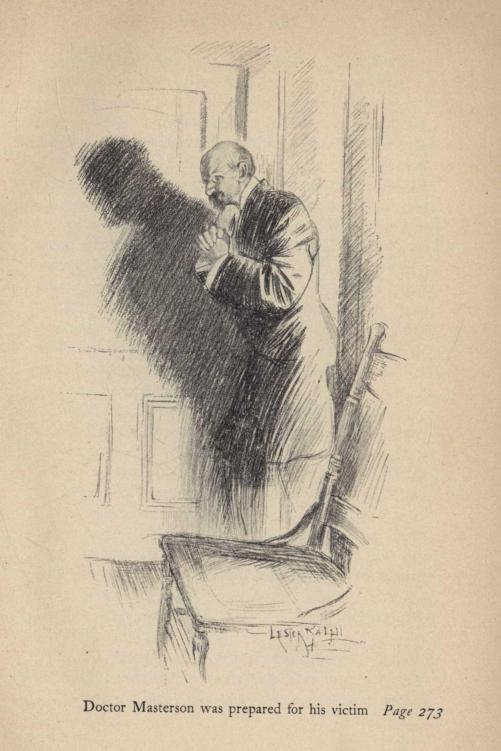
Doctor Masterson was prepared for his victim
"I've been in direct communication with Hasandoka," he said, "and I'm posted on your case now, and have full directions what to do. The first thing is a good course of massage. Now, which would you prefer to have, a man or a woman? I got a girl I sometimes employ who's pretty slick at massage. She's good and strong and willing and as pretty as a peach, if I do say it—she's got a figger like a waxwork—I think p'raps Flora would help you more'n any one—"
Mr. Payson shook his head coldly, saying that he preferred a man.
"Oh, o' course," Doctor Masterson said apologetically, shrugging his shoulders, "if you don't want her I guess I better go to work and do the rubbing myself, if you'd be better satisfied."
The Indian herb prescribed by Hasandoka was, it appeared, a rare, secret and expensive drug. The doctor's price was ten dollars a bottle, in addition to his weekly charge for treatment. He presented Mr. Payson with a bottle of dark brown fluid of abominable odor.
The treatment went on thrice a week, the massage being alternated with trances in which the doctor, under the cogent spell of the medicine man, uttered many strange things. The whole effect of this was to reassure Mr. Payson upon the fact that powerful influences were at work for his especial benefit.
Whether induced by Hasandoka's aid or by Doctor Masterson's suggestion, an improvement in the patient's mind, at least, did come. He was met, the following week, by the magnetic healer in his rooms with a congratulatory smile. Doctor Masterson inaugurated the second stage of his campaign.
"Say, you certainly are looking better, ain't you? How's the pain, disappearing, eh? I thought we could bring you around. Yesterday I was in a trance four hours on your case and it took the life out o' me something terrible. I knew then that I was drawing the disease out o' you. You just go to work and walk acrost the room, and see if you ain't improved. We got you started now, and all we got to do is to keep it up till you're absolutely well."
Blanchard Cayley also seemed interested when Mr. Payson told him of the improvement.
"You certainly are growing younger every day," said Cayley. "I don't know how you manage it at your age, in this vile weather, too, but I notice you've got more color and more spring in you. You're a wonder!"
One afternoon, during the third week of his treatment, as Mr. Payson was seated in his own office, the door opened and a chubby, roly-poly figure of a woman, with soft brown eyes and hair, came in timidly and looked about, seemingly perplexed and embarrassed. She walked up to his desk.
"I beg your pardon," she said, "but could you tell me where Mr. Bigelow's office is, in this building? I thought it was on this floor, but I can't find his name on any door."
He replied, scarcely glancing at her: "Down at the end of the corridor, on the left."
She stood watching him for a moment as he continued his writing, and then ventured to say:
"I beg your pardon, sir, but ain't you the gentleman that come to me some time ago to have your life read?"
He looked up now and recognized her as the one who had initiated him into the occult world, through the medium of the "Egyptian egg."
"Why, yes." He smiled benevolently. "You're Miss Ellis, aren't you?"
She seemed pleased. "Yes," she answered; "I hope you don't mind my reminding you of it, but I took an interest in your case more than usual, on account of your reading being so different, and I was surprised to see you here. You're looking much better than you did then. When you come into my place, I said to myself, 'There's a man that'll pass out pretty soon if he don't take care of himself.' You seemed so miserable. Why, I wouldn't know you now, you're so much improved. You must have gained flesh, too. Well, I congratulate you. If you ever want another reading, come around—here's my card, but perhaps you've tried Madam Spoll since. She's the best in the business. I go to her myself sometimes."
He walked to the door with her and bowed her out politely.
A week after he made another visit to Madam Spoll. The medium was gracious and congratulatory.
"Why, you look like a new man, that's a fact!" she said. "Between you and me, I never really expected that you could recover, but I knew if anybody could help you it would be Masterson. I suppose he come pretty high, didn't he? Two hundred! For the land sake! I'm sorry you had to fall into the hands of that shark, but, after all, it's cheaper than being dead, ain't it? A desperate disease requires a desperate remedy, they say. I wouldn't take you for more than forty years old now, in spite of your gray hairs.
"Now," she continued, "you've had experience and you're in a position to know whether there's any truth in spiritualism or not. No matter what anybody tells you about fakes or tricks and all that nonsense—I don't say some so-called mediums ain't collusions—you've demonstrated the truth of it for yourself, and you've found out that we can do what we say. You can afford to laugh at the skeptics and these smart-Alecs who pretend to know it all. What we claim can be proved and you've proved it. Lord, I'd like to know where you'd be now if you hadn't. I've always said: 'Investigate it for yourself, and if you don't get satisfaction, leave it alone for them that do. Go at it in a frank and honest spirit and try to find out the truth, and you'll generally come out convinced.' I don't believe in no underhanded ways of going to work at it neither. If you was going to study up Christian Science, or Mo-homedism, we'll say, you wouldn't be trying to deceive them and giving false names and all, and why should you when you want to find out about the spirit world? What you want to do is to depend upon the character of the information you get, to test the truth of what we claim. You treat us square and we'll treat you square. We ain't infalliable, but we can help. Whatever is to be had from the spirit plane we can generally get it for you."
"I'm very much interested," Mr. Payson said. "There does seem to be something in it, and I want to get to the bottom of it. There are several things I'd like to get help on, too."
"Do you know, I knew they was something worrying you," she replied, smiling placidly. She laid her fingers to her silken thorax. "I felt your magnetism right here when you came in, and I got a feeling of unpleasantness or worry. It ain't about a little thing either; it's an important matter, now, ain't it?"
Mr. Payson, affected by her sympathy, admitted that it was. Under his shaggy eyebrows, his cold eyes watched her anxiously, as if gazing at one who might wrest secrets from him. His belief in her had increased with every sitting, so that now the old man, gray and bald, in his judicial frock-coat, lost something of his influential manner and became more like a child before his teacher, swayed by every word that fell from her lips.
Her manner was half patronizing, half domineering. "What did I tell you? You feel as if, well, you don't quite know what to do, and you're saying to yourself all the time, 'Now, what shall I do?' That's just the condition I get."
"Do you think you could help me?"
"I don't know; I'll try. I ain't feeling very receptive to spirit influence to-day; I guess I overeat myself some; but then, again, I might be very successful; there's no telling. You just let me hold your hands a few minutes and I can see right off whether conditions are favorable or not."
He did so. Suddenly she turned her head to one side and spoke as if to an invisible person beside her.
"Oh, she's here, is she? What is it? She says she can't find him? Well, what about him? What? Shall I tell him that?"
She opened her eyes and drew a long breath.
"Luella is here and she says to tell you that Felicia wants to give you a message. Do you understand who I mean?"
"Yes, I know. She's the lady you spoke to me about before, with the white hair."
"Would her name be Felicia Grant?"
He assented timidly, as if fearing to acknowledge it.
"Well, Felicia says she has found the child—child, the one that was lost. Do you understand?"
"Yes, yes. Go on!"
"Really, I don't like to tell you this, Mr. Payson—"
"Tell anything."
Madam Spoll dropped her voice, as if fearful of being overheard. "You was in love with her.
"Yes." He eyed her glassily.
"And you was the father of the child?"
He nodded, still staring.
Madam Spoll smiled complacently. "Well, Felicia says she has found the boy, and she's going to bring him to you as soon as conditions are favorable. She can't do it yet; the time ain't come for it. That's all I can get from her. But Luella says you're worried about a book, and she wants to help you."
"How can she help?"
"Wait a minute." Madam Spoll smoothed her forehead with both hands for a while, then went on: "It seems that she can't work through me so well, it being what you might call a business affair, and she recommends that you try some one else, while I'll try to get the boy. I think a physical medium could help you more. There's Professor Vixley; he's something wonderful in a business way. I confess I can't comprehend it. Are you selling books?"
"Not exactly."
"Well, whatever it is, Vixley's the one to go to. He'll do well by you and you can trust him. I'll just write down his address; you go to see him and tell him I sent you, and I guarantee he'll give satisfaction. About the child, now, we'll have to wait. I shouldn't wonder if you could be developed so you could handle the thing alone. You've got strong mediumistic powers, only they're what you might call asleep and dormant. If you could come to me oftener we might be able to produce phenomena, for you're sensitive, only you don't know how to put your powers to the right use. You could join a circle, I suppose, but the quickest way is to have sittings with me, private."
The old man took off his spectacles and wiped off a mist. His hand was trembling. "I might want to try it later," he said at last, "but I'm not quite ready to, yet—I want to think it over. If you really think that this Vixley can help about the book, I'll look him up first. I want it to be a success, and I am a bit worried about it."
When he reached home he went into the living-room, to find Blanchard Cayley sitting there at ease, bland, suave and nonchalant. Clytie had not yet returned for dinner. Mr. Payson shook his hand cordially.
"I'm glad to see you, Blanchard. Been looking over that last chapter of mine? What do you think of it?"
"I haven't had time to read it yet. I've been expecting Cly home any minute."
"How are you getting on with her? Is she still skittish?"
"Oh, it'll come out all right, I expect," the young man said carelessly.
"I hope so! She's a good girl. I know she'll see it my way in the end—you just hold on and be nice to her. You know I'm on your side. I'd give a good deal to see Cly married to a good man like you. Strange, she doesn't seem to take any interest in my work at all. If I didn't have you to talk to, I don't know what I'd do. Suppose I read you that last chapter while we're waiting for her. I'd like to get your criticism of it. That trade dollar material has helped me immensely."
For half an hour, while Mr. Payson read the driest of dry manuscripts, Blanchard Cayley yawned behind his hand or nodded wisely, with an approving word or two. The old man had pushed up his spectacles over his forehead and held the sheets close to his eyes. He read in a mellow, deep voice, but it was the voice of a pedant.
"There," he said at last, stacking up the scattered papers. "I guess that will open their eyes, won't it?"
"It's great; that book will make a sensation."
"Well, it isn't finished yet, and what's to come will be better than what I've done. I'm on the track of something that may help it a good deal."
"What's that?" said Cayley perfunctorily.
"See here," Mr. Payson drew his chair nearer and shook his pencil at the young man. "I've had some wonderful experiences lately. You may not believe it, but I tell you there's something in this spiritualistic business. I've been investigating it for a month now all alone, and I'm thoroughly convinced that these mediums do have some sort of power that we don't understand."
"Really?" Cayley was beginning to be interested. "I knew you had always been an agnostic, but I had no idea that you had gone into this sort of thing. Have you struck anything interesting?"
"I certainly have. I went into it in a scientific spirit, as a skeptic, pure and simple, but I've received some wonderful tests. Why, they told me my name the very first thing and a lot about my life that they had no possible way of finding out. The trouble is, they know too much."
Cayley laughed. "Found out about your wild oats, I suppose?"
Mr. Payson frowned at this frivolity. "There are things they've told me that no one living could possibly know. Whether it's done through spirits or not, it's mysterious business. You ought to go to a séance and see what they can do."
"I'd hate to have them tell my past," Cayley said jocosely, "but I don't take much stock in them. They're a gang of fakirs."
"They're pretty sharp, if they are. I haven't lived fifty years in the West to be taken in as easily as that. I ought to know something about men by this time. Why, see here! You know what trouble I had with my leg? It was something pretty serious. Well, look at me now. You've noticed the change yourself. I went to a medium and now I'm completely cured. That's enough to give any one confidence, isn't it? It's genuine evidence."
Cayley agreed with a solemn nod. "But what about the book?"
"Why, if they can influence the right forces so that it'll be a success, why shouldn't I give them a trial? Look at hypnotism! Look at wireless telegraphy! For that matter, look at the telephone! Fifty years ago no one would believe that such things were possible. It may be the same with this power, whatever it is, spirits or not. I'm an old man, but I keep up with the times. I'm not going to set myself up for an authority and say, because a thing hasn't seemed probable to me, that I know all about the mysterious forces of nature. I've come to believe that there are powers inherent in us that may be developed successfully."
The incipient smile, the attitude of bantering protest had faded from Cayley's face, as the old man spoke. He listened sedately. Oliver Payson was a rich man. He had an attractive, marriageable daughter. Blanchard Cayley was poor, single and without prospects.
"Of course, there's much we don't yet understand," he said gravely. "One hears all sorts of tales—there must be some foundation to them."
"That's so—why, just look at Cly! She's had queer things happen to her ever since she was a child."
"Yes, I suppose that's why she's so interested in this palmist person; though I confess I don't take much stock in him."
"What do you mean?" Mr. Payson demanded.
"Why, I thought of course you knew. Granthope, the palmist—you know, the fellow everybody's taking up now—he has been here, hasn't he? I had an idea that Cly had taken rather a fancy to him."
"He was here?" Mr. Payson seemed much surprised.
"Why, I wouldn't have spoken of it for the world if I had known you didn't know—but I've seen her with him several times, and I thought, of course—" Cayley threw it out apologetically in apparent confusion at his indiscretion.
Mr. Payson stared. "Granthope, did you say? I believe I have heard of him. Cly and a common palmist? I can't believe it. What can she want of a charlatan like that?"
"I was sorry to see it myself," Cayley admitted, "but I suppose she knows what she's doing. The man's notorious enough. Only, she ought to be careful."
"I won't have it!" Mr. Payson began to storm. "Reading palms for a lot of silly women is a very different thing from spiritualism. I don't mind her going to see him once for the curiosity of the thing, but I won't have him in the house. I'll put a stop to that in a hurry. You say you've seen them together? Where?"
"Oh, I think it was probably an accidental meeting," he said. "I wish you wouldn't say anything about it, Mr. Payson. Very likely it doesn't mean anything at all. Tell me about this fellow you spoke of going to. Do you think he's all right?"
"I'll soon find out if he isn't—trust me!" Mr. Payson wagged his head wisely. "His name is Professor Vixley, and I've heard he's a very remarkable man. I'm going to see him next week and see what he can do for me. I'm not one to be fooled by any claptrap; I intend to sift this thing to the bottom."
"How do you intend to go about it?" Cayley asked. "I'll tell you what I'd do. I'd ask him to answer a few definite questions. If he can do that, it'll be a pretty good test, even if it is only thought-reading."
"If there's anything in thought transference there may be something in spiritualism, too. One's as unexplainable as the other. See here! Suppose I ask him something that I don't know the answer to myself—wouldn't that prove it is not telepathy?"
"I should say so; but what could you ask?"
Mr. Payson had arisen, and was walking up and down the room with his hands behind his back. He stopped to deliberate beside the bookcase, then he took down a volume at random. "Suppose I ask him what the first word is on page one hundred of this book."
He looked over at Cayley, then down at the title of the book.
"The Astrology of the Old Testament—queer I should put my hand on that! I'll try it. I won't look at the page at all." He put the book back on the shelf. "Can't you suggest something? Suppose you give me a question that you know the answer of and I don't."
Blanchard Cayley sought for an idea, his eyes fixed on the ceiling. Then he said slowly: "I used to know a girl once in Sacramento who lived next door to me. Try Vixley on her name, why don't you?"
"Good! I'll do it. Now one more."
"You might ask him the number of your watch."
"That's a good idea; then I can corroborate that on the spot."
"You'd better let me see if there's one there, though," Cayley suggested. "I believe sometimes they are not numbered. Just let me look."
Mr. Payson took out his watch and handed it to the young man, who opened the back cover and inspected the works. He noted the number, took a second glance at it and then snapped the cover shut. "All right, if he can tell that number, he's clever." He handed it back to Mr. Payson. "When did you say you were going to see him?" he asked.
"Next Tuesday or Wednesday, I expect," was the reply. "I've got to go up to Stockton to-morrow, and I may be gone two or three days attending to some business. By the by, Cayley, I heard rather a queer story last week when I was up there. You're interested in these romantic yarns of California; perhaps you'd like to hear this."
"Certainly, I should. It may do for my collection of Improbabilities."
"Well, I met the cashier of the Savings Bank up there—he's been with the bank nearly thirty years and he told me the story. It seems one noon, about twenty years ago, while he was alone in the bank, a little boy of seven or eight years of age came in, and said he wanted to deposit some money. The cashier asked him how much he had, thinking, of course, that he'd hand out a dollar or two. The boy put a packet wrapped in newspaper on the counter, and by Jove! if there wasn't something over five thousand dollars, in hundred-dollar greenbacks! What do you think of that? The cashier asked the boy where he got so much money, suspecting that it must have been stolen. The boy wouldn't tell him. The cashier started round the counter to hold the boy till he could investigate, and, if necessary, hand him over to the police. The little fellow saw him coming, got frightened, and ran out the door, leaving the money on the counter. He has never been heard from since."
"Well, what became of the money, then?"
"Why, it had to be entered as deposited, of course. The boy had written a name—the cashier doesn't know whether it was the boy's own name or not—on the margin of the newspaper, and the account stands in that name, awaiting a claimant."
"What was the name?"
"The cashier wouldn't tell me, naturally. It has been kept a secret. With the compound interest, the money now amounts to something like double the original deposit."
"It's a pity I don't know the name; I might prove an alibi."
"Oh, I forgot—and it really is the point of the whole story. The package was wrapped in a copy of Harper's Weekly, and the boy, whose hands were probably dirty, had happened to press a perfect thumb-print on the smooth paper. Of course, that would identify him, and if any one could prove he was in Stockton at that time, give the name and show that his thumb was marked like that impression, the bank would have to permit him to draw that account."
"That lets me out," said Cayley, "unless that particular thumb-print happens to show a banded, duplex, spiral whorl."
"What in the world do you mean?" Payson asked.
"Why, you know thumb-prints have all been classified by Gallon, and every possible variation in the form of the nucleal involution and its envelope has been named and arranged."
"I didn't know that," said Payson. "But I did know there were no two thumbs alike. That's the way they identified my partner when he was drowned. He was interested in the subject, having read of the Chinese method, and he happened to have a collection of thumb-prints, including his own, of course, done in India ink. His body was so disfigured and eaten by fishes that he couldn't be recognized until, suspecting it might be he, we proved it by his own marks."
"I didn't know you ever had a partner."
"Oh, that was years ago, soon after Cly was born. His name was Ichabod Riley. That was a queer story, too. His wife was a regular Jezebel, Madge Riley was, and there's no doubt she poisoned her first two husbands. She was arrested and tried for the murder of the second, but the jury was hung, and she wasn't. Ichabod was supposed to have been accidentally drowned off Black Point, but I have good reason to believe that he committed suicide on account of her. He was afraid of being poisoned as well. She is supposed to have killed her own baby, too.
"Well," Mr. Payson added, rising, "I've got to go up-stairs and get ready for dinner. You'll stay, won't you?"
"I'll wait till Cly gets home, at any rate, but I'll not promise to dine."
The old man went up-stairs, leaving Cayley alone beside the bookcase.
When he returned he found Cayley, cool and suave as ever. Clytie was with him, standing proudly erect on the other side of the room, a red, angry spot on either cheek. She held no dreamy, listless pose now; something had evidently fully awakened her, stinging her into an unaccustomed fervor. Her slender white hands were clasped in front of her, her bosom rose and fell. Her lips were tightly closed.
Mr. Payson, near-sighted and egoistic, was oblivious of these stormy signs, and remarked genially: "You're going to stay to dinner, aren't you, Blanchard?"
Blanchard Cayley drawled, "I think not, Mr. Payson; I'll be going on, if you'll excuse me," smiling, "and if Cly will."
"Don't let us keep you if you have another appointment," she said, without looking at him.
He left after a few more words with the old man, who began at last to smell something wrong.
"What's the matter, Cly?" he asked.
She had sat down and was pretending to read. Now she looked up casually:
"Oh, nothing much, father, except that he was impertinent enough to question me about something that didn't concern him."
"H'm!" Mr. Payson took a seat with a grunt and unfolded his newspaper. "I'm sorry you two don't get on any better."
"We'd get on well enough if he'd only believe that when I say 'no' I mean it."
He stared at her, suddenly possessed by a new thought. "Is there anybody else in the field, Cly?"
"There are many other men that I prefer to Blanchard Cayley."
"What is this about your being with this palmist chap?"
"Did Blanchard tell you that?" she asked with exquisite scorn.
"Have you seen much of this Granthope?"
"I've seen him four times."
"And you have invited him to my house?"
"He has been here."
Mr. Payson rose and shook his eye-glasses at her. "I must positively forbid that!" he exclaimed. "I won't have you receiving that fellow here. From what I hear of him he's a fakir, and I won't encourage him in his attempts to get into society at my expense."
"Do you mean to say that you forbid him the house, father? Isn't that a bit melodramatic? I wouldn't make a scene about it. I am twenty-seven and I'm not absolutely a fool. I think you can trust me."
"Then what have you been doing with him? What does it all mean, anyway?"
"As soon as I know what it means, I'll tell you. At present, I think we had better not discuss Mr. Granthope."
He blustered for a while longer, iterating his reproaches, then simmered down into a morose condition, which lasted through dinner. Clytie knew better than to discuss the subject with him. Her calmness had returned, though she kept her color and did not talk. The two went into the library and read.
Shortly after eight o'clock the door-bell rang. As it was not answered promptly, Mr. Payson, still nervous, irascible and impatient, went out into the hall, growling at the servant's delay.
He opened the door, to see Francis Granthope, rather white-faced under his black hair, supporting himself on crutches.
"Is Miss Payson at home?" he asked, taking off his hat.
"Yes, she is. Won't you step in? What name shall I give her, please?" Mr. Payson spoke hospitably.
"Thank you. Mr. Granthope," was the answer.
The old man turned suddenly and returned his visitor's hat.
"I beg your pardon," he said sternly, "but Miss Payson is not at home—for you—and I don't intend that she ever shall be. I have heard enough about you, Mr. Granthope, and I desire to say that I can not consent to your being received in my house. You're a charlatan and a fakir, sir, and I do not consider you either my daughter's social equal nor one with a character respectable enough to associate with her. I must ask you to leave this house, sir, and not to come again."
Granthope's eyes glowed, and his jaws came together with determination. But he said only:
"Very well, Mr. Payson, I'm sure that I do not care to call if I'm not welcome. This is, of course, no place to discuss the subject, but I shall not come here again without your consent. As to my meeting her again, that lies wholly with her. You may be sure that I shall not annoy her with my attentions if she doesn't care to see me. But I ask you, as a matter of courtesy, to let Miss Payson know that I have called."
"See that you keep your word, sir—that's all I have to say," was Mr. Payson's reply, and he stood in the doorway to watch his visitor down the garden walk. He remained there until Granthope had descended the steps, then walked down after him and watched him to the corner.
Mr. Payson returned to the library sullenly.
"That palmist of yours had the impertinence to come here and ask for you," he informed Clytie, "but I sent him about his business, and I expect he won't be back in a hurry."
Clytie looked up with a white face. "Mr. Granthope, father?" She rose proudly and faced him. "Do you mean to say that you were rude enough to turn him away? It's impossible!"
Mr. Payson walked up and down the room in a dudgeon.
"I certainly did send him away, and what's more, I told him not to come back."
Clytie, without another word, ran out into the hall. The front door was flung open and her footsteps could be heard on the gravel walk. Mr. Payson seated himself sulkily.
In five minutes more she had returned, slowly, her hair blown into a fine disorder, the color flaming in her cheeks, her eyes quickened.
"What in the world have you been doing?" her father demanded.
"I wanted to apologize for your rudeness," she answered, "but I was too late."
CHAPTER X
A LOOK INTO THE MIRROR
"He gives exact and truthful revelations of all love affairs, settles lovers' quarrels, enables you to win the affection and esteem of any one you desire, causes speedy and happy marriages—"
Granthope put down the paper with a look of disgust. It was his own advertisement, and it had appeared daily for months. He took up his desk telephone with a jerk, and called up the Chronicle business office.
"This is Granthope, the palmist. Please take out my displayed ad., and insert only this: 'Francis Granthope, Palmist. 141 Geary St., Readings, Ten Dollars. Only by Appointment. Ten till Four.'"
There was now a red-headed office boy in the corner where Fancy Gray used to sit. Granthope missed her jaunty spirit and unfailing comradeship. Not even his endeavor to give his profession a scientific aspect amused him any longer. He had lost interest in his work. He was uneasy, dissatisfied, blue. He went into his studio listlessly, with a frown printed on his brow. Until his first client appeared he lay upon the big couch, his eyes fixed upon the light.
He had been there a few moments when his office boy knocked, and opening the door, injected his red head.
"Say, dere's a lady in here to see you, Mr. Granthope!"
"Who is she?"
The boy grinned. "By de name of Lucie. Says you know her."
"Tell her I can't see her."
Granthope turned away, and the boy left.
The room was as quiet as a padded cell, full of a soft, velvety blackness, except where the single drop-lamp lighted up the couch. Ordinarily the place was, in its strange dark emptiness, a restful, comforting retreat. Now it imprisoned him. Above his head the great ring of embroidered zodiacal signs shone with a golden luster. They were the symbols of the mysterious dignity of the past, of the dark ages of thought, of priestcraft and secret wisdom of the blind centuries that had gone. But, a modern, incongruously set about with such medieval relics, he felt for the first time, undignified. In their time these emblems had represented all that existed of knowledge. Now, to him they stood for all that was left of ignorance and superstition; and it was upon such instruments he played.
He read palms perfunctorily that Saturday. He seemed to hear his own voice all the while, and some dissociated function of his mind scoffed continually at his chicanery. It was the same old formula: "You are not understood by those about you. You crave sympathy, and it is refused. You are extraordinarily sensitive, but when you are most hurt you often say nothing. You have an intuitive knowledge of people. You have a wonderful power of appreciation and criticism. People confide in you. You are impulsive, but your instinct is usually sure"—the same professional, easy rigamarole, colored with what hints his quick eyes gave him or his flagging imagination suggested.
Women listened avidly, drinking in every word. How could he help telling them what they loved so to hear? They asked questions so suggestive that a child might have answered. They prolonged the discussion of themselves, obviously enjoying his apparent interest. He caught himself again and again playing with their credulity, their susceptibility, and hated himself for it. They lingered, smiling self-consciously, and he delayed them with a look. In very perversity, he began deliberately to flatter their vanity in order to see to what inordinate pitch of conceit their minds would rise. He affected indifference, and even scorn—they followed after him still more eagerly. He grew, at last, almost savagely critical, an instinct of cruelty aroused by such complacent, egregious egoism. They fawned on him, like spaniels under the lash.
After a solitary dinner he returned to his rooms. For an hour or two he tried to lose himself in the study of a medical book. Medicine had long been his passion and his library was well equipped. Had he been reading to prepare himself for practice he could not have been more thorough. To-night, however, he found it hard to fix his attention, and in despair he took up a volume of Casanova's Memoirs. There was an indefatigable charlatan! The fascinating Chevalier had never wearied in ill-doing; he kept his zest to the last. He skipped to another volume to follow the pursuit of Henriette, of "C.V.," of Thérèse. The perusal amused him, and he got back something of his cynical indifference.
It was after eleven o'clock when he laid down the book and rose to look, abstractedly, out of the office window. He longed for an adventure that should reinstate him as his old careless self.
He left his rooms, went up to Powell Street and finally wandered into the noisy gaiety of the Techau Tavern. The place was running full with after-theater gatherings, and he had hard work to find a table. All about him was a confusion of excited talk, the clatter of dishes, the riotous music of an insistent orchestra. Parties were entering all the while, beckoned to places by the head waiter. The place was garish with lights and mirrors.
Granthope had sat there ten minutes or so, sipping his glass, noticing, here and there, clients whom he had served, when, between the heads of two women, far across the room, he recognized Mrs. Page. It was not long before she saw him, caught his eye, and signaled with vivacity. The diversion was agreeable; he rose and went over. A glance at her table showed him a company most of whose members he had met before, but with whom, only a few months since, he would have counted it a social success to be considered intimate. While not being quite of the elect, they held the key of admission to many high places in virtue of their wit and ingenious powers to please. They were such as insured amusement. Granthope himself was this evening desirous of being amused.
With Mrs. Page was Frankie Dean, the irrepressible, voluble, sarcastic, a devil in her black, snapping eyes, as cold-blooded as a snake. It was she who had so nearly embarrassed him at the Chinese supper at the Maxwells'. She eyed him now, dark, feline, whimsically watching her chance to make sport of him. With them was a young girl from Santa Rosa, newly come to San Francisco, an alien in such a company. She was slight and dewy, vivid with sudden color, with soft, fervent eyes that had not yet learned to face such audacity as her companions practised. Keith and Fernigan were there, also, like a vaudeville team, rollicking with fun, playing into each other's hands, charging the company with abandon. Lastly, "Sully" Maxwell sat, silent, happy, indulgent, with his pockets filled with twenty dollar gold-pieces, which he got rid of at every opportunity. He spoke about once every fifteen minutes, and then usually to the waiter. "A good spender" was Sully—that quality and his unfailing good-nature carried him into the gayest circles and kept him there unnoticed, until the bills were to be paid.
To Granthope, tired with his day's work, in conflict with himself, morbidly self-conscious, the scene was stimulating. There was an atmosphere of inconsequent mirth in the group, which dissolved his mood immediately. The women, smartly dressed, bubbling with spirit, quick with repartee—Keith and Fernigan, their sparkling dialogue interrupted, waiting for another auditor—even Sully, prosperous, good-natured, hospitably making him welcome—the group attracted him, rejuvenated him, enveloped him with their frivolity. The party was in the first effervescence of its enthusiasm. Mrs. Page was at her sprightly best, impellent, a gorgeous animal. Even Frankie Dean, whom he did not like, was temptingly piquant and brisk. The little girl had a novelty and virginal charm. He had been out of his element all day. Here, he could be himself. He could take things easily and jocosely, and have no thought of consequences. His mood disappeared like a shattered soap-bubble, and he was caught into their jubilant atmosphere.
He was introduced to the girl from Santa Rosa, who looked up at him timidly but with evident curiosity, as at a celebrity, and sat down between her and Mrs. Page. Sully Maxwell took advantage of the new arrival to order another round of drinks—club sandwiches, golden bucks—till he was stopped by Frankie Dean. Keith and Fernigan recommenced their wit. Mrs. Page looked at him with all kinds of messages in her eyes, as if she were quite sure that he could interpret them. The girl from Santa Rosa said nothing, but, from time to time, gave him a shy, curious glance from her big brown eyes. Granthope's spirits rose steadily, but his excitement had in it something hectic. In a sudden pause he seemed to remember that he had been speaking rather too loudly.
After the party had refused, unanimously, further refreshment, Sully proposed that they should all drive out to the Cliff House, and they left the restaurant forthwith to set out on this absurd expedition. It was already long past midnight; the adventure was a characteristic San Francisco pastime for the giddier spirits of the town.
Sully was for hiring two hacks; Mrs. Page, giggling, vetoed the proposition, and Frankie Dean supported her. Decidedly that would be commonplace; why break up the party? The girl from Santa Rosa looked alarmed at the prospect. Granthope smiled at her ingenuousness, and liked her for it. The result of the sidewalk discussion was that Sully obligingly mounted beside the driver, and the six others squeezed into the carriage, the door banged, and they proceeded on their hilarious way toward the "Panhandle" of the Park. On the rear seat Granthope sat with Mrs. Page and Frankie Dean on either hand, protesting that they were perfectly comfortable. Opposite him the girl from Santa Rosa leaned forward on the edge of the cushion, shrinking away from the two men beside her.
Mrs. Page made an ineffectual search in the dark for Granthope's hand. Not finding it, she began to sing, under her breath:
"It was not like this in the olden time,
It was not like this, at all!"
and Frankie Dean, quick-witted enough to understand the situation, remarked, "Oh, Mr. Granthope doesn't read palms free, Violet; you ought to know that!" She darted a look at him.
So it went on frothily, with chattering, laughter, snatches of song, jests and stories, punctuated occasionally by the rapping of Sully's cane on the window of the carriage, as he leaned over in a jovial attempt to participate in the fun. Granthope, for a while, led the spirit of gaiety that prevailed, told a story or two, "jollied" Mrs. Page, laughed at Keith's inconsequence, accepted Frankie Dean's challenges. But the frank, bewildered eyes of the little girl from Santa Rosa, fixed upon him, disconcerted him more than once.
The carriage soon entered Golden Gate Park. The night was warm and still, the dusk pervaded with perfumes. Under the slope of Strawberry Hill Maxwell stopped the carriage and ordered them all out to invade the shadowy stillness with revelry. The night air was that of belated summer, full of a languor that comes seldom to San Francisco which has neither real summer nor real winter, and the wildness of the place, remote, unvisited, was exhilarating. A mock minuet was started, races run, even trees climbed by Frankie Dean the audacious, with shrieks and laughter, all childishly with the sheer joy of living. Granthope and the girl from Santa Rosa, after watching the sport with amusement for a while, left the rest and walked on past a turn of the road, to stand there, discussing the stars, while the cries of the two women came softened along the sluggish breeze. The girl took off her hat and breathed deeply of the night air. They walked on farther through the gloom, till only an occasional faint shout reached them from the party. Granthope put the girl at her ease, pointed out the planets and the constellations and explained the principles of ancient astrology. They had begun to forget the rest when they were overtaken and captured again and the crowded carriage took its way towards the sea.