THE HEART LINE (continued 6)
Reading edition
Upon a high ledge of rock jutting out into the Pacific, at the very entrance to the Bay of San Francisco, stands the Cliff House, a white, wooden, many-windowed monstrosity with glazed verandas, cupolas, frivolous dormers, cheap, garish, bulky, gay, seemingly almost toppling into the water. Here come not only such innocently holidaying folk as Fancy Gray and Gay P. Summer, not only jaded tourists and the Sunday-outing citizens who lie upon the warm beach below and doze away a morning in the sun and wind. It was patronized of old by the buggy-riding fraternity, the smokers, the spenders, with their lights-o'-love, as the most popular of road-houses. The cable-cars and the two "dummy" railroad lines have changed its character somewhat, but it is still a show-place of the town. There is good eating, a gorgeous view of the Pacific, and the sea-lions on the rocks below.
Here Mrs. Page's party alighted, near three o'clock in the morning. The bar only was open, its white-frocked attendant sleeping behind the counter. This they entered, yawning from their ride. The barkeeper was awakened, peremptorily, and was ordered to prepare what he had for refreshment. With hot beans from the heater, tamales, potato salad, cold cuts, crackers and cheese, he laid a table in a small dining-room. Sully Maxwell undertook all the arrangements, fraternized with the barkeeper, selected beverages, not forgetting ginger ale for the girl from Santa Rosa. Mrs. Page and Frankie Dean, somewhat disheveled, retired, to appear trig and trim and glossy in the gaslight, ready for more gaiety. Granthope, meanwhile, had wandered out upon the veranda to watch the surf dashing on the rocks, to note the yellow gleam from the Point Bonita light, and smell the salt air; to get his courage up, in short, for another round of animation. The instant he returned Mrs. Page went at him.
"Now, Frank," she said, "it won't do to sulk or to flirt with Santa Rosa. What's got into you, anyway? You must positively do something to amuse us."
"Office hours from ten till four," Keith murmured audibly.
Frankie Dean turned on him: "They never let you out of your cage at all!"
Fernigan, thereat, began an absurd pantomime that half terrified the girl from Santa Rosa. He pretended to be a monkey behind the bars of a cage, eating peanuts—and worse. It was shockingly funny. The company roared, all but Granthope. He was at the point of impatience, but replied with what sounded like ennui:
"I'm a bit stale, Violet; you'll have to excuse me if I'm stupid to-night. I came to be entertained."
Frankie Dean looked at him mischievously. "Never mind, Mr. Granthope, she'll come back."
It was obviously no more than a cant phrase, intended for a witticism. Mrs. Page, however, took it up with mock seriousness.
"Who's 'she', now? I'm back in the chorus again! There was a time, Frank—" Her voice was sentimental; she tilted her head and looked at him, under half-closed eyelids, across the table.
"I say, Granthope, you ought to publish an illustrated catalogue of 'em. There's nothing doing for amateurs, nowadays. When women pay five dollars to have their hands held what chance is there for us?" This from Keith, with burlesque emphasis.
Mrs. Page would not be diverted. "No, but really, Frank; who is she? I've quite lost track of your conquests."
"Oh, you know I'm wedded to my art," he said lightly.
"Yes, and it's the art of making love, isn't it?"
"'No further seek his merits to disclose,'" said Keith, and Fernigan added, "'Nor draw his frailties from their dread abode.'"
The girl from Santa Rosa looked suddenly bursting with intelligence, recognizing the quotation. She started to finish it, then stopped; her lips moved silently. Granthope smiled.
Frankie Dean had been watching her chance for another at his expense. Now she asked, with apparent frankness: "Mr. Granthope, can you tell character by the lines on the soles of the feet?"
"Science of Solistry," murmured Keith to the Santa Rosa girl.
"Let's try it!" Mrs. Page exclaimed. "I will, for one! Do you know my second toe's longer than my great toe? I'm awfully proud of it. I can prove it, too!"
"Go on!" Frankie Dean dared her.
The girl from Santa Rosa stared, her lips apart. "Why, every one's is, aren't they?"
"No such thing!" Mrs. Page stopped and almost blushed. A chorus of laughter.
"Oh, there are a good many better ways of telling character than that," said Granthope.
"Yes," Keith put in. "Indiscreet remarks, for instance."
Mrs. Page bit her lip and shrugged her shoulders. "Oh, if I were going in for indiscreet remarks I might make a few about you!"
Here Sully interposed. "Isn't this conversation getting rather personal? I move we discard all these low cards. This is no woman's club. The quiet life for mine."
The hint was taken by Keith, who began an English music-hall song, to the effect that "John was a nice good 'usband, 'e never cared to roam, 'e only wanted a quiet life, 'e only wanted a quiet wife; there 'e would sit by the fireside, such a chilly man was John—" where he was joined in the chorus by Fernigan—"Oh, I 'opes and trusts there's a nice 'ot fire, where my old man's gone!" Maxwell pounded in time upon the table. The girl from Santa Rosa hazarded a laugh.
Granthope looked on listlessly, ever more detached and introspective. This was what he had been used to, since he could remember, but now, in the stuffy little room, with its ghastly yellow gas-light, the smell of eatables and wine, the pallor of the women's faces, the flush of Maxwell's, the desperate frivolity, the artificiality of it all bored him. He wondered, whimsically, why he had ever looked forward to being the companion of such a society as this. It was all harmless enough, unconventional as it was, but he tasted the ashes in his mouth. Perhaps, after all, he was only not in the mood for it. He tried to smile again.
Fernigan seized a small Turkish rug from the floor and hung it in front of him, like a chasuble. Standing before the company he intoned a sacrilegious parody, like everything he did, funny, like everything he did, atrocious:
"O, sanctissimus nabisco in colorado maduro domino te deum, e pluribus unum vice versa et circus hippocriticam, mephisto apollinaris nux vomica dolores intimidad mores; O rara avis per diem cum magnum vino et sappho modus vivendi felicitas," to the droned "A—men."
Keith then enlivened the company with what quaint parlor tricks he knew, or dared, from making of a napkin a ballet dancer pirouetting upon one toe, to limericks that were suppressed by Sully Maxwell, Mrs. Page laughed prodigiously, showing all her teeth, staring with her great eyes, vivid in her every expression, flamboyant, sleek and glossy, abounding in temperament. Frankie Dean smiled maliciously and plied the performers with her acrid wit. The girl from Santa Rosa listened, her cheeks burning.
At six they went outside for fresh air and promenaded the glazed veranda until the sun rose. In front of them was the broad Pacific, stretching out to the Farralones, even to Japan. To the north, across the bar, yellowed with alluvium from the San Joaquin and Sacramento Rivers, a mountainous coast stretched to far, misty Bolinas. Southward ran the broad, wide beach exposed by the ebb tide. It was damp and cool; the last spasm of summer had given way to the brisk, stimulating weather that was San Francisco's usual habit. Granthope buttoned his light overcoat tightly over his rumpled evening dress and walked with the girl from Santa Rosa, enjoying the scene quietly, speaking in monosyllables. The others had a new burst of effervescence, still more desperate than ever; their hilarity was indefatigable. Keith walked along the tops of the tables, leading Mrs. Page. Frankie Dean and Fernigan two-stepped the length and breadth of the wide platform, joking incessantly.
A walk up the beach was then suggested, and, after a preliminary furbishing of faces and hair, they went down the steep rocky road to the wide strand, and proceeded along the shore.
Granthope, falling behind, saw that the girl from Santa Rosa alone had waited for him. She gazed at him steadily with grave eyes.
"Well," he said kindly, "what d'you think of San Francisco?"
She looked down at the sand and drew a circle with her toe before she answered.
"It's pretty gay here, isn't it?"
"Oh, well, if you call this sort of thing gay!"
The girl looked immensely relieved, gave him a quick, searching glance, and said shyly: "Do you know, Mr. Granthope, I have an idea that you didn't enjoy it any more than I did!"
He smiled at her, then silently grasped her hand. She blushed and turned away.
"I thought it was going to be great fun," she said, as they walked on. "I never was up all night before. It's awfully exciting. But people do look awful in the morning, don't they?"
She herself was like a blossom wet with dew, but Granthope knew what she meant, well enough. He had watched the lines come into Mrs. Page's face and her mouth droop at the corners; he had noticed the glitter fade from Frankie Dean's black eyes, and her lids grow heavy.
"You ought never to have come," he said. "I think you'd better go home and get to bed. Suppose we leave them and walk across to the almshouse and take the Haight Street cars?"
"Oh, d'you think they'd mind, if we did?"
"They'd never notice that we were gone, I'm sure."
"I'm afraid you'll find me awfully stupid. Miss Dean is very witty, isn't she?"
"I'd rather be stupid."
"You're sure I won't bore you?"
"I don't feel much like talking, myself. I have plenty to think about. Suppose we don't say anything, unless we have something to say."
"Oh, I didn't know you could do that—in San Francisco!"
He laughed sincerely for the first time that night.
As they came to the place where the beach road turned off for Ingleside, the rest of the party was some distance ahead. They were sitting upon some rocks, and, as Granthope looked, he saw Mrs. Page rise, lift her skirts and walk barefooted across the sands, down to the water's edge. She turned and waved her hand to him. He took off his hat to her and pointed inland in reply. Then he climbed the low sand-hills with his companion and struck off southward, along the road. The girl had colored again.
Her confidence in him was soothing. She was so serious and innocent, so quick with a country girl's delicate observation of nature, that he fell into a more placid state of mind. She became more friendly all the while, till, despite her confession of shyness, she fairly prattled. He let her run on, scarcely listening, busy with his own thoughts. And so, up the long road to the almshouse, resting in the pale sunshine occasionally, through the Park to the end of the Haight Street cable-line they walked, and talked ingenuously.
She lived in "The Mission," and there, having nothing better to do, he escorted her, and at last, in that jumble of wooden buildings so multitudinously prosaic, between the Twin Peaks and the Old Mission, he left her. She bade him good-by apparently with regret. Widely different as they were in mind and temperament, they had, for their hour, come closely together. Now they were to recede, never again, perhaps, to meet.
He walked in town along Valencia Street, through that curious "hot belt" which defies the town's normal state of weather, turned up Van Ness Avenue, still too busy with his reflections to shut himself up in his studio. It was Sunday morning—he had almost forgotten the day—and he turned up his collar, to conceal what he could of his evening attire and its wilted, rumpled linen, somewhat uncomfortable in the presence of the church-going throngs which pervaded the avenue.
He had reached the top of the long slope leading to the Black Point military reservation, and was pausing upon the corner of Lombard Street, when, looking up the hill, he saw Clytie Payson coming down the steep, irregular pathway that did service for a sidewalk. He stepped behind a lamp-post and watched her, uncertain whether or not to let her see him.
She came tripping down, picking her way along the cleated double plank, too intent upon her footsteps to look far ahead. The sight of her made him a little trepid with excitement; it focused his dissatisfaction with himself. He knew, now, what had disturbed him. It was the thought of her. She had forced him to look at himself from a new point of view, with a new, critical vision. He longed for her approval. Her gentle coercion was drawing him into new channels of life, and he felt a sudden need for her help. He was losing his whilom comrades, his old familiar associations repelled him. He had nothing to sustain him now, but the thought of her friendship.
But, in his present state, he had not the courage to address her. As a child plays with circumstances and makes his own omens, he left the decision to chance. If she turned and saw him, he would greet her and throw himself on her grace. If not, he would pass on without speaking, much as he longed to speak.
She came down to the corner diagonally opposite and paused for a moment, looking off at the mountains and the waters of the Golden Gate. He saw her make a sudden movement, as if waking from her abstraction, then she walked over in his direction. He came out from his cover and went to meet her.
"Good morning, Mr. Granthope!" She was smiling, holding out her hand. "I thought I recognized you! Something told me to stop a moment, and wait. Then suddenly I saw you. You see, you can't escape me!"
He was visibly embarrassed, conscious of his significantly unkempt appearance. She, however, did not show that she noticed it.
"How is your ankle?" was her first inquiry. He assured her that it had given him no trouble for a week, and he expressed his thanks to her for her help.
"I've been hoping I might see you," she said, "to apologize for the reception you received the last time you called. I can't tell you how unhappy it made me, nor how I regret it."
"Mayn't I see you a while now?" He felt at such a disadvantage in his present condition that it was embarrassing to be with her, and yet he longed for another hour of companionship.
"Let's walk down to the Point," she said. "I can get in the reservation, and it will be beautiful."
As they walked down across the empty space at the foot of the avenue and along the board-walk over the sand, she talked inconsequently of the day and the scene, evidently attempting to put him at his ease. The little girl from Santa Rosa had given him a passive comfort. Clytie's companionship was an active and inspiring joy. His depression ceased; a sane, wholesome content filled him. He watched her graceful, leopard-like swing and the evidences of vitality that impelled her movements.
They passed the sentry who nodded to her at the gate, went past the officers' quarters, down a little path lined with piled cannon-balls, out to a small promontory that overlooked the harbor. Here there was an old Spanish brass cannon in its wooden mortar-carriage, and a seat on the very edge of the bluff. The harbor extended wide to the southeast. Inshore was a covey of white-sailed yachts in regatta, just tacking, to beat across to Lime Point, opposite.
As they sat down, Clytie said, "Now do tell me about Miss Gray. How is she?"
"She's not with me any more."
She lifted her brows. "Where is she?"
"I don't know, quite."
"You haven't seen her since she left?"
"No, not for two weeks."
Clytie frowned and bit her lip, then shook her head silently. Then she remarked, as if to herself, "I like her. I'm sure she's fine."
"She likes you, too."
"I wish I might see her," she went on, her eyes fixed on the mountains. "I'd like to do something for her. I might get her a position in my father's office, I'm sure, if she'd take it. I have a curious feeling, though, that it is she who will be more likely to do something for me."
"If she ever can, you may be sure she will. Fancy is true blue."
"You didn't—have any misunderstanding with her, did you?"
"Oh, no."
She seemed to notice his reluctance to explain, and did not pursue the subject.
She turned and her eyes fell upon his hand, which lay carelessly upon his knee. "Let me see your palm," she said impulsively. "I've never looked at it carefully. I suppose you've told your own fortune often enough."
He gave his left hand to her. She barely touched it, holding it lightly, but he felt the magnetism of the contact almost as a caress. "You'll find my line of fate shows that I'm to change my career," he remarked. "It's broken at the head line, you see, and begins over again."
"Now, let me look at your right hand."
She looked at it, and her expression changed subtly. It was as if she had found some secret satisfaction in his palm, some answer to her desires.
"What d'you see?"
"The heart line."
In his left hand it began near the root of the second finger, at the mount of Saturn, not, as he would have preferred, farther toward the index finger, at the mount of Jupiter. He wondered if that meant to her what it did, in his professional capacity, to him—an indication of more sensual tastes. Half its length was cobwebbed with tiny branches, and punctuated with islands; then it ran, deep and clear to the edge of the palm, almost straight. In his right palm the line was cleaner, simpler, undivided.
She had begun to color, faintly; she had turned her eyes from him. Into her loveliness had come a new element of charm. There was something special in it, something for him alone; it was as if she had been signaling to him, and he had not, till now, understood. Instantly every line in her body seemed to be imbued with a new grace, a new meaning, translating her spirit. He was too full of the inspiration to speak; he could only look at her, irradiated, as if he had never seen her before. To his admiration for her beauty, his respect for her character, his interest in her mind, there was added something more; the total was not to be accounted for by the sum of these. And the wonderful whole satisfied the divine fastidiousness of his nature. She was for him the supreme choice. Her mind worked like his. Her very size pleased him. He seemed to know her for the first time. He had desired her, before, for her beauty and her intelligence; he had thought calmly of love and marriage. But now he felt the supreme demand for possession, because——only because he must have her—because nothing else in his life mattered.
A secret ray of thought seemed to carry the message back to her, for, apparently embarrassed by the intensity of his silence, she rose and walked a few paces, with her hands behind her back, gazing off at the harbor. It was not thought that he sent, however, for he could not think; it was a new function of his soul aroused, excited, thrilling him with the power of its vibration.
When that wave broke, he was at a loss for words. How could he say how much he wanted her? How could he ask if she, too, felt that same thrill, while he winced under this new, mortifying sense of the cheapness and falsity of his life? He could not yet bring himself to confess the miserable truths; it was not the larger, more obvious things he was afraid of, for she knew well enough of these—but one or two shameful details came into his mind and made him shrink from himself.
She turned to him again, composed, though still she showed elation.
"I'm sorry Fancy had to go," she said earnestly. Her eyes were steady, though her lips were still quivering.
"It was too bad. But it was necessary."
She gave him a swift, searching look.
"Oh! Then you are—finding out?"
"I'm being pushed on, somehow. It's really queer, as if the force came from outside of myself—"
"Oh, no! I'm sure not!"
"Something is working out in me—"
Clytie smiled rarely, her face illuminated. "Oh, fate deals the cards, but we have to play them ourselves. And—I think—you've taken several tricks already."
"You mean—about Fancy Gray?"
"No—that I can't judge—I never have judged. Your advertisement in the papers."
He was immensely surprised, pleased. "You have noticed that already? Why, this is only the very first day—"
"I have watched for it every day."
There was another pause. Her remark was revealing—yet he dared not hope too far. He felt so near to her, so intimate in that revelation that he feared to deceive himself. Oh, he was for her, now! His heart clamored for possession, yet he could not declare himself. They were upon different spiritual altitudes. Women, before, had come at his whistle. Now he was awkward, timid, excited with expectancy, his heart going hard.
"There is a reason why I was glad to see that change, Mr. Granthope," she continued. He waited for her words eagerly. She looked away, her eyes following the sails in mid-channel. "I'm thinking of leaving town."
The announcement fell upon him like a blow. "You are going away!" he exclaimed, his voice betraying him.
"Not for a week or two, perhaps."
"A week!" The words stung him. "Don't go—yet!" he exclaimed faintly.
"I don't want to go—yet. My aunt in the East has invited me to visit her for six months." She spoke calmly, but did not look at him.
"I'll have to hurry, won't I?" he said with a desperate, whimsical inflection.
"Yes. You'll have to hurry."
For a while he was too agitated to speak. If there had needed anything more to convince him of his state of mind, this sufficed. He was aware, by the sense of shock, how much he cared.
"Before I go, I'd like to ask a favor of you, Mr. Granthope."
It almost comforted him. "What is it—of course, I'll do anything."
"Will you see if you can find out something about that little boy who lived with Madam Grant?"
There it was again! This blow turned his mind black. She was gazing at him earnestly—he could hardly bear her look, so placid, so sincere. "You mean—clairvoyantly?" he stammered.
"Yes. I think we might do it, together."
He rose to walk up and down the top of the bank for a few minutes. Once he stopped and gazed at her fiercely, under tensely set brows. Finally he returned hopelessly.
"I'm sorry, but I can't do that."
"Why not?"
He hesitated. "I know I couldn't get anything."
"But you did before?"
He longed desperately to confess everything, but he could not speak. He felt her recede from him; their delightful intimacy was broken. She did not insist further, and self-contempt kept him silent, till he broke out, "Oh, it's you who must help me!"
"I've done all I can for you. You must find out the rest for yourself."
"I don't dare to think how much you have to find out about me."
"Tell me!"
"I haven't the courage."
She let her hand fall lightly upon his for an instant. "Well, that only proves, doesn't it, that, so long as there's anything insurmountable in the way of directness and simplicity, you haven't gone all the way. I'll wait."
"I'm so afraid of losing your sympathy and your respect."
"But you can't stop still!"
"I'm afraid of losing you!"
He saw the tears come into her eyes. "Ah, there's only one way you can lose me," she said deliberately.
"How?" He was eager.
She did not answer, but arose slowly. "I think I must be going."
He followed her, thoroughly dissatisfied with himself at having let his moment pass. He understood her well enough. It was only by stopping still, as she had said, that he could lose her. She had started a change in him, and it must go on. Something which tied his hands, his mind, must be cut; he must be free of that before he could speak.
They retraced their steps, she talking, as when they had come, inconsequently; he, moody, troubled inwardly, self-conscious. She was to give him one more hope, however. As she left him, on the avenue, she offered her hand, and smiled.
"Don't give it up," she said, and turned away, leaving him standing alone, still fighting his battle with himself.
He had enough to think of, as he strode home, ill-satisfied with himself and in a turmoil of thought in regard to her. There was no question of mastery, now; she had beaten him at his own game. It was only a question of surrender.
He went up into his office and stood, looking about. The row of plaster casts confronted him. He took one from the row and examined it. There, too, was a heart line split up with divergent branches, punctuated with little islands, beginning at the Mount of Saturn, herring-boned to the end, at the double crease which signified two marriages. The fingers were short and fat, the thumb being far too small. Small joints, broad lines, deep cushions at the Mounts of Venus and Mercury, deep bracelets at the wrist—Granthope's eyes read the signs as if the hand were a face, or a whole body.
As he turned the cast over thoughtfully, to look at the back, it dropped from his grasp and fell to the floor, breaking into a dozen pieces. Bits of wire projected humorously from the stump. He smiled.
"Kismet!" he said to himself. "Adieu, Violet!"
He was stooping to clear away the fragments when he heard a knock upon the door. Going to answer it, he found Professor Vixley waiting.
"Hello, Frank," said the slate-writer. "Can I see you for a few minutes?"
"Come in." Granthope drew up a chair, but stood himself with his hands in his pockets while his visitor made himself comfortable.
Vixley's shrewd eyes roved about the room and rested upon the broken cast. "Hello," he said, "cat got into the statuary?"
"Accident," said the palmist.
"Plenty more where they come from, I s'pose. Say, Frank, let's see the Payson girl's hand, will you?"
"I haven't it."
"You mean a cast, of course, eh? I expect you've pretty near got the original, ain't you?"
"Not yet." Granthope frowned.
"But soon—"
Granthope shrugged his shoulders.
"It was about Payson I wanted to see you," the Professor went on. "Seems to me you ain't standin' in like you agreed to. Gert claims you got cold feet on the proposition. I thought I'd drop in and chew it over."
Granthope did not answer, and the frown on his forehead persisted. Vixley took out a cigar and lighted it, threw his match on to the desk, looked about again, and grinned. "Then you have got cold feet, eh?" he remarked, crossing his legs.
Granthope looked the Professor squarely in the eye for a moment. Then he said deliberately: "Vixley, what will you take to leave town?"
Vixley showed his astonishment in the stare with which he replied. His lip drew away from his yellow fangs, and a keen light came into his black eyes. "Oho! That's the game, is it? Somethin' doin', after all, eh? Well, well!" He mouthed his cigar meditatively and twirled his thumbs in his lap.
"Come, name your price," said Granthope sharply.
"I'd like a few details first."
"What's the figure?"
Vixley was in no hurry, and enjoyed his advantage. "I thought you was up to something, Frank. Gert's pretty sharp, but Lord, she's only a woman. You fooled her a bunch. She really thought you'd got a change of heart. So you want to cut up the money all by your lonely, eh? Well, now, what'll you give to have me pull out of it?"
"I'll give you five hundred dollars," said Granthope.
"Nothin' doin'," said Vixley decidedly. "Why, it's worth more than that to me just as it stands, and I ain't but just begun. If you can't do better than that, why, it's no use talkin'."
"I asked you what you wanted. Let's have it, and I'll talk business."
"Payson's pretty well fixed," said Vixley. "I s'pose if you marry the girl you'll get a good wad of his money."
"Never mind the girl. I want to buy you out."
"Well, I'd have to think it over. You know we got a great scheme, and if it works it'll mean a steady income. But I don't mind turnin' over money quick. You make it a thousand dollars and I'll agree to leave you alone, and pull off Gert into the bargain. You'll have to fix Masterson yourself. I don't trust him."
Granthope began to walk the room again, thinking. He returned finally, to say: "It won't do merely for you to agree to keep out of it. I know you too well. This is a business agreement. If I give you a thousand, will you leave town? That's my offer."
Vixley reflected. "That ain't so much. I dunno as I could afford to spoil my whole business for that."
"Pshaw. You don't make that in a year!"
"Not last year, perhaps, but I expect to this."
"Then you refuse?"
"Wait a minute. Have you got the money on hand?"
"No, I haven't." Granthope's face clouded. "But I have an idea I might raise it. I could pay you in instalments. But you'd have to be outside of California to get it. That's understood."
Vixley rose. "Well, when you've got the money you can begin to talk. If you can raise it, as you say, I may agree. After all, I could use a thou' just at present, and I s'pose I could operate in Chicago till you let me come back. Say I accept."
"All right. As soon as I can raise five hundred, I'll see you, and buy your ticket. Until then, I expect you to leave Payson alone."
"Will you leave him alone? That's the question! I don't propose to have no interference until you make good with the money."
"I'll make good, all right," said Granthope.
"Very well, then." Vixley rose and buttoned what buttons were left on his coat. "When you're ready to do business, I'm ready. But you see here!" He shook a long, bony finger at the palmist. "If you go to work and try any gum-games with the old man before then, Frank, I'll break you—like that there hand." He pointed down to the cast on the floor. Then he added easily: "Not that it would do you any good if you did, though. I'll attend to that. I got to protect myself. It'll be easy enough to fix it so the old man won't take much stock in what you tell him."
"I expect that's so," Granthope shrugged his shoulders. "I don't mind saying that if I thought I could do anything that way, I would."
"So long, then. The sooner you make your bid, the cheaper it'll be." He turned from the door and looked the palmist over. "You're a good one, Frank. I don't deny you got brains. I wouldn't mind knowin' just what you was up to. It must be something elegant." He came up to Granthope and gestured with both hands. "Say—why don't you let me in? We could work it together, and I'll lose Gertie. I ain't no fool, myself, when it comes right down to business."
Granthope laughed sarcastically. "I hardly think you can help much in this. It's a rather delicate proposition, and I'll have to go it alone. Just as soon as I get the cash I'll let you know."
For an hour after that Granthope sat in his office thinking it over. His offer to Vixley had come on the spur of the moment, and, although he did not regret it, he was at a loss to know how he could make it good. He went over his accounts carefully, inspected his bank-book, made a valuation of his property. He could see no way, at present, to raise sufficient money to buy Vixley off, and yet to sit still and let him go on with Clytie's father was intolerable. He had seen men ruined by such wiles, and his own conscience was not clean in this matter. There seemed no way of escape.
Late that afternoon he decided to call on Fancy Gray. He had hardly seen her since the night she left, and he was troubled in her regard, also. He. dreaded to know just what she was doing, and how she stood it. He had long attempted to deny to himself that she cared too much for him, and always their fiction had been maintained—that fiction which, during their pretty idyl at Alma, so long ago, had crystallized itself into their whimsical motto: "No fair falling in love!" He had kept their pact well enough. He dared not answer for her.
Fancy lived in a three-story house on O'Farrell, Street, near Jones Street, a place back from the sidewalk, with a garden in front and on one side. Fancy had a room on the attic floor, with two dormer windows giving upon the front yard. As Granthope turned in the gate and looked up at her windows, he was surprised to see one of them raised. Fancy's arm appeared, a straw hat in her hand. The next instant the hat sailed gracefully out into the air, curving like an aeroplane. It dropped nearly at his feet. He picked it up, thinking that she would look out after it, but instead, the sash was lowered.
A minute afterward a young man, bareheaded, and apparently violently enraged, appeared at the front door. Granthope walked up and presented the hat to Mr. Gay P. Summer, who took it, staring, without a word of thanks, and stalked sulkily away.
The door being left open, Granthope walked up three flights of stairs and knocked at Fancy's room. There was no reply. He called to her. The door was instantly flung open.
"Why, hello, Frank! Excuse me. I thought it was my meal-ticket coming back to bore me to death again." Fancy began to laugh. "You ought to have seen him. He simply wouldn't go, after I'd given him twenty-three gilt-edged tips, and so I had to throw his hat out of the window to get rid of him."
"I saw him. I think he won't come back. He looked rather uncomfortable."
Fancy sat down on the bed unconcernedly, clasping her hands on her crossed knees, while Granthope took a seat upon a trunk.
"Say, Frank, these people who expect to annex all your time and pay for it in fifty cent table d'hotes are beginning to make me tired. There's nothing so expensive as free dinners, I've found! The minute you let a man buy you a couple of eggs, he thinks he's in a position to dictate to you for the rest of eternity. Why, one dinner means he's hired you till eleven o'clock, and I run out of excuses long before that. No, you don't get anything free in this world, and many a girl's found that out!"
Granthope smiled. Fancy was at her prettiest, with a whimsical animation that he knew of old. Nothing delighted him so much as Fancy in her semi-philosophic vein.
She ran on: "Gay has just proposed to me again—I've lost tally, now. The one good thing about him is that he's always ready to make good with the ring whenever I say the word. He takes me seriously just because I never explain. But all the encouragement I've ever given him is to accept. Gay's the kind that always calls you 'Little girl,' no matter how high you are, and tells you you're 'brave'! There's no one quite like you, Frank—"
As she spoke, her gaiety slowly oozed away, till she sat almost plaintively watching him. Then she smiled and shook her head slowly. "Don't get frightened, I won't do anything foolish." She sprang up and tossed her head. Then, turning to him, she said: "Say, Frank, do you know Blanchard Cayley?"
"Why, I've just heard of him, that's all. He's a friend of Miss Payson's."
"She isn't—fond of him, is she?" Fancy demanded.
"Oh, I hope not! Why?"
"Nothing. Only, I met him, one night, at Carminetti's. Gay had just thrown me down hard. He came round, afterward, and apologized." Fancy looked across the room abstractedly as she talked. Upon the wall were strung a collection of empty chianti bottles in their basket-work shells, a caricature by Maxim, a circus poster and other evidence of her recent conversion to the artistic life. She spoke with a queer introspective manner. "I had a queer feeling about Mr. Cayley. You know, for all I'm such a scatterbrain, I do like a man with a mind. I like to look up to a man. He's awfully well-read. Of course, he isn't as clever as you, but he sort of fascinates me—I don't know why. He interests me, although I can't understand half he says. I suppose he makes me forget. There's nothing like knowing how to forget. But you're sure Miss Payson isn't too fond of him?"
"I'd like to be surer," said Granthope. He, too, was looking fixedly across the room—at the mottoes and texts upon the wall, on the mantel, and over her bed—"Do it Now!" "Nothing Succeeds like Success"—and such platitudes as, printed in red and black, are sold at bookshops for the moral education of those unable to think for themselves.
Fancy slid gently off the bed, and dropped to the floor in front of him. Her hand stole fondly for his, and clasped it, petting it.
"How is she, Frank?"
He put his hand on her hair and smoothed it affectionately. "Fine, Fancy, fine."
"Oh—I hope it's all right, Frank."
"I don't know, Fancy. You'd hardly recognize me, these days. I'm losing my sense of humor. I'm becoming a prig, I think."
Fancy laughed. "Well, there's plenty of room in that direction. But I don't think she'd mind your being a devil occasionally. Women don't have to be saints to be thoroughbreds. And there's many a saint that would like to take a day off, once in a while!"
"Have you seen Vixley, lately?"
Fancy grew serious. "No. Is he still working the old man?"
"Yes, I suppose so. I saw him to-day. I offered him a thousand dollars to leave town, Fancy."
Fancy looked up at him with wonder in her eyes. "Why, Frank! What do you mean? A thousand dollars? Why, you haven't got that much, have you?"
"No. Not yet. But I'll get it, somehow."
"You mean—that you're trying—to save Payson—on her account, Frank?"
He avoided her glance. "On her account—and perhaps my own."
Fancy rose impulsively and put her arms about him. "Do let me hug you, Frank, just once!"
He saw her eyes grow soft. She released herself quickly, as if the embrace, simple as it was, hurt her. She stood in front of him and watched him soberly.
"Frank, I never could make you—" She stopped, the tears welling in her eyes. Then she turned and ran out of the room.
He rose, too, and paced up and down, wondering at her mood. His track was short, for the roof sloped on one side, and the place was encumbered with Fancy's paraphernalia and furniture. His eyes fell, after a while, upon a cigar box on her bureau. It stood upright, under the mirror, and had little doors, glued on with paper hinges, so that the two opened, like the front of a Japanese shrine of Buddha. He went to it and looked at it. Thoughtlessly, with no idea of committing an indiscretion, little suspecting that it could hold anything private or sacred, he swung the little doors open. Then he shut them hastily and walked to the window with a clutch at his heart. Inside he had seen his own photograph. Before it was a little glass jar with a few violets. They were fresh, fragrant. Lettered upon a strip of paper pasted on the inside was the inscription:
No Fair Falling In Love.
He walked away hurriedly to stare hard out of the window.
She came into the room again as he composed himself, and her face, newly washed, was radiant. She reseated herself upon the bed, and, taking up a pair of stockings, proceeded to darn a small hole in the heel.
"Have you got a position, Fancy?"
She laughed. "Vixley wrote me a note and told me he had a job for me if I wanted it, but I turned him down. You couldn't guess what I am doing, Frank."
"What?"
"Detective." She looked up innocently.
"You don't mean—"
"No! Just little jobs for the chief of police, that's all. I'm investigating doctors who practise without a license, that's all. I say, Masterson had better look out or he'll get pulled."
"I'm sorry you haven't anything better, Fancy. Miss Payson said she'd get you a place in her father's office if you'd go. Would you?"
"No." Fancy's eyes were upon her needle.
"Why not?"
"Frank," she said, "do you remember asking me to inquire about that soldier the little girl with freckles wanted to find?"
"Yes. I thought you said that the ticket agent at the ferry had left, and so you couldn't get anything."
"He was only off on a vacation. He's come back, and I saw him yesterday. He remembered that soldier perfectly—I don't see how anybody could fail to—he must look awful. He said he bought a ticket for Santa Barbara."
"That's good. I hope she'll come in again," said Granthope. "She was a nice little thing."
"She was real, Frank, and that's what few people are, nowadays."
He looked at her for a minute. "There's no doubt that you are, Fancy."
"I wish I were. I'm only a drifter, Frank." She kept on with her darning, not looking up.
"Fancy, I want to do something for you. Won't you let me help you?"
"I'm all right, Frank. I told you I wanted to have some fun before I settled down again. But if I ever do need anything, I'll let you know."
"Promise me that—that whenever you want me, you'll send for me, or come to me, Fancy!"
She looked up into his eyes frankly. "I promise, Frank. When I need you, I'll come."
She was a blither spirit after that, till he took his leave. It had been an eventful day for Francis Granthope. He had swung round almost the whole circle of emotions. But not quite.
CHAPTER XI
THE FIRST TURNING TO THE LEFT
At five o'clock the next afternoon Blanchard Cayley sitting at a window of his club, opening the letters which he had just taken from his box in the office. He had his hat on, a trait which always aroused the ire of the older members. Beside him, upon a small table, was a glass of "orange squeeze," which he sipped at intervals.
At this hour there were some twenty members in the large room reading, talking or playing dominoes. Others came in and went out occasionally, and of these more than half approached Cayley to say effusively: "Hello, old man, how goes it?" or some such similarly luminous remark. This was as offensive to Cayley as the wearing of his hat in the club was to the old men. Nothing annoyed him so much as to be interrupted while reading his letters. Yet he always looked up with a smile, and replied:
"Oh, so-so—what's the news?"
To be sure, Cayley's mail to-day was not so important that these hindrances much mattered. The study of Esperanto was his latest fad. With several Misses, Frauleins and Mademoiselles on the official list of the "Esperantistoj," and whom he suspected of being young and beautiful, he had begun a systematic correspondence. The greater part of the answers he received were dull and innocuous, written on picture post-cards. From Odessa, from Siberia, Rio de Janeiro, Cambodia, Moldavia and New Zealand such missives came. Those which were merely perfunctory, or showed but a desire to obtain a San Francisco post-card for a growing collection, he threw into the waste-basket. Others, whose originality promised a flirtation more affording, he answered ingeniously.
A man suddenly slapped him on the shoulder.
"Hello, Blanchard, have a game of dominoes?"
"No, thanks."
"Come and have a drink, then."
"No, thanks, I'm on the wagon now."
"Go to the devil."
"Same to you."
The man grinned and dropped into a big chair opposite Cayley and lighted a cigar. Then his glance wandered out of the window. Cayley put the bunch of letters in his pocket and yawned.
"By Jove, there's a peach over there," said the man. Cayley turned and looked.
"In front of the shoe store. See?"
She was standing, looking idly into the show window—a figure in gray and red. Scarlet cuffs, scarlet collar, scarlet silk gloves. Her form was trim and her carriage jaunty.
It was Fancy Gray—drifting. She stood, hesitating, and shot a glance up to the second story of the club house where the men sat. She caught Cayley's eye and smiled, showing her white teeth. Her eyebrows went up. Then she turned down the street and walked slowly away.
"Say," said the man, "was that for you or for me, Blan?"
"I expect it must have been for me. Good day."
"Something doing? Well, good luck!"
Cayley walked briskly out of the room, got his hat, and ran down the front steps. Fancy was already half a block ahead of him, nearing Kearney Street. He caught up with her before she turned the corner.
"I've been looking for you for three weeks," he began.
She paused and gave him a saucy smile. "You ought to be treated for it," was her somewhat elliptical reply.
"I'm afraid I am pretty slow, but I've got you now. It seems to me you're looking pretty nimble."
"Really? I hope I'll do."
"Fancy Gray, you'll indubitably do. Won't you come to dinner with me somewhere, where we can talk?"
"I accept," said Fancy Gray.
"Are you still with Granthope?"
She hesitated for a second before replying. "No, I left last week."
"What's the row?"
"Oh, nothing, I got tired of it."
"That's not true," he said, looking into her eyes, which had dimmed.
"Cut it out then, I don't care to talk about it."
"I bet he didn't treat you square. He's too much of a bounder."
At this her face flamed and she stopped suddenly on the sidewalk, drawing herself away from him. "Don't," she pleaded, "don't, please, or I can't go with you—"
He saw now what was in her eyes and put his hand into her arm again. "Come along, little girl, I won't worry you," he said gently. And they walked on.
She recovered her spirits in a few moments, but the sparkling of her talk was like the waves on the surface of an invisible current sweeping her toward him. It was too evident for him, used as he was to women, not to notice it. She was a little embarrassed, and such self-consciousness sat strangely on her face. Behind that flashing smile and the quick glances of her eye something slumbered, an emotion alien to such debonair moods as was her wont to express, and as foreign to the deeper secret feelings she concealed. Her eyes had darkened to a deeper brown, the iris almost as dark as the pupils. Cayley did, as she had said, fascinate her. Whether the charm was most physical or mental it would be hard to say, but her demeanor showed that it partook of both elements. She gave herself up to it.
He began to play upon her. He took her arm affectionately, and the tips of his fingers rested upon the little, cool circle of her wrist above her gloves. She did not remove his hand. His eyes sought hers again and again, vanquishing them with his meaning glances. Her pulse beat faster. She talked excitedly. A soft wave of color swept up from her neck.
"Suppose we dine at the 'Poodle Dog'?" he suggested.
"I'm game," she replied; "I like a quiet place where there's no music."
"We can get a room up-stairs where we won't be interrupted."
"Anywhere for mine. I've got a blue bean and I'd like to be cheered up."
She was cheered up to an unwonted pitch by the time the dinner was over. As she sat, flushed, mettlesome with wine, thrilling to his advances, he plied her artfully, and she responded with less and less discretion. She could not conceal her impulse towards him.
"Do you think I'm pretty?" she asked, her eyes burning.
"Indeed you are—you're beautiful!" he said, his hand resting on hers.
"But I don't want to be beautiful—that's what you are when you're queer and woozly—like the girls Maxim paints," she pouted. "They're awful frights—they're never pretty. I want to be just pretty, not handsome or good-looking or anything apologetic like that—that's what men call a girl when she can't make good with her profile. You've got to tell me I'm pretty, Blan, or I won't be satisfied."
"You certainly are pretty," he laughed, as he filled her glass.
"That makes me almost happy again," she mused. "Let's forget everything and everybody else in the world. It's funny how I've been thinking about you and wondering if I'd ever see you again. I had a good mind to put a personal in the Chronicle. It seemed to me as if I simply had to see you, all this week. Wasn't it funny at Carminetti's? I guess I was struck by lightning that time. You certainly did wireless me. It's fierce to own up to it, Blan, but I like you. I've stood men off ever since I was old enough to know what they wanted, but you've got me hypnotized. How did you do it?" She laughed restlessly.
"Why, if I hadn't thought you were a little too thick with Granthope, I would have looked you up before."
"I haven't been there for a week. The wide, wide world for mine, now."
"That's pretty tough, to fire you after you'd been with him for two years, isn't it?"
"I don't want to talk about that, really, Blan; it's all right."
He poured out another glass of champagne for her and she drank it excitedly. Cayley still caressed her free hand, but his eyes were not upon her; he was thinking intently. She took his head in her two hands and turned it gently in her direction.
"There! That's where you want to look. Here is Fancy, Blan, right here."
"I see you. I was only thinking—do you know, you look like the pictures of Cleopatra?" he suggested. "Did you ever hear of Cleopatra, Fancy?"
She laughed. "I guess I ought to—I played Cleopatra once."
"Did you really—where?—comic opera or vaudeville?"
"Oh, never mind where—I made a hit all right." She leaned back in her chair, clasping her hands behind her head, smiling to herself. A tress of hair had fallen across her ear; it did not mar her beauty.
"I'll bet you got every hand in the house, too."
Fancy became suddenly convulsed with giggles. She sipped her glass and choked as she tried to swallow the wine.
Cayley passed this mysterious mirth without comment. "Granthope looks as if he had been an actor, too."
"Oh, yes, we played together—but only as amateurs." She smiled mischievously.
Cayley followed her up. "He has a fine presence; I should think he'd be good at it. He has lots of women running after him, hasn't he?"
"Oh, he did have—women to throw at the birds—women to warm up for supper—women to burn, and he burned 'em, too. But he won't stand for them now," said Fancy.
"What's the matter? Is he stung?" He filled her glass again.
"Yep. He's cut 'em all out—even me. That's why I'm here."
"But he works them, though?"
"Oh, no, Blan, Frank's straight, sure he is. He doesn't graft any more. He hasn't for—some time."
"I don't believe that," said Cayley.
"Oh, of course, he investigates cases sometimes, but he don't work with cappers the way he did. He's going in for high society now, and he doesn't need to do anything but wear a swallow-tail and get up on his hind legs and drink tea."
Blanchard took a chance shot. "I hear he's trying to marry a rich girl."
Fancy, for the first time, seemed to come to herself. She looked hard at Cayley.' "What are you driving at, Blan? What do you want to talk about that for? It's all off between me and Frank, but I'm not going to knock him. He's all right, Frank is. I'd rather talk about Me, please! Talk about Fancy, Blan, won't you? Fancy's so tired of talking shop."
Her elbow was upon the table and her little round chin in her palm, as she looked at him under drooping, languorous lids. "How pretty am I, Blan? Tell me! There's nothing quite so satisfactory, after a good dinner, as to hear how pretty you are."
He looked quizzically at her, and quoted: "'Tout repas est exquis qui a un baiser pour dessert.'"
"What does that mean, Blan? I don't understand Dago talk."
"It means that you're pretty enough to eat, and I'm going to eat you," he replied, making a motion toward her.
She put him off gaily, but only as if to delay the situation. "Oh, pshaw! haven't you had enough to eat yet? That won't go with me, Blan; I've got to have real eighteen carat flattery put on with a knife. I can stand any amount of it. I love it! Whether you mean it or not—I don't care, so long as it sounds nice, I'll believe it. I'll believe anything to-night. Now, how do you like my eyes, Blan?"
He took a long, close look at them, then with an amused smile he said: "Mountain lakes at sunset shot with refracted fires. Or, electric light on champagne—will that do?"
Fancy pouted. "I knew a fellow once who told me they were just like the color of stones in the bed of the brook ... When I was up at Piedra Pinta, I looked in a shallow part of the creek—where I could see my reflection and the bottom at the same time..." Her voice died off in a dreamy monotone; then she looked up at him again sleepily.
"How about my nose?"
"Thy nose is as the tower of Lebanon which looketh toward Damascus," he quoted.
"Whatever does that mean?" She opened her eyes as wide as she could. "Is my poor old nose as big as that?" She felt of it solemnly.
"It is straight and strong and full of character. And Thy lips are like a thread of scarlet, ... thy teeth are like a flock of sheep ... which come up from the washing; whereof every one bear twins."
"That's very swell, indeed," said Fancy, "is it original?"
He laughed. "No. It's from one of the oldest poems in the world."
"I'd like to read that book." Fancy was getting drowsy. "Tell me some more."
"Thine head upon thee is like Carmel..."
"I'm glad we're getting into California at last."
"And the hair of thine head like purple;—"
She shook her head, "Oh, no, don't call it purple, please. Frank says it's Romanesque."
"Thy neck is as a tower of ivory."
"That's the second tower," said Fancy, closing her eyes, "I guess that'll be about all for the towers. I think I'd rather have you make it up as you go along. It's more complimentary." She laid her head upon her arms on the table. "My ears are really something fierce, aren't they?"
Cayley touched them in investigation. "They're a bit too small, of course, and they're very pink, but they're like rosy sea-shells touched by the dawn."
Fancy murmured softly: "'She sells sea-shells. She shells sea-shells—She shells she shells'—say, I'm getting woozly."
She roused herself to laugh softly; her head drooped again.
"Then I'll let you kiss them—once!" she whispered.
"I'm afraid I talked too much last night," she said to him the next evening. "I hope I didn't say anything, did if I didn't quite know what I was doing. Funny how the red stuff throws you down!"
"Oh, no, you didn't give anything away. You're pretty safe, for a woman."
"Coffee's what makes me talk," she said, "if you ever want to make me loosen up, try about four small blacks and I'll use up the dictionary."
He saw her nearly every day after that, but, even with the aid of coffee, he was unsuccessful in his attempts to make her more communicative. At the mention of Granthope's name she froze into silence or changed the subject.
A few days after the dinner he invited her across the bay to Tiburon where Sully Maxwell had given him the use of one of the dozen or more house-boats anchored in the little harbor. Fancy was delighted at the prospect of a day with him, and early on Sunday morning she was ready at the ferry. As she waited with her basket of provisions, saucily and picturesquely dressed in a cheap outing costume of linen, Dougal and Elsie came up to her.
"Hello, Queen," Dougal cried, and he shook both her hands heartily, his round gargoyle face illuminated with cordiality. "Where have you been all this time? We'll have to try you for desertion. You haven't abdicated, have you? We've been wanting to find you and have you go up to Piedra Pinta with us. The bunch is all up there now; Elsie and I were only just able to get off. Can't you come along with us?"
"Oh, do!" Elsie pleaded, putting her arm about Fancy's slender waist.
"No, I'm sorry, but I can't, really; I'm going to Tiburon with Blanchard Cayley."
Dougal's face clouded. "Say, what do you want to run with that lobster for? You're altogether too good for him."
"I guess I'm in love with him," said Fancy, still holding Dougal's hand and looking up into his face with a quaint expression.
"You aren't!" they chorused.
"Oh, I am, I am; I'm sure I am!" she repeated insistently. "I've liked him ever since the first time I saw him. What's the use of pretending? Don't say anything against him, please. I'm so happy—I'm perfectly happy, Dougal." The tears came to her eyes.
"I know what'll happen," Dougal said, his pale eyebrows drawn together. "He'll play with you for a while, and then he'll throw you down hard as soon as he's through with you, or another girl comes along."
"Then I hope she won't show up for a good while," said Fancy cavalierly.
"And when it's over?" said Elsie.
Fancy dropped her eyes. "When it's over—I don't know." She looked up. "When it's over I suppose I'll sell apples on Market Street. What else will there be for me to do?"
"Oh, don't; you frighten me," Elsie cried; "we're all so fond of you, Fancy. Remember, we're your friends, and we'd do anything to help you."
Fancy stooped down and kissed her. "Don't worry. Elsie, I'm pretty lively yet. Only you know I don't do things by halves. I suppose I take it rather seriously."
Elsie stared at her. "You're so different."
"Oh, Fancy'll get over this. She got over Granthope all right, and she got over Gay Summer."
The tears surged into Fancy's eyes again. "Don't say that, Dougal. I'm no quitter. I don't get over things. I may bury them and cake-walk over their graves, but I don't forget my friends."
He grinned jovially and wrung her hand till she winced, then he slapped her on the back. "Well, you know where we are when you want us. We're with you for keeps; you can't lose us, Fancy, remember that."
Fancy squeezed his big hairy hand.
Elsie added, "But you'll be awfully talked about. Fancy, do be careful."
"Will I?" said Fancy. "I don't care. If I like Blan and he likes me, I don't care who knows it."
"Are you going to marry him?" Elsie ventured.
"He hasn't said anything about it—yet—but I'm not thinking of that. All I want is for somebody to love me. I'll be satisfied with that."
"You're all right, Fancy; only I hope you're not in for a broken heart," said Dougal.
"Just imagine Fancy with a broken heart!" Elsie laughed.
"Oh, you don't believe me, but you will sometime."
Fancy's eyes were not for them all this while. She was watching the passengers approaching the ferry, her glance darting from one to the other, scanning the cable-cars which drew up at the terminus, questing up toward Market Street, and along the sidewalks and crossings.
"Have you left Granthope?" Dougal inquired.
"Yep." Fancy, as usual, did not explain.
"Why didn't you let us know where you were, then?" he complained. "I was up to the place the other day looking for you, and no one seemed to know where you were."
Fancy, still watching for Cayley, did not answer.
"Have you got any money, Fancy?"
"Sure!" she answered eagerly. "I have two dollars here—do you want it?"
"Oh, no!" he laughed. "I was going to offer you some. If you're out of a job you must need it. I can let you have twenty or so easy." He put his hand into his pocket.
She hesitated for a moment, then she said:
"I don't know but I could use it, Dougal, if you can spare it as well as not."
"I'm flush this week." He handed her a gold double eagle.
"Granthope will lend me all I want, or I could get it from Blanchard, but somehow I hate to take it from them. Of course, it's all right, and they have plenty, but I'd feel better borrowing of you, you know."
"That's the best thing you've said yet," he said, beaming on her.
"Oh, Dougal, tell her about the séance," said Elsie, as Fancy put the money in her purse.
"Oh, yes! I wanted to see you about a materializing séance, Fancy. Do you know of a good one? We want to go some night and see the spooks. The bunch is going to have some fun with them."
"You want to look out for yourself, then. They always have two or three bouncers, and they'll throw you out if there's any row, you know."
Dougal grinned happily. "That's just what we want. I haven't had a good scrap for months. Maxim can handle three or four of them alone, while Benton, Starr and I raise a rough house. We're going to go early and get front seats."
It was Fancy's turn to laugh. "You can't do it, Dougal. You don't know the first rules of the game. They always have their own crowd on the first two rows, and they won't let you get near the spirits. They only want believers, anyway. If you aren't careful, they won't let you in at all; they'll say all the seats are taken. You'd better go separately and sit in different parts of the room, and spot the bouncers if you can."
"Oh, we'll handle them all right. Where's a good one?"
Fancy reflected a minute. "I think, perhaps, Flora Flint is the best. She's a clever actress, and she always has a crowd. It's fifty cents. Her place is on Van Ness Avenue—I think her séances are on Wednesday evenings—you'll find the notice in the papers. But they're pretty smooth; they've had people try to break up the show before. If you try to turn on the light or grab any ghost, look out you don't get beaten up."
"Oh, you can trust us; we've got a new game," he answered.
Then, as the Sausalito boat was about to leave, they bade Fancy a hurried farewell and ran for the entrance to the slip. A few minutes after this Blanchard Cayley appeared, put his arm through hers, and they went on board the ferry.
The harbor of Tiburon, in the northern part of San Francisco Bay, is sheltered on the west by the promontory of Belvedere, where pretty cottages climb the wooded slopes, and on the south by Angel Island, with its army barracks, hospital and prison. Here was huddled a little fleet of house-boats or "arks," the farthest outshore of which belonged to Sully Maxwell.
It was a queer collection of architectural amphibia, these nautical houses floating in the bay. They were of all sizes, some seemingly too small to stretch one's legs in without kicking down a wall, others more ambitious in size, with double decks and roof-gardens. There were all grades and quality as well; some even had electric lights and telephone wires laid to the shore. Here, free from rent, taxes or insurance, the little summer colony dwelt, and the rowboats of butcher, baker and grocer plied from one to another. It was late in the season now, however, and only a few were occupied. A little later, when the rains had set in, they would all be towed into their winter quarters to hibernate till spring.
Cayley conducted Fancy Gray down to the end of a wharf where the skiff was moored, in the care of a boatman, and after loading the provisions and supplies he had purchased at the little French restaurant by the station, he rowed her out to the Edyth.
The bay was cloudless and without fog. The September sun poured over the water and sparkled from every tiny wave-top, the breeze was a gentle, easterly zephyr. Cayley seemed younger in the open air, and all that was best in him came to the surface. He was almost enthusiastic. Fancy was in high feather. As she sat in the stern of the skiff and trailed her hand in the salt water, he watched her with almost as much pride as had Gay P. Summer.
She climbed rapturously aboard, unlocked the front room and filled it with her gleeful exclamations of delight. Then she popped into the tiny kitchen and gazed curiously at the neat, shining collection of cooking-utensils and the gasoline stove. She danced out again, to circle round the narrow railed deck. Finally she pulled a steamer chair to the front porch and flopped into it.
"I'm never going to leave this place," she cried. "It's just like having a deserted island all to yourself. I feel like a new-laid bride. Let's hoist a white flag."
Cayley, meanwhile, put the provisions on the kitchen table and came out to be deliciously idle with her—but she could not rest. She was up and about like a bee, humming a gay tune. She went into the square, white sitting-room to inspect everything that was there, commenting on each object. She sat in every chair and upon the table as well. She tried a little wheezy melodeon with a snatch of rag-time. She criticized every picture, she cleaned the mirror with her handkerchief, then went out to wash it in salt water and hang it on a line to dry. She read aloud the titles of all the books, she opened and shut drawers, and peeped into a little state-room with bunks and was lost there for five minutes. When she came out again, her copper hair was braided down her back and she had on a white ruffled apron.
"I'm going to cook dinner," she announced.
Cayley smiled at her enthusiasm. "I don't believe you can do it."
She insisted, and he followed her into the kitchen to watch her struggles. She succeeded in setting the table without breaking more than one plate, and then she filled the tea-kettle with fresh water from the demi-john. After that she looked helplessly at Cayley.
"How do you shell these tins?"
"With a can-opener."
She tried for a few moments, biting her lip and pinching her finger in the attempt. Then she turned to him coaxingly.
"You do it, Blan, please."
He had it open in a minute. She unwrapped the steak, put it into a frying-pan, unbuttered, and began to struggle with the stove. After she had lighted a match timidly, she said:
"I'm awfully afraid it'll explode."
He took her in his arms and lifted her to the table, where she sat swinging her legs, her hands in her apron pockets.
"Confess you don't know a blessed thing about housework or cooking!"
"Of course I don't. What do you take me for? I've lived in restaurants and boarding-houses all my life—how should I know? But I thought it was easier than it seems to be. I suppose you have to have a knack for it."
"I'll show you." He took the apron from her, tying it about his own waist. With the grace of a chef he set about the preparations for dinner. He lighted the stove, he put potatoes in the oven to roast, he heated a tin of soup, washed the lettuce, broiled the steak, cut the cranberry pie and made a pot full of coffee.
They sat down at the table with gusto and made short work of the refreshments. Fancy was a little disappointed that they couldn't drop a line over the side of the boat and fry fish while they were fresh and wriggling, but she ate her share, nevertheless. She drank cup after cup of coffee and took a cigarette or two, sitting in blissful content, listening to the cluck-cluck of water plashing lazily against the sides of the boat. While they were there still lingering at the table, the ferry-boat passed them. The ark careened on the swell of the wake, rising and falling, till the water was spilled from the glasses, and the dishes lurched this way and that. Fancy screamed with delight at the motion. For some minutes the hanging lamp above their heads swung slowly to and fro.
All that sunny, breezy afternoon she sat happily, chattering on the front platform, watching the yachts that passed out into the lower bay, the heavily laden ferry-boat that rocked them deliciously in its heaving wake, and the rowboats full of Sunday excursionists, who hailed them with slangy banter. She watched the little red-tiled cottages at Belvedere. She watched the holiday couples walk the Tiburon beach, past the wreck of the Tropic Bird, now transformed into a summer home. She watched the mauve shadow deepen over Mount Tamalpais and the gray city of San Francisco looming to the south in a pearly haze. She was drenched by the salt air and burned by the sunshine; a permanent glow came to her cheeks, her brown eyes grew wistful. She talked incessantly.
Cayley amused her all day with his jests and stories. That he was too subtle for her did not matter. She listened as attentively to his explanations of the set forms of Japanese verse as she did to his mechanical love-making. Cayley was not of the impetuous, hot-blooded type—he preferred the snare to the arrow—his was the wile of the serpent that charms the bird and makes it approach, falteringly, step by step, to fall into his power; but his system, if mathematically accurate, was also artistic. Fancy's devotion to him was undisguised—he did not need his art. It was she who was spontaneous, frank and affectionate. He only added a few flourishes.
"Do you love me, Blan?" she asked, warming to him as the sun went down.
"Why, of course I do; haven't I been apodictically adoring you?"
She looked at him, bewildered. "I thought there was something queer about it; perhaps that's it. But you haven't called me 'dear' once."
"But I've called you 'Nepenthe' and 'Chloe'." He looked down at her patronizingly.
"'Darling' is good enough for me—I guess I like the old-fashioned words best, dear," she whispered shyly.
He quoted:
"Some to the fascination of a name
Surrender judgment hoodwinked,"
and laughed to himself at the appositeness of Cowper's lines.
"Oh, yes, you know some lovely poetry, Blan, but I'm afraid I'm not poetical. I like the things they say in songs,—things I can understand. I'd rather hear slang—"
"'The illegitimate sister of poetry—'"
She looked up at him blankly. Then she sighed and turned her eyes off to the darkling water.
"No one ever made love to suit me, somehow—men are queer—they're so blind—they seem to know so little about the things that mean a lot to a woman." She shivered. "It's getting chilly, isn't it. I'm cold."
"Shall I get you a wrap?"
She took his arm and placed it about her shoulder. "That'll do," she said.
"Fancy, you are adorable—you're absolutely complete. You're unique—you're a nonpareille!"
"I'd rather be a peach," she confessed, snuggling closer.
"You are, Fancy—a clingstone! I'd like to kiss you to death."
"Now, that's the stuff!"
"I'm sorry you don't appreciate my compliments," he remarked, after this little episode.
"I'm afraid I don't. I'm sorry I'm not intellectual, Blan, but I'd rather have you call me a 'damn fool' if you said it lovingly, than have you say pretty things I can't understand."
"All right, then, you're a damn fool!"
She laughed happily. "Thank you, Blan, dear, that was nice! I believe you're improving."
"Oh, if you prefer Anglo-Saxon, I'll call you a piece, a jade, baggage, harridan, hussy, minx—"
"Yes, but you must put 'dear' at the end, you know, to show that you're not in earnest."
"I'll try to remember."
Fancy went on:
"It's wonderful to be out here, all alone with you on the water, cut off from everything. It satisfies me gorgeously—it's like the taste of ice-cream to a hungry little kid. I remember how I used to long for it. I was awfully poor and lonely once. I believe I'm happy now. What do you think it is, Blan, you or the coffee? Don't you want to hold my hand? Let's just sit here and forget things—but I haven't very much to forget, have I? I'd like to read books and know some of the things you do—but it's too late now—I guess I'll always be ign'ant."
"Oh, I'll teach you all the things you want to know," he said condescendingly. "You're good material and you'd learn quickly. I could make a wonder out of you with a little training. I'll give you lessons if you like."
"I accept," said Fancy Gray.
Then she added:
"I don't expect you'll love me very long, Blan, but you must make up for it by loving me as much as you can. That's where I can teach you. Men aren't faithful like women are—I'm glad I'm a woman, Blan."
"I'm glad you are," he echoed.
The night fell, and they began reluctantly to make preparations for their departure. While Cayley was busy in the kitchen, packing up a basket to be returned, Fancy went into the little white state-room to do her hair and put on her wrap.
As she came out she noticed a little card-tray in the corner of the living-room, and idly turned the names over, one by one. Of a sudden her hand fell, and her eyes were fixed intently upon a card that had just come into sight. It bore the legend:
MR. FRANCIS GRANTHOPE
She threw herself upon the couch by the window and broke into sobs.
"Say, Fancy! It's after seven o'clock," Cayley called to her from the kitchen.
She stumbled to her feet and went out on deck, dipped her handkerchief in the salt water and bathed her eyes. Cayley came out just as she finished. It was too dark, now, to notice her expression.
They took the rowboat which had been nuzzling alongside the flank of the ark all day, made for the shore and went aboard the steamer.
It was crowded with Sunday picnickers, who came trooping on in groups, singing, the girls flushed and sunburned with hair distraught and dusty shoes; the men in jovial, uncouth disarray in canvas and in corduroy, like tramps and vagabonds, laden with ferns and flowers. Hunters, with guns and dogs, tramped aboard; fishermen, with rods and baskets; tired families, lagging, whining, came in weary procession. Both decks of the boat were crowded. A brass band struck up a popular air. The restaurant, the bar and the bootblack stand all did a great business.
Cayley and Fancy Gray went to the upper deck for a last draft of the summer breeze. As they sat there, talking little, watching the throng of uneasy passengers, Fancy called his attention to a couple sitting opposite.
It was a strangely assorted pair, the girl and the man. She was about twenty years of age, with a pretty, earnest, freckled face and a modest air. She was talking happily, with undisguised fondness, to the young man beside her. His face was hideous, without a nose. In its place was a livid scar and a depression perforated by nostrils that made his appearance malign. He wore nothing to conceal the mutilation, shocking as it was. His manner toward the girl was that of a lover, devoted and tender.
"Did you ever see anything so awful?" said Fancy. "And isn't she terribly in love with him though! I know who she is; her name is Fleurette Heller. She came into Granthope's studio once and I took a great liking to her. Frank told her that her love affair would come out all right, and she'd be happier than she ever was in her life before."
"I don't see how she can endure that object," said Cayley.
"Don't you?" said Fancy, "that's because you don't know women. She's in love with him. I understand it perfectly. I wouldn't care a bit how he looked."
She nodded, as she spoke, to a man who passed just then. He was dark-skinned, with a pointed beard. He gave her a quick jerk of the head and grinned, showing a line of yellow teeth, and his glance jumped with the rapidity of machinery from her face to Cayley's, and away again. He walked on, his hands behind his back against a coat so faded and shiny as to glow purple as a plum.
Fancy's eyes followed him. "That's Vixley," she said.
Cayley's look turned from a pretty blonde across the way and he became immediately attentive. "Who's Vixley?"
"Why, Professor Vixley, the slate-writer, you know."
"Oh, yes—he's a medium, is he? What sort is he?"
She shook her head. "Wolf! He makes me sick. I'm afraid of him, too. He's out after Granthope with a knife, and I'm afraid he'll do for him some day. Frank ought never to have stood in with him, but you know he used to live with a friend of this man's when he was little, and they've got a hold on him he can't break very well."
"They know things about him?"
"Yes, in a way. Before he braced up. He's square now, and he's trying to shake that bunch. Poor old Frank!"
Cayley pulled at his mustache. "I wish I had noticed Vixley."
"Why?"
"Oh, I'd like to see him, that's all. He must be a pretty clever fakir. Of course he isn't straight?"
"As a bow-knot," said Fancy, "but if he amuses you, I'll introduce you to him. I've got a pretty good stand-in with him, yet." She smiled sadly.
"Suppose you do. I'd like to hear him talk."
"All right," said Fancy. They rose and walked in the medium's direction, encountering him on the foreward deck. He was holding his hat against the fresh breeze and gazing at the approaching lights of the city. The meeting was somewhat constrained at first. Vixley seemed to be embarrassed at Cayley's aristocratic appearance, and evidently wondered what his motive was in being introduced. Cayley, however, was sufficiently a man of the world to be able to put the medium at his ease. He told stories, he made jokes, and gradually drew Vixley out. The wolf talked gingerly, making sure of his ground, his little black eyes shifting from one to the other, whether he spoke or listened. Cayley held him cleverly until the crowd began to descend, making ready for the disembarkation. They went down to the lower deck. Here the crowd had begun to pack together into a close mass, jostling, joking, singing—all sorts and conditions of men in a common holiday mood.
Cayley managed so that Fancy went ahead, and, with some dexterous manoeuvering, allowed two or three persons to pass between himself and her. Vixley was just behind him, when Cayley turned and said quickly:
"Can you meet me at the Hospital Saloon at ten o'clock to-night?"
"What for?" the Professor demanded.
"Important—something about Payson. It is decidedly to your advantage to see me."
"I'll be there!" A light gleamed behind Vixley's shrewd black eyes.
The two squirmed their way to where Fancy was standing, and accompanied her off the boat. At the entrance to the ferry building the medium took his leave. Cayley and Fancy had dinner together, after which, urging an engagement, he put her aboard her car and walked down Market Street to the "Hospital."
Vixley was there, waiting for him, sitting at a side table, regarding an enormous painting of a nude over the bar. His quick eye caught Cayley as he entered and drew him on. For the rest of the interview they did not leave the young man's face.
CHAPTER XII
THE FIRST TURNING TO THE RIGHT
"All I got to say is this," said Madam Spoll, "if you know what's best for yourself, you won't make no enemies."
"I scarcely think you can hurt me much," said Granthope, losing interest in the discussion, as he saw he could make no way with her.
"We can't, can't we? We know a whole lot more about you than you'd care to have told, Frank Granthope. Since I seen you last, things have developed with Payson, and now we're in a position to say to you, look out for yourself. Payson's stock has went up some. We've got inside information that's valuable."
"Then you don't need me, surely."
"We need you to keep your mouth shut, if nothing else."
"You mean not to tell Mr. Payson anything? I would if I thought I could make him listen."
"Tell him? Lord, you can tell him till you're black in the face, and he wouldn't believe it—not till you tell him where we got our information. Why, if he caught me at the keyhole of his room, he wouldn't suspect anything. We've got the goods to deliver this time, don't you fool yourself. Payson's a ten-to-one shot all right. All we want to be sure of now is the girl you're trying to marry."
"I'm not trying to marry her," said Granthope bitterly.
"That's lucky for you!"
"Why?" he demanded suspiciously.
Madam Spoll spoke very slowly and deliberately without asperity, "Because if you should be fool enough to try it on your own hook without helping us out in our game, why, we'd have to show you up to her. I know a little too much about you, Frank Granthope, for you to throw me down as easy as that. You can't exactly set yourself up for a saint, you know; there's the Bennett affair and one or two more like it. Then, again, there's Fancy Gray and several others like that. It'll add up to a pretty tidy scandal, if the Payson girl should happen to hear about it all; and if not her, there's others that it won't do you any good to have know."
Granthope shrugged his shoulders nonchalantly, looking calmly at the medium. Her face was as placid and unwrinkled as his. She showed not the slightest trace of vindictiveness, talking as though discussing some impersonal business arrangement.
"Then I am to understand that you threaten me with blackmail?"
"Black, white or yellow, any color you like." She made a deprecatory gesture, "But I don't put it that way myself; all I do say is, that it's for your interest to leave us alone. You know as well as I do that we can put the kibosh on your business, if we want to. We've got a pretty good gang to work with, and when we pass the word round and hand you the double-cross, you won't read many more palms at five per, not in this town you won't."
He smiled. "That's all a bluff. You can't expose me without giving yourself away as well."
"What have we got to lose? We could get the old man back any time we gave him a jolly. You can't bust up our business—too many suckers in town for that. Lord, I've been exposed till I grew fat on it. But we can break you, Frank Granthope; we can bust your business and queer you with this swell push, easy, not to speak of Clytie Payson."
"Well, then," said Granthope, rising and taking his hat, "go ahead and do it! We might just as well settle this thing now. Smash my business—I don't care; I wish you would! Ruin any social ambition I may be fool enough to have—it'll serve me right for caring for such nonsense. Tell Miss Payson all you know—it'll save me the shame of telling her myself. God knows I wish she did know it! I'm getting sick of the whole dirty game."
Madam Spoll, completely taken aback by his unexpected change of base, stood with a sneer on her face, watching him. "You ought to go on the stage, Frank Granthope—you almost fooled me for a minute," she said with an ironic smile. "I fully expected you to say you had joined the Salvation Army next, and had come around here to save me from hell. So you've got religion, have you? You'd look well in a white necktie, you would! And your inside pocket full of mash notes!"
"Well," he said, walking to the door, "you've had your say and I've had mine. You can believe what you please, but when you do think it over, you may recall the fact that I usually mean what I say."
This was the end of the interview. Madam Spoll, at Vixley's instigation, had sent for Granthope and had "put on the screws." Granthope walked back to his rooms in a brown study. He was at bay now, and there seemed to be no escape for him.
The red-headed office boy was whistling and whittling a pencil lazily at Fancy's desk as the palmist entered. There was no one else in the room.
"Has anybody been here, Jim?" Granthope asked.
Jim looked up carelessly and replied, "Dere was a lady what blew in about a half an hour ago and she told me she might float back."
"Who was she?"
"She wouldn't leave no name, but she was a kissamaroot from Peachville Center all right. She looked like she was just graduated from a French laundry. She left dese gloves here."
He handed over a pair of long, immaculately white gloves, which were lying on a chair. Granthope looked at them carefully, blew one out till it took the form of a hand and then inspected the wrinkles.
"Oh," he said. "Tell Miss Payson to come into my studio when she comes back."
"Say, Mr. Granthope, who's Miss Gray? De lady wanted to know where was Miss Gray, and I told her she could search me, for I wasn't on. She looked like she took me for a shine to be holdin' down de desk here; dat's right."
Granthope walked quickly into his studio without answering.
He seated himself thoughtfully and looked about him, still holding the white glove caressingly in his hand. His eye traveled from the electric-lighted table, round the black velvet arras, to the panel where the signs of the zodiac were embroidered in gold: then his eyes closed. He sat silent for ten minutes or so, then he drew his hand through his heavy black hair and across his brow. His eyes opened; he arose; a faint whimsical smile shone on his face.
Then, still smiling, he strode deliberately across the room, grasped the black velvet hanging and gave it a violent tug, wrenching it from the cornice. It fell in a soft, dark mass upon the floor. He seized the next breadth of drapery, and the next, tearing them from the wall. So he went calmly round the room in his work of destruction, disclosing a widening space of horribly-patterned wall-paper—pink and yellow roses writhing up a violently blue background. On the last side of the room two windows appeared, the glass almost opaque with dust.
He threw up a sash; a shaft of sunshine shot in, and, falling upon the velvet waves upon the floor, changed them to dull purple. In that ray a universe of tiny motes danced radiantly. A current of air set them in motion and swept them from the room through the window into the world outside.
And, as he stood there, his face like that of a child who had released a toy balloon, watching that beam of yellow light, Clytie Payson opened the door of the studio and looked in at him. She appeared suddenly, like a picture thrown vividly upon a screen. She saw Granthope before he saw her, and, for a moment, she stood gazing. His pose was eloquent; he was, in his setting, almost symbolistic—she needed no explanation of what had happened. Then, it was as if some tense cord snapped in her mind, and she threw herself forward, no longer the dreamer, but the actor, giving free rein to her emotion.
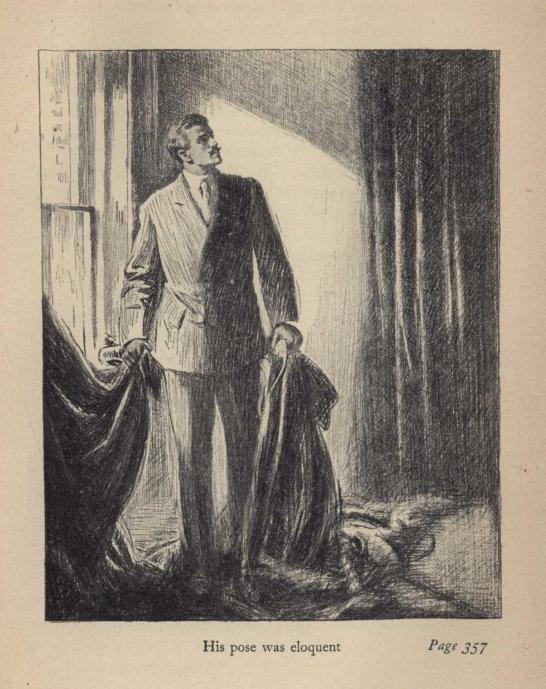
His pose was eloquent
He turned and caught sight of her. Her hands were outstretched, her eyes were burning with a new fire, as if her smoldering had burst into flame.
"Oh! You have done it! I knew you would!"
He gave her his two hands in hers, nodding his head slowly; his smile was that of one who viewed himself impersonally, looking on at his own actions. He did not speak. A quaint humor struggled in his mind with the intensity of the situation. Something in him, also, had snapped, and he was self-conscious in his new rôle.
She clutched his hands excitedly, and lifted her eyes up to his, with a new, unabashed fondness burning in them. She had thrown away all her reserves.
"It's magnificent!" she said. "Oh, how I have longed for this! How I have waited for it! And now, how I admire—and love you for it!"
Her face was so near his that, like an electric spark, the flash of eagerness darted from one to the other. He felt the shock of emotion tingling his blood. It swept his mind from control and flooded his will with an irresistible desire for her. He saw that she was ready for him, willing to be won. He took her in his arms and kissed her softly, but gripping her almost savagely in his embrace.
"Do you mean it?" he cried. "Do you love me, really? I can't believe it! It's too much for me. Tell me!"
She released herself gently, still looking up at him and smiling frankly. "Didn't you know? You, who know so much of women? I thought you understood me as I have understood you."
He still held her, as if he feared he could never get her again so close, and she went on:
"Oh, I would never have told you, if you had gone on as you were going, though I should always have loved you—I could never have helped that. But now, after this crisis, this victory—I know what it all means—I must tell you! Why shouldn't I? It is true, and I am not ashamed to be the first to speak. Yes, I love you!"
The reaction came, his sight grew dark at the thought of his unworthiness, and he freed her, putting her away slowly. Then, as if to resist any temptation, he clasped his hands behind his back.
"I can't stand it!" he exclaimed. "It isn't fair for me to let you say that. Don't say it yet. Wait till I have told you what I am. Then you will despise me, and hate me."
"Never!" she said firmly. "Do you think I don't know you? I am sure. It is impossible for you to surprise me. Whatever you have been or done, it will make no difference—for better or for worse. Of course, I can't know all the circumstances of your life, but I feel that I am sure of your motives—I may know an ideal 'you,' but, if that is not what you are now, it is what you are to be. It is that 'you' that I love—all the rest is dead, I hope." She swept her eyes about the barren room, and her hand went out in comprehensive gesture. "Surely all this can't mean anything less than that? You are not one for compromise or half-measures. You have burned your bridges, haven't you?"
"Oh, yes," he said. "I don't intend to do things half-way. But it's not a pretty story I have to tell. It's selfish, sordid, vulgar."
"Oh, I know something of it, already. Mr. Cayley has told me about that Bennett affair, for he suspected, somehow, that you were implicated in it. And I have guessed more. You needn't be afraid. But you had better tell me as much as you can—not for my sake, but for your own. Then it will all be over, and we can begin fresh."
She dropped to a seat on the couch and leaned languidly against the cushions, clasping her hands in her lap. He scarcely dared look at her, and walked nervously up and down the room, dreading the inevitable ordeal. For a while he did not speak, then he turned swiftly to say:
"Positively, I don't know where to begin!"
"You would better begin at the beginning, then—with Madam Grant."
"You suspected that, then?"
"It was that suspicion that has drawn me to you. I should never have begun to love you without that, perhaps. It seemed to justify my growing feeling for you. Haven't I hinted at that often enough? I mean that in some way we had been connected before. You were the little boy who disappeared when she died, weren't you?"
"Yes, of course."
"But I can't make it out! There was never any child there when I went, though I was conscious of some secret presence—some one invisible."
"I was locked in the closet—I watched you through a crack in the door."
"Oh!" Her eyes widened with a full direct stare; her breath came quickly at the revelation. He watched her, as her expression was transmuted from bewilderment to the beginning of an agonized disillusion. He could not bear it, as he saw that her mind was hastening to the explanation, and he forestalled her next question by his ruthless confession.