THE HEART LINE (continued 9)
Reading edition
"Yes, I know. I know you love him."
"Where is he, Felicia?"
"He's in this city. I shall bring him to you. Then we'll be so happy, all three of us—you and I and our dear son!"
Payson's voice rang out sharply in an angry exclamation:
"It's all a damned fraud!" he cried. "This is not a spirit at all!" He took a step forward.
On the instant, before even Vixley could move, Dougal had jumped up and run forward. As he dashed up the aisle he pressed the key of his electric torch and cast a bright light upon the group by the cabinet. The draped form had started back, Payson faced her, Vixley had risen from his chair fiercely, Flora Flint's startled face peered through the curtains.
"Come on, Max!" Dougal shouted, and threw himself bodily upon the person wrapped in the sheet. Maxim grappled at almost the same time, but before him Vixley sprang in and rained blow after blow upon Dougal, who fell, dropping his torch. Vixley then locked with Maxim. Starr and Benton had run up, hurtling past Spoll, who had risen to block the way. They were just too late to save Dougal, who had fallen, still holding his captive fast. It was too dark to see what was happening, but Vixley's oaths led them on, crashing over chairs, creeping and fighting through the now terrified crowd. A match was struck somewhere behind them, and, before it flared out, Starr and Benton fell on Vixley together and bore him to the floor.
The room was now horrid with confusion. A racket of moving chairs told that every one had arisen in panic. Women screamed, and there was a rush for the door. It seemed hours before there was a light, then Madam Spoll reached up and turned up the light. At that moment Ringa flew past her—she was thrown down and the lamp fell crashing upon the seat of a chair beside her. There was an explosion on the instant. She was drenched with blazing oil, and the flames enveloped her.
Her screams rose over the tumult so piercingly that every one turned, saw her, and fell back in fear and terror. She clambered to her feet clumsily, shrieking in agony, ran for the door, tore it open and fled down-stairs, to fall heavily at the bottom, writhing.
Benton was that moment free, and the only man to keep his senses. He burst right through the room, throwing men and women to right and left and broke out the door after her, and down the stairs, tearing a table-cloth from a table as he ran through the hall. He wrapped it about her, the flames scorching his face and hands as he did so. The woman was struggling so in her blind terror and torture that it was for a moment impossible to help her. Then, in a few heroic moments he conquered the fire. At last he called to the crowd above for help, and they carried her up into a small side room and laid her upon a bed.
Starr, meanwhile, still clung to Vixley while Maxim had held Ringa off. Spoll was busy extinguishing the fire on the carpet. Then some one at last lighted the chandelier, showing a score of white, frenzied faces, men and women in wild disarray, chairs broken and strewn upon the floor, a smoking, blackened place on the carpet where the remains of the lamp had fallen. The room smelled horribly.
Vixley lay in a welter of ornaments that had been swept from the mantel in his struggle. He was still cursing.
Dougal had held his captive fast through all that turmoil, yelling continuously for a light. Now Mabel and Elsie, who had flattened themselves against the wall, joining their screams to the din, crept trembling up to him to see what he had caught. He turned the limp figure in his arms and sought amongst the folds of the sheet, and turned them away at the face. Elsie gave a little cry.
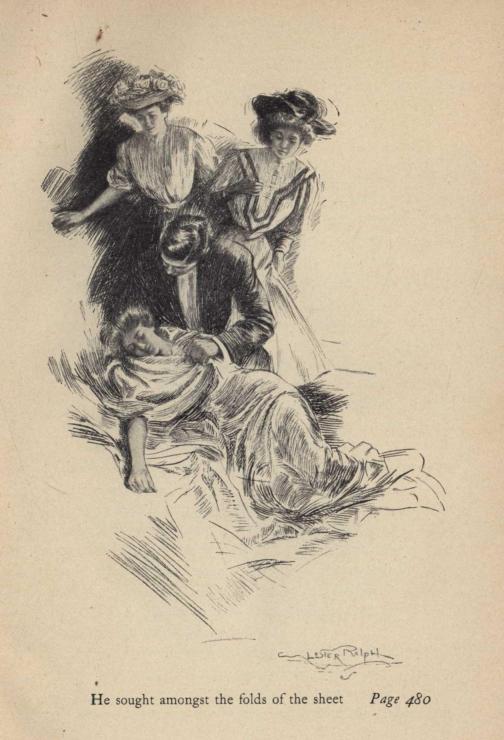
He sought amongst the folds of the sheet
It was Fancy Gray.
CHAPTER XVIII
A RETURN TO INSTINCT
Clytie Payson had come home after a two weeks' stay at Lonely with Mrs. Maxwell, poised, resolute, calm. She seemed sustained by some inward faith manifesting itself only in a higher degree of self-consciousness, as of one inspired by a purpose.
At breakfast, on the morning after the materializing séance, Mr. Payson read the morning journal interestedly, so intensely absorbed in its columns that he scarcely spoke to his daughter. But he did not mention the evening's event, and was moody and morose. The affair had received an extensive notice. Madam Spoll, it seemed, still lingered at the point of death. Although Mr. Payson's name was not mentioned, he was much disturbed and apprehensive of publicity. Clytie, noticing his abstraction, did not disturb him with questions.
After her father had left the house she went up to her workroom, put on her pink pinafore and commenced her bookbinding. She worked at the bench near the window where she could occasionally look out upon the shadows that swept over Mount Tamalpais. The day was alternately bright and lowering; it promised rain before night.
At ten, as she was pausing from her work, with a lingering look out into her garden, she saw a young woman coming up the path. It was Fancy Gray, looking about her as if uncertain whether or not she had found the right place. Fancy wore a black-and-white shepherd's plaid suit, bright and tightly-fitted, which picked her out, in an errant glance of sunshine, against the dull green shrubbery. She stopped for a moment to look at the sun-dial, raising her white-gloved hand to her red and white hat, then passed on toward the house, out of sight.
Clytie went down-stairs herself to answer the bell, and opened the door with a look of pleasure on her face.
Fancy hesitated. "Are you busy, Miss Payson?"
"Of course not!" Clytie held out both her hands. "If I were, I'd be so glad to have you interrupt me, Miss Gray. Do come in! How charming you look! I'm so glad to see you."
Fancy accepted the welcome, looking long into Clytie's eyes, as if she expected to find in them something of special significance. Her own were steady, and had in them an evidence of resolve.
"I've been hoping you'd come to see me, Miss Gray," Clytie began.
Fancy stopped on the threshold.
"Fancy Gray, please!" she corrected, with an elusive smile.
"Fancy Gray—I'm glad to be permitted to use such a lovely name."
"Make it Fancy, straight. Then I'll be more natural. I'm always stiff and stupid when people call me Miss Gray. I always feel as if they were talking about me behind my back." Fancy's smile broke out now, as if in spite of herself.
"I'd love to call you Fancy! It's good of you to let me!" Clytie answered.
Her smile was as delicious, in this gallant interchange. Fancy's smile seemed as much a part of her natural expression as the brightness of her open eyes; it was embracing, like a baby's. Clytie's had the effect of a particularly gracious favor, almost a condescension, a special gift of the moment.
Fancy stopped again at the entrance to the library.
"Say, this is awfully orderly," she said, "haven't you got some place that isn't so tidy and clean? I'm afraid I wouldn't be comfortable here, and I want to talk to you."
Clytie looked at her amusedly. "So you're one of those persons who think dust is artistic? Come up into my workroom, then. You'll find that untidy enough."
Up-stairs they went, to the workroom.
"My!" said Fancy. "If you call this place untidy, you ought to see my room! Why, it's as neat as a pin!" She entered, nevertheless, and looked about her with curiosity at everything.
"Haven't you a looking-glass here?" she asked in astonishment.
"No, but I'll get you one."
Fancy laughed. "I couldn't live an hour without a mirror," she confessed. "You're really queer, aren't you! And you don't even wear jewelry! I'm afraid modesty isn't my favorite stunt. It's very becoming to you, though. I suppose it doesn't go with painted hair." She sighed.
"I don't believe that even you could improve on nature, Fancy!"
"I'm sure nature intended me for a blonde, and got careless. Did you ever know a brunette who didn't want to be a blonde?" She looked at Clytie's tawny hair with evident admiration.
Clytie shook her head, smiling. "I'd give you my hair for your complexion."
"Done!" Fancy rubbed her handkerchief across her pink cheeks, and handed the bit of cambric to Clytie. After this comedy pantomime, she took the little silver watch from her chatelaine pin, opened the back door, where, inside, was a bright and shiny surface, and regarded her face, pouting. Then she looked across at Clytie.
"You're so pretty, Miss Payson! You're four times and a half as pretty as I am!"
Clytie ventured to touch her little finger to the dent in Fancy's upper lip. Fancy retreated a step. "My dear," Clytie asserted, "if I had that, I'd be sure that men would be crazy for me till I was seventy years old!"
Fancy shook her head. "I guess I can't beat that. That's what Gay calls 'the pink penultimate.' And the worst of it is, I suppose it's true! But I'll never be seventy if I can help it." She turned away, suddenly grown serious. The room grew dark. It was as if Fancy's mood had turned off the sunshine.
"What are you doing, now?" Clytie asked.
"Oh, just drifting." Fancy's voice was not hopeful.
Clytie took her hand. "Why don't you come here and stay with me for a while? I'd love to have you."
Fancy gently released her fingers in Clytie's and did not look at her.
"Oh, I wish you wouldn't be quite so kind to me, Miss Payson; I can't stand it!" Her mouth trembled; her gaze was serious.
"But it would be so kind of you to come!" Clytie urged.
Fancy smiled wanly. "I can't do it, Miss Payson, I won't explain. I never explain. It bores me. But I simply can't."
"Well, you know, if you ever do want to come—"
"I'll come, sure!" Fancy looked at her now, with fire in her eyes, not flaming, but burning deep. "Whenever I forget what a thoroughbred is like, I'll come! Whenever I need a teaspoonful of flattery to last me over night, I'll come! Whenever I want to know how much finer and kinder women are than men, I'll come! Whenever—"
She would have gone on, but Clytie interrupted her. "Whenever you want to make me very happy, whenever you want to do me the greatest favor in your power, you'll come!"
Fancy's eyes narrowed and twinkled. "I'm all out of breath trying to keep up with you! I give it up. Take the pot!" She turned to the bench and examined the tools in a box.
"Ugh!" she commented. "They look like dentists' instruments!"
"I don't believe you ever had to suffer from them! It doesn't seem possible!" said Clytie.
In response, Fancy engagingly showed her double row of small, white, zigzag teeth. Then, with a sudden access of frivolity, she favored Clytie with an exhibition of her little, pointed tongue, which she erected and waved sidewise. This done, she dropped into a chair again. The sun had returned and visited the room, making a brilliant object of her jaunty figure as she sat under the window. She wore the fine gold chain with the swastika that Clytie had given her. She fingered it as she spoke.
"Miss Payson," she said, "I'm going to ask you something that perhaps is none of my business."
"Ask what you please," said Clytie, but she looked at Fancy with something like alarm.
"Have you seen Mr. Granthope lately?"
Clytie shook her head. "No."
"Could you tell me why not?"
"I'm afraid I can't, Fancy."
"I'm terribly worried about it. I'm sure there's some trouble. Oh, Miss Payson, I know he's awfully unhappy. And I can't bear that!"
Clytie walked to the window and looked out, standing there with her hands behind her back. There was a faint line come into her forehead. "I'd rather not talk about it," she said quietly.
"But I'm sure that if there is any misunderstanding, I might help you. Oh, Miss Payson, I don't want to be impertinent, but I can't bear it to think that he isn't happy. Can't you tell me about it?"
Clytie turned slowly, a look of pain deepening on her face. "I can only tell you this, that I was mistaken in him."
"Mistaken? How?"
"Not in quality, so much as in quantity, if you know what I mean. I know what he's capable of, what he has done, and what he can do. I don't feel any anger or resentment, for what I know, now, that he has done. I feel only pity and sorrow for him."
"But what has he done? That's just what I want to know. You mean that it was something definite?"
"Yes."
"And—you believed it of him?" Fancy could not restrain her surprise.
"I had to believe it. Oh, Fancy, don't you understand? It was the sort of thing that no woman could forget. It was of no importance except as showing that he wasn't so far along as I had thought. It merely means that I'll have to wait for him. And I shall wait for him. I'm so sure of him that I can wait, though it hurt so at first that I couldn't possibly see him. That's all."
Fancy bit her lip. There was a little, determined shake of her head that Clytie did not see. "Miss Payson," she said, "you must tell me what it was. I've heard Professor Vixley say a thing or two that aroused my suspicions." She went on slowly, with an effort. "I know that Frank adores you—that he has, ever since that night you came with him to his office, after his accident."
"Oh, but this was after that," Clytie said wearily. "It was something he told Vixley."
"After that! Why, Frank hasn't had anything to do with Vixley or Madam Spoll since then, except to try to get them to leave your father alone."
"I saw his own handwriting, Fancy; the very notes of what I had talked about to him—even the little intimate things—they nearly killed me. And Professor Vixley told me himself that Frank had been giving him information right along, up to only a few weeks ago—while we had been so happy together—oh, to think of it!"
Fancy's face had varied in phase, like the opening and shutting of the clouds. Now it was eager, rapt "Oh, I understand, now!" she cried, jumping up.
"Why, Miss Payson, Vixley can no more be trusted than a gambler! Don't you know that he's wild with Frank? Vixley's got it in for him; he is trying to ruin him! Don't you know that Frank has been trying to buy him off, just to save your father from being cheated by them? Why, Frank offered Vixley a thousand dollars to leave town, only last week. Vixley told me so himself!"
"A thousand dollars? That's impossible." Clytie's voice was still hopeless.
"I can't imagine where he got the money, but he had it with him, in cash. Vixley said so."
"How long ago was that?"
"Two weeks ago, about."
Clytie reflected. "I saw Frank on the platform at Stockton, two weeks ago. I wonder—"
"Yes, it was the day after he got back, I remember now."
"Oh!" Clytie's face lightened as if another person had come into the room. She looked away, as if to greet an unseen visitor. Her hand was raised delicately. "I see." Her voice came suddenly, definitely. Then she stared hard at Fancy. "Oh, Fancy, I'm almost frightened at it! I don't dare to believe it. Oh, if I've made a mistake in suspecting him. If I've accused him to myself unjustly, how can I ever bear it! But I saw those notes—"
"And you didn't ask him to explain them?" Fancy spoke very slowly. She did not accuse, she only wondered.
"No." Clytie's tone had dropped low, and she went on, fluttering hurriedly. "I simply went away. Oh, think of it—it was as melodramatic as a play—that's the way women do on the stage, isn't it? But you see, I did know awful things about him. Fancy—he had told me, and I suspected more. There was something in the notes about my present to father, and his birthday had only just passed. That proved to me that Frank's notes had been made recently, I thought."
Fancy looked at her with a quizzical expression. "I knew a fellow once who used to call me a marmoset. I guess that's what you are, you poor dear! Why, Frank told me about your binding a book for your father the day he first came here. You must have spoken of it then."
"I did!" Clytie fairly threw out. "I remember it now! And that was before—before he really knew me, wasn't it! Oh, what shall I do, Fancy?" Her look was, for the moment, as helpless as a child's.
"Do?" Fancy repeated, shrugging her shoulders. "Why, the telephone wires are still working, aren't they?" She spoke a bit dryly. She had done her work, now, and relapsed into a sort of apathy.
"And I prided myself on my intuition, and on my fairness!" Clytie went on, unheeding her. "I knew that I saw in him what no one else saw—not even you, who knew him so well, and who wouldn't suspect him of anything so base as that! To think of my being the victim of such a claptrap trick!"
Fancy raised her eyebrows and watched her quietly. "What I can't understand now, is why you're wasting your time talking about it."
Clytie stared at her, her face still shadowed by her emotion. Then her smile came rapturously. She turned and ran down-stairs to the telephone.
Fancy walked to the window forlornly. There she leaned her head on her arm against the pane and shut her eyes, as if she were fatigued. It was black in the west, and the Marin shore was shrouded in the murk. The harbor was covered with dancing whitecaps. The storm was imminent. She stayed there, motionless, until Clytie's step was heard coming up, then started into life again and gave herself a shake.
"He's coming right up!" Clytie announced.
Fancy immediately looked at the blue enameled dial of her little silver watch. "Well, I must be going."
"Oh, please stay!" Clytie exclaimed, holding her tightly. "I really want you to, so! It's you who have done it all."
Fancy smiled at last, and released herself. "Yes, I've spent my life in straightening out other people's snarls," she said. "Sometime I hope some one will be able to straighten mine. But I've got a date, really."
"Oh, do tell me that you're as happy as I am," Clytie exclaimed. "I've been so selfish, I'm afraid! I don't know who he is, but I'm sure he must be fine, if you care for him. How I wish I could help you, dear!"
"The only way you could, I'm afraid, is by lending me some of your brains—and I'm afraid they wouldn't fit my noddle. He's awfully clever, and I feel like a fool when I'm with him."
"But you do really love him, don't you?" Clytie asked anxiously.
Fancy nodded gravely. "I guess yes. As much as I can love anybody. I'm afraid of him. That's one sign, isn't it?"
"And you can't tell me who he is?"
"Not yet."
"Fancy, when you're married, I'll give you a wedding."
"I accept!" said Fancy Gray.
She turned to go, but hesitated a moment, as if she could hardly make up her mind to ask the question, yet couldn't go without asking it. "Miss Payson," she said finally, "did you tell Frank that I had been here?"
"Of course I did!"
"What did he say?"
"He said that it was like you. That you always played fair."
"Good-by!" Fancy said, and suddenly breaking through the reserve that had so far constrained her, she laid her cheek for a moment to Clytie's.
Clytie kissed her. The two walked down-stairs arm in arm. At the front door Fancy paused and said:
"Take my advice, Miss Payson, and don't explain. Never explain. If you once get into that habit you're lost. It only wastes time. Get right down to business and stay there. Your head belongs on his shoulder, remember that. All Frank will want to know is what you're going to do next. Keep him guessing, my dear, but never explain! Now, I'm going to try and get home before it rains."
She turned up her collar, gave a quick toss to her head, and walked rapidly down the garden path. At the gate she turned, gaily gave a mock-military salute, a relic of her old vaudeville manner, then ran down the steps.
Clytie watched her till she had disappeared. Then she went up-stairs and changed her frock.
Fancy's sage advice was wasted. There were explanations, a torrent of them, when Francis Granthope came, explanations voluble, apologetic, impetuous, half-tragic, semi-humorous. The equilibrium of Clytie's mind was completely overturned and its readjustment came only after a prolonged talk. Every trace of the priestess, the princess, the divinity was gone forever, now. She was more like a mother rejoicing at the restoration of a lost child, for whose absence she blamed her own neglect and carelessness. It was all too delightful for Granthope to wish to cut it short. He was hungry for her.
He, too, had his explanations and his news. For two weeks his hands had been tied. Clytie had disappeared from his ken, and he had had no way of tracing her, for it was useless to telephone to the house or to ask of her father. There had been nothing for it but to wait in the hope that whatever had caused the interruption would come right of itself. He had never really felt sure of Clytie—her acceptance of him had seemed too wonderful to be true, a fortune to which he was not really entitled, and which he might lose any instant. Whether or not Vixley or Madam Spoll had effected the separation, he had no way of determining.
He told then of his trip to Stockton where, by establishing his identity by means of the finger-prints, he had succeeded in obtaining possession of the money he had deposited there so many years ago. This had amounted, with interest, to several thousand dollars. He had gone immediately to Vixley to seal the bargain they had made, but the Professor had absolutely refused to accept any payment for leaving town. Indeed, he had hinted that he had schemes on foot which would bring him an income that Granthope could not hope to rival. How matters stood between Mr. Payson and the mediums, neither Granthope nor Clytie knew. They had not yet heard of the materializing séance, and the situation was, so far as they knew, the same as before. It was agreed that there must be another attempt to rescue Mr. Payson, and this time through Doctor Masterson, who was probably venal.
Granthope, meanwhile, however, had perfected his plans. He had sufficient money, now, to warrant his devoting himself to the study of medicine, a project he had so long contemplated that, with the start he had already made, would make it possible for him to practise in two or three years. He had, therefore, abandoned all idea of going upon the stage. Clytie approved of this with considerable relief. The prospect of reviving gossip by Granthope's appearance as an actor had caused her much dread. They had already been much talked about. Society had discussed them until it had grown tired. Nothing was sensational enough to last long as an object of curiosity in San Francisco, and a half-dozen other affairs had caused them to be almost forgotten.
After this first flurry of talk, in which she had come down from that lofty spiritual altitude where she had dwelt for the last two weeks, she was sheer woman, thrilling to his words and to the sense of his nearness. As they had progressed in intimacy her maternal instinct had asserted itself more and more frankly towards him. She had treated him at times almost as if he were a boy whose education she was fondly directing. She had lost some of that feeling, now, in virtue of her mistake; she was curiously humble.
He, too, had somewhat changed. Before Clytie's direct gaze he had lost something of his power; he had been afraid of her. In this readjustment the normal phase of courtship was restored, and, feeling his way with her, delicately perceptive as he always was with women, he began to notice that she would willingly resign the scepter—she would gladly be mastered if he would but put forth his power. She was learning to be a woman; she would be conquered anew.
He was to learn all this slowly, however; so slowly that, at every manifestation of her inclination he had a moment's pause for the wonder of it, tasting the flavor of her condescension, marveling at his own conquest. To him, as to all lovers, his sweetheart had been a woman different from all her sex. He was now to find that she was not one woman but two—that in her the subtly refined spirit of his vision shared her throne with that immemorial wild creature of primal impulse who is the essence of sex itself; who, subdued or paramount, dwells in all women, saints and sinners alike. He had, in virtue of his victory, merged those two warring elements in her soul into one. She had come into her birthright, not lost it. She seemed a little frightened by the metamorphosis, but there was a triumph of discovery, too; he reveled in its manifestation, but he was still timorous before the new, splendid, potent being he had invoked. There was an intoxicating excitement, now, as he saw in her traces of every woman he had known. It was as if, after exploring a strange land and meeting its people, he had at last come upon the queen who combined all the national characteristics and fused them with the unique distinction of royalty.
They had, also, as yet, a whole lovers' language to manufacture, metaphors to weave into their talk, words to suggest phrases, phrases to stand for moods and emotions. But such idioms are untranslatable—they will never bear analysis. For love is a subjective state, whose objective manifestations are ridiculous. No one can see a kiss—it is a state of being.
But into this relation they entered, as children go to play, making their own rules of the game, establishing their own sentimental traditions as lovers use. With such vivid imagination as both possessed the pastime became deliciously intricate; it had pathos and comedy, wind and dew and fire. They spoke in enigmas, one's quick intuition answering the other—there were flashes so quick with humor that a smile was inadequate in satisfying its esoteric message. An observer would have seen Clytie, her eyes alight, her pose informed with gracile eagerness, waking from her gentle languor to inspired gesture—Granthope pacing the room, erect, virile, dark, sensitive in every fiber to her presence, flinging a whimsical word at her, or with a burst of abandon pouring himself out to her to her delight. There was an intellectual stimulation as well as an emotional pressure in their intercourse that forbade any monotony of mood. There was a tensity of feeling that broke, at times, into waves of laughter; but there were moments, too, when the sudden realization of their relation, with all its doubts, its unknown paths, and secret, fatal web of circumstance, impelled them to make sure, at least, of the moment, and to defy the future with an expression of their present happiness. So they came down, and so they went up. From height to depth, from shadow to light he pursued her. He chased, but she was ready enough to be caught! She held a hand to him and helped him up; they met in delightful solitudes of thought; they walked together through the obvious. That he should so follow her, that she could understand, there was wonder enough, even without that other diviner communion. It was a lovers' play-day, now; there was time enough for the lovers' ritual and the worship at the shrine. For this day was the untellable, impossible delights of wonder. They took repossession of their kingdom, no longer jeoparded by doubt.
It was Clytie, who, at last, grew more bold, more definite. She rose and put her two hands on Granthope's shoulders, smiling at him with pride in her possession.
"I can't wait any longer," she exclaimed. "I've suffered enough. Before anything else comes between us, let's settle it so that nothing can separate us. You see, my instinct has triumphed after all. I'm sure of you—indeed, I always have been. I must speak to father to-morrow, and, if you like—" She hesitated, in a sudden, maidenly access of timidity.
"We'll be married—instantly? Dare you?" He crushed her impetuously in his arms, not even this time without a wonder that she should permit him, not quite daring even yet to believe that she was more than willing.
She freed herself with an expression that should have reassured him. "There's nothing, now, to be gained by waiting, is there?"
"Nothing, if you can live on what I can provide."
She laughed at the very absurdity of it. "It may be hard, but I think I can manage father," she went on. "He's too fond of me really to oppose what I'm set on."
"I only wish I could do something to assure him, to propitiate him," said Granthope. "My position has been so undignified that I've had no chance. I have been meeting you surreptitiously, and I suppose he suspects me of being after your money."
"While the truth is, I'm after yours!"
"I wonder if, after all, it is mine?" he said thoughtfully. "I have never been able to find any heirs of Madam Grant—and her last message to me seemed to be that I should have what she left."
"Oh, it's yours, I'm sure!" she said.
"I long so to know about her! If I could once convince your father of my sincerity there's much I'd like to ask him."
"Father is a strange man. He is often unreasonable and prejudiced in his judgment and treatment of people, but there's a warm vein of affection underneath it all. There's something hidden, something almost furtive, even in his attitude toward me, sometimes, that I can't understand. I happened on a queer evidence of his emotional side only a little while ago. There is a big trunk up-stairs in our garret where my mother's things are stored. It's always kept locked; I've never seen the inside of it. Well, I started to go up into the attic for something, and as I was half-way up the steps where I could just see into the loft, I heard a noise up there. Father was on his knees, in front of that trunk. He was examining something in his hand. There was a tenderness and a pathos in his posture—I got only one glimpse of him before I went down again. You know my mother died when I was about five years old—soon after that day at Madam Grant's. He never seems to want me to talk about my mother at all; he evades the subject whenever I mention her. I think that he must have been very fond of her, and it's still painful to discuss her."
"Have you ever asked him about that clipping about Felicia Gerard?"
"Why, he's as reserved about her, too. Isn't it. strange? But I'm sure that she was Madam Grant—there's a mystery about her I can't fathom. Do tell me more about her. You don't know how queer it seems that I have actually seen her."
He gave her all he knew of the strange, mad woman's life—it was not much, as he had been so young then—his straying into her rooms, her adoption of him, his education, his loneliness, his love. She warmed to him anew as he told the story.
"Ah, that's the part of you I know and love the best!" she exclaimed. "How good you were to her! If anything could make me love you more, it would be your devotion to that poor, lonely, ravaged soul. It seems as if you have served me in serving her, and I would like to think that I could pay you back, by my love, for all you gave her. It stirs me so to think of her pain and her despair!"
"Let's make a pilgrimage!" he said impulsively. "I haven't been inside the Siskiyou Hotel since I was a child, though I've passed there often enough. It's a pretty disreputable place now, I'm afraid."
"Oh, yes!" Clytie caught up with his eagerness. "Think of seeing that place again, where we first met! It will be a celebration, won't it! How long is it? I don't quite dare think."
"Twenty-three years!"
"And all that time we've been coming together—"
"It was a wide curve my orbit traced, my dear!"
"It's one of the mysteries of life that while we seem to be going away from each other, we're as really coming together. But we'll travel the rest of the course together, I'm sure!"
They set out, forthwith, on their quest for what had been. It had begun to rain, but their spirits were unquenchable by the storm. The excursion was, indeed, an adventure. Granthope himself felt his fancy aroused at the thought of the revisitation of the old home. It had a double charm for him now, as the spot where the two women who had most affected his life had been.
He left her under the shelter of an awning while he went into the saloon to interview the bartender who rented the rooms in the building. The man had heard of Madam Grant, though it was so long since she had lived there. There were still stories told of her wealth and her eccentricities, as well as of her occult powers. The rooms had even, at one time, been reported to be haunted, but they had always been let easily enough. At present they were occupied by some Russians. Yes, Granthope might go up; perhaps they would let him in.
They ascended the narrow, dingy stairs together. The wall was grimy where many dirty elbows had rubbed the plastering; the rail was rickety and many balusters were missing. Granthope rapped at the door in the hall with a queer, sick feeling of familiarity, though it was as if he had read of the place in some story rather than a place he had used to inhabit.
A Jewess opened the door, her sleeves rolled to the elbows, her face plump and good-natured. She smiled pleasantly.
"Would you mind our coming in to look at your rooms?" he asked.
"What for?" she said.
"Why, I used to live here when I was a child, and I'd like to show this lady the place."
"If you want to, you can, I suppose. It ain't much to look at now, though. We have to take what we can get, down here."
Her curiosity was appeased by the coin which Granthope slipped into her hand, and she sat down to her sewing phlegmatically, looking up occasionally with little interest.
The place was, of course, much changed. The windows were washed, the floor scrubbed and partly covered with rag rugs. It was well furnished and well aired. Granthope pointed but the little chamber where Madam Grant had slept, where his own bed had been, and, finally, the closet from which he had first spied upon her. Clytie looked about silently, much moved, and trying to bring back her own recollections of the place.
"If I close my eyes, I can almost see it as it was," she said. "I can almost get that strange feeling I had when I came here. If I could be here for a while alone I think I could see things. I'd like to go into the closet again. Let's see if the crack is still in the door."
It was still there. She asked permission to go inside, and the Jewess rather uncomfortably agreed. The place was filled with clothing; it was close and odorous; the shelves were filled with boxes, rags and household belongings. Clytie went in rather timidly.
"Go over where I sat in the front room, that day," she said. "I want to look through the crack, as you did. I'd like to be locked in, too, but the key is gone."
She closed the door on herself while Granthope walked to the bay-window and looked idly out. It was such a strange sensation, being in the old place again, that for some moments he lost himself in a reverie; then, turning and not seeing Clytie, he walked rapidly to the door and opened it.
She stood there, leaning back against the wall of clothing with a wondering, far-away expression, her eyes staring, her face white, her breath coming fast through her parted lips. He took her hand, thinking that she was fainting, and led her out. She recovered herself quickly and drew him into the front room.
"I saw my father while I was in there," she whispered. "He was looking about the room furtively, as if searching for something. What can it mean? I'm afraid something has happened to him—I'm alarmed about it. I must go right home and see if anything's the matter. I had a strange feeling, like a pain, at first, in the dark, and I was frightened. Then I saw him. Come, let's go away!"
She went up to the Jewish woman and shook hands with her, thanking her for the courtesy. The old lady patted Clytie's hand approvingly.
"That's funny, what everybody wants to see my room for," she said, "but I don't care when I get a dollar every time, do I? Last week they was an old gentleman here, like you was, to see it!"
"What was he like?" Granthope inquired.
"Oh, he was bald-head, with a spectacles and some beard."
Granthope and Clytie exchanged glances.
"He must have been down here for something," she said. "I can't make it out. I'm afraid that there's some trouble. It worries me."
CHAPTER XIX
FANCY GRAY ACCEPTS
The rain had come in a vigorous downpour, washing away the mantle of dust that had so long lain over the city. The storm finally settled down to a steady pelting of heavy drops, lightened occasionally to mild, drizzling showers, only to be resumed with greater violence toward night. Every one was glad for the flushing the town received. There was a novelty and excitement about the rain, a relief after the parched, monotonous months of cloudless skies. Men and women walked the streets smiling, the women especially; for that free, fearless gaiety, the almost abandoned good nature of San Francisco girls, was not to be quenched.
On Thursday evening, Fancy Gray, to all appearance her old, gay self, smiling as if she had never a care in the world, went down to Fulda's to dine with Blanchard Cayley.
In a city of restaurants, Fulda's restaurant was unique. The Pintos had discovered the place, and by their own efforts had made it. Maxim and the artists of the quarter had gained Fulda's consent to a new scheme of decoration, a plan so mad and impudent that the room was now a show-place for visitors. The walls were covered with cartoons and sketches as incongruously placed, perhaps, as the embossed pictures on a bean-pot, but what was lacking in art was made up for by a bizarre, esoteric humor that was the perpetual despair of the uninitiated.
Maxim's chief contribution, a huge cartoon with caricatured portraits of his friends, had the place of honor; it was a superb piece of low comedy in crayons. Beyond this the sketches became more grotesque, the inscriptions more cryptic. Quotations from Rabelais, from Brantome, from Chesterton, Whistler and Wilde were scattered here and there, mingling with fiery burlesques of Bohemians, Philistines, lobsters and artists. No one, not even the authors, knew the point of most of these jokes well enough to explain them intelligibly, and it was this baffling suggestiveness which drew patrons to the restaurant and kept its charm piquant. One saw at each table new-comers with questioning faces pointing to legends in Greek and Esperanto and Yiddish, and wondering at the inscrutable accompaniment of illustration. It was a sort of mental and artistic hash spread upon the walls. The humor grew fiercer as one's eyes rose to the ceiling. There, a trail of monstrous footprints, preposterous, impossible, led, with divagations, to a point above the central table which was always reserved for the Pintos. To crown this elaborate nonsense, they had drawn a frieze below the cornice with panels containing the names of the frequenters of the place, alternated with such minor celebrities as Plato, Browning and Nietzsche.
In a larger city, such a place would have had a temporary vogue, and then, after having been "discovered" by reporters and artists, have sunk into the desuetude of impecunious rural diners-out, one of the places of which one says: "Oh, you should have seen it two years ago." But San Francisco is of that fascinating size, half-way between town and city, and of that interesting age where the old is not quite forgotten and the new not quite permanently instated,—it is, above all, so delightfully isolated that it need not ape the East. Though it has outgrown some of its Western crudities, it is significant that such a restaurant as Fulda's could become and remain a resort for the gathering of the cleverest spirits in town. It had already achieved that reputation; it was patronized by the arts. The visitors, for the most part, either did things or wanted to. One was apt to know almost everybody there. If one didn't know Mr. Smith, one's friend did; or one knew Mr. Smith's friend.
To this place entered Fancy Gray, drifter, the day after the materializing séance, in a new, blue mackintosh and a pert but appropriate hat. She nodded, to Felix, at the counter, and, following underneath the trail of footprints on the ceiling, came, jovially as ever, to the central table. Dougal, Elsie and Benton were sitting at the far end of it. Dougal sprang up with a grin.
"Come and sit down quickly and tell us all about it!" he exclaimed. "What happened after we left?"
She sat on the side of a chair without removing her coat, and gave them her ever-ready smile. "Say, you didn't raise a rough house or anything, did you? I thought it would be a case for the coroner before you got through. If I'd known you were going to be there I wouldn't have been in the cast. Wasn't it awful? Madam Spoll was pretty badly burned, I hear."
"I hope I'll never have to see anything as horrible as that again," said Benton. "But I did what I could. I hope she'll recover."
"We waited till the police and the ambulance came and then we got out," Dougal added. "There was nothing more to do but testify. Did you see the account of it in the paper? I believe they're going to have more about it, and play it up for all it's worth. What became of you, Fancy? Last I saw of you you had skipped into that back room."
"Oh, as soon as I had put on my shoes, I got out as quick as I could by the back way. I didn't know whether the house was going to be pulled or not. I'd had trouble enough for one evening. I'm all black and blue now, from Dougal's holding me."
"How did Vixley feel, I wonder? He must have been pretty sore."
"Sore! I guess he was, in more ways than one. But Flora Flint was the funniest! They found her in the cabinet, half dressed, after all the crowd was cleared out—she had been afraid to move."
"How did you happen to be there, anyway, Fancy?" Elsie asked. "I thought you hadn't done anything with that medium crowd for years."
It was not often that Fancy was embarrassed, but she seemed so, now.
"I haven't. I don't know why I did—except—they asked me, and I wanted to oblige somebody—and I needed the money. I had forgotten I had told you to go to Flora's."
"Aren't you going to eat?" Dougal asked. Fancy usually dined at the central table several times a week. Cayley's attentions were already on the wane.
"No, I've got free eggs to-night," was the reply.
Her eyes had been on the door of the restaurant, and, at this moment, they were rewarded by the sight of Blanchard Cayley, who entered and looked about the room for her. "Well, I'm going to meet my royal meal-ticket," she said, rising and waving a hand at him. He nodded, and came down to her, bowing to several friends on the way, and the two took a table beyond the Pintos. She faced Dougal who made disapproving faces at Cayley's back.
The room filled up. One long table was decorated, with flowers, and a party of ladies and gentlemen from up-town soon came in and took seats there. They began immediately to chatter and look about the walls, commenting upon the decorations. At other tables Fancy saw artists, newspaper men and men about town, who had been pointed out to her before. To some of them she nodded. Cayley knew many more. It was like a great family dining-room.
"Well?" said Cayley, in his peculiar tone that made of one word a whole sentence.
"I evidently made a hit. I hope you're satisfied, now."
"You certainly brought down the house." There was a sarcastic, almost a surly note in his voice.
"I'm awfully sorry things went wrong, Blan," she said. "I wouldn't have done it if I'd known the crowd was going to be there. I'm sorry now I consented to take part. I hope I'll never see Vixley again. He was horrid to me."
"I've seen Vixley. He says Madam Spoll isn't expected to live."
"Isn't it awful? I didn't want to do it, Blan, you know I didn't; I wouldn't have done it for anybody but you. I don't see how you can bear to have anything to do with Vixley. Ugh! What did you want me to do it for, anyway?"
"Oh, only to find out some things, that's all. Of course I couldn't do it myself, could I?"
It was evident, now, that he had been drinking. He had not shown it in his walk or in his voice, but there was a slight glaze to his eyes that told the story. He had been abstinent for so long that Fancy wondered at it. He ordered a flask of chianti and poured two glasses.
"You oughtn't to begin again, Blan—don't!" she said anxiously. "Water's good enough for me."
"Pshaw! Don't worry, I'm all right. You don't think I'm drunk, do you?" He laughed harshly.
"N—no, but I don't like it."
"Forget it, Fan; nobody ever saw me drunk. I only get confidential, that's all. In vino veritas. There's a double meaning there. Exoteric and esoteric."
At this moment the waiter appeared with a stone bottle and two Chinese cups. "Mr. Dougal sent this over with his compliments. It's saké," he explained. Fancy kissed her hand to Dougal, and poured for herself and Cayley.
"Ugh! It's horrible!" she said. "Isn't it?"
"No, it's the real thing; I like it." Cayley drank it all and helped himself to more.
"Did you find out what you wanted to know?" said Fancy, proceeding with her dinner daintily.
"No, the row came just in time to queer the whole thing."
"Of course you know that if Dougal had had any idea it was me—"
"Oh, it wasn't Dougal, it was old man Payson—he caught on—"
Fancy laid down her fork, and narrowed her eyes. "Payson?" she repeated.
"Yes, of course; the old chap you were talking to, weren't you?"
She looked at him with a strange expression. "Payson? I didn't think—I was too excited to realize—I mean—who is he, Blan?" Her hands fell into her lap and clasped one another tightly.
"Oh, an old boy I know, a good sort, but a fool. No fool like an old fool, is there?" He poured another glass of chianti, without noticing how intense she had grown. His eyes were dallying with two good-looking girls across the room.
"Is Miss Payson—the one who was with you at Carminetti's—his daughter?"
He looked up at her sharply, now, but her frown meant nothing to him. He returned to his tagliarini. "Yes—why?" he said.
"Tell me about her, Blan, please," Fancy begged, with an unusual air of anxiety.
"Nothing to tell, except she's a disdainful beauty, and a little too haughty for me. Fastidious, pre-Raphaelite, and super-civilized and all that. You wouldn't care for her, any more than you would for a Utamaro." He smiled to himself at what Fancy had once said of Japanese prints.
"H'm!" Fancy put her chin in her hands, and kept her eyes on Cayley. "So that old gentleman was her father," she said in a low unimpassioned voice. "It was Miss Payson's father I was hired to fool!" Suddenly she spoke up more sharply, but with a tremor in her voice. "What did you want me to play spirit for, Blan? Out with it!"
He saw now that something was wrong. It made him peevish.
"What do you know about Miss Payson, anyway?" he demanded.
"I've—seen her."
"Well, what did you think of her?"
"I thought she was a thoroughbred."
"Indeed?" Cayley thought it over, looking somewhat abstractedly at a picture on the wall, entitled: "Je congnois la faulte des Boesmes." Then he turned with an open countenance to her and said, with an air of candor:
"You see, Fancy, I happened to know Payson was in the clutches of Vixley and this Spoll woman—they were sucking his blood. I thought I could rescue him if you would play spirit, and then tell Payson afterwards what a fraud it all was. Understand now?" He smiled blandly.
"I see," she said, and went on with her dinner.
"Then again," Cayley remarked, "I thought you wouldn't mind getting even with Granthope."
This brought her up again with an angry flush. "What has he got to do with it?"
"Well, he played it rather low down on you, didn't he?"
"What d'you mean?"
"Oh, he fired you."
"He didn't! I left of my own accord." Fancy's lie came impetuously.
"Did you know that he's after Miss Payson, now?"
"So I've heard."
"You're remarkably amiable about it, my dear. You didn't really care for him, then?" His smile was unendurable.
"I never explain. If people can't understand without explanations, they never can with them."
"Then you don't mind it at all?" he insisted.
"No—I don't mind it. I'm glad." The words came from her slowly, this time.
"What d'you mean?"
Fancy was silent.
"Well, don't you think he ought to be—shown up a little?" He was on his third cup of saké, but his hand was as steady as ever.
Her lips parted, and her breath came suddenly for an exclamation, but the protest got no further than her eyes. She dropped them to the table-cloth, where she marked crosses with her little finger-nail. Dougal was making overt attempts to attract her attention and the diversion was maddening.
"What d'you mean?" she asked.
"If you were really a good enough friend of mine to help me out—"
"Oh, I'll help you out, Blan; what d'you want me to do?" she said quite eagerly, now. He did not notice her suppressed excitement.
"Well—I suppose you know a good deal about him?"
She nodded wisely.
"And some things, I suppose, might make considerable difference if they came out? You know what I mean."
"Do you want me to tell them?" she flung fiercely at him.
He took alarm, and, reaching across the table, attempted to touch her hand. She evaded him. "Of course I don't want you to do anything dishonorable—but—you said yourself she was a thoroughbred—do you think it's quite the square thing to stand by and let a man like him marry a nice girl like Miss Payson?"
"I thought you said she was supercilious!"
"No, super-civilized, that's all. Call it statuesque. But all the same I hate to see her get stung—don't you, now? Come!" He leaned back and folded his arms.
"She's too haughty for you, I thought!"
"Did I say that? Well, I'm a friend of the family, you know—I want to do what I can for them."
She reached nervously for her wine-glass, and her hand, trembling, struck the chianti flask and tipped it over. Before she could set it straight it had spilled into a plate, drenching a napkin which lay partly folded there. The linen was turned blood red. Cayley laughed at her carelessness loudly. Dougal looked across again, but Fancy avoided his eye.
"Blan," she said, leaning slightly towards him and speaking low, "do you love me? Or are you just playing with me?"
He seemed to consider it. Then he said, very earnestly, and evidently with a subtle psychological intent, "I'm only playing with you, Fancy!" And he smiled.
Her fingers drummed on the table.
"But I'll never treat you the way Granthope did," he added.
Her hands came together again in her lap. "That'll be all about Granthope," she said through her teeth.
"See here," he insisted, "you know what a cad he's been as well as I do! He's trying to marry Miss Payson, damn him! I've seen her with him often. If you'll just go up to her and tell her a few things—you needn't violate any confidences—just enough to put her on her guard—we can head him off and spoil that game!"
"Oh!" Fancy's breast heaved violently. "I see!" she exclaimed slowly. Her eyes blazed at him. "So that's what you've been after all this time, is it? I think I know you now, Blanchard Cayley!"
Her eyes did not leave him as her right hand stole over the cloth, reaching for the wine-soaked napkin, and grasped its dry end. Slowly she rose from her seat, stood up, and leaned far over the table towards him.
Then, raising her hand suddenly, she struck him as with a flail, once, twice across the cheek, across the eyes, leaving a purple stain whose drops trickled down into his beard. The sound was heard all over the room, and drew all eyes. For a moment she watched him put up his arm to ward off the blows; then, with a gasping sob, she turned and ran swiftly down to the door and out into the street.
Cayley, his face now reddened not only by the wine, but from the furious flush which burned in his cheeks, sat for a moment as if paralyzed. Then he wiped the mark with his napkin, automatically. His face worked like a maniac's. He rose deliberately, reached for his hat and strode down the aisle after her.
Dougal saw the pursuit just in time. Quickly his foot shot out into the passage, and Cayley, passing, tripped over it, and fell headlong upon the floor. Dougal, cigarette in mouth, leaped out of his chair and held him lightly. Benton jumped up and stood by him, ready. Cayley was mumbling curses. They helped him up politely, and Dougal muttered:
"Go back to your table, Mr. Cayley, and sit down there for five minutes. If you don't, by God, I'll kill you!"
The room buzzed with exclamations; every one stared.
Cayley stared sullenly, his mouth open, then turned back and sat down and put his hands to his forehead, leaning on the table.
Dougal conferred with Benton. "You wait here, Benton, and wherever Cayley goes, you follow him. I'm going out after Fancy. There'll be the hell to pay to-night if we don't find her. I've never seen her that way before, and it looks like trouble to me!"
With that, he hurried out of the restaurant.
She had run out into the rain without either coat or umbrella. Turning down Commercial Street in the direction of the ferry, she walked hurriedly, as if bent on some special errand; but, at the foot of Market Street, she hesitated, then crossed, walked along East Street past the water-front, saloons and sailors' boarding-houses, stumbling and slipping on the uneven, reeking, board sidewalks. Then she went up Howard Street, dark and gloomy, all the way to Fourth Street. Here she made back for the lights of Market Street, crossed, looked idly in at a drug store window for fully five minutes. A man came up and accosted her jocosely. She turned and stared at him without replying a word, and he walked away.
Then, almost running, now, she flew straight for Granthope's office. Looking up from the street, she saw a light in his window. She ran up the stairs and paused for a moment to get her breath outside his office door. Just at that moment a voice came to her from inside, and then a man's answered, followed by a chorus of soft laughter. She stood transfixed, biting her lip nervously, listening. The woman's voice went on, evenly.
Fancy staggered slowly down the stairs and went out again into the storm. Down Geary to Market Street, down Market Street, hopelessly, aimlessly. Here the rain beat upon her mercilessly in great sheets. Again she stopped, looking up and down wildly. Finally she turned the corner and went into the ladies' entrance of the "Hospital." A waiter led her to a booth where she could be alone.
The "Hospital" was, perhaps, the most respectable saloon in the city where women were permitted. The whole rear of the establishment was given over to a magnificently fitted-up department devoted to such women as were willing to be seen there. One might go and still retain a certain relic of good-repute, if one went with a man—there were married women enough who did, and reckless girls, too, who took the risk; but it was on the frontier of vice, where amateur and professional met.
From a wide, carpeted passage booths opened to right and left; little square rooms, with partitions running up part way, screened off with heavy red plush portières hanging from brass rods. Each of these compartments was finished in a different kind of rare wood, handsomely designed. Arching from a heavy, molded cornice, where owls sat at stately intervals, an elaborately coffered ceiling rose, and in the center was suspended a globe of cathedral glass, electric lighted, glowing like a full moon.
Fancy hung up her jacket to dry and ordered a hot lemonade. Then she went down to the telephone and called up Gay P. Summer's house number. She got him, at last, and asked him, tremulously, to come down to the "Hospital" and see her. She would wait for him. He seemed surprised, but she would not explain, and, after a short discussion, he consented. She went back to the "Toa" room and waited, sipping her drink.
All about her was a persistent babble of voices, the women's raucous, hard and cold, mingled occasionally with the guffaws of men. Across the way, through an opening of the portières, she could see an over-dressed girl tilted back in her chair puffing a cigarette. White-aproned waiters passed and repassed, looking neither to the right nor left.
She was staring fixedly at the wall, her elbows on the table, her chin on the backs of her hands, when Gay entered a little crossly. She looked up with a smile—almost her old winning smile—though it drooped in a moment and was set again with an effort.
"Hello, Gay, here I am again!" she said. She gave him her cold little hand.
He drew off his rain coat and sat down, as fresh and pink as ever, the drops still glistening on his cheeks. "What's up?" he said, touching the electric button and pulling out his cigarette case.
"I'm through with Blanchard Cayley," she said, watching him.
"It's about time," he remarked.
"Aren't you glad to see me, Gay?"
"Sure!" he answered, without looking at her. He scratched a match, and, after he had lighted his cigarette, looked up at the waiter who appeared in the doorway. "Two Picon punches," he said. Then he turned to her and folded his arms.
"What can I do for you, Fancy?"
He seemed, somehow, to have grown ten years older since the time they had frolicked together at the beach. His cheek was as blooming, his figure as boyish, but his eyes were a little harder. His voice showed a little more confidence, and his pose was quite that of the man of the world. Much of his charm had gone.
"Gay," she said, "we were pretty good friends, once."
"That's what we were, Fancy. How much do you need?"
She recoiled as if he had struck her and buried her face in her arms on the table. Her shoulders shook convulsively. "Oh, I didn't want to graft, Gay, don't think that! That's not what I called you up for, really it isn't!"
"What was it, then?" he asked, growing a little more genial.
The waiter appeared with two glasses on a tray and set them down on the table. Fancy looked up and wiped her eyes. When they were alone again he said, "Fire away, now. I've got a date at ten. I'm sorry I said that, but I didn't know but you were hard up, that's all."
"Gay," she said, "do you remember what you said that day we went down to Champoreau's the first time?"
"I believe I said all that crowd had the big head, didn't I?"
"That isn't it, Gay. I wonder if you've forgotten already?"
"I guess I have. Lots of things have happened since that." He blew a lung-full of smoke into the air over her head.
"You've said it several times since then. Do you happen to remember asking me to marry you?"
"I believe I did make a break like that, now you speak of it. And you threw me down good and hard, too."
She got his eyes, and smiled. "You said that—whenever I changed my mind and gave the word—you'd marry me."
"Did I?" Gay moved uncomfortably in his chair.
"You did, Gay, and when you said it, I thought you meant it. I believe you did mean it then. Oh, Gay, dear, I want to quit drifting! I want to settle down and be a good wife to some man who'll take care of me, some one I can love and help and be faithful to! Oh, you don't know how faithful I'd be, Gay! I'd do anything. I'm so tired of drifting—I'm so afraid I'll go on like this! I'm not a grafter, Gay, you know I'm not! But I want to get married and be happy!"
"You ought to have said that two months ago," he said, knocking the ash from his cigarette with exquisite attention.
"Don't you want me now?" she said, shaking her head pathetically. She reached for his hand. "I like you, Gay, I've always liked you and I think I could learn to love you sometime. But I'd be true to you, anyway. Take me, please, Gay! I can't stand it any longer."
"For Heaven's sake, don't talk so loud, Fancy; somebody'll hear you! Say, this isn't fair! I gave you a good chance, and you threw me down. Why didn't you take me then? I was crazy about you, but no, you wouldn't have it!"
"Then you've got all over it? You don't want me now?"
He had a sudden access of pity, and stroked her hand. "Why, I couldn't make you happy, Fancy? You know that. You wouldn't have me marry you if I wasn't in love with you, would you? I suppose I have got over it; I was fascinated, and I thought it was the real thing. We all make mistakes. I've been about a good bit since then, and I know more of the world. I'm sorry, but it's too late."
She looked away, and for a moment her eyes closed.
"I guess nobody wants me, then. Men get tired of me, don't they? I'm good enough to play with for a little while, but—I can't make good as a wife. Never mind. I thought perhaps you were in earnest, that's all. I'm sorry I bothered you. You can go, now!"
He went up to her and put his hand on her shoulder. She shook it off, shuddering. "Go away!" she cried.
He took his hat and left her.
For a quarter of an hour she sat there, and then, looking up haggardly, stared about the room. She consulted the little chatelaine watch that dangled on her breast. Going up to a mirror, she attempted to straighten her hair, but her hands shook so that it was of little use. She was, even in that warm room, shivering. Then she rose and went down the carpeted passage, past luxurious paintings, past the compartments filled with giggling women and tipsy men, out into the night again.
The rain had stopped at last, but it was cold and gusty. Great detached masses of cloud pied the heavens, and in the clear spaces of sky the stars shone, twinkling brilliantly. She turned down Market Street.
Half-way to the ferry she met Dougal, almost falling into his arms before she recognized him.
"Well, I've found you at last!" he exclaimed. "Lord, how wet you are! Come right along home with me, and Elsie will give you some dry clothes."
"Oh, no, thank you, Dougal, but I can't, really! I've got to go to Oakland to-night."
"Nonsense! Wait, I'll get a cab."
"I can't go, honest I can't. Please don't tease me!"
"Well, I won't leave you, at any rate!" He put his arm through hers.
"You can come down to the ferry, if you want. I'm going to Oakland."
"All right, I'll go, too. But you're cold! You oughtn't cross the bay to-night. You ought to go right to bed."
"Oh, I'll be warm enough soon!"
They walked along for a while in silence, till she stopped him to ask, "Have you got a pistol with you, Dougal?"
"Yes, why?"
"Lend it to me, will you?"
"Not on your life! What do you want it for?"
"Never mind, I want it. Please, Dougal!"
"Not after that scrap I saw to-night. I don't want you in the papers to-morrow morning. You've had trouble enough without a shooting scrape. If anybody's going to shoot Cayley, let me do it!"
She sighed, and gave it up.
"Do you want to tell me what's the matter, Fancy?"
"No, Dougal, I'd rather not. It doesn't matter."
"You'll get over it all right, I expect."
"Oh, yes, I'll get over it."
"Anyway, you just want to remember you can call on me any time for anything you want, Fancy, barring guns. Don't get blue when you have good friends to fall back on. We're with you to a finish, old girl!"
"You're a dear!" She flashed a smile at him.
He grinned, and gripped her arm tighter. Then he began to dance her down the sidewalk. Fancy grew hilarious and laughed aloud, excitedly. They began to sing, as they marched, a song they had learned by rote, from Maxim. Neither of them well understood the words:
"Josephine est mor-te,
Morte en faisant sa——
En faisant sa priè-re
A bon Saint Nicolas,
Tu-ra-la!
Ca n'va gu-ère—
Tu-ra-la!
Ca n'va pas!"
They kept it up in this vein till the Ferry Building was reached. There he bought her ticket and took her to the gate. She still smiled, still flung him her odd jests, still clung affectionately to his arm.
"Well, good night, Fancy Gray!" he said at last. "Don't do anything foolish till I see you again!" His grin was like a blessing.
She seemed loath to leave him, and drew back from the gate. She unpinned the little silver watch from her coat and handed it to him.
"Say, Dougal, would you mind taking this to a jeweler and having it adjusted for me?" she said suddenly. "It doesn't go very well, and I won't have time to attend to it. Don't forget it. I'll tell you—perhaps you'd better give it to Elsie—and let her take charge of it."
He took it and put it in his vest pocket. "All right," he said, "I'll give it to her."
"Tell her to be careful of it, I'm awfully fond of that watch!" she added. Then her fingers went to the little gold chain with the swastika at her neck and she started to unclasp that, too.
"And, Dougal—"
"What?"
She left the chain where it was.
"Never mind, it's nothing. Good-by, Dougal, you may kiss me if you want to!"
"Do I want to!" He gave her a bear's hug, and a brother's kiss.
She was still unready to go and stood looking at him whimsically. Then, impulsively, she seized his arm and drew him back under an arc light, and held up her face.
"Dougal," she said, "will you answer me something absolutely honestly?"
"Sure!"
"Do you think I'm pretty?"
He studied her a moment, and his lips worked silently. Then he said deliberately:
"Well,—I don't know as I'd call you exactly a pretty woman, but you're something more than that—"
"Cut it out!" she exclaimed dryly; "I know all the rest! I've heard it before. Stop before you tell me I have 'fine eyes' and am good-natured. I know! 'The bride was a distinguished-looking brunette of great grace and dignity, and wore her clothes well!' Never mind, Dougal, you're honest, anyway," she added.
He opened his mouth to protest, repentance in his eyes, but she blew a kiss at him and darted through the gate. He watched her till she passed through the inner door, where she waved a last time.
She walked rapidly on board, went up the stairway, and hesitated by the door of the cabin. A girl passed her, looked back and then returned timidly.
"Excuse me, but ain't you the young lady that works in Mr. Granthope's office?" she said.
"I did, but I'm not there any more. He's gone out of business," Fancy managed to reply. Her quick eye had recognized the girl as Fleurette.
"I'm sorry for that. He's nice, isn't he? He was awfully kind to me, and he said it was on account of you. Did you know he wouldn't even take any money from me?"
"Wouldn't he?" said Fancy. "That's like him."
"And he gave me such a lovely reading, too. It just saved my life, I think, and everything came out just as he said it would, too. Don't you think he's awfully good-looking?"
"Yes, very." Fancy was breathing hard.
"And he's so good. Why, I 'most fell in love with him, that day. I guess I would have, if I hadn't been in love already. I was awfully unhappy then. I'm the happiest girl in the world, now! Say, weren't you awfully fond of him?"
"Yes."
"I guess he was of you, too. He said some awful nice things about you!"
"Did he?" Fancy's eyes wandered.
The girl saw, now, that something was wrong, and evidently wanted to make up for it. She spoke shyly: "Say—there's something else I always wanted to tell you. I wonder if it would make you mad?"
"Go ahead," said Fancy.
"You won't think I'm fooling?"
"No."
"Well," Fleurette almost whispered, "I think you're awful pretty!"
With that, she turned suddenly and went into the cabin.
Fancy went down-stairs slowly, biting her handkerchief. The lower deck was deserted; she looked carefully about, to make sure of it. She glanced down at the water which boiled up from the paddle-wheels and shuddered.
Overhead the stars now shone free of cloud, in the darkness of space. San Francisco was like a pincushion, stuck with sparks of light. She crossed to the port side of the boat, and saw Goat Island, a blotch of shadow, with its lighthouse, off the bow. It grew rapidly nearer and nearer. It fascinated her. When it was directly opposite, a few hundred yards away, she clenched her teeth and muttered to herself:
"Well, there's nothing in the race but the finish! This is where I get off!"
Clambering to the top of the rail, she took a long, deep breath, then flung herself headlong into the bay, and the waters closed over her.
CHAPTER XX
MASTERSON'S MANOEUVRES
Francis Granthope ran up the two flights of stairs like a boy, and pounded at Masterson's door. The doctor appeared, with his celluloid collar in one hand and a half-eaten orange in the other. He was coatless and unshorn, although his office hours, "from nine till four" had already begun. He looked at Granthope, took another bite of his orange, and then, his mouth being too full for clear articulation, pointed inside to a chair by the fireplace under the shelves full of bottles.
Granthope dumped a pile of newspapers from the chair and sat down. The sun never came into the room, and the place was, as usual, chill, dim and dusty. A handful of fire fought for life upon the hearth. Behind a fringed portière, which was stretched across the back of the room, the doctor's cot was seen, dirty and unkempt.
Masterson finished the last of his orange with a gulp, went to a bowl in the corner where a skull was perched on a shelf, and washed his hands. After he had wiped them and rubbed a blotch of juice from the front of his plaid flannel waistcoat, he put on his coat and sat down by the fire.
"Well, I must say you're quite a stranger. How's things, Frank?" he said casually.
"So-so," was the reply. "I've given up my business."
"So I hear. What's the matter? Sold out?" asked Masterson.
"Oh, no, I just threw it all up and left."
"That's funny. I should have thought you could have got something for the good-will. What you going to do now?"
"Nothing. I didn't come here to talk about myself, Masterson, I came to talk about you."
"Well, well, that's kind of you," said the healer, buttoning on his collar. "That's what you might call friendly. You didn't use to be so much interested when you was wearing your Prince Albert. What makes you so anxious, all of a sudden?"
Granthope smiled good-naturedly, and poked at the fire till it blazed up. "See here," he said. "I can show you how to make some money easily."
"That sounds interesting. I certainly ain't in business for my health. Fire it off. I'm listening."
"There's no use beating about the bush with you. And I'm a man of my word. Isn't that so?"
"I never heard it gainsaid," said Masterson. "I'll trust you, and you can trust me as equally."
"Well, I'll tell you how I'm fixed. You know that Madam Spoll and Vixley have got it in for me—they've tried to run me out of this town, in fact."
"Oh, that's why you quit? Lord, I wouldn't lay down so easy as that!"
"Well, I'm out of it, at any rate. I won't say why, but they tried to hurt me, fast enough. Now I want to give them as good as they sent."
Doctor Masterson grinned and clasped his hands over his knees. "That suits me all right, I ain't any too friendly myself, just at present."
"Then perhaps we can come to terms. What I propose to do, is to checkmate them with Payson."
Masterson rubbed his red, scrawny beard. "That ain't easy," he said reflectively.
"Easy enough, if you'll help me."
"How?"
"Simply by giving the whole business away to Mr. Payson. He'll believe you when he won't me."
"Well, what is there in it?"
"You know what my word is worth. If you help me, and we succeed in getting Mr. Payson out of the net, I promise you a thousand dollars."
"H'm!" Masterson deliberated.
"Of course, they know I'll spoil their game if I can, so I take no chances in telling you. So it's up to you to decide whether you'll stand in with them, or with me. I can do it alone, in time, but if you help, so much the better. You stand to win, anyway. It isn't worth that much to work with them, as things are, and you know it."
"I don't know about that," said Masterson craftily, watching his man; "a thousand ain't much for giving away pals."
"They're not your pals. They've tried to freeze you out—Fancy Gray has told me that from the inside. They're going to get rid of you in short order. Besides, you'll have the credit of rescuing a credulous old man from the clutches of swindlers."
"That's true," said the doctor. "They're a-bleeding him something awful. It had ought to be stopped, as you say. I don't believe in grafting. I'm a straight practitioner, and if any of my patients want fake work they can go somewheres else."
"Well, what d'you say, then?"
Masterson thought it over as he warmed his hands. His reverie was interrupted by a knock on the door, and he rose to open it. An old, shabby woman stood in the hall.
She was wrinkled and veined, with yellowish white hair, vacuous, watery gray eyes, a red, bulbous nose, and a miserable chin. She had nothing of the dignity of age, and her thin, cruel lips were her only signs of character. All other traits were submerged by drink and poverty. Her skirt was ridiculously short and her black shawl ragged and full of holes. She breathed of beer.
"How d'you do, Mrs. Riley?" said Masterson. "I'm sorry to say I'm engaged at present and you'll have to wait. Can't you sit down on the stairs for a while?"
"Oh, dear, but that fire looks good!" she whined. "Can't I just come in and have a seat to rest my bones on? I'm feeling that miserable this day that I can't stand."
"Let her come in," said Granthope, rising. "I've said all that's necessary at present, and if you decide to do what I want, we can talk it over later."
The doctor grudgingly admitted her. She tottered in and took the chair by the fire gratefully. She had looked at Granthope when he first spoke, and now she kept her eyes fixed on him as he stood by the window.
Masterson went over to him and spoke in a lower tone. "I got to have time to think this thing over," he said. "Then, if I accept your offer, we got to discuss ways and means, and so forth and so on. I won't say yes, and I won't say no, just at present. I'll think it over and let you know, Frank."
The woman started at the name. Her lower lip fell pendulous. Her eyes were still on Granthope.
"When will you let me know?" he asked.
"I tell you what I'll do; I'm busy to-day, and I got an engagement to-night. Suppose I come down to your office after theater time? Say ten-thirty. Will that do?"
"I'll be there," Granthope replied. "I'll wait till you come. The outside door is locked at eleven o'clock. Be there before that."
He took his hat and walked to the door, giving a look at Mrs. Riley as he passed. Her face was now almost animated, as her lips mumbled something to herself. Granthope ran briskly down-stairs, and Masterson closed the door.
"Who's that?" Mrs. Riley piped querulously.
"That? Why, Granthope, the palmist," said the doctor, busying himself with some bottles on his table. He took one up and shook it.
"Granthope? No, sir! Don't tell me! I know better."
Masterson was upon her in a flash. "What d'you mean?" he demanded, taking her by the arm.
"I know, I know! You can't fool Margaret Riley!" she croaked.
He shook her roughly. "You're drunk!" he exclaimed in disgust.
"No, I ain't!" she retorted. "I'm sober enough to know that fellow; I've seen him before, I tell you."
"Who is he, then?"
"Oh, d'you want to know?" she said craftily. "What would you give to know, Doctor?"
"I'll give you Hail Columbia if you don't tell me!" he cried. "I'll give you a bloody good reputation, that's what I'll give! I'll give you the name of being a poisoner, old woman, and I'll take care that your neighbors know all about your three husbands, if you don't look out!"
"Oh, my God! Don't speak so loud, Doctor, please! I'll tell you if you'll promise to leave me alone. I didn't mean nothing by it."
"Let's have it then." The doctor's eyes gleamed.
"Did you ever hear tell of Madam Grant?" she asked. "I reckon it was before your day."
"Yes, I did. What about her?"
"Why, this young fellow you call Granthope, he used to live with her."
"He did!" The healer came up to her and looked her hard in the eye. "How the devil do you know that?"
"Why, I've seen him there, many's the time. I used to know the Madam well. Me and her was great friends. Why, I was there the day she died!"
"Were you? I never knew that."
"We used to call him Frankie, then. He didn't call himself Granthope at all. I expect he made that up."
"Is—that—so!" Masterson grinned joyously.
"Let's see—there was some money missing when the boy left, seems to me."
"Lord, yes, and a sight of money, too. Madam Grant was a grand miser. They say she had a fortune stowed away in the dirt on the floor. She run a real estate business, you know, and she done well by it. I expect that's where Frankie got his start. Strange I never seen him afore."
"You're positively sure it's the same one?"
"Didn't I stare hard enough at him? Why, just as soon as I come in the door I says to myself, 'I've seen you before, young man!' Then when you called him Frank, it all come back to me. I'll take my oath to it."
"Lord, I could kick myself!" said Masterson. "To think of all these years I've known him and ain't suspected who he was!"
"You won't give me away, then, will you, Doctor?" the old lady added tearfully.
"I'll see, I'll see." He returned to his medicine, thinking hard.
He proceeded with his treatment of Mrs. Riley, plying her all the while with questions relative to Francis Granthope and Madam Grant. Mrs. Riley knew little, but she embroidered upon what she had seen and heard till, at the end, she had fabricated a considerable history. Her fancy, under fear of the healer's threats, was given free rein; and Masterson listened so hungrily, that, had there been no other inducement, her pleasure in that alone would have made her garrulous. She went away feeling important.
That afternoon, Doctor Masterson, loaded and primed with his secret, took his rusty silk hat and a Chinese carved bamboo cane and walked proudly up Turk Street to hold Professor Vixley up for what was possible.
The Professor welcomed him with a show of politeness.
"How's Madam Spoll?" was Masterson's first question, after he had spread his legs in the front room.
"Gertie's pretty bad," said Vixley. "The doctors don't hold out much hope, but you know the way they linger with a burn. I wonder could you do anything for her?"
"I ain't any too willing, after the way she treated me last time I was here," said the healer coldly. "I ain't never been talked to so in my life!"
"Oh, you don't want to mind a little thing like that, Doc, it was only her way. Business is business, you know. Besides, if Gertie should be took from us it may make a good deal of difference, after all. I don't just know what I'll do."
"I tell you what you'll do," said Masterson, gazing through his spectacles aggressively, "you'll take me into partnership, that's what you'll do!"
"Oh, I will, will I? I ain't so sure about that, Doc. Don't go too fast; Gertie ain't dead yet."
"I rather think I can make it an object to you, Vixley. I may go so far as to say I know I can." Masterson leaned back and noted the effect of his words.
Vixley looked at him curiously and raised his eyebrows. "Is that so? I didn't know as you was in a position to dictate to me, Doc, but maybe you are—you never can tell!"
"I can just everlastingly saw you off with Payson if I want to; that's what I can do!" Masterson rubbed in.
"How?"
"Through something I found out to-day, that's how."
"I guess I could call that bluff on you, Masterson, if I wanted to. We got him sewed up in a sack. You can't touch us there."
"Lord, I can blow you sky-high!" He arose and made as if to walk to the door. "And, by the Lord Harry, I'll do it, too! I've given you a fair chance, you remember that!"
Vixley took water hastily. "Oh, see here, Doc, don't go to work and be hasty! You know it was only Gertie who wanted to freeze you out. I don't say it's impossible to make a deal, only I don't want to buy a pig in a poke, do I? I can't talk business till I know what you have to offer."
"Oh, you'll find I can make good all right," said Masterson, returning to his seat with his hat on the back of his head. "See here; as I understand it, you're working Payson on the strength of something about this Felicia Grant, he was supposed to be sweet on. Is that right?"
"Well, suppose we are, just for the sake of the argument. What then?"
"Now, they was a little boy living with her, and he disappeared. Am I right?"
"You got it about right; yes." Vixley's eyes sparkled.
"Well, then; what if I know who that boy was, and where he is now? How would that strike you?"
"Jimminy! Do you?" Vixley cried, now fairly aroused. "I don't deny that might make considerable difference."
"I should say it would! I should imagine yes! Why, you simply can't do nothing at all till you know who he is, and what he knows! And I got him! Yes, sir, I got him!"
"Who is he?" Vixley asked, with a fine assumption of innocence.
Masterson laughed aloud. "Don't you wish't you knew?" he taunted. "I'll let you know as soon as we come to an agreement. What d'you think about that partnership proposition now?"
"Good Lord, ain't I told you all along I was willin'? It was only Gertie prevented me takin' you in before! Sure! I'm for it. Gertie's in a bad way, and I doubt if she'll be able to do anything for a long time, even if she should recover. Meanwhile, of course, I got to live. It won't do to let Payson slip through our fingers. Let's shake on it, Doc; I'm with you. You help me out, and we'll share and share alike."
"Done!" said Masterson. "I kind of thought I could make you listen to reason. Now you can tell me just how the land lays with Payson."
"Wait a minute! You ain't told me who the kid is, yet."
Masterson hesitated a moment, unwilling to give up his secret till he had bound the bargain, but it was, of course, obviously necessary. He leaned toward his new partner and touched Vixley on the knee. "It's Frank Granthope!"
Vixley jumped to his feet and raised his two fists wildly above his head, then dropped them limply to his side. "Granthope!" he cried. "My God! Are you sure?"
"Positive. Mrs. Riley recognized him to-day at my office. She used to know Madam Grant, and see him down there when he was a kid. Why? What's wrong about that?"
"Hell!" Vixley cried in a fury. "It's all up with us, then!"
"Why, what can Granthope do?"
"Do? He can cook our goose in half a minute. And if Payson finds this out, it's all up in a hurry."
"I don't see it yet," Masterson complained.
"Why, here it is in a nutshell. Payson has an illegitimate son by Madam Grant—he's all but confessed it, and we're sure of it. We had it all fixed up to palm off Ringa on him for the missing heir—see? They was big money in it, if it worked. But let Granthope get wind of the game, and he'll walk in himself as the prodigal son, and we're up a tree. He's thick with the Payson girl already, and unless we fix him, he'll make trouble. If we could only keep Payson from findin' out who Granthope is, and if we could keep Granthope from findin' out that Payson had a son, we might make it yet, but it's a slim chance now."
"It is a mess, ain't it?" said Masterson, scratching his head, and studying the pattern on the carpet. "Of course this son business puts a different face on it for me. But perhaps we can pull it off yet. Have you seen Payson to-day?"
"No—and there's another snag. Did you see the paper this mornin'? The reporters have been around to-day, and I'm afraid they's going to be trouble about that materializin' séance. If they print any more, I'll have to pack up and get out of town till it blows over. What in the world made Payson suspect anything, I don't know! Fancy done her part all right. But I ain't afraid of that. We can get him back on the hook again all right. All we got to do is to lay the fakin' on to Flora, and she'll stand for it. What I want to do next is to develop him."
"Yes, I see you got one of them mirrors over there," said Masterson, going up to it inquisitively. "It's slick, ain't it? Let's have a look at it!"
Vixley sprang in front of him and held his arm. "For God's sake, don't touch it! Don't touch it!" he cried fearfully. "Leave it alone. I don't want it started. I can't stand the damned thing! I'm going to use crystal balls instead. That thing gets on my nerves too bad."
Masterson, surprised, turned away. "What did you get it for, anyway? I should think you'd got 'em again, by the way you talk."
"There's bad luck in it. I'm going to send it away. I'm afraid of it, somehow."
Masterson laughed, and resumed his seat, to discuss with the Professor the details of the plot. He did not seem much interested in the plans for the future, however, and seemed anxious to get away, yawning occasionally. He was now smug and confident, while Vixley seemed to have lost his nerve. The threatened newspaper revelations had cowed him. Madam Spoll was left out of the discussion; it was evident that her part of the affair was finished. Masterson left, promising his assistance if matters quieted down, and Payson could be brought under their influence again.
By dinner-time he had thought the matter over to his satisfaction, and he therefore enjoyed himself with beer and cheap vaudeville till half-past ten. Then he strolled down Geary Street and marched up to Granthope's office.
It had taken all Granthope's resolution to treat with Masterson, but it had seemed the only way, at present, to deal with the situation. Mr. Payson's part in the materializing séance had not yet transpired.
Masterson took a chair, crossed his legs and began:
"Well, Frank, I've been thinking over your proposition to-day, and I've decided that I've got to raise the ante."
"I thought that would be about your style," Granthope returned, "but I think I've offered you about all it's worth."
"Oh, it ain't only my help that's worth it, it's you that's worth it, so to speak. I'm getting on to your game, now, and I happen to know that you can afford to pay well; you see, I didn't happen to know so much about this Payson girl, as I do now. If you're tapping a millionaire's family, why, I want my share of it."
"I guess there's no use discussing the matter, then, if that's your theory. I can't possibly pay more than what I've offered."
"I'd advise you to hear me out, Frank," Masterson went on. "I said you could pay more, but I didn't say what I had to offer wasn't worth more, did I?"
"Why is it worth more now than it was this forenoon?" Granthope asked impatiently.
"It's worth more, because I've seen Vixley, and I've found out things that it's for your interest to know. I'm on the inside, now, and I'm prepared to make a better bargain."
"I see; you've sold me out, and now you want to turn over and sell Vixley out for a raise? I might have guessed that!" He turned to his desk in disgust.
"I don't care what you think. I ain't discussing high moral principles. I'm here to make a living in the quickest and most practical way. If you don't care to hear what I've got to say, I'll leave."
"How do I know you've got anything of value to me? Why should I trust you?"
"You can't expect me to tell you, and then leave it to you to make a satisfactory price, can you?"
"Oh, I don't care what you've learned. We'll call it all off." Granthope rose, as if to end the interview.
Masterson seeing his caution had gone too far became more eager. "Let's talk this thing out, Frank, man to man. Suppose I tell you half of it, and let you see whether it's as important as I say. Then we'll have a basis to figure on."
"All right, but make it brief. I'm getting sick of the business." He sat down, tilted back in his chair and waited, gazing at the ceiling.
Masterson spoke crisply, now. "Suppose I tell you that Payson has confessed that he has a son?" He shifted his cigar in his mouth and watched the bolt fall.
As the words came out, Granthope's face, which had shown only a contemptuous, bored expression, changed instantaneously. It was, for a moment, as if a sponge had been passed over it, obliterating all signs of intelligence, leaving it to blank, hopeless bewilderment. Then his mind leaped to its inevitable conclusion, the whole thing came to him in a sudden revelation; a dozen unnoticed details jumped together to form the pattern, and there it was, a problem solved: horror and despair. He was Clytie's half-brother! He sat enthralled by it for a moment—he forgot the leering scoundrel in front of him—he saw only Clytie—inaccessible for ever.