Volume 1 — THE GOLDEN CIRCLET. A COMPLETE STORY BY CHARLES KENNETT BURROW.
Reading edition
Illustrated by Ralph Peacock.
"HE VENTURED TO GLANCE OUT."
"HE VENTURED TO GLANCE OUT."
ANNESLEY walked past the main entrance to the Century Theatre in the curious condition of one who is able partly to regard himself from the outside. The boards were placarded with the announcement of a new play, to be produced that day week, "The Golden Circlet," by Conrad Howe. Now Annesley and Conrad Howe were the same person; but it was difficult to convince the former, who had worked so deadly hard and failed so often, that the latter was now within sight of what might prove a great success. Annesley saw people stop to look at the announcement and read his other name, with a feeling that he was almost guilty of a serious misdemeanour; he was taking them, as it were, at a disadvantage; he was almost inclined to tap one elderly gentleman on the shoulder and assure him that no harm was intended to him or any one else.
The secret of the authorship of "The Golden Circlet" had been well kept. Only three people were in the know, and not one of these was a woman. Annesley therefore felt safe. He had assumed the other name because his own had brought him no luck; he imagined people shrugging shoulders and wagging wise heads; he could hear the murmur,—"What! Annesley still writing plays? If he hadn't wasted his time over that, he might have had some money left. What a fool the man is!" Annesley had therefore put down the pen and Conrad Howe had taken it up. Moreover, Conrad Howe had actually written a play which seemed to have in it the elements of popularity; hence newspaper paragraphs, discussions as to identity, and finally the fixing of the first night and the appearance of the posters.
"The Golden Circlet" represented six months' grinding work. He had practically shut himself away from the world. He had declined invitations, paid no calls, risked everything on a last throw. When the thing was finished it seemed like coming into fresh air again; he remembered people whose names he had almost forgotten, and above all a girl whom he had told himself it might be wiser to forget; and, while his passionate working fit was on, he had almost succeeded, seeing her only as a possibility at the beginning of success. It is wonderful what hard work may do for a man, for a time. But when the pause comes human nature must always have its backward glance, its old heart searchings, its reviving pains.
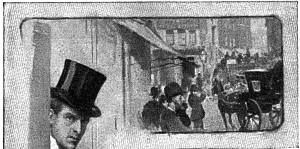
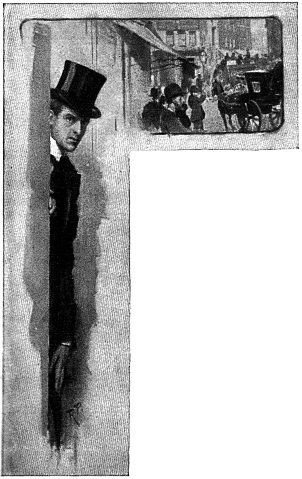
Annesley, then, stood watching the entrance to the Century Theatre, and, as he stood there, suddenly his heart commenced a wild stampede. He slipped into the doorway of a shop just in time to escape the eyes of a girl who was walking quickly up the Strand. He waited for a moment; she did not pass. After a time he ventured to glance out; she had left the theatre, and was disappearing in the crowd.
His first impulse was to overtake her and make a clean breast of everything, but a moment's reflection convinced him that, having restrained himself so far, it would be folly to make a doubtful step then. Connie Bolitho had probably no idea that Conrad Howe was a cloak for Herbert Annesley, and he saw an opportunity for a little comedy not to be neglected. Since his position had grown stronger he felt free to indulge his humours; a year before life had seemed all tragedy, with a diminishing banking account, and a sheaf of unpaid bills. He walked carelessly up to the box-office.
"Did a lady take seats a moment ago; a lady with a red hat and fur-trimmed cloak?"
"Pretty?" asked the clerk.
"Very pretty," said Annesley.
"Yes,—two stalls."
"Two!" said Annesley, with an inner question in the word. "Are the next seats engaged—the ones, I mean, on either side of those two?"
The man looked at the plan.
"No," he said.
"Book them to me, please."
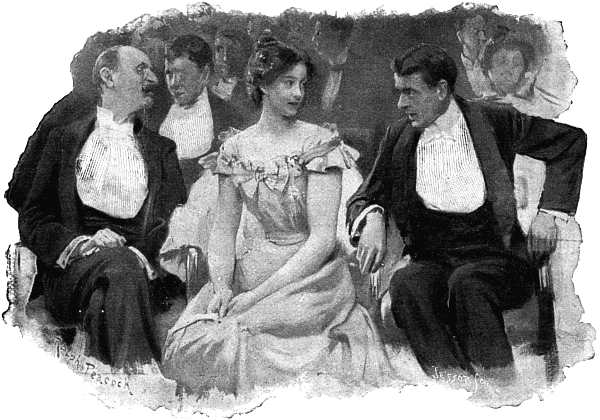
"'YOU ARE FORGIVEN,' SHE SAID, SWEETLY."
The clerk smiled benignly as he handed the tickets to Annesley; the life in a box-office is dull during business hours.
Annesley walked away with his tickets, feeling that he had done a good morning's work. He had at any rate made sure of a seat near Miss Bolitho; if her companion were a man he must brace himself to eclipse that fortunate individual; if a woman, it did not matter. He would prefer the woman, for in six months a great deal might have happened. Miss Bolitho was not bound to him in any way; they had seemed to understand each other, but a struggling writer with only debts to his credit, had not dared to lay those debts and a doubtful future at his lady's feet.
During the next week Annesley's time was fully occupied, but when the great day came and the final rehearsal was over he had a few hours in which to feel that almost unendurable excitement which precedes an ordeal the result of which is not in our own hands. His part of the work was over, but would the actors rise to theirs? He believed they would, but belief is a poor support when so much depends upon it. His excitement was also doubled by the prospect of watching the effect of his work on Miss Bolitho.
Annesley reached the theatre five minutes before the curtain rose. The house was full; the gallery seethed like a hive, people were already standing at the back of the pit. A glance showed him that Miss Bolitho was there, with a man whom he had never seen before at her side. He made his way quickly to his seat and was there before she had observed him.
"You are as interested in plays as ever?" he asked.
"Mr. Annesley!" she cried. He was sure that the hand she gave him trembled a little.
"May I ask you to forgive me for the past six months? I've been working terribly hard, almost night and day."
"At a play?"
"Yes,—at a play."
"You are forgiven," she said sweetly, "because you are brave and stick to your ideals."
"I am rewarded," he murmured. A glance at her face assured him that her beauty was not less; that, at any rate, had remained unchanged.
"Do you know who this Mr. Conrad Howe is?"
"No one seems to know; his identity has been kept secret most successfully."
"Do you suppose it is not his real name?"
"I have an idea it isn't; it sounds assumed, doesn't it?"
"I'm not sure. What do you think, Tom? Let me introduce you to Mr. Annesley,—my cousin, Captain Bolitho, who is just home from India." They bowed severely to each other.
"We were discussing," said Connie, cheerfully, "whether Conrad Howe was a real or a pen name. What do you think?"
"I don't know anything about these writing Johnnies. I don't see why they shouldn't use their own names unless they're ashamed of them."
"Perhaps you don't quite understand, Tom," Miss Bolitho suggested.
"Perhaps I don't!" said Tom.
"The climate of India is so trying," Miss Bolitho whispered to Annesley.
"It must be," he said, smiling.
The orchestra glided into a slow movement and the curtain rose. I need not tell you the story of the play; it was simple, but intensely human, having in it the philosophy learnt in years of struggle, but always with hope and faith in the ultimate good beyond. It presented no problem of the gutter raised to drawing-room standard by meretricious gilding; it had the singular distinction of being perfectly clean and also entirely dramatic. As Annesley saw his work develop before his eyes, and felt how it was taking hold of a breathless audience, he did not grudge the experience that had gone to its making or regret that he had kept his ideals unsoiled. When the curtain fell upon the first act the clamour of applause was the true expression of genuine emotion aroused by legitimate means. Annesley felt weak and almost sick. He realised vividly what it all meant to him; he realised, above all, of what little value it would be if he failed in the greater matter of his love. Connie leaned towards him; she had tears in her eyes.
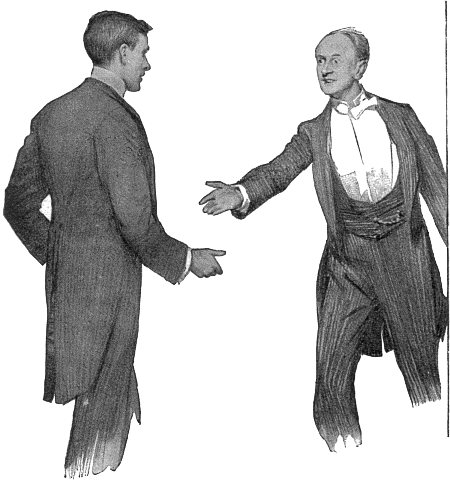
"THE MANAGER WAS SIMMERING WITH JOY."
"This is the kind of thing we've been waiting for," she said. "This is quite true and human. Conrad Howe should be a happy man to-night."
"If he is in the house."
"I hope he is; there's sure to be a call." Annesley's heart thumped.
"That must be awfully trying to a man," he said.
"Why don't you write plays of this kind?"
"It's rather the sort of thing I've been aiming at."
"Go on aiming at it, then, and you'll succeed."
"With your encouragement I feel I could do anything."
"This isn't a bad play, is it?" asked Captain Bolitho.
"It's splendid," said Connie.
"The fellow knows something, too. There's not all that confounded footle that leads you nowhere. The girl's ripping."
"She is," said Annesley. As a matter of fact she was a careful study of Miss Bolitho; for that reason Miss Bolitho appeared entirely unconscious of it.
"There are only three acts, too," said the Captain; "that's sensible. Five acts, with long waits between, are killing. I call it taking your money on false pretences. You don't come to a theatre to hear the band play."
When the curtain rose again the house instantly settled into silence, a sure sign that things were going well. Connie leaned forward with something of the eagerness of a child; even Captain Bolitho unhinged himself, as it were, and indicated interest by a slightly curved back. Annesley began to feel master of himself again; part of the future, at least, was now safe; how much that means to a man who steps from poverty to the security of a decent income can only be realised by those who have been in a like case; the mere fact of being able to pay a debt with promptitude is capable of affording a very exquisite joy. But, now that so much was within his grasp, he longed for all; the horizon of desire, like the horizon of the actual world, always recedes as we advance; since a few months before he had travelled innumerable miles towards success; that being reached, there was still an infinite distance beyond.
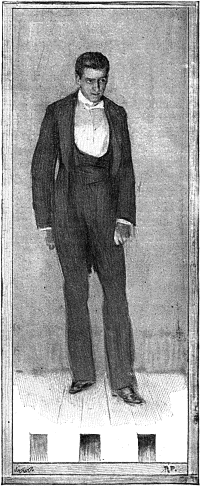
BEFORE THE CURTAIN.
In the second act there was a simple love-scene that appeared to take the audience by surprise; it was direct, touching, convincing. Annesley noticed that no one laughed, a thing almost unprecedented in a London theatre when sentiment attitudinises upon the boards. This gave him a glow of well-earned triumph; he had mentally decided beforehand that that was the crucial point of the play; when it was passed he dropped back and closed his eyes.
"You didn't see all that act," Connie said to him in the interval; "are you tired,—were you asleep?"
"I'm neither tired nor sleepy, I heard everything."
"Didn't you think the love-scene beautiful?"
"Yes," he said, blushing at his own candour.
"I didn't think much of that," said Captain Bolitho, "I suppose because I can't see myself saying pretty things to a girl. It's not in my line, you know. I feel 'em, but can't express 'em. My notion is that the girl should make love to me."
"But you must begin, surely," Connie said.
"That's just the deuce of it," said the Captain, "I can't."
Annesley rose. "I must go now," he said, "to another part of the house. When it's over will you remain here till I come? I've an idea that I can find out who this Conrad Howe is. May I bring him to see you if I'm right?"
"Do, I'll wait for you." He went out into the Strand and lit a cigarette. The aspect of the world had changed for him; he even saw cabs and buses with different eyes. Every passenger upon the pavement seemed a friend, the roar of traffic had new music in it,—the stars above the housetops looked down with kindly eyes. The cool air put fresh courage into him, soothed his pulse, made his hope seem real. Inside the theatre it had been altogether difficult to understand substantial facts; but out there in the hurry of the street it was easy enough. There was no doubt about "The Golden Circlet," or Connie Bolitho, or about himself; they all existed, they all were of the world. The name of Conrad Howe stared at him from the placards; he even touched the letters with his fingers to make quite sure. Ten minutes later he re-entered the theatre by the stage door.
He met the manager in the wings. That gentleman was simmering with joy, his congratulations were overwhelming. Annesley bore them with resignation.
"There's sure to be a call for 'Author,'" said the manager; "you'll go to the front, won't you? It's always better; pleases them, you know. Do you feel nervous? Come to my room and have some champagne. This is a howling success, Mr. Howe—nothing like it for years. Just listen to that applause? You've fetched 'em, no doubt about it. Come along and have that champagne." Annesley went readily enough; the atmosphere of the theatre was getting on his nerves again.
When the last curtain fell the pit and gallery got upon their feet and cheered; the rest of the house was equally decisive if more discreet; "The Golden Circlet" was a success. And in the midst of the hubbub Annesley found himself before the curtain, bowing, dazzled by the footlights and straining his eyes to see one face. And, as though in obedience to his call, it rose before him, flushed, glowing, with eyes from which the delight and astonishment had hardly died, and with lips whose smile seemed tremulous with coming tears. That was the true moment of his triumph.
As soon as he could escape he found his way into the empty stalls; one figure remained. As he approached Connie raised her head. The colour had died out of her face; she was as pale as Annesley was himself. He held out his hand.
"I have brought Conrad Howe to see you," he said.
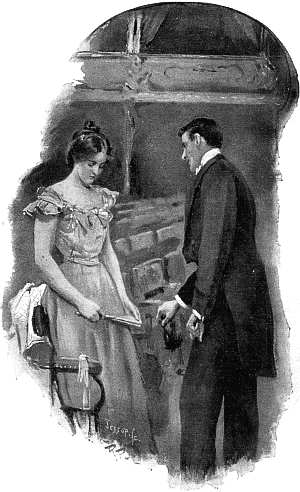
"'I WISHED TO WIN YOUR LOVE.'"
"Why didn't you tell me before? It was cruel of you."
"Perhaps it was because I thought that if I failed I could not bear that you should know it."
"That was not true friendship."
"Did I ever profess friendship for you?"
She hesitated, and played with her fan. A little wave of colour flowed back into her cheeks.
"You see," he went on, "I was pretty much alone in the world, and had to make my mark in my own way. A few months ago things were very black with me. I shut myself up and worked."
"It must have been hard for you," she said, "to cut yourself off from everything like that."
"It was hard, I'm not going to pretend it wasn't. But I had hope—not very bright, perhaps, but still it was enough to keep me from going under."
"You had faith in yourself and in your own work."
"I had more than that. Can you guess what it was?" Their voices sounded curiously hollow in the empty theatre,—the attendants were already putting up and covering the seats.
"You hoped to get fame and money?"
"Yes, but more than either I wished to win your love. Don't kill my illusion, don't ring down the curtain on my romance, Connie, and leave me in the dark. Everything I did was for you. You inspired whatever was good in 'The Golden Circlet.' The thought of you kept my head above water. I can come to you now without feeling ashamed."
"You might have come before. You need never have been ashamed. I could have helped you, oh, so much!"
"But now that the dark days are over, you won't turn your back on me and say I don't need your help? I need it more than ever. My love, the golden circlet is yours if you will take it from me."
She, gave him both her hands and lifted her face to his.
"I am your's always," she said, "but I think, perhaps, I loved you better when you were quite poor, but you never asked me then to love you. Think of what you've lost!"
Annesley took her in his arms in spite of a watchful attendant. "Never mind," he said, "everything's in the future for both of us, never mind the past. They may even damn my play now if they like."
At this point Captain Bolitho's voice was heard in loud protest.
"I tell you," he was saying, "I left a lady in your confounded theatre, and she hasn't come out. I've had a cab waiting ten minutes."
"It's Tom," Connie whispered, "I forgot all about him. Poor Tom!"
"Miss Bolitho's quite safe," said Annesley, "we've just been settling a little matter of great importance to both of us."
Captain Bolitho peered into the face of each in the uncertain light and seemed to understand.
"The devil you have!" he murmured under his breath. Then he said aloud, "Anyhow, Connie, I can't keep the cab waiting any longer. I congratulate you, Mr. Annesley Howe, on your 'Golden Circlet.' That was a deuced neat little surprise you'd hatched for us. I like your play, and I daresay I shall like you when I know more of you. Dine with me next Thursday, will you? Good-night."