Volume 1 — SERMONS WITHOUT WORDS A Marvellous Performance in Dumb Show.
Reading edition
NOT a quarter of a mile from the Marble Arch, on the left side of Oxford Street (No. 419, Oxford Street, as a matter of fact), looking towards the Park, there stands a dull, unpretentious, red brick edifice, so unpretentious indeed that in spite of its ecclesiastical appearance it is unnoticed by the majority of passers by.
The bulk of the teeming thousands who pride themselves that they know their London are ignorant of its whereabouts, nor are the countless legions who daily pass through the busy thoroughfare better informed.
Nor is it surprising; for there is little but a tiny cross on the coping stone, and a dingy notice board behind dingier railings, to mark one of the most interesting buildings in all London—St. Saviour's Church, the cathedral of London's 2,000 deaf and dumb.
Here Sunday by Sunday the silent poor and the silent rich worship together. Outside, the roll of traffic merges into one long dull roar that may distract the thoughts of worshippers in other churches, but to the congregation of St. Saviour's makes no difference. They cannot hear it.
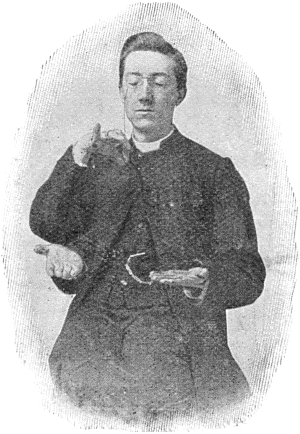
JUSTICE (WEIGHING WITH SCALES).
I had heard much of the Rev. F. W. G. Gilby's wonderful method of preaching to his people, how he has become thoroughly conversant not only with the old-fashioned finger spelling familiar to those who have watched the conversation of the deaf and dumb, but can also by means of gesture and acting make use of a system of preaching richer in suggestion, wider in range, and infinitely more effective in its scope and power of riveting the interest of his flock.
Accordingly, one wet Thursday evening a short time ago, I made one of the congregation at evening service, curious to take part in such a service myself. I am never likely to forget the impression that quiet service made on me, nor to relieve my mind of the feeling of overwhelming depression at the realisation that this little crowd of afflicted people, miserably and unutterably poor in the majority of cases, was living, moving, and breathing in our very midst, helpless yet happy, willing and intelligent, yet almost entirely dependent on this one enthusiastic, unselfish man for their comfort—not only spiritual, but in many cases, as I discovered, material as well.
I have not the space, nor is it in my province in this short article, to describe or appeal on behalf of the needs of this institution, but the interested ones should see for themselves, and if within their power, help.
Excepting the chaplain's wife, herself an expert follower of her husband's method, I was the first to arrive. The lights were low, and there was nothing about the dim church save the absence of choir stalls and pulpit to suggest the unusual nature of its mission.
Presently a distant door opened, a shuffling step dragged along the aisle. The first member of the congregation took his rags with him into a front seat. He was a shoeblack down on his luck, but nobody turned him out. In Mr. Gilby's flock all are equals, all are friends in their common adversity. The first seats are for the first comers.
A few moments later and the congregation was nearly complete. Here and there one caught a flash of recognition between two friends, then up went two pairs of hands flashing white in the dim light as an animated conversation took place across the church. By the time the church was half full a whole volley of chatter was playing round; everywhere the darkness was alive with flickering, speaking hands, and faces vibrating with expressive gesture. It was an odd scene, weird and uncanny to the hearing visitor who sat misunderstood and not understanding amid the silent throng.
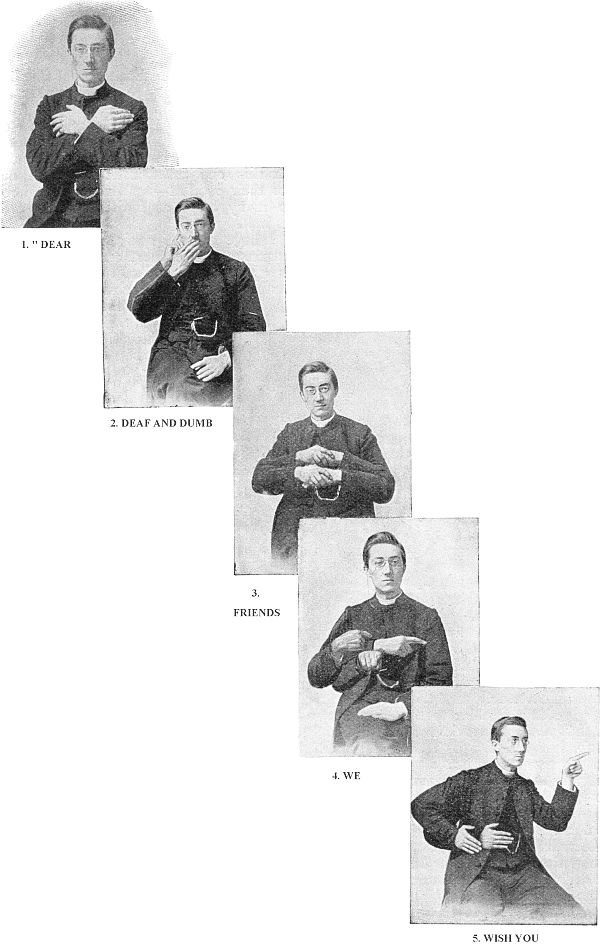
"DEAR DEAF AND DUMB FRIENDS WE WISH YOU
In a few moments the chaplain, attired in the usual canonicals, appeared, and the service commenced.
Throughout the proceedings there was no sound but the dull roar of passing omnibuses and cabs outside. Not a hymn, not a word, only that indescribable hush, almost unnerving to one strange to the scene. Yet throughout the service, in the prayers, in the sermon, not an eye strayed from the slight figure talking in a language of his own at the little desk on the altar steps.
At first the ghostly reality of this strange sermon dispelled all other thoughts. It did not seem comprehensible that there could be any connection between the chaplain and the attentive congregation, but here and there one could catch a reflection of one of his gestures on the face of an intent watcher.
Then a more than usually familiar passage was signalled, and a broad intelligent smile passed swiftly across the faces of the congregation, and they nodded and looked towards each other comprehendingly.
Then for the first time one realised that the flying fingers playing rapidly above the reading desk, flickering now high and now low, like the figures in a kinetoscope picture, meant something; that the gestures, the graceful swaying of the body, the marvellous play of the features, all had their meaning; that each little movement was intelligible to the watchers as the word of a spoken sermon, and infinitely more expressive.
As the utter novelty of the scene became more familiar, I found myself trying to interpret the drift of the sermon, and it was little short of marvellous how intelligible a great number of the gestures were, even to one untrained and unused to sign language.
The acting and gestures in many sentences were so obvious, that it was almost as though the words were rather the equivalents of the signs than vice versâ. It was, indeed, an astonishing revelation of the possibilities of human expression. When the faculty is combined with a system of word signs intelligible to the merest child, it will be understood how much may be done in this way, without recourse to the more tedious method of spelling out each word separately, although this is necessary where the sign imagery is so subtle as only to appeal to highly cultivated imaginations.
As a matter of fact, Mr. Gilby has a marvellous faculty in this direction, that has been fostered and perfected by life-long study. So much is this the case, indeed, that I doubt if he could be equalled in this direction by any one of our greatest actors.
Presently the service was at an end. There was a little desultory silent conversation, and the congregation dispersed, just as it came, without a sound. Three or four stragglers, clean and intelligent-looking, but obviously poor, remained behind, and presently made their way up the altar steps, and into the tiny vestry.
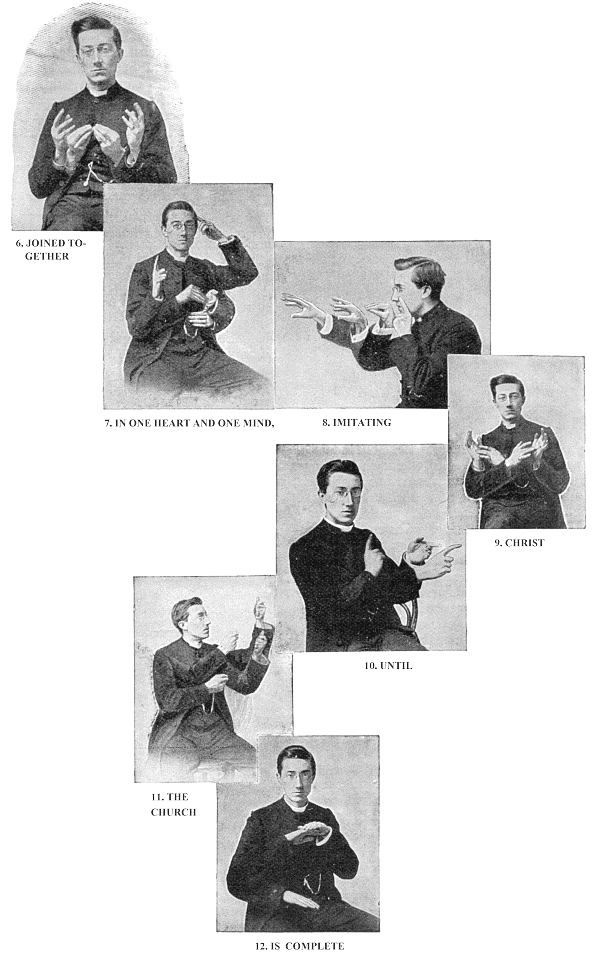
JOINED TOGETHER IN ONE HEART AND ONE MIND, IMITATING CHRIST UNTIL THE CHURCH IS COMPLETE."
I followed them, and when each had stated his different wants and difficulties, and received relief and comfort, I persuaded Mr. Gilby to assist me in the preparation of this article, illustrative of his remarkable work.
It will be readily granted by those who examine our interesting series of photographs, that my demands on his good nature were by no means moderate. Those who object to being photographed almost as much as they dislike the necessary visit to the dentist—and Mr. Gilby is one of these—will appreciate Mr. Gilby's feelings when our photographer desired not only one siting, but a dozen. However, Mr. Gilby will be more than compensated if this article is the means of attracting public attention to the afflicted ones that are his especial charge.
The most important photographs we give are those that illustrate a message that I have prevailed on Mr. Gilby to issue through these pages to the deaf and dumb of the British Empire. The message is necessarily brief and short: as it is we are obliged to print twelve photographs in order to do it justice. The exact message is as follows:—
"Dear deaf and dumb friends, we wish you joined together in one heart and one mind, imitating Christ until the Church is complete."
The appropriateness of many of Mr. Gilby's signs becomes immediately apparent on glancing at the photographs, but some are not as clear as others. "Deaf and dumb" is signified by rapidly touching the mouth and the ear; "friend," by shaking hands with oneself; "we," by pointing at oneself, at the persons addressed, and vaguely to the left to indicate people in general; and "joined together," by opening the hands, and then bringing them together closed. A most interesting sign is that representing "Christ," where a finger is pressed into the palm of each hand in rapid succession, as if to indicate the piercings of the nails of the cross; and scarcely less remarkable is that which denotes the "Church"—the motions being those of one ringing church bells!
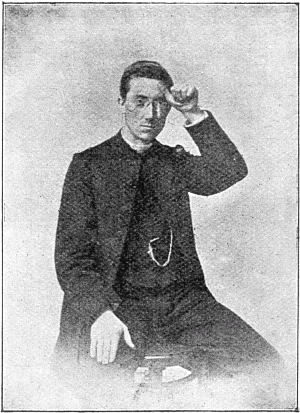
"KNOWLEDGE."
Excellent as these photographs are, they convey but a slight impression of the effect produced by a sermon in Mr. Gilby's gesture-language. It must be understood that his is no laborious art. Distinct and picturesque as Mr. Gilby's motions are, they succeed one another with the rapidity of words penned by an expert shorthand writer. On one occasion, indeed, Canon Wilberforce—one of the most fiery orators of the day—addressed our deaf and dumb congregation, and Mr. Gilby, who stood by the side of the eloquent Canon to interpret the discourse, experienced no difficulty in keeping level with him. It will thus be seen that, as practised by an expert, the art of gesture-language leaves little room for improvement. As a matter of fact, the sentence given above would be "signed" by Mr. Gilby, in the course of an ordinary pulpit address, in about three seconds.
Needless to say those signs that are to be expressive of themselves require to be of the most suggestive nature in order to be readily understood, and it is in the invention of these that the teacher of the deaf and dumb may find a great field for the exercise of his ingenuity.
In a great number of cases there are signs which are universally accepted and understood by deaf mutes the world over. On the other hand, each school has its own special gestures, equally expressive but peculiar to itself, and in the department of versatility of gesture Mr. Gilby is second to none. In fact, I have seen him express an idea in half a dozen ways, and each one of them could have been interpreted with ease by a half wit.
In the majority of cases the photographs illustrating the gestures have been taken in an entirely novel way.
By making several exposures on one plate we have sought to illustrate the various movements composing those gestures which are of a composite description. Where a word or idea is expressed by a single sign, this is, of course, unnecessary. One photograph is all-sufficient.
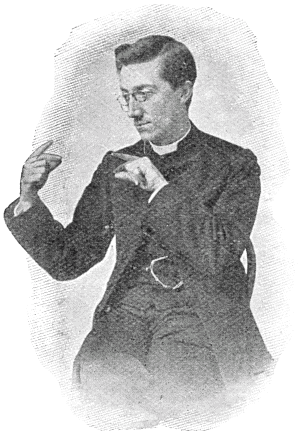
"CONVERSATION" (OPENING AND SHUTTING FINGERS AS THE MOUTHS OF BIRDS CHATTERING).
It may possibly occur to many that there might be considerable difficulty in conveying a difference of expression in the same idea; that is to say, the difference indicated in spoken language by a mere variation of inflection in the voice. As a matter of fact, the sign language is even more expressive in this particular. An excellent illustration of this is given in two photographs on page 71. Both gestures express the same idea—a parting between two friends. In the first of the two you have the parting in which there is a little sadness. The idea of separation is conveyed by the hand leading the other away. That it is a matter of regret is shown by the expression of the face and the nod of the head.
In the second photograph of the pair you still have the parting. This time, however, it is a humorous rendering which might be used with happy felicity at the conclusion of a platform speech, where the speaker wished to convey a sort of "Well, I'm sorry to go, but I must," notion. Here the separation is humorously expressed by the suggestion of brute force brought to bear on the speaker's collar.
In similar fashion many inflections may be given to the same idea, and with the indispensable assistance of facial expression the elements of Hope, Tragedy, Comedy, Fear, are introduced.
The extraordinary mobility of Mr. Gilby's features must prove of the utmost service to him. With a scarcely perceptible quiver of the features his face expresses alternate Tragedy and Humour. So much so, indeed, that one feels that he is throwing his whole nature into each and every fleeting gesture. And this is probably the secret of his success, for to this pale-faced, highly strung man the cause of the deaf mute is as life itself.
The education of the deaf and dumb is necessarily limited, though the general impression that they are deficient in mental capacity is entirely erroneous. On the contrary, brightness, intelligence, and, curiously enough, content are their chief characteristics. Such educational limitations as exist are an unavoidable result of the tedious and trying system that must be gone through in order to give a deaf and dumb child even the rudiments of an education.
If you wish to teach such an one what a cow is and how to spell the word, there is only one method, and that is to place a picture of a cow before it and write the word on paper till it comprehends that the letters C O W represent the name of the animal in question.
It will be seen, therefore, that only those who have enjoyed very exceptional educational advantages are in a position to appreciate some of the deeper abstract ideas of philosophy and the sciences.
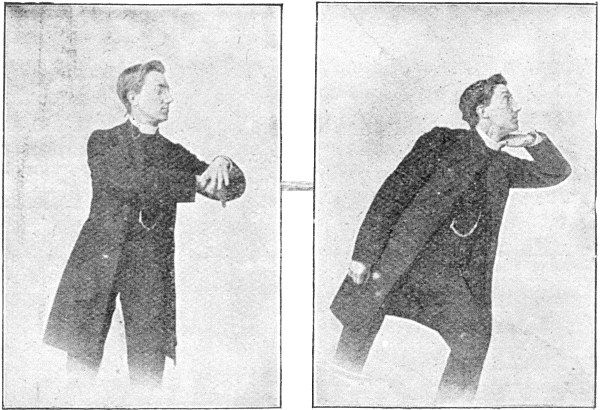
"PARTING."
Abstract ideas are difficult of adequate expression, therefore, not because they cannot be suggested by the sign language, but by reason of the reader's own inability to comprehend their significance. Some of the more general ideas of an abstract nature are, however, taught with comparative ease. We give two examples. Both are almost self-explanatory. The first (on p. 70) expresses Knowledge, or Wisdom; the second (p. 67) is a sign demonstrative of Justice. Nothing could be clearer, of course. It is simply a mimetic illustration of the symbolical picture of Justice blind, and so impartial, holding the scales. The right hand is first placed in the position of holding the scales, and is then rapidly brought down on a level with the other, thus picturing the scales.
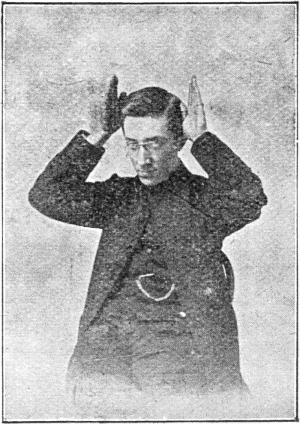
"STUPIDITY" (THE ASS).
Two other pictures illustrate signs of a peculiarly expressive nature. Nobody will want to be told what a deaf and dumb man means who describes you with the sign shown below. The lower picture on the preceding page is Mr. Gilby's way of expressing the fact that he has been holding a conversation with someone. It will be noticed that there are two positions of the forefinger, which are intended to indicate that this finger is snapped rapidly against the thumb. It is more or less a humorous way of expressing the idea, and as actually illustrated by Mr. Gilby is exceedingly comic. A more sedate way of expressing the idea would be to hold the hands in the same position, but to draw them slowly apart and towards each other.
I feel that no article on this subject would be complete without some special illustration of the enormous part pure facial expression plays in Mr. Gilby's peculiar method. Indeed it is in his case a fine art, and must represent an enormous increase in the effectiveness of his addresses and lectures, and consequently in the happiness and comfort they give his silent audiences.
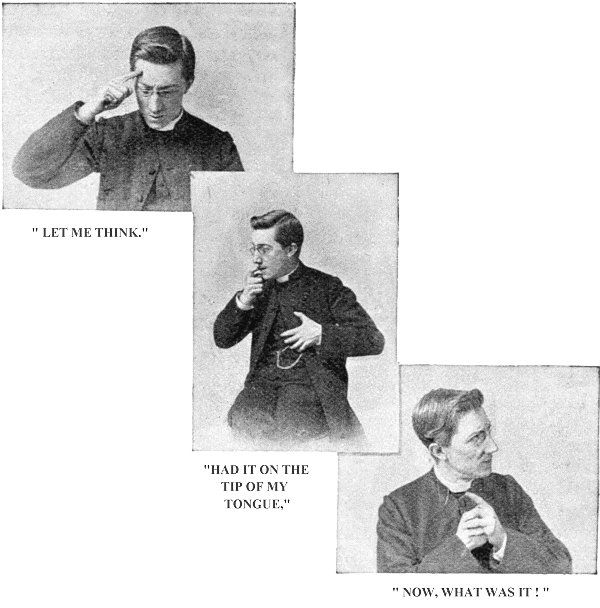
"LET ME THINK. HAD IT ON THE TIP OF MY TONGUE. NOW, WHAT WAS IT!"
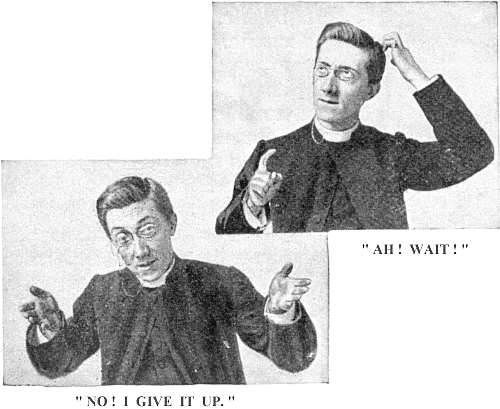
AH! WAIT! "NO! I GIVE IT UP."
Five photographs illustrative of a little lapse of memory explain better than any words what I mean. Without strict attention to grammar, I will call this Forgetfulness, More Forgetfulness, Most Forgetfulness, Still more Forgetful, Forgotten.
This series will be an object lesson on the debt we all owe that fleeting, intangible thing we call Human Expression.
No article is complete without its story. Mr. Gilby is full of stories, but I have only space for one, and that looks weak on paper when I remember how inimitably it was acted when he gave it to me.
Some time since he was due to give a short address in the schoolroom under the church. The Vicarage adjoins the sacred edifice, and he therefore decided it was unnecessary to change the light indoor shoes he was wearing in his study. Accordingly he wore them on the platform downstairs and commenced his address.
A few moments later he happened to quote the text in which the words, "I cast my shoe," occur. Now obviously the best sign for the expression of this idea was a gentle kick. Mr. Gilby gave it, but the demonstration proved much more literal than he had intended, for a second later his shoe flew through the air and dropped in the midst of an immensely amused audience.
The story emphasises Mr. Gilby's belief that humour is, and always should be, a valuable ally in the higher education of the deaf and dumb.
It is an infallible means of securing that closer understanding and sympathy between teacher and pupil which raises teaching from the dull mechanical level of routine to a fine art.
Humour in his case is a natural gift—perhaps one of his greatest. It peeps out unbidden in his sermons. It renders his lectures and addresses delightful to deaf, dumb, and hearing visitors alike, and one cannot but feel that in all the many branches of his work it turns sadness into sunshine and depression into an unfaltering hope for the future.
The scope of this article on St. Saviour's Church does not permit of our entering upon the hotly-contested methods of educating the deaf, whether by the lips or by manual signs or spelling. Mr. Gilby is one of the Government Inspectors of Schools, and, having been born of deaf parents, and brought up amongst the afflicted, may reasonably be presumed to have a right judgment in these matters. For himself, he is an ardent upholder of the Combined System—often known as the American way of instructing the deaf. He differs in toto from any who may think that Missions to the Deaf are unnecessary, for by learning speech they are raised to the same level as their more fortunate brethren who can hear.
In conclusion I cannot repay Mr. Gilby's courtesy and kind assistance in the preparation of this article better than by repeating the wish I feel to be nearest his heart:—
If you have an opportunity, help the Deaf and Dumb.
Alfred Arkas.