Volume 1 — HIS SOVEREIGN REMEDY. A COMEDY IN AN OMNIBUS.
Reading edition
By Clarence Rook; Illustrated by B. E. Minns.
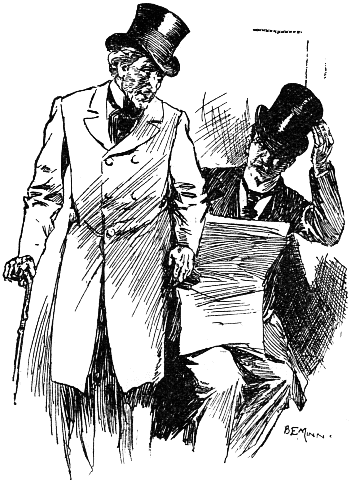
THE gloom was gathering. Ten minutes ago the conductor had leaned from his step, taken the lamp from some unseen hand, and stuck it up in its place by the door. The bus lurched round the corner into Bishop's Road. It was a Bayswater bus, and the old gentleman who was changing his seat drove his elbow into my hat.
"DROVE HIS ELBOW INTO MY HAT."
"Bless me! I'm always doing that. Most extraordinary! I'm sure I beg your pardon."
I told him that it was of little consequence, and another swing of the bus seated him suddenly beside the tired-looking girl with a music portfolio in her hand. She opened her eyes for a moment, and then closed them again. The woman beyond shifted her baby to the other arm—the arm furthest removed from the old gentleman—and continued to rock it mechanically.
The old gentleman evinced a restlessness which was not suggested by his mild aspect and his white hair, though a closer examination revealed a certain furtive look in his eyes. Four separate times he had shifted his seat since I had taken my place in the corner next the door at Oxford Circus. A slight irritation at his want of repose caused me to shoot a protesting glance at him over the top of my evening paper, for few things annoy me so much as purposeless activity. Old gentlemen should be glad enough to sit still when they have the chance. But I could not find it in my heart to be angry with such a benevolent-looking old gentleman.
It was just then, as my eyes were returning to my paper, that the demon of suspicion took tentative hold upon my mind. "Why," I asked myself, "do nice-looking old gentlemen, with white hair and shifting eyes, want to change their place in a bus?"
The suspicion came—and went, for the kindly and venerable face gave no hold for doubt. But I laid down my paper upon my knees and leant back in the corner to watch him, speculating whether he would change his place again before we came to Westbourne Grove. The driver's whip-lash sounded on the middle pane opposite to me, and the bus slowed down to take up a passenger who, after a glance inside, mounted to the roof.
The conductor shoved his parcel up after him, pulled the string and resumed his position against the side of the door, where, upon that mysterious block which is kept in a receptacle over the entrance, he was apparently making sketches of the passengers inside. Mentally commending his diligence, I turned my eyes again to the old gentleman, who met my glance for a moment, and seemed to deprecate my displeasure by the lifting of his brows and a turn of his head.
As the bus quickened up again, the tired-looking girl swayed slightly, and her head sank upon the shoulder of the old gentleman. The old gentleman glanced sideways at the closed eyes of his neighbour, and, as a kindly smile stole over his face, his arm slid round the girl's waist. The pair made quite a pretty picture. The conductor at my elbow turned slightly, to get a better light upon his sketching block.
And then I noticed a curious disturbance—only a momentary rise and fall—in the dress of the sleeping girl. No one, so far as I could tell, had moved. The girl's hands were lying in her lap, precariously clasping her music portfolio. The disturbance occurred on the right side of the dress, which was the side furthest from the old gentleman in whose kindly embrace the girl lay.
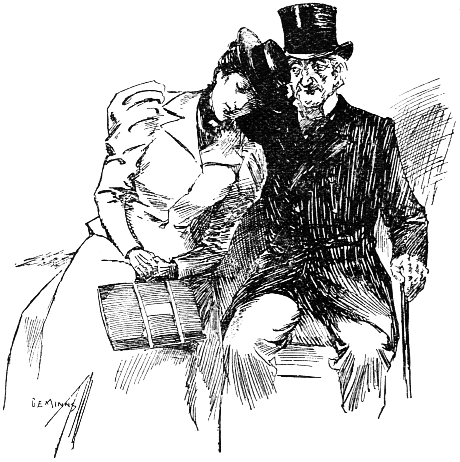
"THE TIRED-LOOKING GIRL SWAYED SLIGHTLY."
The explanation came to me in a flash. In so sudden a flash that I turned in the same instant to the conductor and found his sidelong glance meeting mine.
"See that?" he muttered, under the clatter of the bus.
"I should think I did," I said, "he's picked her pocket."
"I've 'ad a eye on the old josser for the last month," he said. "I'll make it a fair cop this time. You're my witness."
"Well," I said, "I'm not awfully keen on being mixed up——"
"Bit of high-spyin' now," he said. "What's the matter with a little bit o' high-spyin', eh?"
The conductor mounted the steps to the roof. The tired girl, awakened suddenly to her position, straightened herself and peered anxiously through the window of the bus as though to make certain that she had not been carried to Wormwood Scrubs in her sleep. Reassured, she gathered up her portfolio in a firmer grasp with one hand, and with the other searched the back of her head for errant pins.
Round the edge of my paper I watched the old gentleman, whose eyes were now fixed obliquely upon the woman on his left. I distinctly saw his eyes travel down from the woman's face to her black cloth jacket, and stop at the outside pocket, from which her omnibus ticket was peeping. The pocket was on a level with, and almost touching his elbow, and his hand, his left hand, which was resting upon his knee, began slowly to travel towards the pocket of the tired-looking woman.
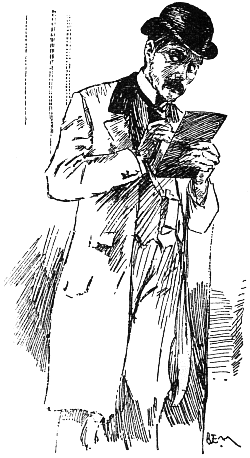
"APPARENTLY MAKING SKETCHES OF THE PASSENGERS."
The baby was kicking, grasping at the stuffy air with crinkled fingers, and threatened to give voice, and the tired-looking woman, rocking more anxiously than before, looked timidly from one neighbour to another as though in apology for the wrath to come.
At that moment my glance was attracted to a point above the old gentleman's head, where I met the eyes of the conductor, pressed close against the window-pane. A little higher was the tip of his nose, whitened by the pressure, and above that his stubby red moustache, underneath which a mouth gaped with inquiry. For a moment or two I was fascinated by the inverted face, which seemed to belong to some other-world creature which had tumbled from extra-mundane space and stuck fast upon the window of the Bayswater bus.
The benevolent old gentleman, quite unconscious of the watchful eyes behind his head, was regarding with a bland smile the advertisements on the window behind me. And as my eyes fell again on the spot where I had last seen his hand, I saw that it was not there. There never was a more unskilful performance. For there sat the old gentleman before my eyes, looking calmly over my head, with two fingers inserted into the pocket of the woman who was rocking the baby. As though it knew the wrong that was being done, the baby gave vent to the threatened yell, and the mother, patting it, and rocking it, and speaking to it in unknown tongues, saw nothing and felt nothing else.
Suddenly, as I watched, the benevolent old gentleman dropped his eyes from the advertisements, and mine arrested them as they fell. Never was an old gentleman so vastly perturbed. I almost felt sorry for him; for an aged criminal who has not learned the art of escaping detection and is therefore hopelessly incompetent, is a pathetic sight.
The omnibus stopped with a jerk just as we came within the range of the lamps at the corner, and the old gentleman, so evil were his deeds, seemed to shrink from the light. I was not quite certain of the etiquette with pickpockets. Ought I to leap upon him then and there and to denounce him? That would be melodramatic, I reflected; and I hate a scene; so I only raised myself from my seat, borrowed support from the handrail above my head, and waited upon events.
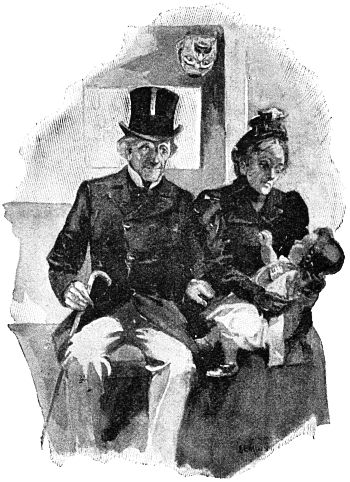
"TOWARDS THE POCKET OF THE TIRED-LOOKING WOMAN."
The tired girl bestirred herself and looked round, the woman with the baby changed her burden again from one arm to the other and peered anxiously at the door.
"Royal Oak," I said, answering her look of inquiry.
She sank back in her seat and closed her eyes, and at the same moment the old gentleman jumped up and shambled towards the door, while the other passengers carefully drew in their toes.
By this time I noticed that the conductor's face had detached itself from the window. Three people had risen to leave; but the old gentleman was first, being clearly in a hurry; and as he found himself unable to pass me, half-standing and half-sitting, with my hand on the overhead rail, he looked pleadingly at me, as though imploring my silence. I hesitated a moment. It was none of my business to arrest criminals. But I did not mind giving a passive support to the cause of justice, so I stayed where I was. And then the conductor appeared, blocking the doorway.
"No, yer don't," he said.
"My good man," began the old gentleman, "I sincerely trust I have given no offence. I only——"
"I see yer," said the conductor, looking over his shoulder towards the public-house, and jerking his head.
"Then kindly oblige me," said the old gentleman, "by not making a fuss. If a sovereign now——"
"Oh, stow it," said the conductor. "You've done it once too often, that's what you 'ave. I see yer right enough this time, and you're going to be give in chawge, that's what you are. Strite."
The old gentleman looked helplessly round him. Impatient passengers began to remonstrate from the step; others from the kerb.
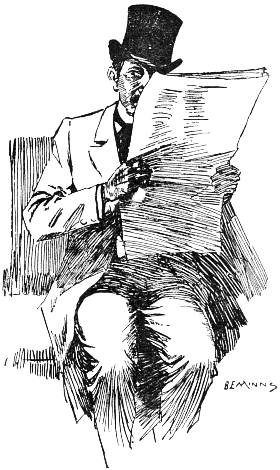
"AS I WATCHED."
"'Old on," said the conductor, "we're all goin' 'ome to tea."
A policeman crossed from the opposite corner.
"'Igher up there!" he remarked, dispassionately.
"Look 'ere, constable," said the conductor, "'ere's a job in your line." Then his tone became official. "I 'ereby give this man in chawge for picking pockets."
"Oh," said the policeman, scattering the bunch of people gathered round the step.
"I see him—and this gentleman 'ere see him," said the conductor. "'Tain't the first time, neither. Old 'and, he is; that's what he is."
The doorway was now blocked by the policeman's form.
"That ain't good enough for me," he said. "Any of you ladies and gentlemen lost anything?"
"I see 'is 'and in that lydy's pocket," said the conductor, pointing over the constable's shoulder at the woman with the baby. "You feel in your pocket, lydy."
Then ensued a general searching of pockets, while a rival omnibus swept by triumphantly and gathered up such passengers as were too impatient to await the outcome of the situation.
I leaned forward and said in an undertone to the girl with the portfolio, who alone of the passengers shewed no interest in the contents of her pocket, "You had better look in your pocket, I feel convinced it was picked while you were asleep upon his shoulder."
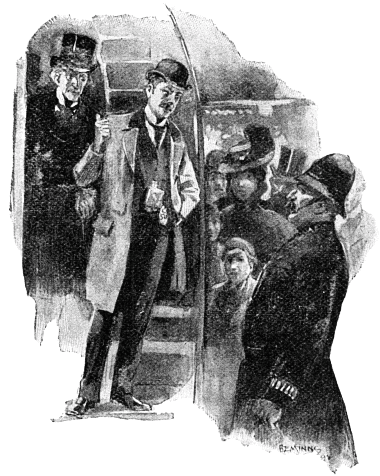
"'I GIVE THIS MAN IN CHARGE FOR PICKING POCKETS.'"
"I wasn't," she said, abruptly. Then, reflecting apparently that she was rude as well as tired, she added, "I've nothing worth stealing, thank you all the same."
In a desultory way she began fumbling in the pocket of her dress. The old gentleman stood by the policeman. His face had grown very red; his eyes, wandering from one passenger to another, became suddenly fixed, and his face was redder than ever. It was sufficiently obvious that he was very uneasy. Following the direction of his eyes, I saw the baby's head hanging at an alarming angle over the woman's arm. The mother was leaning towards the light and looking at the contents of her free hand—a bus ticket, two pennies, a farthing, and a sovereign.
"Now, then! lost anything, mem?" asked the conductor.
"No, I ain't lost nothing," she began, slowly.
The old gentleman nodded to her pleasantly.
"Though," she continued, "I don't rightly understand why——"
"I think this must belong to you, sir," said the girl with the portfolio, suddenly, holding out a sovereign to the old gentleman.
"Not at all, my dear; nothing to do with me, nothing whatever," he said, nodding his head at her. "Old enough to be your grandfather, too!"
"Now then, what's all that?" asked the policeman.
"Only this gentleman must have been putting a sovereign into my pocket, and I insist—oh! I insist——"
"Look here, constable," said the old gentleman, "can't you see that you are embarrassing the young lady? Any little transaction between her and me is none of your business, or anyone else's either."
The old gentleman stamped impotently upon the floor of the omnibus.
"He's been giving money away," said the policeman over his shoulder to the conductor, "looks like."
"And why not, why not?" said the old gentleman. "What's the good of having money if you can't make people happy with it?"
The constable looked reflectively at him.
"I dunno," he said. "I'd better take your name and address."
The old gentleman looked apprehensively round. Then he took a card from his pocket and gave it to the policeman.
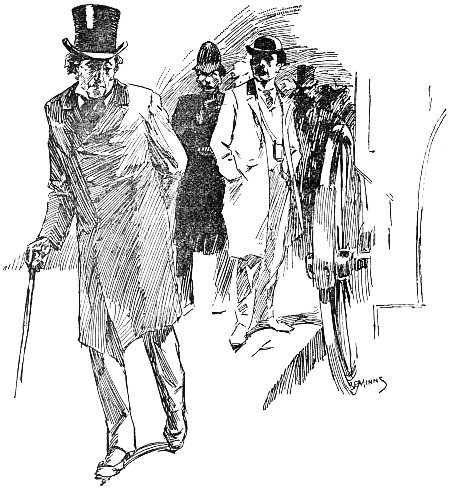
"'YOU GO HOME,' HE SAID."
"Please don't read it out," he said.
The policeman looked at the card, put it into his pocket-book, and made a note in pencil. Then he swung himself off the omnibus and looked hard at the old gentleman as he descended slowly.
"You go home," he said. "You want to be took care of, you do."
The conductor stood upon the kerb with his hand on the rail, looking after the old gentleman as he trudged off towards Royal Oak Station.
"'Urry up there," said the constable. "Wastin' my time," he added, as he turned his back.
The conductor rang the bell and leaned dolefully against the stairway as the bus started away from the dispersing crowd.
The girl with the portfolio was regarding her sovereign thoughtfully, holding it between her thumb and forefinger; then she returned it with her handkerchief to her pocket, looked doubtfully round and blushed slightly.
The woman with the baby was biting something, which, as she caught my eye, she hurriedly slipped into her jacket pocket. "Not that I'd be be'olden to anybody," she remarked at large, rocking her baby with much energy, "me 'usband earning good money, thanks be. But peliteness is peliteness——"
"You may think yer know yer way abart," said the conductor, looking at me and jerking his head up and down, "but now and then you find you're left—badly left. Now, think o' that! Droppin' sovereigns all over the place. Well, I wish I'd a'knowed!"
Photo by Landor, Ealing
THE HEAVENLY TWINS.