Volume 1 — HOME LIFE ON BOARD A MAN-OF-WAR. DESCRIBED BY ONE WHO HAS LIVED THERE.
Reading edition
TO the majority of Englishmen the phrase "Life on board a Man-of-War" calls up pictures of smart gun-drill, tactical exercises, and other more or less irksome though necessary duties. Few people indeed have any cognizance of the way in which our bluejackets live their daily life and how they manage to amuse themselves in the spare time at their disposal during the three years afloat, which is the usual period of a seagoing ship's commission.
Jack is awakened at 5 a.m. in summer and 6 a.m. in winter by the loud blare of a bugle under his hammock, and the hoarse voices of the bosun's-mates shouting "Show a leg there. Arise and shine, 'rise and shine. All ha- - - - - -nds lashupandstowhammocks." Having lashed his bedding in his hammock in the regulation manner, by taking seven turns round it with his hammock-lashing, he has his breakfast, for which meal he is allowed half an hour.
He then works and drills more or less continuously until noon, with the exception of 15 minutes' "stand easy" at 8 a.m., when he is allowed to smoke, and to go down to his mess and eat and drink if he feels so inclined.
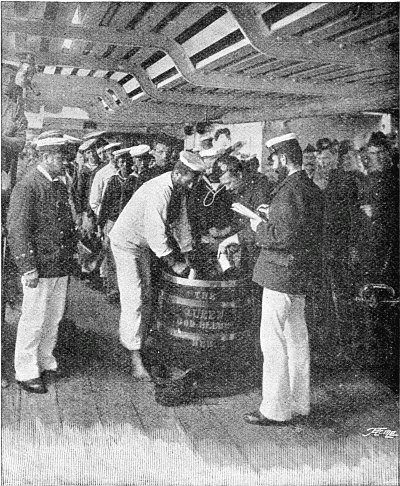
Photo. R. Thiele & Co.
SERVING OUT JACK'S GROG (12.30).
At noon the ship's company is "piped to dinner."
Noon is the dinner hour of our navy right throughout the world, and though things have greatly changed since the introduction of steam and the torpedo, the navy still retains the "bosun's pipes" of the days of Nelson. No sooner is the shrill pipe sounded than there is an excited rush of men to the cook's "galley," whence arises a cloud of odorous steam redolent of baked meats, vegetables, and baked and boiled "duffs" (so dear to the naval heart of all ages), which are to feed the 600 or 700 odd hungry men just released from work.
Men going on watch at noon—as the Marine sentries, for example—are allowed to fetch their dinner at "seven bells" (11.30), and sometimes ludicrous mistakes will arise through this privilege. The men take turns to prepare the dinner, and the cook of the mess for the day usually fetches his mess-mates' dinner from the "galley." On one occasion which the writer recalls, the cook was at work on deck when the bell struck seven, and could not get away. Several of his mess-mates (he was a Marine Artillery man) having to go on watch at noon, proceeded to the "galley" in quest of their dinner, and "fisted" (seized) a savoury dish they imagined to be theirs, without first examining the brass mess-number on the side thereof. The dinner was divided and eaten, and the plates were being washed up, when a group of excited bluejackets, having questioned every other mess in the ship, made their way to No. 19 mess and hungrily demanded their dinner.
The Marines had taken the wrong one, but offered their own in exchange. Search at the "galley" failed to produce the missing meal, which was eventually discovered stowed away beneath a wash-tub under the Marines' mess-table, uncooked. The absent-minded cook for the day, who was much taken up with a song of his own composition, entitled "A Barrack-room Dinner," which he was to sing at a forthcoming entertainment, had, in his contemplation of the visionary meal he was to sing of, forgotten to take the actual dinner to the galley, and there it lay in the mess in all its uncooked glory.
After a somewhat heated discussion, the Marines appeased the bluejackets by paying for a dinner of corned beef and pickles from the canteen, and thought they had heard the last of the matter; but the sailors had determined to pay the "Joeys" in their own coin, and did so a few days later, when the ship's company, being at "collision quarters," the Marines' messes were emptied of all their inmates. A party of bluejackets was stationed with the diving apparatus on the main-deck near the Marines' messes, and in the party were several who had suffered the loss of their dinner. It was 4 p.m., and noticing a large "plum-duff" on the table, evidently intended as a delicacy for tea, they pounced on it to a man. When the Marines came down in hungry expectation, behold! there was but an empty dish.
Dinner time lasts an hour and a quarter, and at "one bell" (12.30) the bugle-call for grog—"Nancy Dawson," as it is nick-named—summons the cooks to the grog tub.
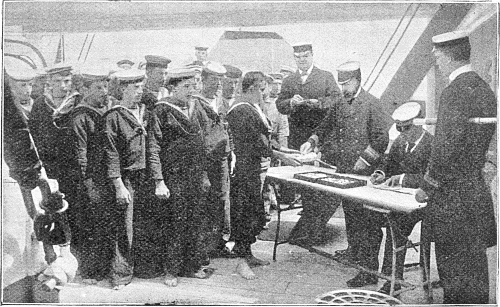
Photo. R. Thiele & Co.
TEETOTAL SAILORS RECEIVING CASH INSTEAD OF RUM.
The bugle-call, which is unknown even to army men, is given on the previous page.
Each man above the age of eighteen is allowed half a pint of grog, usually mixed in the proportion of one part of rum to three of water, and hence familiarly termed "three water"; and the number of half-pints due to each mess is served out to the cook of that mess for the day. The cooks stand à queue in the numerical order of their messes, the mess whose turn it is to pump the grog-water for that day (the messes take daily turns at so doing, petty officers' mess excepted) standing first "on tally," and the grog is served out by a petty officer and the Marine sergeant of the guard, under the supervision of a warrant officer and the ship's steward, who, book in hand, checks off the number of pints allotted to each cook.
The grog-tub is usually decorated with some loyal motto worked in brass, a first favourite being "The Queen, God bless Her."
A large proportion of men, thanks to the praiseworthy exertions of that true friend of Naval mankind, Miss Agnes Weston, are teetotalers; and these men, together with the boys under 18, are allowed money instead of rum at the rate of one penny one day and three farthings the next alternately. This is paid them once a quarter (monthly in harbour ships) by the paymaster in exactly the same manner in which the entire ship's company receive their ordinary pay.
The dinner-hour, too, is a convenient time for the sale of dead or "run" men's effects.
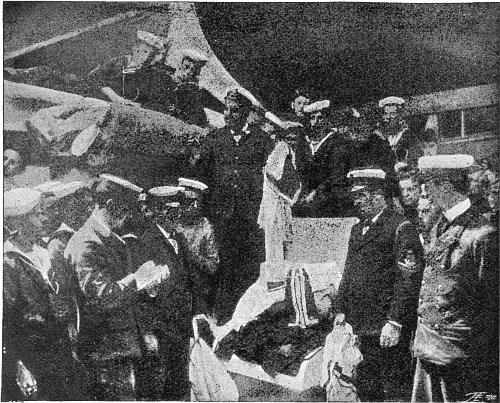
Photo. R. Thiele & Co.
AN AUCTION—SELLING A DESERTER'S CLOTHES.
When a man has absented himself without leave for seven days he is officially posted a deserter, and any clothes, uniform, &c., he may have left behind him are sold by auction to the highest bidder, the proceeds going to the Government.
Jack Tar, like a great number of his social superiors, does not believe in giving a paternal Government any more than he can conveniently help; and many a great bargain does he pick up at these sales. For instance, a white duck tunic, such as the master-at-arms is holding up for inspection in our illustration, and which costs Jack 4s. to 5s., will start at 3d. and slowly mount up to 6d. or 8d., beyond which sum the bidding seldom rises.
At 1.15 p.m., dinner being over, on ordinary week days the bugle sounds "Clean Guns," and work recommences; but on Sundays and Thursdays (known to the bluejacket as "Spun-yarn Sunday") the ship's company are granted an afternoon of rest.
As soon as dinner time is over the bosun's mate pipes the sufficiently obvious pipe "Hands make and mend clothes"; and, as Jack makes all his own wearing apparel, he is not slow to take advantage of the time allowed him.
In fine weather the men bring their machines on deck and smoke and sew together. Every conceivable kind of needlework does Jack execute equally well. And not only the rank and file, but the petty officers also are glad to make their own clothes rather than buy them ready made; and though Jack is generally a self-taught tailor, he turns out far smarter work than the slop-shops. The difference is very obvious if one compares a bluejacket wearing uniform "built" by his own deft fingers, with one who is wearing a suit bought at some "Naval Outfitter's."
The men have the forward part of the upper deck to themselves, the petty officers having the space further aft set apart for them; but this advantage is not without its little drawbacks. Witness an incident experienced by the writer.
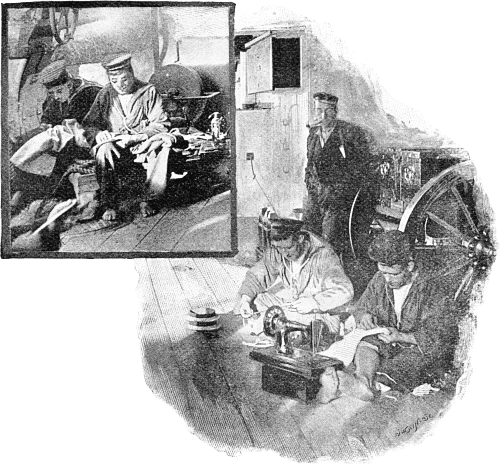
Photo. R. Thiele & Co.
JACK AS TAILOR—MAKING AND MENDING HIS CLOTHES.
He was seated by a ventilator playing chess—a favourite game—with a comrade. The fleet was about to enter Vigo, and a heavy sea was running, drenching the fo'c'sle and the other side of the deck, but leaving the space where the players were seated dry as a bone. They were just congratulating themselves on their comfortable quarters, when the ship, suddenly altering course to make the entrance to the bay, slewed round to port, and a heavy sea came neatly in and caught them as they sat. Chessmen, board, and players went suddenly floating about the deck in picturesque confusion, to the great amusement of the onlookers, who were expecting some diversion. Going below to change his clothes—for he was wet to the skin—the writer had the bad luck to stand directly under the same ventilator, and no sooner had he donned dry clothes than another malevolent and illfavoured sea came carefully down the ventilator shaft and rendered him as wet again. He tenderly avoided that ventilator during the remainder of the cruise.
Thursday afternoon is the recognised time for the opening of the mysterious and voracious "Scran-bag."
On board a man-of-war tidiness is a matter of great importance, and with a view to enforcing it an officer—on Sundays and Thursdays the puissant captain himself—makes a tour of the entire ship at certain hours. Woe betide the luckless man who has left out of its place the smallest article! For when the decks are being cleared up for the "Rounds" (as the inspection is termed), here a towel that has been inadvertently left on a rack instead of being stowed away in its appointed place, the kit-bag—here a book, or a coat, or a pound of tobacco, stowed away out of sight behind a scuttle cover, and discovered by the insinuative, far-reaching hand of the "Crusher," as the ship's corporal is familiarly termed, a hand that has a pleasant knack of exploring out-of-the-way nooks and corners—in short, any article that is left about is confiscated, and placed within a huge canvas bag, the "Scran-bag."
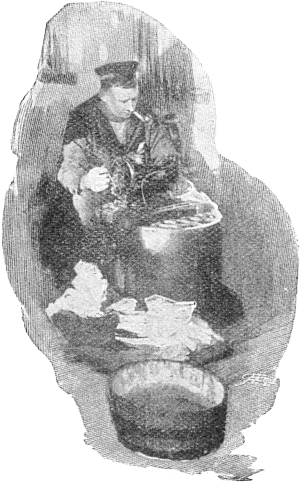
Photo. R. Thiele & Co.
A SKILFUL MACHINIST.
Every Thursday it is opened, and there gathers around it an excited knot of men who overhaul its contents thoroughly, a ship's corporal standing by to see that no man claims "what isn't his'n." But before the owner is allowed to take away his article he is mulcted in one penny for each article, to be put in the poor-box, or else he has to provide a piece of soap to be used in scrubbing decks.
Nearly everyone has seen "Ship's tobacco" in some form or other, but few know how the sailor prepares it for use. It is served out to him monthly, at the same time as his soap, in packages of 1 lb., for which he pays 1s. 1d., being allowed it duty free. It is a dark, rich leaf, and the first thing done is to remove the stems. This done, some water is sprinkled on the loose leaves (the old salt will prefer rum, to add to its strength and flavour), and the whole is enclosed in a piece of canvas and tightly bound with twine until it assumes a cigar-like shape, pointed at each end. Next some fine line is taken, one end secured to the tobacco and the other made fast to some strong support. One or two men now sit astride the line, and the tobacco is wound round and round, the weight of the men compressing it to about half its original bulk. When entirely covered with line it is tightly secured, and in two or three days is ready for use.
At night the men's time may fairly be considered their own. On certain evenings fresh water is served out for the washing of clothes, for Jack is his own washerwoman as well as tailor. That the marine is no less handy than his sailor brother may be gathered from the fact that the ship's cobbler usually belongs to that immensely useful branch of the service so aptly described by Kipling as "soldier and sailor too."
A number of men who are handy with razor and scissors make a good addition to their pay by attending to the tonsorial wants of their less gifted brethren, and shave and cut hair in a heavy sea-way with the ship rolling and pitching all over the place as easily as they do in harbour with an immovable deck to stand on.
"All work and no play"—the proverb was made for Jack; and though the bluejacket has to make his own amusement he does it as thoroughly as he does all else he puts his hand to. Nearly every ship in the navy has its nigger troupe or theatrical party, and some really clever performances are given; the make-up and dress are good, and would be no disgrace to a professional company. The fair sex, though absent, are hardly conspicuous thereby; few uninitiated eyes would detect in the female characters a middle-aged able-seaman or a cheeky young ordinary.
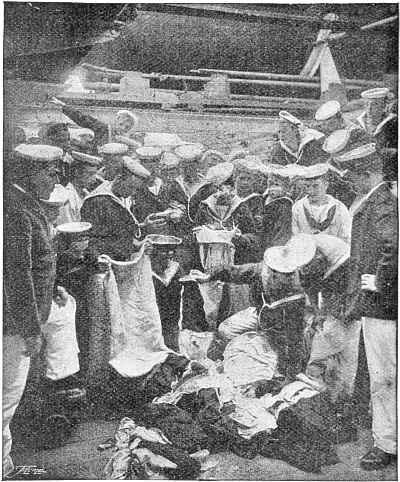
Photo. R. Thiele & Co.
SAILORS CLAIMING THEIR ARTICLES ON THE OPENING OF THE "SCRAN-BAG."
A more athletic relaxation is boxing, which is—as it should be—a favourite amusement aboard. Many a good man has the Royal Marines or the navy supplied to the professional ring.
While the men are amusing themselves in various ways their superiors are likewise killing time, and will often indulge in cricket on the quarter-deck, which is screened with canvas to avoid losing the ball overboard. The game can only be played at sea, for in harbour the quarter-deck is required for more serious work. The ball is usually a soft tennis-ball. The officers don flannels, and many an exciting game, such as Ward-room v. Gun-room, is played, and continued at every opportunity till the match is finished.
Every officer aboard takes an interest in these matches, captain and commander often coming on deck to encourage their juniors with their august presence, and many a match won by the navy ashore has been due to the practice aboard. For if a man can play cricket with a sloping and mobile deck beneath him he can surely do better on a well-rolled pitch.
On Saturday nights, on such ships as carry one, the band discourses sweet dance-music for the delectation of the men; and these proverbially ardent lovers of Terpsichore are true to their goddess, even though the wind is howling great guns, and the ship rolling and pitching in such a way that none but true sons of Neptune could even walk upright, to say nothing of dancing.
When no band is carried, a miscellaneous collection of blue-jacket and marine musical amateurs supply the deficiency; and their music, though not perhaps up to the standard of Mr. Dan Godfrey, amply fulfils its requirements.
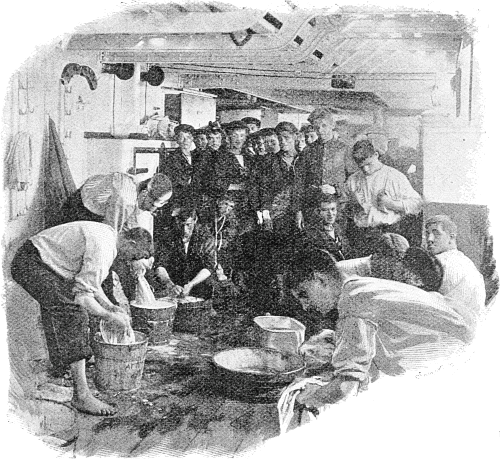
Photo. R. Thiele & Co.
"JACK IS HIS OWN WASHERWOMAN."
When the ship is in harbour, leave is often allowed, and in connection with shore-going there is an interesting formality not generally known. It is one of the most heinous crimes in the naval decalogue to attempt to smuggle any intoxicant aboard; and to obviate such a possibility every man on returning from shore is searched by the corporal of the gangway, a ship's corporal standing by, book in hand, to enter the names of the offenders in the "black list," to be dealt with next day by the commander.
The corporal of the gangway is usually an experienced Marine told off for the duty, and under his hands it would be difficult for even the most crafty smuggler to conceal any liquor about his person.
But to the credit of our navy be it said that cases of smuggling are extremely rare.
As a general rule Jack Tar and Joe the Marine, though certainly sometimes labouring under conditions trying to even the most law-abiding civilian, conform to regulations and discipline with that breezy cheerfulness and brave good-will which makes them, as they always have been and it is to be hoped always will be, the idols of their countrymen, the proud boast of their nation, and a standing menace to her enemies.
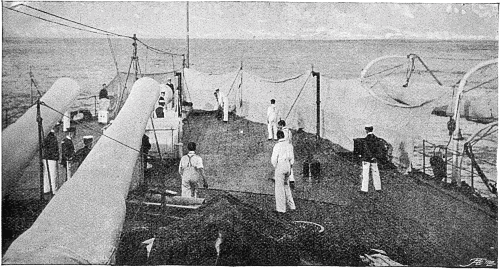
Photo. R. Thiele & Co.
OFFICERS PLAYING CRICKET ON THE QUARTER DECK.