Volume 1 — HOW WE GET OUR WEATHER. By Gavin Macdonald.
Reading edition
With photographs illustrating the queer side of the matter.
IN most of the morning papers we are accustomed to the luxury of a detailed weather report and forecast. The majority glance at it with a sceptical smile. They are of opinion that in order to be on the safe side they must invert its message. If fine weather and sunshine are predicted, they sagely nod and take down the homely gamp. The prediction of a hurricane or stormy showers is the signal for leaving umbrellas and overcoats at home.
However, those who know anything of the gigantic strides meteorology has made within the past few years are aware that in the main its prognostications are accurate. In fact, it is a matter for great surprise that its practical uses are not more generally recognised and taken advantage of.
If you meet your best friend in the street his first six words contain some reference to the weather. The merest stranger looks questioningly at the sky when he has made his bow. Two-thirds of the daily conversation of the British Isles has to do with this subject; nor is this surprising, for it is a matter of vital importance, affecting all classes alike.
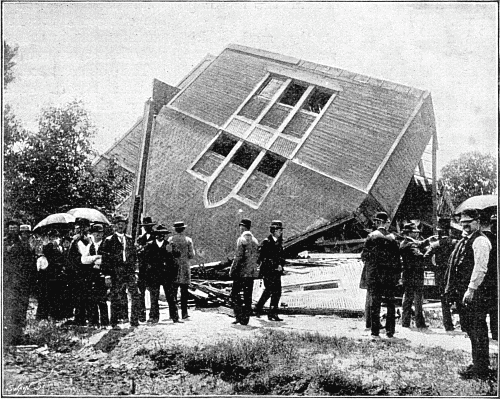
CHURCH LIFTED INTO THE AIR BY A TORNADO AND DROPPED ROOF-DOWN ON A HOUSE 100 FEET AWAY.
A wet Bank Holiday may mean thousands of pounds out of a railway company's pocket, not to mention the disappointment and chagrin of countless thousands of prospective holiday makers. A severe frost may disorganise a whole trade. In 1881, for instance, the whole building trade was at a standstill for a period of nearly three weeks, owing to the severity of the frost. And to the farmers, horticulturists, and fruit-growers the weather is a matter of financial life or death.
Meteorology is of invaluable assistance in other ways: in warning our coasts of coming storms; in deciding the climate and consequent healthfulness of the different parts of the country.
You can't even build a new town successfully without it, for only by accurate meteorological observation can the two most important factors of water-supply and sewerage be dealt with. For example, in planning a new waterworks, the ground subject to the greatest rainfall, and having the utmost gathering capacity, must be selected; while in constructing the system of sewerage, it is essential for the surveyor to accurately gauge the force and volume of the heaviest thunder-shower. If this is miscalculated, pipes of insufficient capacity may be laid with disastrous results to the city and its inhabitants.
These things are only to be learned by a study of meteorology.
Few people have any knowledge of the science beyond that supplied them by the forecasts and charts in the daily papers. Consequently the charts, which are more or less abstruse, are only understood by the few, and the forecasts are indulgently tolerated as a description of useless fortune-telling, rendered respectable by scientific recognition.
The popular idea seems to be that certain scientific men who have given the subject considerable study, cast a knowing eye on the evening sky, and pass on written prognostications for use in the morning papers.
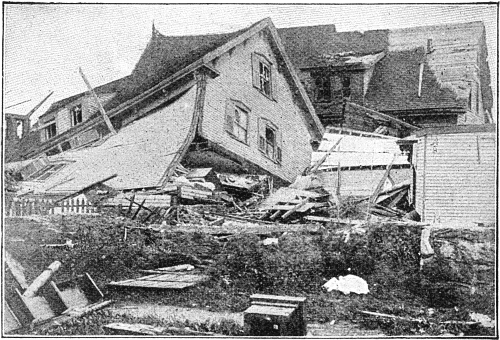
HOUSES WRECKED BY A TORNADO.
As a matter of fact the method by which we obtain our weather reports and forecasts is very different, and savours even more strongly of romance than the clairvoyant system usually identified with the seers of the weather office.
Two institutions look after our weather—the Meteorological Office, a Government department with a grant of £15,000 per annum, and the Royal Meteorological Society, a scientific institution maintained by the subscriptions and donations of its members.
The Meteorological Office occupies a dull set of rooms in Victoria Street over a shop, and, other than the latest weather chart, hung up outside the street door, there is nothing to intimate that the presiding wizards of the weather sit upstairs, and that if you are particularly anxious to have the latest information in their possession you have only to walk up and pay the nominal sum of one shilling.
Likewise you may receive the latest information by letter for the same fee, or by wiring to "Weather," London, the shilling fee and the cost of a telegraphic reply.
Farmers and others to whom the question of weather is a vital one, especially at the hay and harvest seasons, are supplied with harvest forecasts for the nominal sum of 2s. 6d. per quarter, in addition to the cost of the telegrams.
In addition to this, a set of forecasts is daily supplied to the newspapers, and about twenty-eight well-known agriculturists, for public exhibition in their neighbourhoods.
The system employed in making up the weather is of more than usual interest, and is worthy of some description.
In connection with the office are some 140 observing stations, including 17 belonging to the Royal Meteorological Society and 19 to the Scottish Meteorological Society. These stations are divided into classes according to the value and quantity of the observations supplied by them. Excepting the cases of telegraphic stations, which are subsidised by the central office, the observers are mostly volunteers who are interested in meteorology, and who provide their own instruments.
The office receives sixty telegraphic weather reports each morning, eighteen every afternoon, and twenty-nine each evening, in addition to an enormous mass of data supplied by volunteer and casual observers.
The forecast we are accustomed to find in our morning paper is compiled from the telegraphic reports of the subsidised stations. There is something peculiarly fascinating in the idea of the clerk of the weather scenting out a big gale and issuing a warning hours before its arrival on our coasts. One associates him with a prophet or witch, and very naturally wonders how it is done.
As a matter of fact forecast work is far from romantic, entails very great mental labour, excellent judgment, and great scientific knowledge and experience.
The forecasts are made three times a day—at 11 a.m., 3.30 p.m., and 8.30 p.m. They are, of course, based on the telegraphic reports and observations. The 8.30 p.m. forecast is made for the morning newspapers.
Among the volunteer observers are representatives of all professions. In one case a deaf and dumb gentleman presides over a station of considerable importance.
The stations themselves are mostly situated in the observers' grounds, and the surroundings of some of them are very picturesque. The stations at Rousdon and Chapel Hill, Torquay, are both beautifully situated. Princetown station is particularly interesting, because of its situation in the yard of the great Dartmoor penal establishment! We may be quite sure that its presence in such surroundings has nothing to do with the well-being of the convicts themselves, the dreary routine of whose lives is little affected by considerations of weather. In another case, the meteorological observatory is found on the tower of a church—that of Boston, Lincolnshire. Among the instruments on the tower is an electrical thermometer connected with the ground by a wire so that it may be read without the necessity of ascending. It is impossible to over-estimate the usefulness of a station such as this, situated as it is in the midst of purely agricultural country. The farmers round Boston avail themselves, it need scarcely be said, of the valuable information furnished by the mysterious little instruments on their church tower.
More interesting, perhaps, than any of these is the observatory situated in a London churchyard.
Although every day a ceaseless throng of human beings crowd and jostle in the streets of the City of London, yet it has always been difficult to obtain observations there, for the very good reason that scarcely anybody lives within its precincts. The only station of the kind is to be found in the churchyard of St. Luke's, Old Street, one of the few restful spots in this busiest corner of the world.
The highest station in Great Britain is that on the summit of Ben Nevis, 4,407 feet above the sea. The northmost station is in the Shetland Isles.
Many gentlemen among the volunteer observers are leading meteorological experts, and spend much time and money on the equipment and maintenance of their stations.
Messrs. Metcalfe, photo. Richmond, Yorks
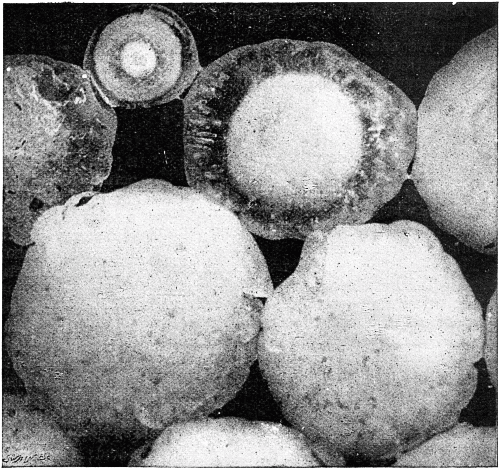
HAILSTONES (ACTUAL SIZE) THAT FELL AT YORK, JULY 8, 1893.
A very fine private observatory is that belonging to Col. Knight, of Harestock, Winchester, of which an illustration appears on page 60.
The scaffolding in the foreground was erected for the purpose of lowering an earth thermometer into the ground. This instrument, which is constructed to register the temperature seventy feet below the surface, is contained in the wooden chamber standing at an angle to the scaffolding, and was photographed during the sinking process.
Besides the work of preparing weather reports and forecasts, the office fulfils many other functions, such as the study of ocean meteorology, climatology, and so forth. In connection with the former work, the office annually receives some hundreds of reports and observations from officers of ships of the Royal Navy and Mercantile Marine.
The fishermen and sailors round our coasts have much to thank the office for. Besides supplying all the ports with daily weather reports and forecasts, it has lent over 200 barometers to fishing villages and other places on the coast for the benefit of the seafaring population.
Fortunately in this country we suffer comparative immunity from tornados, sirrocos, cyclones, and other dangerous natural phenomena.
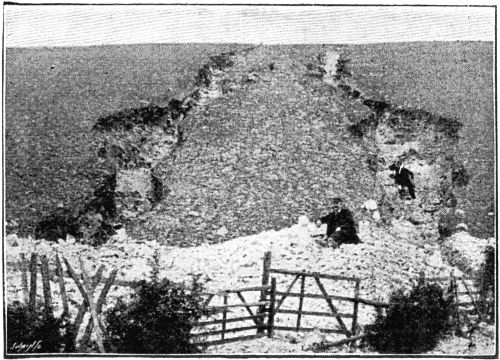
That we can produce something more ferocious than an April shower, however, is amply demonstrated by our illustration of two huge rents torn in a hillside at Langtoft, East Yorkshire, by the bursting of a waterspout.
Hailstorms are another great source of destruction. Most people will remember the damage caused by a hailstorm in Essex last year, when several farms and homesteads were utterly wrecked, and great numbers of cattle killed.
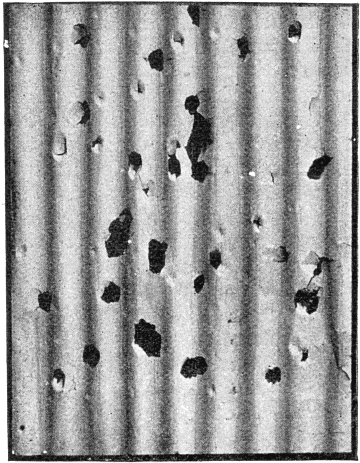
Many people who have not encountered the big hailstorm regard it with the cheerful scepticism with which they view the sea serpent and the abnormal gooseberry. However, by permission of the Royal Meteorological Society, we are enabled to reproduce a photograph of some of the hailstones—actual size—which fell in a great storm at York on July 8th, 1893, together with a section of corrugated iron, showing holes and damage caused by hailstones which fell in a similar storm at Tulcumbah, N.S.W., on Oct. 13th, 1892.
CORRUGATED IRON PIERCED BY HAILSTONES.
However, most people would rather lose a section of corrugated roofing than encounter the flash of lightning that struck the man whose clothes appear in the illustration on the next page. As will be seen, the clothes are literally shredded to rags, and the strong leather boots are torn as though they were tissue paper.
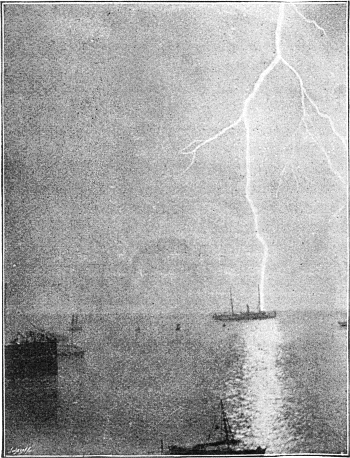
MIDNIGHT PHOTOGRAPH OF LIGHTNING FLASH IN SHANGHAI HARBOUR.
Photographs of lightning are no longer novel; but our picture of a flash taken at midnight in Shanghai Harbour is one of the most remarkable ever seen. It is some distance behind the anchored steamer, but the reflection on the water is so vivid as to give it the appearance of moonlight.
The tornado is a phenomenon we can very well do without, and we sincerely hope the clerk of the weather will give us ample notice of the very faintest indication that one of these inanimate monsters is coming our way.
The tornado is soon over, it is true, but hailstorms are to be preferred. On May 27th, 1893, a storm of this nature put in an appearance at Wellington, Kansas, and practically wrecked the whole city. A horse was picked up, stable and all, and blown some hundreds of yards to leeward. The stable was smashed, but curiously enough the horse came down on his feet and escaped unhurt.
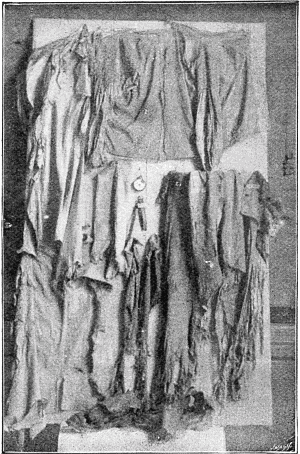
CLOTHES OF MAN STRUCK BY LIGHTNING.
In the same storm the Lutheran church was lifted bodily from its foundations into the air, and fell, bottom upwards, on top of a new residence 100 feet away, as it appears in the photograph.
In another photograph are some collapsed houses, the result of a similar storm in Lawrence, U.S.A.
Although our own Meteorological Office and Society have no such startling instances to record, yet they possess much data of equal interest.
For instance, how many people know that on Dec. 4th, 1879, the thermometer registered 23 degrees below zero at a place called Black Adder, in Berwickshire? This is the greatest degree of frost ever known in Great Britain. The coldest spot in the world is Verkoianski, a town in Siberia, where 120 degrees of frost have been registered. The hottest is the Red Sea, where 120 degrees of heat are often experienced.
The hottest place in Great Britain, curiously enough, is London, or rather the Thames Valley. The wettest, Seathwaite, in the Lake District, where 8.03 inches of rainfall have been registered in 24 hours.
Taking 1 inch of rain to represent 101 tons of water per acre, it will be seen that the farmers cannot complain of drought in the Seathwaite district.
However, the greatest rainfall ever measured in this country occurred in Camden Square, London, on June 28, 1878, when 3¼ inches fell in 1½ hours.
Lately several meteorological experiments have been made with kites and balloons, which are expected to enrich the science with many new discoveries.
Many people have curious ideas of the capabilities and functions of "The clerk of the weather." Mr. Robert H. Scott. M.A., F.R.S., the gentleman at present occupying this position, in his book on "Weather Charts and Storm Warnings," tells some curious stories illustrative of this.
For instance, in June 1886 he received a letter bearing no less than ten postmarks. It was addressed "Weather Office, Strand, London." Its contents were—"Three next days order to be fine."
A Boston letter was addressed—Right Hon. Clerk of Weather, 9, Downing Street, London, W.C.
Its contents were—
"My Lord Clerk,—May it please your lordship you will greatly oblige your humble servant by writing or sending me a telegraph whether it will be fine or no on the 5th of November, 1867.
"I have the honour to remain,
"Your lordship's most obedient servant,
"Joseph William ——."
Such letters are by no means rare, though such ignorance seems scarcely credible in the nineteenth century.
Boak & Co., Photo, Bridlington Quay
HILL TORN BY WATERSPOUT, LANGTOFT, E. YORKS
Further, there are many false prophets who prophesy without science, and they rarely miss the opportunity of sending along a forecast in order to give the constituted clerk of the weather a leg up in his arduous duties.
There are also many amateur weather prophets.
One of these gentlemen issued monthly postcard forecasts for more than twelve months between 1882 and 1883.
If they are wrong, nobody bothers, but if the S.W. gale predicted from the Meteorological Office fails to put in an appearance, woe to the unfortunate clerk of the weather. People forget how many times his predictions have been verified.
If one is interested in meteorological work and is anxious to become an observer, the path is by no means difficult. On application at the office a form is sent, which must be filled up. Certain particulars as to the observer's fitness are naturally required, and he is invited to forward a description of his residence and a plan of the spot on which he would suggest erecting his instruments.
He must also describe the natural surroundings, so that the office may decide whether they are likely to have any prejudicial effect on the instruments, and therefore affect the accuracy of the records.
Each observer supplies his own instruments, and if his application is accepted, a book of instructions on their correct use is sent to him.
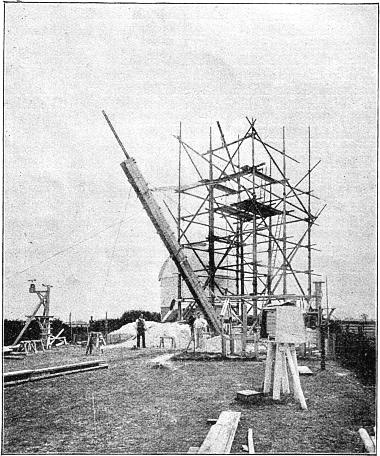
COLONEL KNIGHT'S 70-FOOT EARTH THERMOMETER, WINCHESTER.
Or he may obtain instruction at the London office, or any of its chief agencies. In all these places sets of instruments are kept in working order for the express purpose of instructing observers in the methods of observation.
I suppose most of our readers, during a stay at some port or favourite watering place, have observed a curious triangular black object suspended from the pier or jetty signal-mast.
Those who have enquired as to its nature will know that it is the signal of an approaching storm. On receiving telegraphic notice of an atmospheric disturbance on or near the British coasts, the Meteorological Office telegraphs to all the chief ports and fishing stations.
The telegram is exhibited at the foot of the signal-mast, and the warning signal, a black canvas cone 3 feet high and 3 feet wide at the base, is immediately hoisted.
The nature and direction of the approaching storm is indicated by the position of the cone.
At night three lanterns hung on a triangular frame supply its place.
Storm warning telegrams are supplied to some 215 stations, of which 117 are in England and Wales, 63 in Scotland, 28 in Ireland, 4 in the Isle of Man, and 3 in the Channel Islands.
Another branch of the work, of invaluable service to navigators, is the preparation of monthly current charts of the oceans of the world. Observations are constantly being made by captains of ocean-going vessels, and the data are forwarded whenever possible to the Weather Office. A strict account of the currents recorded in each month has been kept for 60 years!