Volume 1 — HOW SANDOW MADE ME STRONG A REMARKABLE PHYSICAL TRANSFORMATION.
Reading edition
IT was a question of going to South Africa or running the risk of a short life in England; health dictated the question, and the answer depended on many things. Someone suggested Sandow's School of Physical Culture as a compromise; and finally England, backed up by financial and other reasoning, carried the day.
ON ENTERING SANDOW'S SCHOOL.TEN MONTHS AFTER. (From Photographs.)
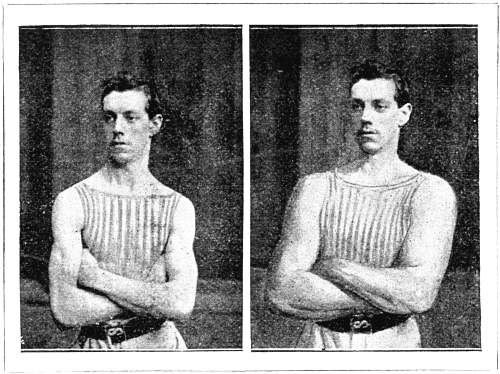
I was a puny youth, weak of spirit and frail of frame, when I first visited Sandow's muscle factory in St. James's Street, London, and said that I had come to be made into a strong and healthy Englishman—to obtain a fresh lease of life if possible.
HEIGHT AND WEIGHT.
BEING SOUNDED."THE LITTLE MACHINE TICKED MERRILY AWAY."
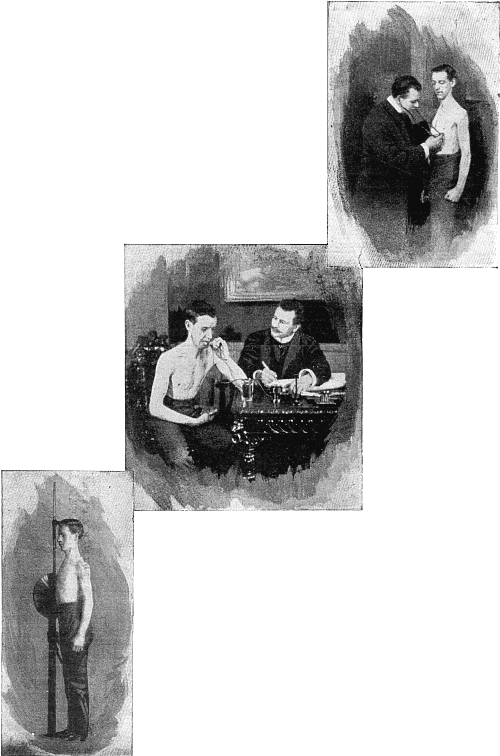
Sandow fingered my arms and chest as he might a prize ox, and remarked that I should make an admirable subject for his purpose; he liked pulling folks out of their graves. Whereupon I imagined I should be passed into the gymnasium to swing a dumb-bell for an hour or so, and be invited to drop in again when I was next that way. But I was mistaken. Had my object been to enlist in Her Majesty's forces, the examinations and tests I was subjected to could not have been more extensive or peculiar. I was sounded, measured, weighed, pounded and questioned, the results being solemnly entered into a big ledger, as though it might all be used as evidence against me should the need ever arise. Weight 120 lbs., chest measurement 32 in., height 5 ft. 6½ in., though the latter is immaterial, as Sandow does not bargain to make one grow in that direction when nature considers her duty done.
Though I felt ashamed of the figures myself, they did not seem to affect my burly interrogators in any way, and the examination proceeded. Had I indigestion, and did I smoke? I confessed to a little of either weakness of the flesh. Was there any particular ailment in the family, and would I take a full breath and blow down this tube? As I did so, a little clock-like machine ticked merrily away, till it registered that my pair of lungs—or "one and a decimal," as a blunt old doctor had once informed me—could contain at full pressure 185 cubic inches of air—a poor record, be it said.
Next came dumb-bell and weight tests, careful note being made of the exact number of pounds I could lift with one hand, two hands, hold at arm's length, and support above my head. The record ran thus:—One hand lift, 65 lbs.; at arm's length, 18 lbs.; raised from shoulders (1) 40 lbs., (2) 35 lbs. each. Bar-bell raised above head, 85 lbs. So the examination ended, and when my photograph had been taken as a sort of example "before trying," I was free to join the little army of health-and-muscle seekers whenever I chose.
A very mixed army it was. Stern-visaged men were there going through the exercises as seriously as if life itself depended on them; sprightly veterans taking again to regular exercise, so much missed since they joined the half-pays; middle-aged men making up for the negligences of earlier days; clerks and students of all kinds going into strict training in order to be in form for the cricket and running season; and finally a goodly sprinkling of puny youths working hard to attain the weight and chest measurement necessary to give them another chance at Sandhurst or Woolwich, where they had just been declined "for physical reasons."
The display was not without its humour. A plump stockbroker is a common and natural enough sight in the city, but he forms a different spectacle as, minus the glossy hat and black coat of his calling, he energetically whirls a pair of dumb-bells in the frantic endeavour to exchange his superfluous avoirdupois for sinew and muscle, especially when his immediate neighbour, a very lean littérateur, is performing the same evolutions with the secret hope of putting on flesh.
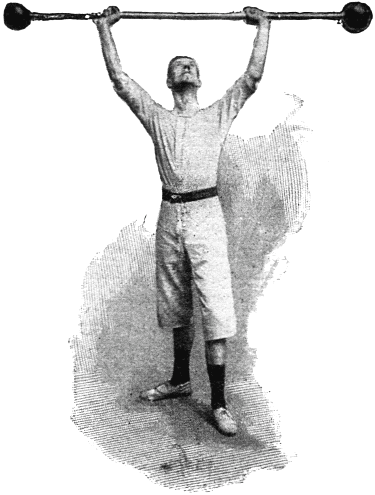
THE BAR-BELL TEST—SUPPORTING 85 LBS.
It would require a keen eye, supported by a good imagination, to discover any outward visible sign of the "strong man" about the various instructors of Sandow's school, dressed as they are in ordinary attire, to say nothing of fashionable collars and the latest thing in neckties. Any one of them might have strolled in from Bond Street, mistaking the place for the club, yet any one of them would think nothing of snatching up a 100 lb. dumb-bell and raising it aloft with the ease with which most people might perform a similar feat with an umbrella.
When I presented myself at the gymnasium for my first course of instruction I was handed a pair of dumb-bells weighing not more than 3 lbs. each. I protested that I had been in the habit of using bells three times as heavy. It did not matter, I was informed,—lead pencils would be almost as serviceable, providing I concentrated my whole attention on each exercise in turn.
It must not be supposed, however, that dumb-bells do not play an important part in Sandow's system. On the contrary, as will be seen from the photographs herewith, they figure in numerous exercises, but their weight is practically immaterial. They usually vary according to the physical condition of those using them.
Having grasped his "three-pounders," the student is made to stand in an attitude of ease, the inner side of his arms fronting outwards. His very first step on the road to muscular development is to alternately bend each arm at the elbow, bringing the dumb-bell close to the shoulder. This has to be repeated some twenty or thirty times, to the measured "One, two, three," of the instructor.
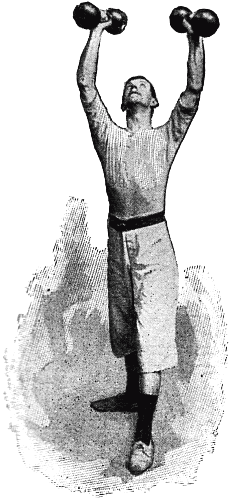
LIFTING 70 LBS. WITH TWO HANDS.
The same thing is then gone through with the arms turned the other way, so that the knuckles instead of the finger-tips are brought up to the shoulders. Next the arms are extended outwards in a straight line, each being bent in turn at the elbow, and the dumb-bell brought immediately above the shoulder. And here comes the student's first difficulty; for in extending the arms each time it is necessary to keep them straight and rigid in order that the muscles may be benefited by the strain. It is amusing to watch various pairs of arms gradually drooping as this exercise proceeds.
Altogether the dumb-bells are used in about twenty different positions, each affecting a different set of muscles. There is the lunge, for instance, exercising both arms and legs. First standing at ease, the pupil takes a stride forward and strikes out alternately with his left and right, as though an adversary awaited the blow. Some twenty-five or thirty such lunges, however, are calculated to transform the most bellicose among Sandow's disciples into members of the Peace Society.
The wrists are strengthened in this fashion: once more extending the arms in a line with the shoulders the pupil now holds the dumb-bells by the ends, instead of in the usual way, and with a circular motion of the wrists revolves the bells first from right to left, then from left to right.
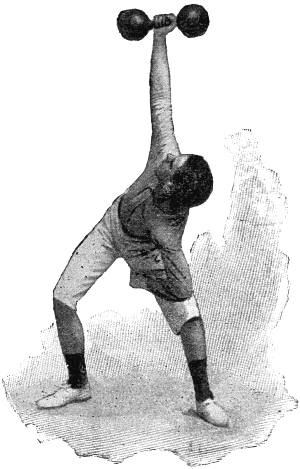
RAISING 40 LBS. WITH ONE HAND.
Next comes what the flippant call the "see-saw" motion. With the inevitable dumb-bell in each hand the student stands erect; the see-saw consists of nothing more remarkable than bending the upper portion of the body from side to side, without moving the lower limbs. These are cared for in the next exercise. Lying at full length on the ground, the pupil actually proceeds to kick his legs in the air! Not particularly graceful, perhaps, but highly beneficial, it is claimed, to the "hinges" at the knees and hips. What this motion does for the lower limbs, the next does for the upper part of the body. Lying at full length on the ground as before, and keeping the legs perfectly stiff, the student raises his head and shoulders from the ground, and with a quick movement swings forward until his body is bent almost double, then returning slowly to the former position. The dumb-bells are now forsaken for a time. The lesson to be learned is to support the body on the hands and toes, and to alternately lower and raise it by respectively bending the elbows and straightening the arms, taking care not to touch the ground with any part of the body. It looks and sounds easy enough; so it is, to do it once, but quite another thing to keep it up in quick succession until the instructor sees fit to cry "halt!" which is timed, it seems to the student, specially to remind him of the penultimate straw and the camel's back.
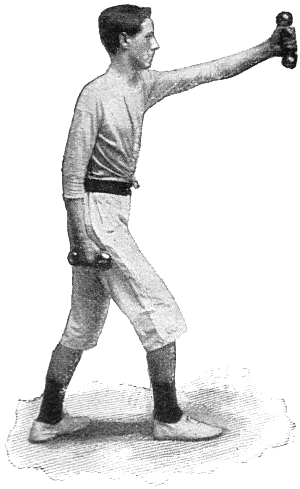
THE LUNGE.
Dumb-bells are now resumed, this time attached to stout elastic strands, these in turn being fixed to the wall. Exercises of much the same kind as before are gone through, except that the strain on the muscles is now greater, seeing that almost every movement involves stretching the rubber bands to their fullest extent, and allowing them to return to their natural state slowly, not with a snap. The same principle is applied to the development of the legs and neck, ingenious devices in the shape of "harness"—forming an interesting branch of the system—being requisitioned for the purpose. In each case the elastics have to be stretched as much as possible, the strain being in turn centred on sets of muscles that could be reached by no other method.
If after having gone through all these exercises the pupil should pine to develop his knowledge of Physiology as well as his frame, he may learn that this little action affects the latissimus dorsi, that that tiny movement seeks out the neglected deltoid, that another bend of the body, insignificant though it may seem, means much to the pectoralis major, and so forth. But the gentle student usually prefers not to burden his brain with these things, and in this respect he is perhaps not unlike the gentle reader. So no more shall be inflicted.
Every pupil has to attend Sandow's School at least twice a week, and when there to repeat each of the exercises named some twenty times, though this number is a kind of moveable feast, advancing or decreasing with his condition, reaching as high as sixty and as low as ten. Beyond that he is supposed to practise every day at home, and regularity in this greatly facilitates the development, just as home-lessons assist a schoolboy's education. There, probably, the simile ends; certainly the majority of Sandow's followers do conscientiously work out of school hours.
When students have been got into trim generally—this takes about a month—they are allowed to add weight-lifting, with and without "harness," to their regular exercises. To do so before the body was in a supple condition might result in serious strains occasionally. A still further stage is practice on the Roman pillar. This consists of hanging backwards suspended from the knees, and from that rising to an upright position, lifting with the body a bar-bell weighing anything between 30 lbs. and 120 lbs.
Every few months examinations are held, the same tests and measurements as on entering being gone through, and the results put down side by side in the ledger, so that one's weak points can be seen at a glance and receive particular attention forthwith.
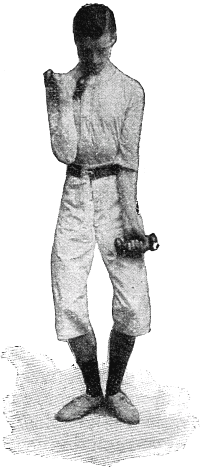
THE FIRST STEP.
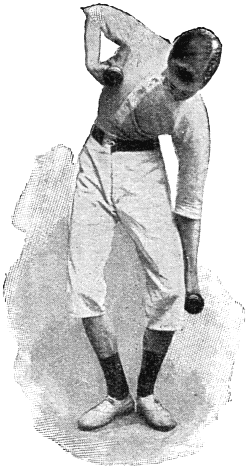
"WHAT THE FLIPPANT CALL THE 'SEE-SAW' MOTION."
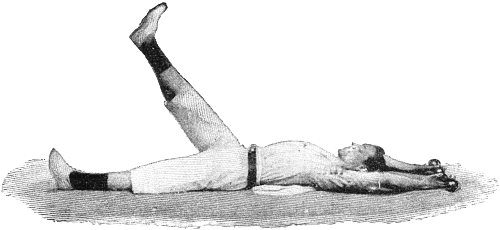
"NOT PARTICULARLY GRACEFUL, BUT HIGHLY BENEFICIAL."
Personally, I had not been in the school a few weeks before I began to feel its benefits. The first signs were the arrival of an appetite and the disappearance of indigestion and insomnia. Gradually I exchanged loose flesh for firm muscle; my weight increased; my chest measurement advanced. My weight-lifting crept up by "fives" and "tens," till at the end of three months I could raise 70 lbs. with one hand, 350 lbs. with two, and 500 lbs. in "harness," all with comparative ease.
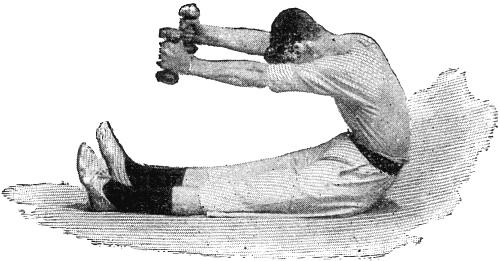
"UNTIL HIS BODY IS BENT ALMOST DOUBLE."
Every time I blew into the little lung-testing machine I felt apprehensive of its breaking or getting out of order under the strain. My course of instruction commenced ten months ago; at the last examination, held recently, my record ran:—One hand lift 130 lbs. (an increase of 65 lbs.). Held at arm's length 35 lbs. (increase 17 lbs.). Raised from shoulders, one hand, 90 lbs. (increase 50 lbs.), both hands, 160 lbs. (increase 90 lbs.). Raised above head 175 lbs. (increase 90 lbs.). Weight, 10 st. 0 lb. (increase 1 st. 6 lb.); chest measurement, 36 inches (increase 4 inches). Lift with "harness" 800 lbs.; without 550 lbs. Perhaps it should be added that this result was not achieved by irregular attendance at the school or occasional practice at home. I worked diligently every day on rising in the morning, and before retiring at night, and I fancy I have no need to go to South Africa now.
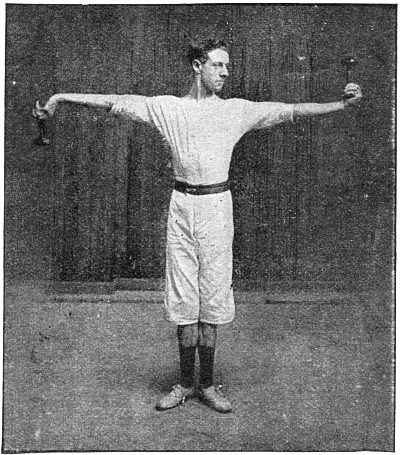
FOR THE WRISTS.
A little about the St. James's School itself. Incredible though it may seem, it is not a limited company. Every one connected with the place, from the manager downwards, has to go through the system. That is why the door is opened to you by a young Hercules whose clothes are bursting over him, and who, rumour says, is afraid to take them off o' nights lest he should never be able to get into them again; that is why, if you call early or late enough, you will see a muscular charwoman scrubbing the front steps to the quick time of "Sandow's March," for even she is not exempt. There is, by the way, a special course of training for lady pupils.
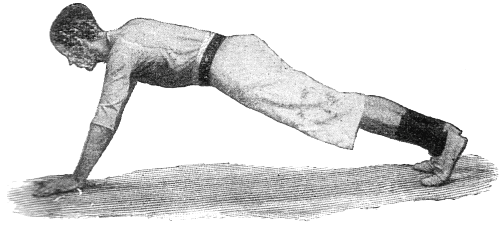
NOT SO EASY—
Every one connected with the place participates in the profits, which must be large, from the head-manager down to the two humbler individuals just mentioned. That, doubtless, is why the door is always opened to you with commendable alacrity, and may account for the fact that the front steps are the whitest in St. James's Street, and that the brasswork about the establishment positively dazzles the eyes with its gleam.
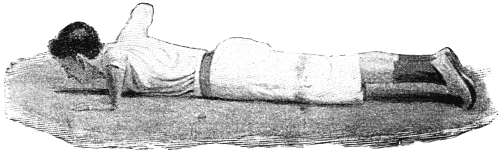
—AS IT LOOKS.
Of course Sandow has his "secret." It is that he does not believe in developing one part of the body at the expense of another. His aim is not to turn out pupils with runners' legs or rowers' arms, but of good physique generally. If a runner enters the school his legs are naturally better developed than the average. They will, therefore, require less attention than usual, and more will be given to other parts of his body. And so forth.
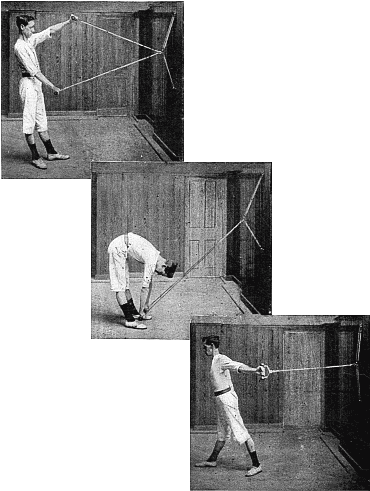
IT IS THE CONSTANT_STRAIN THAT_DEVELOPS THE MUSCLES.
The exercises are so devised that no set of muscles in the body is overlooked. In the ordinary course they are all developed together, at much the same rate; but this, of course, cannot always be adhered to. It frequently happens that a pupil desires chest expansion above all else, in which case he will devote himself primarily to the exercises specially framed to bring about that result. In several cases a couple of inches in the way of chest measurement has stood between pupils at Sandow's and commissions in Her Majesty's army.
Much depends, Sandow avers, on mind concentration.
"It is of little use," he says, "going through the exercises mechanically. As each one is performed, it should occupy the whole attention. Merely swinging a dumb-bell the regulation number of times will do no good. It should be regarded as serious work, and one's heart should be in it. It has not been my aim to produce what are known as strong men; it is a comparatively easy task to pick out a few men exceptionally endowed by nature, and train them until they attain great proficiency in particular feats of strength and activity. It may be considered somewhat ambitious, but my honest desire is nothing less than to permanently raise the standard of physique in the whole race, and to restore, as far as possible, the old types of physical strength and beauty, for the loss of which civilization is so largely responsible."
One naturally asks: What is the age limit at which physical development necessarily ceases? Perhaps Sandow's school-register best answers the question. His pupils range from fourteen to seventy-three. The gentleman of the latter age felt so rejuvenated after one week's attendance that he promptly put himself down for a whole year's course, and has since declared his intention of "never leaving school" until old age compels him.
It is interesting to recall how Sandow first came before the public as an exponent of strength. Some nine years ago it was the practice of a "strong man" then performing at a London theatre of varieties to issue nightly from the stage a challenge to the world generally to accomplish any of his feats, which included the lifting of great weights, the snapping of steel chains, and the bending of iron bars. One night, to everyone's surprise, the challenge was accepted by a member of the audience, and a young man stepped upon the stage in immaculate evening dress. When this was removed the customary attire of the stage "strong man" was revealed. It was Sandow, then unknown.
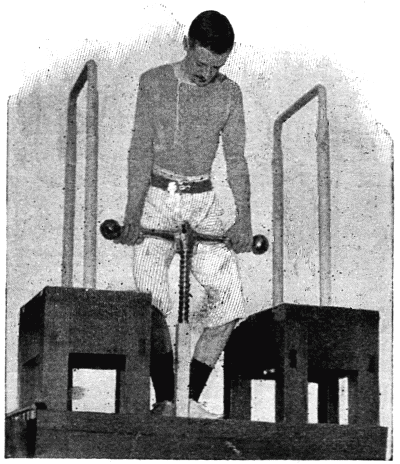
LIFTING 350 LBS. WITHOUT HARNESS.
Amid the wildest excitement he performed every one of the wonderful feats. The next day a new "strong man" had dawned.
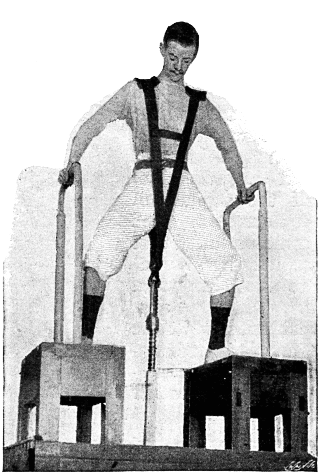
LIFTING 500 LBS. WITH HARNESS.
It is Sandow's ambition to start schools of muscular development in all the principal cities and towns in the kingdom, and if they become as popular as those in London, there is hope for the country, physically, yet. The tendency of the Englishman, since he acquired the habit of living in towns, has been to take too little exercise. Roast beef and Sandow may do more for the race than the former ever accomplished alone.
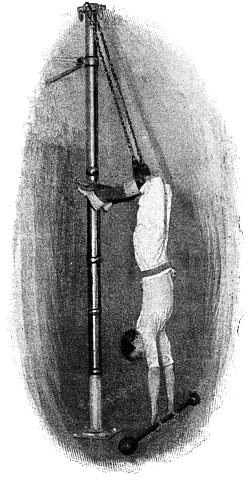
WEIGHT-LIFTING ON THE ROMAN PILLAR.
A. E. J.