XV OUT OF ASIA INTO EUROPE
Reading edition
The long journey in the train de luxe from Irkutsk to St. Petersburg, especially the Siberian part of the journey, does not afford a great variety of scenery or incident. But, if somewhat monotonous, it is a pleasing and gentle monotony. There is not a mile of desert land in all the five thousand versts between Lake Baikal and the Atlantic, or, for that matter, between the Pacific and the Atlantic, by the way we have travelled.
There are no long stretches of sagebrush plain, such as Wyoming, Utah, and Nevada afford; no “bad lands,” such as are found in the Dakotas; no interminable stretches of wearisome, treeless prairies, such as the Canadian Pacific traverses in Manitoba and Assiniboia. There are occasional wide reaches of prairie or meadow land, but trees are always in sight, and for the most part the road passes through a heavily wooded country. Birches abound everywhere, with their graceful white boles, and there are many forests of pine and poplar. The trees in the vicinity of the railway are not large, the “monarchs of the forest,” if there ever were any, having been cut off at the advent of the railway.
The piles of cut wood by the railroad track impress the traveller with the boundlessness of the forests. Millions of cords of clean cut birch and pine, with scarcely a knot or a blemish, stand in neat piles waiting the insatiable engine.
Everywhere the land seems fertile, and, though but an infinitesimal part of it is cultivated, it would all reward the husbandman. Great flocks of sleek cattle roam over these natural pastures, but there is room for a hundred flocks where one roams to-day. And all this vast domain has been waiting for settlers at Europe’s back door during all the centuries. Only now is the door fairly open, and the new settlers are pouring through. America, meanwhile, has been discovered, opened, and occupied; Australia has been discovered and great cities built upon its seaboard; the tropics and the poles have been explored; and all the time a great fertile domain, vaster than all Europe, and separated from Europe’s swarming, overcrowded millions by no barrier of sea, and but a low mountain range, has been waiting, almost tenantless, for a people. But now Siberia has been discovered—discovered by the settler and the home-maker, as well as by the politician and the autocrat who desires a Botany Bay for his convicts—and a new and virgin empire that can afford asylum for the surplus population of two continents has been added to the world’s productive domains. Undoubtedly this enormous and almost untrodden empire gives Russia a great advantage among the nations of the world. Here is a vast new continent contiguous and near to ancient Russia, a domain which cannot be seriously threatened by any enemy, a domain which in the decrepit state of China requires no fleets or armies to protect. At length Russia has awakened to a sense of its value, and is pouring into it by the ten thousand every month the peaceful settlers who will make her possession secure.
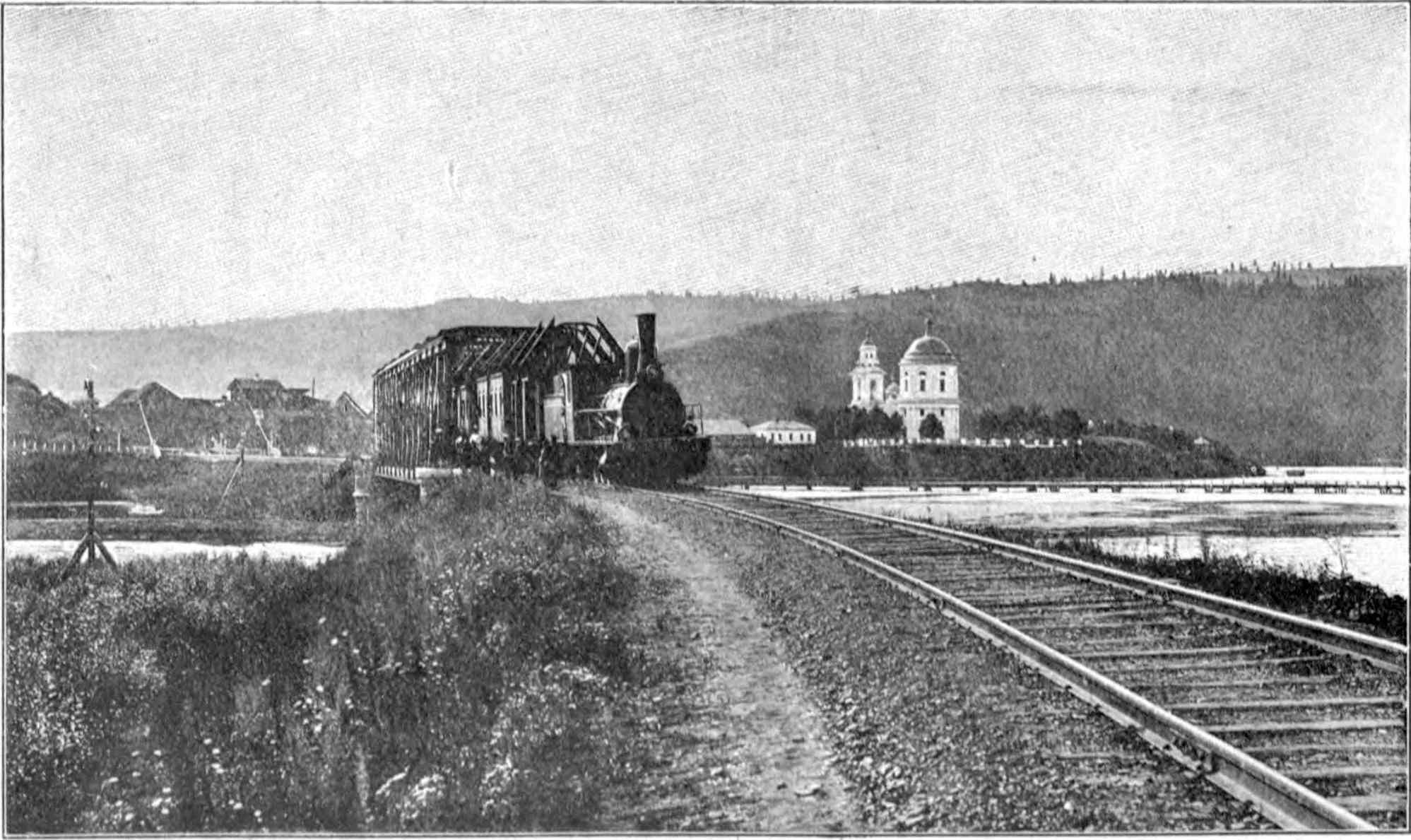
ZLATOOST, A BORDER TOWN BETWEEN EUROPE AND ASIA
Between Irkutsk and Moscow the railway passes through a few large towns of considerable importance. Chief of these are Crasnoiarsk, about seven hundred miles from Irkutsk; Taiga, some three hundred miles still nearer Europe; Omsk, about five hundred miles further west; and Tschelabinsk, which lies near the edge of Europe, two thousand miles from our starting point at Irkutsk.
These places will be but names to most of my readers, and they will not be much the wiser if I tell them such facts as that Omsk has forty thousand inhabitants and Tschelabinsk has fifteen thousand. All these towns, and many smaller ones that I might mention, are places of no little importance in the districts of which they are the centres, but they do not as yet cut much of a figure on the world’s maps. They all have the characteristics of frontier towns, are built largely of logs, but boast from one to twenty beautiful churches, which always strike the eye and give them a character and a beauty which they would sadly lack without the shining domes and brilliant crosses pointing heavenward.
Omsk is the most important place on the line of the railway between Irkutsk and Moscow, and is the residence of the governor-general of the province of the Steppes, and of a Greek Church archbishop.
Tomsk is a larger and more important place still, but is not directly on the Trans-Siberian route, being connected by a branch line at Taiga.
The road crosses many large rivers during these two thousand miles before it reaches the European frontier, and the cost of the great iron bridges which span them must have been enormous. They seem to be built in the most substantial manner, with piers and buttresses of massive cut stone. These rivers belong to the great systems of the Yenisei and the Obi, which in their upper reaches branch off into many streams, each of which, in any other continent, would be a notable and famous stream. But Siberia is so rich in great rivers that even the names of these mighty tributaries are not of great interest to the reading public. When Siberia shall come to her own and take her place among the great populous nations of the earth, these rivers will add enormously to her wealth and commerce.
On the evening of the fifth day from Irkutsk we went to bed in Asia, and woke up on the morning of the sixth day in Europe, and in the beautifully situated town of Zlatoost. We found ourselves also in the heart of the Urals, and the contrast with the flat plains of Siberia was most refreshing.
Lovely spruce-clad mountains towered above us on every side; a rushing river, which the track follows for many miles, seemed to beckon us on with its smiling ripples that glinted and glowed in the morning sun. Great, open, park-like valleys and uplands lay between the mountains, dotted with trees and covered with the greenest of grass, studded with beautiful flowers of every hue. Altogether, for many miles, the scene was one of rare loveliness, and was worth travelling a thousand weary versts to see.
The Russians call this region of the Urals the “Switzerland of Russia,” and though it lacks the grandeur of the snow-clad Alps, it has a beauty of its own which is exceedingly charming.
All day long our road wound through these charming scenes, up hill and down dale, usually keeping a rushing, sparkling river in view, until, towards the close of the long day, the great town of Oofa, with its beautiful churches and fine railway station, came in view. We had passed the barrier of the Urals, and the day of loveliest scenery in all the long journey had come to an end.
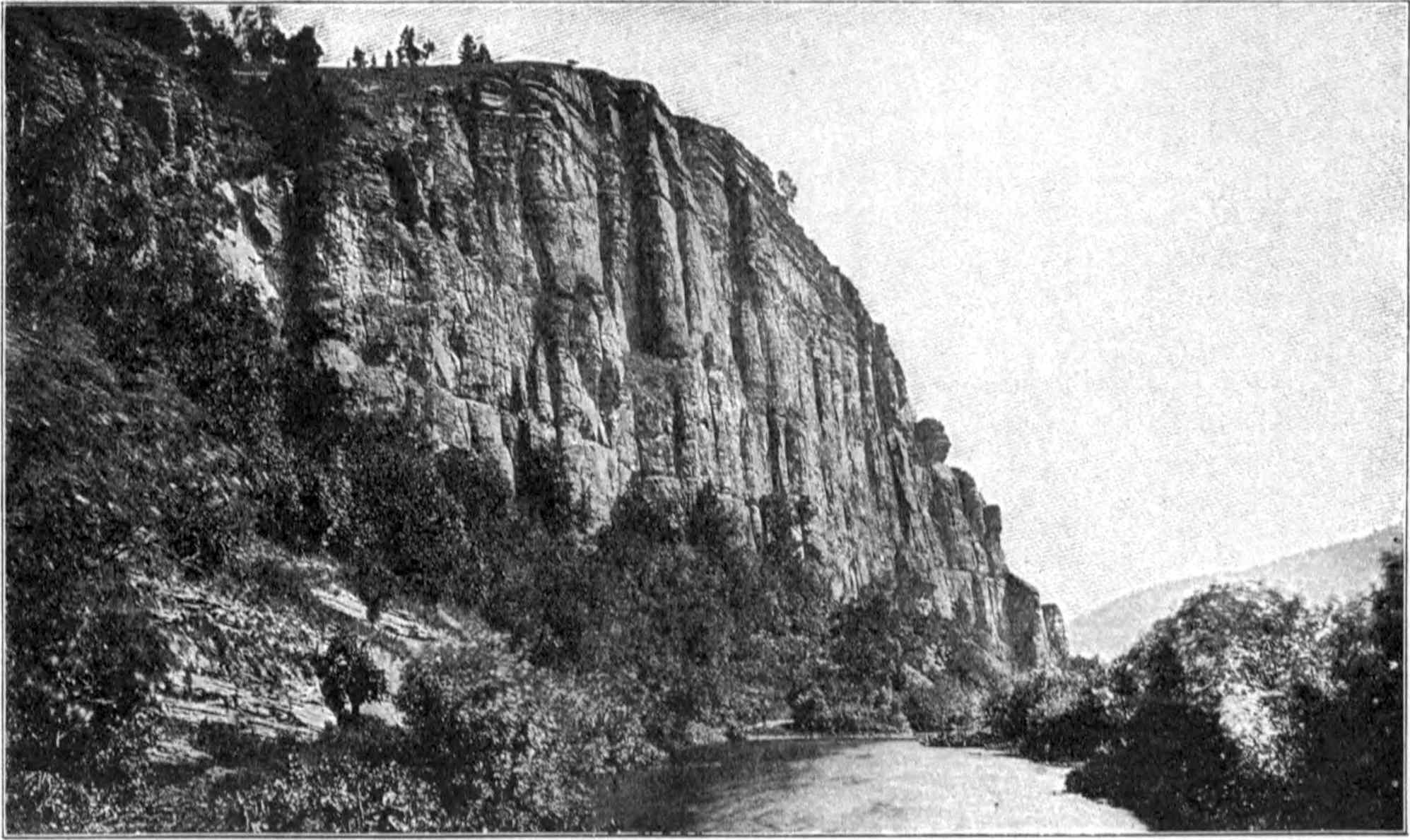
IN THE URAL MOUNTAINS
Our deliberate train mended its pace very considerably after getting into Europe, and, on the last three days of the journey, did almost as many versts as during the first five. The engineer actually seemed able to get by some small and insignificant stations without stopping, and where we did stop it was often for less than a full half-hour. We averaged fully twenty miles an hour after crossing the Urals, which seemed like lightning speed after our slow and toilsome way in Siberia.
On the seventh day of our journey from Irkutsk, the Urals had faded into the distance, and the flat plains of European Russia were substituted for the flat plains of Asiatic Russia. The country on both sides of the mountains looks much the same, except that the European plains are better cultivated and less wooded. They have evidently known the plowshare for many a hundred years, and in early July were smiling with luxuriant crops of wheat, and barley, and rye. Greater Russia plainly is in no danger this year of a wide-spread famine.
In some places hay-making had begun, and the great unfenced fields containing hundreds of acres were alive with haymakers in gay attire. The Russian farmers live together in villages, instead of in isolated farmhouses, as do our husbandmen, and the business of cutting and making a great communal hayfield was evidently an important matter that brought together all the men, women, and children of the village. Often forty hay-wagons, each with a span of horses and five times as many people, were assembled at the edge of a field. The mowers, in long rows, would then start for the other side of the great field, nearly a mile away, cutting a wide swath as they went, while fifty Russian Maud Mullers, in red and blue bodices, raked the meadows sweet with hay, which yesterday had been cut. They seemed merry and light-hearted about their task, and we could hear snatches of song and bursts of laughter, and many a bright bandanna was waved at the flying train.
The small villages did not strike me, as I saw them from the train, as being superior to the Siberian towns. They are built largely of logs, or of mud and wattle, and have low-browed thatch roofs, often much out of repair. But every village, however small and shabby, has a beautiful church, which contrasts strangely with the one-story thatch-roof huts that gather around it, as if a brood of very diminutive chickens were clustering around a big brooding mother hen.
The large towns which we passed, as we drew near to Moscow, were distinctly better built than in Siberia. Large blocks of brick and stone, wide streets, and a general air of thrift and prosperity seemed to pervade them. Samara is a city nobly situated on the banks of the Volga, and has really a regal appearance on her crown of hills, with her great cathedral and noble churches dominating all.
The railway crosses the Volga, a few miles after leaving Samara, by a splendid iron bridge, nearly a mile long. Even here, so far from its source, this greatest river of Europe is a majestic, swift-flowing stream, bearing upon its ample bosom great rafts from the pine forests near its source, and many great steamers, which carry passengers to the famous fair at Nijni-Novgorod, and other towns along its banks. Most, if not all of these steamers, use petroleum for fuel, brought from the great wells of Batoum, and huge tanks for the storage of oil begin to form conspicuous features of the landscape near every large town.
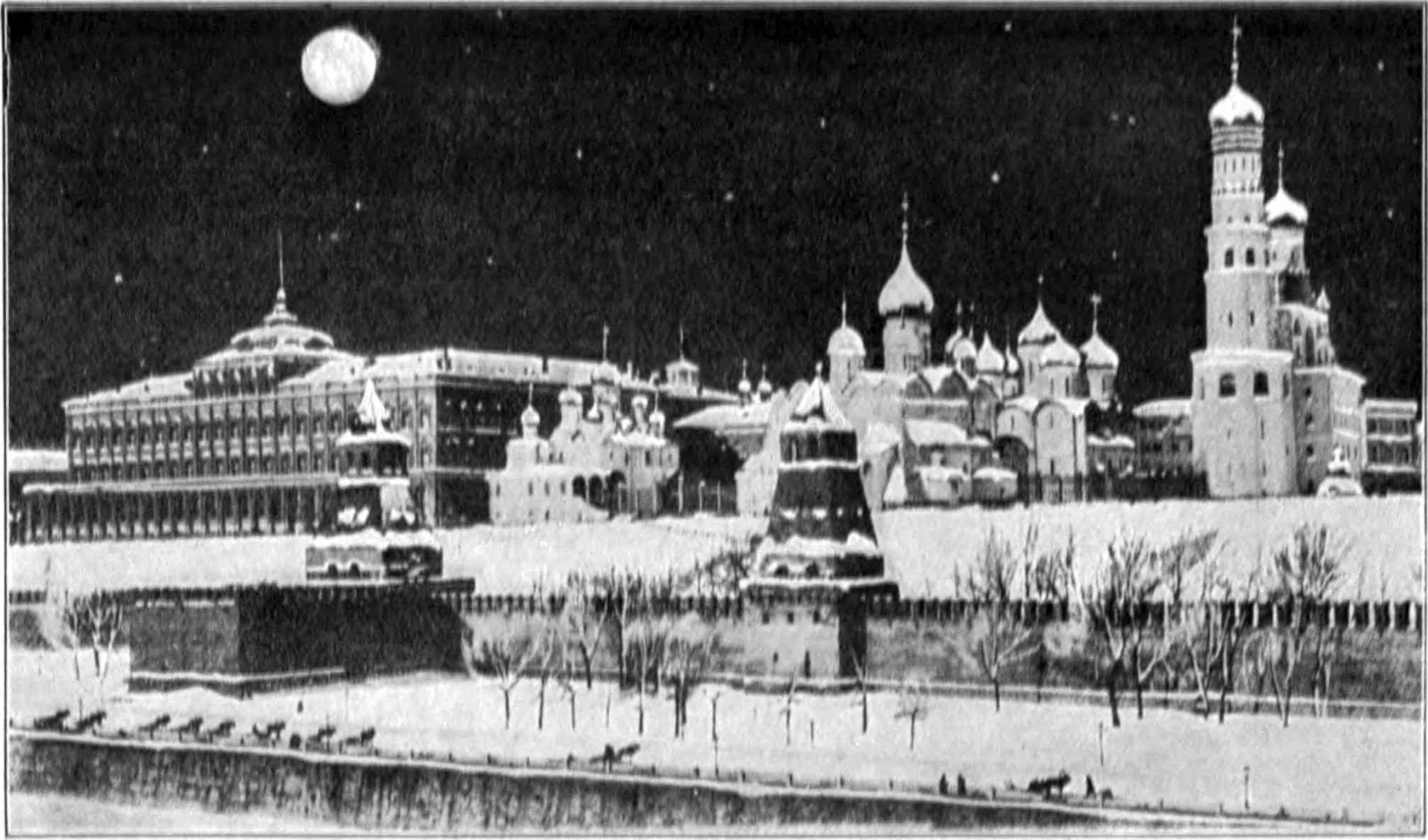
THE KREMLIN IN WINTER
Indeed, our own locomotive, instead of gorging itself with birchwood, as its predecessors which drew the train de luxe had done, took long deep draughts of crude kerosene oil, which, it must be said, did not improve its breath. Some of the engines I noticed at this end of the line were Baldwin locomotives, a make which I had not seen since we had left Khabaroffsk, on the further side of far Siberia.
On the eighth and last day of our journey on the “Siberian Special,” as our train was called in railroad nomenclature, we passed through the large and commanding town of Toula, a great railroad centre, and also famous for the splendor of its churches. The stations we passed on this day were finer than any we had yet seen, and were often embowered in trees until they looked like châteaus in lovely green parks. Peasant women stood on every platform with heaps of little wild strawberries, which they sold at a ridiculously cheap price, about two cents a quart. Others had the first red cherries of the season, and others yellow apples that had been kept in water for nearly a year, and that tasted as if baked. Other vendors of delicious, sparkling koumyss, milk, Russian kvass, and other more harmful beverages, also appeared upon the scene at many stations.
The devout character of the Russians was shown by the fact that every third-class waiting-room had its shrine, with beautifully framed pictures of Christ and the Madonna and some of the Eastern saints. Before these icons often burned ceremonial candles, and smaller candles were to be had by devotees for two or three kopeks apiece. Rapt travellers, with uplifted eyes, were often to be seen crossing themselves before these icons.
We still passed frequent trains of Siberian settlers, and others of brawny soldiers, “bearded like the pard,” and packed into their fifth and sixth-class cars like the proverbial sardines in their boxes. Occasionally a train of prisoners looked out through their iron gratings at us, seeming to cast a murky shadow on the pleasant landscape, as we thought of the dreary years of exile before them. We saw no political prisoners, however, and even the criminals are allowed to take their wives and children with them. These latter often clung to the iron bars with their faces close against them, like so many infant Charlotte Cordays. It must be said that these prisoners, like others whom we had seen, fared a good deal better in their railway accommodations than the emigrants or the soldiers.
More and more cultivated and attractive the beautiful country appeared as we approached Moscow, giving evidence in every smooth and fertile field of five hundred years of tillage, until at last, promptly on schedule time, 197 hours after leaving Irkutsk, the Siberian Special rolled into the beautiful station of sacred Moscow, and our long journey across all the Russias was practically finished. It is a matter of thirteen hours further to St. Petersburg, and two days more by the fastest train to London. Thence six or seven days more by one of the Atlantic liners to New York, and our journey by this new way around an old world was completed.